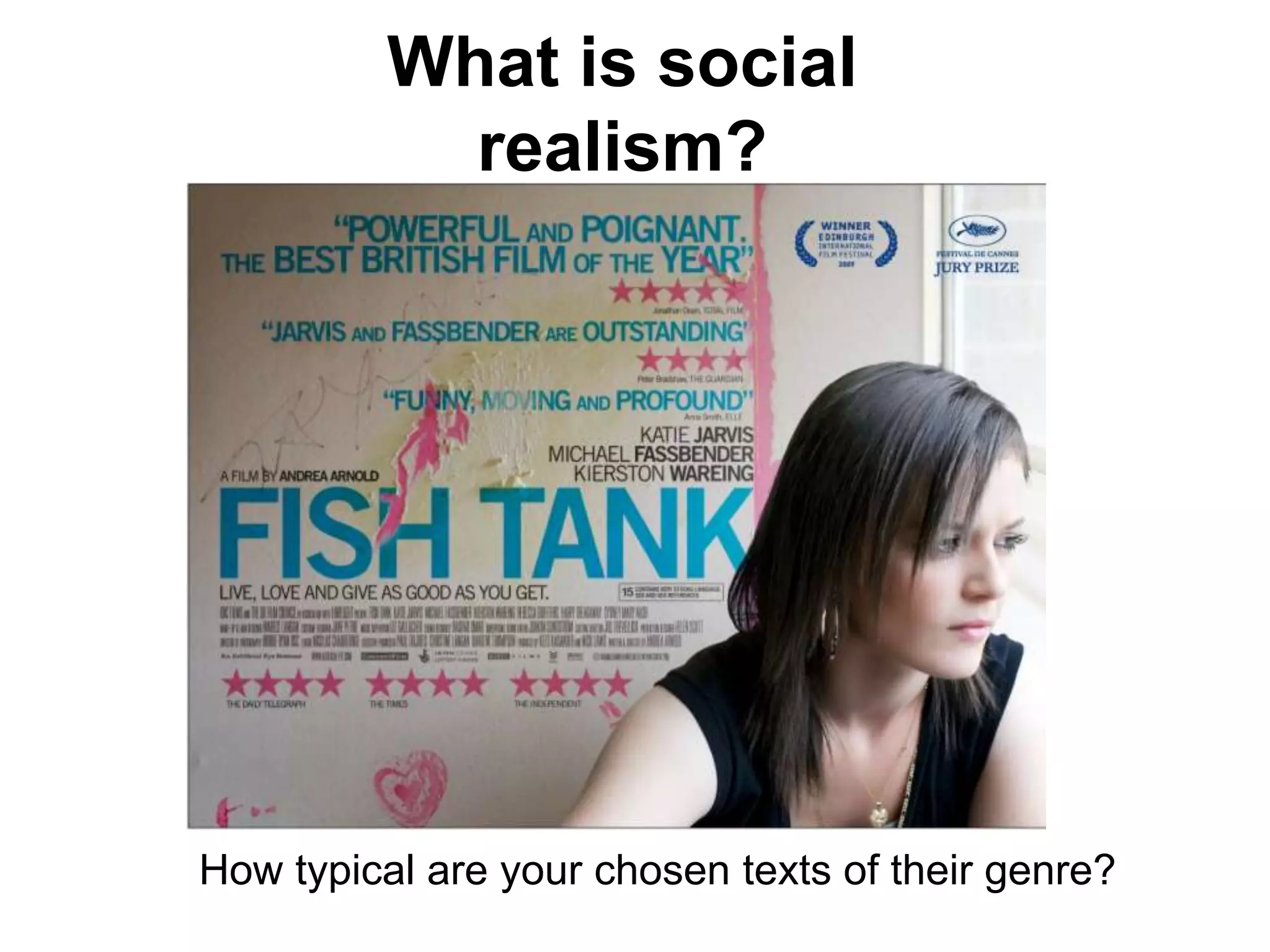
What is social
realism?
How typical are your chosen texts of their genre?
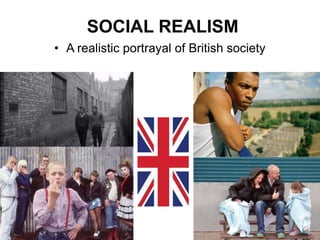
SOCIAL REALISM
• A realistic portrayal of British society
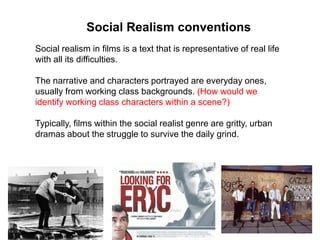
Social realism in films is a text that is representative of real life
with all its difficulties.
The narrative and characters portrayed are everyday ones,
usually from working class backgrounds. (How would we
identify working class characters within a scene?)
Typically, films within the social realist genre are gritty, urban
dramas about the struggle to survive the daily grind.
Social Realism conventions
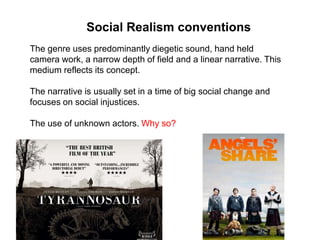
The genre uses predominantly diegetic sound, hand held
camera work, a narrow depth of field and a linear narrative. This
medium reflects its concept.
The narrative is usually set in a time of big social change and
focuses on social injustices.
The use of unknown actors. Why so?
Social Realism conventions
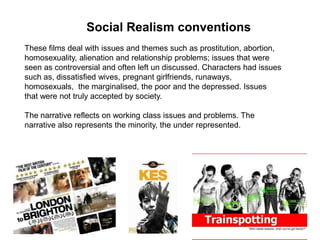
These films deal with issues and themes such as prostitution, abortion,
homosexuality, alienation and relationship problems; issues that were
seen as controversial and often left un discussed. Characters had issues
such as, dissatisfied wives, pregnant girlfriends, runaways,
homosexuals, the marginalised, the poor and the depressed. Issues
that were not truly accepted by society.
The narrative reflects on working class issues and problems. The
narrative also represents the minority, the under represented.
Social Realism conventions
• Social Realism
• The most 'typically British' of all film genres
• Better than any other genre, social realism has
shown us to ourselves, pushing the boundaries
in the effort to put the experiences of real Britons
on the screen, and shaping our ideas of what
British cinema can be. While our cinema has
experienced all the fluctuations in fortune of
Hollywood's first export territory, realism has
been Britain's richest gift to the world.
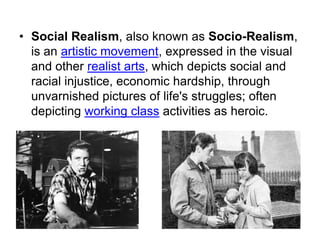
• Social Realism, also known as Socio-Realism,
is an artistic movement, expressed in the visual
and other realist arts, which depicts social and
racial injustice, economic hardship, through
unvarnished pictures of life's struggles; often
depicting working class activities as heroic.
• In Film
• Social Realism in cinema is a style that finds its
roots in the Italian neorealism movement known
for naturalistic, substance-over-style works but is
considered Britain's main form of cinematic
style.
• For Britons, their early cinema used common
social interaction found in Dickens and Thomas
Hardy.
• Repressive censorship during 1945-1954
prevented British films from more radical social
positions.
• British Social Realism cinema has an objective
distancing from what the characters think and
feel.
• There was a revolution in British film at the end
of the 1950s: working people and the realities of
their everyday lives started to appear on the big
screen.
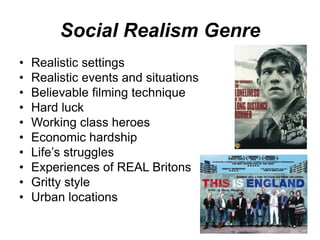
Social Realism Genre
• Realistic settings
• Realistic events and situations
• Believable filming technique
• Hard luck
• Working class heroes
• Economic hardship
• Life’s struggles
• Experiences of REAL Britons
• Gritty style
• Urban locations
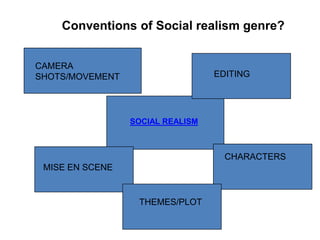
Conventions of Social realism genre?
SOCIAL REALISM
MISE EN SCENE
CAMERA
SHOTS/MOVEMENT EDITING
CHARACTERS
THEMES/PLOT
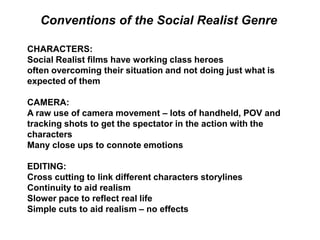
CHARACTERS:
Social Realist films have working class heroes
often overcoming their situation and not doing just what is
expected of them
CAMERA:
A raw use of camera movement – lots of handheld, POV and
tracking shots to get the spectator in the action with the
characters
Many close ups to connote emotions
EDITING:
Cross cutting to link different characters storylines
Continuity to aid realism
Slower pace to reflect real life
Simple cuts to aid realism – no effects
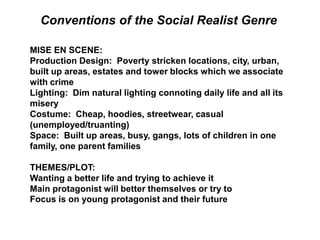
Conventions of the Social Realist Genre
MISE EN SCENE:
Production Design: Poverty stricken locations, city, urban,
built up areas, estates and tower blocks which we associate
with crime
Lighting: Dim natural lighting connoting daily life and all its
misery
Costume: Cheap, hoodies, streetwear, casual
(unemployed/truanting)
Space: Built up areas, busy, gangs, lots of children in one
family, one parent families
THEMES/PLOT:
Wanting a better life and trying to achieve it
Main protagonist will better themselves or try to
Focus is on young protagonist and their future
Conventions of the Social Realist Genre
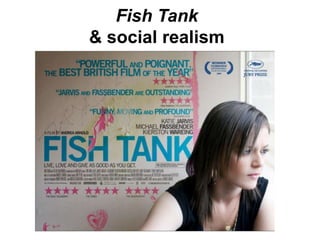
Fish Tank
& social realism
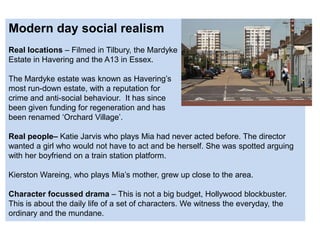
Modern day social realism
Real locations – Filmed in Tilbury, the Mardyke
Estate in Havering and the A13 in Essex.
The Mardyke estate was known as Havering’s
most run-down estate, with a reputation for
crime and anti-social behaviour. It has since
been given funding for regeneration and has
been renamed ‘Orchard Village’.
Real people– Katie Jarvis who plays Mia had never acted before. The director
wanted a girl who would not have to act and be herself. She was spotted arguing
with her boyfriend on a train station platform.
Kierston Wareing, who plays Mia’s mother, grew up close to the area.
Character focussed drama – This is not a big budget, Hollywood blockbuster.
This is about the daily life of a set of characters. We witness the everyday, the
ordinary and the mundane.
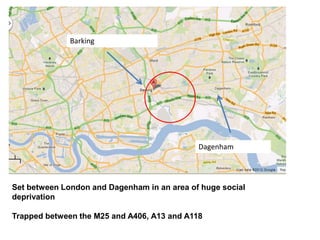
Barking
Dagenham
Set between London and Dagenham in an area of huge social
deprivation
Trapped between the M25 and A406, A13 and A118
•A world where all sense of community and family has disappeared
•Like Saturday Night and Sunday Morning, the protagonist wants to escape
•The film looks forward rather than backwards
•It charts the rise and fall of hope and despair of a handful of characters
•Mia does not want to follow the path of those around her
•She is not content to stay where she is and let life happen to her
•Fish Tank presents a bleak message. As such, it is marginalised, pushed aside
and intended for a niche audience.
•This is not England presenting itself to the world as a green and pleasant land.
This is inward looking, exposing elements of our society that most people would
prefer were not a version of England.
•Fish Tank presents something which feels much more real.
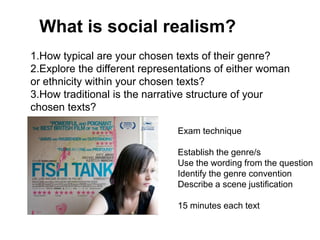
What is social realism?
1.How typical are your chosen texts of their genre?
2.Explore the different representations of either woman
or ethnicity within your chosen texts?
3.How traditional is the narrative structure of your
chosen texts?
Exam technique
Establish the genre/s
Use the wording from the question
Identify the genre convention
Describe a scene justification
15 minutes each text

Fish Tank

  • 1.
    What is social realism? Howtypical are your chosen texts of their genre?
  • 2.
    SOCIAL REALISM • Arealistic portrayal of British society
  • 3.
    Social realism infilms is a text that is representative of real life with all its difficulties. The narrative and characters portrayed are everyday ones, usually from working class backgrounds. (How would we identify working class characters within a scene?) Typically, films within the social realist genre are gritty, urban dramas about the struggle to survive the daily grind. Social Realism conventions
  • 4.
    The genre usespredominantly diegetic sound, hand held camera work, a narrow depth of field and a linear narrative. This medium reflects its concept. The narrative is usually set in a time of big social change and focuses on social injustices. The use of unknown actors. Why so? Social Realism conventions
  • 5.
    These films dealwith issues and themes such as prostitution, abortion, homosexuality, alienation and relationship problems; issues that were seen as controversial and often left un discussed. Characters had issues such as, dissatisfied wives, pregnant girlfriends, runaways, homosexuals, the marginalised, the poor and the depressed. Issues that were not truly accepted by society. The narrative reflects on working class issues and problems. The narrative also represents the minority, the under represented. Social Realism conventions
  • 6.
    • Social Realism •The most 'typically British' of all film genres • Better than any other genre, social realism has shown us to ourselves, pushing the boundaries in the effort to put the experiences of real Britons on the screen, and shaping our ideas of what British cinema can be. While our cinema has experienced all the fluctuations in fortune of Hollywood's first export territory, realism has been Britain's richest gift to the world.
  • 7.
    • Social Realism,also known as Socio-Realism, is an artistic movement, expressed in the visual and other realist arts, which depicts social and racial injustice, economic hardship, through unvarnished pictures of life's struggles; often depicting working class activities as heroic.
  • 8.
    • In Film •Social Realism in cinema is a style that finds its roots in the Italian neorealism movement known for naturalistic, substance-over-style works but is considered Britain's main form of cinematic style. • For Britons, their early cinema used common social interaction found in Dickens and Thomas Hardy. • Repressive censorship during 1945-1954 prevented British films from more radical social positions. • British Social Realism cinema has an objective distancing from what the characters think and feel. • There was a revolution in British film at the end of the 1950s: working people and the realities of their everyday lives started to appear on the big screen.
  • 9.
    Social Realism Genre •Realistic settings • Realistic events and situations • Believable filming technique • Hard luck • Working class heroes • Economic hardship • Life’s struggles • Experiences of REAL Britons • Gritty style • Urban locations
  • 10.
    Conventions of Socialrealism genre? SOCIAL REALISM MISE EN SCENE CAMERA SHOTS/MOVEMENT EDITING CHARACTERS THEMES/PLOT
  • 11.
    CHARACTERS: Social Realist filmshave working class heroes often overcoming their situation and not doing just what is expected of them CAMERA: A raw use of camera movement – lots of handheld, POV and tracking shots to get the spectator in the action with the characters Many close ups to connote emotions EDITING: Cross cutting to link different characters storylines Continuity to aid realism Slower pace to reflect real life Simple cuts to aid realism – no effects Conventions of the Social Realist Genre
  • 12.
    MISE EN SCENE: ProductionDesign: Poverty stricken locations, city, urban, built up areas, estates and tower blocks which we associate with crime Lighting: Dim natural lighting connoting daily life and all its misery Costume: Cheap, hoodies, streetwear, casual (unemployed/truanting) Space: Built up areas, busy, gangs, lots of children in one family, one parent families THEMES/PLOT: Wanting a better life and trying to achieve it Main protagonist will better themselves or try to Focus is on young protagonist and their future Conventions of the Social Realist Genre
  • 13.
  • 14.
    Modern day socialrealism Real locations – Filmed in Tilbury, the Mardyke Estate in Havering and the A13 in Essex. The Mardyke estate was known as Havering’s most run-down estate, with a reputation for crime and anti-social behaviour. It has since been given funding for regeneration and has been renamed ‘Orchard Village’. Real people– Katie Jarvis who plays Mia had never acted before. The director wanted a girl who would not have to act and be herself. She was spotted arguing with her boyfriend on a train station platform. Kierston Wareing, who plays Mia’s mother, grew up close to the area. Character focussed drama – This is not a big budget, Hollywood blockbuster. This is about the daily life of a set of characters. We witness the everyday, the ordinary and the mundane.
  • 15.
    Barking Dagenham Set between Londonand Dagenham in an area of huge social deprivation Trapped between the M25 and A406, A13 and A118
  • 16.
    •A world whereall sense of community and family has disappeared •Like Saturday Night and Sunday Morning, the protagonist wants to escape •The film looks forward rather than backwards •It charts the rise and fall of hope and despair of a handful of characters •Mia does not want to follow the path of those around her •She is not content to stay where she is and let life happen to her •Fish Tank presents a bleak message. As such, it is marginalised, pushed aside and intended for a niche audience. •This is not England presenting itself to the world as a green and pleasant land. This is inward looking, exposing elements of our society that most people would prefer were not a version of England. •Fish Tank presents something which feels much more real.
  • 17.
    What is socialrealism? 1.How typical are your chosen texts of their genre? 2.Explore the different representations of either woman or ethnicity within your chosen texts? 3.How traditional is the narrative structure of your chosen texts? Exam technique Establish the genre/s Use the wording from the question Identify the genre convention Describe a scene justification 15 minutes each text