Presentation
On
BLACK HOLES
Contents
• Introduction
• History
• Parts of Black Hole
• Classification
• Closest Black Hole
• Largest Black Hole
What is Black Hole?
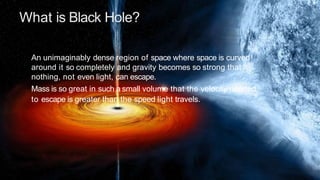
An unimaginably dense region of space where space is curved
around it so completely and gravity becomes so strong that
nothing, not even light, can escape.
Mass is so great in such a small volume that the velocity needed
to escape is greater than the speed light travels.
History
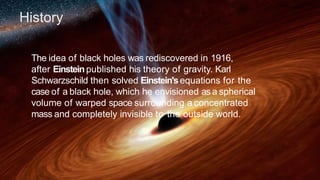
The idea of black holes was rediscovered in 1916,
after Einsteinpublished his theory of gravity. Karl
Schwarzschild then solved Einstein'sequations for the
case of a black hole, which he envisioned as a spherical
volume of warped space surrounding a concentrated
mass and completely invisible to the outside world.
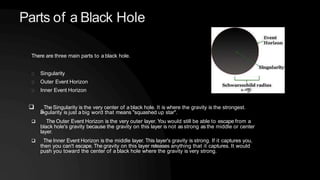
Parts of a Black Hole
There are three main parts to a black hole.
Singularity
Outer Event Horizon
Inner Event Horizon

S
The Singularity is the very center of a black hole. It is where the gravity is the strongest.
ingularity is just a big word that means "squashed up star".
 The Outer Event Horizon is the very outer layer. You would still be able to escape from a
black hole's gravity because the gravity on this layer is not as strong as the middle or center
layer.
 The Inner Event Horizon is the middle layer. This layer's gravity is strong. If it captures you,
then you can't escape. The gravity on this layer releases anything that it captures. It would
push you toward the center of a black hole where the gravity is very strong.
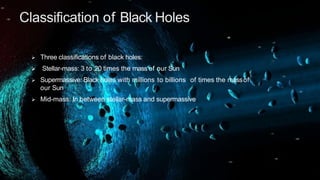
Classification of Black Holes
 Three classifications of black holes:
 Stellar-mass: 3 to 20 times the mass of our Sun
 Supermassive: Black holes with millions to billions of times the massof
our Sun
 Mid-mass: In between stellar-mass and supermassive
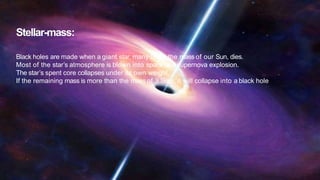
Stellar-mass:
Black holes are made when a giant star, many times the mass of our Sun, dies.
Most of the star’s atmosphere is blown into space asa supernova explosion.
The star’s spent core collapses under its own weight.
If the remaining mass is more than the mass of 3 Suns, it will collapse into a black hole
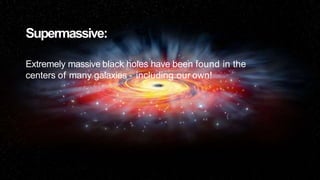
Supermassive:
Extremely massive black holes have been found in the
centers of many galaxies - including our own!
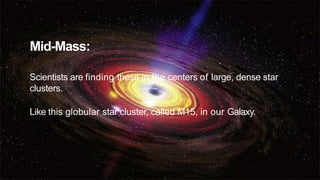
Mid-Mass:
Scientists are finding these in the centers of large, dense star
clusters.
Like this globular star cluster, called M15, in our Galaxy.
Closest known of Black Hole
The closest black holes yet discovered are several thousand
light-years away. They are so far that they have no effect
on Earth or its environment. A supermassive black hole appears
to inhabit the center of the Milky Way galaxy, about 27,000
light-years away.
Largest Black Hole known till date
The largest of the nearby galaxies, M87, now has the largest
known black hole. It contains 6.6 billion times the mass of our
sun and could swallow our solar system whole.
Thank You…!

Blackhole

  • 1.
  • 2.
    Contents • Introduction • History •Parts of Black Hole • Classification • Closest Black Hole • Largest Black Hole
  • 3.
    What is BlackHole? An unimaginably dense region of space where space is curved around it so completely and gravity becomes so strong that nothing, not even light, can escape. Mass is so great in such a small volume that the velocity needed to escape is greater than the speed light travels.
  • 4.
    History The idea ofblack holes was rediscovered in 1916, after Einsteinpublished his theory of gravity. Karl Schwarzschild then solved Einstein'sequations for the case of a black hole, which he envisioned as a spherical volume of warped space surrounding a concentrated mass and completely invisible to the outside world.
  • 5.
    Parts of aBlack Hole There are three main parts to a black hole. Singularity Outer Event Horizon Inner Event Horizon  S The Singularity is the very center of a black hole. It is where the gravity is the strongest. ingularity is just a big word that means "squashed up star".  The Outer Event Horizon is the very outer layer. You would still be able to escape from a black hole's gravity because the gravity on this layer is not as strong as the middle or center layer.  The Inner Event Horizon is the middle layer. This layer's gravity is strong. If it captures you, then you can't escape. The gravity on this layer releases anything that it captures. It would push you toward the center of a black hole where the gravity is very strong.
  • 6.
    Classification of BlackHoles  Three classifications of black holes:  Stellar-mass: 3 to 20 times the mass of our Sun  Supermassive: Black holes with millions to billions of times the massof our Sun  Mid-mass: In between stellar-mass and supermassive
  • 7.
    Stellar-mass: Black holes aremade when a giant star, many times the mass of our Sun, dies. Most of the star’s atmosphere is blown into space asa supernova explosion. The star’s spent core collapses under its own weight. If the remaining mass is more than the mass of 3 Suns, it will collapse into a black hole
  • 8.
    Supermassive: Extremely massive blackholes have been found in the centers of many galaxies - including our own!
  • 9.
    Mid-Mass: Scientists are findingthese in the centers of large, dense star clusters. Like this globular star cluster, called M15, in our Galaxy.
  • 10.
    Closest known ofBlack Hole The closest black holes yet discovered are several thousand light-years away. They are so far that they have no effect on Earth or its environment. A supermassive black hole appears to inhabit the center of the Milky Way galaxy, about 27,000 light-years away.
  • 11.
    Largest Black Holeknown till date The largest of the nearby galaxies, M87, now has the largest known black hole. It contains 6.6 billion times the mass of our sun and could swallow our solar system whole.
  • 12.