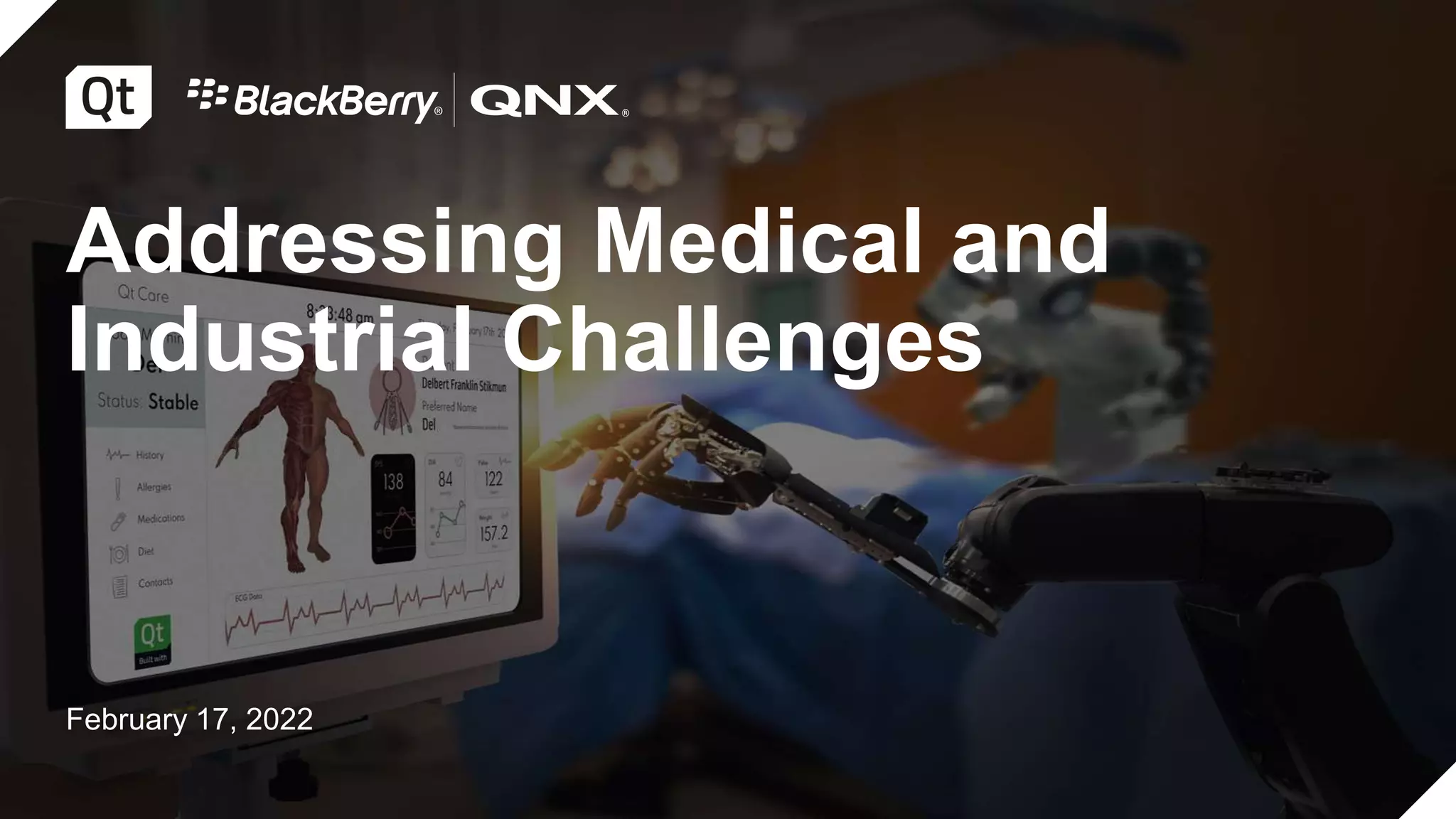
Addressing Medical and
Industrial Challenges
February 17, 2022
5 April 2022
2
Speakers
ADDRESSING MEDICAL AND INDUSTRIAL CHALLENGES
Shawn Dorsey
Technical Artist
The Qt Company
Pat Shelly
Manager
Solutions Architecture
The Qt Company
Elton Lum
Director
Field Application Engineering
BlackBerry QNX
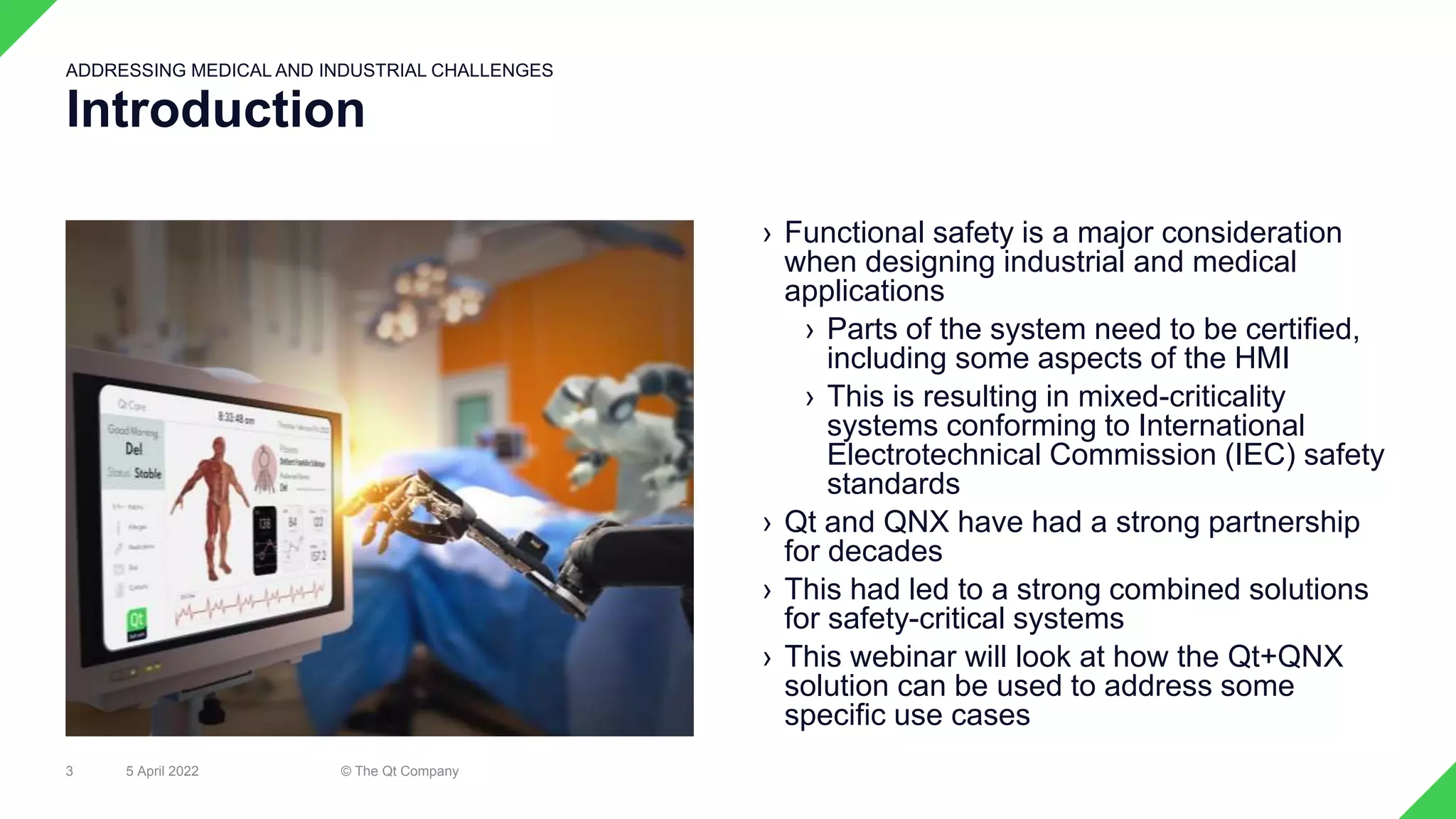
› Functional safety is a major consideration
when designing industrial and medical
applications
› Parts of the system need to be certified,
including some aspects of the HMI
› This is resulting in mixed-criticality
systems conforming to International
Electrotechnical Commission (IEC) safety
standards
› Qt and QNX have had a strong partnership
for decades
› This had led to a strong combined solutions
for safety-critical systems
› This webinar will look at how the Qt+QNX
solution can be used to address some
specific use cases
5 April 2022 © The Qt Company
3
Introduction
ADDRESSING MEDICAL AND INDUSTRIAL CHALLENGES
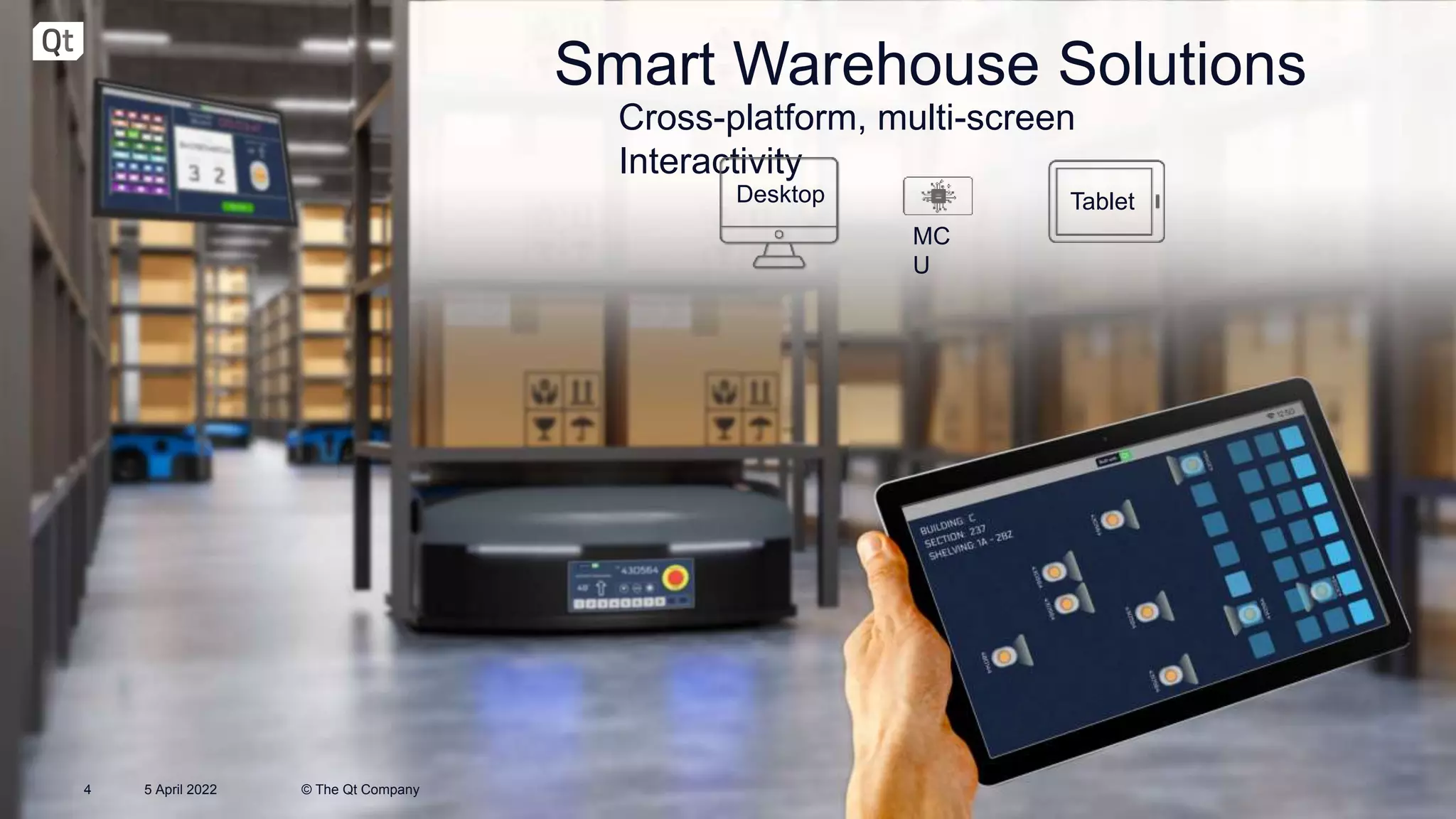
Smart Warehouse Solutions
Cross-platform, multi-screen
Interactivity
Desktop Tablet
MC
U
© The Qt Company
5 April 2022
4
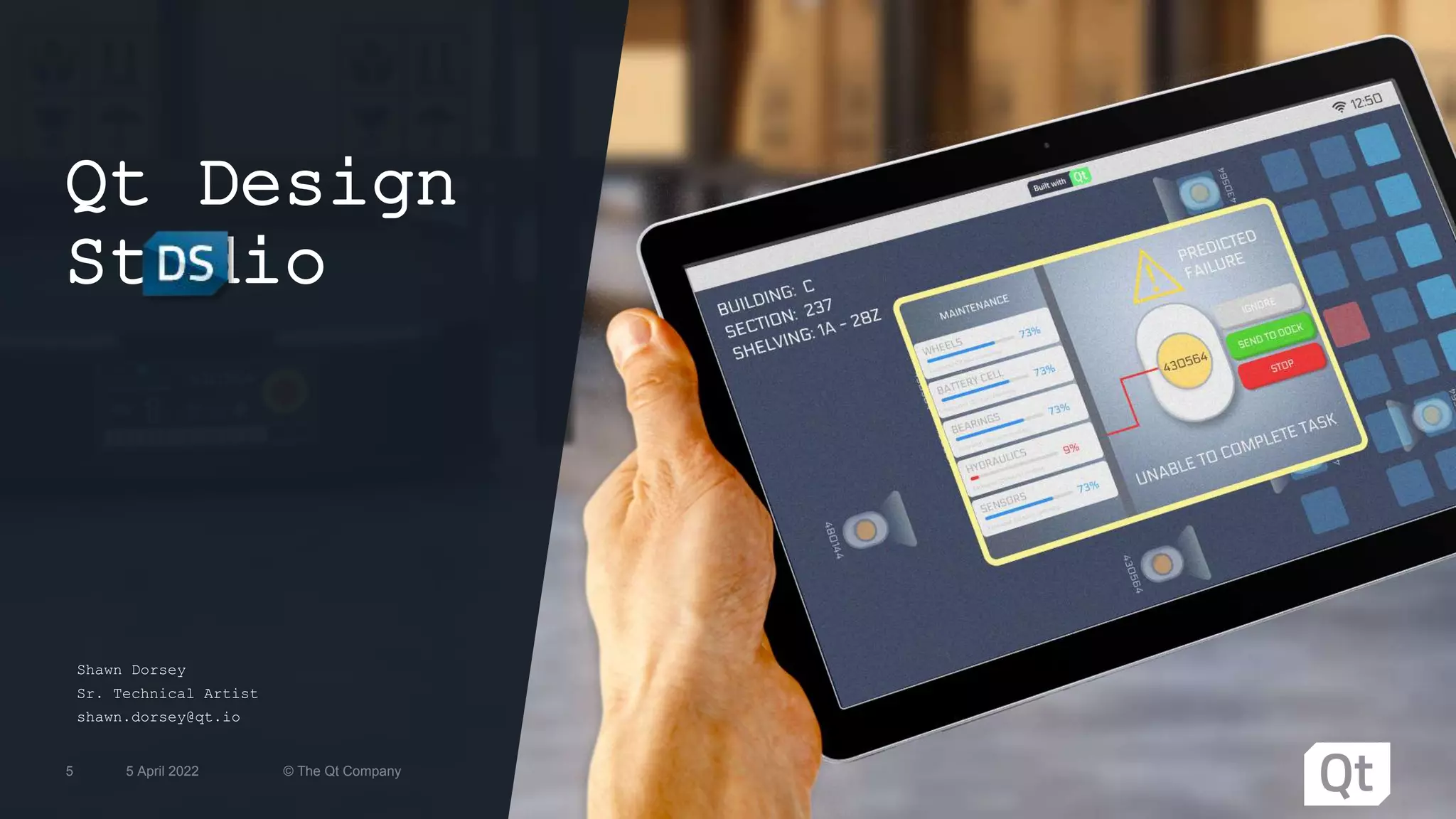
Qt Design
Studio
© The Qt Company
5 April 2022
5
Shawn Dorsey
Sr. Technical Artist
shawn.dorsey@qt.io
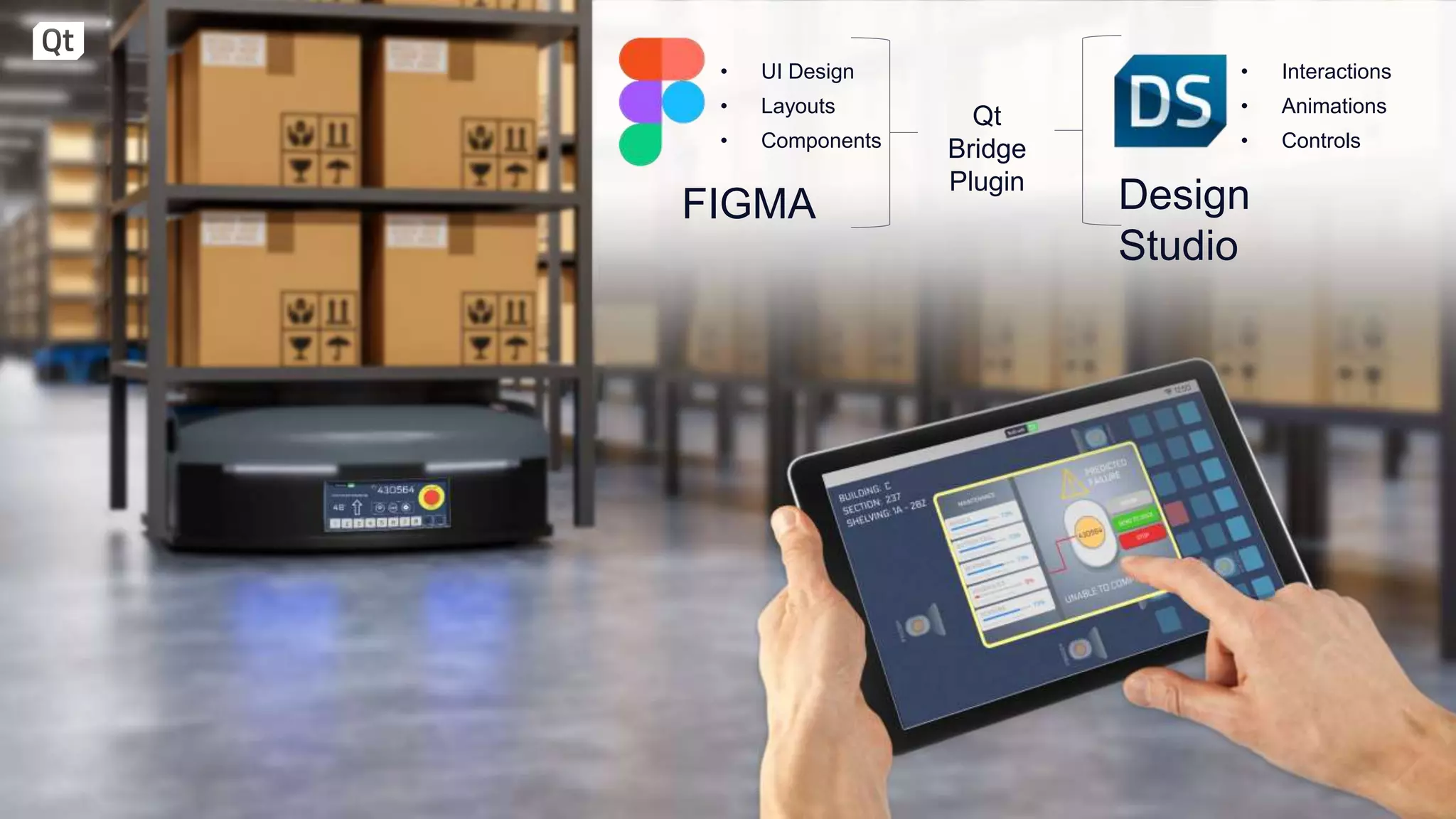
FIGMA
• UI Design
• Layouts
• Components
Design
Studio
• Interactions
• Animations
• Controls
Qt
Bridge
Plugin
© The Qt Company
5 April 2022
7
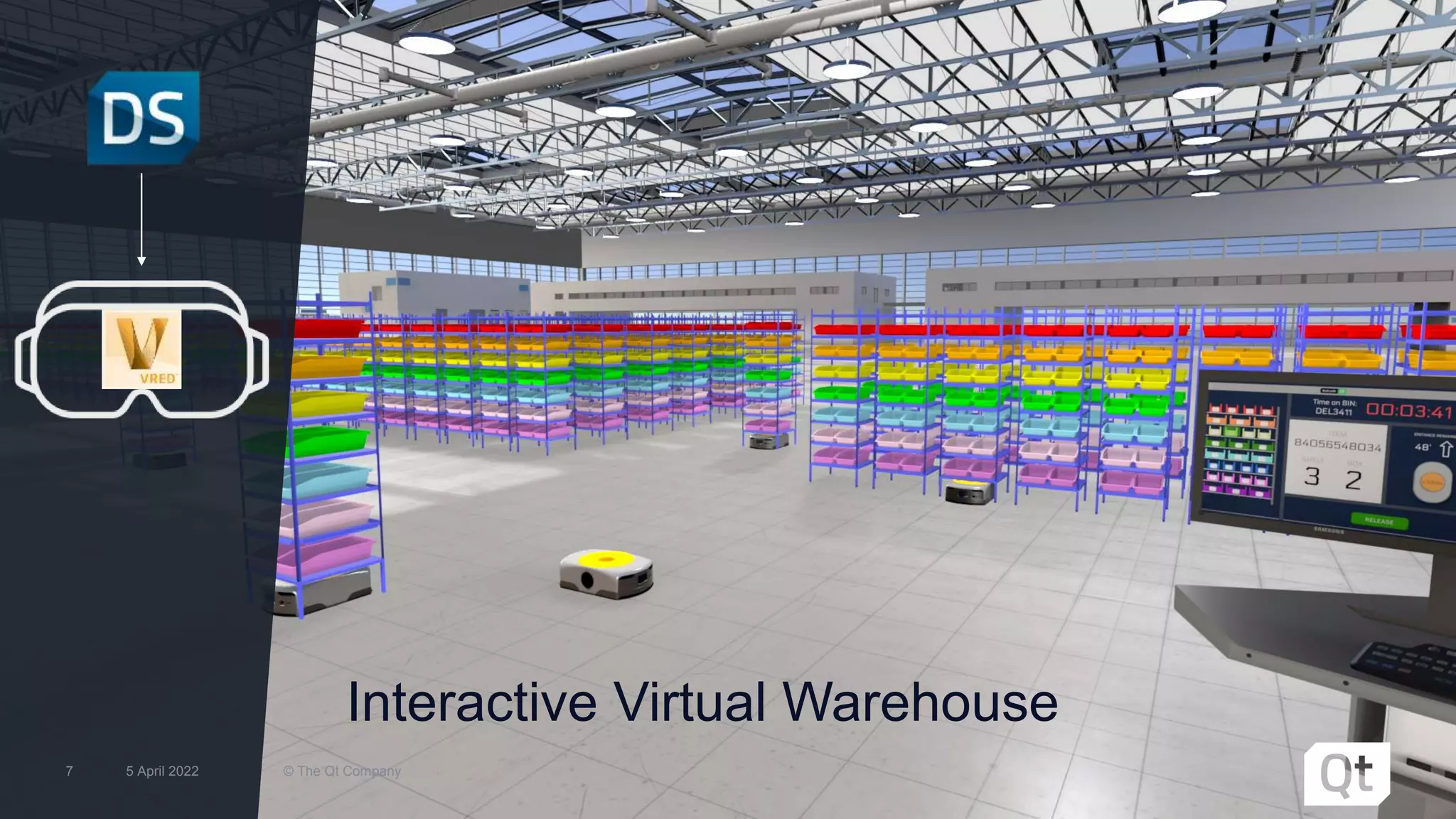
Interactive Virtual Warehouse
› Helps create a safe user environment in medical and industrial applications
› For example, in the Emergency Room, Operating Room or Intensive Care Unit
› Doctors and nurses can continue to focus on the patient in the event of a system failure
› On the industrial plant floor or warehouse
› Robot payload could fall resulting in personal harm or property damage
› Qt Safe Renderer will ensure that the system is put into a safe state in the event of a system
failure
› Qt Safe Renderer is not required for your system to be certified
› But Qt Safe Renderer will save you time and money
› We hold ourselves to the same safety standards as our customers do
› QSR is pre-certified for use in your system, we provide all necessary certification artifacts
› You can include these certification artifacts directly in your safety case
5 April 2022 © The Qt Company
8
Qt Safe Renderer
ADDRESSING MEDICAL AND INDUSTRIAL CHALLENGES
5 April 2022 - Public
8
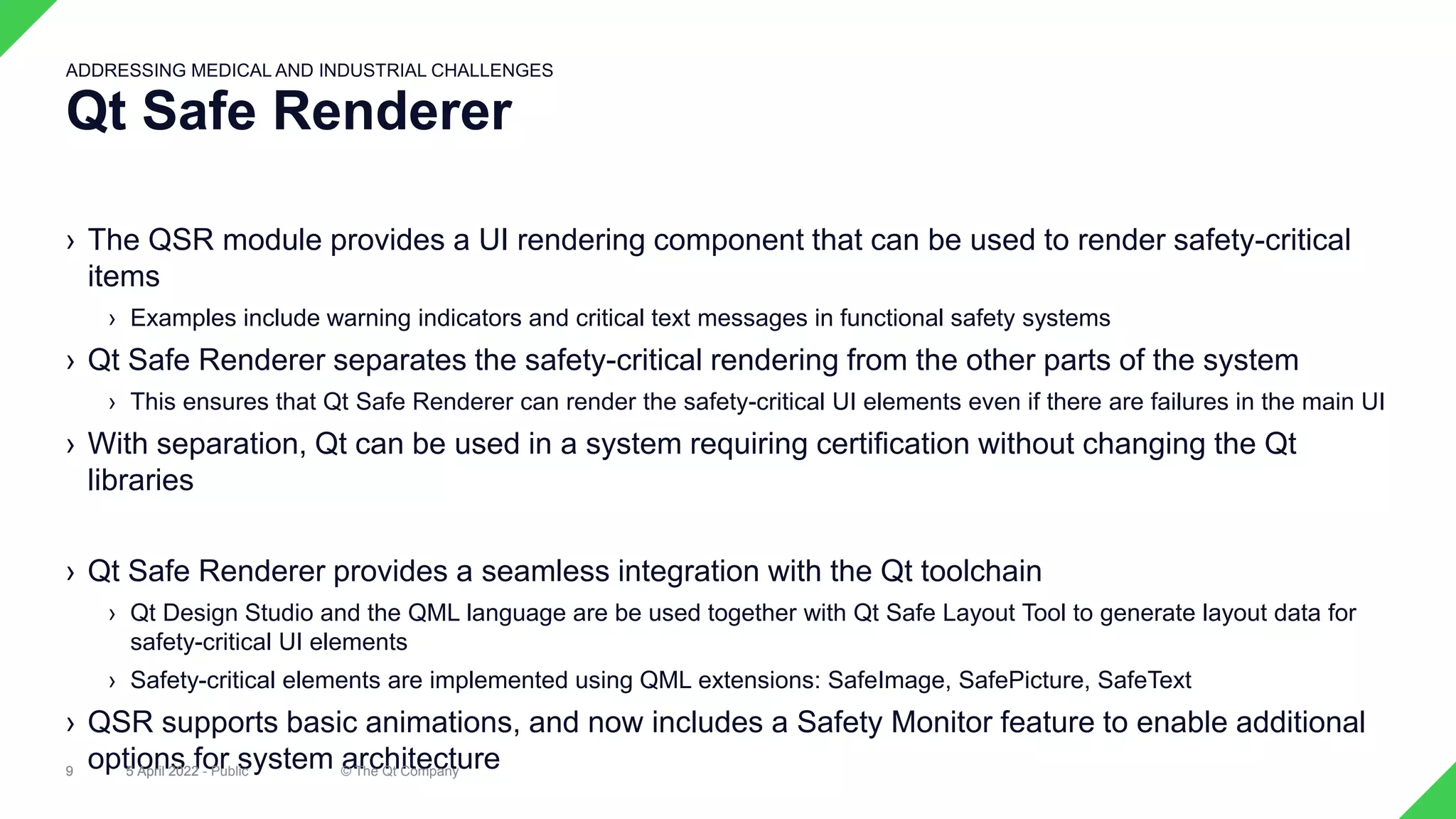
› The QSR module provides a UI rendering component that can be used to render safety-critical
items
› Examples include warning indicators and critical text messages in functional safety systems
› Qt Safe Renderer separates the safety-critical rendering from the other parts of the system
› This ensures that Qt Safe Renderer can render the safety-critical UI elements even if there are failures in the main UI
› With separation, Qt can be used in a system requiring certification without changing the Qt
libraries
› Qt Safe Renderer provides a seamless integration with the Qt toolchain
› Qt Design Studio and the QML language are be used together with Qt Safe Layout Tool to generate layout data for
safety-critical UI elements
› Safety-critical elements are implemented using QML extensions: SafeImage, SafePicture, SafeText
› QSR supports basic animations, and now includes a Safety Monitor feature to enable additional
options for system architecture
5 April 2022 © The Qt Company
9
Qt Safe Renderer
ADDRESSING MEDICAL AND INDUSTRIAL CHALLENGES
5 April 2022 - Public
9
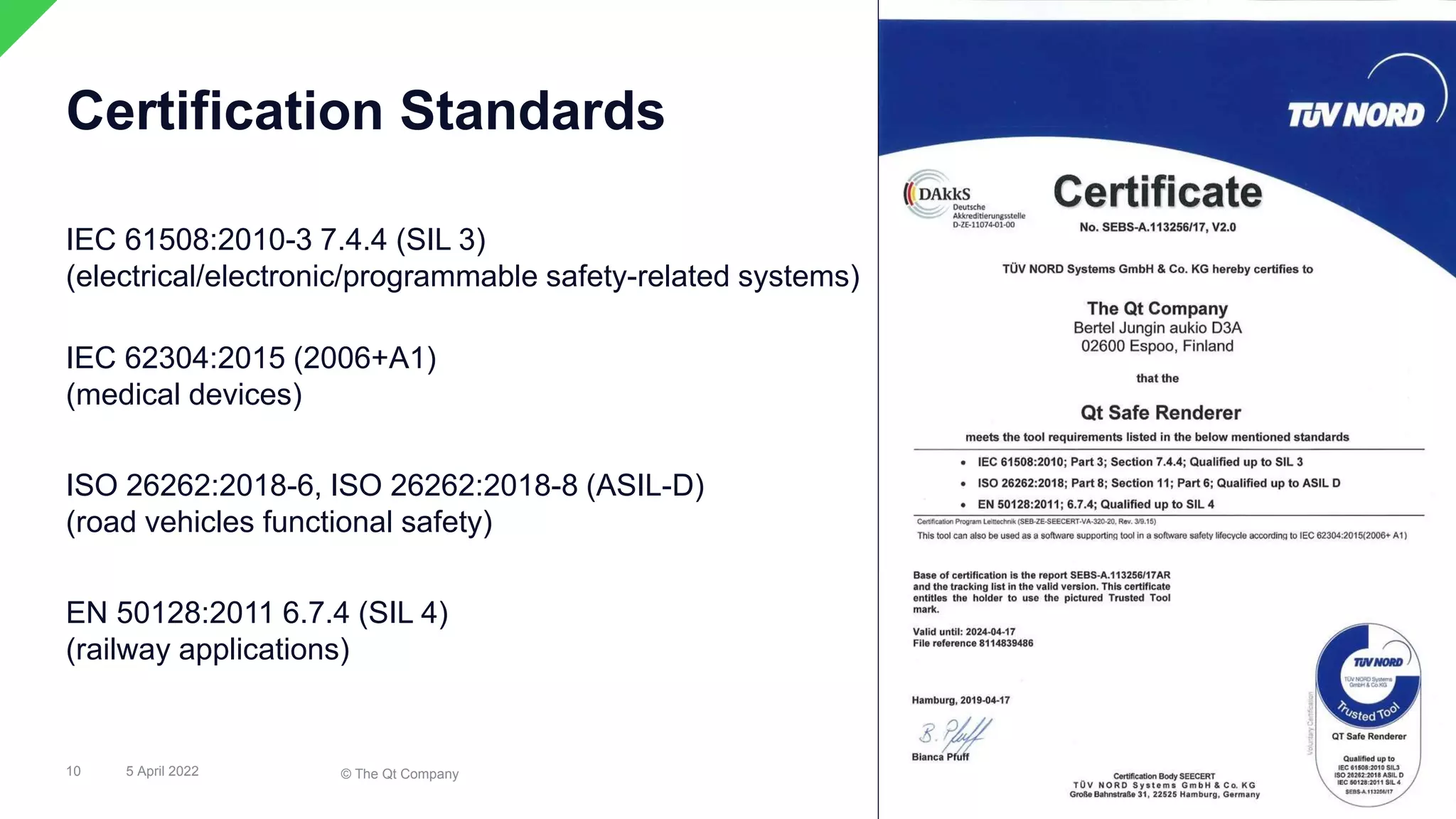
IEC 61508:2010-3 7.4.4 (SIL 3)
(electrical/electronic/programmable safety-related systems)
IEC 62304:2015 (2006+A1)
(medical devices)
ISO 26262:2018-6, ISO 26262:2018-8 (ASIL-D)
(road vehicles functional safety)
EN 50128:2011 6.7.4 (SIL 4)
(railway applications)
Certification Standards
5 April 2022
10 © The Qt Company
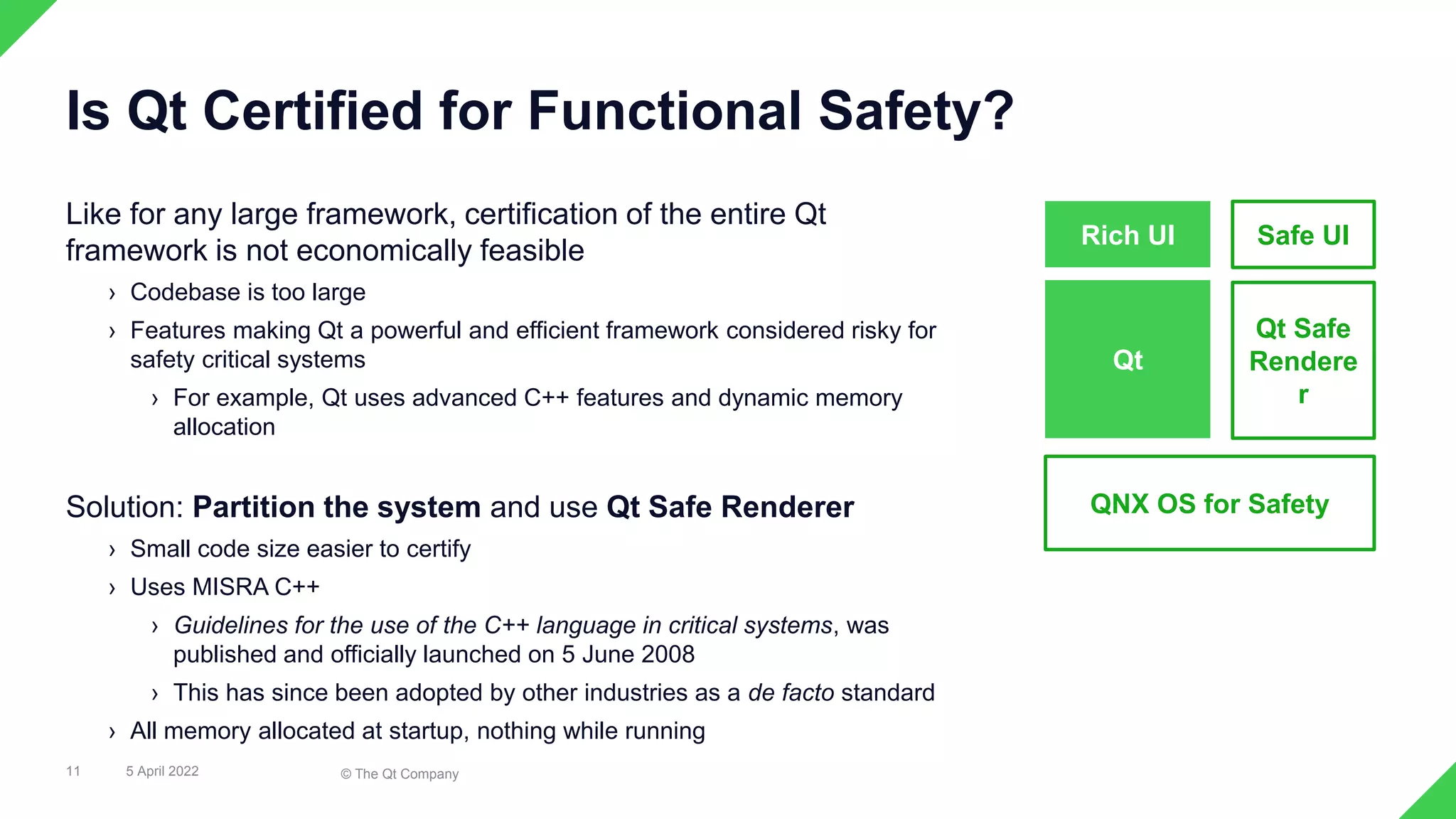
Like for any large framework, certification of the entire Qt
framework is not economically feasible
› Codebase is too large
› Features making Qt a powerful and efficient framework considered risky for
safety critical systems
› For example, Qt uses advanced C++ features and dynamic memory
allocation
Solution: Partition the system and use Qt Safe Renderer
› Small code size easier to certify
› Uses MISRA C++
› Guidelines for the use of the C++ language in critical systems, was
published and officially launched on 5 June 2008
› This has since been adopted by other industries as a de facto standard
› All memory allocated at startup, nothing while running
5 April 2022
11
Is Qt Certified for Functional Safety?
Rich UI Safe UI
Qt
Qt Safe
Rendere
r
QNX OS for Safety
© The Qt Company
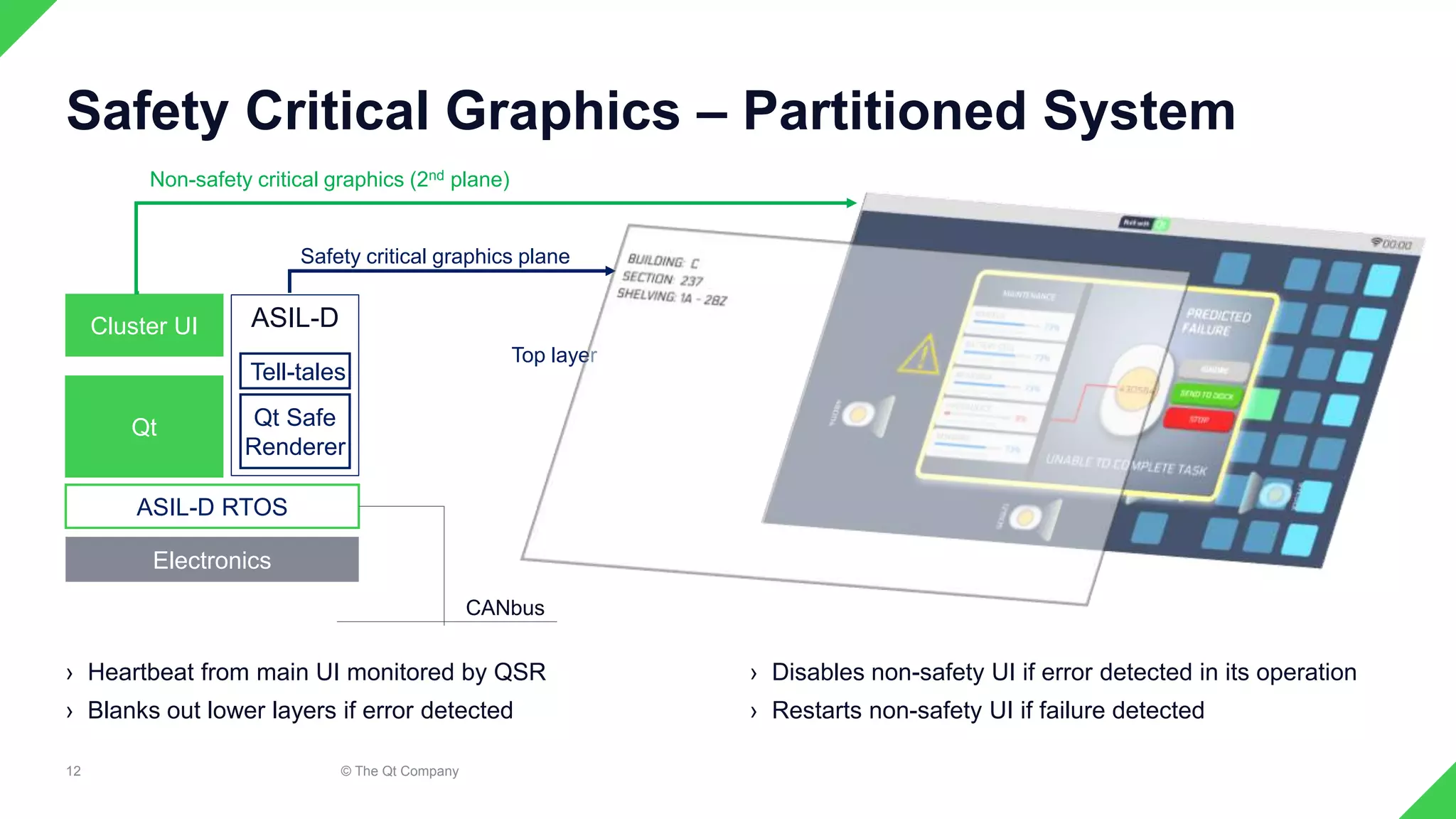
› Heartbeat from main UI monitored by QSR
› Blanks out lower layers if error detected
› Disables non-safety UI if error detected in its operation
› Restarts non-safety UI if failure detected
12
Safety Critical Graphics – Partitioned System
Electronics
Cluster UI
Qt
Tell-tales
Qt Safe
Renderer
ASIL-D RTOS
ASIL-D
CANbus
Non-safety critical graphics (2nd plane)
Safety critical graphics plane
Top layer
© The Qt Company
Qt Safe Renderer: We deliver four parts
5 April 2022 © The Qt Company
13
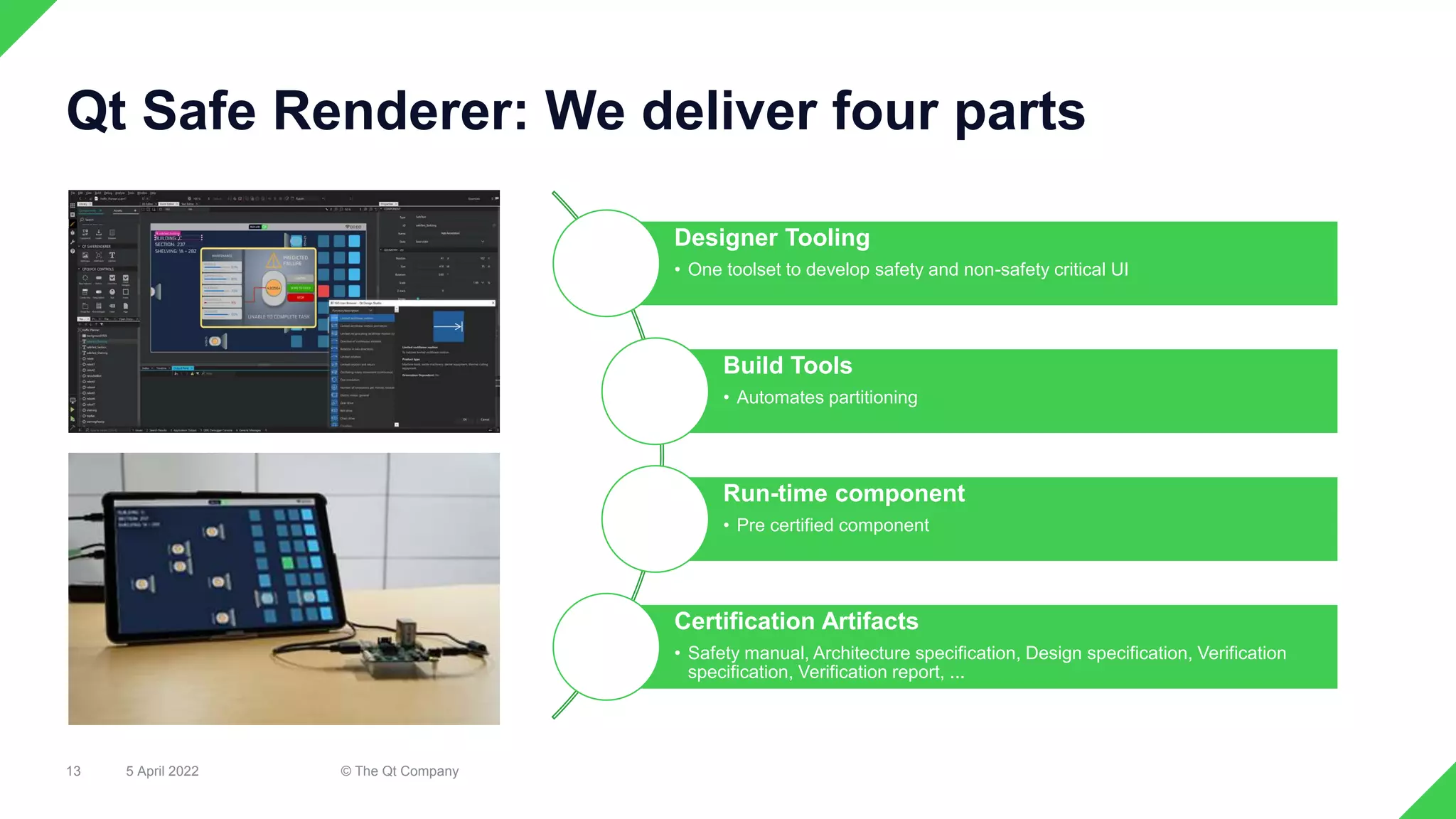
Designer Tooling
• One toolset to develop safety and non-safety critical UI
Build Tools
• Automates partitioning
Run-time component
• Pre certified component
Certification Artifacts
• Safety manual, Architecture specification, Design specification, Verification
specification, Verification report, ...
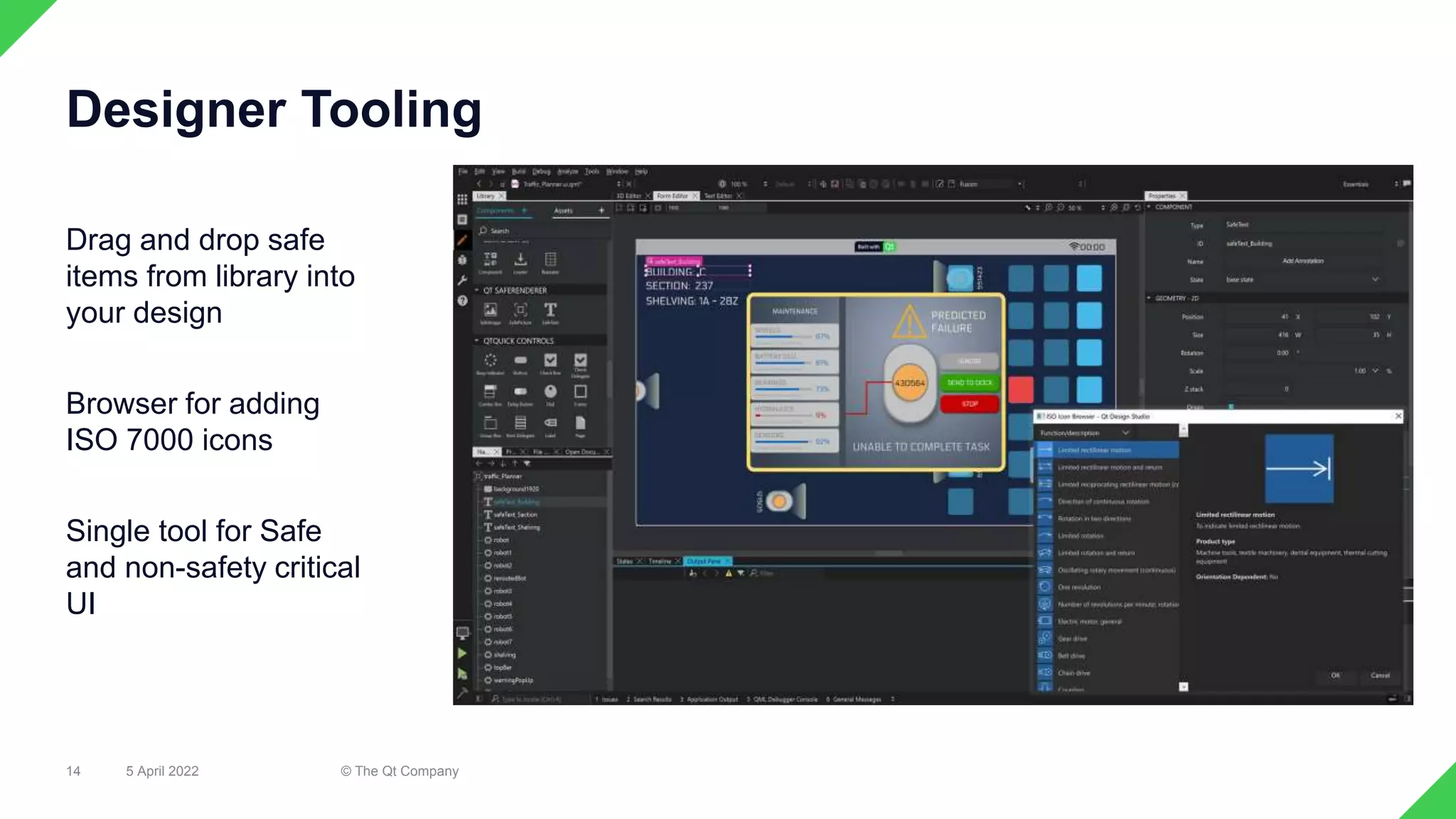
Drag and drop safe
items from library into
your design
Browser for adding
ISO 7000 icons
Single tool for Safe
and non-safety critical
UI
5 April 2022 © The Qt Company
14
Designer Tooling
SIL
Build tools: Desktop or Target
5 April 2022 © The Qt Company
15
Software Build
UI design
Robot UI with safe text
Qt
Desktop OS
Software Build
UI design
Electronics
Robot UI
Qt
Safe
Text
Qt Safe
Renderer
QNX OS for Safety
Rich UI
Safety critical
UI
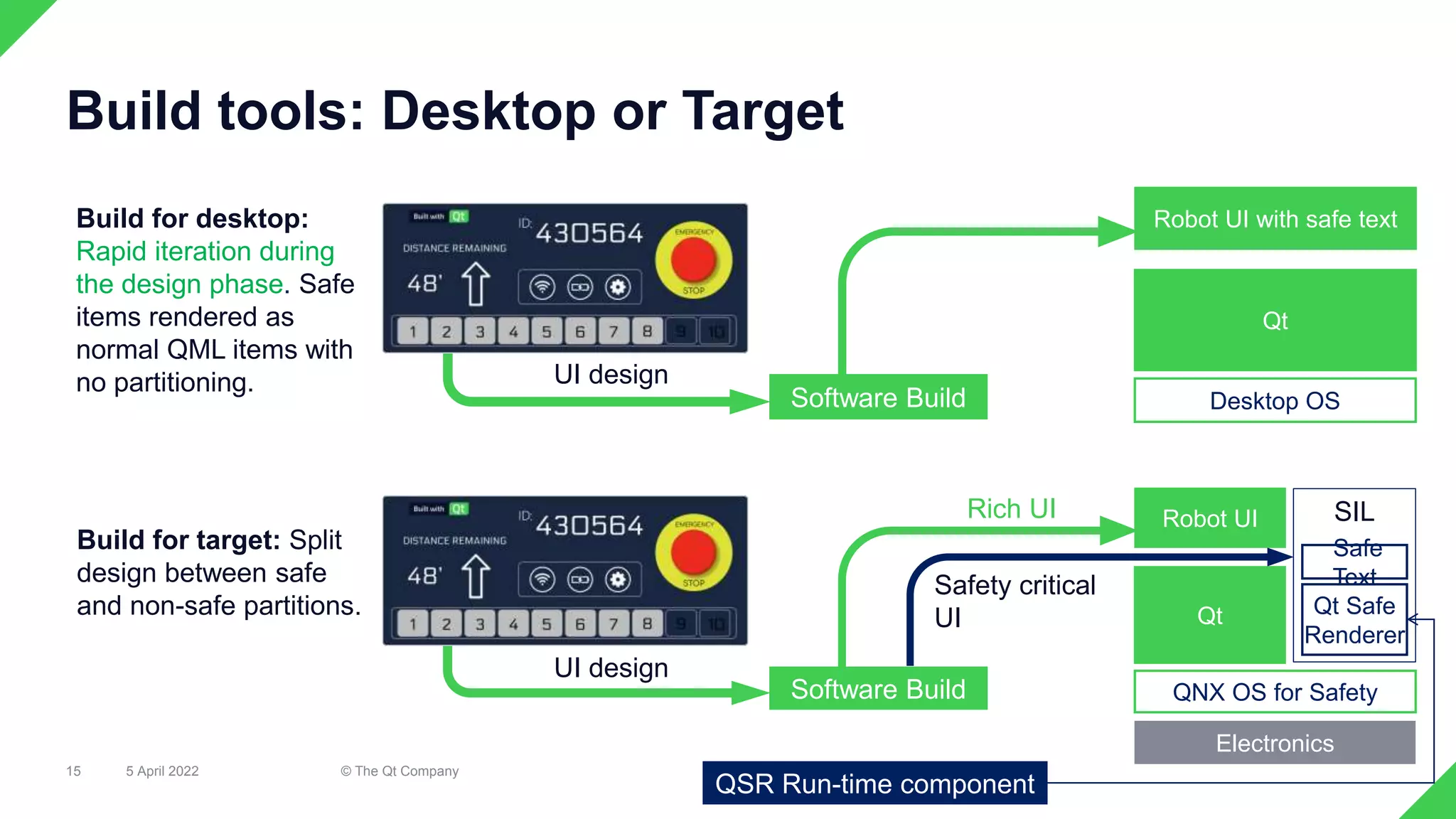
Build for target: Split
design between safe
and non-safe partitions.
Build for desktop:
Rapid iteration during
the design phase. Safe
items rendered as
normal QML items with
no partitioning.
QSR Run-time component
5 April 2022 © The Qt Company
16
New in 2.0: Safety Monitoring
QT SAFE RENDERER
Customer Device
QNX OS for Safety
QNX Hypervisor for Safety (Optional)
SoC
MCU
RTOS
Serial
System Logic
Robot Display
Main UI
State Logic
QSR 2.0
QSR Monitor
CRC Check
QSR Render
Main UI Watchdog Main UI Heartbeat
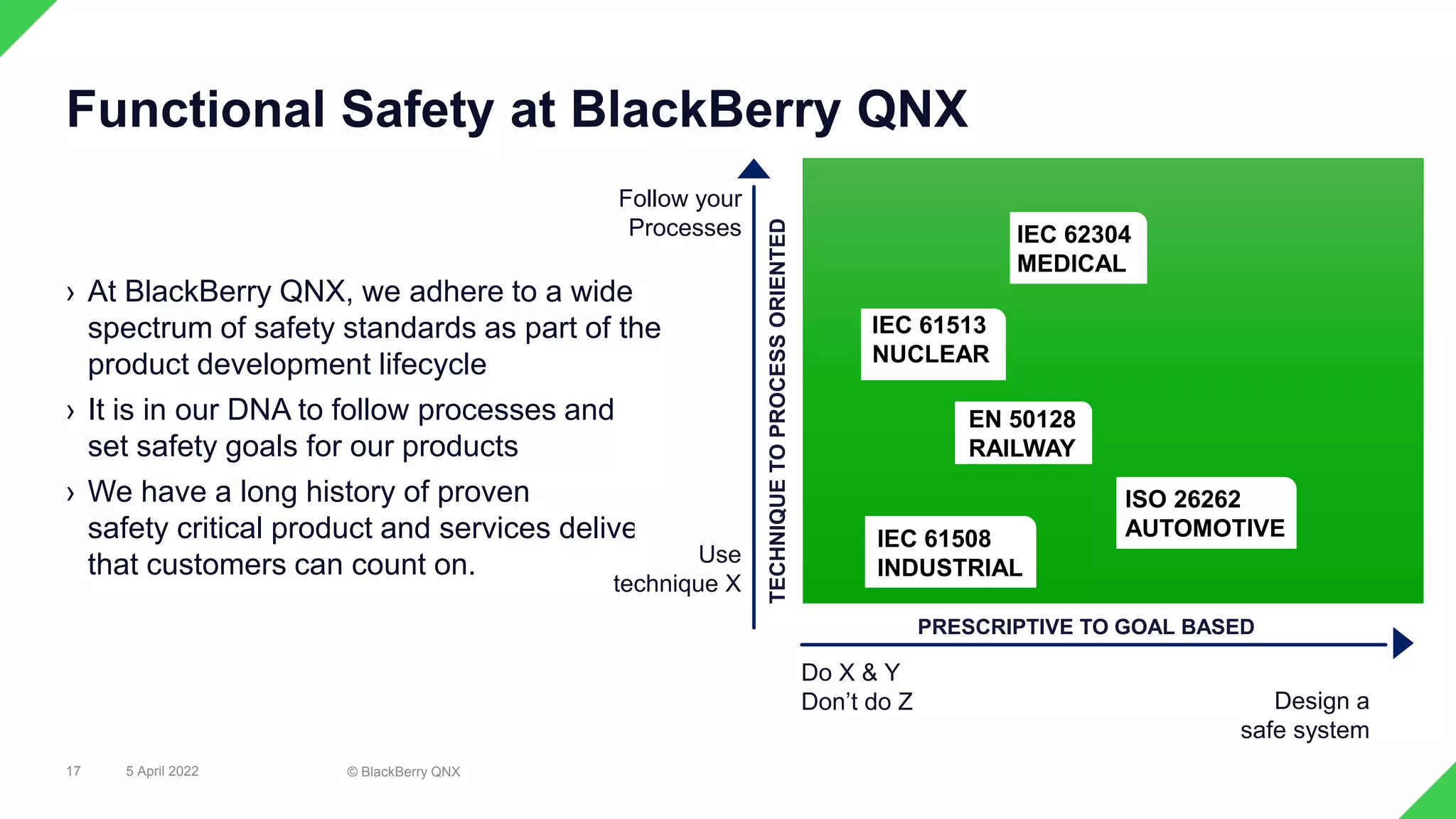
› At BlackBerry QNX, we adhere to a wide
spectrum of safety standards as part of the
product development lifecycle
› It is in our DNA to follow processes and
set safety goals for our products
› We have a long history of proven
safety critical product and services delivery
that customers can count on.
17
Functional Safety at BlackBerry QNX
Follow your
Processes
Use
technique X
IEC 62304
MEDICAL
IEC 61513
NUCLEAR
EN 50128
RAILWAY
IEC 61508
INDUSTRIAL
TECHNIQUE
TO
PROCESS
ORIENTED
PRESCRIPTIVE TO GOAL BASED
Do X & Y
Don’t do Z Design a
safe system
ISO 26262
AUTOMOTIVE
5 April 2022 © BlackBerry QNX
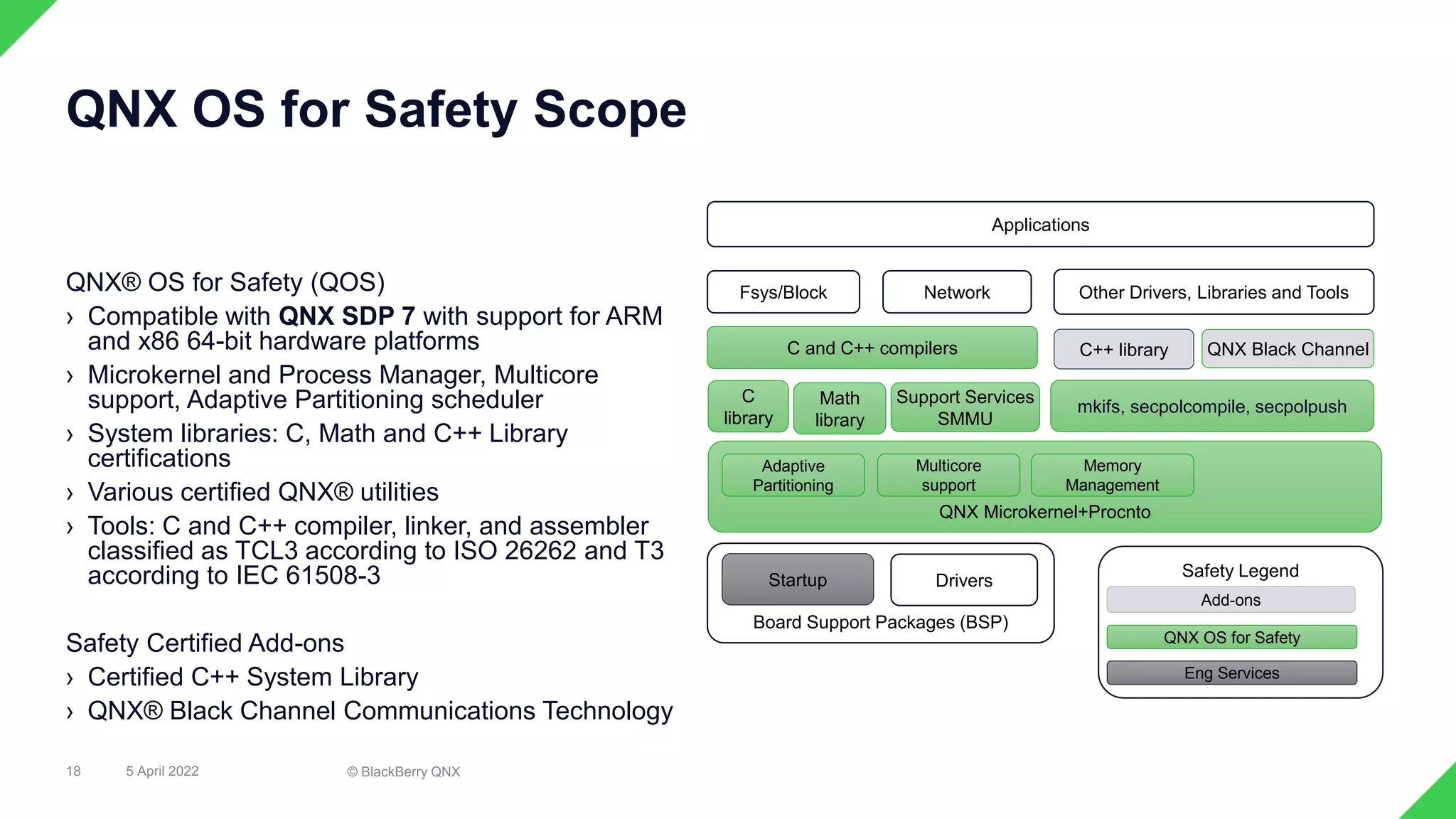
QNX® OS for Safety (QOS)
› Compatible with QNX SDP 7 with support for ARM
and x86 64-bit hardware platforms
› Microkernel and Process Manager, Multicore
support, Adaptive Partitioning scheduler
› System libraries: C, Math and C++ Library
certifications
› Various certified QNX® utilities
› Tools: C and C++ compiler, linker, and assembler
classified as TCL3 according to ISO 26262 and T3
according to IEC 61508-3
Safety Certified Add-ons
› Certified C++ System Library
› QNX® Black Channel Communications Technology
18
QNX OS for Safety Scope
Safety Legend
Network
Fsys/Block Other Drivers, Libraries and Tools
Applications
C
library
QNX Microkernel+Procnto
Board Support Packages (BSP)
Startup Drivers
QNX OS for Safety
Eng Services
Adaptive
Partitioning
Multicore
support
Memory
Management
C++ library
mkifs, secpolcompile, secpolpush
C and C++ compilers
Math
library
Add-ons
Support Services
SMMU
QNX Black Channel
5 April 2022 © BlackBerry QNX
› Safe communication and secure communication do not mean the same thing
› Secure communication relates to protecting your data from malicious threats and requires
frequent patching of software and firmware to combat new threats
› Safe Communication relates to the automatic prevention of accidents from
Systematic software faults, random hardware faults and transient faults
despite malicious threats
19
Understanding the Difference
5 April 2022 © BlackBerry QNX
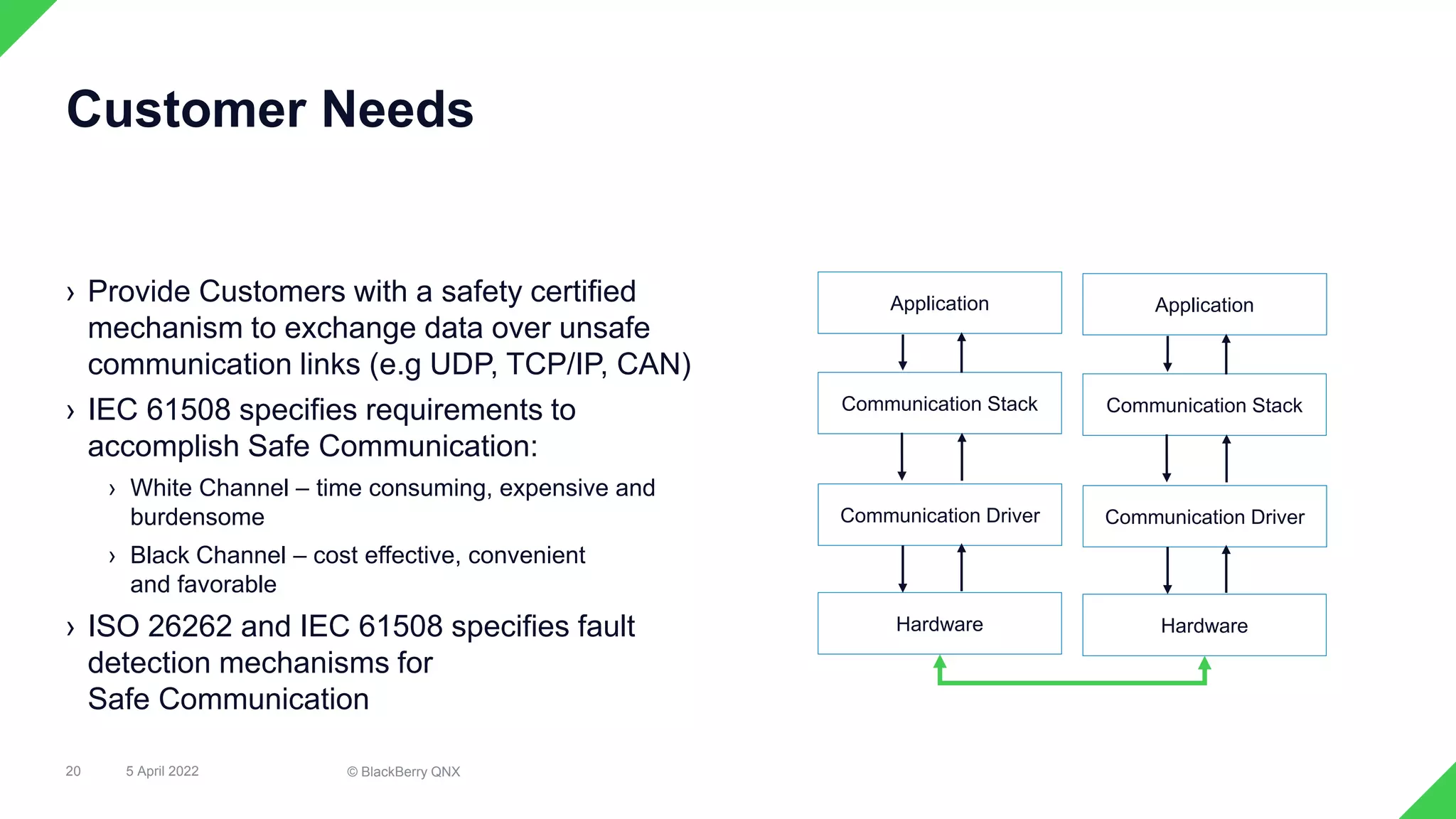
› Provide Customers with a safety certified
mechanism to exchange data over unsafe
communication links (e.g UDP, TCP/IP, CAN)
› IEC 61508 specifies requirements to
accomplish Safe Communication:​
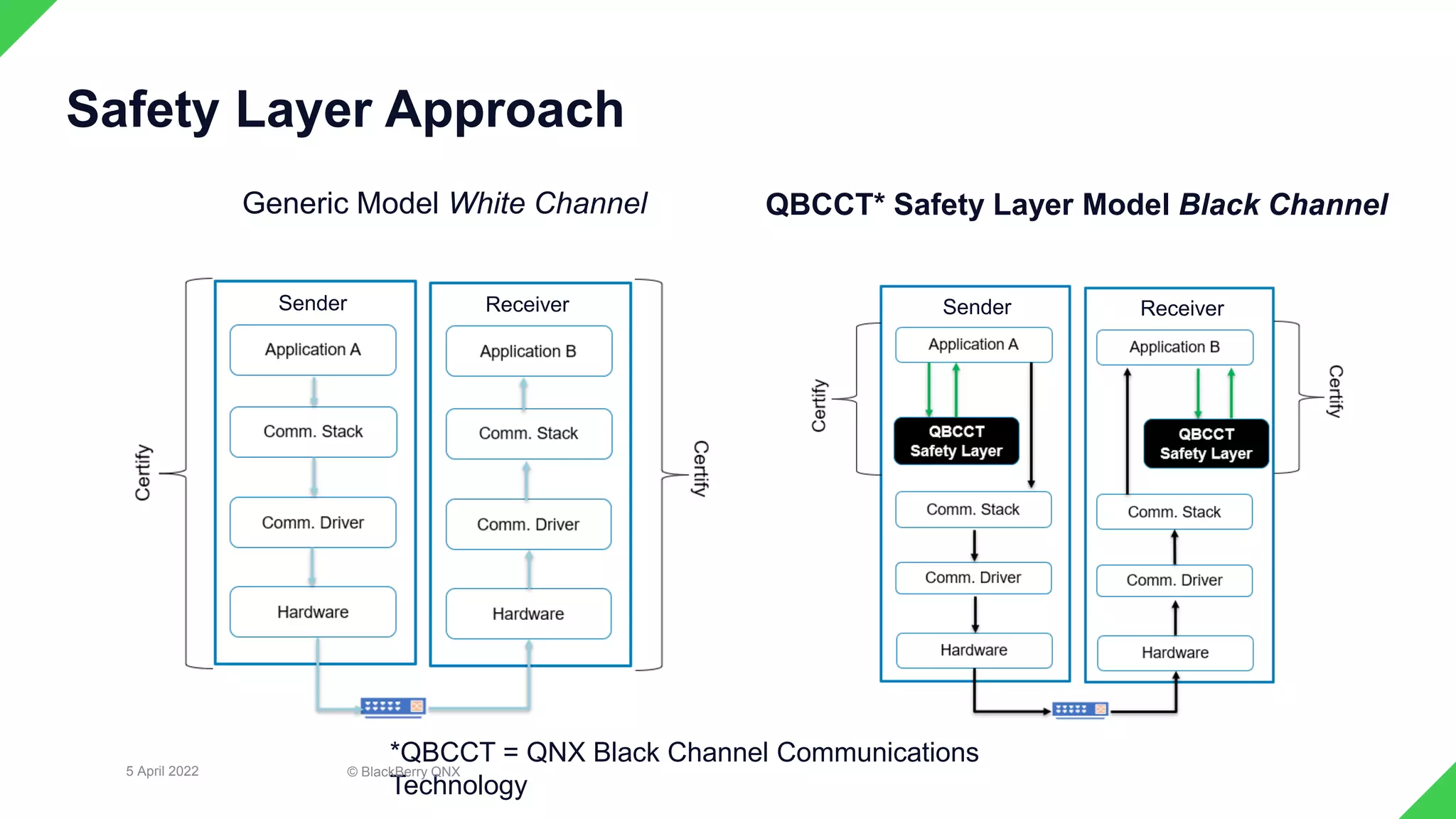
› White Channel – time consuming, expensive and
burdensome​
› Black Channel – cost effective, convenient
and favorable​
› ISO 26262 and IEC 61508 specifies fault
detection mechanisms for
Safe Communication
20
Customer Needs
Application
Communication Stack
Communication Driver
Hardware
Application
Communication Stack
Communication Driver
Hardware
5 April 2022 © BlackBerry QNX
Generic Model White Channel QBCCT* Safety Layer Model Black Channel
5 April 2022
21
Safety Layer Approach
Sender Receiver Sender Receiver
*QBCCT = QNX Black Channel Communications
Technology
5 April 2022 © BlackBerry QNX
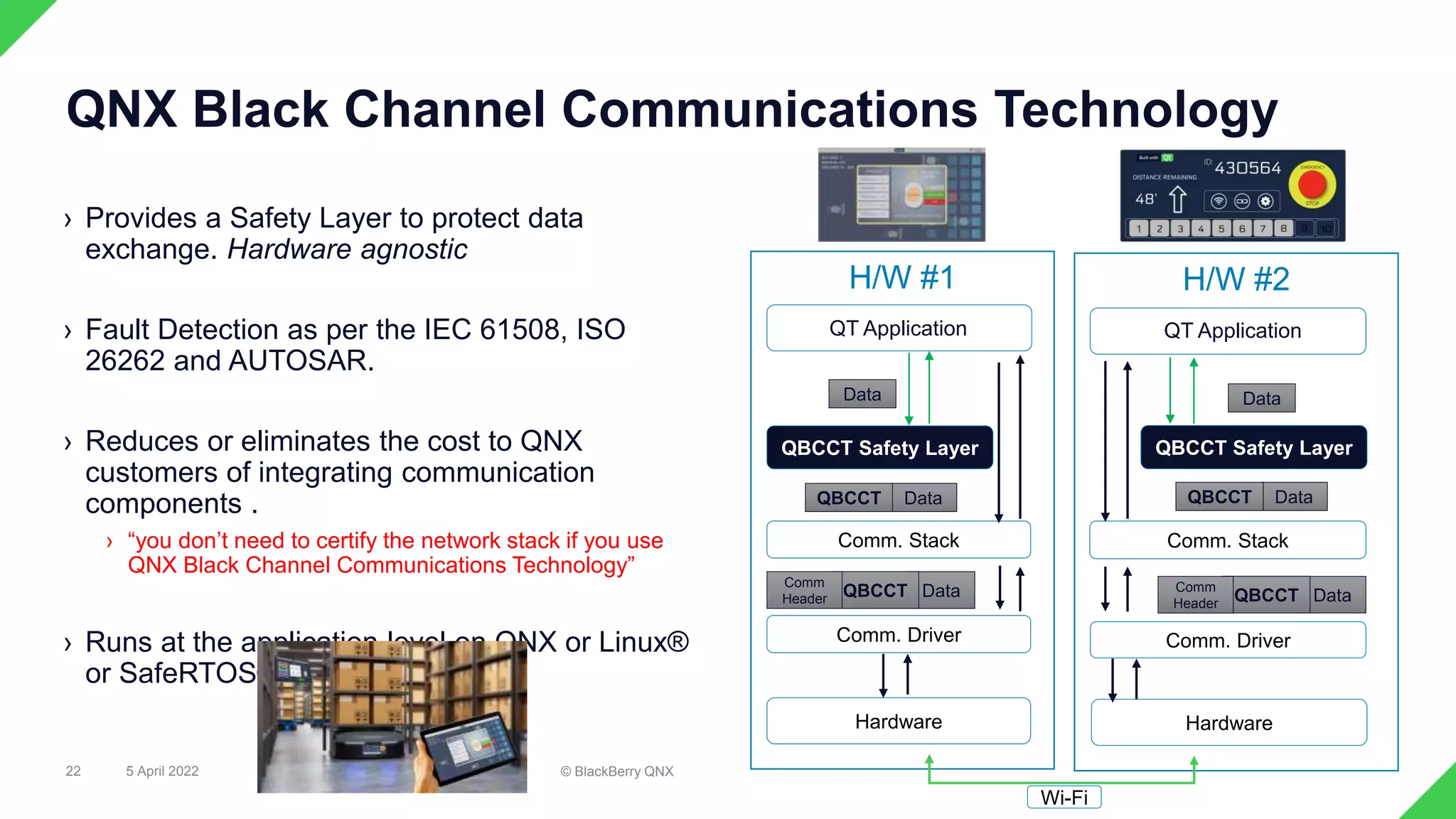
› Provides a Safety Layer to protect data
exchange. Hardware agnostic
› Fault Detection as per the IEC 61508, ISO
26262 and AUTOSAR.
› Reduces or eliminates the cost to QNX
customers of integrating communication
components ​.
› “you don’t need to certify the network stack if you use
QNX Black Channel Communications Technology”
› Runs at the application level on QNX or Linux®
or SafeRTOS®
22
QNX Black Channel Communications Technology
H/W #1
Application A
Comm. Stack
Comm. Driver
Hardware
QBCCT Safety Layer
H/W #2
Application B
Comm. Stack
Comm. Driver
Hardware
QBCCT Safety Layer
Data
Data
Data
QBCCT
QBCCT
Comm
Header Data
QBCCT
Comm
Header
Data
QBCCT
Data
QT Application QT Application
Wi-Fi
5 April 2022 © BlackBerry QNX
23
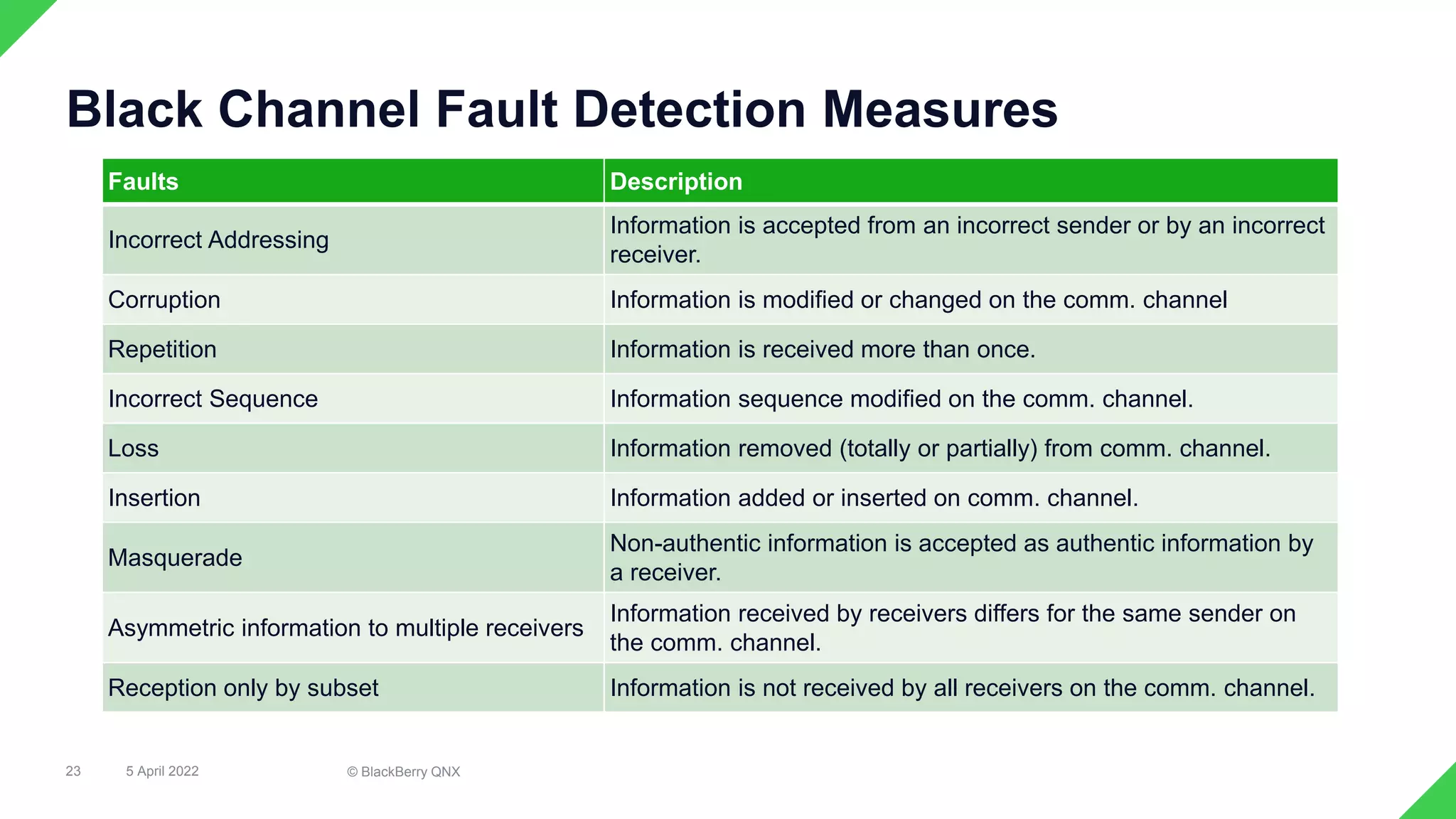
Black Channel Fault Detection Measures
Faults Description
Incorrect Addressing
Information is accepted from an incorrect sender or by an incorrect
receiver.
Corruption Information is modified or changed on the comm. channel
Repetition Information is received more than once.
Incorrect Sequence Information sequence modified on the comm. channel.
Loss Information removed (totally or partially) from comm. channel.
Insertion Information added or inserted on comm. channel.
Masquerade
Non-authentic information is accepted as authentic information by
a receiver.
Asymmetric information to multiple receivers
Information received by receivers differs for the same sender on
the comm. channel.
Reception only by subset Information is not received by all receivers on the comm. channel.
5 April 2022 © BlackBerry QNX
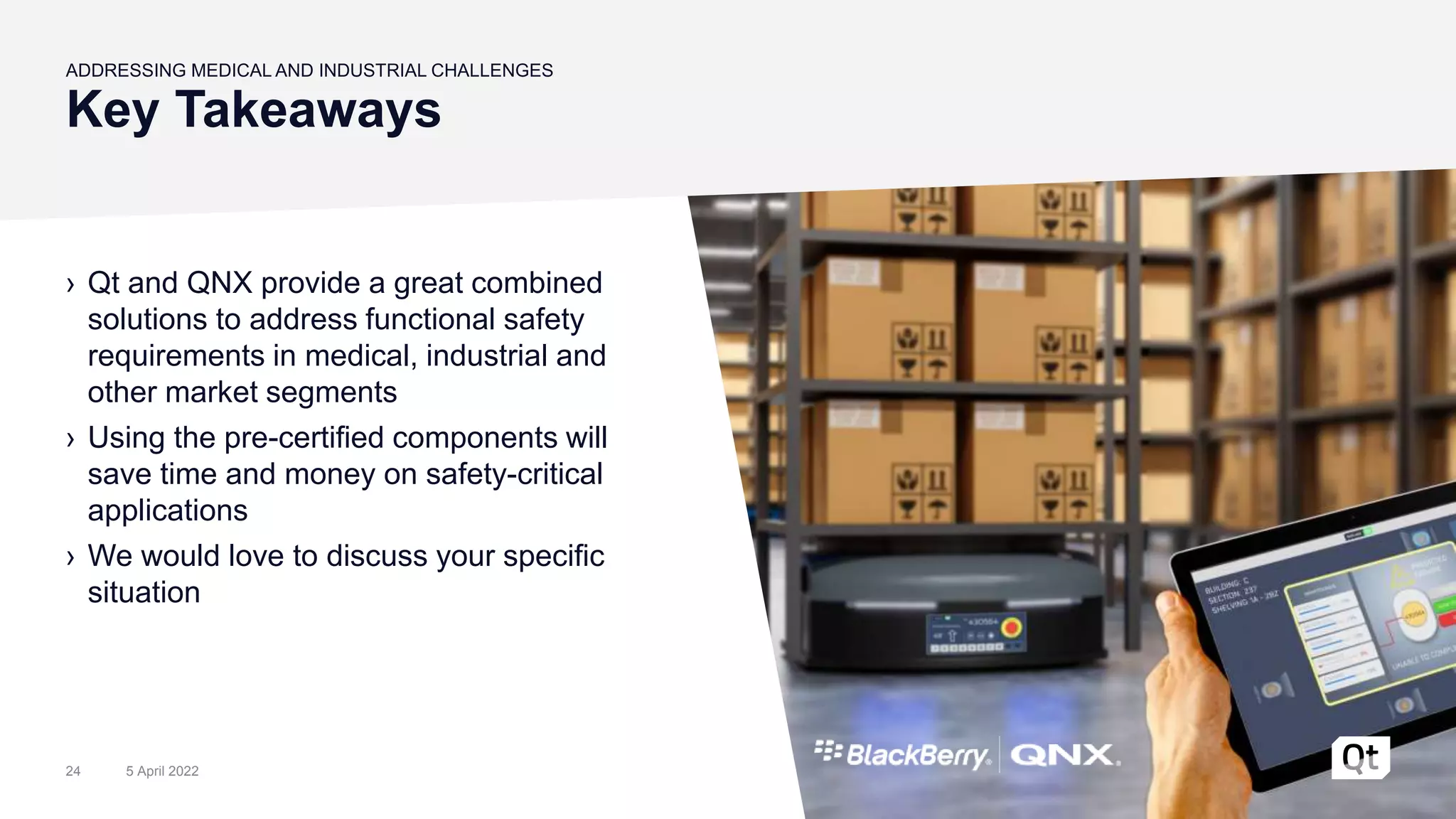
Key Takeaways
ADDRESSING MEDICAL AND INDUSTRIAL CHALLENGES
› Qt and QNX provide a great combined
solutions to address functional safety
requirements in medical, industrial and
other market segments
› Using the pre-certified components will
save time and money on safety-critical
applications
› We would love to discuss your specific
situation
5 April 2022
24
Thank you!

Learn how to addressing medical and industrial challenges with BlackBerry QNX and QT

  • 1.
    Addressing Medical and IndustrialChallenges February 17, 2022
  • 2.
    5 April 2022 2 Speakers ADDRESSINGMEDICAL AND INDUSTRIAL CHALLENGES Shawn Dorsey Technical Artist The Qt Company Pat Shelly Manager Solutions Architecture The Qt Company Elton Lum Director Field Application Engineering BlackBerry QNX
  • 3.
    › Functional safetyis a major consideration when designing industrial and medical applications › Parts of the system need to be certified, including some aspects of the HMI › This is resulting in mixed-criticality systems conforming to International Electrotechnical Commission (IEC) safety standards › Qt and QNX have had a strong partnership for decades › This had led to a strong combined solutions for safety-critical systems › This webinar will look at how the Qt+QNX solution can be used to address some specific use cases 5 April 2022 © The Qt Company 3 Introduction ADDRESSING MEDICAL AND INDUSTRIAL CHALLENGES
  • 4.
    Smart Warehouse Solutions Cross-platform,multi-screen Interactivity Desktop Tablet MC U © The Qt Company 5 April 2022 4
  • 5.
    Qt Design Studio © TheQt Company 5 April 2022 5 Shawn Dorsey Sr. Technical Artist shawn.dorsey@qt.io
  • 6.
    FIGMA • UI Design •Layouts • Components Design Studio • Interactions • Animations • Controls Qt Bridge Plugin
  • 7.
    © The QtCompany 5 April 2022 7 Interactive Virtual Warehouse
  • 8.
    › Helps createa safe user environment in medical and industrial applications › For example, in the Emergency Room, Operating Room or Intensive Care Unit › Doctors and nurses can continue to focus on the patient in the event of a system failure › On the industrial plant floor or warehouse › Robot payload could fall resulting in personal harm or property damage › Qt Safe Renderer will ensure that the system is put into a safe state in the event of a system failure › Qt Safe Renderer is not required for your system to be certified › But Qt Safe Renderer will save you time and money › We hold ourselves to the same safety standards as our customers do › QSR is pre-certified for use in your system, we provide all necessary certification artifacts › You can include these certification artifacts directly in your safety case 5 April 2022 © The Qt Company 8 Qt Safe Renderer ADDRESSING MEDICAL AND INDUSTRIAL CHALLENGES 5 April 2022 - Public 8
  • 9.
    › The QSRmodule provides a UI rendering component that can be used to render safety-critical items › Examples include warning indicators and critical text messages in functional safety systems › Qt Safe Renderer separates the safety-critical rendering from the other parts of the system › This ensures that Qt Safe Renderer can render the safety-critical UI elements even if there are failures in the main UI › With separation, Qt can be used in a system requiring certification without changing the Qt libraries › Qt Safe Renderer provides a seamless integration with the Qt toolchain › Qt Design Studio and the QML language are be used together with Qt Safe Layout Tool to generate layout data for safety-critical UI elements › Safety-critical elements are implemented using QML extensions: SafeImage, SafePicture, SafeText › QSR supports basic animations, and now includes a Safety Monitor feature to enable additional options for system architecture 5 April 2022 © The Qt Company 9 Qt Safe Renderer ADDRESSING MEDICAL AND INDUSTRIAL CHALLENGES 5 April 2022 - Public 9
  • 10.
    IEC 61508:2010-3 7.4.4(SIL 3) (electrical/electronic/programmable safety-related systems) IEC 62304:2015 (2006+A1) (medical devices) ISO 26262:2018-6, ISO 26262:2018-8 (ASIL-D) (road vehicles functional safety) EN 50128:2011 6.7.4 (SIL 4) (railway applications) Certification Standards 5 April 2022 10 © The Qt Company
  • 11.
    Like for anylarge framework, certification of the entire Qt framework is not economically feasible › Codebase is too large › Features making Qt a powerful and efficient framework considered risky for safety critical systems › For example, Qt uses advanced C++ features and dynamic memory allocation Solution: Partition the system and use Qt Safe Renderer › Small code size easier to certify › Uses MISRA C++ › Guidelines for the use of the C++ language in critical systems, was published and officially launched on 5 June 2008 › This has since been adopted by other industries as a de facto standard › All memory allocated at startup, nothing while running 5 April 2022 11 Is Qt Certified for Functional Safety? Rich UI Safe UI Qt Qt Safe Rendere r QNX OS for Safety © The Qt Company
  • 12.
    › Heartbeat frommain UI monitored by QSR › Blanks out lower layers if error detected › Disables non-safety UI if error detected in its operation › Restarts non-safety UI if failure detected 12 Safety Critical Graphics – Partitioned System Electronics Cluster UI Qt Tell-tales Qt Safe Renderer ASIL-D RTOS ASIL-D CANbus Non-safety critical graphics (2nd plane) Safety critical graphics plane Top layer © The Qt Company
  • 13.
    Qt Safe Renderer:We deliver four parts 5 April 2022 © The Qt Company 13 Designer Tooling • One toolset to develop safety and non-safety critical UI Build Tools • Automates partitioning Run-time component • Pre certified component Certification Artifacts • Safety manual, Architecture specification, Design specification, Verification specification, Verification report, ...
  • 14.
    Drag and dropsafe items from library into your design Browser for adding ISO 7000 icons Single tool for Safe and non-safety critical UI 5 April 2022 © The Qt Company 14 Designer Tooling
  • 15.
    SIL Build tools: Desktopor Target 5 April 2022 © The Qt Company 15 Software Build UI design Robot UI with safe text Qt Desktop OS Software Build UI design Electronics Robot UI Qt Safe Text Qt Safe Renderer QNX OS for Safety Rich UI Safety critical UI Build for target: Split design between safe and non-safe partitions. Build for desktop: Rapid iteration during the design phase. Safe items rendered as normal QML items with no partitioning. QSR Run-time component
  • 16.
    5 April 2022© The Qt Company 16 New in 2.0: Safety Monitoring QT SAFE RENDERER Customer Device QNX OS for Safety QNX Hypervisor for Safety (Optional) SoC MCU RTOS Serial System Logic Robot Display Main UI State Logic QSR 2.0 QSR Monitor CRC Check QSR Render Main UI Watchdog Main UI Heartbeat
  • 17.
    › At BlackBerryQNX, we adhere to a wide spectrum of safety standards as part of the product development lifecycle › It is in our DNA to follow processes and set safety goals for our products › We have a long history of proven safety critical product and services delivery that customers can count on. 17 Functional Safety at BlackBerry QNX Follow your Processes Use technique X IEC 62304 MEDICAL IEC 61513 NUCLEAR EN 50128 RAILWAY IEC 61508 INDUSTRIAL TECHNIQUE TO PROCESS ORIENTED PRESCRIPTIVE TO GOAL BASED Do X & Y Don’t do Z Design a safe system ISO 26262 AUTOMOTIVE 5 April 2022 © BlackBerry QNX
  • 18.
    QNX® OS forSafety (QOS) › Compatible with QNX SDP 7 with support for ARM and x86 64-bit hardware platforms › Microkernel and Process Manager, Multicore support, Adaptive Partitioning scheduler › System libraries: C, Math and C++ Library certifications › Various certified QNX® utilities › Tools: C and C++ compiler, linker, and assembler classified as TCL3 according to ISO 26262 and T3 according to IEC 61508-3 Safety Certified Add-ons › Certified C++ System Library › QNX® Black Channel Communications Technology 18 QNX OS for Safety Scope Safety Legend Network Fsys/Block Other Drivers, Libraries and Tools Applications C library QNX Microkernel+Procnto Board Support Packages (BSP) Startup Drivers QNX OS for Safety Eng Services Adaptive Partitioning Multicore support Memory Management C++ library mkifs, secpolcompile, secpolpush C and C++ compilers Math library Add-ons Support Services SMMU QNX Black Channel 5 April 2022 © BlackBerry QNX
  • 19.
    › Safe communicationand secure communication do not mean the same thing › Secure communication relates to protecting your data from malicious threats and requires frequent patching of software and firmware to combat new threats › Safe Communication relates to the automatic prevention of accidents from Systematic software faults, random hardware faults and transient faults despite malicious threats 19 Understanding the Difference 5 April 2022 © BlackBerry QNX
  • 20.
    › Provide Customerswith a safety certified mechanism to exchange data over unsafe communication links (e.g UDP, TCP/IP, CAN) › IEC 61508 specifies requirements to accomplish Safe Communication:​ › White Channel – time consuming, expensive and burdensome​ › Black Channel – cost effective, convenient and favorable​ › ISO 26262 and IEC 61508 specifies fault detection mechanisms for Safe Communication 20 Customer Needs Application Communication Stack Communication Driver Hardware Application Communication Stack Communication Driver Hardware 5 April 2022 © BlackBerry QNX
  • 21.
    Generic Model WhiteChannel QBCCT* Safety Layer Model Black Channel 5 April 2022 21 Safety Layer Approach Sender Receiver Sender Receiver *QBCCT = QNX Black Channel Communications Technology 5 April 2022 © BlackBerry QNX
  • 22.
    › Provides aSafety Layer to protect data exchange. Hardware agnostic › Fault Detection as per the IEC 61508, ISO 26262 and AUTOSAR. › Reduces or eliminates the cost to QNX customers of integrating communication components ​. › “you don’t need to certify the network stack if you use QNX Black Channel Communications Technology” › Runs at the application level on QNX or Linux® or SafeRTOS® 22 QNX Black Channel Communications Technology H/W #1 Application A Comm. Stack Comm. Driver Hardware QBCCT Safety Layer H/W #2 Application B Comm. Stack Comm. Driver Hardware QBCCT Safety Layer Data Data Data QBCCT QBCCT Comm Header Data QBCCT Comm Header Data QBCCT Data QT Application QT Application Wi-Fi 5 April 2022 © BlackBerry QNX
  • 23.
    23 Black Channel FaultDetection Measures Faults Description Incorrect Addressing Information is accepted from an incorrect sender or by an incorrect receiver. Corruption Information is modified or changed on the comm. channel Repetition Information is received more than once. Incorrect Sequence Information sequence modified on the comm. channel. Loss Information removed (totally or partially) from comm. channel. Insertion Information added or inserted on comm. channel. Masquerade Non-authentic information is accepted as authentic information by a receiver. Asymmetric information to multiple receivers Information received by receivers differs for the same sender on the comm. channel. Reception only by subset Information is not received by all receivers on the comm. channel. 5 April 2022 © BlackBerry QNX
  • 24.
    Key Takeaways ADDRESSING MEDICALAND INDUSTRIAL CHALLENGES › Qt and QNX provide a great combined solutions to address functional safety requirements in medical, industrial and other market segments › Using the pre-certified components will save time and money on safety-critical applications › We would love to discuss your specific situation 5 April 2022 24
  • 25.

Editor's Notes

  • #6 Please add your own contact details to the presentation. Two aspects to our approach to Android Automotive platforms: 1. What can we do to bring value on top of the AAOS platforms? 2. What are the pain points in native development that we could help alleviate?
  • #8 Please add your own contact details to the presentation. Two aspects to our approach to Android Automotive platforms: 1. What can we do to bring value on top of the AAOS platforms? 2. What are the pain points in native development that we could help alleviate?
  • #9 COTS/SOUP Transparency: Understanding that the Qt Safe Renderer is the certified tool in the software stack and that the Qt software in its entirety is SOUP, the question is often asked: Can Qt be used for the GUI of a safety critical medical device? The choice of technologies is up to the system designer. None of the standards will tell you to choose one software toolkit over the other. The manufacturer of the medical device is responsible for making sure that the medical device itself is safe and effective. Additionally, IEC 62304 requires that the manufacturer makes a conscious decision about their third-party software choice. A device manufacturer will have to provide evidence of the following to satisfy the IEC 62304 requirements: The software provides the functionality and performance required The device provides the support necessary to operate the software within its specification The software performs as required for the system
  • #10 Qt Safe Renderer allows customers to build partioned User Interface architectures ensuring that safety-critical graphics are running even when the main application has run into error. Qt Safe Renderer relies on there being at least two graphics planes and this is usually the case SoCs. The safety critical graphics are written to the upper layer, the rich graphics to the layer below.​ ​ The software is partitioned with the non-safety critical Qt running on one partition, the safety critical QSR on another.
  • #11 Qt Safe Renderer has been certified to the following four standards. The Automotive ISO 26262 ASIL-D is perhaps the most stringent of these standards.
  • #12 This is an optional slide that can be used with customers. It is largely educational as some who are not so well educated into what it takes to build functionally safe software will think Qt can be certified. The point is that Qt itself is not certified (because it is not feasible) but a system using Qt can be certified by partitioning the system. The next slide will illustrate how this partitioning is done. Emphasis that the reasons that stop Qt from being certified are strengths that make Qt great and are what all large software projects use.
  • #13 Here’s the technical details for how QSR works. It relies on there being at least two graphics planes and this is usually the case SoCs. The safety critical graphics are written to the upper layer, the rich graphics to the layer below. The software is partitioned with the non-safety critical Qt running on one partition, the safety critical QSR on another. In this example the RTOS provides the partitioning. The RTOS should also be safety certified to allow the whole system to be certified. Here its shown as ASIL-D as that’s what QNX and INTEGRITY support for their safety certified RTOS.
  • #15 The Tooling includes ISO 7000 icons that can be dropped into a design using the ISO Icon Browser. Key point to emphasis is that a single tool can be used to design the whole UI, even though there are parts that will be split into different partitions. This simplifies the designer’s role; the designer just needs to mark what is safety critical and the rest is taken care of.
  • #16 Being able to run the same project on either the desktop or on the embedded target is on of Qt key strengths. We continue this for the QSR so when the designer tests their design on the desktop all safety critical flags are ignores. This makes for rapid design iteration so the whole design can come together quicker. When targeting the embedded system the build tools automatically separate the safe and non safety critical parts. This again makes for a very easy development experience.
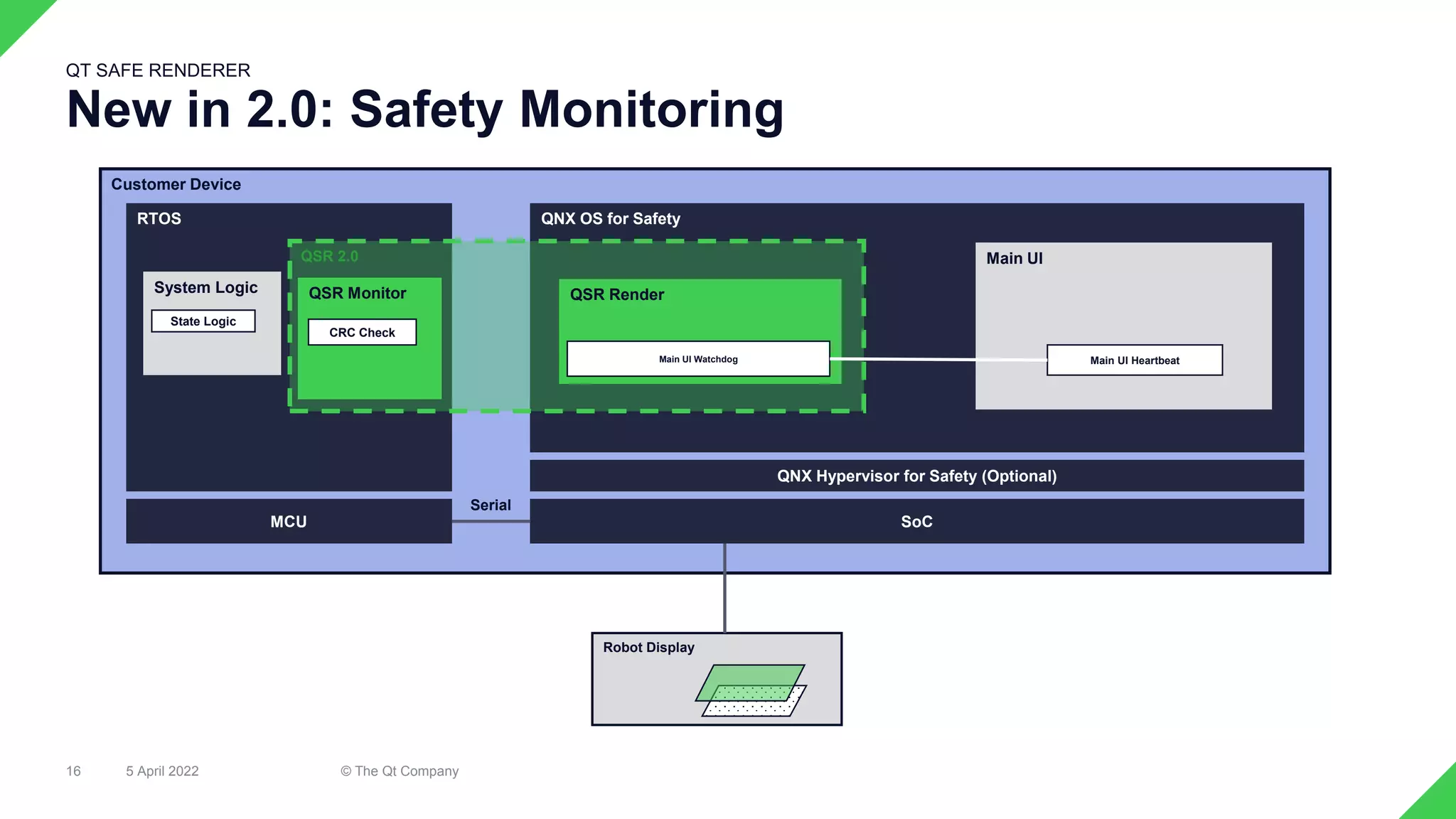
  • #17 With the QSR Safety Monitor available in QSR 2.0, additional system architectures can be supported. Instead of using a hypervisor to separate safety-critical rendering from the non-safe HMI, you can perform all safe and non-safe graphics rendering in an uncertified environment (meaning standard QNX and not QNX OS for Safety) and handle the safety checking on a separate, connected MCU device. This also eliminates the need for a hypervisor to separate the safety domain on the SoC.
  • #18 The original Functional Safety Standard for such systems, called IEC 61508, was published 2 decades ago.  It has since been used at the basis for other functional safety standards, which have been adapted to specific “fields”.  And they are not one side fits all, IEC 61508 is prescriptive and calls for specific techniques, while ISO 26262 for automotive is more goal based, EN 50128 calls for independence and role definition and IEC 62304 is more about following your own processes.   
  • #22 For the white channel approach, if we look at the diagram on the left, you will see two applications that are on two separate pieces of hardware that send data back on both. To establish safe communication for this scenario using the white channel approach, you will have to certify every single aspect of the communication path to the functional safety standard that is required for your system. That included the communication protocol, services and underlying hardware. This will clearly reduce the risk of hardware and software fault introduction in your system. However this approach is extremely costly and time consuming to be able to certify all these elements to the functional safety standard For the black channel approach, the use case is the same on the right where you have two applications communicating on two separate pieces of hardware. The Black Channel approach recommends a Safety layer that sits at the application level where the sender application sends its data to for essential safety checks prior to transmission and on the receiver side upon receipt of the data you send it to the safety layer to check to make sure the data hasn’t changed. That safety layer has to be safety certified as well as the application however, given  the fact you have the safety checks on both sides of the sender and receiver, the approach highlights that you don’t need to safety certify the components underneath like the communication stack, comm driver and hardware. This is clearly cost effective and less time consuming when it comes to safety certification. It also allows you to use uncertified communication components in your design.
  • #24 So what are those safety checks that the safety layer for Black Channel looking for? The safety layer has to check the data to ensure the faults in the table here are not detected. This list is defined in the IEC 61508 and ISO 26262. that layer has to check for incorrect addressing, corruption, repetition, incorrect sequence, data loss, data insertion, data masquerade, asymmetric information to multiple receivers, reception only by a subset of receiver and lastly delay of information. As you can see the list is quiet comprehensive and covers a lot if not all of the hardware/software faults that could arise in any system that are not malicious.