Towards 0-bug software in the
automotive industry
Amin Amini
www.certx.com
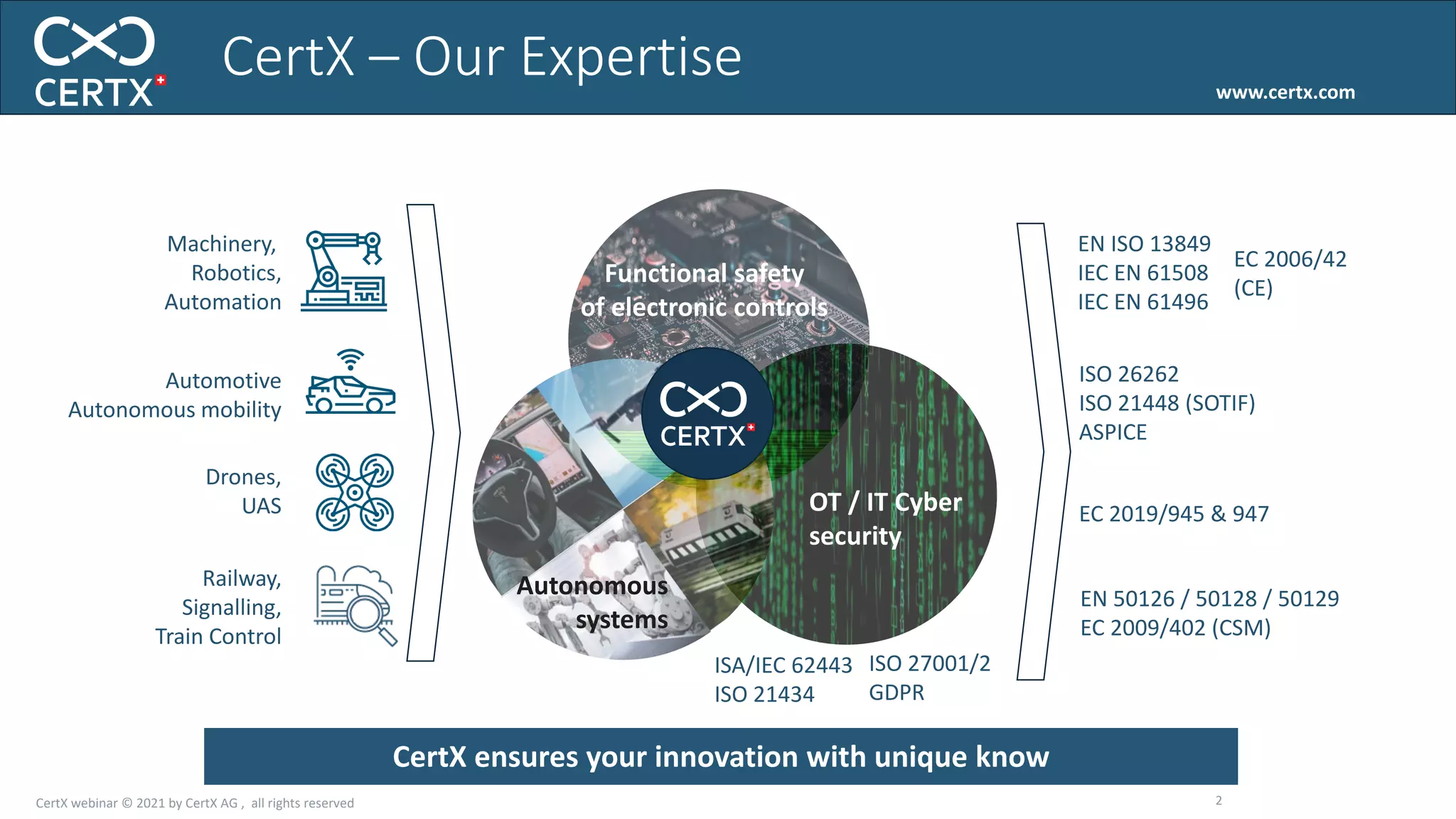
Autonomous
systems
Functional safety
of electronic controls
OT / IT Cyber
security
CertX – Our Expertise
CertX ensures your innovation with unique know
Machinery,
Robotics,
Automation
Automotive
Autonomous mobility
Drones,
UAS
Railway,
Signalling,
Train Control
2
EN ISO 13849
IEC EN 61508
IEC EN 61496
ISO 26262
ISO 21448 (SOTIF)
ASPICE
EC 2019/945 & 947
EN 50126 / 50128 / 50129
EC 2009/402 (CSM)
EC 2006/42
(CE)
ISA/IEC 62443
ISO 21434
ISO 27001/2
GDPR
CertX webinar © 2021 by CertX AG , all rights reserved
www.certx.com
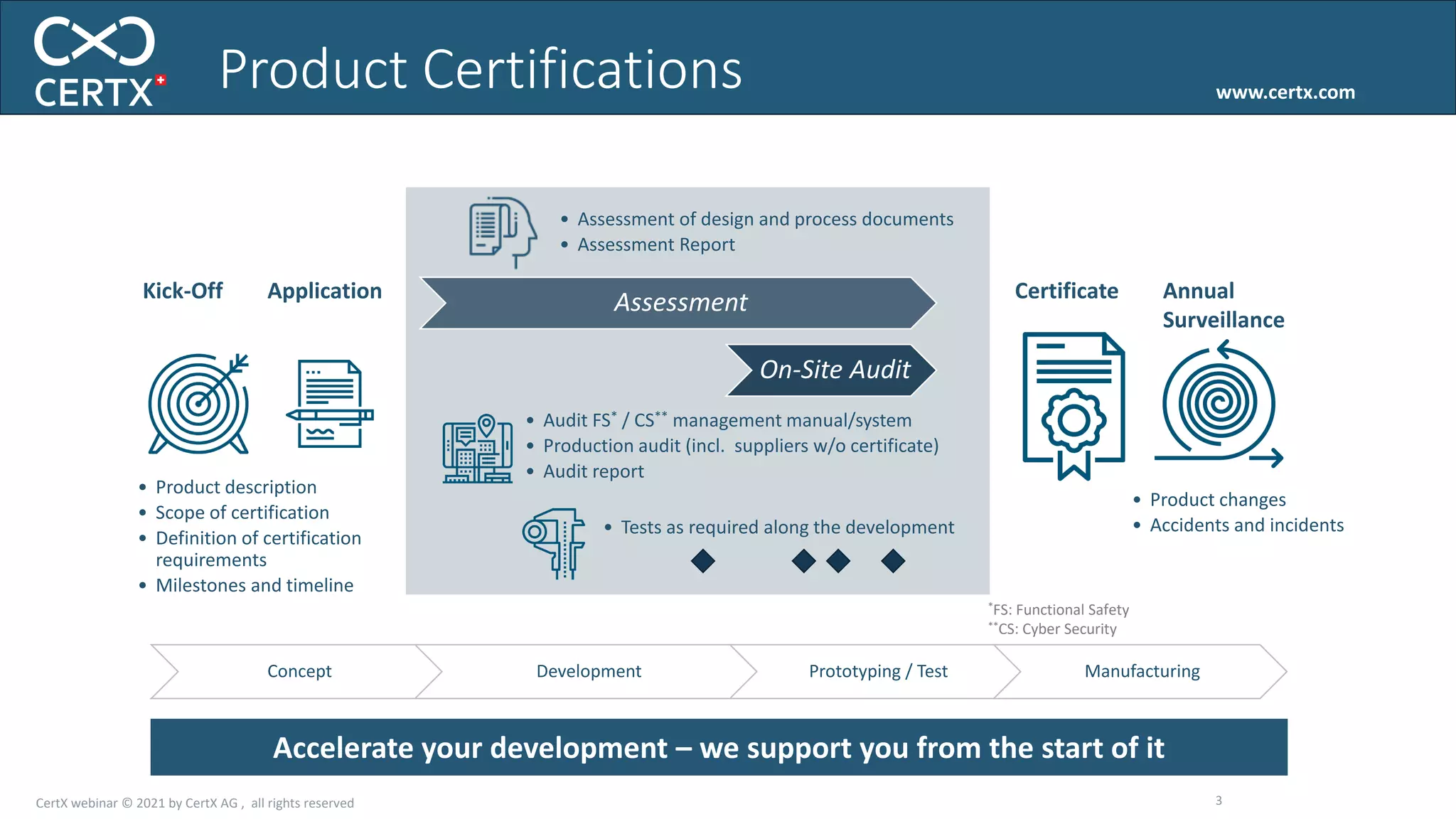
Product Certifications
Concept Development Prototyping / Test Manufacturing
Accelerate your development – we support you from the start of it
3
Assessment
On-Site Audit
Application Certificate
• Product description
• Scope of certification
• Definition of certification
requirements
• Milestones and timeline
• Audit FS* / CS** management manual/system
• Production audit (incl. suppliers w/o certificate)
• Audit report
Kick-Off
• Product changes
• Accidents and incidents
Annual
Surveillance
*FS: Functional Safety
**CS: Cyber Security
• Assessment of design and process documents
• Assessment Report
• Tests as required along the development
CertX webinar © 2021 by CertX AG , all rights reserved
www.certx.com
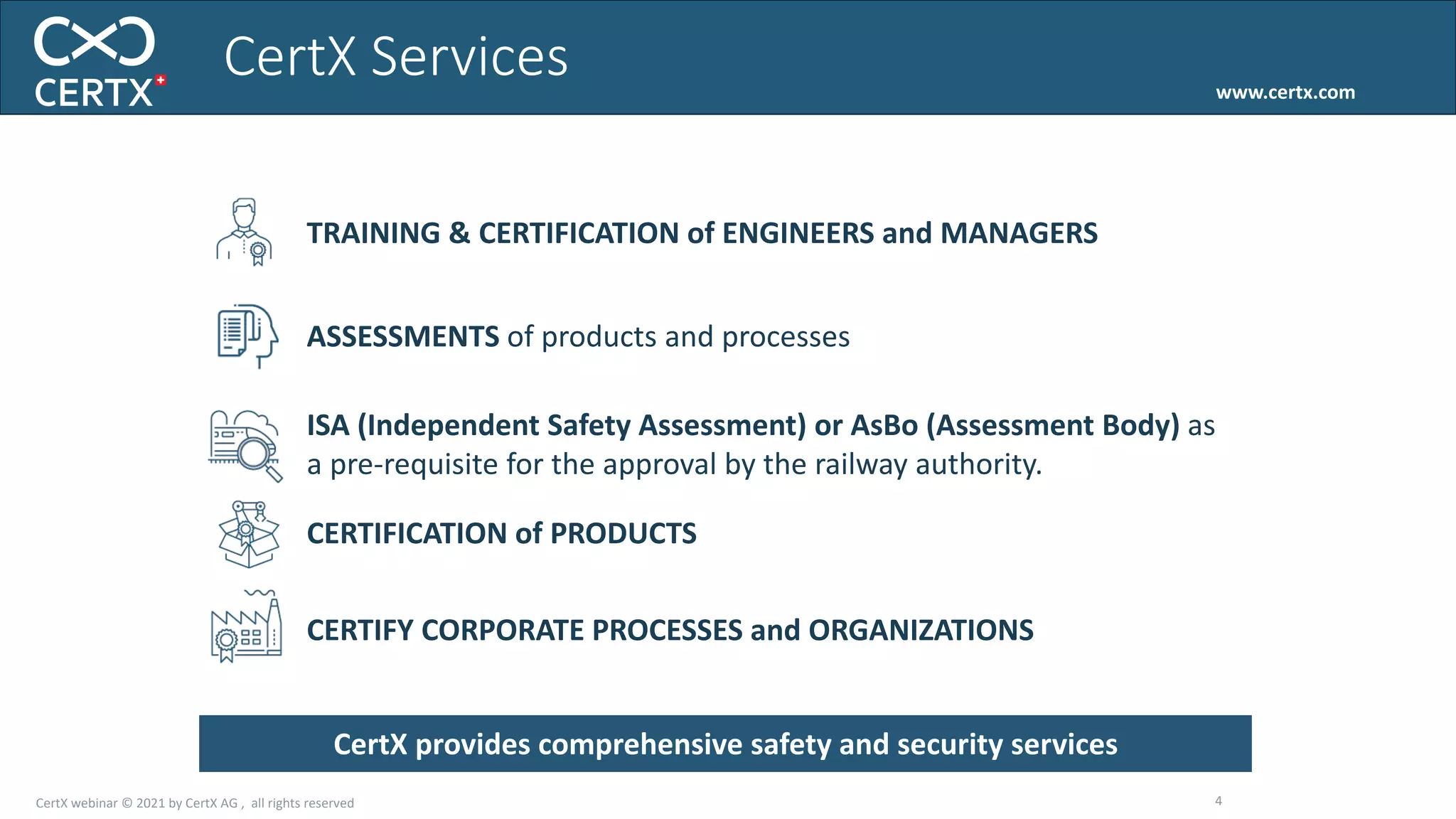
CertX Services
CertX provides comprehensive safety and security services
4
TRAINING & CERTIFICATION of ENGINEERS and MANAGERS
ASSESSMENTS of products and processes
ISA (Independent Safety Assessment) or AsBo (Assessment Body) as
a pre-requisite for the approval by the railway authority.
CERTIFICATION of PRODUCTS
CERTIFY CORPORATE PROCESSES and ORGANIZATIONS
CertX webinar © 2021 by CertX AG , all rights reserved
Safe & Secure Software
www.certx.com
Dilemma of Fail Safe, Fail Secure and Fail Operational
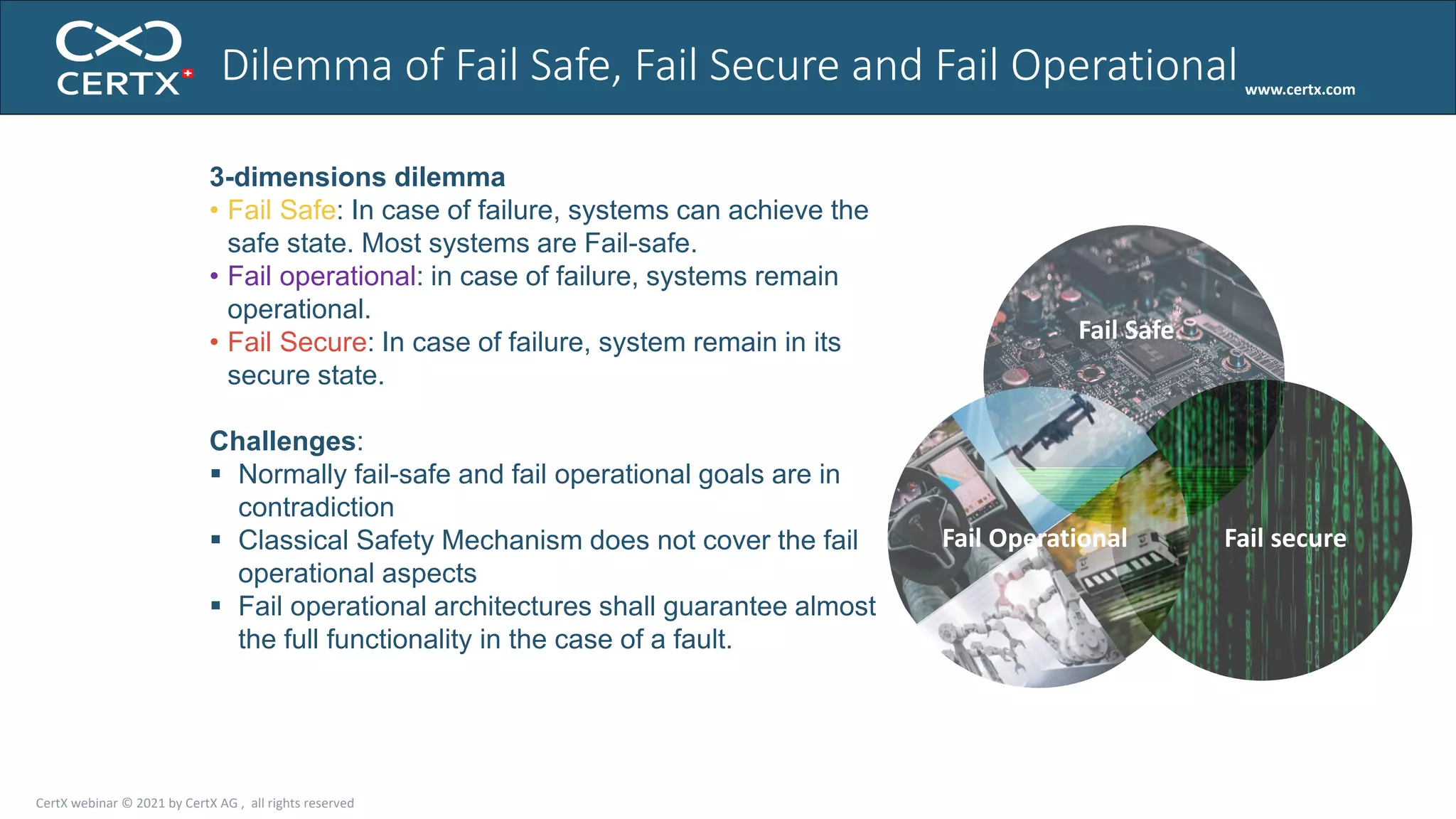
3-dimensions dilemma
• Fail Safe: In case of failure, systems can achieve the
safe state. Most systems are Fail-safe.
• Fail operational: in case of failure, systems remain
operational.
• Fail Secure: In case of failure, system remain in its
secure state.
Challenges:
 Normally fail-safe and fail operational goals are in
contradiction
 Classical Safety Mechanism does not cover the fail
operational aspects
 Fail operational architectures shall guarantee almost
the full functionality in the case of a fault.
Fail Operational
Fail Safe
Fail secure
CertX webinar © 2021 by CertX AG , all rights reserved
www.certx.com
7
 ISO 26262:2018 Road vehicles Functional Safety — Applied to safety-related
systems that include one or more electrical and/or electronic (E/E) systems and
that are installed in series production road vehicles, excluding mopeds
 ISO 21448:2021 Safety Of The Intended Functionality- An acceptable level of
safety for road vehicles requires the avoidance of unreasonable risk caused by
every hazard associated with the intended functionality and its implementation,
especially those not due to failures, e.g. due to performance limitations or
insufficiencies of specification.
 ISO 21434:2020 Road vehicles Cybersecurity engineering - This document
addresses the cybersecurity perspective in engineering of electrical and
electronic (E/E) systems within road vehicles. By ensuring appropriate
consideration of cybersecurity, this document aims to enable the engineering of
E/E systems to keep up with changing technology and attack methods.
Automotive industry Safety & security standards
CertX webinar © 2021 by CertX AG , all rights reserved
Most Seen Challenges for Safe &
Secure codes
www.certx.com
Challenge 1 – Software Requirement Specification
9
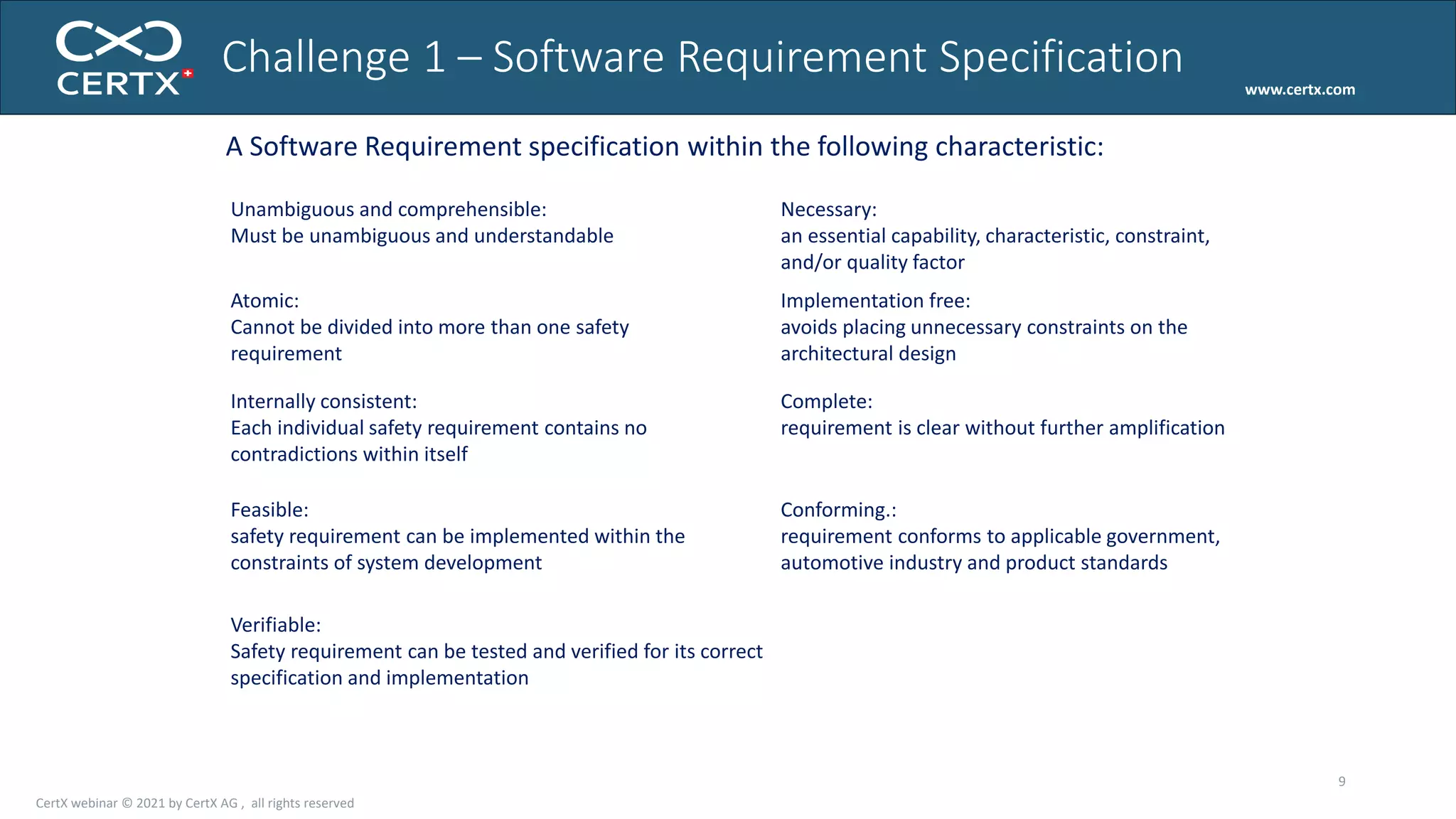
A Software Requirement specification within the following characteristic:
Unambiguous and comprehensible:
Must be unambiguous and understandable
Atomic:
Cannot be divided into more than one safety
requirement
Internally consistent:
Each individual safety requirement contains no
contradictions within itself
Feasible:
safety requirement can be implemented within the
constraints of system development
Verifiable:
Safety requirement can be tested and verified for its correct
specification and implementation
Necessary:
an essential capability, characteristic, constraint,
and/or quality factor
Implementation free:
avoids placing unnecessary constraints on the
architectural design
Complete:
requirement is clear without further amplification
Conforming.:
requirement conforms to applicable government,
automotive industry and product standards
CertX webinar © 2021 by CertX AG , all rights reserved
www.certx.com
Freedom from interference
absence of cascading failures between two or more elements that could lead to the violation of a safety
requirement
EXAMPLE 1 Element 1 is free of interference from element 2 if no of element 2 can cause element 1 to fail.
EXAMPLE 2 Element 3 interferes with element 4 if there exists a failure of element 3 that causes element 4
to fail.
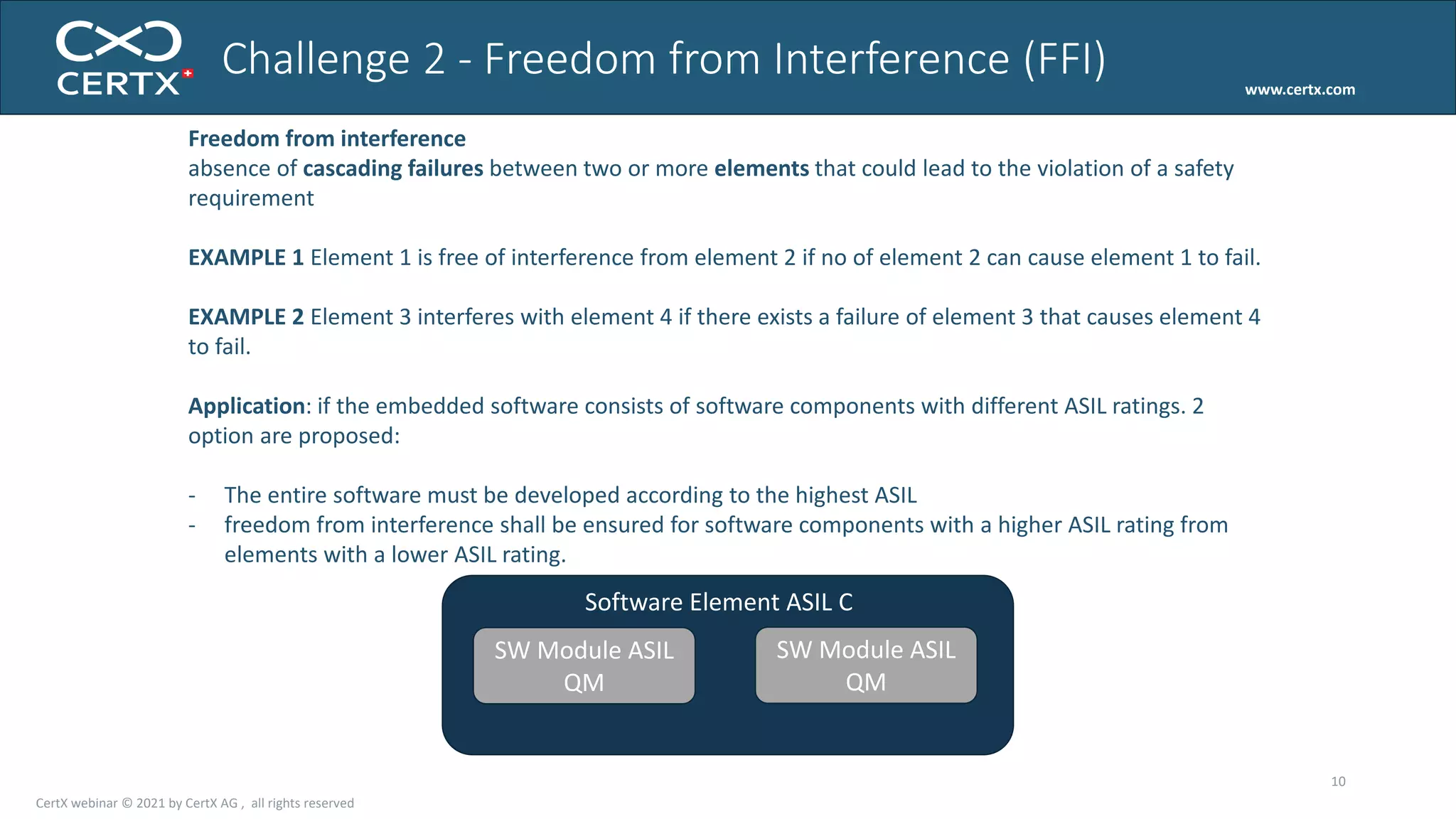
Application: if the embedded software consists of software components with different ASIL ratings. 2
option are proposed:
- The entire software must be developed according to the highest ASIL
- freedom from interference shall be ensured for software components with a higher ASIL rating from
elements with a lower ASIL rating.
10
Challenge 2 - Freedom from Interference (FFI)
SW Module ASIL
QM
SW Module ASIL
QM
Software Element ASIL C
CertX webinar © 2021 by CertX AG , all rights reserved
www.certx.com
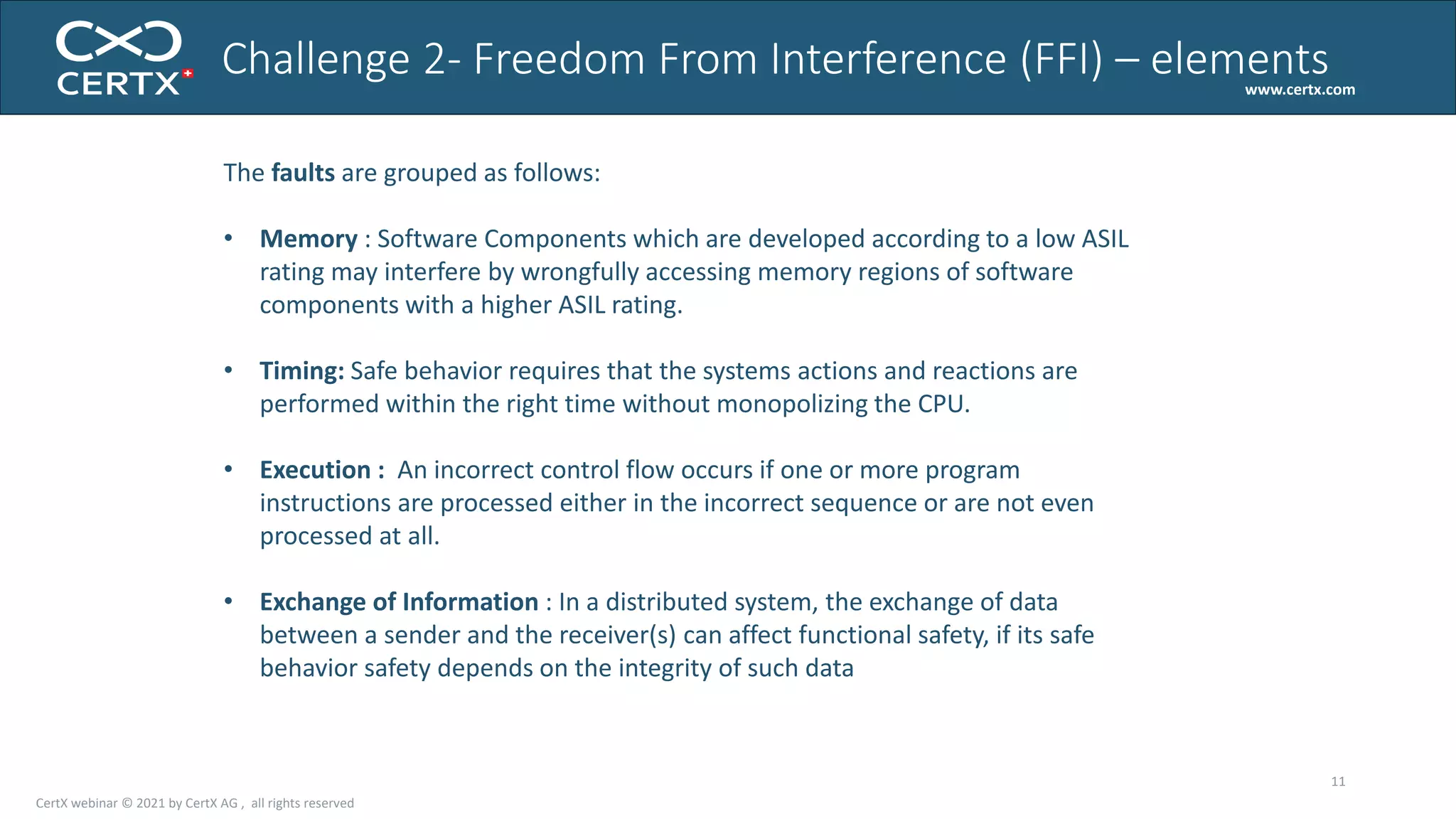
The faults are grouped as follows:
• Memory : Software Components which are developed according to a low ASIL
rating may interfere by wrongfully accessing memory regions of software
components with a higher ASIL rating.
• Timing: Safe behavior requires that the systems actions and reactions are
performed within the right time without monopolizing the CPU.
• Execution : An incorrect control flow occurs if one or more program
instructions are processed either in the incorrect sequence or are not even
processed at all.
• Exchange of Information : In a distributed system, the exchange of data
between a sender and the receiver(s) can affect functional safety, if its safe
behavior safety depends on the integrity of such data
11
Challenge 2- Freedom From Interference (FFI) – elements
CertX webinar © 2021 by CertX AG , all rights reserved
www.certx.com
12
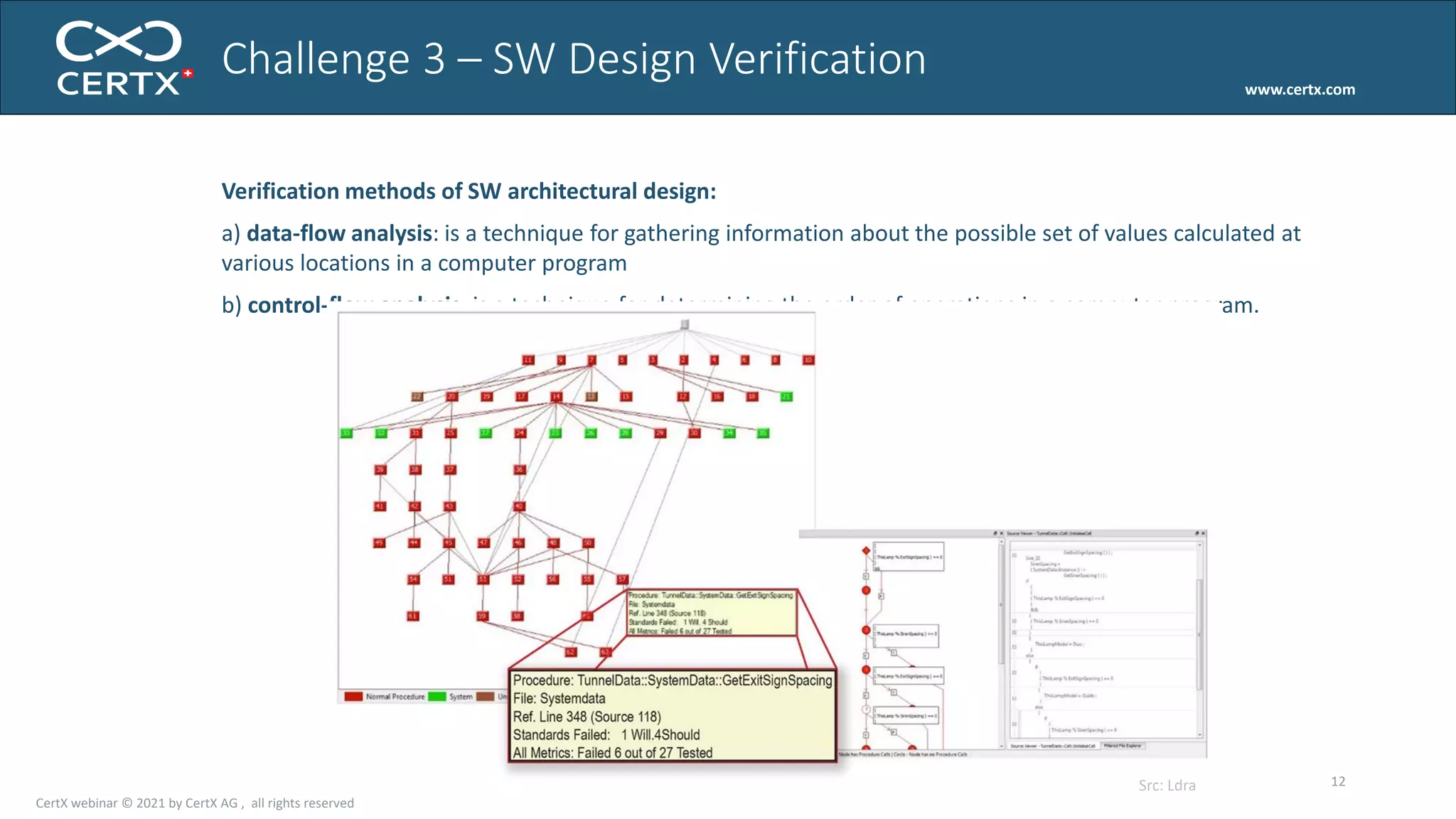
Verification methods of SW architectural design:
a) data-flow analysis: is a technique for gathering information about the possible set of values calculated at
various locations in a computer program
b) control-flow analysis: is a technique for determining the order of operations in a computer program.
Challenge 3 – SW Design Verification
Src: Ldra
CertX webinar © 2021 by CertX AG , all rights reserved
www.certx.com
13
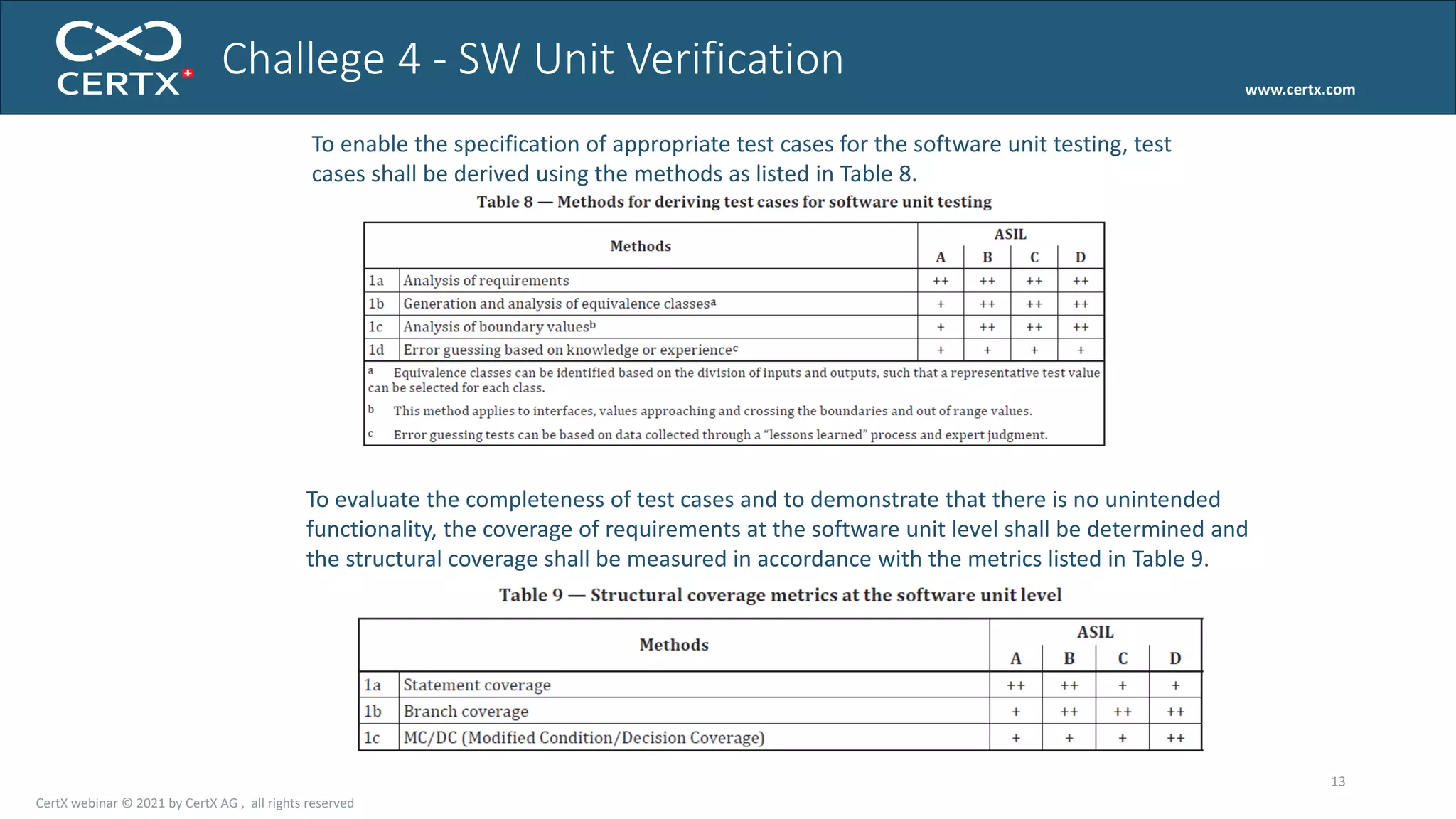
Challege 4 - SW Unit Verification
To enable the specification of appropriate test cases for the software unit testing, test
cases shall be derived using the methods as listed in Table 8.
To evaluate the completeness of test cases and to demonstrate that there is no unintended
functionality, the coverage of requirements at the software unit level shall be determined and
the structural coverage shall be measured in accordance with the metrics listed in Table 9.
CertX webinar © 2021 by CertX AG , all rights reserved
www.certx.com
Workshop - Slide 14
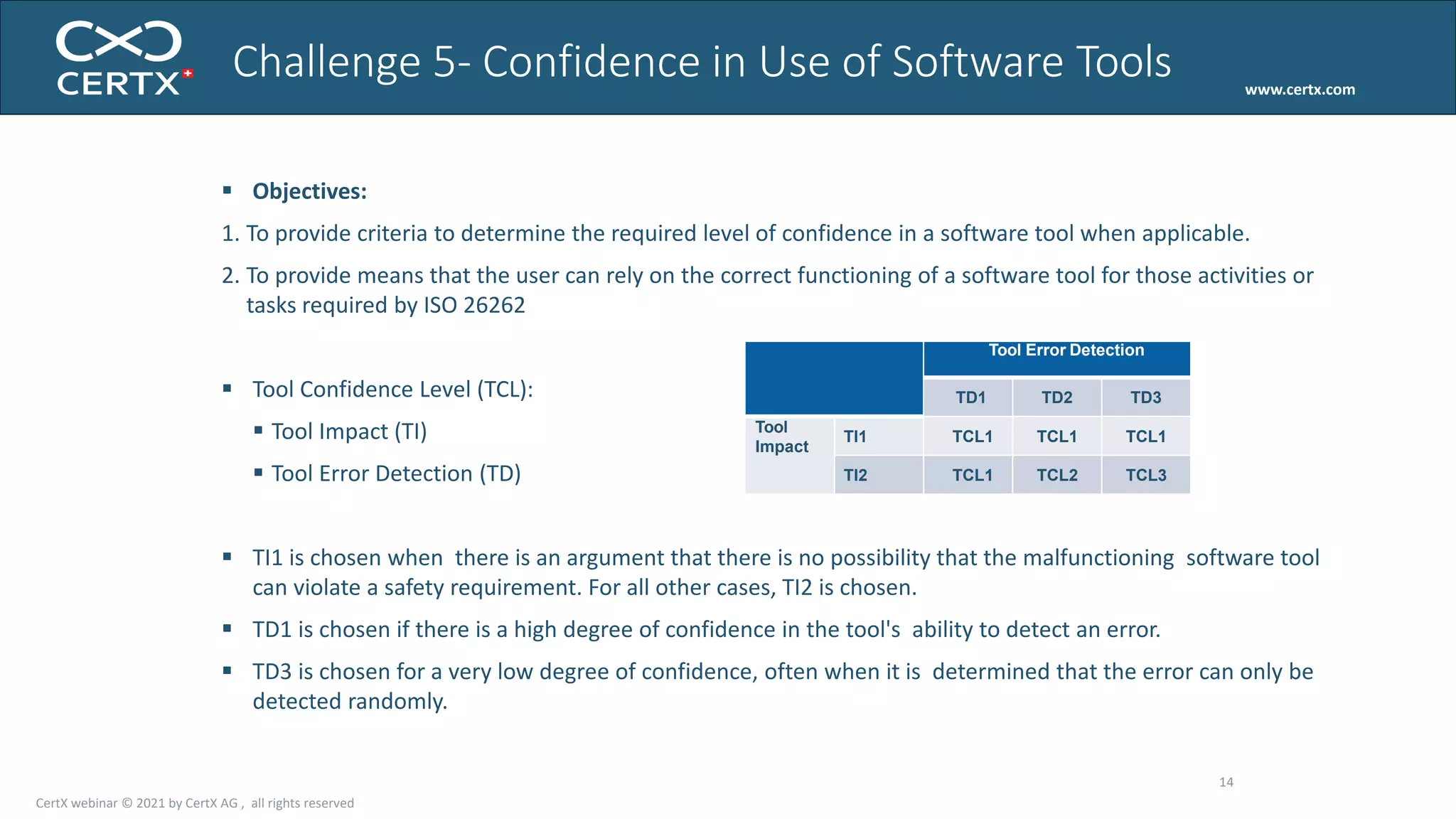
 Objectives:
1. To provide criteria to determine the required level of confidence in a software tool when applicable.
2. To provide means that the user can rely on the correct functioning of a software tool for those activities or
tasks required by ISO 26262
 Tool Confidence Level (TCL):
 Tool Impact (TI)
 Tool Error Detection (TD)
 TI1 is chosen when there is an argument that there is no possibility that the malfunctioning software tool
can violate a safety requirement. For all other cases, TI2 is chosen.
 TD1 is chosen if there is a high degree of confidence in the tool's ability to detect an error.
 TD3 is chosen for a very low degree of confidence, often when it is determined that the error can only be
detected randomly.
Challenge 5- Confidence in Use of Software Tools
14
Tool Error Detection
TD1 TD2 TD3
Tool
Impact
TI1 TCL1 TCL1 TCL1
TI2 TCL1 TCL2 TCL3
CertX webinar © 2021 by CertX AG , all rights reserved
www.certx.com
Workshop - Slide 15
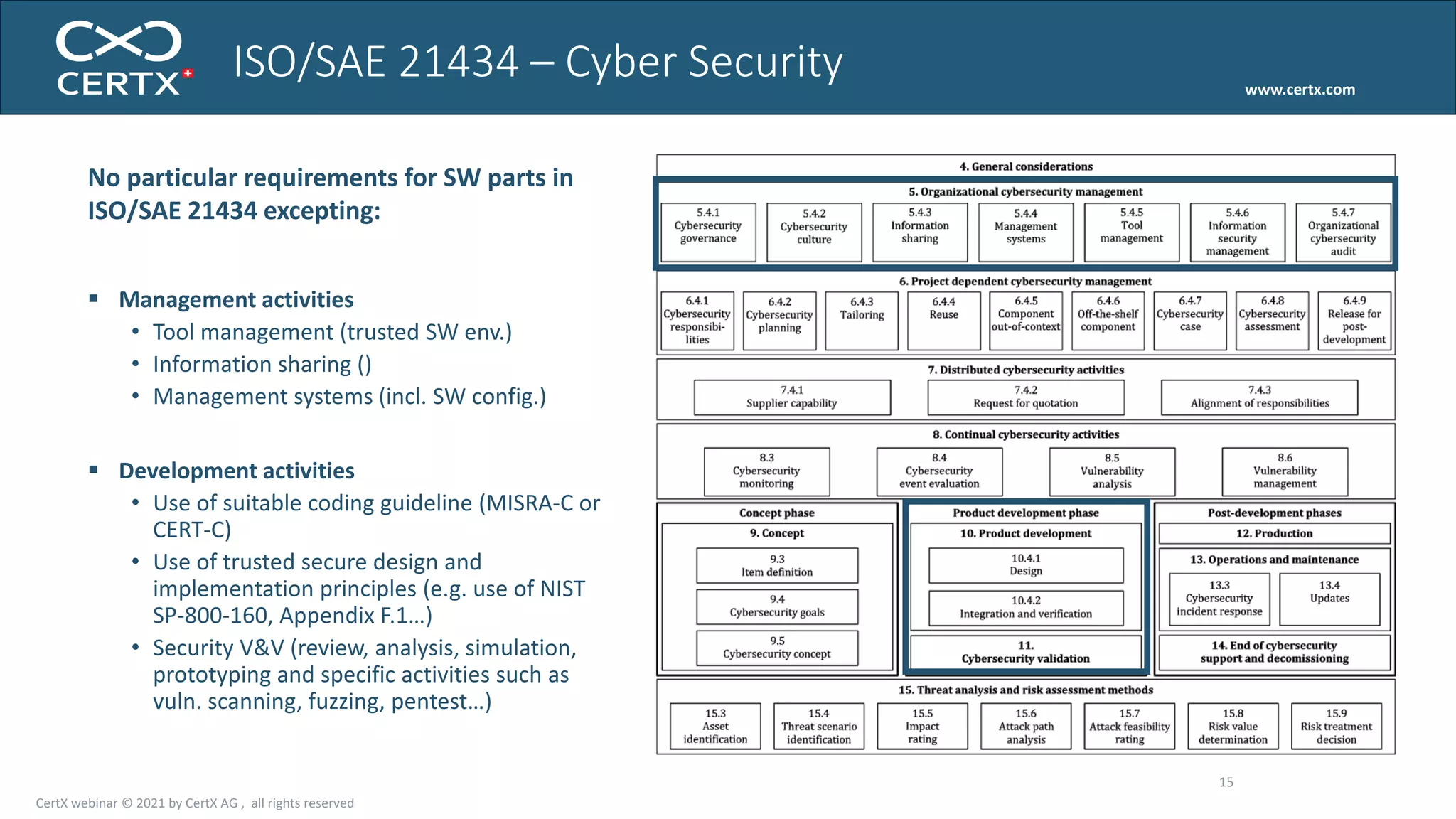
No particular requirements for SW parts in
ISO/SAE 21434 excepting:
 Management activities
• Tool management (trusted SW env.)
• Information sharing ()
• Management systems (incl. SW config.)
 Development activities
• Use of suitable coding guideline (MISRA-C or
CERT-C)
• Use of trusted secure design and
implementation principles (e.g. use of NIST
SP-800-160, Appendix F.1…)
• Security V&V (review, analysis, simulation,
prototyping and specific activities such as
vuln. scanning, fuzzing, pentest…)
ISO/SAE 21434 – Cyber Security
15
CertX webinar © 2021 by CertX AG , all rights reserved
www.certx.com
Workshop - Slide 16
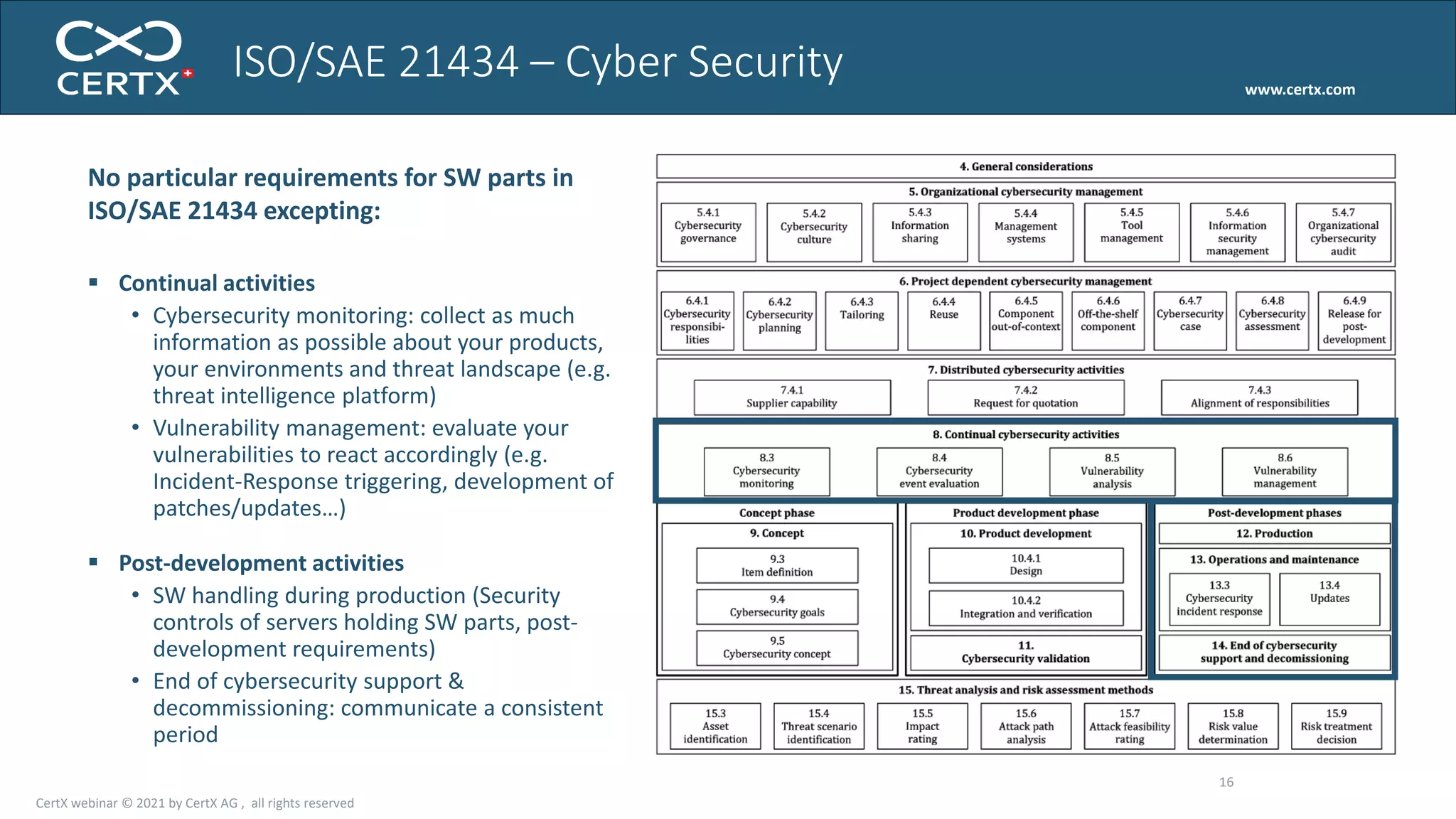
No particular requirements for SW parts in
ISO/SAE 21434 excepting:
 Continual activities
• Cybersecurity monitoring: collect as much
information as possible about your products,
your environments and threat landscape (e.g.
threat intelligence platform)
• Vulnerability management: evaluate your
vulnerabilities to react accordingly (e.g.
Incident-Response triggering, development of
patches/updates…)
 Post-development activities
• SW handling during production (Security
controls of servers holding SW parts, post-
development requirements)
• End of cybersecurity support &
decommissioning: communicate a consistent
period
ISO/SAE 21434 – Cyber Security
16
CertX webinar © 2021 by CertX AG , all rights reserved
www.certx.com
Workshop - Slide 17
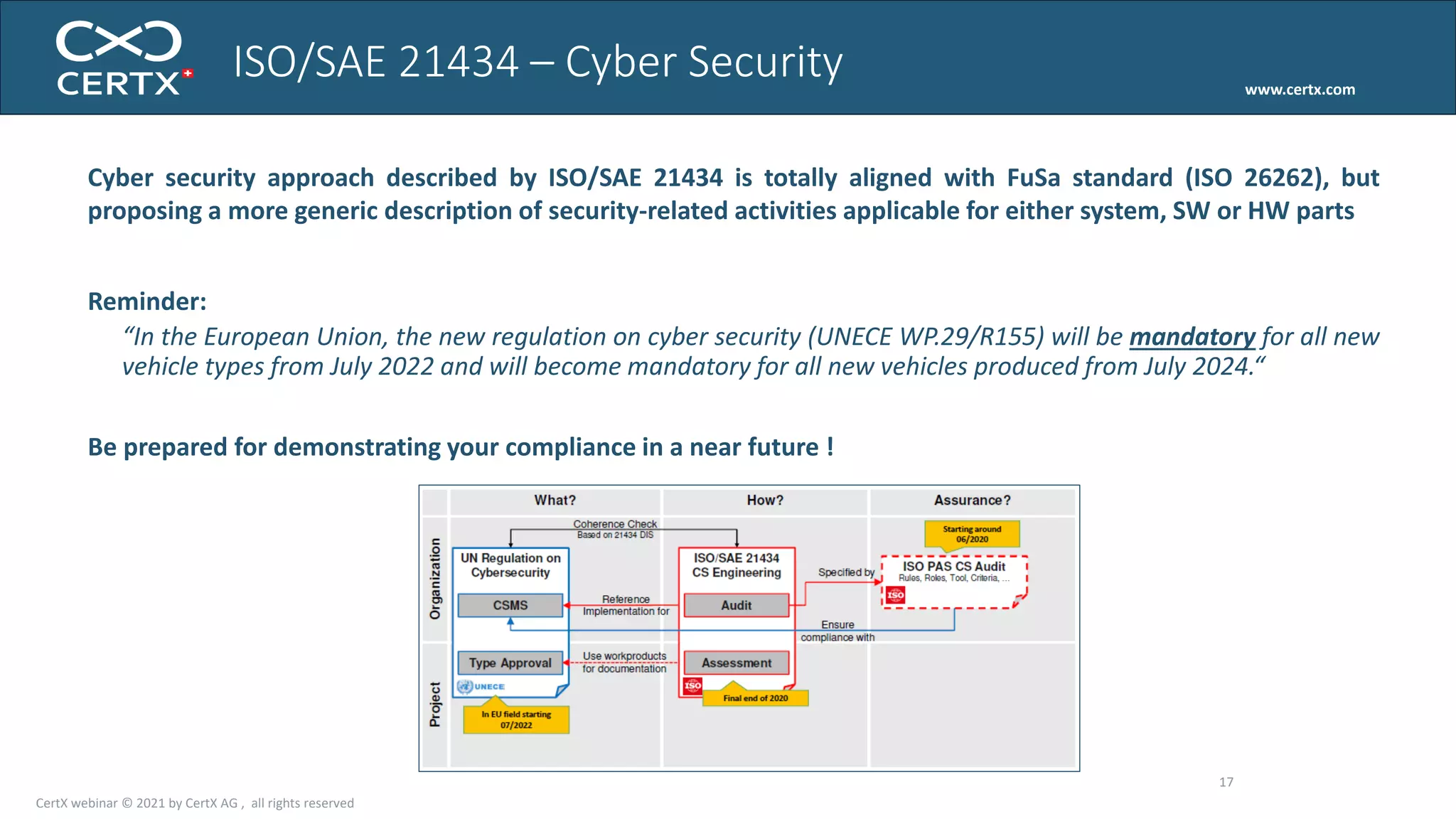
Cyber security approach described by ISO/SAE 21434 is totally aligned with FuSa standard (ISO 26262), but
proposing a more generic description of security-related activities applicable for either system, SW or HW parts
Reminder:
“In the European Union, the new regulation on cyber security (UNECE WP.29/R155) will be mandatory for all new
vehicle types from July 2022 and will become mandatory for all new vehicles produced from July 2024.“
Be prepared for demonstrating your compliance in a near future !
ISO/SAE 21434 – Cyber Security
17
CertX webinar © 2021 by CertX AG , all rights reserved
The information contained in this presentation is the property of CertX AG.
This presentation and extracts thereof may only be duplicated or forwarded tthird parties following
explicit written approval by CertX AG.
All product names used in this documentation are trademarks or otherwise protected by law, even if
not specifically indicated.
© 2020 by CertX AG.
Route Ancienne Papeterie 106
1723 Marly, Switzerland
www.certx.com
All rights reserved.
18
1
Confidential . EasyMile© . 2021
AUTONOMOUS FUTURE,
TODAY
EasyMile brings driverless vehicle solutions
for people and goods to life with leading technology,
providing a real service.
2
Confidential . EasyMile© . 2021
Autonomous solutions ready today
—
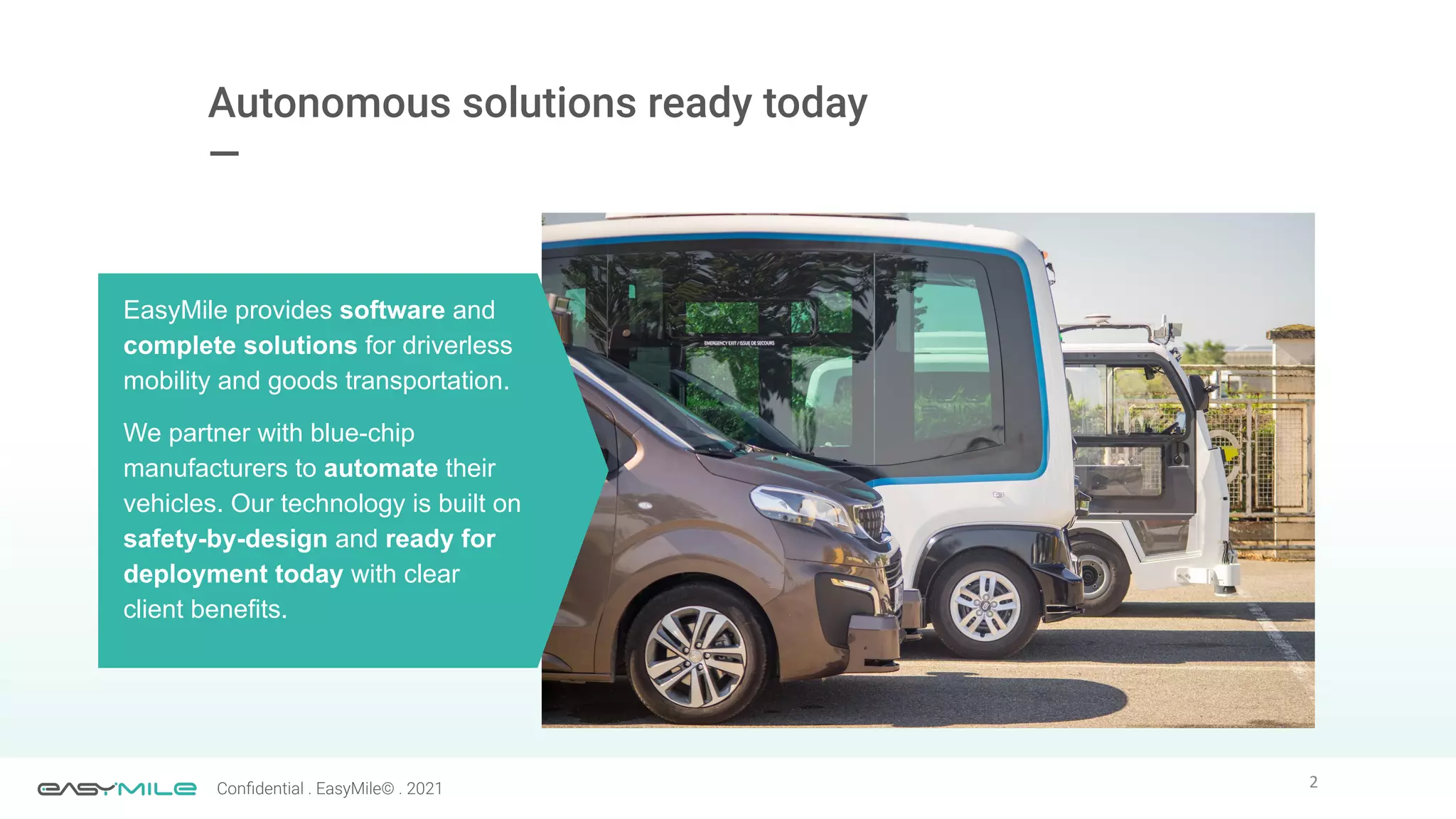
EasyMile provides software and
complete solutions for driverless
mobility and goods transportation.
We partner with blue-chip
manufacturers to automate their
vehicles. Our technology is built on
safety-by-design and ready for
deployment today with clear
client benefits.
3
Confidential . EasyMile© . 2021
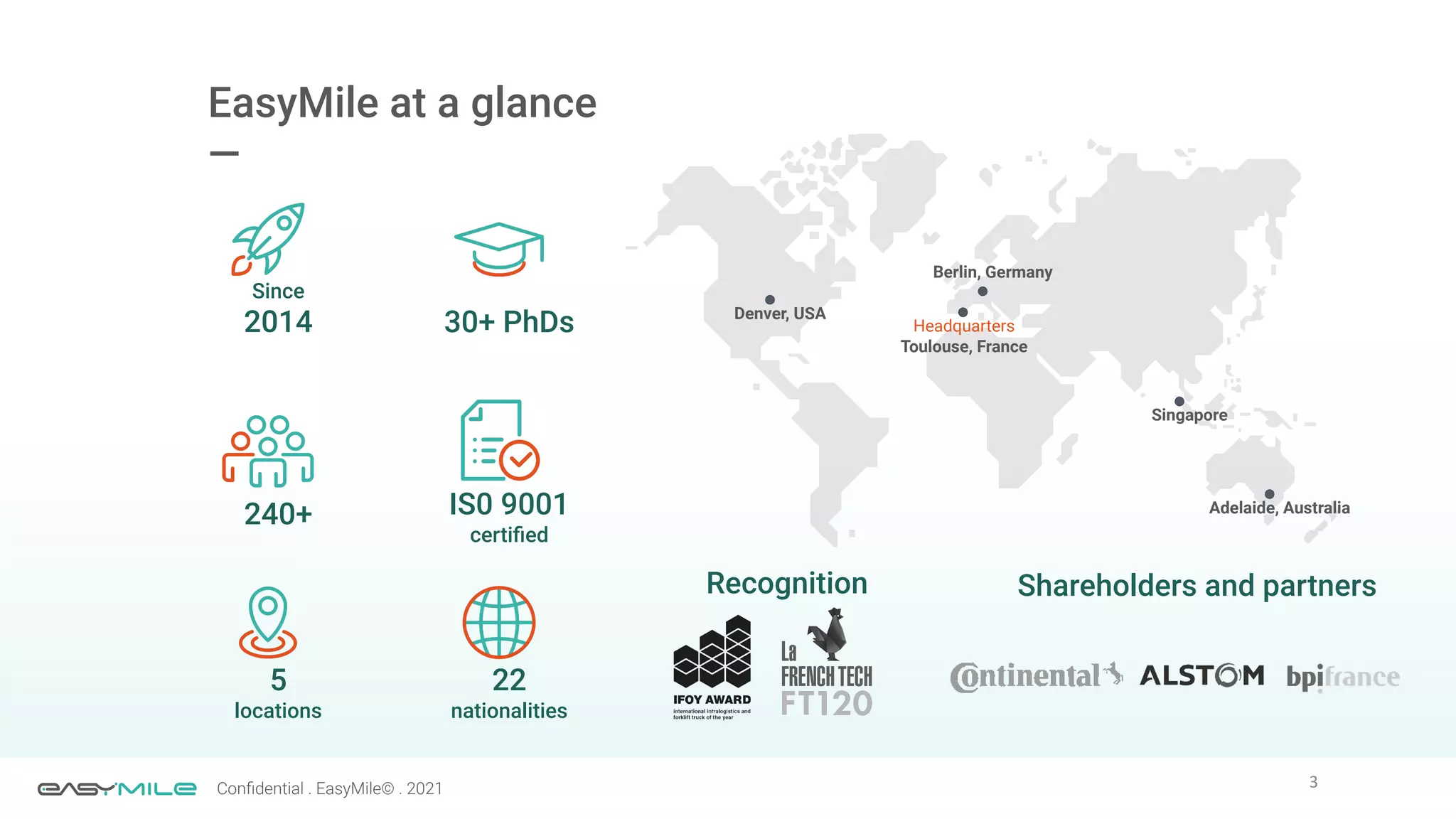
EasyMile at a glance
—
5
locations
22
nationalities
Shareholders and partners
Since
2014
240+
30+ PhDs
IS0 9001
certified
Denver, USA
Berlin, Germany
Singapore
Adelaide, Australia
Headquarters
Toulouse, France
Recognition
4
Confidential . EasyMile© . 2021
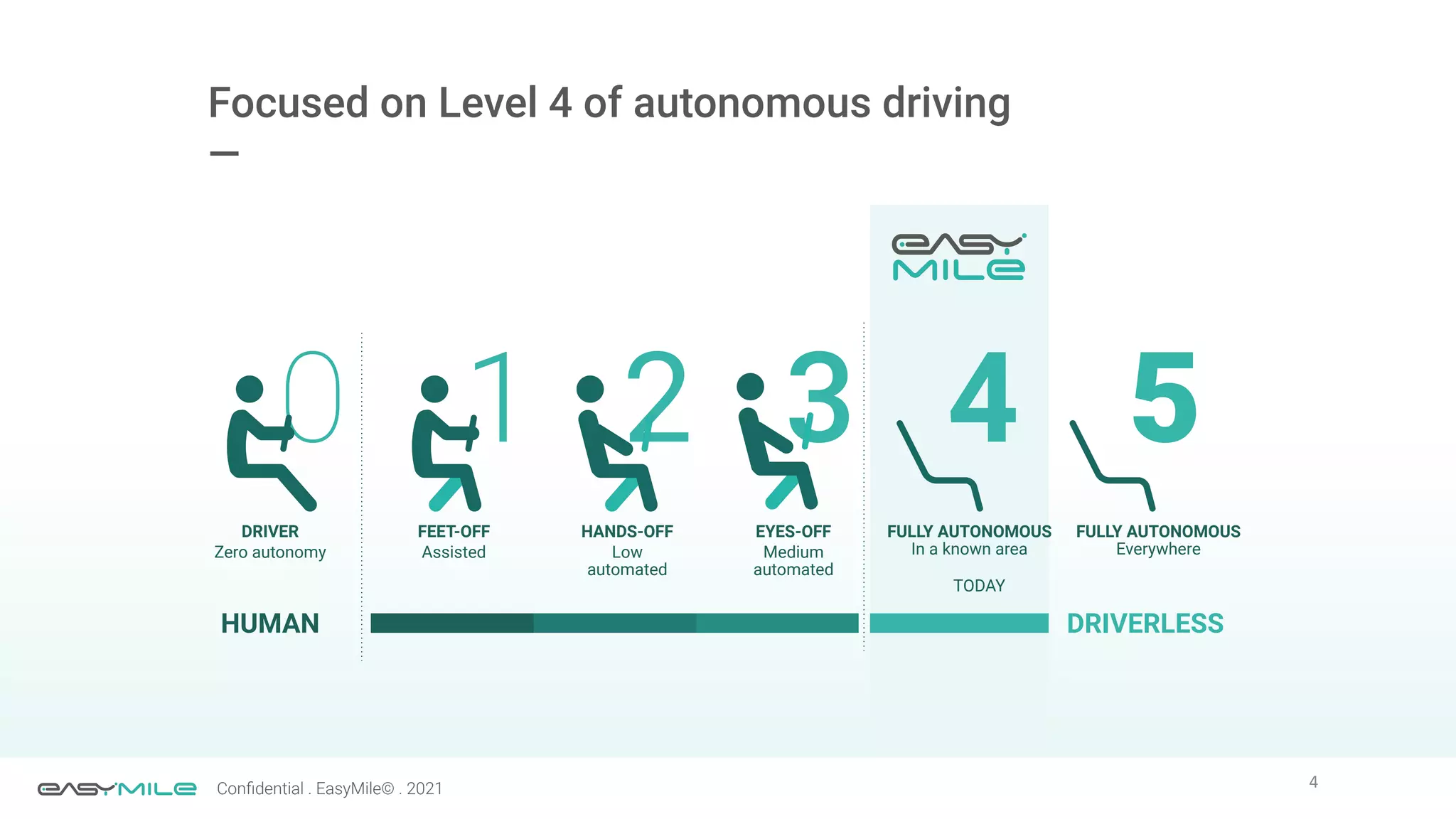
Focused on Level 4 of autonomous driving
—
DRIVERLESS
FULLY AUTONOMOUS
In a known area
4
DRIVER
Zero autonomy
0
FEET-OFF
Assisted
1
HANDS-OFF
Low
automated
2
EYES-OFF
Medium
automated
3
FULLY AUTONOMOUS
Everywhere
5
HUMAN
TODAY
5
Confidential . EasyMile© . 2021
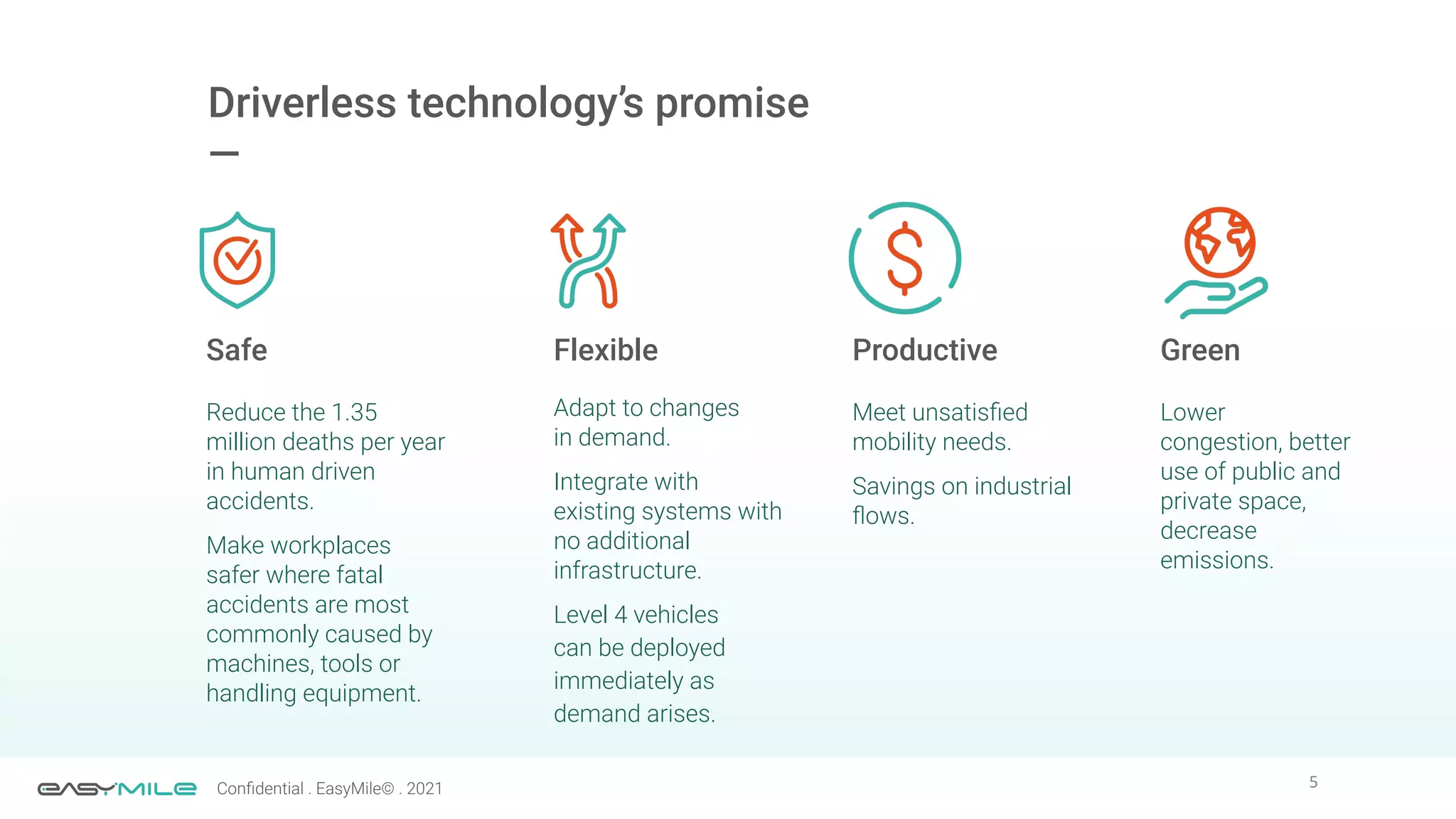
Driverless technology’s promise
—
Safe
Reduce the 1.35
million deaths per year
in human driven
accidents.
Make workplaces
safer where fatal
accidents are most
commonly caused by
machines, tools or
handling equipment.
Productive
Meet unsatisfied
mobility needs.
Savings on industrial
flows.
Green
Lower
congestion, better
use of public and
private space,
decrease
emissions.
Flexible
Adapt to changes
in demand.
Integrate with
existing systems with
no additional
infrastructure.
Level 4 vehicles
can be deployed
immediately as
demand arises.
6
Confidential . EasyMile© . 2021
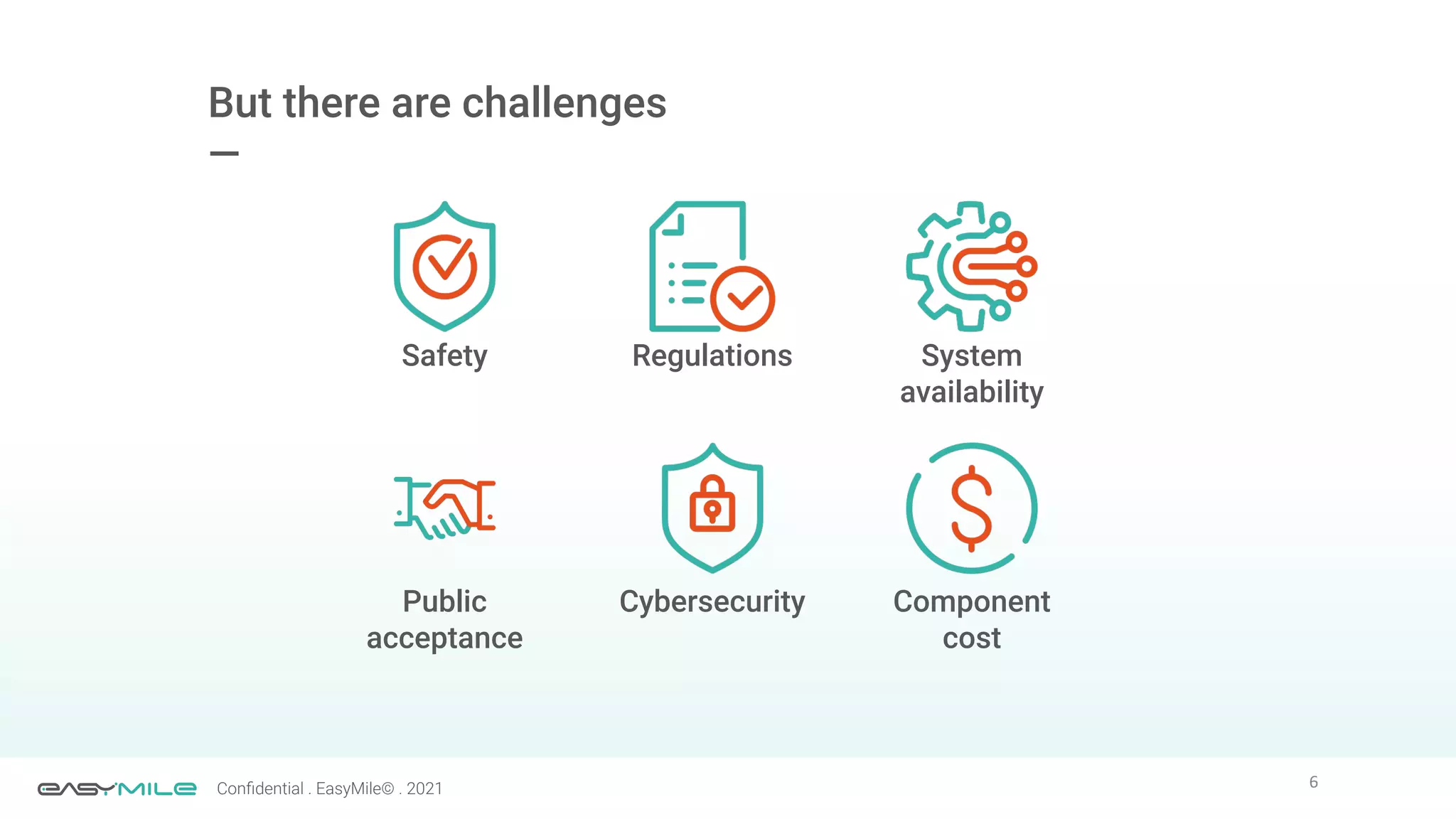
But there are challenges
—
System
availability
Component
cost
Regulations
Cybersecurity
Safety
Public
acceptance
7
Confidential . EasyMile© . 2021
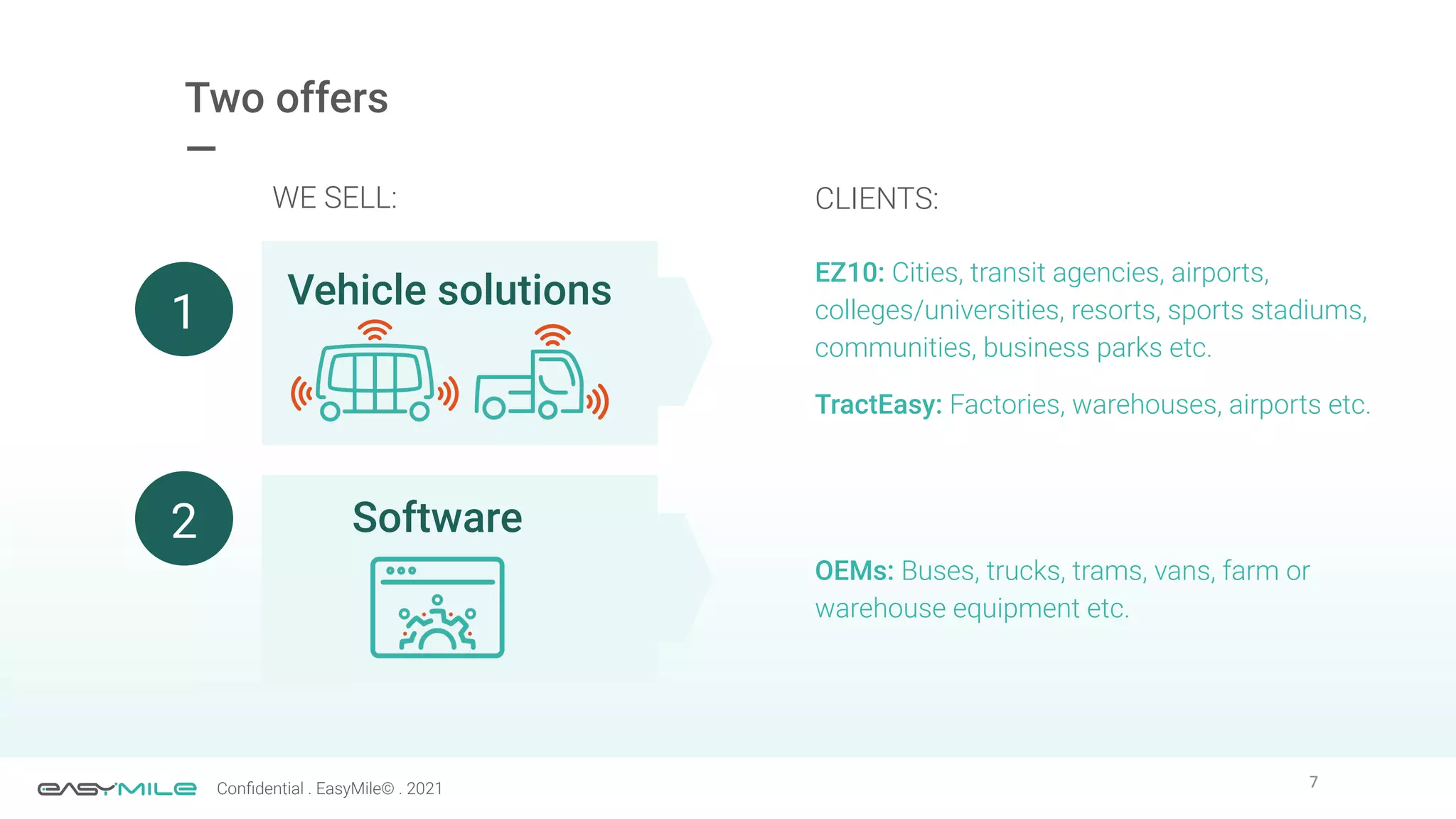
Two offers
—
Vehicle solutions
EZ10: Cities, transit agencies, airports,
colleges/universities, resorts, sports stadiums,
communities, business parks etc.
TractEasy: Factories, warehouses, airports etc.
CLIENTS:
Software
OEMs: Buses, trucks, trams, vans, farm or
warehouse equipment etc.
WE SELL:
1
2
8
Confidential . EasyMile© . 2021
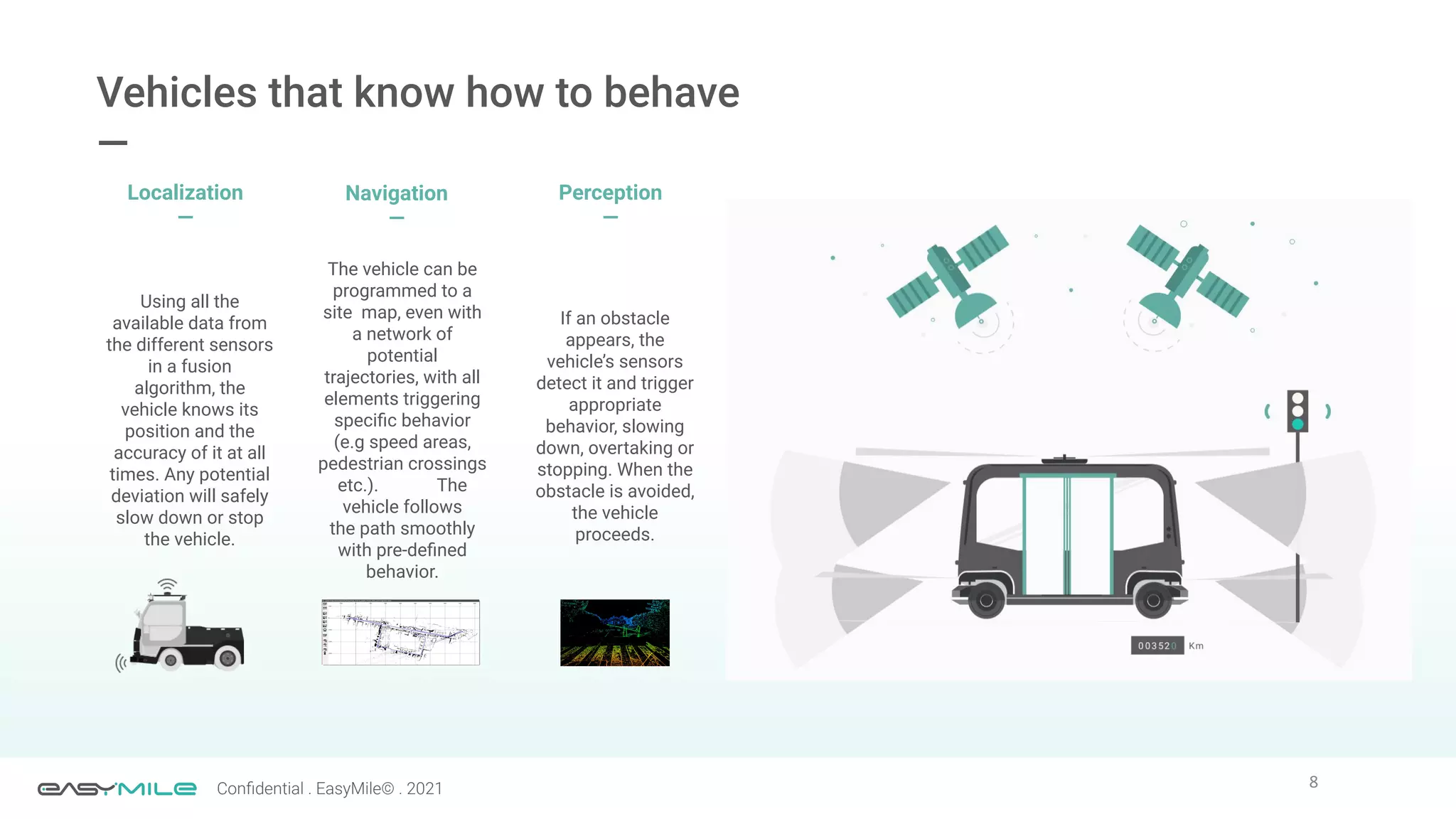
Using all the
available data from
the different sensors
in a fusion
algorithm, the
vehicle knows its
position and the
accuracy of it at all
times. Any potential
deviation will safely
slow down or stop
the vehicle.
The vehicle can be
programmed to a
site map, even with
a network of
potential
trajectories, with all
elements triggering
specific behavior
(e.g speed areas,
pedestrian crossings
etc.). The
vehicle follows
the path smoothly
with pre-defined
behavior.
If an obstacle
appears, the
vehicle’s sensors
detect it and trigger
appropriate
behavior, slowing
down, overtaking or
stopping. When the
obstacle is avoided,
the vehicle
proceeds.
Navigation
—
Perception
—
Localization
—
Vehicles that know how to behave
—
9
Confidential . EasyMile© . 2021
Safety Critical System V&V
—
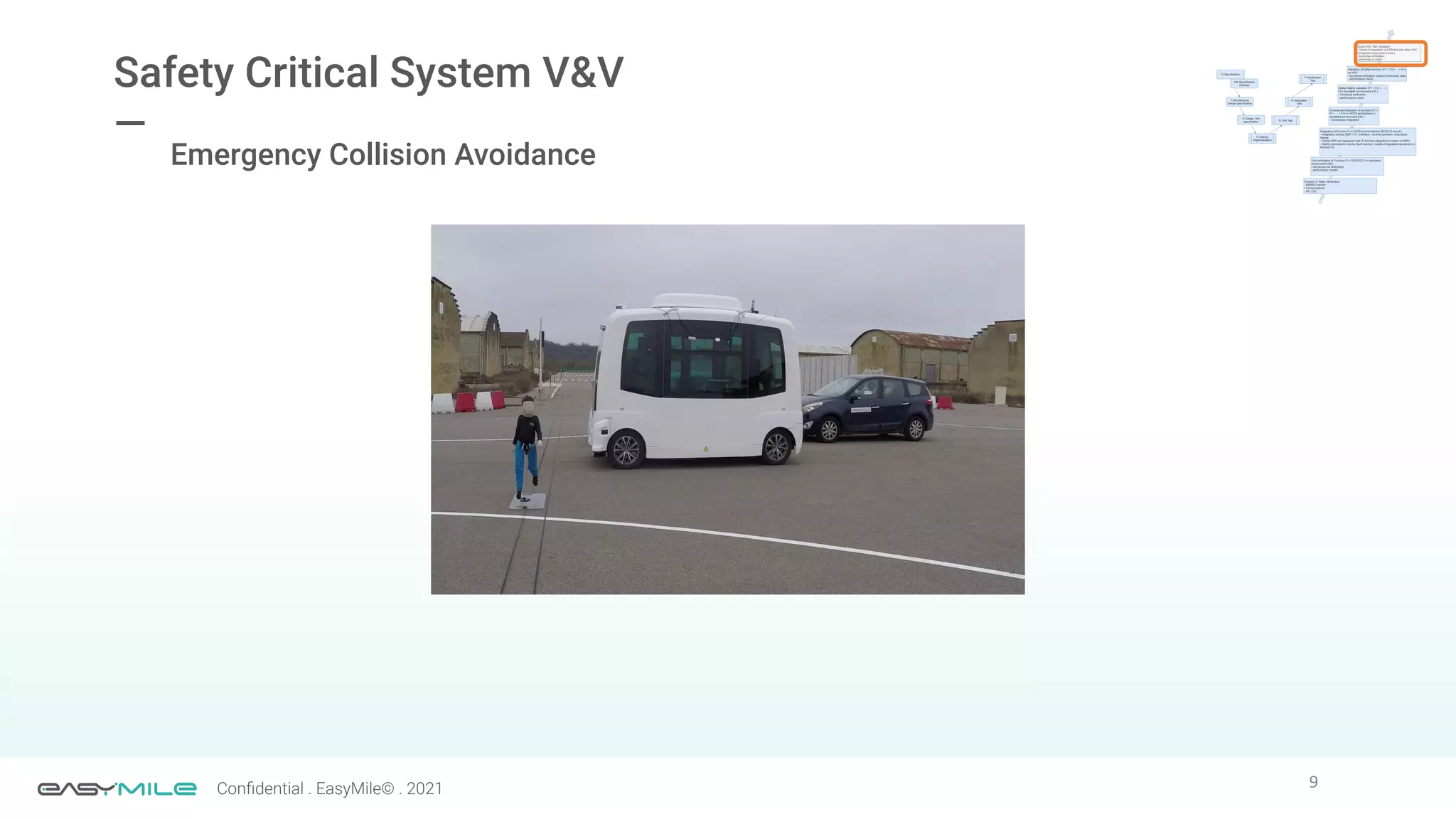
Emergency Collision Avoidance
10
Confidential . EasyMile© . 2021
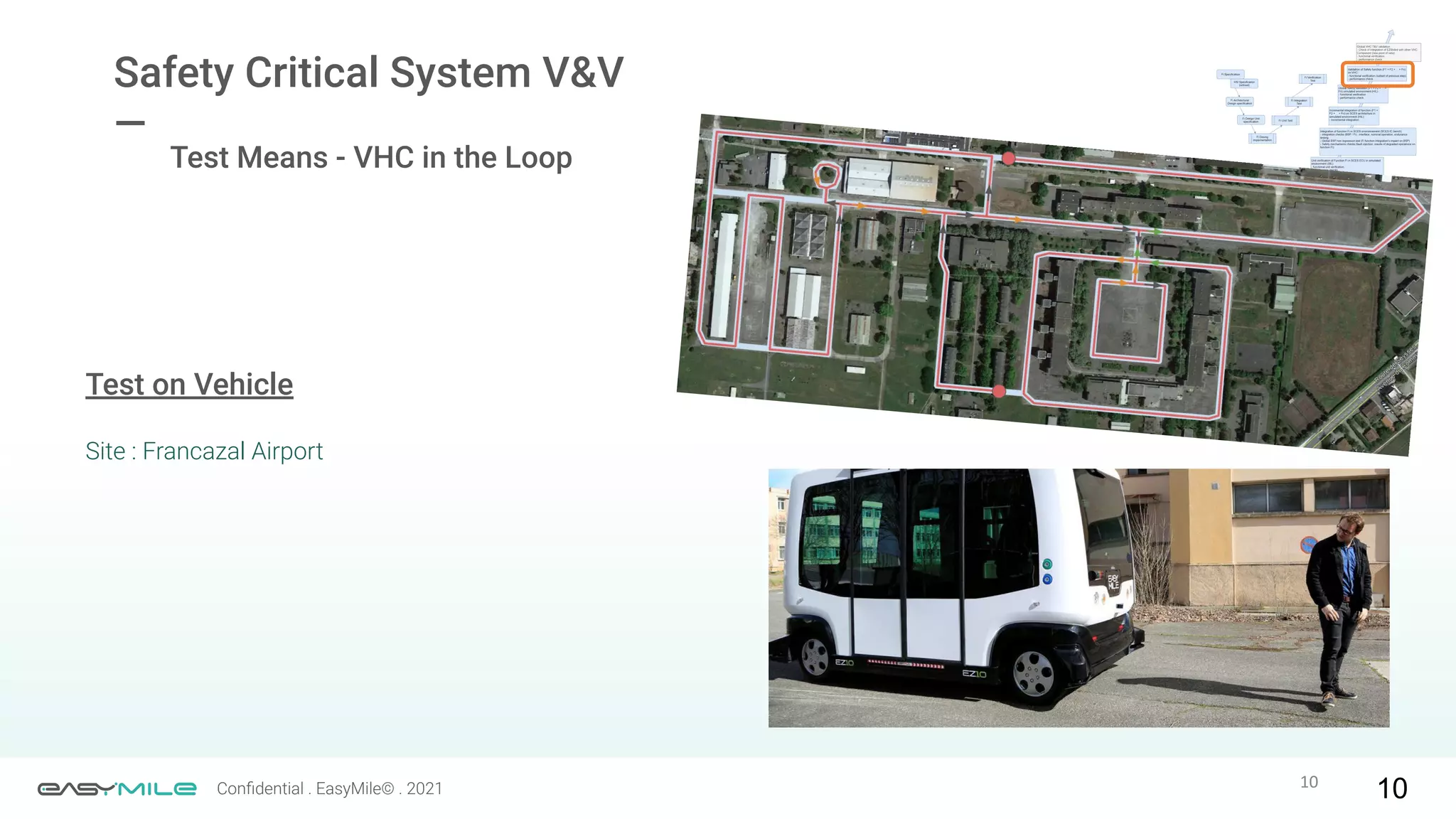
Test Means - VHC in the Loop
Test on Vehicle
Site : Francazal Airport
10
Safety Critical System V&V
—
11
Confidential . EasyMile© . 2021
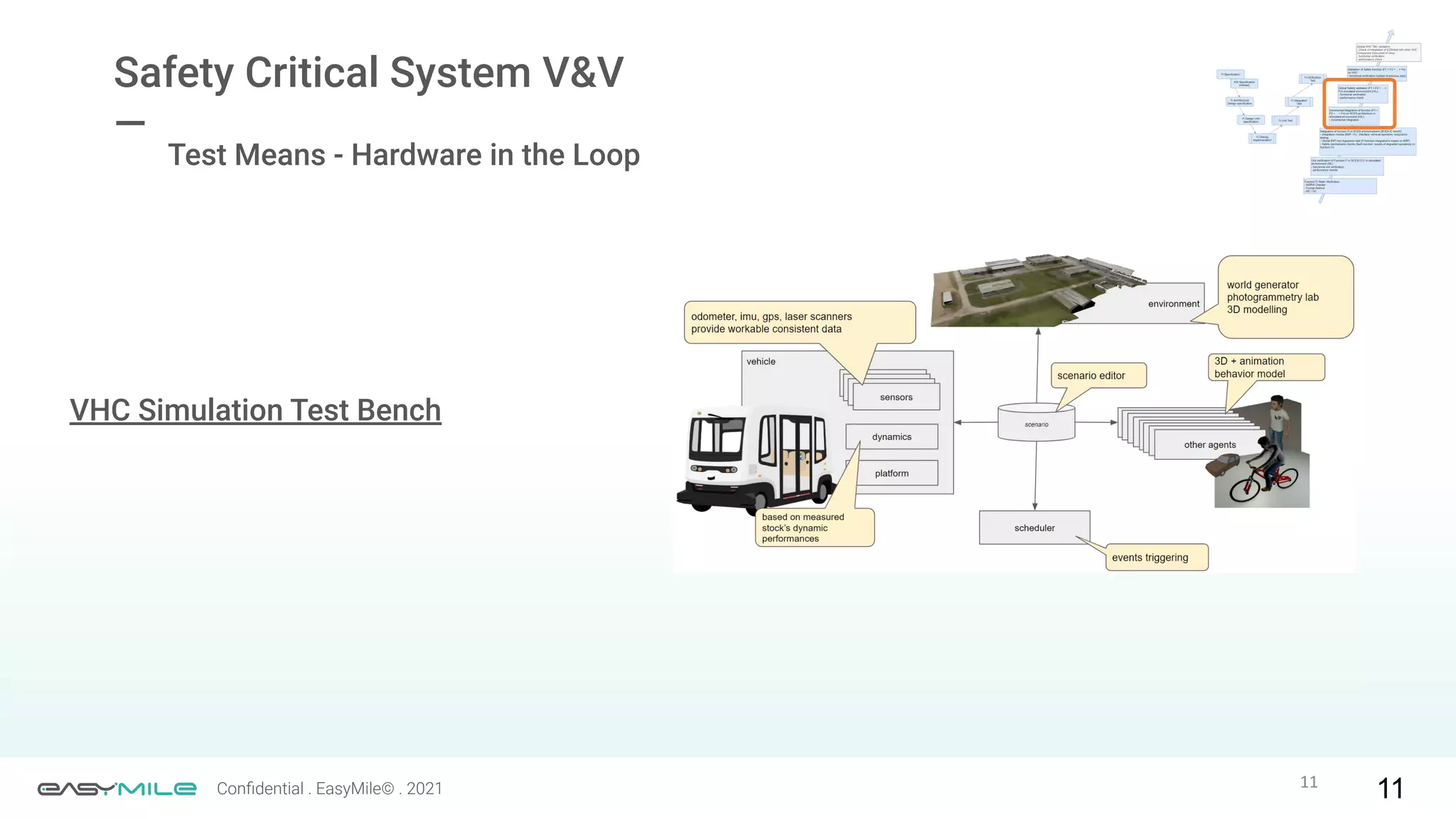
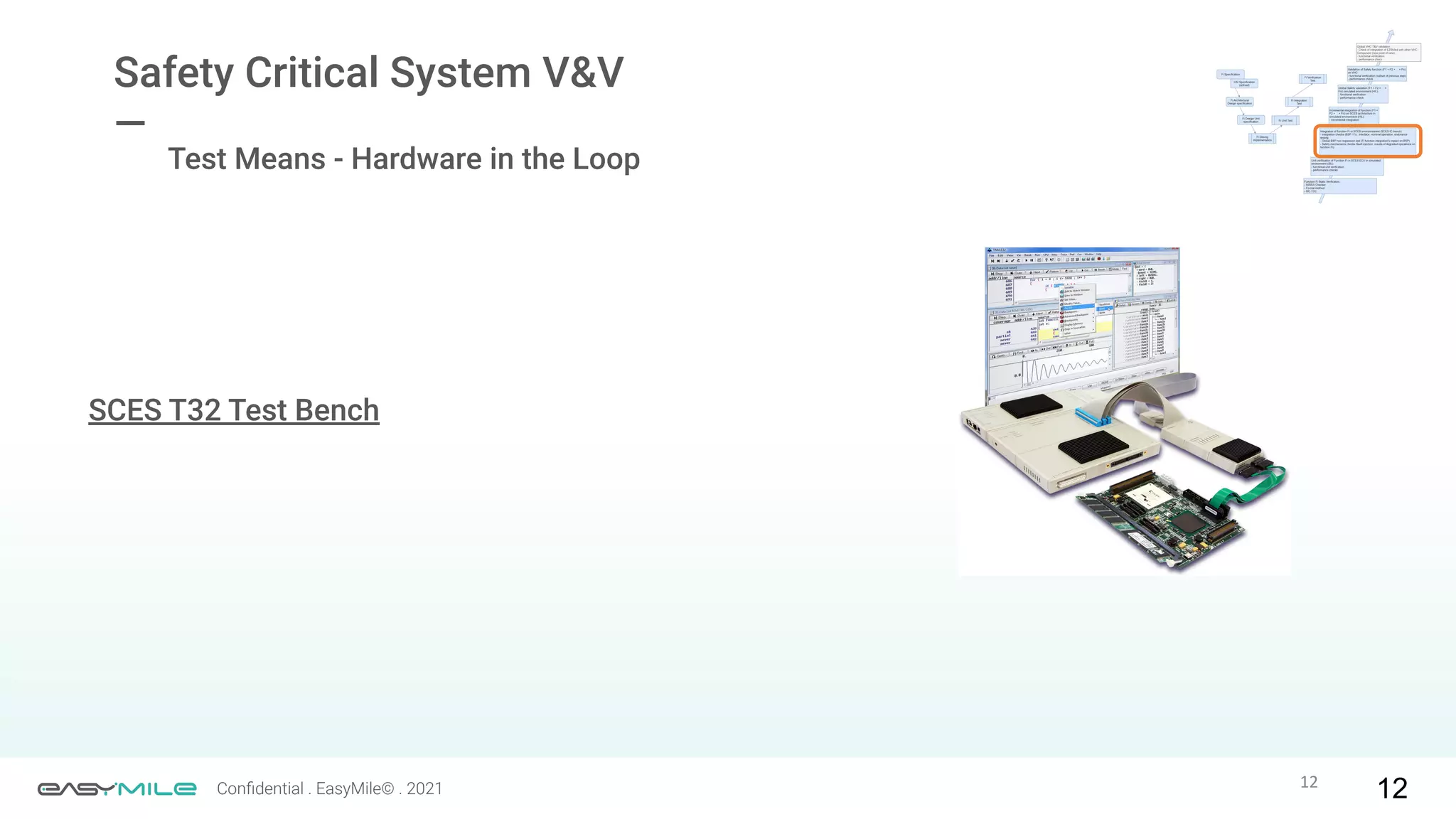
Test Means - Hardware in the Loop
VHC Simulation Test Bench
11
Safety Critical System V&V
—
12
Confidential . EasyMile© . 2021
Test Means - Hardware in the Loop
SCES T32 Test Bench
12
Safety Critical System V&V
—
13
Confidential . EasyMile© . 2021
Static Verification tools (CI)
13
Safety Critical System V&V
—
Test Means - Software in the Loop
14
Confidential . EasyMile© . 2021
Thank you
—
Connect with us:
#EasyMile
March 29th, 2021
Ma t h e m a t ica lly
Gu a ra n t e e d
C a n d C++ Co d e
Fabrice Derepas
Co-founder
CEO TrustInSoft
@fderepas
Formal methods for human beings
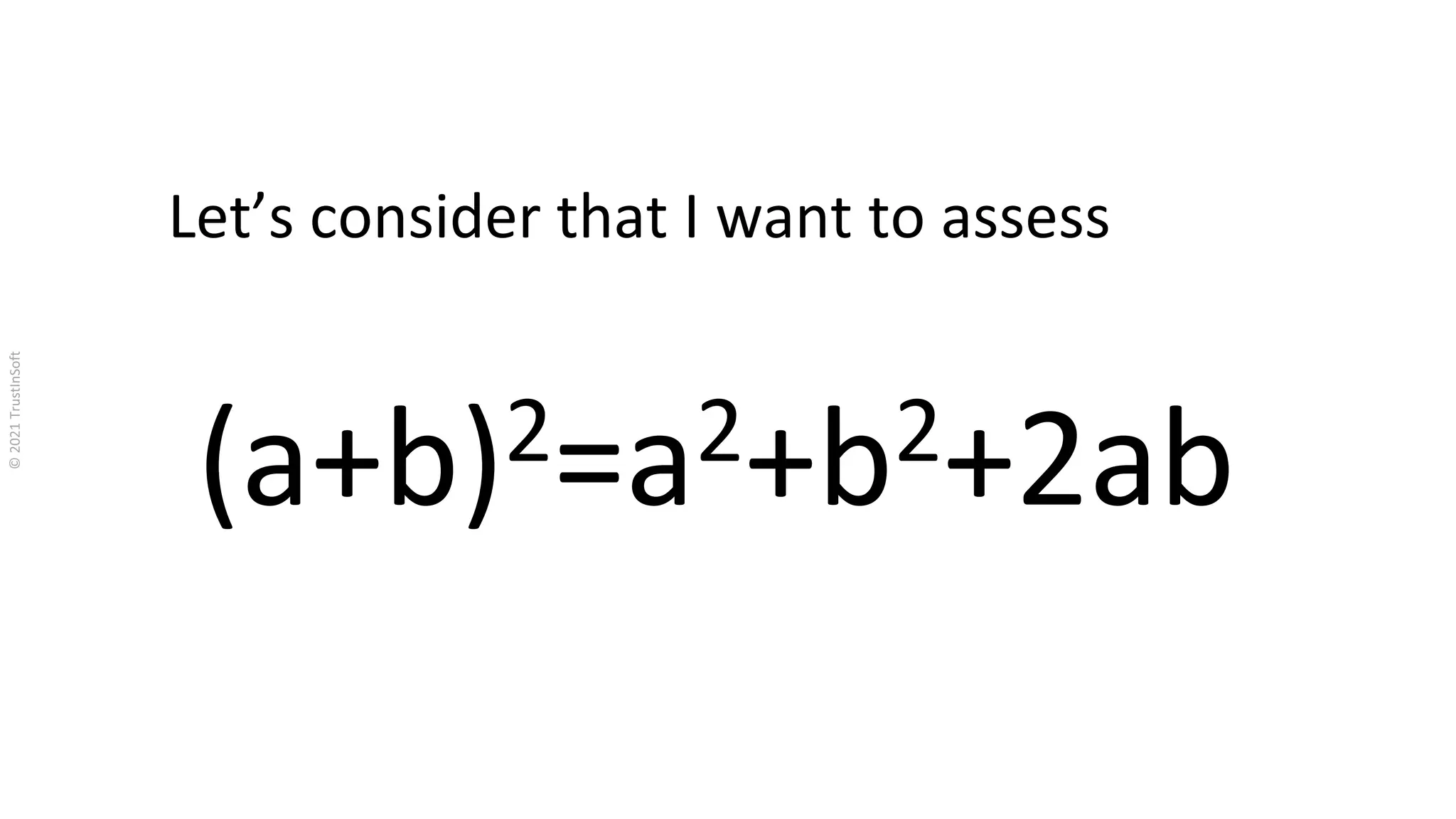
Let’s consider that I want to assess
(a+b)2=a2+b2+2ab
I am going to compute this formula
for, let’s say, 10,000 values for (a,b).
I think that I will have a good idea if
the formula holds or not!
Would that still work with larger
numbers? Did I miss any corner cases
(INT_MAX or INT_MIN)
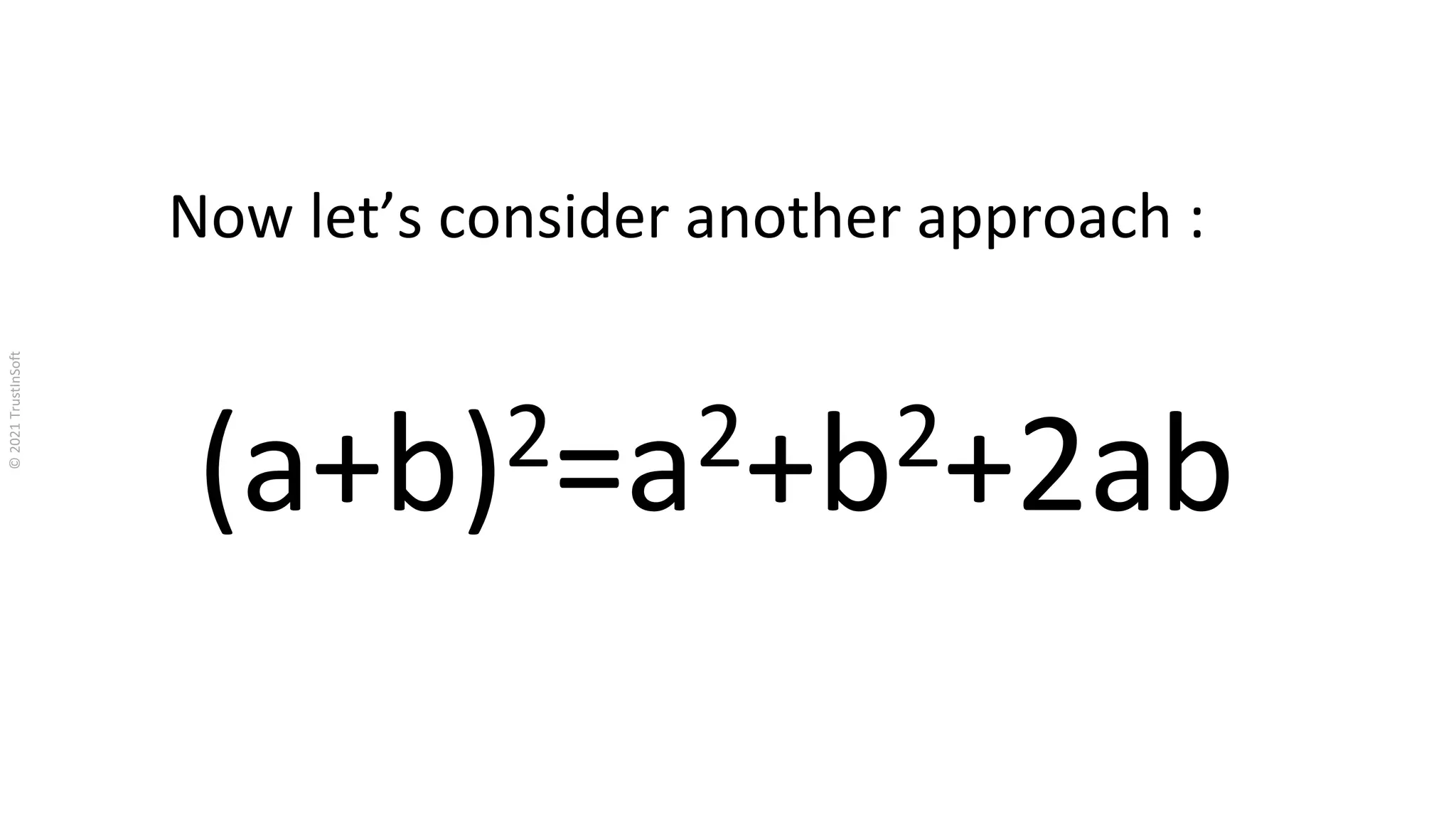
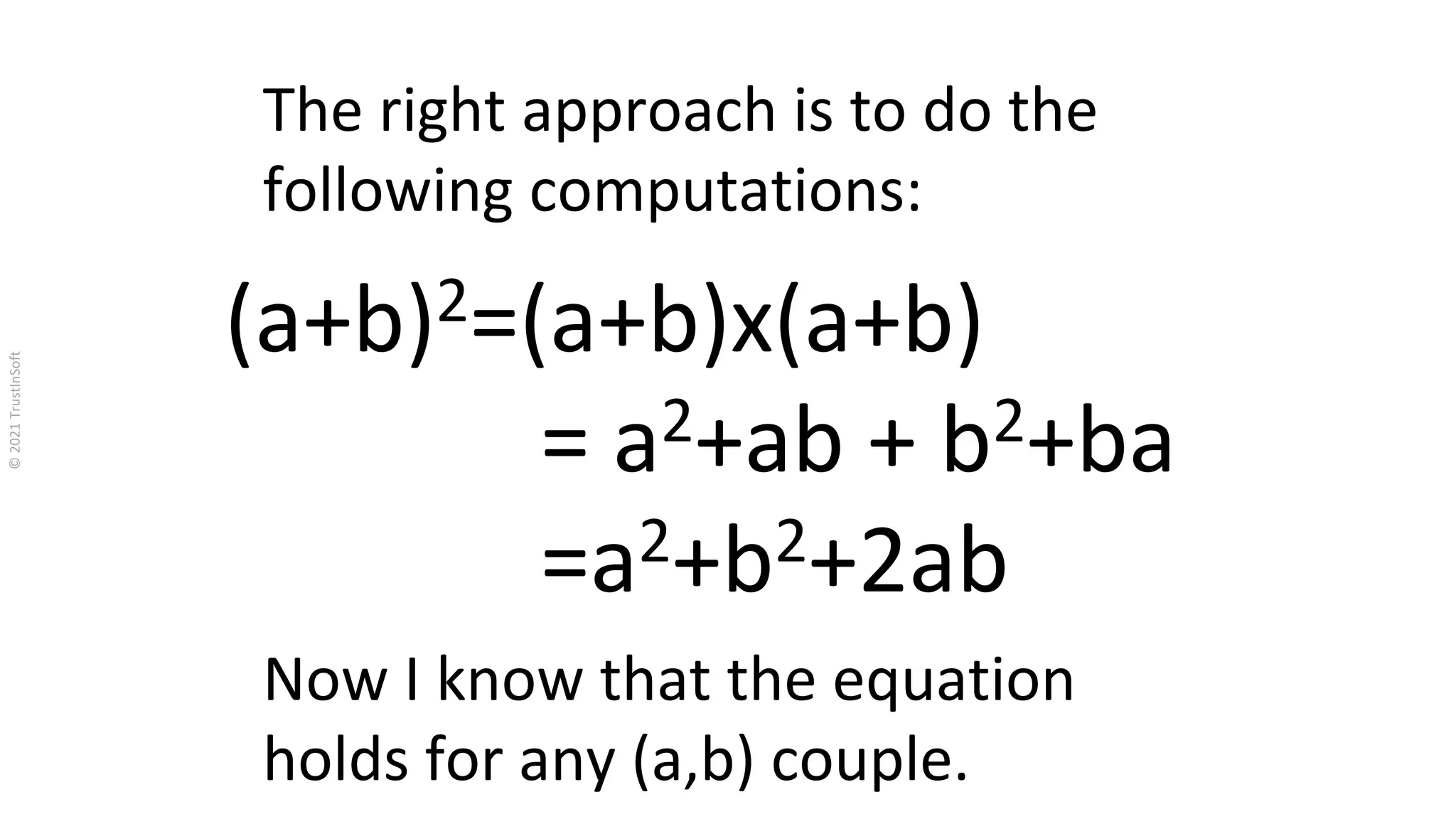
Now let’s consider another approach :
(a+b)2=a2+b2+2ab
(a+b)2=(a+b)x(a+b)
= a2+ab + b2+ba
=a2+b2+2ab
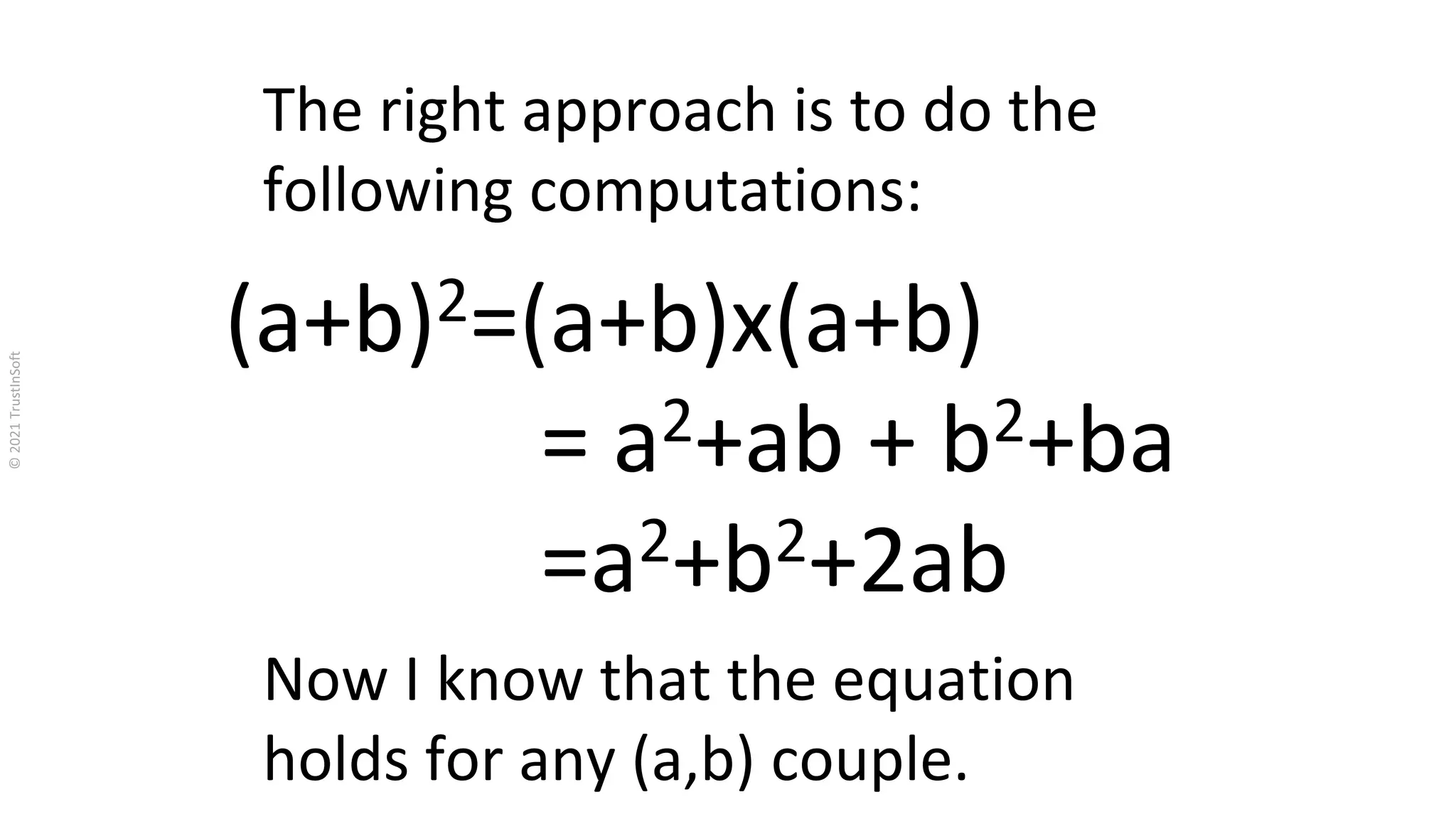
The right approach is to do the
following computations:
Now I know that the equation
holds for any (a,b) couple.
We do just that, on software.
Three examples
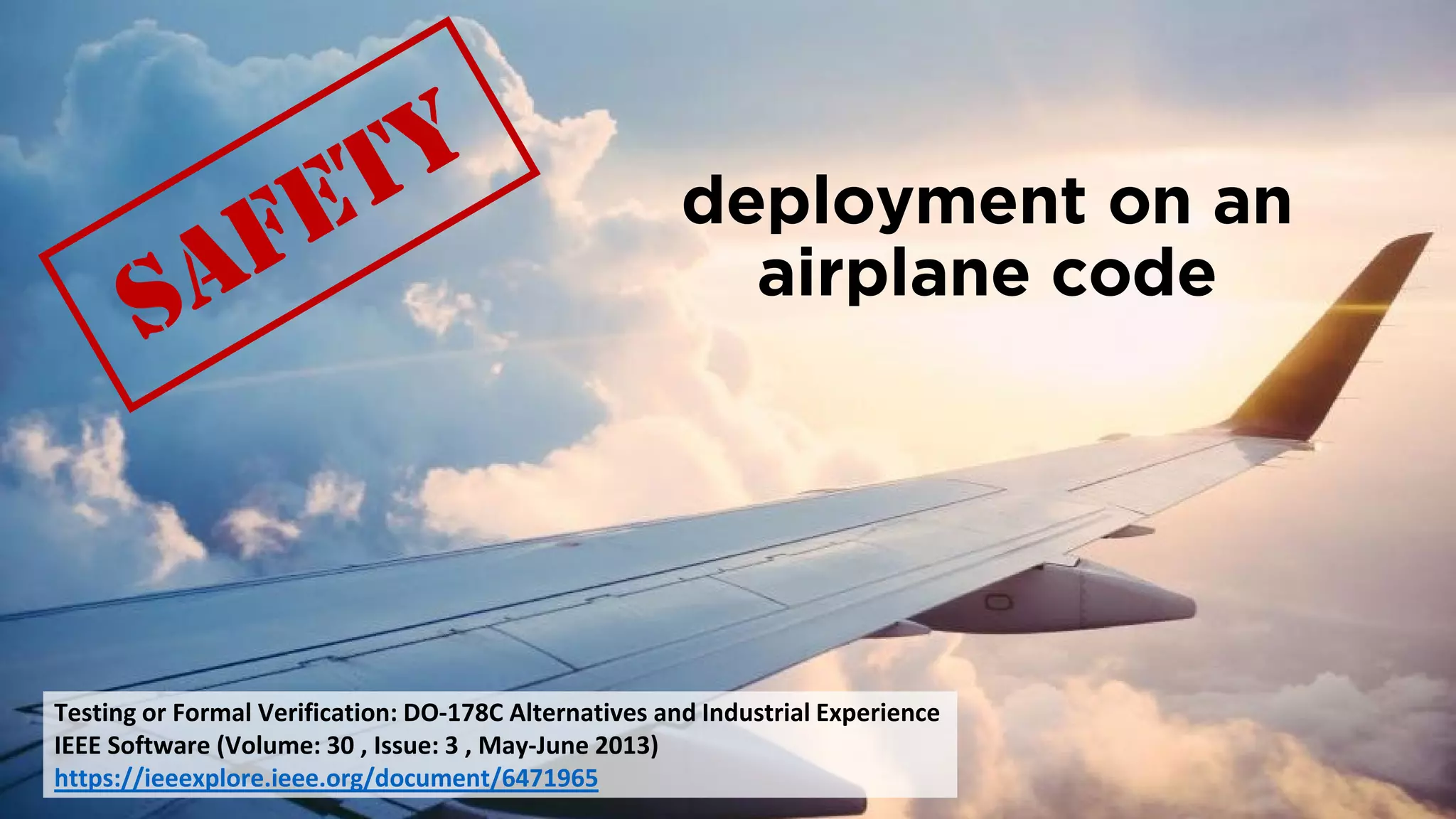
deployment on an
airplane code
Testing or Formal Verification: DO-178C Alternatives and Industrial Experience
IEEE Software (Volume: 30 , Issue: 3 , May-June 2013)
https://ieeexplore.ieee.org/document/6471965
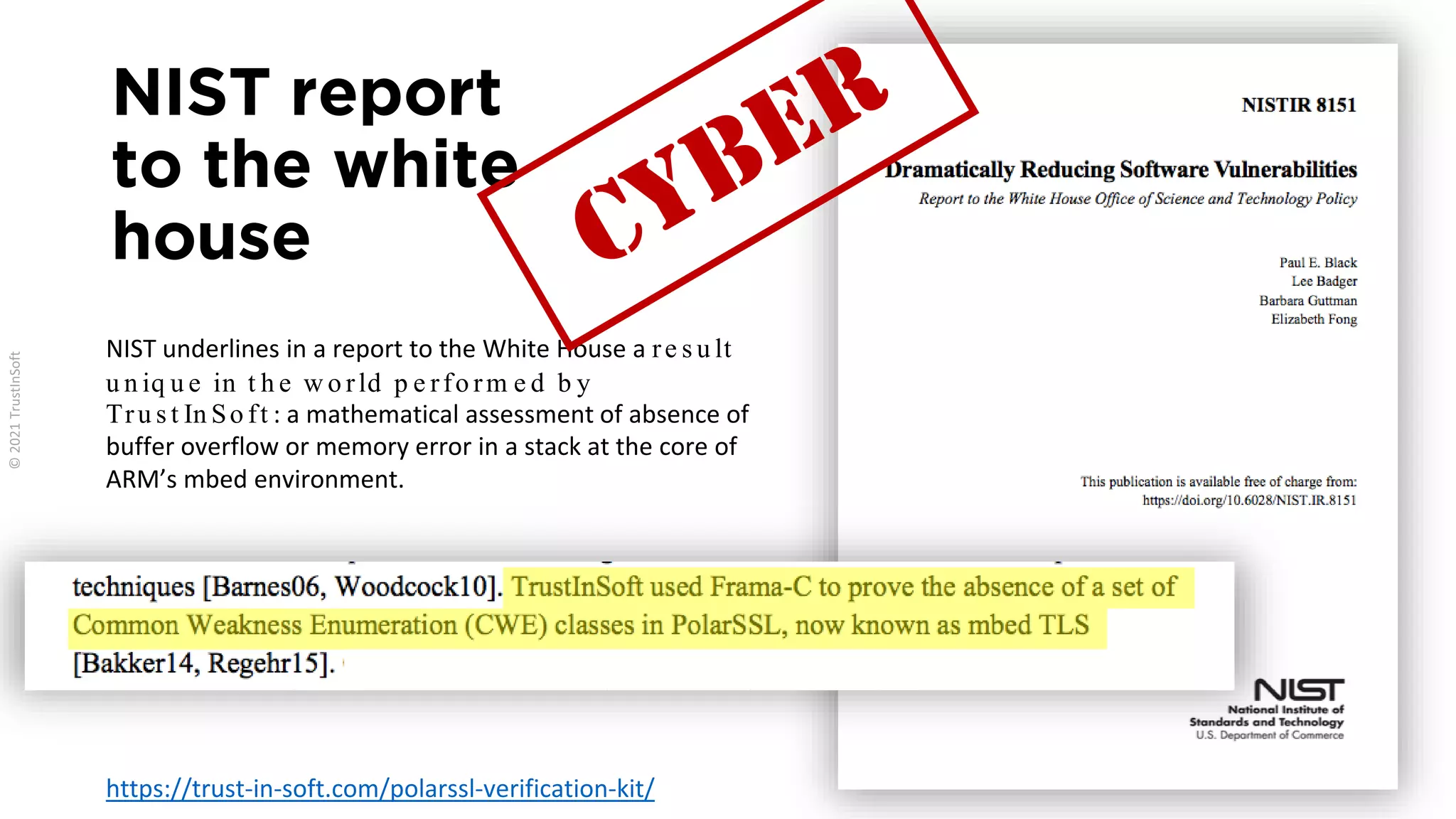
NIST report
to the white
house
NIST underlines in a report to the White House a re s u lt
u n iq u e in t h e w o rld p e rfo rm e d b y
Tru s t In So ft : a mathematical assessment of absence of
buffer overflow or memory error in a stack at the core of
ARM’s mbed environment.
https://trust-in-soft.com/polarssl-verification-kit/
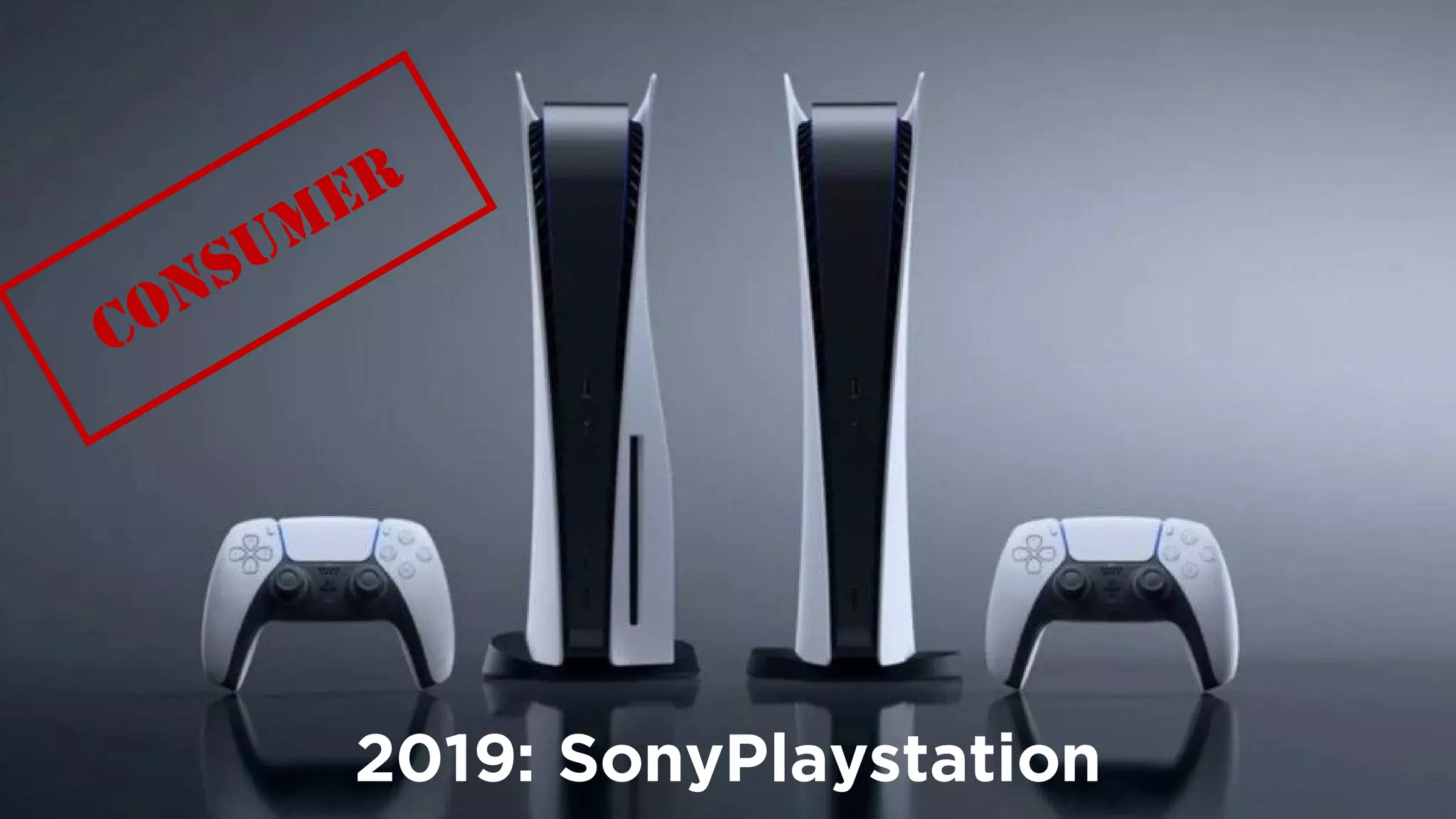
2019: SonyPlaystation
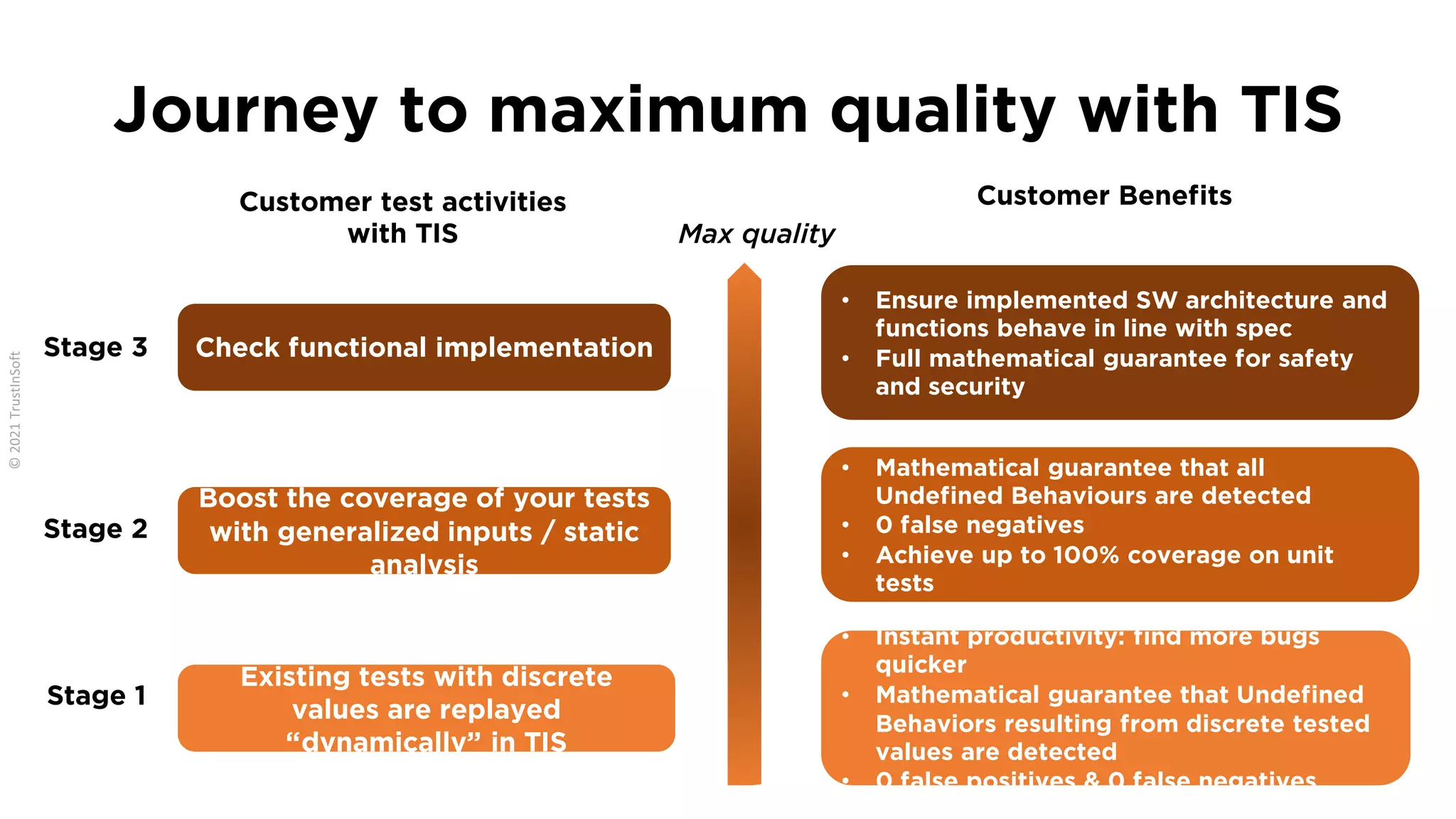
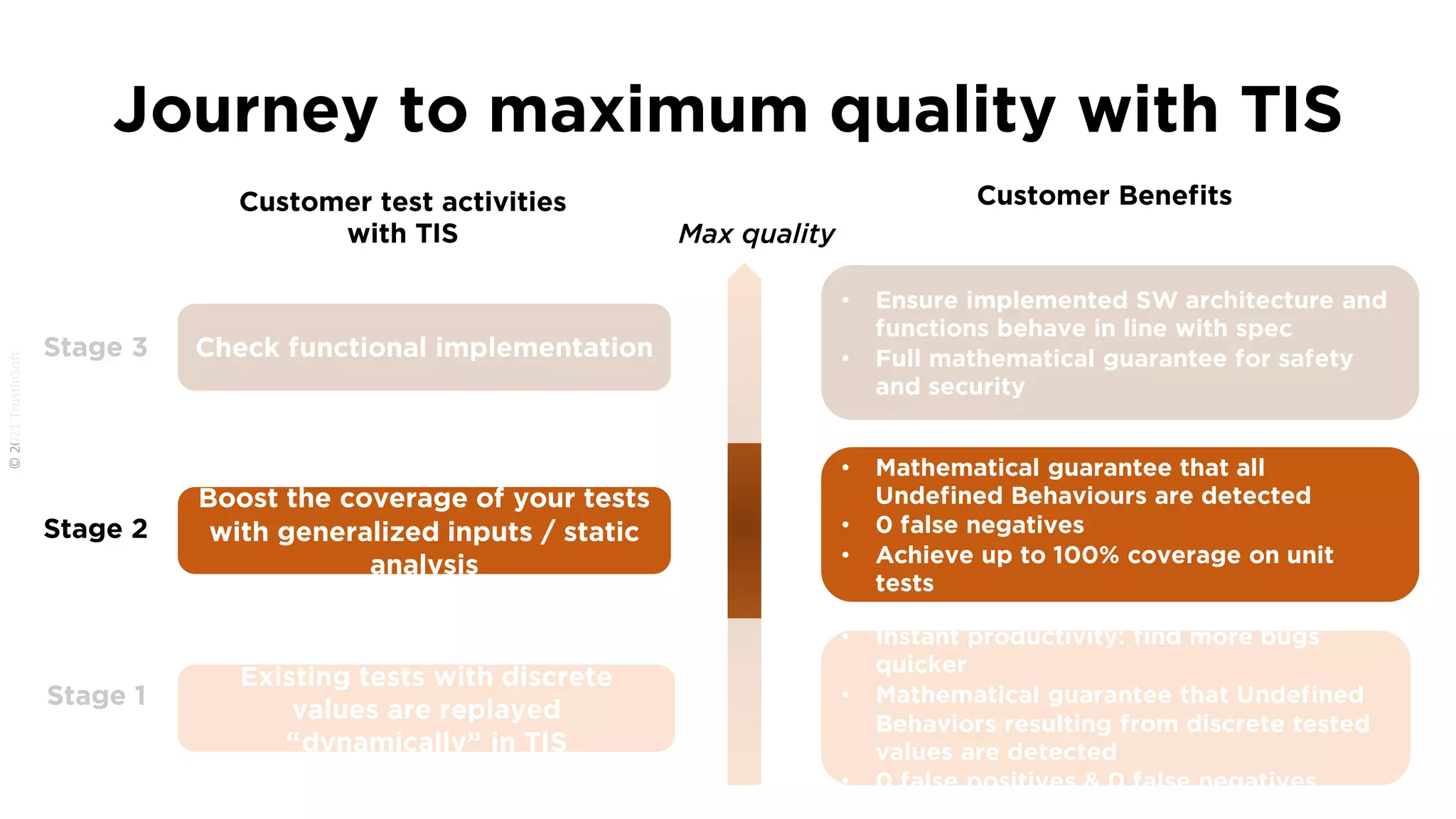
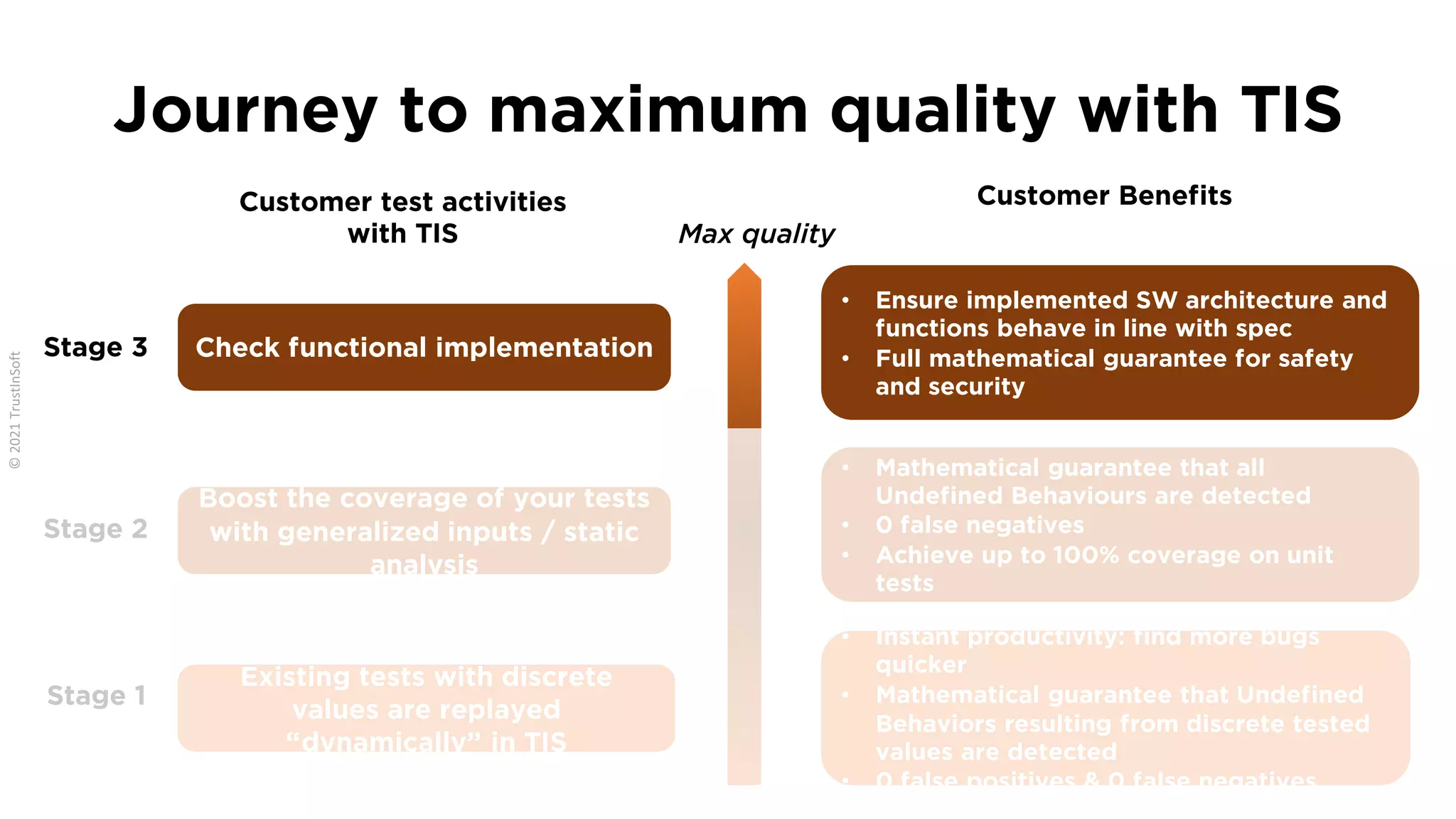
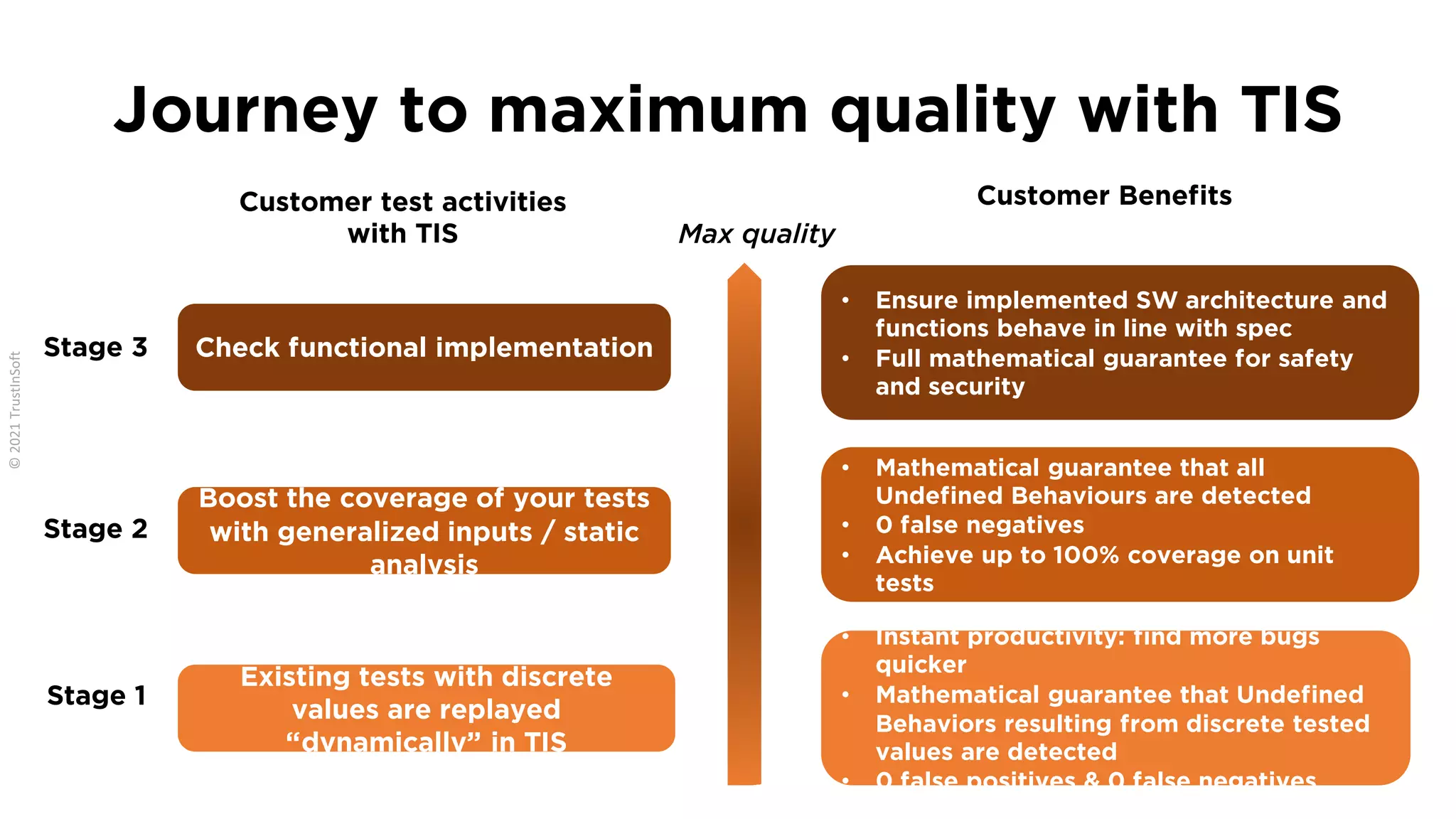
Journey to maximum quality with TIS
Boost the coverage of your tests
with generalized inputs / static
analysis
Check functional implementation
Customer test activities
with TIS
Stage 3
Stage 2
Stage 1
Customer Benefits
• Ensure implemented SW architecture and
functions behave in line with spec
• Full mathematical guarantee for safety
and security
• Mathematical guarantee that all
Undefined Behaviours are detected
• 0 false negatives
• Achieve up to 100% coverage on unit
tests
• Instant productivity: find more bugs
quicker
• Mathematical guarantee that Undefined
Behaviors resulting from discrete tested
values are detected
• 0 false positives & 0 false negatives
Existing tests with discrete
values are replayed
“dynamically” in TIS
Max quality
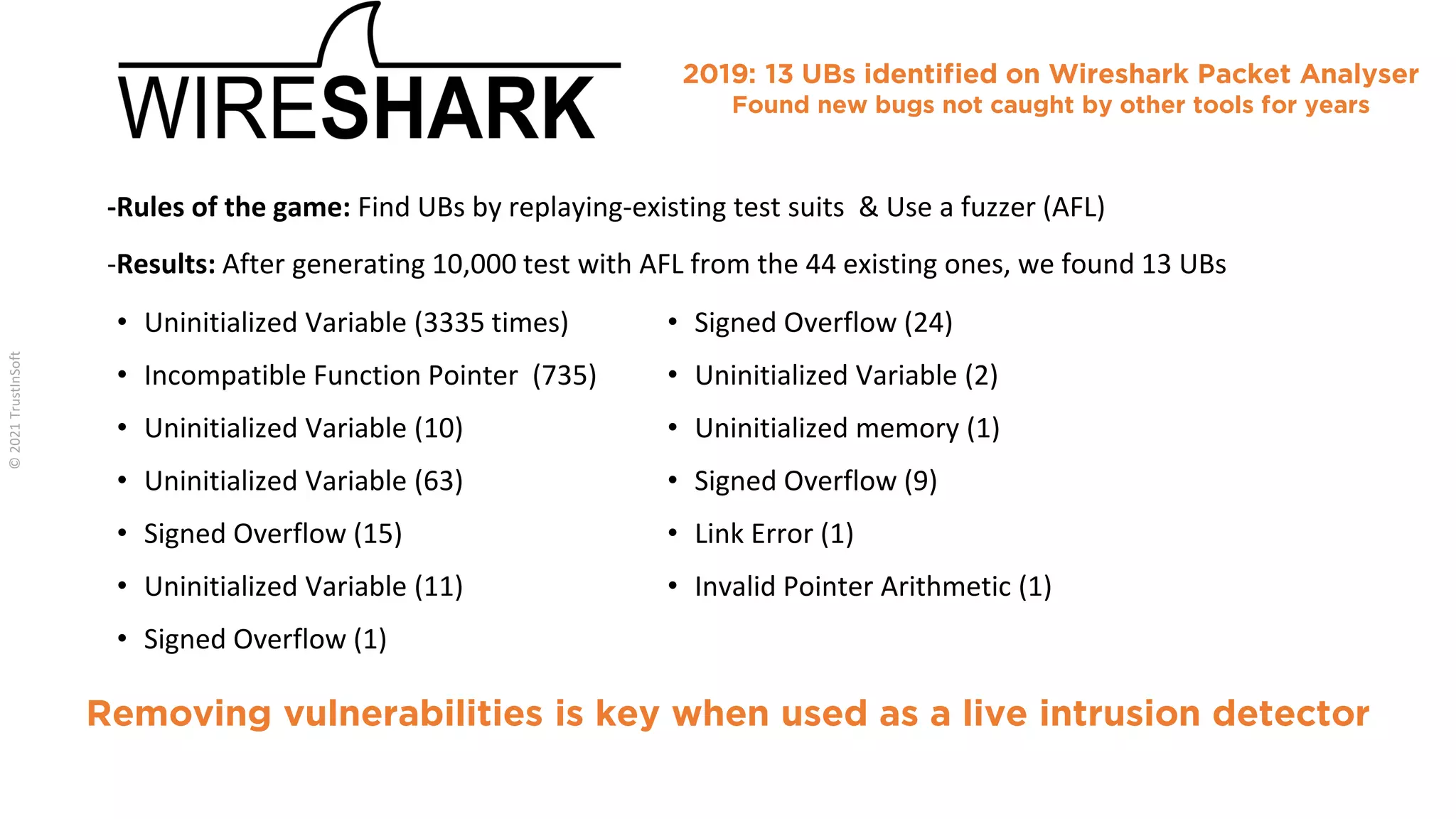
• Signed Overflow (24)
• Uninitialized Variable (2)
• Uninitialized memory (1)
• Signed Overflow (9)
• Link Error (1)
• Invalid Pointer Arithmetic (1)
• Uninitialized Variable (3335 times)
• Incompatible Function Pointer (735)
• Uninitialized Variable (10)
• Uninitialized Variable (63)
• Signed Overflow (15)
• Uninitialized Variable (11)
• Signed Overflow (1)
-Rules of the game: Find UBs by replaying-existing test suits & Use a fuzzer (AFL)
-Results: After generating 10,000 test with AFL from the 44 existing ones, we found 13 UBs
Removing vulnerabilities is key when used as a live intrusion detector
2019: 13 UBs identified on Wireshark Packet Analyser
Found new bugs not caught by other tools for years
Journey to maximum quality with TIS
Boost the coverage of your tests
with generalized inputs / static
analysis
Check functional implementation
Customer test activities
with TIS
Stage 3
Stage 2
Stage 1
Customer Benefits
• Ensure implemented SW architecture and
functions behave in line with spec
• Full mathematical guarantee for safety
and security
• Mathematical guarantee that all
Undefined Behaviours are detected
• 0 false negatives
• Achieve up to 100% coverage on unit
tests
• Instant productivity: find more bugs
quicker
• Mathematical guarantee that Undefined
Behaviors resulting from discrete tested
values are detected
• 0 false positives & 0 false negatives
Existing tests with discrete
values are replayed
“dynamically” in TIS
Max quality
toy example
Compute 2^4 in a virtual machine
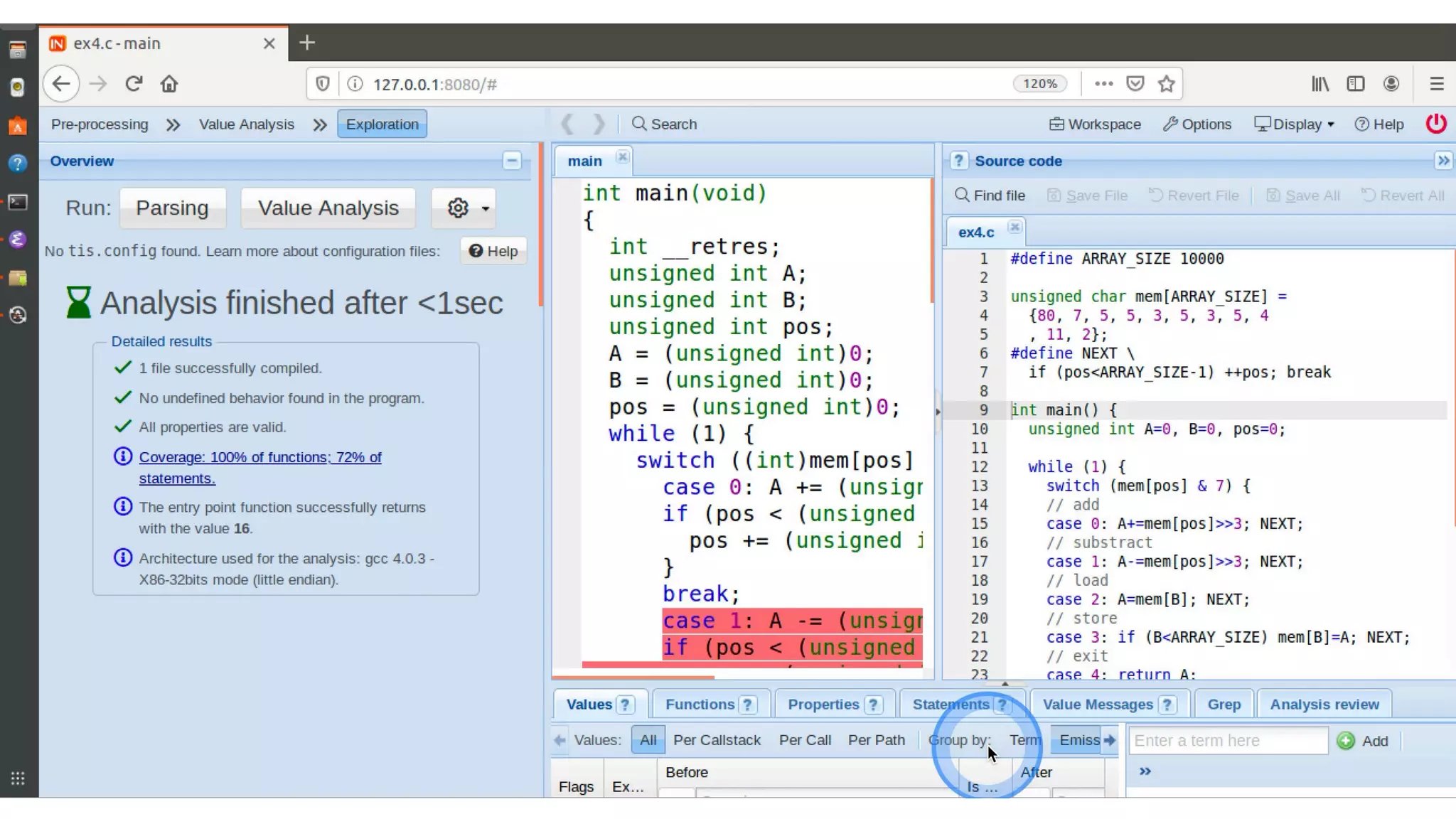
#define ARRAY_SIZE 10000
unsigned char mem[ARRAY_SIZE] =
{80, 7, 5, 5, 3, 5, 3, 5, 4 , 11, 2};
#define NEXT 
if (pos<ARRAY_SIZE-1) ++pos; break
int main() {
unsigned int A=0, B=0, pos=0;
while (1) {
switch (mem[pos] & 7) {
// add
case 0: A+=mem[pos]>>3; NEXT;
// substract
case 1: A-=mem[pos]>>3; NEXT;
// load
case 2: A=mem[B]; NEXT;
// store
case 3: if (B<ARRAY_SIZE) mem[B]=A; NEXT;
// exit
case 4: return A;
// load and add
case 5: if (B<ARRAY_SIZE) A=A+mem[B]; NEXT;
// goto A
case 6: if (A<ARRAY_SIZE) pos=A; break;
// swap A and B
case 7: {int tmp=B; B=A; A=tmp;} NEXT;
}}}
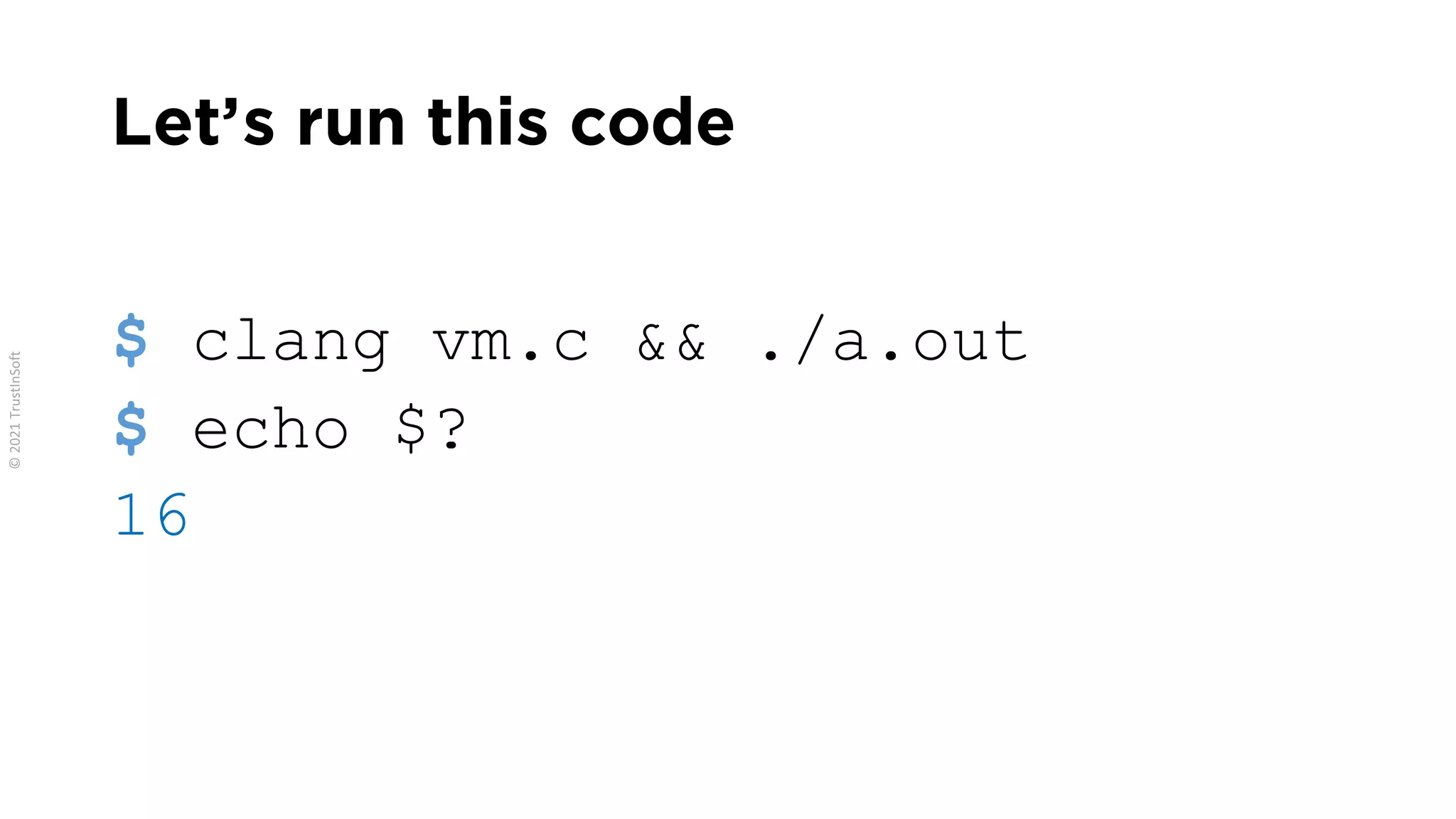
Let’s run this code
$ clang vm.c && ./a.out
$ echo $?
16
Compute 2^4 in a virtual machine
#define ARRAY_SIZE 10000
unsigned char mem[ARRAY_SIZE] =
{80, 7, 5, 5, 3, 5, 3, 5, 4 , 11, 2};
#define NEXT 
if (pos<ARRAY_SIZE-1) ++pos; break
int main() {
unsigned int A=0, B=0, pos=0;
while (1) {
switch (mem[pos] & 7) {
// add
case 0: A+=mem[pos]>>3; NEXT;
// substract
case 1: A-=mem[pos]>>3; NEXT;
// load
case 2: A=mem[B]; NEXT;
// store
case 3: if (B<ARRAY_SIZE) mem[B]=A; NEXT;
// exit
case 4: return A;
// load and add
case 5: if (B<ARRAY_SIZE) A=A+mem[B]; NEXT;
// goto A
case 6: if (A<ARRAY_SIZE) pos=A; break;
// swap A and B
case 7: {int tmp=B; B=A; A=tmp;} NEXT;
}}}
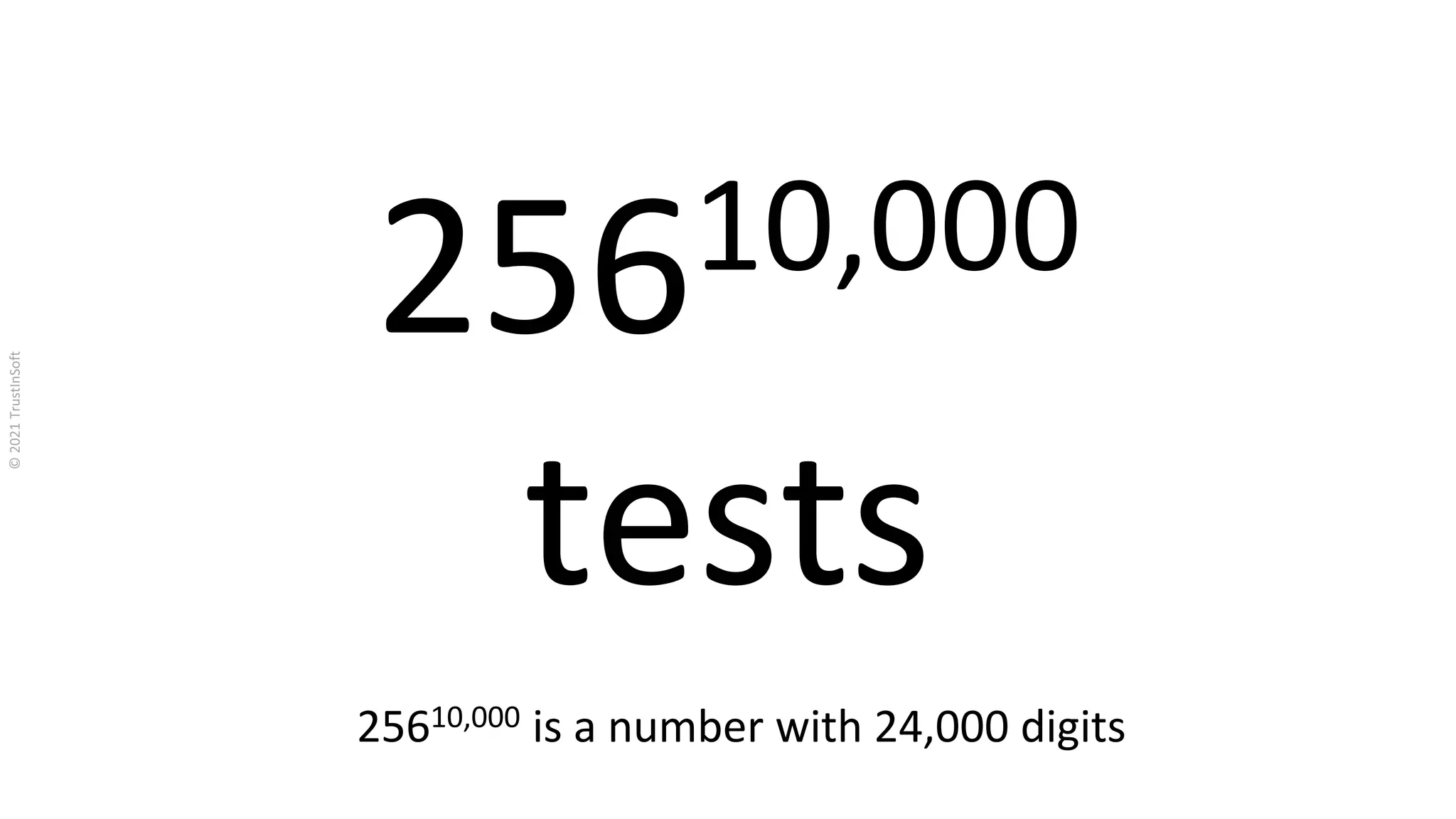
25610,000
tests
25610,000 is a number with 24,000 digits
(a+b)2=(a+b)x(a+b)
= a2+ab + b2+ba
=a2+b2+2ab
The right approach is to do the
following computations:
Now I know that the equation
holds for any (a,b) couple.
solution
#include <tis_builtin.h>
#define ARRAY_SIZE 10000
unsigned char mem[ARRAY_SIZE] =
{80, 7, 5, 5, 3, 5, 3, 5, 4 , 11, 2};
#define NEXT 
if (pos<ARRAY_SIZE-1) ++pos; break
int main() {
unsigned int A=0, B=0, pos=0;
tis_make_unkown(mem, ARRAY_SIZE);
while (1) {
switch (mem[pos] & 7) {
// add
case 0: A+=mem[pos]>>3; NEXT;
// substract
case 1: A-=mem[pos]>>3; NEXT;
// load
case 2: A=mem[B]; NEXT;
// store
case 3: if (B<ARRAY_SIZE) mem[B]=A; NEXT;
// exit
case 4: return A;
// load and add
case 5: if (B<ARRAY_SIZE) A=A+mem[B]; NEXT;
// goto A
case 6: if (A<ARRAY_SIZE) pos=A; break;
// swap A and B
case 7: {int tmp=B; B=A; A=tmp;} NEXT;
}}}
solution
#include <tis_builtin.h>
#define ARRAY_SIZE 10000
unsigned char mem[ARRAY_SIZE] =
{80, 7, 5, 5, 3, 5, 3, 5, 4 , 11, 2};
#define NEXT 
if (pos<ARRAY_SIZE-1) ++pos; break
int main() {
unsigned int A=0, B=0, pos=0;
tis_make_unkown(mem, ARRAY_SIZE);
while (1) {
switch (mem[pos] & 7) {
// add
case 0: A+=mem[pos]>>3; NEXT;
// substract
case 1: A-=mem[pos]>>3; NEXT;
// load
case 2: if (B<ARRAY_SIZE) A=mem[B]; NEXT;
// store
case 3: if (B<ARRAY_SIZE) mem[B]=A; NEXT;
// exit
case 4: return A;
// load and add
case 5: if (B<ARRAY_SIZE) A=A+mem[B]; NEXT;
// goto A
case 6: if (A<ARRAY_SIZE) pos=A; break;
// swap A and B
case 7: {int tmp=B; B=A; A=tmp;} NEXT;
}}}
real world examples
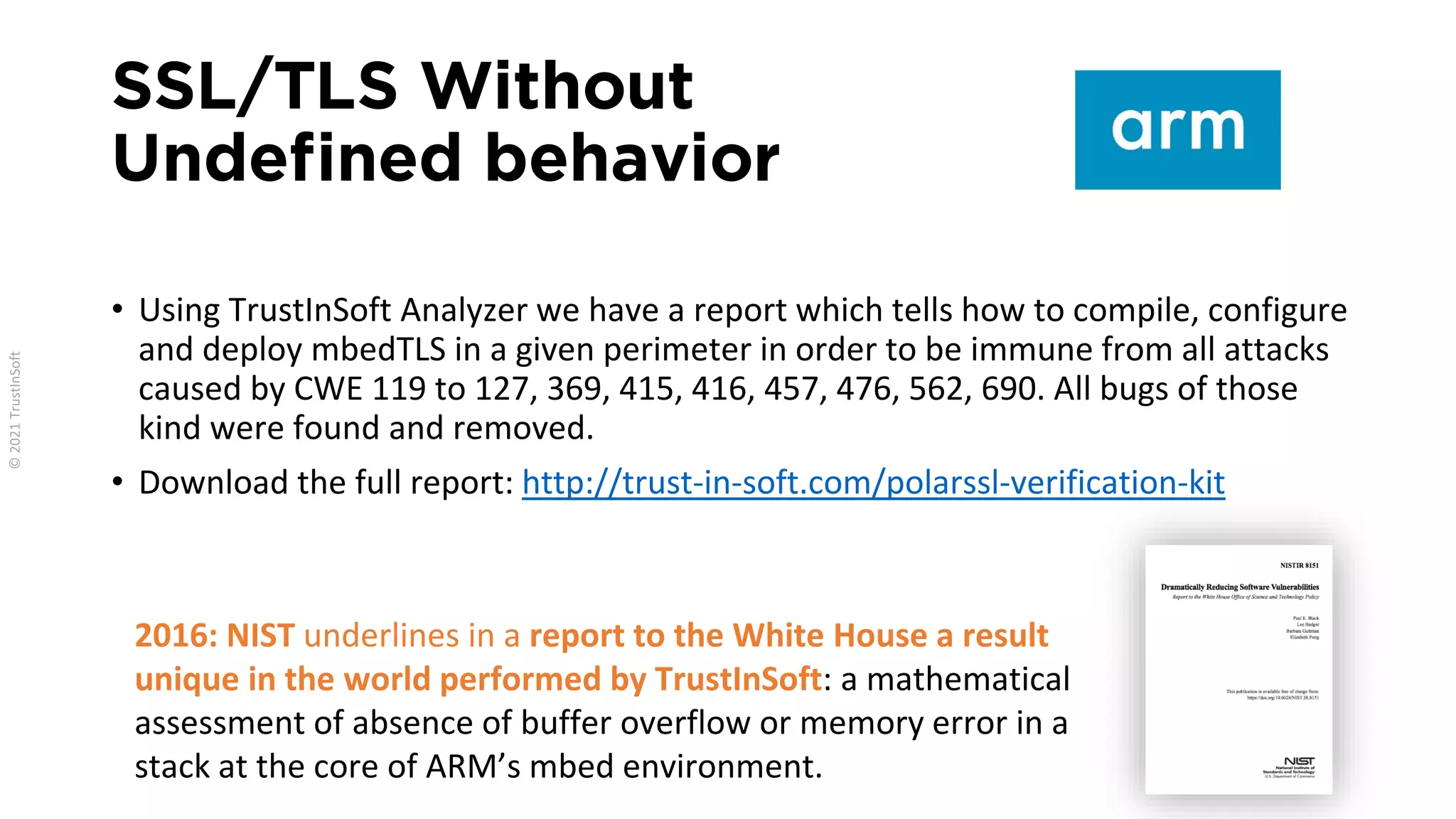
SSL/TLS Without
Undefined behavior
• Using TrustInSoft Analyzer we have a report which tells how to compile, configure
and deploy mbedTLS in a given perimeter in order to be immune from all attacks
caused by CWE 119 to 127, 369, 415, 416, 457, 476, 562, 690. All bugs of those
kind were found and removed.
• Download the full report: http://trust-in-soft.com/polarssl-verification-kit
2016: NIST underlines in a report to the White House a result
unique in the world performed by TrustInSoft: a mathematical
assessment of absence of buffer overflow or memory error in a
stack at the core of ARM’s mbed environment.
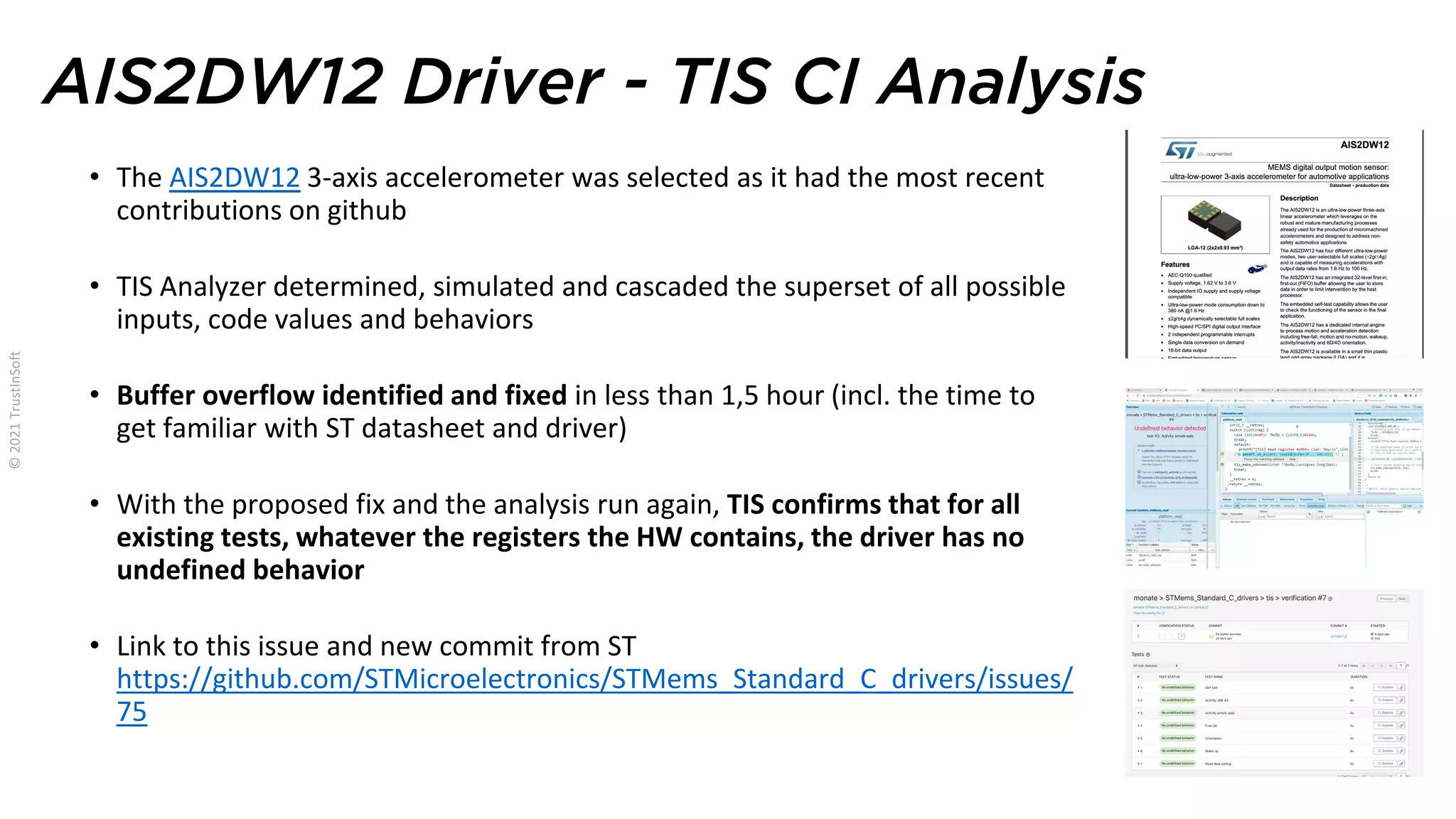
AIS2DW12 Driver - TIS CI Analysis
• The AIS2DW12 3-axis accelerometer was selected as it had the most recent
contributions on github
• TIS Analyzer determined, simulated and cascaded the superset of all possible
inputs, code values and behaviors
• Buffer overflow identified and fixed in less than 1,5 hour (incl. the time to
get familiar with ST datasheet and driver)
• With the proposed fix and the analysis run again, TIS confirms that for all
existing tests, whatever the registers the HW contains, the driver has no
undefined behavior
• Link to this issue and new commit from ST
https://github.com/STMicroelectronics/STMems_Standard_C_drivers/issues/
75
Journey to maximum quality with TIS
Boost the coverage of your tests
with generalized inputs / static
analysis
Check functional implementation
Customer test activities
with TIS
Stage 3
Stage 2
Stage 1
Customer Benefits
• Ensure implemented SW architecture and
functions behave in line with spec
• Full mathematical guarantee for safety
and security
• Mathematical guarantee that all
Undefined Behaviours are detected
• 0 false negatives
• Achieve up to 100% coverage on unit
tests
• Instant productivity: find more bugs
quicker
• Mathematical guarantee that Undefined
Behaviors resulting from discrete tested
values are detected
• 0 false positives & 0 false negatives
Existing tests with discrete
values are replayed
“dynamically” in TIS
Max quality
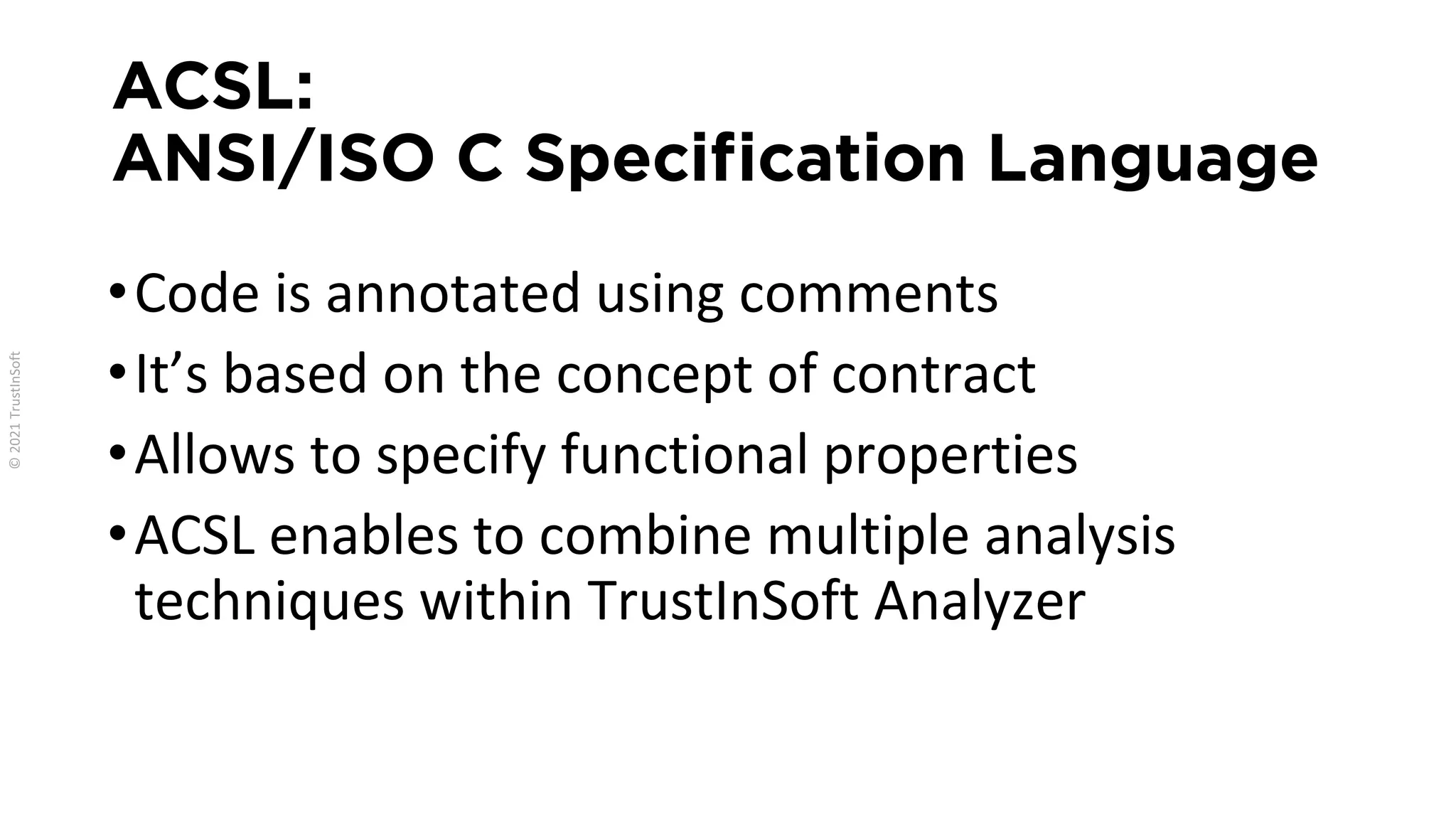
ACSL:
ANSI/ISO C Specification Language
•Code is annotated using comments
•It’s based on the concept of contract
•Allows to specify functional properties
•ACSL enables to combine multiple analysis
techniques within TrustInSoft Analyzer
/*@requires n>=0 &&
valid(t+(0 .. n−1));
assigns nothing;
ensures result!=0 <==>
(forall integer j ;0<=j<n ==> t[j]==0) ;
*/
int check_all_zeros (int t[],int n){
int k;
/*@ loop invariant 0<=k<=n;
loop invariant (forall integer j ; 0<=j<k ==> t[j]==0);
loop assigns k ;
loop variant n−k ; */
for(k=0; k<n; k++)
if(t[k]!=0)
return 0;
return 1;
}
Checking values
in an array
9 red lines
6 black lines
From https://nikolai-kosmatov.eu/publications/talk_2015_11_24_SASEFOR_slides.pdf, thanks Nikolaï!
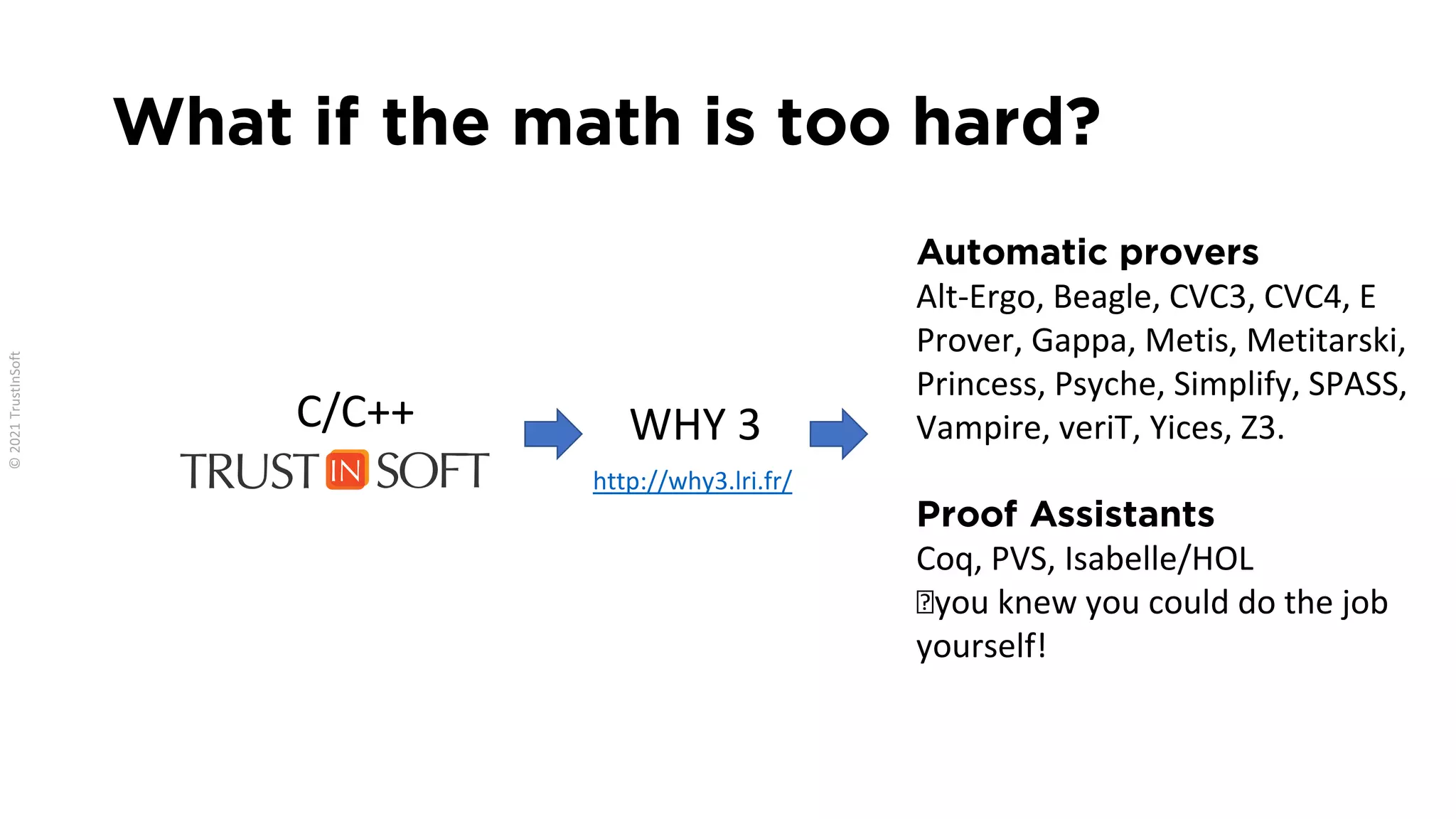
What if the math is too hard?
WHY 3
http://why3.lri.fr/
Automatic provers
Alt-Ergo, Beagle, CVC3, CVC4, E
Prover, Gappa, Metis, Metitarski,
Princess, Psyche, Simplify, SPASS,
Vampire, veriT, Yices, Z3.
Proof Assistants
Coq, PVS, Isabelle/HOL
you knew you could do the job
yourself!
C/C++
32
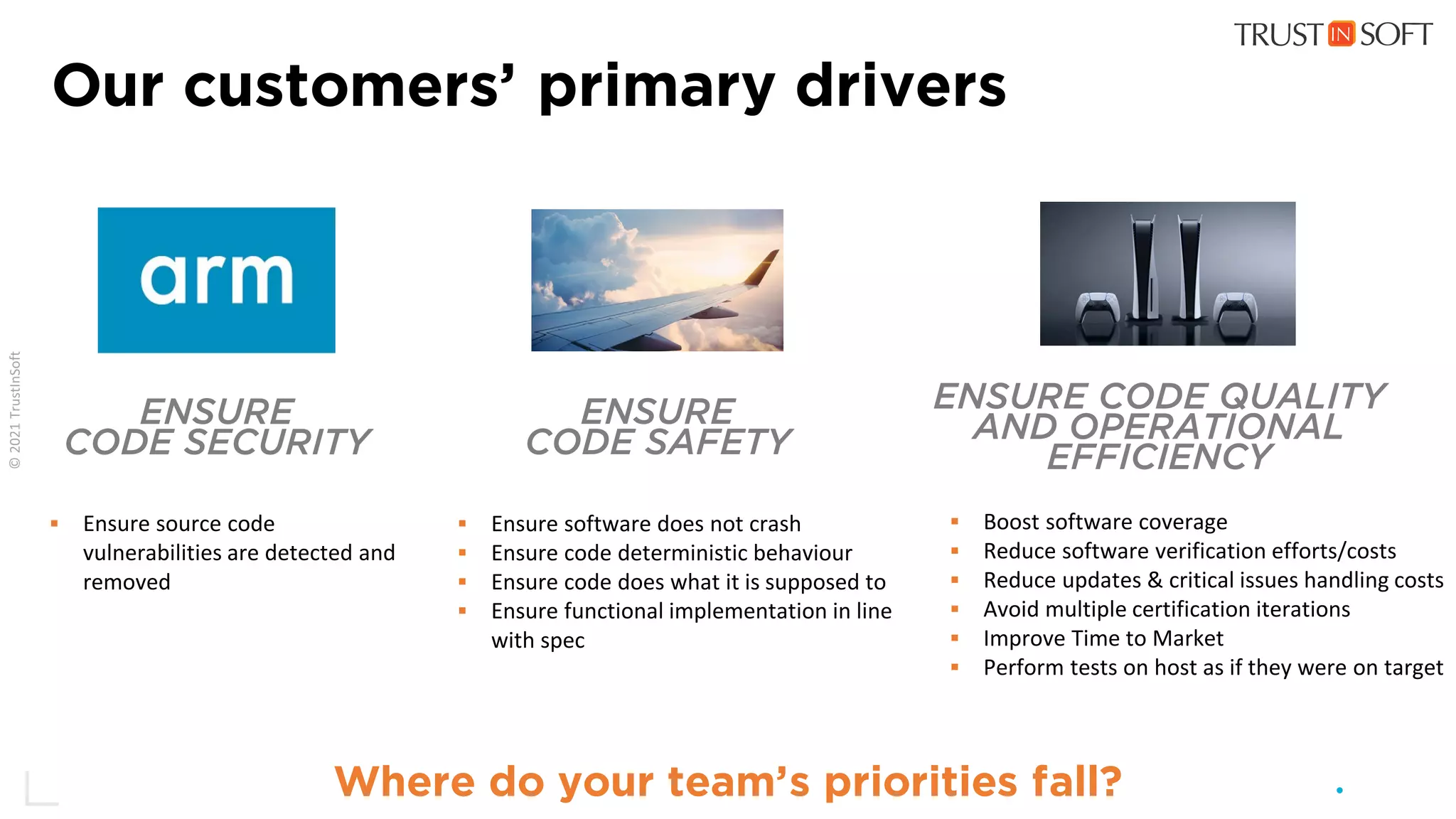
Our customers’ primary drivers
ENSURE CODE QUALITY
AND OPERATIONAL
EFFICIENCY
Where do your team’s priorities fall?
ENSURE
CODE SECURITY
ENSURE
CODE SAFETY
 Boost software coverage
 Reduce software verification efforts/costs
 Reduce updates & critical issues handling costs
 Avoid multiple certification iterations
 Improve Time to Market
 Perform tests on host as if they were on target
 Ensure source code
vulnerabilities are detected and
removed
 Ensure software does not crash
 Ensure code deterministic behaviour
 Ensure code does what it is supposed to
 Ensure functional implementation in line
with spec
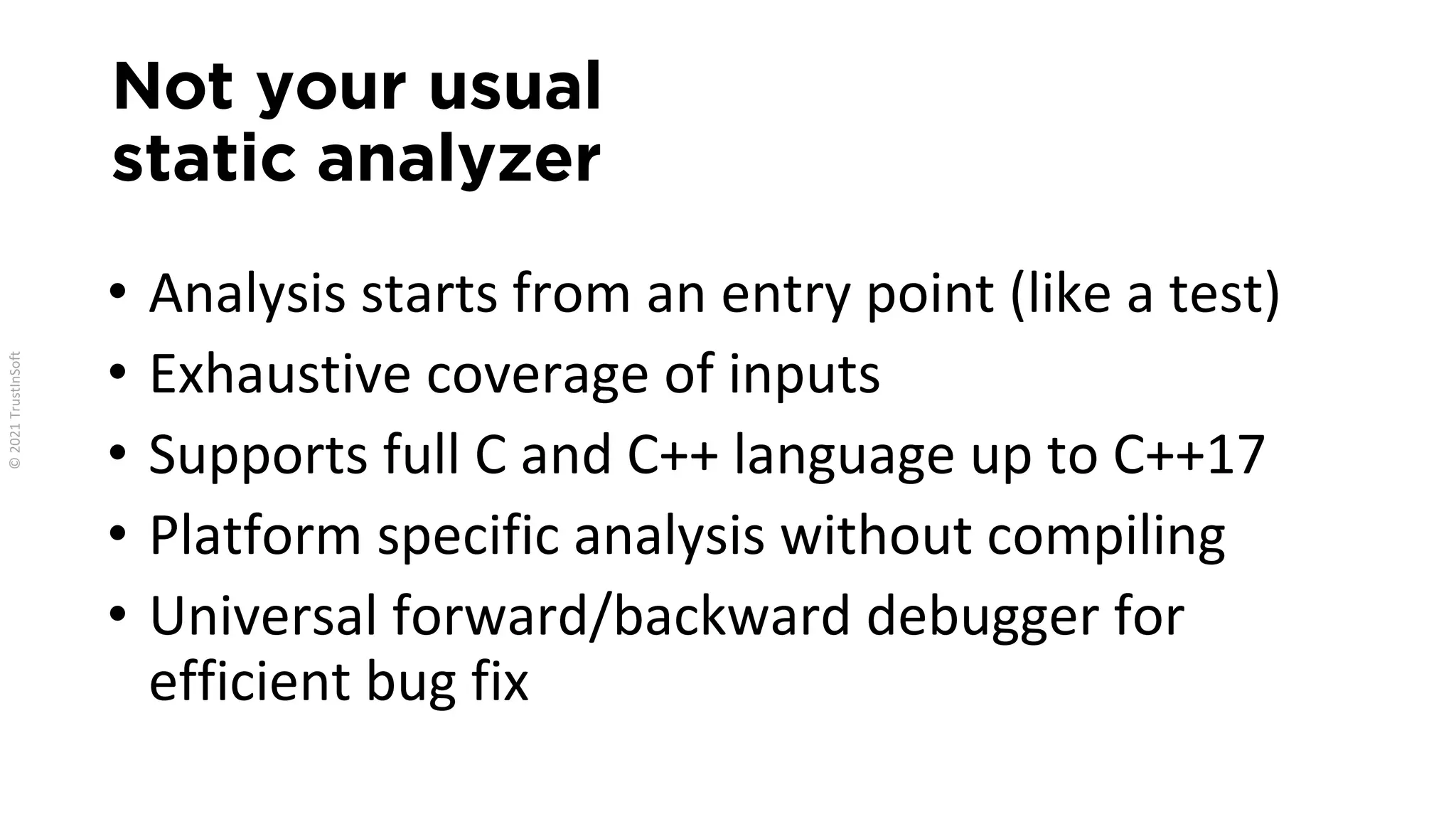
Not your usual
static analyzer
• Analysis starts from an entry point (like a test)
• Exhaustive coverage of inputs
• Supports full C and C++ language up to C++17
• Platform specific analysis without compiling
• Universal forward/backward debugger for
efficient bug fix
Journey to maximum quality with TIS
Boost the coverage of your tests
with generalized inputs / static
analysis
Check functional implementation
Customer test activities
with TIS
Stage 3
Stage 2
Stage 1
Customer Benefits
• Ensure implemented SW architecture and
functions behave in line with spec
• Full mathematical guarantee for safety
and security
• Mathematical guarantee that all
Undefined Behaviours are detected
• 0 false negatives
• Achieve up to 100% coverage on unit
tests
• Instant productivity: find more bugs
quicker
• Mathematical guarantee that Undefined
Behaviors resulting from discrete tested
values are detected
• 0 false positives & 0 false negatives
Existing tests with discrete
values are replayed
“dynamically” in TIS
Max quality
@fderepas

Towards 0-bug software in the automotive industry

  • 1.
    Towards 0-bug softwarein the automotive industry Amin Amini
  • 2.
    www.certx.com Autonomous systems Functional safety of electroniccontrols OT / IT Cyber security CertX – Our Expertise CertX ensures your innovation with unique know Machinery, Robotics, Automation Automotive Autonomous mobility Drones, UAS Railway, Signalling, Train Control 2 EN ISO 13849 IEC EN 61508 IEC EN 61496 ISO 26262 ISO 21448 (SOTIF) ASPICE EC 2019/945 & 947 EN 50126 / 50128 / 50129 EC 2009/402 (CSM) EC 2006/42 (CE) ISA/IEC 62443 ISO 21434 ISO 27001/2 GDPR CertX webinar © 2021 by CertX AG , all rights reserved
  • 3.
    www.certx.com Product Certifications Concept DevelopmentPrototyping / Test Manufacturing Accelerate your development – we support you from the start of it 3 Assessment On-Site Audit Application Certificate • Product description • Scope of certification • Definition of certification requirements • Milestones and timeline • Audit FS* / CS** management manual/system • Production audit (incl. suppliers w/o certificate) • Audit report Kick-Off • Product changes • Accidents and incidents Annual Surveillance *FS: Functional Safety **CS: Cyber Security • Assessment of design and process documents • Assessment Report • Tests as required along the development CertX webinar © 2021 by CertX AG , all rights reserved
  • 4.
    www.certx.com CertX Services CertX providescomprehensive safety and security services 4 TRAINING & CERTIFICATION of ENGINEERS and MANAGERS ASSESSMENTS of products and processes ISA (Independent Safety Assessment) or AsBo (Assessment Body) as a pre-requisite for the approval by the railway authority. CERTIFICATION of PRODUCTS CERTIFY CORPORATE PROCESSES and ORGANIZATIONS CertX webinar © 2021 by CertX AG , all rights reserved
  • 5.
    Safe & SecureSoftware
  • 6.
    www.certx.com Dilemma of FailSafe, Fail Secure and Fail Operational 3-dimensions dilemma • Fail Safe: In case of failure, systems can achieve the safe state. Most systems are Fail-safe. • Fail operational: in case of failure, systems remain operational. • Fail Secure: In case of failure, system remain in its secure state. Challenges:  Normally fail-safe and fail operational goals are in contradiction  Classical Safety Mechanism does not cover the fail operational aspects  Fail operational architectures shall guarantee almost the full functionality in the case of a fault. Fail Operational Fail Safe Fail secure CertX webinar © 2021 by CertX AG , all rights reserved
  • 7.
    www.certx.com 7  ISO 26262:2018Road vehicles Functional Safety — Applied to safety-related systems that include one or more electrical and/or electronic (E/E) systems and that are installed in series production road vehicles, excluding mopeds  ISO 21448:2021 Safety Of The Intended Functionality- An acceptable level of safety for road vehicles requires the avoidance of unreasonable risk caused by every hazard associated with the intended functionality and its implementation, especially those not due to failures, e.g. due to performance limitations or insufficiencies of specification.  ISO 21434:2020 Road vehicles Cybersecurity engineering - This document addresses the cybersecurity perspective in engineering of electrical and electronic (E/E) systems within road vehicles. By ensuring appropriate consideration of cybersecurity, this document aims to enable the engineering of E/E systems to keep up with changing technology and attack methods. Automotive industry Safety & security standards CertX webinar © 2021 by CertX AG , all rights reserved
  • 8.
    Most Seen Challengesfor Safe & Secure codes
  • 9.
    www.certx.com Challenge 1 –Software Requirement Specification 9 A Software Requirement specification within the following characteristic: Unambiguous and comprehensible: Must be unambiguous and understandable Atomic: Cannot be divided into more than one safety requirement Internally consistent: Each individual safety requirement contains no contradictions within itself Feasible: safety requirement can be implemented within the constraints of system development Verifiable: Safety requirement can be tested and verified for its correct specification and implementation Necessary: an essential capability, characteristic, constraint, and/or quality factor Implementation free: avoids placing unnecessary constraints on the architectural design Complete: requirement is clear without further amplification Conforming.: requirement conforms to applicable government, automotive industry and product standards CertX webinar © 2021 by CertX AG , all rights reserved
  • 10.
    www.certx.com Freedom from interference absenceof cascading failures between two or more elements that could lead to the violation of a safety requirement EXAMPLE 1 Element 1 is free of interference from element 2 if no of element 2 can cause element 1 to fail. EXAMPLE 2 Element 3 interferes with element 4 if there exists a failure of element 3 that causes element 4 to fail. Application: if the embedded software consists of software components with different ASIL ratings. 2 option are proposed: - The entire software must be developed according to the highest ASIL - freedom from interference shall be ensured for software components with a higher ASIL rating from elements with a lower ASIL rating. 10 Challenge 2 - Freedom from Interference (FFI) SW Module ASIL QM SW Module ASIL QM Software Element ASIL C CertX webinar © 2021 by CertX AG , all rights reserved
  • 11.
    www.certx.com The faults aregrouped as follows: • Memory : Software Components which are developed according to a low ASIL rating may interfere by wrongfully accessing memory regions of software components with a higher ASIL rating. • Timing: Safe behavior requires that the systems actions and reactions are performed within the right time without monopolizing the CPU. • Execution : An incorrect control flow occurs if one or more program instructions are processed either in the incorrect sequence or are not even processed at all. • Exchange of Information : In a distributed system, the exchange of data between a sender and the receiver(s) can affect functional safety, if its safe behavior safety depends on the integrity of such data 11 Challenge 2- Freedom From Interference (FFI) – elements CertX webinar © 2021 by CertX AG , all rights reserved
  • 12.
    www.certx.com 12 Verification methods ofSW architectural design: a) data-flow analysis: is a technique for gathering information about the possible set of values calculated at various locations in a computer program b) control-flow analysis: is a technique for determining the order of operations in a computer program. Challenge 3 – SW Design Verification Src: Ldra CertX webinar © 2021 by CertX AG , all rights reserved
  • 13.
    www.certx.com 13 Challege 4 -SW Unit Verification To enable the specification of appropriate test cases for the software unit testing, test cases shall be derived using the methods as listed in Table 8. To evaluate the completeness of test cases and to demonstrate that there is no unintended functionality, the coverage of requirements at the software unit level shall be determined and the structural coverage shall be measured in accordance with the metrics listed in Table 9. CertX webinar © 2021 by CertX AG , all rights reserved
  • 14.
    www.certx.com Workshop - Slide14  Objectives: 1. To provide criteria to determine the required level of confidence in a software tool when applicable. 2. To provide means that the user can rely on the correct functioning of a software tool for those activities or tasks required by ISO 26262  Tool Confidence Level (TCL):  Tool Impact (TI)  Tool Error Detection (TD)  TI1 is chosen when there is an argument that there is no possibility that the malfunctioning software tool can violate a safety requirement. For all other cases, TI2 is chosen.  TD1 is chosen if there is a high degree of confidence in the tool's ability to detect an error.  TD3 is chosen for a very low degree of confidence, often when it is determined that the error can only be detected randomly. Challenge 5- Confidence in Use of Software Tools 14 Tool Error Detection TD1 TD2 TD3 Tool Impact TI1 TCL1 TCL1 TCL1 TI2 TCL1 TCL2 TCL3 CertX webinar © 2021 by CertX AG , all rights reserved
  • 15.
    www.certx.com Workshop - Slide15 No particular requirements for SW parts in ISO/SAE 21434 excepting:  Management activities • Tool management (trusted SW env.) • Information sharing () • Management systems (incl. SW config.)  Development activities • Use of suitable coding guideline (MISRA-C or CERT-C) • Use of trusted secure design and implementation principles (e.g. use of NIST SP-800-160, Appendix F.1…) • Security V&V (review, analysis, simulation, prototyping and specific activities such as vuln. scanning, fuzzing, pentest…) ISO/SAE 21434 – Cyber Security 15 CertX webinar © 2021 by CertX AG , all rights reserved
  • 16.
    www.certx.com Workshop - Slide16 No particular requirements for SW parts in ISO/SAE 21434 excepting:  Continual activities • Cybersecurity monitoring: collect as much information as possible about your products, your environments and threat landscape (e.g. threat intelligence platform) • Vulnerability management: evaluate your vulnerabilities to react accordingly (e.g. Incident-Response triggering, development of patches/updates…)  Post-development activities • SW handling during production (Security controls of servers holding SW parts, post- development requirements) • End of cybersecurity support & decommissioning: communicate a consistent period ISO/SAE 21434 – Cyber Security 16 CertX webinar © 2021 by CertX AG , all rights reserved
  • 17.
    www.certx.com Workshop - Slide17 Cyber security approach described by ISO/SAE 21434 is totally aligned with FuSa standard (ISO 26262), but proposing a more generic description of security-related activities applicable for either system, SW or HW parts Reminder: “In the European Union, the new regulation on cyber security (UNECE WP.29/R155) will be mandatory for all new vehicle types from July 2022 and will become mandatory for all new vehicles produced from July 2024.“ Be prepared for demonstrating your compliance in a near future ! ISO/SAE 21434 – Cyber Security 17 CertX webinar © 2021 by CertX AG , all rights reserved
  • 18.
    The information containedin this presentation is the property of CertX AG. This presentation and extracts thereof may only be duplicated or forwarded tthird parties following explicit written approval by CertX AG. All product names used in this documentation are trademarks or otherwise protected by law, even if not specifically indicated. © 2020 by CertX AG. Route Ancienne Papeterie 106 1723 Marly, Switzerland www.certx.com All rights reserved. 18
  • 19.
    1 Confidential . EasyMile©. 2021 AUTONOMOUS FUTURE, TODAY EasyMile brings driverless vehicle solutions for people and goods to life with leading technology, providing a real service.
  • 20.
    2 Confidential . EasyMile©. 2021 Autonomous solutions ready today — EasyMile provides software and complete solutions for driverless mobility and goods transportation. We partner with blue-chip manufacturers to automate their vehicles. Our technology is built on safety-by-design and ready for deployment today with clear client benefits.
  • 21.
    3 Confidential . EasyMile©. 2021 EasyMile at a glance — 5 locations 22 nationalities Shareholders and partners Since 2014 240+ 30+ PhDs IS0 9001 certified Denver, USA Berlin, Germany Singapore Adelaide, Australia Headquarters Toulouse, France Recognition
  • 22.
    4 Confidential . EasyMile©. 2021 Focused on Level 4 of autonomous driving — DRIVERLESS FULLY AUTONOMOUS In a known area 4 DRIVER Zero autonomy 0 FEET-OFF Assisted 1 HANDS-OFF Low automated 2 EYES-OFF Medium automated 3 FULLY AUTONOMOUS Everywhere 5 HUMAN TODAY
  • 23.
    5 Confidential . EasyMile©. 2021 Driverless technology’s promise — Safe Reduce the 1.35 million deaths per year in human driven accidents. Make workplaces safer where fatal accidents are most commonly caused by machines, tools or handling equipment. Productive Meet unsatisfied mobility needs. Savings on industrial flows. Green Lower congestion, better use of public and private space, decrease emissions. Flexible Adapt to changes in demand. Integrate with existing systems with no additional infrastructure. Level 4 vehicles can be deployed immediately as demand arises.
  • 24.
    6 Confidential . EasyMile©. 2021 But there are challenges — System availability Component cost Regulations Cybersecurity Safety Public acceptance
  • 25.
    7 Confidential . EasyMile©. 2021 Two offers — Vehicle solutions EZ10: Cities, transit agencies, airports, colleges/universities, resorts, sports stadiums, communities, business parks etc. TractEasy: Factories, warehouses, airports etc. CLIENTS: Software OEMs: Buses, trucks, trams, vans, farm or warehouse equipment etc. WE SELL: 1 2
  • 26.
    8 Confidential . EasyMile©. 2021 Using all the available data from the different sensors in a fusion algorithm, the vehicle knows its position and the accuracy of it at all times. Any potential deviation will safely slow down or stop the vehicle. The vehicle can be programmed to a site map, even with a network of potential trajectories, with all elements triggering specific behavior (e.g speed areas, pedestrian crossings etc.). The vehicle follows the path smoothly with pre-defined behavior. If an obstacle appears, the vehicle’s sensors detect it and trigger appropriate behavior, slowing down, overtaking or stopping. When the obstacle is avoided, the vehicle proceeds. Navigation — Perception — Localization — Vehicles that know how to behave —
  • 27.
    9 Confidential . EasyMile©. 2021 Safety Critical System V&V — Emergency Collision Avoidance
  • 28.
    10 Confidential . EasyMile©. 2021 Test Means - VHC in the Loop Test on Vehicle Site : Francazal Airport 10 Safety Critical System V&V —
  • 29.
    11 Confidential . EasyMile©. 2021 Test Means - Hardware in the Loop VHC Simulation Test Bench 11 Safety Critical System V&V —
  • 30.
    12 Confidential . EasyMile©. 2021 Test Means - Hardware in the Loop SCES T32 Test Bench 12 Safety Critical System V&V —
  • 31.
    13 Confidential . EasyMile©. 2021 Static Verification tools (CI) 13 Safety Critical System V&V — Test Means - Software in the Loop
  • 32.
    14 Confidential . EasyMile©. 2021 Thank you — Connect with us: #EasyMile
  • 33.
    March 29th, 2021 Mat h e m a t ica lly Gu a ra n t e e d C a n d C++ Co d e Fabrice Derepas Co-founder CEO TrustInSoft @fderepas Formal methods for human beings
  • 34.
    Let’s consider thatI want to assess (a+b)2=a2+b2+2ab
  • 35.
    I am goingto compute this formula for, let’s say, 10,000 values for (a,b). I think that I will have a good idea if the formula holds or not! Would that still work with larger numbers? Did I miss any corner cases (INT_MAX or INT_MIN)
  • 36.
    Now let’s consideranother approach : (a+b)2=a2+b2+2ab
  • 37.
    (a+b)2=(a+b)x(a+b) = a2+ab +b2+ba =a2+b2+2ab The right approach is to do the following computations: Now I know that the equation holds for any (a,b) couple.
  • 38.
    We do justthat, on software.
  • 39.
  • 40.
    deployment on an airplanecode Testing or Formal Verification: DO-178C Alternatives and Industrial Experience IEEE Software (Volume: 30 , Issue: 3 , May-June 2013) https://ieeexplore.ieee.org/document/6471965
  • 41.
    NIST report to thewhite house NIST underlines in a report to the White House a re s u lt u n iq u e in t h e w o rld p e rfo rm e d b y Tru s t In So ft : a mathematical assessment of absence of buffer overflow or memory error in a stack at the core of ARM’s mbed environment. https://trust-in-soft.com/polarssl-verification-kit/
  • 42.
  • 43.
    Journey to maximumquality with TIS Boost the coverage of your tests with generalized inputs / static analysis Check functional implementation Customer test activities with TIS Stage 3 Stage 2 Stage 1 Customer Benefits • Ensure implemented SW architecture and functions behave in line with spec • Full mathematical guarantee for safety and security • Mathematical guarantee that all Undefined Behaviours are detected • 0 false negatives • Achieve up to 100% coverage on unit tests • Instant productivity: find more bugs quicker • Mathematical guarantee that Undefined Behaviors resulting from discrete tested values are detected • 0 false positives & 0 false negatives Existing tests with discrete values are replayed “dynamically” in TIS Max quality
  • 45.
    • Signed Overflow(24) • Uninitialized Variable (2) • Uninitialized memory (1) • Signed Overflow (9) • Link Error (1) • Invalid Pointer Arithmetic (1) • Uninitialized Variable (3335 times) • Incompatible Function Pointer (735) • Uninitialized Variable (10) • Uninitialized Variable (63) • Signed Overflow (15) • Uninitialized Variable (11) • Signed Overflow (1) -Rules of the game: Find UBs by replaying-existing test suits & Use a fuzzer (AFL) -Results: After generating 10,000 test with AFL from the 44 existing ones, we found 13 UBs Removing vulnerabilities is key when used as a live intrusion detector 2019: 13 UBs identified on Wireshark Packet Analyser Found new bugs not caught by other tools for years
  • 46.
    Journey to maximumquality with TIS Boost the coverage of your tests with generalized inputs / static analysis Check functional implementation Customer test activities with TIS Stage 3 Stage 2 Stage 1 Customer Benefits • Ensure implemented SW architecture and functions behave in line with spec • Full mathematical guarantee for safety and security • Mathematical guarantee that all Undefined Behaviours are detected • 0 false negatives • Achieve up to 100% coverage on unit tests • Instant productivity: find more bugs quicker • Mathematical guarantee that Undefined Behaviors resulting from discrete tested values are detected • 0 false positives & 0 false negatives Existing tests with discrete values are replayed “dynamically” in TIS Max quality
  • 47.
  • 48.
    Compute 2^4 ina virtual machine #define ARRAY_SIZE 10000 unsigned char mem[ARRAY_SIZE] = {80, 7, 5, 5, 3, 5, 3, 5, 4 , 11, 2}; #define NEXT if (pos<ARRAY_SIZE-1) ++pos; break int main() { unsigned int A=0, B=0, pos=0; while (1) { switch (mem[pos] & 7) { // add case 0: A+=mem[pos]>>3; NEXT; // substract case 1: A-=mem[pos]>>3; NEXT; // load case 2: A=mem[B]; NEXT; // store case 3: if (B<ARRAY_SIZE) mem[B]=A; NEXT; // exit case 4: return A; // load and add case 5: if (B<ARRAY_SIZE) A=A+mem[B]; NEXT; // goto A case 6: if (A<ARRAY_SIZE) pos=A; break; // swap A and B case 7: {int tmp=B; B=A; A=tmp;} NEXT; }}}
  • 49.
    Let’s run thiscode $ clang vm.c && ./a.out $ echo $? 16
  • 50.
    Compute 2^4 ina virtual machine #define ARRAY_SIZE 10000 unsigned char mem[ARRAY_SIZE] = {80, 7, 5, 5, 3, 5, 3, 5, 4 , 11, 2}; #define NEXT if (pos<ARRAY_SIZE-1) ++pos; break int main() { unsigned int A=0, B=0, pos=0; while (1) { switch (mem[pos] & 7) { // add case 0: A+=mem[pos]>>3; NEXT; // substract case 1: A-=mem[pos]>>3; NEXT; // load case 2: A=mem[B]; NEXT; // store case 3: if (B<ARRAY_SIZE) mem[B]=A; NEXT; // exit case 4: return A; // load and add case 5: if (B<ARRAY_SIZE) A=A+mem[B]; NEXT; // goto A case 6: if (A<ARRAY_SIZE) pos=A; break; // swap A and B case 7: {int tmp=B; B=A; A=tmp;} NEXT; }}}
  • 51.
    25610,000 tests 25610,000 is anumber with 24,000 digits
  • 52.
    (a+b)2=(a+b)x(a+b) = a2+ab +b2+ba =a2+b2+2ab The right approach is to do the following computations: Now I know that the equation holds for any (a,b) couple.
  • 54.
    solution #include <tis_builtin.h> #define ARRAY_SIZE10000 unsigned char mem[ARRAY_SIZE] = {80, 7, 5, 5, 3, 5, 3, 5, 4 , 11, 2}; #define NEXT if (pos<ARRAY_SIZE-1) ++pos; break int main() { unsigned int A=0, B=0, pos=0; tis_make_unkown(mem, ARRAY_SIZE); while (1) { switch (mem[pos] & 7) { // add case 0: A+=mem[pos]>>3; NEXT; // substract case 1: A-=mem[pos]>>3; NEXT; // load case 2: A=mem[B]; NEXT; // store case 3: if (B<ARRAY_SIZE) mem[B]=A; NEXT; // exit case 4: return A; // load and add case 5: if (B<ARRAY_SIZE) A=A+mem[B]; NEXT; // goto A case 6: if (A<ARRAY_SIZE) pos=A; break; // swap A and B case 7: {int tmp=B; B=A; A=tmp;} NEXT; }}}
  • 55.
    solution #include <tis_builtin.h> #define ARRAY_SIZE10000 unsigned char mem[ARRAY_SIZE] = {80, 7, 5, 5, 3, 5, 3, 5, 4 , 11, 2}; #define NEXT if (pos<ARRAY_SIZE-1) ++pos; break int main() { unsigned int A=0, B=0, pos=0; tis_make_unkown(mem, ARRAY_SIZE); while (1) { switch (mem[pos] & 7) { // add case 0: A+=mem[pos]>>3; NEXT; // substract case 1: A-=mem[pos]>>3; NEXT; // load case 2: if (B<ARRAY_SIZE) A=mem[B]; NEXT; // store case 3: if (B<ARRAY_SIZE) mem[B]=A; NEXT; // exit case 4: return A; // load and add case 5: if (B<ARRAY_SIZE) A=A+mem[B]; NEXT; // goto A case 6: if (A<ARRAY_SIZE) pos=A; break; // swap A and B case 7: {int tmp=B; B=A; A=tmp;} NEXT; }}}
  • 56.
  • 57.
    SSL/TLS Without Undefined behavior •Using TrustInSoft Analyzer we have a report which tells how to compile, configure and deploy mbedTLS in a given perimeter in order to be immune from all attacks caused by CWE 119 to 127, 369, 415, 416, 457, 476, 562, 690. All bugs of those kind were found and removed. • Download the full report: http://trust-in-soft.com/polarssl-verification-kit 2016: NIST underlines in a report to the White House a result unique in the world performed by TrustInSoft: a mathematical assessment of absence of buffer overflow or memory error in a stack at the core of ARM’s mbed environment.
  • 58.
    AIS2DW12 Driver -TIS CI Analysis • The AIS2DW12 3-axis accelerometer was selected as it had the most recent contributions on github • TIS Analyzer determined, simulated and cascaded the superset of all possible inputs, code values and behaviors • Buffer overflow identified and fixed in less than 1,5 hour (incl. the time to get familiar with ST datasheet and driver) • With the proposed fix and the analysis run again, TIS confirms that for all existing tests, whatever the registers the HW contains, the driver has no undefined behavior • Link to this issue and new commit from ST https://github.com/STMicroelectronics/STMems_Standard_C_drivers/issues/ 75
  • 59.
    Journey to maximumquality with TIS Boost the coverage of your tests with generalized inputs / static analysis Check functional implementation Customer test activities with TIS Stage 3 Stage 2 Stage 1 Customer Benefits • Ensure implemented SW architecture and functions behave in line with spec • Full mathematical guarantee for safety and security • Mathematical guarantee that all Undefined Behaviours are detected • 0 false negatives • Achieve up to 100% coverage on unit tests • Instant productivity: find more bugs quicker • Mathematical guarantee that Undefined Behaviors resulting from discrete tested values are detected • 0 false positives & 0 false negatives Existing tests with discrete values are replayed “dynamically” in TIS Max quality
  • 60.
    ACSL: ANSI/ISO C SpecificationLanguage •Code is annotated using comments •It’s based on the concept of contract •Allows to specify functional properties •ACSL enables to combine multiple analysis techniques within TrustInSoft Analyzer
  • 61.
    /*@requires n>=0 && valid(t+(0.. n−1)); assigns nothing; ensures result!=0 <==> (forall integer j ;0<=j<n ==> t[j]==0) ; */ int check_all_zeros (int t[],int n){ int k; /*@ loop invariant 0<=k<=n; loop invariant (forall integer j ; 0<=j<k ==> t[j]==0); loop assigns k ; loop variant n−k ; */ for(k=0; k<n; k++) if(t[k]!=0) return 0; return 1; } Checking values in an array 9 red lines 6 black lines From https://nikolai-kosmatov.eu/publications/talk_2015_11_24_SASEFOR_slides.pdf, thanks Nikolaï!
  • 62.
    What if themath is too hard? WHY 3 http://why3.lri.fr/ Automatic provers Alt-Ergo, Beagle, CVC3, CVC4, E Prover, Gappa, Metis, Metitarski, Princess, Psyche, Simplify, SPASS, Vampire, veriT, Yices, Z3. Proof Assistants Coq, PVS, Isabelle/HOL you knew you could do the job yourself! C/C++
  • 64.
    32 Our customers’ primarydrivers ENSURE CODE QUALITY AND OPERATIONAL EFFICIENCY Where do your team’s priorities fall? ENSURE CODE SECURITY ENSURE CODE SAFETY  Boost software coverage  Reduce software verification efforts/costs  Reduce updates & critical issues handling costs  Avoid multiple certification iterations  Improve Time to Market  Perform tests on host as if they were on target  Ensure source code vulnerabilities are detected and removed  Ensure software does not crash  Ensure code deterministic behaviour  Ensure code does what it is supposed to  Ensure functional implementation in line with spec
  • 65.
    Not your usual staticanalyzer • Analysis starts from an entry point (like a test) • Exhaustive coverage of inputs • Supports full C and C++ language up to C++17 • Platform specific analysis without compiling • Universal forward/backward debugger for efficient bug fix
  • 66.
    Journey to maximumquality with TIS Boost the coverage of your tests with generalized inputs / static analysis Check functional implementation Customer test activities with TIS Stage 3 Stage 2 Stage 1 Customer Benefits • Ensure implemented SW architecture and functions behave in line with spec • Full mathematical guarantee for safety and security • Mathematical guarantee that all Undefined Behaviours are detected • 0 false negatives • Achieve up to 100% coverage on unit tests • Instant productivity: find more bugs quicker • Mathematical guarantee that Undefined Behaviors resulting from discrete tested values are detected • 0 false positives & 0 false negatives Existing tests with discrete values are replayed “dynamically” in TIS Max quality
  • 67.