

© 2019 Western Digital Corporation or its affiliates. All rights reserved. 1/6/2020
RISC-V Boot Process: One step
at a time
Atish Patra <Atish.Patra@wdc.com>
1/6/2020© 2019 Western Digital Corporation or its affiliates. All rights reserved. 2
Outline
• Introduction to RISC-V
• Common embedded boot flow
• Current RISC-V boot flow
• OpenSBI Project
• Upstream Status
• Future work
• Demo
1/6/2020© 2019 Western Digital Corporation or its affiliates. All rights reserved. 3
Acknowledgements
• U-Boot
– Lukas Auler
– Bin Meng
– Anup Patel
• Coreboot
– Ron Minnich
– Jonathan Neuschäfer
– Patrick Rudolph
– Philip Hug
• EDK2
– Abner Chang
• And others
1/6/2020© 2019 Western Digital Corporation or its affiliates. All rights reserved. 4
What is RISC-V ?
Free and Open Instruction Set Architecture (ISA)
1/6/2020© 2019 Western Digital Corporation or its affiliates. All rights reserved. 5
What is RISC-V?
• Pronounced as risk-five
• An open RISC Instruction Set Architecture (ISA)
• The base ISA is incredibly small
– The ISA can be extended
• Integer (I) and Embedded (E) are part of the base ISA
• Multiply/Divide (M), Atomic (A), Single Floating Point (F), Double Floating Point (D), Quad Floating Point (Q) and
Compressed Instructions (C) are frozen already
• Virtualization (H), Vector (V), Bit Manipulation (B) are examples of draft extensions
• The General Extension (G) is shorthand for M, A, F and D
– Aimed at everything from small embedded systems to high end HPC
• Multiple CPU implementations already available
• SiFive, BOOM, Rocket64, Andes, Western Digital, QEMU, etc
• Currently heavily backed by SiFive, Microsemi, NVIDIA, Western Digital and others
Free and Open Instruction Set Architecture (ISA)
1/6/2020© 2019 Western Digital Corporation or its affiliates. All rights reserved. 6
Why RISC-V?
• An open source ISA allows anyone to use and modify the ISA without any licensing cost
– This is different to commercial companies which ship black boxes with strict NDAs
• Customization for specific applications
• Security audits to verify security in critical applications
• No license fees to use the ISA
• Community driven development approach allows input from anybody
Free and Open Instruction Set Architecture (ISA)
1/6/2020© 2019 Western Digital Corporation or its affiliates. All rights reserved. 7
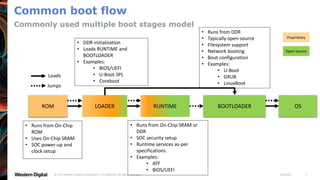
Common boot flow
Commonly used multiple boot stages model
ROM LOADER RUNTIME BOOTLOADER OS
Loads
Jumps
• Runs from On-Chip
ROM
• Uses On-Chip SRAM
• SOC power-up and
clock setup
• DDR initialization
• Loads RUNTIME and
BOOTLOADER
• Examples:
• BIOS/UEFI
• U-Boot SPL
• Coreboot
• Runs from On-Chip SRAM or
DDR
• SOC security setup
• Runtime services as-per
specifications
• Examples:
• ATF
• BIOS/UEFI
• Runs from DDR
• Typically open-source
• Filesystem support
• Network booting
• Boot configuration
• Examples:
• U-Boot
• GRUB
• LinuxBoot
Proprietary
Open Source
1/6/2020© 2019 Western Digital Corporation or its affiliates. All rights reserved. 8
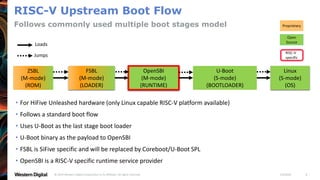
RISC-V Upstream Boot Flow
Follows commonly used multiple boot stages model
• For HiFive Unleashed hardware (only Linux capable RISC-V platform available)
• Follows a standard boot flow
• Uses U-Boot as the last stage boot loader
• U-Boot binary as the payload to OpenSBI
• FSBL is SiFive specific and will be replaced by Coreboot/U-Boot SPL
• OpenSBI is a RISC-V specific runtime service provider
Linux
(S-mode)
(OS)
ZSBL
(M-mode)
(ROM)
FSBL
(M-mode)
(LOADER)
OpenSBI
(M-mode)
(RUNTIME)
U-Boot
(S-mode)
(BOOTLOADER)
Loads
Jumps
Proprietary
Open
Source
RISC-V
specific
1/6/2020© 2019 Western Digital Corporation or its affiliates. All rights reserved. 9
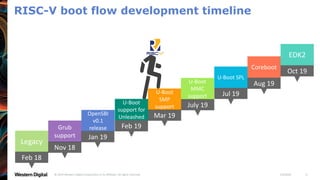
RISC-V boot flow development timeline
OpenSBI
v0.1
release
U-Boot
SMP
support
U-Boot
MMC
support
U-Boot SPL
Coreboot
Legacy
Feb 18
Jan 19
Mar 19
July 19
Jul 19
Aug 19
EDK2
Oct 19
U-Boot
support for
Unleashed
Feb 19Grub
support
Nov 18
1/6/2020© 2019 Western Digital Corporation or its affiliates. All rights reserved. 10
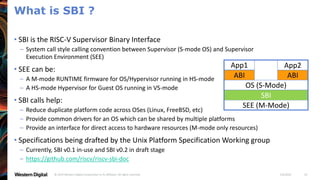
What is SBI ?
• SBI is the RISC-V Supervisor Binary Interface
– System call style calling convention between Supervisor (S-mode OS) and Supervisor
Execution Environment (SEE)
• SEE can be:
– A M-mode RUNTIME firmware for OS/Hypervisor running in HS-mode
– A HS-mode Hypervisor for Guest OS running in VS-mode
• SBI calls help:
– Reduce duplicate platform code across OSes (Linux, FreeBSD, etc)
– Provide common drivers for an OS which can be shared by multiple platforms
– Provide an interface for direct access to hardware resources (M-mode only resources)
• Specifications being drafted by the Unix Platform Specification Working group
– Currently, SBI v0.1 in-use and SBI v0.2 in draft stage
– https://github.com/riscv/riscv-sbi-doc
SEE (M-Mode)
SBI
OS (S-Mode)
ABI ABI
App1 App2
1/6/2020© 2019 Western Digital Corporation or its affiliates. All rights reserved. 11
What is OpenSBI ?
• OpenSBI is an open-source implementation of the RISC-V Supervisor Binary Interface
(SBI) specifications
– Licensed under the terms of the BSD-2 clause license
– Helps to avoid SBI implementation fragmentation
– Maintained by the community
• Aimed at providing RUNTIME services in M-mode
– Typically used in boot stage following ROM/LOADER
• Provides support for reference platforms
– Generic simple drivers included for M-mode to operate
 PLIC, CLINT, UART 8250
– Other platforms can reuse the common code and add needed drivers
• Source
– https://github.com/riscv/opensbi
1/6/2020© 2019 Western Digital Corporation or its affiliates. All rights reserved. 12
Key Features
• Layered structure to accommodate various use cases
– Generic SBI library with platform abstraction
• Typically used with external firmware and bootloader
– EDK2 (UEFI implementation), Secure boot working group
– Platform specific library
• Similar to core library but including platform specific drivers
– Platform specific reference firmware
• Three different types of RUNTIME firmware
• Wide range of hardware features supported
– RV32 and RV64
– Hypervisor support
– Misaligned load/store handling
– Missing CSR emulation
– Protects firmware using PMP support
Platform Specific
Reference Firmware
Platform Specific
Library
SBI Library
OpenSBI Layers
1/6/2020© 2019 Western Digital Corporation or its affiliates. All rights reserved. 13
Reference Firmwares
• OpenSBI provides several types of reference firmware, all platform-specific
– FW_PAYLOAD
• Firmware with the next booting stage as a payload
• Default firmware being used in Linux capable RISC-V hardware
– FW_JUMP
• Firmware with fixed jump address to the next booting stage
• Default method for QEMU
– FW_DYNAMIC
• Firmware with dynamic information on the next booting stage
• U-Boot SPL/Coreboot is using FW_DYNAMIC
• SOC Vendors may choose:
– Use one of OpenSBI reference firmwares as their M-mode RUNTIME firmware
– Build M-mode RUNTIME firmware from scratch with OpenSBI as library
– Extend existing M-mode firmwares (U-Boot_M_mode/EDK2) with OpenSBI as library
1/6/2020© 2019 Western Digital Corporation or its affiliates. All rights reserved. 14
Platform support
• SiFive HiFive Unleashed
• Andes AE350
• Ariane FPGA SOC
• Kendryte K210
• QEMU virt machines (32-bit/64-bit)
1/6/2020© 2019 Western Digital Corporation or its affiliates. All rights reserved. 15
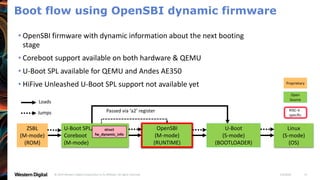
Boot flow using OpenSBI dynamic firmware
• OpenSBI firmware with dynamic information about the next booting
stage
• Coreboot support available on both hardware & QEMU
• U-Boot SPL available for QEMU and Andes AE350
• HiFive Unleashed U-Boot SPL support not available yet
Passed via ‘a2’ register
Linux
(S-mode)
(OS)
ZSBL
(M-mode)
(ROM)
U-Boot SPL/
Coreboot
(M-mode)
OpenSBI
(M-mode)
(RUNTIME)
U-Boot
(S-mode)
(BOOTLOADER)
Loads
Jumps
Proprietary
Open
Source
RISC-V
specific
struct
fw_dynamic_info
1/6/2020© 2019 Western Digital Corporation or its affiliates. All rights reserved. 16
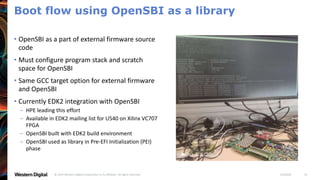
Boot flow using OpenSBI as a library
• OpenSBI as a part of external firmware source
code
• Must configure program stack and scratch
space for OpenSBI
• Same GCC target option for external firmware
and OpenSBI
• Currently EDK2 integration with OpenSBI
– HPE leading this effort
– Available in EDK2 mailing list for U540 on Xilinx VC707
FPGA
– OpenSBI built with EDK2 build environment
– OpenSBI used as library in Pre-EFI Initialization (PEI)
phase
1/6/2020© 2019 Western Digital Corporation or its affiliates. All rights reserved. 17
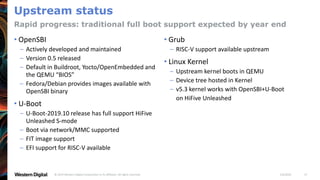
Upstream status
• OpenSBI
– Actively developed and maintained
– Version 0.5 released
– Default in Buildroot, Yocto/OpenEmbedded and
the QEMU “BIOS”
– Fedora/Debian provides images available with
OpenSBI binary
• U-Boot
– U-Boot-2019.10 release has full support HiFive
Unleashed S-mode
– Boot via network/MMC supported
– FIT image support
– EFI support for RISC-V available
• Grub
– RISC-V support available upstream
• Linux Kernel
– Upstream kernel boots in QEMU
– Device tree hosted in Kernel
– v5.3 kernel works with OpenSBI+U-Boot
on HiFive Unleashed
Rapid progress: traditional full boot support expected by year end
1/6/2020© 2019 Western Digital Corporation or its affiliates. All rights reserved. 18
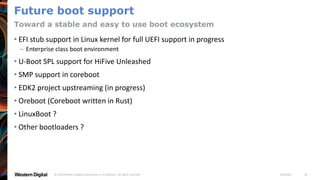
Future boot support
• EFI stub support in Linux kernel for full UEFI support in progress
– Enterprise class boot environment
• U-Boot SPL support for HiFive Unleashed
• SMP support in coreboot
• EDK2 project upstreaming (in progress)
• Oreboot (Coreboot written in Rust)
• LinuxBoot ?
• Other bootloaders ?
Toward a stable and easy to use boot ecosystem
1/6/2020© 2019 Western Digital Corporation or its affiliates. All rights reserved. 19
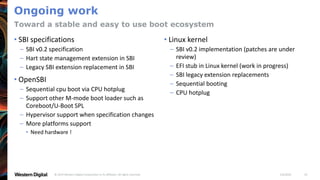
Ongoing work
• SBI specifications
– SBI v0.2 specification
– Hart state management extension in SBI
– Legacy SBI extension replacement in SBI
• OpenSBI
– Sequential cpu boot via CPU hotplug
– Support other M-mode boot loader such as
Coreboot/U-Boot SPL
– Hypervisor support when specification changes
– More platforms support
• Need hardware !
• Linux kernel
– SBI v0.2 implementation (patches are under
review)
– EFI stub in Linux kernel (work in progress)
– SBI legacy extension replacements
– Sequential booting
– CPU hotplug
Toward a stable and easy to use boot ecosystem
1/6/2020© 2019 Western Digital Corporation or its affiliates. All rights reserved. 20
Demo 1: U-Boot MMC boot
1/6/2020© 2019 Western Digital Corporation or its affiliates. All rights reserved. 21
Thank you!!
• Q&A ?
© 2019 Western Digital Corporation or its affiliates. All rights reserved. 1/6/2020
1/6/2020© 2019 Western Digital Corporation or its affiliates. All rights reserved. 23
Backup
1/6/2020© 2019 Western Digital Corporation or its affiliates. All rights reserved. 24
Constraints on using OpenSBI Library
• Same GCC target options (i.e. -march, -mabi, and -mcmodel) need to be used for the
external firmware and OpenSBI sources
• External firmware must create per-HART non-overlapping:
1.Program Stack
2.OpenSBI scratch space (i.e. struct sbi_scratch instance with extra space above)
• Two constraints in calling any OpenSBI functions from external firmware:
1.MSCRATCH CSR of calling HART must be set to its own OpenSBI scratch space
2.SP register (i.e. the stack pointer) of calling HART must be set to its own stack
• External firmware must also ensure that:
– Interrupts are disabled in the MSTATUS and MIE CSRs when calling sbi_init()
– sbi_init() is called for each HART that is powered-up at boot-time or in response to a CPU hotplug event
– sbi_trap_handler() is called for M-mode interrupts and M-mode traps
1/6/2020© 2019 Western Digital Corporation or its affiliates. All rights reserved. 25
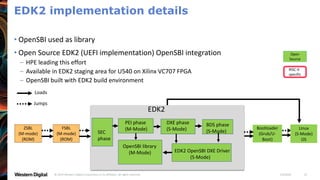
EDK2 implementation details
• OpenSBI used as library
• Open Source EDK2 (UEFI implementation) OpenSBI integration
– HPE leading this effort
– Available in EDK2 staging area for U540 on Xilinx VC707 FPGA
– OpenSBI built with EDK2 build environment
Passed via ‘a2’ register
ZSBL
(M-mode)
(ROM)
Bootloader
(Grub/U-
Boot)
Loads
Jumps
Open
Source
RISC-V
specific
EDK2
FSBL
(M-mode)
(ROM)
Linux
(S-Mode)
OS
SEC
phase
PEI phase
(M-Mode)
DXE phase
(S-Mode)
BDS phase
(S-Mode)
EDK2 OpenSBI DXE Driver
(S-Mode)
OpenSBI library
(M-Mode)
1/6/2020© 2019 Western Digital Corporation or its affiliates. All rights reserved. 26
Reference
• OpenSBI
– https://github.com/riscv/opensbi
• SBI
– https://github.com/riscv/riscv-sbi-doc
• EDK2
– https://edk2.groups.io/g/devel/message/46479?p=,,,20,0,0,0::Created,,riscv,20,2,0,33047245

RISC-V Boot Process: One Step at a Time

  • 1.
    © 2019 WesternDigital Corporation or its affiliates. All rights reserved. 1/6/2020 RISC-V Boot Process: One step at a time Atish Patra <Atish.Patra@wdc.com>
  • 2.
    1/6/2020© 2019 WesternDigital Corporation or its affiliates. All rights reserved. 2 Outline • Introduction to RISC-V • Common embedded boot flow • Current RISC-V boot flow • OpenSBI Project • Upstream Status • Future work • Demo
  • 3.
    1/6/2020© 2019 WesternDigital Corporation or its affiliates. All rights reserved. 3 Acknowledgements • U-Boot – Lukas Auler – Bin Meng – Anup Patel • Coreboot – Ron Minnich – Jonathan Neuschäfer – Patrick Rudolph – Philip Hug • EDK2 – Abner Chang • And others
  • 4.
    1/6/2020© 2019 WesternDigital Corporation or its affiliates. All rights reserved. 4 What is RISC-V ? Free and Open Instruction Set Architecture (ISA)
  • 5.
    1/6/2020© 2019 WesternDigital Corporation or its affiliates. All rights reserved. 5 What is RISC-V? • Pronounced as risk-five • An open RISC Instruction Set Architecture (ISA) • The base ISA is incredibly small – The ISA can be extended • Integer (I) and Embedded (E) are part of the base ISA • Multiply/Divide (M), Atomic (A), Single Floating Point (F), Double Floating Point (D), Quad Floating Point (Q) and Compressed Instructions (C) are frozen already • Virtualization (H), Vector (V), Bit Manipulation (B) are examples of draft extensions • The General Extension (G) is shorthand for M, A, F and D – Aimed at everything from small embedded systems to high end HPC • Multiple CPU implementations already available • SiFive, BOOM, Rocket64, Andes, Western Digital, QEMU, etc • Currently heavily backed by SiFive, Microsemi, NVIDIA, Western Digital and others Free and Open Instruction Set Architecture (ISA)
  • 6.
    1/6/2020© 2019 WesternDigital Corporation or its affiliates. All rights reserved. 6 Why RISC-V? • An open source ISA allows anyone to use and modify the ISA without any licensing cost – This is different to commercial companies which ship black boxes with strict NDAs • Customization for specific applications • Security audits to verify security in critical applications • No license fees to use the ISA • Community driven development approach allows input from anybody Free and Open Instruction Set Architecture (ISA)
  • 7.
    1/6/2020© 2019 WesternDigital Corporation or its affiliates. All rights reserved. 7 Common boot flow Commonly used multiple boot stages model ROM LOADER RUNTIME BOOTLOADER OS Loads Jumps • Runs from On-Chip ROM • Uses On-Chip SRAM • SOC power-up and clock setup • DDR initialization • Loads RUNTIME and BOOTLOADER • Examples: • BIOS/UEFI • U-Boot SPL • Coreboot • Runs from On-Chip SRAM or DDR • SOC security setup • Runtime services as-per specifications • Examples: • ATF • BIOS/UEFI • Runs from DDR • Typically open-source • Filesystem support • Network booting • Boot configuration • Examples: • U-Boot • GRUB • LinuxBoot Proprietary Open Source
  • 8.
    1/6/2020© 2019 WesternDigital Corporation or its affiliates. All rights reserved. 8 RISC-V Upstream Boot Flow Follows commonly used multiple boot stages model • For HiFive Unleashed hardware (only Linux capable RISC-V platform available) • Follows a standard boot flow • Uses U-Boot as the last stage boot loader • U-Boot binary as the payload to OpenSBI • FSBL is SiFive specific and will be replaced by Coreboot/U-Boot SPL • OpenSBI is a RISC-V specific runtime service provider Linux (S-mode) (OS) ZSBL (M-mode) (ROM) FSBL (M-mode) (LOADER) OpenSBI (M-mode) (RUNTIME) U-Boot (S-mode) (BOOTLOADER) Loads Jumps Proprietary Open Source RISC-V specific
  • 9.
    1/6/2020© 2019 WesternDigital Corporation or its affiliates. All rights reserved. 9 RISC-V boot flow development timeline OpenSBI v0.1 release U-Boot SMP support U-Boot MMC support U-Boot SPL Coreboot Legacy Feb 18 Jan 19 Mar 19 July 19 Jul 19 Aug 19 EDK2 Oct 19 U-Boot support for Unleashed Feb 19Grub support Nov 18
  • 10.
    1/6/2020© 2019 WesternDigital Corporation or its affiliates. All rights reserved. 10 What is SBI ? • SBI is the RISC-V Supervisor Binary Interface – System call style calling convention between Supervisor (S-mode OS) and Supervisor Execution Environment (SEE) • SEE can be: – A M-mode RUNTIME firmware for OS/Hypervisor running in HS-mode – A HS-mode Hypervisor for Guest OS running in VS-mode • SBI calls help: – Reduce duplicate platform code across OSes (Linux, FreeBSD, etc) – Provide common drivers for an OS which can be shared by multiple platforms – Provide an interface for direct access to hardware resources (M-mode only resources) • Specifications being drafted by the Unix Platform Specification Working group – Currently, SBI v0.1 in-use and SBI v0.2 in draft stage – https://github.com/riscv/riscv-sbi-doc SEE (M-Mode) SBI OS (S-Mode) ABI ABI App1 App2
  • 11.
    1/6/2020© 2019 WesternDigital Corporation or its affiliates. All rights reserved. 11 What is OpenSBI ? • OpenSBI is an open-source implementation of the RISC-V Supervisor Binary Interface (SBI) specifications – Licensed under the terms of the BSD-2 clause license – Helps to avoid SBI implementation fragmentation – Maintained by the community • Aimed at providing RUNTIME services in M-mode – Typically used in boot stage following ROM/LOADER • Provides support for reference platforms – Generic simple drivers included for M-mode to operate  PLIC, CLINT, UART 8250 – Other platforms can reuse the common code and add needed drivers • Source – https://github.com/riscv/opensbi
  • 12.
    1/6/2020© 2019 WesternDigital Corporation or its affiliates. All rights reserved. 12 Key Features • Layered structure to accommodate various use cases – Generic SBI library with platform abstraction • Typically used with external firmware and bootloader – EDK2 (UEFI implementation), Secure boot working group – Platform specific library • Similar to core library but including platform specific drivers – Platform specific reference firmware • Three different types of RUNTIME firmware • Wide range of hardware features supported – RV32 and RV64 – Hypervisor support – Misaligned load/store handling – Missing CSR emulation – Protects firmware using PMP support Platform Specific Reference Firmware Platform Specific Library SBI Library OpenSBI Layers
  • 13.
    1/6/2020© 2019 WesternDigital Corporation or its affiliates. All rights reserved. 13 Reference Firmwares • OpenSBI provides several types of reference firmware, all platform-specific – FW_PAYLOAD • Firmware with the next booting stage as a payload • Default firmware being used in Linux capable RISC-V hardware – FW_JUMP • Firmware with fixed jump address to the next booting stage • Default method for QEMU – FW_DYNAMIC • Firmware with dynamic information on the next booting stage • U-Boot SPL/Coreboot is using FW_DYNAMIC • SOC Vendors may choose: – Use one of OpenSBI reference firmwares as their M-mode RUNTIME firmware – Build M-mode RUNTIME firmware from scratch with OpenSBI as library – Extend existing M-mode firmwares (U-Boot_M_mode/EDK2) with OpenSBI as library
  • 14.
    1/6/2020© 2019 WesternDigital Corporation or its affiliates. All rights reserved. 14 Platform support • SiFive HiFive Unleashed • Andes AE350 • Ariane FPGA SOC • Kendryte K210 • QEMU virt machines (32-bit/64-bit)
  • 15.
    1/6/2020© 2019 WesternDigital Corporation or its affiliates. All rights reserved. 15 Boot flow using OpenSBI dynamic firmware • OpenSBI firmware with dynamic information about the next booting stage • Coreboot support available on both hardware & QEMU • U-Boot SPL available for QEMU and Andes AE350 • HiFive Unleashed U-Boot SPL support not available yet Passed via ‘a2’ register Linux (S-mode) (OS) ZSBL (M-mode) (ROM) U-Boot SPL/ Coreboot (M-mode) OpenSBI (M-mode) (RUNTIME) U-Boot (S-mode) (BOOTLOADER) Loads Jumps Proprietary Open Source RISC-V specific struct fw_dynamic_info
  • 16.
    1/6/2020© 2019 WesternDigital Corporation or its affiliates. All rights reserved. 16 Boot flow using OpenSBI as a library • OpenSBI as a part of external firmware source code • Must configure program stack and scratch space for OpenSBI • Same GCC target option for external firmware and OpenSBI • Currently EDK2 integration with OpenSBI – HPE leading this effort – Available in EDK2 mailing list for U540 on Xilinx VC707 FPGA – OpenSBI built with EDK2 build environment – OpenSBI used as library in Pre-EFI Initialization (PEI) phase
  • 17.
    1/6/2020© 2019 WesternDigital Corporation or its affiliates. All rights reserved. 17 Upstream status • OpenSBI – Actively developed and maintained – Version 0.5 released – Default in Buildroot, Yocto/OpenEmbedded and the QEMU “BIOS” – Fedora/Debian provides images available with OpenSBI binary • U-Boot – U-Boot-2019.10 release has full support HiFive Unleashed S-mode – Boot via network/MMC supported – FIT image support – EFI support for RISC-V available • Grub – RISC-V support available upstream • Linux Kernel – Upstream kernel boots in QEMU – Device tree hosted in Kernel – v5.3 kernel works with OpenSBI+U-Boot on HiFive Unleashed Rapid progress: traditional full boot support expected by year end
  • 18.
    1/6/2020© 2019 WesternDigital Corporation or its affiliates. All rights reserved. 18 Future boot support • EFI stub support in Linux kernel for full UEFI support in progress – Enterprise class boot environment • U-Boot SPL support for HiFive Unleashed • SMP support in coreboot • EDK2 project upstreaming (in progress) • Oreboot (Coreboot written in Rust) • LinuxBoot ? • Other bootloaders ? Toward a stable and easy to use boot ecosystem
  • 19.
    1/6/2020© 2019 WesternDigital Corporation or its affiliates. All rights reserved. 19 Ongoing work • SBI specifications – SBI v0.2 specification – Hart state management extension in SBI – Legacy SBI extension replacement in SBI • OpenSBI – Sequential cpu boot via CPU hotplug – Support other M-mode boot loader such as Coreboot/U-Boot SPL – Hypervisor support when specification changes – More platforms support • Need hardware ! • Linux kernel – SBI v0.2 implementation (patches are under review) – EFI stub in Linux kernel (work in progress) – SBI legacy extension replacements – Sequential booting – CPU hotplug Toward a stable and easy to use boot ecosystem
  • 20.
    1/6/2020© 2019 WesternDigital Corporation or its affiliates. All rights reserved. 20 Demo 1: U-Boot MMC boot
  • 21.
    1/6/2020© 2019 WesternDigital Corporation or its affiliates. All rights reserved. 21 Thank you!! • Q&A ?
  • 22.
    © 2019 WesternDigital Corporation or its affiliates. All rights reserved. 1/6/2020
  • 23.
    1/6/2020© 2019 WesternDigital Corporation or its affiliates. All rights reserved. 23 Backup
  • 24.
    1/6/2020© 2019 WesternDigital Corporation or its affiliates. All rights reserved. 24 Constraints on using OpenSBI Library • Same GCC target options (i.e. -march, -mabi, and -mcmodel) need to be used for the external firmware and OpenSBI sources • External firmware must create per-HART non-overlapping: 1.Program Stack 2.OpenSBI scratch space (i.e. struct sbi_scratch instance with extra space above) • Two constraints in calling any OpenSBI functions from external firmware: 1.MSCRATCH CSR of calling HART must be set to its own OpenSBI scratch space 2.SP register (i.e. the stack pointer) of calling HART must be set to its own stack • External firmware must also ensure that: – Interrupts are disabled in the MSTATUS and MIE CSRs when calling sbi_init() – sbi_init() is called for each HART that is powered-up at boot-time or in response to a CPU hotplug event – sbi_trap_handler() is called for M-mode interrupts and M-mode traps
  • 25.
    1/6/2020© 2019 WesternDigital Corporation or its affiliates. All rights reserved. 25 EDK2 implementation details • OpenSBI used as library • Open Source EDK2 (UEFI implementation) OpenSBI integration – HPE leading this effort – Available in EDK2 staging area for U540 on Xilinx VC707 FPGA – OpenSBI built with EDK2 build environment Passed via ‘a2’ register ZSBL (M-mode) (ROM) Bootloader (Grub/U- Boot) Loads Jumps Open Source RISC-V specific EDK2 FSBL (M-mode) (ROM) Linux (S-Mode) OS SEC phase PEI phase (M-Mode) DXE phase (S-Mode) BDS phase (S-Mode) EDK2 OpenSBI DXE Driver (S-Mode) OpenSBI library (M-Mode)
  • 26.
    1/6/2020© 2019 WesternDigital Corporation or its affiliates. All rights reserved. 26 Reference • OpenSBI – https://github.com/riscv/opensbi • SBI – https://github.com/riscv/riscv-sbi-doc • EDK2 – https://edk2.groups.io/g/devel/message/46479?p=,,,20,0,0,0::Created,,riscv,20,2,0,33047245

Editor's Notes

  • #6 Meant for world domination – So ISA is designed so that microcontroller to enterprise server, everything can ba handled
  • #7 There were some questions about why part RISC-V bof last night. So I will quickly address them. Community driven development – Individual membership is free
  • #9 U-Boot supports MMC card & tftpbooting Why another runtime service Provider ? Why OpenSBI ?? Qemu can load super
  • #10 That’s the personification of RISC-V I could come up with which tells how incapable is right brain is  Legacy – BBL + Vmlinux as a single binary Grub was ported to RISC-V were upstreamed sometime in last year. UEFI support in U-Boot was done even before that time. But it was way ahead of its time as there was no effort in separating supervisor binary interface implementation from the Linux.
  • #11 Maintain and evolve the SBI specifications
  • #12  20K lines of code 49K – dynamic firmware
  • #16 OpenSBI firmware with dynamic information about the next booting stage The next stage booting stage (i.e. BOOTLADER) and FW_DYNAMIC are loaded by the previous booting stage (i.e. LOADER) The previous booting stage (i.e. LOADER) passes the location of struct fw_dynamic_info to FW_DYNAMIC via ‘a2’ register Down-side: Previous booting stage (i.e. LOADER) needs to be aware of struct fw_dynamic_info