How counterfeiting and IP
crime affects leading
companies
A project commissioned by the Swedish Confederation of
Enterprise
OECD, March 2014
Underlying logic
Problem:
Lack of public data on impact of illicit trade on business
= Lack of political prioritisation
Solution:
Collecting data - a prerequisite for further action
NASDAQ OMX 30 Stockholm index
- IP intense and internationally active companies
- Manageable number of companies to interview
- Market cap 470 billion US dollars (23 January 2015)
Methodology
Hypothesis: Companies themselves best placed to (gu)estimate
impact of intellectual property crimes on their own activities
- Questionnaire & interviews
- Anonymise (in order to reduce reluctance to share info)
- 17 companies whose core business activity could be
significantly affected by counterfeiting, patent theft or copyright
infringement. 14 (+1) participated in the study
The results
Counterfeiting and piracy
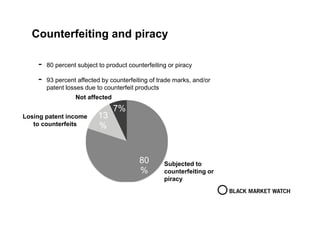
- 80 percent subject to product counterfeiting or piracy
- 93 percent affected by counterfeiting of trade marks, and/or
patent losses due to counterfeit products
80
%
13
%
7%
Subjected to
counterfeiting or
piracy
Losing patent income
to counterfeits
Not affected
Trade mark damage
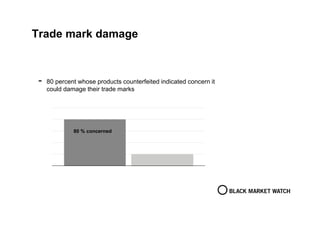
- 80 percent whose products counterfeited indicated concern it
could damage their trade marks
0
20
40
60
80
100
April
80 % concerned
Risk to human health and safety
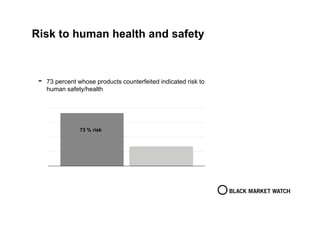
- 73 percent whose products counterfeited indicated risk to
human safety/health
0
20
40
60
80
April
73 % risk
Growth trend
Grown past 5 years? - 73 percent YES
Grow next 5 year? - 80 percent YES
“Growth driven by online fora”
“It will become bigger as we expand in emerging markets”
“We may see a revolution like in the music industry, when content
became digital. With 3D printing the customer will become
manufacturer. In the future digital blueprints will be a key
commodity”
Countries
Counterfeiting biggest problem in non-OECD countries
China
- identified as main source country by all companies affected by
counterfeiting
- Chinese websites enormous sales points for counterfeits,
some efficient at removing offending material
- some companies viewed “China Inc.” as pursuing a strategy of
intellectual property theft, others viewed Chinese authorities as
more cooperative
Organised crime
- Companies do not look for organised crime connection - seen
as law enforcement responsibility
- Four companies confirmed organised crime involvement;
including European, Russian, Chinese, Asian and Latin
American groups
- Three companies confirmed cases where perpetrators of IP
crime were also involved in other serious crimes, including
narcotics and firearms
- One company named a Middle Eastern terrorist group that had
been involved in counterfeit trade of its brands
Government
80 percent stated Swedish government prioritisation of enforcing IP
rights too low (others did not know or indicate a view)
Common views:
- EU could do more to bring issue on global agenda (US more
focused)
- Need higher punishments for IP crimes
- Need to promote public awareness
Shareholder, financial analyst and
media questions
Shareholders at annual meetings
-Two companies, one in relation to high profile cases, other stated
questions not serious
Financial analysts
- Only one single question reported by one company
Media interest
- High profile incidents
- Only one company reported media doing an analytic piece
covering the sector
Challenges quantifying problem
- Overall corporate impact assessment difficult as companies
have several markets, product categories and trade marks
- Few companies could (or were willing) to quantify the
economic impact of IP crimes, despite that 60 percent saw it
as a strategic threat
Views on extent of problem
“For some product categories it’s 20-30 percent counterfeits, for others less than 10 percent.”
“A study estimated 3-5 percent counterfeits in our sector, resulting in a total damage (adding
trade mark damage to sales volume losses) as being equivalent to 10 percent of turnover. I
believe that would be a reasonable estimate in our case.”
“Counterfeits have been estimated at 2 percent of global output, I think it’s about the same for
us.”
“We are losing billions of SEK every year on our patent rights.”
“The majority of products sold are unlicensed products.”
“Counterfeiting is endemic in the spare parts market.”
“For us it’s more of an inconvenience, resulting in sales losses of a few million Euros a year.”
“The pirates offer more content at lower prices.”
“It’s my personal opinion, but maybe counterfeiting is not bad for all brands.”
“In my industry illicit trade is bigger than the market leader.”
“It’s a catastrophe — in some countries over 50 percent of the after sales market is fake.”
Concluding questions
- Will the findings help mobilise political action?
- Interest in replicating for other stock market indices?
- Survey of stock analysts?
Thank you!

How counterfeiting and IP crime affects leading companies by Black Market Watch, OECD, Paris, 30-31 March 2015‌

  • 2.
    How counterfeiting andIP crime affects leading companies A project commissioned by the Swedish Confederation of Enterprise OECD, March 2014
  • 3.
    Underlying logic Problem: Lack ofpublic data on impact of illicit trade on business = Lack of political prioritisation Solution: Collecting data - a prerequisite for further action
  • 4.
    NASDAQ OMX 30Stockholm index - IP intense and internationally active companies - Manageable number of companies to interview - Market cap 470 billion US dollars (23 January 2015)
  • 5.
    Methodology Hypothesis: Companies themselvesbest placed to (gu)estimate impact of intellectual property crimes on their own activities - Questionnaire & interviews - Anonymise (in order to reduce reluctance to share info) - 17 companies whose core business activity could be significantly affected by counterfeiting, patent theft or copyright infringement. 14 (+1) participated in the study
  • 6.
  • 7.
    Counterfeiting and piracy -80 percent subject to product counterfeiting or piracy - 93 percent affected by counterfeiting of trade marks, and/or patent losses due to counterfeit products 80 % 13 % 7% Subjected to counterfeiting or piracy Losing patent income to counterfeits Not affected
  • 8.
    Trade mark damage -80 percent whose products counterfeited indicated concern it could damage their trade marks 0 20 40 60 80 100 April 80 % concerned
  • 9.
    Risk to humanhealth and safety - 73 percent whose products counterfeited indicated risk to human safety/health 0 20 40 60 80 April 73 % risk
  • 10.
    Growth trend Grown past5 years? - 73 percent YES Grow next 5 year? - 80 percent YES “Growth driven by online fora” “It will become bigger as we expand in emerging markets” “We may see a revolution like in the music industry, when content became digital. With 3D printing the customer will become manufacturer. In the future digital blueprints will be a key commodity”
  • 11.
    Countries Counterfeiting biggest problemin non-OECD countries China - identified as main source country by all companies affected by counterfeiting - Chinese websites enormous sales points for counterfeits, some efficient at removing offending material - some companies viewed “China Inc.” as pursuing a strategy of intellectual property theft, others viewed Chinese authorities as more cooperative
  • 12.
    Organised crime - Companiesdo not look for organised crime connection - seen as law enforcement responsibility - Four companies confirmed organised crime involvement; including European, Russian, Chinese, Asian and Latin American groups - Three companies confirmed cases where perpetrators of IP crime were also involved in other serious crimes, including narcotics and firearms - One company named a Middle Eastern terrorist group that had been involved in counterfeit trade of its brands
  • 13.
    Government 80 percent statedSwedish government prioritisation of enforcing IP rights too low (others did not know or indicate a view) Common views: - EU could do more to bring issue on global agenda (US more focused) - Need higher punishments for IP crimes - Need to promote public awareness
  • 14.
    Shareholder, financial analystand media questions Shareholders at annual meetings -Two companies, one in relation to high profile cases, other stated questions not serious Financial analysts - Only one single question reported by one company Media interest - High profile incidents - Only one company reported media doing an analytic piece covering the sector
  • 15.
    Challenges quantifying problem -Overall corporate impact assessment difficult as companies have several markets, product categories and trade marks - Few companies could (or were willing) to quantify the economic impact of IP crimes, despite that 60 percent saw it as a strategic threat
  • 16.
    Views on extentof problem “For some product categories it’s 20-30 percent counterfeits, for others less than 10 percent.” “A study estimated 3-5 percent counterfeits in our sector, resulting in a total damage (adding trade mark damage to sales volume losses) as being equivalent to 10 percent of turnover. I believe that would be a reasonable estimate in our case.” “Counterfeits have been estimated at 2 percent of global output, I think it’s about the same for us.” “We are losing billions of SEK every year on our patent rights.” “The majority of products sold are unlicensed products.” “Counterfeiting is endemic in the spare parts market.” “For us it’s more of an inconvenience, resulting in sales losses of a few million Euros a year.” “The pirates offer more content at lower prices.” “It’s my personal opinion, but maybe counterfeiting is not bad for all brands.” “In my industry illicit trade is bigger than the market leader.” “It’s a catastrophe — in some countries over 50 percent of the after sales market is fake.”
  • 17.
    Concluding questions - Willthe findings help mobilise political action? - Interest in replicating for other stock market indices? - Survey of stock analysts?
  • 18.