Epiphyseal injuries, Types,
classification and management
Moderators
Dr.T.Venkateshwara Rao
Prof.& HOD
Dr.J.Venkateshwarlu
Asso.prof.
Dr.K.Venkatswamy
Asst.prof.
Dr.Prasad reddy
Tutor
Presented by
Dr.B.Kiran Kumar
PG in Orthopaedics
Terminology
 Epiphyseal Plate = Growth
Plate = Physis
 Epiphysis
 Secondary Ossification Center
 Epiphysis and growth plate are
NOT synonyms
 The epiphysis is the bone
located between the articular
surface and the physis
 Metaphysis
 Bone adjacent to the physis on
the opposite side of the
epiphysis.
 Diaphysis
 The shaft of the bone
During growth, the epiphyseal and metaphyseal regions are
separated by the organized cartilaginous physis, which is the
major contributor to longitudinal growth of the bone.
The larger long bones (clavicle, humerus, radius, ulna, femur,
tibia, and fibula) have physes at both ends, whereas the smaller
tubular bones (metacarpals, metatarsals, and phalanges) usually
have a physis at one end only.
At birth, with the exception of the distal femur and occasionally
the proximal tibia, all of the above-mentioned epiphyses are
purely cartilaginous.
At various stages of postnatal growth and development, a
secondary ossification center forms within the epiphysis.
 This development helps define the radiolucent zone of the
physis, which persists until the physis closes at skeletal
maturation.
C- 1 yr
R – 3yr
I - 5yr
T- 7 yr
O – 9yr
E – 11yr
Typical age (and range) of development of the secondary ossification centers of
the epiphyses in the (A) upper extremity and (B) lower extremity
Typical age (and range) of closure of physes in the (A) upper extremity and (B)
lower extremity.
Microscopic Anatomy of the physis
 2 growth plates
 Spherical
 Horizontal
 3 layers in the physis
 Reserve zone
 Proliferative zone
 Hypertrophic zone
 Maturation zone
 Degenerative zone
 Zone of provisional
calcificaton
Reserve zone
 Chondrocytes store lipids, glycogen
and proteoglycan aggregates
 Blood vessels pass through this layer
causing low pO2
 Diseases with defects of this layer
 Pseudoachondroplasia
 Diastrophic dwarfism
Proliferative zone
 Longitudinal growth occurs
 Good blood supply inhibits
calcification
 Diseases with defects in this layer
 Gigantism
 Achondroplasia
 Hypochondroplasia
 Malnutrition, irradiation injury,
glucocorticoid excess
Hypertrophic zone
 Maturation zone
 Degeneration zone
 Provisional calcification zone
 Accumulate calcium in their
mitochondria
 releasing Ca from matrix vesicles
Hypertrophic zone
 Osteoblasts use cartilage as a scaffold
for bone formation
 Low pO2 facilitates this
 Diseases with defects in this layer
 Mucopolysaccharidoses
 Morquio’s, Hurler’s, Hunter’s
 Rickets, osteomalacia
 Insufficient Ca2+
/ P for normal calcification
 Physis appears widened
 Enchondromas originate in this zone
 Physeal fractures
The peripheral margin of the physis comprises
two specialized areas important for
• mechanical integrity
• peripheral growth of the physis
The zone (or groove) of Ranvier :
a triangular microscopic structure at the
periphery of the physis, containing fibroblasts,
chondroblasts, and osteoblasts responsible for
peripheral growth of the physis.
The perichondral ring of LaCroix :
a fibrous structure overlying the zone of
Ranvier, connecting the metaphyseal
periosteum and cartilaginous epiphysis, and
has the important mechanical function of
stabilizing the epiphysis to the metaphysis.
Classification of epiphyseal blood supply
according to Dale and Harris.
A. Type A epiphyses are nearly completely covered
by articular cartilage.
Blood supply must enter via the perichondrium. This
blood supply is susceptible to disruption by
epiphyseal separation.
The proximal femur and proximal humerus are
examples of type A epiphyses.
B. Type B epiphyses are only
partially covered by articular
cartilage.
Such epiphyses are more
resistant to blood supply
impairment by epiphyseal
separation.
The distal femur, proximal
and distal tibia, and distal
radius are clinical examples
of type B epiphyses.
Contributions to Longitudinal Growth
Approximate percentage of
longitudinal growth
provided by the proximal
and distal physes for each
long bone in the
upper (A) and
lower (B) extremities.
Histologic Review
 Important for
understanding
prognosis
 The germinal layer of
the cartilage is on the
epiphysis
 Cartilage cells grow
from the epiphysis
towards the metaphysis.
The fragments of cells
then mineralize.
Histology (cont’d)
 Neovascularization occurs from the
metaphysis towards the epiphysis.
 Damage to either epiphyseal or metaphyseal
vascular supply disrupts bone growth
 Damage to the layer of cartilage may not be
significant if the surfaces are reapposed, and
vascular supply to the growing cartilage is
not permanently interrupted.
Overview
 Salter-Harris fractures are fractures through
a growth plate (physis); therefore, they are
unique to pediatric patients.
 Several types of fractures have been
categorized by the involvement of the physis,
metaphysis, and epiphysis.
 The classification of the injury is important
because it affect the treatment of the patient
and provides clues to possible long-term
complications.
Epidemiology
 18% to 30% of children’s
fractures involve the
physis
 Male-to-female ratio is
about 2:1
 Most common site is
phalanges of the fingers
(~37%)
 Next is distal radius (18%)
Physeal Fractures
 Traditionally believed to occur primarily
through zone of hypertrophy
 Some fractures may traverse more than one zone
 Growth disturbance/arrest potentially related to
location of fracture within physeal zones,
disruption of vascularity
ETIOLOGY OF PHYSEAL INJURIES
• Trauma (most common)
• Infection(long bone OSTEOMYELITIS or SEPTIC
ARTRITIS)
• Tumor(BENIGN OR MALIGNANT)
• Vascular insult
• Repetitive stress
• Miscellaneous ( Irradiation , Thermal injury, Electrical )
Classification
Classifications
Poland 1898
Salter - Harris 1963
Aitken 1965
Rang 1969
Weber 1980
Ogden 1981
Peterson 1994
Classification
 Multiple classification systems
 Salter-Harris – most commonly used (1963)
 Poland – earliest scientific approach (1895)
 Bergenfeldt – later modified by Salter & Harris
(1933)
 Aitken – standard from 1930’s until S-H proposed
(1936)
 Peterson – newer and more thorough, but more
complicated (1994)
SALTER HARRIS
CLASSIFICATION
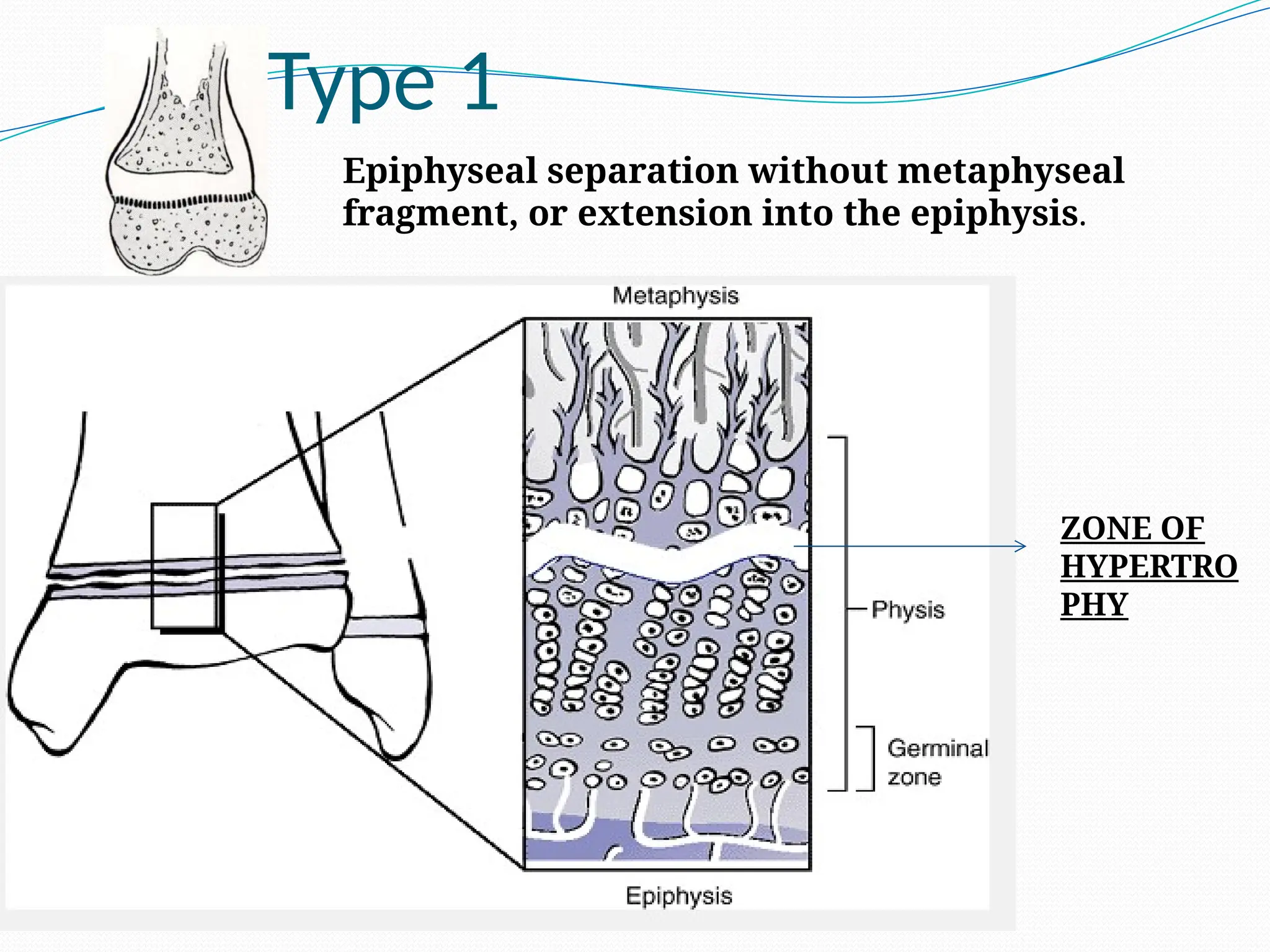
Type 1
Epiphyseal separation without metaphyseal
fragment, or extension into the epiphysis.
ZONE OF
HYPERTRO
PHY
Type I
 A type 1 fracture is transverse fracture
through the hypertrophic zone of the physis.
In this injury, the width of the physis is
increased. The growing zone of the physis
usually is not injured, and growth
disturbance is uncommon.
 Usually dx’d by clinical presentation alone.
 On clinical examination, the child has point
tenderness at the epiphyseal plate, which is
suggestive of a type I fracture.
X-rays of undisplaced type I physeal fractures, therefore, are normal except for
associated soft tissue swelling, making careful patient examination particularly
important in this injury
Type 2
physeal fracture line extends into
the metaphysis.
THURSTON HOLLAND
FRAGMANT OR SIGN
Type II
 A type II fracture is a fracture through the physis
and metaphysis, but the epiphysis is not involved
in the injury.
 These fractures may cause minimal shortening;
however, the injuries rarely result in functional
limitations.
 mechanism: shear or avlusion with angular
force;
 healing is rapid, and growth is rarely disturbed;
 Type II is the most common
Type 3
Fracture extends from the articular
surface to the physis and continues
peripherally through the physis
Type III
 A type III fracture is a fracture through the physis
and the epiphysis. This fracture passes across the
hypertrophic layer of the physis and extends to split
the epiphysis, inevitably damaging the
reproductive layer of the physis.
 Prone to chronic disability because, by crossing the
physis, it extends into the articular surface of the
bone.
 Rarely result in significant deformity; therefore, they
have a relatively favorable prognosis.
 A type of ankle fracture termed a Tillaux fracture is a
type of Salter-Harris type III fracture that is prone to
disability.
 Treatment is often surgical.
Type 4
The fracture line extends across the physis from
the epiphysis and articular surface into the
peripheral metaphysis. The fracture line extends
across the physis
Type IV
 A Type IV fracture involves all 3 elements of the
bone: The fracture passes through the epiphysis,
physis, and metaphysis.
 Similar to a type III fracture, a type IV fracture also
is an intraarticular fracture; thus, it can result in
chronic disability.
 By interfering with the growing layer of cartilage
cells, these fractures can cause premature focal
fusion of the involved bone. Therefore, these
injuries can cause deformity of the joint. –
 Even w/ perfect reduction, growth is affected &
prognosis is guarded;
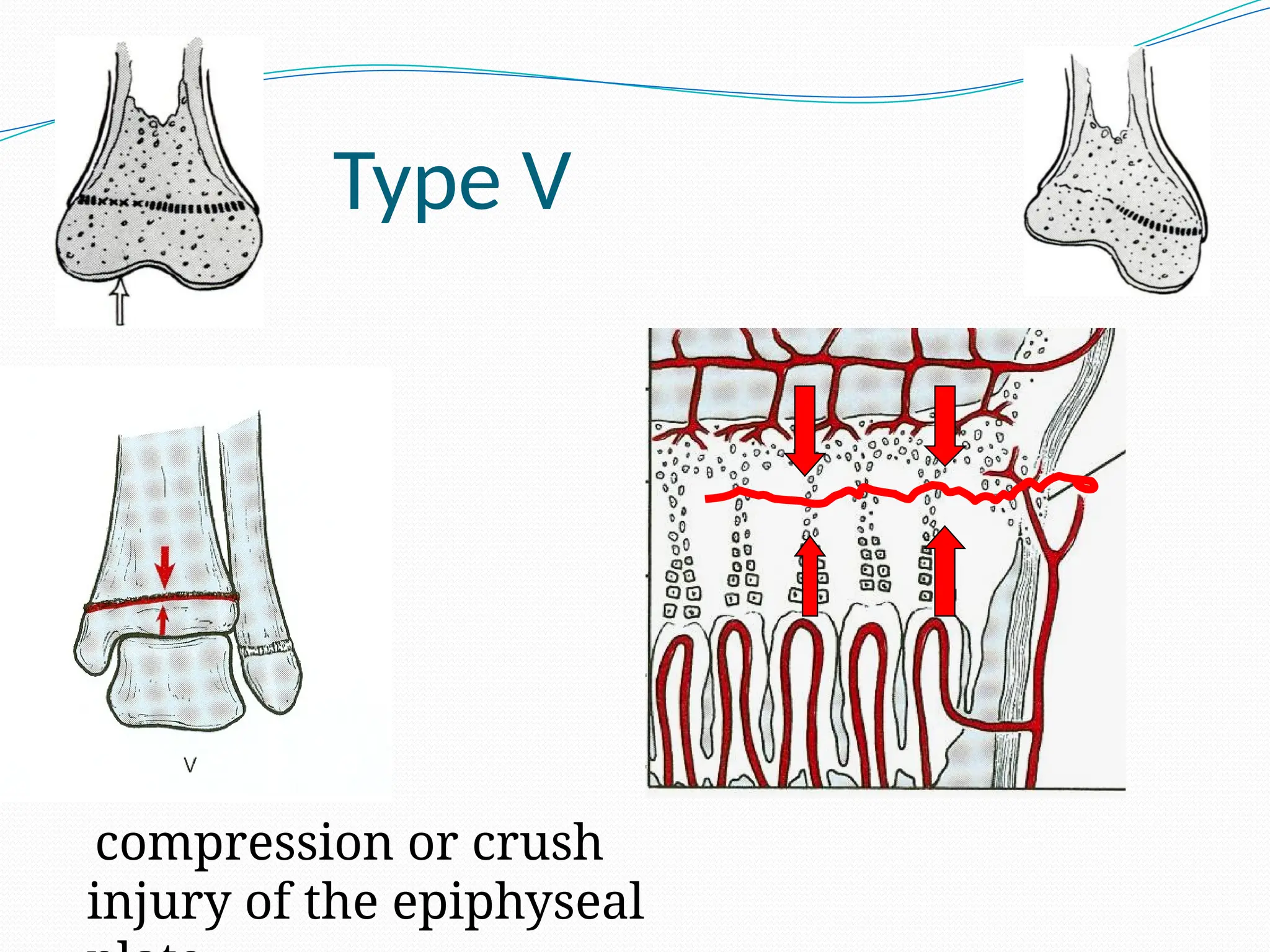
Type V
compression or crush
injury of the epiphyseal
Type V
 A type V injury is a compression or crush injury of the
epiphyseal plate with no associated epiphyseal or
metaphyseal fracture.
 This fracture is associated with growth disturbances at
the physis. Initially, diagnosis may be difficult, and it
often is made retrospectively after premature closure of
the physis is observed. In the older teenagers, the
diagnosis is particularly difficult.
 The clinical history is paramount in the diagnosis of this
fracture. A typical history is that of an axial load injury.
 These injuries have a poor functional prognosis.
 Angulation and limb length inequality may be long term
complications
S H TYPE 6
Perichondrial injury as
described by Mercer
Rang(1969)
Rare injury
Blow to
periosteum/perichondrial
ring
pgmedicalworld.com
Type 6
Rare Salter-Harris Fractures
Type VI: This is a rare injury and consists of an
injury to the perichondral structures.
Type VII: This is an isolated injury to the
epiphyseal plate.
Type VIII: This is an isolated injury to the
metaphysis, with a potential injury related to
endochondral ossification.
Type IX: This is an injury to the periosteum
that may interfere with membranous growth.
Poland classification of physeal fractures. Compare to
the Salter-Harris classification,
Poland type I, epiphyseal separation without
metaphyseal fragment, or extension into the epiphysis.
Poland type II, physeal fracture line extends into the
metaphysis. Poland type III fracture extends from the
articular surface to the physis and continues
peripherally through the physis. Poland type IV, T-
condylar fracture of epiphysis &physis.
Aitken classification of physeal
fractures: types I, II, and III.
Types 1 2 3 is equivalent of
Salter-Harris type 2,3 & 4
Peterson Classification of Physeal Fractures
His classification retained Salter-Harris types I through IV as Peterson types
II, III, IV, and V and added two new types
It is important to know the two new patterns that Peterson described,
because they are clinically relevant.
type I is a
transverse
metaphyseal
fracture with
a
longitudinal
extension to
the physis
partial
physeal
loss
Lawnmower injuries are a frequent mechanism for type VI
injuries
Principles of management
 Diagnosis
 Goals
 Reduction
 Avoid growth plate arrest
 Return of function
 Operative or non-operative
Evaluation of Physeal
Fractures
• Plain radiograph
• CT
• Arthrography
• MRI scans
• Ultrasound
X-rays should be taken in true orthogonal views and include the joint
both above and below the fracture.
If a physeal injury is suspected, views centered over the suspected
physis should be obtained to decrease parallax and increase detail.
Oblique views may be of value in assessing minimally displaced
injuries.
CT scans provide excellent definition of bony anatomy, particularly
using reconstructed images
MRI scans are excellent for demonstrating soft tissue lesions and
minor osseous injuries, which may not be seen using standard radiation

techniques.
Both arthrography and ultrasound have been used to
assess the congruency of articular surfaces
Arthrography may help define the anatomy in young patients with
small or no secondary ossification centers in the epiphyses .
Ultrasonography occasionally is useful for diagnostic purposes to
identify epiphyseal separation in infants
Principles of management
 Goals
 Reduction
 Avoid growth plate injury
 Return of function
Salter Harris Classification - General
Treatment Principles
 Type I & Type II -
closed reduction,
immobilization
Exceptions =
proximal femur,
distal femur
Salter Harris Classification - General
Treatment Principles
 Type III & IV -
intraarticular and
physeal step-off
needs anatomic
reduction, ORIF if
necessary
• Damage to physis must be avoided while oRIF
• Generally growth plate must be traversed with k wires
and not with lag screw
• Ideally , k-wires should be inserted at low speed and
should cross the physis at a right angle.
• When placing wires across the growth plate , repeated
drilling , starting several wires from a single point and a
very peripheral insertion must be avoided to minimize
damage to the proliferation zones
• Generally , k wires can be removed after 3-4 weeks
• If it is necessary for a screw to cross the physis then it
must be removed as soon as possible
PROGNOSIS
Severity of injury
Age of the child
Site of injury
Amount of physis injured
Treatment
 Goal of treatment of all physeal fractures is to
maintain function and normal growth
 Attainment of these goals is most likely when all
structures are anatomically reduced
 Therefore goal is to obtain and maintain anatomic
reduction
 May be done by open or closed means
 All reductions should be gentle to prevent damage to the
delicate physeal cartilage
 Forceful, repeated manipulations should be avoided!
Treatment
Salter-Harris I
 Most common with fractures
of the phalanges, distal
radius and fibula
 All layers of the physis may
be involved
 Should be managed by closed
reduction if possible, as
internal fixation would
require crossing the physis
 In a young child, better to
accept an imperfect
reduction than risk hazards
of fixation across physis
Treatment
Salter-Harris II
 Most can be easily reduced
with closed reduction
 Important to have good
relaxation to prevent physeal
damage
 Intact periosteum on side of
metaphyseal fragment
imparts further stability to
fracture
 ORIF often unnecessary
 Periosteum can become
impinged at fracture site,
especially in distal tibia
Treatment
Salter-Harris II
 If ORIF is necessary
 Internal fixation is best
accomplished by pins or screws
from metaphysis to metaphysis,
avoiding the physis
 If Thurstan Holland fragment is
small, smooth pins may be
placed across physis
 Growth arrest less likely if
 Pins avoid perichondrial ring
 Are longitudinal as possible
 Remain in place short time (< 3
wks)
Treatment
Salter-Harris II
 Prognosis depends greatly
on
 Amount of physis involved
 Site of injury
 Degree of displacement
 Patient age
 Site of injury important
because
 Irregular and undulating physes
produce more scraping of
irregular surfaces of delicate
cartilage (e.g. distal femur)
Treatment
Salter-Harris III
 Cartilage of physis and
articular surface are both
disrupted
 Best result achieved by
anatomic reduction of joint
and physis
 Reduce the likelihood of
degenerative arthrosis
 Reduce the likelihood of growth
arrest
Treatment
Salter-Harris III
 Usually require open
reduction of joint
 Most desirable internal
fixation is epiphysis to
epiphysis, especially in
younger children
Treatment
Salter-Harris IV
 Anatomic reduction and
maintenance of reduction are
essential to align both physis
and articular surface
 If any displacement, open
reduction usually required
 Closed reduction and percutanous
fixation may be acceptable in some
situations (e.g. lateral hum. condyle)
 Fixation best accomplished from
epiphysis to epiphysis and/or
metaphysis to metaphysis
 Growth arrest is common!
Treatment
Salter-Harris V
 Rarely diagnosed at time of
injury
 “No fracture on radiograph”
 Often diagnosed in
retrospect after growth
arrest discovered
 Occasionally seen in severe
triradiate acetabular injuries
 Rarely require initial
treatment as usually minimal
displacement and/or
instability
 But subsequent deformity may
require treatment
COMPLICATIONS
 Premature growth arrest
1.length discrepancy
2.angular deformity
Compartment syndrome/arterial occlusion
Neurological complications
sepsis & osteomyelitis
Overgrowth & hypoplasia
Malunion/delayed union/non union
summary
 Type II is most common
 Types III & IV are more prone to chronic
disability
 Type V associated with growth disturbances and
has a poor functional prognosis
 Only 2% of Salter-Harris fractures result in a
significant functional disturbance
BKK EPIPHYSEAL  INJURIES  IN CHILDREN- Copy.pptx

BKK EPIPHYSEAL INJURIES IN CHILDREN- Copy.pptx

  • 1.
    Epiphyseal injuries, Types, classificationand management Moderators Dr.T.Venkateshwara Rao Prof.& HOD Dr.J.Venkateshwarlu Asso.prof. Dr.K.Venkatswamy Asst.prof. Dr.Prasad reddy Tutor Presented by Dr.B.Kiran Kumar PG in Orthopaedics
  • 2.
    Terminology  Epiphyseal Plate= Growth Plate = Physis  Epiphysis  Secondary Ossification Center  Epiphysis and growth plate are NOT synonyms  The epiphysis is the bone located between the articular surface and the physis  Metaphysis  Bone adjacent to the physis on the opposite side of the epiphysis.  Diaphysis  The shaft of the bone
  • 3.
    During growth, theepiphyseal and metaphyseal regions are separated by the organized cartilaginous physis, which is the major contributor to longitudinal growth of the bone. The larger long bones (clavicle, humerus, radius, ulna, femur, tibia, and fibula) have physes at both ends, whereas the smaller tubular bones (metacarpals, metatarsals, and phalanges) usually have a physis at one end only. At birth, with the exception of the distal femur and occasionally the proximal tibia, all of the above-mentioned epiphyses are purely cartilaginous. At various stages of postnatal growth and development, a secondary ossification center forms within the epiphysis.  This development helps define the radiolucent zone of the physis, which persists until the physis closes at skeletal maturation.
  • 4.
    C- 1 yr R– 3yr I - 5yr T- 7 yr O – 9yr E – 11yr Typical age (and range) of development of the secondary ossification centers of the epiphyses in the (A) upper extremity and (B) lower extremity
  • 5.
    Typical age (andrange) of closure of physes in the (A) upper extremity and (B) lower extremity.
  • 6.
    Microscopic Anatomy ofthe physis  2 growth plates  Spherical  Horizontal  3 layers in the physis  Reserve zone  Proliferative zone  Hypertrophic zone  Maturation zone  Degenerative zone  Zone of provisional calcificaton
  • 7.
    Reserve zone  Chondrocytesstore lipids, glycogen and proteoglycan aggregates  Blood vessels pass through this layer causing low pO2  Diseases with defects of this layer  Pseudoachondroplasia  Diastrophic dwarfism
  • 8.
    Proliferative zone  Longitudinalgrowth occurs  Good blood supply inhibits calcification  Diseases with defects in this layer  Gigantism  Achondroplasia  Hypochondroplasia  Malnutrition, irradiation injury, glucocorticoid excess
  • 9.
    Hypertrophic zone  Maturationzone  Degeneration zone  Provisional calcification zone  Accumulate calcium in their mitochondria  releasing Ca from matrix vesicles
  • 10.
    Hypertrophic zone  Osteoblastsuse cartilage as a scaffold for bone formation  Low pO2 facilitates this  Diseases with defects in this layer  Mucopolysaccharidoses  Morquio’s, Hurler’s, Hunter’s  Rickets, osteomalacia  Insufficient Ca2+ / P for normal calcification  Physis appears widened  Enchondromas originate in this zone  Physeal fractures
  • 11.
    The peripheral marginof the physis comprises two specialized areas important for • mechanical integrity • peripheral growth of the physis The zone (or groove) of Ranvier : a triangular microscopic structure at the periphery of the physis, containing fibroblasts, chondroblasts, and osteoblasts responsible for peripheral growth of the physis. The perichondral ring of LaCroix : a fibrous structure overlying the zone of Ranvier, connecting the metaphyseal periosteum and cartilaginous epiphysis, and has the important mechanical function of stabilizing the epiphysis to the metaphysis.
  • 12.
    Classification of epiphysealblood supply according to Dale and Harris. A. Type A epiphyses are nearly completely covered by articular cartilage. Blood supply must enter via the perichondrium. This blood supply is susceptible to disruption by epiphyseal separation. The proximal femur and proximal humerus are examples of type A epiphyses.
  • 13.
    B. Type Bepiphyses are only partially covered by articular cartilage. Such epiphyses are more resistant to blood supply impairment by epiphyseal separation. The distal femur, proximal and distal tibia, and distal radius are clinical examples of type B epiphyses.
  • 14.
    Contributions to LongitudinalGrowth Approximate percentage of longitudinal growth provided by the proximal and distal physes for each long bone in the upper (A) and lower (B) extremities.
  • 15.
    Histologic Review  Importantfor understanding prognosis  The germinal layer of the cartilage is on the epiphysis  Cartilage cells grow from the epiphysis towards the metaphysis. The fragments of cells then mineralize.
  • 16.
    Histology (cont’d)  Neovascularizationoccurs from the metaphysis towards the epiphysis.  Damage to either epiphyseal or metaphyseal vascular supply disrupts bone growth  Damage to the layer of cartilage may not be significant if the surfaces are reapposed, and vascular supply to the growing cartilage is not permanently interrupted.
  • 17.
    Overview  Salter-Harris fracturesare fractures through a growth plate (physis); therefore, they are unique to pediatric patients.  Several types of fractures have been categorized by the involvement of the physis, metaphysis, and epiphysis.  The classification of the injury is important because it affect the treatment of the patient and provides clues to possible long-term complications.
  • 18.
    Epidemiology  18% to30% of children’s fractures involve the physis  Male-to-female ratio is about 2:1  Most common site is phalanges of the fingers (~37%)  Next is distal radius (18%)
  • 19.
    Physeal Fractures  Traditionallybelieved to occur primarily through zone of hypertrophy  Some fractures may traverse more than one zone  Growth disturbance/arrest potentially related to location of fracture within physeal zones, disruption of vascularity
  • 20.
    ETIOLOGY OF PHYSEALINJURIES • Trauma (most common) • Infection(long bone OSTEOMYELITIS or SEPTIC ARTRITIS) • Tumor(BENIGN OR MALIGNANT) • Vascular insult • Repetitive stress • Miscellaneous ( Irradiation , Thermal injury, Electrical )
  • 21.
  • 22.
    Classifications Poland 1898 Salter -Harris 1963 Aitken 1965 Rang 1969 Weber 1980 Ogden 1981 Peterson 1994
  • 23.
    Classification  Multiple classificationsystems  Salter-Harris – most commonly used (1963)  Poland – earliest scientific approach (1895)  Bergenfeldt – later modified by Salter & Harris (1933)  Aitken – standard from 1930’s until S-H proposed (1936)  Peterson – newer and more thorough, but more complicated (1994)
  • 24.
  • 25.
    Type 1 Epiphyseal separationwithout metaphyseal fragment, or extension into the epiphysis. ZONE OF HYPERTRO PHY
  • 26.
    Type I  Atype 1 fracture is transverse fracture through the hypertrophic zone of the physis. In this injury, the width of the physis is increased. The growing zone of the physis usually is not injured, and growth disturbance is uncommon.  Usually dx’d by clinical presentation alone.  On clinical examination, the child has point tenderness at the epiphyseal plate, which is suggestive of a type I fracture.
  • 27.
    X-rays of undisplacedtype I physeal fractures, therefore, are normal except for associated soft tissue swelling, making careful patient examination particularly important in this injury
  • 28.
    Type 2 physeal fractureline extends into the metaphysis. THURSTON HOLLAND FRAGMANT OR SIGN
  • 29.
    Type II  Atype II fracture is a fracture through the physis and metaphysis, but the epiphysis is not involved in the injury.  These fractures may cause minimal shortening; however, the injuries rarely result in functional limitations.  mechanism: shear or avlusion with angular force;  healing is rapid, and growth is rarely disturbed;  Type II is the most common
  • 31.
    Type 3 Fracture extendsfrom the articular surface to the physis and continues peripherally through the physis
  • 32.
    Type III  Atype III fracture is a fracture through the physis and the epiphysis. This fracture passes across the hypertrophic layer of the physis and extends to split the epiphysis, inevitably damaging the reproductive layer of the physis.  Prone to chronic disability because, by crossing the physis, it extends into the articular surface of the bone.  Rarely result in significant deformity; therefore, they have a relatively favorable prognosis.  A type of ankle fracture termed a Tillaux fracture is a type of Salter-Harris type III fracture that is prone to disability.  Treatment is often surgical.
  • 34.
    Type 4 The fractureline extends across the physis from the epiphysis and articular surface into the peripheral metaphysis. The fracture line extends across the physis
  • 35.
    Type IV  AType IV fracture involves all 3 elements of the bone: The fracture passes through the epiphysis, physis, and metaphysis.  Similar to a type III fracture, a type IV fracture also is an intraarticular fracture; thus, it can result in chronic disability.  By interfering with the growing layer of cartilage cells, these fractures can cause premature focal fusion of the involved bone. Therefore, these injuries can cause deformity of the joint. –  Even w/ perfect reduction, growth is affected & prognosis is guarded;
  • 37.
    Type V compression orcrush injury of the epiphyseal
  • 38.
    Type V  Atype V injury is a compression or crush injury of the epiphyseal plate with no associated epiphyseal or metaphyseal fracture.  This fracture is associated with growth disturbances at the physis. Initially, diagnosis may be difficult, and it often is made retrospectively after premature closure of the physis is observed. In the older teenagers, the diagnosis is particularly difficult.  The clinical history is paramount in the diagnosis of this fracture. A typical history is that of an axial load injury.  These injuries have a poor functional prognosis.  Angulation and limb length inequality may be long term complications
  • 40.
    S H TYPE6 Perichondrial injury as described by Mercer Rang(1969) Rare injury Blow to periosteum/perichondrial ring pgmedicalworld.com
  • 41.
  • 42.
    Rare Salter-Harris Fractures TypeVI: This is a rare injury and consists of an injury to the perichondral structures. Type VII: This is an isolated injury to the epiphyseal plate. Type VIII: This is an isolated injury to the metaphysis, with a potential injury related to endochondral ossification. Type IX: This is an injury to the periosteum that may interfere with membranous growth.
  • 43.
    Poland classification ofphyseal fractures. Compare to the Salter-Harris classification, Poland type I, epiphyseal separation without metaphyseal fragment, or extension into the epiphysis. Poland type II, physeal fracture line extends into the metaphysis. Poland type III fracture extends from the articular surface to the physis and continues peripherally through the physis. Poland type IV, T- condylar fracture of epiphysis &physis.
  • 44.
    Aitken classification ofphyseal fractures: types I, II, and III. Types 1 2 3 is equivalent of Salter-Harris type 2,3 & 4
  • 45.
    Peterson Classification ofPhyseal Fractures His classification retained Salter-Harris types I through IV as Peterson types II, III, IV, and V and added two new types It is important to know the two new patterns that Peterson described, because they are clinically relevant. type I is a transverse metaphyseal fracture with a longitudinal extension to the physis partial physeal loss Lawnmower injuries are a frequent mechanism for type VI injuries
  • 47.
    Principles of management Diagnosis  Goals  Reduction  Avoid growth plate arrest  Return of function  Operative or non-operative
  • 48.
    Evaluation of Physeal Fractures •Plain radiograph • CT • Arthrography • MRI scans • Ultrasound X-rays should be taken in true orthogonal views and include the joint both above and below the fracture. If a physeal injury is suspected, views centered over the suspected physis should be obtained to decrease parallax and increase detail. Oblique views may be of value in assessing minimally displaced injuries.
  • 49.
    CT scans provideexcellent definition of bony anatomy, particularly using reconstructed images MRI scans are excellent for demonstrating soft tissue lesions and minor osseous injuries, which may not be seen using standard radiation  techniques. Both arthrography and ultrasound have been used to assess the congruency of articular surfaces Arthrography may help define the anatomy in young patients with small or no secondary ossification centers in the epiphyses . Ultrasonography occasionally is useful for diagnostic purposes to identify epiphyseal separation in infants
  • 50.
    Principles of management Goals  Reduction  Avoid growth plate injury  Return of function
  • 51.
    Salter Harris Classification- General Treatment Principles  Type I & Type II - closed reduction, immobilization Exceptions = proximal femur, distal femur
  • 52.
    Salter Harris Classification- General Treatment Principles  Type III & IV - intraarticular and physeal step-off needs anatomic reduction, ORIF if necessary
  • 53.
    • Damage tophysis must be avoided while oRIF • Generally growth plate must be traversed with k wires and not with lag screw • Ideally , k-wires should be inserted at low speed and should cross the physis at a right angle. • When placing wires across the growth plate , repeated drilling , starting several wires from a single point and a very peripheral insertion must be avoided to minimize damage to the proliferation zones • Generally , k wires can be removed after 3-4 weeks • If it is necessary for a screw to cross the physis then it must be removed as soon as possible
  • 54.
    PROGNOSIS Severity of injury Ageof the child Site of injury Amount of physis injured
  • 55.
    Treatment  Goal oftreatment of all physeal fractures is to maintain function and normal growth  Attainment of these goals is most likely when all structures are anatomically reduced  Therefore goal is to obtain and maintain anatomic reduction  May be done by open or closed means  All reductions should be gentle to prevent damage to the delicate physeal cartilage  Forceful, repeated manipulations should be avoided!
  • 56.
    Treatment Salter-Harris I  Mostcommon with fractures of the phalanges, distal radius and fibula  All layers of the physis may be involved  Should be managed by closed reduction if possible, as internal fixation would require crossing the physis  In a young child, better to accept an imperfect reduction than risk hazards of fixation across physis
  • 57.
    Treatment Salter-Harris II  Mostcan be easily reduced with closed reduction  Important to have good relaxation to prevent physeal damage  Intact periosteum on side of metaphyseal fragment imparts further stability to fracture  ORIF often unnecessary  Periosteum can become impinged at fracture site, especially in distal tibia
  • 60.
    Treatment Salter-Harris II  IfORIF is necessary  Internal fixation is best accomplished by pins or screws from metaphysis to metaphysis, avoiding the physis  If Thurstan Holland fragment is small, smooth pins may be placed across physis  Growth arrest less likely if  Pins avoid perichondrial ring  Are longitudinal as possible  Remain in place short time (< 3 wks)
  • 61.
    Treatment Salter-Harris II  Prognosisdepends greatly on  Amount of physis involved  Site of injury  Degree of displacement  Patient age  Site of injury important because  Irregular and undulating physes produce more scraping of irregular surfaces of delicate cartilage (e.g. distal femur)
  • 62.
    Treatment Salter-Harris III  Cartilageof physis and articular surface are both disrupted  Best result achieved by anatomic reduction of joint and physis  Reduce the likelihood of degenerative arthrosis  Reduce the likelihood of growth arrest
  • 63.
    Treatment Salter-Harris III  Usuallyrequire open reduction of joint  Most desirable internal fixation is epiphysis to epiphysis, especially in younger children
  • 64.
    Treatment Salter-Harris IV  Anatomicreduction and maintenance of reduction are essential to align both physis and articular surface  If any displacement, open reduction usually required  Closed reduction and percutanous fixation may be acceptable in some situations (e.g. lateral hum. condyle)  Fixation best accomplished from epiphysis to epiphysis and/or metaphysis to metaphysis  Growth arrest is common!
  • 65.
    Treatment Salter-Harris V  Rarelydiagnosed at time of injury  “No fracture on radiograph”  Often diagnosed in retrospect after growth arrest discovered  Occasionally seen in severe triradiate acetabular injuries  Rarely require initial treatment as usually minimal displacement and/or instability  But subsequent deformity may require treatment
  • 66.
    COMPLICATIONS  Premature growtharrest 1.length discrepancy 2.angular deformity Compartment syndrome/arterial occlusion Neurological complications sepsis & osteomyelitis Overgrowth & hypoplasia Malunion/delayed union/non union
  • 67.
    summary  Type IIis most common  Types III & IV are more prone to chronic disability  Type V associated with growth disturbances and has a poor functional prognosis  Only 2% of Salter-Harris fractures result in a significant functional disturbance

Editor's Notes

  • #1 Presented by Dr.B.Kiran Kumar PG in MS orthopaedics
  • #21 Classification
  • #22 Peterson Classification: A portion of the epiphysis, growth plate, and metaphysis is missing open wound or compound fracture, often involving lawnmowers, farm machinery, snowmobiles, or gunshot wounds
  • #25 mechanism:             - pure shear;             - frx lines follow growth plate, separating epiphysis from metaphysis;       - unless the periosteum is torn, displacement cannot occur;       - w/o displacement radiographs appear normal;       - healing is rapid, usually within 2-3 weeks;       - complications are rare; the growing cells remain attached to the epiphysis. Thus, if the nutrition of these cells is not damaged by the separation, there is no reason why normal growth should not continue. The crux of the problem, then, is not the mechanical damage to the plate, but whether the separation interferes with the blood supply of the epiphysis.
  • #28 occurs after age 10;     - mechanism: shear or avlusion with angular force;     - cartilage failure on the tension side;     - metaphyseal failure on the compression side;     - w/ type II frxs, there is a division between epiphysis & metaphysis except for a             flake of metaphyseal bone is carried w/ epiphysis, (Thurston Holland sign)     - healing is rapid, and growth is rarely disturbed;     - note: Type II frx of distal femur and tibia may result in growth deformity;
  • #31 usually occurs after 10 years;     - this type of frx generally occurs when the growth plate is partially fused;     - prognosis is poor unless there is early accurate reduction;     - type III physeal injuries involve separations of portion of epiphysis and its           associated growth plate from the rest of the epiphysis;
  • #34 may occur at any age       - rare in the hand       - type IV frx potentially interfere with normal growth;       - frx line crosses physis, separating a portion of metaphysis-physis-epiphysis             from the remaining metaphysis-physis-ephiphysis;       - if frx is displaced, ORIF is indicated;      
  • #37 type V growth plate injuries are due to severe axial loading;     - some or all of the physis is so severely compressed that growth           potential is destroyed;     -;
  • #48 . Although plain x-rays provide adequate detail for the assessment and treatment of most physeal injuries, occasionally greater anatomic detail is necessary. CT scans provide excellent definition of bony anatomy, particularly using reconstructed images. They may be helpful in assessing complex or highly comminuted fractures, as well as the articular congruency of minimally displaced fractures (Fig. 5-29). MRI scans are excellent for demonstrating soft tissue lesions and “minor osseous injuries,” which may not be seen using standard radiation techniques.
  • #49 . Oblique views may be of value in assessing minimally displaced injuries. Although plain x-rays provide adequate detail for the assessment and treatment of most physeal injuries, occasionally greater anatomic detail is necessary. CT scans provide excellent definition of bony anatomy, particularly using reconstructed images. They may be helpful in assessing complex or highly comminuted fractures, as well as the articular congruency of minimally displaced fractures (Fig. 5-29). MRI scans are excellent for demonstrating soft tissue lesions and “minor osseous injuries,” which may not be seen using standard radiation techniques.
  • #50 In general physeal injuries heal in half the time it takes for nonphyseal fracture in the same region Healing time dependent on fracture location, displacement Stiffness from immobilization rare, thus err towards more time in cast if in doubt