GOOD BUSINESS PRACTICES   FOR ENTREPRENEURS Ronna Brown THE BETTER BUSINESS BUREAU New York Public Library Science, Industry and Business Library Branch October 19, 2004
Small Business Facts Over half of all employees in NY work for small businesses 99% of all businesses in state are small
Today’s Agenda BBB: Finding Capital and Keeping Customers FTC: Good Advertising and Avoiding Scams Questions and Answers
Entrepreneurs   Hurdles and Rewards Initial Hurdles Create plan Get Financing Comply with regulations Staying in Business Hurdles Offer quality product/service Price competitively Market Rewards Lifestyle, Financial, Achievement of Dreams
At the Beginning   Get Expert Advice Free Sources Business Associations Government Nonprofits Community Business Counselors Get Help With The Basics  Business Plans and Loan Proposal Marketing and Selling Techniques Financing Local Laws and Licensing
Where’s the Money? Informal -  Friends/Relatives/Business Owner Loans -  Banks/Credit Unions Debt Financing Alternatives -  Commercial Finance Co. Non-Profit MicroLenders/Govt Backed Programs - Empowerment Zones Selling Equity

Where’s the Money? Informal Network Create written document Don’t overextend Understand risk
Where’s the Money? Traditional Loans Banks Interest Rate Longterm/Shortterm Risk Factor Relationship/Partnership
Where’s the Money? Alternatives to Traditional Loans Vendor Credit Leasing Companies Factor Companies Customer Financing
Where’s the Money? Selling Equity Control Need business advisor Understand exactly what all the terms mean
General Issues for Financing Risk as it relates to the owner Know your actual & perceived risk level personal credit score  credit and borrowing history Prepare to make a Personal Investment (25% is typical ) Your experience and track record in business Create relationships – know loan officers
General Issues for Financing Risk as it relates to your business Collateral Business cash flow Equity in business Accurate records  Your business plan and loan proposal
Scams Targeting Small Businesses  &  Organizations
Just the Facts Common scams Office supply fraud Yellow Pages invoice scams Public safety fundraising fraud Web site cramming fraud How they work Pointers to prevent losses
Office Supply Fraud Chronic problem  Affects all types of businesses and organizations Companies lose $200 million annually
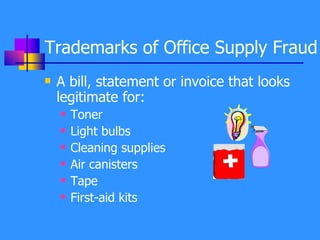
Trademarks of Office Supply Fraud A bill, statement or invoice that looks legitimate for: Toner Light bulbs Cleaning supplies Air canisters Tape First-aid kits
How the Scam Works Telemarketers state or imply that: They are calling from the regular, previous or “authorized” supplier It is time to reorder before prices go up They are calling to complete an existing order They are asking for confirmation to send previously ordered merchandise
How the Scam Works Telemarketers ask for: Name of the person that orders supplies Serial number and brand of equipment Confirmation of business address Does the business want a free gift?
Subsequent Events Supplies arrive at the office (not the kind usually ordered) Invoice follows several days later “Past due” invoices and collection efforts INVOICE PAST DUE
Fighting Back When a business fights back, the scam artists . . . Bully the caller with litigation threats Try to negotiate a lower price Appeal to sympathy Charge a “restocking” fee Make the organization return supplies at its own expense
Why This Fraud Thrives Invoices appear legitimate Employees may not be familiar with regular vendors and the cost of supplies Employees may feel they have consented to the transaction The scam succeeds even when a business returns the supplies, pays a “restocking” fee, or negotiates a lower price
How to Protect Your Business or Organization
1. Know Your Rights Don’t pay for unordered merchandise. Don’t return unordered merchandise. The Telemarketing Sales Rule offers protections It requires disclosures It prohibits telemarketers from misrepresenting material information
2. Use Purchase Controls Consider assigning a designated buyer Use purchase orders Send a copy of every purchase order and bill of lading to accounts payable or designated staff Refuse merchandise that does not match your purchase order or bill of lading.
3. Train Your Staff Instruct employees on how to respond to telemarketers Employees should refer callers to the designated buyer Require telemarketers to get a  purchase order
Yellow Pages Invoice Scams The solicitation has the appearance of an invoice It may bear the logo and feature the name “Yellow Pages” It may falsely suggest the publisher is your local telephone company It may lead you to believe your business has already been listed in the directory and you are now being billed
Avoiding These Scams Check out the company and publication Call local Yellow Pages publisher Ask for a copy of a prior edition Ask for online address and call advertisers Ask for written information regarding publication, distribution and circulation  Check with consumer protection agencies Contact local postmaster or postal inspector
Public Safety Fundraising Fraud Raising money for local police or fire personnel Selling advertising that will appear in local law enforcement journals Raising money to help fight drug abuse in the schools or community
Blowing the Whistle Ask for identification Ask how your contribution will be used  Call to verify legitimacy If you cannot verify legitimacy, report telemarketer Be wary of “special treatment” offers Don’t be intimidated!
Website Cramming Scams The “Offer” Free website  Nominal fee Cancel anytime The “Catch” Sites contain limited information  Sites are not listed with major search engines
Don’t Get “Crammed” Treat unordered services as a gift Review phone bills promptly Assign purchasing to designated staff Document purchases Train your staff on how to deal with telemarketers Buy from those you know and trust
Where to Complain and Get More Information Federal Trade Commission 1-877-FTC-HELP (382-4357) www. ftc . gov FTC, Washington, DC 20580 State Attorney General www. naag . gov Local Consumer Protection Office Better Business Bureau www. bbb .org
Federal Trade Commission 600 Pennsylvania Ave, NW Washington, DC  20580 1-877-FTC-HELP (382-4357) www.ftc.gov
Customers Easier to keep a current customer than find a new one What do customers want Quality product Respect/Appreciation
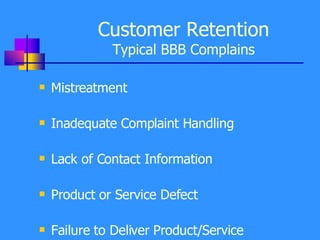
Customer Retention Typical BBB Complains Mistreatment Inadequate Complaint Handling Lack of Contact Information Product or Service Defect Failure to Deliver Product/Service
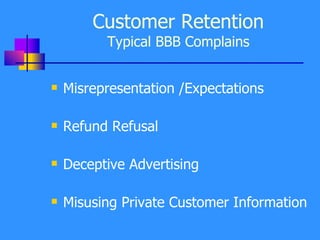
Customer Retention Typical BBB Complains Misrepresentation /Expectations Refund Refusal Deceptive Advertising Misusing Private Customer Information
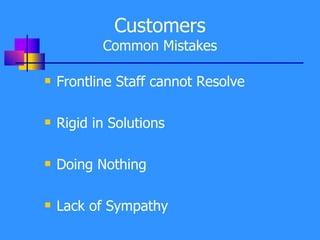
Customers Common Mistakes Frontline Staff cannot Resolve Rigid in Solutions Doing Nothing Lack of Sympathy
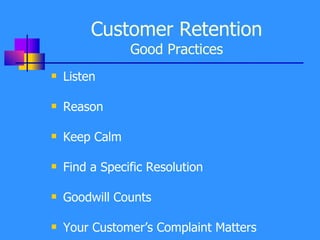
Customer Retention Good Practices Listen Reason Keep Calm Find a Specific Resolution Goodwill Counts Your Customer’s Complaint Matters
Customer Complaints Mediation Fast, Fair, Flexible Confidential Requires Good Faith
Legal Compliance “Ignorance is not Bliss” Federal, State, Country, and City Laws Seek Professional Help Legal Forms of Business Ownership Tax Laws Required Licenses or Permits Employment and Labor Law Consumer Laws
CONTACT THE BBB  THE BETTER BUSINESS BUREAU  Servicing Metro New York, Long Island, and the Mid-Hudson Region www. newyork .BBB.org [email_address] Telephone: 212-533-7500
THANK YOU

Biz Practices And Scams

  • 1.
    GOOD BUSINESS PRACTICES FOR ENTREPRENEURS Ronna Brown THE BETTER BUSINESS BUREAU New York Public Library Science, Industry and Business Library Branch October 19, 2004
  • 2.
    Small Business FactsOver half of all employees in NY work for small businesses 99% of all businesses in state are small
  • 3.
    Today’s Agenda BBB:Finding Capital and Keeping Customers FTC: Good Advertising and Avoiding Scams Questions and Answers
  • 4.
    Entrepreneurs Hurdles and Rewards Initial Hurdles Create plan Get Financing Comply with regulations Staying in Business Hurdles Offer quality product/service Price competitively Market Rewards Lifestyle, Financial, Achievement of Dreams
  • 5.
    At the Beginning Get Expert Advice Free Sources Business Associations Government Nonprofits Community Business Counselors Get Help With The Basics Business Plans and Loan Proposal Marketing and Selling Techniques Financing Local Laws and Licensing
  • 6.
    Where’s the Money?Informal - Friends/Relatives/Business Owner Loans - Banks/Credit Unions Debt Financing Alternatives - Commercial Finance Co. Non-Profit MicroLenders/Govt Backed Programs - Empowerment Zones Selling Equity
  • 7.
    Where’s the Money?Informal Network Create written document Don’t overextend Understand risk
  • 8.
    Where’s the Money?Traditional Loans Banks Interest Rate Longterm/Shortterm Risk Factor Relationship/Partnership
  • 9.
    Where’s the Money?Alternatives to Traditional Loans Vendor Credit Leasing Companies Factor Companies Customer Financing
  • 10.
    Where’s the Money?Selling Equity Control Need business advisor Understand exactly what all the terms mean
  • 11.
    General Issues forFinancing Risk as it relates to the owner Know your actual & perceived risk level personal credit score credit and borrowing history Prepare to make a Personal Investment (25% is typical ) Your experience and track record in business Create relationships – know loan officers
  • 12.
    General Issues forFinancing Risk as it relates to your business Collateral Business cash flow Equity in business Accurate records Your business plan and loan proposal
  • 13.
    Scams Targeting SmallBusinesses & Organizations
  • 14.
    Just the FactsCommon scams Office supply fraud Yellow Pages invoice scams Public safety fundraising fraud Web site cramming fraud How they work Pointers to prevent losses
  • 15.
    Office Supply FraudChronic problem Affects all types of businesses and organizations Companies lose $200 million annually
  • 16.
    Trademarks of OfficeSupply Fraud A bill, statement or invoice that looks legitimate for: Toner Light bulbs Cleaning supplies Air canisters Tape First-aid kits
  • 17.
    How the ScamWorks Telemarketers state or imply that: They are calling from the regular, previous or “authorized” supplier It is time to reorder before prices go up They are calling to complete an existing order They are asking for confirmation to send previously ordered merchandise
  • 18.
    How the ScamWorks Telemarketers ask for: Name of the person that orders supplies Serial number and brand of equipment Confirmation of business address Does the business want a free gift?
  • 19.
    Subsequent Events Suppliesarrive at the office (not the kind usually ordered) Invoice follows several days later “Past due” invoices and collection efforts INVOICE PAST DUE
  • 20.
    Fighting Back Whena business fights back, the scam artists . . . Bully the caller with litigation threats Try to negotiate a lower price Appeal to sympathy Charge a “restocking” fee Make the organization return supplies at its own expense
  • 21.
    Why This FraudThrives Invoices appear legitimate Employees may not be familiar with regular vendors and the cost of supplies Employees may feel they have consented to the transaction The scam succeeds even when a business returns the supplies, pays a “restocking” fee, or negotiates a lower price
  • 22.
    How to ProtectYour Business or Organization
  • 23.
    1. Know YourRights Don’t pay for unordered merchandise. Don’t return unordered merchandise. The Telemarketing Sales Rule offers protections It requires disclosures It prohibits telemarketers from misrepresenting material information
  • 24.
    2. Use PurchaseControls Consider assigning a designated buyer Use purchase orders Send a copy of every purchase order and bill of lading to accounts payable or designated staff Refuse merchandise that does not match your purchase order or bill of lading.
  • 25.
    3. Train YourStaff Instruct employees on how to respond to telemarketers Employees should refer callers to the designated buyer Require telemarketers to get a purchase order
  • 26.
    Yellow Pages InvoiceScams The solicitation has the appearance of an invoice It may bear the logo and feature the name “Yellow Pages” It may falsely suggest the publisher is your local telephone company It may lead you to believe your business has already been listed in the directory and you are now being billed
  • 27.
    Avoiding These ScamsCheck out the company and publication Call local Yellow Pages publisher Ask for a copy of a prior edition Ask for online address and call advertisers Ask for written information regarding publication, distribution and circulation Check with consumer protection agencies Contact local postmaster or postal inspector
  • 28.
    Public Safety FundraisingFraud Raising money for local police or fire personnel Selling advertising that will appear in local law enforcement journals Raising money to help fight drug abuse in the schools or community
  • 29.
    Blowing the WhistleAsk for identification Ask how your contribution will be used Call to verify legitimacy If you cannot verify legitimacy, report telemarketer Be wary of “special treatment” offers Don’t be intimidated!
  • 30.
    Website Cramming ScamsThe “Offer” Free website Nominal fee Cancel anytime The “Catch” Sites contain limited information Sites are not listed with major search engines
  • 31.
    Don’t Get “Crammed”Treat unordered services as a gift Review phone bills promptly Assign purchasing to designated staff Document purchases Train your staff on how to deal with telemarketers Buy from those you know and trust
  • 32.
    Where to Complainand Get More Information Federal Trade Commission 1-877-FTC-HELP (382-4357) www. ftc . gov FTC, Washington, DC 20580 State Attorney General www. naag . gov Local Consumer Protection Office Better Business Bureau www. bbb .org
  • 33.
    Federal Trade Commission600 Pennsylvania Ave, NW Washington, DC 20580 1-877-FTC-HELP (382-4357) www.ftc.gov
  • 34.
    Customers Easier tokeep a current customer than find a new one What do customers want Quality product Respect/Appreciation
  • 35.
    Customer Retention TypicalBBB Complains Mistreatment Inadequate Complaint Handling Lack of Contact Information Product or Service Defect Failure to Deliver Product/Service
  • 36.
    Customer Retention TypicalBBB Complains Misrepresentation /Expectations Refund Refusal Deceptive Advertising Misusing Private Customer Information
  • 37.
    Customers Common MistakesFrontline Staff cannot Resolve Rigid in Solutions Doing Nothing Lack of Sympathy
  • 38.
    Customer Retention GoodPractices Listen Reason Keep Calm Find a Specific Resolution Goodwill Counts Your Customer’s Complaint Matters
  • 39.
    Customer Complaints MediationFast, Fair, Flexible Confidential Requires Good Faith
  • 40.
    Legal Compliance “Ignoranceis not Bliss” Federal, State, Country, and City Laws Seek Professional Help Legal Forms of Business Ownership Tax Laws Required Licenses or Permits Employment and Labor Law Consumer Laws
  • 41.
    CONTACT THE BBB THE BETTER BUSINESS BUREAU Servicing Metro New York, Long Island, and the Mid-Hudson Region www. newyork .BBB.org [email_address] Telephone: 212-533-7500
  • 42.

Editor's Notes

  • #2 Thanks NY Public Library and co-speakers, FTC Also thanks to Bank of New York, sponsored project What is BBB: We believe in upholding and recognizing ethical business standards and practices in New York;–