Presented by: 
Vidyaranya.D 2nd year MBA
A currency is anything that has value and can 
be exchanged for goods and services 
 Fiat currency versus virtual currency 
 Fiat currency is any legal tender designated and issued 
by a central authority 
 Virtual currency: Unregulated digital money 
 E-money: Regulated digital money
 Developed by “Satoshi Nakamoto.” 
 Started in 2009. 
 Bitcoin is an electronic peer-to-peer (i.e. with 
no third party being involved) payment 
network and a digital currency. 
 Decentralisation – not being backed by or tied 
to any government or central bank. 
 Exchanged for fiat money. 
 The price of bitcoins is set purely by market 
demand and supply.
 It is decentralized 
 Peer to peer network 
 No central clearing houses 
 Not inflationary 
 Only 21 million bitcoin ever created 
 The last bitcoin mined in 2140 
 It is anonymous 
 One can hold multiple public addresses 
 It is transparent.
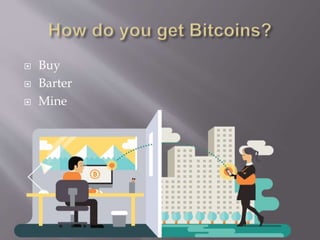
 Buy 
 Barter 
 Mine
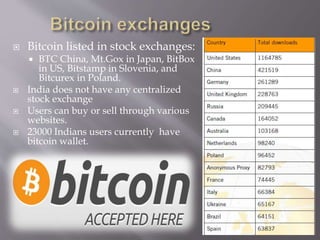
 Bitcoin listed in stock exchanges: 
 BTC China, Mt.Gox in Japan, BitBox 
in US, Bitstamp in Slovenia, and 
Bitcurex in Poland. 
 India does not have any centralized 
stock exchange 
 Users can buy or sell through various 
websites. 
 23000 Indians users currently have 
bitcoin wallet.
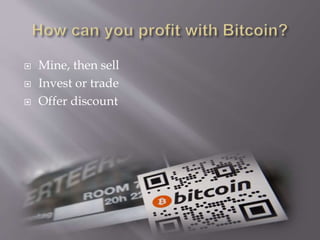
 Mine, then sell 
 Invest or trade 
 Offer discount
 Case law: Trendon Shavers of Bitcoin Savings & 
Trust (BTCST) 
 Accused for scamming $4.5 million bitcoin. 
 Argued bitcoin wasn’t money 
 District court of US (2013) 
 Bitcoin can be used as money. It can be used to purchase 
goods or services, and as Shavers stated, used to pay for 
individual living expenses. 
 The only limitation of Bitcoin is that it is limited to those 
places that accept it as currency. 
 It can also be exchanged for conventional currencies, such 
as the US dollar, Euro, Yen and Yuan. 
 Therefore, Bitcoin is a currency or form of money, and 
investors wishing to invest in BTCST provided an 
investment of money.”
 FEMA act 1999: currency defined, ”all currency notes, postal 
notes, postal orders, money orders, cheques, drafts, travelers 
cheques, letters of credit, bills of exchange and promisory 
notes, credit cards or such other similar instruments, as may be 
notified by the reserve bank. 
 the Payment and Settlement systems Act 2007, 
 A payment system cannot be exist without the authorization issued 
by the Reserve Bank of India. 
 It cannot be a security: Securities contract act 1955 
 It cannot be a derivative 
 It cannot be a negotiable instrument 
 The Indian Copyright Act defines the term “computer programme” 
as “a set of instructions expressed in words, codes, schemes or in any 
other form, including a machine readable medium, capable of 
causing a computer to perform a particular task or achieve a 
particular result”
 Reserve Bank of India (press release: 24 Dec 2013) 
 Creation, trading or usage of VCs as a medium for payment are 
not authorized including Bitcoin, litecoin, bbqcoin, dogecoins 
 No regulatory approvals, registration or authorization stated to 
have been obtained by the entities concerned for carrying on 
such activities 
 Risks: 
 Hacking, loss of password, malware attack 
 No established framework for recourse of customers problems 
 No underlying or back of any asset for VCs 
 Huge volatility in price 
 Legal status of exchange bodies of bitcoin also unclear 
 Media reports on illegal usage of VCs
 Anonymous:- take precautions 
 Never devalue due to inflation :-don’t hold longer 
period 
 No transaction fee:-cheer up 
 You can buy things: 
 You can speculate on bitcoin
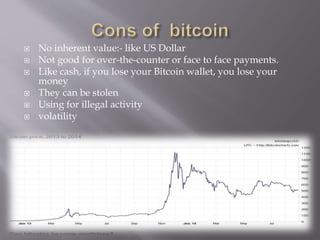
 No inherent value:- like US Dollar 
 Not good for over-the-counter or face to face payments. 
 Like cash, if you lose your Bitcoin wallet, you lose your 
money 
 They can be stolen 
 Using for illegal activity 
 volatility
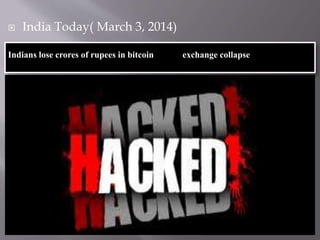
 India Today( March 3, 2014) 
Indians lose crores of rupees in bitcoin exchange collapse 
 What happened? 
 Japan based Mt.Gox collapsed. 
 Loss over 3,000 crore. (7.5 lakh bitcoins) 
 It has 1.27 lakh creditors(1000 Japanese) 
 Indians 35000 bitcoins( 100 crores)
 Bit Coin: The Indian banker 
 What and why Bitcoins: journal of Accounting and 
Finance 
 www.rbi.org.in › Press Releases 
 www.indiatoday.intoday.in › India › West › 
Maharashtra 
 https://bitcoin.org/bitcoin.pdf 
 www.mondaq.com/india/x/310426/.../Bitcoins+Leg 
al+Or+Illegal+In+Ind... 
 An exploration of Bitcoin ecosystem.pdf
Bitcoin ,

Bitcoin ,

  • 1.
  • 2.
    A currency isanything that has value and can be exchanged for goods and services  Fiat currency versus virtual currency  Fiat currency is any legal tender designated and issued by a central authority  Virtual currency: Unregulated digital money  E-money: Regulated digital money
  • 3.
     Developed by“Satoshi Nakamoto.”  Started in 2009.  Bitcoin is an electronic peer-to-peer (i.e. with no third party being involved) payment network and a digital currency.  Decentralisation – not being backed by or tied to any government or central bank.  Exchanged for fiat money.  The price of bitcoins is set purely by market demand and supply.
  • 4.
     It isdecentralized  Peer to peer network  No central clearing houses  Not inflationary  Only 21 million bitcoin ever created  The last bitcoin mined in 2140  It is anonymous  One can hold multiple public addresses  It is transparent.
  • 6.
     Buy Barter  Mine
  • 7.
     Bitcoin listedin stock exchanges:  BTC China, Mt.Gox in Japan, BitBox in US, Bitstamp in Slovenia, and Bitcurex in Poland.  India does not have any centralized stock exchange  Users can buy or sell through various websites.  23000 Indians users currently have bitcoin wallet.
  • 8.
     Mine, thensell  Invest or trade  Offer discount
  • 9.
     Case law:Trendon Shavers of Bitcoin Savings & Trust (BTCST)  Accused for scamming $4.5 million bitcoin.  Argued bitcoin wasn’t money  District court of US (2013)  Bitcoin can be used as money. It can be used to purchase goods or services, and as Shavers stated, used to pay for individual living expenses.  The only limitation of Bitcoin is that it is limited to those places that accept it as currency.  It can also be exchanged for conventional currencies, such as the US dollar, Euro, Yen and Yuan.  Therefore, Bitcoin is a currency or form of money, and investors wishing to invest in BTCST provided an investment of money.”
  • 10.
     FEMA act1999: currency defined, ”all currency notes, postal notes, postal orders, money orders, cheques, drafts, travelers cheques, letters of credit, bills of exchange and promisory notes, credit cards or such other similar instruments, as may be notified by the reserve bank.  the Payment and Settlement systems Act 2007,  A payment system cannot be exist without the authorization issued by the Reserve Bank of India.  It cannot be a security: Securities contract act 1955  It cannot be a derivative  It cannot be a negotiable instrument  The Indian Copyright Act defines the term “computer programme” as “a set of instructions expressed in words, codes, schemes or in any other form, including a machine readable medium, capable of causing a computer to perform a particular task or achieve a particular result”
  • 11.
     Reserve Bankof India (press release: 24 Dec 2013)  Creation, trading or usage of VCs as a medium for payment are not authorized including Bitcoin, litecoin, bbqcoin, dogecoins  No regulatory approvals, registration or authorization stated to have been obtained by the entities concerned for carrying on such activities  Risks:  Hacking, loss of password, malware attack  No established framework for recourse of customers problems  No underlying or back of any asset for VCs  Huge volatility in price  Legal status of exchange bodies of bitcoin also unclear  Media reports on illegal usage of VCs
  • 12.
     Anonymous:- takeprecautions  Never devalue due to inflation :-don’t hold longer period  No transaction fee:-cheer up  You can buy things:  You can speculate on bitcoin
  • 13.
     No inherentvalue:- like US Dollar  Not good for over-the-counter or face to face payments.  Like cash, if you lose your Bitcoin wallet, you lose your money  They can be stolen  Using for illegal activity  volatility
  • 14.
     India Today(March 3, 2014) Indians lose crores of rupees in bitcoin exchange collapse  What happened?  Japan based Mt.Gox collapsed.  Loss over 3,000 crore. (7.5 lakh bitcoins)  It has 1.27 lakh creditors(1000 Japanese)  Indians 35000 bitcoins( 100 crores)
  • 16.
     Bit Coin:The Indian banker  What and why Bitcoins: journal of Accounting and Finance  www.rbi.org.in › Press Releases  www.indiatoday.intoday.in › India › West › Maharashtra  https://bitcoin.org/bitcoin.pdf  www.mondaq.com/india/x/310426/.../Bitcoins+Leg al+Or+Illegal+In+Ind...  An exploration of Bitcoin ecosystem.pdf

Editor's Notes

  • #3  Anything that has a value and can be exchanged for goods or services