
Seminar report 
on 
Bit Coins
OUTLINE 
 Introduction 
 Mining 
 Working of Bit Coins 
 Payment method 
 Advantages 
 Disadvantages 
 Economy 
 Security
Introduction 
Bitcoin is a peer-to-peer payment system introduced as open source software in 
2009 by developer Satoshi Nakamoto . Bitcoins are alternatively referred as 
a virtual currency. Bitcoin was first mentioned in a 2008 paper published under 
the name Satoshi Nakamoto. In 2009, an exploit in an early bitcoin client was 
found that allowed large numbers of bitcoins to be created.
Mining 
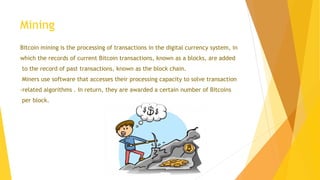
Bitcoin mining is the processing of transactions in the digital currency system, in 
which the records of current Bitcoin transactions, known as a blocks, are added 
to the record of past transactions, known as the block chain. 
Miners use software that accesses their processing capacity to solve transaction 
-related algorithms . In return, they are awarded a certain number of Bitcoins 
per block.
Mining 
Source : Internet
Working of Bit Coins 
As a new user, you can get started with Bitcoin, Once you have installed a Bitcoin wallet on your 
computer or mobile phone, it will generate your first Bitcoin address and you can create more 
whenever you need one. You can disclose your addresses to your friends so that they can pay you or 
vice versa. 
 Balances - block chain : The block chain is a shared public ledger on which the entire Bitcoin 
network relies. All confirmed transactions are included in the block chain. This way, Bitcoin 
wallets can calculate their spendable balance and new transactions can be verified to be spending 
bitcoins that are actually owned by the spender.
Working of Bit Coins 
 Transactions - private keys : A transaction is a transfer of value between Bitcoin wallets that gets 
included in the block chain. Bitcoin wallets keep a secret piece of data called a private key or seed, 
which is used to sign transactions, providing a mathematical proof that they have come from the 
owner of the wallet. The signature also prevents the transaction from being altered by anybody 
once it has been issued. 
 Processing – mining : Mining is a distributed consensus system that is used to confirm waiting 
transactions by including them in the block chain. To be confirmed, transactions must be packed in a 
block that fits very strict cryptographic rules that will be verified by the network. These rules prevent 
previous blocks from being modified because doing so would invalidate all following blocks. Mining 
also creates the equivalent of a competitive lottery that prevents any individual from easily adding 
new blocks consecutively in the block chain.
Working of Bit Coins 
Source : Internet
Payment method 
 Using Bitcoin as an Individual 
 Install the official Bitcoin client on your computer 
 Set up your wallet : Like regular money, you've got to have a place to keep your digital 
money. Wallets are basically programs that sort and track your digital currency via your 
account settings. 
Software wallets don't run on a third-party service after download. These wallets are operated 
from your computer, where you'll have to run a local blockchain to keep your transactions 
anonymous. This is the wallet for which the Bitcoin was originally conceived. 
Software wallets include: 
 BitcoinQT 
 Armory 
 Multibit
Software wallet 
For : PC For : Mobile 
Source : Internet
Payment method 
Web wallets are always available online, making them probably the most convenient and user 
friendly. All you need to do is set up an account and log in. They are, however, potentially 
somewhat less secure than hardware wallets, though each of these is also compatible with most 
Mobile phone providers. Web wallet options include: 
 Blockchain 
 Coinbase 
 Coinjar 
 Coinpunk 
 BitGo
Source : Internet
Payment method 
 Get some Bitcoin: There are several options available to grow your wallet and acquire 
more Bitcoin to spend. While the system is somewhat unpredictable and still experimental, 
They seem to be appreciating in value, making Bitcoins a unique opportunity. 
You can earn Bitcoin in several ways: 
 Purchase some Bitcoins 
 Mine Bitcoin 
 Trade for Bitcoins
Payment method 
Secure your wallet: 
 If you want, you can run a file encryption program. Click the menu option “Settings” -> 
“Encrypt Wallet”. 
 It's also a good idea to try and keep two different wallets, one account for daily use and 
making transactions and a separate savings account, offline, where you might consider 
storing the bulk of your Bitcoin
Payment method 
 Using Bitcoin as a Merchant 
Follow the basic steps of setting up a secure wallet and preparing for transactions as you would 
for an individual account, and then explore your payment processing options to make your 
business Bitcoin-friendly. There are a variety of Bitcoin services designed for vendors to 
facilitate transactions and work alongside businesses to make Bitcoin use simple and safe. 
To use bitcoin as a merchant you need to follow some simple steps: 
 Understand the Bitcoin rate and accommodate for it 
 Advertise your business as a Bitcoin merchant 
 Exercise caution 
 Confirm all payments
Advantages and Disadvantages 
Advantages: 
 Payment freedom : No bank holidays. No borders. No imposed limits. Bitcoin allows its 
users to be in full control of their money. 
 Very low fees : As these services are based on Bitcoin, they can be offered for much lower 
fees than with PayPal or credit card networks. 
 Fewer risks for merchants :Bitcoin transactions are secure, irreversible, and do not 
contain customers’ sensitive or personal information 
 Security and control : Bitcoin users are in full control of their transactions 
 Transparent and neutral : No individual or organization can control or manipulate the 
Bitcoin protocol because it is cryptographically secure. This allows the core of Bitcoin to 
be trusted for being completely neutral, transparent and predictable.
Advantages and Disadvantages 
Disadvantages 
 Degree of acceptance : Many people are still unaware of Bitcoin. 
 Volatility : The total value of bitcoins in circulation and the number of businesses using 
Bitcoin are still very small compared to what they could be 
 Ongoing development : Bitcoin is still in the process of maturing.
Economy 
 Classification as money :Bitcoin is often referred to as a currency, but it does 
not conform to the definition of money. 
 Price volatility 
 Alternative to national currencies 
 As investment 
 Money supply 
 Value forecasts
Rise and fall in prices of Bitcoins 
Source : Internet
Security 
There are two main ways the blockchain ledger can be corrupted to steal bitcoins: by 
fraudulently adding to or modifying it. The bitcoin system protects the blockchain against both 
using a combination of digital signatures and cryptographic hashes. 
Frauds and attacks which can take place are: 
 The Addition Attack and digital signatures 
 The Modification Attack and mining 
 Race attack 
 Finney attack 
 Vector76 attack 
 Brute force attack 
 >50% attack
References 
o https://bitcoin.org/en/ 
o http://whatis.techtarget.com/definition/Bitcoin-mining 
o https://products.butterflylabs.com/ 
o https://bitcoin.org/en/faq#what-are-the-advantages-of-bitcoin 
o https://bitcoin.org/en/faq#what-are-the-disadvantages-of-bitcoin
Thank you

Bitcoin

  • 1.
  • 2.
    OUTLINE  Introduction  Mining  Working of Bit Coins  Payment method  Advantages  Disadvantages  Economy  Security
  • 3.
    Introduction Bitcoin isa peer-to-peer payment system introduced as open source software in 2009 by developer Satoshi Nakamoto . Bitcoins are alternatively referred as a virtual currency. Bitcoin was first mentioned in a 2008 paper published under the name Satoshi Nakamoto. In 2009, an exploit in an early bitcoin client was found that allowed large numbers of bitcoins to be created.
  • 4.
    Mining Bitcoin miningis the processing of transactions in the digital currency system, in which the records of current Bitcoin transactions, known as a blocks, are added to the record of past transactions, known as the block chain. Miners use software that accesses their processing capacity to solve transaction -related algorithms . In return, they are awarded a certain number of Bitcoins per block.
  • 5.
  • 6.
    Working of BitCoins As a new user, you can get started with Bitcoin, Once you have installed a Bitcoin wallet on your computer or mobile phone, it will generate your first Bitcoin address and you can create more whenever you need one. You can disclose your addresses to your friends so that they can pay you or vice versa.  Balances - block chain : The block chain is a shared public ledger on which the entire Bitcoin network relies. All confirmed transactions are included in the block chain. This way, Bitcoin wallets can calculate their spendable balance and new transactions can be verified to be spending bitcoins that are actually owned by the spender.
  • 7.
    Working of BitCoins  Transactions - private keys : A transaction is a transfer of value between Bitcoin wallets that gets included in the block chain. Bitcoin wallets keep a secret piece of data called a private key or seed, which is used to sign transactions, providing a mathematical proof that they have come from the owner of the wallet. The signature also prevents the transaction from being altered by anybody once it has been issued.  Processing – mining : Mining is a distributed consensus system that is used to confirm waiting transactions by including them in the block chain. To be confirmed, transactions must be packed in a block that fits very strict cryptographic rules that will be verified by the network. These rules prevent previous blocks from being modified because doing so would invalidate all following blocks. Mining also creates the equivalent of a competitive lottery that prevents any individual from easily adding new blocks consecutively in the block chain.
  • 8.
    Working of BitCoins Source : Internet
  • 9.
    Payment method Using Bitcoin as an Individual  Install the official Bitcoin client on your computer  Set up your wallet : Like regular money, you've got to have a place to keep your digital money. Wallets are basically programs that sort and track your digital currency via your account settings. Software wallets don't run on a third-party service after download. These wallets are operated from your computer, where you'll have to run a local blockchain to keep your transactions anonymous. This is the wallet for which the Bitcoin was originally conceived. Software wallets include:  BitcoinQT  Armory  Multibit
  • 10.
    Software wallet For: PC For : Mobile Source : Internet
  • 11.
    Payment method Webwallets are always available online, making them probably the most convenient and user friendly. All you need to do is set up an account and log in. They are, however, potentially somewhat less secure than hardware wallets, though each of these is also compatible with most Mobile phone providers. Web wallet options include:  Blockchain  Coinbase  Coinjar  Coinpunk  BitGo
  • 12.
  • 13.
    Payment method Get some Bitcoin: There are several options available to grow your wallet and acquire more Bitcoin to spend. While the system is somewhat unpredictable and still experimental, They seem to be appreciating in value, making Bitcoins a unique opportunity. You can earn Bitcoin in several ways:  Purchase some Bitcoins  Mine Bitcoin  Trade for Bitcoins
  • 14.
    Payment method Secureyour wallet:  If you want, you can run a file encryption program. Click the menu option “Settings” -> “Encrypt Wallet”.  It's also a good idea to try and keep two different wallets, one account for daily use and making transactions and a separate savings account, offline, where you might consider storing the bulk of your Bitcoin
  • 15.
    Payment method Using Bitcoin as a Merchant Follow the basic steps of setting up a secure wallet and preparing for transactions as you would for an individual account, and then explore your payment processing options to make your business Bitcoin-friendly. There are a variety of Bitcoin services designed for vendors to facilitate transactions and work alongside businesses to make Bitcoin use simple and safe. To use bitcoin as a merchant you need to follow some simple steps:  Understand the Bitcoin rate and accommodate for it  Advertise your business as a Bitcoin merchant  Exercise caution  Confirm all payments
  • 16.
    Advantages and Disadvantages Advantages:  Payment freedom : No bank holidays. No borders. No imposed limits. Bitcoin allows its users to be in full control of their money.  Very low fees : As these services are based on Bitcoin, they can be offered for much lower fees than with PayPal or credit card networks.  Fewer risks for merchants :Bitcoin transactions are secure, irreversible, and do not contain customers’ sensitive or personal information  Security and control : Bitcoin users are in full control of their transactions  Transparent and neutral : No individual or organization can control or manipulate the Bitcoin protocol because it is cryptographically secure. This allows the core of Bitcoin to be trusted for being completely neutral, transparent and predictable.
  • 17.
    Advantages and Disadvantages Disadvantages  Degree of acceptance : Many people are still unaware of Bitcoin.  Volatility : The total value of bitcoins in circulation and the number of businesses using Bitcoin are still very small compared to what they could be  Ongoing development : Bitcoin is still in the process of maturing.
  • 18.
    Economy  Classificationas money :Bitcoin is often referred to as a currency, but it does not conform to the definition of money.  Price volatility  Alternative to national currencies  As investment  Money supply  Value forecasts
  • 19.
    Rise and fallin prices of Bitcoins Source : Internet
  • 20.
    Security There aretwo main ways the blockchain ledger can be corrupted to steal bitcoins: by fraudulently adding to or modifying it. The bitcoin system protects the blockchain against both using a combination of digital signatures and cryptographic hashes. Frauds and attacks which can take place are:  The Addition Attack and digital signatures  The Modification Attack and mining  Race attack  Finney attack  Vector76 attack  Brute force attack  >50% attack
  • 21.
    References o https://bitcoin.org/en/ o http://whatis.techtarget.com/definition/Bitcoin-mining o https://products.butterflylabs.com/ o https://bitcoin.org/en/faq#what-are-the-advantages-of-bitcoin o https://bitcoin.org/en/faq#what-are-the-disadvantages-of-bitcoin
  • 22.