Welcome
to
Learning Module 11
Introduction to Bitcoin Technology
https://www.computersupport.com/itanywherelabs/the-rapid-rise-of-blockchain-technology
RETRIEVED FROM HTTPS://WWW.IBTIMES.CO.UK/EUROPEAN-BITCOIN-LEGAL-EXPERTS-LAUNCH-DIGITAL-CURRENCY-BLOCKCHAIN-
TECHNOLOGY-FORUM-1555099
MODULE
LEARNING
OUTCOMES
Identify
Issues and implications of bitcoin
technology to the society
Enumerate. Applications of Bitcoin technology
Describe Bitcoin technology
https://coinzodiac.com/bitcoin-quick-guide/
HISTORY OF BITCOIN
TECHNOLOGY
RETRIEVED FROM
HTTPS://COINZODIAC.COM/BITCOIN-QUICK-GUIDE/
It is believed that Satoshi Nakamoto, an elusive software
developer from Japan created the Bitcoin in 2009 with the goal
of removing central authority over the new currency. This
currency is not being printed like regular money, and never will
be, as it is virtual in nature.
From its inception, Bitcoin has dramatically increased in
popularity because of its growing consumer base. More and
more people are drawn towards investing in Bitcoin due to its
unique characteristics.
WHAT IS BITCOIN?
 Bitcoin (₿) is a cryptocurrency. It is a
decentralized digital currency without a central
bank or single administrator that can be sent
from user to user on the peer-to-peer bitcoin
network without the need for intermediaries.
 A cryptocurrency is a digital or virtual currency designed to
work as a medium of exchange. It uses cryptography to
secure and verify transactions as well as to control the
creation of new units of a particular cryptocurrency.
Cryptography involves creating written or generated codes that allow
information to be kept secret. Cryptography converts data into a format
that is unreadable for an unauthorized user, allowing it to be transmitted
without unauthorized entities decoding it back into a readable format,
thus compromising the data.
 Bitcoins aren’t printed, like dollars or euros –
they’re produced by computers all around the
world, using free software. It was the first
example of what we today call cryptocurrencies,
a growing asset class that shares some
characteristics of traditional currencies, with
verification based on cryptography. Bitcoin is the
best-known and simplest implementations of
cryptocurrency in use today and Blockchain is
the technology that enables the existence of
cryptocurrency.
HOW DOES BITCOIN TECHNOLOGY WORK?
Bitcoin is a cryptocurrency that is conducted on a public
ledger, the "blockchain." Digitally transferred, it exists only
online. Much like gold, it can have monetary value while
also being a commodity, but it’s still its own currency. It is
also decentralized and not managed by a single entity, but
rather a group of people who process transactions, called
miners. This means it is not subject to government
regulations when traded or spent, and you don't need a
bank to use it.
 Miners secure the Bitcoin network by making it
difficult to attack, alter or stop.
 The more miners that mine, the more the secure
the network.
 What is Bitcoin Mining Actually Doing?
 Issuance of new bitcoins
 Confirming transactions
 Security
Retrieved from https://www.buybitcoinworldwide.com/mining/
Most Bitcoin mining is specialized and the warehouses
look something like this:
HOW DO YOU BUY BITCOIN
 Bitcoin can be bought on exchanges, or
directly from other people via marketplaces.
 You can pay for them in a variety of ways,
ranging from hard cash to credit and debit
cards to wire transfers, or even with other
cryptocurrencies, depending on who you
are buying them from and where you live.
 The first step is to set up a wallet to store
your bitcoin – you will need one, whatever
your preferred method of purchase. The
most important part of any wallet is keeping
your keys (a string of characters) and/or
passwords safe. If you lose them, you lose
access to the bitcoin stored there.
TYPES OF WALLET
 Electronic wallets
Electronic wallets can be downloaded software,
or hosted in the cloud. The former is simply a
formatted file that lives on your computer or
device, that facilitates transactions
 Software wallet
Installing a wallet directly on your computer
gives you the security that you control your keys.
Most have relatively easy configuration, and are
free. The disadvantage is that they do require
more maintenance in the form of backups. If
your computer gets stolen or corrupted and your
private keys are not also stored elsewhere, you
lose your bitcoin.
 Hardware wallets
Hardware wallets are small devices that
occasionally connect to the web to enact bitcoin
transactions. They are extremely secure, as they
are generally offline and therefore not hackable.
 Paper wallets
Perhaps the simplest of all the wallets, these are
pieces of paper on which the private and public
keys of a bitcoin address are printed. Ideal for
the long-term storage of bitcoin (away from fire
and water, obviously), or for the giving of bitcoin
as a gift, these wallets are more secure in that
they’re not connected to a network.
 Online wallet
Online (or cloud-based) wallets offer increased
convenience – you can generally access your
bitcoin from any device if you have the right
passwords. All are easy to set up, come with
desktop and mobile apps which make it easy to
spend and receive bitcoin, and most are free.
 Mobile wallets
Mobile wallets are available as apps for your
smartphone, especially useful if you want to pay
for something in bitcoin in a shop, or if you want
to buy, sell or send while on the move.
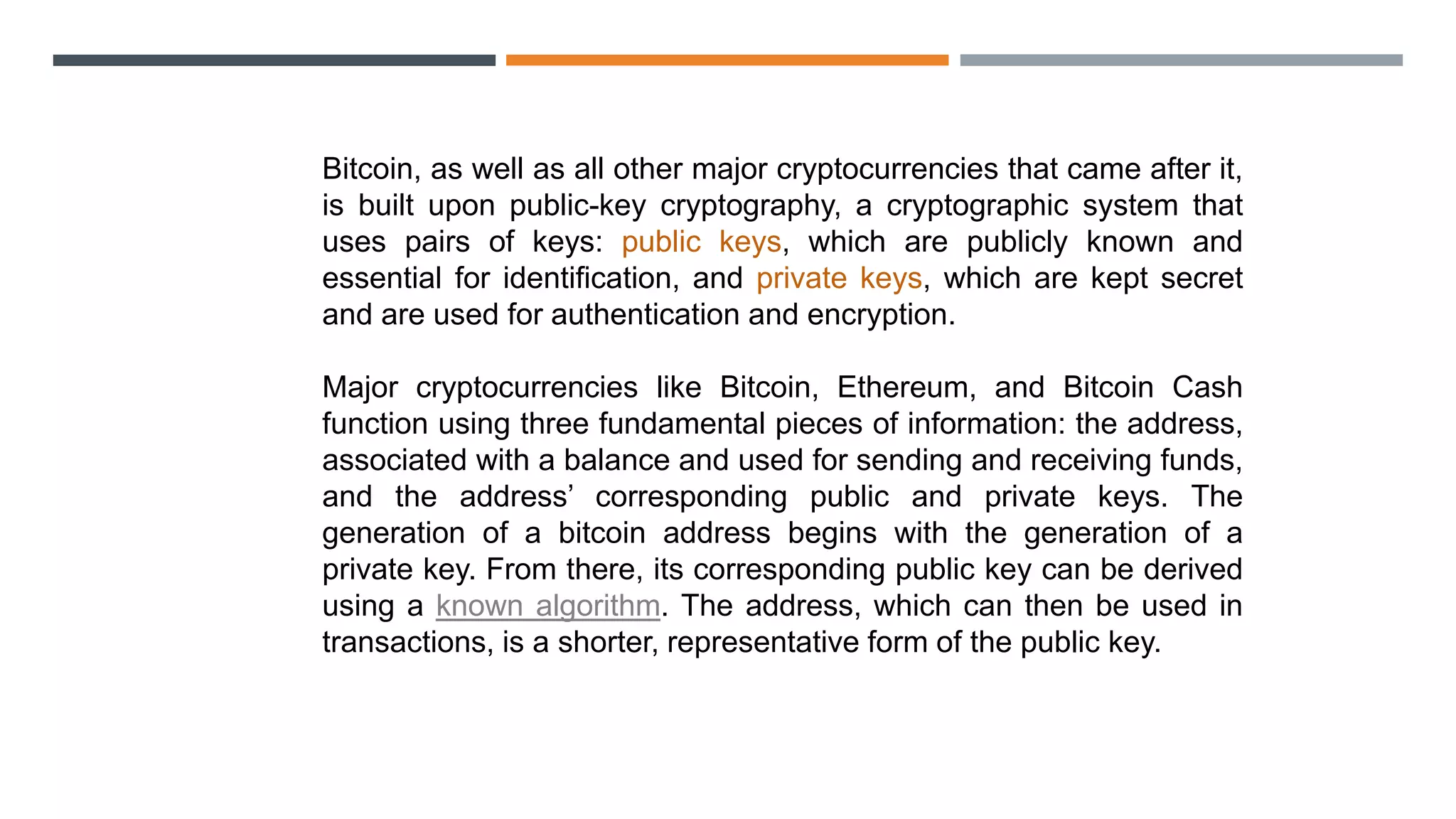
Bitcoin, as well as all other major cryptocurrencies that came after it,
is built upon public-key cryptography, a cryptographic system that
uses pairs of keys: public keys, which are publicly known and
essential for identification, and private keys, which are kept secret
and are used for authentication and encryption.
Major cryptocurrencies like Bitcoin, Ethereum, and Bitcoin Cash
function using three fundamental pieces of information: the address,
associated with a balance and used for sending and receiving funds,
and the address’ corresponding public and private keys. The
generation of a bitcoin address begins with the generation of a
private key. From there, its corresponding public key can be derived
using a known algorithm. The address, which can then be used in
transactions, is a shorter, representative form of the public key.
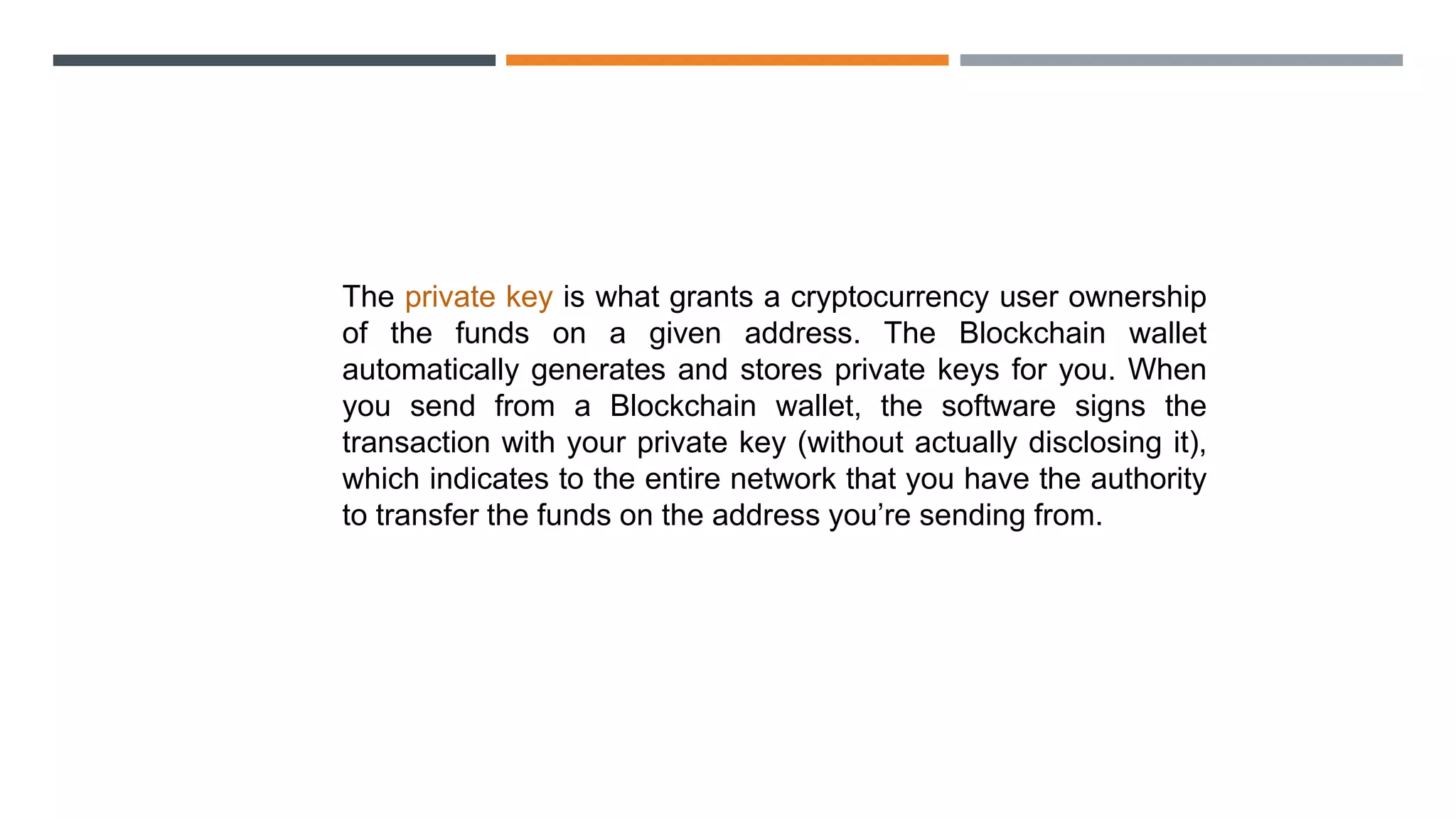
The private key is what grants a cryptocurrency user ownership
of the funds on a given address. The Blockchain wallet
automatically generates and stores private keys for you. When
you send from a Blockchain wallet, the software signs the
transaction with your private key (without actually disclosing it),
which indicates to the entire network that you have the authority
to transfer the funds on the address you’re sending from.
HOW DOES BITCOIN WORK?
A transaction is a transfer of value between Bitcoin
wallets that gets included in the block chain. Bitcoin
wallets keep a secret piece of data called a private key
or seed, which is used to sign transactions, providing a
mathematical proof that they have come from the owner
of the wallet. The signature also prevents the transaction
from being altered by anybody once it has been issued.
All transactions are broadcast to the network and usually
begin to be confirmed within 10-20 minutes, through a
process called mining.
TO FURTHER UNDERSTAND HOW DO BITCOINS WORK, AFTER
READING THE MODULE, CLICK ON THE VIDEOS PROVIDED FOR THE
TOPIC.
Retrieved fromhttps://clamorworld.com/what-is-bitcoin-is-it-real-or-a-
bubble/
HOW DO YOU BUY BITCOIN?
 BUYING ONLINE
 Open an account at an exchange
Cryptocurrency exchanges will buy and sell
bitcoin on your behalf. There are
hundreds currently operating, with varying
degrees of liquidity and security, and new
ones continue to emerge while others end up
closing
 BUYING WITH CASH
 Choose a purchase method
Platforms such as LocalBitcoins will help you to
find individuals near you who are willing to
exchange bitcoin for cash.
ATMs are machines that will send bitcoin to your
wallet in exchange for cash. They operate in a
similar way to bank ATMs – you feed in the bills,
hold your wallet’s QR code up to a screen, and
the corresponding amount of bitcoin are beamed
to your account.
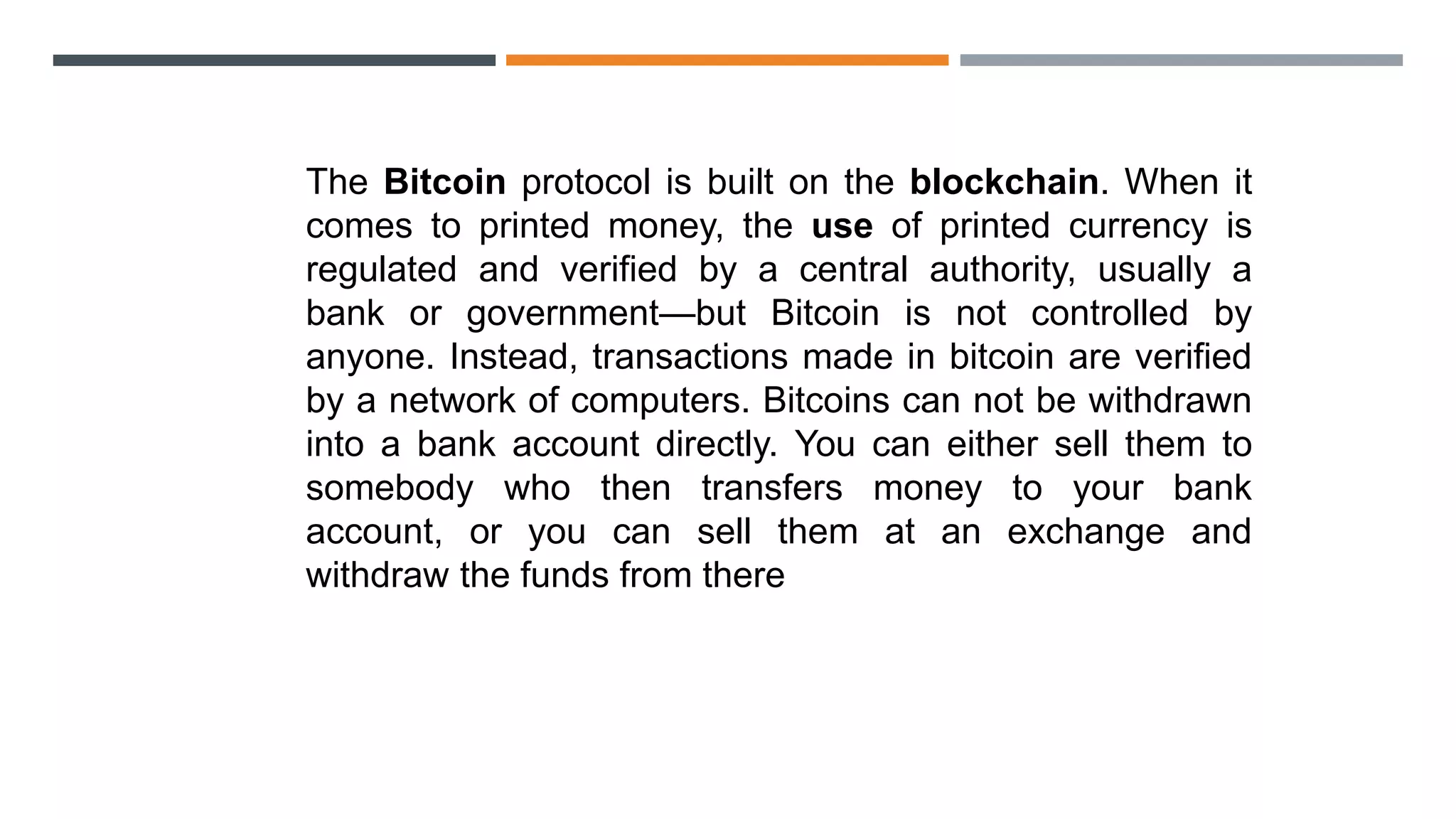
The Bitcoin protocol is built on the blockchain. When it
comes to printed money, the use of printed currency is
regulated and verified by a central authority, usually a
bank or government—but Bitcoin is not controlled by
anyone. Instead, transactions made in bitcoin are verified
by a network of computers. Bitcoins can not be withdrawn
into a bank account directly. You can either sell them to
somebody who then transfers money to your bank
account, or you can sell them at an exchange and
withdraw the funds from there
WHAT ARE THE CHALLENGES IN USING BITCOIN?
Bitcoin has come a long way in the eight or so years it's been in
existence, but there's still a long way to go before the digital currency
becomes a widely used method of paying for goods and services.
CHALLENGES
 A lack of legislation regulating digital
currencies and user protection is a great
challenge. When technical security is
considered, bitcoin is superior to any other
known technology. Educating people about
protecting personal data is of core
importance here. However, insurance
protection and clear legislation needs to be
put in place.
 The volatility of prices also puts a question mark on the
potential of bitcoins as a currency.
 Bitcoin being a technically an open community, has
disputes among members as which way it should go.
Furthermore, the concept of not having a centralized
authority is the base and having a centralized
authority would remarkably change the plan.
 Bitcoin has a small user base and hence, are very
volatile. The stability is expected to increase with its
popularity.
 There are lots of doubts about this cryptocurrency like
where we can use bitcoin.
 The use and reputation of bitcoins to purchase illegal
drugs and in the black market, is a big challenge.
 There is a lot of resistance from governments, making
it difficult for the Bitcoin community to grow.
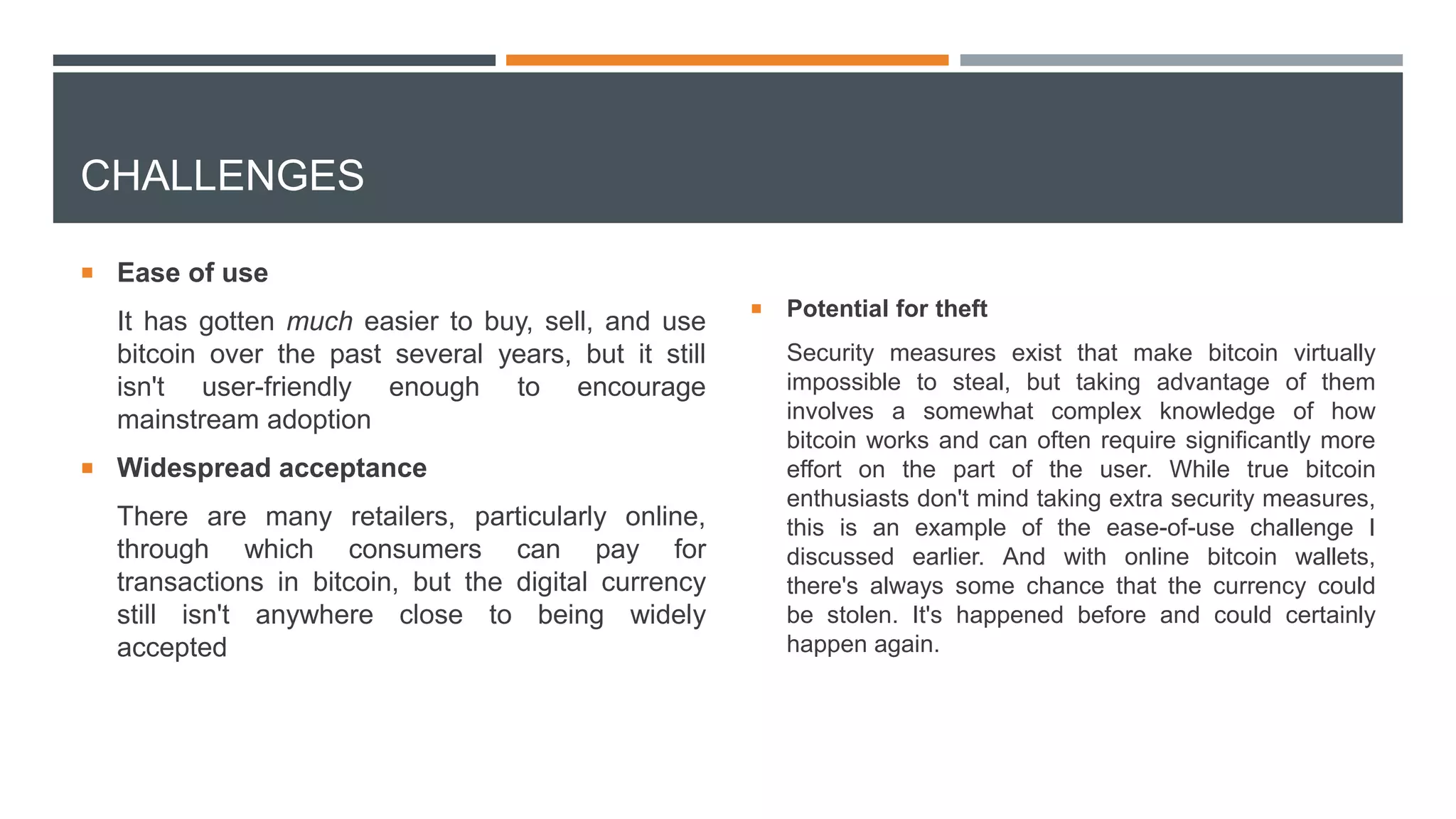
CHALLENGES
 Ease of use
It has gotten much easier to buy, sell, and use
bitcoin over the past several years, but it still
isn't user-friendly enough to encourage
mainstream adoption
 Widespread acceptance
There are many retailers, particularly online,
through which consumers can pay for
transactions in bitcoin, but the digital currency
still isn't anywhere close to being widely
accepted
 Potential for theft
Security measures exist that make bitcoin virtually
impossible to steal, but taking advantage of them
involves a somewhat complex knowledge of how
bitcoin works and can often require significantly more
effort on the part of the user. While true bitcoin
enthusiasts don't mind taking extra security measures,
this is an example of the ease-of-use challenge I
discussed earlier. And with online bitcoin wallets,
there's always some chance that the currency could
be stolen. It's happened before and could certainly
happen again.
WHAT ARE THE PROS AND COINS OF BITCOIN AND
OTHER CRYPTOCURRENCIES?
PROS AND CONS OF BITCOIN
Pros
 There will only ever be 21 million Bitcoins. Most of these Bitcoins
already have been mined by users. There are currently around 17 million
Bitcoins, so there are around 4 million left to be mined. This low limit for
Bitcoin is good for the price — if a lot of people want Bitcoin but there
aren’t many Bitcoins available, the people that want Bitcoin will pay more
for it. That would make the price go up!
 Bitcoin is easier to liquidate than rival cryptocurrency types. This
means it is easier to convert Bitcoin into cash. That’s right — because
Bitcoin is so popular, it is easier to exchange your Bitcoin for fiat
currency like USD and EUR. Also, Bitcoin is on almost every crypto
exchange on the internet. This means the trading volume is super high!
In fact, it’s the highest of all cryptocurrencies.
 More stores accept Bitcoin than other cryptocurrency types. You
are able to buy just about any item using Bitcoin through the hundreds of
online sellers that accept the cryptocurrency. This is another way you
can liquidate your Bitcoin — rather than convert it back into cash, you
can just spend it like you would with cash.
 Bitcoin is the biggest cryptocurrency. Bitcoin was the first crypto, and
it is the biggest. It currently dominates over 40% of the market, which is
huge!
Cons
 Bitcoin fluctuates a lot. This means the price of Bitcoin changes a lot
every day. In fact, the Mt. Gox collapse actually caused Bitcoin’s price to
fall 50% below what it was the day before. Some investors like
fluctuations, but the people who lose money because of fluctuations,
definitely do not like them.
 Bitcoin may be replaced by a better cryptocurrency. As we
mentioned in the section on altcoins, there are hundreds of variations on
Bitcoin in existence today. Bitcoin is almost 10 years old now. Any of
these newer coins could eventually replace Bitcoin — they are newer
and further advanced.
 People still use Bitcoin for a crime. The reputation of Bitcoin is
improving since its early days on Silk Road, but it’s still not perfect. We
only hear of a few people being prosecuted for using Bitcoin illegally, but
there are probably a lot more people that use it illegally and don’t get
caught. These include things like scams and avoiding taxes.
RIPPLE IS A BLOCKCHAIN THAT IS DESIGNED TO BE USED BY BANKS TO MAKE THEIR PAYMENTS
FASTER. IT IS KNOWN AS THE BANKER’S COIN, AND THERE ARE MANY PARTNERSHIPS WITH
GLOBAL BANKS CURRENTLY BEING WORKED ON.
Pros
 Big, well-respected companies (like global banks) are
trusting Ripple. Huge financial organizations (such as
banks and governments) have partnered with Ripple.
Many more are yet to partner but have plans to. So, as an
alternative to fiat currency, Ripple may be the best option
within the world of finance. Because it is working with
governments, the power it has to be widespread could be
the reason it succeeds.
Cons
 Unlike other cryptocurrencies, Ripple isn’t
decentralized. Instead, it is centralized. The company
behind Ripple (called Ripple Labs) owns most of the
Ripple tokens (XRP). So, if they wanted to, they could
sell all of their tokens and the price of XRP would go
down a lot. This is extremely unlikely because they
wouldn’t want to sell all of their tokens.
LITECOIN - IT IS A FORK OF BITCOIN! SO, BASICALLY, THE BLOCKCHAIN OF LITECOIN USED TO BE A PART OF
BITCOIN’S BLOCKCHAIN, BUT IT SPLIT WHEN THE LITECOIN UPDATE WAS OFFERED. SO, IT’S VERY SIMILAR
BUT IT HAS DIFFERENT FEATURES TO BITCOIN. IT WAS CREATED TO IMPROVE UPON WHAT BITCOIN HAD
CREATED.
Pros
 Litecoin is both faster and much cheaper
than Bitcoin. Litecoin transactions take
seconds, like Ethereum transactions. Bitcoin
transactions take upwards of 10 minutes.
 Also, Bitcoin transactions can be costly, which
makes them pointless for sending small
amounts. As Litecoin transactions are much
cheaper, Litecoin is a lot better for
micropayments (small payments), which is why
it is called “Lite” coin.
Cons
 Litecoin is still only a slight improvement in
Bitcoin. If Bitcoin can improve so that it can
scale and offer cheaper & faster transactions,
there might not be much need for Litecoin.
Retrieved from https://cryptocurrencyfare.com/litecoin-versus-bitcoin/
ETHEREUM IS A PLATFORM THAT ALLOWS PEOPLE TO BUILD DAPPS, TOKENS AND SMART
CONTRACTS. ITS CURRENCY IS CALLED ETHER (ETH).
RETRIEVED FROMHTTPS://PAXTRADINGS.COM/ETHEREUM-PRICE-JUMPS-5-CRYPTOCURRENCY-MARKET-REBOUNDS-TOKENS-
SIGNIFICANTLY/
Pros
 Users of dApps built on Ethereum will
always need Ether. They need Ether to pay for
transaction fees on the dApps because the
dApps run on the Ethereum blockchain.
 Many new projects are being built on
Ethereum. Most of these projects will take
years to develop, however, a lot of them could
be huge when they are completed.
 Speed. Ethereum can process transactions in a
matter of seconds, whereas Bitcoin’s
transactions take upwards of 10 minutes.
Cons
 There are many more Ether coins than there
are Bitcoins. Earlier, we talked about how part
of Bitcoin’s value comes from the fact that there
is a limited supply. This is not the case with
Ethereum — there are almost 100,000,000
Ether coins at the moment and they will never
stop being created. However, the rate at which
they are being produced will slow down greatly.
If you have some questions
concerning the concepts in the
module, please bring them up
with your Professor through the
INBOX on your Canvas.
REFERENCES
 How does Bitcoin work? URL - https://bitcoin.org/en/how-it-works
 Bitcoin Technology-The Guardian. URL - https://www.theguardian.com/technology/bitcoin
 It’s Make or Break for Bitcoin. URL - https://www.forbes.com/sites/billybambrough/2020/04/18/its-make-
or-break-for-bitcoin/#171e42aa6e52
 Bitcoin and Blockchain Technology. URL - https://www.youtube.com/watch?v=X1_PnojpXcY
 How to Buy Bitcoins. URL - https://www.youtube.com/watch?v=tuUO-Q4_b5c&feature=emb_rel_pause
 How does Bitcoin actually works. URL - https://www.youtube.com/watch?v=bBC-
nXj3Ng4&feature=emb_rel_pause
 What is Bitcoin? URL - https://money.cnn.com/infographic/technology/what-is-bitcoin/index.html

Bitcoin technology

  • 1.
  • 2.
  • 3.
    MODULE LEARNING OUTCOMES Identify Issues and implicationsof bitcoin technology to the society Enumerate. Applications of Bitcoin technology Describe Bitcoin technology
  • 4.
  • 5.
    It is believedthat Satoshi Nakamoto, an elusive software developer from Japan created the Bitcoin in 2009 with the goal of removing central authority over the new currency. This currency is not being printed like regular money, and never will be, as it is virtual in nature. From its inception, Bitcoin has dramatically increased in popularity because of its growing consumer base. More and more people are drawn towards investing in Bitcoin due to its unique characteristics.
  • 6.
    WHAT IS BITCOIN? Bitcoin (₿) is a cryptocurrency. It is a decentralized digital currency without a central bank or single administrator that can be sent from user to user on the peer-to-peer bitcoin network without the need for intermediaries.  A cryptocurrency is a digital or virtual currency designed to work as a medium of exchange. It uses cryptography to secure and verify transactions as well as to control the creation of new units of a particular cryptocurrency. Cryptography involves creating written or generated codes that allow information to be kept secret. Cryptography converts data into a format that is unreadable for an unauthorized user, allowing it to be transmitted without unauthorized entities decoding it back into a readable format, thus compromising the data.  Bitcoins aren’t printed, like dollars or euros – they’re produced by computers all around the world, using free software. It was the first example of what we today call cryptocurrencies, a growing asset class that shares some characteristics of traditional currencies, with verification based on cryptography. Bitcoin is the best-known and simplest implementations of cryptocurrency in use today and Blockchain is the technology that enables the existence of cryptocurrency.
  • 7.
    HOW DOES BITCOINTECHNOLOGY WORK?
  • 8.
    Bitcoin is acryptocurrency that is conducted on a public ledger, the "blockchain." Digitally transferred, it exists only online. Much like gold, it can have monetary value while also being a commodity, but it’s still its own currency. It is also decentralized and not managed by a single entity, but rather a group of people who process transactions, called miners. This means it is not subject to government regulations when traded or spent, and you don't need a bank to use it.
  • 9.
     Miners securethe Bitcoin network by making it difficult to attack, alter or stop.  The more miners that mine, the more the secure the network.  What is Bitcoin Mining Actually Doing?  Issuance of new bitcoins  Confirming transactions  Security Retrieved from https://www.buybitcoinworldwide.com/mining/ Most Bitcoin mining is specialized and the warehouses look something like this:
  • 10.
    HOW DO YOUBUY BITCOIN  Bitcoin can be bought on exchanges, or directly from other people via marketplaces.  You can pay for them in a variety of ways, ranging from hard cash to credit and debit cards to wire transfers, or even with other cryptocurrencies, depending on who you are buying them from and where you live.  The first step is to set up a wallet to store your bitcoin – you will need one, whatever your preferred method of purchase. The most important part of any wallet is keeping your keys (a string of characters) and/or passwords safe. If you lose them, you lose access to the bitcoin stored there.
  • 11.
    TYPES OF WALLET Electronic wallets Electronic wallets can be downloaded software, or hosted in the cloud. The former is simply a formatted file that lives on your computer or device, that facilitates transactions  Software wallet Installing a wallet directly on your computer gives you the security that you control your keys. Most have relatively easy configuration, and are free. The disadvantage is that they do require more maintenance in the form of backups. If your computer gets stolen or corrupted and your private keys are not also stored elsewhere, you lose your bitcoin.
  • 12.
     Hardware wallets Hardwarewallets are small devices that occasionally connect to the web to enact bitcoin transactions. They are extremely secure, as they are generally offline and therefore not hackable.  Paper wallets Perhaps the simplest of all the wallets, these are pieces of paper on which the private and public keys of a bitcoin address are printed. Ideal for the long-term storage of bitcoin (away from fire and water, obviously), or for the giving of bitcoin as a gift, these wallets are more secure in that they’re not connected to a network.
  • 13.
     Online wallet Online(or cloud-based) wallets offer increased convenience – you can generally access your bitcoin from any device if you have the right passwords. All are easy to set up, come with desktop and mobile apps which make it easy to spend and receive bitcoin, and most are free.  Mobile wallets Mobile wallets are available as apps for your smartphone, especially useful if you want to pay for something in bitcoin in a shop, or if you want to buy, sell or send while on the move.
  • 14.
    Bitcoin, as wellas all other major cryptocurrencies that came after it, is built upon public-key cryptography, a cryptographic system that uses pairs of keys: public keys, which are publicly known and essential for identification, and private keys, which are kept secret and are used for authentication and encryption. Major cryptocurrencies like Bitcoin, Ethereum, and Bitcoin Cash function using three fundamental pieces of information: the address, associated with a balance and used for sending and receiving funds, and the address’ corresponding public and private keys. The generation of a bitcoin address begins with the generation of a private key. From there, its corresponding public key can be derived using a known algorithm. The address, which can then be used in transactions, is a shorter, representative form of the public key.
  • 15.
    The private keyis what grants a cryptocurrency user ownership of the funds on a given address. The Blockchain wallet automatically generates and stores private keys for you. When you send from a Blockchain wallet, the software signs the transaction with your private key (without actually disclosing it), which indicates to the entire network that you have the authority to transfer the funds on the address you’re sending from.
  • 16.
    HOW DOES BITCOINWORK? A transaction is a transfer of value between Bitcoin wallets that gets included in the block chain. Bitcoin wallets keep a secret piece of data called a private key or seed, which is used to sign transactions, providing a mathematical proof that they have come from the owner of the wallet. The signature also prevents the transaction from being altered by anybody once it has been issued. All transactions are broadcast to the network and usually begin to be confirmed within 10-20 minutes, through a process called mining.
  • 17.
    TO FURTHER UNDERSTANDHOW DO BITCOINS WORK, AFTER READING THE MODULE, CLICK ON THE VIDEOS PROVIDED FOR THE TOPIC. Retrieved fromhttps://clamorworld.com/what-is-bitcoin-is-it-real-or-a- bubble/
  • 18.
    HOW DO YOUBUY BITCOIN?  BUYING ONLINE  Open an account at an exchange Cryptocurrency exchanges will buy and sell bitcoin on your behalf. There are hundreds currently operating, with varying degrees of liquidity and security, and new ones continue to emerge while others end up closing  BUYING WITH CASH  Choose a purchase method Platforms such as LocalBitcoins will help you to find individuals near you who are willing to exchange bitcoin for cash. ATMs are machines that will send bitcoin to your wallet in exchange for cash. They operate in a similar way to bank ATMs – you feed in the bills, hold your wallet’s QR code up to a screen, and the corresponding amount of bitcoin are beamed to your account.
  • 19.
    The Bitcoin protocolis built on the blockchain. When it comes to printed money, the use of printed currency is regulated and verified by a central authority, usually a bank or government—but Bitcoin is not controlled by anyone. Instead, transactions made in bitcoin are verified by a network of computers. Bitcoins can not be withdrawn into a bank account directly. You can either sell them to somebody who then transfers money to your bank account, or you can sell them at an exchange and withdraw the funds from there
  • 20.
    WHAT ARE THECHALLENGES IN USING BITCOIN? Bitcoin has come a long way in the eight or so years it's been in existence, but there's still a long way to go before the digital currency becomes a widely used method of paying for goods and services.
  • 21.
    CHALLENGES  A lackof legislation regulating digital currencies and user protection is a great challenge. When technical security is considered, bitcoin is superior to any other known technology. Educating people about protecting personal data is of core importance here. However, insurance protection and clear legislation needs to be put in place.  The volatility of prices also puts a question mark on the potential of bitcoins as a currency.  Bitcoin being a technically an open community, has disputes among members as which way it should go. Furthermore, the concept of not having a centralized authority is the base and having a centralized authority would remarkably change the plan.  Bitcoin has a small user base and hence, are very volatile. The stability is expected to increase with its popularity.  There are lots of doubts about this cryptocurrency like where we can use bitcoin.  The use and reputation of bitcoins to purchase illegal drugs and in the black market, is a big challenge.  There is a lot of resistance from governments, making it difficult for the Bitcoin community to grow.
  • 22.
    CHALLENGES  Ease ofuse It has gotten much easier to buy, sell, and use bitcoin over the past several years, but it still isn't user-friendly enough to encourage mainstream adoption  Widespread acceptance There are many retailers, particularly online, through which consumers can pay for transactions in bitcoin, but the digital currency still isn't anywhere close to being widely accepted  Potential for theft Security measures exist that make bitcoin virtually impossible to steal, but taking advantage of them involves a somewhat complex knowledge of how bitcoin works and can often require significantly more effort on the part of the user. While true bitcoin enthusiasts don't mind taking extra security measures, this is an example of the ease-of-use challenge I discussed earlier. And with online bitcoin wallets, there's always some chance that the currency could be stolen. It's happened before and could certainly happen again.
  • 23.
    WHAT ARE THEPROS AND COINS OF BITCOIN AND OTHER CRYPTOCURRENCIES?
  • 24.
    PROS AND CONSOF BITCOIN Pros  There will only ever be 21 million Bitcoins. Most of these Bitcoins already have been mined by users. There are currently around 17 million Bitcoins, so there are around 4 million left to be mined. This low limit for Bitcoin is good for the price — if a lot of people want Bitcoin but there aren’t many Bitcoins available, the people that want Bitcoin will pay more for it. That would make the price go up!  Bitcoin is easier to liquidate than rival cryptocurrency types. This means it is easier to convert Bitcoin into cash. That’s right — because Bitcoin is so popular, it is easier to exchange your Bitcoin for fiat currency like USD and EUR. Also, Bitcoin is on almost every crypto exchange on the internet. This means the trading volume is super high! In fact, it’s the highest of all cryptocurrencies.  More stores accept Bitcoin than other cryptocurrency types. You are able to buy just about any item using Bitcoin through the hundreds of online sellers that accept the cryptocurrency. This is another way you can liquidate your Bitcoin — rather than convert it back into cash, you can just spend it like you would with cash.  Bitcoin is the biggest cryptocurrency. Bitcoin was the first crypto, and it is the biggest. It currently dominates over 40% of the market, which is huge! Cons  Bitcoin fluctuates a lot. This means the price of Bitcoin changes a lot every day. In fact, the Mt. Gox collapse actually caused Bitcoin’s price to fall 50% below what it was the day before. Some investors like fluctuations, but the people who lose money because of fluctuations, definitely do not like them.  Bitcoin may be replaced by a better cryptocurrency. As we mentioned in the section on altcoins, there are hundreds of variations on Bitcoin in existence today. Bitcoin is almost 10 years old now. Any of these newer coins could eventually replace Bitcoin — they are newer and further advanced.  People still use Bitcoin for a crime. The reputation of Bitcoin is improving since its early days on Silk Road, but it’s still not perfect. We only hear of a few people being prosecuted for using Bitcoin illegally, but there are probably a lot more people that use it illegally and don’t get caught. These include things like scams and avoiding taxes.
  • 25.
    RIPPLE IS ABLOCKCHAIN THAT IS DESIGNED TO BE USED BY BANKS TO MAKE THEIR PAYMENTS FASTER. IT IS KNOWN AS THE BANKER’S COIN, AND THERE ARE MANY PARTNERSHIPS WITH GLOBAL BANKS CURRENTLY BEING WORKED ON. Pros  Big, well-respected companies (like global banks) are trusting Ripple. Huge financial organizations (such as banks and governments) have partnered with Ripple. Many more are yet to partner but have plans to. So, as an alternative to fiat currency, Ripple may be the best option within the world of finance. Because it is working with governments, the power it has to be widespread could be the reason it succeeds. Cons  Unlike other cryptocurrencies, Ripple isn’t decentralized. Instead, it is centralized. The company behind Ripple (called Ripple Labs) owns most of the Ripple tokens (XRP). So, if they wanted to, they could sell all of their tokens and the price of XRP would go down a lot. This is extremely unlikely because they wouldn’t want to sell all of their tokens.
  • 26.
    LITECOIN - ITIS A FORK OF BITCOIN! SO, BASICALLY, THE BLOCKCHAIN OF LITECOIN USED TO BE A PART OF BITCOIN’S BLOCKCHAIN, BUT IT SPLIT WHEN THE LITECOIN UPDATE WAS OFFERED. SO, IT’S VERY SIMILAR BUT IT HAS DIFFERENT FEATURES TO BITCOIN. IT WAS CREATED TO IMPROVE UPON WHAT BITCOIN HAD CREATED. Pros  Litecoin is both faster and much cheaper than Bitcoin. Litecoin transactions take seconds, like Ethereum transactions. Bitcoin transactions take upwards of 10 minutes.  Also, Bitcoin transactions can be costly, which makes them pointless for sending small amounts. As Litecoin transactions are much cheaper, Litecoin is a lot better for micropayments (small payments), which is why it is called “Lite” coin. Cons  Litecoin is still only a slight improvement in Bitcoin. If Bitcoin can improve so that it can scale and offer cheaper & faster transactions, there might not be much need for Litecoin. Retrieved from https://cryptocurrencyfare.com/litecoin-versus-bitcoin/
  • 27.
    ETHEREUM IS APLATFORM THAT ALLOWS PEOPLE TO BUILD DAPPS, TOKENS AND SMART CONTRACTS. ITS CURRENCY IS CALLED ETHER (ETH). RETRIEVED FROMHTTPS://PAXTRADINGS.COM/ETHEREUM-PRICE-JUMPS-5-CRYPTOCURRENCY-MARKET-REBOUNDS-TOKENS- SIGNIFICANTLY/ Pros  Users of dApps built on Ethereum will always need Ether. They need Ether to pay for transaction fees on the dApps because the dApps run on the Ethereum blockchain.  Many new projects are being built on Ethereum. Most of these projects will take years to develop, however, a lot of them could be huge when they are completed.  Speed. Ethereum can process transactions in a matter of seconds, whereas Bitcoin’s transactions take upwards of 10 minutes. Cons  There are many more Ether coins than there are Bitcoins. Earlier, we talked about how part of Bitcoin’s value comes from the fact that there is a limited supply. This is not the case with Ethereum — there are almost 100,000,000 Ether coins at the moment and they will never stop being created. However, the rate at which they are being produced will slow down greatly.
  • 29.
    If you havesome questions concerning the concepts in the module, please bring them up with your Professor through the INBOX on your Canvas.
  • 31.
    REFERENCES  How doesBitcoin work? URL - https://bitcoin.org/en/how-it-works  Bitcoin Technology-The Guardian. URL - https://www.theguardian.com/technology/bitcoin  It’s Make or Break for Bitcoin. URL - https://www.forbes.com/sites/billybambrough/2020/04/18/its-make- or-break-for-bitcoin/#171e42aa6e52  Bitcoin and Blockchain Technology. URL - https://www.youtube.com/watch?v=X1_PnojpXcY  How to Buy Bitcoins. URL - https://www.youtube.com/watch?v=tuUO-Q4_b5c&feature=emb_rel_pause  How does Bitcoin actually works. URL - https://www.youtube.com/watch?v=bBC- nXj3Ng4&feature=emb_rel_pause  What is Bitcoin? URL - https://money.cnn.com/infographic/technology/what-is-bitcoin/index.html

Editor's Notes

  • #3 OBJECTIVES
  • #4 The main purpose of Internet-connected devices has been to enable people to communicate with each other and to access online data and processes
  • #5 Pix smart car ..pix on hailing a taxi etc…