Introduction to
Blockchain
Nikola Matijašević
Blockchain Technical Lead, Google DSC
University of Belgrade
Quick overview
In the last lecture, we talked about:
●Asymmetric Cryptography
●Hash functions
●Merkle tree
●Distributed Systems
●Peer-To-Peer (P2P) networks
●Bitcoin network and nodes
Blockchain technology
What is it? Where is it implemented?
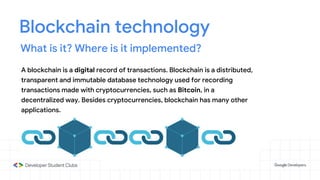
A blockchain is a digital record of transactions. Blockchain is a distributed,
transparent and immutable database technology used for recording
transactions made with cryptocurrencies, such as Bitcoin, in a
decentralized way. Besides cryptocurrencies, blockchain has many other
applications.
Blockchain technology
What is so special about it?
Bitcoin’s breakthrough contribution was to create a means of achieving
consensus within an open, ‘permissionless’ environment – anyone can join
the Bitcoin network and become a miner, compete for bitcoin currency
rewards, and contribute to the ledger by engaging in proof of work.
Blockchain technology
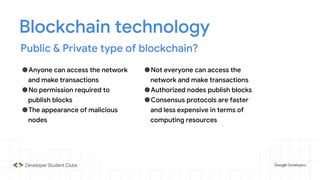
Public & Private type of blockchain?
●Anyone can access the network
and make transactions
●No permission required to
publish blocks
●The appearance of malicious
nodes
●Not everyone can access the
network and make transactions
●Authorized nodes publish blocks
●Consensus protocols are faster
and less expensive in terms of
computing resources
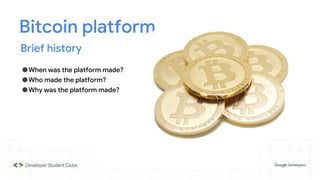
Bitcoin platform
Brief history
●When was the platform made?
●Who made the platform?
●Why was the platform made?
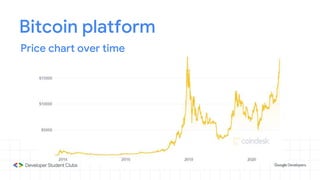
Bitcoin platform
Price chart over time
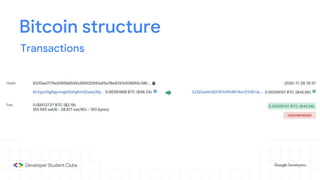
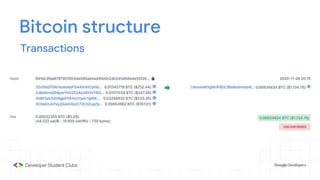
Bitcoin structure
Transactions
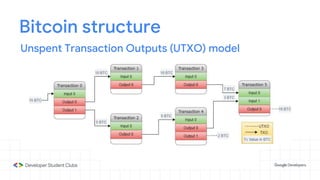
Bitcoin structure
Unspent Transaction Outputs (UTXO) model
Bitcoin structure
Transactions
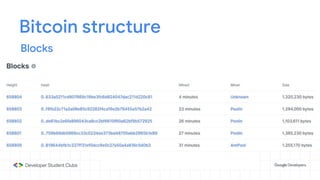
Bitcoin structure
Blocks
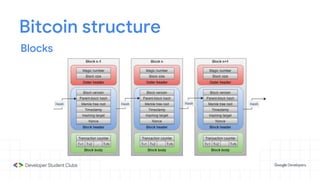
Bitcoin structure
Blocks
Bitcoin structure
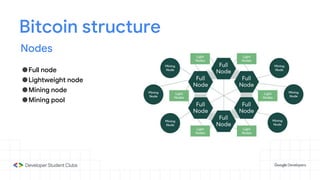
Nodes
●Full node
●Lightweight node
●Mining node
●Mining pool
What is it? How is it reached in a network? What
are the algorithms being used?
Consensus
algorithms
Consensus algorithms
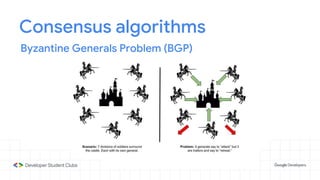
Byzantine Generals Problem (BGP)
Consensus algorithms
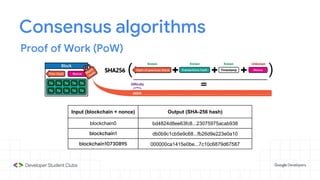
Proof of Work (PoW)
Input (blockchain + nonce) Output (SHA-256 hash)
blockchain0 bd4824d8ee63fc8...23075975acab938
blockchain1 db0b9c1cb5e9c68...fb26d9e223e0a10
blockchain10730895 000000ca1415e0be...7c10c6879d67587
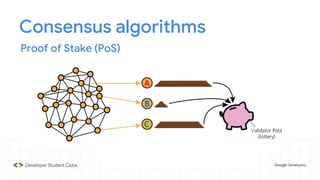
Consensus algorithms
Proof of Stake (PoS)
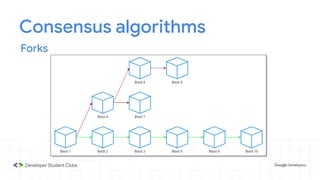
Consensus algorithms
Forks
Putting it all together.
Back to Bitcoin
platform
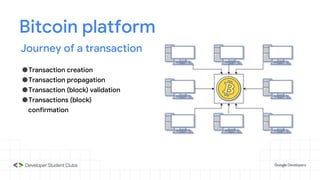
Bitcoin platform
Journey of a transaction
●Transaction creation
●Transaction propagation
●Transaction (block) validation
●Transactions (block)
confirmation
Key differences between the two.
Any competition for
Bitcoin? Yes, Ethereum!
Ethereum platform
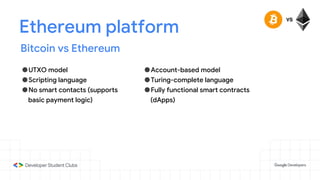
Bitcoin vs Ethereum
●UTXO model
●Scripting language
●No smart contacts (supports
basic payment logic)
●Account-based model
●Turing-complete language
●Fully functional smart contracts
(dApps)
Ethereum platform
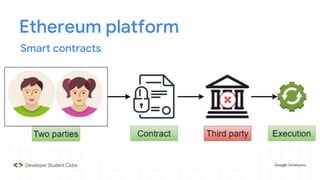
Smart contracts
“Study how to write smart contracts, which
is the basic unit of programming a
blockchain for business purposes. It is the
equivalent of being taught HTML and Java
during the early Internet days. And master
how to create assets or tokenize existing
ones on a blockchain.”
Do you have any questions?
Thank You!
Nikola Matijašević
Blockchain Technical Lead, Google DSC
University of Belgrade

Blockchain

Editor's Notes

  • #16 https://www.youtube.com/watch?v=dfsRQyYXOsQ&ab_channel=MarkReddick