1
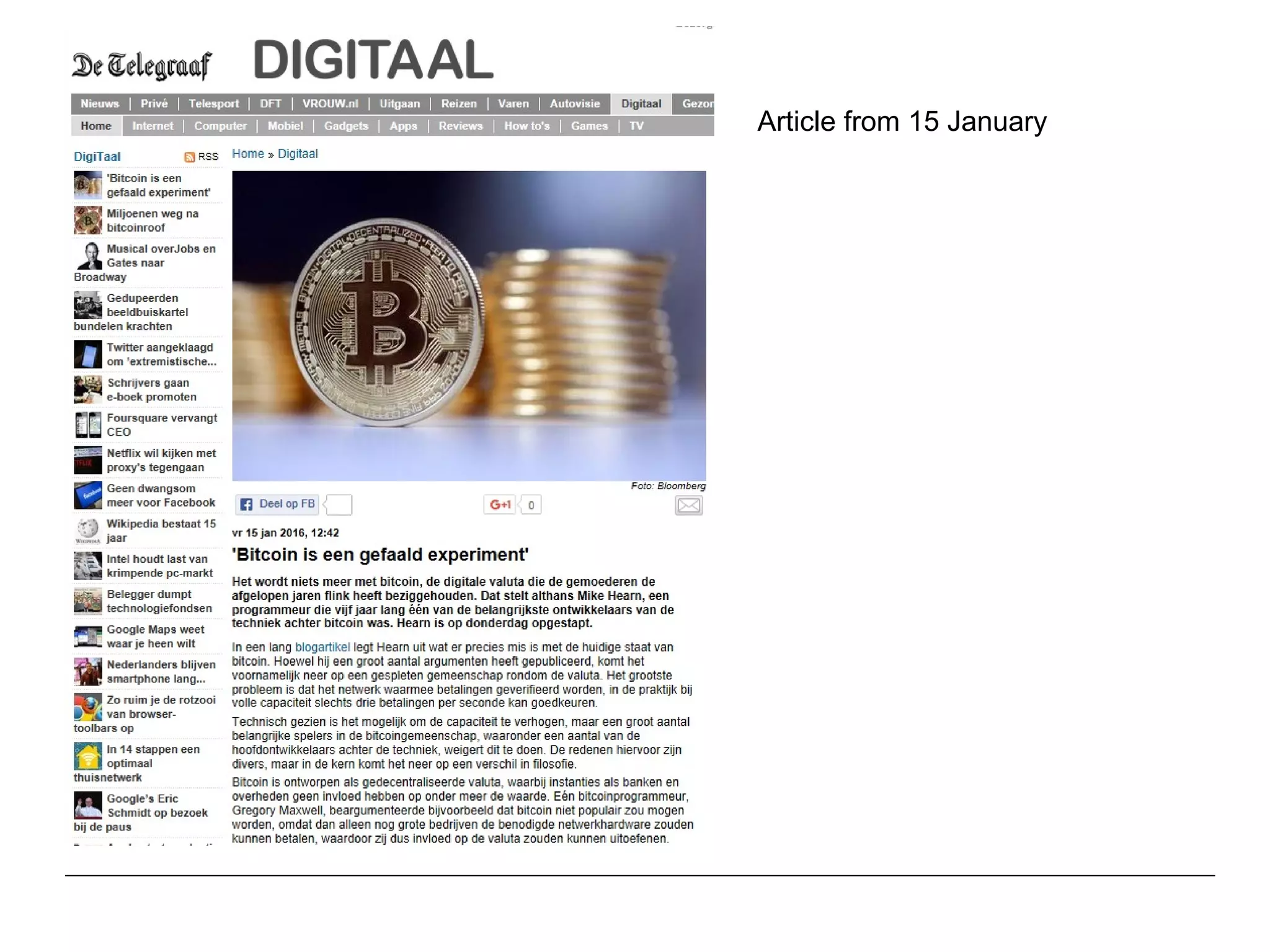
Article from 15 January
3
4
Content
History of the bitcoin
What can I do with a bitcoin
How can I get bitcoins
How does the bitcoin infrastructure ( blockchain) look like
How can this effect our future
5
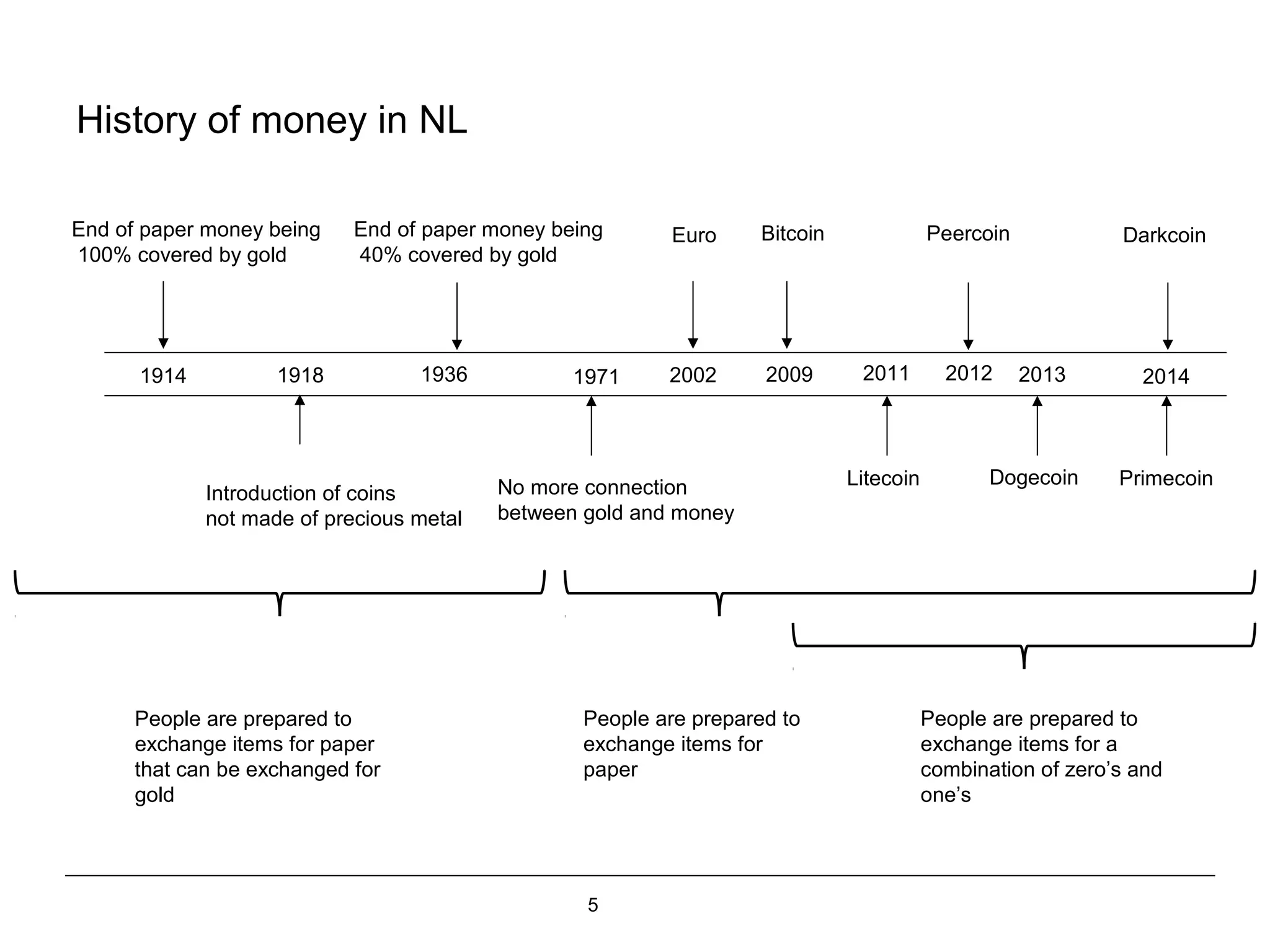
History of money in NL
End of paper money being
100% covered by gold
1914 1936
Introduction of coins
not made of precious metal
1918
End of paper money being
40% covered by gold
1971
No more connection
between gold and money
2009
Bitcoin
Litecoin
DarkcoinPeercoin
Dogecoin Primecoin
2011 2012 2013 2014
People are prepared to
exchange items for paper
that can be exchanged for
gold
People are prepared to
exchange items for
paper
People are prepared to
exchange items for a
combination of zero’s and
one’s
2002
Euro
6
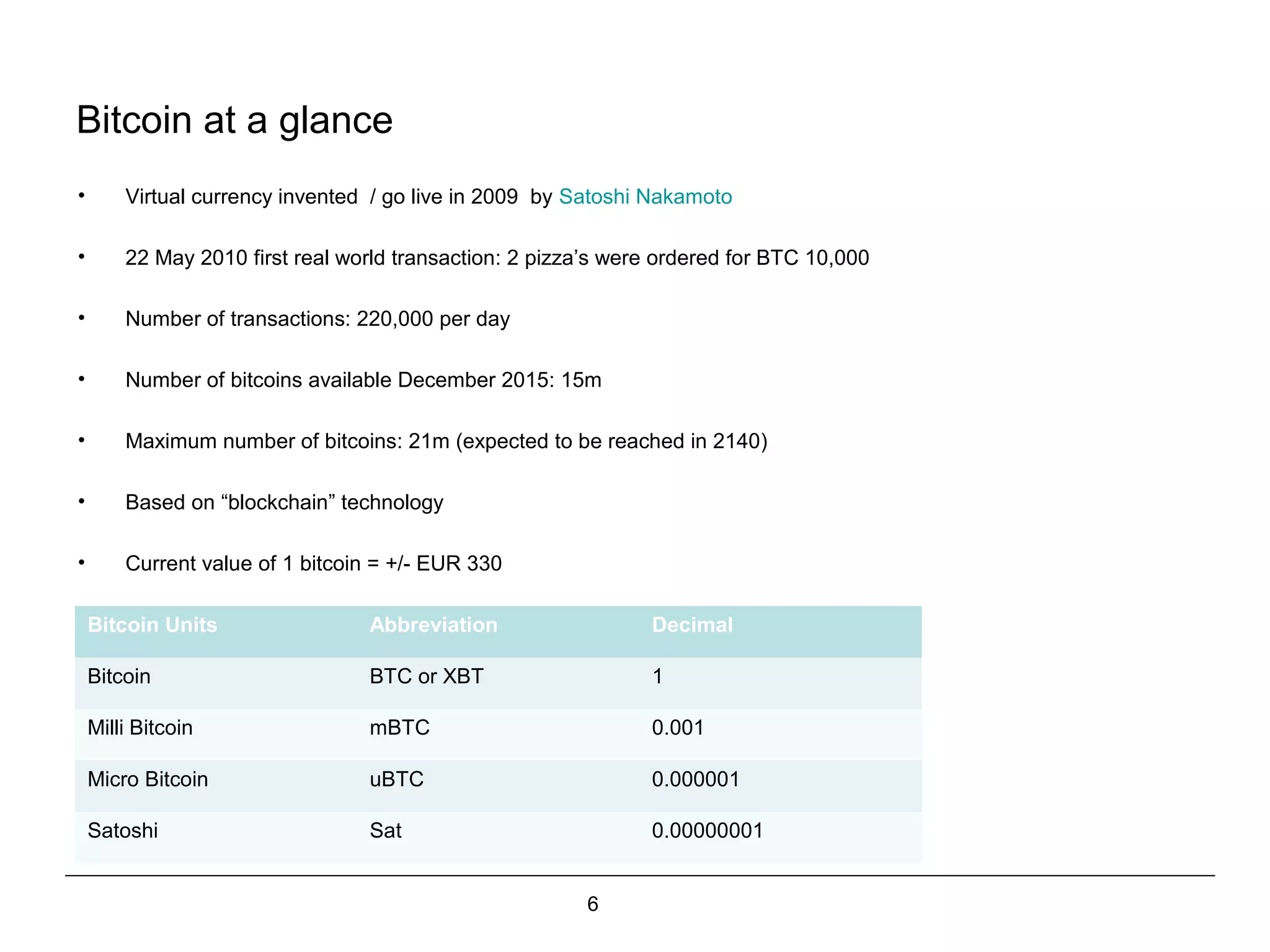
Bitcoin at a glance
• Virtual currency invented / go live in 2009 by Satoshi Nakamoto
• 22 May 2010 first real world transaction: 2 pizza’s were ordered for BTC 10,000
• Number of transactions: 220,000 per day
• Number of bitcoins available December 2015: 15m
• Maximum number of bitcoins: 21m (expected to be reached in 2140)
• Based on “blockchain” technology
• Current value of 1 bitcoin = +/- EUR 330
Bitcoin Units Abbreviation Decimal
Bitcoin BTC or XBT 1
Milli Bitcoin mBTC 0.001
Micro Bitcoin uBTC 0.000001
Satoshi Sat 0.00000001
7
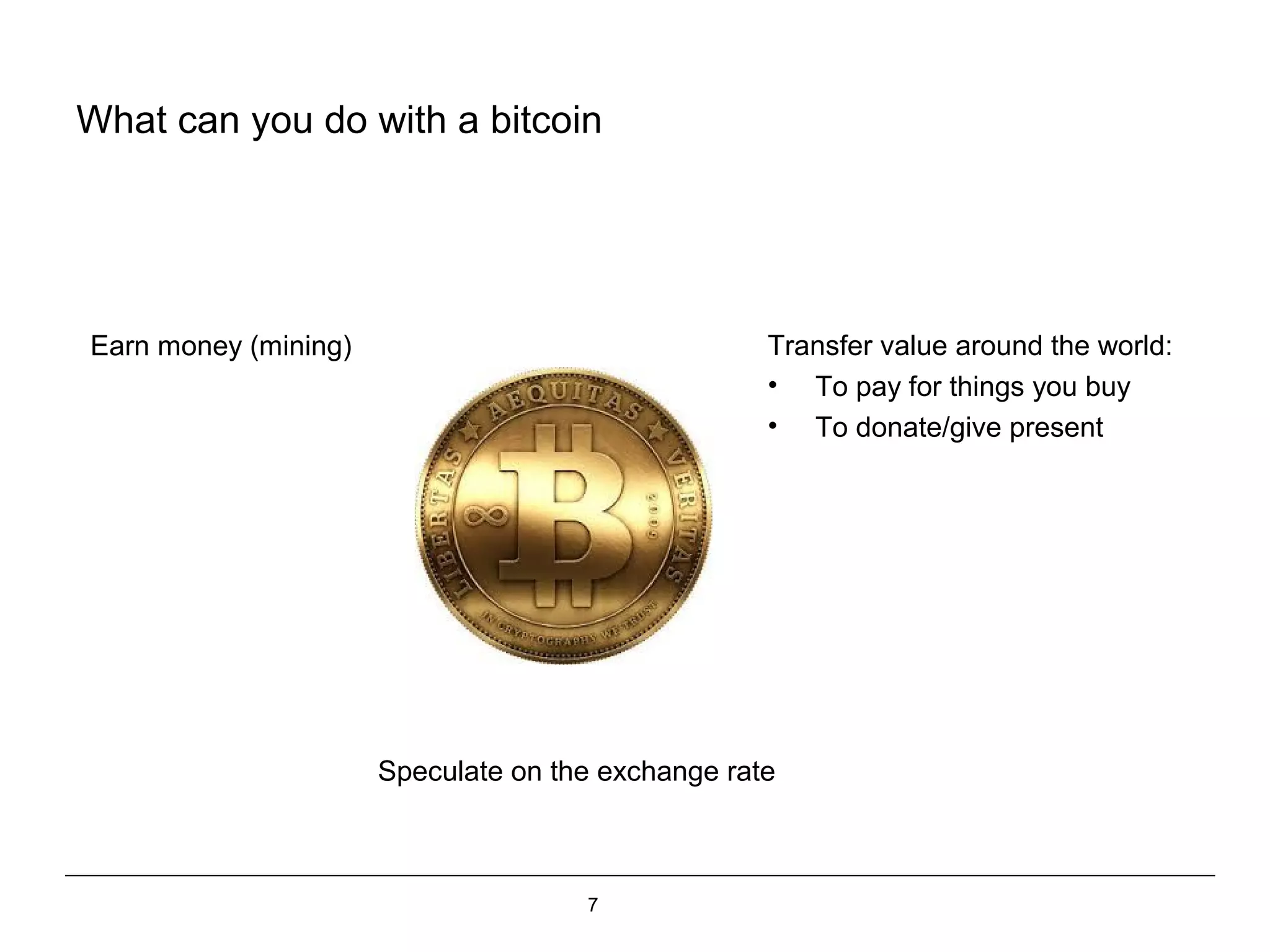
What can you do with a bitcoin
Transfer value around the world:
• To pay for things you buy
• To donate/give present
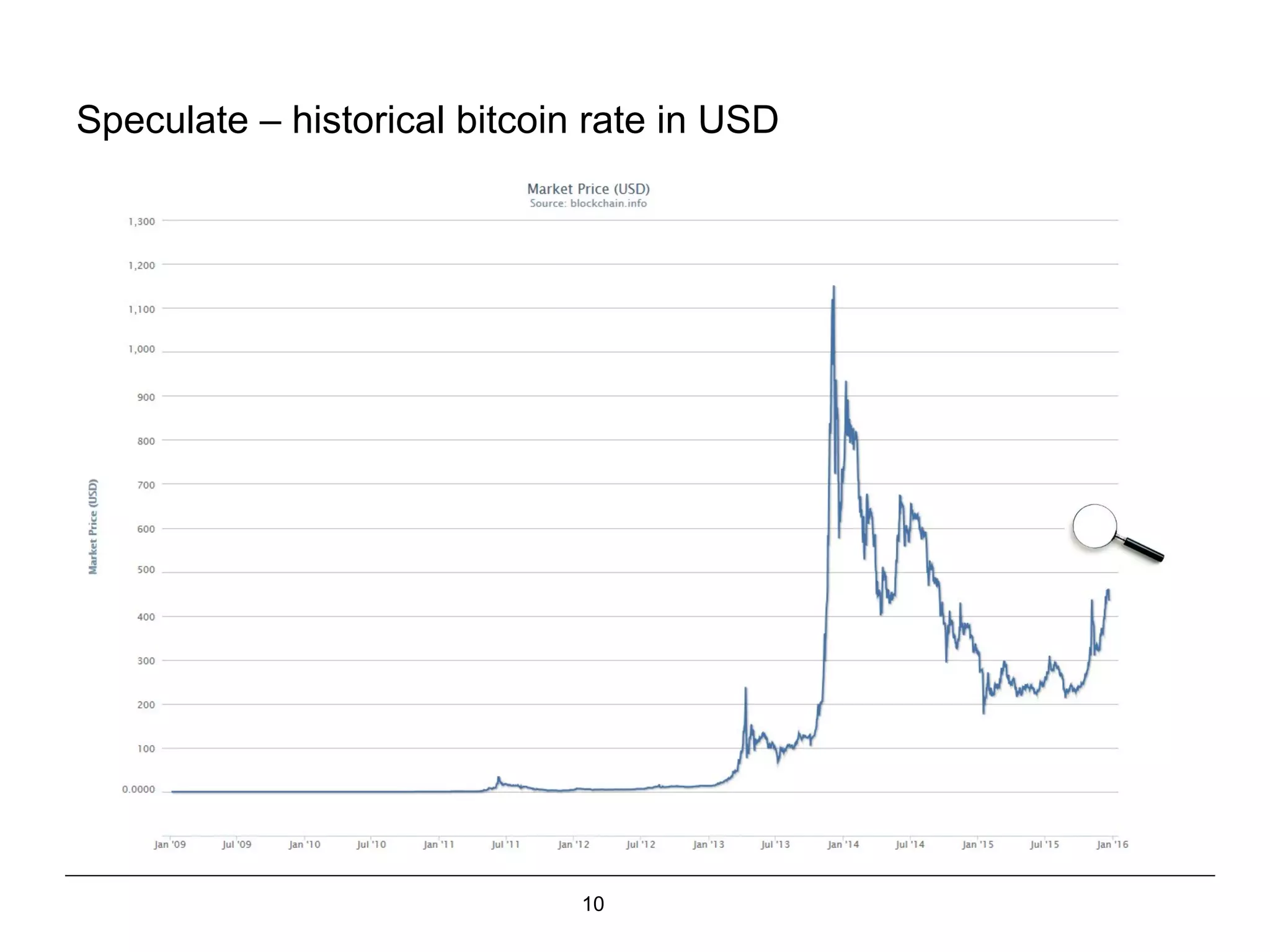
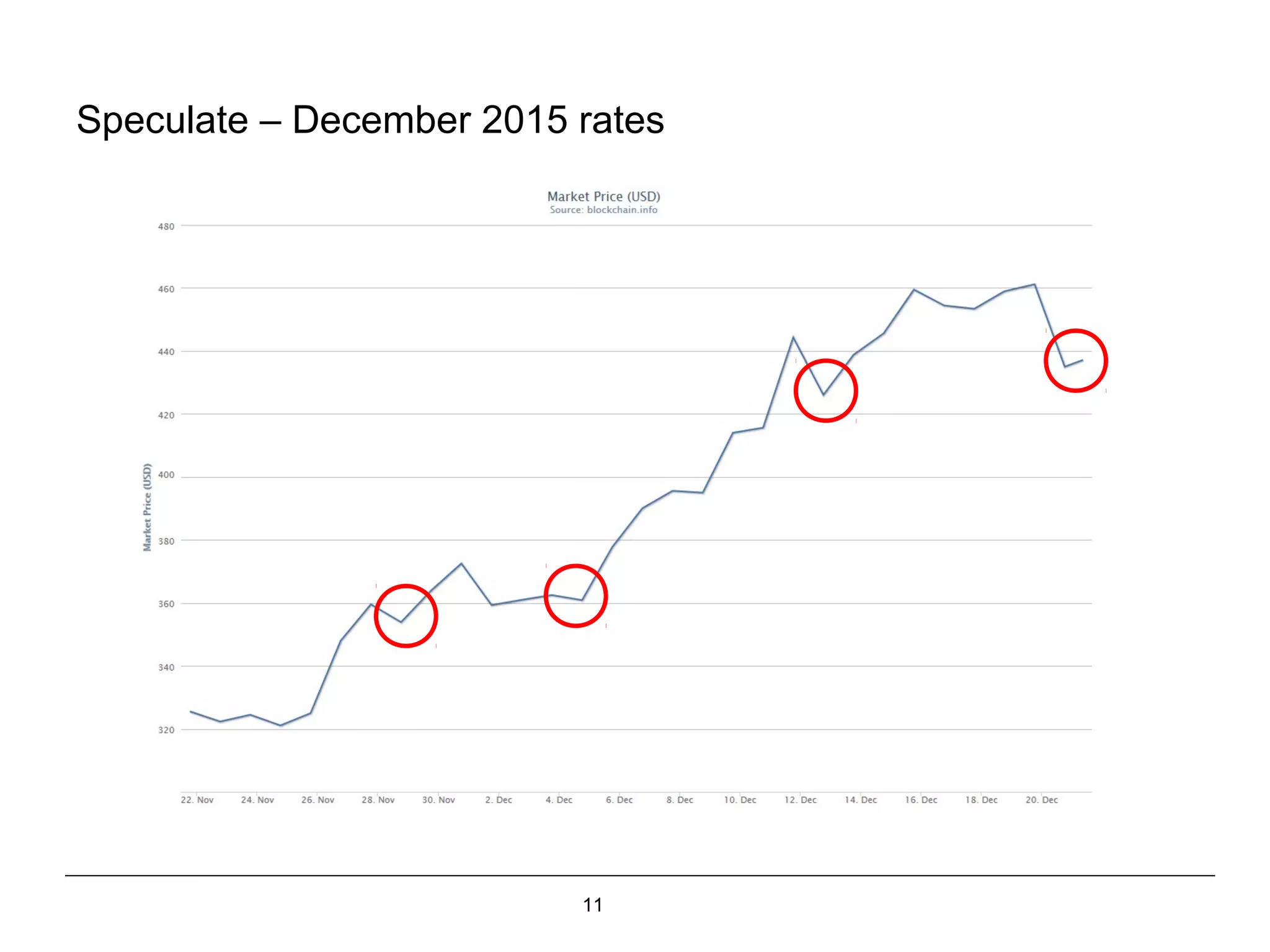
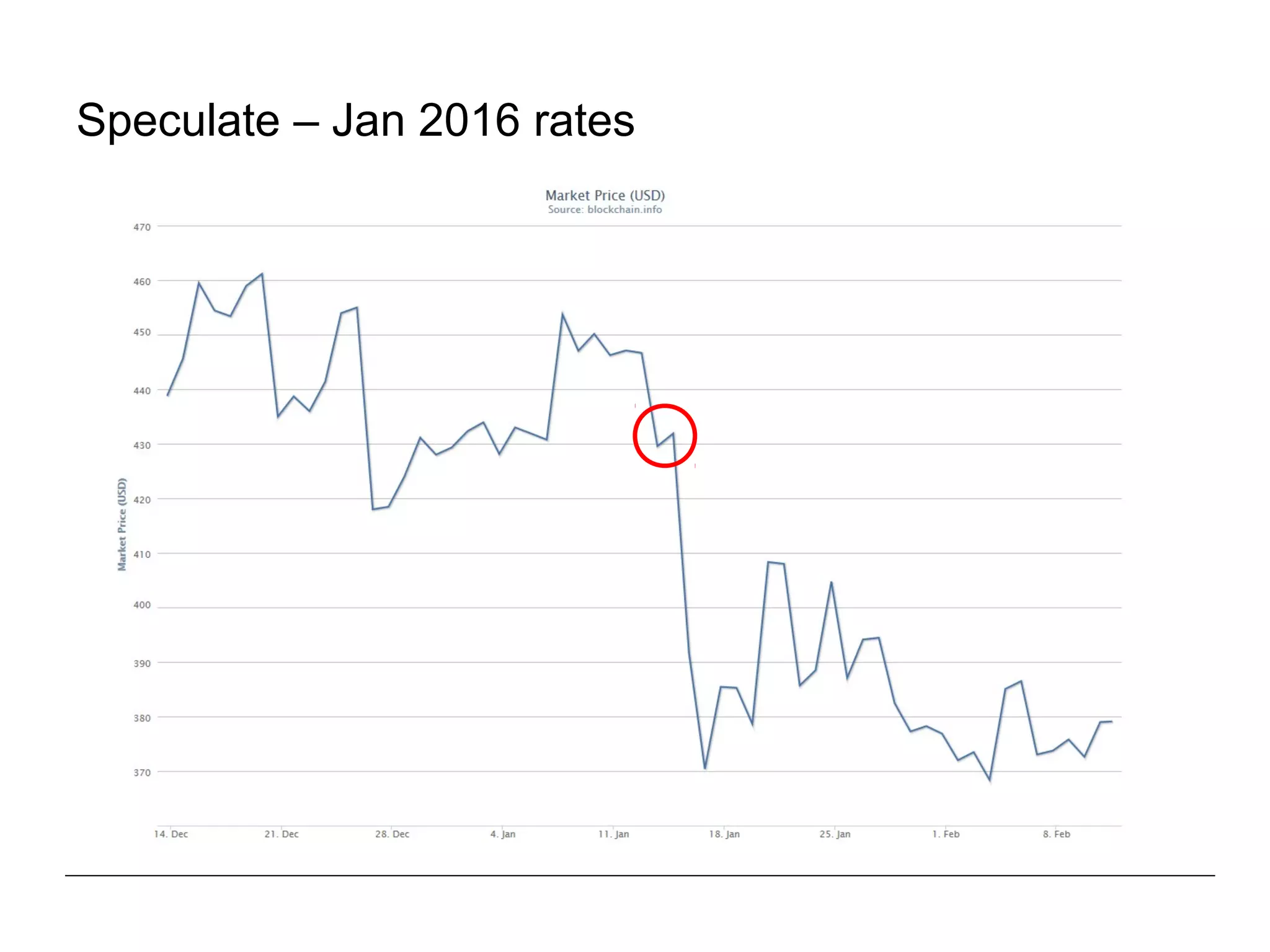
Speculate on the exchange rate
Earn money (mining)
8
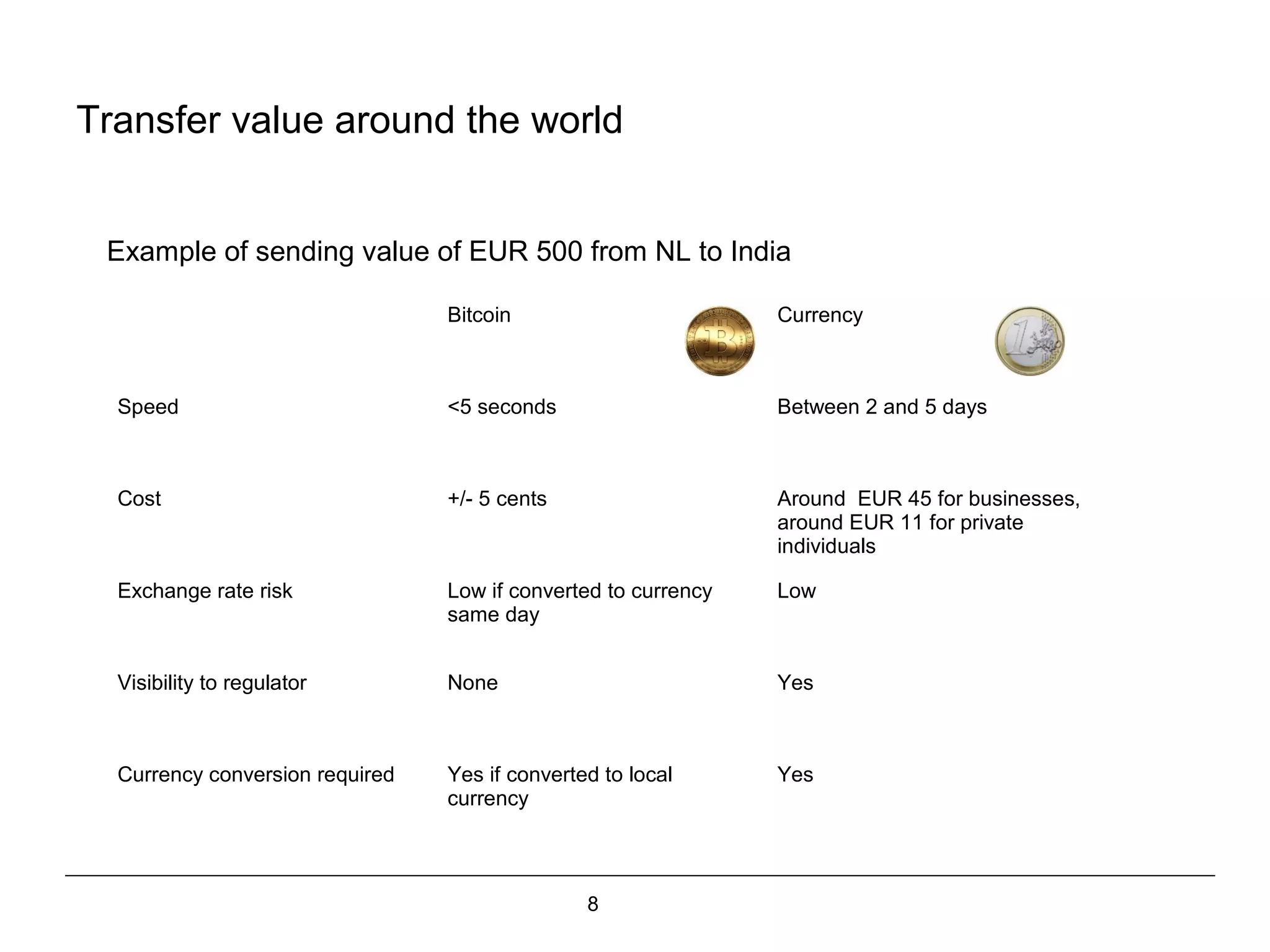
Transfer value around the world
Bitcoin Currency
Speed <5 seconds Between 2 and 5 days
Cost +/- 5 cents Around EUR 45 for businesses,
around EUR 11 for private
individuals
Exchange rate risk Low if converted to currency
same day
Low
Visibility to regulator None Yes
Currency conversion required Yes if converted to local
currency
Yes
Example of sending value of EUR 500 from NL to India
9
Pay for things you buy
10
Speculate – historical bitcoin rate in USD
11
Speculate – December 2015 rates
Speculate – Jan 2016 rates
13
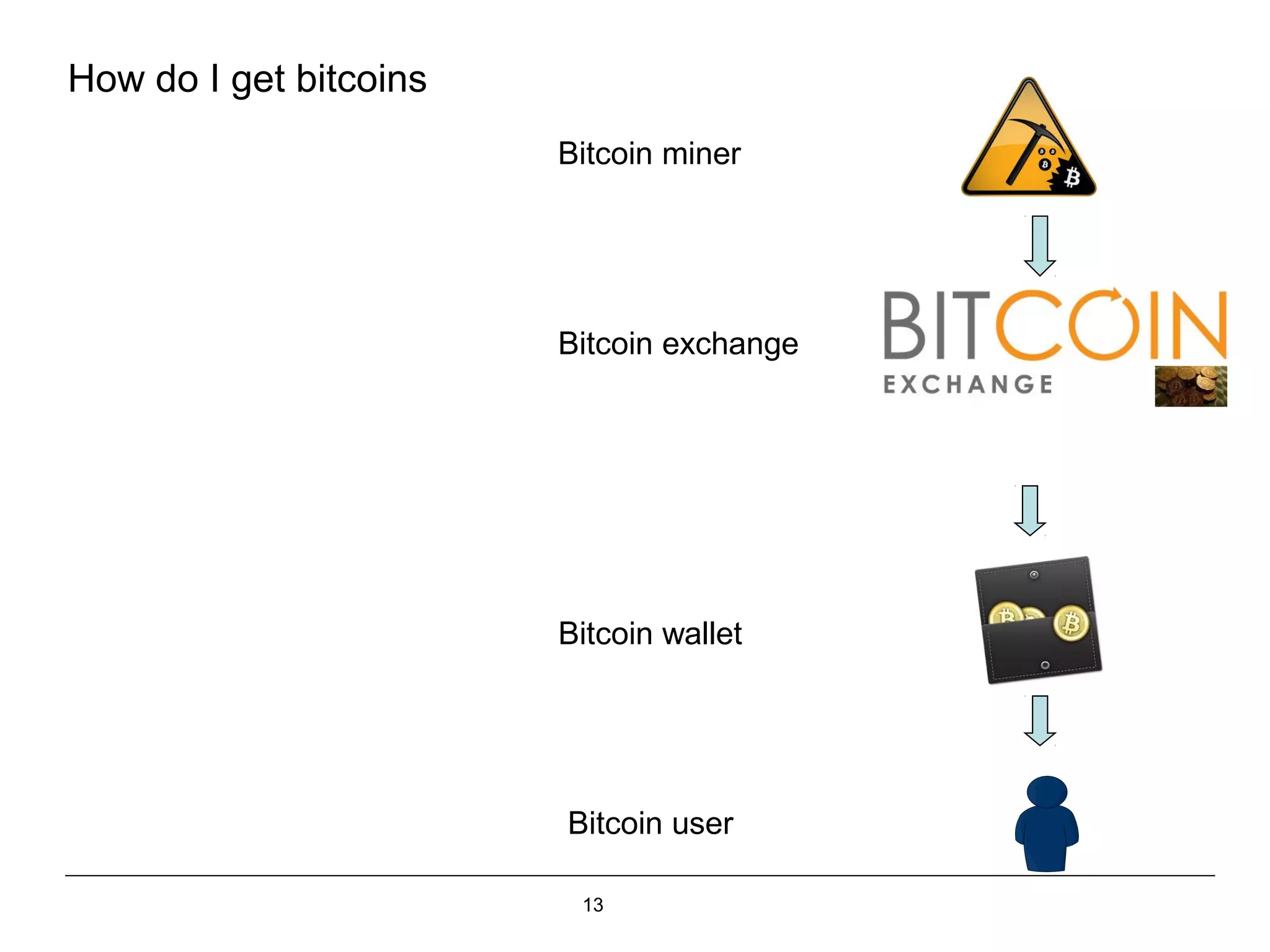
How do I get bitcoins
Bitcoin miner
Bitcoin exchange
Bitcoin wallet
Bitcoin user
14
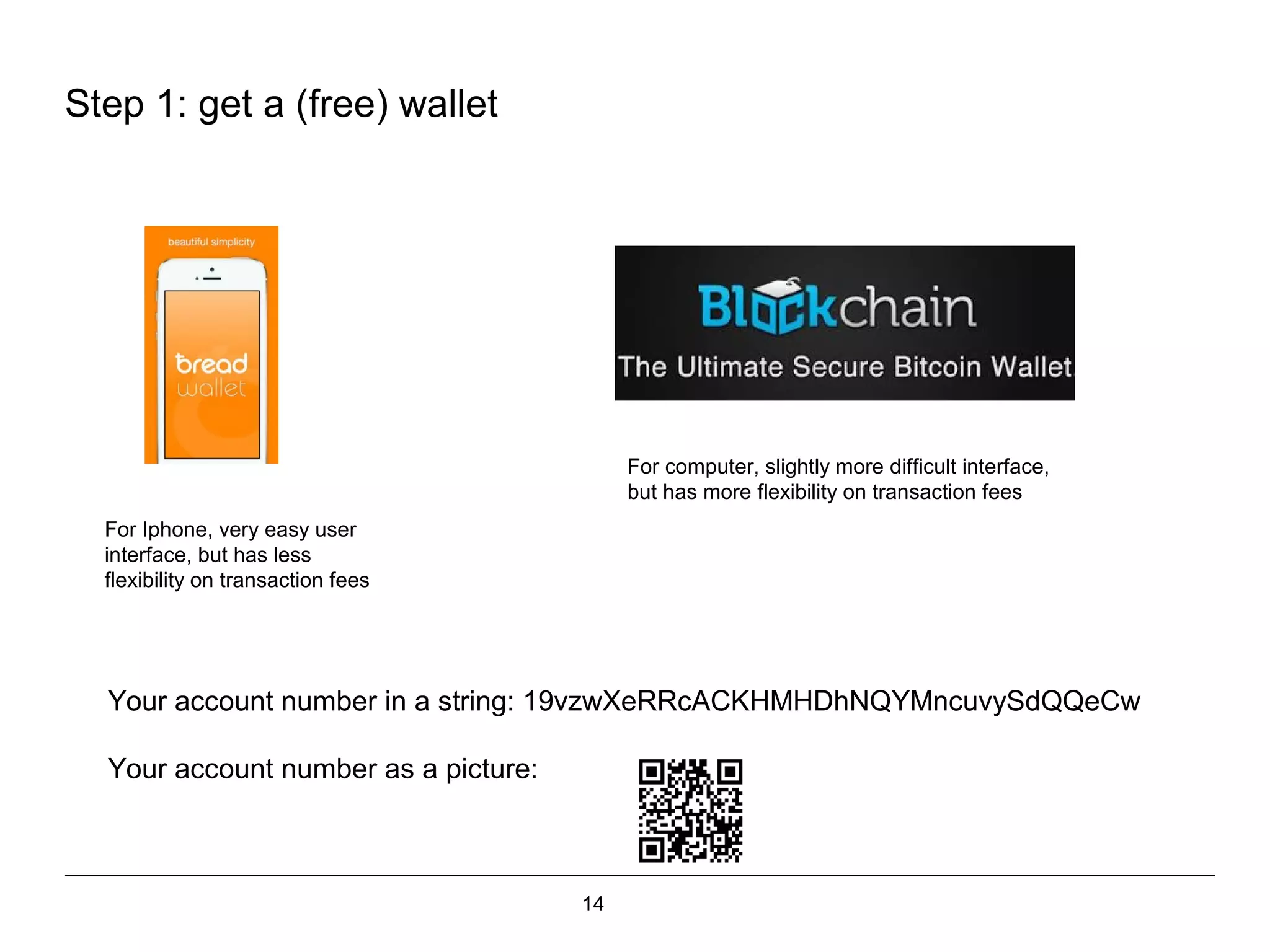
Step 1: get a (free) wallet
For Iphone, very easy user
interface, but has less
flexibility on transaction fees
For computer, slightly more difficult interface,
but has more flexibility on transaction fees
Your account number in a string: 19vzwXeRRcACKHMHDhNQYMncuvySdQQeCw
Your account number as a picture:
15
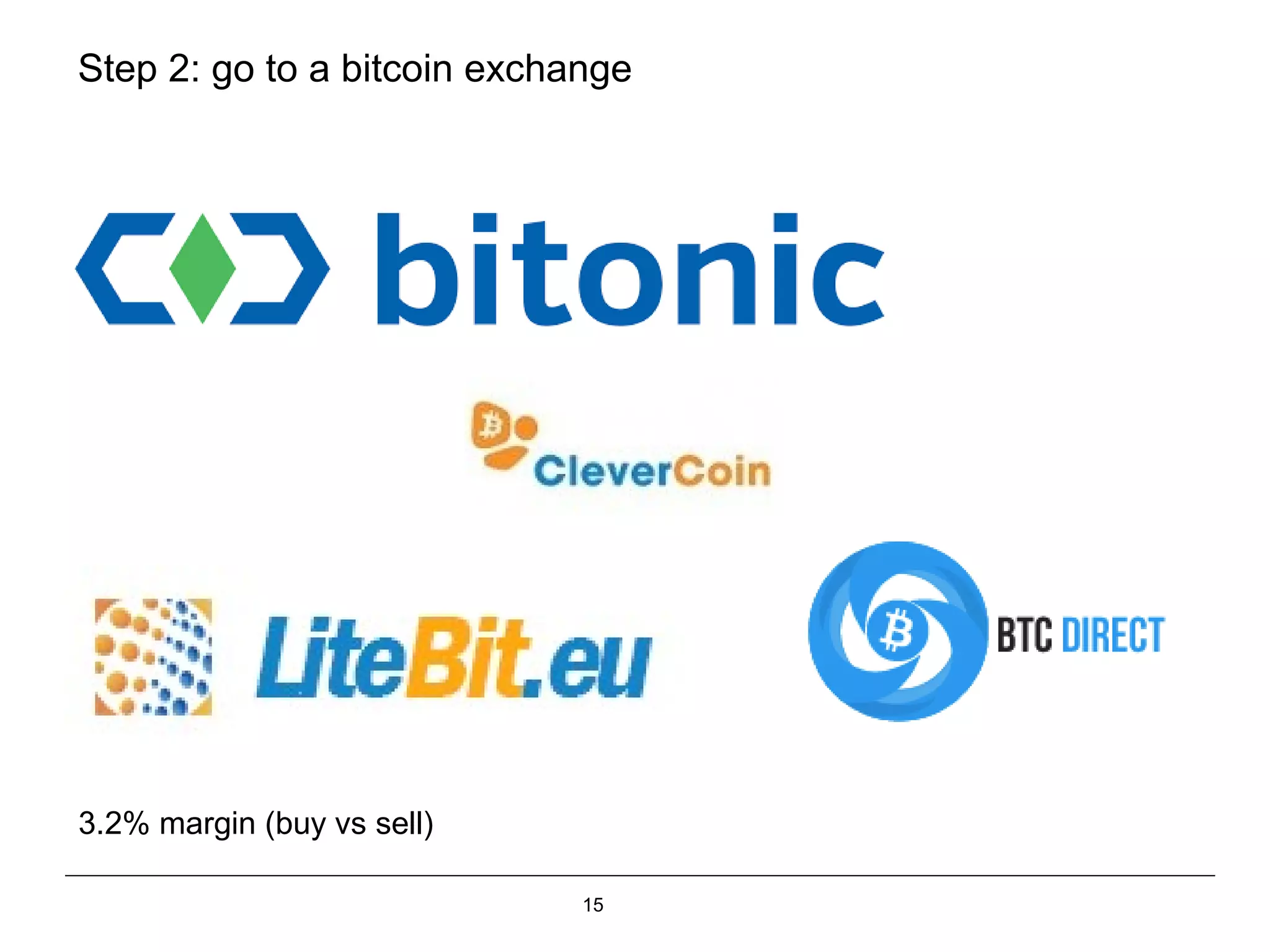
Step 2: go to a bitcoin exchange
3.2% margin (buy vs sell)
16
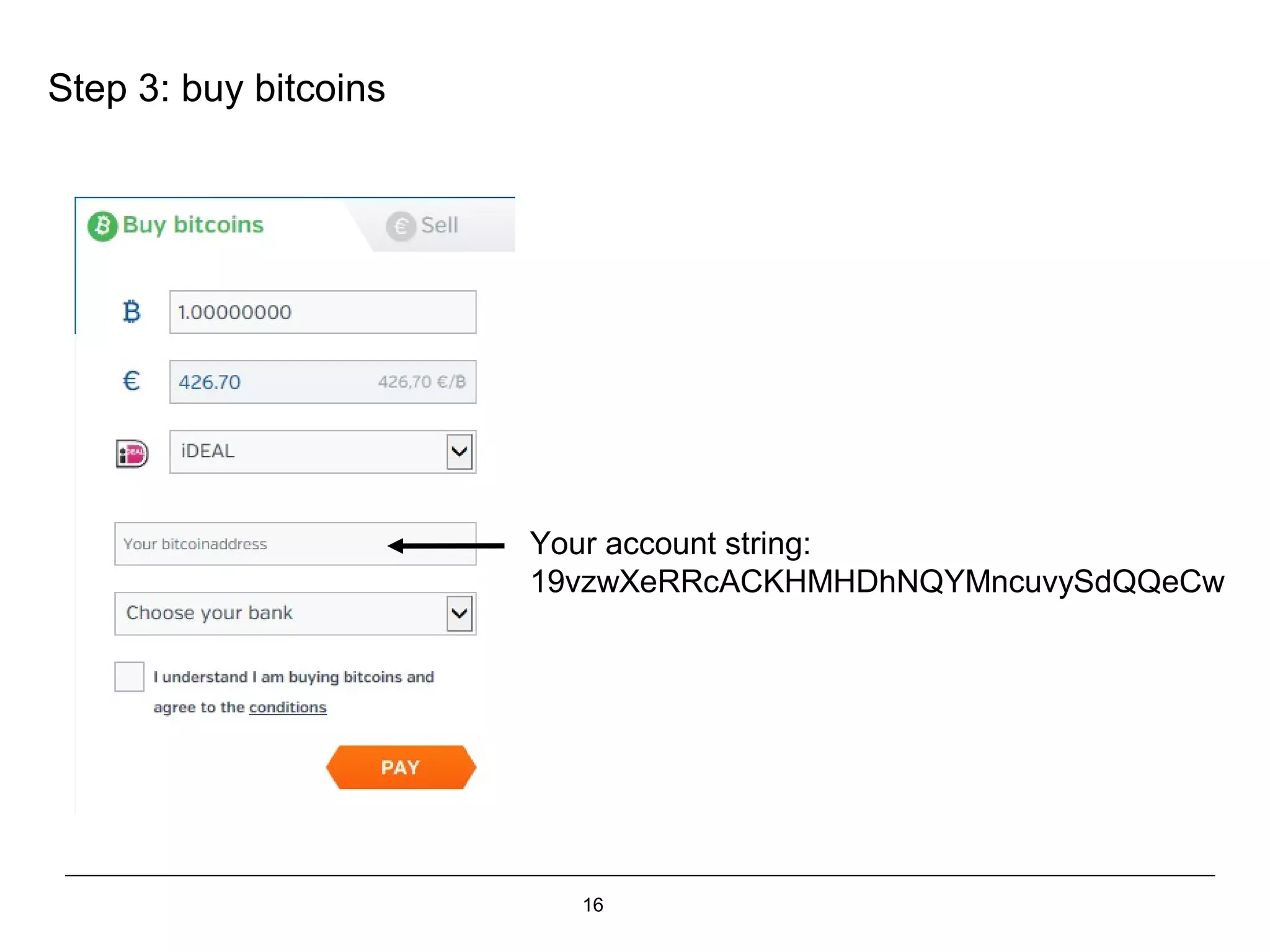
Step 3: buy bitcoins
Your account string:
19vzwXeRRcACKHMHDhNQYMncuvySdQQeCw
17
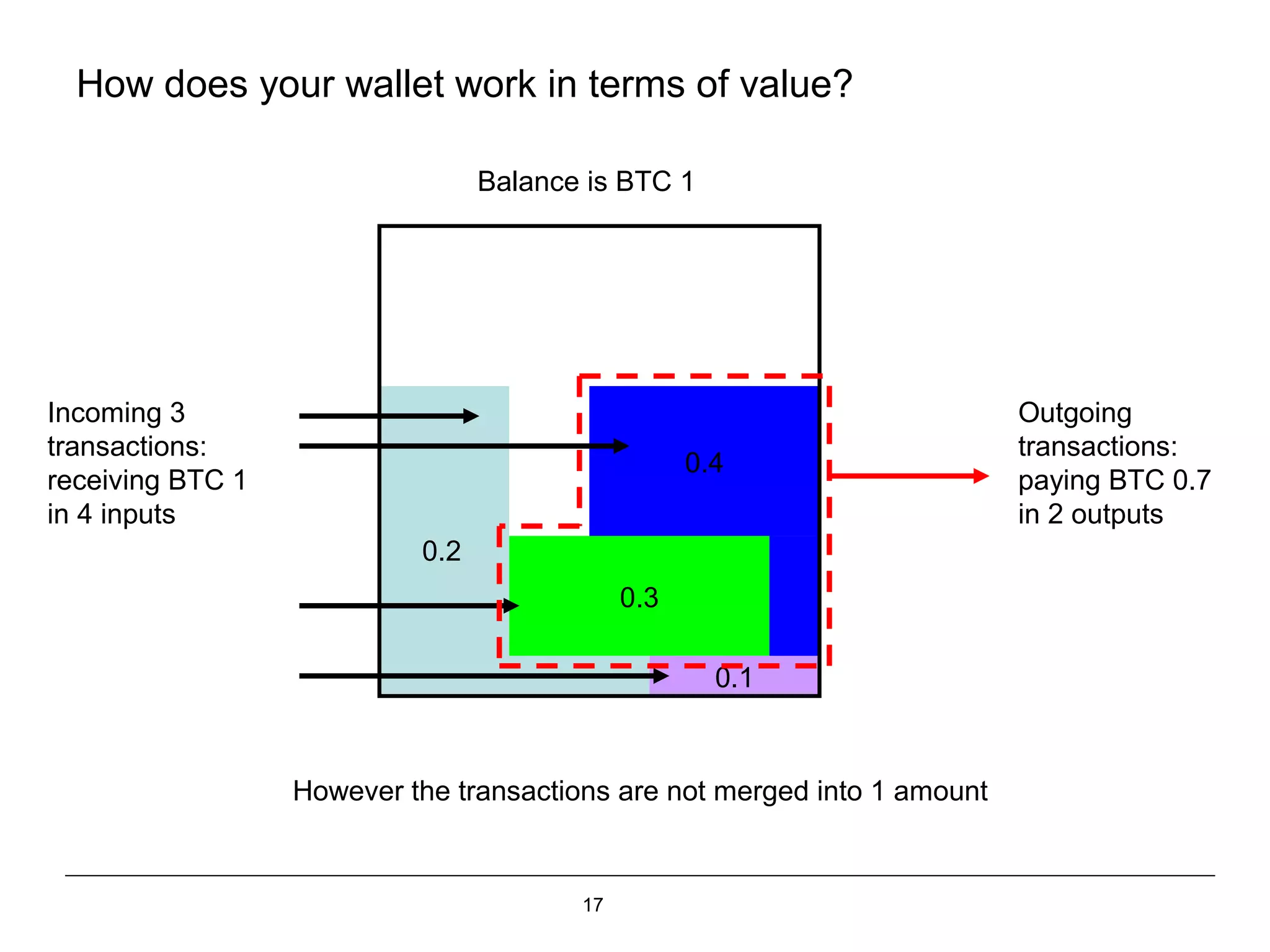
How does your wallet work in terms of value?
0.2
0.3
0.1
0.4
Balance is BTC 1
However the transactions are not merged into 1 amount
Incoming 3
transactions:
receiving BTC 1
in 4 inputs
Outgoing
transactions:
paying BTC 0.7
in 2 outputs
18
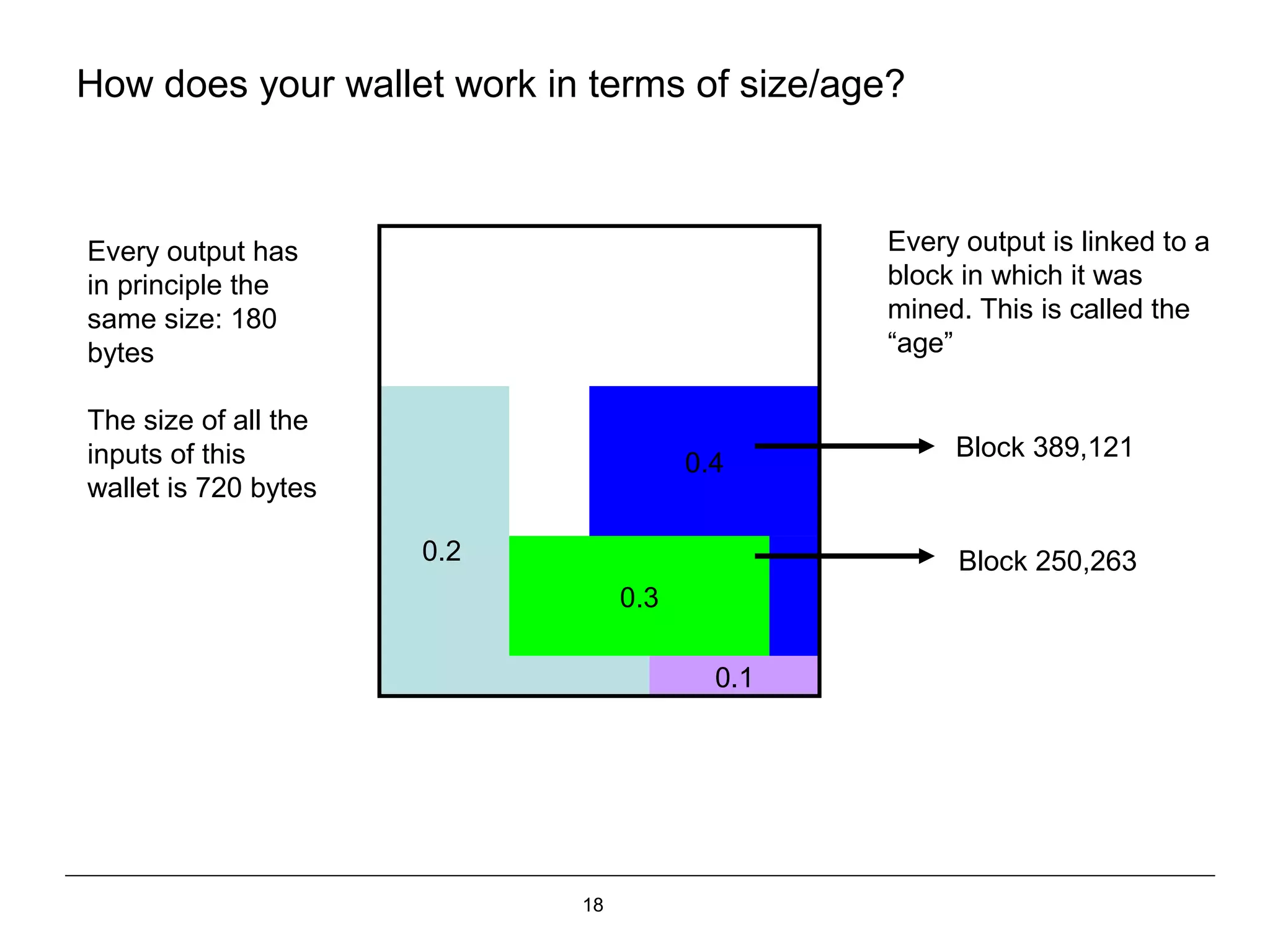
How does your wallet work in terms of size/age?
0.2
0.3
0.1
0.4
Every output has
in principle the
same size: 180
bytes
The size of all the
inputs of this
wallet is 720 bytes
Every output is linked to a
block in which it was
mined. This is called the
“age”
Block 389,121
Block 250,263
19
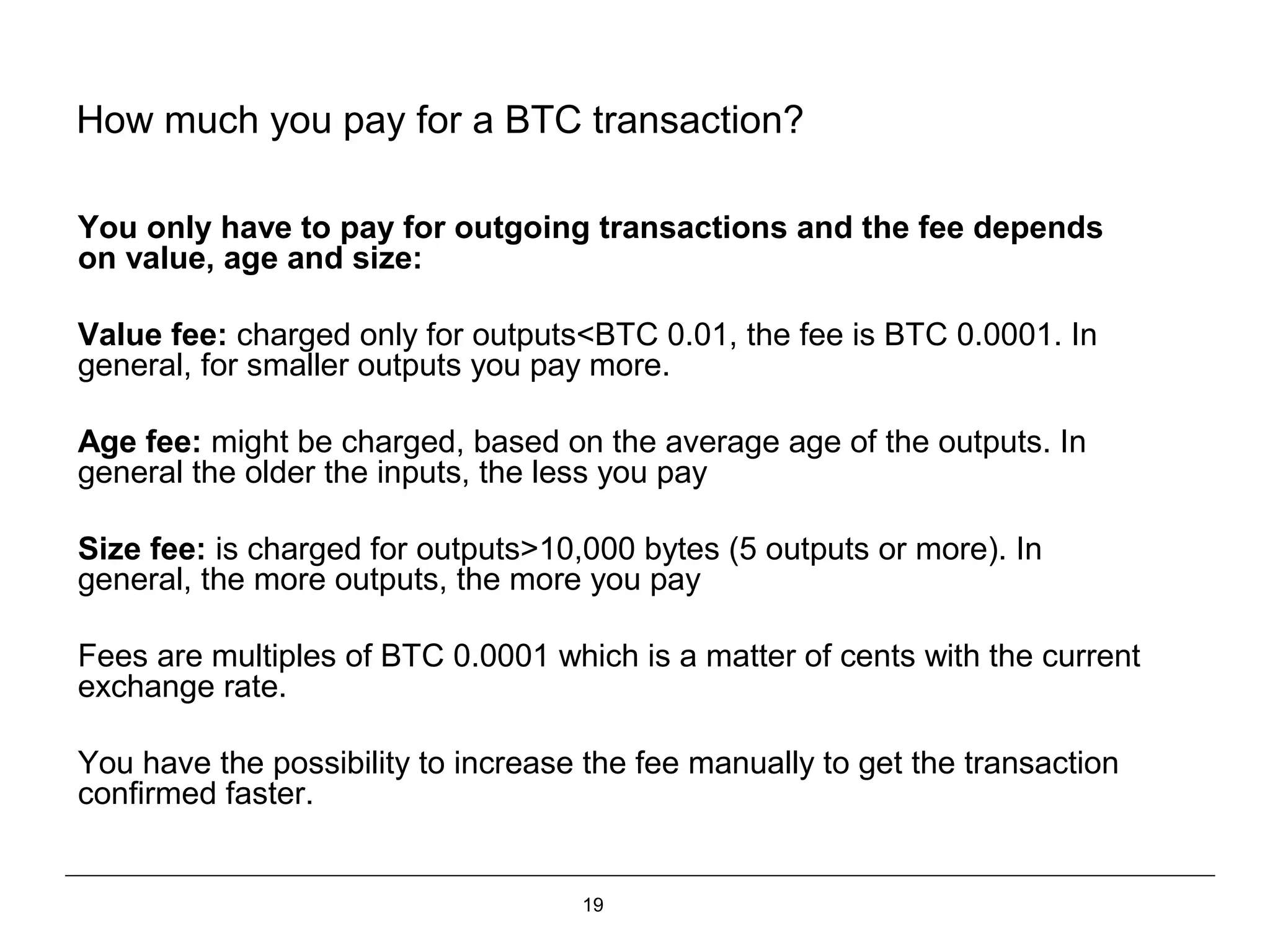
How much you pay for a BTC transaction?
You only have to pay for outgoing transactions and the fee depends
on value, age and size:
Value fee: charged only for outputs<BTC 0.01, the fee is BTC 0.0001. In
general, for smaller outputs you pay more.
Age fee: might be charged, based on the average age of the outputs. In
general the older the inputs, the less you pay
Size fee: is charged for outputs>10,000 bytes (5 outputs or more). In
general, the more outputs, the more you pay
Fees are multiples of BTC 0.0001 which is a matter of cents with the current
exchange rate.
You have the possibility to increase the fee manually to get the transaction
confirmed faster.
20
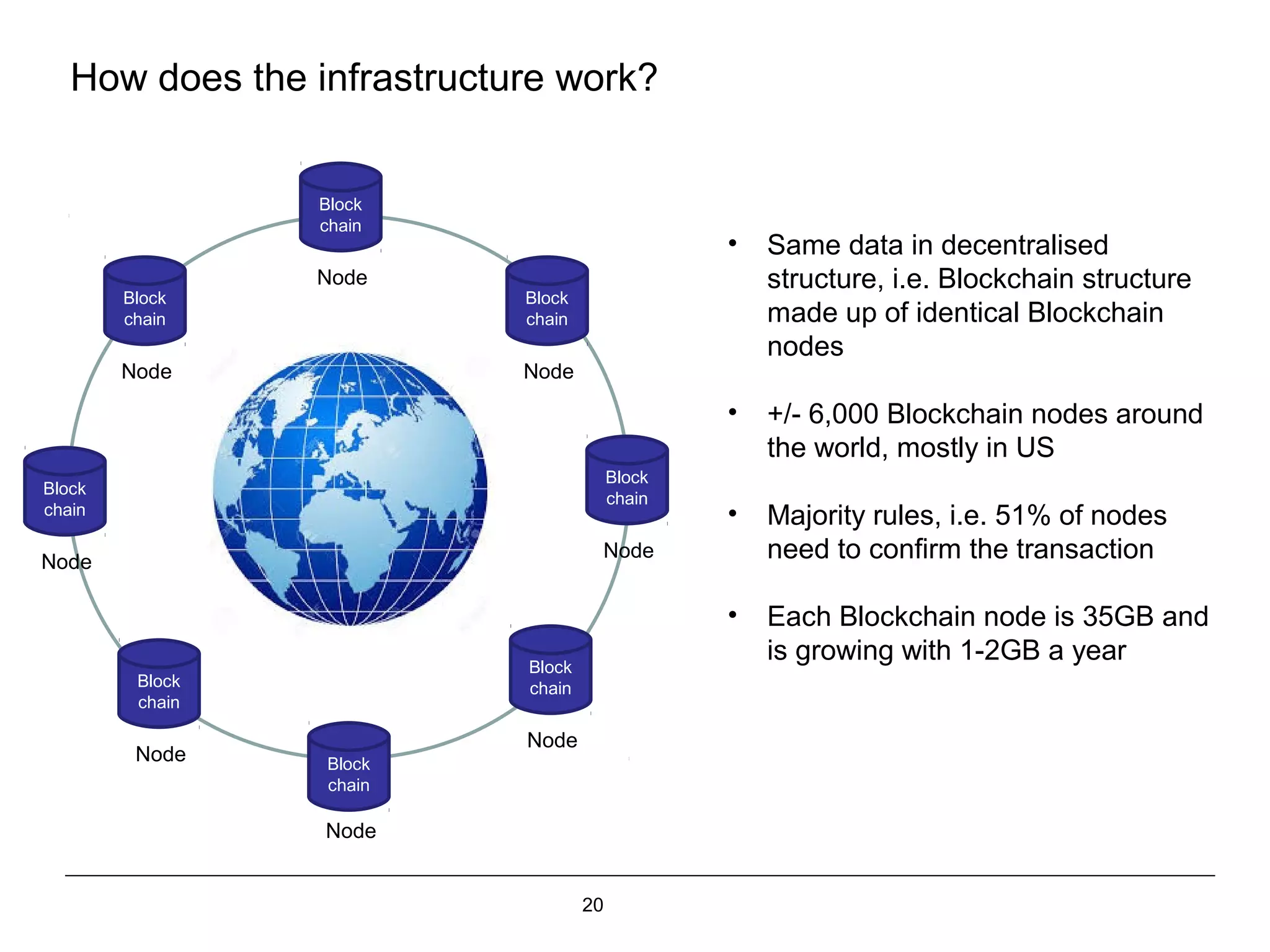
How does the infrastructure work?
Block
chain
Node
Block
chain
Node
Block
chain
Node
Block
chain
Node
Block
chain
Node
Block
chain
Node
Block
chain
Node
Block
chain
Node
• Same data in decentralised
structure, i.e. Blockchain structure
made up of identical Blockchain
nodes
• +/- 6,000 Blockchain nodes around
the world, mostly in US
• Majority rules, i.e. 51% of nodes
need to confirm the transaction
• Each Blockchain node is 35GB and
is growing with 1-2GB a year
21
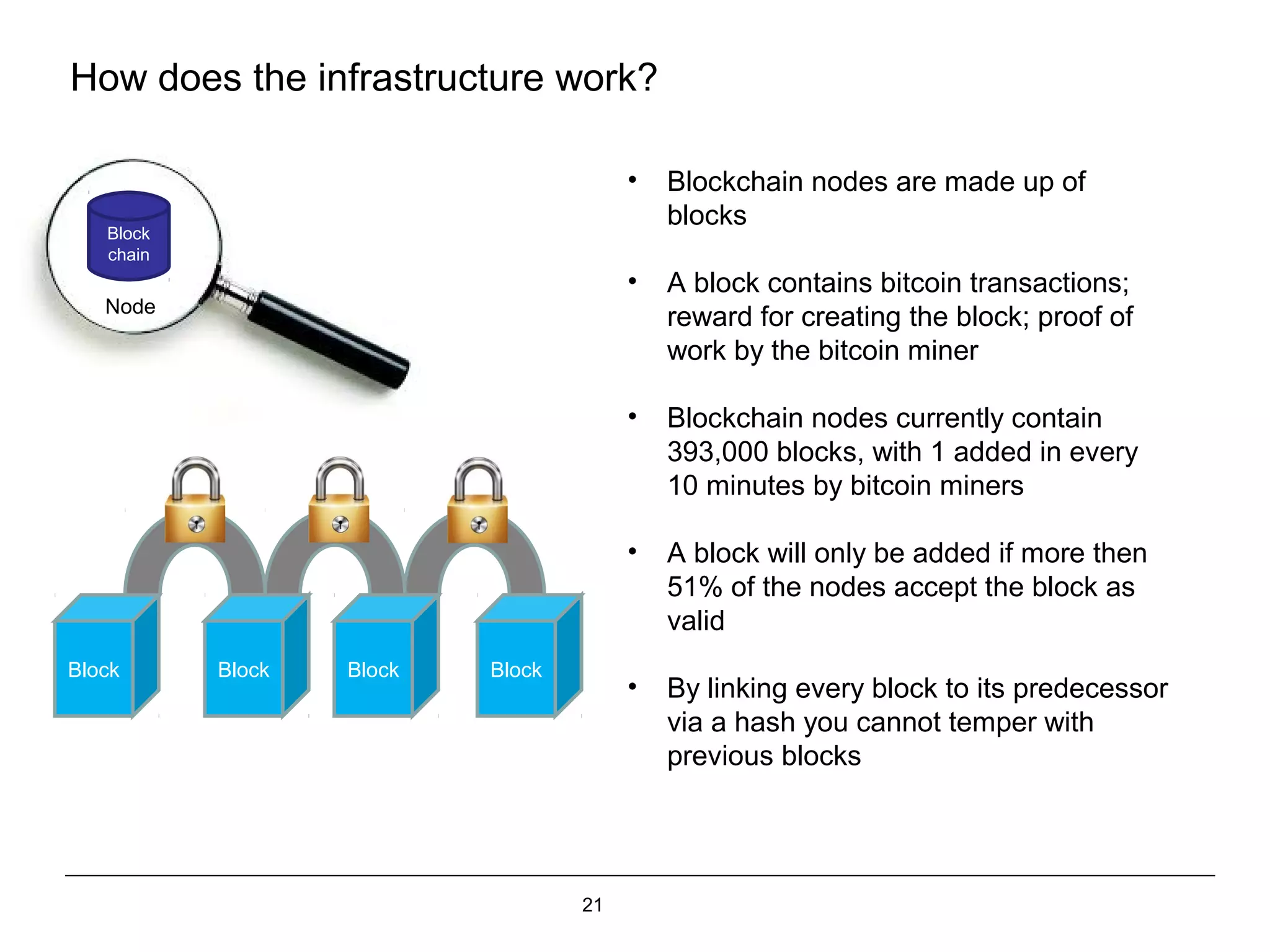
Block
chain
Node
Block Block Block Block
• Blockchain nodes are made up of
blocks
• A block contains bitcoin transactions;
reward for creating the block; proof of
work by the bitcoin miner
• Blockchain nodes currently contain
393,000 blocks, with 1 added in every
10 minutes by bitcoin miners
• A block will only be added if more then
51% of the nodes accept the block as
valid
• By linking every block to its predecessor
via a hash you cannot temper with
previous blocks
How does the infrastructure work?
22
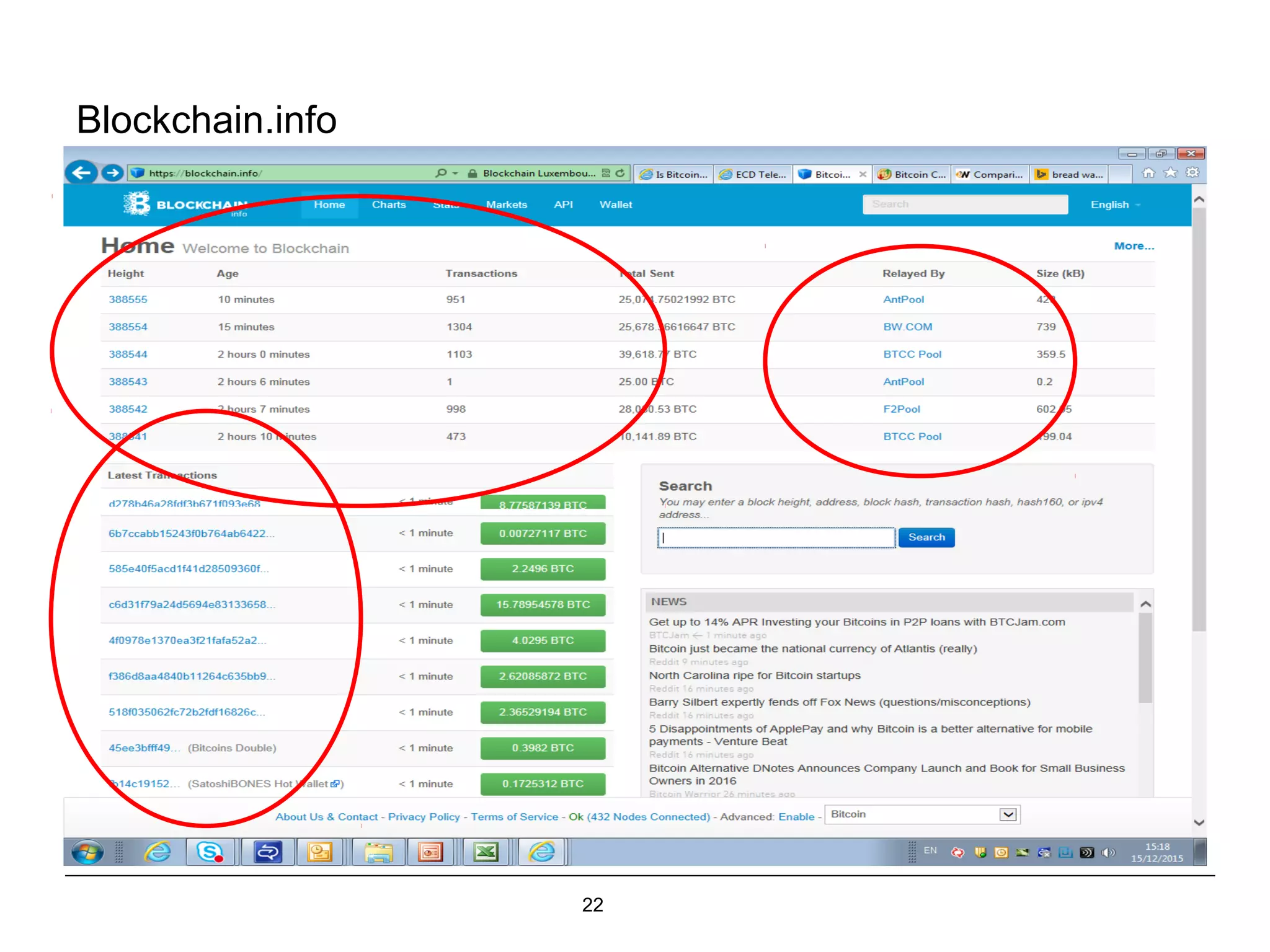
Blockchain.info
23
How bitcoin mining works?
• Bitcoin miners ensure that the bitcoin network is up and running and stays
up-to-date. They collect the transactions in blocks and add them to the
Blockchain. A block is added to the Blockchain in every 10 minutes
• At his moment there are between 5,000 and 100,000 miners
• The miner who solves the Proof of Work mathematical problem first, is able
to put his block in the Blockchain and gets rewarded (BTC 25 and all the
fees of the transactions in the block)
• ‘The winner takes it all’, so the other miners get nothing. But there is a race
every 10 minutes and each time you start from scratch
• Costs: entrance is free however to race you need fast computers and
electricity. So racing costs real money!
• Revenues: close to EUR 10,000 in 10 minutes. But then you need to be the
fastest and smartest!
24
How can you successfully mine?
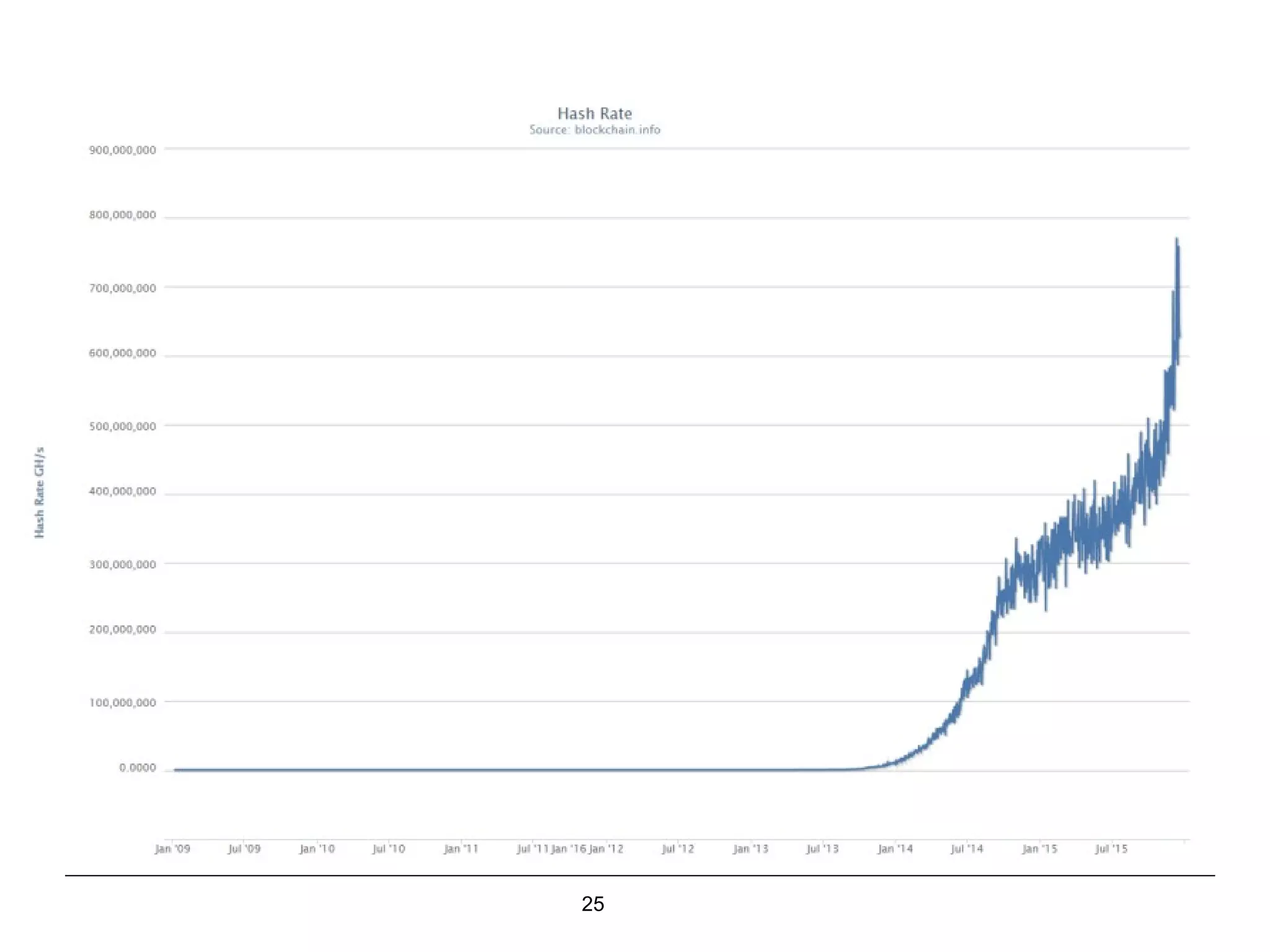
• Ensure you have more computer power (hash rate) then other
miners, which increases the chance that you solve the Proof of
Work first
• Pool together with other miners and agree that you share the reward
if one person in the pool wins
• Check www.blockchain.info to see who won the latest block
BUT:
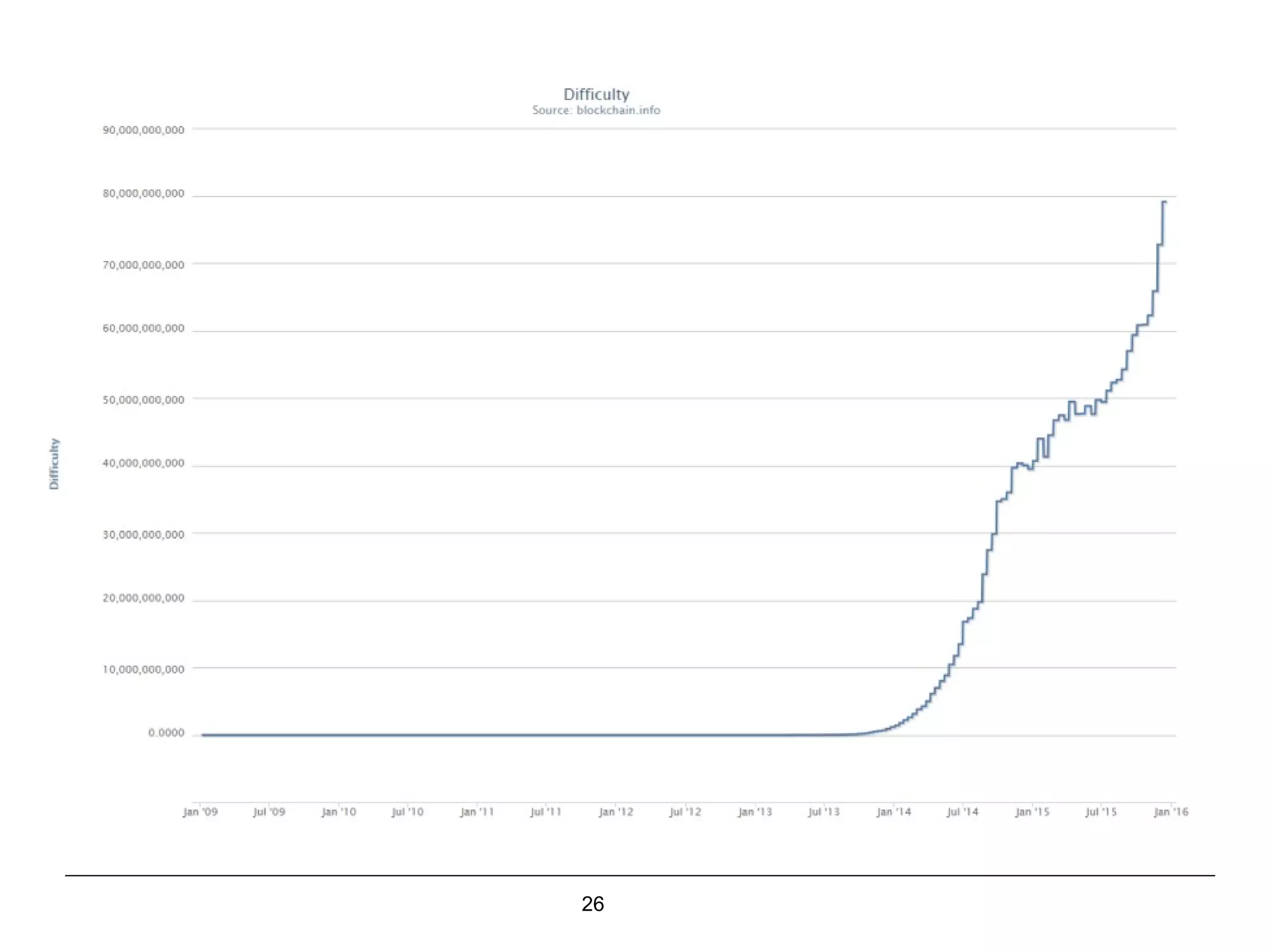
• The more miners there are – i.e. the more computer power
becomes available – the faster the mining of a block. To avoid too
fast mining, the Proof of Work is made increasingly difficult
(difficulty)
25
26
27
How will this impact us?
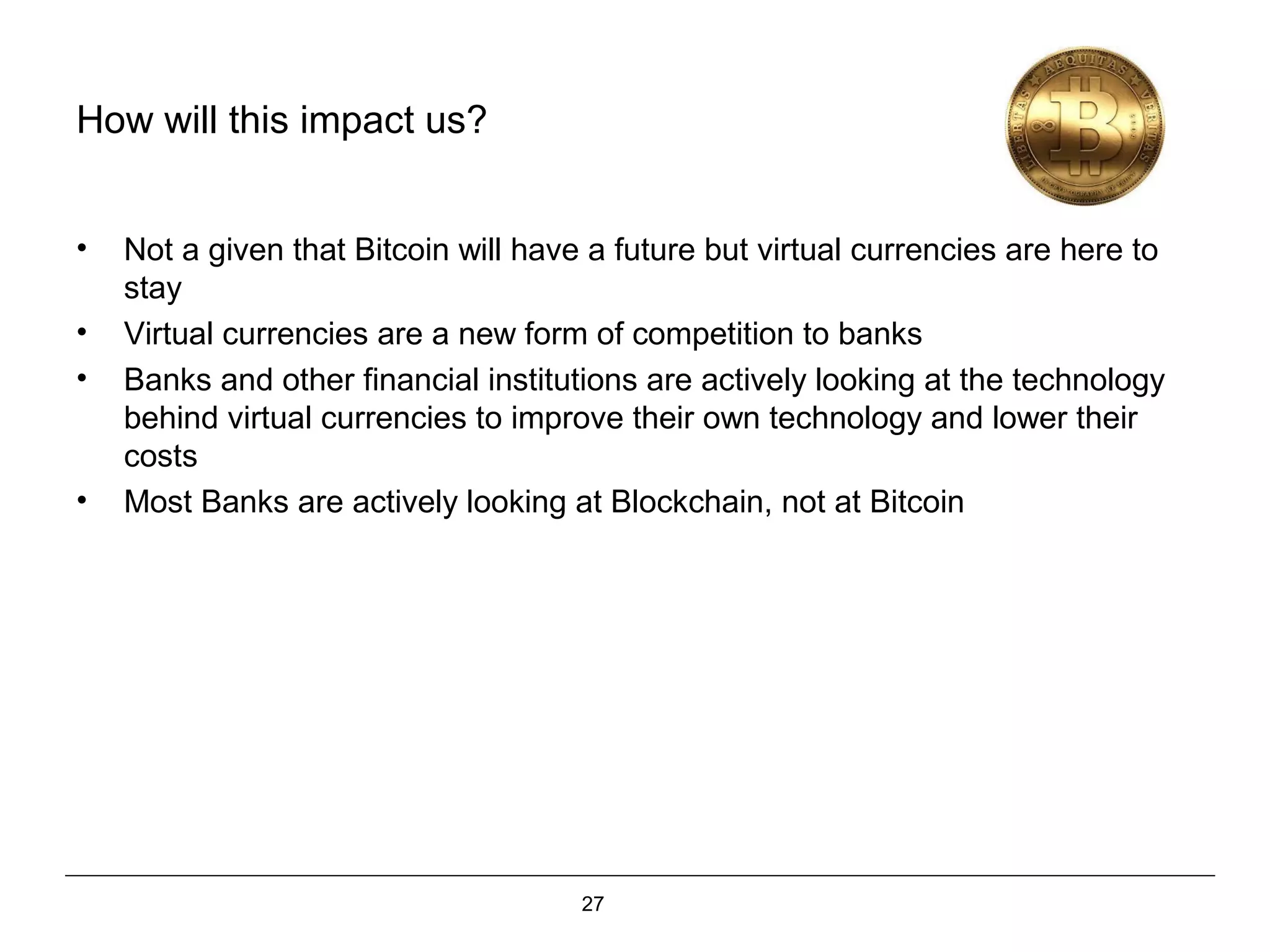
• Not a given that Bitcoin will have a future but virtual currencies are here to
stay
• Virtual currencies are a new form of competition to banks
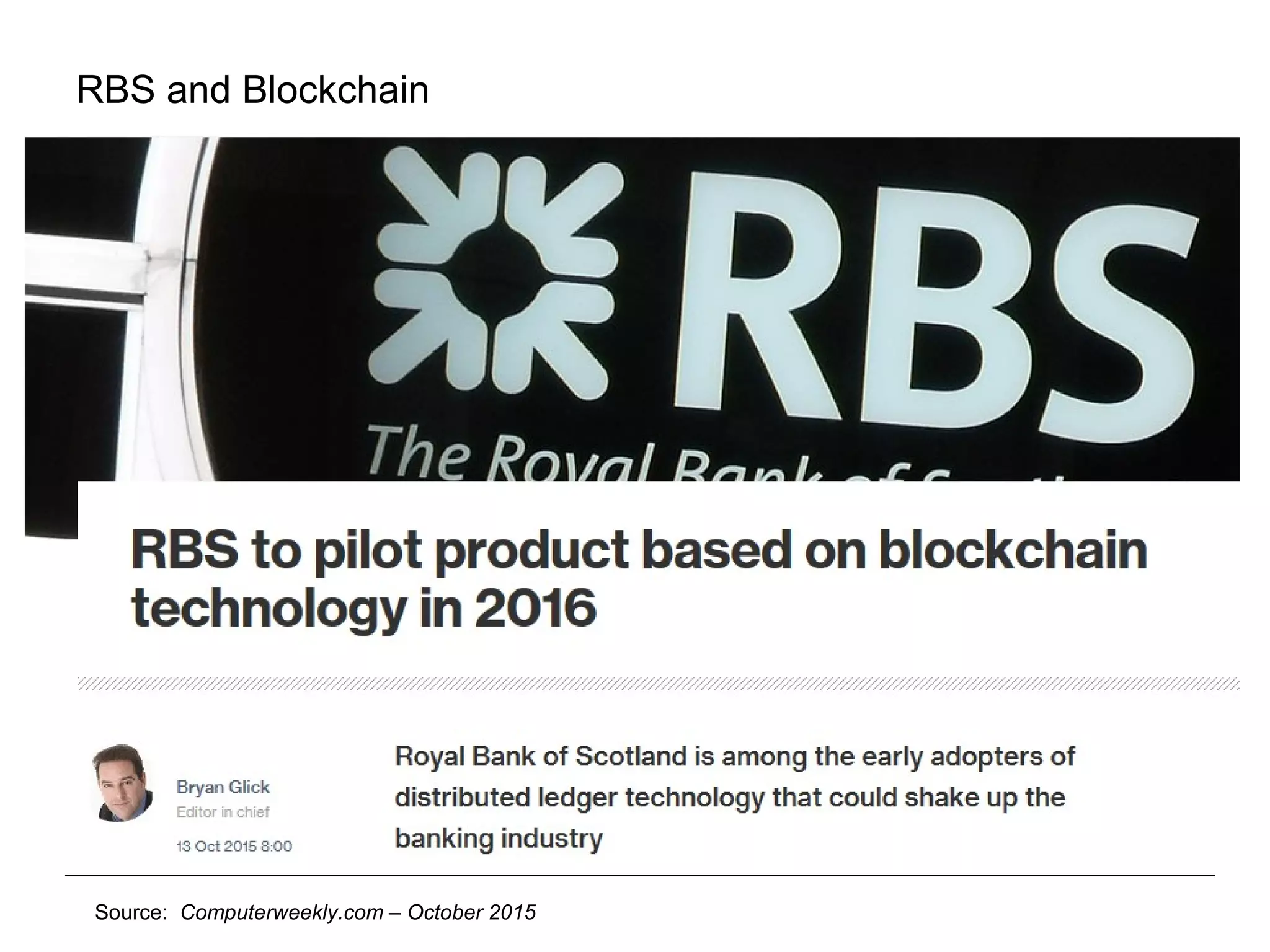
• Banks and other financial institutions are actively looking at the technology
behind virtual currencies to improve their own technology and lower their
costs
• Most Banks are actively looking at Blockchain, not at Bitcoin
Source: Computerweekly.com – October 2015
RBS and Blockchain
29
Questions?
30
Sources for this presentation
– https://99bitcoins.com/bitcoin-mining-profitable-beginners-explanation/
– https://blockchain.info/
– https://en.bitcoin.it/wiki/Comparison_of_mining_pools
– https://bitcoin.org/en/
– http://organofcorti.blogspot.mx/
– https://www.khanacademy.org/economics-finance-domain/core-finance/money-and-
banking/bitcoin/v/bitcoin-proof-of-work
– https://www.khanacademy.org/economics-finance-domain/core-finance/money-and-
banking/bitcoin/v/bitcoin-transaction-block-chains
– https://bitnodes.21.co/
– http://bitcoinfees.com/
– Andreas M. Antonopoulos: "Consensus Algorithms, Blockchain Technology and Bitcoin" [UCL]
(https://www.youtube.com/watch?v=sE7998qfjgk)

All you ever needed to know on bitcoin and blockchain

  • 1.
  • 2.
  • 3.
  • 4.
    4 Content History of thebitcoin What can I do with a bitcoin How can I get bitcoins How does the bitcoin infrastructure ( blockchain) look like How can this effect our future
  • 5.
    5 History of moneyin NL End of paper money being 100% covered by gold 1914 1936 Introduction of coins not made of precious metal 1918 End of paper money being 40% covered by gold 1971 No more connection between gold and money 2009 Bitcoin Litecoin DarkcoinPeercoin Dogecoin Primecoin 2011 2012 2013 2014 People are prepared to exchange items for paper that can be exchanged for gold People are prepared to exchange items for paper People are prepared to exchange items for a combination of zero’s and one’s 2002 Euro
  • 6.
    6 Bitcoin at aglance • Virtual currency invented / go live in 2009 by Satoshi Nakamoto • 22 May 2010 first real world transaction: 2 pizza’s were ordered for BTC 10,000 • Number of transactions: 220,000 per day • Number of bitcoins available December 2015: 15m • Maximum number of bitcoins: 21m (expected to be reached in 2140) • Based on “blockchain” technology • Current value of 1 bitcoin = +/- EUR 330 Bitcoin Units Abbreviation Decimal Bitcoin BTC or XBT 1 Milli Bitcoin mBTC 0.001 Micro Bitcoin uBTC 0.000001 Satoshi Sat 0.00000001
  • 7.
    7 What can youdo with a bitcoin Transfer value around the world: • To pay for things you buy • To donate/give present Speculate on the exchange rate Earn money (mining)
  • 8.
    8 Transfer value aroundthe world Bitcoin Currency Speed <5 seconds Between 2 and 5 days Cost +/- 5 cents Around EUR 45 for businesses, around EUR 11 for private individuals Exchange rate risk Low if converted to currency same day Low Visibility to regulator None Yes Currency conversion required Yes if converted to local currency Yes Example of sending value of EUR 500 from NL to India
  • 9.
  • 10.
    10 Speculate – historicalbitcoin rate in USD
  • 11.
  • 12.
  • 13.
    13 How do Iget bitcoins Bitcoin miner Bitcoin exchange Bitcoin wallet Bitcoin user
  • 14.
    14 Step 1: geta (free) wallet For Iphone, very easy user interface, but has less flexibility on transaction fees For computer, slightly more difficult interface, but has more flexibility on transaction fees Your account number in a string: 19vzwXeRRcACKHMHDhNQYMncuvySdQQeCw Your account number as a picture:
  • 15.
    15 Step 2: goto a bitcoin exchange 3.2% margin (buy vs sell)
  • 16.
    16 Step 3: buybitcoins Your account string: 19vzwXeRRcACKHMHDhNQYMncuvySdQQeCw
  • 17.
    17 How does yourwallet work in terms of value? 0.2 0.3 0.1 0.4 Balance is BTC 1 However the transactions are not merged into 1 amount Incoming 3 transactions: receiving BTC 1 in 4 inputs Outgoing transactions: paying BTC 0.7 in 2 outputs
  • 18.
    18 How does yourwallet work in terms of size/age? 0.2 0.3 0.1 0.4 Every output has in principle the same size: 180 bytes The size of all the inputs of this wallet is 720 bytes Every output is linked to a block in which it was mined. This is called the “age” Block 389,121 Block 250,263
  • 19.
    19 How much youpay for a BTC transaction? You only have to pay for outgoing transactions and the fee depends on value, age and size: Value fee: charged only for outputs<BTC 0.01, the fee is BTC 0.0001. In general, for smaller outputs you pay more. Age fee: might be charged, based on the average age of the outputs. In general the older the inputs, the less you pay Size fee: is charged for outputs>10,000 bytes (5 outputs or more). In general, the more outputs, the more you pay Fees are multiples of BTC 0.0001 which is a matter of cents with the current exchange rate. You have the possibility to increase the fee manually to get the transaction confirmed faster.
  • 20.
    20 How does theinfrastructure work? Block chain Node Block chain Node Block chain Node Block chain Node Block chain Node Block chain Node Block chain Node Block chain Node • Same data in decentralised structure, i.e. Blockchain structure made up of identical Blockchain nodes • +/- 6,000 Blockchain nodes around the world, mostly in US • Majority rules, i.e. 51% of nodes need to confirm the transaction • Each Blockchain node is 35GB and is growing with 1-2GB a year
  • 21.
    21 Block chain Node Block Block BlockBlock • Blockchain nodes are made up of blocks • A block contains bitcoin transactions; reward for creating the block; proof of work by the bitcoin miner • Blockchain nodes currently contain 393,000 blocks, with 1 added in every 10 minutes by bitcoin miners • A block will only be added if more then 51% of the nodes accept the block as valid • By linking every block to its predecessor via a hash you cannot temper with previous blocks How does the infrastructure work?
  • 22.
  • 23.
    23 How bitcoin miningworks? • Bitcoin miners ensure that the bitcoin network is up and running and stays up-to-date. They collect the transactions in blocks and add them to the Blockchain. A block is added to the Blockchain in every 10 minutes • At his moment there are between 5,000 and 100,000 miners • The miner who solves the Proof of Work mathematical problem first, is able to put his block in the Blockchain and gets rewarded (BTC 25 and all the fees of the transactions in the block) • ‘The winner takes it all’, so the other miners get nothing. But there is a race every 10 minutes and each time you start from scratch • Costs: entrance is free however to race you need fast computers and electricity. So racing costs real money! • Revenues: close to EUR 10,000 in 10 minutes. But then you need to be the fastest and smartest!
  • 24.
    24 How can yousuccessfully mine? • Ensure you have more computer power (hash rate) then other miners, which increases the chance that you solve the Proof of Work first • Pool together with other miners and agree that you share the reward if one person in the pool wins • Check www.blockchain.info to see who won the latest block BUT: • The more miners there are – i.e. the more computer power becomes available – the faster the mining of a block. To avoid too fast mining, the Proof of Work is made increasingly difficult (difficulty)
  • 25.
  • 26.
  • 27.
    27 How will thisimpact us? • Not a given that Bitcoin will have a future but virtual currencies are here to stay • Virtual currencies are a new form of competition to banks • Banks and other financial institutions are actively looking at the technology behind virtual currencies to improve their own technology and lower their costs • Most Banks are actively looking at Blockchain, not at Bitcoin
  • 28.
    Source: Computerweekly.com –October 2015 RBS and Blockchain
  • 29.
  • 30.
    30 Sources for thispresentation – https://99bitcoins.com/bitcoin-mining-profitable-beginners-explanation/ – https://blockchain.info/ – https://en.bitcoin.it/wiki/Comparison_of_mining_pools – https://bitcoin.org/en/ – http://organofcorti.blogspot.mx/ – https://www.khanacademy.org/economics-finance-domain/core-finance/money-and- banking/bitcoin/v/bitcoin-proof-of-work – https://www.khanacademy.org/economics-finance-domain/core-finance/money-and- banking/bitcoin/v/bitcoin-transaction-block-chains – https://bitnodes.21.co/ – http://bitcoinfees.com/ – Andreas M. Antonopoulos: "Consensus Algorithms, Blockchain Technology and Bitcoin" [UCL] (https://www.youtube.com/watch?v=sE7998qfjgk)

Editor's Notes

  • #10 UK example : Ilse of Man US example: 200- 400 Bitcoin ATM’s Bitcoin banks
  • #15 In NL no KYC check, In India we have seen this
  • #16 Mt Gox exchange in Japan went bankrupt in 2014
  • #21 1 Blockchain nodes are run by: 1 Software Developers, Miners, Exchanges, Wallet producers and Merchants all need to be onboard for accepting change. 2 Bitcoin Improvement Proposals are first discussed socialised offline, then through the network preferences can be made public majority rules 3 The network has become unstable due to forks. A 1 block fork happens once a day, a 2 block fork once a week, but if there is more then you run into issues. April 2013 a 26 block fork appeared, due to introduction of new database software, which caused miners still using old software to crash. In July 2015 where someminers tried to cheat, and not verify transactions in a block.
  • #22 1 A miner can’t spend his block award for 100 blocks 2 A block that is submitted to the network is called a candidate block 3 the Block that belongs to the longest chain ( fork) wins. 4 code of the software is in C++ 5 Block info + Nonce = proof of work. Proof of work is a number that starts with a number of leading zero’s. At the moment the number of leading zero’s is around 17. The size of 1 block is currently set to 1 MB. So the number of transactions are limited. BIP 100 to 103 are suggestions to increase this. At the moment most blocks only 70% capacity.
  • #26 Evolution of Hardware: CPU to GPU to FPGA to ASIC
  • #28 Imaging a government can upfront determine where parts of subsidies can be spent? That can be coded in the money. Imaging a central bank has a direct view on all transactions in a country?
  • #29 Loyalty Program underway