Block chain
Applications
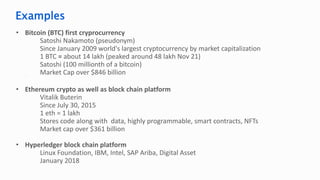
• Bitcoin (BTC) first cryprocurrency
Satoshi Nakamoto (pseudonym)
Since January 2009 world's largest cryptocurrency by market capitalization
1 BTC = about 14 lakh (peaked around 48 lakh Nov 21)
Satoshi (100 millionth of a bitcoin)
Market Cap over $846 billion
• US$48000
• Ethereum crypto as well as block chain platform
Vitalik Buterin
Since July 30, 2015
1 eth = 1 lakh
Stores code along with data, highly programmable, smart contracts, NFTs
Market cap over $361 billion
• Hyperledger block chain platform
Linux Foundation, IBM, Intel, SAP Ariba, Digital Asset
January 2018
Examples
Cryptocurrency – alternate
currencie(s)
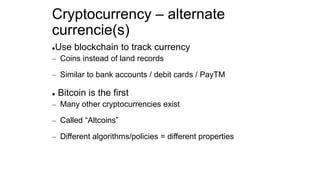
Use blockchain to track currency
– Coins instead of land records
– Similar to bank accounts / debit cards / PayTM
 Bitcoin is the first
– Many other cryptocurrencies exist
– Called “Altcoins”
– Different algorithms/policies = different properties
Cryptocurrency
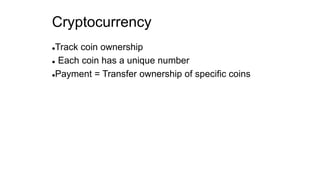
Track coin ownership
 Each coin has a unique number
Payment = Transfer ownership of specific coins
Cryptocurrency – Key
Features
Commissions for miners
– Per-block rewards (create new coins)
– Per-transaction commissions
 No central bank
– No monetary policy adjustments
– No controller, no monopoly
Cryptocurrency – Advantages
No single point of failure / attack
Tamper-proof
– Less fraud
– Reduce friction/risk
Counterfeit-proof
 Smart money
– Automation of complex business processes
Bitcoin
Bitcoin
New Coins Created in Every Block
New block every 10 minutes
Given to Block Creator
Initially, 50 coins per block
Halved Every 4 Years
Currently 6.25
Max: 21 million – then transaction fee
19 million already mined, last till 2140
Protocol Specifics
New blocks every 10 minutes
– Few hundred transactions per block
 Optional transaction fees
– Amount determined by miner
– Currently approx 13000 servers as predicted by many, 83k
(Jan 2021 -> 50k by one source
Price determined purely by supply and demand
– Also transaction fees
Programmable
Money
Bitcoin Scripting
Transactions allow simple if-then-else scripting
Default transaction:
allow transaction if signed by Julie
 Complex:
allow transaction if signed by any 2 out of Julie, Neha, and
Karan
Escrow
Julie wants to buy expensive camera from Neha
Uses Karan's escrow service
Create transaction:
allow transaction
if signed by any 2 out of Julie, Neha, and Karan
Escrow - Settlement
If camera received properly
– Julie signs transaction
– Neha signs transaction
– Money transferred to Neha
Conflict:
– Karan investigates
– Gives signature to Julie or Neha
– Who can withdraw money
Micropayments
Website wants to charge 0.01µɃ per page
Transaction per page too expensive
Solution: off-chain transactions
Micropayments – Initial Setup
Customer pays 20µɃ to Website
–Deposit
Website emails refund transaction
–Pay 20µɃ to Customer
–Not submitted to blockchain
Micropayments – Ongoing usage
After 1 page, website emails:
– Pay 19.99µɃ to Customer, 0.01µɃ to
Website
– Invalidates previous refund transaction
After 2 pages, website emails:
– Pay 19.98µɃ to Customer, 0.02µɃ to
Website
– Still not submitted to blockchain
Micropayments – Closing
account
After 364 page, website emails:
–Pay 16.36µɃ to Customer, 3.64µɃ
to Website
Customer submits to blockchain
364 “email” transactions
2 blockchain transactions
Lightning Network
Like micropayments, but bidirectional
Julie + Neha “channel”
Put 10µɃ each into joint signature account
Both signatures needed to withdraw
Lightning Network - Usage
Julie pays 1.23µɃ to Neha
Create transaction:
– Pay 11.23µɃ to Neha, 8.77µɃ to Julie
– Both sign
Neha pays 1.00µɃ to Julie
– Pay 10.23µɃ to Neha, 9.77µɃ to Julie
– Both sign
 Invalidating previous transaction
Lightning Network
Many point-to-point channels
TCP/IP style routing possible
Pocket transactions
over email
off block chain
put on block chain
for finalizing
in case of disputes
Smart Contracts
Blockchain + Code
Transactions can run a program
– Simple programs preferred
– if-then-else conditions
– Can specify future actions
– All miners run same code
Automatic, Guaranteed, and Tamper-proof
Proof-of-Work
Why?
Allows “random” picking of next server
Makes it “expensive” to create fake blocks
Also, provide incentives for server
Features
Hard to create
Easy to verify
Easy to adjust difficulty
Problems
Very compute intensive
Proof-of-Stake
Use “stakes” instead of CPU power
To determine probability of a server getting selected to
create next block
To save on CPU/electricity wastage
Usually “stake” is in terms of the coin itself
Deposit some coins ($40000) for a chance to get
selected as validator, done randomly, other validators
attest, threshold number of attesters required to update,
earn interest with rewarded coins
Hybrid schemes are common: Start with proof-of-work
and transition to proof-of-stake
Ethereum 2.0 uses Proof-of-Stake
AltCoins
Non-Bitcoin blockchains
Types:
Same as bitcoin, but different set of servers
Bitcoin code, but different config params
Similar to bitcoin, with some different features
Totally different
Example Altcoins
Ethereum
Allows Smart Contracts
Monero
Allows True Anonymity
LiteCoin
Like BitCoin, But Faster and Cheaper
• Gas : fee for computation
o Maximum gas limit (#computational steps)
o Price per unit : the more you pay, the faster you execute / priority
o Fails if exceeds gas limit (losing gas fee paid so far) : timeout
• Tokens (ERC-20): new cryptocurrencies
• With smart contract you can create your own crypto (4 line code)
• Non Fungible Token (NFT) ERC-721
o Each coin is different
• Initial Coin Offering (ICO)
o 60 million ether for about $18.3 million
o currently 122 million ether
o boomed in 2017
Ethereum
Beyond Ethereum
• 45 cryptocurrencies with billion+ market cap
• 10000+ crypto currencies
• prices vary from subcents to $20k
• 100+ more blockchains
• Blockchain Trilemma (like CAP theorem): 2 of
decentralization, security, scalability
• Both bitcoin and ethereum chose first two
• Layer 2 Lightening Network to make bitcoins scalable
• Bridge across independent blockchains
• Wormhole, Ethereum/Solana, hacked last year for $320 million
Security focus
• web -> web 2.0 -> Web3 about technology AND money
Cryptocurrency
Challenges
Legal Status – India
2018 RBI circular : not allowed to deal in crypto
2020 Supreme Court overruling
Nov 23, 2021 Lok Sabha Bulletin
Against private crypto, for underlying technology
No progress due to complexities involved
2022 bill : 30% tax on transfer
Some confusion:
– Owning cryptocurrency is not illegal, not legal tender
– Illegal to use it in “the payment system”
– Banks barred from dealing with cryptocurrency exchanges
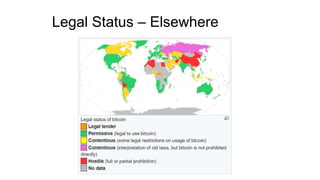
Legal Status – Elsewhere
Legal Status – Expected
Dance of regulators and innovators
Regulation inevitable
But blockchain too important to kill
IRS taxes it as property
Prediction: Regulated coexistence
– after years of fits and starts
– over-reactions and pullbacks
Crypto Questions
Helping black money/drug dealers?
– Not really: pseudonymity vs anonymity (silkroad was tracked by
FBI 7 years ago)
 Energy consumption
– Trade-off against business/social/trust problems
– Alternatives being developed e.g. PoS
 No real-world uses after 8 years
– Entire system needs to change
– Electric motor took 30 years
Summary
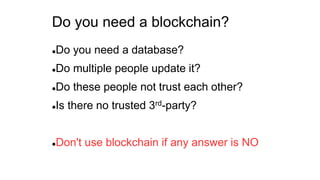
Do you need a blockchain?
Do you need a database?
Do multiple people update it?
Do these people not trust each other?
Is there no trusted 3rd-party?
Don't use blockchain if any answer is NO
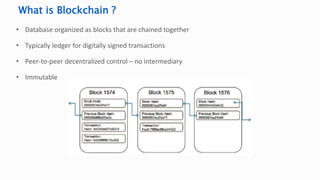
• Database organized as blocks that are chained together
• Typically ledger for digitally signed transactions
• Peer-to-peer decentralized control – no intermediary
• Immutable
What is Blockchain ?
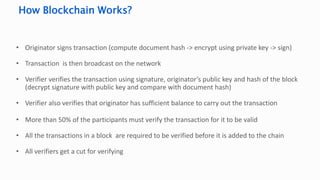
• Originator signs transaction (compute document hash -> encrypt using private key -> sign)
• Transaction is then broadcast on the network
• Verifier verifies the transaction using signature, originator’s public key and hash of the block
(decrypt signature with public key and compare with document hash)
• Verifier also verifies that originator has sufficient balance to carry out the transaction
• More than 50% of the participants must verify the transaction for it to be valid
• All the transactions in a block are required to be verified before it is added to the chain
• All verifiers get a cut for verifying
How Blockchain Works?
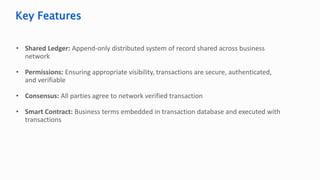
• Shared Ledger: Append-only distributed system of record shared across business
network
• Permissions: Ensuring appropriate visibility, transactions are secure, authenticated,
and verifiable
• Consensus: All parties agree to network verified transaction
• Smart Contract: Business terms embedded in transaction database and executed with
transactions
Key Features
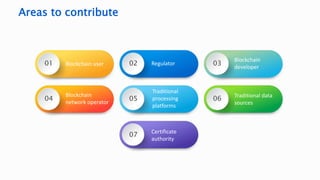
Areas to contribute
Blockchain
network operator
Blockchain user
01
04
Certificate
authority
Traditional
processing
platforms
Regulator
02
05
07
Traditional data
sources
Blockchain
developer
03
06
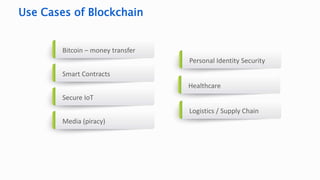
Use Cases of Blockchain
Personal Identity Security
Healthcare
Logistics / Supply Chain
Bitcoin – money transfer
Smart Contracts
Secure IoT
Media (piracy)

Crypto101.pptx

  • 1.
  • 2.
    • Bitcoin (BTC)first cryprocurrency Satoshi Nakamoto (pseudonym) Since January 2009 world's largest cryptocurrency by market capitalization 1 BTC = about 14 lakh (peaked around 48 lakh Nov 21) Satoshi (100 millionth of a bitcoin) Market Cap over $846 billion • US$48000 • Ethereum crypto as well as block chain platform Vitalik Buterin Since July 30, 2015 1 eth = 1 lakh Stores code along with data, highly programmable, smart contracts, NFTs Market cap over $361 billion • Hyperledger block chain platform Linux Foundation, IBM, Intel, SAP Ariba, Digital Asset January 2018 Examples
  • 3.
    Cryptocurrency – alternate currencie(s) Useblockchain to track currency – Coins instead of land records – Similar to bank accounts / debit cards / PayTM  Bitcoin is the first – Many other cryptocurrencies exist – Called “Altcoins” – Different algorithms/policies = different properties
  • 4.
    Cryptocurrency Track coin ownership Each coin has a unique number Payment = Transfer ownership of specific coins
  • 5.
    Cryptocurrency – Key Features Commissionsfor miners – Per-block rewards (create new coins) – Per-transaction commissions  No central bank – No monetary policy adjustments – No controller, no monopoly
  • 6.
    Cryptocurrency – Advantages Nosingle point of failure / attack Tamper-proof – Less fraud – Reduce friction/risk Counterfeit-proof  Smart money – Automation of complex business processes
  • 7.
  • 8.
    Bitcoin New Coins Createdin Every Block New block every 10 minutes Given to Block Creator Initially, 50 coins per block Halved Every 4 Years Currently 6.25 Max: 21 million – then transaction fee 19 million already mined, last till 2140
  • 9.
    Protocol Specifics New blocksevery 10 minutes – Few hundred transactions per block  Optional transaction fees – Amount determined by miner – Currently approx 13000 servers as predicted by many, 83k (Jan 2021 -> 50k by one source Price determined purely by supply and demand – Also transaction fees
  • 10.
  • 11.
    Bitcoin Scripting Transactions allowsimple if-then-else scripting Default transaction: allow transaction if signed by Julie  Complex: allow transaction if signed by any 2 out of Julie, Neha, and Karan
  • 12.
    Escrow Julie wants tobuy expensive camera from Neha Uses Karan's escrow service Create transaction: allow transaction if signed by any 2 out of Julie, Neha, and Karan
  • 13.
    Escrow - Settlement Ifcamera received properly – Julie signs transaction – Neha signs transaction – Money transferred to Neha Conflict: – Karan investigates – Gives signature to Julie or Neha – Who can withdraw money
  • 14.
    Micropayments Website wants tocharge 0.01µɃ per page Transaction per page too expensive Solution: off-chain transactions
  • 15.
    Micropayments – InitialSetup Customer pays 20µɃ to Website –Deposit Website emails refund transaction –Pay 20µɃ to Customer –Not submitted to blockchain
  • 16.
    Micropayments – Ongoingusage After 1 page, website emails: – Pay 19.99µɃ to Customer, 0.01µɃ to Website – Invalidates previous refund transaction After 2 pages, website emails: – Pay 19.98µɃ to Customer, 0.02µɃ to Website – Still not submitted to blockchain
  • 17.
    Micropayments – Closing account After364 page, website emails: –Pay 16.36µɃ to Customer, 3.64µɃ to Website Customer submits to blockchain 364 “email” transactions 2 blockchain transactions
  • 18.
    Lightning Network Like micropayments,but bidirectional Julie + Neha “channel” Put 10µɃ each into joint signature account Both signatures needed to withdraw
  • 19.
    Lightning Network -Usage Julie pays 1.23µɃ to Neha Create transaction: – Pay 11.23µɃ to Neha, 8.77µɃ to Julie – Both sign Neha pays 1.00µɃ to Julie – Pay 10.23µɃ to Neha, 9.77µɃ to Julie – Both sign  Invalidating previous transaction
  • 20.
    Lightning Network Many point-to-pointchannels TCP/IP style routing possible Pocket transactions over email off block chain put on block chain for finalizing in case of disputes
  • 21.
    Smart Contracts Blockchain +Code Transactions can run a program – Simple programs preferred – if-then-else conditions – Can specify future actions – All miners run same code Automatic, Guaranteed, and Tamper-proof
  • 22.
    Proof-of-Work Why? Allows “random” pickingof next server Makes it “expensive” to create fake blocks Also, provide incentives for server Features Hard to create Easy to verify Easy to adjust difficulty Problems Very compute intensive
  • 23.
    Proof-of-Stake Use “stakes” insteadof CPU power To determine probability of a server getting selected to create next block To save on CPU/electricity wastage Usually “stake” is in terms of the coin itself Deposit some coins ($40000) for a chance to get selected as validator, done randomly, other validators attest, threshold number of attesters required to update, earn interest with rewarded coins Hybrid schemes are common: Start with proof-of-work and transition to proof-of-stake Ethereum 2.0 uses Proof-of-Stake
  • 24.
    AltCoins Non-Bitcoin blockchains Types: Same asbitcoin, but different set of servers Bitcoin code, but different config params Similar to bitcoin, with some different features Totally different
  • 25.
    Example Altcoins Ethereum Allows SmartContracts Monero Allows True Anonymity LiteCoin Like BitCoin, But Faster and Cheaper
  • 26.
    • Gas :fee for computation o Maximum gas limit (#computational steps) o Price per unit : the more you pay, the faster you execute / priority o Fails if exceeds gas limit (losing gas fee paid so far) : timeout • Tokens (ERC-20): new cryptocurrencies • With smart contract you can create your own crypto (4 line code) • Non Fungible Token (NFT) ERC-721 o Each coin is different • Initial Coin Offering (ICO) o 60 million ether for about $18.3 million o currently 122 million ether o boomed in 2017 Ethereum
  • 27.
    Beyond Ethereum • 45cryptocurrencies with billion+ market cap • 10000+ crypto currencies • prices vary from subcents to $20k • 100+ more blockchains • Blockchain Trilemma (like CAP theorem): 2 of decentralization, security, scalability • Both bitcoin and ethereum chose first two • Layer 2 Lightening Network to make bitcoins scalable • Bridge across independent blockchains • Wormhole, Ethereum/Solana, hacked last year for $320 million Security focus • web -> web 2.0 -> Web3 about technology AND money
  • 28.
  • 29.
    Legal Status –India 2018 RBI circular : not allowed to deal in crypto 2020 Supreme Court overruling Nov 23, 2021 Lok Sabha Bulletin Against private crypto, for underlying technology No progress due to complexities involved 2022 bill : 30% tax on transfer Some confusion: – Owning cryptocurrency is not illegal, not legal tender – Illegal to use it in “the payment system” – Banks barred from dealing with cryptocurrency exchanges
  • 30.
  • 31.
    Legal Status –Expected Dance of regulators and innovators Regulation inevitable But blockchain too important to kill IRS taxes it as property Prediction: Regulated coexistence – after years of fits and starts – over-reactions and pullbacks
  • 32.
    Crypto Questions Helping blackmoney/drug dealers? – Not really: pseudonymity vs anonymity (silkroad was tracked by FBI 7 years ago)  Energy consumption – Trade-off against business/social/trust problems – Alternatives being developed e.g. PoS  No real-world uses after 8 years – Entire system needs to change – Electric motor took 30 years
  • 33.
  • 34.
    Do you needa blockchain? Do you need a database? Do multiple people update it? Do these people not trust each other? Is there no trusted 3rd-party? Don't use blockchain if any answer is NO
  • 35.
    • Database organizedas blocks that are chained together • Typically ledger for digitally signed transactions • Peer-to-peer decentralized control – no intermediary • Immutable What is Blockchain ?
  • 36.
    • Originator signstransaction (compute document hash -> encrypt using private key -> sign) • Transaction is then broadcast on the network • Verifier verifies the transaction using signature, originator’s public key and hash of the block (decrypt signature with public key and compare with document hash) • Verifier also verifies that originator has sufficient balance to carry out the transaction • More than 50% of the participants must verify the transaction for it to be valid • All the transactions in a block are required to be verified before it is added to the chain • All verifiers get a cut for verifying How Blockchain Works?
  • 37.
    • Shared Ledger:Append-only distributed system of record shared across business network • Permissions: Ensuring appropriate visibility, transactions are secure, authenticated, and verifiable • Consensus: All parties agree to network verified transaction • Smart Contract: Business terms embedded in transaction database and executed with transactions Key Features
  • 38.
    Areas to contribute Blockchain networkoperator Blockchain user 01 04 Certificate authority Traditional processing platforms Regulator 02 05 07 Traditional data sources Blockchain developer 03 06
  • 39.
    Use Cases ofBlockchain Personal Identity Security Healthcare Logistics / Supply Chain Bitcoin – money transfer Smart Contracts Secure IoT Media (piracy)