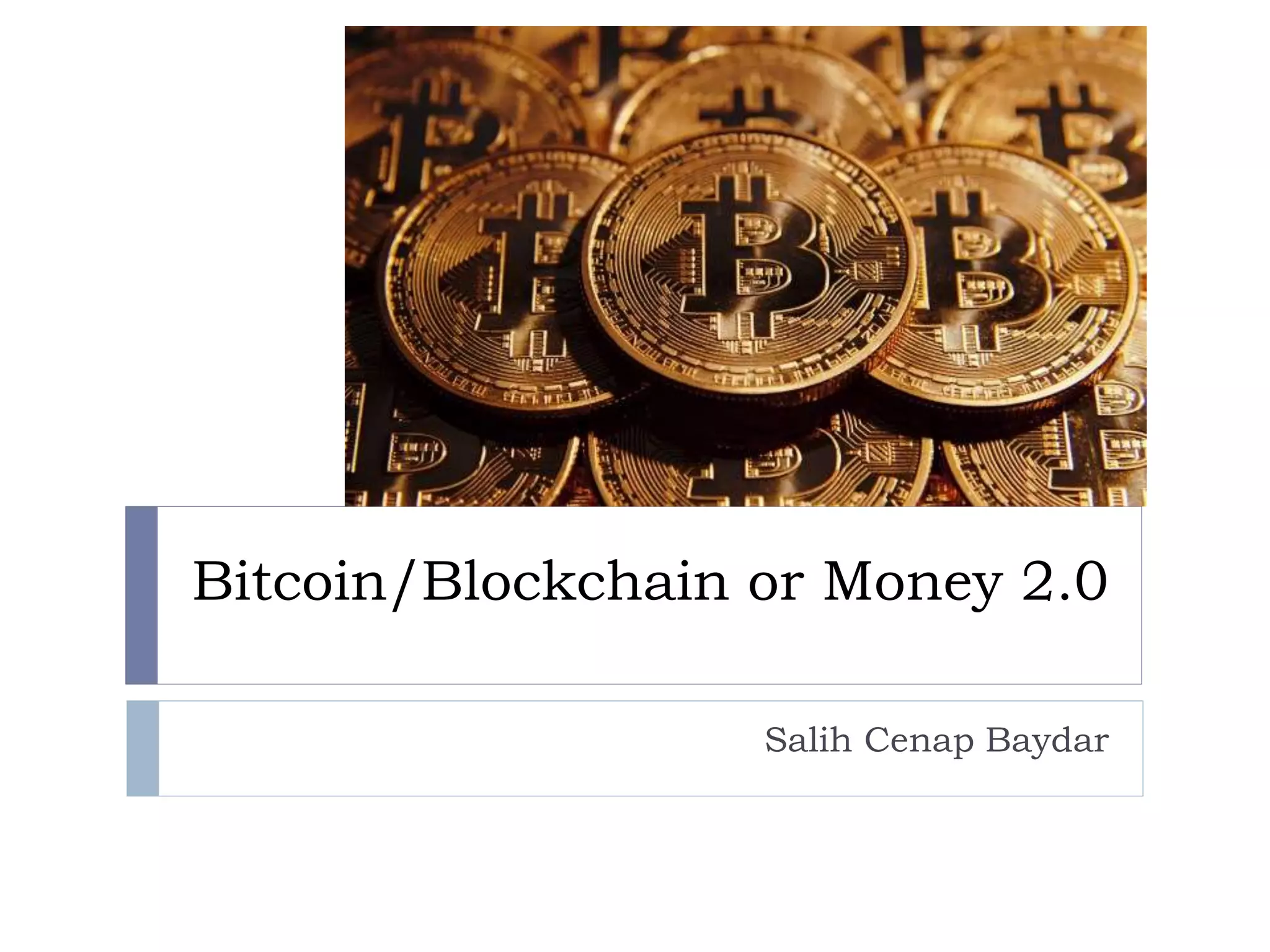
Bitcoin/Blockchain or Money 2.0
Salih Cenap Baydar
Dystopia of ultimate monopoly!...
 Every moment, power is accumulating more and more in
the hands of a minority of elites.
 Fifteen banks manage more than 60 percent of the
world's financial assets.
 Fifteen telecoms run more than 60 percent of the world's
phone calls.
 Ten insurers issue over 60 percent of the world's
life/health policies and influence most health-care
decisions.
 Ten media giants control over 75 percent of the world's
media assets.
 Four central banks control 75 percent of the world's
money supply.
Can «decentralisation» be the answer?
 Can we find a way to provide same services in a
decentralised setting?
 In a decentralized system, it might be possible to
design an application similar to today’s centralised
systems that doesn’t use central servers and control.
It might be possible to store data on anyone’s
computer who wants to store it. These do not need
to be volunteers — they can be paid for the
computing power they provide. Since thousands of
computers will have a copy, no “bad actors” can
disrupt it.
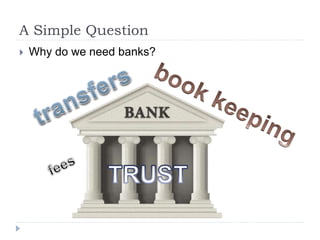
A Simple Question
 Why do we need banks?
Innovation knocking on the door
 Thanks to new technological advancements, it is now
possible to,
 Eliminate trillions of dollars of wasted effort in coordination
 Record data - including ownership rights to anything of value -
permanently, in a way that can't be hacked or stolen.
 Eliminate middle men - companies that bring buyers and sellers
together and charge high fees (everything from banks to
insurance companies)
 Eliminate data centers, which are bare targets for hackers.
 Eliminate IT departments, which are expensive, sluggish, and
prevent companies from being agile.
 Radically transform government services to be far cheaper,
faster, and better.
 Escape the terrible surveilance of the «big brother»
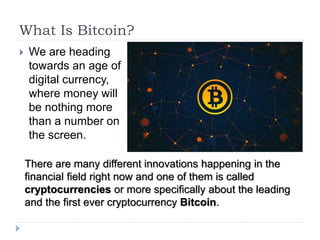
What Is Bitcoin?
 We are heading
towards an age of
digital currency,
where money will
be nothing more
than a number on
the screen.
There are many different innovations happening in the
financial field right now and one of them is called
cryptocurrencies or more specifically about the leading
and the first ever cryptocurrency Bitcoin.
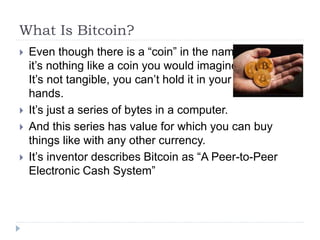
What Is Bitcoin?
 Even though there is a “coin” in the name
it’s nothing like a coin you would imagine.
It’s not tangible, you can’t hold it in your
hands.
 It’s just a series of bytes in a computer.
 And this series has value for which you can buy
things like with any other currency.
 It’s inventor describes Bitcoin as “A Peer-to-Peer
Electronic Cash System”
What is Bitcoin?
 Bitcoin is digital cash,
 Bitcoin is cryptocurrency,
 Bitcoin is an international payment network,
 Bitcoin is the money of internet
 Bitcoin is a revolution that is changing the way
everyone sees and uses money.
 Bitcoin is a virtual currency that is created from
computer code.
 Bitcoin is a currency that has no central bank and is
not backed by any government.
Who is behind this bitcoin thing?
 Satoshi Nakamoto, a secretive internet
user, invented bitcoin in 2008 before
it went online in 2009.
 Many attempts to identify Satoshi have
been made without conclusive proof
 He is known as a secretive genius who develops a
technology that changes the world,
 An unknown person who develops a cult-like following
and becomes fabulously wealthy in the process, without
a soul knowing who he, or she, is.
 An Australian computer scientist named Craig Wright,
claimed he was Satoshi in May 2016. Wright presented
his apparent proof to the some journalists and two
experts but he was not able to convince the community!
Mysterious Satoshi Nakamoto
 The original Bitcoin code was designed by Satoshi
Nakamoto under MIT open source credentials. In
2008 Nakamoto outlined the idea behind Bitcoin in
his White Paper -in a mail list about cryptography-
which scientifically described how the cryptocurrency
would function. Bitcoin is the first successful digital
currency designed with trust in cryptography over
central authorities. Satoshi left the Bitcoin code in
the hands of developers and the community in 2010.
Thus far hundreds of developers have added to the
core code throughout the years.
What is blockchain?
 Blockchain is the technology that
bitcoin is built on
 A blockchain is a shared ledger that
everyone trusts to be accurate
forever.
 What’s a ledger?
It’s a record of transactions.
That’s it. That’s the “one simple trick” for changing
the world completely, from top-down hierarchical
institutions to autonomy, freedom, and self-
determination.
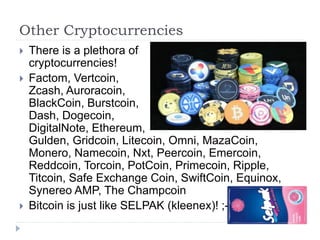
Other Cryptocurrencies
 There is a plethora of
cryptocurrencies!
 Factom, Vertcoin,
Zcash, Auroracoin,
BlackCoin, Burstcoin,
Dash, Dogecoin,
DigitalNote, Ethereum,
Gulden, Gridcoin, Litecoin, Omni, MazaCoin,
Monero, Namecoin, Nxt, Peercoin, Emercoin,
Reddcoin, Torcoin, PotCoin, Primecoin, Ripple,
Titcoin, Safe Exchange Coin, SwiftCoin, Equinox,
Synereo AMP, The Champcoin
 Bitcoin is just like SELPAK (kleenex)! ;-)
How does it work?
How does it work?
 Bockchain is simply a vast, distributed public ledger of account.
 It keeps track of every transaction ever made in the network, and all
transactions are timestamped and verified by network miners.
 This is how it works: miners with specialized computers compete to
solve mathematical puzzles with other computers, and once they
solve a puzzle they are awarded with some Bitcoin, but they also add
a “block” of completed transactions to the blockchain for future
viewing and verifiability.
 Once a block is added to the chain the cycle repeats itself, and the
computers continue to compete to solve these difficult problems.
 Every transaction on the blockchain is completely transparent and
accounted for in its log.
 Anyone can see the public keys of any transaction they want
(although there are no names associated with transactions).
 One could go all the way back and view the very first transactions
ever made on the first block ever created. This block was unironically
called the Genesis Block. (referring the Bible)
What is bitcoin mining?
 To keep the bitcoin economy going computers have
to process all the transactions and update the
blockchain consistently. In other words, for the
bitcoin to work computers need to «evaluate» every
single transaction happening.
 Obviously, no one wants to work for free so,
for processing all the transactions,
people (miners) are getting rewarded
with bitcoins.
What is bitcoin mining?
 When the bitcoin was at its early stage this
evaluation was done by regular computers. People
were incentivized to mine because they get the fees
from the transactions that were made and 25 bitcoin
as a reward.
 With todays prices that would mean you would get
$40.000 + for computing a single block!
 Now, as the bitcoin grew, the system made the
calculation of these blocks harder and harder
by design. Where it got to a point where
regular computers would need to work
years just to solve a single block.
What is bitcoin mining?
 So, technologies like AntMiners emerged that were
specifically made to work with the bitcoin hashing
algorithm which is called SHA-256.
 These days, even those miners aren’t too profitable
and there are servers being built for that purpose
alone because it’s cheaper to mine at bulk and in
places where electricity prices are the lowest.
 Unfortunately, for a regular user,
it isn’t profitable to mine
bitcoin anymore.
What are mining pools?
 It takes a ton of computing power to calculate a
single block.
 The time it takes to compute a block is equal to the
bitcoin transaction time. So, it’s necessary for a block
to be calculated quickly.
 This is done by mining pools.
 People, usually server owners, join
mining pools where they divide the work
and also divide the rewards.
 This makes it possible even for the
smallest miners to join.
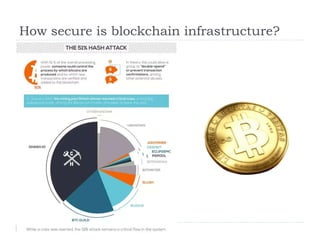
How secure is blockchain infrastructure?
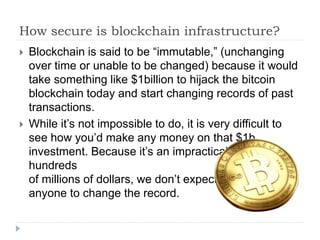
 Blockchain is said to be “immutable,” (unchanging
over time or unable to be changed) because it would
take something like $1billion to hijack the bitcoin
blockchain today and start changing records of past
transactions.
 While it’s not impossible to do, it is very difficult to
see how you’d make any money on that $1b
investment. Because it’s an impractical use of
hundreds
of millions of dollars, we don’t expect
anyone to change the record.
How secure is blockchain infrastructure?
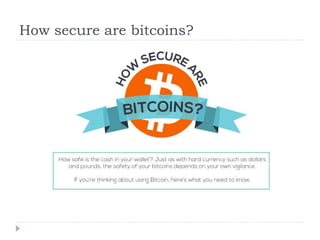
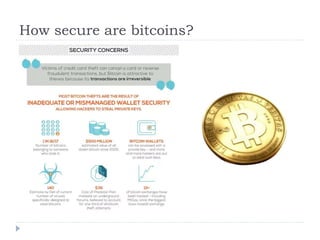
How secure are bitcoins?
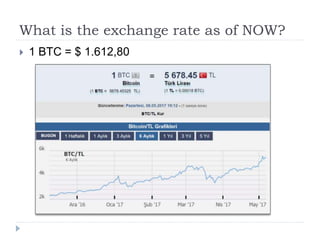
What is the exchange rate as of NOW?
 1 BTC = $ 1.612,80
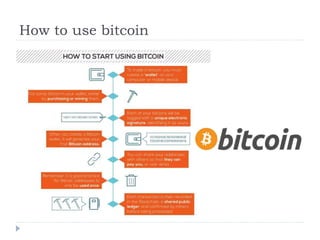
How to use bitcoin
What is a bitcoin wallet?
 Bitcoin wallet is an application that stores, sends and
receives bitcoins. You can think of it like you would a
leather wallet full of physical cash, and basically that’s all
you need to use Bitcoin.
 The most common wallets are smartphone-based, and
use the device’s camera to scan QR codes to save the
user from needing to copy/paste long Bitcoin addresses.
 Other people have desktop versions or use browser-
based wallets.
 To the end user the interface is similar, though the way
they function and handle private keys (the ‘key’ which
allow you to spend your bitcoins) and user privacy can be
very different.
Types of bitcoin wallets
 The most important distinction among diffrent wallet
types is in relation to who is in control of the private keys
required to spend the bitcoins.
 Some Bitcoin “wallets” actually act more like banks
because they are holding the user’s private keys on
behalf. If you choose to use one of these services, be
aware that you are completely at their mercy regarding
the security of your bitcoins.
 Most wallets, however, allow the user to be in charge of
their own private keys. This means that no one in the
entire world can access your account without your
permission. It also means that no one can help you if you
forget your password or otherwise lose access to your
private keys.
Be careful: Bitcoin price is volatile!
 The price of a bitcoin can unpredictably increase or
decrease over a short period of time due to its young
economy, novel nature, and sometimes illiquid
markets. Consequently, keeping your savings with
Bitcoin is not recommended at this point. Bitcoin
should be seen like a high risk asset, and you should
never store money that you cannot afford to lose
with Bitcoin. If you receive payments with Bitcoin,
many service providers can convert them to your
local currency.
Bitcoin payments are irreversible
 Any transaction issued with Bitcoin cannot be
reversed, they can only be refunded by the person
receiving the funds. That means you should take
care to do business with people and organizations
you know and trust, or who have an established
reputation. For their part, businesses need to keep
control of the payment requests they are displaying
to their customers.
 Bitcoin can detect typos and usually won't let you
send money to an invalid address by mistake.
Bitcoin transactions are not anonymous!
 All Bitcoin transactions are stored publicly and
permanently on the network, which means anyone
can see the balance and transactions of any Bitcoin
address. However, the identity of the user behind
an address remains unknown until information is
revealed during a purchase or in other
circumstances. This is one reason why Bitcoin
addresses should only be used once. It should
always be remembered that it is users responsibility
to adopt good practices in order to protect his/her
privacy.
Unconfirmed transactions aren't secure
Confirmations Lightweight wallets Bitcoin Core
0 Only safe if you trust the person paying you
1 Somewhat reliable Mostly reliable
3 Mostly reliable Highly reliable
6 Minimum recommendation for high-value bitcoin transfers
30 Recommendation during emergencies to allow human intervention
Transactions don't start out as irreversible.
Instead, they get a confirmation score that indicates
how hard it is to reverse them (see table).
Each confirmation takes between a few seconds and 90 minutes,
with 10 minutes being the average.
If the transaction pays too low a fee or is otherwise atypical,
getting the first confirmation can take much longer.
In conclusion…
 I believe,
 Blockchain technology will definitely reshape the world.
 The volatility of cryprocurrencies will settle down
eventually.
 Decentralization is the key for a free tomorrow
 The community will take care of todays vulnerabilities
 Strong governments will try to control & manipulate all
kinds of distrubuted and decentralised networks. If they
fail to do accomplish that they will try to destroy them.
 We should study, understand and contribute to the efforts
on decentralised networks as a developing country.
Thanks for listening…
Resources for further research
 https://www.taylorwessing.com/download/article-how-secure-is-block-chain.html
 http://www.decentralstation.com/
 https://www.bitcoin.com/guides
 http://www.telegraph.co.uk/technology/2016/05/08/satoshi-nakamoto-whoever-that-is-will-not-rescue-bitcoin/
 https://2030.io/
 https://www.bitcoin.com/guides/how-to-choose-the-right-bitcoin-wallet
 https://www.mindmeister.com/694609910/bitcoin-blockchain
 http://easym6.com/2017/01/26/all-you-need-to-know-about-bitcoin/
 http://economictimes.indiatimes.com/magazines/panache/bitcoin-heres-all-that-you-need-to-know-about-the-virtual-
currency/articleshow/56369446.cms
 https://www.bitcoin.com/is-bitcoin-real-money
 https://www.bitcoin.com/faq
 https://www.bitcoin.com/you-need-to-know
 https://www.youtube.com/watch?v=YIVAluSL9SU
 https://www.youtube.com/watch?v=93E_GzvpMA0
 https://www.bitcoinmining.com/
 http://www.rd.com/culture/what-is-bitcoin/
 https://www.wired.com/2013/11/bitcoin-survival-guide/
 https://bitcoinmagazine.com/articles/chinas-blockchain-invasion/
 https://steemit.com/bitcoin/@mohamedhayibor/intro-to-bitcoin-mindmap
 http://unmitigatedrisk.com/wp-content/uploads/2014/05/Bitcoin-Attacker-Capabilities-and-Motivations1.png

Bitcoin on Blockchain: Money 2.0

  • 1.
    Bitcoin/Blockchain or Money2.0 Salih Cenap Baydar
  • 2.
    Dystopia of ultimatemonopoly!...  Every moment, power is accumulating more and more in the hands of a minority of elites.  Fifteen banks manage more than 60 percent of the world's financial assets.  Fifteen telecoms run more than 60 percent of the world's phone calls.  Ten insurers issue over 60 percent of the world's life/health policies and influence most health-care decisions.  Ten media giants control over 75 percent of the world's media assets.  Four central banks control 75 percent of the world's money supply.
  • 3.
    Can «decentralisation» bethe answer?  Can we find a way to provide same services in a decentralised setting?  In a decentralized system, it might be possible to design an application similar to today’s centralised systems that doesn’t use central servers and control. It might be possible to store data on anyone’s computer who wants to store it. These do not need to be volunteers — they can be paid for the computing power they provide. Since thousands of computers will have a copy, no “bad actors” can disrupt it.
  • 4.
    A Simple Question Why do we need banks?
  • 5.
    Innovation knocking onthe door  Thanks to new technological advancements, it is now possible to,  Eliminate trillions of dollars of wasted effort in coordination  Record data - including ownership rights to anything of value - permanently, in a way that can't be hacked or stolen.  Eliminate middle men - companies that bring buyers and sellers together and charge high fees (everything from banks to insurance companies)  Eliminate data centers, which are bare targets for hackers.  Eliminate IT departments, which are expensive, sluggish, and prevent companies from being agile.  Radically transform government services to be far cheaper, faster, and better.  Escape the terrible surveilance of the «big brother»
  • 6.
    What Is Bitcoin? We are heading towards an age of digital currency, where money will be nothing more than a number on the screen. There are many different innovations happening in the financial field right now and one of them is called cryptocurrencies or more specifically about the leading and the first ever cryptocurrency Bitcoin.
  • 7.
    What Is Bitcoin? Even though there is a “coin” in the name it’s nothing like a coin you would imagine. It’s not tangible, you can’t hold it in your hands.  It’s just a series of bytes in a computer.  And this series has value for which you can buy things like with any other currency.  It’s inventor describes Bitcoin as “A Peer-to-Peer Electronic Cash System”
  • 8.
    What is Bitcoin? Bitcoin is digital cash,  Bitcoin is cryptocurrency,  Bitcoin is an international payment network,  Bitcoin is the money of internet  Bitcoin is a revolution that is changing the way everyone sees and uses money.  Bitcoin is a virtual currency that is created from computer code.  Bitcoin is a currency that has no central bank and is not backed by any government.
  • 9.
    Who is behindthis bitcoin thing?  Satoshi Nakamoto, a secretive internet user, invented bitcoin in 2008 before it went online in 2009.  Many attempts to identify Satoshi have been made without conclusive proof  He is known as a secretive genius who develops a technology that changes the world,  An unknown person who develops a cult-like following and becomes fabulously wealthy in the process, without a soul knowing who he, or she, is.  An Australian computer scientist named Craig Wright, claimed he was Satoshi in May 2016. Wright presented his apparent proof to the some journalists and two experts but he was not able to convince the community!
  • 10.
    Mysterious Satoshi Nakamoto The original Bitcoin code was designed by Satoshi Nakamoto under MIT open source credentials. In 2008 Nakamoto outlined the idea behind Bitcoin in his White Paper -in a mail list about cryptography- which scientifically described how the cryptocurrency would function. Bitcoin is the first successful digital currency designed with trust in cryptography over central authorities. Satoshi left the Bitcoin code in the hands of developers and the community in 2010. Thus far hundreds of developers have added to the core code throughout the years.
  • 11.
    What is blockchain? Blockchain is the technology that bitcoin is built on  A blockchain is a shared ledger that everyone trusts to be accurate forever.  What’s a ledger? It’s a record of transactions. That’s it. That’s the “one simple trick” for changing the world completely, from top-down hierarchical institutions to autonomy, freedom, and self- determination.
  • 12.
    Other Cryptocurrencies  Thereis a plethora of cryptocurrencies!  Factom, Vertcoin, Zcash, Auroracoin, BlackCoin, Burstcoin, Dash, Dogecoin, DigitalNote, Ethereum, Gulden, Gridcoin, Litecoin, Omni, MazaCoin, Monero, Namecoin, Nxt, Peercoin, Emercoin, Reddcoin, Torcoin, PotCoin, Primecoin, Ripple, Titcoin, Safe Exchange Coin, SwiftCoin, Equinox, Synereo AMP, The Champcoin  Bitcoin is just like SELPAK (kleenex)! ;-)
  • 13.
  • 14.
    How does itwork?  Bockchain is simply a vast, distributed public ledger of account.  It keeps track of every transaction ever made in the network, and all transactions are timestamped and verified by network miners.  This is how it works: miners with specialized computers compete to solve mathematical puzzles with other computers, and once they solve a puzzle they are awarded with some Bitcoin, but they also add a “block” of completed transactions to the blockchain for future viewing and verifiability.  Once a block is added to the chain the cycle repeats itself, and the computers continue to compete to solve these difficult problems.  Every transaction on the blockchain is completely transparent and accounted for in its log.  Anyone can see the public keys of any transaction they want (although there are no names associated with transactions).  One could go all the way back and view the very first transactions ever made on the first block ever created. This block was unironically called the Genesis Block. (referring the Bible)
  • 15.
    What is bitcoinmining?  To keep the bitcoin economy going computers have to process all the transactions and update the blockchain consistently. In other words, for the bitcoin to work computers need to «evaluate» every single transaction happening.  Obviously, no one wants to work for free so, for processing all the transactions, people (miners) are getting rewarded with bitcoins.
  • 16.
    What is bitcoinmining?  When the bitcoin was at its early stage this evaluation was done by regular computers. People were incentivized to mine because they get the fees from the transactions that were made and 25 bitcoin as a reward.  With todays prices that would mean you would get $40.000 + for computing a single block!  Now, as the bitcoin grew, the system made the calculation of these blocks harder and harder by design. Where it got to a point where regular computers would need to work years just to solve a single block.
  • 17.
    What is bitcoinmining?  So, technologies like AntMiners emerged that were specifically made to work with the bitcoin hashing algorithm which is called SHA-256.  These days, even those miners aren’t too profitable and there are servers being built for that purpose alone because it’s cheaper to mine at bulk and in places where electricity prices are the lowest.  Unfortunately, for a regular user, it isn’t profitable to mine bitcoin anymore.
  • 18.
    What are miningpools?  It takes a ton of computing power to calculate a single block.  The time it takes to compute a block is equal to the bitcoin transaction time. So, it’s necessary for a block to be calculated quickly.  This is done by mining pools.  People, usually server owners, join mining pools where they divide the work and also divide the rewards.  This makes it possible even for the smallest miners to join.
  • 19.
    How secure isblockchain infrastructure?  Blockchain is said to be “immutable,” (unchanging over time or unable to be changed) because it would take something like $1billion to hijack the bitcoin blockchain today and start changing records of past transactions.  While it’s not impossible to do, it is very difficult to see how you’d make any money on that $1b investment. Because it’s an impractical use of hundreds of millions of dollars, we don’t expect anyone to change the record.
  • 20.
    How secure isblockchain infrastructure?
  • 21.
    How secure arebitcoins?
  • 22.
    How secure arebitcoins?
  • 23.
    What is theexchange rate as of NOW?  1 BTC = $ 1.612,80
  • 24.
    How to usebitcoin
  • 25.
    What is abitcoin wallet?  Bitcoin wallet is an application that stores, sends and receives bitcoins. You can think of it like you would a leather wallet full of physical cash, and basically that’s all you need to use Bitcoin.  The most common wallets are smartphone-based, and use the device’s camera to scan QR codes to save the user from needing to copy/paste long Bitcoin addresses.  Other people have desktop versions or use browser- based wallets.  To the end user the interface is similar, though the way they function and handle private keys (the ‘key’ which allow you to spend your bitcoins) and user privacy can be very different.
  • 26.
    Types of bitcoinwallets  The most important distinction among diffrent wallet types is in relation to who is in control of the private keys required to spend the bitcoins.  Some Bitcoin “wallets” actually act more like banks because they are holding the user’s private keys on behalf. If you choose to use one of these services, be aware that you are completely at their mercy regarding the security of your bitcoins.  Most wallets, however, allow the user to be in charge of their own private keys. This means that no one in the entire world can access your account without your permission. It also means that no one can help you if you forget your password or otherwise lose access to your private keys.
  • 27.
    Be careful: Bitcoinprice is volatile!  The price of a bitcoin can unpredictably increase or decrease over a short period of time due to its young economy, novel nature, and sometimes illiquid markets. Consequently, keeping your savings with Bitcoin is not recommended at this point. Bitcoin should be seen like a high risk asset, and you should never store money that you cannot afford to lose with Bitcoin. If you receive payments with Bitcoin, many service providers can convert them to your local currency.
  • 28.
    Bitcoin payments areirreversible  Any transaction issued with Bitcoin cannot be reversed, they can only be refunded by the person receiving the funds. That means you should take care to do business with people and organizations you know and trust, or who have an established reputation. For their part, businesses need to keep control of the payment requests they are displaying to their customers.  Bitcoin can detect typos and usually won't let you send money to an invalid address by mistake.
  • 29.
    Bitcoin transactions arenot anonymous!  All Bitcoin transactions are stored publicly and permanently on the network, which means anyone can see the balance and transactions of any Bitcoin address. However, the identity of the user behind an address remains unknown until information is revealed during a purchase or in other circumstances. This is one reason why Bitcoin addresses should only be used once. It should always be remembered that it is users responsibility to adopt good practices in order to protect his/her privacy.
  • 30.
    Unconfirmed transactions aren'tsecure Confirmations Lightweight wallets Bitcoin Core 0 Only safe if you trust the person paying you 1 Somewhat reliable Mostly reliable 3 Mostly reliable Highly reliable 6 Minimum recommendation for high-value bitcoin transfers 30 Recommendation during emergencies to allow human intervention Transactions don't start out as irreversible. Instead, they get a confirmation score that indicates how hard it is to reverse them (see table). Each confirmation takes between a few seconds and 90 minutes, with 10 minutes being the average. If the transaction pays too low a fee or is otherwise atypical, getting the first confirmation can take much longer.
  • 31.
    In conclusion…  Ibelieve,  Blockchain technology will definitely reshape the world.  The volatility of cryprocurrencies will settle down eventually.  Decentralization is the key for a free tomorrow  The community will take care of todays vulnerabilities  Strong governments will try to control & manipulate all kinds of distrubuted and decentralised networks. If they fail to do accomplish that they will try to destroy them.  We should study, understand and contribute to the efforts on decentralised networks as a developing country.
  • 32.
  • 33.
    Resources for furtherresearch  https://www.taylorwessing.com/download/article-how-secure-is-block-chain.html  http://www.decentralstation.com/  https://www.bitcoin.com/guides  http://www.telegraph.co.uk/technology/2016/05/08/satoshi-nakamoto-whoever-that-is-will-not-rescue-bitcoin/  https://2030.io/  https://www.bitcoin.com/guides/how-to-choose-the-right-bitcoin-wallet  https://www.mindmeister.com/694609910/bitcoin-blockchain  http://easym6.com/2017/01/26/all-you-need-to-know-about-bitcoin/  http://economictimes.indiatimes.com/magazines/panache/bitcoin-heres-all-that-you-need-to-know-about-the-virtual- currency/articleshow/56369446.cms  https://www.bitcoin.com/is-bitcoin-real-money  https://www.bitcoin.com/faq  https://www.bitcoin.com/you-need-to-know  https://www.youtube.com/watch?v=YIVAluSL9SU  https://www.youtube.com/watch?v=93E_GzvpMA0  https://www.bitcoinmining.com/  http://www.rd.com/culture/what-is-bitcoin/  https://www.wired.com/2013/11/bitcoin-survival-guide/  https://bitcoinmagazine.com/articles/chinas-blockchain-invasion/  https://steemit.com/bitcoin/@mohamedhayibor/intro-to-bitcoin-mindmap  http://unmitigatedrisk.com/wp-content/uploads/2014/05/Bitcoin-Attacker-Capabilities-and-Motivations1.png