Bioprocess
Instrumentation Project
Concurrent Alcohol Recovery and Fermentation (CARAF)
Using Pass-through Distillation
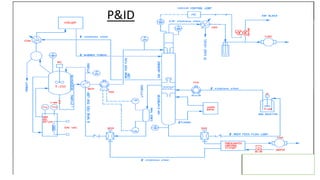
P&ID
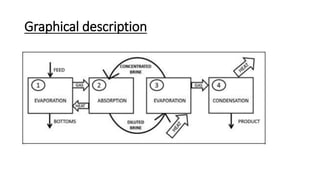
Graphical description
Written overview
Steps:
Block-1: Here, fermentation broth (Feed) from bioreactor is brought into
the block 1 (Evaporation chamber; distillation unit) where ethanol and
water gets evaporated (In form of gas) and from there it travels to the
absorption chamber (Block 2). Here the feed cycle is continuous
throughout the process.
Block-2: The gas (Containing Ethanol) gets absorbed by absorbing fluid
(Concentrated Brine solution) which enters into the block-2 from block-3.
Once ethanol got absorbed, these brine solution gets diluted and return
back to block-3. This process is continuous throughout the process.
Block-3: The diluted brine (Which has absorbed ethanol) enters in this
block, where heat is applied for ethanol vaporization and this ethanol
vapour gets entry into block-4 (condenser)
Block-4: Here the ethanol gets condensed which is our desired product.
Conclusion:
This process is low-energy, Low-temperature separation technique, cost
effective & environmental friendly when compared with conventional
methodologies. Reason being, vacuum (30 Torr) is used which brings
down the boiling point of ethanol (From 80 to 30 0 C). Secondly, this
whole process is continuous when it comes to Feed input, absorption
fluid and applied heat (This makes this whole process an excellent
example of lean production). Thus, we hence proved this process as an
excellent step in industrial biotechnology revolution.
Actuators
Different types of actuators involved in this process
along with their functions are as follows: (What, why,
where)
- Pressure control valve (PCV-0300): Controlling the
vacuum pressure in the system by regulating air
- Agitator (AG-1,2): Used for mixing the process fluid
- Solenoid valve (SV-101): Used to regulate diaphragm
pump
- Diaphragm pump (D-100, D-200): Controls the process
fluid (Fluid of bioreactor) and brine coming out of
distillation unit.
- Valve (V-400): Controls flow od brine
- Pump (P-101): It’s a peristaltic pump which regulates
flow of bioreactor fluid and brine into distillation unit.
- Vacuum pump (V-300, V-100): Creates/generate
vacuum inside the performing system.
- Condenser (C-100, C-202): Condense the ethanol
vapour
Sensors
Types of sensors used in this process are as
follows:
Temperature sensor (TT201, TT202, TT203, TT101, TT300):
T201: Measure temperature of Tank-200 (Which has brine
solution)
T202: Measure temperature of the returning feed (Coming
from the distillation unit)
T203: Measures temperature of the brine going into the
distillation unit
T101: Measures temperature of the fluid coming out of
distillation unit and going toward the bioreactor (T100)
T300: Measure the temperature of the distillation unit.
Pressure sensor (PP300): Measures the pressure of the
distillation unit
Level sensor (LSH, LSL): Regulates the level on brine (Which
already has absorbed the ethanol) in the surge tank
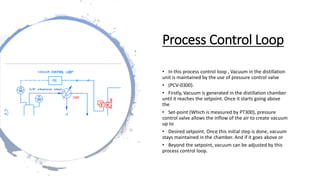
Process Control Loop
• In this process control loop , Vacuum in the distillation
unit is maintained by the use of pressure control valve
• (PCV-0300).
• Firstly, Vacuum is generated in the distillation chamber
until it reaches the setpoint. Once it starts going above
the
• Set-point (Which is measured by PT300), pressure
control valve allows the inflow of the air to create vacuum
up to
• Desired setpoint. Once this initial step is done, vacuum
stays maintained in the chamber. And if it goes above or
• Beyond the setpoint, vacuum can be adjusted by this
process control loop.
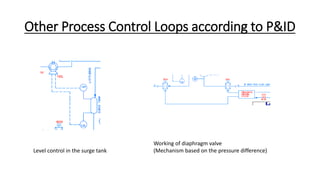
Other Process Control Loops according to P&ID
Level control in the surge tank
Working of diaphragm valve
(Mechanism based on the pressure difference)
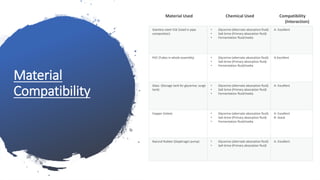
Material
Compatibility
Material Used Chemical Used Compatibility
(Interaction)
Stainless steel-316 (Used in pipe
composition)
• Glycerine (Alternate absorption fluid)
• Salt brine (Primary absorption fluid)
• Fermentation fluid/media
A- Excellent
PVC (Tubes in whole assembly) • Glycerine (alternate absorption fluid)
• Salt brine (Primary absorption fluid)
• Fermentation fluid/media
A-Excellent
Glass (Storage tank for glycerine; surge
tank)
• Glycerine (alternate absorption fluid)
• Salt brine (Primary absorption fluid)
• Fermentation fluid/media
A- Excellent
Copper (Valve) • Glycerine (alternate absorption fluid)
• Salt brine (Primary absorption fluid)
• Fermentation fluid/media
A- Excellent
B- Good
Natural Rubber (Diaphragm pump) • Glycerine (alternate absorption fluid)
• Salt brine (Primary absorption fluid)
A- Excellent

Biotech process instrumentation presentation

  • 1.
    Bioprocess Instrumentation Project Concurrent AlcoholRecovery and Fermentation (CARAF) Using Pass-through Distillation
  • 2.
  • 3.
  • 4.
    Written overview Steps: Block-1: Here,fermentation broth (Feed) from bioreactor is brought into the block 1 (Evaporation chamber; distillation unit) where ethanol and water gets evaporated (In form of gas) and from there it travels to the absorption chamber (Block 2). Here the feed cycle is continuous throughout the process. Block-2: The gas (Containing Ethanol) gets absorbed by absorbing fluid (Concentrated Brine solution) which enters into the block-2 from block-3. Once ethanol got absorbed, these brine solution gets diluted and return back to block-3. This process is continuous throughout the process. Block-3: The diluted brine (Which has absorbed ethanol) enters in this block, where heat is applied for ethanol vaporization and this ethanol vapour gets entry into block-4 (condenser) Block-4: Here the ethanol gets condensed which is our desired product. Conclusion: This process is low-energy, Low-temperature separation technique, cost effective & environmental friendly when compared with conventional methodologies. Reason being, vacuum (30 Torr) is used which brings down the boiling point of ethanol (From 80 to 30 0 C). Secondly, this whole process is continuous when it comes to Feed input, absorption fluid and applied heat (This makes this whole process an excellent example of lean production). Thus, we hence proved this process as an excellent step in industrial biotechnology revolution.
  • 5.
    Actuators Different types ofactuators involved in this process along with their functions are as follows: (What, why, where) - Pressure control valve (PCV-0300): Controlling the vacuum pressure in the system by regulating air - Agitator (AG-1,2): Used for mixing the process fluid - Solenoid valve (SV-101): Used to regulate diaphragm pump - Diaphragm pump (D-100, D-200): Controls the process fluid (Fluid of bioreactor) and brine coming out of distillation unit. - Valve (V-400): Controls flow od brine - Pump (P-101): It’s a peristaltic pump which regulates flow of bioreactor fluid and brine into distillation unit. - Vacuum pump (V-300, V-100): Creates/generate vacuum inside the performing system. - Condenser (C-100, C-202): Condense the ethanol vapour
  • 6.
    Sensors Types of sensorsused in this process are as follows: Temperature sensor (TT201, TT202, TT203, TT101, TT300): T201: Measure temperature of Tank-200 (Which has brine solution) T202: Measure temperature of the returning feed (Coming from the distillation unit) T203: Measures temperature of the brine going into the distillation unit T101: Measures temperature of the fluid coming out of distillation unit and going toward the bioreactor (T100) T300: Measure the temperature of the distillation unit. Pressure sensor (PP300): Measures the pressure of the distillation unit Level sensor (LSH, LSL): Regulates the level on brine (Which already has absorbed the ethanol) in the surge tank
  • 7.
    Process Control Loop •In this process control loop , Vacuum in the distillation unit is maintained by the use of pressure control valve • (PCV-0300). • Firstly, Vacuum is generated in the distillation chamber until it reaches the setpoint. Once it starts going above the • Set-point (Which is measured by PT300), pressure control valve allows the inflow of the air to create vacuum up to • Desired setpoint. Once this initial step is done, vacuum stays maintained in the chamber. And if it goes above or • Beyond the setpoint, vacuum can be adjusted by this process control loop.
  • 8.
    Other Process ControlLoops according to P&ID Level control in the surge tank Working of diaphragm valve (Mechanism based on the pressure difference)
  • 9.
    Material Compatibility Material Used ChemicalUsed Compatibility (Interaction) Stainless steel-316 (Used in pipe composition) • Glycerine (Alternate absorption fluid) • Salt brine (Primary absorption fluid) • Fermentation fluid/media A- Excellent PVC (Tubes in whole assembly) • Glycerine (alternate absorption fluid) • Salt brine (Primary absorption fluid) • Fermentation fluid/media A-Excellent Glass (Storage tank for glycerine; surge tank) • Glycerine (alternate absorption fluid) • Salt brine (Primary absorption fluid) • Fermentation fluid/media A- Excellent Copper (Valve) • Glycerine (alternate absorption fluid) • Salt brine (Primary absorption fluid) • Fermentation fluid/media A- Excellent B- Good Natural Rubber (Diaphragm pump) • Glycerine (alternate absorption fluid) • Salt brine (Primary absorption fluid) A- Excellent