Clarke Iakovakis | Research & Instruction Librarian | UHCL Neumann Library
Library Research for CRIM 4384: Statistics
Crime image courtesy Sivi Steys on Flickr. Licensed under CC-BY-SA
http://libguides.uhcl.edu/CRIM-SOCI4385
For me, the hardest part
of research is…
a. Getting started
b. Finding relevant information
c. Writing the paper
d. Citing sources
e. None – research is easy
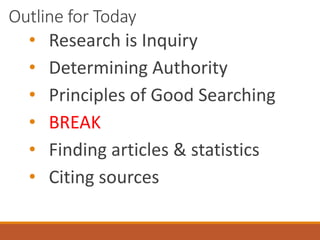
Outline for Today
• Research is Inquiry
• Determining Authority
• Principles of Good Searching
• BREAK
• Finding articles & statistics
• Citing sources
Section 1:
Research is Inquiry
Screenshot from Sherlock © British Broadcasting Company. Retrieved from Tumblr
Research is an open-
ended exploration and
engagement with
information
Anxiety is normal!
Be open-minded—seek
divergent perspectives
and information that
challenges your beliefs,
and be skeptical
Curiosity Rover Self-Image courtesy NASA/JPL-Caltech/Malin Space Science Systems. Public Domain.
A literature review is part of the published
work referencing related research, theory,
and background information
A review of the literature (literature search)
may be conducted to…
◦ understand a topic
◦ help you form a problem statement
◦ provide confirmation of an already
existing hypothesis
◦ analyze and interpret your own data
◦ gain exposure to past, current, and
ongoing research about a subject you are
exploring for research of your own
Reviewing literature
Primary, secondary, and tertiary
sources
•Primary sources are the “raw
material” or first-hand
evidence
•Secondary sources describe
and interpret information
from primary sources
•Tertiary sources compile and
summarize primary and
secondary sources
Art and Picture Collection, The New
York Public Library. (1883). The Arrest.
Data vs. Statistics: What’s the
difference?
DATA
Collected as part of a study
CSV or Excel files, text, XML,
databases
Contain individual observations
Come with documentation to
understand
Often require preparation (also called
“cleaning”)
Used as the “raw ingredients” for
generating statistics
STATISTICS
Results of data analysis
Tables, charts, maps, graphs
May describe what the data shows
◦ Frequency
◦ Mean
◦ Median
May go beyond the immediate data
to find inferences
◦ Regression
◦ Analysis of variance
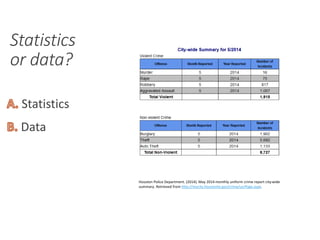
Statistics
or data?
Statistics
Data
Houston Police Department. (2014). May 2014 monthly uniform crime report by street. Retrieved from
http://www.houstontx.gov/police/cs/xls/may14.xls.
Statistics
or data?
Data
Statistics
Houston Police Department. (2014). May 2014 monthly uniform crime report city-wide
summary. Retrieved from http://mycity.houstontx.gov/crime/ucrPage.aspx.
Section 2:
Determining
Authority
Benito Mussolini. Public domain image retrieved from Library of Congress Prints & Photographs Division,
Farm Security Administration/Office of War Information Black-and-White Negatives collection.
Authority is constructed and
contextual
“Authority” is a type of influence
recognized or exerted in a community
Disciplines have acknowledged
authorities—scholars, publications &
processes
Approach all information
(“authoritative” or not) with informed
skepticism.
What are some indicators you can
use to help determine if
information is valid?
CRAAP: Currency
Relevance
Authority
Accuracy
Purpose
Craps table image courtesy Lisa Brewster on Flickr.
Licensed under CC-BY-SA
What is peer review?
 A process for establishing authority of
scholarly research
 Experts review the original ideas to
certify the accuracy, validity, and value
of the results
Chubin, D. E., & Hackett, E. J. (2005). Peer Review. In C. Mitcham (Ed.),
Encyclopedia of Science, Technology, and Ethics (Vol. 3, pp. 1390-1394).
Detroit: Macmillan Reference USA. Retrieved from
http://libproxy.uhcl.edu/login?url=http://go.galegroup.com/ps/i.do?id
=GALE%7CCX3434900491&v=2.1&u=txshracd2589&it=r&p=GVRL&sw
=w&asid=67e06d81c0d758521a67ba637722e45c
Periodicals (journals, magazines)
Peer-reviewed
Refereed
Scholarly
Academic
Trade
Professional
Practitioner
Industry
General
Popular
Author credentials (usually
universities; sometimes
industry or government)
Journal information (name, volume, issue, year)
Abstract
Literature Review
Methodology
Anatomy of a scholarly article
Tables and/or graphs
Establishing the validity of
data is a bit trickier
• Data are not typically “peer reviewed”—most
journals do not require researchers to submit the
full dataset
• Apply the CRAAP test
• Review the research methodology
• Data collection
• Data analysis
• Data interpretation
When interpreting statistics,
consider:
What is your research question or topic?
What is being measured (the unit of observation)?
◦ Individual? Family? Household? Race? Nation? World?
◦ Pay attention to the unit of measurement
What is the space? Are you comparing geographic areas?
◦ County? State? World?
What is the time period?
◦ 10 years ago? Today? Snapshot vs. across time (“longitudinal”)? Future?
Section 3: Principles
of good searching
On the Scent. Image licensed CC-BY on Flickr by stephen bowler.
• Determine your research question1
• Identify the key concepts2
• List alternate keywords, synonyms, and related words3
• Join terms and concepts with appropriate Boolean
operators4
• Make use of database’s limiters & suggested subject
terms5
• Organize and cite your sources6
Search Process
One
• What are some factors that play a role in shaping
teenagers’ attitudes toward police officers?
Two
• How do socio-economic status, neighborhood crime,
education level, and previous interactions with police
officers shape teenagers’ attitudes toward police officers?
Three
• What is the influence of individual teenagers’ past contact
with police officers on their attitudes toward police?
1. Determine your research question
2. Identify the key concepts
Teenagers
Police
Attitudes
Police contact
What is the influence of individual
teenagers’ past contact with police
officers on their attitudes toward police?
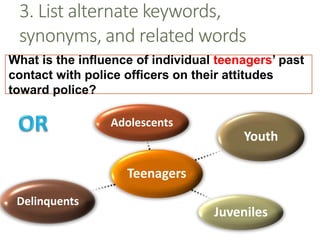
Teenagers
Adolescents
Youth
Juveniles
Delinquents
3. List alternate keywords,
synonyms, and related words
What is the influence of individual teenagers’ past
contact with police officers on their attitudes
toward police?
Police
Law enforcement
Peace
officers
CopsCorrections
3. List alternate keywords,
synonyms, and related words
What is the influence of individual teenagers’ past
contact with police officers on their attitudes
toward police?
Police contact
Police interaction
Police-
community
relations
Arrest
Questioning OR
interrogation
3. List alternate keywords,
synonyms, and related words
What is the influence of individual teenagers’ past
contact with police officers on their attitudes
toward police?
AND
OR
NOT
4. Join terms and concepts with
appropriate Boolean operators
juveniles
teenagers
adolescents
teenagers OR juveniles OR adolescents
Police OR law
enforcement OR
corrections
teenagers OR
juveniles OR
adolescents
Which statement below will
generate more search results?
Which search will find
FEWER results?
A.
B.
OR
teenagers
teenagers
police
police
m
Using a wildcard (*) will find a
larger number of results
interrogate
interrogates
interrogating
interrogation
interrogator
interrogators
interrogat* *
• State your research topic1
• Identify the key concepts2
• List alternate keywords, synonyms, and related words3
• Join terms and concepts with appropriate Boolean
operators4
• Make use of database’s limiters & suggested subject
terms5
• Organize and cite your sources6
Search Strategies
Breaktime
Please be back in 10
minutes
Image courtesy Archives and Special Collections at the University of Montana, Maureen and Mike Mansfield Library
Section 4: Research
Databases &
Library Catalog
Screenshot from Wargames © United Artists. Retrieved from Tumblr
Why use a library when I have Google?
But wait…
tumblr
.gov Wikipedia
Subscription
databases
Password-protected
websites
restricted
access
$$$
Illegal
content
Classified
documents
Surface Web
Deep Web
Amazon
cnn
Google
ads
What are some sources of
scholarly information?
Books
Reference works
Peer-reviewed journal articles
Gray literature
Reports (government,
non-governmental organizations)
Theses & dissertations
Conference proceedings
Archival resources
Research Data & Statistics
Portrait of a Scholar – Rembrandt
Public Domain Image courtesy Wikimedia
Three
• What is the influence of individual teenagers’ past
contact with police officers on their attitudes toward
police?
Access a Criminology database (Criminal Justice
Abstracts or Criminology: SAGE Journals) to find an
article related to the following research question:
Currency
Relevance
Authority
Accuracy
Purpose
Sources for statistics
Studies & research reports by non-governmental
organizations
Official statistics collected by the government
Polling organizations
Peer reviewed journal articles
Data repositories
Textbooks & encyclopedias
Newspapers & magazines (both print and online)
Which state executed the most
prisoners in the last 35 years
(1977-2011)?
Colorado
Virginia
Oklahoma
Florida
Texas
Jury designed by Luis Prado from the Noun Project
Which state executed the most
prisoners in the last 35 years
(1977-2011)?
• Texas – 477
• Florida - 71
• Oklahoma - 96
• Virginia - 109
• Colorado - 1
Source: Bureau of Justice Statistics
Retrieved from Statistical Abstract of the
United States
Link
To connect to library
databases from home
Log in using your UHCL ID and last name
Log in using your eservice account
Call the library and ask for a password
Google it
Log in using your Library barcode and last name
Section 5: Citing
Sources
Dissect this citation
Carr, P. J., Napolitano, L., & Keating, J. (2007). We
never call the cops and here is why: A qualitative
examination of legal cynicism in three Philadelphia
neighborhoods. Criminology, 45(2), 445-480. doi:
10.1111/j.1745-9125.2007.00084.x
What is the…
 Journal name
 Volume number
 Issue number
 Authors
 Article title
 Page number range
 Year of publication
 DOI
To contact a Librarian
libanswers.uhcl.edu
Please turn your
clicker OFF
Feedback please!

Crim 4384 statistics

  • 1.
    Clarke Iakovakis |Research & Instruction Librarian | UHCL Neumann Library Library Research for CRIM 4384: Statistics Crime image courtesy Sivi Steys on Flickr. Licensed under CC-BY-SA
  • 2.
  • 3.
    For me, thehardest part of research is… a. Getting started b. Finding relevant information c. Writing the paper d. Citing sources e. None – research is easy
  • 5.
    Outline for Today •Research is Inquiry • Determining Authority • Principles of Good Searching • BREAK • Finding articles & statistics • Citing sources
  • 6.
    Section 1: Research isInquiry Screenshot from Sherlock © British Broadcasting Company. Retrieved from Tumblr
  • 7.
    Research is anopen- ended exploration and engagement with information Anxiety is normal! Be open-minded—seek divergent perspectives and information that challenges your beliefs, and be skeptical Curiosity Rover Self-Image courtesy NASA/JPL-Caltech/Malin Space Science Systems. Public Domain.
  • 8.
    A literature reviewis part of the published work referencing related research, theory, and background information A review of the literature (literature search) may be conducted to… ◦ understand a topic ◦ help you form a problem statement ◦ provide confirmation of an already existing hypothesis ◦ analyze and interpret your own data ◦ gain exposure to past, current, and ongoing research about a subject you are exploring for research of your own Reviewing literature
  • 9.
    Primary, secondary, andtertiary sources •Primary sources are the “raw material” or first-hand evidence •Secondary sources describe and interpret information from primary sources •Tertiary sources compile and summarize primary and secondary sources Art and Picture Collection, The New York Public Library. (1883). The Arrest.
  • 10.
    Data vs. Statistics:What’s the difference? DATA Collected as part of a study CSV or Excel files, text, XML, databases Contain individual observations Come with documentation to understand Often require preparation (also called “cleaning”) Used as the “raw ingredients” for generating statistics STATISTICS Results of data analysis Tables, charts, maps, graphs May describe what the data shows ◦ Frequency ◦ Mean ◦ Median May go beyond the immediate data to find inferences ◦ Regression ◦ Analysis of variance
  • 11.
    Statistics or data? Statistics Data Houston PoliceDepartment. (2014). May 2014 monthly uniform crime report by street. Retrieved from http://www.houstontx.gov/police/cs/xls/may14.xls.
  • 12.
    Statistics or data? Data Statistics Houston PoliceDepartment. (2014). May 2014 monthly uniform crime report city-wide summary. Retrieved from http://mycity.houstontx.gov/crime/ucrPage.aspx.
  • 13.
    Section 2: Determining Authority Benito Mussolini.Public domain image retrieved from Library of Congress Prints & Photographs Division, Farm Security Administration/Office of War Information Black-and-White Negatives collection.
  • 14.
    Authority is constructedand contextual “Authority” is a type of influence recognized or exerted in a community Disciplines have acknowledged authorities—scholars, publications & processes Approach all information (“authoritative” or not) with informed skepticism.
  • 15.
    What are someindicators you can use to help determine if information is valid? CRAAP: Currency Relevance Authority Accuracy Purpose Craps table image courtesy Lisa Brewster on Flickr. Licensed under CC-BY-SA
  • 16.
    What is peerreview?  A process for establishing authority of scholarly research  Experts review the original ideas to certify the accuracy, validity, and value of the results Chubin, D. E., & Hackett, E. J. (2005). Peer Review. In C. Mitcham (Ed.), Encyclopedia of Science, Technology, and Ethics (Vol. 3, pp. 1390-1394). Detroit: Macmillan Reference USA. Retrieved from http://libproxy.uhcl.edu/login?url=http://go.galegroup.com/ps/i.do?id =GALE%7CCX3434900491&v=2.1&u=txshracd2589&it=r&p=GVRL&sw =w&asid=67e06d81c0d758521a67ba637722e45c
  • 17.
  • 18.
    Author credentials (usually universities;sometimes industry or government) Journal information (name, volume, issue, year) Abstract Literature Review Methodology Anatomy of a scholarly article Tables and/or graphs
  • 19.
    Establishing the validityof data is a bit trickier • Data are not typically “peer reviewed”—most journals do not require researchers to submit the full dataset • Apply the CRAAP test • Review the research methodology • Data collection • Data analysis • Data interpretation
  • 20.
    When interpreting statistics, consider: Whatis your research question or topic? What is being measured (the unit of observation)? ◦ Individual? Family? Household? Race? Nation? World? ◦ Pay attention to the unit of measurement What is the space? Are you comparing geographic areas? ◦ County? State? World? What is the time period? ◦ 10 years ago? Today? Snapshot vs. across time (“longitudinal”)? Future?
  • 21.
    Section 3: Principles ofgood searching On the Scent. Image licensed CC-BY on Flickr by stephen bowler.
  • 22.
    • Determine yourresearch question1 • Identify the key concepts2 • List alternate keywords, synonyms, and related words3 • Join terms and concepts with appropriate Boolean operators4 • Make use of database’s limiters & suggested subject terms5 • Organize and cite your sources6 Search Process
  • 23.
    One • What aresome factors that play a role in shaping teenagers’ attitudes toward police officers? Two • How do socio-economic status, neighborhood crime, education level, and previous interactions with police officers shape teenagers’ attitudes toward police officers? Three • What is the influence of individual teenagers’ past contact with police officers on their attitudes toward police? 1. Determine your research question
  • 24.
    2. Identify thekey concepts Teenagers Police Attitudes Police contact What is the influence of individual teenagers’ past contact with police officers on their attitudes toward police?
  • 25.
    Teenagers Adolescents Youth Juveniles Delinquents 3. List alternatekeywords, synonyms, and related words What is the influence of individual teenagers’ past contact with police officers on their attitudes toward police?
  • 26.
    Police Law enforcement Peace officers CopsCorrections 3. Listalternate keywords, synonyms, and related words What is the influence of individual teenagers’ past contact with police officers on their attitudes toward police?
  • 27.
    Police contact Police interaction Police- community relations Arrest QuestioningOR interrogation 3. List alternate keywords, synonyms, and related words What is the influence of individual teenagers’ past contact with police officers on their attitudes toward police?
  • 28.
    AND OR NOT 4. Join termsand concepts with appropriate Boolean operators
  • 29.
  • 30.
    Police OR law enforcementOR corrections teenagers OR juveniles OR adolescents
  • 32.
    Which statement belowwill generate more search results?
  • 33.
    Which search willfind FEWER results? A. B. OR teenagers teenagers police police
  • 34.
  • 35.
    Using a wildcard(*) will find a larger number of results interrogate interrogates interrogating interrogation interrogator interrogators interrogat* *
  • 36.
    • State yourresearch topic1 • Identify the key concepts2 • List alternate keywords, synonyms, and related words3 • Join terms and concepts with appropriate Boolean operators4 • Make use of database’s limiters & suggested subject terms5 • Organize and cite your sources6 Search Strategies
  • 37.
    Breaktime Please be backin 10 minutes Image courtesy Archives and Special Collections at the University of Montana, Maureen and Mike Mansfield Library
  • 38.
    Section 4: Research Databases& Library Catalog Screenshot from Wargames © United Artists. Retrieved from Tumblr
  • 39.
    Why use alibrary when I have Google? But wait…
  • 40.
  • 41.
    What are somesources of scholarly information? Books Reference works Peer-reviewed journal articles Gray literature Reports (government, non-governmental organizations) Theses & dissertations Conference proceedings Archival resources Research Data & Statistics Portrait of a Scholar – Rembrandt Public Domain Image courtesy Wikimedia
  • 43.
    Three • What isthe influence of individual teenagers’ past contact with police officers on their attitudes toward police? Access a Criminology database (Criminal Justice Abstracts or Criminology: SAGE Journals) to find an article related to the following research question: Currency Relevance Authority Accuracy Purpose
  • 44.
    Sources for statistics Studies& research reports by non-governmental organizations Official statistics collected by the government Polling organizations Peer reviewed journal articles Data repositories Textbooks & encyclopedias Newspapers & magazines (both print and online)
  • 45.
    Which state executedthe most prisoners in the last 35 years (1977-2011)? Colorado Virginia Oklahoma Florida Texas Jury designed by Luis Prado from the Noun Project
  • 46.
    Which state executedthe most prisoners in the last 35 years (1977-2011)? • Texas – 477 • Florida - 71 • Oklahoma - 96 • Virginia - 109 • Colorado - 1 Source: Bureau of Justice Statistics Retrieved from Statistical Abstract of the United States Link
  • 47.
    To connect tolibrary databases from home Log in using your UHCL ID and last name Log in using your eservice account Call the library and ask for a password Google it Log in using your Library barcode and last name
  • 48.
  • 49.
    Dissect this citation Carr,P. J., Napolitano, L., & Keating, J. (2007). We never call the cops and here is why: A qualitative examination of legal cynicism in three Philadelphia neighborhoods. Criminology, 45(2), 445-480. doi: 10.1111/j.1745-9125.2007.00084.x What is the…  Journal name  Volume number  Issue number  Authors  Article title  Page number range  Year of publication  DOI
  • 51.
    To contact aLibrarian libanswers.uhcl.edu
  • 52.
  • 53.