Motivation of the project
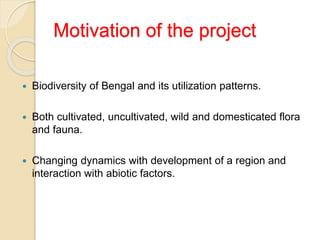
 Biodiversity of Bengal and its utilization patterns.
 Both cultivated, uncultivated, wild and domesticated flora
and fauna.
 Changing dynamics with development of a region and
interaction with abiotic factors.
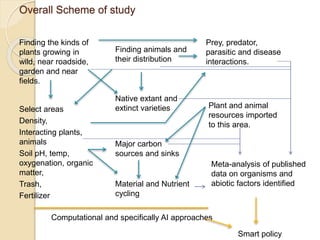
Overall Scheme of study
Finding the kinds of
plants growing in
wild, near roadside,
garden and near
fields.
Prey, predator,
parasitic and disease
interactions.
Select areas
Density,
Interacting plants,
animals
Soil pH, temp,
oxygenation, organic
matter,
Trash,
Fertilizer
Native extant and
extinct varieties
Major carbon
sources and sinks
Material and Nutrient
cycling
Finding animals and
their distribution
Plant and animal
resources imported
to this area.
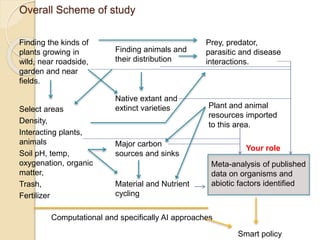
Meta-analysis of published
data on organisms and
abiotic factors identified
Computational and specifically AI approaches
Smart policy
Overall Scheme of study
Finding the kinds of
plants growing in
wild, near roadside,
garden and near
fields.
Prey, predator,
parasitic and disease
interactions.
Select areas
Density,
Interacting plants,
animals
Soil pH, temp,
oxygenation, organic
matter,
Trash,
Fertilizer
Native extant and
extinct varieties
Major carbon
sources and sinks
Material and Nutrient
cycling
Finding animals and
their distribution
Plant and animal
resources imported
to this area.
Meta-analysis of published
data on organisms and
abiotic factors identified
Computational and specifically AI approaches
Smart policy
Your role
To start with
 Saags
 Medicinal plants
 Rice varieties
Ex: Topics to be covered for saags
 Family name of the saag
 Scientific name of the saag
 Common name of the saag
 Distribution in Bengal
 Distribution in India
 Distribution in the world
 Macronutrients present
 Micronutrients present
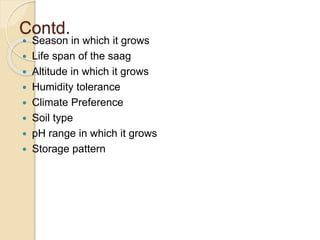
Contd.
 Season in which it grows
 Life span of the saag
 Altitude in which it grows
 Humidity tolerance
 Climate Preference
 Soil type
 pH range in which it grows
 Storage pattern
Contd.
 Edible parts
 Pest Resistance
 Metal Accumulation Pattern
 Stress tolerance ability
 Traditional medical use of the saag
 Modern medical use of the saag
 Uses/Economic importance of the saag
How to go about the project?
A) Go to Google scholar
( https://scholar.google.com )
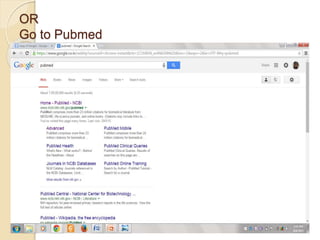
OR
Go to Pubmed
B) Do extensive search of desired topic
(Use appropriate key words)
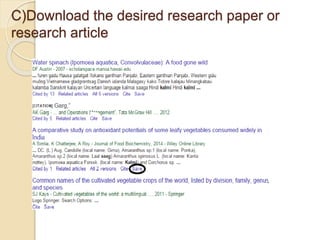
C)Download the desired research paper or
research article
•Avoid collecting data from websites/blogs.
•If research papers are unavailable then data can be
collected from government websites.
D) Read the paper thoroughly
E) Extract the data given in research paper/ article
F) Put the data in excel sheet
NOTE
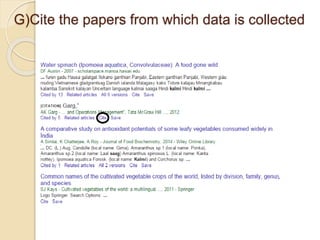
G)Cite the papers from which data is collected
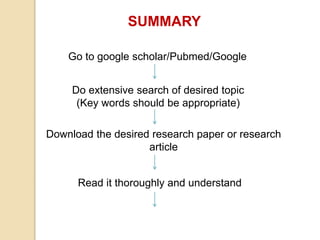
Go to google scholar/Pubmed/Google
Do extensive search of desired topic
(Key words should be appropriate)
SUMMARY
Download the desired research paper or research
article
Read it thoroughly and understand
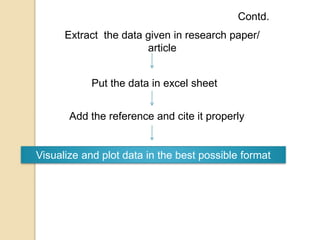
Extract the data given in research paper/
article
Put the data in excel sheet
Add the reference and cite it properly
Contd.
Visualize and plot data in the best possible format
Timeline
 General reading on topic by team until
June 20th.
 Finalizing parameters to quantify on
June 21st.
 Double bind collection of facts on saags
and medicinal plants by team from June
22nd to July 31st.
 August; Two teams: 1)Creation of private
data base 2)Quantitation, analysis and
visualization of data.
 September paper writing and
submission.

Agricultural and medicinal data

  • 1.
    Motivation of theproject  Biodiversity of Bengal and its utilization patterns.  Both cultivated, uncultivated, wild and domesticated flora and fauna.  Changing dynamics with development of a region and interaction with abiotic factors.
  • 2.
    Overall Scheme ofstudy Finding the kinds of plants growing in wild, near roadside, garden and near fields. Prey, predator, parasitic and disease interactions. Select areas Density, Interacting plants, animals Soil pH, temp, oxygenation, organic matter, Trash, Fertilizer Native extant and extinct varieties Major carbon sources and sinks Material and Nutrient cycling Finding animals and their distribution Plant and animal resources imported to this area. Meta-analysis of published data on organisms and abiotic factors identified Computational and specifically AI approaches Smart policy
  • 3.
    Overall Scheme ofstudy Finding the kinds of plants growing in wild, near roadside, garden and near fields. Prey, predator, parasitic and disease interactions. Select areas Density, Interacting plants, animals Soil pH, temp, oxygenation, organic matter, Trash, Fertilizer Native extant and extinct varieties Major carbon sources and sinks Material and Nutrient cycling Finding animals and their distribution Plant and animal resources imported to this area. Meta-analysis of published data on organisms and abiotic factors identified Computational and specifically AI approaches Smart policy Your role
  • 4.
    To start with Saags  Medicinal plants  Rice varieties
  • 5.
    Ex: Topics tobe covered for saags  Family name of the saag  Scientific name of the saag  Common name of the saag  Distribution in Bengal  Distribution in India  Distribution in the world  Macronutrients present  Micronutrients present
  • 6.
    Contd.  Season inwhich it grows  Life span of the saag  Altitude in which it grows  Humidity tolerance  Climate Preference  Soil type  pH range in which it grows  Storage pattern
  • 7.
    Contd.  Edible parts Pest Resistance  Metal Accumulation Pattern  Stress tolerance ability  Traditional medical use of the saag  Modern medical use of the saag  Uses/Economic importance of the saag
  • 8.
    How to goabout the project?
  • 9.
    A) Go toGoogle scholar ( https://scholar.google.com )
  • 10.
  • 11.
    B) Do extensivesearch of desired topic (Use appropriate key words)
  • 12.
    C)Download the desiredresearch paper or research article
  • 13.
    •Avoid collecting datafrom websites/blogs. •If research papers are unavailable then data can be collected from government websites. D) Read the paper thoroughly E) Extract the data given in research paper/ article F) Put the data in excel sheet NOTE
  • 14.
    G)Cite the papersfrom which data is collected
  • 15.
    Go to googlescholar/Pubmed/Google Do extensive search of desired topic (Key words should be appropriate) SUMMARY Download the desired research paper or research article Read it thoroughly and understand
  • 16.
    Extract the datagiven in research paper/ article Put the data in excel sheet Add the reference and cite it properly Contd. Visualize and plot data in the best possible format
  • 17.
    Timeline  General readingon topic by team until June 20th.  Finalizing parameters to quantify on June 21st.  Double bind collection of facts on saags and medicinal plants by team from June 22nd to July 31st.  August; Two teams: 1)Creation of private data base 2)Quantitation, analysis and visualization of data.  September paper writing and submission.