Nucleic Acid Structure and
Organization
By: Ibrahim Bangura (MBChB)
Overview of Nucleic Acids
• Naturally occurring chemical compounds that servers as the main information
carrying molecule of the cell.
• There are two types of nucleic acids:
Deoxyribonucleic acid (DNA) and
Ribonucleic acid (RNA).
• Genetic information is encoded in DNA, which, in eukaryotes, is located mainly in
nuclei, with small amount in mitochondria.
• Genetic information is inherited and expressed:
• Inheritance occurs by the process of replication. The strands of parental DNA
serve as templates for synthesis of copies that are passed on to daughter cells
• Expression of genes requires two steps (transcription and translation) that
ultimately leads to the production of proteins
Overview of Nucleic Acid Structure
• The monomeric units of nucleic acids are nucleotides; each
nucleotide contains a nitrogenous bas, a sugar , and phosphate
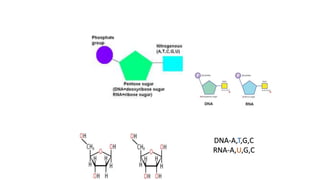
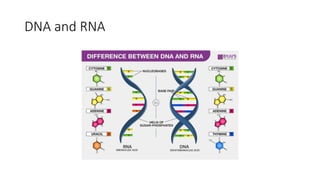
• DNA contains the bases Adenine (A), Guanine (G) Cytosine (C), and
Thymine (T)
• RNA contains A, G, and C, but has Uracil (U) instead of T
• Deoxyribose is present in DNA, whereas RNA contains Ribose
DNA-A,T,G,C
RNA-A,U,G,C
The Structure of DNA
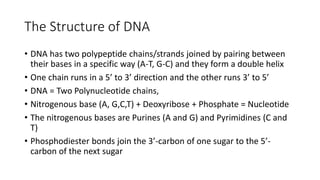
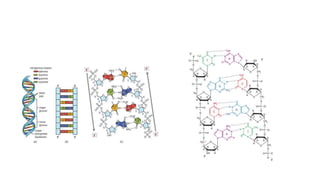
• DNA has two polypeptide chains/strands joined by pairing between
their bases in a specific way (A-T, G-C) and they form a double helix
• One chain runs in a 5’ to 3’ direction and the other runs 3’ to 5’
• DNA = Two Polynucleotide chains,
• Nitrogenous base (A, G,C,T) + Deoxyribose + Phosphate = Nucleotide
• The nitrogenous bases are Purines (A and G) and Pyrimidines (C and
T)
• Phosphodiester bonds join the 3’-carbon of one sugar to the 5’-
carbon of the next sugar
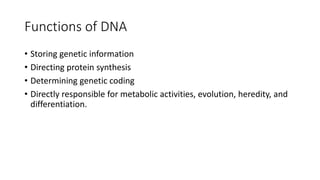
Functions of DNA
• Storing genetic information
• Directing protein synthesis
• Determining genetic coding
• Directly responsible for metabolic activities, evolution, heredity, and
differentiation.
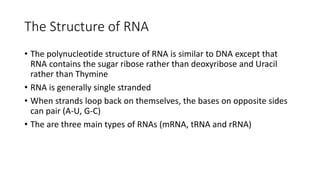
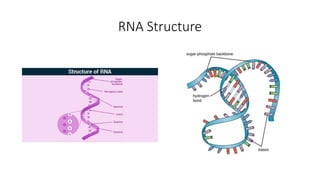
The Structure of RNA
• The polynucleotide structure of RNA is similar to DNA except that
RNA contains the sugar ribose rather than deoxyribose and Uracil
rather than Thymine
• RNA is generally single stranded
• When strands loop back on themselves, the bases on opposite sides
can pair (A-U, G-C)
• The are three main types of RNAs (mRNA, tRNA and rRNA)
RNA Structure
Functions of RNA
• Facilitate the translation of DNA into proteins
• Functions as an adapter molecule in protein synthesis
• Serves as a messenger between the DNA and the ribosomes.
• They are the carrier of genetic information in all living cells
• Promotes the ribosomes to choose the right amino acid which is
required in building up of new proteins in the body.
DNA and RNA
conclusion
• The DNA molecule satisfies the requirement of genetic material in the
following ways:-
It can replicate itself accurately during cell growth and division.
Its structure is sufficiently stable so that heritable charges i.e., mutations can
occur only very rarely.
It has a potential to carry all kinds of necessary biological information.
It transmits all the biological information to the daughter cells.
Thus the essential functions of DNA are the storage and transmission of
genetic information and the expression of this information in the form
of synthesis of cellular proteins.
DNA Replication and Protein
Synthesis
NEXT TOPIC
Thank You
THE END

2 Nucleic Acid Structure and Organization.pptx

  • 1.
    Nucleic Acid Structureand Organization By: Ibrahim Bangura (MBChB)
  • 2.
    Overview of NucleicAcids • Naturally occurring chemical compounds that servers as the main information carrying molecule of the cell. • There are two types of nucleic acids: Deoxyribonucleic acid (DNA) and Ribonucleic acid (RNA). • Genetic information is encoded in DNA, which, in eukaryotes, is located mainly in nuclei, with small amount in mitochondria. • Genetic information is inherited and expressed: • Inheritance occurs by the process of replication. The strands of parental DNA serve as templates for synthesis of copies that are passed on to daughter cells • Expression of genes requires two steps (transcription and translation) that ultimately leads to the production of proteins
  • 3.
    Overview of NucleicAcid Structure • The monomeric units of nucleic acids are nucleotides; each nucleotide contains a nitrogenous bas, a sugar , and phosphate • DNA contains the bases Adenine (A), Guanine (G) Cytosine (C), and Thymine (T) • RNA contains A, G, and C, but has Uracil (U) instead of T • Deoxyribose is present in DNA, whereas RNA contains Ribose
  • 4.
  • 5.
    The Structure ofDNA • DNA has two polypeptide chains/strands joined by pairing between their bases in a specific way (A-T, G-C) and they form a double helix • One chain runs in a 5’ to 3’ direction and the other runs 3’ to 5’ • DNA = Two Polynucleotide chains, • Nitrogenous base (A, G,C,T) + Deoxyribose + Phosphate = Nucleotide • The nitrogenous bases are Purines (A and G) and Pyrimidines (C and T) • Phosphodiester bonds join the 3’-carbon of one sugar to the 5’- carbon of the next sugar
  • 7.
    Functions of DNA •Storing genetic information • Directing protein synthesis • Determining genetic coding • Directly responsible for metabolic activities, evolution, heredity, and differentiation.
  • 8.
    The Structure ofRNA • The polynucleotide structure of RNA is similar to DNA except that RNA contains the sugar ribose rather than deoxyribose and Uracil rather than Thymine • RNA is generally single stranded • When strands loop back on themselves, the bases on opposite sides can pair (A-U, G-C) • The are three main types of RNAs (mRNA, tRNA and rRNA)
  • 9.
  • 10.
    Functions of RNA •Facilitate the translation of DNA into proteins • Functions as an adapter molecule in protein synthesis • Serves as a messenger between the DNA and the ribosomes. • They are the carrier of genetic information in all living cells • Promotes the ribosomes to choose the right amino acid which is required in building up of new proteins in the body.
  • 11.
  • 12.
    conclusion • The DNAmolecule satisfies the requirement of genetic material in the following ways:- It can replicate itself accurately during cell growth and division. Its structure is sufficiently stable so that heritable charges i.e., mutations can occur only very rarely. It has a potential to carry all kinds of necessary biological information. It transmits all the biological information to the daughter cells. Thus the essential functions of DNA are the storage and transmission of genetic information and the expression of this information in the form of synthesis of cellular proteins.
  • 13.
    DNA Replication andProtein Synthesis NEXT TOPIC
  • 14.