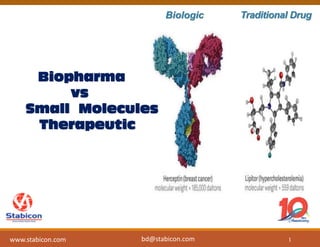
Biologic Traditional Drug
1
www.stabicon.com
Biopharma
vs
Small Molecules
Therapeutic
bd@stabicon.com
Topics Covered :
I. Introduction
II. Protein Basic Mechanism
III. Step in Protein Production
IV.Identification and characterization technique
V. Monitoring protein synthesis
VI.Data Processing Methodology
2
www.stabicon.com bd@stabicon.com
Introduction
Chapter –I
3
www.stabicon.com bd@stabicon.com
Therapeutic small molecule being dominant for more than 100 year for
treatment then why biologics required for therapeutic ?
Why???
4
www.stabicon.com bd@stabicon.com
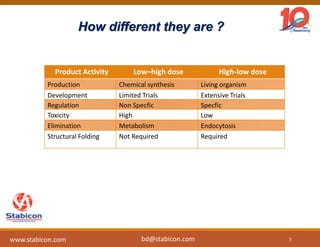
How different they are ?
Product Activity Low–high dose High-low dose
Production Chemical synthesis Living organism
Development Limited Trials Extensive Trials
Regulation Non Specfic Specfic
Toxicity High Low
Elimination Metabolism Endocytosis
Structural Folding Not Required Required
5
www.stabicon.com bd@stabicon.com
What are these?
 What are these large molecule or biomolecule and how similar are they to
human body?
 What make them so specific and effective?
 What is the correlation of large/ biomolecule molecule to living machinery?
6
www.stabicon.com bd@stabicon.com
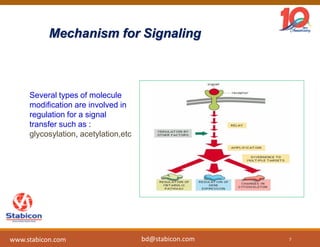
Mechanism for Signaling
Several types of molecule
modification are involved in
regulation for a signal
transfer such as :
glycosylation, acetylation,etc
7
www.stabicon.com bd@stabicon.com
Effect in the body
 Small molecule rarely elict secondary signaling thus effect prevail until
drug adhere to the target site whereas in case of large molecule
always elict an secondary signaling hence effect remain even after
the drug is eliminated.
8
www.stabicon.com bd@stabicon.com
Protein Basic Mechanism
Chapter –II
9
www.stabicon.com bd@stabicon.com
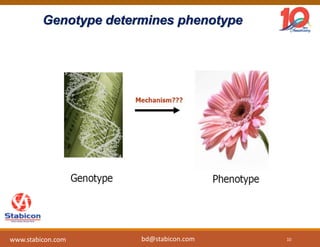
Genotype determines phenotype
10
www.stabicon.com bd@stabicon.com
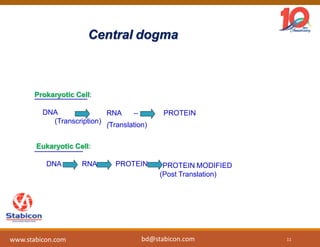
Central dogma
Prokaryotic Cell:
DNA –
(Transcription)
RNA – PROTEIN
(Translation)
Eukaryotic Cell:
DNA – RNA – PROTEIN - PROTEIN MODIFIED
(Post Translation)
11
www.stabicon.com bd@stabicon.com
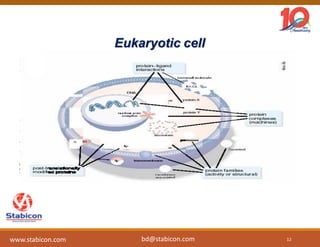
Eukaryotic cell
12
www.stabicon.com bd@stabicon.com
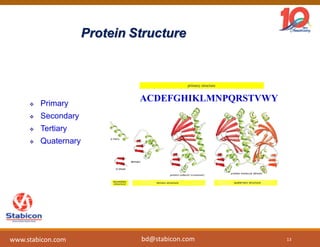
Protein Structure
 Primary
 Secondary
 Tertiary
 Quaternary
ACDEFGHIKLMNPQRSTVWY
primary structure
13
www.stabicon.com bd@stabicon.com
Therapeutic Protein Production
Chapter –III
14
www.stabicon.com bd@stabicon.com
Biopharma
 Biopharmaceutical are protein with considerable therapeutic structural
diversity. They tend to between 100 to 1000 times larger than traditional
small molecule drug .
 Such complex protein can't be produced using convential chemical
synthesis rather than in a living cell under stringently controlled condition.
15
www.stabicon.com bd@stabicon.com
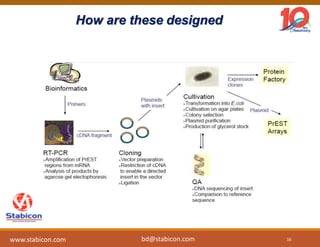
How are these designed
16
www.stabicon.com bd@stabicon.com
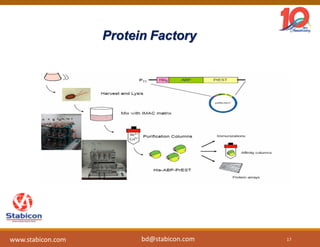
Protein Factory
17
www.stabicon.com bd@stabicon.com
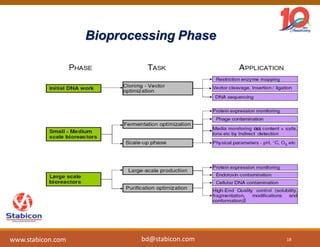
Bioprocessing Phase
18
www.stabicon.com bd@stabicon.com
Examples of Biologics marketed:
 Insulin
 Imiglucerase
 Glucagon
 Human Growth
Hormone
 Erythropoietin
 G-CSF
 Interferon
19
www.stabicon.com bd@stabicon.com
Chapter –IV
Protein Characterization
20
www.stabicon.com bd@stabicon.com
Characterization Step
 Primary structure - peptide mapping
 Glycan analysis
 Intact Mass analysis
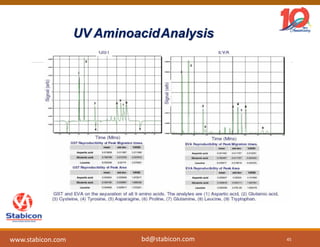
 Amino acid and media analysis
 Data processing
21
www.stabicon.com bd@stabicon.com
How to characterize ?
 Large scale screening of proteins, their expression, modification and
interaction by using high-throughput approaches
22
www.stabicon.com bd@stabicon.com
Characterization Required for
 Protein identity (mutant protein)
 Protein quantity (Expression)
 Protein post-translational modifications (up or down)
 Protein structure
 Protein-protein interaction
 Protein localization
 Change in any protein property may cause functional
abnormality and might be relevant to pathogenesis.
Tools
 Protein Array
 Mass Spectrometry
23
www.stabicon.com bd@stabicon.com
Why Protein by Mass Spectrometry?
 MS can unambiguously identify proteins Gel
separated proteins
 Proteins in mixture
 Protein: protein association
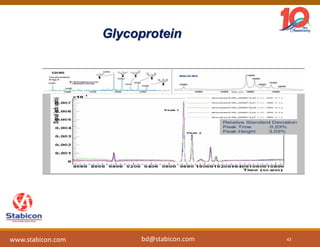
 Identify precise post translational changes
Phosphorylation
 N- or C- terminal modification
Many more
24
www.stabicon.com bd@stabicon.com
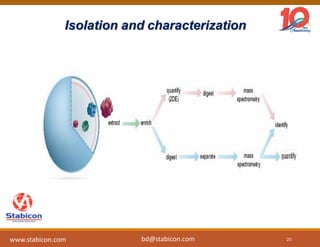
Isolation and characterization
25
www.stabicon.com bd@stabicon.com
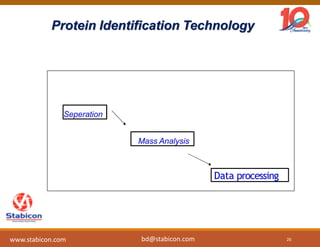
Protein Identification Technology
Seperation
Mass Analysis
Data processing
26
www.stabicon.com bd@stabicon.com
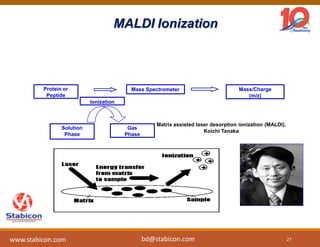
MALDI Ionization
Protein or
Peptide
Mass Spectrometer Mass/Charge
(m/z)
Ionization
Solution
Phase
Gas
Phase
Matrix assisted laser desorption ionization (MALDI),
Koichi Tanaka
27
www.stabicon.com bd@stabicon.com
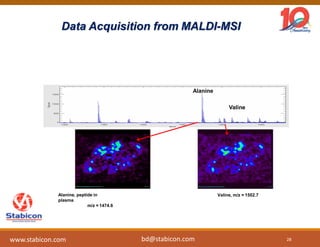
Data Acquisition from MALDI-MSI
Alanine, peptide in
plasma
m/z = 1474.6
Valine, m/z = 1502.7
Alanine
Valine
28
www.stabicon.com bd@stabicon.com
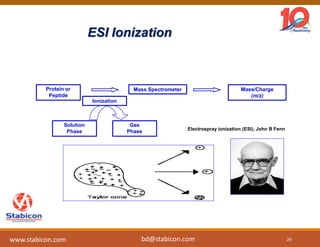
Protein or
Peptide
Mass Spectrometer Mass/Charge
(m/z)
Ionization
Solution
Phase
Gas
Phase
ESI Ionization
Electrospray ionization (ESI), John B Fenn
29
www.stabicon.com bd@stabicon.com
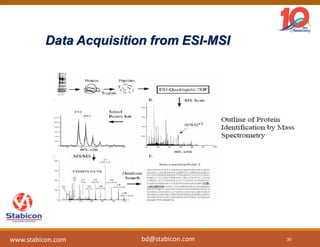
Data Acquisition from ESI-MSI
30
www.stabicon.com bd@stabicon.com
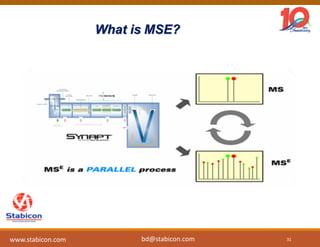
What is MSE?
31
www.stabicon.com bd@stabicon.com
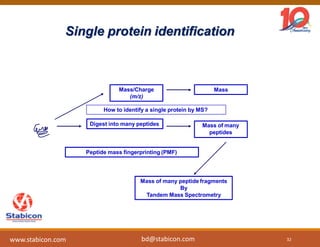
How to identify a single protein by MS?
Mass/Charge
(m/z)
Mass
Digest into many peptides Mass of many
peptides
Peptide mass fingerprinting (PMF)
Mass of many peptide fragments
By
Tandem Mass Spectrometry
Single protein identification
32
www.stabicon.com bd@stabicon.com
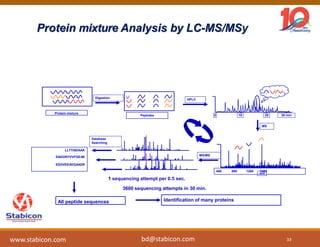
Protein mixture Analysis by LC-MS/MSy
Protein mixture
Digestion
Peptides
400 800 1200 1600
m/z
MS
MS/MS
10 20 30 min
0
HPLC
Database
Searching
LLTTIADAAK
SAGGNYVVFGEAK
EDDVEEAVQAADR
All peptide sequences Identification of many proteins
1 sequencing attempt per 0.5 sec.
3600 sequencing attempts in 30 min.
33
www.stabicon.com bd@stabicon.com
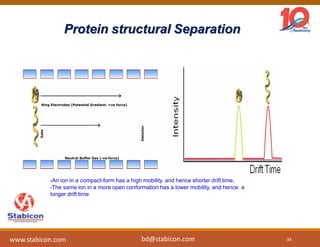
Protein structural Separation
•An ion in a compact-form has a high mobility, and hence shorter drift time,
•The same ion in a more open conformation has a lower mobility, and hence a
longer drift time
Gate
Detector
Neutral Buffer Gas (-ve force)
Ring Electrodes (Potential Gradient. +ve force)
34
www.stabicon.com bd@stabicon.com
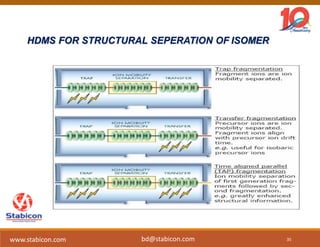
HDMS FOR STRUCTURAL SEPERATION OF ISOMER
35
www.stabicon.com bd@stabicon.com
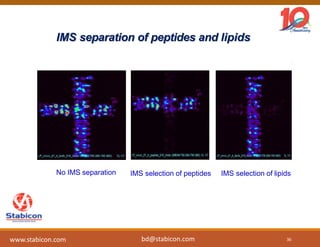
IMS separation of peptides and lipids
No IMS separation IMS selection of peptides IMS selection of lipids
36
www.stabicon.com bd@stabicon.com
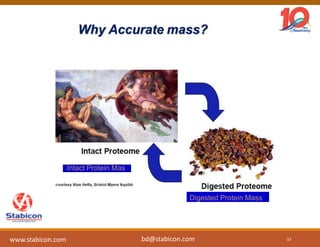
Why Accurate mass?
s
Intact Protein Mas
Digested Protein Mass
37
www.stabicon.com bd@stabicon.com
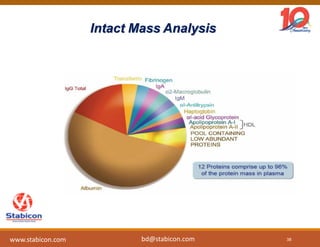
Intact Mass Analysis
38
www.stabicon.com bd@stabicon.com
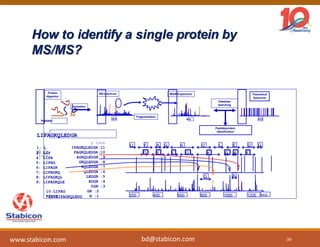
How to identify a single protein by
MS/MS?
Peptides
Theoretical
Spectrum
Database
searching
m/z
Ionization
MS spectrum MS/MS spectrum
Fragmentation
Protein
digestion
Peptide/protein
identification
m/z m/z
200 400 600 800 1000 1200 m/z
K G A F
D E L Q
LIFAGKQLEDGR
b
ions
1: L
2: LI
3: LIF
4: LIFA
5: LIFAG
6: LIFAGK
7: LIFAGKQ
8: LIFAGKQL
9: LIFAGKQLE
10:LIFAG
KQLED
11:LIFAGKQLEDG
y ions
IFAGKQLEDGR:11
FAGKQLEDGR:10
AGKQLEDGR :9
GKQLEDGR :8
KQLEDGR :7
QLEDGR :6
LEDGR :5
EDGR :4
DGR :3
GR :2
R :1
A G
F D
E
L G
LI K Q
Q A
39
www.stabicon.com bd@stabicon.com
N & C terminal Ions
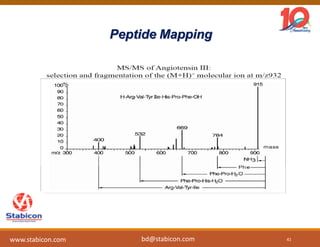
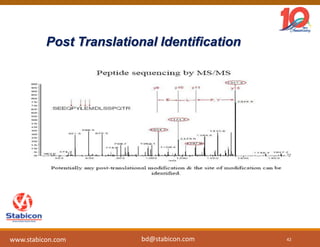
 Selected Peptides (parent ions) are fragmented in the of a nebulizing
neutral gas. Energy imparted by collision breaks the covalent bond in
parent bonds.
 y & b-type ions series thus generated can give us the sequence of the
peptide
40
www.stabicon.com bd@stabicon.com
Peptide Mapping
41
www.stabicon.com bd@stabicon.com
Post Translational Identification
42
www.stabicon.com bd@stabicon.com
Glycoprotein
43
www.stabicon.com bd@stabicon.com
Monitor the Bioreactor
Media &
Protein Synthesis
Chapter – V
44
www.stabicon.com bd@stabicon.com
UV AminoacidAnalysis
45
www.stabicon.com bd@stabicon.com
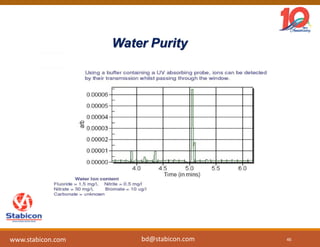
Water Purity
46
www.stabicon.com bd@stabicon.com
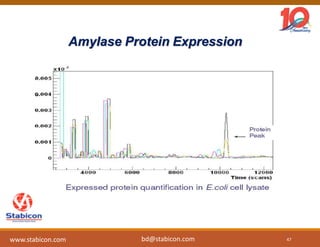
Amylase Protein Expression
47
www.stabicon.com bd@stabicon.com
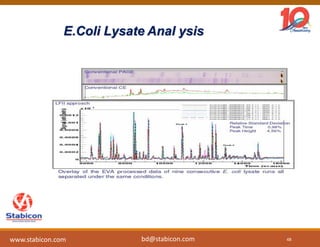
E.Coli Lysate Anal ysis
48
www.stabicon.com bd@stabicon.com
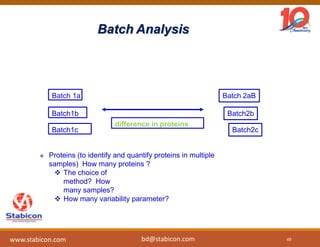
Batch Analysis
Batch 1a Batch 2aB
Batch1b Batch2b
Batch1c Batch2c
difference in proteins
 Proteins (to identify and quantify proteins in multiple
samples) How many proteins ?
 The choice of
method? How
many samples?
 How many variability parameter?
49
www.stabicon.com bd@stabicon.com
Data processing
Chapter –VI
50
www.stabicon.com bd@stabicon.com
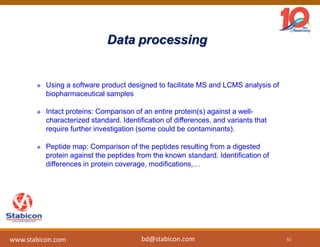
Data processing
 Using a software product designed to facilitate MS and LCMS analysis of
biopharmaceutical samples
 Intact proteins: Comparison of an entire protein(s) against a well-
characterized standard. Identification of differences, and variants that
require further investigation (some could be contaminants).
 Peptide map: Comparison of the peptides resulting from a digested
protein against the peptides from the known standard. Identification of
differences in protein coverage, modifications,…
51
www.stabicon.com bd@stabicon.com
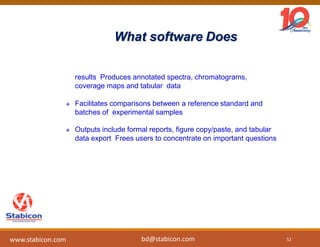
What software Does
 Automates data processing and annotation of experimental
results Produces annotated spectra, chromatograms,
coverage maps and tabular data
 Facilitates comparisons between a reference standard and
batches of experimental samples
 Outputs include formal reports, figure copy/paste, and tabular
data export Frees users to concentrate on important questions
52
www.stabicon.com bd@stabicon.com
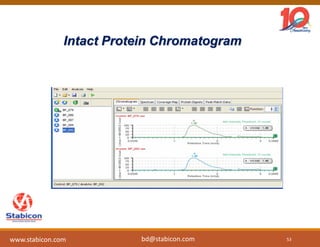
Intact Protein Chromatogram
53
www.stabicon.com bd@stabicon.com
54
www.stabicon.com
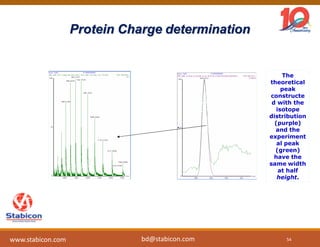
Protein Charge determination
The
theoretical
peak
constructe
d with the
isotope
distribution
(purple)
and the
experiment
al peak
(green)
have the
same width
at half
height.
bd@stabicon.com
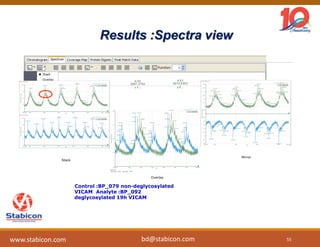
Results :Spectra view
Stack
Overlay
Mirror
Control :BP_079 non-deglycosylated
VICAM Analyte :BP_092
deglycosylated 19h VICAM
55
www.stabicon.com bd@stabicon.com
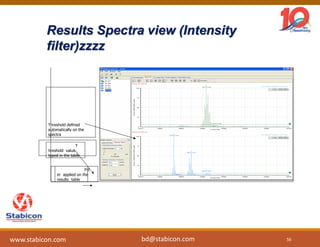
Results Spectra view (Intensity
filter)zzzz
Threshold defined
automatically on the
spectra
T
hreshold value
typed in the table
Filt
er applied on the
results table
56
www.stabicon.com bd@stabicon.com
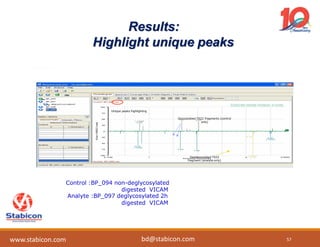
Results:
Highlight unique peaks
Unique peaks highlighting
Deglycosylated T022
fragment (analyte only)
Glycosylated T022 fragments (control
only)
Control :BP_094 non-deglycosylated
digested VICAM
Analyte :BP_097 deglycosylated 2h
digested VICAM
57
www.stabicon.com bd@stabicon.com
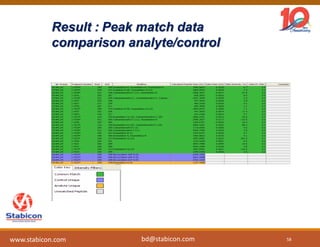
Result : Peak match data
comparison analyte/control
58
www.stabicon.com bd@stabicon.com
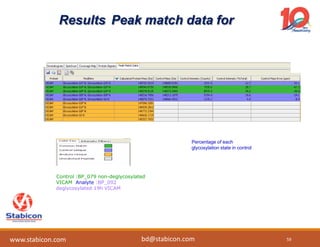
Results Peak match data for
control (glycosylated)
Percentage of each
glycosylation state in control
Control :BP_079 non-deglycosylated
VICAM Analyte :BP_092
deglycosylated 19h VICAM
59
www.stabicon.com bd@stabicon.com
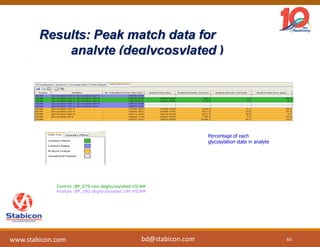
Results: Peak match data for
analyte (deglycosylated )
Percentage of each
glycosylation state in analyte
Control :BP_079 non-deglycosylated VICAM
Analyte :BP_092 deglycosylated 19h VICAM
60
www.stabicon.com bd@stabicon.com
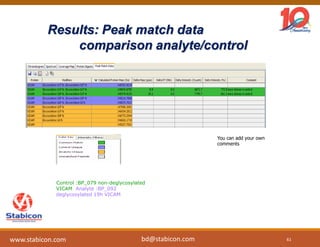
Results: Peak match data
comparison analyte/control
You can add your own
comments
Control :BP_079 non-deglycosylated
VICAM Analyte :BP_092
deglycosylated 19h VICAM
61
www.stabicon.com bd@stabicon.com
PEPTIDE MAP ANALYSIS
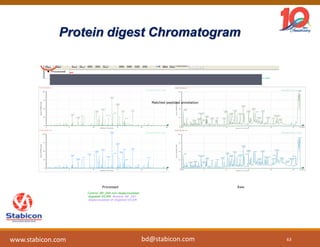
62
www.stabicon.com bd@stabicon.com
Protein digest Chromatogram
Processed
Control :BP_094 non-deglycosylated
digested VICAM Analyte :BP_097
deglycosylated 2h digested VICAM
Raw
Matched peptides annotation
63
www.stabicon.com bd@stabicon.com
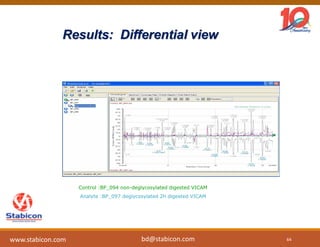
Results: Differential view
Control :BP_094 non-deglycosylated digested VICAM
Analyte :BP_097 deglycosylated 2h digested VICAM
64
www.stabicon.com bd@stabicon.com
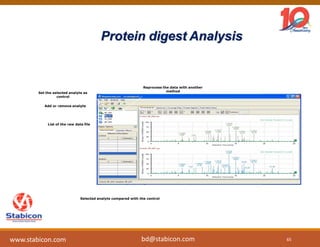
Protein digest Analysis
List of the raw data file
Selected analyte compared with the control
Add or remove analyte
Set the selected analyte as
control
Reprocess the data with another
method
65
www.stabicon.com bd@stabicon.com
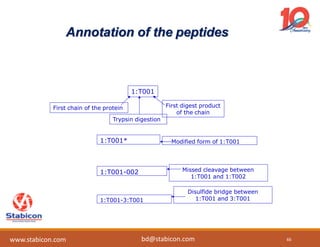
Annotation of the peptides
1:T001
First chain of the protein
Trypsin digestion
First digest product
of the chain
1:T001* Modified form of 1:T001
1:T001-002 Missed cleavage between
1:T001 and 1:T002
1:T001-3:T001
Disulfide bridge between
1:T001 and 3:T001
66
www.stabicon.com bd@stabicon.com
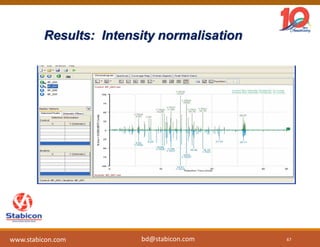
Results: Intensity normalisation
67
www.stabicon.com bd@stabicon.com
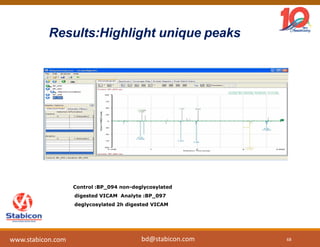
Results:Highlight unique peaks
Control :BP_094 non-deglycosylated
digested VICAM Analyte :BP_097
deglycosylated 2h digested VICAM
68
www.stabicon.com bd@stabicon.com
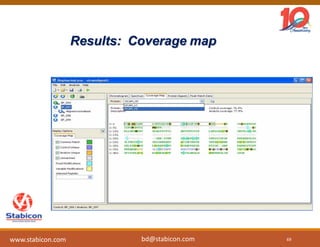
Results: Coverage map
69
www.stabicon.com bd@stabicon.com
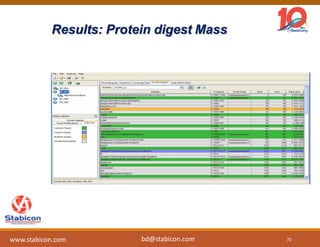
Results: Protein digest Mass
70
www.stabicon.com bd@stabicon.com
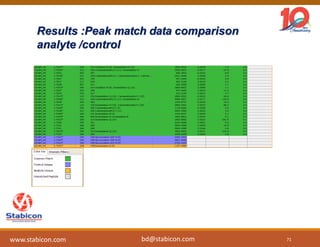
Results :Peak match data comparison
analyte /control
71
www.stabicon.com bd@stabicon.com
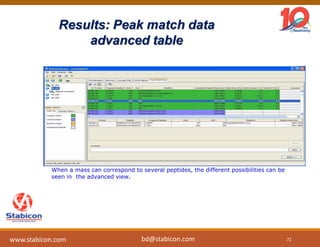
Results: Peak match data
advanced table
When a mass can correspond to several peptides, the different possibilities can be
seen in the advanced view.
72
www.stabicon.com bd@stabicon.com
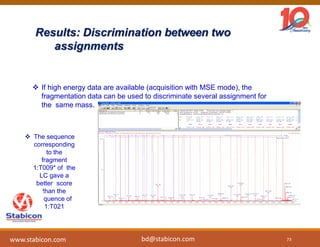
Results: Discrimination between two
assignments
 The sequence
corresponding
to the
fragment
1:T009* of the
LC gave a
better score
than the
sequence of
1:T021
 If high energy data are available (acquisition with MSE mode), the
fragmentation data can be used to discriminate several assignment for
the same mass.
73
www.stabicon.com bd@stabicon.com
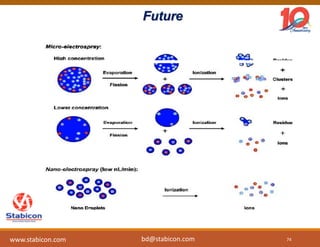
Future
74
www.stabicon.com bd@stabicon.com
Thank you
75
www.stabicon.com
Stabicon Life Sciences, #4M-413,1st Floor, Near
ICICI Bank, H R B R 3rd Block, Kammanahalli Main
Road, Bangalore – 560043, Karnataka, India.
Tel: +91 80 41250324
bd@stabicon.com

Biopharma VS Small Molecules Therapeutic

  • 1.
  • 2.
    Topics Covered : I.Introduction II. Protein Basic Mechanism III. Step in Protein Production IV.Identification and characterization technique V. Monitoring protein synthesis VI.Data Processing Methodology 2 www.stabicon.com bd@stabicon.com
  • 3.
  • 4.
    Therapeutic small moleculebeing dominant for more than 100 year for treatment then why biologics required for therapeutic ? Why??? 4 www.stabicon.com bd@stabicon.com
  • 5.
    How different theyare ? Product Activity Low–high dose High-low dose Production Chemical synthesis Living organism Development Limited Trials Extensive Trials Regulation Non Specfic Specfic Toxicity High Low Elimination Metabolism Endocytosis Structural Folding Not Required Required 5 www.stabicon.com bd@stabicon.com
  • 6.
    What are these? What are these large molecule or biomolecule and how similar are they to human body?  What make them so specific and effective?  What is the correlation of large/ biomolecule molecule to living machinery? 6 www.stabicon.com bd@stabicon.com
  • 7.
    Mechanism for Signaling Severaltypes of molecule modification are involved in regulation for a signal transfer such as : glycosylation, acetylation,etc 7 www.stabicon.com bd@stabicon.com
  • 8.
    Effect in thebody  Small molecule rarely elict secondary signaling thus effect prevail until drug adhere to the target site whereas in case of large molecule always elict an secondary signaling hence effect remain even after the drug is eliminated. 8 www.stabicon.com bd@stabicon.com
  • 9.
    Protein Basic Mechanism Chapter–II 9 www.stabicon.com bd@stabicon.com
  • 10.
  • 11.
    Central dogma Prokaryotic Cell: DNA– (Transcription) RNA – PROTEIN (Translation) Eukaryotic Cell: DNA – RNA – PROTEIN - PROTEIN MODIFIED (Post Translation) 11 www.stabicon.com bd@stabicon.com
  • 12.
  • 13.
    Protein Structure  Primary Secondary  Tertiary  Quaternary ACDEFGHIKLMNPQRSTVWY primary structure 13 www.stabicon.com bd@stabicon.com
  • 14.
    Therapeutic Protein Production Chapter–III 14 www.stabicon.com bd@stabicon.com
  • 15.
    Biopharma  Biopharmaceutical areprotein with considerable therapeutic structural diversity. They tend to between 100 to 1000 times larger than traditional small molecule drug .  Such complex protein can't be produced using convential chemical synthesis rather than in a living cell under stringently controlled condition. 15 www.stabicon.com bd@stabicon.com
  • 16.
    How are thesedesigned 16 www.stabicon.com bd@stabicon.com
  • 17.
  • 18.
  • 19.
    Examples of Biologicsmarketed:  Insulin  Imiglucerase  Glucagon  Human Growth Hormone  Erythropoietin  G-CSF  Interferon 19 www.stabicon.com bd@stabicon.com
  • 20.
  • 21.
    Characterization Step  Primarystructure - peptide mapping  Glycan analysis  Intact Mass analysis  Amino acid and media analysis  Data processing 21 www.stabicon.com bd@stabicon.com
  • 22.
    How to characterize?  Large scale screening of proteins, their expression, modification and interaction by using high-throughput approaches 22 www.stabicon.com bd@stabicon.com
  • 23.
    Characterization Required for Protein identity (mutant protein)  Protein quantity (Expression)  Protein post-translational modifications (up or down)  Protein structure  Protein-protein interaction  Protein localization  Change in any protein property may cause functional abnormality and might be relevant to pathogenesis. Tools  Protein Array  Mass Spectrometry 23 www.stabicon.com bd@stabicon.com
  • 24.
    Why Protein byMass Spectrometry?  MS can unambiguously identify proteins Gel separated proteins  Proteins in mixture  Protein: protein association  Identify precise post translational changes Phosphorylation  N- or C- terminal modification Many more 24 www.stabicon.com bd@stabicon.com
  • 25.
  • 26.
    Protein Identification Technology Seperation MassAnalysis Data processing 26 www.stabicon.com bd@stabicon.com
  • 27.
    MALDI Ionization Protein or Peptide MassSpectrometer Mass/Charge (m/z) Ionization Solution Phase Gas Phase Matrix assisted laser desorption ionization (MALDI), Koichi Tanaka 27 www.stabicon.com bd@stabicon.com
  • 28.
    Data Acquisition fromMALDI-MSI Alanine, peptide in plasma m/z = 1474.6 Valine, m/z = 1502.7 Alanine Valine 28 www.stabicon.com bd@stabicon.com
  • 29.
    Protein or Peptide Mass SpectrometerMass/Charge (m/z) Ionization Solution Phase Gas Phase ESI Ionization Electrospray ionization (ESI), John B Fenn 29 www.stabicon.com bd@stabicon.com
  • 30.
    Data Acquisition fromESI-MSI 30 www.stabicon.com bd@stabicon.com
  • 31.
  • 32.
    How to identifya single protein by MS? Mass/Charge (m/z) Mass Digest into many peptides Mass of many peptides Peptide mass fingerprinting (PMF) Mass of many peptide fragments By Tandem Mass Spectrometry Single protein identification 32 www.stabicon.com bd@stabicon.com
  • 33.
    Protein mixture Analysisby LC-MS/MSy Protein mixture Digestion Peptides 400 800 1200 1600 m/z MS MS/MS 10 20 30 min 0 HPLC Database Searching LLTTIADAAK SAGGNYVVFGEAK EDDVEEAVQAADR All peptide sequences Identification of many proteins 1 sequencing attempt per 0.5 sec. 3600 sequencing attempts in 30 min. 33 www.stabicon.com bd@stabicon.com
  • 34.
    Protein structural Separation •Anion in a compact-form has a high mobility, and hence shorter drift time, •The same ion in a more open conformation has a lower mobility, and hence a longer drift time Gate Detector Neutral Buffer Gas (-ve force) Ring Electrodes (Potential Gradient. +ve force) 34 www.stabicon.com bd@stabicon.com
  • 35.
    HDMS FOR STRUCTURALSEPERATION OF ISOMER 35 www.stabicon.com bd@stabicon.com
  • 36.
    IMS separation ofpeptides and lipids No IMS separation IMS selection of peptides IMS selection of lipids 36 www.stabicon.com bd@stabicon.com
  • 37.
    Why Accurate mass? s IntactProtein Mas Digested Protein Mass 37 www.stabicon.com bd@stabicon.com
  • 38.
  • 39.
    How to identifya single protein by MS/MS? Peptides Theoretical Spectrum Database searching m/z Ionization MS spectrum MS/MS spectrum Fragmentation Protein digestion Peptide/protein identification m/z m/z 200 400 600 800 1000 1200 m/z K G A F D E L Q LIFAGKQLEDGR b ions 1: L 2: LI 3: LIF 4: LIFA 5: LIFAG 6: LIFAGK 7: LIFAGKQ 8: LIFAGKQL 9: LIFAGKQLE 10:LIFAG KQLED 11:LIFAGKQLEDG y ions IFAGKQLEDGR:11 FAGKQLEDGR:10 AGKQLEDGR :9 GKQLEDGR :8 KQLEDGR :7 QLEDGR :6 LEDGR :5 EDGR :4 DGR :3 GR :2 R :1 A G F D E L G LI K Q Q A 39 www.stabicon.com bd@stabicon.com
  • 40.
    N & Cterminal Ions  Selected Peptides (parent ions) are fragmented in the of a nebulizing neutral gas. Energy imparted by collision breaks the covalent bond in parent bonds.  y & b-type ions series thus generated can give us the sequence of the peptide 40 www.stabicon.com bd@stabicon.com
  • 41.
  • 42.
  • 43.
  • 44.
    Monitor the Bioreactor Media& Protein Synthesis Chapter – V 44 www.stabicon.com bd@stabicon.com
  • 45.
  • 46.
  • 47.
  • 48.
    E.Coli Lysate Analysis 48 www.stabicon.com bd@stabicon.com
  • 49.
    Batch Analysis Batch 1aBatch 2aB Batch1b Batch2b Batch1c Batch2c difference in proteins  Proteins (to identify and quantify proteins in multiple samples) How many proteins ?  The choice of method? How many samples?  How many variability parameter? 49 www.stabicon.com bd@stabicon.com
  • 50.
  • 51.
    Data processing  Usinga software product designed to facilitate MS and LCMS analysis of biopharmaceutical samples  Intact proteins: Comparison of an entire protein(s) against a well- characterized standard. Identification of differences, and variants that require further investigation (some could be contaminants).  Peptide map: Comparison of the peptides resulting from a digested protein against the peptides from the known standard. Identification of differences in protein coverage, modifications,… 51 www.stabicon.com bd@stabicon.com
  • 52.
    What software Does Automates data processing and annotation of experimental results Produces annotated spectra, chromatograms, coverage maps and tabular data  Facilitates comparisons between a reference standard and batches of experimental samples  Outputs include formal reports, figure copy/paste, and tabular data export Frees users to concentrate on important questions 52 www.stabicon.com bd@stabicon.com
  • 53.
  • 54.
    54 www.stabicon.com Protein Charge determination The theoretical peak constructe dwith the isotope distribution (purple) and the experiment al peak (green) have the same width at half height. bd@stabicon.com
  • 55.
    Results :Spectra view Stack Overlay Mirror Control:BP_079 non-deglycosylated VICAM Analyte :BP_092 deglycosylated 19h VICAM 55 www.stabicon.com bd@stabicon.com
  • 56.
    Results Spectra view(Intensity filter)zzzz Threshold defined automatically on the spectra T hreshold value typed in the table Filt er applied on the results table 56 www.stabicon.com bd@stabicon.com
  • 57.
    Results: Highlight unique peaks Uniquepeaks highlighting Deglycosylated T022 fragment (analyte only) Glycosylated T022 fragments (control only) Control :BP_094 non-deglycosylated digested VICAM Analyte :BP_097 deglycosylated 2h digested VICAM 57 www.stabicon.com bd@stabicon.com
  • 58.
    Result : Peakmatch data comparison analyte/control 58 www.stabicon.com bd@stabicon.com
  • 59.
    Results Peak matchdata for control (glycosylated) Percentage of each glycosylation state in control Control :BP_079 non-deglycosylated VICAM Analyte :BP_092 deglycosylated 19h VICAM 59 www.stabicon.com bd@stabicon.com
  • 60.
    Results: Peak matchdata for analyte (deglycosylated ) Percentage of each glycosylation state in analyte Control :BP_079 non-deglycosylated VICAM Analyte :BP_092 deglycosylated 19h VICAM 60 www.stabicon.com bd@stabicon.com
  • 61.
    Results: Peak matchdata comparison analyte/control You can add your own comments Control :BP_079 non-deglycosylated VICAM Analyte :BP_092 deglycosylated 19h VICAM 61 www.stabicon.com bd@stabicon.com
  • 62.
  • 63.
    Protein digest Chromatogram Processed Control:BP_094 non-deglycosylated digested VICAM Analyte :BP_097 deglycosylated 2h digested VICAM Raw Matched peptides annotation 63 www.stabicon.com bd@stabicon.com
  • 64.
    Results: Differential view Control:BP_094 non-deglycosylated digested VICAM Analyte :BP_097 deglycosylated 2h digested VICAM 64 www.stabicon.com bd@stabicon.com
  • 65.
    Protein digest Analysis Listof the raw data file Selected analyte compared with the control Add or remove analyte Set the selected analyte as control Reprocess the data with another method 65 www.stabicon.com bd@stabicon.com
  • 66.
    Annotation of thepeptides 1:T001 First chain of the protein Trypsin digestion First digest product of the chain 1:T001* Modified form of 1:T001 1:T001-002 Missed cleavage between 1:T001 and 1:T002 1:T001-3:T001 Disulfide bridge between 1:T001 and 3:T001 66 www.stabicon.com bd@stabicon.com
  • 67.
  • 68.
    Results:Highlight unique peaks Control:BP_094 non-deglycosylated digested VICAM Analyte :BP_097 deglycosylated 2h digested VICAM 68 www.stabicon.com bd@stabicon.com
  • 69.
  • 70.
    Results: Protein digestMass 70 www.stabicon.com bd@stabicon.com
  • 71.
    Results :Peak matchdata comparison analyte /control 71 www.stabicon.com bd@stabicon.com
  • 72.
    Results: Peak matchdata advanced table When a mass can correspond to several peptides, the different possibilities can be seen in the advanced view. 72 www.stabicon.com bd@stabicon.com
  • 73.
    Results: Discrimination betweentwo assignments  The sequence corresponding to the fragment 1:T009* of the LC gave a better score than the sequence of 1:T021  If high energy data are available (acquisition with MSE mode), the fragmentation data can be used to discriminate several assignment for the same mass. 73 www.stabicon.com bd@stabicon.com
  • 74.
  • 75.
    Thank you 75 www.stabicon.com Stabicon LifeSciences, #4M-413,1st Floor, Near ICICI Bank, H R B R 3rd Block, Kammanahalli Main Road, Bangalore – 560043, Karnataka, India. Tel: +91 80 41250324 bd@stabicon.com