Autism 200 SeriesBiomedical TherapiesA Practical ApproachGary Stobbe, MDClinical Assistant ProfessorUniversity of WashingtonAttending NeurologistSeattle Children’s Autism Center
What are Biomedical Therapies?Can be defined as any agent or therapy that directly influences the body’s internal environmentIncludes diet/nutrition, nutraceuticals,  pharmaceuticals, etc.Traditionally excludes “hands-on” therapies (ABA, speech, OT, vision, AIT, CST, neurofeedback, etc.)
Case Study3 ½ yo maleNormal pregnancy and deliveryNormal motor milestones“Picture perfect” babyAt 16 months, says first wordEnjoys physical play, investigates environmentLikes to play by himself
Case Study (cont.)At 18 months, no more words and not responding to his nameTold probably just “late talker” 24 months, hearing test normal30 months, hand flapping when excitedSpeech therapy started; referred for evaluation to r/o autism
Case Study (cont.)36 months, diagnosed with autismEnrolled in developmental preschool, ABA therapy, OT, speech therapyNow echoes some wordsEye contact improvedLoose stools, poor attention, poor sleep
QuestionsWhat caused this (“if I could just figure it out”)?He’s improving, but is it fast enough?Am I doing everything I can?Do I believe the stories and try unproven (and potentially risky) treatments?What do I do first?
Fast Forward…Age 7, 1st grade with 1:1 aide Struggling with social skillsImpulsive behaviors difficult to control, can be violentSevere anxiety over “trivial” eventsUnable to stay on complex tasksTeachers suggesting medication trial
Fast Forward (again)Age 16, ritualistic behavior interfering with daily activitiesExplosive behaviors which were gone have recurred Becoming more isolatedNow what?
Biomedical Therapies in Autism10 Rules to Get You Started
Rule #1Psychoeducational therapy is the foundation of treatment.Biomedicals should never replace behavioral approaches.Highly unlikely that any biomedical will have maximal effect without an appropriate psychoeducational program.
Rule #2No biomedical therapy has proven to be effective in treating “core features” of autism.Minimal “class 1” evidence exists for biomedical therapies in ASD.
Social ImpairmentASD – Core FeaturesASDLanguage/Comm. DeficitsRepetitive Behaviors/ Restricted Interests
Rule #3Autism treatment is symptom-based. Stratify treatment options based on risk.Classic decision making for symptom-based diagnosis.Because treatments generally have little or no efficacy data, risk plays heavy role in decision-making.
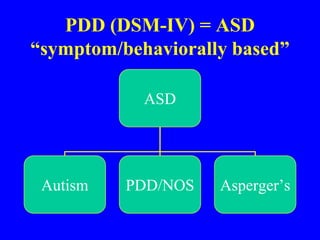
PDD (DSM-IV) = ASD“symptom/behaviorally based”
ASD“causally based”
Causes of ASD85% idiopathic, more common HFA, 4:1 m/f
Symptomatic/cryptogenic more commonly associated with MR, 1:1 m/f ratio
Genetic (tuberous sclerosis, fragile X, Angelman’s, Down’s)
Structural (migration defects, Moebius)
Perinatal (anoxia, infectious)
Epileptic (infantile spasms, Landau-Kleffner)Common Co-morbid Symptom Clusters in ASD - BehavioralAnxiety/OCD (rigidity, sensory sensitivity, transition difficulties, “desire for sameness”)Attention deficit (focus, impulsivity, planning, organization)Mood instability (rapid cycling, extreme behaviors, poor impulse control)
Common Co-morbid Symptom Clusters in ASD - MedicalSleep (initiating, night-time awakening)GI (IBS, food sensitivities, inflammatory)Esophagitis responsible for severe abarrent behaviorsSeizures30-40% classic autism with seizures by teensEpileptiform discharges associated with poor progress? (causal vs. epiphenomenon)
Rule #4Maximizing health goes a long way.Don’t always assume aberrant behaviors are purely due to autism.Follows similar rule as other CNS conditions.Physical exercise, sleep very important.
Rule #5Don’t go out on a limb if making good progress.The opposite is also true – a lack of expected progress through conventional treatments warrants consideration of biomedical therapies.
Measuring Progress in ASDClinical Global Impression – Parent RatingAccurate, although often won’t know whyClinical Global Impression – Clinician RatingObjective MeasuresDifficult to obtain in clinical setting
Biomedical Therapies – Barriers to Clinical ResearchPoorly understood mechanisms/etiologyProbable multiple causesLack of biomarkersPediatric populationPoor fundingMinimal pharmaceutical industry support
Rule #6Implement new treatment in  “controlled” setting if possible.Avoid starting or changing therapies simultaneously, including hands-on therapies and changes in schedule or routine.
Rule #7Define your endpoints.Likelihood of successful treatment will increase if goals of treatment are clearly defined.Define duration of treatment and objective (target symptom).
Rule #8Use “on-off” protocol if benefit not clear.Difficult to see subtle benefit when improving anyway.Trial of discontinuation to observe regression – suggest “on” phase of 1-3 months.
Rule #9Combinations usually work better than pushing the dose of a single agent.Pervasive nature of the disorder often requires addressing multiple neurotransmitter systems.The population is sensitive. Start low and go slow.Remember to identify your target.
Rule #10A treatment that gives benefit today is not necessarily beneficial tomorrow.Some treatments may be age-specific.The reverse may also be true regarding treatment tolerability.
Biomedical TherapiesDietary ModificationSupplementsPharmacological – MedicalPharmacological – BehavioralExperimental
Biomedical Therapies – Dietary ModificationGluten and casein free most commonPossible improvements in hyperactivity, sleep, GI, and core featureImprove health vs. core feature?Additional behavioral benefitwww.gfcfdiet.com
Biomedical Therapies – Dietary Modification (cont.)Theories“Opioid excess theory” related to undigested proteins interfering with brain function“Autoimmunity theory” related to immune response (IgG Abs) to specific undigested protiensBoth theories imply “leaky gut”Improvement over time expected (healing vs. development)
Biomedical Therapies – Supplements“Nutritional”Zinc/iron (common deficiencies)Others (individually based on diet)“Therapeutic”Omega-3 EFAs (Amminger, Biol Psychiatry. 2007). Improved hyperactivity, ?anxiety.High dose B6/magnesium (Mausain-Bosc, Magnes Res, 2006). Improved attention.Dimethylglycine (Kern, J.Child Neurol., 2001)
Biomedical Therapies – Supplements (cont.)Methylcobalamin/folinic acidCofactors in methylation/sulfation enzyme pathwaysImportant for integrity of CNS, immune, GI (Moretti, Neurology, 2005)Improved biomarkers in 20 autistic children (James, J. DAN! Meeting, Portland, 2003)Clinically unproven
Biomedical Therapies – Antifungal/bacterial/viralAntifungal based on “gut dysbiosis” theory? Antiinflammatory effect2 small group studies of antibacterial therapy showing unsustained benefitAntiviral based on “stealth virus” theory or latent GI viral infection (Wakefield, Lancet, 1998 – data later shown to be falsified)
Biomedical Therapies – Sleep DisorderMost effective for sleep initiationMelatoninClonidineTrazadoneTricyclicsGabapentinNeurolepticsConsider sleep study
Biomedical Therapies – GI DysfunctionIBS symptoms common24% of autistics with GI symptoms (Molloy, Autism, 2003)Consider GI study for unexplained severe behaviorsPrevacid trial (possible esophagitis)
Biomedical Therapies – PharmacologicalSerotonin Transporter Inhibitors (SSRIs)Stimulants/non-stimulant ADD medsNeurolepticsAnticonvulsantsSympatholyticsOthers
Biomedical Therapies – Pharmacological (cont.)SSRIsSupported by studies implicating 5-HT (PET, blood)Supported by open label studies (fluoxetine, sertraline, citalopram) and blinded study (fluvoxamine)Targets anxiety, ritualistic/compulsive/repetitive behaviors, maladaptive behavior, aggression
Biomedical Therapies – Pharmacological (cont.)Stimulant/non-stimulant ADD medsTargets ADHD symptoms (attention, hyperactivity)Frequent paradoxical worseningGood safety dataStimulants (methylphenidate, lisdexamfetamine) alpha-adrenergic agonists (guanfacine, clonidine)Newer non-stimulants (atomoxetine, modafinil)Consider amantadine as alternative
Biomedical Therapies – Pharmacological (cont.)NeurolepticsTargets irritability, aggression, impulsivity, ritualistic behaviorGood class 1 evidence (risperidone, aripiprazole)Higher risk profile (weight gain, ? Diabetes, movement disorders)
Biomedical Therapies – Pharmacological (cont.)Anti-convulsants? Association with regressionUp to 46% with EEG epileptiform findingsTarget mood stabilization, irritability, compulsions, agressiveness? Language improvement (Stobbe, AES Meeting, 2006)Better safety with newer agents  (oxcarbazapine, lamotrigine)
Biomedical Therapies – Experimental Goal to find treatments of “core” features (language, social) not just symptom managementNo good supportive data currently
Biomedical Therapies – Experimental (cont.)Chelation therapyBased on mercury/toxic metal theoryOral DMSA approved for acute mercury and lead toxicity? riskNewborn hair study (Holmes, 2003)Urine DMSA challenge study (Bradstreet, 2003)Urinary porphyrin study discredits theory (Woods JS, 2010)

Biomedical Therapies

  • 1.
    Autism 200 SeriesBiomedicalTherapiesA Practical ApproachGary Stobbe, MDClinical Assistant ProfessorUniversity of WashingtonAttending NeurologistSeattle Children’s Autism Center
  • 2.
    What are BiomedicalTherapies?Can be defined as any agent or therapy that directly influences the body’s internal environmentIncludes diet/nutrition, nutraceuticals, pharmaceuticals, etc.Traditionally excludes “hands-on” therapies (ABA, speech, OT, vision, AIT, CST, neurofeedback, etc.)
  • 3.
    Case Study3 ½yo maleNormal pregnancy and deliveryNormal motor milestones“Picture perfect” babyAt 16 months, says first wordEnjoys physical play, investigates environmentLikes to play by himself
  • 4.
    Case Study (cont.)At18 months, no more words and not responding to his nameTold probably just “late talker” 24 months, hearing test normal30 months, hand flapping when excitedSpeech therapy started; referred for evaluation to r/o autism
  • 5.
    Case Study (cont.)36months, diagnosed with autismEnrolled in developmental preschool, ABA therapy, OT, speech therapyNow echoes some wordsEye contact improvedLoose stools, poor attention, poor sleep
  • 6.
    QuestionsWhat caused this(“if I could just figure it out”)?He’s improving, but is it fast enough?Am I doing everything I can?Do I believe the stories and try unproven (and potentially risky) treatments?What do I do first?
  • 7.
    Fast Forward…Age 7,1st grade with 1:1 aide Struggling with social skillsImpulsive behaviors difficult to control, can be violentSevere anxiety over “trivial” eventsUnable to stay on complex tasksTeachers suggesting medication trial
  • 8.
    Fast Forward (again)Age16, ritualistic behavior interfering with daily activitiesExplosive behaviors which were gone have recurred Becoming more isolatedNow what?
  • 9.
    Biomedical Therapies inAutism10 Rules to Get You Started
  • 10.
    Rule #1Psychoeducational therapyis the foundation of treatment.Biomedicals should never replace behavioral approaches.Highly unlikely that any biomedical will have maximal effect without an appropriate psychoeducational program.
  • 11.
    Rule #2No biomedicaltherapy has proven to be effective in treating “core features” of autism.Minimal “class 1” evidence exists for biomedical therapies in ASD.
  • 12.
    Social ImpairmentASD –Core FeaturesASDLanguage/Comm. DeficitsRepetitive Behaviors/ Restricted Interests
  • 13.
    Rule #3Autism treatmentis symptom-based. Stratify treatment options based on risk.Classic decision making for symptom-based diagnosis.Because treatments generally have little or no efficacy data, risk plays heavy role in decision-making.
  • 14.
    PDD (DSM-IV) =ASD“symptom/behaviorally based”
  • 15.
  • 16.
    Causes of ASD85%idiopathic, more common HFA, 4:1 m/f
  • 17.
    Symptomatic/cryptogenic more commonlyassociated with MR, 1:1 m/f ratio
  • 18.
    Genetic (tuberous sclerosis,fragile X, Angelman’s, Down’s)
  • 19.
  • 20.
  • 21.
    Epileptic (infantile spasms,Landau-Kleffner)Common Co-morbid Symptom Clusters in ASD - BehavioralAnxiety/OCD (rigidity, sensory sensitivity, transition difficulties, “desire for sameness”)Attention deficit (focus, impulsivity, planning, organization)Mood instability (rapid cycling, extreme behaviors, poor impulse control)
  • 22.
    Common Co-morbid SymptomClusters in ASD - MedicalSleep (initiating, night-time awakening)GI (IBS, food sensitivities, inflammatory)Esophagitis responsible for severe abarrent behaviorsSeizures30-40% classic autism with seizures by teensEpileptiform discharges associated with poor progress? (causal vs. epiphenomenon)
  • 23.
    Rule #4Maximizing healthgoes a long way.Don’t always assume aberrant behaviors are purely due to autism.Follows similar rule as other CNS conditions.Physical exercise, sleep very important.
  • 24.
    Rule #5Don’t goout on a limb if making good progress.The opposite is also true – a lack of expected progress through conventional treatments warrants consideration of biomedical therapies.
  • 25.
    Measuring Progress inASDClinical Global Impression – Parent RatingAccurate, although often won’t know whyClinical Global Impression – Clinician RatingObjective MeasuresDifficult to obtain in clinical setting
  • 26.
    Biomedical Therapies –Barriers to Clinical ResearchPoorly understood mechanisms/etiologyProbable multiple causesLack of biomarkersPediatric populationPoor fundingMinimal pharmaceutical industry support
  • 27.
    Rule #6Implement newtreatment in “controlled” setting if possible.Avoid starting or changing therapies simultaneously, including hands-on therapies and changes in schedule or routine.
  • 28.
    Rule #7Define yourendpoints.Likelihood of successful treatment will increase if goals of treatment are clearly defined.Define duration of treatment and objective (target symptom).
  • 29.
    Rule #8Use “on-off”protocol if benefit not clear.Difficult to see subtle benefit when improving anyway.Trial of discontinuation to observe regression – suggest “on” phase of 1-3 months.
  • 30.
    Rule #9Combinations usuallywork better than pushing the dose of a single agent.Pervasive nature of the disorder often requires addressing multiple neurotransmitter systems.The population is sensitive. Start low and go slow.Remember to identify your target.
  • 31.
    Rule #10A treatmentthat gives benefit today is not necessarily beneficial tomorrow.Some treatments may be age-specific.The reverse may also be true regarding treatment tolerability.
  • 32.
    Biomedical TherapiesDietary ModificationSupplementsPharmacological– MedicalPharmacological – BehavioralExperimental
  • 33.
    Biomedical Therapies –Dietary ModificationGluten and casein free most commonPossible improvements in hyperactivity, sleep, GI, and core featureImprove health vs. core feature?Additional behavioral benefitwww.gfcfdiet.com
  • 34.
    Biomedical Therapies –Dietary Modification (cont.)Theories“Opioid excess theory” related to undigested proteins interfering with brain function“Autoimmunity theory” related to immune response (IgG Abs) to specific undigested protiensBoth theories imply “leaky gut”Improvement over time expected (healing vs. development)
  • 35.
    Biomedical Therapies –Supplements“Nutritional”Zinc/iron (common deficiencies)Others (individually based on diet)“Therapeutic”Omega-3 EFAs (Amminger, Biol Psychiatry. 2007). Improved hyperactivity, ?anxiety.High dose B6/magnesium (Mausain-Bosc, Magnes Res, 2006). Improved attention.Dimethylglycine (Kern, J.Child Neurol., 2001)
  • 36.
    Biomedical Therapies –Supplements (cont.)Methylcobalamin/folinic acidCofactors in methylation/sulfation enzyme pathwaysImportant for integrity of CNS, immune, GI (Moretti, Neurology, 2005)Improved biomarkers in 20 autistic children (James, J. DAN! Meeting, Portland, 2003)Clinically unproven
  • 37.
    Biomedical Therapies –Antifungal/bacterial/viralAntifungal based on “gut dysbiosis” theory? Antiinflammatory effect2 small group studies of antibacterial therapy showing unsustained benefitAntiviral based on “stealth virus” theory or latent GI viral infection (Wakefield, Lancet, 1998 – data later shown to be falsified)
  • 38.
    Biomedical Therapies –Sleep DisorderMost effective for sleep initiationMelatoninClonidineTrazadoneTricyclicsGabapentinNeurolepticsConsider sleep study
  • 39.
    Biomedical Therapies –GI DysfunctionIBS symptoms common24% of autistics with GI symptoms (Molloy, Autism, 2003)Consider GI study for unexplained severe behaviorsPrevacid trial (possible esophagitis)
  • 40.
    Biomedical Therapies –PharmacologicalSerotonin Transporter Inhibitors (SSRIs)Stimulants/non-stimulant ADD medsNeurolepticsAnticonvulsantsSympatholyticsOthers
  • 41.
    Biomedical Therapies –Pharmacological (cont.)SSRIsSupported by studies implicating 5-HT (PET, blood)Supported by open label studies (fluoxetine, sertraline, citalopram) and blinded study (fluvoxamine)Targets anxiety, ritualistic/compulsive/repetitive behaviors, maladaptive behavior, aggression
  • 42.
    Biomedical Therapies –Pharmacological (cont.)Stimulant/non-stimulant ADD medsTargets ADHD symptoms (attention, hyperactivity)Frequent paradoxical worseningGood safety dataStimulants (methylphenidate, lisdexamfetamine) alpha-adrenergic agonists (guanfacine, clonidine)Newer non-stimulants (atomoxetine, modafinil)Consider amantadine as alternative
  • 43.
    Biomedical Therapies –Pharmacological (cont.)NeurolepticsTargets irritability, aggression, impulsivity, ritualistic behaviorGood class 1 evidence (risperidone, aripiprazole)Higher risk profile (weight gain, ? Diabetes, movement disorders)
  • 44.
    Biomedical Therapies –Pharmacological (cont.)Anti-convulsants? Association with regressionUp to 46% with EEG epileptiform findingsTarget mood stabilization, irritability, compulsions, agressiveness? Language improvement (Stobbe, AES Meeting, 2006)Better safety with newer agents (oxcarbazapine, lamotrigine)
  • 45.
    Biomedical Therapies –Experimental Goal to find treatments of “core” features (language, social) not just symptom managementNo good supportive data currently
  • 46.
    Biomedical Therapies –Experimental (cont.)Chelation therapyBased on mercury/toxic metal theoryOral DMSA approved for acute mercury and lead toxicity? riskNewborn hair study (Holmes, 2003)Urine DMSA challenge study (Bradstreet, 2003)Urinary porphyrin study discredits theory (Woods JS, 2010)