F A L L 2 0 1 2 
UCSF Autism and Neurodevelopment Program 
Greetings from the ANP team 
We have had another busy and productive year. Thanks to many of 
your efforts, our clinical programs have experienced tremendous 
development and research studies have been very active and 
successful. Just a couple of months ago, we introduced the UCSF 
Autism NeuroGenetics Clinic (ANGC), a collaborative clinic that 
brings together autism expertise in neurology and genetics. The 
newly formed ANGC is now taking place monthly, making it easier 
for our families to receive coordinated care. We continue to work 
closely in psychiatry, psychology, genetics and neurology to bring 
together our clinical programs for unified evaluation and treatment 
that is informed by the latest research findings. We also use the 
inspiration from our weekly ANP seminars to drive our clinical care. 
The ANP research community is pushing the boundaries of what is 
known about autism and related neurodevelopmental disorders. The 
addition of our beautiful new neuroscience building at the UCSF 
Mission Bay Campus allows us to enjoy innovative techniques for 
neuroimaging and behavioral studies. Our scientists are studying 
adult outcomes for individuals with autism. We are also investigating 
brain activity in agenesis of the corpus callosum, 16p11.2 genetic 
variations, and dyslexia. Meanwhile, our labs are conducting studies 
of mouse models and stem cells for gene mutations associated with 
autism. Finally, we have ongoing intervention trials with computer 
training tools, standard medications, and nutritional supplements. 
We will highlight these topics as well as the ongoing studies and 
recent publications in this newsletter. 
As we continue to seek new treatments, we welcome your ideas and 
your ongoing support of our mission to integrate personalized care 
with innovative research and education for individuals and families 
with autism and neurodevelopmental disabilities. 
Tips of the Trade 
“Motherese” Can Help 
Language Development 
Auditory Support Strategy: 
Young children with language 
delay may benefit if you speak 
very slowly and clearly with an 
emphasis on the most important 
word(s)—similar to the way you 
talk to a baby. We call this 
“motherese.” 
Visual Support Strategy: When 
possible, show or point to what 
you are talking about to 
enhance comprehension. 
Combined Auditory/Visual 
Strategy: If your child sight 
reads words, you may be able 
to use sight reading to foster 
phonics and spoken language 
by pointing to and reading 
words aloud to help your child 
see what he is hearing.
UCSF AUTISM AND NEURODEVELOPMENT PROGRAM FALL 2012 
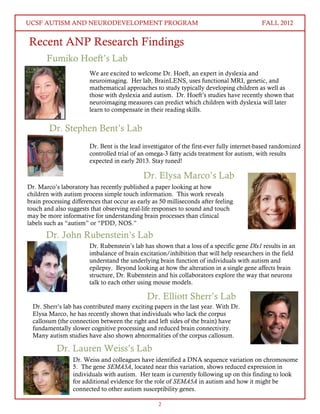
Recent ANP Research Findings 
We are excited to welcome Dr. Hoeft, an expert in dyslexia and 
neuroimaging. Her lab, BrainLENS, uses functional MRI, genetic, and 
mathematical approaches to study typically developing children as well as 
those with dyslexia and autism. Dr. Hoeft’s studies have recently shown that 
neuroimaging measures can predict which children with dyslexia will later 
learn to compensate in their reading skills. 
Dr. Bent is the lead investigator of the first-ever fully internet-based randomized 
controlled trial of an omega-3 fatty acids treatment for autism, with results 
expected in early 2013. Stay tuned! 
Dr. Marco’s laboratory has recently published a paper looking at how 
children with autism process simple touch information. This work reveals 
brain processing differences that occur as early as 50 milliseconds after feeling 
touch and also suggests that observing real-life responses to sound and touch 
may be more informative for understanding brain processes than clinical 
labels such as “autism” or “PDD, NOS.” 
Dr. Rubenstein’s lab has shown that a loss of a specific gene Dlx1 results in an 
imbalance of brain excitation/inhibition that will help researchers in the field 
understand the underlying brain function of individuals with autism and 
epilepsy. Beyond looking at how the alteration in a single gene affects brain 
structure, Dr. Rubenstein and his collaborators explore the way that neurons 
talk to each other using mouse models. 
Dr. Elliott Sherr’s Lab 
Dr. Sherr’s lab has contributed many exciting papers in the last year. With Dr. 
Elysa Marco, he has recently shown that individuals who lack the corpus 
callosum (the connection between the right and left sides of the brain) have 
fundamentally slower cognitive processing and reduced brain connectivity. 
Many autism studies have also shown abnormalities of the corpus callosum. 
2 
Fumiko Hoeft’s Lab 
Dr. Stephen Bent’s Lab 
Dr. Elysa Marco’s Lab 
Dr. John Rubenstein’s Lab 
Dr. Lauren Weiss’s Lab 
Dr. Weiss and colleagues have identified a DNA sequence variation on chromosome 
5. The gene SEMA5A, located near this variation, shows reduced expression in 
individuals with autism. Her team is currently following up on this finding to look 
for additional evidence for the role of SEMA5A in autism and how it might be 
connected to other autism susceptibility genes.
UCSF AUTISM AND NEURODEVELOPMENT PROGRAM FALL 2012 
Dr. Bryna Siegel’s Lab 
Dr. Siegel has studied 21-26 years olds with autism followed since age 2-4 
years. Some had received early intensive behavioral interventions (EIBI) 
and some did not. The highest functioning who had EIBI often lost ASD 
diagnoses; a middle group still met ASD criteria but with improved 
adaptation. The low group showed no significant difference with EIBI, 
but parents felt EIBI had been critical. 
UCSF Autism and Neurodevelopment Clinics 
• Dr. Bryna Siegel, director of the Autism Clinic for over 20 years, will be retiring from UCSF at 
the end of 2012. She will continue to evaluate children and study autism through JumpStart 
Learning to Learn (www.autismjumpstart.org). Dr. Siegel can be reached at 
bryna.siegel@autsimjumpstart.org. We will miss Bryna tremendously but will continue to 
work closely with her in the coming years on shared projects. 
• The UCSF Autism NeuroGenetic Clinic with Drs. Marco and Wynshaw-Boris evaluates and 
treats children monthly, providing a collaborative evaluation that focuses on finding the 
underlying cause of your child’s developmental difference. For more information or an 
appointment, you can call our clinic coordinator, Linda Torres at 415-519-9643. 
• The Autism Clinic at Langley Porter Psychiatric Institute with Dr. Hendren cares for children 
every Tuesday and Wednesday providing in-depth diagnostic evaluation and medication 
treatment recommendations. For an appointment, call: (415) 476-7500 
• The Cognitive and Behavioral Child Neurology Clinic with Dr. Marco takes place every 
Tuesday and provides a comprehensive neurologic evaluation and investigates causes of 
neurodevelopmental differences, provides medical management, and works with the family to 
assemble a treatment team. For an appointment, have your physician fax a referral to: 415- 
353-2400. 
• The Neurodevelopmental Pediatrics Clinic for ADHD and Autism at the Osher Integrative 
Medicine with Dr. Newmark cares for children daily providing integrative and holistic 
treatment by combining conventional medicine with nutrition, behavior management, and 
various complementary modalities. For an appointment, call 415-353-7720. 
3 
Enrolling Studies 
Can an iPad game improve attention for children with and without neurodevelopmental differences? 
(CHR #: 10-01940) 
• Eligibility: Children, ages 8-12 years, with and without ASD, sensory processing differences, and 
ADHD. 
• Contact: Shivani Desai: 415.640.2680, desais@neuropeds.ucsf.edu 
Why are some RASopathy associated features different among affected people? (CHR #: 10-02794) 
• Eligibility: Neurofibromatosis type 1, Noonan, Costello, or cardio-facio-cutaneous syndrome 
(CFC); all ages. 
• Contact: Iris Corbin: 415.476.6988, iris.corbin@ucsf.edu 
Why do more boys than girls have autism? (CHR #: 10-02794) 
• Eligibility: ASD diagnosis (Autism, Asperger’s syndrome, PDD-NOS); all ages. 
• Contact: Iris Corbin: 415.476.6988, iris.corbin@ucsf.edu
More Studies! 
What is the effect of 16p11.2 variations on brain and behavior? (CHR #: 11-06454) 
• Eligibility:16p11.2 variations and Neurotypical Controls; all ages 
• Contact: Polina Bukshpun: 415.502.0183, BukshpunP@neuropeds.ucsf.edu 
What is the relationship between oxytoxin, autism and social function? (CHR #: 11-08189) 
• Eligibility:children with and without autism who are receiving a clinically indicated lumbar 
puncture. 
• Contact: Brieana Fregeau: 415.502.8039, fregeaub@neurology.ucsf.edu 
Does oxytocin help communication between parents and children with autism? (CHR #10-04286) 
• Eligibility: Child (14-28 yrs) and parent/caregiver (30-60 yrs) 
• Contact: Olivia Lam 415-484-5132 
Does the drug memantine help children with autism with communication and socialization? (CHR 
#: 10-01867) 
• Eligibility: ASD diagnosis (Autism, Asperger’s, PDD-NOS); ages 6-12 
• Contact: Felicia Widjaja: 415-476-7803, Felicia.widjaja@ucsf.edu 
Does Vitamin D help children with autism? (CHR #: 11-06899) 
• Eligibility: Autism; ages 3-8 
• Contact: Felicia Widjaja: 415-476-7803, Felicia.widjaja@ucsf.edu 
Does the digestive enzyme CM-AT help children with autism? (CHR #: 10-03510) 
• Eligibility: Autism; ages 9-12 
• Contact: Felicia Widjaja: 415-476-7803, Felicia.widjaja@ucsf.edu
Have a wonderful Fall!! 
The UCSF Autism and Neurodevelopment Program 
ANP.ucsf.edu 
Please forward to friends and groups who may be 
interesting in knowing about our studies 
FALL 2012 
If you would not like to receive newsletters in the future, 
our feelings will not be hurt. Simply email or call 
Shivani Desai at desais@neuropeds.ucsf.edu or 415-640- 
2680.

ANP 2012 Fall Newsletter

  • 1.
    F A LL 2 0 1 2 UCSF Autism and Neurodevelopment Program Greetings from the ANP team We have had another busy and productive year. Thanks to many of your efforts, our clinical programs have experienced tremendous development and research studies have been very active and successful. Just a couple of months ago, we introduced the UCSF Autism NeuroGenetics Clinic (ANGC), a collaborative clinic that brings together autism expertise in neurology and genetics. The newly formed ANGC is now taking place monthly, making it easier for our families to receive coordinated care. We continue to work closely in psychiatry, psychology, genetics and neurology to bring together our clinical programs for unified evaluation and treatment that is informed by the latest research findings. We also use the inspiration from our weekly ANP seminars to drive our clinical care. The ANP research community is pushing the boundaries of what is known about autism and related neurodevelopmental disorders. The addition of our beautiful new neuroscience building at the UCSF Mission Bay Campus allows us to enjoy innovative techniques for neuroimaging and behavioral studies. Our scientists are studying adult outcomes for individuals with autism. We are also investigating brain activity in agenesis of the corpus callosum, 16p11.2 genetic variations, and dyslexia. Meanwhile, our labs are conducting studies of mouse models and stem cells for gene mutations associated with autism. Finally, we have ongoing intervention trials with computer training tools, standard medications, and nutritional supplements. We will highlight these topics as well as the ongoing studies and recent publications in this newsletter. As we continue to seek new treatments, we welcome your ideas and your ongoing support of our mission to integrate personalized care with innovative research and education for individuals and families with autism and neurodevelopmental disabilities. Tips of the Trade “Motherese” Can Help Language Development Auditory Support Strategy: Young children with language delay may benefit if you speak very slowly and clearly with an emphasis on the most important word(s)—similar to the way you talk to a baby. We call this “motherese.” Visual Support Strategy: When possible, show or point to what you are talking about to enhance comprehension. Combined Auditory/Visual Strategy: If your child sight reads words, you may be able to use sight reading to foster phonics and spoken language by pointing to and reading words aloud to help your child see what he is hearing.
  • 2.
    UCSF AUTISM ANDNEURODEVELOPMENT PROGRAM FALL 2012 Recent ANP Research Findings We are excited to welcome Dr. Hoeft, an expert in dyslexia and neuroimaging. Her lab, BrainLENS, uses functional MRI, genetic, and mathematical approaches to study typically developing children as well as those with dyslexia and autism. Dr. Hoeft’s studies have recently shown that neuroimaging measures can predict which children with dyslexia will later learn to compensate in their reading skills. Dr. Bent is the lead investigator of the first-ever fully internet-based randomized controlled trial of an omega-3 fatty acids treatment for autism, with results expected in early 2013. Stay tuned! Dr. Marco’s laboratory has recently published a paper looking at how children with autism process simple touch information. This work reveals brain processing differences that occur as early as 50 milliseconds after feeling touch and also suggests that observing real-life responses to sound and touch may be more informative for understanding brain processes than clinical labels such as “autism” or “PDD, NOS.” Dr. Rubenstein’s lab has shown that a loss of a specific gene Dlx1 results in an imbalance of brain excitation/inhibition that will help researchers in the field understand the underlying brain function of individuals with autism and epilepsy. Beyond looking at how the alteration in a single gene affects brain structure, Dr. Rubenstein and his collaborators explore the way that neurons talk to each other using mouse models. Dr. Elliott Sherr’s Lab Dr. Sherr’s lab has contributed many exciting papers in the last year. With Dr. Elysa Marco, he has recently shown that individuals who lack the corpus callosum (the connection between the right and left sides of the brain) have fundamentally slower cognitive processing and reduced brain connectivity. Many autism studies have also shown abnormalities of the corpus callosum. 2 Fumiko Hoeft’s Lab Dr. Stephen Bent’s Lab Dr. Elysa Marco’s Lab Dr. John Rubenstein’s Lab Dr. Lauren Weiss’s Lab Dr. Weiss and colleagues have identified a DNA sequence variation on chromosome 5. The gene SEMA5A, located near this variation, shows reduced expression in individuals with autism. Her team is currently following up on this finding to look for additional evidence for the role of SEMA5A in autism and how it might be connected to other autism susceptibility genes.
  • 3.
    UCSF AUTISM ANDNEURODEVELOPMENT PROGRAM FALL 2012 Dr. Bryna Siegel’s Lab Dr. Siegel has studied 21-26 years olds with autism followed since age 2-4 years. Some had received early intensive behavioral interventions (EIBI) and some did not. The highest functioning who had EIBI often lost ASD diagnoses; a middle group still met ASD criteria but with improved adaptation. The low group showed no significant difference with EIBI, but parents felt EIBI had been critical. UCSF Autism and Neurodevelopment Clinics • Dr. Bryna Siegel, director of the Autism Clinic for over 20 years, will be retiring from UCSF at the end of 2012. She will continue to evaluate children and study autism through JumpStart Learning to Learn (www.autismjumpstart.org). Dr. Siegel can be reached at bryna.siegel@autsimjumpstart.org. We will miss Bryna tremendously but will continue to work closely with her in the coming years on shared projects. • The UCSF Autism NeuroGenetic Clinic with Drs. Marco and Wynshaw-Boris evaluates and treats children monthly, providing a collaborative evaluation that focuses on finding the underlying cause of your child’s developmental difference. For more information or an appointment, you can call our clinic coordinator, Linda Torres at 415-519-9643. • The Autism Clinic at Langley Porter Psychiatric Institute with Dr. Hendren cares for children every Tuesday and Wednesday providing in-depth diagnostic evaluation and medication treatment recommendations. For an appointment, call: (415) 476-7500 • The Cognitive and Behavioral Child Neurology Clinic with Dr. Marco takes place every Tuesday and provides a comprehensive neurologic evaluation and investigates causes of neurodevelopmental differences, provides medical management, and works with the family to assemble a treatment team. For an appointment, have your physician fax a referral to: 415- 353-2400. • The Neurodevelopmental Pediatrics Clinic for ADHD and Autism at the Osher Integrative Medicine with Dr. Newmark cares for children daily providing integrative and holistic treatment by combining conventional medicine with nutrition, behavior management, and various complementary modalities. For an appointment, call 415-353-7720. 3 Enrolling Studies Can an iPad game improve attention for children with and without neurodevelopmental differences? (CHR #: 10-01940) • Eligibility: Children, ages 8-12 years, with and without ASD, sensory processing differences, and ADHD. • Contact: Shivani Desai: 415.640.2680, desais@neuropeds.ucsf.edu Why are some RASopathy associated features different among affected people? (CHR #: 10-02794) • Eligibility: Neurofibromatosis type 1, Noonan, Costello, or cardio-facio-cutaneous syndrome (CFC); all ages. • Contact: Iris Corbin: 415.476.6988, iris.corbin@ucsf.edu Why do more boys than girls have autism? (CHR #: 10-02794) • Eligibility: ASD diagnosis (Autism, Asperger’s syndrome, PDD-NOS); all ages. • Contact: Iris Corbin: 415.476.6988, iris.corbin@ucsf.edu
  • 4.
    More Studies! Whatis the effect of 16p11.2 variations on brain and behavior? (CHR #: 11-06454) • Eligibility:16p11.2 variations and Neurotypical Controls; all ages • Contact: Polina Bukshpun: 415.502.0183, BukshpunP@neuropeds.ucsf.edu What is the relationship between oxytoxin, autism and social function? (CHR #: 11-08189) • Eligibility:children with and without autism who are receiving a clinically indicated lumbar puncture. • Contact: Brieana Fregeau: 415.502.8039, fregeaub@neurology.ucsf.edu Does oxytocin help communication between parents and children with autism? (CHR #10-04286) • Eligibility: Child (14-28 yrs) and parent/caregiver (30-60 yrs) • Contact: Olivia Lam 415-484-5132 Does the drug memantine help children with autism with communication and socialization? (CHR #: 10-01867) • Eligibility: ASD diagnosis (Autism, Asperger’s, PDD-NOS); ages 6-12 • Contact: Felicia Widjaja: 415-476-7803, Felicia.widjaja@ucsf.edu Does Vitamin D help children with autism? (CHR #: 11-06899) • Eligibility: Autism; ages 3-8 • Contact: Felicia Widjaja: 415-476-7803, Felicia.widjaja@ucsf.edu Does the digestive enzyme CM-AT help children with autism? (CHR #: 10-03510) • Eligibility: Autism; ages 9-12 • Contact: Felicia Widjaja: 415-476-7803, Felicia.widjaja@ucsf.edu
  • 5.
    Have a wonderfulFall!! The UCSF Autism and Neurodevelopment Program ANP.ucsf.edu Please forward to friends and groups who may be interesting in knowing about our studies FALL 2012 If you would not like to receive newsletters in the future, our feelings will not be hurt. Simply email or call Shivani Desai at desais@neuropeds.ucsf.edu or 415-640- 2680.