Padmashree Dr. Vitthalrao Vikhe Patil
College of Physiotherapy
Vadgoan Gupta,
Ahmednagar(M.S.)
414111
www.vims.edu.in
By- Dr. Vrushali S. Jadhav
PG in Musculoskeletal Sciences
Guide- Dr. Deepak Anap
Associate Professor

 Lever
 Type of lever
 Clinical application in physiotherapy
 Force couple
 Resolution of forces
Objective

 Principle of rigid bar
 3 forces of mechanical lever-
Axis(A)
Weight(W or R)
Moving force(F or E)
Lever

 The bones and muscles in the body act as lever systems
Bones—levers
Joints---fulcrum
Muscles contracting ---effort
Resistance(load)-----COG of part moved or object to be lifted

First Order- Balance
Second Order- Power
Third Order- Speed
Order of Lever

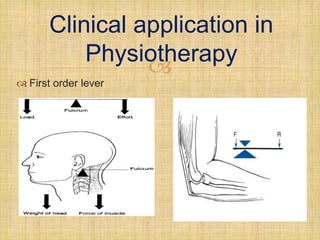
 First order lever
Clinical application in
Physiotherapy

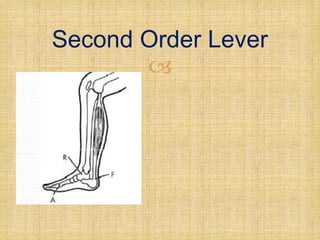
Second Order Lever

Third Order Lever


Torque
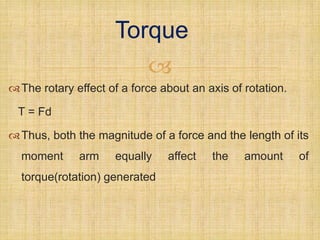
The rotary effect of a force about an axis of rotation.
T = Fd
Thus, both the magnitude of a force and the length of its
moment arm equally affect the amount of
torque(rotation) generated

Force Couple
 Pure force couple-
rotational motion
 In General- both
translational & rotational
motion

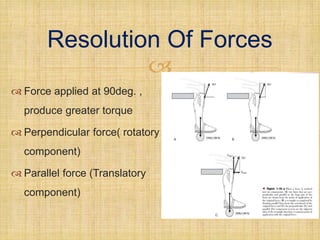
 Force applied at 90deg. ,
produce greater torque
 Perpendicular force( rotatory
component)
 Parallel force (Translatory
component)
Resolution Of Forces

 To visualize the effect of such angular forces on the
body.
 To determine the torque produced by the forces.
 To calculate the magnitude of unknown muscle &
joint forces.
Uses


Muscle Role Versus Angle Of Attachment
Mechanical advantage is greater at 90 elbow flexion

 Joint structure and function by Cynthia Norkin, 4th
edition.
 Brunstorm’s Clinical Kinesiology, 5th edition.
 Kinesiology by Carol Oatis, 2nd edition.
 Biomechanical basis of Human Movement by Joseph
Hamill, 2nd edition.
 The principle of exercise therapy by Dena Gardiner,
4th edition.
References

Thank You

Biomechanics

  • 1.
    Padmashree Dr. VitthalraoVikhe Patil College of Physiotherapy Vadgoan Gupta, Ahmednagar(M.S.) 414111 www.vims.edu.in
  • 2.
    By- Dr. VrushaliS. Jadhav PG in Musculoskeletal Sciences Guide- Dr. Deepak Anap Associate Professor
  • 3.
      Lever  Typeof lever  Clinical application in physiotherapy  Force couple  Resolution of forces Objective
  • 4.
      Principle ofrigid bar  3 forces of mechanical lever- Axis(A) Weight(W or R) Moving force(F or E) Lever
  • 5.
      The bonesand muscles in the body act as lever systems Bones—levers Joints---fulcrum Muscles contracting ---effort Resistance(load)-----COG of part moved or object to be lifted
  • 6.
     First Order- Balance SecondOrder- Power Third Order- Speed Order of Lever
  • 7.
      First orderlever Clinical application in Physiotherapy
  • 8.
  • 9.
  • 10.
  • 11.
     Torque The rotary effectof a force about an axis of rotation. T = Fd Thus, both the magnitude of a force and the length of its moment arm equally affect the amount of torque(rotation) generated
  • 12.
     Force Couple  Pureforce couple- rotational motion  In General- both translational & rotational motion
  • 13.
      Force appliedat 90deg. , produce greater torque  Perpendicular force( rotatory component)  Parallel force (Translatory component) Resolution Of Forces
  • 14.
      To visualizethe effect of such angular forces on the body.  To determine the torque produced by the forces.  To calculate the magnitude of unknown muscle & joint forces. Uses
  • 15.
  • 16.
     Muscle Role VersusAngle Of Attachment Mechanical advantage is greater at 90 elbow flexion
  • 17.
      Joint structureand function by Cynthia Norkin, 4th edition.  Brunstorm’s Clinical Kinesiology, 5th edition.  Kinesiology by Carol Oatis, 2nd edition.  Biomechanical basis of Human Movement by Joseph Hamill, 2nd edition.  The principle of exercise therapy by Dena Gardiner, 4th edition. References
  • 18.