BBIIOOLLOOGGYY
IINNVVEESSTTIIGGAATTOORRYY
PPRROOJJEECCTT
TTooppiicc-- SSIICCKKLLEE CCEELLLL AANNEEMMIIAA
PPRROOJJEECCTT BBYY-- HHAARRIIOOMM KKUUMMAARR RROOYY
CCLLAASSSS-- XXIIII--BB
GGUUIIDDEEDD BBYY-- MMRR..RRAAHHUULL DDEEVV MMAANNDDAALL
BBOOAARRDD RROOLLLL NNOO--
BiologyInvestigatoryProject Hariom kumar roy
Page | 1
CCEERRTTIIFFIICCAATTEE
TThhiiss iiss ttoo cceerrttiiffyy tthhaatt HHaarriioomm KKuummaarr RRooyy ssttuuddeenntt
ooff ccllaassss XXIIII--BB hhaass ssuucccceessssffuullllyy .. CCoommpplleetteedd tthhee
BBiioollooggyy pprroojjeecctt uunnddeerr tthhee gguuiiddaannccee ooff MMrr.. RRaahhuull
ddeevv mmaannddaall.. TThhiiss pprroojjeecctt iiss ggeennuuiinnee aanndd iiss nnoott
ppllaaggiiaarriissmm ooff aannyy kkiinndd .. TThhee rreeffeerreenncceess uusseedd iinn
mmaakkiinngg tthhiiss pprroojjeecctt ffiillee aarree ddeeccllaarreedd aatt tthhee eenndd ooff
tthhee ffiillee..
EExxtteerrnnaall’’ss SSiiggnn:: IInntteerrnnaall’’ss SSiiggnn::
PPrriinncciippaall ssiiggnnaattuurree
SScchhooooll ssttaammpp
BiologyInvestigatoryProject Hariom kumar roy
Page | 2
AACCKKNNOOWWLLEEDDGGEEMMEENNTT
II wwiisshh ttoo eexxpprreessss mmyy ddeeeepp ggrraattiittuuddee aanndd ssiinncceerree
tthhaannkkss ttoo tthhee pprriinncciippaall ,,MMrr SShhiibbuu VV .. rraajjuu ,, HHOOLLYY
MMAARRYY IINNTTEERRNNAATTIIOONNAALL SSCCHHOOOOLL,,DDAARRBBHHAANNGGAA
hhiiss eennccoouurraaggeemmeenntt aanndd ffoorr aallll tthhee ffaacciilliittiieess hhee
hhaass pprroovviiddeedd ffoorr tthhiiss pprroojjeecctt..II eexxtteenndd mmyy hheeaarrttyy
tthhaannkkss ttoo mmyy ccllaassss tteeaacchheerr MMrr.. RRaahhuull DDeevv MMaannddaall
wwhhoo gguuiiddeedd mmee ttoo tthhee ssuucccceessssffuull ccoommpplleettiioonn ooff
tthhiiss pprroojjeecctt.. II ttaakkee tthhiiss ooppppoorrttuunniittyy ttoo eexxpprreessss
mmyy ddeeeepp sseennssee ooff ggrraattiittuuddee ffoorr tthheeiirr iinnvvaalluuaabbllee
gguuiiddaannccee,,ccoonnssttaanntt eennccoouurraaggeemmeenntt aanndd iimmmmeennssee
mmoottiivvaattiioonn wwhhiicchh hhaass ssuussttaaiinneedd mmyy eeffffoorrttss aatt aallll
ssttaaggeess ooff tthhiiss pprroojjeecctt wwoorrkk.. II ccaann’’tt ffoorrggeett ttoo ooffffeerr
mmyy ssiinncceerree tthhaannkkss ttoo mmyy ccllaassssmmaatteess wwhhoo hheellppeedd
mmee ttoo ccaarrrryy oouutt tthhiiss pprroojjeecctt wwoorrkk ssuucccceessssffuullllyy
aanndd ffoorr tthheeiirr vvaalluuaabbllee aaddvviiccee aanndd ssuuppppoorrtt
wwhhiicchh II rreecceeiivveedd ffoorr tthheemm ttiimmee ttoo ttiimmee..
BiologyInvestigatoryProject Hariom kumar roy
Page | 3
IInnddeexx
SS..NNOO CCoonntteennttss PPgg..NNoo
11 AAIIMM 0044
22 AABBSSTTRRAACCTT 0055
33 SSIICCKKLLEE CCEELLLL
MMUUTTAATTIIOONN
0077
44 SSIICCKKLLEE CCEELLLL
TTRRAAIITT
0088
55 SSIIGGNN AANNDD
SSYYMMPPTTOOMMSS
RREELLAATTEEDD TTOO
PPAAIINN
0099
66 SSTTEEPP TTOO
PPRREEVVEENNTT AANNDD
CCOONNTTRROOLL
CCOOMMPPLLIICCAATTIIOONN
1111
77 RREEFFEERREENNCCEE 2233
BiologyInvestigatoryProject Hariom kumar roy
Page | 4
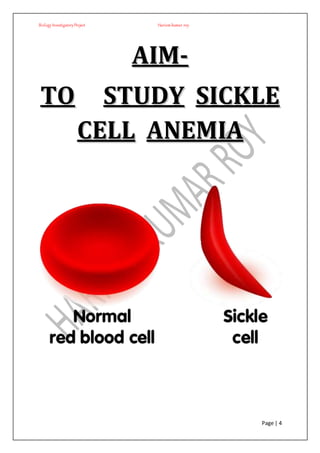
AAIIMM--
TTOO SSTTUUDDYY SSIICCKKLLEE
CCEELLLL AANNEEMMIIAA
BiologyInvestigatoryProject Hariom kumar roy
Page | 5
AABBSSTTRRAACCTT
Sickle cell anemia is the most common form of
sickle cell disease (SCD). SCD is a serious disorder
in which the body makes sickle-shaped red blood
cells. “Sickle-shaped” means that the red blood
cells are shaped like a crescent.
Normal red blood cells are disc-shaped and look
like doughnuts without holes in the center. They
move easily through your blood vessels. Red
blood cells contain an iron-rich protein called
hemoglobin. This protein carries oxygen from the
lungs to the rest of the body.Sickle cells contain
abnormal hemoglobin called sickle hemoglobin or
hemoglobin S. Sickle hemoglobin causes the cells
to develop a sickle, or crescent, shape.
Sickle cells are stiff and sticky. They tend to block
blood flow in the blood vessels of the limbs and
organs. Blocked blood flow can cause pain and
organ damage. It can also raise the risk for
infection.
BiologyInvestigatoryProject Hariom kumar roy
Page | 6
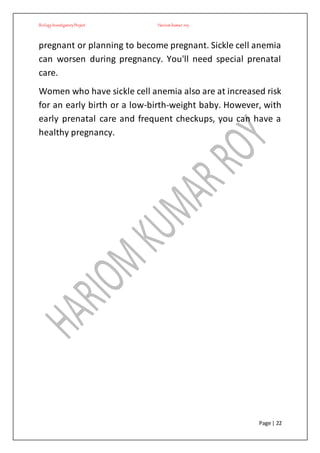
Normal Red Blood Cells and
Sickle cells-
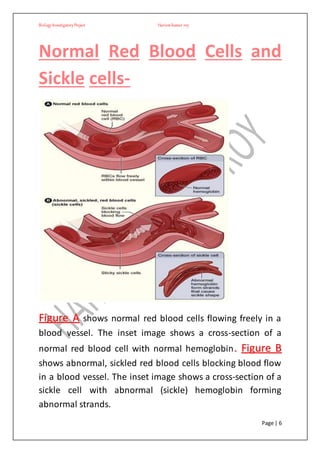
FFiigguurree AA shows normal red blood cells flowing freely in a
blood vessel. The inset image shows a cross-section of a
normal red blood cell with normal hemoglobin.. FFiigguurree BB
shows abnormal, sickled red blood cells blocking blood flow
in a blood vessel. The inset image shows a cross-section of a
sickle cell with abnormal (sickle) hemoglobin forming
abnormal strands.
BiologyInvestigatoryProject Hariom kumar roy
Page | 7
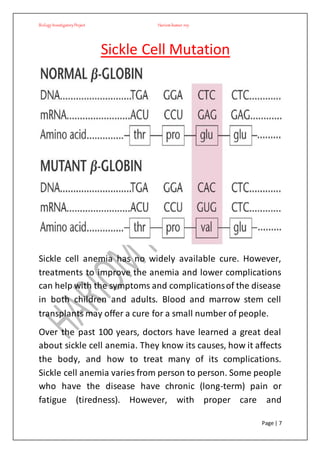
Sickle Cell Mutation
Sickle cell anemia has no widely available cure. However,
treatments to improve the anemia and lower complications
can help with the symptoms and complicationsof the disease
in both children and adults. Blood and marrow stem cell
transplants may offer a cure for a small number of people.
Over the past 100 years, doctors have learned a great deal
about sickle cell anemia. They know its causes, how it affects
the body, and how to treat many of its complications.
Sickle cell anemia varies from person to person. Some people
who have the disease have chronic (long-term) pain or
fatigue (tiredness). However, with proper care and
BiologyInvestigatoryProject Hariom kumar roy
Page | 8
treatment, many people who have the disease can have
improved quality of life and reasonable health much of the
time.
Because of improved treatments and care, people who have
sickle cell anemia are now living into their forties or fifties, or
longer.
 What Causes Sickle Cell
Anemia?
Sickle cell anemia is an inherited disease. People who have
the disease inherit two genes for sickle hemoglobin—one
from each parent.
Sickle hemoglobin causes red blood cells to develop a sickle,
or crescent, shape. Sickle cells are stiff and sticky. They tend
to block blood flow in the blood vessels of the limbs and
organs. Blocked blood flow can cause pain and organ
damage. It can also raise the risk for infection.
Sickle Cell Trait
People who inherit a sickle hemoglobin gene from one
parent and a normal gene from the other parent have sickle
cell trait. Their bodies make both sickle hemoglobin and
normal hemoglobin.
BiologyInvestigatoryProject Hariom kumar roy
Page | 9
People who have sickle cell trait usually have few, if any,
symptoms and lead normal lives. However, some people may
have medical complications.
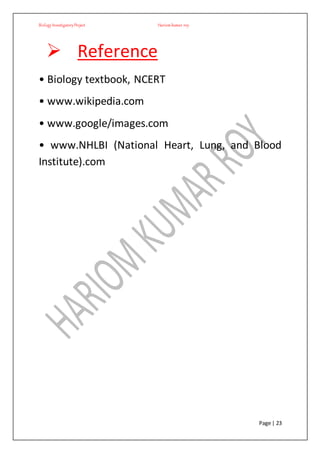
People who have sickle cell trait can pass the sickle
hemoglobin gene to their children. The following image
shows an example of an inheritance pattern for sickle cell
trait.
Example of an Inheritance Pattern for Sickle Cell Trait
When both parents have a normal gene and an abnormal
gene, each child has a 25 percent chance of inheriting two
normal genes; a 50 percent chance of inheriting one normal
gene and one abnormal
 What Are the Signs and
Symptoms of Sickle Cell Anemia
The signs and symptoms of sickle cell anemia vary. Some
people have mild symptoms. Others have very severe
symptoms and often are hospitalizedfor treatment.Sickle cell
anemia is present at birth, but many infants don't show any
signs until after 4 months of age.The most common signs and
symptoms are linked to anemia and pain. Other signs and
symptoms are linked to the disease's complications.
BiologyInvestigatoryProject Hariom kumar roy
Page | 10
Signs and Symptoms Related to
Anemia
The most common symptom of anemia is fatigue (feeling
tired or weak). Other signs and symptoms of anemia include:
• Shortness of breath
• Dizziness
• Headaches
• Coldness in the hands and feet
• Paler than normal skin or mucous membranes (the tissue
that lines your nose, mouth, and other organs and body
cavities)
• Jaundice(a yellowish color of the skin or whites of the eyes)
Signs and Symptoms Related to Pain
Sudden pain throughout the body is a common symptom of
sickle cell anemia. This pain is called a sickle cell crisis. Sickle
cell crises often affect the bones, lungs, abdomen, and joints.
These crises occur when sickled red blood cells block blood
flow to the limbs and organs. This can cause pain and organ
damage.The pain from sickle cell anemia can be acute or
chronic, but acute pain is more common. Acute pain is
sudden and can range from mild to very severe. The pain
BiologyInvestigatoryProject Hariom kumar roy
Page | 11
usually lasts from hours to as long as a week or more.Many
people who have sickle cell anemia also have chronic pain,
especially in their bones. Chronic pain often lasts for weeks
or months and can be hard to bear and mentally draining.
Chronic pain may limit your daily activities.
Almost all people who have sickle cell anemia have painful
crises at some point in their lives. Some have these crises less
than once a year. Others may have crises once a month or
more. Repeated crises can damage the bones, kidneys, lungs,
eyes, heart, and liver. This type of damage happens more
often in adults than in children.Many factors can play a role
in sickle cell crises. Often, more than one factor is involved
and the exact cause isn't known.
You can control some factors. For example, the risk
of a sickle cell crisis increases if you're dehydrated (your
body doesn't have enough fluids). Drinking plenty of
fluids can lower the risk of a painful crisis.You can't
control other factors, such as infections.Painful crises
are the leading cause of emergency room visits and
hospital stays for people who have sickle cell anemia.
Complications of Sickle Cell
Anemia
Sickle cell crises can affect many parts of the body and cause
many complications.
BiologyInvestigatoryProject Hariom kumar roy
Page | 12
 Hand-Foot Syndrome
Sickle cells can block the small blood vessels in the hands and
feet in children (usually those younger than 4 years of age).
This condition is called hand-foot syndrome. It can lead to
pain, swelling, and fever.Swelling often occurs on the back of
the hands and feet and moves into the fingers and toes. One
or both hands and/or feet might be affected at the same
time.
 Splenic Crisis
The spleen is an organ in the abdomen. Normally, it filters
out abnormal red blood cells and helps fight infections.
Sometimes the spleen may trap red blood cells that should
be in the bloodstream. This causes the spleen to grow large
and leads to anemia.If the spleen traps too many red blood
cells, you may need blood transfusionsuntil your body can
make more cells and recover.
 Infections
Both children and adults who have sickle cell anemia may get
infections easily and have a hard time fighting them. This is
because sickle cell anemia can damage the spleen, an organ
that helps fight infections.
Infants and young children who have damaged spleens are
more likely to get serious infections that can kill them within
BiologyInvestigatoryProject Hariom kumar roy
Page | 13
hours or days. Bloodstream infections are the most common
cause of death in young children who have sickle cell
anemia.Medicines and vaccines can help prevent severe
illness and death. For example, vaccines are available for
infections such as meningitis, influenza, and hepatitis.
Getting treatment right away for high fevers (which can be a
sign of a severe infection) also helps prevent death in infants
and children who have sickle cell anemia.It's also important
to get treatment right away for a cough, problems breathing,
bone pain, and headaches.
 Acute Chest Syndrome
Acute chest syndrome is a life-threatening conditionlinkedto
sickle cell anemia. This syndrome is similar to pneumonia. An
infection or sickle cells trapped in the lungs can cause acute
chest syndrome.People who have this condition often have
chest pain, shortness of breath, and fever. They also often
have low oxygen levels and abnormal chest X ray results.
 Pulmonary Hypertension
Damage to the small blood vessels in the lungs makes it hard
for the heart to pump blood through the lungs. This causes
blood pressure in the lungs to rise.Increased blood pressure
in the lungs is called pulmonary hypertension (PH). Shortness
of breath and fatigue are the main symptoms of PH.
BiologyInvestigatoryProject Hariom kumar roy
Page | 14
 Delayed Growth and Puberty in
Children
Children who have sickle cell anemia often grow more slowly
than other children. They may reach puberty later. A
shortage of red blood cells causes the slow growth rate.
Adults who have sickle cell anemia often are slender or
smaller in size than other adults.
 Stroke
Two forms of stroke can occur in people who have sickle cell
anemia. One form occurs if a blood vessel in the brain is
damaged and blocked. This type of stroke occurs more often
in children than adults. The other form of stroke occurs if a
blood vessel in the brain bursts.Either type of stroke can
cause learning problems and lasting brain damage, long-term
disability, paralysis (an inability to move), or death.
 Eye Problems
Sickle cells also can affect the small blood vessels that deliver
oxygen-rich blood to the eyes. Sickle cells can block these
vessels or cause them to break open and bleed. This can
damage the retinas—thin layers of tissue at the back of the
eyes. The retinas take the images you see and send them to
your brain.This damage can cause serious problems,
including blindness.
BiologyInvestigatoryProject Hariom kumar roy
Page | 15
 Priapism
Males who have sickle cell anemia may have painful,
unwanted erections. This condition is called priapism. It
happens because the sickle cells block blood flow out of an
erect penis. Over time, priapism can damage the penis and
lead to impotence.
 Gallstones
When red blood cells die, they release their hemoglobin. The
body breaks down this protein into a compound called
bilirubin. Too much bilirubin in the body can cause stones to
form in the gallbladder, called gallstones.Gallstones may
cause steady pain that lasts for 30 minutes or more in the
upper right side of the belly, under the right shoulder, or
between the shoulder blades. The pain may happen after
eating fatty meals.
People who have gallstones may have nausea (feeling sick to
the stomach), vomiting, fever, sweating, chills, clay-colored
stools, or jaundice.
 Ulcers on the Legs
Sickle cell ulcers (sores) usually begin as small, raised, crusted
sores on the lower third of the leg. Leg sores may occur more
often in males than in females. These sores usuallydevelop in
people who are aged 10 years or older.The cause of sickle cell
BiologyInvestigatoryProject Hariom kumar roy
Page | 16
ulcers isn't clear. The number of ulcers can vary from one to
many. Some heal quickly, but others persist for years or
come back after healing.
 Multiple Organ Failure
Multiple organ failure is rare, but serious. It happens if you
have a sickle cell crisis that causes two out of three major
organs (lungs, liver, or kidneys) to fail. Often, multiple organ
failure occurs during an unusually severe pain
crisis.Symptoms of this complication are fever, rapid
heartbeat, problems breathing, and changes in mental status
(such as sudden tiredness or confusion).
How is Sickle Cell Anemia
Diagnosed?
A simple blood test, done at any time during a person's
lifespan, can detect whether he or she has sickle hemoglobin.
However, early diagnosis is very important.
In the United States, all States mandate testing for sickle cell
anemia as part of their newborn screening programs. The
test uses blood from the same blood samples used for other
routine newborn screening tests. The test can show whether
a newborn infant has sickle hemoglobin.Test results are sent
to the doctor who ordered the test and to the baby's primary
care doctor. It's important to give the correct contact
BiologyInvestigatoryProject Hariom kumar roy
Page | 17
information to the hospital. This allows the baby's doctor to
get the test results as quickly as possible.
Health providers from a newborn screening followup
program may contact you directly to make sure you're aware
of the test results.If the test shows some sickle hemoglobin, a
second blood test is done to confirm the diagnosis. The
second test should be done as soon as possible and within
the first few months of life.
The primary care doctor may send you to a hematologist for
a second blood test. A hematologist is a doctor who
specializes in blood diseases and disorders. This doctor also
can provide treatment for sickle cell disease if needed.
Doctors also can diagnose sickle cell disease before birth. This
is done using a sample of amniotic fluid or tissue taken from
the placenta. (Amniotic fluid is the fluid in the sac
surrounding a growing embryo. The placenta is the organ
that attaches the umbilical cord to the mother's
womb.)Testing before birth can be done as early as 10 weeks
into the pregnancy. This testing looks for the sickle
hemoglobingene, rather than the abnormal hemoglobin that
the gene makes.
 New Treatments
Research on blood and marrow stem cell transplants, gene
therapy, and new medicines for sickle cell anemia is ongoing.
The hope is that these studies will provide better treatments
BiologyInvestigatoryProject Hariom kumar roy
Page | 18
for the disease. Researchers also are looking for a way to
predict the severity of the disease.
 Blood and Marrow Stem Cell
Transplant
A blood and marrow stem cell transplant can work well for
treating sickle cell anemia. This treatment may even offer a
cure for a small number of people.The stem cells used for a
transplant must come from a closely matched donor. The
donor usually is a close family member who doesn't have
sickle cell anemia. This limits the number of people who may
have a donor.
The transplant process is risky and can lead to serious side
effects or even death. However, new transplant approaches
may improve treatment for people who have sickle cell
anemia and involve less risk.Blood and marrow stem cell
transplants usually are used for young patients who have
severe sickle cell anemia. However, the decision to give this
treatment is made on a case-by-case basis.
Researchers continue to look for sources of bone marrow
stem cells—for example, blood from babies' umbilical cords.
They also continue to look for ways to reduce the risks of this
procedure.
BiologyInvestigatoryProject Hariom kumar roy
Page | 19
 Gene Therapy
Gene therapy is being studied as a possible treatment for
sickle cell anemia. Researchers want to know whether a
normal gene can be put into the bone marrow stem cells of a
person who has sickle cell anemia. This would cause the body
to make normal red blood cells.
Researchers also are studying whether they can "turn off"
the sickle hemoglobin gene or "turn on" a gene that makes
red blood cells behave normally.
 New Medicines
Researchers are studying several medicines for sickle cell
anemia. They include:
• Decitabine: Like hydroxyurea, this medicine prompts the
body to make fetal hemoglobin. Fetal hemoglobin helps
prevent red blood cells from sickling and improves anemia.
Decitabinemight be used instead of hydroxyurea or added to
hydroxyurea.
• Adenosine A2a receptor agonists: These medicines may
reduce pain-related complications in people who have sickle
cell anemia.
• 5-HMF: This natural compound binds to red blood cells and
increases their oxygen. This helps prevent the red blood cells
from sickling.
BiologyInvestigatoryProject Hariom kumar roy
Page | 20
Take Steps To Prevent and Control Complications
Along with adopting healthy lifestyle habits, you can take
other steps to prevent and control painful sickle cell crises.
Many factors can cause sickle cell crises. Knowing how to
avoid or control these factors can help you manage your
pain.You may want to avoid decongestants, such as
pseudoephedrine.These medicines can tighten blood vessels,
making it harder for red blood cells to move smoothly
through the vessels.
Avoid extremes of heat and cold. Wear warm clothes outside
in cold weather and inside of air-conditioned rooms. Don't
swim in cold water. Also, be cautious at high altitudes; you
may need extra oxygen.If possible, avoid jobs that require a
lot of heavy physical labor, expose you to extremes of heat or
cold, or involve long work hours.
Don't travel in airplanes in which the cabins aren't
pressurized (that is, no extra oxygen is pumped into the
cabin). If you must travel in such an airplane, talk with your
doctor about how to protect yourself.
 Ongoing Care
Get a flu shot and other vaccines to prevent infections. You
also should see your dentist regularly to prevent infections
and loss of teeth. Contact your doctor right away if you have
any signs of an infection, such as a fever or trouble
breathing.Forpeople who have sickle cell anemia, just like for
BiologyInvestigatoryProject Hariom kumar roy
Page | 21
everyone else, regular medical care and treatment for health
issues are important. Your checkups may include extra tests
for possible kidney, lung, and liver diseases. See a sickle cell
anemia expert regularly. Also, see an eye doctor regularly to
check for damage to your eyes.
Learn the signs and symptoms of a stroke. They include:
• Sudden weakness
• Paralysis (an inability to move) or numbness of the face,
arms, or legs, especially on one side of the body
• Confusion
• Trouble speaking or understanding speech
• Trouble seeing in one or both eyes
• Problems breathing
• Dizziness, trouble walking, loss of balance or coordination,
and unexplained falls
• Loss of consciousness
• Sudden and severe headache
If you think you’re having a stroke, call 9–1–1 right away. Do
not drive to the hospital or let someone else drive you. Call
an ambulanceso that medical personnel can begin life-saving
treatment on the way to the emergency room.
Get treatment and control any other medical conditions you
have, such as diabetes.Talk with your doctor if you're
BiologyInvestigatoryProject Hariom kumar roy
Page | 22
pregnant or planning to become pregnant. Sickle cell anemia
can worsen during pregnancy. You'll need special prenatal
care.
Women who have sickle cell anemia also are at increased risk
for an early birth or a low-birth-weight baby. However, with
early prenatal care and frequent checkups, you can have a
healthy pregnancy.
BiologyInvestigatoryProject Hariom kumar roy
Page | 23
 Reference
• Biology textbook, NCERT
• www.wikipedia.com
• www.google/images.com
• www.NHLBI (National Heart, Lung, and Blood
Institute).com

Biology5

  • 1.
    BBIIOOLLOOGGYY IINNVVEESSTTIIGGAATTOORRYY PPRROOJJEECCTT TTooppiicc-- SSIICCKKLLEE CCEELLLLAANNEEMMIIAA PPRROOJJEECCTT BBYY-- HHAARRIIOOMM KKUUMMAARR RROOYY CCLLAASSSS-- XXIIII--BB GGUUIIDDEEDD BBYY-- MMRR..RRAAHHUULL DDEEVV MMAANNDDAALL BBOOAARRDD RROOLLLL NNOO--
  • 2.
    BiologyInvestigatoryProject Hariom kumarroy Page | 1 CCEERRTTIIFFIICCAATTEE TThhiiss iiss ttoo cceerrttiiffyy tthhaatt HHaarriioomm KKuummaarr RRooyy ssttuuddeenntt ooff ccllaassss XXIIII--BB hhaass ssuucccceessssffuullllyy .. CCoommpplleetteedd tthhee BBiioollooggyy pprroojjeecctt uunnddeerr tthhee gguuiiddaannccee ooff MMrr.. RRaahhuull ddeevv mmaannddaall.. TThhiiss pprroojjeecctt iiss ggeennuuiinnee aanndd iiss nnoott ppllaaggiiaarriissmm ooff aannyy kkiinndd .. TThhee rreeffeerreenncceess uusseedd iinn mmaakkiinngg tthhiiss pprroojjeecctt ffiillee aarree ddeeccllaarreedd aatt tthhee eenndd ooff tthhee ffiillee.. EExxtteerrnnaall’’ss SSiiggnn:: IInntteerrnnaall’’ss SSiiggnn:: PPrriinncciippaall ssiiggnnaattuurree SScchhooooll ssttaammpp
  • 3.
    BiologyInvestigatoryProject Hariom kumarroy Page | 2 AACCKKNNOOWWLLEEDDGGEEMMEENNTT II wwiisshh ttoo eexxpprreessss mmyy ddeeeepp ggrraattiittuuddee aanndd ssiinncceerree tthhaannkkss ttoo tthhee pprriinncciippaall ,,MMrr SShhiibbuu VV .. rraajjuu ,, HHOOLLYY MMAARRYY IINNTTEERRNNAATTIIOONNAALL SSCCHHOOOOLL,,DDAARRBBHHAANNGGAA hhiiss eennccoouurraaggeemmeenntt aanndd ffoorr aallll tthhee ffaacciilliittiieess hhee hhaass pprroovviiddeedd ffoorr tthhiiss pprroojjeecctt..II eexxtteenndd mmyy hheeaarrttyy tthhaannkkss ttoo mmyy ccllaassss tteeaacchheerr MMrr.. RRaahhuull DDeevv MMaannddaall wwhhoo gguuiiddeedd mmee ttoo tthhee ssuucccceessssffuull ccoommpplleettiioonn ooff tthhiiss pprroojjeecctt.. II ttaakkee tthhiiss ooppppoorrttuunniittyy ttoo eexxpprreessss mmyy ddeeeepp sseennssee ooff ggrraattiittuuddee ffoorr tthheeiirr iinnvvaalluuaabbllee gguuiiddaannccee,,ccoonnssttaanntt eennccoouurraaggeemmeenntt aanndd iimmmmeennssee mmoottiivvaattiioonn wwhhiicchh hhaass ssuussttaaiinneedd mmyy eeffffoorrttss aatt aallll ssttaaggeess ooff tthhiiss pprroojjeecctt wwoorrkk.. II ccaann’’tt ffoorrggeett ttoo ooffffeerr mmyy ssiinncceerree tthhaannkkss ttoo mmyy ccllaassssmmaatteess wwhhoo hheellppeedd mmee ttoo ccaarrrryy oouutt tthhiiss pprroojjeecctt wwoorrkk ssuucccceessssffuullllyy aanndd ffoorr tthheeiirr vvaalluuaabbllee aaddvviiccee aanndd ssuuppppoorrtt wwhhiicchh II rreecceeiivveedd ffoorr tthheemm ttiimmee ttoo ttiimmee..
  • 4.
    BiologyInvestigatoryProject Hariom kumarroy Page | 3 IInnddeexx SS..NNOO CCoonntteennttss PPgg..NNoo 11 AAIIMM 0044 22 AABBSSTTRRAACCTT 0055 33 SSIICCKKLLEE CCEELLLL MMUUTTAATTIIOONN 0077 44 SSIICCKKLLEE CCEELLLL TTRRAAIITT 0088 55 SSIIGGNN AANNDD SSYYMMPPTTOOMMSS RREELLAATTEEDD TTOO PPAAIINN 0099 66 SSTTEEPP TTOO PPRREEVVEENNTT AANNDD CCOONNTTRROOLL CCOOMMPPLLIICCAATTIIOONN 1111 77 RREEFFEERREENNCCEE 2233
  • 5.
    BiologyInvestigatoryProject Hariom kumarroy Page | 4 AAIIMM-- TTOO SSTTUUDDYY SSIICCKKLLEE CCEELLLL AANNEEMMIIAA
  • 6.
    BiologyInvestigatoryProject Hariom kumarroy Page | 5 AABBSSTTRRAACCTT Sickle cell anemia is the most common form of sickle cell disease (SCD). SCD is a serious disorder in which the body makes sickle-shaped red blood cells. “Sickle-shaped” means that the red blood cells are shaped like a crescent. Normal red blood cells are disc-shaped and look like doughnuts without holes in the center. They move easily through your blood vessels. Red blood cells contain an iron-rich protein called hemoglobin. This protein carries oxygen from the lungs to the rest of the body.Sickle cells contain abnormal hemoglobin called sickle hemoglobin or hemoglobin S. Sickle hemoglobin causes the cells to develop a sickle, or crescent, shape. Sickle cells are stiff and sticky. They tend to block blood flow in the blood vessels of the limbs and organs. Blocked blood flow can cause pain and organ damage. It can also raise the risk for infection.
  • 7.
    BiologyInvestigatoryProject Hariom kumarroy Page | 6 Normal Red Blood Cells and Sickle cells- FFiigguurree AA shows normal red blood cells flowing freely in a blood vessel. The inset image shows a cross-section of a normal red blood cell with normal hemoglobin.. FFiigguurree BB shows abnormal, sickled red blood cells blocking blood flow in a blood vessel. The inset image shows a cross-section of a sickle cell with abnormal (sickle) hemoglobin forming abnormal strands.
  • 8.
    BiologyInvestigatoryProject Hariom kumarroy Page | 7 Sickle Cell Mutation Sickle cell anemia has no widely available cure. However, treatments to improve the anemia and lower complications can help with the symptoms and complicationsof the disease in both children and adults. Blood and marrow stem cell transplants may offer a cure for a small number of people. Over the past 100 years, doctors have learned a great deal about sickle cell anemia. They know its causes, how it affects the body, and how to treat many of its complications. Sickle cell anemia varies from person to person. Some people who have the disease have chronic (long-term) pain or fatigue (tiredness). However, with proper care and
  • 9.
    BiologyInvestigatoryProject Hariom kumarroy Page | 8 treatment, many people who have the disease can have improved quality of life and reasonable health much of the time. Because of improved treatments and care, people who have sickle cell anemia are now living into their forties or fifties, or longer.  What Causes Sickle Cell Anemia? Sickle cell anemia is an inherited disease. People who have the disease inherit two genes for sickle hemoglobin—one from each parent. Sickle hemoglobin causes red blood cells to develop a sickle, or crescent, shape. Sickle cells are stiff and sticky. They tend to block blood flow in the blood vessels of the limbs and organs. Blocked blood flow can cause pain and organ damage. It can also raise the risk for infection. Sickle Cell Trait People who inherit a sickle hemoglobin gene from one parent and a normal gene from the other parent have sickle cell trait. Their bodies make both sickle hemoglobin and normal hemoglobin.
  • 10.
    BiologyInvestigatoryProject Hariom kumarroy Page | 9 People who have sickle cell trait usually have few, if any, symptoms and lead normal lives. However, some people may have medical complications. People who have sickle cell trait can pass the sickle hemoglobin gene to their children. The following image shows an example of an inheritance pattern for sickle cell trait. Example of an Inheritance Pattern for Sickle Cell Trait When both parents have a normal gene and an abnormal gene, each child has a 25 percent chance of inheriting two normal genes; a 50 percent chance of inheriting one normal gene and one abnormal  What Are the Signs and Symptoms of Sickle Cell Anemia The signs and symptoms of sickle cell anemia vary. Some people have mild symptoms. Others have very severe symptoms and often are hospitalizedfor treatment.Sickle cell anemia is present at birth, but many infants don't show any signs until after 4 months of age.The most common signs and symptoms are linked to anemia and pain. Other signs and symptoms are linked to the disease's complications.
  • 11.
    BiologyInvestigatoryProject Hariom kumarroy Page | 10 Signs and Symptoms Related to Anemia The most common symptom of anemia is fatigue (feeling tired or weak). Other signs and symptoms of anemia include: • Shortness of breath • Dizziness • Headaches • Coldness in the hands and feet • Paler than normal skin or mucous membranes (the tissue that lines your nose, mouth, and other organs and body cavities) • Jaundice(a yellowish color of the skin or whites of the eyes) Signs and Symptoms Related to Pain Sudden pain throughout the body is a common symptom of sickle cell anemia. This pain is called a sickle cell crisis. Sickle cell crises often affect the bones, lungs, abdomen, and joints. These crises occur when sickled red blood cells block blood flow to the limbs and organs. This can cause pain and organ damage.The pain from sickle cell anemia can be acute or chronic, but acute pain is more common. Acute pain is sudden and can range from mild to very severe. The pain
  • 12.
    BiologyInvestigatoryProject Hariom kumarroy Page | 11 usually lasts from hours to as long as a week or more.Many people who have sickle cell anemia also have chronic pain, especially in their bones. Chronic pain often lasts for weeks or months and can be hard to bear and mentally draining. Chronic pain may limit your daily activities. Almost all people who have sickle cell anemia have painful crises at some point in their lives. Some have these crises less than once a year. Others may have crises once a month or more. Repeated crises can damage the bones, kidneys, lungs, eyes, heart, and liver. This type of damage happens more often in adults than in children.Many factors can play a role in sickle cell crises. Often, more than one factor is involved and the exact cause isn't known. You can control some factors. For example, the risk of a sickle cell crisis increases if you're dehydrated (your body doesn't have enough fluids). Drinking plenty of fluids can lower the risk of a painful crisis.You can't control other factors, such as infections.Painful crises are the leading cause of emergency room visits and hospital stays for people who have sickle cell anemia. Complications of Sickle Cell Anemia Sickle cell crises can affect many parts of the body and cause many complications.
  • 13.
    BiologyInvestigatoryProject Hariom kumarroy Page | 12  Hand-Foot Syndrome Sickle cells can block the small blood vessels in the hands and feet in children (usually those younger than 4 years of age). This condition is called hand-foot syndrome. It can lead to pain, swelling, and fever.Swelling often occurs on the back of the hands and feet and moves into the fingers and toes. One or both hands and/or feet might be affected at the same time.  Splenic Crisis The spleen is an organ in the abdomen. Normally, it filters out abnormal red blood cells and helps fight infections. Sometimes the spleen may trap red blood cells that should be in the bloodstream. This causes the spleen to grow large and leads to anemia.If the spleen traps too many red blood cells, you may need blood transfusionsuntil your body can make more cells and recover.  Infections Both children and adults who have sickle cell anemia may get infections easily and have a hard time fighting them. This is because sickle cell anemia can damage the spleen, an organ that helps fight infections. Infants and young children who have damaged spleens are more likely to get serious infections that can kill them within
  • 14.
    BiologyInvestigatoryProject Hariom kumarroy Page | 13 hours or days. Bloodstream infections are the most common cause of death in young children who have sickle cell anemia.Medicines and vaccines can help prevent severe illness and death. For example, vaccines are available for infections such as meningitis, influenza, and hepatitis. Getting treatment right away for high fevers (which can be a sign of a severe infection) also helps prevent death in infants and children who have sickle cell anemia.It's also important to get treatment right away for a cough, problems breathing, bone pain, and headaches.  Acute Chest Syndrome Acute chest syndrome is a life-threatening conditionlinkedto sickle cell anemia. This syndrome is similar to pneumonia. An infection or sickle cells trapped in the lungs can cause acute chest syndrome.People who have this condition often have chest pain, shortness of breath, and fever. They also often have low oxygen levels and abnormal chest X ray results.  Pulmonary Hypertension Damage to the small blood vessels in the lungs makes it hard for the heart to pump blood through the lungs. This causes blood pressure in the lungs to rise.Increased blood pressure in the lungs is called pulmonary hypertension (PH). Shortness of breath and fatigue are the main symptoms of PH.
  • 15.
    BiologyInvestigatoryProject Hariom kumarroy Page | 14  Delayed Growth and Puberty in Children Children who have sickle cell anemia often grow more slowly than other children. They may reach puberty later. A shortage of red blood cells causes the slow growth rate. Adults who have sickle cell anemia often are slender or smaller in size than other adults.  Stroke Two forms of stroke can occur in people who have sickle cell anemia. One form occurs if a blood vessel in the brain is damaged and blocked. This type of stroke occurs more often in children than adults. The other form of stroke occurs if a blood vessel in the brain bursts.Either type of stroke can cause learning problems and lasting brain damage, long-term disability, paralysis (an inability to move), or death.  Eye Problems Sickle cells also can affect the small blood vessels that deliver oxygen-rich blood to the eyes. Sickle cells can block these vessels or cause them to break open and bleed. This can damage the retinas—thin layers of tissue at the back of the eyes. The retinas take the images you see and send them to your brain.This damage can cause serious problems, including blindness.
  • 16.
    BiologyInvestigatoryProject Hariom kumarroy Page | 15  Priapism Males who have sickle cell anemia may have painful, unwanted erections. This condition is called priapism. It happens because the sickle cells block blood flow out of an erect penis. Over time, priapism can damage the penis and lead to impotence.  Gallstones When red blood cells die, they release their hemoglobin. The body breaks down this protein into a compound called bilirubin. Too much bilirubin in the body can cause stones to form in the gallbladder, called gallstones.Gallstones may cause steady pain that lasts for 30 minutes or more in the upper right side of the belly, under the right shoulder, or between the shoulder blades. The pain may happen after eating fatty meals. People who have gallstones may have nausea (feeling sick to the stomach), vomiting, fever, sweating, chills, clay-colored stools, or jaundice.  Ulcers on the Legs Sickle cell ulcers (sores) usually begin as small, raised, crusted sores on the lower third of the leg. Leg sores may occur more often in males than in females. These sores usuallydevelop in people who are aged 10 years or older.The cause of sickle cell
  • 17.
    BiologyInvestigatoryProject Hariom kumarroy Page | 16 ulcers isn't clear. The number of ulcers can vary from one to many. Some heal quickly, but others persist for years or come back after healing.  Multiple Organ Failure Multiple organ failure is rare, but serious. It happens if you have a sickle cell crisis that causes two out of three major organs (lungs, liver, or kidneys) to fail. Often, multiple organ failure occurs during an unusually severe pain crisis.Symptoms of this complication are fever, rapid heartbeat, problems breathing, and changes in mental status (such as sudden tiredness or confusion). How is Sickle Cell Anemia Diagnosed? A simple blood test, done at any time during a person's lifespan, can detect whether he or she has sickle hemoglobin. However, early diagnosis is very important. In the United States, all States mandate testing for sickle cell anemia as part of their newborn screening programs. The test uses blood from the same blood samples used for other routine newborn screening tests. The test can show whether a newborn infant has sickle hemoglobin.Test results are sent to the doctor who ordered the test and to the baby's primary care doctor. It's important to give the correct contact
  • 18.
    BiologyInvestigatoryProject Hariom kumarroy Page | 17 information to the hospital. This allows the baby's doctor to get the test results as quickly as possible. Health providers from a newborn screening followup program may contact you directly to make sure you're aware of the test results.If the test shows some sickle hemoglobin, a second blood test is done to confirm the diagnosis. The second test should be done as soon as possible and within the first few months of life. The primary care doctor may send you to a hematologist for a second blood test. A hematologist is a doctor who specializes in blood diseases and disorders. This doctor also can provide treatment for sickle cell disease if needed. Doctors also can diagnose sickle cell disease before birth. This is done using a sample of amniotic fluid or tissue taken from the placenta. (Amniotic fluid is the fluid in the sac surrounding a growing embryo. The placenta is the organ that attaches the umbilical cord to the mother's womb.)Testing before birth can be done as early as 10 weeks into the pregnancy. This testing looks for the sickle hemoglobingene, rather than the abnormal hemoglobin that the gene makes.  New Treatments Research on blood and marrow stem cell transplants, gene therapy, and new medicines for sickle cell anemia is ongoing. The hope is that these studies will provide better treatments
  • 19.
    BiologyInvestigatoryProject Hariom kumarroy Page | 18 for the disease. Researchers also are looking for a way to predict the severity of the disease.  Blood and Marrow Stem Cell Transplant A blood and marrow stem cell transplant can work well for treating sickle cell anemia. This treatment may even offer a cure for a small number of people.The stem cells used for a transplant must come from a closely matched donor. The donor usually is a close family member who doesn't have sickle cell anemia. This limits the number of people who may have a donor. The transplant process is risky and can lead to serious side effects or even death. However, new transplant approaches may improve treatment for people who have sickle cell anemia and involve less risk.Blood and marrow stem cell transplants usually are used for young patients who have severe sickle cell anemia. However, the decision to give this treatment is made on a case-by-case basis. Researchers continue to look for sources of bone marrow stem cells—for example, blood from babies' umbilical cords. They also continue to look for ways to reduce the risks of this procedure.
  • 20.
    BiologyInvestigatoryProject Hariom kumarroy Page | 19  Gene Therapy Gene therapy is being studied as a possible treatment for sickle cell anemia. Researchers want to know whether a normal gene can be put into the bone marrow stem cells of a person who has sickle cell anemia. This would cause the body to make normal red blood cells. Researchers also are studying whether they can "turn off" the sickle hemoglobin gene or "turn on" a gene that makes red blood cells behave normally.  New Medicines Researchers are studying several medicines for sickle cell anemia. They include: • Decitabine: Like hydroxyurea, this medicine prompts the body to make fetal hemoglobin. Fetal hemoglobin helps prevent red blood cells from sickling and improves anemia. Decitabinemight be used instead of hydroxyurea or added to hydroxyurea. • Adenosine A2a receptor agonists: These medicines may reduce pain-related complications in people who have sickle cell anemia. • 5-HMF: This natural compound binds to red blood cells and increases their oxygen. This helps prevent the red blood cells from sickling.
  • 21.
    BiologyInvestigatoryProject Hariom kumarroy Page | 20 Take Steps To Prevent and Control Complications Along with adopting healthy lifestyle habits, you can take other steps to prevent and control painful sickle cell crises. Many factors can cause sickle cell crises. Knowing how to avoid or control these factors can help you manage your pain.You may want to avoid decongestants, such as pseudoephedrine.These medicines can tighten blood vessels, making it harder for red blood cells to move smoothly through the vessels. Avoid extremes of heat and cold. Wear warm clothes outside in cold weather and inside of air-conditioned rooms. Don't swim in cold water. Also, be cautious at high altitudes; you may need extra oxygen.If possible, avoid jobs that require a lot of heavy physical labor, expose you to extremes of heat or cold, or involve long work hours. Don't travel in airplanes in which the cabins aren't pressurized (that is, no extra oxygen is pumped into the cabin). If you must travel in such an airplane, talk with your doctor about how to protect yourself.  Ongoing Care Get a flu shot and other vaccines to prevent infections. You also should see your dentist regularly to prevent infections and loss of teeth. Contact your doctor right away if you have any signs of an infection, such as a fever or trouble breathing.Forpeople who have sickle cell anemia, just like for
  • 22.
    BiologyInvestigatoryProject Hariom kumarroy Page | 21 everyone else, regular medical care and treatment for health issues are important. Your checkups may include extra tests for possible kidney, lung, and liver diseases. See a sickle cell anemia expert regularly. Also, see an eye doctor regularly to check for damage to your eyes. Learn the signs and symptoms of a stroke. They include: • Sudden weakness • Paralysis (an inability to move) or numbness of the face, arms, or legs, especially on one side of the body • Confusion • Trouble speaking or understanding speech • Trouble seeing in one or both eyes • Problems breathing • Dizziness, trouble walking, loss of balance or coordination, and unexplained falls • Loss of consciousness • Sudden and severe headache If you think you’re having a stroke, call 9–1–1 right away. Do not drive to the hospital or let someone else drive you. Call an ambulanceso that medical personnel can begin life-saving treatment on the way to the emergency room. Get treatment and control any other medical conditions you have, such as diabetes.Talk with your doctor if you're
  • 23.
    BiologyInvestigatoryProject Hariom kumarroy Page | 22 pregnant or planning to become pregnant. Sickle cell anemia can worsen during pregnancy. You'll need special prenatal care. Women who have sickle cell anemia also are at increased risk for an early birth or a low-birth-weight baby. However, with early prenatal care and frequent checkups, you can have a healthy pregnancy.
  • 24.
    BiologyInvestigatoryProject Hariom kumarroy Page | 23  Reference • Biology textbook, NCERT • www.wikipedia.com • www.google/images.com • www.NHLBI (National Heart, Lung, and Blood Institute).com