Welcome to
Introduction to Classification
• The branch of study that deals with principles and procedures of
identification, classification and nomenclature of organisms is called
taxonomy.
Recall! Taxonomy
Need for
Classification
What do you see here?
Which of these are fruits? Which are vegetables?
Let’s classify!
Fruits- Watermelon, orange, muskmelon, kiwi,
grapes, berries, pear, banana, lemon, pomegranate.
Let’s classify!
Vegetables- Carrot, broccoli,
beans, onion, garlic, tomato
Classification to study diversity of living world
Biological
Classification
● Identification and description of organisms
● Arrangement of organism in various categories
● Evolve a phylogenetic system
Biological Classification
Objectives of Biological Classification-
Let’s travel back in
time to learn about
history of
classification
History of
Classification
ARISTOTLE
● Father of biology
● Earliest scientific classification based on simple
morphological characters
● Classified living things as plants and animals
History of Classification
Several Woody Stems (Shrubs)
Plants One Woody Stem (Trees)
Soft Stem (Herbs)
Animals
RBC
Habitat
Land Dwellers
Water Dwellers
Air Dwellers
Enaima (with RBC)
Anaima
(without RBC)
History of Classification
● No evolutionary
relationships
consideration
● First novel attempt
of classification of
living organisms
Merit
Demerit
History of Classification
Classification
Systems
Carolus Linnaeus
★ Father of Taxonomy.
★ Gave two kingdom classification
★ Wrote Species plantarum and Systema naturae
Two Kingdom Classification (1758)
Plantae Animalia
Two Kingdom Classification
Are two kingdoms enough to classify all organisms?
Three and four
kingdom
classification
ERNST HAECKEL
● Proposed three kingdom classification
● Established Kingdom Protista
Ernst Haeckel
Animalia
Plantae
Protista
● Demerit : Not accepted because both
prokaryotic and eukaryotic organisms
containing chlorophyll were grouped
together
Three Kingdom Classification
Habitat
Animalia
Plantae
Protista
Monera
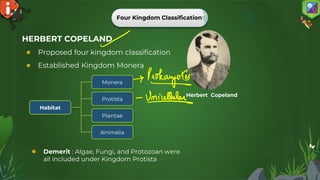
HERBERT COPELAND
● Proposed four kingdom classification
● Established Kingdom Monera
Herbert Copeland
● Demerit : Algae, Fungi, and Protozoan were
all included under Kingdom Protista
Four Kingdom Classification
Five kingdom
Classification
R H Whittaker
ROBERT H. WHITTAKER
● Proposed five kingdom classification in 1969
● Established Kingdom Fungi
● Based on :
○ Cell structure
○ Body organisation
○ Mode of nutrition
○ Reproduction
○ Phylogenetic relationship
Five Kingdom Classification
Monera
Prokaryotic
Animalia
Eukaryotic
Fungi
Eukaryotic
Cell Type
Protista
Eukaryotic
Plantae
Eukaryotic
Five Kingdom Classification
Monera
Present Non-
cellulosic
(polysaccharide +
amino acid)
Animalia
Absent
Fungi
Present with
chitin
Cell Wall
Protista
Present in some
(varied
composition)
Plantae
Present with
cellulose
Five Kingdom Classification
Monera
Absent
Animalia
Present
Fungi
Present
Nuclear
Membrane
Protista
Present
Plantae
Present
Five Kingdom Classification
Monera
Cellular
Animalia
Tissue / Organ/
Organ System
Fungi
Multicellular /
Loose Tissue
Body
Organisation
Protista
Cellular
Plantae
Tissue / Organ
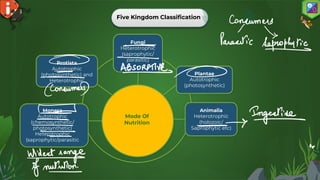
Five Kingdom Classification
Animalia
Heterotrophic
(holozoic/
Saprophytic etc)
Fungi
Heterotrophic
(saprophytic/
parasitic)
Mode Of
Nutrition
Protista
Autotrophic
(photosynthetic) and
Heterotrophic
Plantae
Autotrophic
(photosynthetic)
Monera
Autotrophic
(chemosynthetic/
photosynthetic)
Heterotrophic
(saprophytic/parasitic
Five Kingdom Classification
Kingdom
Plantae
Kingdom
Fungi
Kingdom
Animalia
Kingdom protista
Kingdom Monera
Prokaryotes
Complex (multicellular)
Simple (unicellular)
Autotroph
Photosynthesis
Consumer
Heterotrophy
Ingestion
Decomposer
Heterotrophy
Absorption
Ecological role
Mode of
nutrition
Complexity of
organism
Complexity of
Cell
Direction
of
Evolution
Producer
Eukaryotes
Let’s
Solve a
Question!
In Whittaker’s five kingdom classification, all unicellular
eukaryotes, primarily aquatic and having a well defined
nucleus and various cell organelles belong to
Protista
B
Animalia
C
Plantae
D
Monera
A
In Whittaker’s five kingdom classification, all unicellular
eukaryotes, primarily aquatic and having a well defined
nucleus and various cell organelles belong to
Protista
B
Animalia
C
Plantae
D
Monera
A
R.H. Whittaker proposed the five kingdom classification. In his
system of classification:
★ Kingdom Monera includes all the unicellular prokaryotes.
★ Kingdom Protista includes the unicellular eukaryotes, which
are primarily aquatic and have a well defined nucleus and
various other cell organelles.
Discussion
Protista
B
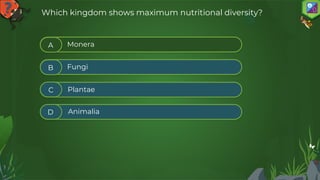
Which kingdom shows maximum nutritional diversity?
Fungi
B
Plantae
C
Animalia
D
Monera
A
Which kingdom shows maximum nutritional diversity?
Fungi
B
Plantae
C
Animalia
D
Monera
A
Kingdom Monera shows the maximum nutritional diversity.
★ Kingdom Monera includes autotrophs
(chemosynthetic/photosynthetic) heterotrophs
(saprophytic/parasitic).
★ Kingdom Fungi constitutes heterotrophs
(saprophytic/parasitic).
★ Kingdom Plantae includes the autotrophs (photosynthetic).
★ Kingdom Animalia includes Heterotrophs
(holozoic/Saprophytic etc).
Discussion
Monera
A
Merits and
Demerits of
Five kingdom
classification
Merits:
★ Prokaryotes got a separate place as Kingdom Monera
★ Unicellular and multicellular organisms are kept separate
★ Fungi are placed in a separate kingdom as their mode of nutrition
differs from all other plants
★ Autotrophs and heterotrophs are placed separately.
Merits
Demerits:
★ Some unicellular algae (Chlamydomonas) are kept in Kingdom
Protista, away from remaining algae placed in Kingdom Plantae
★ Chlorella and Chlamydomonas (autotrophic) placed with
Paramecium and Amoeba (heterotrophic) in Kingdom Protista
★ No place for viruses and lichens
Demerits
Let us summarise..!
Ernst Haeckel
Two Kingdom
Classification
(1758)
Plantae
Animalia
Three Kingdom
Classification
(1860s)
Protista
Plantae
Animalia
Herbert Copeland
R H Whittaker
Four Kingdom
Classification
(1860s)
Monera
Protista
Plantae
Animalia
Four Kingdom
Classification
(1860s)
Monera
Protista
Plantae
Animalia
Fungi
Keep
Learning!!

Biological classification systems etc ad biodiversity