Literary Reading through a
Biographical Context
How does looking through the eyes of the author
help us better understand the text?
Line up facing each other in two concentric circles. Students on
the inside circle will ask questions to the students on the outside
circle. Take turns in asking and answering questions.
Questions that will be read by the teacher are based on the
following: (1) personal beliefs, (2) religion, (3) family culture and
tradition, and (4) any other things about your life.
Reflect on the following:
From what you have listened to, what made you understand your
classmate/friend better? Do these personal beliefs affect their
way of thinking and way of interacting shown in their daily
activities?
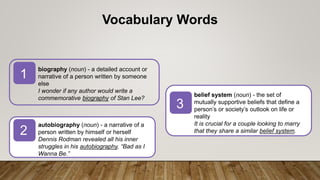
biography (noun) - a detailed account or
narrative of a person written by someone
else
I wonder if any author would write a
commemorative biography of Stan Lee?
autobiography (noun) - a narrative of a
person written by himself or herself
Dennis Rodman revealed all his inner
struggles in his autobiography, “Bad as I
Wanna Be.”
1
2
3
Vocabulary Words
belief system (noun) - the set of
mutually supportive beliefs that define a
person’s or society’s outlook on life or
reality
It is crucial for a couple looking to marry
that they share a similar belief system.
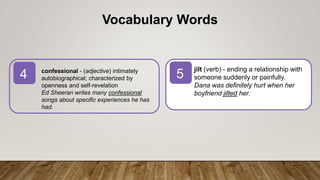
5
4
Vocabulary Words
jilt (verb) - ending a relationship with
someone suddenly or painfully.
Dana was definitely hurt when her
boyfriend jilted her.
confessional - (adjective) intimately
autobiographical; characterized by
openness and self-revelation
Ed Sheeran writes many confessional
songs about specific experiences he has
had.
Reasons to read literature through the biographical context
(Gioia and Kennedy 2007):
● Understanding the author’s life can help you understand his
or her work thoroughly.
● Reading the author’s biography or autobiography helps you
see how much his experiences shape his or her work directly
and indirectly.
Biographical Strategies
● Research on what the author believes in and also what he or
she does not.
● Analyze how the author’s belief system is reflected in his or
her work.
● Look at the author’s other works and analyze if there is a
pattern with regard to the theme that is indicative of his or her
life and beliefs.
Reading Literature through a Biographical Context
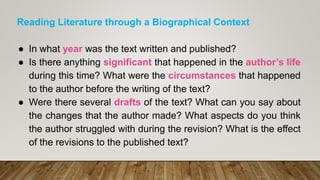
● In what year was the text written and published?
● Is there anything significant that happened in the author’s life
during this time? What were the circumstances that happened
to the author before the writing of the text?
● Were there several drafts of the text? What can you say about
the changes that the author made? What aspects do you think
the author struggled with during the revision? What is the effect
of the revisions to the published text?
Reading Literature through a Biographical Context
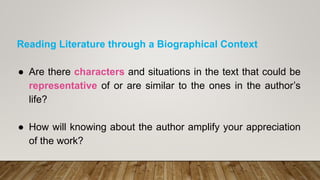
● Are there characters and situations in the text that could be
representative of or are similar to the ones in the author’s
life?
● How will knowing about the author amplify your appreciation
of the work?
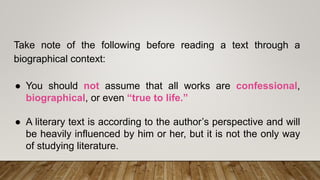
Take note of the following before reading a text through a
biographical context:
● You should not assume that all works are confessional,
biographical, or even “true to life.”
● A literary text is according to the author’s perspective and will
be heavily influenced by him or her, but it is not the only way
of studying literature.
Dreams
Paul Laurence Dunbar
Guide Questions
1. What is the central theme of the poem? How is this used
throughout the poem?
2. What does the poem say about its central theme or image?
3. What other images or figures of speech help develop this
central theme?
4. How are these related to the author’s personal history and
background?
5. What aspects of the author’s history can be seen in his
written work?
Read and analyze the poem below, research on the
biography of the author, then answer the questions that
follow comprehensively. Responses must be at least one
paragraph long.
I Sit and Sew
Alice Moore Dunbar-Nelson
Short Response Questions:
1. What is the central image of the poem?
2. What kind of person does the persona seem to be?
3. What other images and figures of speech are found in the
poem?
4. What do you think is the thematic message that the poem
conveys?
5. Refer to your research. How does the poet’s biography tie up
with this poem?
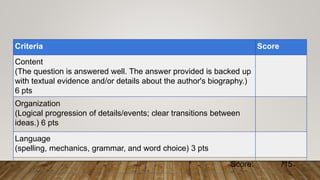
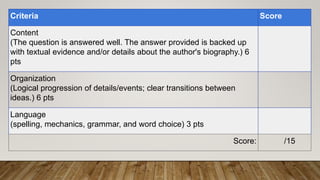
Criteria Score
Content
(The question is answered well. The answer provided is backed up
with textual evidence and/or details about the author's biography.)
6 pts
Organization
(Logical progression of details/events; clear transitions between
ideas.) 6 pts
Language
(spelling, mechanics, grammar, and word choice) 3 pts
Score: /15
Values Integration
We have learned how an author’s life experiences and
beliefs influence his or her writing. How can the
knowledge of someone’s background affect the way we
treat him or her as a person?
1. Find a partner. Each of you will write a short autobiographical
essay. It could be a narrative of your most memorable or
significant life events; or a description/exposition of your
character, upbringing, and core beliefs.
2. Exchange essays with your partner. Write a poem or short
story using your partner’s essay as a basis. Or you could write
the poem or short story from your partner’s perspective using
his/her essay as a guide.
3. Your teacher may call on volunteers to share their work.
Assignment
Read and analyze the short story, research on the author, and
answer the questions that follow.
The Tell-Tale Heart
Edgar Allan Poe
Guide Questions
1. How is the story narrated? What effect does this have on the
way the story is told?
2. Who is the central character of the story? What is this person
like?
3. What is the central conflict of the short story? How is the
conflict resolved?
4. What point does the last line of dialogue make?
5. Refer to your research on Edgar Allan Poe. How is his
background reflected in his writing?
Criteria Score
Content
(The question is answered well. The answer provided is backed up
with textual evidence and/or details about the author's biography.) 6
pts
Organization
(Logical progression of details/events; clear transitions between
ideas.) 6 pts
Language
(spelling, mechanics, grammar, and word choice) 3 pts
Score: /15

1.pptx

  • 1.
    Literary Reading througha Biographical Context
  • 2.
    How does lookingthrough the eyes of the author help us better understand the text?
  • 3.
    Line up facingeach other in two concentric circles. Students on the inside circle will ask questions to the students on the outside circle. Take turns in asking and answering questions. Questions that will be read by the teacher are based on the following: (1) personal beliefs, (2) religion, (3) family culture and tradition, and (4) any other things about your life.
  • 4.
    Reflect on thefollowing: From what you have listened to, what made you understand your classmate/friend better? Do these personal beliefs affect their way of thinking and way of interacting shown in their daily activities?
  • 5.
    biography (noun) -a detailed account or narrative of a person written by someone else I wonder if any author would write a commemorative biography of Stan Lee? autobiography (noun) - a narrative of a person written by himself or herself Dennis Rodman revealed all his inner struggles in his autobiography, “Bad as I Wanna Be.” 1 2 3 Vocabulary Words belief system (noun) - the set of mutually supportive beliefs that define a person’s or society’s outlook on life or reality It is crucial for a couple looking to marry that they share a similar belief system.
  • 6.
    5 4 Vocabulary Words jilt (verb)- ending a relationship with someone suddenly or painfully. Dana was definitely hurt when her boyfriend jilted her. confessional - (adjective) intimately autobiographical; characterized by openness and self-revelation Ed Sheeran writes many confessional songs about specific experiences he has had.
  • 7.
    Reasons to readliterature through the biographical context (Gioia and Kennedy 2007): ● Understanding the author’s life can help you understand his or her work thoroughly. ● Reading the author’s biography or autobiography helps you see how much his experiences shape his or her work directly and indirectly.
  • 8.
    Biographical Strategies ● Researchon what the author believes in and also what he or she does not. ● Analyze how the author’s belief system is reflected in his or her work. ● Look at the author’s other works and analyze if there is a pattern with regard to the theme that is indicative of his or her life and beliefs.
  • 9.
    Reading Literature througha Biographical Context ● In what year was the text written and published? ● Is there anything significant that happened in the author’s life during this time? What were the circumstances that happened to the author before the writing of the text? ● Were there several drafts of the text? What can you say about the changes that the author made? What aspects do you think the author struggled with during the revision? What is the effect of the revisions to the published text?
  • 10.
    Reading Literature througha Biographical Context ● Are there characters and situations in the text that could be representative of or are similar to the ones in the author’s life? ● How will knowing about the author amplify your appreciation of the work?
  • 11.
    Take note ofthe following before reading a text through a biographical context: ● You should not assume that all works are confessional, biographical, or even “true to life.” ● A literary text is according to the author’s perspective and will be heavily influenced by him or her, but it is not the only way of studying literature.
  • 12.
  • 13.
    Guide Questions 1. Whatis the central theme of the poem? How is this used throughout the poem? 2. What does the poem say about its central theme or image? 3. What other images or figures of speech help develop this central theme? 4. How are these related to the author’s personal history and background? 5. What aspects of the author’s history can be seen in his written work?
  • 14.
    Read and analyzethe poem below, research on the biography of the author, then answer the questions that follow comprehensively. Responses must be at least one paragraph long. I Sit and Sew Alice Moore Dunbar-Nelson
  • 15.
    Short Response Questions: 1.What is the central image of the poem? 2. What kind of person does the persona seem to be? 3. What other images and figures of speech are found in the poem? 4. What do you think is the thematic message that the poem conveys? 5. Refer to your research. How does the poet’s biography tie up with this poem?
  • 16.
    Criteria Score Content (The questionis answered well. The answer provided is backed up with textual evidence and/or details about the author's biography.) 6 pts Organization (Logical progression of details/events; clear transitions between ideas.) 6 pts Language (spelling, mechanics, grammar, and word choice) 3 pts Score: /15
  • 17.
    Values Integration We havelearned how an author’s life experiences and beliefs influence his or her writing. How can the knowledge of someone’s background affect the way we treat him or her as a person?
  • 18.
    1. Find apartner. Each of you will write a short autobiographical essay. It could be a narrative of your most memorable or significant life events; or a description/exposition of your character, upbringing, and core beliefs. 2. Exchange essays with your partner. Write a poem or short story using your partner’s essay as a basis. Or you could write the poem or short story from your partner’s perspective using his/her essay as a guide. 3. Your teacher may call on volunteers to share their work.
  • 19.
    Assignment Read and analyzethe short story, research on the author, and answer the questions that follow. The Tell-Tale Heart Edgar Allan Poe
  • 20.
    Guide Questions 1. Howis the story narrated? What effect does this have on the way the story is told? 2. Who is the central character of the story? What is this person like? 3. What is the central conflict of the short story? How is the conflict resolved? 4. What point does the last line of dialogue make? 5. Refer to your research on Edgar Allan Poe. How is his background reflected in his writing?
  • 21.
    Criteria Score Content (The questionis answered well. The answer provided is backed up with textual evidence and/or details about the author's biography.) 6 pts Organization (Logical progression of details/events; clear transitions between ideas.) 6 pts Language (spelling, mechanics, grammar, and word choice) 3 pts Score: /15