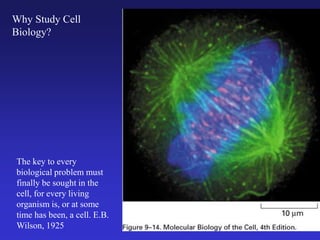
The key to every
biological problem must
finally be sought in the
cell, for every living
organism is, or at some
time has been, a cell. E.B.
Wilson, 1925
Why Study Cell
Biology?
Cells are Us
Cells are Us
Cilia on a protozoan Sperm meets egg
Cells are Us
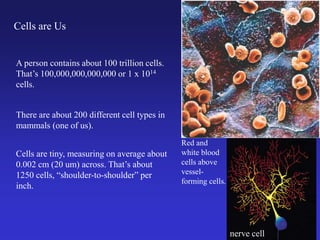
A person contains about 100 trillion cells.
That’s 100,000,000,000,000 or 1 x 10¹⁴
cells.
There are about 200 different cell types in
mammals (one of us).
Cells are tiny, measuring on average about
0.002 cm (20 um) across. That’s about
1250 cells, “shoulder-to-shoulder” per
inch.
nerve cell
Red and
white blood
cells above
vessel-
forming cells.
The Cell Theory
All organisms are composed of one or more cells.
Cells are the smallest living things.
All organisms living today are descendents of an
ancestral cell.
Cells arise only by division of previously existing cells.
The cell theory (proposed independently in 1838 and
1839) is a cornerstone of biology.
Schleiden
Schwann
A Sense of Scale and Abundance – Bacteria on the Head of a Pin
Two Fundamentally Different Types of Cells
A prokaryotic cell
A eukaryotic cell
Us vs. Them -
Eukaryotes and
Prokaryotes
An Idealized Animal Cell
Major Divisions of the Eukaryotic Cell
A rat liver cell (with color enhancement to show organelles)
It’s Crowded In There
An artist’s conception of the cytoplasm - the region of a cell
that’s not in the nucleus or within an organelle.
A micrograph showing
cytoskeleton (red),
ribosomes (green), and
membrane (blue)
It’s Crowded In There
Animal and Plant Cells Have More
Similarities Than Differences
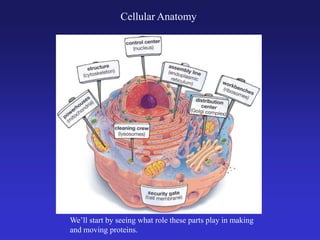
Cellular Anatomy
We’ll start by seeing what role these parts play in making
and moving proteins.
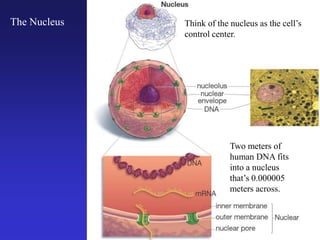
The Nucleus Think of the nucleus as the cell’s
control center.
Two meters of
human DNA fits
into a nucleus
that’s 0.000005
meters across.
Ribosomes and the Endoplasmic Reticulum
The Rough Endoplasmic Reticulum
Protein movement
(trafficking)
Protein synthesis (about
half the cell’s proteins are
made here).
Protein “proofreading”
Functions:
Cystic Fibrosis
Click here to see the article.
The Lysosome
Cell suicide (suicide is bad for
cells, but good for us!)
Recycling cellular components
Functions:
Digesting food or cellular invaders
(The lysosome is not found in plant
cells)
The
Lysosome
This bacterium
about to be
eaten by an
immune system
cell will spend
the last minutes
of its existence
within a
lysosome.
Many Diseases are Caused by Lysosome Malfunction
Cellular Anatomy
The Mitochondrion
Think of the mitochondrion as the
powerhouse of the cell.
Both plant and animal cells contain
many mitochondria.
(Mitochondria is the
plural of mitochondrion)
The Mitochondrion
A class of diseases that causes
muscle weakness and
neurological disorders are due
to malfunctioning
mitochondria.
Worn out mitochondria may be an important factor in aging.
Mitochondrial Diseases
Mitochondria and Health
Animal vs. Plant Cells – Chloroplasts Are a Big Part of
the Difference
Cells In a Leaf
The Chloroplast
Think of the chloroplast as the solar panel of the plant cell.
Only plants have chloroplasts, but animals reap the benefits too.
Two Other Unique Features of Plant Cells
The central
vacuole may
occupy 90%
of a plant
cell.
A Consequence of Cell Walls –
the Great Strength of Woody
Plants
The Central Vacuole Controls Turgor Pressure
flaccid
turgid
Cellular Anatomy
The name is misleading. The
cytoskeleton is the skeleton
of the cell, but it’s also like
the muscular system, able to
change the shape of cells in a
flash.
The Cytoskeleton
An animal cell cytoskeleton
A Cytoskeleton Gallery
A white
blood cell
using the
cytoskeleton
to “reach
out” for a
hapless
bacterium.
The
Cytoskeleton
in Action
The Cytoskeleton in Action
Cilia on a protozoan Beating sperm tail at fertilization
Smoker’s cough is due to destruction of cilia linking the airways.

bio_cells_1_.ppt

  • 1.
    The key toevery biological problem must finally be sought in the cell, for every living organism is, or at some time has been, a cell. E.B. Wilson, 1925 Why Study Cell Biology?
  • 2.
  • 3.
    Cells are Us Ciliaon a protozoan Sperm meets egg
  • 4.
    Cells are Us Aperson contains about 100 trillion cells. That’s 100,000,000,000,000 or 1 x 10¹⁴ cells. There are about 200 different cell types in mammals (one of us). Cells are tiny, measuring on average about 0.002 cm (20 um) across. That’s about 1250 cells, “shoulder-to-shoulder” per inch. nerve cell Red and white blood cells above vessel- forming cells.
  • 5.
    The Cell Theory Allorganisms are composed of one or more cells. Cells are the smallest living things. All organisms living today are descendents of an ancestral cell. Cells arise only by division of previously existing cells. The cell theory (proposed independently in 1838 and 1839) is a cornerstone of biology. Schleiden Schwann
  • 6.
    A Sense ofScale and Abundance – Bacteria on the Head of a Pin
  • 7.
    Two Fundamentally DifferentTypes of Cells A prokaryotic cell A eukaryotic cell
  • 8.
    Us vs. Them- Eukaryotes and Prokaryotes
  • 9.
  • 10.
    Major Divisions ofthe Eukaryotic Cell
  • 11.
    A rat livercell (with color enhancement to show organelles)
  • 12.
    It’s Crowded InThere An artist’s conception of the cytoplasm - the region of a cell that’s not in the nucleus or within an organelle.
  • 13.
    A micrograph showing cytoskeleton(red), ribosomes (green), and membrane (blue) It’s Crowded In There
  • 14.
    Animal and PlantCells Have More Similarities Than Differences
  • 15.
    Cellular Anatomy We’ll startby seeing what role these parts play in making and moving proteins.
  • 16.
    The Nucleus Thinkof the nucleus as the cell’s control center. Two meters of human DNA fits into a nucleus that’s 0.000005 meters across.
  • 17.
    Ribosomes and theEndoplasmic Reticulum
  • 18.
    The Rough EndoplasmicReticulum Protein movement (trafficking) Protein synthesis (about half the cell’s proteins are made here). Protein “proofreading” Functions:
  • 19.
    Cystic Fibrosis Click hereto see the article.
  • 20.
    The Lysosome Cell suicide(suicide is bad for cells, but good for us!) Recycling cellular components Functions: Digesting food or cellular invaders (The lysosome is not found in plant cells)
  • 21.
    The Lysosome This bacterium about tobe eaten by an immune system cell will spend the last minutes of its existence within a lysosome.
  • 22.
    Many Diseases areCaused by Lysosome Malfunction
  • 23.
  • 24.
    The Mitochondrion Think ofthe mitochondrion as the powerhouse of the cell. Both plant and animal cells contain many mitochondria. (Mitochondria is the plural of mitochondrion)
  • 25.
    The Mitochondrion A classof diseases that causes muscle weakness and neurological disorders are due to malfunctioning mitochondria. Worn out mitochondria may be an important factor in aging.
  • 26.
  • 27.
  • 28.
    Animal vs. PlantCells – Chloroplasts Are a Big Part of the Difference
  • 29.
  • 30.
    The Chloroplast Think ofthe chloroplast as the solar panel of the plant cell. Only plants have chloroplasts, but animals reap the benefits too.
  • 31.
    Two Other UniqueFeatures of Plant Cells The central vacuole may occupy 90% of a plant cell.
  • 32.
    A Consequence ofCell Walls – the Great Strength of Woody Plants
  • 33.
    The Central VacuoleControls Turgor Pressure flaccid turgid
  • 34.
  • 35.
    The name ismisleading. The cytoskeleton is the skeleton of the cell, but it’s also like the muscular system, able to change the shape of cells in a flash. The Cytoskeleton An animal cell cytoskeleton
  • 36.
  • 37.
    A white blood cell usingthe cytoskeleton to “reach out” for a hapless bacterium. The Cytoskeleton in Action
  • 38.
    The Cytoskeleton inAction Cilia on a protozoan Beating sperm tail at fertilization Smoker’s cough is due to destruction of cilia linking the airways.

Editor's Notes