J. Quigley
2012
• In 1850, about two dozen rabbits from
  Europe were introduced to Australia. The
  rabbits had plenty of vegetation to eat, no
  competition and no predators. Their
  numbers increased rapidly. By the 1950’s,
  there were 600 million rabbits!!! The
  rabbits ate so much vegetation that the
  numbers of native plants and animals
  declined and crops were damaged.
• As Australia learned,
  understanding
  populations is
  important in
  protecting
  ecosystems!
• A population is group
  of organisms of the
  same species that
  live together in the
  same place
• Understanding
  population grown
  is important
  because
  populations of
  different species
  interact and
  affect one
  another, including
  human
  populations
• How do populations
  grow and shrink?
• Biologists use
  population models to
  track population
  growth
• Population growth
  depends on: births,
  deaths, immigration
  and emigration
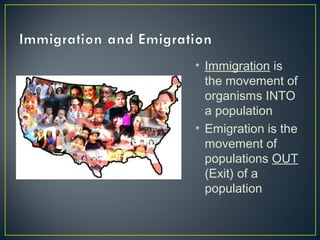
• Immigration is
  the movement of
  organisms INTO
  a population
• Emigration is the
  movement of
  populations OUT
  (Exit) of a
  population
• Exponential growth:
  occurs when number
  increase by a certain
  factor in each
  successive time
  period
Example: When a
  population is small, its
  growth is also small,
  but as it gets bigger…
  it grows even faster!
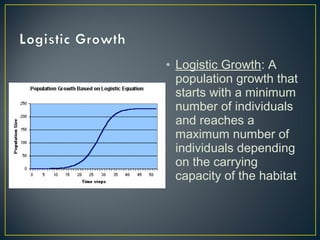
• Logistic Growth: A
  population growth that
  starts with a minimum
  number of individuals
  and reaches a
  maximum number of
  individuals depending
  on the carrying
  capacity of the habitat
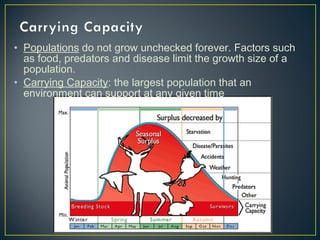
• Populations do not grow unchecked forever. Factors such
  as food, predators and disease limit the growth size of a
  population.
• Carrying Capacity: the largest population that an
  environment can support at any given time
• Anything that
  limits the size of
  a population:
  • Availability of
    food
  • Shelter
  • Space
  • Sunlight
  • Water
  • Mates
  • Disease
ABIOTIC FACTORS          BIOTIC FACTORS
•Climate: temperature    •Food (plants and
and rain                 animals)
•Sun exposure            •Predators (animals that
•Availability of water   eat other animals)
•Fertile soil            •Finding a mate
•Earth factors: wind,    •Natural resources for
tornadoes, volcanoes,    living: nest making,
earth quakes             trees for living, brush for
•Space and shelter       hiding…)
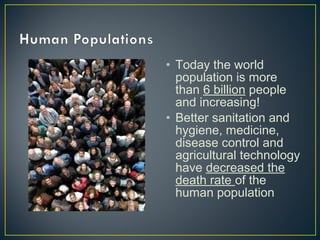
• Today the world
  population is more
  than 6 billion people
  and increasing!
• Better sanitation and
  hygiene, medicine,
  disease control and
  agricultural technology
  have decreased the
  death rate of the
  human population
• For most of human history there has been fewer than 10
  million people.
• In 1700 there were 10 million people but due to more
  modern technology… the population has grown to over 6
  billion in 300 years!
• Scientists believe the world population will be 9 billion in
  another 50 years!
• How many people the earth can support depends on how
  humans take care of the earth, along with science and
  technology
• Interactions in communities take many forms.
  Predators and prey are locked in a struggle
  for survival. Organisms with the same needs
  compete for food. Parasites and hosts try to
  get ahead of one another and some
  organisms depend on other organisms for
  their own survival…
• Mutualism: a
                                    relationship in
                                    which both
                                    organisms benefit
                                    from one another
                                    (good/good)
These two species of fish have
evolved a mutualistic             • Example: A shark
relationship: the grouper fish      gets cleaned by
allows the cleaner fish to eat      cleaner fish. (shark
food trapped between its teeth:    gets parasites out of his
a free lunch in exchange for       gills, cleaner fish get food…
                                   good for both)
some dental hygiene.
• Commensalism: a relationship
  in which two organisms live in
  a community, one organism
  benefits while the other is
  unharmed. (good/nothing)

• Example: Lion kills a zebra,
  when the lion is done eating,
  birds come and eat the rest
  (good for the birds, does not
  effect the lion)
• Parasitism: a
  relationship between
  two organisms in
  which one benefits
  and the other is
  harmed (good/bad)
• Example: Human Bot
 Fly needs to grow under
 the skin of the human
 stealing blood and
 nutrients and causing the
 human pain
A. Predator: An
   animal that hunts,
   kills and eats
   another animal
B. Prey: the animal
   that is hunted and
   killed by the
   predator

Interactions in communities

  • 1.
  • 2.
    • In 1850,about two dozen rabbits from Europe were introduced to Australia. The rabbits had plenty of vegetation to eat, no competition and no predators. Their numbers increased rapidly. By the 1950’s, there were 600 million rabbits!!! The rabbits ate so much vegetation that the numbers of native plants and animals declined and crops were damaged.
  • 3.
    • As Australialearned, understanding populations is important in protecting ecosystems! • A population is group of organisms of the same species that live together in the same place
  • 4.
    • Understanding population grown is important because populations of different species interact and affect one another, including human populations
  • 5.
    • How dopopulations grow and shrink? • Biologists use population models to track population growth • Population growth depends on: births, deaths, immigration and emigration
  • 6.
    • Immigration is the movement of organisms INTO a population • Emigration is the movement of populations OUT (Exit) of a population
  • 7.
    • Exponential growth: occurs when number increase by a certain factor in each successive time period Example: When a population is small, its growth is also small, but as it gets bigger… it grows even faster!
  • 8.
    • Logistic Growth:A population growth that starts with a minimum number of individuals and reaches a maximum number of individuals depending on the carrying capacity of the habitat
  • 9.
    • Populations donot grow unchecked forever. Factors such as food, predators and disease limit the growth size of a population. • Carrying Capacity: the largest population that an environment can support at any given time
  • 10.
    • Anything that limits the size of a population: • Availability of food • Shelter • Space • Sunlight • Water • Mates • Disease
  • 11.
    ABIOTIC FACTORS BIOTIC FACTORS •Climate: temperature •Food (plants and and rain animals) •Sun exposure •Predators (animals that •Availability of water eat other animals) •Fertile soil •Finding a mate •Earth factors: wind, •Natural resources for tornadoes, volcanoes, living: nest making, earth quakes trees for living, brush for •Space and shelter hiding…)
  • 12.
    • Today theworld population is more than 6 billion people and increasing! • Better sanitation and hygiene, medicine, disease control and agricultural technology have decreased the death rate of the human population
  • 13.
    • For mostof human history there has been fewer than 10 million people. • In 1700 there were 10 million people but due to more modern technology… the population has grown to over 6 billion in 300 years! • Scientists believe the world population will be 9 billion in another 50 years! • How many people the earth can support depends on how humans take care of the earth, along with science and technology
  • 14.
    • Interactions incommunities take many forms. Predators and prey are locked in a struggle for survival. Organisms with the same needs compete for food. Parasites and hosts try to get ahead of one another and some organisms depend on other organisms for their own survival…
  • 15.
    • Mutualism: a relationship in which both organisms benefit from one another (good/good) These two species of fish have evolved a mutualistic • Example: A shark relationship: the grouper fish gets cleaned by allows the cleaner fish to eat cleaner fish. (shark food trapped between its teeth: gets parasites out of his a free lunch in exchange for gills, cleaner fish get food… good for both) some dental hygiene.
  • 16.
    • Commensalism: arelationship in which two organisms live in a community, one organism benefits while the other is unharmed. (good/nothing) • Example: Lion kills a zebra, when the lion is done eating, birds come and eat the rest (good for the birds, does not effect the lion)
  • 17.
    • Parasitism: a relationship between two organisms in which one benefits and the other is harmed (good/bad) • Example: Human Bot Fly needs to grow under the skin of the human stealing blood and nutrients and causing the human pain
  • 18.
    A. Predator: An animal that hunts, kills and eats another animal B. Prey: the animal that is hunted and killed by the predator