Binary Code
The Language of Your Computer
Input/Output
Input is whatever is put into a computer.
Input can be data, letters, numbers, symbols, shapes,
sounds, pressure, light beams or whatever material
needs processing.
Output hardware consists of devices that translate
information processed by the computer into a form
humans can understand - print, sound, graphics, or
video, for example.
The Binary System
The base of all programs is the binary
number system of two - 1 and 0.
system, a
These represent On and Off - the position for an
electrical signal to pass through (or not) a transistor.
All data and
computer to
represented
program instructions that go into the
be processed and stored, are
by these binary numbers.
Decimal System
To understand the binary system,
our Base 10, decimal system.
The prefix “dec-” means 10
we need to review
Our decimal system is based on
(0,1,2,3,4,5,6,7,8,9)
10 numbers
When counting, using place value, we fill the ones
place and then move to the tens place.
For example:
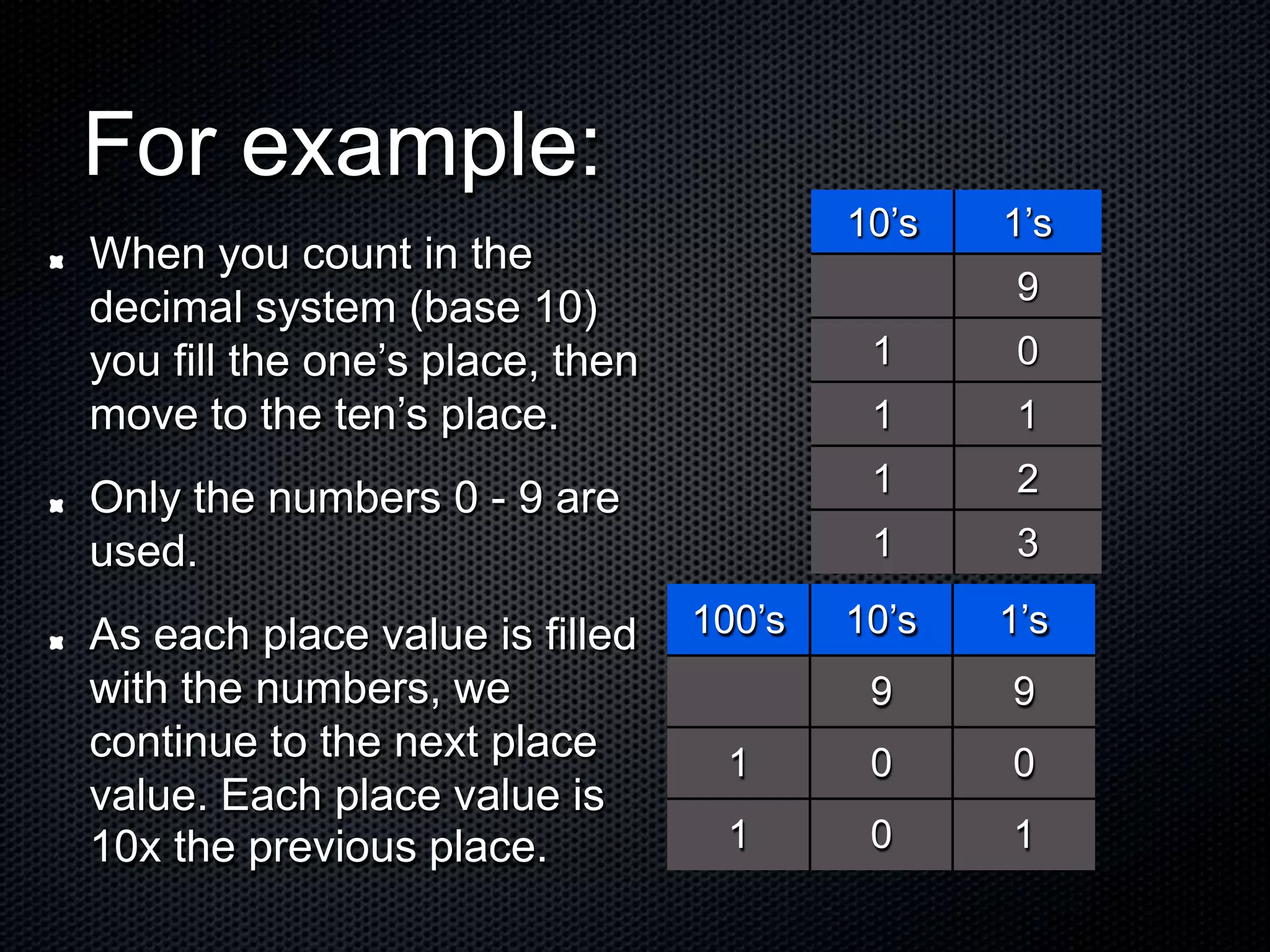
When you count in the
decimal system (base 10)
you fill the one’s place, then
move to the ten’s place.
Only the numbers 0 - 9 are
used.
As each place value is filled
with the numbers, we
continue to the next place
value. Each place value is
10x the previous place.
100’s 10’s 1’s
9 9
1 0 0
1 0 1
10’s 1’s
9
1 0
1 1
1 2
1 3
Counting in Binary (Base 2)
The prefix “bi-” means two.
The binary system uses only two numbers - 0 and 1.
We count in the binary system the same as in the
decimal system by filling in the place values and
moving up the place value chart.
If the decimal system, base 10 has place values 10x
the previous place - How do you think the place
values for the binary system are determined?
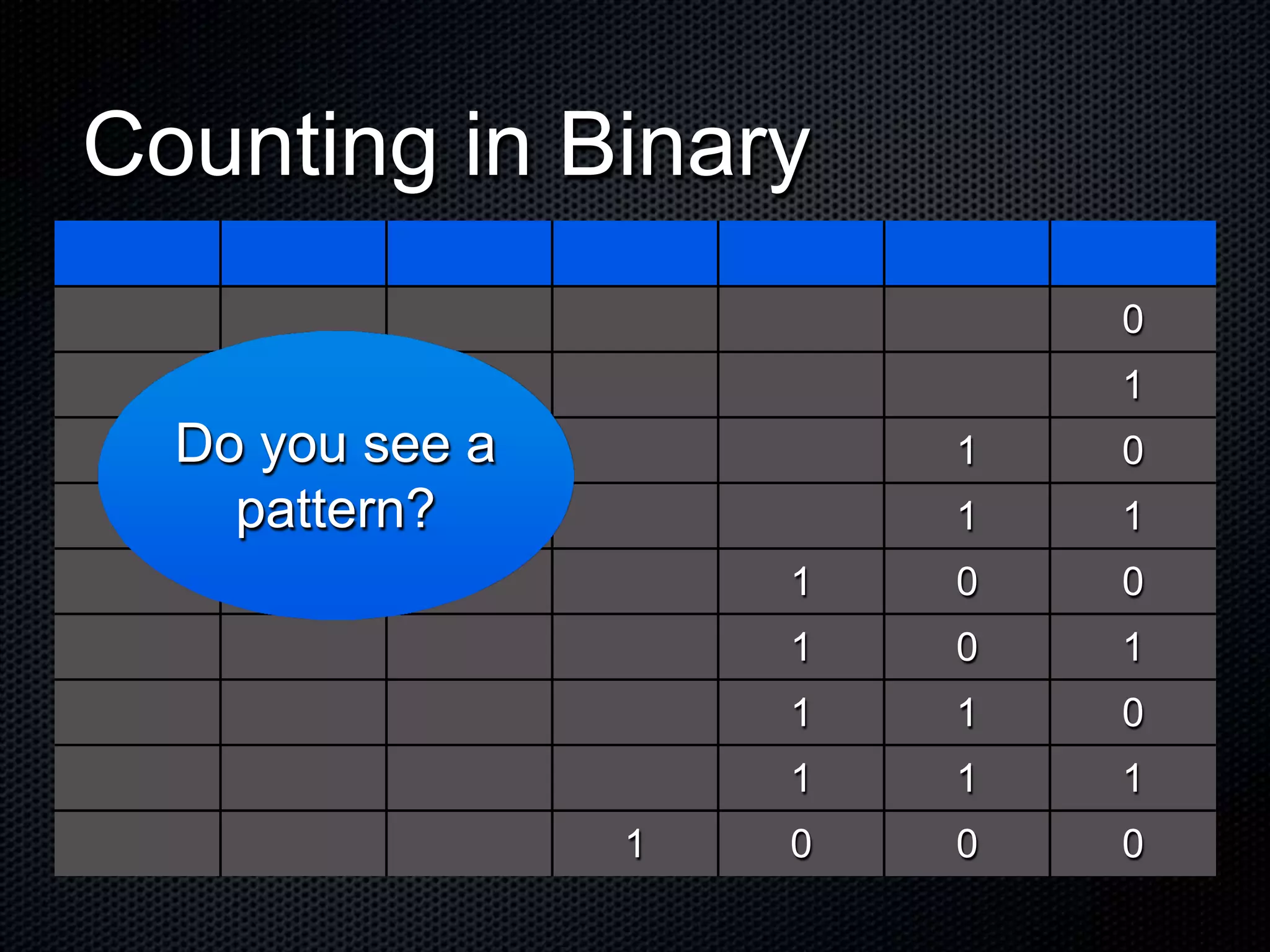
Counting in Binary
Do you see a
pattern?
0
1
1 0
1 1
1 0 0
1 0 1
1 1 0
1 1 1
1 0 0 0
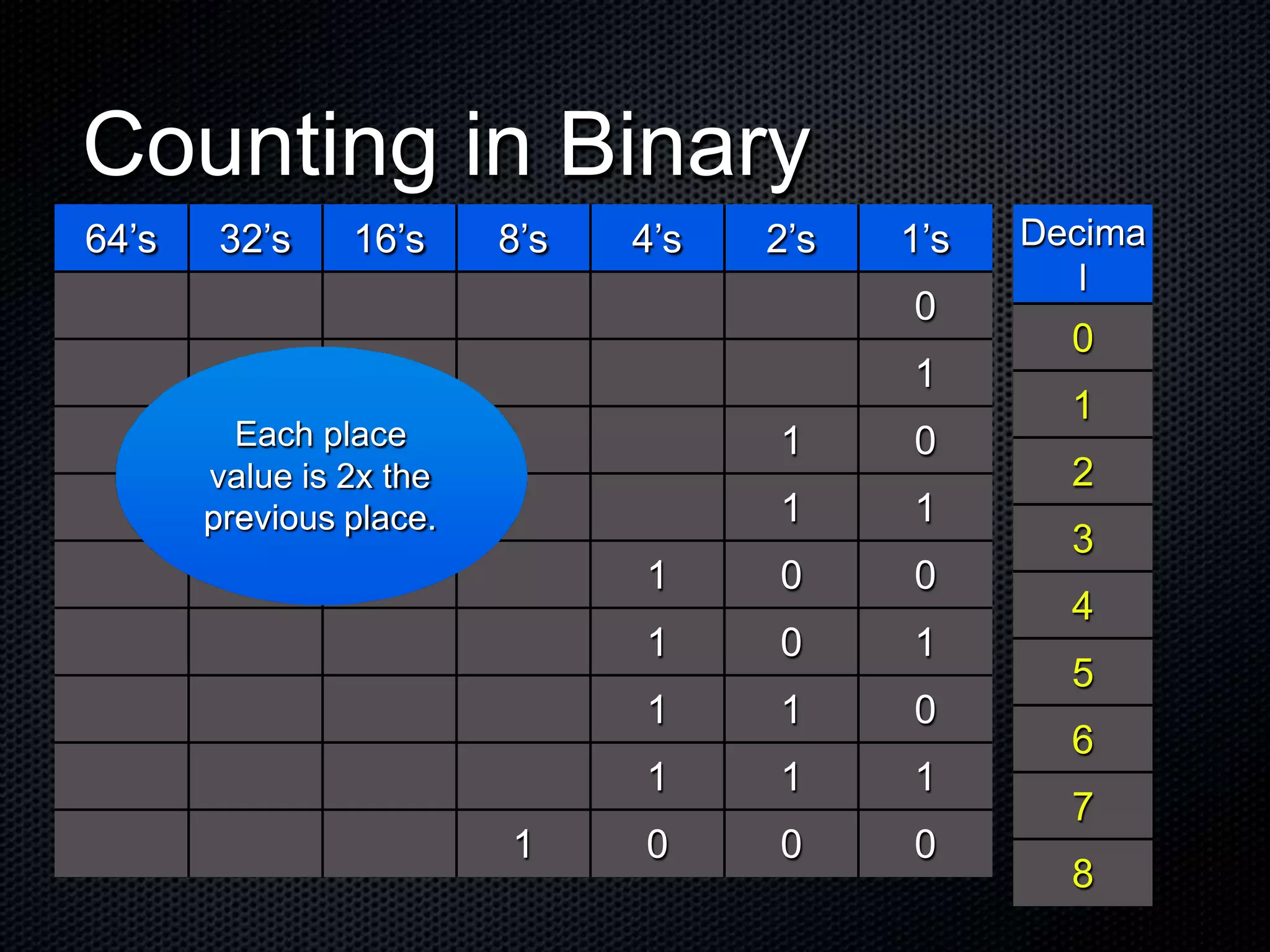
Counting in Binary
l
value is 2x the
previous place.
Decima
0
1
2
3
4
5
6
7
8
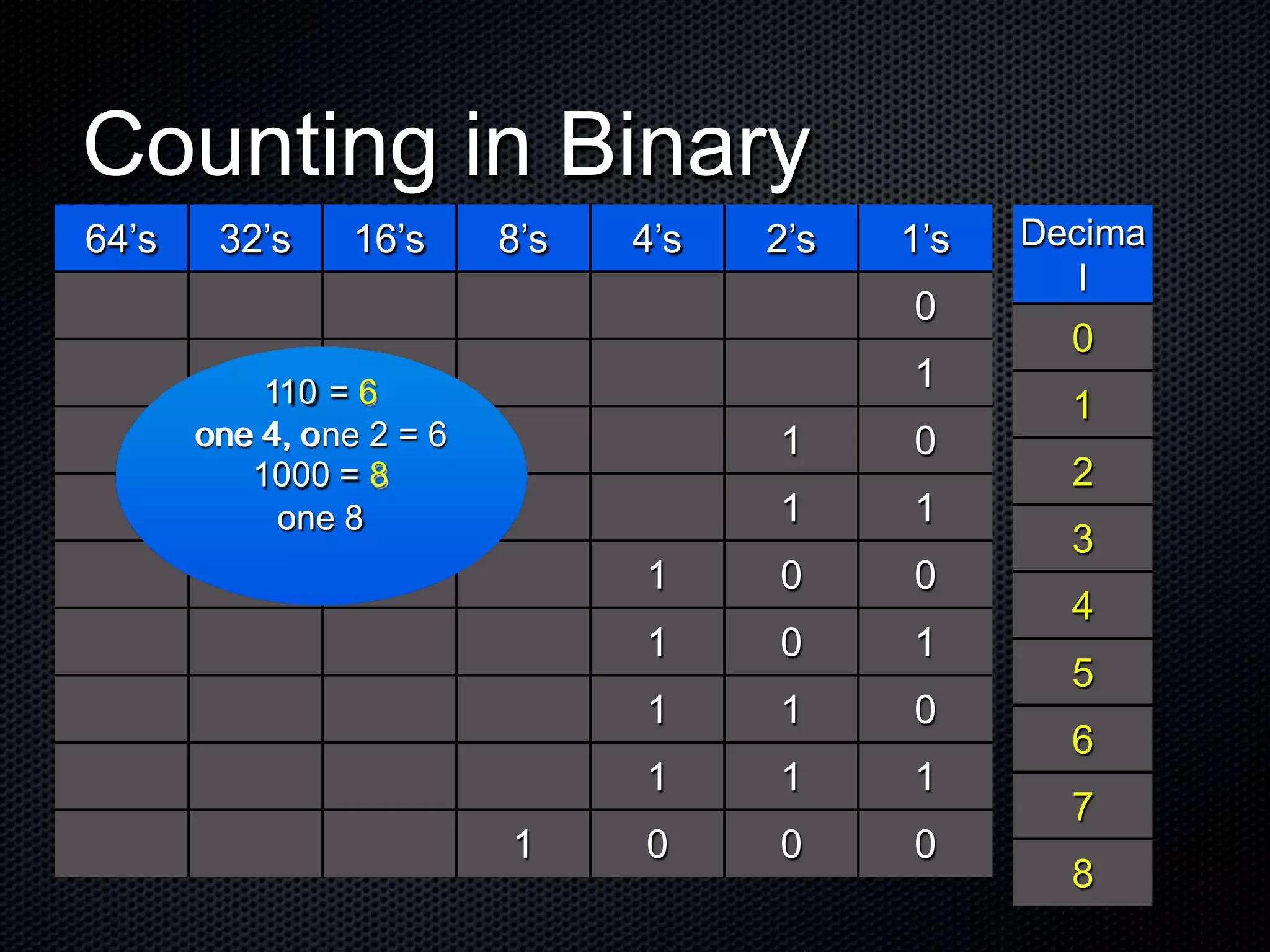
64’s 32’s 16’s 8’s 4’s 2’s 1’s
0
1
Each place 1 0
previo 1 1
1 0 0
1 0 1
1 1 0
1 1 1
1 0 0 0
Counting in Binary
l
one 4, one 2 = 6
1000 = 8
one 8
Decima
0
1
2
3
4
5
6
7
8
64’s 32’s 16’s 8’s 4’s 2’s 1’s
0
110 = 6 1
one 4, o 1 0
on 1 1
1 0 0
1 0 1
1 1 0
1 1 1
1 0 0 0
Counting in Binary
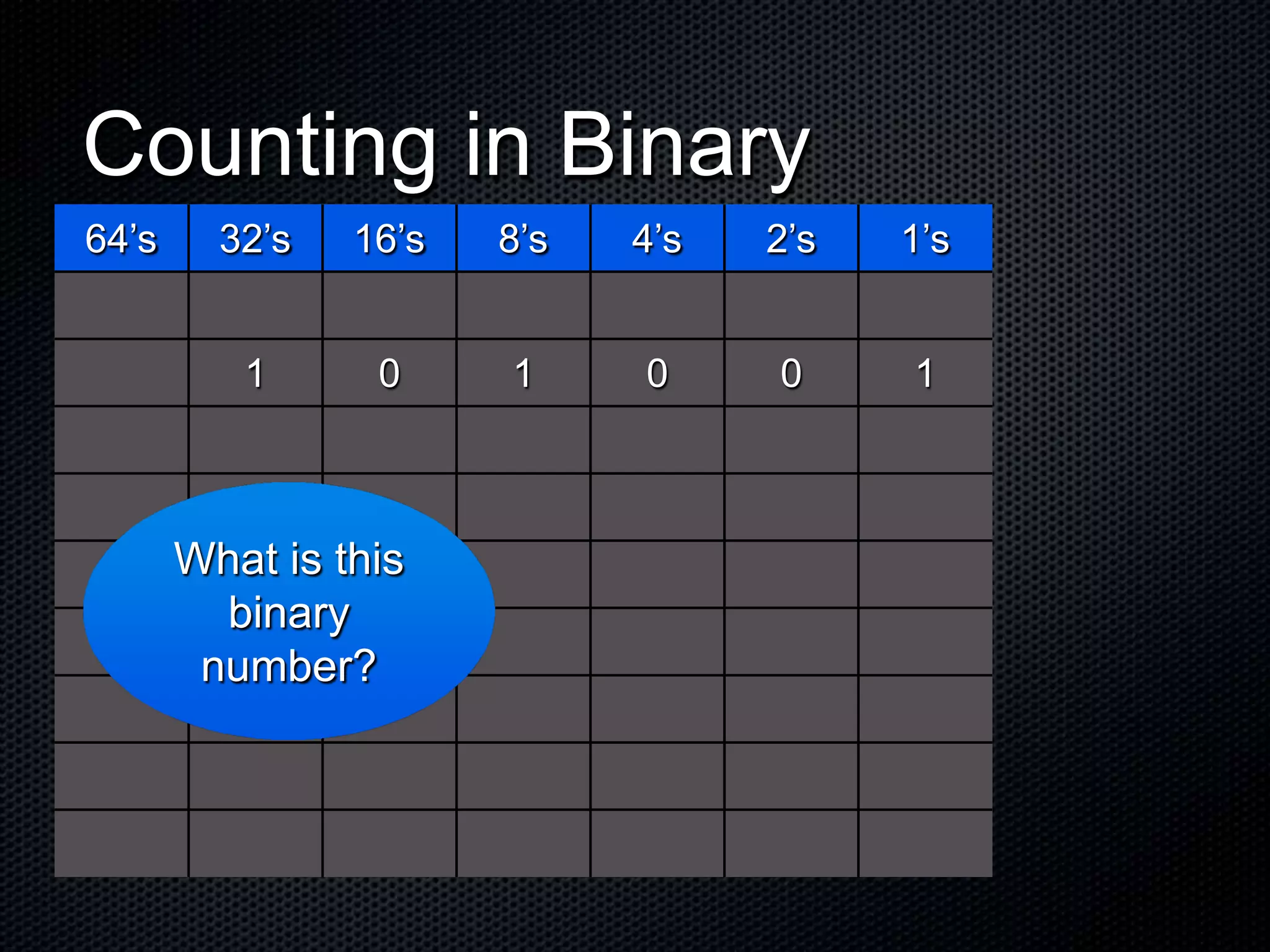
What is
binary
number?
64’s 32’s 16’s 8’s 4’s 2’s 1’s
1 0 1 0 0 1
this
Counting in Binary
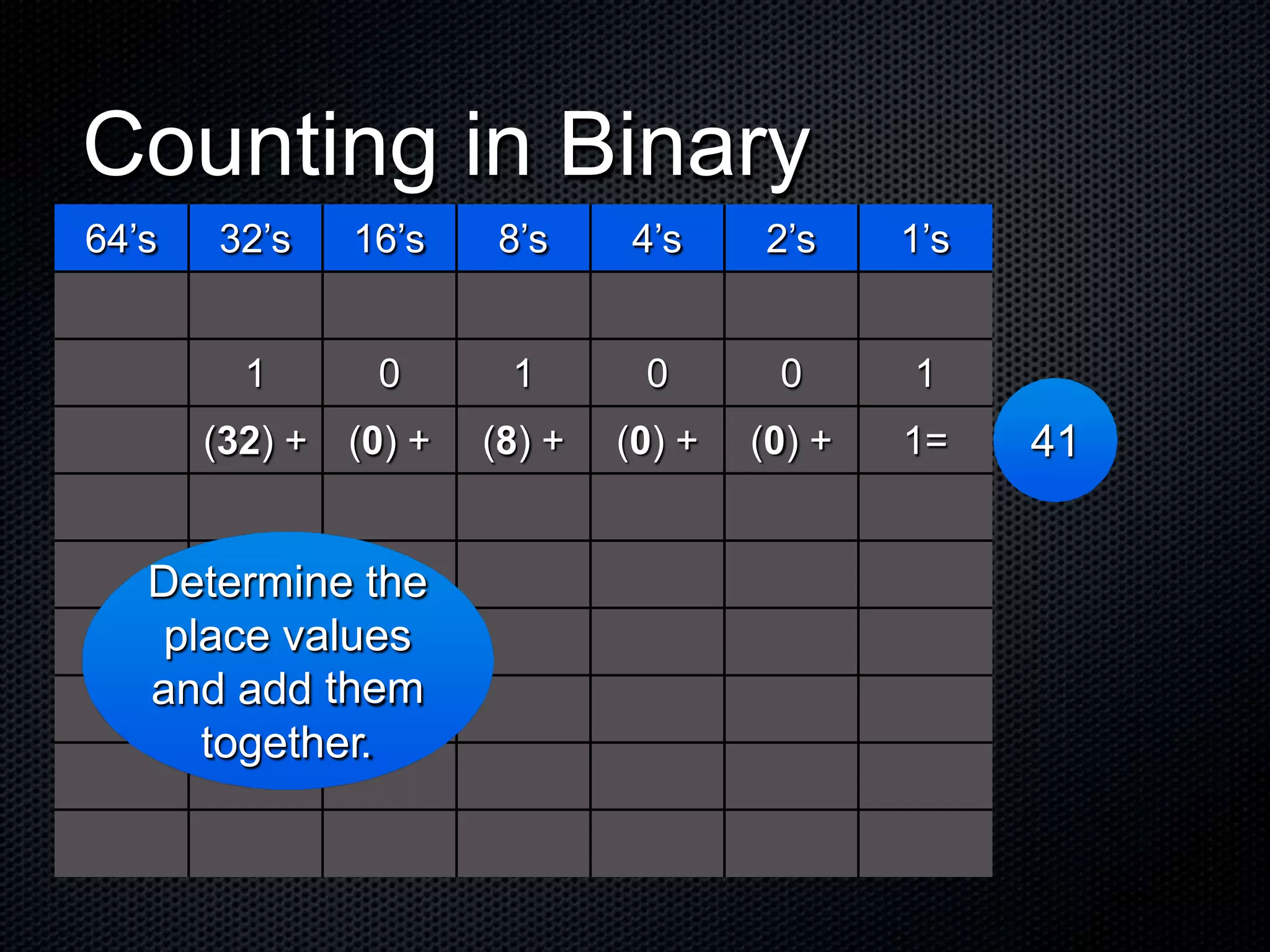
41
Determine the
place values
and add
together.
64’s 32’s 16’s 8’s 4’s 2’s 1’s
1 0 1 0 0 1
(32) + (0) + (8) + (0) + (0) + 1=
them
Try
counting
to 20.
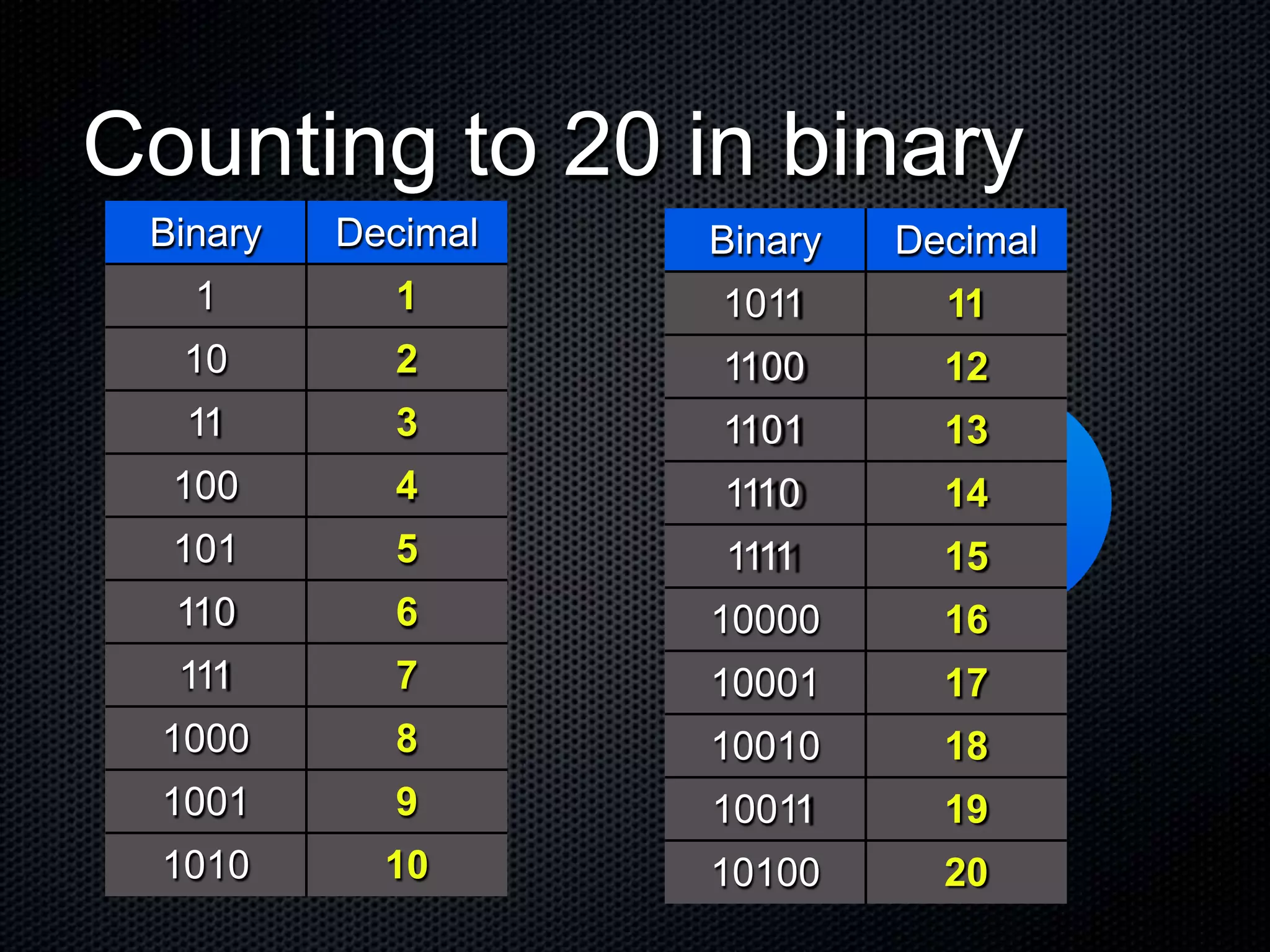
Counting to 20 in binary
Binary Decimal
1011 11
1100 12
1101 13
1110 14
1111 15
10000 16
10001 17
10010 18
10011 19
10100 20
Binary Decimal
1 1
10 2
11 3
100 4
101 5
110 6
111 7
1000 8
1001 9
1010 10
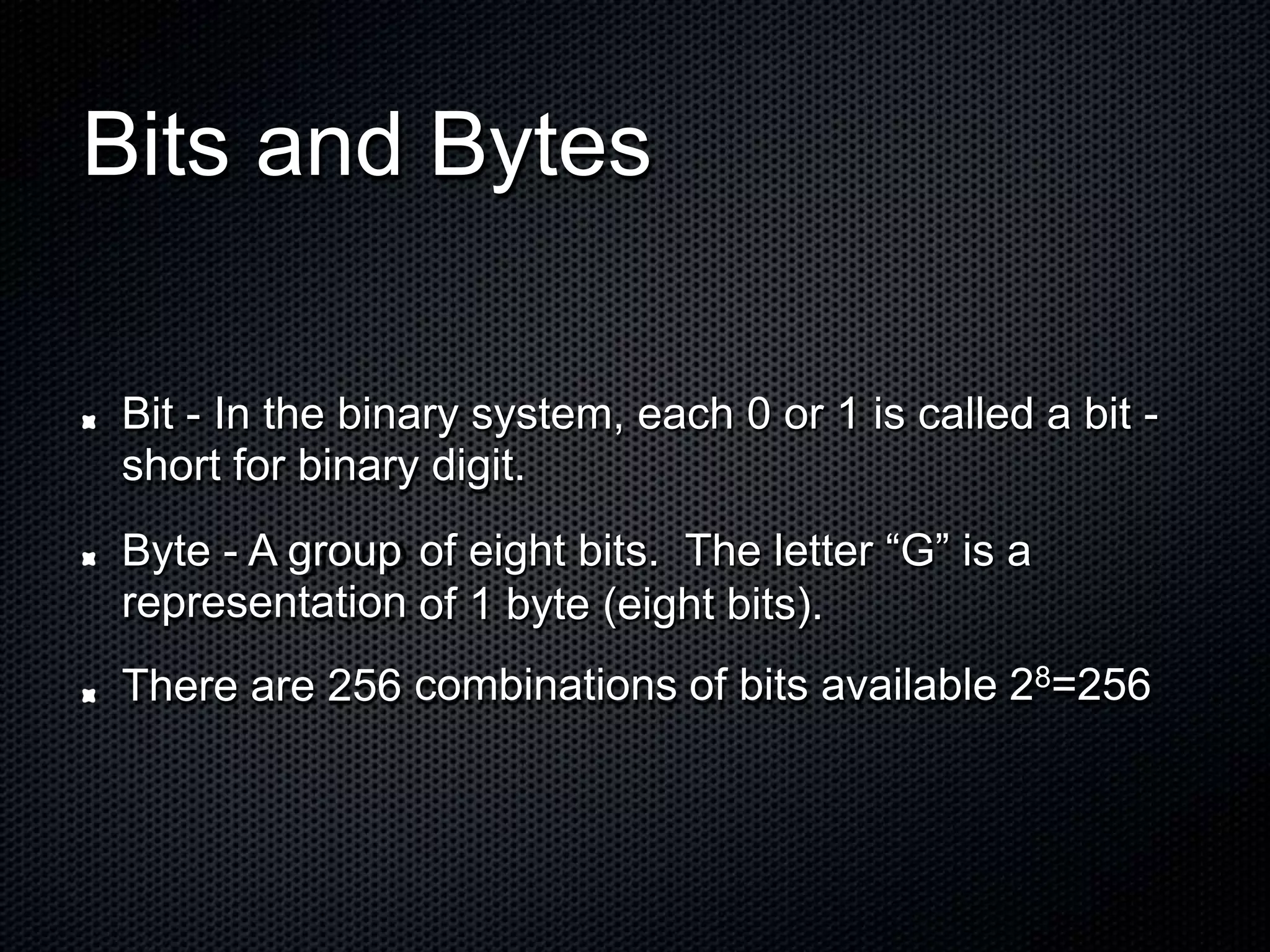
Bits and Bytes
Bit - In the binary system, each
short for binary digit.
0 or 1 is called a bit -
Byte - A group
representation
There are 256
of eight bits. The letter “G” is a
of 1 byte (eight bits).
combinations of bits available 28=256
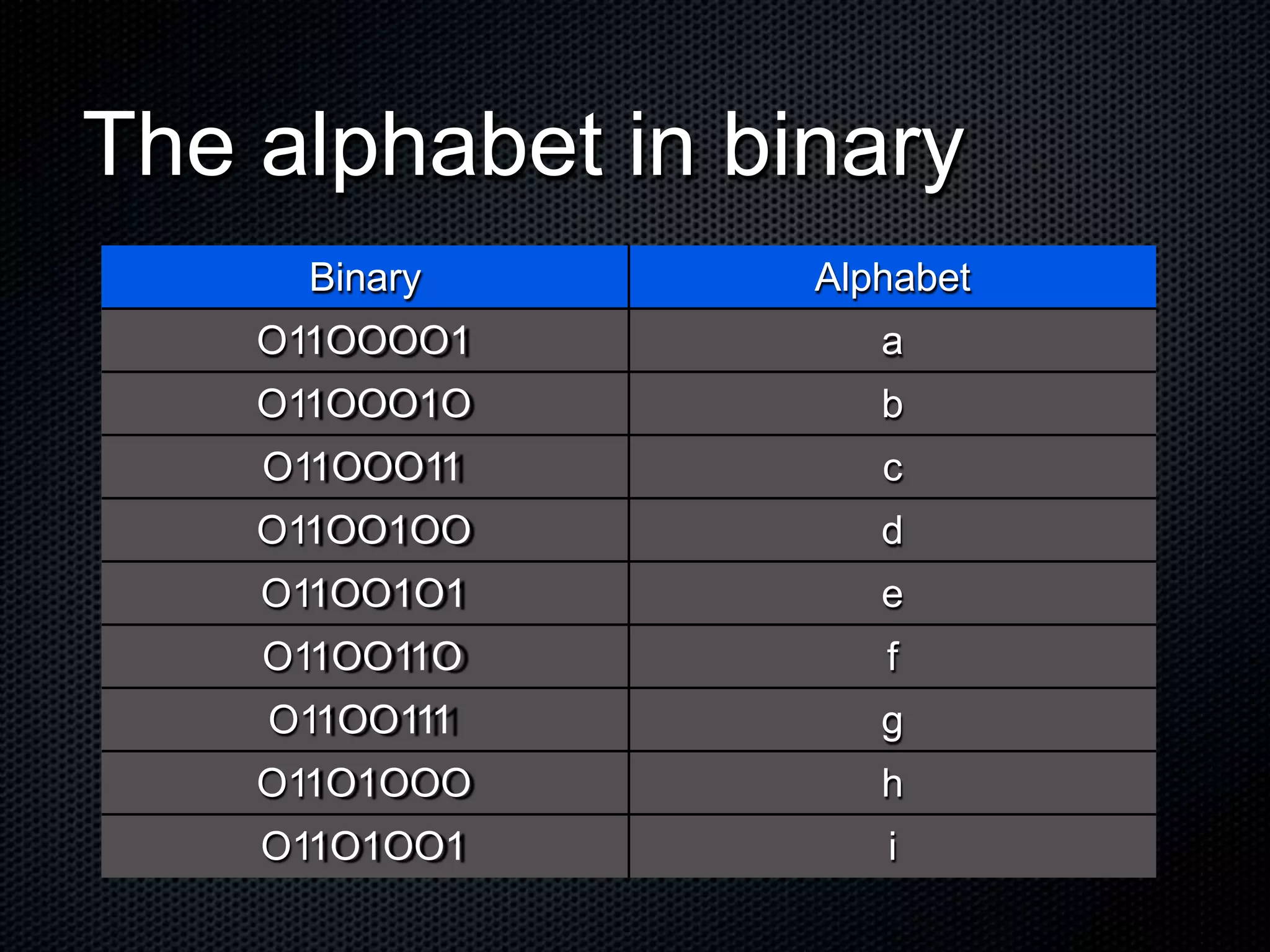
The alphabet in binary
Binary Alphabet
O11OOOO1 a
O11OOO1O b
O11OOO11 c
O11OO1OO d
O11OO1O1 e
O11OO11O f
O11OO111 g
O11O1OOO h
O11O1OO1 i
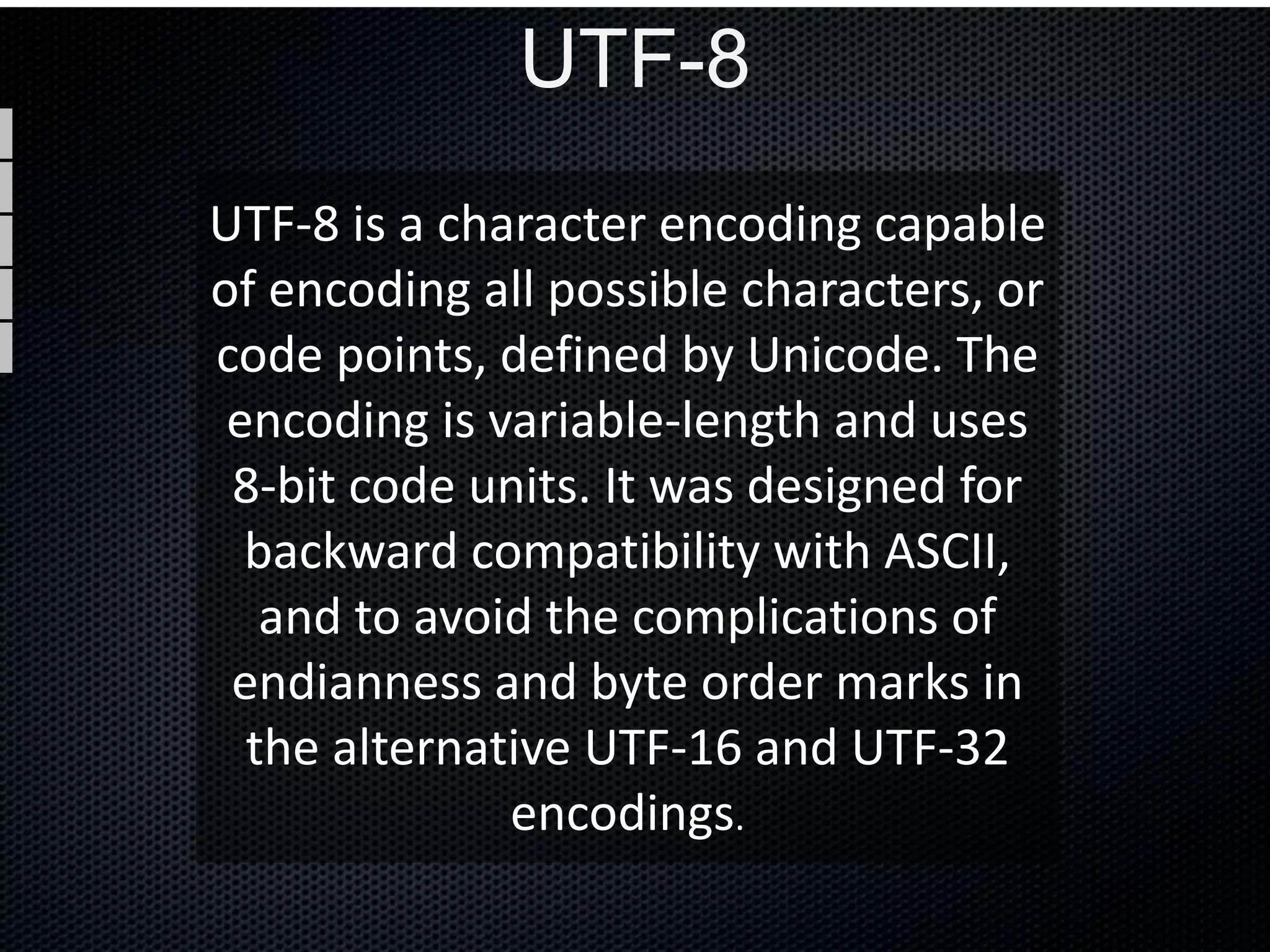
UTF-8
UTF-8 is a character encoding capable
of encoding all possible characters, or
code points, defined by Unicode. The
encoding is variable-length and uses
8-bit code units. It was designed for
backward compatibility with ASCII,
and to avoid the complications of
endianness and byte order marks in
the alternative UTF-16 and UTF-32
encodings.
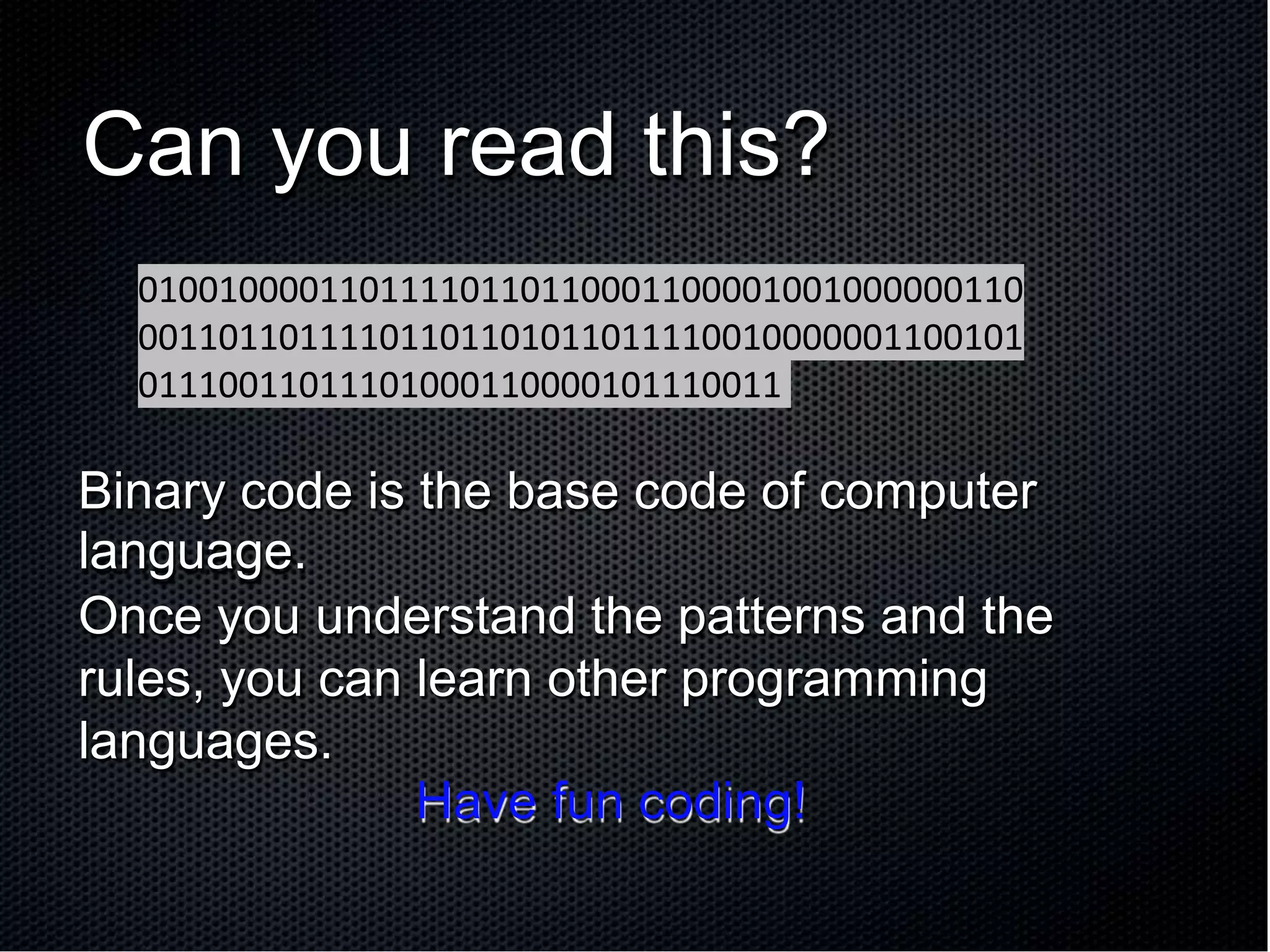
Can you read this?
Binary code is the base code of computer
language.
Once you understand the patterns and the
rules, you can learn other programming
languages.
Have fun coding!
01001000011011110110110001100001001000000110
00110110111101101101011011110010000001100101
01110011011101000110000101110011
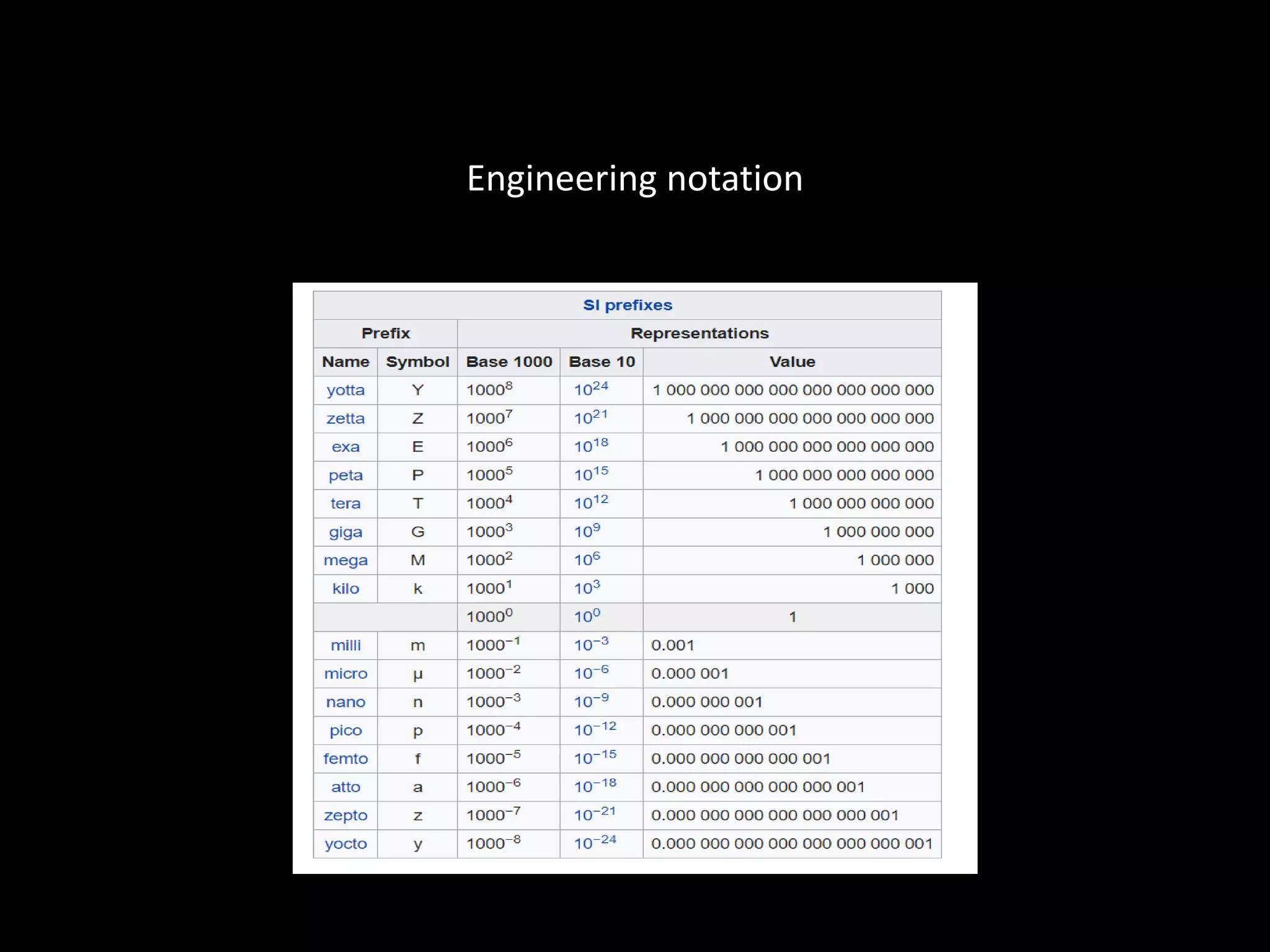
Engineering notation
Sources
Adapted from, Using Information Technology,
Williams/Sawyer
Additional Teaching Links
Text to Binary and Back Again
http://www.roubaixinteractive.com/PlayGround/Binary_Conversion/Binary_To_Text.a
sp
The Alphabet in Binary
http://www.tekmom.com/buzzwords/binaryalphabet.html
http://en.wikipedia.org/wiki/Binary_numeral_system

binarycode.pptx

  • 1.
    Binary Code The Languageof Your Computer
  • 2.
    Input/Output Input is whateveris put into a computer. Input can be data, letters, numbers, symbols, shapes, sounds, pressure, light beams or whatever material needs processing. Output hardware consists of devices that translate information processed by the computer into a form humans can understand - print, sound, graphics, or video, for example.
  • 3.
    The Binary System Thebase of all programs is the binary number system of two - 1 and 0. system, a These represent On and Off - the position for an electrical signal to pass through (or not) a transistor. All data and computer to represented program instructions that go into the be processed and stored, are by these binary numbers.
  • 4.
    Decimal System To understandthe binary system, our Base 10, decimal system. The prefix “dec-” means 10 we need to review Our decimal system is based on (0,1,2,3,4,5,6,7,8,9) 10 numbers When counting, using place value, we fill the ones place and then move to the tens place.
  • 5.
    For example: When youcount in the decimal system (base 10) you fill the one’s place, then move to the ten’s place. Only the numbers 0 - 9 are used. As each place value is filled with the numbers, we continue to the next place value. Each place value is 10x the previous place. 100’s 10’s 1’s 9 9 1 0 0 1 0 1 10’s 1’s 9 1 0 1 1 1 2 1 3
  • 6.
    Counting in Binary(Base 2) The prefix “bi-” means two. The binary system uses only two numbers - 0 and 1. We count in the binary system the same as in the decimal system by filling in the place values and moving up the place value chart. If the decimal system, base 10 has place values 10x the previous place - How do you think the place values for the binary system are determined?
  • 7.
    Counting in Binary Doyou see a pattern? 0 1 1 0 1 1 1 0 0 1 0 1 1 1 0 1 1 1 1 0 0 0
  • 8.
    Counting in Binary l valueis 2x the previous place. Decima 0 1 2 3 4 5 6 7 8 64’s 32’s 16’s 8’s 4’s 2’s 1’s 0 1 Each place 1 0 previo 1 1 1 0 0 1 0 1 1 1 0 1 1 1 1 0 0 0
  • 9.
    Counting in Binary l one4, one 2 = 6 1000 = 8 one 8 Decima 0 1 2 3 4 5 6 7 8 64’s 32’s 16’s 8’s 4’s 2’s 1’s 0 110 = 6 1 one 4, o 1 0 on 1 1 1 0 0 1 0 1 1 1 0 1 1 1 1 0 0 0
  • 10.
    Counting in Binary Whatis binary number? 64’s 32’s 16’s 8’s 4’s 2’s 1’s 1 0 1 0 0 1 this
  • 11.
    Counting in Binary 41 Determinethe place values and add together. 64’s 32’s 16’s 8’s 4’s 2’s 1’s 1 0 1 0 0 1 (32) + (0) + (8) + (0) + (0) + 1= them
  • 12.
    Try counting to 20. Counting to20 in binary Binary Decimal 1011 11 1100 12 1101 13 1110 14 1111 15 10000 16 10001 17 10010 18 10011 19 10100 20 Binary Decimal 1 1 10 2 11 3 100 4 101 5 110 6 111 7 1000 8 1001 9 1010 10
  • 13.
    Bits and Bytes Bit- In the binary system, each short for binary digit. 0 or 1 is called a bit - Byte - A group representation There are 256 of eight bits. The letter “G” is a of 1 byte (eight bits). combinations of bits available 28=256
  • 14.
    The alphabet inbinary Binary Alphabet O11OOOO1 a O11OOO1O b O11OOO11 c O11OO1OO d O11OO1O1 e O11OO11O f O11OO111 g O11O1OOO h O11O1OO1 i
  • 16.
    UTF-8 UTF-8 is acharacter encoding capable of encoding all possible characters, or code points, defined by Unicode. The encoding is variable-length and uses 8-bit code units. It was designed for backward compatibility with ASCII, and to avoid the complications of endianness and byte order marks in the alternative UTF-16 and UTF-32 encodings.
  • 17.
    Can you readthis? Binary code is the base code of computer language. Once you understand the patterns and the rules, you can learn other programming languages. Have fun coding! 01001000011011110110110001100001001000000110 00110110111101101101011011110010000001100101 01110011011101000110000101110011
  • 18.
  • 19.
    Sources Adapted from, UsingInformation Technology, Williams/Sawyer
  • 20.
    Additional Teaching Links Textto Binary and Back Again http://www.roubaixinteractive.com/PlayGround/Binary_Conversion/Binary_To_Text.a sp The Alphabet in Binary http://www.tekmom.com/buzzwords/binaryalphabet.html http://en.wikipedia.org/wiki/Binary_numeral_system