OBSERVE SAFETY
PROTOCOL
PE & HEALTH 12
Quarter II
Dance comes in different forms. All
dance styles are not alike, and they are
distinctive. Knowing and understanding
the nature of a specific dance and
mastering several of its techniques are
just the first few steps in learning the
dance as a whole.
In this lesson, you will be introduced to
the nature of different types of dances
and you will also learn and experience
some of these dances as you plan and
take part in your community outreach
program. It will be exciting without you
knowing that you are at the same time
improving your fitness and your sense of
community. Good luck and have fun!
OBJECTIVES
At the end of the lesson, you should be able to:
Identify the personal safety protocol during MVPA participation
while dancing;
Perform moderate to vigorous physical activity; and
Observe personal safety protocol to avoid dehydration,
overexertion, hypo- and hyperthermia.
Dehydration
➢ This refers to excessive loss of water from the body,
usually through perspiration or sweating, urination, or
evaporation.
❖ Signs of mild to moderate dehydration o dry mouth and
tongue
o thirst o lethargy o dry skin o muscle weakness o
dizziness
o dark urine
To make sure that you don’t lose a lot of fluids in your body
we need Electrolytes to replenish the water that you lost
Electrolytes
are the minerals that are
involved in many essential
Process in the ody
7 Healthy Drinks Rich in Electrolytes
• Coconut Water - is naturally low in calories and sugar yet
rich in electrolytes like potassium and magnesium.
• Milk - is a good source of electrolytes, as well as protein
and carbs, making it a good post-workout beverage.
• Watermelon and other fruits - contain several electrolytes
but are typically low in sodium and high in sugar.
• Smoothie - allows you to obtain electrolytes from blended,
whole foods like fruits, vegetables, and dairy products.
They’re a great pre- or post-workout recovery beverage.
7 Healthy Drinks Rich in Electrolytes
• Electrolyte-infused water - can be a great low-calorie
hydration options, but be mindful of the brands that
contain large quantities of added sugar.
• Electrolyte Tablets - are a convenient and affordable
option for making your electrolyte drink. All you have to do
is mix a tablet with water.
• Sports Drinks - Commercial sports drinks can be good for
refueling and replenishing electrolytes during intense
exercise, but they’re often high in sugar and artificial colors
and flavors. Try making a healthier version at home.
Overexertion or Overtraining
•This refers to the detrimental
cause of excessive training.
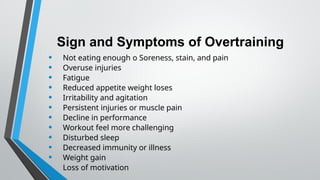
Sign and Symptoms of Overtraining
• Not eating enough o Soreness, stain, and pain
• Overuse injuries
• Fatigue
• Reduced appetite weight loses
• Irritability and agitation
• Persistent injuries or muscle pain
• Decline in performance
• Workout feel more challenging
• Disturbed sleep
• Decreased immunity or illness
• Weight gain
• Loss of motivation
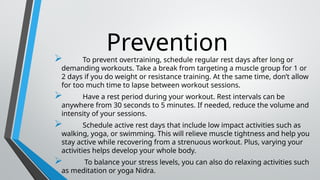
Prevention
 To prevent overtraining, schedule regular rest days after long or
demanding workouts. Take a break from targeting a muscle group for 1 or
2 days if you do weight or resistance training. At the same time, don’t allow
for too much time to lapse between workout sessions.
 Have a rest period during your workout. Rest intervals can be
anywhere from 30 seconds to 5 minutes. If needed, reduce the volume and
intensity of your sessions.
 Schedule active rest days that include low impact activities such as
walking, yoga, or swimming. This will relieve muscle tightness and help you
stay active while recovering from a strenuous workout. Plus, varying your
activities helps develop your whole body.
 To balance your stress levels, you can also do relaxing activities such
as meditation or yoga Nidra.
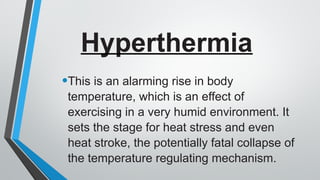
Hyperthermia
•This is an alarming rise in body
temperature, which is an effect of
exercising in a very humid environment. It
sets the stage for heat stress and even
heat stroke, the potentially fatal collapse of
the temperature regulating mechanism.
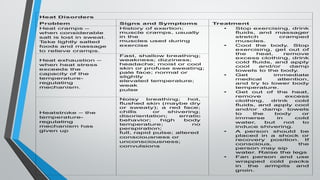
Heat Disorders
Problem Signs and Symptoms Treatment
Heat cramps –
when considerable
salt is lost in sweat.
T
ake lightly salted
foods and massage
to relieve cramps.
History of exertion;
muscle cramps, usually
in the
muscles used during
exercise
• Stop exercising, drink
fluids, and massager
stretch cramped
muscles.
• Cool the body
. Stop
exercising, get out of
the heat, remove
excess clothing, drink
cold fluids, and apply
cool and/or damp
towels to the body
.
• Get immediate
medical attention,
and try to lower body
temperature.
• Get out of the heat,
remove excess
clothing, drink cold
fluids, and apply cool
and/or damp towels
to the body or
immerse in cold
water, but not to
induce shivering.
• A person should be
placed in a shock or
recovery position. If
conscious, the
person may sip
water. Raise the legs
• Fan person and use
wrapped cold packs
in the armpits and
groin.
Heat exhaustion –
when heat stress
exceeds the
capacity of the
temperature-
regulating
mechanism.
Fast, shallow breathing;
weakness; dizziness;
headache; moist or cool
skin or profuse sweating;
pale face; normal or
slightly
elevated temperature;
weak
pulse
Heatstroke – the
temperature-
regulating
mechanism has
given up
Noisy breathing; hot,
flushed skin (maybe dry
or sweaty); a red face;
chills or shivering;
disorientation; erratic
behavior; high body
temperature; no
perspiration;
full, rapid pulse; altered
consciousness or
unconsciousness;
convulsions
Hypothermia
• Excessively low body temperature, characterized by
uncontrollable shivering, loss of coordination, and mental
confusion.
• This occurs when the body begins to lose heat faster than it can
be produced. Prolonged exertion leads to progressive muscular
fatigue. As exposure continues and additional body heat is lost,
the cold reaches the brain. One loses judgment and the ability to
reason. Speech becomes slow and slurred and control of the
hands is lost.
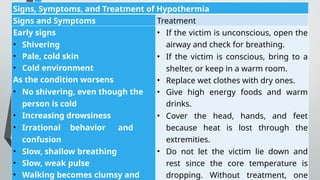
Signs, Symptoms, and Treatment of Hypothermia
Signs and Symptoms Treatment
Early signs
• Shivering
• Pale, cold skin
• Cold environment
As the condition worsens
• No shivering, even though the
person is cold
• Increasing drowsiness
• Irrational behavior and
confusion
• Slow, shallow breathing
• Slow, weak pulse
• Walking becomes clumsy and
• If the victim is unconscious, open the
airway and check for breathing.
• If the victim is conscious, bring to a
shelter, or keep in a warm room.
• Replace wet clothes with dry ones.
• Give high energy foods and warm
drinks.
• Cover the head, hands, and feet
because heat is lost through the
extremities.
• Do not let the victim lie down and
rest since the core temperature is
dropping. Without treatment, one
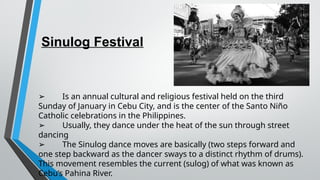
Sinulog Festival
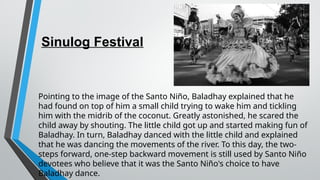
➢ Is an annual cultural and religious festival held on the third
Sunday of January in Cebu City, and is the center of the Santo Niño
Catholic celebrations in the Philippines.
➢ Usually, they dance under the heat of the sun through street
dancing
➢ The Sinulog dance moves are basically (two steps forward and
one step backward as the dancer sways to a distinct rhythm of drums).
This movement resembles the current (sulog) of what was known as
Cebu’s Pahina River.
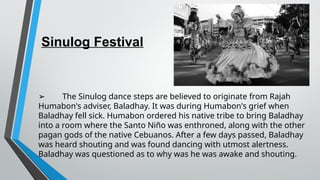
Sinulog Festival
➢ The Sinulog dance steps are believed to originate from Rajah
Humabon's adviser, Baladhay. It was during Humabon's grief when
Baladhay fell sick. Humabon ordered his native tribe to bring Baladhay
into a room where the Santo Niño was enthroned, along with the other
pagan gods of the native Cebuanos. After a few days passed, Baladhay
was heard shouting and was found dancing with utmost alertness.
Baladhay was questioned as to why was he was awake and shouting.
Sinulog Festival
Pointing to the image of the Santo Niño, Baladhay explained that he
had found on top of him a small child trying to wake him and tickling
him with the midrib of the coconut. Greatly astonished, he scared the
child away by shouting. The little child got up and started making fun of
Baladhay. In turn, Baladhay danced with the little child and explained
that he was dancing the movements of the river. To this day, the two-
steps forward, one-step backward movement is still used by Santo Niño
devotees who believe that it was the Santo Niño's choice to have
Baladhay dance.
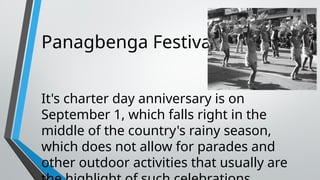
Panagbenga Festival
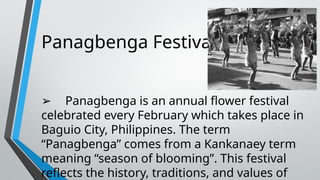
➢ Panagbenga is an annual flower festival
celebrated every February which takes place in
Baguio City, Philippines. The term
“Panagbenga” comes from a Kankanaey term
meaning “season of blooming”. This festival
reflects the history, traditions, and values of
Panagbenga Festival
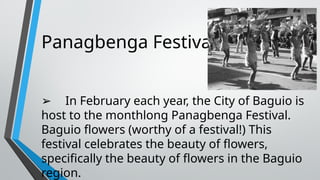
➢ In February each year, the City of Baguio is
host to the monthlong Panagbenga Festival.
Baguio flowers (worthy of a festival!) This
festival celebrates the beauty of flowers,
specifically the beauty of flowers in the Baguio
region.
Panagbenga Festival
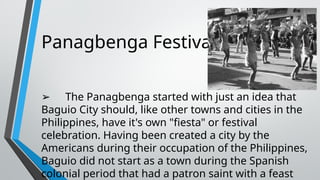
➢ The Panagbenga started with just an idea that
Baguio City should, like other towns and cities in the
Philippines, have it's own "fiesta" or festival
celebration. Having been created a city by the
Americans during their occupation of the Philippines,
Baguio did not start as a town during the Spanish
colonial period that had a patron saint with a feast
Panagbenga Festival
It's charter day anniversary is on
September 1, which falls right in the
middle of the country's rainy season,
which does not allow for parades and
other outdoor activities that usually are
Direction: Choose the correct symptoms
of Dehydration, Overexertion,
Hyperthermia, and Hypothermia from the
word pool below. List the symptoms on the
correct column in the second table below.
Write your answers in ½ sheet of paper.
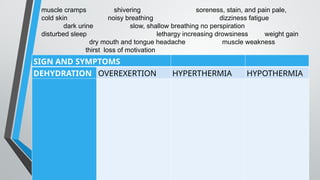
muscle cramps shivering soreness, stain, and pain pale,
cold skin noisy breathing dizziness fatigue
dark urine slow, shallow breathing no perspiration
disturbed sleep lethargy increasing drowsiness weight gain
dry mouth and tongue headache muscle weakness
thirst loss of motivation
SIGN AND SYMPTOMS
DEHYDRATION OVEREXERTION HYPERTHERMIA HYPOTHERMIA
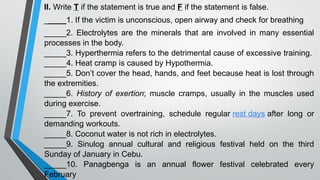
II. Write T if the statement is true and F if the statement is false.
_____1. If the victim is unconscious, open airway and check for breathing
_____2. Electrolytes are the minerals that are involved in many essential
processes in the body.
_____3. Hyperthermia refers to the detrimental cause of excessive training.
_____4. Heat cramp is caused by Hypothermia.
_____5. Don’t cover the head, hands, and feet because heat is lost through
the extremities.
_____6. History of exertion; muscle cramps, usually in the muscles used
during exercise.
_____7. To prevent overtraining, schedule regular rest days after long or
demanding workouts.
_____8. Coconut water is not rich in electrolytes.
_____9. Sinulog annual cultural and religious festival held on the third
Sunday of January in Cebu.
_____10. Panagbenga is an annual flower festival celebrated every
February

OBSERVE SAFETY PROTOCOL physcal education.pptx

  • 1.
    OBSERVE SAFETY PROTOCOL PE &HEALTH 12 Quarter II
  • 2.
    Dance comes indifferent forms. All dance styles are not alike, and they are distinctive. Knowing and understanding the nature of a specific dance and mastering several of its techniques are just the first few steps in learning the dance as a whole.
  • 3.
    In this lesson,you will be introduced to the nature of different types of dances and you will also learn and experience some of these dances as you plan and take part in your community outreach program. It will be exciting without you knowing that you are at the same time improving your fitness and your sense of community. Good luck and have fun!
  • 4.
    OBJECTIVES At the endof the lesson, you should be able to: Identify the personal safety protocol during MVPA participation while dancing; Perform moderate to vigorous physical activity; and Observe personal safety protocol to avoid dehydration, overexertion, hypo- and hyperthermia.
  • 5.
    Dehydration ➢ This refersto excessive loss of water from the body, usually through perspiration or sweating, urination, or evaporation. ❖ Signs of mild to moderate dehydration o dry mouth and tongue o thirst o lethargy o dry skin o muscle weakness o dizziness o dark urine To make sure that you don’t lose a lot of fluids in your body we need Electrolytes to replenish the water that you lost
  • 6.
    Electrolytes are the mineralsthat are involved in many essential Process in the ody
  • 7.
    7 Healthy DrinksRich in Electrolytes • Coconut Water - is naturally low in calories and sugar yet rich in electrolytes like potassium and magnesium. • Milk - is a good source of electrolytes, as well as protein and carbs, making it a good post-workout beverage. • Watermelon and other fruits - contain several electrolytes but are typically low in sodium and high in sugar. • Smoothie - allows you to obtain electrolytes from blended, whole foods like fruits, vegetables, and dairy products. They’re a great pre- or post-workout recovery beverage.
  • 8.
    7 Healthy DrinksRich in Electrolytes • Electrolyte-infused water - can be a great low-calorie hydration options, but be mindful of the brands that contain large quantities of added sugar. • Electrolyte Tablets - are a convenient and affordable option for making your electrolyte drink. All you have to do is mix a tablet with water. • Sports Drinks - Commercial sports drinks can be good for refueling and replenishing electrolytes during intense exercise, but they’re often high in sugar and artificial colors and flavors. Try making a healthier version at home.
  • 9.
    Overexertion or Overtraining •Thisrefers to the detrimental cause of excessive training.
  • 10.
    Sign and Symptomsof Overtraining • Not eating enough o Soreness, stain, and pain • Overuse injuries • Fatigue • Reduced appetite weight loses • Irritability and agitation • Persistent injuries or muscle pain • Decline in performance • Workout feel more challenging • Disturbed sleep • Decreased immunity or illness • Weight gain • Loss of motivation
  • 11.
    Prevention  To preventovertraining, schedule regular rest days after long or demanding workouts. Take a break from targeting a muscle group for 1 or 2 days if you do weight or resistance training. At the same time, don’t allow for too much time to lapse between workout sessions.  Have a rest period during your workout. Rest intervals can be anywhere from 30 seconds to 5 minutes. If needed, reduce the volume and intensity of your sessions.  Schedule active rest days that include low impact activities such as walking, yoga, or swimming. This will relieve muscle tightness and help you stay active while recovering from a strenuous workout. Plus, varying your activities helps develop your whole body.  To balance your stress levels, you can also do relaxing activities such as meditation or yoga Nidra.
  • 12.
    Hyperthermia •This is analarming rise in body temperature, which is an effect of exercising in a very humid environment. It sets the stage for heat stress and even heat stroke, the potentially fatal collapse of the temperature regulating mechanism.
  • 13.
    Heat Disorders Problem Signsand Symptoms Treatment Heat cramps – when considerable salt is lost in sweat. T ake lightly salted foods and massage to relieve cramps. History of exertion; muscle cramps, usually in the muscles used during exercise • Stop exercising, drink fluids, and massager stretch cramped muscles. • Cool the body . Stop exercising, get out of the heat, remove excess clothing, drink cold fluids, and apply cool and/or damp towels to the body . • Get immediate medical attention, and try to lower body temperature. • Get out of the heat, remove excess clothing, drink cold fluids, and apply cool and/or damp towels to the body or immerse in cold water, but not to induce shivering. • A person should be placed in a shock or recovery position. If conscious, the person may sip water. Raise the legs • Fan person and use wrapped cold packs in the armpits and groin. Heat exhaustion – when heat stress exceeds the capacity of the temperature- regulating mechanism. Fast, shallow breathing; weakness; dizziness; headache; moist or cool skin or profuse sweating; pale face; normal or slightly elevated temperature; weak pulse Heatstroke – the temperature- regulating mechanism has given up Noisy breathing; hot, flushed skin (maybe dry or sweaty); a red face; chills or shivering; disorientation; erratic behavior; high body temperature; no perspiration; full, rapid pulse; altered consciousness or unconsciousness; convulsions
  • 14.
    Hypothermia • Excessively lowbody temperature, characterized by uncontrollable shivering, loss of coordination, and mental confusion. • This occurs when the body begins to lose heat faster than it can be produced. Prolonged exertion leads to progressive muscular fatigue. As exposure continues and additional body heat is lost, the cold reaches the brain. One loses judgment and the ability to reason. Speech becomes slow and slurred and control of the hands is lost.
  • 15.
    Signs, Symptoms, andTreatment of Hypothermia Signs and Symptoms Treatment Early signs • Shivering • Pale, cold skin • Cold environment As the condition worsens • No shivering, even though the person is cold • Increasing drowsiness • Irrational behavior and confusion • Slow, shallow breathing • Slow, weak pulse • Walking becomes clumsy and • If the victim is unconscious, open the airway and check for breathing. • If the victim is conscious, bring to a shelter, or keep in a warm room. • Replace wet clothes with dry ones. • Give high energy foods and warm drinks. • Cover the head, hands, and feet because heat is lost through the extremities. • Do not let the victim lie down and rest since the core temperature is dropping. Without treatment, one
  • 16.
    Sinulog Festival ➢ Isan annual cultural and religious festival held on the third Sunday of January in Cebu City, and is the center of the Santo Niño Catholic celebrations in the Philippines. ➢ Usually, they dance under the heat of the sun through street dancing ➢ The Sinulog dance moves are basically (two steps forward and one step backward as the dancer sways to a distinct rhythm of drums). This movement resembles the current (sulog) of what was known as Cebu’s Pahina River.
  • 17.
    Sinulog Festival ➢ TheSinulog dance steps are believed to originate from Rajah Humabon's adviser, Baladhay. It was during Humabon's grief when Baladhay fell sick. Humabon ordered his native tribe to bring Baladhay into a room where the Santo Niño was enthroned, along with the other pagan gods of the native Cebuanos. After a few days passed, Baladhay was heard shouting and was found dancing with utmost alertness. Baladhay was questioned as to why was he was awake and shouting.
  • 18.
    Sinulog Festival Pointing tothe image of the Santo Niño, Baladhay explained that he had found on top of him a small child trying to wake him and tickling him with the midrib of the coconut. Greatly astonished, he scared the child away by shouting. The little child got up and started making fun of Baladhay. In turn, Baladhay danced with the little child and explained that he was dancing the movements of the river. To this day, the two- steps forward, one-step backward movement is still used by Santo Niño devotees who believe that it was the Santo Niño's choice to have Baladhay dance.
  • 19.
    Panagbenga Festival ➢ Panagbengais an annual flower festival celebrated every February which takes place in Baguio City, Philippines. The term “Panagbenga” comes from a Kankanaey term meaning “season of blooming”. This festival reflects the history, traditions, and values of
  • 20.
    Panagbenga Festival ➢ InFebruary each year, the City of Baguio is host to the monthlong Panagbenga Festival. Baguio flowers (worthy of a festival!) This festival celebrates the beauty of flowers, specifically the beauty of flowers in the Baguio region.
  • 21.
    Panagbenga Festival ➢ ThePanagbenga started with just an idea that Baguio City should, like other towns and cities in the Philippines, have it's own "fiesta" or festival celebration. Having been created a city by the Americans during their occupation of the Philippines, Baguio did not start as a town during the Spanish colonial period that had a patron saint with a feast
  • 22.
    Panagbenga Festival It's charterday anniversary is on September 1, which falls right in the middle of the country's rainy season, which does not allow for parades and other outdoor activities that usually are
  • 23.
    Direction: Choose thecorrect symptoms of Dehydration, Overexertion, Hyperthermia, and Hypothermia from the word pool below. List the symptoms on the correct column in the second table below. Write your answers in ½ sheet of paper.
  • 24.
    muscle cramps shiveringsoreness, stain, and pain pale, cold skin noisy breathing dizziness fatigue dark urine slow, shallow breathing no perspiration disturbed sleep lethargy increasing drowsiness weight gain dry mouth and tongue headache muscle weakness thirst loss of motivation SIGN AND SYMPTOMS DEHYDRATION OVEREXERTION HYPERTHERMIA HYPOTHERMIA
  • 25.
    II. Write Tif the statement is true and F if the statement is false. _____1. If the victim is unconscious, open airway and check for breathing _____2. Electrolytes are the minerals that are involved in many essential processes in the body. _____3. Hyperthermia refers to the detrimental cause of excessive training. _____4. Heat cramp is caused by Hypothermia. _____5. Don’t cover the head, hands, and feet because heat is lost through the extremities. _____6. History of exertion; muscle cramps, usually in the muscles used during exercise. _____7. To prevent overtraining, schedule regular rest days after long or demanding workouts. _____8. Coconut water is not rich in electrolytes. _____9. Sinulog annual cultural and religious festival held on the third Sunday of January in Cebu. _____10. Panagbenga is an annual flower festival celebrated every February

Editor's Notes

  • #5 As you engage in moderate to vigorous physical activity, you need to observe some personal safety precautions to avoid certain conditions related to physical activity participation. These conditions include dehydration, overexertion, hypothermia, and hyperthermia. Each of these conditions should be taken seriously because each poses health risks to an exerciser. These conditions are usually associated with exercising in different types of environments, like a hot or cold environment. However, dehydration and overexertion may be experienced even when exercising in environments that do not have extreme temperatures. Each condition will be discussed with ample safety precautions to guide you as you engage in moderate to vigorous physical activities.
  • #6 As you engage in moderate to vigorous physical activity, you need to observe some personal safety precautions to avoid certain conditions related to physical activity participation. These conditions include dehydration, overexertion, hypothermia, and hyperthermia. Each of these conditions should be taken seriously because each poses health risks to an exerciser. These conditions are usually associated with exercising in different types of environments, like a hot or cold environment. However, dehydration and overexertion may be experienced even when exercising in environments that do not have extreme temperatures. Each condition will be discussed with ample safety precautions to guide you as you engage in moderate to vigorous physical activities.