Chapter 7
Bilingualism
and Cognition
By:
Ana Zulianingrum
Introduction
“If it were possible for a child to live in two
languages at once equally well, so much the
worse. His intellectual and spiritual growth
would not thereby be doubted, but halved.
Unity of mind and character would have
great difficulty in asserting itself in such
circumstances” (Laurie, 1890:15)
Bilingualism and Intelligence
Period of Detrimental Effects
Bilingual’s intellectual growth would not be
doubted by being bilingual.
IQ score compared, bilinguals were behind
monolinguals.
Bilinguals were mentally confused.(Saerr,
1923)
Problems of defining
Intelligence is
relatively fixed
and unlikely to
be affected by
becoming
bilingual.
IQ tests tend
to relate a
middle class,
white, western
view of
intelligence.
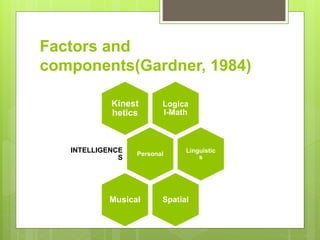
Factors and
components(Gardner, 1984)
Logica
l-Math
Kinest
hetics
Personal
INTELLIGENCE
S
Linguistic
s
SpatialMusical
Measuring intelligence
• IQ administered
in English only
• Test lg weakness
and under
performed
Lg
Testing
• Simple
average
comparison
• No significant
differences
Analysis
• Simplistic
classification
• Incentive and
imprecise
manner
Classification
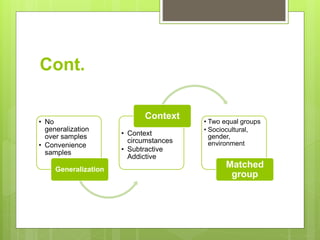
Cont.
• No
generalization
over samples
• Convenience
samples
Generalization
• Context
circumstances
• Subtractive
Addictive
Context
• Two equal groups
• Sociocultural,
gender,
environment
Matched
group
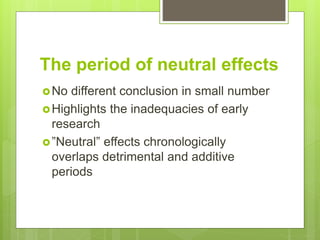
The period of neutral effects
No different conclusion in small number
Highlights the inadequacies of early
research
”Neutral” effects chronologically
overlaps detrimental and additive
periods
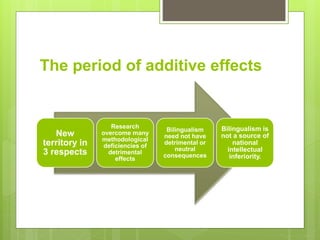
The period of additive effects
New
territory in
3 respects
Research
overcome many
methodological
deficiencies of
detrimental
effects
Bilingualism
need not have
detrimental or
neutral
consequences
Bilingualism is
not a source of
national
intellectual
inferiority.
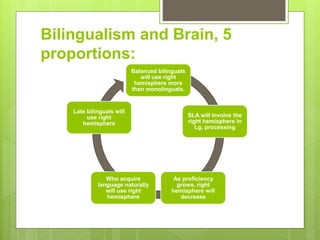
Bilingualism and Brain, 5
proportions:
Balanced bilinguals
will use right
hemisphere more
than monolinguals.
SLA will involve the
right hemisphere in
Lg. processing
As proficiency
grows, right
hemisphere will
decrease
Who acquire
language naturally
will use right
hemisphere
Late bilinguals will
use right
hemisphere
Bilingualism, divergent, and
creative thinking
 Divergent thinking is investigated by asking
questions “How many….”
 Creative thinking(North American) analyzes the
answers to the “Uses of an Object”
 Fluency score in CT is the different acceptable
answer
 Flexibility score is the number of different
categories measured by references.
 Elaboration refers to the extent of extra detail that
a person gives beyond the basic use of an object.
Major problems:
1. Some studies fail to control
adequately differences
2. Some studies have small samples
3. Some studies fail to define the level
and degree of bilingualism
4. Not all studies find positive
relationship
5. The term “Creativity” is defined in
different ways
Bilingualism and
metalinguistic awareness:
Initial research
Doyle “Bilinguals tend to be superior in
their ability to relate stories and to
express concepts within stories”
Leopald “An effect apparently due to
bilingualism”
Worrall “Sound and meaning
separation idea. No differences
between mono and bilinguals in their
choices”
Recent trends
Recent trends has been to look at the
process rather than products of
thinking
Working within the information
processing
Memorization and language processing
approaches in psychology
Bilingualism and
communicative sensitivity
What is communicative sensitivity?
Bilinguals need to be aware of which
language to speak in which situation
Bilingual increases sensitivity to the
social nature and communicative
function of language
Field dependency and
independency
Descending order of scores of
independence:
1. Proficient bilinguals
2. Partial bilinguals
3. Late language learners
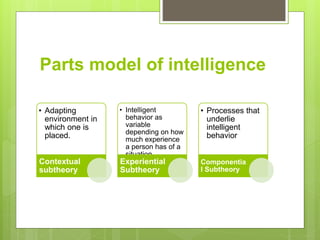
Parts model of intelligence
• Adapting
environment in
which one is
placed.
Contextual
subtheory
• Intelligent
behavior as
variable
depending on how
much experience
a person has of a
situation
Experiential
Subtheory
• Processes that
underlie
intelligent
behavior
Componentia
l Subtheory
Limitation of findings
• Research needs to match monolingual
and bilingual groups on all variables
• Cognitive advantages mostly focused
on balanced bilinguals.
• Cause and effect relationship must
again be highlighted.

Bilingualism and Cognition, Collin Baker

  • 1.
  • 2.
    Introduction “If it werepossible for a child to live in two languages at once equally well, so much the worse. His intellectual and spiritual growth would not thereby be doubted, but halved. Unity of mind and character would have great difficulty in asserting itself in such circumstances” (Laurie, 1890:15)
  • 3.
    Bilingualism and Intelligence Periodof Detrimental Effects Bilingual’s intellectual growth would not be doubted by being bilingual. IQ score compared, bilinguals were behind monolinguals. Bilinguals were mentally confused.(Saerr, 1923)
  • 4.
    Problems of defining Intelligenceis relatively fixed and unlikely to be affected by becoming bilingual. IQ tests tend to relate a middle class, white, western view of intelligence.
  • 5.
  • 6.
    Measuring intelligence • IQadministered in English only • Test lg weakness and under performed Lg Testing • Simple average comparison • No significant differences Analysis • Simplistic classification • Incentive and imprecise manner Classification
  • 7.
    Cont. • No generalization over samples •Convenience samples Generalization • Context circumstances • Subtractive Addictive Context • Two equal groups • Sociocultural, gender, environment Matched group
  • 8.
    The period ofneutral effects No different conclusion in small number Highlights the inadequacies of early research ”Neutral” effects chronologically overlaps detrimental and additive periods
  • 9.
    The period ofadditive effects New territory in 3 respects Research overcome many methodological deficiencies of detrimental effects Bilingualism need not have detrimental or neutral consequences Bilingualism is not a source of national intellectual inferiority.
  • 10.
    Bilingualism and Brain,5 proportions: Balanced bilinguals will use right hemisphere more than monolinguals. SLA will involve the right hemisphere in Lg. processing As proficiency grows, right hemisphere will decrease Who acquire language naturally will use right hemisphere Late bilinguals will use right hemisphere
  • 11.
    Bilingualism, divergent, and creativethinking  Divergent thinking is investigated by asking questions “How many….”  Creative thinking(North American) analyzes the answers to the “Uses of an Object”  Fluency score in CT is the different acceptable answer  Flexibility score is the number of different categories measured by references.  Elaboration refers to the extent of extra detail that a person gives beyond the basic use of an object.
  • 12.
    Major problems: 1. Somestudies fail to control adequately differences 2. Some studies have small samples 3. Some studies fail to define the level and degree of bilingualism 4. Not all studies find positive relationship 5. The term “Creativity” is defined in different ways
  • 13.
    Bilingualism and metalinguistic awareness: Initialresearch Doyle “Bilinguals tend to be superior in their ability to relate stories and to express concepts within stories” Leopald “An effect apparently due to bilingualism” Worrall “Sound and meaning separation idea. No differences between mono and bilinguals in their choices”
  • 14.
    Recent trends Recent trendshas been to look at the process rather than products of thinking Working within the information processing Memorization and language processing approaches in psychology
  • 15.
    Bilingualism and communicative sensitivity Whatis communicative sensitivity? Bilinguals need to be aware of which language to speak in which situation Bilingual increases sensitivity to the social nature and communicative function of language
  • 16.
    Field dependency and independency Descendingorder of scores of independence: 1. Proficient bilinguals 2. Partial bilinguals 3. Late language learners
  • 17.
    Parts model ofintelligence • Adapting environment in which one is placed. Contextual subtheory • Intelligent behavior as variable depending on how much experience a person has of a situation Experiential Subtheory • Processes that underlie intelligent behavior Componentia l Subtheory
  • 18.
    Limitation of findings •Research needs to match monolingual and bilingual groups on all variables • Cognitive advantages mostly focused on balanced bilinguals. • Cause and effect relationship must again be highlighted.