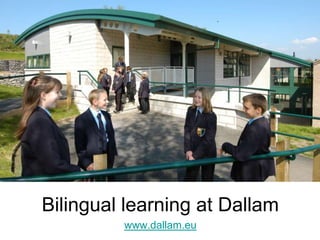
Bilingual learning at Dallam
         www.dallam.eu
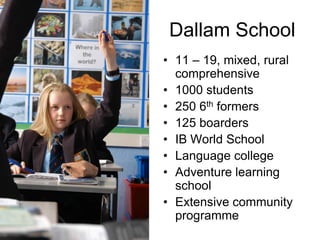
Dallam School
• 11 – 19, mixed, rural
  comprehensive
• 1000 students
• 250 6th formers
• 125 boarders
• IB World School
• Language college
• Adventure learning
  school
• Extensive community
  programme
Why bilingual?
• Language College         • Shift in ethos
• Languages results        • Wider school
• Staff prior experience     improvement
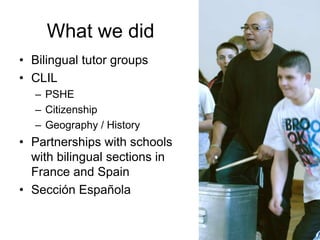
What we did
• Bilingual tutor groups
• CLIL
  – PSHE
  – Citizenship
  – Geography / History
• Partnerships with schools
  with bilingual sections in
  France and Spain
• Sección Española
Did it work?
2011 Year 9 bilingual group
• 28 students
• 60% FFT(D) expected grades A*-C in
  Year 11
• 89% achieved C+ two years earlier
• Many A/A* (including max UMS)
• However, need to evaluate skills and
  attitudes
Year 8
• Bilingual class (31 students)
• Control group - Spanish classes (of 24 and 30)
• Frequency and quality of spontaneous oral
  participation in Spanish
• Independent ability to decode authentic texts and
  confidence as readers
• Motivation and confidence to use Spanish in and
  beyond the classroom.
• Attitudes to registration and Lifeskills, when
  delivered in Spanish or English
Speaking participation - incidents
    counted of pupils’ use of Spanish
• responding to the teacher
• asking teacher a question
• speaking to each other
• The lesson content and activities were
  different in each lesson
• Quality assessed by filmed, unprepared
  Speaking task
Reading skills
• progressive ‘challenge’ of 60 minutes
• authentic text (NC) Level 4
• cross-over grade C-B question from GCSE
  (Edexcel June 2010)
• question from Edexcel AS Reading grade D
• adapted to comprehension alone
• Using cognate or known key words
• anonymous scaled questionnaire on
  confidence in reading
Attitudes to language learning and
       Lifeskills/registration
• anonymous 20-question scaled survey
• perceptions of using Spanish in the
  classroom
• interest and confidence in using Spanish
  beyond the classroom
• attitudes to future study of languages
• perceptions of Lifeskills/registration
  sessions
Key Findings
Speaking: frequency and
            spontaneity
• bilingual class 1 in 4 of all comments and
  questions in Spanish
• control classes almost two-thirds in
  Spanish
• However, one control class twice as many
  answers in Spanish and half of questions
Speaking: quality
• filmed improvised role-play
• bilingual group twice as many Spanish
  contributions
• half of bilingual class at NC Level 4
• other students as expected at NC level 1-
  2
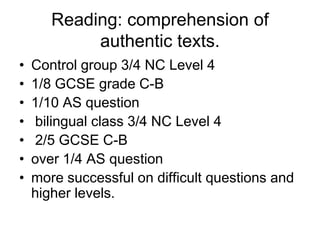
Reading: comprehension of
            authentic texts.
•   Control group 3/4 NC Level 4
•   1/8 GCSE grade C-B
•   1/10 AS question
•   bilingual class 3/4 NC Level 4
•   2/5 GCSE C-B
•   over 1/4 AS question
•   more successful on difficult questions and
    higher levels.
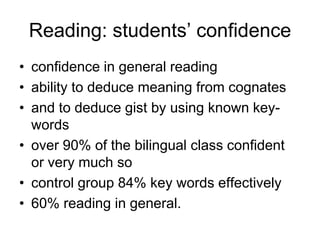
Reading: students’ confidence
• confidence in general reading
• ability to deduce meaning from cognates
• and to deduce gist by using known key-
  words
• over 90% of the bilingual class confident
  or very much so
• control group 84% key words effectively
• 60% reading in general.
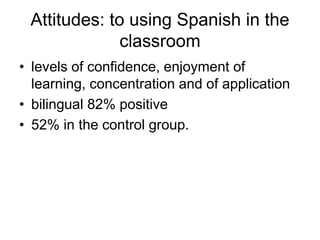
Attitudes: to using Spanish in the
              classroom
• levels of confidence, enjoyment of
  learning, concentration and of application
• bilingual 82% positive
• 52% in the control group.
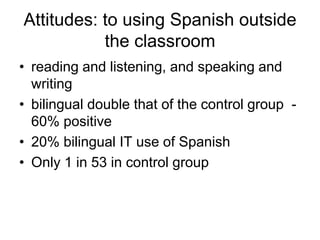
Attitudes: to using Spanish outside
           the classroom
• reading and listening, and speaking and
  writing
• bilingual double that of the control group -
  60% positive
• 20% bilingual IT use of Spanish
• Only 1 in 53 in control group
Attitudes: to further MFL study
• Year 10 languages are compulsory at KS4
• 58% bilingual looked forward to Spanish at
  GCSE
• 71% might continue beyond GCSE
• control group 25% looked forward GCSE
• 21% were contemplating going beyond.
• 55% bilingual class favoured 2nd MFL
• 36% of control group
• Overall, attitudes towards further MFL study
  bilingual 62% to 27%
Attitudes: to Lifeskills and form
         registration sessions
• enjoyment of learning, engagement in
  lessons and the use of thinking skills
• bilingual 67% positive
• control group 65% positive
Conclusion
• positive impact on speaking and reading skills
• bilingual class double level of enthusiasm for
  language learning
• gains in confidence and motivation to use the
  language, particularly beyond the classroom
• progress and confidence in reading skills imply
  underlying independent learning and thinking skills
• speaking gains depend more on the teacher’s
  example and tolerance of classroom chatter than
  on a strict ‘Spanish only’ methodology.
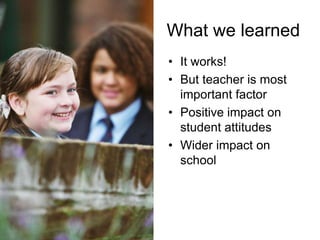
What we learned
• It works!
• But teacher is most
  important factor
• Positive impact on
  student attitudes
• Wider impact on
  school
s.holdup@dallam.eu

Bilingual Learning at Dallam School

  • 1.
    Bilingual learning atDallam www.dallam.eu
  • 2.
    Dallam School • 11– 19, mixed, rural comprehensive • 1000 students • 250 6th formers • 125 boarders • IB World School • Language college • Adventure learning school • Extensive community programme
  • 3.
    Why bilingual? • LanguageCollege • Shift in ethos • Languages results • Wider school • Staff prior experience improvement
  • 4.
    What we did •Bilingual tutor groups • CLIL – PSHE – Citizenship – Geography / History • Partnerships with schools with bilingual sections in France and Spain • Sección Española
  • 5.
  • 6.
    2011 Year 9bilingual group • 28 students • 60% FFT(D) expected grades A*-C in Year 11 • 89% achieved C+ two years earlier • Many A/A* (including max UMS) • However, need to evaluate skills and attitudes
  • 7.
    Year 8 • Bilingualclass (31 students) • Control group - Spanish classes (of 24 and 30) • Frequency and quality of spontaneous oral participation in Spanish • Independent ability to decode authentic texts and confidence as readers • Motivation and confidence to use Spanish in and beyond the classroom. • Attitudes to registration and Lifeskills, when delivered in Spanish or English
  • 8.
    Speaking participation -incidents counted of pupils’ use of Spanish • responding to the teacher • asking teacher a question • speaking to each other • The lesson content and activities were different in each lesson • Quality assessed by filmed, unprepared Speaking task
  • 9.
    Reading skills • progressive‘challenge’ of 60 minutes • authentic text (NC) Level 4 • cross-over grade C-B question from GCSE (Edexcel June 2010) • question from Edexcel AS Reading grade D • adapted to comprehension alone • Using cognate or known key words • anonymous scaled questionnaire on confidence in reading
  • 10.
    Attitudes to languagelearning and Lifeskills/registration • anonymous 20-question scaled survey • perceptions of using Spanish in the classroom • interest and confidence in using Spanish beyond the classroom • attitudes to future study of languages • perceptions of Lifeskills/registration sessions
  • 11.
  • 12.
    Speaking: frequency and spontaneity • bilingual class 1 in 4 of all comments and questions in Spanish • control classes almost two-thirds in Spanish • However, one control class twice as many answers in Spanish and half of questions
  • 13.
    Speaking: quality • filmedimprovised role-play • bilingual group twice as many Spanish contributions • half of bilingual class at NC Level 4 • other students as expected at NC level 1- 2
  • 14.
    Reading: comprehension of authentic texts. • Control group 3/4 NC Level 4 • 1/8 GCSE grade C-B • 1/10 AS question • bilingual class 3/4 NC Level 4 • 2/5 GCSE C-B • over 1/4 AS question • more successful on difficult questions and higher levels.
  • 15.
    Reading: students’ confidence •confidence in general reading • ability to deduce meaning from cognates • and to deduce gist by using known key- words • over 90% of the bilingual class confident or very much so • control group 84% key words effectively • 60% reading in general.
  • 16.
    Attitudes: to usingSpanish in the classroom • levels of confidence, enjoyment of learning, concentration and of application • bilingual 82% positive • 52% in the control group.
  • 17.
    Attitudes: to usingSpanish outside the classroom • reading and listening, and speaking and writing • bilingual double that of the control group - 60% positive • 20% bilingual IT use of Spanish • Only 1 in 53 in control group
  • 18.
    Attitudes: to furtherMFL study • Year 10 languages are compulsory at KS4 • 58% bilingual looked forward to Spanish at GCSE • 71% might continue beyond GCSE • control group 25% looked forward GCSE • 21% were contemplating going beyond. • 55% bilingual class favoured 2nd MFL • 36% of control group • Overall, attitudes towards further MFL study bilingual 62% to 27%
  • 19.
    Attitudes: to Lifeskillsand form registration sessions • enjoyment of learning, engagement in lessons and the use of thinking skills • bilingual 67% positive • control group 65% positive
  • 20.
    Conclusion • positive impacton speaking and reading skills • bilingual class double level of enthusiasm for language learning • gains in confidence and motivation to use the language, particularly beyond the classroom • progress and confidence in reading skills imply underlying independent learning and thinking skills • speaking gains depend more on the teacher’s example and tolerance of classroom chatter than on a strict ‘Spanish only’ methodology.
  • 21.
    What we learned •It works! • But teacher is most important factor • Positive impact on student attitudes • Wider impact on school
  • 22.