English Language Learners:
Equity and Education
The Effects of Legislation on ELL Education
Emily Bond
SPED 6275
May 2, 2021
“
Without language, one cannot talk
to people and understand them;
one cannot share their hopes and
aspirations, grasp their history,
appreciate their poetry, or savour
their songs.
- Nelson Mandela
2
Today’s Agenda
1) History Language in Education
2) A brief introduce of legislation that began ELL
education
3) Discuss the changes over time to ELL law
4) What this looks like in legislation today
5) What it looks like in your school
3
4
Brief History of Bilingual Education in America
◂ Colonial America - schools reflected the language of the community in which they served.
◂ Post - Civil War - Heavy racism, primarily focused on Black Americans, led to resentments and
discrimination of all “non-whites” including those who had non-english home langauges.
◂ 1910 - Strong opposition to education in any language except English
◂ American Indians and African “slave” culture were heavily suppressed forced to lose
language and culture
◂ 1954 - Brown v. Board of Education was the first step in student civil rights
◂ National Defense Act of 1958 - The government's reaction to Sputnik and other Cold War
ideas was to fund foriegn language instruction in schools, in 1960 the first bilingual pilot
program was launched, not designed for students to learn English
Bilingual Education
Act of 1968
◂ The first official recognition of the needs of students with Limited
English speaking ability (LESA)
◂ Students with LESA should be offered bilingual programs that
support english language acquisition and content knowledge
(Stewner-Manzanares, 1988).
◂ This bill supported the teaching of English as a second language,
and programs that were specifically designed to give
Spanish-speaking students an appreciation of their native
language, access to meaningful content, and an appreciation of
their native culture.
◂ This led to the creation of 37 other bills throughout the United
States, for multiple languages, which were eventually merged
into the Title VII section of the Elementary and Secondary
Education Act (ESEA). 5
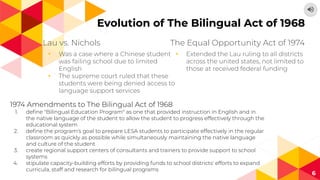
Evolution of The Bilingual Act of 1968
Lau vs. Nichols
◂ Was a case where a Chinese student
was failing school due to limited
English
◂ The supreme court ruled that these
students were being denied access to
language support services
The Equal Opportunity Act of 1974
◂ Extended the Lau ruling to all districts
across the united states, not limited to
those at received federal funding
6
1974 Amendments to The Bilingual Act of 1968
1. define "Bilingual Education Program" as one that provided instruction in English and in
the native language of the student to allow the student to progress effectively through the
educational system
2. define the program's goal to prepare LESA students to participate effectively in the regular
classroom as quickly as possible while simultaneously maintaining the native language
and culture of the student
3. create regional support centers of consultants and trainers to provide support to school
systems
4. stipulate capacity-building efforts by providing funds to school districts' efforts to expand
curricula, staff and research for bilingual programs
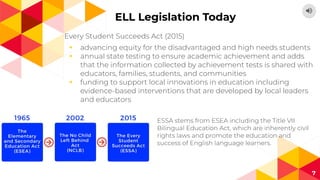
ELL Legislation Today
Every Student Succeeds Act (2015)
◂ advancing equity for the disadvantaged and high needs students
◂ annual state testing to ensure academic achievement and adds
that the information collected by achievement tests is shared with
educators, families, students, and communities
◂ funding to support local innovations in education including
evidence-based interventions that are developed by local leaders
and educators
7
ESSA stems from ESEA including the Title VII
Bilingual Education Act, which are inherently civil
rights laws and promote the education and
success of English language learners.
8
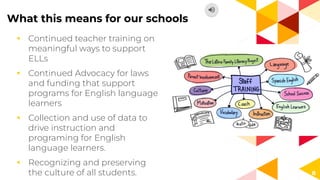
What this means for our schools
◂ Continued teacher training on
meaningful ways to support
ELLs
◂ Continued Advocacy for laws
and funding that support
programs for English language
learners
◂ Collection and use of data to
drive instruction and
programing for English
language learners.
◂ Recognizing and preserving
the culture of all students.
Take the Quiz
9
https://forms.gle/UpD8G4jZPWHhnAtV9
Resources
10
Brown, B. (1992). The History of Bilingual Education in America (Rep.). Retrieved May 1,
2021, from https://eric.ed.gov/?id=ED350874. (ERIC Document Reproduction Service No. ED350874)
Carlos J. Ovando (2003) Bilingual Education in the United States: Historical Development and
Current Issues, Bilingual Research Journal, 27:1, 1-24, DOI: 10.1080/15235882.2003.10162589
Cortiella, C. (2006). NCLB and IDEA: What Parents of Students with Disabilities Need to Know
and Do. National Center on Educational Outcomes, University of Minnesota.
Sosa, A. S. (1995, January). Civil Rights in Education, Revisiting the Lau Decision. IDRA
Focus. IDRA Newsletter, 22, 2.
De Jong, E. (2011). Language Policy in the United States. In Foundations for Multilingualism in
Education. Retrieved April 26, 2021, from https://www.colorincolorado.org/article/return-bilingual-education
Every Student Succeeds Act (ESSA). (n.d.). Retrieved April 26, 2021, from
https://www.ed.gov/essa?src=rn
Lyons, J. (1990). The Past and Future Directions of Federal Bilingual-Education Policy. The
Annals of the American Academy of Political and Social Science, 508, 66-80. Retrieved May 2, 2021, from http://www.jstor.org/stable/1047619
Orr, A. J. (n.d.). Bilingual Education Act of 1968. Retrieved from
https://immigrationtounitedstates.org/379-bilingual-education-act-of-1968.html
Stewner-Manzanares, G. (1988). The Bilingual Education Act: Twenty Years Later. The National
Clearinghouse for Bilingual Education, (6). Retrieved April 22, 2021.
Teitelbaum, H. and Hiller, R.J. Bilingual Education: The Legal 1977 Mandate. Harvard
Educational Review: 4(2) 138-170.

Bilingual Education Act - Teacher Training.pdf

  • 1.
    English Language Learners: Equityand Education The Effects of Legislation on ELL Education Emily Bond SPED 6275 May 2, 2021
  • 2.
    “ Without language, onecannot talk to people and understand them; one cannot share their hopes and aspirations, grasp their history, appreciate their poetry, or savour their songs. - Nelson Mandela 2
  • 3.
    Today’s Agenda 1) HistoryLanguage in Education 2) A brief introduce of legislation that began ELL education 3) Discuss the changes over time to ELL law 4) What this looks like in legislation today 5) What it looks like in your school 3
  • 4.
    4 Brief History ofBilingual Education in America ◂ Colonial America - schools reflected the language of the community in which they served. ◂ Post - Civil War - Heavy racism, primarily focused on Black Americans, led to resentments and discrimination of all “non-whites” including those who had non-english home langauges. ◂ 1910 - Strong opposition to education in any language except English ◂ American Indians and African “slave” culture were heavily suppressed forced to lose language and culture ◂ 1954 - Brown v. Board of Education was the first step in student civil rights ◂ National Defense Act of 1958 - The government's reaction to Sputnik and other Cold War ideas was to fund foriegn language instruction in schools, in 1960 the first bilingual pilot program was launched, not designed for students to learn English
  • 5.
    Bilingual Education Act of1968 ◂ The first official recognition of the needs of students with Limited English speaking ability (LESA) ◂ Students with LESA should be offered bilingual programs that support english language acquisition and content knowledge (Stewner-Manzanares, 1988). ◂ This bill supported the teaching of English as a second language, and programs that were specifically designed to give Spanish-speaking students an appreciation of their native language, access to meaningful content, and an appreciation of their native culture. ◂ This led to the creation of 37 other bills throughout the United States, for multiple languages, which were eventually merged into the Title VII section of the Elementary and Secondary Education Act (ESEA). 5
  • 6.
    Evolution of TheBilingual Act of 1968 Lau vs. Nichols ◂ Was a case where a Chinese student was failing school due to limited English ◂ The supreme court ruled that these students were being denied access to language support services The Equal Opportunity Act of 1974 ◂ Extended the Lau ruling to all districts across the united states, not limited to those at received federal funding 6 1974 Amendments to The Bilingual Act of 1968 1. define "Bilingual Education Program" as one that provided instruction in English and in the native language of the student to allow the student to progress effectively through the educational system 2. define the program's goal to prepare LESA students to participate effectively in the regular classroom as quickly as possible while simultaneously maintaining the native language and culture of the student 3. create regional support centers of consultants and trainers to provide support to school systems 4. stipulate capacity-building efforts by providing funds to school districts' efforts to expand curricula, staff and research for bilingual programs
  • 7.
    ELL Legislation Today EveryStudent Succeeds Act (2015) ◂ advancing equity for the disadvantaged and high needs students ◂ annual state testing to ensure academic achievement and adds that the information collected by achievement tests is shared with educators, families, students, and communities ◂ funding to support local innovations in education including evidence-based interventions that are developed by local leaders and educators 7 ESSA stems from ESEA including the Title VII Bilingual Education Act, which are inherently civil rights laws and promote the education and success of English language learners.
  • 8.
    8 What this meansfor our schools ◂ Continued teacher training on meaningful ways to support ELLs ◂ Continued Advocacy for laws and funding that support programs for English language learners ◂ Collection and use of data to drive instruction and programing for English language learners. ◂ Recognizing and preserving the culture of all students.
  • 9.
  • 10.
    Resources 10 Brown, B. (1992).The History of Bilingual Education in America (Rep.). Retrieved May 1, 2021, from https://eric.ed.gov/?id=ED350874. (ERIC Document Reproduction Service No. ED350874) Carlos J. Ovando (2003) Bilingual Education in the United States: Historical Development and Current Issues, Bilingual Research Journal, 27:1, 1-24, DOI: 10.1080/15235882.2003.10162589 Cortiella, C. (2006). NCLB and IDEA: What Parents of Students with Disabilities Need to Know and Do. National Center on Educational Outcomes, University of Minnesota. Sosa, A. S. (1995, January). Civil Rights in Education, Revisiting the Lau Decision. IDRA Focus. IDRA Newsletter, 22, 2. De Jong, E. (2011). Language Policy in the United States. In Foundations for Multilingualism in Education. Retrieved April 26, 2021, from https://www.colorincolorado.org/article/return-bilingual-education Every Student Succeeds Act (ESSA). (n.d.). Retrieved April 26, 2021, from https://www.ed.gov/essa?src=rn Lyons, J. (1990). The Past and Future Directions of Federal Bilingual-Education Policy. The Annals of the American Academy of Political and Social Science, 508, 66-80. Retrieved May 2, 2021, from http://www.jstor.org/stable/1047619 Orr, A. J. (n.d.). Bilingual Education Act of 1968. Retrieved from https://immigrationtounitedstates.org/379-bilingual-education-act-of-1968.html Stewner-Manzanares, G. (1988). The Bilingual Education Act: Twenty Years Later. The National Clearinghouse for Bilingual Education, (6). Retrieved April 22, 2021. Teitelbaum, H. and Hiller, R.J. Bilingual Education: The Legal 1977 Mandate. Harvard Educational Review: 4(2) 138-170.