CLASSROOMS
in
AMERICAN
English
Learners
New York • Toronto • London • Auckland • Sydney
Mexico City • New Delhi • Hong Kong • Buenos Aires
101 Questions 5 101 Answers
James Crawford
& Stephen Krashen
English Learners in American Classrooms © Crawford & Krashen, Published by Scholastic Teaching Resources
Scholastic Inc. grants teachers permission to photocopy the reproducible pages in this book
only for personal classroom use. No other part of this publication may be reproduced in whole
or in part, or stored in a retrieval system, or transmitted in any form or by any means, electronic,
mechanical, photocopying, recording, or otherwise, without written permission of the authors.
The authors may be contacted c/o Permissions Department, Scholastic Inc., 557 Broadway,
New York, NY 10012.
Cover Design: Maria Lilja
Interior Design: LDL Designs
Editor: Lois Bridges
Production Editor: Carol Ghiglieri
Copy Editor: Jeannie Hutchins
ISBN-13: 978-0-545-00519-7
ISBN-10: 0-545-00519-1
Copyright © 2007 by James Crawford and Stephen Krashen
All rights reserved. Published by Scholastic Inc.
Printed in the U.S.A.
1 2 3 4 5 6 7 8 9 10 23 12 11 10 09 08 07
English Learners in American Classrooms © Crawford & Krashen, Published by Scholastic Teaching Resources
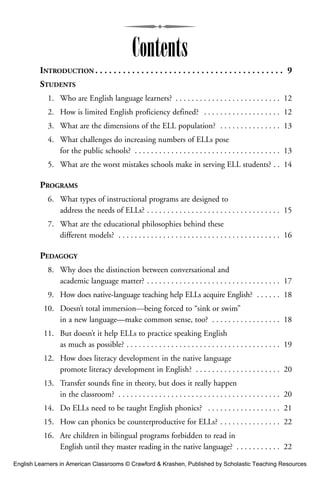
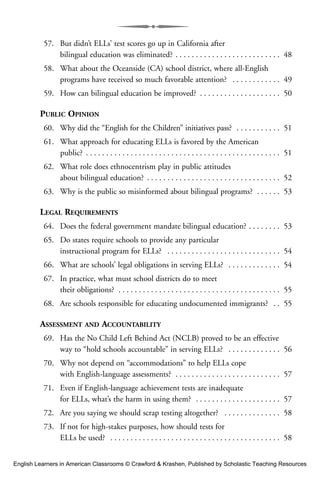
INTRODUCTION . . . . . . . . . . . . . . . . . . . . . . . . . . . . . . . . . . . . . . . . . 9
STUDENTS
1. Who are English language learners? . . . . . . . . . . . . . . . . . . . . . . . . . . 12
2. How is limited English proficiency defined? . . . . . . . . . . . . . . . . . . . 12
3. What are the dimensions of the ELL population? . . . . . . . . . . . . . . . 13
4. What challenges do increasing numbers of ELLs pose
for the public schools? . . . . . . . . . . . . . . . . . . . . . . . . . . . . . . . . . . . . 13
5. What are the worst mistakes schools make in serving ELL students? . . 14
PROGRAMS
6. What types of instructional programs are designed to
address the needs of ELLs? . . . . . . . . . . . . . . . . . . . . . . . . . . . . . . . . . 15
7. What are the educational philosophies behind these
different models? . . . . . . . . . . . . . . . . . . . . . . . . . . . . . . . . . . . . . . . . 16
PEDAGOGY
8. Why does the distinction between conversational and
academic language matter? . . . . . . . . . . . . . . . . . . . . . . . . . . . . . . . . . 17
9. How does native-language teaching help ELLs acquire English? . . . . . . 18
10. Doesn’t total immersion—being forced to “sink or swim”
in a new language—make common sense, too? . . . . . . . . . . . . . . . . . 18
11. But doesn’t it help ELLs to practice speaking English
as much as possible? . . . . . . . . . . . . . . . . . . . . . . . . . . . . . . . . . . . . . . 19
12. How does literacy development in the native language
promote literacy development in English? . . . . . . . . . . . . . . . . . . . . . 20
13. Transfer sounds fine in theory, but does it really happen
in the classroom? . . . . . . . . . . . . . . . . . . . . . . . . . . . . . . . . . . . . . . . . 20
14. Do ELLs need to be taught English phonics? . . . . . . . . . . . . . . . . . . 21
15. How can phonics be counterproductive for ELLs? . . . . . . . . . . . . . . . 22
16. Are children in bilingual programs forbidden to read in
English until they master reading in the native language? . . . . . . . . . . . 22
Contents
English Learners in American Classrooms © Crawford & Krashen, Published by Scholastic Teaching Resources
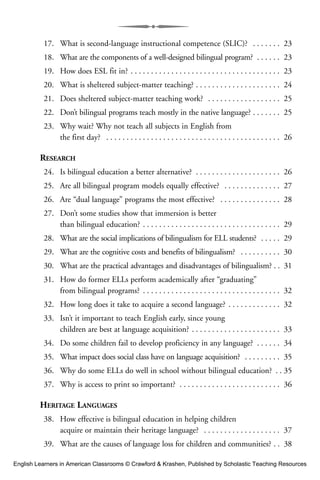
17. What is second-language instructional competence (SLIC)? . . . . . . . 23
18. What are the components of a well-designed bilingual program? . . . . . . 23
19. How does ESL fit in? . . . . . . . . . . . . . . . . . . . . . . . . . . . . . . . . . . . . . 23
20. What is sheltered subject-matter teaching? . . . . . . . . . . . . . . . . . . . . . 24
21. Does sheltered subject-matter teaching work? . . . . . . . . . . . . . . . . . . 25
22. Don’t bilingual programs teach mostly in the native language? . . . . . . . 25
23. Why wait? Why not teach all subjects in English from
the first day? . . . . . . . . . . . . . . . . . . . . . . . . . . . . . . . . . . . . . . . . . . . 26
RESEARCH
24. Is bilingual education a better alternative? . . . . . . . . . . . . . . . . . . . . . 26
25. Are all bilingual program models equally effective? . . . . . . . . . . . . . . 27
26. Are “dual language” programs the most effective? . . . . . . . . . . . . . . . 28
27. Don’t some studies show that immersion is better
than bilingual education? . . . . . . . . . . . . . . . . . . . . . . . . . . . . . . . . . . 29
28. What are the social implications of bilingualism for ELL students? . . . . . 29
29. What are the cognitive costs and benefits of bilingualism? . . . . . . . . . . 30
30. What are the practical advantages and disadvantages of bilingualism? . . 31
31. How do former ELLs perform academically after “graduating”
from bilingual programs? . . . . . . . . . . . . . . . . . . . . . . . . . . . . . . . . . . 32
32. How long does it take to acquire a second language? . . . . . . . . . . . . . 32
33. Isn’t it important to teach English early, since young
children are best at language acquisition? . . . . . . . . . . . . . . . . . . . . . . 33
34. Do some children fail to develop proficiency in any language? . . . . . . 34
35. What impact does social class have on language acquisition? . . . . . . . . . 35
36. Why do some ELLs do well in school without bilingual education? . . 35
37. Why is access to print so important? . . . . . . . . . . . . . . . . . . . . . . . . . 36
HERITAGE LANGUAGES
38. How effective is bilingual education in helping children
acquire or maintain their heritage language? . . . . . . . . . . . . . . . . . . . 37
39. What are the causes of language loss for children and communities? . . 38
English Learners in American Classrooms © Crawford & Krashen, Published by Scholastic Teaching Resources
40. What is ethnic ambivalence? . . . . . . . . . . . . . . . . . . . . . . . . . . . . . . . 38
41. What is language shyness? . . . . . . . . . . . . . . . . . . . . . . . . . . . . . . . . . 39
CRITICISMS OF BILINGUAL EDUCATION
42. What are the criticisms of bilingual education that led
to the passage of English-only initiatives in California
(1998), Arizona (2000), and Massachusetts (2002)? . . . . . . . . . . . . . . 39
43. ELLs score much lower on standardized tests than other
students. Doesn’t this show that bilingual education has failed? . . . . . . 40
44. Shouldn’t parents have the right to choose whether their
children are placed in bilingual education? . . . . . . . . . . . . . . . . . . . . 40
45. What types of programs do the parents of ELLs favor
for their children? . . . . . . . . . . . . . . . . . . . . . . . . . . . . . . . . . . . . . . . 41
46. Does bilingual education lead to segregation by race or ethnicity? . . . 42
47. Do children “languish” in non-English classrooms for years,
never learning enough English to transfer to mainstream classrooms? . . 42
48. Is there a tendency for schools to delay redesignating
ELLs as English-proficient in states where per capita
subsidies are provided to serve these children? . . . . . . . . . . . . . . . . . . 43
49. What are the cost differences among various options
for educating ELLs? . . . . . . . . . . . . . . . . . . . . . . . . . . . . . . . . . . . . . . 44
50. How can schools teach bilingually when ELL students
speak several different languages? . . . . . . . . . . . . . . . . . . . . . . . . . . . . 44
51. Doesn’t the shortage of qualified teachers make bilingual
education impractical? . . . . . . . . . . . . . . . . . . . . . . . . . . . . . . . . . . . . 45
52. If bilingual education works, why is the Hispanic dropout
rate so high? . . . . . . . . . . . . . . . . . . . . . . . . . . . . . . . . . . . . . . . . . . . . . 45
53. Then why do Hispanic students drop out of school at higher rates? . . 46
54. If bilingual education is such a good idea, why don’t
other countries provide it? . . . . . . . . . . . . . . . . . . . . . . . . . . . . . . . . . 47
55. Are bilingual educators promoting a hidden agenda of
ethnic separatism? . . . . . . . . . . . . . . . . . . . . . . . . . . . . . . . . . . . . . . . 47
56. What has been the impact of English-only instruction laws? . . . . . . . 48
English Learners in American Classrooms © Crawford & Krashen, Published by Scholastic Teaching Resources
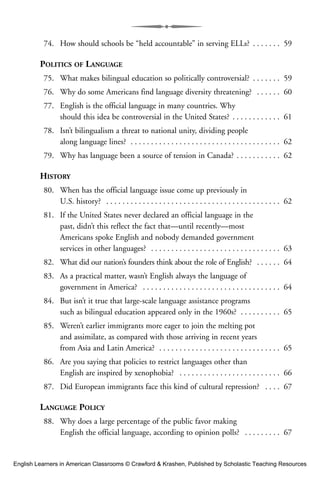
57. But didn’t ELLs’ test scores go up in California after
bilingual education was eliminated? . . . . . . . . . . . . . . . . . . . . . . . . . . 48
58. What about the Oceanside (CA) school district, where all-English
programs have received so much favorable attention? . . . . . . . . . . . . 49
59. How can bilingual education be improved? . . . . . . . . . . . . . . . . . . . . 50
PUBLIC OPINION
60. Why did the “English for the Children” initiatives pass? . . . . . . . . . . . 51
61. What approach for educating ELLs is favored by the American
public? . . . . . . . . . . . . . . . . . . . . . . . . . . . . . . . . . . . . . . . . . . . . . . . . 51
62. What role does ethnocentrism play in public attitudes
about bilingual education? . . . . . . . . . . . . . . . . . . . . . . . . . . . . . . . . . 52
63. Why is the public so misinformed about bilingual programs? . . . . . . 53
LEGAL REQUIREMENTS
64. Does the federal government mandate bilingual education? . . . . . . . . 53
65. Do states require schools to provide any particular
instructional program for ELLs? . . . . . . . . . . . . . . . . . . . . . . . . . . . . 54
66. What are schools’ legal obligations in serving ELLs? . . . . . . . . . . . . . 54
67. In practice, what must school districts do to meet
their obligations? . . . . . . . . . . . . . . . . . . . . . . . . . . . . . . . . . . . . . . . . 55
68. Are schools responsible for educating undocumented immigrants? . . 55
ASSESSMENT AND ACCOUNTABILITY
69. Has the No Child Left Behind Act (NCLB) proved to be an effective
way to “hold schools accountable” in serving ELLs? . . . . . . . . . . . . . 56
70. Why not depend on “accommodations” to help ELLs cope
with English-language assessments? . . . . . . . . . . . . . . . . . . . . . . . . . . 57
71. Even if English-language achievement tests are inadequate
for ELLs, what’s the harm in using them? . . . . . . . . . . . . . . . . . . . . . 57
72. Are you saying we should scrap testing altogether? . . . . . . . . . . . . . . 58
73. If not for high-stakes purposes, how should tests for
ELLs be used? . . . . . . . . . . . . . . . . . . . . . . . . . . . . . . . . . . . . . . . . . . 58
English Learners in American Classrooms © Crawford & Krashen, Published by Scholastic Teaching Resources
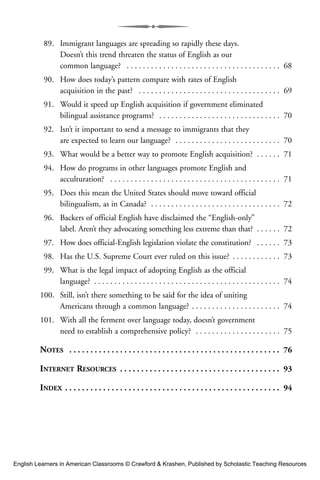
74. How should schools be “held accountable” in serving ELLs? . . . . . . . 59
POLITICS OF LANGUAGE
75. What makes bilingual education so politically controversial? . . . . . . . 59
76. Why do some Americans find language diversity threatening? . . . . . . 60
77. English is the official language in many countries. Why
should this idea be controversial in the United States? . . . . . . . . . . . . 61
78. Isn’t bilingualism a threat to national unity, dividing people
along language lines? . . . . . . . . . . . . . . . . . . . . . . . . . . . . . . . . . . . . . 62
79. Why has language been a source of tension in Canada? . . . . . . . . . . . 62
HISTORY
80. When has the official language issue come up previously in
U.S. history? . . . . . . . . . . . . . . . . . . . . . . . . . . . . . . . . . . . . . . . . . . . 62
81. If the United States never declared an official language in the
past, didn’t this reflect the fact that—until recently—most
Americans spoke English and nobody demanded government
services in other languages? . . . . . . . . . . . . . . . . . . . . . . . . . . . . . . . . 63
82. What did our nation’s founders think about the role of English? . . . . . . 64
83. As a practical matter, wasn’t English always the language of
government in America? . . . . . . . . . . . . . . . . . . . . . . . . . . . . . . . . . . 64
84. But isn’t it true that large-scale language assistance programs
such as bilingual education appeared only in the 1960s? . . . . . . . . . . 65
85. Weren’t earlier immigrants more eager to join the melting pot
and assimilate, as compared with those arriving in recent years
from Asia and Latin America? . . . . . . . . . . . . . . . . . . . . . . . . . . . . . . 65
86. Are you saying that policies to restrict languages other than
English are inspired by xenophobia? . . . . . . . . . . . . . . . . . . . . . . . . . 66
87. Did European immigrants face this kind of cultural repression? . . . . 67
LANGUAGE POLICY
88. Why does a large percentage of the public favor making
English the official language, according to opinion polls? . . . . . . . . . 67
English Learners in American Classrooms © Crawford & Krashen, Published by Scholastic Teaching Resources
89. Immigrant languages are spreading so rapidly these days.
Doesn’t this trend threaten the status of English as our
common language? . . . . . . . . . . . . . . . . . . . . . . . . . . . . . . . . . . . . . . 68
90. How does today’s pattern compare with rates of English
acquisition in the past? . . . . . . . . . . . . . . . . . . . . . . . . . . . . . . . . . . . 69
91. Would it speed up English acquisition if government eliminated
bilingual assistance programs? . . . . . . . . . . . . . . . . . . . . . . . . . . . . . . 70
92. Isn’t it important to send a message to immigrants that they
are expected to learn our language? . . . . . . . . . . . . . . . . . . . . . . . . . . 70
93. What would be a better way to promote English acquisition? . . . . . . 71
94. How do programs in other languages promote English and
acculturation? . . . . . . . . . . . . . . . . . . . . . . . . . . . . . . . . . . . . . . . . . . 71
95. Does this mean the United States should move toward official
bilingualism, as in Canada? . . . . . . . . . . . . . . . . . . . . . . . . . . . . . . . . 72
96. Backers of official English have disclaimed the “English-only”
label. Aren’t they advocating something less extreme than that? . . . . . . 72
97. How does official-English legislation violate the constitution? . . . . . . 73
98. Has the U.S. Supreme Court ever ruled on this issue? . . . . . . . . . . . . 73
99. What is the legal impact of adopting English as the official
language? . . . . . . . . . . . . . . . . . . . . . . . . . . . . . . . . . . . . . . . . . . . . . . 74
100. Still, isn’t there something to be said for the idea of uniting
Americans through a common language? . . . . . . . . . . . . . . . . . . . . . . 74
101. With all the ferment over language today, doesn’t government
need to establish a comprehensive policy? . . . . . . . . . . . . . . . . . . . . . 75
NOTES . . . . . . . . . . . . . . . . . . . . . . . . . . . . . . . . . . . . . . . . . . . . . . . . . . 76
INTERNET RESOURCES . . . . . . . . . . . . . . . . . . . . . . . . . . . . . . . . . . . . . . 93
INDEX . . . . . . . . . . . . . . . . . . . . . . . . . . . . . . . . . . . . . . . . . . . . . . . . . . . 94
English Learners in American Classrooms © Crawford & Krashen, Published by Scholastic Teaching Resources
5 INTRODUCTION 5
It’s no secret that immigrants are transforming American classrooms. Or that
increasing numbers of our students are ELLs—English language learners—a
trend that poses unique challenges and opportunities for schools. How should
educators respond?
Answering that question is the central aim of this book. While there are
numerous excellent works on teaching ELLs, we saw the need for a basic but
comprehensive introduction that would address the concerns of busy educators
in a concise and accessible way. So we have strived to produce a state-of-the-art
guide to our field, using a straightforward, Q & A format designed to focus
sharply on the major issues.
For professionals seeking to do the best job they can for ELL students, sev-
eral things are necessary.
First, it’s essential to appreciate the dimensions of demographic and cultural
change. The nation’s Hispanic population has nearly tripled since 1980, while
its Asian and Pacific Islander population has more than tripled. Growth has
been especially dramatic in Southern and Midwestern states where non-English-
speaking groups were sparse until the last decade.
Not only is the number of newcomers increasing; so is their diversity. Half
a century ago, immigrants to the United States were most likely to arrive from
Germany, Canada, Mexico, the United Kingdom, or Italy, in that order. Today,
the top five source countries are Mexico, India, China, the Philippines, and
Cuba. Other important nations of origin—each contributing 10,000 or more
new Americans in 2005—include Vietnam, Dominican Republic, Korea,
Colombia, Ukraine, El Salvador, Russia, Guatemala, Brazil, Peru, Poland,
Pakistan, Haiti, Bosnia-Herzogovina, Iran, Bangladesh, Venezuela, Ecuador,
Nigeria, and Ethiopia.1
On average, immigrants are younger than the U.S. population as a whole
and are thus more likely to have school-age children. A large percentage of these
9
1 Rankings are for “persons obtaining legal permanent resident status” in the United States; refugees,
asylum seekers, temporary workers, and other “nonimmigrant admissions” are counted separately.
English Learners in American Classrooms © Crawford & Krashen, Published by Scholastic Teaching Resources
children face language barriers in the classroom. Teaching them effectively
requires educational approaches that are adapted to their needs and that seek to
build on their strengths.
Educators’ second major task, then, is to master the pedagogies that work
for ELL students and the scientific fundamentals behind them. This means
learning about theories of second-language acquisition and their implications
for educational practice, including the features and effectiveness of various pro-
gram models.
To provide high-quality instruction for ELLs, teachers must be well versed in
this research. Among other things, they need to know about the difference between
conversational and academic language; the importance of “comprehensible input”
in English and the role of native-language instruction in making English input
more comprehensible; the “silent period” experienced by many children; and the
transfer of literacy between languages.
For administrators who make program decisions, it’s important to under-
stand the debates about language of instruction. Should children be taught
bilingually or in all-English classrooms? What are the options within each
approach and how do they differ in methods and goals? What are the advan-
tages and disadvantages for children? What do parents and communities want?
Our view is that bilingual education is usually a superior alternative for
ELL students. A large body of research shows that, other things being equal,
bilingual programs are more successful in teaching English and in fostering aca-
demic achievement in English. They can also provide valuable opportunities to
cultivate bilingualism and biliteracy, not only for ELLs but for English-speaking
students as well. Of course, bilingual education is not always possible, for prac-
tical and sometimes for political reasons. But where it is feasible, it should be
seriously considered, especially in teaching students with the greatest academic
and language needs.
Third, educators must learn to cope with external pressures and become
strong advocates for the programs that best serve ELLs. Perhaps no other area
of education has been more politicized in recent years. Immigration has become
a stormy controversy and language a frequent lightning rod. “English-only”
activism—or a desire to avoid it—can complicate decision-making by school
10
English Learners in American Classrooms © Crawford & Krashen, Published by Scholastic Teaching Resources
boards and superintendents. To resist such campaigns, it’s necessary to learn
how their arguments are frequently based on misconceptions and misinforma-
tion about language diversity.
Teachers also feel increasing pressure from federal and state accountability
systems that rely heavily on standardized test scores. ELLs rarely perform well
on such tests, the vast majority of which are designed for native speakers of
English. Yet under the No Child Left Behind Act of 2001, schools risk punitive
sanctions if the ELL “subgroup” falls short of arbitrary targets for “adequate
yearly progress.” Students themselves are often denied promotion or graduation
because of high-stakes assessments that are neither valid nor reliable.
Thus it has become a challenge for educators to provide school programs
that are based on pedagogical effectiveness rather than short-term expediency.
They need to recognize the dangers of turning classrooms into test-prep facto-
ries, stressing remedial “skill-building” exercises, and narrowing the curriculum
to two tested subjects: reading and math. To succeed in the long term, ELL
students must have access to the kind of challenging education that all chil-
dren need and deserve. It’s our job as professionals to make sure that’s what
they receive.
This book is meant to be a starting point. Above all, we hope it will stimu-
late readers to learn more about this important and growing field.
11
English Learners in American Classrooms © Crawford & Krashen, Published by Scholastic Teaching Resources
5 STUDENTS 5
1Who are English language learners?
ELL (English language learner) is the most popular term today for children
who are sometimes described as LEP (limited-English-proficient2), ESOL
(English for speakers of other languages), or simply bilingual students. The
meaning of these labels is roughly the same. All of them refer to students who
face a formidable challenge: learning academic skills and knowledge while
acquiring a second language at the same time.
This is a diverse population. A majority of ELLs are immigrants or the chil-
dren of immigrants to the United States, with literally hundreds of national identi-
ties. Others are indigenous minorities, including Native Americans and Puerto
Ricans. Although slightly more than two-thirds of these students are native speak-
ers of Spanish, U.S. schools enroll ELLs from over 400 language backgrounds.
Substantial numbers speak Vietnamese, Hmong, Cantonese, Korean, Haitian
Creole, Arabic, Tagalog, Russian, or Navajo. ELLs also vary significantly in socio-
economic status, cultural traditions, family literacy rates, prior schooling, English
proficiency, and other factors.
If the past is any guide, the vast majority of these students will eventually
become fluent speakers of English. Their problem is timing. By the time ELLs
have acquired the language skills needed for school, their English-proficient class-
mates may have moved far ahead academically or, worse yet, their school years
may have ended. To meet the needs of students whose English proficiency is lim-
ited, appropriate educational services are critical.
2How is limited English proficiency defined?
There is no uniform definition at the national level. Each state and, in many
cases, each school district set their own criteria for assessing and placing ELLs and
for reclassifying them as English-proficient. A variety of tests are now in use for
gauging progress in second-language acquisition. Such assessments are among mul-
12
2 The term LEP has fallen out of favor because of its pejorative connotations (i.e., its focus on what
students lack). ELL has become the preferred term among educators and will be used in this volume.
English Learners in American Classrooms © Crawford & Krashen, Published by Scholastic Teaching Resources
tiple factors, including teacher judgments, class grades, achievement test scores,
and parental preferences, that are usually considered in deciding when children are
ready to exit language-assistance programs.
Generally speaking, LEP or ELL students can be defined as those who
come from language backgrounds other than English and whose difficulties
in understanding, speaking, reading, and writing English are sufficient to
create academic difficulties if they are placed in mainstream, English-
language classrooms.
3What are the dimensions of the ELL population?
ELLs represent about one in ten U.S. students today, and their numbers
are growing rapidly. According to reports by states and school districts—the
most reliable source of data in this area—there were 5.1 million ELLs in U.S.
elementary and secondary schools in 2004–05.3 Their enrollments increased by
65 percent in the past decade, about seven times the growth rate of the K–12
population overall. If these trends continued at current rates, by 2043 one in
three of the nation’s students would be ELLs.
The largest numbers of these children attend school in California, Texas,
Florida, New York, Illinois, and Arizona. But during the 1990s, as immigrant
communities began to expand in other states, the fastest-growing ELL enroll-
ments were in Georgia, North Carolina, Nebraska, Oregon, Kentucky, and
Arkansas.
4What challenges do increasing numbers of ELLs pose for the
public schools?
There are several: designing effective programs, mobilizing adequate resources,
finding appropriate materials, and dealing with community concerns, among
others. But unquestionably the biggest challenge for schools is to recruit and
train sufficient numbers of qualified staff to serve ELLs’ needs. This is true
whether programs are bilingual or all-English.
13
3 This figure included students in Puerto Rico and other “outlying areas.” ELL enrollments for
the 50 states and the District of Columbia totaled 4,453,678; of these students, 68 percent were
native Spanish speakers.
English Learners in American Classrooms © Crawford & Krashen, Published by Scholastic Teaching Resources
Because this population has not only grown but also spread widely
throughout the heartland, the number of U.S. teachers with ELLs in their class-
rooms has multiplied from 364,485 (15 percent) in 1992 to 1,273,420 (43
percent) in 2002. Schools that have rarely if ever served ELLs in the past are
now scrambling to respond. It won’t be easy. Only 11 percent of ELLs’ teachers
are certified in bilingual education and 18 percent in English as a second lan-
guage (ESL), while barely 15 percent are fluent in a language other than
English. On average, these teachers have received just four hours of in-service
training to serve ELLs in the past five years.
5What are the worst mistakes schools make in serving
ELL students?
Three common responses can be summed up as denial, delegating, and remedi-
ation. None of them is beneficial to ELLs.
Denial means ignoring the language barrier and offering students little or
no special help in accessing the curriculum. Students simply receive the same
instruction as English-proficient students. Sometimes described as “sink or
swim,” this approach is destined to fail. It’s also illegal under civil-rights law
(see question 66); nevertheless, it persists in some areas.
Delegating is what happens when administrators acknowledge there’s a
“problem” and turn it over to specialists—bilingual or ESL teachers—rather
than involving the entire school in addressing the needs of these children.
Sometimes a single, itinerant ESL specialist is given responsibility for students
at several schools, a recipe for futility.
Remediation reflects an impulse to “cure” ELLs’ “language disability” rather
than recognizing—and, if possible, developing—the native language as a
resource to support English acquisition. It also treats students as if they have a
learning problem, a none-too-subtle message that tends to be self-fulfilling.
Remediation is increasingly a response to the pressures of high-stakes testing
that stresses mastery of discrete skills in English. It often takes the form of skill
building, or the direct teaching of grammar and vocabulary, instead of more
effective forms of ESL (see question 19).
14
English Learners in American Classrooms © Crawford & Krashen, Published by Scholastic Teaching Resources
5 PROGRAMS 5
6What types of instructional programs are designed to address
the needs of ELLs?
Program models vary widely, even among those that share the same labels, such
as “bilingual” or “ESL” or “immersion.” Adding to the confusion is the fact that
these models are not mutually exclusive. For example, bilingual education always
features an ESL component and often uses “immersion” methods as well. With
those caveats, ELL program types can be broadly characterized as follows.
Bilingual education is best defined as the use of students’ native language to
accelerate English-language development. Children receive content-area instruc-
tion in both languages, although the proportions may vary (with English
phased in rapidly or gradually). Goals include developing “academic English,”
promoting academic achievement in English, and in some models, cultivating
proficiency in both languages. Bilingual program types include the following:
• Transitional bilingual education uses the native language as a temporary
support. Many transitional programs are “early-exit,” stressing a trans-
fer to the mainstream as quickly as possible.
• Developmental or “late exit” bilingual education emphasizes the goals of
bilingualism and biliteracy—well-developed skills in English and in
students’ native language—as well as academic achievement.
• Two-way bilingual or dual language education is a form of developmental
bilingual education that includes native-English speakers and limited-
English speakers acquiring a second language and learning academic con-
tent in the same classroom.
All-English approaches make little or no use of students’ first language.
ELLs may receive some “native-language support,” typically in the form of clar-
ifications by teacher aides. But content-area lessons are in English only.
Students may or may not receive direct instruction in English. All-English pro-
gram types include the following:
• Submersion, a fancy term for providing ELLs no special help in overcom-
ing the language barrier, was common before the Bilingual Education
Act of 1968 and the Lau v. Nichols decision of 1974 (see question 66).
15
English Learners in American Classrooms © Crawford & Krashen, Published by Scholastic Teaching Resources
• Structured immersion adjusts the level of English in an attempt to make
content-area instruction accessible for ELLs until they have acquired
enough English to survive in mainstream classrooms.
• English as a second language (ESL) describes a range of strategies designed
to teach English to students adjusting to an English-dominant society.
ESL may be grammar-based, stressing a skill-building philosophy. Or it
may be communication-based, emphasizing the use of English in mean-
ingful contexts. Instruction may take place in a self-contained classroom
or in “pull-out” sessions for individual or small-group tutoring.
7 What are the educational philosophies behind these
different models?
All-English submersion and immersion models reflect on a “time on task” phi-
losophy. The assumption is that the more exposure to English, the more
English students will learn and the sooner they will be ready for the main-
stream. Use of the native language is therefore seen as a distraction, or as a
crutch that discourages students from using English. According to this logic,
putting ELLs in a situation from which there is no escape will force them to
acquire the language; hence the term sink or swim.
Bilingual approaches are based on a more scientific understanding of lan-
guage acquisition. Rather than slow down or halt academic work while waiting
for students to acquire English, bilingual models stress the importance of
building on the linguistic foundation that ELLs already have.
The idea is that acquiring content-area knowledge in this way helps to make
English instruction comprehensible and thereby fosters English acquisition (see
question 9). In addition, developing literacy in the native language speeds up the
development of literacy in English. Thus time spent learning in the native lan-
guage is not wasted learning time. To the contrary, it is good for English as well
as for academic achievement.
Bilingual approaches also draw a distinction between conversational language,
sometimes described as “playground English,” and academic language, the kind
of English needed for success in school. This distinction has important implica-
tions for curriculum, instruction, and placement.
16
English Learners in American Classrooms © Crawford & Krashen, Published by Scholastic Teaching Resources
5 PEDAGOGY 5
8 Why does the distinction between conversational and
academic language matter?
Academic language refers to the decontextualized, cognitively challenging lan-
guage used not only in school, but also in business, politics, science, journalism,
and so forth. In the classroom, it means the ability to understand story prob-
lems, write book reports, and read complex social studies texts. If a child has
developed high levels of academic language in Spanish, for example, it is much
easier to develop this kind of competence in English.
Academic English takes considerably longer to acquire than conversational
English, the kind of language that ELLs “pick up” through social interactions
with English-speaking classmates and through beginning ESL classes. While
conversational language is important, it’s not sufficient for the purposes of
school. Children who sound quite fluent in English in a relatively short time
often do poorly when “transitioned” into mainstream programs. This may
occur because they have acquired conversational English but have yet to mas-
ter enough academic English to enable them to understand instruction in reg-
ular classrooms.
Developing academic language—literacy in particular—requires instruc-
tional strategies that enable students to do challenging, grade-level work while
they are acquiring English. This is quite difficult, especially for beginning ELLs,
when instruction is in a language that students don’t understand. All-English
programs tend to rely on worksheets and other unchallenging material that are
conveyed in simple language. This type of curriculum is boring and alienating
for many students. It also fails to stimulate them in ways that develop complex
forms of language proficiency.
The good news is that bilingual education offers a solution. It enables ELLs
to acquire academic language because, by using the native language, teachers do
not need to “dumb down” the curriculum. In addition, by teaching grade-level
material, a bilingual program enables students to keep pace with English-speaking
peers while they are acquiring academic language.
17
English Learners in American Classrooms © Crawford & Krashen, Published by Scholastic Teaching Resources
9How does native-language teaching help ELLs acquire English?
One might assume that the more English children hear and the more
“immersed” in all-English instruction they are, the faster they will acquire the
language. This turns out not to be true. Study after study has provided no evi-
dence to support the time-on-task philosophy of language acquisition. ELLs
who receive more native-language instruction in well-implemented bilingual
programs typically learn more academic English than those in all-English pro-
grams (see question 7).
Research shows that when we give children a good education in their native
language, they get two things: knowledge and literacy. Knowledge and literacy, in
turn, support English-language development. The effect is indirect but powerful.
How does this work? What matters is the quality—not the quantity—of
English exposure. The only English that helps is the English that students
understand. In other words, the more comprehensible input in English they
receive, the more English they acquire. Knowledge learned in one language pro-
vides context that makes what children hear and read in a second language
more meaningful. The positive effects of background knowledge on language
acquisition (and on learning in general) have been thoroughly documented.
The concept also makes common sense.
Consider the hypothetical case of a recently arrived ELL student enrolled in
a high school history class. While she has clear limitations in English, she has
studied history extensively in her native language. She has learned a lot about
World Wars I and II, is familiar with Louis XIV, Franklin D. Roosevelt, and
Fidel Castro, and knows the locations of Istanbul, Addis Ababa, Copenhagen,
and Bangkok. Thanks to the knowledge learned in her native language, she will
have a context for understanding history taught in English. She is likely to
make good progress in class, perhaps even better than that of some native
speakers, and she will also acquire academic English.
10Doesn’t total immersion—being forced to “sink or swim”
in a new language—make common sense, too?
Not really. When we can’t understand a language, we don’t acquire it.
Incomprehensible input becomes undifferentiated noise, signifying nothing. It
18
English Learners in American Classrooms © Crawford & Krashen, Published by Scholastic Teaching Resources
fails to register in the brain. What’s more, being placed in a stressful situation
that is demanding and unfamiliar only makes things worse. The anxiety and
self-consciousness that result can interfere with our ability to receive input that
might otherwise be comprehensible, a barrier known as the affective filter.
In other words, the sink-or-swim treatment actually retards the process of
English acquisition, as well as academic achievement. Failure rates for children
who were subjected to this approach (before it was outlawed) were extremely
high. For those who survived, a common recollection is . . . no recollection of
anything that happened in the first two to three years of school—that is, until
they began to acquire some English. Nothing comprehended, nothing learned.
While a few ELLs were able to succeed despite the odds, it was often because
they enjoyed advantages that their classmates did not (see question 36).
11But doesn’t it help ELLs to practice speaking English as
much as possible?
A common misconception—in laypersons’ terms—is the idea that “practice
makes perfect” in second-language acquisition. Also known as the comprehensi-
ble output hypothesis, it assumes that we acquire language when we “produce” it,
for example, in social interactions that prompt us to reformulate our speech so
it becomes understandable to others.
This view confuses cause and effect. For ELLs, speaking English is the result
of English acquisition, not the source. A phenomenon known as the silent period
helps to illustrate why. Sometimes ELL students who have said nothing in their
first weeks or even months of school suddenly start speaking English in complete
sentences. Their teachers are often shocked, having assumed that the students
were making little or no progress in English. In fact, during the silent period
they were acquiring the language through comprehensible input; no output was
required. Now they are showing off what they have acquired.
In any case, ELLs simply do not produce enough language to account for
the complex linguistic system they eventually acquire, and only a small percent-
age of what they produce is self-corrected (or corrected by others). Acquisition
frequently occurs from listening and reading alone—that is, with no output
whatsoever—which goes to show that “practicing their English” cannot be
19
English Learners in American Classrooms © Crawford & Krashen, Published by Scholastic Teaching Resources
essential. Finally, it’s important to note that there is no experimental evidence
supporting the comprehensible output hypothesis.
12How does literacy development in the native language
promote literacy development in English?
Literacy in the native language provides a shortcut to literacy in English. A sim-
ple three-step argument explains why:
1. We learn to read by reading, by making sense of what we see on the page.
2. If we learn to read by reading, it will be much easier to learn to read in
a language we already understand.
3. Once you can read, you can read. Being literate in one language makes
it much easier to develop reading ability in additional languages. In
other words, literacy transfers across languages.
How do we know that transfer works? Several ways:
1. The process of reading is similar in different languages; readers of dif-
ferent languages use the same strategies while reading.
2. Learning to read also happens in similar ways. In both English and Chinese,
for example, vocabulary develops as readers pick up a bit of the meaning
of a new word each time they see it in print in a meaningful context.
3. Studies show that students with more reading competence in the native
language learn to read better in a second language.
4. Transfer has been documented even when writing systems are very dissimi-
lar, such as from Vietnamese to English, Turkish to Dutch, and Arabic to
French. In fact, whenever researchers have looked for evidence of transfer,
they have found it.
The facilitating effect of native-language literacy may not be immediate. But
it’s clear that a person who is literate in any language will find learning to read
easier in a second language than a person who is not literate.
13Transfer sounds fine in theory, but does it really happen
in the classroom?
It happens in every well-designed bilingual program. Here’s an example.
Lorraine Ruiz taught a second-grade class of Spanish speakers in the Alum
20
English Learners in American Classrooms © Crawford & Krashen, Published by Scholastic Teaching Resources
Rock School District in California. All of her students were ELLs. The children
had exposure to oral comprehensible input in English, but much of the curricu-
lum was in Spanish, and reading was taught exclusively in Spanish.
Ms. Ruiz had a classroom library with books in both English and Spanish.
At the beginning of the year, the children could not read the English books, but
by the end of the year they could. The children themselves were amazed. One
child asked Ms. Ruiz, “When did you teach us to read in English?” The expla-
nation is that Ms. Ruiz helped them learn to read in Spanish. Once you can
read, you can read.
14 Do ELLs need to be taught English phonics?
Phonics are the rules that enable us to read aloud merely by looking
at letters, with no consideration of meaning. For example, we know that in
English the letters b-a-t are pronounced bat, regardless of whether we have any
familiarity with baseball or with nocturnal creatures that fly around.
A common assumption is that phonics must be learned and taught “direct-
ly,” so that students will have conscious knowledge of the rules. This view
asserts that we learn to read by applying these rules while we sound out or read
aloud. A conflicting hypothesis is that our knowledge of phonics is acquired, or
subconsciously absorbed, through reading. In other words, it regards phonics as
the result of reading, not the cause.
Evidence from bilingual education lends support to the second hypothesis.
Research has shown that knowledge of phonics gained in the native language is
available for reading in the second language, provided that the writing systems
are similar. Phonics in Spanish, whose pronunciation happens to be much more
regular than that of English, seem to be all that most children need to acquire
literacy in English.
It should be noted that teaching children the most straightforward rules, or
“basic phonics,” can be useful. This is especially true for ELLs who have not learned
to read in the native language. A conscious knowledge of some simple rules can
help make texts more comprehensible. But drilling students in the complex and
irregular rules of English phonics can be unproductive and even counterproductive.
21
English Learners in American Classrooms © Crawford & Krashen, Published by Scholastic Teaching Resources
15How can phonics be counterproductive for ELLs?
Phonics are counterproductive when too many rules are explicitly
taught and when these rules are overly complex. For example, the letters h-o at
the beginning of a word can be pronounced in nine different ways (hot, hoot,
hook, hour, honest, house, hope, honey, hoist). It is doubtful that any reader of
this book consciously knows the rules for how h-o is pronounced in each case.
Nevertheless, we have acquired the necessary phonics, because we all know how
to pronounce these words.4 Many phonics rules are so complex that teachers
report they have to review them before teaching them each year.
Not only does excessive phonics teaching cause needless frustration, but it
also wastes time that could be used in much more productive activities. Some
reading programs are so devoted to phonics that there is little or no time left for
actual reading—especially of the free, voluntary variety that is especially impor-
tant for ELLs (see question 37). In addition, it is likely that ELLs have not yet
acquired the oral English that many phonics activities assume.
16Are children in bilingual programs forbidden to read in
English until they master reading in the native language?
Not at all. There is no reason to hold ELLs back in developing English literacy.
The only criterion to consider is comprehensibility. Children can be encouraged
to read in English as soon as they comprehend enough English to make the texts
meaningful. Reading in the native language will make this happen sooner, because
literacy transfers across languages and because the concepts that children learn
through native-language reading will make English texts more comprehensible.
Many bilingual programs continue to stress native-language literacy even after
children can read in English, because the benefits of transfer do not stop at a basic
level. Throughout their school careers, children continue to develop academic
language—a crucial component of second-language instructional competence.
17 What is second-language instructional competence (SLIC)?
SLIC refers to the level of language proficiency required to learn in
22
4 Note that even if you knew the phonics rules for h-o, you would not be able to read any of these
words accurately left to right, letter by letter. To sound them out correctly, you have to look ahead.
English Learners in American Classrooms © Crawford & Krashen, Published by Scholastic Teaching Resources
English-language classrooms. It will vary according to the subject matter and
the student’s background knowledge. Young children are quicker to develop
SLIC in mathematics than, say, social studies, because math is easier to contex-
tualize using nonlinguistic means. By contrast, social studies involves abstract
concepts that are hard to clarify with visuals and real-life objects; so SLIC takes
longer to develop in that subject.
The weakness of many transitional, or “early-exit,” bilingual programs is
that they transfer ELLs to regular classrooms before students have acquired
enough SLIC to do well in an all-English environment. The urgency to “main-
stream” ELLs often springs from a concern that children may languish in spe-
cial programs without making academic progress (see question 47). Such wor-
ries are misplaced if children are enrolled in a well-designed bilingual program.
18What are the components of a well-designed bilingual
program?
There are three basic components:
1. Teaching content areas in the native language, without translation.
This builds subject matter knowledge, which makes input in English
more comprehensible.
2. Developing literacy in the native language, which transfers to the sec-
ond language and provides a shortcut to English literacy.
3. Providing comprehensible input in English, first through ESL and later
through “sheltered” instruction in academic subjects.
Developmental, also known as “late-exit,” bilingual programs provide a fourth
component: development of the heritage language, or mother tongue of an ethnic
community. These programs enable students to continue some classes in that lan-
guage after they are no longer ELLs. The results—bilingualism and biliteracy—are
beneficial not only to the child but also to society (see questions 28–30 and 101).
19 How does ESL fit in?
ESL, or English as a second language, refers to special classes for ELLs, usu-
ally given for one or two sessions per day. Sometimes ESL is the only option provid-
ed for English learners, but it is always a part of bilingual education programs.
23
English Learners in American Classrooms © Crawford & Krashen, Published by Scholastic Teaching Resources
There are two fundamentally different approaches to ESL. The traditional
grammar-based approach, sometimes called skill building, assumes that we learn
language when we are taught the rules of syntax and memorize vocabulary.
According to this view, the rules are refined through error correction—requiring
us to come up with better ones—and gradually become “automatic” when we
use them repeatedly. Over the last three decades, evidence has mounted that this
is not the way language is acquired, by either children or adults.
A newer, communication-based ESL approach begins with the idea that we
acquire language when we comprehend what we hear or what we read. The result of
receiving comprehensible input is not a conscious knowledge of language, but a sub-
conscious “feel” for language, and the ability to understand and use it in meaningful
contexts.5 In this sense, language is acquired rather than learned. Effective ESL classes
provide a natural setting that maximizes opportunities for acquisition to occur.
ESL classes have different goals, depending on the approach. While the tra-
ditional goal is mastery of the grammatical system, the newer approach stresses
the goal of using English for communication in ordinary conversation.
As important as this is, it’s crucial to remember that conversational English
goes only so far in the classroom, where academic English is needed for more
complex, demanding purposes (see question 8). An advanced ESL methodolo-
gy, known as sheltered subject-matter teaching, is needed to stimulate academic-
language development.
20 What is sheltered subject-matter teaching?
Sheltered subject-matter teaching is a form of communication-based
ESL instruction in which the focus is on academic content—science, math, histo-
ry, and so forth—taught in a way that is comprehensible for students with limited
English. The goal in the minds of both the students and the teacher is mastering
subject matter, not particular rules of grammar or vocabulary. In this way, students
absorb academic English naturally and incidentally, while they are learning useful
knowledge. If students are tested, they are tested on subject matter, not language.
Sheltered classes are appropriate for intermediate ELLs, that is, for students
24
5 The study of grammar can be of some value to older students. Some of the “easier,” more straight-
forward rules can be consciously learned and used for editing after students get their ideas on paper.
English Learners in American Classrooms © Crawford & Krashen, Published by Scholastic Teaching Resources
who have acquired some conversational English competence. At first, subjects
such as science or math are chosen because they can be more easily contextual-
ized, and thereby made comprehensible through the use of realia and pictures.
Beginners in the second language are not included in sheltered classes, because
the input will not be comprehensible for them. Fluent English speakers are not
included either, because their interactions with the teacher and with each other
may be incomprehensible to the other students.
21Does sheltered subject-matter teaching work?
Studies with intermediate, literate foreign-language students have con-
sistently demonstrated the effectiveness of sheltered subject-matter teaching.
Students in these classes acquire as much or more language as those in regular
intermediate classes, and they learn impressive amounts of subject matter at the
same time. Moreover, the kind of language they acquire is academic language,
the cognitively challenging competencies needed for school success.
In bilingual programs, sheltered instruction can be used effectively as a bridge
to regular, all-English programs. For example, an ELL student will learn math first
in the native language, then in a sheltered class, and finally in the mainstream.
This approach ensures that instruction is comprehensible at all times, while the
student is making the transition. No learning time is wasted.
22Don’t bilingual programs teach mostly in the native
language?
Well-designed bilingual programs do not. Some critics have claimed that bilin-
gual education requires children to spend five to seven years mastering their
native language before they are taught English. This is untrue.
In the bilingual classroom, English can and should be introduced immedi-
ately. ESL begins on the first day, and subjects are taught in English as soon as
they can be made comprehensible.
Research confirms that exposure to English is not delayed in bilingual edu-
cation. According to one study of bilingual programs, by the time children
reached third grade, 75 percent of their academic content instruction was in
English; by fifth grade, 90 percent. A study of late-exit programs, which feature
25
English Learners in American Classrooms © Crawford & Krashen, Published by Scholastic Teaching Resources
a more gradual transition to the mainstream, revealed that 50 percent of
instruction was in English by fourth grade.
23Why wait? Why not teach all subjects in English from the
first day?
Teaching only in English from day one does not speed up English acquisition.
To the contrary, it slows students down. That’s because all-English classes are
not comprehensible for beginning ELLs, even if they are sheltered classes. It is
virtually impossible to teach complex subject matter in a language that students
do not yet understand. ELLs in such classrooms, receiving little or no compre-
hensible input, acquire little or no English.
A more efficient strategy is to give beginning students high-quality ESL to
build English competence, along with high-quality subject-matter teaching in
the native language. By introducing academic lessons in English after children
have acquired some English and some content knowledge, instruction becomes
much more comprehensible and progress is faster.
Let’s say that you, as an adult, planned to study computers in Japan. But
you know no Japanese and next to nothing about computers. You would bene-
fit from a gradual transition as well. While acquiring some Japanese, it would
make sense to learn something about computers in English at the same time.
Plunging into computer science classes in Japanese right away would be a bad
idea because virtually nothing would be comprehensible.
Now consider the experience of many ELLs, new to the United States, who
are assigned to all-English classrooms with a little tutoring on the side. It’s no
wonder that ELLs in this situation make slow progress, both in English and in
academics. There is no justification for treating children in this way when
research shows there are better alternatives.
5 RESEARCH 5
24 Is bilingual education a better alternative?
Scientific evidence for the effectiveness of bilingual education is strong,
26
English Learners in American Classrooms © Crawford & Krashen, Published by Scholastic Teaching Resources
abundant, and consistent. Research has repeatedly shown that well-designed and
well-implemented bilingual programs are superior to all-English alternatives, both
in teaching English and in promoting academic achievement. Nearly every scholar
who has reviewed the controlled studies in this area has come to this conclusion.
Controlled studies are scientific experiments that are carefully designed to
avoid bias from “background variables”—for example, differences in socioeconom-
ic status or prior schooling between ELLs enrolled in a bilingual program versus
ELLs enrolled in an all-English program. In this way, researchers can ensure a fair
comparison of the educational alternatives. They know that if ELLs do better in
one group, it’s because the program worked better, and not because the students
enjoyed special advantages that those in the comparison group lacked.
A rule of thumb in social science research is that results from a single study
should not be taken as the last word. There is no “perfect experiment,” especial-
ly when human variables are involved. On the other hand, considerable confi-
dence can be placed in research results that are consistent from study to study,
provided that researchers’ methods are rigorous. Findings favoring bilingual
education fall into this category.
Three major reviews of the scientific literature on ELL programs were com-
pleted in 2005. Although these reviews examined different studies for the most
part, their conclusions were remarkably similar. Not only did bilingual
approaches prove to be more effective than all-English approaches, but they gave
ELLs about the same “edge” in English reading scores. The advantage for bilin-
gual education, while moderate, was nearly identical in all three reviews. This
degree of consistency is rarely seen in educational research.
25Are all bilingual program models equally effective?
No. Research findings have been more positive for developmental bilin-
gual education than for transitional bilingual education. Two of the 2005 litera-
ture reviews considered only studies comparing any type of program using the
native language for instruction versus any type of program using only English.
The third review, however, also compared results between transitional and devel-
opmental bilingual education. It found a significantly higher “effect size,” or
advantage in academic outcomes, for developmental programs.
27
English Learners in American Classrooms © Crawford & Krashen, Published by Scholastic Teaching Resources
The results of a four-year longitudinal study sponsored by the U.S.
Department of Education, released in 1991, are consistent with these findings:
ELLs did considerably better in English reading and math when enrolled in
programs that stressed bilingualism and biliteracy. Those enrolled in both tran-
sitional bilingual and all-English immersion programs did worse.
26 Are “dual language” programs the most effective?
Promising results have been reported for dual language, or two-way
bilingual programs, which have become increasingly popular in recent years. These
models are designed to cultivate bilingualism among both English-proficient
and limited-English-proficient students, taught side by side in the same class-
rooms. They often feature cooperative learning strategies, which have proven
effective for both groups.
Two-way program models vary considerably in student characteristics, com-
munity contexts, and the way the two languages are used for instruction. In
some cases—for example, in bilingual communities—students may come from
similar ethnic and socioeconomic backgrounds and have exposure to both lan-
guages outside of school. In other cases—for example, in affluent areas where
English is dominant—there may be stark differences in ethnicity and class that
parallel differences in students’ language backgrounds. These variations can have
significant implications in the classroom and for the participation of parents.
Two-way bilingual instruction typically takes one of two forms. The 90/10
model primarily uses the minority language (such as Spanish) for most instruction
in kindergarten and first grade, phasing in English gradually until the two lan-
guages are used equally by fourth or fifth grade (a pattern also found in “one-way”
developmental programs). The 50/50 model strives to provide equal instructional
time for both languages throughout elementary school, sometimes in response to
parental concerns that English not be neglected. Each of these approaches has its
enthusiasts, but so far neither has proven superior in all contexts.
Meanwhile, excitement about two-way models in general has inspired
claims that they are the “most effective” form of bilingual education. There is
good reason to believe that these programs can be quite successful in develop-
ing academic language. In addition, the benefits of bilingualism are undeniable
28
English Learners in American Classrooms © Crawford & Krashen, Published by Scholastic Teaching Resources
for all children (see questions 28–30). A review of evaluation studies, however,
shows there is not yet strong evidence that two-way programs are superior to
other forms of developmental bilingual education for ELLs.
27 Don’t some studies show that immersion is better than
bilingual education?
A few researchers say yes. But on closer inspection, the “immersion” success sto-
ries they cite are primarily foreign-language programs designed to teach French to
English-speaking students in Canada. These are not alternatives to bilingual edu-
cation. In fact, they are varieties of bilingual (and sometimes trilingual) education,
which are designed to serve the language-acquisition needs of socially and eco-
nomically “advantaged” members of Canada’s majority ethnic group. French
immersion programs have been very successful, but they have little to do with
structured immersion for language-minority children in the United States (see
question 6)—programs whose value remains unsupported by research.
The contrast between Canadian-style French immersion and all-English
structured immersion has been summed up as additive versus subtractive bilin-
gualism. The first model, like developmental bilingual education, helps students
acquire a new language while also supporting their native-language develop-
ment. The second model essentially seeks to replace the native language with
English. The difference between additive and subtractive bilingualism has major
effects on minority children’s cultural adjustment and their academic and cogni-
tive development.
28What are the social implications of bilingualism for ELL
students?
Immigrant children’s adjustment, or acculturation, to a new society can take various
paths. Some are quick to embrace English and American culture at the expense of
their ethnic heritage; others become bilingual and bicultural; a few remain largely
dependent on their native language. Research has shown that each of these paths
has implications for school performance, family relations, and life chances.
In the Children of Immigrants Longitudinal Study, a team of sociologists
has been following the progress of 5,000 second-generation immigrants, prima-
29
English Learners in American Classrooms © Crawford & Krashen, Published by Scholastic Teaching Resources
rily Latinos and Asian Americans, enrolled in middle and high schools in
Florida and California. Among the study’s findings:
• Students are making good progress in acquiring English; 94 percent
know English “well,” 64 percent “very well.”
• Yet language loss is pervasive; only 44 percent know their community’s
heritage language “well,” 16 percent “very well.”
• A substantial majority of these students—72 percent—prefer to use
English as their usual language.
The researchers reported that acquiring English alone was no guarantee of
success in school or psychosocial well-being. Children who had become largely
monolingual in English rated lower in family solidarity and harmony, self-esteem,
and educational aspirations than those who had maintained their bilingualism.
Mastery of both languages, the study found, “helps anchor youthful identities by
facilitating knowledge of parental cultures” while students were learning to func-
tion in American society. The overall conclusion: “While popular with the public
at large, educational policies that promote complete linguistic assimilation con-
tain hidden costs for these children, depriving them of a key social resource at a
critical juncture in their lives.”
Other studies confirm that second-generation children who fail to develop
proficiency in the heritage language tend to experience serious communication
problems with their parents and grandparents. Family relationships often suffer
at a time when family support is critical to young immigrants’ social adjust-
ment and educational attainment.
29 What are the cognitive costs and benefits of bilingualism?
Many people still suspect that speaking more than one language is confus-
ing to the brain. Indeed, that used to be the consensus among educational psycholo-
gists, based on IQ tests administered to immigrants in the early twentieth century.
Such studies turned out to be flawed because they failed to consider cultural, educa-
tional, and economic factors that biased the test results. Nevertheless, bilingualism was
long viewed as a cognitive handicap.
Recent research points toward the opposite conclusion. Other things being
equal, it seems that bilingualism may make us smarter. Bilinguals tend to outper-
30
English Learners in American Classrooms © Crawford & Krashen, Published by Scholastic Teaching Resources
form monolinguals on some tests of language and nonverbal intelligence, includ-
ing the ability to think abstractly about language, or meta-linguistic awareness, and
one kind of creativity known as divergent thinking.
Other studies have shown that bilinguals are better at executive control, or
the ability to solve problems that require us to ignore irrelevant information and
to focus on what is important. They also have superior working memories, that
is, a better ability to keep information in mind while solving a problem. While
both of these capacities decline in older people, bilinguals show less of a decline.
In other words, bilingualism might reduce some of the negative effects of aging.
Fluent bilinguals also seem to do better in school. One study of Hispanic
high school seniors found that those who were proficient in Spanish slightly
outperformed English monolinguals in English reading, and they expected to
stay in school longer.
30 What are the practical advantages and disadvantages of
bilingualism?
It’s hard to think of disadvantages, unless one counts the ethnocentric biases—
“This is America! Speak English!”—sometimes directed at those who speak
other languages in public.
By contrast, the advantages of bilingualism are numerous. Beyond the obvious
expansion of social and cultural horizons, speaking additional languages provides a
competitive edge in business and the job market. A 1999 study found that in
Miami, San Antonio, and Jersey City, Hispanics who were proficient in both
Spanish and English earned up to $7,000 more annually than those who spoke
only English. Similar patterns are evident in Quebec, where research shows that
both Anglophone and Francophone bilinguals have a significant income advantage
over their monolingual counterparts.
Just in the past decade, economic globalization has substantially increased
the demand for bilingual proficiencies. While English has unquestionably
become a global language, the preferred medium of finance and trade, it has
hardly replaced the need for fluency in other languages. As the old adage goes,
a business can buy in any language; to sell, it needs to speak the language of
its customers.
31
English Learners in American Classrooms © Crawford & Krashen, Published by Scholastic Teaching Resources
Meanwhile, there is a critical need for diplomatic and military personnel
who are knowledgeable in the languages of the Middle East and South Asia.
The threat of international terrorism has created a booming job market for
bilinguals with these skills.
31How do former ELLs perform academically after “graduating”
from bilingual programs?
Unfortunately, there are relatively few studies that track the progress of students
after they exit bilingual classrooms. But the available research on this question con-
firms that children who complete bilingual programs and are reclassified as profi-
cient in English do quite well in mainstream classrooms. One study reported that,
on average, “graduates” of bilingual and ESL programs in San Francisco significant-
ly outperformed native speakers of English in middle-school reading and math.
Of course, critics may argue that these are the survivors, the gifted, or the
otherwise exceptional few who survived despite bilingual education. But the
reports of such “survivors” are very consistent and include substantial numbers
of children. They demonstrate, at a minimum, that bilingual education is not a
pathway to failure.
32 How long does it take to acquire a second language?
Children vary significantly in oral language development. Some ELLs
who start school as non-English speakers are able to carry on a conversation in
English after a few months. Generally, they need more time—two to four years—
to catch up with native speakers in conversational English. In one recent study, it
took ELLs in elementary school an average of 3.3 years to achieve oral proficiency
in the second language (although the range was considerable: 1 to 6.5 years).
Proficiency in academic English takes longer to acquire. ELLs usually need
five to eight years, on average, to catch up to native speakers—in other words, to
score at the 50th percentile level on tests of reading comprehension in English.
This is a high standard, which half of native speakers never reach, so it is mis-
leading to say that it “takes five to eight years” to acquire academic English.
Academic language proficiency is a central aspect of redesignation, or reclassi-
fication, of ELLs as “fluent English proficient.” Criteria for redesignation can be
32
English Learners in American Classrooms © Crawford & Krashen, Published by Scholastic Teaching Resources
quite high, requiring test performance up to the 36th or even 40th percentile in
some states. After five years, about 30 percent of ELLs meet such criteria.
The important question is how long it takes to reach second-language
instructional competence, the level of English required to understand English
instruction in particular subjects. Although no formal studies have investigated
this question, it is clear that SLIC can be acquired in a much shorter time than is
required for redesignation or for reading at the 50th percentile.
33Isn’t it important to teach English early, since young
children are best at language acquisition?
Starting early is always a good idea, since full proficiency in a language takes
several years to acquire. But there is no reason for policies that push children
into English subject-matter classes as rapidly as possible (which usually means
before they are ready). Contrary to popular myth, older language students do as
well as, or better than, younger students in language acquisition. So there is no
danger, for example, that ELLs will be “left behind” if they remain in bilingual
programs rather than making a quick transition to the mainstream.
Young children sometimes appear to be more adept at acquiring a second
language, for two reasons. First, they tend to be less self-conscious about making
mistakes and thus speak more freely than adults. Second, they tend to use the
language in more social, less challenging contexts, making them appear more
proficient than they are. As a result of such judgments, ELLs are often main-
streamed prematurely, before they have acquired enough academic English to
keep up in classrooms with native speakers.
Significantly, research has shown that ELLs who arrive later in U.S. ele-
mentary schools—after developing native-language literacy in their home coun-
tries—tend to acquire English faster and to make better academic progress than
ELLs who have been enrolled since kindergarten. Despite less exposure to
English, the late arrivals have a head start in academic language development.
In the 1960s, some linguists advanced a “critical period” hypothesis, arguing
that our ability to acquire language declines sharply after puberty. Though consis-
tent with folk wisdom, the idea that human biology plays this role has limited
empirical support—especially when it comes to acquiring a second language. Recent
33
English Learners in American Classrooms © Crawford & Krashen, Published by Scholastic Teaching Resources
research suggests that the capacity to master a new language starts to decline in early
adulthood and may continue with age. But the decline is gradual, not dramatic, and
many who start acquiring second languages as adults do very well.
Moreover, the presence of a critical period—to the extent it may or may not
exist—should not discourage the use of bilingual education. Well-designed and
well-implemented programs do not delay English (see question 22). To the con-
trary, they expose ELLs to comprehensible English, the only kind that counts, as
soon as possible.
34 Do some children fail to develop proficiency in any
language?
Except in cases of developmental disability, all children come equipped with a
fully functioning “language acquisition device.” The ability to acquire language
is as much a part of the human endowment as the ability to develop normal
vision, hearing, hand-eye coordination, balance, and so forth. This principle
applies equally in the case of deaf children, who acquire sign language—if given
the opportunity—in much the same way that hearing children acquire speech.
The term semilingualism has sometimes been applied to ELLs and other
children from poor and minority backgrounds, attributing their academic fail-
ure to a lack of proficiency in any language. Such judgments have been encour-
aged by assessment practices in some states, which require schools to test lan-
guage-minority students’ development in their native language as well as in
English. In certain districts, substantial numbers of students have been classified
as “non-nons”—that is, nonverbal in both English and their native language.
This theory has been widely criticized on both scientific and pedagogical
grounds. It has led to the misidentification of children as limited in their
native language, either because they speak a nonstandard dialect or because
assessments are actually testing academic skills such as literacy rather than
language development. As a result, many ELLs have been erroneously placed
in special education or, at best, treated as “slow learners.”
Like earlier theories of “cultural deprivation,” semilingualism is an example of
a deficit hypothesis. It has functioned as a way of blaming students for failing to
progress in school rather than analyzing how schools are failing the students. Not
34
English Learners in American Classrooms © Crawford & Krashen, Published by Scholastic Teaching Resources
surprisingly, the ELLs who are mislabeled tend to be those with the lowest socio-
economic status and the greatest educational needs.
35What impact does social class have on language acquisition?
There is no question that socioeconomic status (SES) is a strong predictor
of school performance. Numerous studies have shown a close correlation between
household income and achievement test scores for all students, including ELLs.
Social class differences are also associated with differences in rates of second-
language acquisition. Higher SES means faster development of English, regardless
of the measure used and regardless of whether bilingual education is available.
Poverty has the opposite effect. In one study, 75 percent of children in the
highest SES group were reclassified as English-proficient by fifth grade, as
compared with only 40 percent of the lowest SES group.
Why does family wealth provide an advantage? Higher SES brings obvious
advantages that have a major effect on school performance, such as better nutri-
tion and health care, fewer social problems, and less family mobility in search
of employment. Immigrant children from higher SES backgrounds have typi-
cally had superior education in the native language before arriving in the
United States. Even for those who came earlier, or were born here, there are
profound advantages, including educated caregivers, tutoring in the native lan-
guage, and more access to print, both at home and in better libraries.
Good schooling can compensate for some of these socioeconomic differ-
ences. Factors such as literacy development and academic support in the native
language—characteristics of well-designed bilingual programs—can improve
the achievement of low-SES students.
36 Why do some ELLs do well in school without bilingual
education?
A common argument against bilingual education is that some ELLs have suc-
ceeded in all-English programs, gotten good jobs, and “made it” in America.
Some have even gone on to become famous writers in English. On closer
inspection, however, these “success without bilingual education” stories reveal
advantages that most ELLs do not enjoy.
35
English Learners in American Classrooms © Crawford & Krashen, Published by Scholastic Teaching Resources
One “English-only” advocate, who arrived from Mexico at age nine speaking
no English, claims that he did very well in a sink-or-swim classroom. Soon, he
says, he was “one of the top students” in the third grade. But this student had been
in fifth grade in Mexico in a good school system. Besides knowing subject matter
at grade level, he was fully literate in Spanish—just as if he had been in a bilingual
classroom. This preparation would have made the English he heard more compre-
hensible and his literacy transferable to English. No wonder he did better than the
average ELL student. He had experienced de facto bilingual education.
Such cases are quite different from those of children in poverty, who tend to
lack a good education or well-developed literacy in their native language, have
limited access to books, and live in communities where non-English languages are
dominant. These are the ELLs who can benefit most from bilingual instruction.
Richard Rodríguez, the well-known author of Hunger of Memory, is
another interesting “exception.” As the only Spanish-speaking child in his
neighborhood and his elementary school class, Rodríguez had plenty of
exposure to English. He also received extensive tutoring after school from a
caring teacher. And, perhaps most important, through ample access to print,
he became a voracious consumer of books. Rodríguez succeeded because of
several advantages that add up to de facto bilingual education.6
37 Why is access to print so important?
Possibly the most powerful way of increasing the English competence
of ELLs is free voluntary reading. This means that students select reading materi-
als for themselves, with no requirements, no book reports, no need to finish
each book they start—no “accountability” of any kind. Studies have repeatedly
confirmed the ability of free voluntary reading to improve reading comprehen-
sion, vocabulary, writing style, spelling, and grammatical competence among
children, teenagers, and adults. The results apply to first- and second-language
development in different countries and in a wide range of situations.
Reading can also be encouraged by read-alouds, discussion of good books,
36
6 No doubt he would have done just as well in a real bilingual classroom—and with considerably
less trauma. As Rodríguez tells the story, opting for an English-only lifestyle led to painful identi-
ty problems and estrangement from his family.
English Learners in American Classrooms © Crawford & Krashen, Published by Scholastic Teaching Resources
teachers’ reading while students are reading (modeling), and scheduled reading
times (sustained silent reading) during the school day. We also know that the
reading habit “transfers”; ELLs who start out as pleasure readers in the native
language tend to become pleasure readers in English.
There is no evidence that giving students rewards or other external incen-
tives for reading has any long-term effect on students’ reading ability or on how
much they read. What is clear, however, is that they need plenty of comprehen-
sible and interesting reading materials. Given access, most children read. This
means that well-stocked libraries are crucial, especially for children with little
access to books at home. ELLs often live in high-poverty neighborhoods with
few bookstores or good public libraries.
5 HERITAGE LANGUAGES 5
38How effective is bilingual education in helping children
acquire or maintain their heritage language?
Developmental bilingual models, both one-way and two-way, can be quite effec-
tive. By enabling students to take academic subjects and acquire advanced literacy
in the heritage language, they often lead to proficient bilingualism and biliteracy.
Such programs have grown in popularity not only among immigrants but also in
Native American communities, where language loss is widely perceived to be a seri-
ous problem. For example, bilingual programs created to serve Navajo-speaking
children in the 1970s have been converted into programs to teach Navajo to
English-dominant students, whose families may no longer speak the tribal tongue.
Unfortunately, most developmental bilingual programs—including those labeled
“late exit”—end by the sixth grade. Few bilingual classes are available at the middle
and high school levels, and these are typically transitional in nature, designed to keep
students from falling behind in demanding subjects while they acquire English.
Secondary schools sometimes provide programs dedicated to heritage-
language development, such as Spanish for Spanish speakers, as an alternative to
traditional foreign-language instruction. In addition, some community and reli-
gious organizations sponsor private schools that can be effective in teaching eth-
37
English Learners in American Classrooms © Crawford & Krashen, Published by Scholastic Teaching Resources
nic languages and cultures. While programs are diverse, they share the goal of
preventing or reversing language loss.
39What are the causes of language loss for children and
communities?
Language loss among individuals, like language shift at the community level, has
multiple causes. Sociolinguists have found that, over time, minority language
groups tend to adopt a dominant language that has more power and prestige than
their own. Language shift is encouraged by factors such as integration into the
wider society; geographic mobility, especially from rural to urban areas; economic
and educational advancement; exposure to mass culture in the majority tongue;
intermarriage with other ethnic groups; and increased identification with the
nation, at the expense of identification with another country or tribal heritage.
Historically speaking, among immigrants to the United States, the shift to
English has been relatively rapid, a phenomenon that one linguist has described as
“Babel in reverse.” The trend shows no signs of slowing down, contrary to claims
by some English-only proponents (see questions 89 and 90). It also affects Native
Americans, most of whose languages are not being transmitted to younger genera-
tions. As a result, these ancestral tongues and the cultural traditions they embody
are in danger of dying out.
At the individual level, three important factors help to explain failure to
acquire or reach high levels of competence in the heritage language. First and
most obvious is a lack of comprehensible input in that language. Studies show
that if parents speak the mother tongue at home, children are more likely to
acquire it. But if children hear the language only from their parents, there are
likely to be limits on how far they can progress.
Two psychological factors also create obstacles. These are ethnic ambivalence, a
stage some children go through in which they are reluctant or ashamed to use the
heritage language, and a phenomenon known as language shyness.
40 What is ethnic ambivalence?
Children’s attitudes toward the heritage language tend to be quite posi-
tive in the elementary and middle school years, but this can change. Some minority
38
English Learners in American Classrooms © Crawford & Krashen, Published by Scholastic Teaching Resources
language speakers go through a stage in which their desire to integrate into the
dominant culture is so strong that they become apathetic or hostile toward the cul-
tural heritage of their parents. This stage is known as ethnic ambivalence or ethnic
evasion. Typically, it occurs during later childhood and adolescence, and may extend
into adulthood. Those who experience such identity conflicts not only have little
interest in speaking the heritage language, they may even hide their proficiency.
41What is language shyness?
Young immigrants or Native Americans who are less than fully profi-
cient in their heritage language sometimes report that their efforts to speak it
are met with correction and even ridicule by more competent speakers. Not
surprisingly, these reactions make them self-conscious and tend to discourage
them from using the heritage language. This, in turn, results in less input and
less competence. It appears that heritage language speakers tend to set very high
standards for themselves, and for others.
One advantage of well-designed bilingual and heritage language programs
is that they avoid practices that can “raise the affective filter,” or create psycho-
logical barriers to language acquisition.
5 CRITICISMS OF BILINGUAL EDUCATION 5
42 What are the criticisms of bilingual education that led
to the passage of English-only initiatives in California
(1998), Arizona (2000), and Massachusetts (2002)?
These ballot measures required most ELLs to be placed in “structured English
immersion” programs for “a temporary transition period not normally intended
to exceed one year.” Native-language instruction was generally prohibited
before children were redesignated as proficient in English, except in certain
cases where “waivers” of the English-only rule were granted at parents’ request.7
39
7 Rules vary among the three states. In California, a court decision has given the parents of ELLs
some leeway to choose bilingual education, although procedures are confusing and hurdles
remain high in many districts. By contrast, interpretations of the Arizona and Massachusetts
measures have severely limited parental choices.
English Learners in American Classrooms © Crawford & Krashen, Published by Scholastic Teaching Resources
The group that sponsored the initiatives, known as English for the Children,
claimed that bilingual education was a failure because ELLs were performing
poorly in school, dropping out at alarming rates, and “languishing” for years in
Spanish-only classrooms without acquiring English. It accused schools of
improperly assigning children to bilingual classrooms and keeping them there
despite the objections of their parents, because state subsidies provided a finan-
cial incentive to inflate ELL enrollments. Finally, it characterized supporters of
bilingual education as ethnic separatists.
As we shall see, none of these charges was supported by evidence. Nevertheless,
they reinforced public misconceptions and stereotypes. All three initiatives
passed by wide margins.
43ELLs score much lower on standardized tests than other stu-
dents. Doesn’t this show that bilingual education has failed?
The vast majority of ELLs take standardized tests in English, a language they
have yet to master. So it should surprise no one that their scores are considerably
lower than those of fluent English speakers, for whom these tests were designed.
This is true whether students are receiving bilingual education or not, because
all-English assessments do a poor job of measuring what they know. If ELLs did
well on these assessments, it would mean they were no longer ELLs.
In short, such test results are meaningless in judging the effectiveness of edu-
cational programs. Using them to draw conclusions about bilingual education is
like criticizing an intensive care ward as substandard because its patients are sicker
than those in the general wards of the hospital. This type of faulty logic has been
encouraged by the No Child Left Behind Act, with its high-stakes uses of testing
and failure to recognize what is unique about ELLs (see questions 69–71).
44 Shouldn’t parents have the right to choose whether
their children are placed in bilingual education?
They already do. Under federal and state laws, the parents of ELLs must be
notified of program placements for their children, and they may veto assign-
ments to bilingual or other language-assistance programs. No doubt there are
cases in which parents’ choices are poorly explained or even denied. Schools are
40
English Learners in American Classrooms © Crawford & Krashen, Published by Scholastic Teaching Resources
imperfect institutions. Yet there is no evidence that large numbers of children
are being kept in bilingual classrooms against the will of their parents.
A state official in California, who oversaw ELL program compliance in the
decade before the English-only initiative passed there, reported that his office
had not received a single complaint during that period from a parent unable to
remove a child from bilingual education. There were, however, numerous com-
plaints from parents unable to get their children enrolled in bilingual education.
45What types of programs do the parents of ELLs favor for
their children?
Opinion surveys in this area have produced contradictory results because ques-
tions are often phrased in a misleading, either/or format. That is, many pollsters
have implied that bilingual education is an alternative, rather than a means, to
teaching English. In a typical survey of this kind, conducted in 1998, 73 percent
of immigrant parents agreed that “public schools should teach new immigrants
English as quickly as possible” rather than teach “subjects in their native lan-
guage,” thereby (the pollster implies) slowing down their English acquisition.
By contrast, another poll that same year reported that 68 percent of Spanish-
speaking parents supported bilingual education, including 88 percent of those
with children currently enrolled in bilingual classrooms.
One thing is clear: studies show that significant majorities of immigrant
parents support the principles underlying bilingual education when they are
clearly explained. Most agree that learning subject matter in the native language
helps make instruction more comprehensible in English and that developing
native-language literacy speeds up English literacy development. These respons-
es have been consistent across both Hispanic and Asian groups.
In addition, like other ethnic minorities before them, today’s immigrants tend
to place a high value on the heritage language and to hope their children will
maintain it. Some parents prefer to achieve this goal through private means, such
as “Saturday schools.” Others welcome the role that public schools can play
through developmental bilingual education. Research has also shown that when
ELLs are enrolled in programs that make significant use of the native language,
parents are more likely to help with homework.
41
English Learners in American Classrooms © Crawford & Krashen, Published by Scholastic Teaching Resources
46Does bilingual education lead to segregation by race or
ethnicity?
Avoiding segregation—an obvious danger when children are separated for lan-
guage instruction—has been a concern ever since the rebirth of bilingual educa-
tion in the 1960s. If ELLs have limited contact with English-proficient peers,
they are less likely to make good progress in English acquisition and more likely
to feel stigmatized as slow learners, often a self-fulfilling prophecy.
Bilingual programs have addressed this problem effectively by ensuring that
ELLs are mixed with other students during lunch, recess, and often in classes such
as music, art, and physical education. In gradual-exit models, students join the
mainstream in a subject as soon as they have acquired second-language instruc-
tional competence in it.
There is little educators can do about segregation, however, when the school
itself is segregated by race and ethnicity. This pattern is especially common for
Hispanic students, who are most likely to be concentrated in poor, urban,
majority-minority schools. At the elementary level, nearly seven in ten ELLs
attend schools where at least 25 percent of students are limited in English.
47Do children “languish” in non-English classrooms for
years, never learning enough English to transfer to
mainstream classrooms?
This simply does not happen in well-designed bilingual programs; indeed, it rarely
happens at all. While the proportions of English and native-language instruction
vary, depending on program model and grade level, ESL instruction is provided
from day one, along with some subject-matter instruction in English (for example,
beginning with non-language-dependent subjects like music, art, and physical edu-
cation). Typically, the percentage of English increases until it predominates by the
third or fourth grade.
In 2001–02, according to a nationwide survey, about 29 percent of ELLs
were receiving some form of subject-matter instruction in the native language.
Almost half of these “bilingual” programs were taught in English more than 75
percent of the time.
Although the rate at which students are redesignated as fluent in English and
42
English Learners in American Classrooms © Crawford & Krashen, Published by Scholastic Teaching Resources
exited from special programs differs among states and school districts, there is no
evidence that ELLs are languishing. In 2000, only 14 percent of New York City
children who had started school in kindergarten or first grade remained in bilin-
gual education after six years. That same year, an estimated 7 percent of such chil-
dren in the state of Texas remained in bilingual education after fifth grade.
ELLs in California have lower redesignation rates than in many states, owing
to stricter criteria. These include scoring at least “basic” on the English language
arts assessment administered to all California students, 27 percent of whom fail to
reach that level. Yet many who remain ELLs have nevertheless made the transition
from special programs. In 2005–06, 42 percent of ELL students in California had
met criteria that enabled them to study in mainstream classrooms.
48Is there a tendency for schools to delay redesignating
ELLs as English-proficient in states where per capita
subsidies are provided to serve these children?
Critics of bilingual education have frequently speculated about this possibility,
but without mustering any evidence that it has actually occurred. It seems
unlikely that school administrators would make program placement decisions
in this way. Here’s why:
By conservative estimates, it costs at least 40 percent more to educate an
ELL student than an English-proficient student. The additional expenses go for
items such as in-service training, administrative support, instructional materials,
language assessments, and teacher aides. State categorical formulas rarely pro-
vide enough funding to cover all of these extra costs. So, if anything, there are
negative financial incentives to providing special services for ELLs, not to men-
tion political pressures to exit students rapidly to the mainstream.
Most educators would agree that financial considerations should never deter-
mine whether children are retained in bilingual or ESL classrooms—or whether
they are pushed out. Considering what research has shown about the conse-
quences of a premature transition to English, many believe it makes sense to err
on the side of extra language assistance.
In any case, as long as ELLs are receiving excellent instruction, there is no
reason to worry about keeping them “too long” in special programs. The for-
43
English Learners in American Classrooms © Crawford & Krashen, Published by Scholastic Teaching Resources
mer ELLs who outscored native-English speakers in San Francisco (see ques-
tion 31) had spent, on average, 4.6 years in bilingual education or ESL.
49 What are the cost differences among various options
for educating ELLs?
Contrary to popular assumptions, bilingual education is generally no more expen-
sive than all-English models like communication-based ESL. Some bilingual pro-
gram types, such as two-way, or dual language, tend to cost more because they
require additional administrative support. But the most expensive option is an all-
English approach, ESL pullout, which requires an extra complement of teachers
with special skills. In one California study, an ESL pullout program cost about six
times as much as a developmental bilingual program. It also happens to be the
least effective pedagogical model for ELLs (other than sink-or-swim).
50 How can schools teach bilingually when ELL students
speak several different languages?
Sometimes it is impossible. A “critical mass” of ELLs from the same language
group, which is necessary to organize a bilingual classroom, may be lacking at
some or all grade levels. In addition, schools may be unable to recruit bilingual
teachers who are proficient in the students’ languages, especially those from
Asia or Africa. For diverse schools, a program of communication-based ESL
and sheltered subject-matter instruction, combined with native-language support
by paraprofessionals, is often the best solution.
Nevertheless, language diversity in itself should not become an excuse to
avoid using the native language. Some critics of bilingual education have argued
that it’s “unfair” to provide Spanish-English programs when there are ELLs who
speak Vietnamese, Russian, or Somali in the same school.8 But the principle of
equal deprivation is not one that many educators would endorse. A range of
program options, bilingual and otherwise, is more likely to serve the needs of
children. Research suggests that ELLs with the lowest socioeconomic status and
the least exposure to English in the community—who are often Spanish speak-
ers—are most likely to benefit from bilingual instruction (see question 35).
44
8 This is an odd argument, since these critics also claim that bilingual education is ineffective.
English Learners in American Classrooms © Crawford & Krashen, Published by Scholastic Teaching Resources
51Doesn’t the shortage of qualified teachers make bilingual
education impractical?
There are also shortages of math, science, and special education teachers in many
areas. Yet no one has suggested that we abandon those fields as impractical to teach.
Staff shortages—of both teachers and administrators—are common not
only in bilingual education but also in ESL (see question 4). ELL programs,
whatever the approach, require well-qualified teachers who are knowledgeable
about second-language acquisition, cultural diversity, and best practices in the
classroom, as well as social and policy issues affecting the education of ELLs.
Unfortunately, most colleges of education and the legislators who fund profes-
sional development programs have been slow to adjust to changing demogra-
phy.9 As a result, the supply of certified bilingual and ESL teachers has failed to
keep pace with the growing demand.
In an increasing number of states, first-year teachers are almost certain to
have ELLs in their classrooms. Yet many are poorly prepared to meet the needs
of linguistically and culturally diverse students. It’s no wonder that many ELL
programs are less effective than they should be. But the answer is not to aban-
don pedagogical approaches that we know can be effective. Instead, policymak-
ers must invest in the personnel needed to make them work.
52If bilingual education works, why is the Hispanic dropout
rate so high?
Simple answer: There is no causal relationship, because not all Hispanics are
ELLs and not all ELLs receive bilingual education. For example, in 1998, when
California voters approved an English-only school initiative, less than half of the
state’s Hispanic students in grades K–12 were classified as limited-English-
proficient and only about 17 percent were enrolled in bilingual programs.
Everyone agrees that the Hispanic dropout rate is too high. Calculating
what the rate is can be tricky, however. According to a recent analysis by the
U.S. Department of Education, 23.5 percent of Latinos aged 16–24 in 2003
were not enrolled in school and had received neither a high-school diploma nor
45
9 For example, federal funding for ELL teacher preparation has dropped more than 60 percent
because of spending limits imposed by the No Child Left Behind Act.
English Learners in American Classrooms © Crawford & Krashen, Published by Scholastic Teaching Resources
a GED. The comparable figures were 6.3 percent for non-Hispanic whites,
10.9 percent for blacks, and 3.9 percent for Asians and Pacific Islanders.
A large majority of the Latino dropouts, however, were born outside the
United States. Many were recent immigrants who had never been enrolled in
U.S. schools—or in bilingual education. For Hispanic students born in the 50
states and the District of Columbia, the dropout rate was 12.2 percent. Still a sig-
nificant concern, but hardly the “crisis” that’s often hyped in media accounts.10
Several studies suggest that students who have been taught in bilingual
programs drop out at significantly lower rates than similar students who have
not. Rather than a cause of school dropouts, bilingual education seems to be
part of the cure.
53Then why do Hispanic students drop out of school at
higher rates?
In general, students drop out less if they come from wealthier families, live with
both parents, have parents who monitor their homework, have lived in the
United States longer, or inhabit a more print-rich environment.
Some of these factors appear to be responsible for much, if not all, of the
disparity in dropout rates among ethnic and racial groups. About 40 percent of
Hispanic students live in poverty, as compared with just 15 percent of non-
Hispanic white students. Only 68 percent of the former live with both parents,
versus 81 percent of the latter. When researchers control for such factors, there
is little or no difference in dropout rates between Hispanics and other groups.
It should be no surprise that students who report lower levels of English com-
petence, and thus experience greater difficulties in school, tend to drop out more.
But speaking a language other than English in itself does not have this effect. A
federal study reported no significant difference in dropout rates between Hispanic
young adults who speak English at home and those who speak Spanish at home.
A recent factor that seems to be exacerbating the dropout problem is high-
stakes testing, such as graduation and promotion exams required in an increasing
number of states. Summarizing the results of a number of studies, one team of
46
10 Even the rate of 23.5 percent represented a significant improvement over the comparable
figure for Latino dropouts in 1988, which was 35.8 percent.
English Learners in American Classrooms © Crawford & Krashen, Published by Scholastic Teaching Resources
researchers has concluded that such testing programs are clearly “linked to
decreased rates of high school completion.”
54 If bilingual education is such a good idea, why don’t
other countries provide it?
They do. Bilingual programs designed to help children acquire the local lan-
guage are offered in Norway, the Netherlands, Belgium, Germany, France,
Australia, Denmark, and Sweden, among others. In addition, several countries
in the European Union (EU) provide instruction in languages spoken by
indigenous minorities, such as Basque, Catalan, Irish, Welsh, and Frisian, as
well as in heritage languages spoken by immigrants. No member of the EU has
passed or even considered anti-bilingual education laws equivalent to those in
California, Arizona, and Massachusetts.
Research confirms that bilingual education programs in other countries are
successful, echoing similar results in the United States. Studies show that chil-
dren in these programs acquire the language of the country at least as well as
children in “immersion” programs, and they often acquire it faster.
55Are bilingual educators promoting a hidden agenda of
ethnic separatism?
Nothing could be further from reality. Unfortunately, some critics have tried
to exploit ethnic stereotypes—for example, labeling bilingual education a
“Hispanic jobs program” or a separatist political cause—rather than advancing
fact-based arguments.
It is true that several Latino advocacy organizations (as well as groups repre-
senting other ethnic minorities) have enthusiastically supported bilingual educa-
tion. But they have done so in the name of equal educational opportunity, not
separatism. Even leaders of La Raza Unida Party, a militant Chicano group in
the 1970s, adopted a transitional bilingual program that stressed the importance
of English when they were elected to the school board in Crystal City, Texas.
Some English-only proponents have argued that bilingual education is
unprecedented because public schools never taught in other languages in the
past and that government programs always operated in English. These claims
47
English Learners in American Classrooms © Crawford & Krashen, Published by Scholastic Teaching Resources
reflect an ignorance of American history (see questions 81–85). Other critics
express nostalgia for a “melting pot” tradition that requires immigrants to aban-
don their linguistic and cultural traits in order to be considered fully American.
Political viewpoints of this kind should not be used to limit the pedagogical
options for ELLs. Bilingual education should be judged on its merits: whether
it is successful in fostering the goals of English proficiency, academic achieve-
ment in English, and—when possible—heritage-language development. All-
English approaches should be subjected to similar standards of effectiveness.
56 What has been the impact of English-only instruction laws?
Proponents of the anti-bilingual initiatives in California, Arizona, and
Massachusetts argued that a mandate for structured immersion—a program specifi-
cally designed to last one year or less—would speed up English acquisition for
ELLs. But in all three states this has proved to be a hollow promise.
• A five-year study commissioned by the California legislature found no
evidence that all-English immersion programs had improved academic
outcomes for ELLs in the state or narrowed the achievement gap with
English-proficient students. In 2004–05, only 9 percent of ELLs were
reclassified as fluent in English—a rate that has barely budged since the
year before passage of the English-only law.11
• Researchers at Arizona State University reported that 60 percent of
ELLs in Arizona made “no gain” in English in 2003–04, while 7 percent
actually lost ground; all were enrolled in structured immersion pro-
grams. Another study found that the academic achievement gap
between ELLs and other students in the state was widening.
• In Massachusetts, more than half of ELLs were still limited in English
after three years in structured English immersion classrooms.
57 But didn’t ELLs’ test scores go up in California after
bilingual education was eliminated?
This question is based on a misconception. In fact, significant numbers of
California’s ELL students have remained in bilingual education, thanks to a
48
11 Redesignation rates have remained in the 7 percent to 9 percent range since 1998.
English Learners in American Classrooms © Crawford & Krashen, Published by Scholastic Teaching Resources
flexible interpretation of the law’s parental-choice provisions.12
It is true that ELLs’ scores on the Stanford 9 test rose following the initia-
tive’s passage, as widely reported in national media. But so did the scores of all
groups in California—including students who were rich, poor, white, minority,
in all-English classrooms, and in bilingual classrooms.
As it happened, the Stanford 9 was introduced the year before the English-
only law took effect. Scores increased each year thereafter as teachers and stu-
dents became more familiar with the test, an “inflationary” pattern that has been
well documented elsewhere when new tests are introduced. Researchers have
found no differences among ELL scores in California districts that continued to
offer bilingual education, those that had eliminated bilingual education, and
those that had never offered bilingual education. In short, there is no evidence
that imposing all-English programs can be credited for increased academic per-
formance by these students.
58What about the Oceanside (CA) school district, where all-
English programs have received so much favorable attention?
Given the variability of achievement test results, it’s easy to cherry pick certain
schools or certain districts to “prove” virtually any point. But such claims have
nothing to do with scientific evidence.
Reports about student progress in the Oceanside school district, as widely
circulated by the New York Times and other media, were part of an organized
campaign to promote English-only initiatives in other states. Dramatic improve-
ments were cited in ELLs’ Stanford 9 scores two years after the district eliminat-
ed all bilingual education in favor of structured immersion in English. By 2000,
scores had indeed risen—to around the statewide average for ELLs—from a very
low “baseline” level in 1998.
One likely explanation was that, prior to passage of California’s English-
only law, Oceanside’s bilingual program had been substandard. According to
the district’s superintendent, the program had provided little or no English
49
12 According to the California Language Census, about 112,000 ELLs were enrolled in full-fledged
bilingual programs in 2004–05, down from about 410,000 in 1997–98, the year before the
English-only law took effect.
English Learners in American Classrooms © Crawford & Krashen, Published by Scholastic Teaching Resources
instruction for ELLs’ first four years or longer. Introducing English would obvi-
ously improve results on English-language tests.13
In any case, the “Oceanside miracle” ended abruptly in 2001; since then,
scores for ELLs in Oceanside have actually declined, relative to statewide scores,
at most grade levels. Meanwhile, districts that had continued to provide bilingual
instruction, such as San Francisco, were receiving limited attention for ELL test
scores considerably higher than those at Oceanside. What does this prove? Only
the capricious habits of news media. To draw any reliable comparisons about the
outcomes of ELL program models, controlled scientific studies are necessary.
Such studies have repeatedly confirmed the effectiveness of bilingual education.
59 How can bilingual education be improved?
Simply using students’ native language for instruction is no panacea
for ELLs (any more than it is for English-proficient students). Numerous
other factors are essential in developing effective programs. Indeed, a major
goal of the federal Bilingual Education Act was to assist districts in capacity-
building to improve schooling for ELLs.
One simple and cost-effective way to strengthen bilingual programs is to
enrich the print environment (see question 37). The number of books per child in
elementary school libraries is a significant and strong predictor of reading scores.
Yet print resources are severely limited in languages other than English. A study of
school libraries in southern California found only one book per child in the native
language spoken by ELLs, and these were in schools with bilingual programs.
Other well-documented ways to improve bilingual and other programs for
ELLs include:
• Strengthening the in-service and preservice training of teachers in lan-
guage acquisition, understanding diversity, and effective practices in the
classroom.
• Ensuring that bilingual teachers are proficient in the native languages
of their students.
50
13 Another possible explanation is that Oceanside’s redesignation rate fell to 4 percent that year,
about half the statewide average. So higher-performing students remained classified as ELLs, ele-
vating average scores for the group. The following year, when redesignation increased to 18 per-
cent, average ELL scores fell.
English Learners in American Classrooms © Crawford & Krashen, Published by Scholastic Teaching Resources
• Making all school staff responsible for educating ELLs rather than delegat-
ing the job to bilingual or ESL programs that operate in isolation.
• Developing schoolwide language policies that treat students’ diverse
backgrounds with respect, whether or not their languages are used for
classroom instruction.
• Stressing cooperative learning and other strategies that involve ELLs active-
ly, rather than treating children as passive receptors of academic knowledge.
5 PUBLIC OPINION 5
60 Why did the “English for the Children” initiatives pass?
Most people thought they were voting for English. A Los Angeles
Times poll asked supporters of California’s anti-bilingual measure why they
planned to vote yes. Among likely voters, 73 percent agreed with the state-
ment, “If you live in America, you need to speak English.” Only 10 percent
cited a belief that bilingual education was “not effective.”
The wording of poll questions, as well as the official ballot summaries,
offered voters a false choice: bilingual education versus English. The one survey
that explained the fine print of the California law (mandating an all-English
program limited to one year, threatening lawsuits against teachers who used the
native language, requiring bilingual programs to be dismantled no matter how
successful they were) produced very different results. Only 15 percent of
respondents said they would vote for such a measure.
Most voters, however, made their decision on the basis of ballot summaries
and press accounts that were often misleading. Widely publicized opinion polls
in California, which erroneously reported strong Hispanic support for the
English-only initiative, may have also played a role. On election day, Hispanics
rejected the measure by a 2-to-1 margin.
61What approach for educating ELLs is favored by the
American public?
Again, survey results are contradictory, depending on how the survey question
51
English Learners in American Classrooms © Crawford & Krashen, Published by Scholastic Teaching Resources
is worded. Generally speaking, the public recognizes the need to do something
special to help ELLs with the language barrier and, of course, the need for these
children to be taught English effectively.
A 2003 Gallup Poll asked the simple question, “Do you favor or oppose
school districts offering bilingual education for non-English-speaking students?”
Fifty-eight percent of respondents were in favor, including 72 percent of Latinos
and 73 percent of blacks.
These results contrasted sharply with those of a 1998 Gallup Poll. That year
it offered a choice between “immersion,” defined as “teaching students all of their
subjects in English while giving them intensive training in how to read and speak
English,” and “bilingual education,” defined as “teaching students core subjects in
their native language while providing them gradual training in how to speak and
read English” (emphasis added). Not surprisingly, 63 percent of respondents
chose the former program, which placed a higher priority on second-language
acquisition. Just 33 percent chose the latter, which de-emphasized it.
It’s clear that support for bilingual education is stronger when its role in
teaching English is better understood. Surveys with language-minority parents
have shown that when the pedagogical principles are explained, respondents
express strong agreement (see question 45).
62 What role does ethnocentrism play in public attitudes
about bilingual education?
In some cases, negative attitudes toward bilingual education reflect negative
attitudes toward immigrants or particular ethnic and racial groups and toward
spending public funds to serve their children. Such reactions have been
encouraged and exploited by proponents of English-only legislation (see
question 88).
Overall, however, ethnocentrism appears to be a secondary factor. According
to one major study, a combination of anti-immigrant attitudes and “inegalitarian
values” explained only 26 percent of the opposition to bilingual education.
Negative attitudes stem primarily from a pervasive ignorance about bilingual
education—what it is, how it works, and how effective it can be, according to
scientific research.
52
English Learners in American Classrooms © Crawford & Krashen, Published by Scholastic Teaching Resources
63Why is the public so misinformed about bilingual programs?
To begin with, the idea of teaching in two languages is unfamiliar to
many Americans. Those who came of age in the mid-twentieth century formed
their worldviews during the least diverse period, linguistically speaking, in U.S.
history (see question 76). So it’s no surprise that many have been slow to acknowl-
edge or adjust to the realities of demographic change.
In addition, the news media have done a poor job of explaining bilingual
education, often opting to fan the flames of political controversy rather than
illuminate the pedagogical issues. A study comparing media coverage with
research-based views between 1984 and 1994 found a remarkable disparity.
While 87 percent of the academic articles were favorable toward bilingual edu-
cation, that was true of only 45 percent of the articles in newspapers and maga-
zines. In addition, less than half of popular editorials on bilingual education
made any reference to educational research.
A final factor is that bilingual-education researchers and practitioners have not
paid enough attention to informing the public about their work. Arguably, this
should not be their job. But when a program is controversial, advocacy can be vital
to its survival. Educators and academics have been slow to recognize this reality
and act upon it. As a result, there has been a growing divergence between scientific
findings on the one hand and federal and state policies for ELLs on the other.
5 LEGAL REQUIREMENTS 5
64 Does the federal government mandate bilingual education?
No. For a time during the late 1970s, the U.S. Department of
Education required school districts that had neglected ELLs’ needs to adopt
bilingual education as part of an overall remedy for their civil-rights violations.
That policy was dropped in 1981.
For more than 30 years, the Bilingual Education Act of 1968 authorized
grants to support instructional programs for ELLs. Most of the funding was set
aside for approaches that used the native language and, from 1994 to 2001, for
those that actively encouraged bilingualism and biliteracy. But school districts
53
English Learners in American Classrooms © Crawford & Krashen, Published by Scholastic Teaching Resources
were only affected by these requirements if they applied for federal support.
In 2002, the Bilingual Education Act was replaced by Title III of the No
Child Left Behind (NCLB) Act and was formally renamed the English
Proficiency Act. All references to bilingual or bilingualism were removed from
the text of the law. NCLB explicitly declines to require, or even recommend,
any particular instructional approach in serving ELLs. But its accountability
system provides incentives for schools to drop bilingual education in favor of
all-English instruction (see question 71).
65 Do states require schools to provide any particular
instructional program for ELLs?
Most do not. A few states, including Texas, Illinois, and New Jersey, enacted
laws in the 1970s (which remain on the books) requiring bilingual education
for ELL students under certain circumstances. Similar mandates in California,
Arizona, and Massachusetts were repealed by ballot initiatives and replaced
with mandates for “structured English immersion” (see question 42). In other
states, such as Arkansas, Oklahoma, and North Carolina, laws dating from
the World War I era prohibit instruction in languages other than English for
any student, but these bans have gone largely unenforced.
66 What are schools’ legal obligations in serving ELLs?
Under Title VI of the Civil Rights Act of 1964, federally funded pro-
grams are prohibited from discriminating on the basis of “race, color, or national
origin.”14 School districts assumed they could meet this legal obligation by provid-
ing ELLs the same, all-English education they provided to other students. But in
Lau v. Nichols (1974), a unanimous U.S. Supreme Court disagreed, ruling that:
There is no equality of treatment merely by providing students
with the same facilities, textbooks, teachers, and curriculum; for
students who do not understand English are effectively fore-
closed from any meaningful education.
The court determined that districts must take “affirmative steps” to over-
come language barriers obstructing ELLs’ access to the curriculum. In other
54
14 Anti-discrimination provisions on sex, age, and religion were passed separately.
English Learners in American Classrooms © Crawford & Krashen, Published by Scholastic Teaching Resources
words, to provide these students an equal opportunity, schools must offer them
a different educational program.
Lau did not impose any particular pedagogical approach. It simply required that
schools provide some form of language assistance that would be effective. San
Francisco, the defendant school district in the case, ended up expanding bilingual
education for its Chinese- and Spanish-speaking ELL students.
67In practice, what must school districts do to meet their
obligations?
A “good faith” effort to help children overcome language barriers is not enough.
Nor can a district cite financial constraints as an excuse to avoid providing
effective programs for ELLs. Federal law guarantees students a right to equal
educational opportunity—in this case, a right of access to the same school cur-
riculum provided to English-proficient students.
But without specifying a pedagogical approach, how can civil-rights author-
ities determine whether districts are complying with the law? To answer this
question, a federal appeals court established a “three-prong” test:
1. Programs for ELLs must be based on an educational theory recognized
as sound by experts.
2. Resources, personnel, and practices must be reasonably calculated to
implement the program effectively.
3. Programs must be evaluated and, if necessary, restructured to ensure
that language barriers are being overcome.
Created in a 1981 case, Castañeda v. Pickard, this test was soon adopted by
the federal Office for Civil Rights and by similar agencies at the state level. It
remains the primary tool for enforcing the requirements of Lau v. Nichols.15
68 Are schools responsible for educating undocumented
immigrants?
Yes. Under Plyler v. Doe, a 1982 decision by the U.S. Supreme Court, public
schools may not discriminate on the basis of immigration status. It struck down
as unconstitutional a Texas statute that had authorized school districts to exclude
55
15 Those requirements were also “codified” into a 1974 law, the Equal Educational Opportunity Act.
English Learners in American Classrooms © Crawford & Krashen, Published by Scholastic Teaching Resources
students who had no proof of legal residency. “These children can neither affect
their parents’ conduct nor their own undocumented status,” the court ruled.
Public education has a pivotal role in maintaining the fabric of
our society and in sustaining our political and cultural heritage;
the deprivation of education takes an inestimable toll on the
social, economic, intellectual, and psychological well-being of
the individual and poses an obstacle to individual achievement.
In accordance with the ruling, school authorities in most states are forbid-
den to inquire about children’s immigration status or to require their parents to
provide birth certificates, social security numbers, or other proofs of legal resi-
dency. Because Plyler was decided by a 5–4 majority, however, it has been chal-
lenged on several occasions by state laws designed to encourage the Supreme
Court to revisit the issue.
The Plyler decision does not apply to undocumented students after they
graduate from high school, and, as a result, most have difficulty continuing
their education. The DREAM Act, a bill first introduced in Congress in 2003,
would permit such students to qualify for in-state tuition at public colleges
and universities, as well as legalized immigration status. But the legislation has
proved controversial and, at this writing, has yet to pass.
5 ASSESSMENT AND ACCOUNTABILITY 5
69 Has the No Child Left Behind Act (NCLB) proved to be an
effective way to “hold schools accountable” in serving ELLs?
No. One problem is that this law contradicts the spirit of Lau v. Nichols. That
is, it fails to recognize the unique situation of ELLs, requiring them to meet the
same targets for “adequate yearly progress” and, in most cases, to take the same
standardized tests as English-background students.
Although NCLB does allow schools to assess ELLs’ academic progress in
their native language, such assessments rarely exist in practice. Most that are
available are not “aligned” with state standards and may bear little relation to
what students have been taught.
56
English Learners in American Classrooms © Crawford & Krashen, Published by Scholastic Teaching Resources
So the law relies primarily on achievement tests designed for native-English
speakers. These are neither valid nor reliable in measuring what ELLs know.
When tested in a language they don’t fully understand, students may do poorly
because of their limited English or because they haven’t learned the academic
material. There is simply no way to tell. Yet, under NCLB, these invalid and
unreliable scores are used to make high-stakes decisions about schools.
70 Why not depend on “accommodations” to help ELLs cope
with English-language assessments?
Giving students extra time to take the test, allowing them to use bilingual diction-
aries, and reading test questions aloud are among the techniques that have been
used to make academic assessments in English more comprehensible. Some studies
show that such accommodations can raise ELLs’ scores. Yet there is no evidence
that they make the tests valid or reliable. Moreover, accommodations place heavy
demands on school staff, whose ability to provide them effectively is often limited.
In principle, it’s unlikely that accommodations alone could ever solve the
assessment problem, given the wide variations among ELLs in levels of second-
language instructional competence. How could bilingual dictionaries, for exam-
ple, be equally appropriate for children who speak very little English and for
those who are nearly ready for mainstream classrooms?
71Even if English-language achievement tests are inadequate
for ELLs, what’s the harm in using them?
Invalid and unreliable tests are worse than useless. They are frustrating and humili-
ating for children who find them incomprehensible. They are demoralizing to
teachers who know their students are being judged unfairly. What’s more, they gen-
erate misinformation. Using inaccurate data to make high-stakes decisions about
schools is not only pointless but potentially damaging to programs that are working
well. Yet this is precisely what NCLB requires in the name of “accountability.”
If all students, or even one of eight subgroups including ELLs, fail to make
“adequate yearly progress” (AYP) as measured by a single test of language arts or
math, their school will face labels, sanctions, and “corrective action” that esca-
late over time. Ultimately, these may include transformation into a charter
57
English Learners in American Classrooms © Crawford & Krashen, Published by Scholastic Teaching Resources
school, takeover by state officials or private companies, and replacement of
school staff. High stakes indeed.
Educators recognize that their careers are at risk, and adapt accordingly.
Teaching to the test is a common response. Since achievement tests are over-
whelmingly in English, it’s not hard to imagine the impact on native-language
instruction. As schools seek ways to boost ELLs’ scores, they are abandoning
bilingual education—often over the protests of parents and communities. Since
2002–03, when NCLB took effect, bilingual enrollments have fallen by 31 per-
cent in California and 22 percent in New York City.
72 Are you saying we should scrap testing altogether?
Certainly not. Only that tests should be used appropriately, to serve
the purposes for which they were designed.
A broad consensus among psychometricians, including those who work for
the test publishers themselves, holds that a single test should never be used to
make high-stakes decisions—for example, to retain a child in grade or to pun-
ish a school for students’ “failure.” The reason is simple: there is too much
uncertainty about what standardized tests actually measure.
Even the best academic assessments, those that have been carefully field-
tested and found to be valid and reliable, can sample only a tiny part of what
students have learned. That’s why—in evaluating a program, for example—it’s
necessary to consider “multiple measures,” such as classroom grades and projects,
portfolios of student work, enrollment in honors and AP classes, and rates of
attendance, promotion, and school completion.
73 If not for high-stakes purposes, how should tests for
ELLs be used?
Above all, tests should serve the cause of improving instruction. That is, they
should generate meaningful data that will assist educators in better serving
kids. For example:
• Assessments of second-language proficiency can be useful in identifying
ELLs, placing them in appropriate classrooms, and gauging their
progress in acquiring English.
58
English Learners in American Classrooms © Crawford & Krashen, Published by Scholastic Teaching Resources
• Tests of academic knowledge, especially those that are locally designed,
can help teachers diagnose the strengths and weaknesses of individual
students.
• Such assessments can also be helpful in assessing programs, or compar-
ing program models, for effectiveness.
• Standardized tests such as the National Assessment of Educational
Progress (NAEP) can track long-term trends and relative performance
between groups of students.
• Data from various tests, provided they are valid and reliable, can be
used along with other criteria for accountability purposes.
74 How should schools be “held accountable” in serving ELLs?
Meaningful accountability involves more than standardized test
scores. Enforcement of the Lau v. Nichols decision has focused broadly on the
question of whether school districts are providing equal opportunities for ELLs.
That means considering “inputs” like qualified teachers and effective program
designs as well as educational “outputs.”
These principles are embodied in the Castañeda test currently used to
enforce civil-rights laws for ELLs (see question 67), which could be adapted as
part of a locally designed and administered accountability system. While allow-
ing for state and federal oversight, this approach to accountability would reflect
the priorities of parents and communities rather than distant bureaucrats. It
would also be flexible enough to ensure that excellent programs are encouraged
rather than dismantled for failing to meet arbitrary achievement targets.
5 POLITICS OF LANGUAGE 5
75 What makes bilingual education so politically controversial?
Clearly, there’s more at stake in the debate than the best way to
teach a second language. Bilingual education raises a host of larger questions,
such as immigrant rights and responsibilities, the role of English in our society,
and even what it means to be an American.
59
English Learners in American Classrooms © Crawford & Krashen, Published by Scholastic Teaching Resources
These issues received little or no debate in 1968, when Congress passed the
Bilingual Education Act. The law was intended to address the educational
needs of language-minority groups—primarily Mexican Americans, Puerto
Ricans, and Native Americans—who were long-established in this country.
Large waves of immigrants began to arrive a decade later.
Opposition first emerged in the late 1970s, but an organized attack on bilin-
gual education did not begin until the mid-1980s, with the rise of the English-
only movement. Although important questions of language policy were raised,
the discussion soon became polarized and distorted by factual inaccuracies. As
immigration levels rose, “bilingualism” generated increasingly emotional reactions.
76 Why do some Americans find language diversity threatening?
Many believe that bilingualism is an unnatural and unhealthy state of
affairs for nations in general and for the United States in particular. This is the
central argument of the campaign to declare English the “official language.”
It’s a parochial perspective to be sure, but hardly surprising. Americans who
came of age in the mid-twentieth century tended to form their social views at a
time when immigration was at a low ebb, and so was language diversity. Many
were unprepared for the sharp influx of newcomers, most from non-English-
speaking countries, over the past three decades.
Here’s one way to view this trend, using 1960 as a baseline, when the
foreign-born population was 5 percent. Today’s demographics look abnormal
by comparison.
60
Source: U.S. Census Bureau
0
3
6
9
12
percent
U.S. Foreign-Born Population, 1960–2000
1960 1970 1980 1990 2000
English Learners in American Classrooms © Crawford & Krashen, Published by Scholastic Teaching Resources
If we take a longer view, however, the perspective is quite different.
Notwithstanding its rapid growth in recent decades, the proportion of first-
generation immigrants in 2000—11.1 percent—was about average for the past
150 years. It’s safe to assume a similar pattern for minority language speakers.
The “abnormal” period was the mid-twentieth century, the least ethnically
diverse in American history.
77 English is the official language in many countries. Why
should this idea be controversial in the United States?
So far, no country has designated English as its sole official language, with
legal restrictions on the use of other languages by government. Most nations
where English is an official language—such as Canada, India, the Philippines,
and South Africa—are officially bilingual or multilingual. That is, they grant
legal protections for speakers of languages in addition to English. None has
imposed the kind of English-only regime that today’s official-English advocates
are proposing.
It’s true that some non-English-speaking countries have adopted repressive
language policies aimed at restricting the expression of ethnic minorities. For
example, Turkey and Slovakia have targeted the use of Kurdish and Hungarian,
respectively, and have persecuted their speakers. Such draconian policies are
inconsistent with American traditions of free speech and civil rights.
61
Source: U.S. Census Bureau
0
3
6
9
12
15
percent
U.S. Foreign-Born Population, 1850–2000
1850
1860
1870
1880
1890
1900
1910
1920
1930
1940
1950
1960
1970
1980
1990
2000
English Learners in American Classrooms © Crawford & Krashen, Published by Scholastic Teaching Resources
78 Isn’t bilingualism a threat to national unity, dividing
people along language lines?
Language diversity is a fact of life throughout the world, the normal state of
affairs in all but a few small countries. This has been equally true in the United
States, where hundreds of immigrant and indigenous tongues have coexisted
with English. At least 380 different languages are spoken by U.S. residents
today, according to the Census Bureau (school districts have counted even
more; see question 1).
As a marker of ethnic differences, language sometimes plays a role in ethnic
conflicts. But diverse societies need not be divided societies. In a study of 130
nation-states, the sociolinguist Joshua Fishman found no correlation between lin-
guistic diversity and civil strife. For every Canada, where language differences have
become politicized, there is a Switzerland, where four language groups have coex-
isted harmoniously for centuries, enjoying equal rights under their constitution.
79 Why has language been a source of tension in Canada?
Canada is a good example of the polarization that can result from
generations of social inequality based on language. Before 1969, French-speaking
citizens had limited access to government outside the province of Quebec. De
facto English-only policies made them second-class Canadians. Official bilingual-
ism, adopted that year, was a belated attempt to guarantee minority rights.
Unfortunately, it came too late to head off Quebecois separatism in the 1970s,
including French-only policies that discriminate against English speakers. The
problem in Canada has not been language differences per se, but the use of lan-
guage as a tool of ethnic domination. This phenomenon has been less common in
the United States, which has avoided major conflicts over language—until now.
5 HISTORY 5
80When has the official language issue come up in U.S. history?
Here are some key dates and events:
1923—First official language legislation at the federal level, a bill to declare
62
English Learners in American Classrooms © Crawford & Krashen, Published by Scholastic Teaching Resources
“American” the official language. This was a tongue-in-cheek assault on
Americans who valued English literary traditions more than their own. It was
not taken seriously by Congress. Nevertheless, the proposal was adopted that
year in the state of Illinois, where Irish American legislators saw an opportu-
nity to embarrass the British Empire. In 1969, Illinois quietly replaced
“American” with English as its official tongue.
1981—First proposal to declare English the official language nationwide.
Senator S. I. Hayakawa, a California Republican, introduced a constitu-
tional amendment that provided: “Neither the United States nor any State
shall make or enforce any law which requires the use of any language other
than English. This article shall apply to laws, ordinances, regulations,
orders, programs, and policies.”
1996—First Congressional vote on official English. By 259–169, the House
approved the English Language Empowerment Act, a measure designating
English—and only English—as the language of most federal documents,
communications, and services. The bill died in the Senate, which declined
to act on it.
2006—First Senate vote on official English. An amendment sponsored by
Senator James Inhofe, an Oklahoma Republican, would have declared
English the “national language” while restricting access to government in
other languages. It passed the U.S. Senate, 63–34, but died when the 109th
Congress failed to agree on an immigration reform bill.
81If the U.S. never declared an official language in the past,
didn’t this reflect the fact that—until recently—most
Americans spoke English and nobody demanded government
services in other languages?
Not at all. The United States has been linguistically diverse since before it became
the United States. During the Colonial period, immigrants arrived speaking most if
not all European languages; African slaves brought many others. In 1664, when the
colony of New Netherland passed from Dutch to English control—and became
New York—18 different languages were spoken on the island of Manhattan, not
counting the numerous Native American languages spoken nearby.
63
English Learners in American Classrooms © Crawford & Krashen, Published by Scholastic Teaching Resources
To accommodate significant language-minority groups and solicit their sup-
port for the American Revolution, the Continental Congress translated important
documents into German and French. German settlers were especially numerous.
In the 1790 census, they represented 8.6 percent of the population of the original
13 states; millions more arrived as immigrants during the nineteenth century.
German Americans established rural “language islands” (Sprachinseln) in states
such as Pennsylvania, Missouri, Ohio, Illinois, Michigan, and Wisconsin, where
their language thrived for up to five generations.
82What did our nation’s founders think about the role of
English?
All of the founders saw the dominance of English as an advantage for the new
nation, but most disapproved of language legislation. One exception was John
Adams, who in 1780 proposed an “American Academy for refining, improving,
and ascertaining the English language,” modeled on the French and Spanish
academies. The plan went nowhere in the Continental Congress. There was a
general consensus among early leaders that government, especially at the federal
level, should play no role in regulating the people’s speech.
Meanwhile, there was some loose talk about replacing English—the language
of King George III—with German, French, Greek, or Hebrew as America’s
national tongue. But Roger Sherman, a delegate to the Continental Congress
from Connecticut, summed up the prevailing view: “It would be more conven-
ient for us to keep the language as it was and make the English speak Greek.”
83As a practical matter, wasn’t English always the language
of government in America?
Mostly but not exclusively. It is worth noting that in 1783, when Americans won
independence from England, Spain remained a major colonial power, laying
claim to about half of today's continental United States. Spanish was the language
of government in the earliest European settlements, St. Augustine and Santa Fe,
as well as in San Antonio, San Diego, San Francisco, and many areas in between.
In 1800, Napoleon reclaimed the Louisiana Territory for France, then sold
it to the United States three years later. When Louisiana joined the Union in
64
English Learners in American Classrooms © Crawford & Krashen, Published by Scholastic Teaching Resources
1812, French speakers remained a majority there. Congress required the state to
keep official records in English—but not only in English. Until after the Civil
War, the legislature and courts operated bilingually. Some officials, such as
Louisiana’s second governor, Jacques Villeré (1816–20), spoke only French.
Beginning in the 1830s, states including Ohio, Indiana, Illinois, Iowa,
Wisconsin, and Missouri translated laws and governors’ messages into German
and sometimes other languages, such as Norwegian and Welsh. California’s 1849
constitution required all statutes to be translated into Spanish. In 1857,
Minnesota printed its new state constitution in English, German, Swedish,
Norwegian, and French. In 1875, Texas did so in English, German, Spanish, and
Czech. New Mexico’s 1912 constitution specified a variety of language rights for
Spanish speakers, including a provision for the training of bilingual teachers.
84But isn’t it true that large-scale language assistance programs
such as bilingual education appeared only in the 1960s?
Not true. In 1839, Ohio became the first state to adopt a bilingual education
law, requiring instruction in both German and English where parents peti-
tioned for it. Louisiana passed the identical legislation in 1847, substituting
French for German. By the turn of the twentieth century, about a dozen states
and territories had passed statutes authorizing bilingual schools. Such instruc-
tion was often provided elsewhere without state sanction.
Surveys conducted in 1900 reported that 600,000 children in U.S. elemen-
tary schools, public and parochial, were receiving part or all of their instruction
in the German language. This represented about 4 percent of the nation’s ele-
mentary school enrollment—larger than the proportion of students (from all
language groups) in bilingual classrooms today.
85Weren’t earlier immigrants more eager to join the melting
pot and assimilate, as compared with those arriving in
recent years from Asia and Latin America?
This is a racial stereotype that is unsupported by factual evidence. The same
unfair charge was made against the so-called “new immigrants”—Italians, Jews,
Greeks, and Slavs—who arrived at the turn of the twentieth century. In 1911,
65
English Learners in American Classrooms © Crawford & Krashen, Published by Scholastic Teaching Resources
for example, a federal commission accused these groups of failing to learn
English as rapidly as the “old immigrants”—Germans, Irish, and Scandinavians.
In fact, German Americans, from Colonial times until the early twentieth
century, were more aggressive and more successful in maintaining their lan-
guage and culture than most other groups. Pursuit of Deutschtum (German
“identity politics”) was combined with loyalty to an American nation-state
based on democratic and egalitarian values, not cultural conformity. These aspi-
rations were quite similar to those of multiculturalism today.
By contrast, the melting pot, as popularized by a play that opened on
Broadway in 1908, espoused the goal of eliminating ethnic identities:
“America is God’s Crucible . . . where all the races of Europe are melting and
re-forming!” Some immigrants were enthusiastic at the time, but others
resented the paternalistic and coercive “Americanization” efforts sponsored by
government and industry. In any case, ethnic differences survived. As the
sociologists Nathan Glazer and Daniel Patrick Moynihan reported in 1963,
“the point about the melting pot is that it did not happen.”
It is fair to say, however, that German and other immigrant languages
would have remained viable longer if not for the xenophobic restrictions adopt-
ed during and after World War I (see question 87). Coercive and repressive
policies succeeded in making the country less diverse.
86 Are you saying that policies to restrict languages other
than English are inspired by xenophobia?
Language-restrictionist policies are never just “about language.” Inevitably
they reflect attitudes toward speakers of the languages targeted for restriction.
Some sponsors of English-only legislation may sincerely believe they are
espousing a “tough love” position that will benefit immigrants by forcing
them to acquire English. Yet they tend to dismiss the discriminatory poten-
tial and the message of intolerance embodied in such laws. It’s easy to be
cavalier about the rights of others, with or without racist intent.
Coercive assimilation efforts are aimed primarily at immigrants today (see
question 88), but indigenous minorities have been targeted as well. Beginning
in the late nineteenth century, the U.S. government imposed English-only
66
English Learners in American Classrooms © Crawford & Krashen, Published by Scholastic Teaching Resources
school policies that required Native American students to be punished when
caught speaking their tribal tongues.16 As J. D. C. Atkins, Commissioner of
Indian Affairs, explained the rationale in 1887, “Teaching an Indian youth in
his own barbarous dialect is a positive detriment to him. The first step to be
taken toward civilization, toward teaching the Indians the mischief and folly of
continuing in their barbarous practices, is to teach them the English language.”
In fact, this was the first step toward cultural genocide. Virtually all the lan-
guages of indigenous peoples in the United States are threatened with extinction
today, at great social cost to their communities. It was to help mitigate this catastro-
phe that Congress passed the Native American Languages Acts of 1990 and 1992.
87Did European immigrants face this kind of cultural
repression?
Rarely, but it sometimes occurred. During World War I, paranoia against
German Americans led to emergency bans on their language throughout the
Midwest. The use of the German language was outlawed on the street, in
church, on the telephone, and in private as well as public schools.
Even after the war, states continued to enact English-only school laws. These
were aimed especially at German speakers but affected all immigrant groups.
Arguments in favor of such measures, like those in favor of official English today,
were couched in the rhetoric of national unity. The most extreme of these laws
prohibited foreign-language instruction before the eighth grade, a restriction that
was later ruled unconstitutional by the U.S. Supreme Court in Meyer v. Nebraska
(see question 98).
5 LANGUAGE POLICY 5
88Why does a large percentage of the public favor making
English the official language, according to opinion polls?
Ethnocentrism clearly plays a role, but lack of knowledge probably plays a larger
67
16 In the Southwest, similar “speak English only” rules were commonly enforced for Mexican
American students before the civil-rights era.
English Learners in American Classrooms © Crawford & Krashen, Published by Scholastic Teaching Resources
one. Frequently, on first hearing about the official-English issue, monolingual
Americans fail to see the downside. Many wonder, since English is so dominant in
this country, whether it isn’t already the official language. And if not, why not? This
reaction is not surprising since—compared with citizens of many other nations—
Americans today have limited experience with the politics of language. But when
the potential impact of official English is explained, support drops off sharply.
Favoring English as the official language, in itself, should not be equated with
racism. Yet it’s undeniable that English-only fervor has ebbed and flowed along
with waves of anti-immigrant activism. Racist attitudes—toward Latinos and
sometimes Asians—have been closely associated with this movement. U.S. English,
the first and largest English-only group, was a spinoff from the immigration-
restriction lobby. Its founder was forced to resign in 1988 after he wrote a memo
containing vicious anti-Hispanic stereotypes. That same year an internal survey
commissioned by U.S. English found that 42 percent of its members, when asked
why they had joined the organization, agreed with the statement, “I wanted
America to stand strong and not cave in to Hispanics who shouldn’t be here.”
89 Immigrant languages are spreading so rapidly these days.
Doesn’t this trend threaten the status of English as our
common language?
Certainly, with immigration at higher rates than, say, during the 1950s, it is now
more common to hear other languages spoken throughout most of this country. In
the 2000 census, nearly one in five U.S. residents reported speaking a language other
than English at home—although not necessarily to the exclusion of English. Both
the number and percentage of minority language speakers are clearly on the rise, as
ethnic and linguistic diversity return to their historic norms (see question 76).
Yet English is in no way threatened in the United States. That’s because
rates of English acquisition among immigrants and their children are also on
the rise. In other words, the trend toward speaking non-English languages is
balanced by a countertrend toward increasing bilingualism. Between 1980 and
2000, while the number of minority language speakers doubled, so did the
number of fluent bilinguals—those who reported speaking English “very well,”
according to the Census Bureau.
68
English Learners in American Classrooms © Crawford & Krashen, Published by Scholastic Teaching Resources
If anything, the census figures understate the number of second-generation
youth who are losing their heritage language. Other studies have shown a
strong tendency for immigrant children to prefer English and to adopt it as
their usual language (see question 28).
90 How does this pattern compare with rates of English
acquisition in the past?
Demographic data from a variety of sources suggest that today’s immigrants are
acquiring English more rapidly than ever before. According to the 2000 census,
96 percent speak English “well” or “very well,” and only 1.3 percent speak no
English at all.
In the 1890 census, by contrast, the proportion of non-English speakers
was 3.6 percent—nearly three times as large. Even higher percentages were
recorded that year in cities with substantial immigrant populations, such as
Milwaukee, Wisconsin (20 percent); Manchester, New Hampshire (17 percent);
and Fall River, Massachusetts (14 percent). Indeed, the data show that it’s lan-
guages other than English that are threatened in the United States today.
69
Source: U.S. Census Bureau
Trends in Home Language Use
English-Speaking Ability, 1980–2000
1980 1990 2000
Change
since
1980
All speakers, age 5+ 210,247,455 230,445,777 262,375,152 +25%
English only 187,187,415 198,600,798 215,423,557 +15%
Other language 23,060,040 31,844,979 46,951,595 +104%
Speaks English
“very well”
12,879,004 17,862,477 25,631,188 +99%
. . . less than
“very well”
10,181,036 13,982,502 21,320,407 +109%
English Learners in American Classrooms © Crawford & Krashen, Published by Scholastic Teaching Resources
Demographic studies have reported that, without the replenishing effects of
immigration, most if not all of these languages would gradually die out.
91Would it speed up English acquisition if government
eliminated bilingual assistance programs?
Some people assume that if non-English speakers can read Social Security pam-
phlets or take driver’s tests in their native language, they will have no incentive
to learn English. Bilingual assistance programs supposedly convey the false
notion that it’s okay to live in the United States as monolingual speakers of
Spanish or Chinese. Or they encourage immigrants to be lazy when it comes to
language learning. In fact, no real evidence has ever been mustered to support
such claims—only personal anecdotes and ethnic stereotypes.
Bilingual accommodations are rare in any case. A 1995 study by the
Government Accountability Office could locate only 265 out of 400,000
federal publications—less than one tenth of one percent—that were printed
in languages other than English.
92Isn’t it important to send a message to immigrants that
they are expected to learn our language?
People who face language barriers every day—on the job, in the supermarket, at
70
Source: U.S. Census Bureau
Language Spoken at Home and English-Speaking Ability, 2000
All speakers, age 5+ 262,375,152 100.0%
English only 215,423,557 82.1%
Other language 46,951,595 17.9%
Speaks English “very well” 25,631,188 9.8%
. . . “well” 10,333,556 3.9%
. . . “not well” 7,620,719 2.9%
. . . “not at all” 3,366,132 1.3%
English Learners in American Classrooms © Crawford & Krashen, Published by Scholastic Teaching Resources
the hospital—understand better than anyone the importance of proficiency in
English in America. They don’t need English-only laws to impress upon them this
reality. According to surveys by the Pew Hispanic Center, a substantial majority
of Latinos agree that immigrants “have to speak English to say they are part of
American society.” Meanwhile, 92 percent say it is “very important” for immi-
grant children to be taught English—a higher percentage than non-Hispanic
whites (87 percent) or blacks (83 percent).
93What would be a better way to promote English acquisition?
For many recent immigrants, the biggest obstacle to learning English is
the shortage of affordable ESL classes. The federal adult education program served
1.1 million students in 2004 but the demand for instruction far outpaced the sup-
ply. According to recent reports, there were waiting lists of more than 17,000 for
adult ESL classes in Massachusetts, 12,000 in Houston, 6,000 in Dallas, and
3,000 for a single school in Seattle. English programs operated by the New York
Public Library are so popular that students must win a lottery to get in. The prob-
lem is simple: inadequate funding from state and federal governments.
English-only laws do nothing whatsoever to address this shortage. Rather
than offering practical help to immigrants in learning English, they erect
unnecessary barriers for those who are trying to do so. Outlawing bilingual pro-
grams now offered by government—and ruling out additional services in the
future—would be counterproductive both for English acquisition and the
acculturation of immigrants.
94 How do programs in other languages promote English and
acculturation?
Bilingual voting materials, for example, which are provided in about 500 juris-
dictions, have been shown to increase political participation by language-minority
citizens. A high level of English literacy is needed—higher than what is
required for naturalization—to understand complex ballot measures and elec-
tion procedures. In addition, there are native-born language minorities, includ-
ing Puerto Ricans and Native Americans, whose English is sometimes limited.
Language assistance at the polls helps these citizens become informed voters
71
English Learners in American Classrooms © Crawford & Krashen, Published by Scholastic Teaching Resources
and gives them a stake in our democracy.
Another benefit: the more comprehensible American society becomes for
newcomers, the more comprehensible English will become and the more English
they will acquire.
95 Does this mean the United States should move toward
official bilingualism, as in Canada?
There’s no need for that. What would make more sense is a systematic effort to
address language barriers that limited-English speakers face in accessing essen-
tial services and exercising legal rights. Executive Order 13166, issued by
President Clinton in 2000 and reaffirmed by President Bush in 2001, is a step
in that direction. The policy is grounded in Title VI of the Civil Rights Act of
1964, which prohibits discrimination on the basis of national origin in activi-
ties supported by the U.S. government. It requires federal agencies—and, equal-
ly important, programs that receive federal funding—to develop plans and pro-
cedures to “provide meaningful access” for those whose English is limited.
Unfortunately, compliance has been minimal thus far, even within the govern-
ment itself. English-only advocates in Congress have actively opposed the order.
96 Backers of official English have disclaimed the “English-
only” label. Aren’t they advocating something less
extreme than that?
In fact, it was the U.S. English organization that invented the term back in
1984, when it sponsored a ballot initiative in California entitled Voting
Materials in English Only. The label stuck because it accurately sums up the
official-English agenda: banning or restricting the use of other languages.
For example, a 1988 ballot initiative in Arizona mandated: “This state
shall act in English and no other language.” The measure was so extreme that
it even applied to state legislators, who were forbidden to communicate with
constituents in any language but English. It passed narrowly but was later
ruled unconstitutional and never took effect.17
72
17 In 2006, Arizona voters adopted a less restrictive version of official English, along with three
initiatives designed to limit the rights of undocumented immigrants.
English Learners in American Classrooms © Crawford & Krashen, Published by Scholastic Teaching Resources
97 How does official-English legislation violate the
constitution?
The Arizona measure was struck down for violating the First Amendment
guarantee of freedom of speech and the Fourteenth Amendment guarantee of
equal protection of the laws. The English-only law not only violated the rights
of state employees and elected officials to express themselves, the Arizona
Supreme Court found. It also violated the rights of limited- and non-English-
speaking persons to receive information “when multilingual access may be
available and may be necessary to ensure fair and effective delivery of govern-
mental services.”
Government cannot abridge fundamental rights without a compelling
reason to do so, and in this case the court found such a rationale to be
absent: “The Amendment’s goal to promote English as a common language
does not require a general prohibition on non-English usage. English can be
promoted without prohibiting the use of other languages by state and local
governments.”
98Has the U.S. Supreme Court ever ruled on this issue?
Its 1923 decision in Meyer v. Nebraska struck down an English-only
law, which banned foreign-language instruction below the eighth grade. In
doing so, it used similar reasoning to that of the Arizona Supreme Court in
1998. “The desire of the Legislature to foster a homogeneous people with
American ideals prepared readily to understand current discussions of civic mat-
ters is easy to appreciate,” the high court said.
But the means adopted, we think, exceed the limitations upon
the power of the state. . . . [T]he individual has certain funda-
mental rights that must be respected. The protection of the
Constitution extends to all, to those who speak other languages
as well as to those born with English on the tongue. Perhaps it
would be highly advantageous if all had ready understanding of
our ordinary speech, but this cannot be coerced with methods
which conflict with the Constitution—a desirable end cannot
be promoted by prohibited means.
73
English Learners in American Classrooms © Crawford & Krashen, Published by Scholastic Teaching Resources
99 What is the legal impact of adopting English as the
official language?
Naturally, the impact depends on the wording of the legislation, which varies
considerably. Of the 25 active official-English laws at the state level, most con-
sist of simple declarations—“English is the official language of the state of
________.” These have had few, if any, direct legal effects.
Other versions, such as the English Language Unity Act and the National
Language Act, bills introduced in the 109th Congress, would impose sweeping
restrictions on the federal government’s use of other languages. While allowing
some exceptions for purposes such as national security, public safety, and for-
eign-language teaching, these measures would curtail most rights and services
for non-English speakers, including the bilingual provisions of the Voting
Rights Act.
Among other things, restrictive official-English proposals would:
• ban most federal publications in other languages—for example, to
explain tax laws, veterans’ benefits, medical precautions, consumer pro-
tection, fair housing rules, and business regulations;
• prohibit the use of public funds to translate civil lawsuits or adminis-
trative hearings; and
• eliminate anti-discrimination guarantees for limited-English speakers in
federally funded programs, including the right of parents to receive
school notices in a language they can understand.
100 Still, isn’t there something to be said for the idea of
uniting Americans through a common language?
Of all the arguments in favor of official English, this one is probably the most
specious and hypocritical. Ever since the campaign emerged in the early 1980s,
its main effect has been to divide communities. Whenever this debate flares up,
the news media report outbreaks of language vigilantism, as local officials and
private citizens take it upon themselves to enforce discriminatory policies.
While many English speakers may not see a problem, the targets of
English-only campaigns find them offensive and threatening. Opposing such
legislation in his home state of Arizona, Senator John McCain asked: “Why
74
English Learners in American Classrooms © Crawford & Krashen, Published by Scholastic Teaching Resources
would we want to pass some kind of initiative that a significant portion of our
population considers an assault on their heritage?” This is a question that
English-only proponents have never been able to answer.
101With all the ferment over language today, doesn’t
government need to establish a comprehensive policy?
Yes. Strictly speaking, the United States has never had a language policy, con-
sciously planned and national in scope. It has had language policies—ad hoc
responses to immediate needs or political pressures—often contradictory and
inadequate to cope with changing times.
Americans need a language policy that reflects our values of ethnic toler-
ance, respect for civil rights, and generosity in meeting social needs. Executive
Order 13166 represents a modest advance (see question 95). But more explicit
and enforceable guidelines are necessary to ensure these programs are effective.
We also need a language policy that promotes language acquisition in ways
that serve the national interest. It should begin by strengthening opportunities
to acquire English, of course, but should not stop there. English alone is not
enough in today’s global economy. America needs English Plus—well-developed
skills in many languages to enhance international competitiveness and national
security—as a resolution introduced in recent Congresses makes clear.
Finally, we need a policy that values the languages of immigrants and
indigenous minorities, recognizing them not as a “problem” but as a resource.
Rather than attempting to stamp out language diversity with English-only laws,
we should conserve and develop multiple-language competence to encourage
community harmony, foster cultural expression, and meet the nation’s needs.
75
English Learners in American Classrooms © Crawford & Krashen, Published by Scholastic Teaching Resources
76
Introduction
Hispanic population:
Gibson, C. J., & Lennon, E. (1999). Historical
census statistics on the foreign-born population of
the United States, 1850–1990. Washington,
DC: U.S. Census Bureau.
American Community Survey (2006). General
demographic characteristics: 2005.
Washington, DC: U.S. Census Bureau.
Asian and Pacific Islander population:
U.S. Census Bureau. (1995). The nation’s Asian
and Pacific Islander population—1994.
Washington, DC: Author.
U.S. Census Bureau. (2006). American
Community Survey. Washington, DC: Author.
half a century ago; top five source countries:
Office of Immigration Statistics (2006). 2005
yearbook of immigration statistics. Washington,
DC: U.S. Department of Homeland Security.
1. Who are English language learners?
a diverse population:
Kindler, A. L. (2002). Survey of the states’ limited
English proficient students and available edu-
cational programs and services: 2001–2002
summary report. Washington, DC: National
Clearinghouse for English Language
Acquisition.
2. How is limited English proficiency defined?
no uniform definition:
Abedi, J. (2004). The No Child Left Behind Act
and English language learners: Assessment and
accountability issues. Educational Researcher,
33(1), 4–44.
3. What are the dimensions of the ELL
population?
one in ten U.S. students:
National Clearinghouse for English Language
Acquisition (2006a). How many school-aged
English language learners (ELLs) are there in
the U.S? Washington, DC: NCELA. Online:
http://www.ncela.gwu.edu/
enrollments increased:
National Clearinghouse for English Language
Acquisition (2006b). How has the English
language learner (ELL) population changed
in recent years? Washington, DC:
NCELA. Online: http://www.ncela.gwu.edu/
4. What challenges do increasing numbers of
ELLs pose for the public schools?
teachers with ELLs:
Zehler, A. M., Fleishman, H. L., Hopstock, P.
J., Stephenson, T. G., Pendzik, M. L., &
Sapru, S. (2003). Descriptive study of services
to LEP students and to LEP students with dis-
abilities; Policy report: Summary of findings
related to LEP and SpEd-LEP students.
Arlington, VA: Development Associates.
Online: http://www.devassoc.com/
5. What are the worst mistakes schools make
in serving ELL students?
civil-rights law:
Lau v. Nichols. (1974). 414 U.S. 56.
6. What types of instructional programs are
designed to address the needs of ELLs?
program models vary:
Notes
English Learners in American Classrooms © Crawford & Krashen, Published by Scholastic Teaching Resources
77
Crawford, J. (2004). Educating English learners:
Language diversity in the classroom (5th ed.).
Los Angeles: Bilingual Educational Services.
7. What are the educational philosophies
behind these different models?
time on task:
Porter, R. (1990). Forked tongue: The politics of
bilingual education. New York: Basic Books.
content-area knowledge, literacy in the native language:
Krashen, S. (1996). Under attack: The case
against bilingual education. Culver City, CA:
Language Education Associates.
conversational vs. academic language:
Cummins, J. (2000). Language, power, and peda-
gogy: Bilingual children in the crossfire.
Clevedon, UK: Multilingual Matters.
8. Why does the distinction between conver-
sational and academic language matter?
longer to acquire:
Hakuta, K., Butler, Y. G., & Witt, D. (2000).
How long does it take English learners to attain
proficiency? (Policy Report 2000–1). Santa
Barbara: Linguistic Minority Research
Institute.
Grissom, J. (2004). Reclassification of English learn-
ers. Education Policy Analysis Archives 12(36).
Online: http://epaa.asu.edu/epaa/v12n36/
sound quite fluent:
Cummins, J. (1980). The entry and exit fallacy
in bilingual education. NABE Journal, 4(3),
25–29.
9. How does native-language teaching help
ELLs acquire English?
more comprehensible input:
Krashen, S. (2003a). Explorations in language
acquisition and use: The Taipei lectures.
Portsmouth, NH: Heinemann.
positive effects:
García, G. (1991). Factors influencing the
English reading test performance of Spanish-
speaking Hispanic children. Reading Research
Quarterly, 26(4), 371–392.
10. Doesn’t total immersion—being forced to
“sink or swim” in a new language—make
common sense, too?
affective filter:
Krashen, S. (1981). Second language acquisition
and second language learning. New York:
Prentice Hall. Online:
http://www.sdkrashen.com/
failure rates:
U.S. Commission on Civil Rights (1971–72).
The unfinished education (Report II), The
excluded student (Report III). Mexican
American educational series. Washington,
DC: Government Printing Office.
11. But doesn’t it help ELLs to practice
speaking English as much as possible?
comprehensible output hypothesis:
Krashen, S. (1998). Comprehensible output?
System 26, 175–182.
result of English acquisition; silent period:
Krashen (1981).
12. How does literacy development in the
native language promote literacy development
in English?
learn to read by reading:
Smith, F. (2003). Understanding reading (6th
ed.). Hillsdale, NJ: Lawrence Erlbaum.
Goodman, K. (1982). Language, literacy, and
learning. London: Routledge & Kegan Paul.
literacy transfers:
English Learners in American Classrooms © Crawford & Krashen, Published by Scholastic Teaching Resources
78
Cummins, J., Swain, M., Nakajima, K.,
Handscombe, J., Green, D., & Tran, C.
(1984). Linguistic interdependence among
Japanese and Vietnamese immigrant students.
In C. Rivera (Ed.), Communicative compe-
tence approaches to language proficiency assess-
ment: Research and application (pp. 60–81).
Clevedon, UK: Multilingual Matters.
Krashen, S. (2003b). Three roles for reading for
language-minority students. In G. García
(Ed.), English learners: Reaching the highest level
of English proficiency (pp. 55–70). Newark,
DE: International Reading Association.
13. Transfer sounds fine in theory, but does it
really happen in the classroom?
an example:
Krashen (2003b).
14. Do ELLs need to be taught English
phonics?
result of reading:
Smith (2003); Goodman (1982).
15. How can phonics be counterproductive
for ELLs?
overly complex:
Smith (2003).
16. Are children in bilingual programs for-
bidden to read in English until they master
reading in the native language?
no reason:
Cummins (2000).
17. What is second-language instructional
competence (SLIC)?
level of language proficiency:
Rolstad, K. (In press). Second language instruc-
tional competence. In K. Rolstad (Ed.),
Rethinking language in school. Mahwah, NJ:
Lawrence Erlbaum.
MacSwan, J., & Rolstad, K. (2003). Linguistic
diversity, schooling, and social class: Rethink-
ing our conception of language proficiency
in language minority education. In C. B.
Paulston & R. Tucker (Eds.), Essential read-
ings in sociolinguistics. Oxford: Blackwell.
18. What are the components of a well-
designed bilingual program?
Krashen (1996).
19. How does ESL fit in?
not the way; acquired, not learned:
Krashen (2003a).
20. What is sheltered subject-matter teaching?
Krashen, S. (1991). Sheltered subject matter teach-
ing. Cross Currents, 18, 183–188. reprinted
1993 in J. Oller (Ed.), Methods that work (pp.
143–148). Boston: Heinle & Heinle.
21. Does sheltered subject-matter teaching
work?
literate foreign-language students:
Krashen (1991).
22. Don’t bilingual programs teach mostly in
the native language?
exposure to English:
Mitchell, D., Destino, T., & Karan, R. (1997).
Evaluation of English language development
programs in the Santa Ana Unified School
District. Riverside, CA: California
Educational Research Cooperative,
University of California, Riverside.
English Learners in American Classrooms © Crawford & Krashen, Published by Scholastic Teaching Resources
79
Ramírez, J. D., Yuen, S., Ramey, D., & Pasta,
D. (1991). Final report: Longitudinal study
of structured English immersion strategy, early-
exit, and late-exit bilingual education pro-
grams for language-minority students (Vol. I).
San Mateo, CA: Aguirre International.
Ramírez, J. D. (1992). Executive summary.
Bilingual Research Journal, 16(1–2), 1–62.
23. Why wait? Why not teach all subjects in
English from the first day?
more efficient strategy:
Krashen (1996).
24. Is bilingual education a better alternative?
scientific evidence:
Willig, A. (1985). A meta-analysis of some
selected studies on the effectiveness of bilin-
gual education. Review of Educational
Research, 55(3), 269–318.
Greene, J. (1997). A meta-analysis of the Rossell &
Baker review of bilingual education research.
Bilingual Research Journal, 21(2/3), 103–122.
three major reviews:
Slavin, R., & Cheung, A. (2005). A synthesis of
research of reading instruction for English
language learners. Review of Educational
Research, 75(2), 247–284.
Rolstad, K., Mahoney, K., & Glass, G. (2005).
The big picture: A meta-analysis of program
effectiveness research on English language
learners. Educational Policy, 19(4), 572–594.
Francis, D., Leseaux, N., & August, D. (2006).
Language of instruction. In D. August & T.
Shanahan (Eds.), Developing literacy in sec-
ond-language learners (pp. 365–413).
Mahwah, NJ: Lawrence Erlbaum.
25. Are all bilingual program models equally
effective?
third review:
Rolstad, Mahoney, & Glass (2005).
four-year longitudinal study:
Ramírez (1992).
26. Are “dual language” programs the most
effective?
two-way bilingual programs:
Lindholm-Leary, K. (2001). Dual language edu-
cation. Clevedon, UK: Multilingual Matters.
not yet strong evidence:
Krashen, S. (2005). The acquisition of English
by children in two-way programs: What
does the research say? NABE Review of
Research and Practice, 3, 1–20.
27. Don’t some studies show that immersion
is better than bilingual education?
a few researchers say yes:
Rossell, C., & Baker, K. (1996). The educational
effectiveness of bilingual education. Research
in the Teaching of English, 30(1), 7–74.
French immersion programs:
Lambert, W., & Tucker, G. R. (1972). The bilin-
gual education of children: The St. Lambert
experiment. Rowley, MA: Newbury House.
Swain, M., & Lapkin, S. (1982). Evaluating
bilingual education: A Canadian case study.
Clevedon, UK: Multilingual Matters.
varieties of bilingual education:
Cummins (2000).
additive versus subtractive bilingualism:
Lambert, W. (1977). The effects of bilingualism
on the individual: Cognitive and sociocultu-
ral considerations. In P. Hornby (Ed.),
Bilingualism: Psychological, social, and educa-
English Learners in American Classrooms © Crawford & Krashen, Published by Scholastic Teaching Resources
80
tion implications (pp. 15–27). New York:
Academic Press.
28. What are the social implications of bilin-
gualism for ELL students?
Children of Immigrants Longitudinal Study:
Portes, A., & Hao, L. (1998). E Pluribus Unum:
Bilingualism and loss of language in the sec-
ond generation. Sociology of Language, 71,
269–94.
Portes, A., & Hao, L. (2002). The price of uni-
formity: Language, family, and personality
adjustment in the immigrant second genera-
tion. Ethnic and Racial Studies, 25, 889–912.
serious communication problems:
Wong-Fillmore, L. (1991). When learning a sec-
ond language means losing the first. Early
Childhood Research Quarterly, 6, 323–346.
Cho, G. (2001). The role of heritage language
in social interactions and relationships:
Reflections from a language minority group.
Bilingual Research Journal, 24(4), 369–384.
29. What are the cognitive costs and benefits
of bilingualism?
turned out to be flawed:
Peal, E., & Lambert, W. (1962). The relation of
bilingualism to intelligence. Psychological
Monographs, 76, 1–23.
Hakuta, K. (1986). Mirror of language: The debate
on bilingualism. New York: Basic Books.
makes us smarter:
Cummins, J. (1976). The influence of bilingual-
ism on cognitive growth: A synthesis of
research findings and explanatory hypotheses.
Working Papers on Bilingualism, April 1976,
pp. 1–43. Reprinted 2001 in C. Baker & N.
Hornberger (Eds.), An introductory reader to
the writings of Jim Cummins (pp. 26–55).
Clevedon, UK: Multilingual Matters.
Hakuta, K., & Diaz, R. (1985). The relationship
between degree of bilingualism and cognitive
ability: A critical discussion and some new
longitudinal data. In K. E. Nelson (Ed.),
Children’s language (Vol. 5, pp. 319–344).
Hillsdale, NJ: Lawrence Erlbaum.
executive control; working memories:
Bialystok, E., Craik, F., Klein, R. & Viswanathan,
M. (2004). Bilingualism, aging, and cognitive
control: Evidence from the Simon task.
Psychology and Aging, 19(2), 290–303.
Bialystok, E., Craik, F., & Ryan, J. (In press).
Executive control in a modified anti-saccade
task: Effects of aging and bilingualism.
Journal of Experimental Psychology: Learning,
Memory, and Cognition.
better in school:
Fernandez, R., & Nielsen, F. (1986).
Bilingualism and Hispanic scholastic
achievement: Some baseline results. Social
Science Research, 15, 43–70.
30. What are the practical advantages and
disadvantages of bilingualism?
1999 study:
Fradd, S. H., & Boswell, T. D. (1999). Income
patterns of bilingual and English-only
Hispanics in selected metropolitan areas. In S.
H. Fradd (Ed.), Creating Florida’s multilingual
global workforce: Educational policies and prac-
tices for students learning new languages.
Tallahassee: Florida Department of Education.
evident in Quebec:
Chorney, H. (1995). The economic benefits of
linguistic duality and bilingualism: A politi-
cal economy approach. In Official languages
English Learners in American Classrooms © Crawford & Krashen, Published by Scholastic Teaching Resources
81
and the economy: New Canadian perspectives;
Papers presented at a colloquium. Ottawa,
Canada: Canadian Heritage.
old adage:
Simon, P. (1988). The tongue-tied American.
New York: Continuum.
31. How do former ELLs perform academical-
ly after “graduating” from bilingual programs?
well in mainstream classes:
Burnham-Massey, L., & Pina, M. (1990).
Effects of bilingual instruction on English
academic achievement of LEP students.
Reading Improvement, 27(2), 129–132.
Medina, M., Saldate, M., & Mishra, S. (1985).
The sustaining effects of bilingual education:
A follow-up study. Journal of Instructional
Psychology, 12(3), 132–139.
Curiel, H., Rosenthal, J., & Richek, P. (1986).
Impacts of bilingual education on school
grades, attendance, retentions, and drop-
outs. Hispanic Journal of Behavioral Sciences,
8(4), 357–367.
significantly outperformed:
Ramírez, J. D. (1998). Performance of redesignated
fluent-English-proficient students. San Francisco:
San Francisco Unified School District.
32. How long does it take to acquire a second
language?
two to four years:
Hakuta, Butler, & Witt (2000).
3.3 years:
Pray, L. C., & MacSwan, J. (2002, April 4).
Different question, same answer: How long
does it take for English learners to acquire pro-
ficiency? Paper presented at the annual meet-
ing of the American Educational Research
Association, New Orleans.
at the 50th percentile:
Collier, V. (1989). How long? A synthesis of
research on academic achievement in second
language. TESOL Quarterly, 23, 509–531.
about 30 percent of ELLs:
Hakuta, Butler, & Witt (2000).
Grissom, J. (2004). Reclassification of
English learners. Education Policy
Analysis Archives, 12(36). Online:
http://epaa.asu.edu./epaa/v12n36/
33. Isn’t it important to teach English early, since
young children are best at language acquisition?
older language students:
Krashen, S., Long, M., & Scarcella, R. (1979).
Age, rate, and eventual attainment in second
language acquisition. TESOL Quarterly, 12,
573–582.
mainstreamed prematurely:
Cummins, J. (1980). The entry and exit fallacy
in bilingual education. NABE Journal, 4(3),
25–29.
ELLs who arrive later:
Collier, V. (1987). Age and rate of acquisition of
second language for academic purposes.
TESOL Quarterly, 21, 617–641.
“critical period” hypothesis:
Lenneberg, E. (1967). Biological foundations of
language. New York: John Wiley & Sons.
limited empirical support:
Krashen, S. (1973). Lateralization, language
learning, and the critical period. Language
Learning, 23, 63–74.
gradual decline:
Bialystok, E., & Hakuta, K. (1999). Confounded
age: Linguistic and cognitive factors in age
differences for second language acquisition.
In D. Birdsong (Ed.), Second language acqui-
English Learners in American Classrooms © Crawford & Krashen, Published by Scholastic Teaching Resources
82
sition and the critical period hypothesis (pp.
161–181). Mahwah, NJ: Lawrence Erlbaum.
34. Do some children fail to develop profi-
ciency in any language?
Semilingualism; widely criticized:
MacSwan, J. (2000). The threshold hypothesis,
semilingualism, and other contributions to a
deficit view of linguistic minorities. Hispanic
Journal of Behavioral Sciences, 22(1), 3–45.
35. What impact does social class have on
language acquisition?
household income and achievement test scores:
Rothstein, R. (1998). The way we were? The myths
and realities of America’s student achievement.
New York: Century Foundation.
faster development:
Hakuta, Butler, & Witt (2000).
obvious advantages:
Rothstein, R. (2004). Class and schools: Using
social, economic, and educational reform to
close the black-white achievement gap.
Washington, DC: Economic Policy Institute.
higher SES backgrounds:
Tse, L. (2001). Why don't they learn English?
Separating fact from fallacy in the U.S. English
debate. New York: Teachers College Press.
36. Why do some ELLs do well in school
without bilingual education?
“English-only” advocate:
de la Peña, F. (1991). Democracy or Babel? The
case for official English. Washington, DC:
U.S. English.
interesting “exception”:
Rodríguez, R. (1983). Hunger of memory: The edu-
cation of Richard Rodríguez. New York: Bantam.
37. Why is access to print so important?
free voluntary reading:
Krashen, S. (2004). The power of reading (2nd
ed.). Portsmouth, NH: Heinemann.
reading habit “transfers”:
Kim, H. Y., & Cho, K. S. (2005). The influence
of first language reading on second language
reading and second language acquisition.
International Journal of Foreign Language
Teaching, 1(4), 13–16.
rewards:
Krashen (2004).
few bookstores:
Neuman, S., & Celano, D. (2001). Access to
print in low-income and middle-income
communities. Reading Research Quarterly,
36(1), 8–26.
38. How effective is bilingual education in
helping children acquire or maintain their
heritage language?
Language loss:
Kraus, M. (1996). Status of Native American
language endangerment. In G. Cantoni
(Ed.), Stabilizing indigenous languages (pp.
16–21). Flagstaff, AZ: Northern Arizona
University.
39. What are the causes of language loss for
children and communities?
language shift:
Veltman, C. (1983). Language loss in the United
States. Berlin, Germany: Mouton.
“Babel in reverse”:
Haugen, E. (1972). The ecology of languages.
Stanford, CA: Stanford University Press.
if parents speak the mother tongue:
Cho, G., & Krashen, S. (2000). The role of vol-
untary factors in heritage language develop-
English Learners in American Classrooms © Crawford & Krashen, Published by Scholastic Teaching Resources
83
ment: How speakers can develop the heritage
language on their own. ITL: Review of Applied
Linguistics, 127–140.
40. What is ethnic ambivalence?
ethnic evasion:
Tse (2001).
41. What is language shyness?
high standards:
Krashen, S. (1998). Language shyness and her-
itage language development. In S. Krashen,
L. Tse, & J. McQuillan (Eds.), Heritage lan-
guage development (pp. 41–49). Culver City,
CA: Language Education Associates.
42. What are the criticisms of bilingual edu-
cation that led to the passage of English-only
initiatives in California (1998), Arizona
(2000), and Massachusetts (2002)?
California:
English Language in Public Schools. (1998).
Proposition 227: Initiative statute. Online:
http://Primary98.ss.ca.gov/VoterGuide/
Propositions/227.htm
Arizona:
English Language Education for Children in
Public Schools. (2000). Proposition 203:
An initiative measure. Online:
http://www.azsos.gov/election/2000/info/
PubPamphlet/english/prop203.htm
Massachusetts:
English Language Education in Public Schools.
(2002). Question 2: Law proposed by initia-
tive petition. Online: http://www.sec.state
.ma.us/ele/ele02/elebq02/bq022.htm
43. ELLs score much lower on standardized
tests than other students. Doesn’t this show
that bilingual education has failed?
faulty logic:
Crawford, J. (2005). No Child Left Behind:
Misguided approach to school accountabili-
ty for English language learners. NABE
News, 28(3), 3–7, 35.
44. Shouldn’t parents have the right to choose
whether their children are placed in bilingual
education?
state official in California:
Crawford (2004).
45. What types of programs do the parents of
ELLs favor for their children?
73 percent of immigrant parents:
Farkas, S., Duffet, A., & Johnson, J. (2003). Now
that I’m here: What America’s immigrants have
to say about life in the U.S. today. Washington,
DC: Public Agenda.
Spanish-speaking parents:
Rivera, C. (1998, February 10). Bilingual classes
get support in poll. Los Angeles Times, Feb. 10,
p. B3.
help with homework:
Ramírez (1992).
significant majorities:
Shin, F. (2000). Parent attitudes toward the prin-
ciples of bilingual education and their chil-
dren’s participation in bilingual programs.
Journal of Intercultural Studies, 21(1), 93–99.
46. Does bilingual education lead to segrega-
tion by race or ethnicity?
Hispanic students:
Orfield, G., & Lee, C. (2006). Racial transfor-
mation and the changing nature of segregation.
English Learners in American Classrooms © Crawford & Krashen, Published by Scholastic Teaching Resources
84
Cambridge, MA: Harvard Civil Rights
Project. Online: http://www.civilrights
project.harvard.edu/
nearly seven in ten ELLs:
Cosentino de Cohen, C., Deterding, N., &
Clewell, B. C. (2005). Who’s left behind:
Immigrant children in high and low LEP
schools. Washington, DC: Urban Institute.
Online: http://www.urban.org/
47. Do children “languish” in non-English
classrooms for years, never learning enough
English to transfer to mainstream classrooms?
nationwide survey:
Zehler et al. (2003).
New York City:
New York City Board of Education. (2000).
Chancellor’s ELL education report. New York:
Division of Assessment and Accountability.
Texas:
Texas Education Agency. (2000). Study of possible
expansion of the assessment system for limited
English proficient students. Austin, TX: Author.
California:
Parrish, T. B., Perez, M., Merickel, A., &
Linquanti, R. (2006). Effects of the implemen-
tation of Proposition 227 on the education of
English learners, K–12: Findings from a five-
year evaluation. Palo Alto, CA: American
Institutes for Research and WestEd. Online:
http://www.wested.org/cs/we/view/rs/804
California Department of Education. (2006).
Annual language census. Online:
http://www.cde.gov/
48. Is there a tendency for schools to delay
redesignating ELLs as English-proficient in
states where per capita subsidies are provided
to serve these children?
costs at least 40 percent more:
Dietz, J. (2004). Findings of fact and conclu-
sions of law. West Orange Cove Consolidated
ISD v. Neely. Travis County (TX) District
Court, Case No. GV-100528, Nov. 30.
4.6 years:
Ramírez (1998).
49. What are the cost differences among vari-
ous options for educating ELLs?
California study:
Chambers, J., & Parrish, T. (1992). Meeting the
challenge of diversity: An evaluation of programs
for pupils with limited proficiency in English
(Vol. IV), Cost of programs and services for LEP
students. Berkeley, CA: BW Associates.
50. How can schools teach bilingually when
ELL students speak several different languages?
“unfair”:
Crawford (2004).
51. Doesn’t the shortage of qualified teachers
make bilingual education impractical?
staff shortages:
Zehler et al. (2003).
52. If bilingual education works, why is the
Hispanic dropout rate so high?
less than half:
Han, M., Baker, D., & Rodríguez, C. (1997). A
profile of policies and practices for limited English
proficient students: Screening methods, program
support, and teacher training. Washington, DC:
U.S. Department of Education.
recent analysis; born outside the United States:
Laird, J., Lew, S., DeBeill, M., & Chapman, C.
(2006). Dropout rates in the United States: 2002
and 2003. (NCES 2006-062). Washington,
English Learners in American Classrooms © Crawford & Krashen, Published by Scholastic Teaching Resources
85
DC: National Center for Educational Statistics.
studies suggest:
Curiel, H., Rosenthal, J., & Richek, P. (1986).
Impacts of bilingual education on school
grades, attendance, retentions, and drop-
outs. Hispanic Journal of Behavioral Sciences,
8(4), 357–367.
MacGregor-Mendoza, P. (1999). Spanish and
academic achievement among Midwest
Mexican youth. New York: Garland.
53. Then why do Hispanic students drop out
of school at higher rates?
live with both parents:
Rumberger, R. (1991). Chicano dropouts: A
review of research and policy issues. In R.
Valencia (Ed.), Chicano school failure and
success (pp. 64–89). New York: Falmer Press.
little or no difference:
Rumberger, R. (1995). Dropping out of middle
school: A multilevel analysis of students and
schools. American Educational Research
Journal, 32(3), 583–625.
White, M., & Kaufman, G. (1997). Language
usage, social capital, and school completion
among immigrants and native-born ethnic
groups. Social Science Quarterly, 78(2),
385–398.
no significant difference:
McMillen, M., Kaufman, P., & Klein, S. (1997).
Dropout rates in the United States: 1995.
(NCES 97–473). Washington, DC:
National Center for Educational Statistics.
high-stakes testing:
Clarke, M., Haney, W., & Madaus, G. (2000).
High stakes testing and high school
completion. Boston: National Board on
Testing and Public Policy. Online:
http://www.bc.edu/research/nbetpp/
54. If bilingual education is such a good idea,
why don’t other countries provide it?
they do:
Krashen, S. (1999). Condemned without a trial:
Bogus arguments against bilingual education.
Portsmouth, NH: Heinemann.
55. Are bilingual educators promoting a hid-
den agenda of ethnic separatism?
La Raza Unida:
Shockley, J. S. (1974). Chicano revolt in a Texas
town. Notre Dame, IN: Notre Dame
University Press.
56. What has been the impact of English-only
instruction laws?
five-year study:
Parrish et al. (2006).
researchers at Arizona State:
Mahoney, K., MacSwan, J., & Thompson, M.
(2005). The condition of English language
learners in Arizona: 2005. Tempe, AZ:
Education Policy Studies Laboratory. Online:
http://www.asu.edu/educ/epsl/AEPI/Report/
EPSL-0509-110-AEPI.pdf
Wright, W. E., & Pu, C. Academic achievement
of English language learners in post-
Proposition 203 Arizona. Tempe, AZ:
Education Policy Studies Laboratory. Online:
http://www.asu.edu/educ/epsl/EPRU/
documents/EPSL-0509-103-LPRU.pdf
in Massachusetts:
Sacchetti, M., & Tracy, J. (2006, May 21).
Bilingual law fails first test: Most students
not learning English quickly. Boston Globe.
57. But didn’t ELLs’ test scores go up in
California after bilingual education was
eliminated?
English Learners in American Classrooms © Crawford & Krashen, Published by Scholastic Teaching Resources
86
well documented elsewhere:
Linn, R., Graue, E., & Sanders, N. (1990).
Comparing state and district test results to
national norms: The validity of claims that
“everyone is above average.” Educational
Measurement: Issues and Practice, 10, 5–14.
no differences among ELL scores:
Goto-Butler, Y., Orr, J. E., Bousquet Gutierrez,
M., & Hakuta, K. (2000). Inadequate con-
clusions from an inadequate assessment:
What can SAT-9 scores tell us about the
impact of Proposition 227 in California?
Bilingual Research Journal, 24, 141–154.
Parrish, T., Linquanti, R., Merickel, A., Quick,
H., Laird, J., & Esra, P. (2002). Effects of the
implementation of Proposition 227 on the
education of English learners, K–12: Year 2
report. San Francisco: WestEd.
58. What about the Oceanside (CA) school
district, where all-English programs have
received so much favorable attention?
reports about student progress:
Steinberg, J. (2000, August 20). Increase in test
scores counters dire forecasts for bilingual
ban. New York Times.
little or no English instruction:
Noonan, K. (2000, September 3). I believed
that bilingual education was best . . . until
the kids proved me wrong. Washington Post.
ended abruptly:
Hakuta, K. (2003). What can we learn about the
impact of Proposition 227 from SAT-9 scores?
Online: http://faculty.ucmerced.edu/khakuta
/research/SAT9/index.html
Oceanside’s redesignation rate:
Crawford (2004).
59. How can bilingual education be improved?
study of school libraries:
Pucci, S. (1994). Supporting Spanish-language
literacy: Latino children and free reading
resources in schools. Bilingual Research
Journal, 18(1–2), 67–82.
well-documented ways:
August, D., & Hakuta, K. (Eds.). (1997).
Improving schooling for language-minority
children: A research agenda. Washington,
DC: National Academy Press.
Guerrero, M. D. (1997). Spanish academic lan-
guage proficiency: The case of bilingual edu-
cation teachers in the U.S. Bilingual
Research Journal, 21(1), 65–84.
Ramírez (1992).
60. Why did the “English for the Children”
initiatives pass?
73 percent agreed:
Los Angeles Times Poll (1998). Study #410,
Apr. 13. Online: http://www.latimes
interactive.com/pdfarchive/state/
la-980413calpoll410pa2da.pdf
only 15 percent:
Crawford, J., Krashen, S., & Kim, H. (1998).
Anti-bilingual initiative: Confusing in any lan-
guage. Hispanic Link News Service, Mar. 29.
2-to-1 margin:
Los Angeles Times Poll (1998). Study #413, Jun. 2.
Online: http://www.latimesinteractive.com/
pdfarchive/state/la-980604exitpoll413grph2.pdf
61. What approach for educating ELLs is
favored by the American public?
2003 Gallup Poll:
Hubler, E. (2003, July 9). Bilingual ed backed
by 58% in U.S., poll says. Denver Post.
English Learners in American Classrooms © Crawford & Krashen, Published by Scholastic Teaching Resources
87
1998 Gallup Poll:
Gallup Poll (1999, June 6). Bilingual education.
In Public opinion, 1998. Wilmington, DE:
Scholarly Resources.
62. What role does ethnocentrism play in
public attitudes about bilingual education?
only 26 percent:
Huddy, L., & Sears, D. (1990). Qualified public
support for bilingual education: Some policy
implications. Annals of the American Academy
of Political and Social Science, 508, 119–134.
63. Why is the public so misinformed about
bilingual programs?
remarkable disparity:
McQuillan, J., & Tse, L. (1996). Does research
really matter? An analysis of media opinion
on bilingual education, 1984–1994.
Bilingual Research Journal, 20(1), 1–27.
Crawford, J. (1998, June 26). The bilingual edu-
cation story: Why can’t the news media get
it right? Presentation to the National
Association of Hispanic Journalists, Miami.
64. Does the federal government mandate
bilingual education?
policy was dropped:
Jiménez, M. (1992). The educational rights of
language-minority children. In J. Crawford
(Ed.), Language loyalties: A source book on the
official English controversy (pp. 243–251).
Chicago: University of Chicago Press.
Bilingual Education Act:
Public Law 90–247 (Jan. 2, 1968).
No Child Left Behind Act:
Public Law 107–110 (Jan. 8, 2002).
65. Do states require schools to provide any
particular instructional program for ELLs?
mandates:
Crawford (2004).
66. What are schools’ legal obligations in
serving ELLs?
Civil Rights Act of 1964:
42 U.S.C §§ 2000d–2000d-7
unanimous:
Lau v. Nichols (1974). 414 U.S. 56.
San Francisco:
Crawford (2004).
67. In practice, what must school districts do
to meet their obligations?
“three-prong” test:
Castañeda v. Pickard. (1981). 648 F.2d 989 (5th
Cir.).
Equal Educational Opportunity Act:
20 U.S.C. §1703(f).
68. Are schools responsible for educating
undocumented immigrants?
1982 decision:
Plyler v. Doe. (1982). 452 U.S. 202.
DREAM Act:
S. 2075. (2005). 109th Cong., 1st Sess., Nov. 18.
69. Has the No Child Left Behind Act (NCLB)
proved to be an effective way to “hold schools
accountable” in serving ELLs?
contradicts the spirit:
Crawford (2005).
neither valid nor reliable:
Government Accountability Office (2006). No
Child Left Behind Act: Assistance from
Education could help states better measure
progress of students with limited English profi-
English Learners in American Classrooms © Crawford & Krashen, Published by Scholastic Teaching Resources
88
ciency. (GAO-06-815). Washington, DC:
Author.
70. Why not depend on “accommodations”
to help ELLs cope with English-language
assessments?
accommodations alone:
Abedi (2004).
71. Even if English-language achievement
tests are inadequate for ELLs, what’s the
harm in using them?
humiliating for children:
Meyer, L. M. (2004, May 27). No Child Left
Behind fails to pass fairness test.
Albuquerque Journal.
31 percent in California:
California Department of Education (2003–06).
Annual language census. Online:
http://www.cde.gov/
22 percent in New York City:
New York City Department of Education,
Office of English Language Learners.
(2006). ELLs in New York City: Student
demographic data report. New York: Author.
72. Are you saying we should scrap testing
altogether?
high-stakes decisions:
Gottlieb, M. (2003). Large-scale assessment of
English language learners. Alexandria, VA:
Teachers of English to Speakers of Other
Languages.
73. If not for high-stakes purposes, how
should tests for ELLs be used?
improving instruction:
August & Hakuta (1997).
74. How should schools be “held account-
able” in serving ELLs?
considering “inputs”:
Crawford (2005).
75. What makes bilingual education so politi-
cally controversial?
little or no debate:
Crawford, J. (1992). Hold your tongue:
Bilingualism and the politics of “English
Only.” Reading, MA: Addison-Wesley.
76. Why do some Americans find language
diversity threatening?
foreign-born population:
Gibson & Lennon (1999).
77. English is the official language in many
countries. Why should this idea be controver-
sial in the United States?
Turkey and Slovakia:
Kontra, M. (1999). “Don’t speak Hungarian in
public!”—A documentation and analysis of
folk linguistic rights. In M. Kontra, R.
Phillipson, T. Skutnabb-Kangas, & T.
Várady (Eds.), Language: A right and a
resource (pp. 81–97). Budapest: Central
European University Press.
78. Isn’t bilingualism a threat to national
unity, dividing people along language lines?
380 different languages:
Shin, H. B., & Bruno, R. (2003). Language use
and English-speaking ability: 2000.
Washington, DC: U.S. Census Bureau.
130 nation-states:
Fishman, J. A. (1991). Interpolity perspective on
the relationships between linguistic hetero-
English Learners in American Classrooms © Crawford & Krashen, Published by Scholastic Teaching Resources
89
geneity, civil strife and per capita gross
national product. Applied Linguistics, 1, 5–18.
79. Why has language been a source of ten-
sion in Canada?
French-speaking citizens:
Yalden, M. F. (1981). The bilingual experience in
Canada. In M. Ridge (Ed.), The new bilin-
gualism: An American dilemma (pp. 71–87).
New Brunswick, NJ: Transaction Books.
ethnic domination:
Lemco, J. (1992). Quebec’s “distinctive charac-
ter” and the question of minority rights. In
J. Crawford (Ed.), Language loyalties: A
source book on the official English controversy.
Chicago: University of Chicago Press.
80. When has the official language issue come
up previously in U.S. history?
1923:
Baron, D. (1990). The English-only question: An
official language for Americans? New Haven,
CT: Yale University Press.
1981:
S. J. Res. 72. (1981). 97th Cong., 1st Sess., Apr.
27. Online: http://ourworld.compuserve.com/
homepages/jwcrawford/ela97.htm
1996:
H.R. 123. (1996). 104th Cong., 2nd Sess., Aug. 1.
Online: http://ourworld.compuserve.com/
homepages/jwcrawford /hr123d.htm
2006:
Congressional Record. (2006). 109th Cong., 2nd
Sess., May 18, pp. S4735-4770.
81. If the United States never declared an offi-
cial language in the past, didn’t this reflect the
fact that—until recently—most Americans
spoke English and nobody demanded govern-
ment services in other languages?
18 different languages:
Hansen, M. L. (1961). The Atlantic migration,
1607–1860: A history of the continuing settle-
ment of the United States. New York: Harper
Torchbooks.
8.6 percent of the population:
American Council of Learned Societies. (1931).
Report of the committee on linguistic and
national stocks in the population of the United
States. In Annual report of the American
Historical Association. Washington, DC: Author.
“language islands”:
Hawgood, J. A. (1940). The tragedy of German-
America. New York: Putnam.
82. What did our nation’s founders think
about the role of English?
John Adams:
Heath, S. B. (1976). A national language acade-
my? Debate in the new nation. International
Journal of the Sociology of Language, 11, 9–43.
make the English speak Greek:
Baron, D. (1982). Grammar and good taste:
Reforming the American language. New
Haven, CT: Yale University Press.
83. As a practical matter, wasn’t English always
the language of government in America?
major colonial power:
Horwitz, T. (2006, July 9). Immigration and the
curse of the Black Legend. New York Times,
IV, 13.
Jacques Villeré:
Crawford (1992).
translated laws:
Kloss, H. (1998). The American bilingual tradi-
tion (2nd ed.). McHenry, IL: Center for
Applied Linguistics and Delta Systems.
English Learners in American Classrooms © Crawford & Krashen, Published by Scholastic Teaching Resources
90
84. But isn’t it true that large-scale language
assistance programs such as bilingual
education appeared only in the 1960s?
the first state; 600,000 children:
Kloss (1998).
85. Weren’t earlier immigrants more eager to
join the melting pot and assimilate, as
compared with those arriving in recent
years from Asia and Latin America?
“new immigrants”:
Immigration Commission, U.S. (1911). Reports
of the Immigration Commission (Vol. 1).
Washington, DC: Government Printing
Office.
Deutschtum:
Hawgood (1940).
“God’s Crucible”:
Zangwill, I. (1909). The melting-pot: Drama in
four acts. New York: Macmillan. Reprinted
1975, New York: Arno Press.
“did not happen”:
Glazer, N., & Moynihan, D. P. (1963). Beyond
the melting pot: The Negroes, Puerto Ricans,
Jews, Italians, and Irish of New York City.
Cambridge, MA: MIT Press.
“Americanization” efforts:
Higham, J. (1988). Strangers in the land: Patterns
of American nativism, 1860–1925 (2nd ed.).
New Brunswick, NJ: Rutgers University Press.
86. Are you saying that policies to restrict
languages other than English are inspired by
xenophobia?
“tough love”:
Crawford, J. (2000a). Boom to bust: Official
English in the 1990s. In At war with diversity:
U.S. language policy in an age of anxiety (pp.
31–51). Clevedon, UK: Multilingual Matters.
barbarous dialect:
Atkins, J.D.C. (1887). Report of the
Commissioner of Indian Affairs. Reprinted
1972 in J. Crawford (Ed.), Language loyal-
ties: A source book on the official English con-
troversy (pp. 47–51). Chicago: University of
Chicago Press.
social cost:
Crawford, J. (2000b). Endangered Native
American languages: What is to be done,
and why? In At war with diversity: U.S. lan-
guage policy in an age of anxiety (pp. 52–65).
Clevedon, UK: Multilingual Matters.
87. Did European immigrants groups face
this kind of cultural repression?
during World War I:
Luebke, F. C. (1980). Legal restrictions on for-
eign languages in the Great Plains states,
1917–1923. In P. Schach (Ed.), Languages in
conflict: Linguistic acculturation on the Great
Plains (pp. 1–19). Lincoln, NE: University
of Nebraska Press.
English-only school laws:
Leibowitz, A. H. (1969). English literacy: Legal
sanction for discrimination. Notre Dame
Lawyer, 45(7), 7–67.
ruled unconstitutional:
Meyer v. Nebraska. (1923). 262 U.S. 390.
88. Why does a large percentage of the public
favor making English the official language,
according to opinion polls?
already the official language:
Associated Press. (1987, February 14). Survey:
Most Americans think English is official
U.S. language.
potential impact:
Language Policy Web Site. (1997). Opinion
English Learners in American Classrooms © Crawford & Krashen, Published by Scholastic Teaching Resources
91
polls on official English. Online:
http://ourworld.compuserve.com/home
pages/jwcrawford/can-poll.htm
forced to resign:
Crawford, J. (1988). What’s behind official English?
Reprinted 1992 in J. Crawford (Ed.), Language
loyalties: A source book on the official English con-
troversy. Chicago: University of Chicago Press.
42 percent of its members:
Gary C. Lawrence Co. (1988, April). National
telephone membership survey of U.S.
English. Santa Ana, CA: Author.
89. Immigrant languages are spreading so rap-
idly these days. Doesn’t this trend threaten the
status of English as our common language?
one in five:
Shin & Bruno (2003).
other studies:
Portes & Hao (1998); Veltman (1983).
90. How does today’s pattern compare with
rates of English acquisition in the past?
more rapidly than ever:
Veltman (1983).
1890 census:
U.S. Census Office (1897). Can not speak
English. In Compendium of the eleventh cen-
sus: 1890, Pt. III (pp. 346–353). Washington,
DC: Government Printing Office.
threatened in the United States:
Veltman, C. (2000). The American linguistic
mosaic: Understanding language shift in the
United States. In S. L. McKay & S. C. Wong
(Eds.), New immigrants in the United States.
Cambridge, MA: Cambridge University Press.
91. Would it speed up English acquisition
even more if government eliminated bilingual
assistance programs?
1995 study:
Associated Press. (1995, September 27).
Practically English-only.
92. Isn’t it important to send a message to
immigrants that they are expected to learn
our language?
substantial majority; 92 percent say:
Pew Hispanic Center. (2006). Fact sheet:
Hispanic attitudes toward learning English.
Washington, DC: Author. Online:
http://pewhispanic.org/files/factsheets/20.pdf
93. What would be a better way to promote
English acquisition?
waiting lists:
Pope, J. (2006). Immigrants rely on patchy
English teaching. Washington Post.
American Immigration Law Foundation. (2002).
ESL helps immigrants integrate. Online:
http://www.ailf.org/ipc/policy_reports
_2002_ESL.asp
English programs:
New York Public Library. English classes for
speakers of other languages (ESOL). Online:
http://www.nypl.org/classes/esol.html
94. How do programs in other languages pro-
mote English and acculturation?
bilingual voting materials:
Washington Post. (2006, July 10). Yes on bilin-
gual ballots.
English Learners in American Classrooms © Crawford & Krashen, Published by Scholastic Teaching Resources
92
95. Does this mean the United States should
move toward official bilingualism, as in Canada?
systematic effort:
Executive Order 13166. (2000, August 11).
Improving services for persons with limited
English proficiency. Online:
http://www.lep.gov/
96. Backers of official English have dis-
claimed the “English-only” label. Aren’t they
advocating something less extreme than that?
Voting Materials in English Only:
Crawford (1992).
act in English:
Arizona Constitution, Art. XXVIII. (1988).
English as the official language.
97. How does official-English legislation vio-
late the constitution?
Arizona Measure:
Ruíz v. Hull. (1998). 191 Ariz. 441.
98. Has the U.S. Supreme Court ever ruled
on this issue?
Meyer v. Nebraska. (1923). 262 U.S. 390.
99. What is the legal impact of adopting
English as the official language?
25 active official-English laws:
Language Policy Web Site. (2006). Language
legislation. Online: http://ourworld.
compuserve.com/homepages/jwcrawford/
langleg.htm
English Language Unity Act:
H.R. 997. (2005). 109th Cong., 1st Sess., Mar. 1.
National Language Act:
H.R. 4408. (2005). 109th Cong., 1st Sess.,
Nov. 18.
100. Still, isn’t there something to be said for
the idea of uniting Americans through a com-
mon language?
language vigilantism:
Bender, S. W. (1997). Direct democracy and
distrust: The relationship between language
law rhetoric and the language vigilantism
experience. Harvard Latino Law Review,
2(1), 145–174.
“assault on their heritage”:
Cheseborough, S. (1988, August 26). McCain
raps official English movement. Phoenix
Gazette.
101. With all the ferment over language
today, doesn’t government need to establish a
comprehensive policy?
English Plus:
H.Con.Res. 9. (2005). 109th Cong., 1st Sess.,
Jan. 4.
English Learners in American Classrooms © Crawford & Krashen, Published by Scholastic Teaching Resources
93
Internet Resources
Center for Multilingual, Multicultural Research
http://www-bcf.usc.edu/~cmmr/
James Crawford’s Language Policy Web Site & Emporium
http://ourworld.compuserve.com/homepages/jwcrawford/
Education Policy Studies Laboratory
http://epsl.asu.edu/
Institute for Language and Education Policy
http://www.elladvocates.org/
Stephen Krashen’s Web Site
http://www.sdkrashen.com/
Language Policy Research Unit
http://www.language-policy.org/
Modern Language Association: A Map of Languages in the United States
http://www.mla.org/map_main
National Clearinghouse for English Language Acquisition and Language
Instruction Education Programs
http://www.ncela.gwu.edu/
University of California Linguistic Minority Research Institute
http://lmri.ucsb.edu/
English Learners in American Classrooms © Crawford & Krashen, Published by Scholastic Teaching Resources
94
Academic language, 22, 25, 28, 32-33
vs. conversational language, 10, 16–17, 24
Accountability, 11, 40, 54, 56–59
Acculturation, 29, 47–48, 71–72
repressive policies and, 65–66
Adams, John, 64
Affective filter. See Second-language acquisition
Asian Americans, 30, 41, 46, 55, 68
population growth of, 9
Assessment, 12, 34, 43
accommodations and, 57
inadequacy of, for ELLs, 11, 34, 43, 56–58
proper role of, 58–59
Bilingual education, 10, 14, 21, 25, 32, 35, 58
academic language and, 17
components of, 23
cost of, 43–44
criticisms of, 39–40
de facto, 36
defined, 15
developmental, 15, 23, 27, 28, 29, 34, 44
dropout rates and, 45–46
dual language. See Bilingual education, two-way
early-exit. See Bilingual education, transitional
effectiveness of, 26–29
ethnic separatism and, 47–48
how to improve, 50–51
in other countries, 47
in U.S. history, 65
language diversity and, 44
late-exit. See Bilingual education, developmental
legal mandates for, 53-55
legal restrictions on, 39–40, 47, 48, 51, 54
parental aspirations and, 41
politics of, 59–60
public attitudes toward, 51–53
role of English in, 25–26, 42–43
school segregation and, 42
test scores and, 40
transitional, 15, 23, 27, 28, 37, 39, 47
two-way, 15, 28–29, 44
Bilingual Education Act, 15, 50, 53-54, 60
Bilingualism. See also Language diversity
acculturation and, 29–30
additive vs. subtractive, 29
cognitive effects of, 30–31
history of, in United States, 62–67, 69–70
in Canada, 62
official, 72
practical advantages of, 31–32, 75
social impact of, 62
Bush, George W., 72
Castañeda v. Pickard, 55, 59
Chinese Americans, 55
Civil Rights Act of 1964, 54, 72
Clinton, Bill, 72
Comprehensible input, 10, 16, 18–19, 21, 22,
23–26, 34, 36–37, 38, 41, 57, 72. See
also Second-language acquisition;
Sheltered instruction
Comprehensible-output hypothesis. See Second-
language acquisition
Conversational language, 32
vs. academic language, 10, 16–17, 24
Cooperative learning, 28, 51
Critical period hypothesis. See Second-language
acquisition
DREAM Act, 56
Dropouts, 40, 45–47
English as a second language (ESL), 14, 16, 25,
26, 32, 42–43, 45, 51
as component of bilingual education, 23–24
communication-based, 16, 44
early introduction of, 42
grammar-based, 16
shortage of adult classes in, 71
Index
English Learners in American Classrooms © Crawford & Krashen, Published by Scholastic Teaching Resources
95
English for the Children, 40, 51
English language learners (ELLs), 9–11, 18, 23,
32–33, 35–36, 42–44
acculturation of, 29–30
assessment and, 11, 34, 40, 43, 56–58
civil rights of, 54–56
defined, 12–13
dropout rates among, 45–47
enrollment growth of, 9, 13–14
long-term progress of, 32
No Child Left Behind Act and, 56–58
placement of, 34–35, 40–41
programs for serving, 15–16, 27–29, 48–50
public attitudes toward, 51–53
redesignation of, as English-proficient,
32–33, 42–43
teachers of, 14, 44–45, 50, 57, 59, 65
English-only laws, 39–40, 47, 48, 51, 54, 63,
72–74
English-only movement, 60, 66, 67–68, 72
Equal Educational Opportunity Act of 1974, 55
Ethnic ambivalence, 38–39
Ethnocentrism, 66–68
Executive Order 13166, 72, 75
Fishman, Joshua, 62
Free voluntary reading, 22, 36–37. See also
Literacy
German Americans, 64, 66–67
Glazer, Nathan, 66
Hayakawa, S. I., 63
Heritage languages, 37–39, 41, 47, 48
bilingual education and, 23
loss of, 30, 37–38, 69
obstacles to acquiring, 38–39
programs to maintain, 23, 37–38
Hispanic Americans, 31, 41, 42, 51–52
acculturation of, 30, 71
dropout rates of, 45–47
population growth of, 9
prejudice against, 68
Immersion, 15, 16, 18–19. See also Structured
immersion
Canadian-style, 29
research on, 28, 29, 47–49
Immigrants, 9, 12–13, 29–30, 35, 37–39, 41,
46, 48, 60–61, 63–64
assimilation of. See Acculturation
backlash against, 52, 65–68
English-speaking ability of, 68–70
obstacles for, in acquiring English, 71
undocumented, 55–56
Inhofe, James, 63
Language diversity, 9, 44
attitudes toward, 10–11, 60–61, 62, 66, 68, 75
efforts to accommodate, 65, 70–72, 75
in U.S. history, 62, 63–66
Language loss, 30, 37–38
Language restrictionism, 61–62, 66–68, 74
U.S. Supreme Court ruling on, 73
Language shyness, 38–39
Language vigilantism, 74
La Raza Unida Party, 47
Lau v. Nichols, 15, 54–55, 56, 59
Libraries, 21, 35, 37
Literacy, 12, 15, 16–18, 53, 71. See also Free
voluntary reading
access to print and, 36–37, 50
assessment and, 34
native-language, 33, 35, 37, 41
phonics and, 21–22
transfer of, 10, 20–21, 23, 36
McCain, John, 73–74
Melting pot, 48, 65–66. See also Acculturation
Mexican Americans, 60, 67
Meyer v. Nebraska, 67, 73
Moynihan, Daniel Patrick, 66
Napoleon, 64
Native American Languages Acts, 67
Native Americans, 12, 60, 71
language loss among, 37, 38
school policies toward, 66–67
English Learners in American Classrooms © Crawford & Krashen, Published by Scholastic Teaching Resources
National Assessment of Educational Progress
(NAEP), 59
Navajo students, 37
No Child Left Behind Act of 2001, 11, 40, 45, 56
impact of, on bilingual education, 54
Oceanside Unified School District. See
Structured immersion
Official English, 60–61, 62–63, 67–68, 72
arguments for and against, 68–69, 70–71,
74–75
declared unconstitutional, 72–73
legal impact of, 74
Parents, 10, 13, 28, 30, 38–39, 46, 49, 56, 58,
59, 65, 74
attitudes of, toward bilingual education, 41, 52
rights of, to choose ELL programs, 40–41
Pew Hispanic Center, 71
Plyler v. Doe, 55–56
Poverty. See Socioeconomic status
Public opinion, 10–11, 51–53, 60–61, 66, 68
Puerto Ricans, 12, 60, 71
Racism. See Ethnocentrism
Rodríguez, Richard, 36
Ruiz, Lorraine, 20–21
Second-language acquisition, 12, 16, 18–19, 24,
26, 33, 41, 42, 45, 48, 50, 52, 68,
69–71, 75
affective filter and, 19, 39
comprehensible-output hypothesis of, 19–20
critical-period hypothesis of, 33–34
impact of social class on, 35
silent period in, 10, 19
time needed for, 32–33, 43
time-on-task hypothesis of, 16, 18
Second-language instructional competence
(SLIC), 22–23, 33, 42, 57
Semilingualism, 34–35
Sheltered instruction, 23, 26, 44
bilingual education and, 25
effectiveness of, 25
Sherman, Roger, 64
Sink or swim. See Submersion
Socioeconomic status, 12, 27, 28, 36–37
impact of, on English language development,
35
Structured immersion, 16, 28, 29, 47, 52
ineffectiveness of, 48–50
in Oceanside, California, 49–50
mandates for, 39, 54
Submersion, 14, 15, 16, 18–19, 36
Time-on-task hypothesis. See Second-language
acquisition
U.S. Department of Education, 45, 53
U.S. English, 68, 72
Villeré, Jacques, 65
Voting rights, bilingual, 71–72, 74
Xenophobia. See Ethnocentrism
96
English Learners in American Classrooms © Crawford & Krashen, Published by Scholastic Teaching Resources

Krashen

  • 1.
    CLASSROOMS in AMERICAN English Learners New York •Toronto • London • Auckland • Sydney Mexico City • New Delhi • Hong Kong • Buenos Aires 101 Questions 5 101 Answers James Crawford & Stephen Krashen English Learners in American Classrooms © Crawford & Krashen, Published by Scholastic Teaching Resources
  • 2.
    Scholastic Inc. grantsteachers permission to photocopy the reproducible pages in this book only for personal classroom use. No other part of this publication may be reproduced in whole or in part, or stored in a retrieval system, or transmitted in any form or by any means, electronic, mechanical, photocopying, recording, or otherwise, without written permission of the authors. The authors may be contacted c/o Permissions Department, Scholastic Inc., 557 Broadway, New York, NY 10012. Cover Design: Maria Lilja Interior Design: LDL Designs Editor: Lois Bridges Production Editor: Carol Ghiglieri Copy Editor: Jeannie Hutchins ISBN-13: 978-0-545-00519-7 ISBN-10: 0-545-00519-1 Copyright © 2007 by James Crawford and Stephen Krashen All rights reserved. Published by Scholastic Inc. Printed in the U.S.A. 1 2 3 4 5 6 7 8 9 10 23 12 11 10 09 08 07 English Learners in American Classrooms © Crawford & Krashen, Published by Scholastic Teaching Resources
  • 3.
    INTRODUCTION . .. . . . . . . . . . . . . . . . . . . . . . . . . . . . . . . . . . . . . . . 9 STUDENTS 1. Who are English language learners? . . . . . . . . . . . . . . . . . . . . . . . . . . 12 2. How is limited English proficiency defined? . . . . . . . . . . . . . . . . . . . 12 3. What are the dimensions of the ELL population? . . . . . . . . . . . . . . . 13 4. What challenges do increasing numbers of ELLs pose for the public schools? . . . . . . . . . . . . . . . . . . . . . . . . . . . . . . . . . . . . 13 5. What are the worst mistakes schools make in serving ELL students? . . 14 PROGRAMS 6. What types of instructional programs are designed to address the needs of ELLs? . . . . . . . . . . . . . . . . . . . . . . . . . . . . . . . . . 15 7. What are the educational philosophies behind these different models? . . . . . . . . . . . . . . . . . . . . . . . . . . . . . . . . . . . . . . . . 16 PEDAGOGY 8. Why does the distinction between conversational and academic language matter? . . . . . . . . . . . . . . . . . . . . . . . . . . . . . . . . . 17 9. How does native-language teaching help ELLs acquire English? . . . . . . 18 10. Doesn’t total immersion—being forced to “sink or swim” in a new language—make common sense, too? . . . . . . . . . . . . . . . . . 18 11. But doesn’t it help ELLs to practice speaking English as much as possible? . . . . . . . . . . . . . . . . . . . . . . . . . . . . . . . . . . . . . . 19 12. How does literacy development in the native language promote literacy development in English? . . . . . . . . . . . . . . . . . . . . . 20 13. Transfer sounds fine in theory, but does it really happen in the classroom? . . . . . . . . . . . . . . . . . . . . . . . . . . . . . . . . . . . . . . . . 20 14. Do ELLs need to be taught English phonics? . . . . . . . . . . . . . . . . . . 21 15. How can phonics be counterproductive for ELLs? . . . . . . . . . . . . . . . 22 16. Are children in bilingual programs forbidden to read in English until they master reading in the native language? . . . . . . . . . . . 22 Contents English Learners in American Classrooms © Crawford & Krashen, Published by Scholastic Teaching Resources
  • 4.
    17. What issecond-language instructional competence (SLIC)? . . . . . . . 23 18. What are the components of a well-designed bilingual program? . . . . . . 23 19. How does ESL fit in? . . . . . . . . . . . . . . . . . . . . . . . . . . . . . . . . . . . . . 23 20. What is sheltered subject-matter teaching? . . . . . . . . . . . . . . . . . . . . . 24 21. Does sheltered subject-matter teaching work? . . . . . . . . . . . . . . . . . . 25 22. Don’t bilingual programs teach mostly in the native language? . . . . . . . 25 23. Why wait? Why not teach all subjects in English from the first day? . . . . . . . . . . . . . . . . . . . . . . . . . . . . . . . . . . . . . . . . . . . 26 RESEARCH 24. Is bilingual education a better alternative? . . . . . . . . . . . . . . . . . . . . . 26 25. Are all bilingual program models equally effective? . . . . . . . . . . . . . . 27 26. Are “dual language” programs the most effective? . . . . . . . . . . . . . . . 28 27. Don’t some studies show that immersion is better than bilingual education? . . . . . . . . . . . . . . . . . . . . . . . . . . . . . . . . . . 29 28. What are the social implications of bilingualism for ELL students? . . . . . 29 29. What are the cognitive costs and benefits of bilingualism? . . . . . . . . . . 30 30. What are the practical advantages and disadvantages of bilingualism? . . 31 31. How do former ELLs perform academically after “graduating” from bilingual programs? . . . . . . . . . . . . . . . . . . . . . . . . . . . . . . . . . . 32 32. How long does it take to acquire a second language? . . . . . . . . . . . . . 32 33. Isn’t it important to teach English early, since young children are best at language acquisition? . . . . . . . . . . . . . . . . . . . . . . 33 34. Do some children fail to develop proficiency in any language? . . . . . . 34 35. What impact does social class have on language acquisition? . . . . . . . . . 35 36. Why do some ELLs do well in school without bilingual education? . . 35 37. Why is access to print so important? . . . . . . . . . . . . . . . . . . . . . . . . . 36 HERITAGE LANGUAGES 38. How effective is bilingual education in helping children acquire or maintain their heritage language? . . . . . . . . . . . . . . . . . . . 37 39. What are the causes of language loss for children and communities? . . 38 English Learners in American Classrooms © Crawford & Krashen, Published by Scholastic Teaching Resources
  • 5.
    40. What isethnic ambivalence? . . . . . . . . . . . . . . . . . . . . . . . . . . . . . . . 38 41. What is language shyness? . . . . . . . . . . . . . . . . . . . . . . . . . . . . . . . . . 39 CRITICISMS OF BILINGUAL EDUCATION 42. What are the criticisms of bilingual education that led to the passage of English-only initiatives in California (1998), Arizona (2000), and Massachusetts (2002)? . . . . . . . . . . . . . . 39 43. ELLs score much lower on standardized tests than other students. Doesn’t this show that bilingual education has failed? . . . . . . 40 44. Shouldn’t parents have the right to choose whether their children are placed in bilingual education? . . . . . . . . . . . . . . . . . . . . 40 45. What types of programs do the parents of ELLs favor for their children? . . . . . . . . . . . . . . . . . . . . . . . . . . . . . . . . . . . . . . . 41 46. Does bilingual education lead to segregation by race or ethnicity? . . . 42 47. Do children “languish” in non-English classrooms for years, never learning enough English to transfer to mainstream classrooms? . . 42 48. Is there a tendency for schools to delay redesignating ELLs as English-proficient in states where per capita subsidies are provided to serve these children? . . . . . . . . . . . . . . . . . . 43 49. What are the cost differences among various options for educating ELLs? . . . . . . . . . . . . . . . . . . . . . . . . . . . . . . . . . . . . . . 44 50. How can schools teach bilingually when ELL students speak several different languages? . . . . . . . . . . . . . . . . . . . . . . . . . . . . 44 51. Doesn’t the shortage of qualified teachers make bilingual education impractical? . . . . . . . . . . . . . . . . . . . . . . . . . . . . . . . . . . . . 45 52. If bilingual education works, why is the Hispanic dropout rate so high? . . . . . . . . . . . . . . . . . . . . . . . . . . . . . . . . . . . . . . . . . . . . . 45 53. Then why do Hispanic students drop out of school at higher rates? . . 46 54. If bilingual education is such a good idea, why don’t other countries provide it? . . . . . . . . . . . . . . . . . . . . . . . . . . . . . . . . . 47 55. Are bilingual educators promoting a hidden agenda of ethnic separatism? . . . . . . . . . . . . . . . . . . . . . . . . . . . . . . . . . . . . . . . 47 56. What has been the impact of English-only instruction laws? . . . . . . . 48 English Learners in American Classrooms © Crawford & Krashen, Published by Scholastic Teaching Resources
  • 6.
    57. But didn’tELLs’ test scores go up in California after bilingual education was eliminated? . . . . . . . . . . . . . . . . . . . . . . . . . . 48 58. What about the Oceanside (CA) school district, where all-English programs have received so much favorable attention? . . . . . . . . . . . . 49 59. How can bilingual education be improved? . . . . . . . . . . . . . . . . . . . . 50 PUBLIC OPINION 60. Why did the “English for the Children” initiatives pass? . . . . . . . . . . . 51 61. What approach for educating ELLs is favored by the American public? . . . . . . . . . . . . . . . . . . . . . . . . . . . . . . . . . . . . . . . . . . . . . . . . 51 62. What role does ethnocentrism play in public attitudes about bilingual education? . . . . . . . . . . . . . . . . . . . . . . . . . . . . . . . . . 52 63. Why is the public so misinformed about bilingual programs? . . . . . . 53 LEGAL REQUIREMENTS 64. Does the federal government mandate bilingual education? . . . . . . . . 53 65. Do states require schools to provide any particular instructional program for ELLs? . . . . . . . . . . . . . . . . . . . . . . . . . . . . 54 66. What are schools’ legal obligations in serving ELLs? . . . . . . . . . . . . . 54 67. In practice, what must school districts do to meet their obligations? . . . . . . . . . . . . . . . . . . . . . . . . . . . . . . . . . . . . . . . . 55 68. Are schools responsible for educating undocumented immigrants? . . 55 ASSESSMENT AND ACCOUNTABILITY 69. Has the No Child Left Behind Act (NCLB) proved to be an effective way to “hold schools accountable” in serving ELLs? . . . . . . . . . . . . . 56 70. Why not depend on “accommodations” to help ELLs cope with English-language assessments? . . . . . . . . . . . . . . . . . . . . . . . . . . 57 71. Even if English-language achievement tests are inadequate for ELLs, what’s the harm in using them? . . . . . . . . . . . . . . . . . . . . . 57 72. Are you saying we should scrap testing altogether? . . . . . . . . . . . . . . 58 73. If not for high-stakes purposes, how should tests for ELLs be used? . . . . . . . . . . . . . . . . . . . . . . . . . . . . . . . . . . . . . . . . . . 58 English Learners in American Classrooms © Crawford & Krashen, Published by Scholastic Teaching Resources
  • 7.
    74. How shouldschools be “held accountable” in serving ELLs? . . . . . . . 59 POLITICS OF LANGUAGE 75. What makes bilingual education so politically controversial? . . . . . . . 59 76. Why do some Americans find language diversity threatening? . . . . . . 60 77. English is the official language in many countries. Why should this idea be controversial in the United States? . . . . . . . . . . . . 61 78. Isn’t bilingualism a threat to national unity, dividing people along language lines? . . . . . . . . . . . . . . . . . . . . . . . . . . . . . . . . . . . . . 62 79. Why has language been a source of tension in Canada? . . . . . . . . . . . 62 HISTORY 80. When has the official language issue come up previously in U.S. history? . . . . . . . . . . . . . . . . . . . . . . . . . . . . . . . . . . . . . . . . . . . 62 81. If the United States never declared an official language in the past, didn’t this reflect the fact that—until recently—most Americans spoke English and nobody demanded government services in other languages? . . . . . . . . . . . . . . . . . . . . . . . . . . . . . . . . 63 82. What did our nation’s founders think about the role of English? . . . . . . 64 83. As a practical matter, wasn’t English always the language of government in America? . . . . . . . . . . . . . . . . . . . . . . . . . . . . . . . . . . 64 84. But isn’t it true that large-scale language assistance programs such as bilingual education appeared only in the 1960s? . . . . . . . . . . 65 85. Weren’t earlier immigrants more eager to join the melting pot and assimilate, as compared with those arriving in recent years from Asia and Latin America? . . . . . . . . . . . . . . . . . . . . . . . . . . . . . . 65 86. Are you saying that policies to restrict languages other than English are inspired by xenophobia? . . . . . . . . . . . . . . . . . . . . . . . . . 66 87. Did European immigrants face this kind of cultural repression? . . . . 67 LANGUAGE POLICY 88. Why does a large percentage of the public favor making English the official language, according to opinion polls? . . . . . . . . . 67 English Learners in American Classrooms © Crawford & Krashen, Published by Scholastic Teaching Resources
  • 8.
    89. Immigrant languagesare spreading so rapidly these days. Doesn’t this trend threaten the status of English as our common language? . . . . . . . . . . . . . . . . . . . . . . . . . . . . . . . . . . . . . . 68 90. How does today’s pattern compare with rates of English acquisition in the past? . . . . . . . . . . . . . . . . . . . . . . . . . . . . . . . . . . . 69 91. Would it speed up English acquisition if government eliminated bilingual assistance programs? . . . . . . . . . . . . . . . . . . . . . . . . . . . . . . 70 92. Isn’t it important to send a message to immigrants that they are expected to learn our language? . . . . . . . . . . . . . . . . . . . . . . . . . . 70 93. What would be a better way to promote English acquisition? . . . . . . 71 94. How do programs in other languages promote English and acculturation? . . . . . . . . . . . . . . . . . . . . . . . . . . . . . . . . . . . . . . . . . . 71 95. Does this mean the United States should move toward official bilingualism, as in Canada? . . . . . . . . . . . . . . . . . . . . . . . . . . . . . . . . 72 96. Backers of official English have disclaimed the “English-only” label. Aren’t they advocating something less extreme than that? . . . . . . 72 97. How does official-English legislation violate the constitution? . . . . . . 73 98. Has the U.S. Supreme Court ever ruled on this issue? . . . . . . . . . . . . 73 99. What is the legal impact of adopting English as the official language? . . . . . . . . . . . . . . . . . . . . . . . . . . . . . . . . . . . . . . . . . . . . . . 74 100. Still, isn’t there something to be said for the idea of uniting Americans through a common language? . . . . . . . . . . . . . . . . . . . . . . 74 101. With all the ferment over language today, doesn’t government need to establish a comprehensive policy? . . . . . . . . . . . . . . . . . . . . . 75 NOTES . . . . . . . . . . . . . . . . . . . . . . . . . . . . . . . . . . . . . . . . . . . . . . . . . . 76 INTERNET RESOURCES . . . . . . . . . . . . . . . . . . . . . . . . . . . . . . . . . . . . . . 93 INDEX . . . . . . . . . . . . . . . . . . . . . . . . . . . . . . . . . . . . . . . . . . . . . . . . . . . 94 English Learners in American Classrooms © Crawford & Krashen, Published by Scholastic Teaching Resources
  • 9.
    5 INTRODUCTION 5 It’sno secret that immigrants are transforming American classrooms. Or that increasing numbers of our students are ELLs—English language learners—a trend that poses unique challenges and opportunities for schools. How should educators respond? Answering that question is the central aim of this book. While there are numerous excellent works on teaching ELLs, we saw the need for a basic but comprehensive introduction that would address the concerns of busy educators in a concise and accessible way. So we have strived to produce a state-of-the-art guide to our field, using a straightforward, Q & A format designed to focus sharply on the major issues. For professionals seeking to do the best job they can for ELL students, sev- eral things are necessary. First, it’s essential to appreciate the dimensions of demographic and cultural change. The nation’s Hispanic population has nearly tripled since 1980, while its Asian and Pacific Islander population has more than tripled. Growth has been especially dramatic in Southern and Midwestern states where non-English- speaking groups were sparse until the last decade. Not only is the number of newcomers increasing; so is their diversity. Half a century ago, immigrants to the United States were most likely to arrive from Germany, Canada, Mexico, the United Kingdom, or Italy, in that order. Today, the top five source countries are Mexico, India, China, the Philippines, and Cuba. Other important nations of origin—each contributing 10,000 or more new Americans in 2005—include Vietnam, Dominican Republic, Korea, Colombia, Ukraine, El Salvador, Russia, Guatemala, Brazil, Peru, Poland, Pakistan, Haiti, Bosnia-Herzogovina, Iran, Bangladesh, Venezuela, Ecuador, Nigeria, and Ethiopia.1 On average, immigrants are younger than the U.S. population as a whole and are thus more likely to have school-age children. A large percentage of these 9 1 Rankings are for “persons obtaining legal permanent resident status” in the United States; refugees, asylum seekers, temporary workers, and other “nonimmigrant admissions” are counted separately. English Learners in American Classrooms © Crawford & Krashen, Published by Scholastic Teaching Resources
  • 10.
    children face languagebarriers in the classroom. Teaching them effectively requires educational approaches that are adapted to their needs and that seek to build on their strengths. Educators’ second major task, then, is to master the pedagogies that work for ELL students and the scientific fundamentals behind them. This means learning about theories of second-language acquisition and their implications for educational practice, including the features and effectiveness of various pro- gram models. To provide high-quality instruction for ELLs, teachers must be well versed in this research. Among other things, they need to know about the difference between conversational and academic language; the importance of “comprehensible input” in English and the role of native-language instruction in making English input more comprehensible; the “silent period” experienced by many children; and the transfer of literacy between languages. For administrators who make program decisions, it’s important to under- stand the debates about language of instruction. Should children be taught bilingually or in all-English classrooms? What are the options within each approach and how do they differ in methods and goals? What are the advan- tages and disadvantages for children? What do parents and communities want? Our view is that bilingual education is usually a superior alternative for ELL students. A large body of research shows that, other things being equal, bilingual programs are more successful in teaching English and in fostering aca- demic achievement in English. They can also provide valuable opportunities to cultivate bilingualism and biliteracy, not only for ELLs but for English-speaking students as well. Of course, bilingual education is not always possible, for prac- tical and sometimes for political reasons. But where it is feasible, it should be seriously considered, especially in teaching students with the greatest academic and language needs. Third, educators must learn to cope with external pressures and become strong advocates for the programs that best serve ELLs. Perhaps no other area of education has been more politicized in recent years. Immigration has become a stormy controversy and language a frequent lightning rod. “English-only” activism—or a desire to avoid it—can complicate decision-making by school 10 English Learners in American Classrooms © Crawford & Krashen, Published by Scholastic Teaching Resources
  • 11.
    boards and superintendents.To resist such campaigns, it’s necessary to learn how their arguments are frequently based on misconceptions and misinforma- tion about language diversity. Teachers also feel increasing pressure from federal and state accountability systems that rely heavily on standardized test scores. ELLs rarely perform well on such tests, the vast majority of which are designed for native speakers of English. Yet under the No Child Left Behind Act of 2001, schools risk punitive sanctions if the ELL “subgroup” falls short of arbitrary targets for “adequate yearly progress.” Students themselves are often denied promotion or graduation because of high-stakes assessments that are neither valid nor reliable. Thus it has become a challenge for educators to provide school programs that are based on pedagogical effectiveness rather than short-term expediency. They need to recognize the dangers of turning classrooms into test-prep facto- ries, stressing remedial “skill-building” exercises, and narrowing the curriculum to two tested subjects: reading and math. To succeed in the long term, ELL students must have access to the kind of challenging education that all chil- dren need and deserve. It’s our job as professionals to make sure that’s what they receive. This book is meant to be a starting point. Above all, we hope it will stimu- late readers to learn more about this important and growing field. 11 English Learners in American Classrooms © Crawford & Krashen, Published by Scholastic Teaching Resources
  • 12.
    5 STUDENTS 5 1Whoare English language learners? ELL (English language learner) is the most popular term today for children who are sometimes described as LEP (limited-English-proficient2), ESOL (English for speakers of other languages), or simply bilingual students. The meaning of these labels is roughly the same. All of them refer to students who face a formidable challenge: learning academic skills and knowledge while acquiring a second language at the same time. This is a diverse population. A majority of ELLs are immigrants or the chil- dren of immigrants to the United States, with literally hundreds of national identi- ties. Others are indigenous minorities, including Native Americans and Puerto Ricans. Although slightly more than two-thirds of these students are native speak- ers of Spanish, U.S. schools enroll ELLs from over 400 language backgrounds. Substantial numbers speak Vietnamese, Hmong, Cantonese, Korean, Haitian Creole, Arabic, Tagalog, Russian, or Navajo. ELLs also vary significantly in socio- economic status, cultural traditions, family literacy rates, prior schooling, English proficiency, and other factors. If the past is any guide, the vast majority of these students will eventually become fluent speakers of English. Their problem is timing. By the time ELLs have acquired the language skills needed for school, their English-proficient class- mates may have moved far ahead academically or, worse yet, their school years may have ended. To meet the needs of students whose English proficiency is lim- ited, appropriate educational services are critical. 2How is limited English proficiency defined? There is no uniform definition at the national level. Each state and, in many cases, each school district set their own criteria for assessing and placing ELLs and for reclassifying them as English-proficient. A variety of tests are now in use for gauging progress in second-language acquisition. Such assessments are among mul- 12 2 The term LEP has fallen out of favor because of its pejorative connotations (i.e., its focus on what students lack). ELL has become the preferred term among educators and will be used in this volume. English Learners in American Classrooms © Crawford & Krashen, Published by Scholastic Teaching Resources
  • 13.
    tiple factors, includingteacher judgments, class grades, achievement test scores, and parental preferences, that are usually considered in deciding when children are ready to exit language-assistance programs. Generally speaking, LEP or ELL students can be defined as those who come from language backgrounds other than English and whose difficulties in understanding, speaking, reading, and writing English are sufficient to create academic difficulties if they are placed in mainstream, English- language classrooms. 3What are the dimensions of the ELL population? ELLs represent about one in ten U.S. students today, and their numbers are growing rapidly. According to reports by states and school districts—the most reliable source of data in this area—there were 5.1 million ELLs in U.S. elementary and secondary schools in 2004–05.3 Their enrollments increased by 65 percent in the past decade, about seven times the growth rate of the K–12 population overall. If these trends continued at current rates, by 2043 one in three of the nation’s students would be ELLs. The largest numbers of these children attend school in California, Texas, Florida, New York, Illinois, and Arizona. But during the 1990s, as immigrant communities began to expand in other states, the fastest-growing ELL enroll- ments were in Georgia, North Carolina, Nebraska, Oregon, Kentucky, and Arkansas. 4What challenges do increasing numbers of ELLs pose for the public schools? There are several: designing effective programs, mobilizing adequate resources, finding appropriate materials, and dealing with community concerns, among others. But unquestionably the biggest challenge for schools is to recruit and train sufficient numbers of qualified staff to serve ELLs’ needs. This is true whether programs are bilingual or all-English. 13 3 This figure included students in Puerto Rico and other “outlying areas.” ELL enrollments for the 50 states and the District of Columbia totaled 4,453,678; of these students, 68 percent were native Spanish speakers. English Learners in American Classrooms © Crawford & Krashen, Published by Scholastic Teaching Resources
  • 14.
    Because this populationhas not only grown but also spread widely throughout the heartland, the number of U.S. teachers with ELLs in their class- rooms has multiplied from 364,485 (15 percent) in 1992 to 1,273,420 (43 percent) in 2002. Schools that have rarely if ever served ELLs in the past are now scrambling to respond. It won’t be easy. Only 11 percent of ELLs’ teachers are certified in bilingual education and 18 percent in English as a second lan- guage (ESL), while barely 15 percent are fluent in a language other than English. On average, these teachers have received just four hours of in-service training to serve ELLs in the past five years. 5What are the worst mistakes schools make in serving ELL students? Three common responses can be summed up as denial, delegating, and remedi- ation. None of them is beneficial to ELLs. Denial means ignoring the language barrier and offering students little or no special help in accessing the curriculum. Students simply receive the same instruction as English-proficient students. Sometimes described as “sink or swim,” this approach is destined to fail. It’s also illegal under civil-rights law (see question 66); nevertheless, it persists in some areas. Delegating is what happens when administrators acknowledge there’s a “problem” and turn it over to specialists—bilingual or ESL teachers—rather than involving the entire school in addressing the needs of these children. Sometimes a single, itinerant ESL specialist is given responsibility for students at several schools, a recipe for futility. Remediation reflects an impulse to “cure” ELLs’ “language disability” rather than recognizing—and, if possible, developing—the native language as a resource to support English acquisition. It also treats students as if they have a learning problem, a none-too-subtle message that tends to be self-fulfilling. Remediation is increasingly a response to the pressures of high-stakes testing that stresses mastery of discrete skills in English. It often takes the form of skill building, or the direct teaching of grammar and vocabulary, instead of more effective forms of ESL (see question 19). 14 English Learners in American Classrooms © Crawford & Krashen, Published by Scholastic Teaching Resources
  • 15.
    5 PROGRAMS 5 6Whattypes of instructional programs are designed to address the needs of ELLs? Program models vary widely, even among those that share the same labels, such as “bilingual” or “ESL” or “immersion.” Adding to the confusion is the fact that these models are not mutually exclusive. For example, bilingual education always features an ESL component and often uses “immersion” methods as well. With those caveats, ELL program types can be broadly characterized as follows. Bilingual education is best defined as the use of students’ native language to accelerate English-language development. Children receive content-area instruc- tion in both languages, although the proportions may vary (with English phased in rapidly or gradually). Goals include developing “academic English,” promoting academic achievement in English, and in some models, cultivating proficiency in both languages. Bilingual program types include the following: • Transitional bilingual education uses the native language as a temporary support. Many transitional programs are “early-exit,” stressing a trans- fer to the mainstream as quickly as possible. • Developmental or “late exit” bilingual education emphasizes the goals of bilingualism and biliteracy—well-developed skills in English and in students’ native language—as well as academic achievement. • Two-way bilingual or dual language education is a form of developmental bilingual education that includes native-English speakers and limited- English speakers acquiring a second language and learning academic con- tent in the same classroom. All-English approaches make little or no use of students’ first language. ELLs may receive some “native-language support,” typically in the form of clar- ifications by teacher aides. But content-area lessons are in English only. Students may or may not receive direct instruction in English. All-English pro- gram types include the following: • Submersion, a fancy term for providing ELLs no special help in overcom- ing the language barrier, was common before the Bilingual Education Act of 1968 and the Lau v. Nichols decision of 1974 (see question 66). 15 English Learners in American Classrooms © Crawford & Krashen, Published by Scholastic Teaching Resources
  • 16.
    • Structured immersionadjusts the level of English in an attempt to make content-area instruction accessible for ELLs until they have acquired enough English to survive in mainstream classrooms. • English as a second language (ESL) describes a range of strategies designed to teach English to students adjusting to an English-dominant society. ESL may be grammar-based, stressing a skill-building philosophy. Or it may be communication-based, emphasizing the use of English in mean- ingful contexts. Instruction may take place in a self-contained classroom or in “pull-out” sessions for individual or small-group tutoring. 7 What are the educational philosophies behind these different models? All-English submersion and immersion models reflect on a “time on task” phi- losophy. The assumption is that the more exposure to English, the more English students will learn and the sooner they will be ready for the main- stream. Use of the native language is therefore seen as a distraction, or as a crutch that discourages students from using English. According to this logic, putting ELLs in a situation from which there is no escape will force them to acquire the language; hence the term sink or swim. Bilingual approaches are based on a more scientific understanding of lan- guage acquisition. Rather than slow down or halt academic work while waiting for students to acquire English, bilingual models stress the importance of building on the linguistic foundation that ELLs already have. The idea is that acquiring content-area knowledge in this way helps to make English instruction comprehensible and thereby fosters English acquisition (see question 9). In addition, developing literacy in the native language speeds up the development of literacy in English. Thus time spent learning in the native lan- guage is not wasted learning time. To the contrary, it is good for English as well as for academic achievement. Bilingual approaches also draw a distinction between conversational language, sometimes described as “playground English,” and academic language, the kind of English needed for success in school. This distinction has important implica- tions for curriculum, instruction, and placement. 16 English Learners in American Classrooms © Crawford & Krashen, Published by Scholastic Teaching Resources
  • 17.
    5 PEDAGOGY 5 8Why does the distinction between conversational and academic language matter? Academic language refers to the decontextualized, cognitively challenging lan- guage used not only in school, but also in business, politics, science, journalism, and so forth. In the classroom, it means the ability to understand story prob- lems, write book reports, and read complex social studies texts. If a child has developed high levels of academic language in Spanish, for example, it is much easier to develop this kind of competence in English. Academic English takes considerably longer to acquire than conversational English, the kind of language that ELLs “pick up” through social interactions with English-speaking classmates and through beginning ESL classes. While conversational language is important, it’s not sufficient for the purposes of school. Children who sound quite fluent in English in a relatively short time often do poorly when “transitioned” into mainstream programs. This may occur because they have acquired conversational English but have yet to mas- ter enough academic English to enable them to understand instruction in reg- ular classrooms. Developing academic language—literacy in particular—requires instruc- tional strategies that enable students to do challenging, grade-level work while they are acquiring English. This is quite difficult, especially for beginning ELLs, when instruction is in a language that students don’t understand. All-English programs tend to rely on worksheets and other unchallenging material that are conveyed in simple language. This type of curriculum is boring and alienating for many students. It also fails to stimulate them in ways that develop complex forms of language proficiency. The good news is that bilingual education offers a solution. It enables ELLs to acquire academic language because, by using the native language, teachers do not need to “dumb down” the curriculum. In addition, by teaching grade-level material, a bilingual program enables students to keep pace with English-speaking peers while they are acquiring academic language. 17 English Learners in American Classrooms © Crawford & Krashen, Published by Scholastic Teaching Resources
  • 18.
    9How does native-languageteaching help ELLs acquire English? One might assume that the more English children hear and the more “immersed” in all-English instruction they are, the faster they will acquire the language. This turns out not to be true. Study after study has provided no evi- dence to support the time-on-task philosophy of language acquisition. ELLs who receive more native-language instruction in well-implemented bilingual programs typically learn more academic English than those in all-English pro- grams (see question 7). Research shows that when we give children a good education in their native language, they get two things: knowledge and literacy. Knowledge and literacy, in turn, support English-language development. The effect is indirect but powerful. How does this work? What matters is the quality—not the quantity—of English exposure. The only English that helps is the English that students understand. In other words, the more comprehensible input in English they receive, the more English they acquire. Knowledge learned in one language pro- vides context that makes what children hear and read in a second language more meaningful. The positive effects of background knowledge on language acquisition (and on learning in general) have been thoroughly documented. The concept also makes common sense. Consider the hypothetical case of a recently arrived ELL student enrolled in a high school history class. While she has clear limitations in English, she has studied history extensively in her native language. She has learned a lot about World Wars I and II, is familiar with Louis XIV, Franklin D. Roosevelt, and Fidel Castro, and knows the locations of Istanbul, Addis Ababa, Copenhagen, and Bangkok. Thanks to the knowledge learned in her native language, she will have a context for understanding history taught in English. She is likely to make good progress in class, perhaps even better than that of some native speakers, and she will also acquire academic English. 10Doesn’t total immersion—being forced to “sink or swim” in a new language—make common sense, too? Not really. When we can’t understand a language, we don’t acquire it. Incomprehensible input becomes undifferentiated noise, signifying nothing. It 18 English Learners in American Classrooms © Crawford & Krashen, Published by Scholastic Teaching Resources
  • 19.
    fails to registerin the brain. What’s more, being placed in a stressful situation that is demanding and unfamiliar only makes things worse. The anxiety and self-consciousness that result can interfere with our ability to receive input that might otherwise be comprehensible, a barrier known as the affective filter. In other words, the sink-or-swim treatment actually retards the process of English acquisition, as well as academic achievement. Failure rates for children who were subjected to this approach (before it was outlawed) were extremely high. For those who survived, a common recollection is . . . no recollection of anything that happened in the first two to three years of school—that is, until they began to acquire some English. Nothing comprehended, nothing learned. While a few ELLs were able to succeed despite the odds, it was often because they enjoyed advantages that their classmates did not (see question 36). 11But doesn’t it help ELLs to practice speaking English as much as possible? A common misconception—in laypersons’ terms—is the idea that “practice makes perfect” in second-language acquisition. Also known as the comprehensi- ble output hypothesis, it assumes that we acquire language when we “produce” it, for example, in social interactions that prompt us to reformulate our speech so it becomes understandable to others. This view confuses cause and effect. For ELLs, speaking English is the result of English acquisition, not the source. A phenomenon known as the silent period helps to illustrate why. Sometimes ELL students who have said nothing in their first weeks or even months of school suddenly start speaking English in complete sentences. Their teachers are often shocked, having assumed that the students were making little or no progress in English. In fact, during the silent period they were acquiring the language through comprehensible input; no output was required. Now they are showing off what they have acquired. In any case, ELLs simply do not produce enough language to account for the complex linguistic system they eventually acquire, and only a small percent- age of what they produce is self-corrected (or corrected by others). Acquisition frequently occurs from listening and reading alone—that is, with no output whatsoever—which goes to show that “practicing their English” cannot be 19 English Learners in American Classrooms © Crawford & Krashen, Published by Scholastic Teaching Resources
  • 20.
    essential. Finally, it’simportant to note that there is no experimental evidence supporting the comprehensible output hypothesis. 12How does literacy development in the native language promote literacy development in English? Literacy in the native language provides a shortcut to literacy in English. A sim- ple three-step argument explains why: 1. We learn to read by reading, by making sense of what we see on the page. 2. If we learn to read by reading, it will be much easier to learn to read in a language we already understand. 3. Once you can read, you can read. Being literate in one language makes it much easier to develop reading ability in additional languages. In other words, literacy transfers across languages. How do we know that transfer works? Several ways: 1. The process of reading is similar in different languages; readers of dif- ferent languages use the same strategies while reading. 2. Learning to read also happens in similar ways. In both English and Chinese, for example, vocabulary develops as readers pick up a bit of the meaning of a new word each time they see it in print in a meaningful context. 3. Studies show that students with more reading competence in the native language learn to read better in a second language. 4. Transfer has been documented even when writing systems are very dissimi- lar, such as from Vietnamese to English, Turkish to Dutch, and Arabic to French. In fact, whenever researchers have looked for evidence of transfer, they have found it. The facilitating effect of native-language literacy may not be immediate. But it’s clear that a person who is literate in any language will find learning to read easier in a second language than a person who is not literate. 13Transfer sounds fine in theory, but does it really happen in the classroom? It happens in every well-designed bilingual program. Here’s an example. Lorraine Ruiz taught a second-grade class of Spanish speakers in the Alum 20 English Learners in American Classrooms © Crawford & Krashen, Published by Scholastic Teaching Resources
  • 21.
    Rock School Districtin California. All of her students were ELLs. The children had exposure to oral comprehensible input in English, but much of the curricu- lum was in Spanish, and reading was taught exclusively in Spanish. Ms. Ruiz had a classroom library with books in both English and Spanish. At the beginning of the year, the children could not read the English books, but by the end of the year they could. The children themselves were amazed. One child asked Ms. Ruiz, “When did you teach us to read in English?” The expla- nation is that Ms. Ruiz helped them learn to read in Spanish. Once you can read, you can read. 14 Do ELLs need to be taught English phonics? Phonics are the rules that enable us to read aloud merely by looking at letters, with no consideration of meaning. For example, we know that in English the letters b-a-t are pronounced bat, regardless of whether we have any familiarity with baseball or with nocturnal creatures that fly around. A common assumption is that phonics must be learned and taught “direct- ly,” so that students will have conscious knowledge of the rules. This view asserts that we learn to read by applying these rules while we sound out or read aloud. A conflicting hypothesis is that our knowledge of phonics is acquired, or subconsciously absorbed, through reading. In other words, it regards phonics as the result of reading, not the cause. Evidence from bilingual education lends support to the second hypothesis. Research has shown that knowledge of phonics gained in the native language is available for reading in the second language, provided that the writing systems are similar. Phonics in Spanish, whose pronunciation happens to be much more regular than that of English, seem to be all that most children need to acquire literacy in English. It should be noted that teaching children the most straightforward rules, or “basic phonics,” can be useful. This is especially true for ELLs who have not learned to read in the native language. A conscious knowledge of some simple rules can help make texts more comprehensible. But drilling students in the complex and irregular rules of English phonics can be unproductive and even counterproductive. 21 English Learners in American Classrooms © Crawford & Krashen, Published by Scholastic Teaching Resources
  • 22.
    15How can phonicsbe counterproductive for ELLs? Phonics are counterproductive when too many rules are explicitly taught and when these rules are overly complex. For example, the letters h-o at the beginning of a word can be pronounced in nine different ways (hot, hoot, hook, hour, honest, house, hope, honey, hoist). It is doubtful that any reader of this book consciously knows the rules for how h-o is pronounced in each case. Nevertheless, we have acquired the necessary phonics, because we all know how to pronounce these words.4 Many phonics rules are so complex that teachers report they have to review them before teaching them each year. Not only does excessive phonics teaching cause needless frustration, but it also wastes time that could be used in much more productive activities. Some reading programs are so devoted to phonics that there is little or no time left for actual reading—especially of the free, voluntary variety that is especially impor- tant for ELLs (see question 37). In addition, it is likely that ELLs have not yet acquired the oral English that many phonics activities assume. 16Are children in bilingual programs forbidden to read in English until they master reading in the native language? Not at all. There is no reason to hold ELLs back in developing English literacy. The only criterion to consider is comprehensibility. Children can be encouraged to read in English as soon as they comprehend enough English to make the texts meaningful. Reading in the native language will make this happen sooner, because literacy transfers across languages and because the concepts that children learn through native-language reading will make English texts more comprehensible. Many bilingual programs continue to stress native-language literacy even after children can read in English, because the benefits of transfer do not stop at a basic level. Throughout their school careers, children continue to develop academic language—a crucial component of second-language instructional competence. 17 What is second-language instructional competence (SLIC)? SLIC refers to the level of language proficiency required to learn in 22 4 Note that even if you knew the phonics rules for h-o, you would not be able to read any of these words accurately left to right, letter by letter. To sound them out correctly, you have to look ahead. English Learners in American Classrooms © Crawford & Krashen, Published by Scholastic Teaching Resources
  • 23.
    English-language classrooms. Itwill vary according to the subject matter and the student’s background knowledge. Young children are quicker to develop SLIC in mathematics than, say, social studies, because math is easier to contex- tualize using nonlinguistic means. By contrast, social studies involves abstract concepts that are hard to clarify with visuals and real-life objects; so SLIC takes longer to develop in that subject. The weakness of many transitional, or “early-exit,” bilingual programs is that they transfer ELLs to regular classrooms before students have acquired enough SLIC to do well in an all-English environment. The urgency to “main- stream” ELLs often springs from a concern that children may languish in spe- cial programs without making academic progress (see question 47). Such wor- ries are misplaced if children are enrolled in a well-designed bilingual program. 18What are the components of a well-designed bilingual program? There are three basic components: 1. Teaching content areas in the native language, without translation. This builds subject matter knowledge, which makes input in English more comprehensible. 2. Developing literacy in the native language, which transfers to the sec- ond language and provides a shortcut to English literacy. 3. Providing comprehensible input in English, first through ESL and later through “sheltered” instruction in academic subjects. Developmental, also known as “late-exit,” bilingual programs provide a fourth component: development of the heritage language, or mother tongue of an ethnic community. These programs enable students to continue some classes in that lan- guage after they are no longer ELLs. The results—bilingualism and biliteracy—are beneficial not only to the child but also to society (see questions 28–30 and 101). 19 How does ESL fit in? ESL, or English as a second language, refers to special classes for ELLs, usu- ally given for one or two sessions per day. Sometimes ESL is the only option provid- ed for English learners, but it is always a part of bilingual education programs. 23 English Learners in American Classrooms © Crawford & Krashen, Published by Scholastic Teaching Resources
  • 24.
    There are twofundamentally different approaches to ESL. The traditional grammar-based approach, sometimes called skill building, assumes that we learn language when we are taught the rules of syntax and memorize vocabulary. According to this view, the rules are refined through error correction—requiring us to come up with better ones—and gradually become “automatic” when we use them repeatedly. Over the last three decades, evidence has mounted that this is not the way language is acquired, by either children or adults. A newer, communication-based ESL approach begins with the idea that we acquire language when we comprehend what we hear or what we read. The result of receiving comprehensible input is not a conscious knowledge of language, but a sub- conscious “feel” for language, and the ability to understand and use it in meaningful contexts.5 In this sense, language is acquired rather than learned. Effective ESL classes provide a natural setting that maximizes opportunities for acquisition to occur. ESL classes have different goals, depending on the approach. While the tra- ditional goal is mastery of the grammatical system, the newer approach stresses the goal of using English for communication in ordinary conversation. As important as this is, it’s crucial to remember that conversational English goes only so far in the classroom, where academic English is needed for more complex, demanding purposes (see question 8). An advanced ESL methodolo- gy, known as sheltered subject-matter teaching, is needed to stimulate academic- language development. 20 What is sheltered subject-matter teaching? Sheltered subject-matter teaching is a form of communication-based ESL instruction in which the focus is on academic content—science, math, histo- ry, and so forth—taught in a way that is comprehensible for students with limited English. The goal in the minds of both the students and the teacher is mastering subject matter, not particular rules of grammar or vocabulary. In this way, students absorb academic English naturally and incidentally, while they are learning useful knowledge. If students are tested, they are tested on subject matter, not language. Sheltered classes are appropriate for intermediate ELLs, that is, for students 24 5 The study of grammar can be of some value to older students. Some of the “easier,” more straight- forward rules can be consciously learned and used for editing after students get their ideas on paper. English Learners in American Classrooms © Crawford & Krashen, Published by Scholastic Teaching Resources
  • 25.
    who have acquiredsome conversational English competence. At first, subjects such as science or math are chosen because they can be more easily contextual- ized, and thereby made comprehensible through the use of realia and pictures. Beginners in the second language are not included in sheltered classes, because the input will not be comprehensible for them. Fluent English speakers are not included either, because their interactions with the teacher and with each other may be incomprehensible to the other students. 21Does sheltered subject-matter teaching work? Studies with intermediate, literate foreign-language students have con- sistently demonstrated the effectiveness of sheltered subject-matter teaching. Students in these classes acquire as much or more language as those in regular intermediate classes, and they learn impressive amounts of subject matter at the same time. Moreover, the kind of language they acquire is academic language, the cognitively challenging competencies needed for school success. In bilingual programs, sheltered instruction can be used effectively as a bridge to regular, all-English programs. For example, an ELL student will learn math first in the native language, then in a sheltered class, and finally in the mainstream. This approach ensures that instruction is comprehensible at all times, while the student is making the transition. No learning time is wasted. 22Don’t bilingual programs teach mostly in the native language? Well-designed bilingual programs do not. Some critics have claimed that bilin- gual education requires children to spend five to seven years mastering their native language before they are taught English. This is untrue. In the bilingual classroom, English can and should be introduced immedi- ately. ESL begins on the first day, and subjects are taught in English as soon as they can be made comprehensible. Research confirms that exposure to English is not delayed in bilingual edu- cation. According to one study of bilingual programs, by the time children reached third grade, 75 percent of their academic content instruction was in English; by fifth grade, 90 percent. A study of late-exit programs, which feature 25 English Learners in American Classrooms © Crawford & Krashen, Published by Scholastic Teaching Resources
  • 26.
    a more gradualtransition to the mainstream, revealed that 50 percent of instruction was in English by fourth grade. 23Why wait? Why not teach all subjects in English from the first day? Teaching only in English from day one does not speed up English acquisition. To the contrary, it slows students down. That’s because all-English classes are not comprehensible for beginning ELLs, even if they are sheltered classes. It is virtually impossible to teach complex subject matter in a language that students do not yet understand. ELLs in such classrooms, receiving little or no compre- hensible input, acquire little or no English. A more efficient strategy is to give beginning students high-quality ESL to build English competence, along with high-quality subject-matter teaching in the native language. By introducing academic lessons in English after children have acquired some English and some content knowledge, instruction becomes much more comprehensible and progress is faster. Let’s say that you, as an adult, planned to study computers in Japan. But you know no Japanese and next to nothing about computers. You would bene- fit from a gradual transition as well. While acquiring some Japanese, it would make sense to learn something about computers in English at the same time. Plunging into computer science classes in Japanese right away would be a bad idea because virtually nothing would be comprehensible. Now consider the experience of many ELLs, new to the United States, who are assigned to all-English classrooms with a little tutoring on the side. It’s no wonder that ELLs in this situation make slow progress, both in English and in academics. There is no justification for treating children in this way when research shows there are better alternatives. 5 RESEARCH 5 24 Is bilingual education a better alternative? Scientific evidence for the effectiveness of bilingual education is strong, 26 English Learners in American Classrooms © Crawford & Krashen, Published by Scholastic Teaching Resources
  • 27.
    abundant, and consistent.Research has repeatedly shown that well-designed and well-implemented bilingual programs are superior to all-English alternatives, both in teaching English and in promoting academic achievement. Nearly every scholar who has reviewed the controlled studies in this area has come to this conclusion. Controlled studies are scientific experiments that are carefully designed to avoid bias from “background variables”—for example, differences in socioeconom- ic status or prior schooling between ELLs enrolled in a bilingual program versus ELLs enrolled in an all-English program. In this way, researchers can ensure a fair comparison of the educational alternatives. They know that if ELLs do better in one group, it’s because the program worked better, and not because the students enjoyed special advantages that those in the comparison group lacked. A rule of thumb in social science research is that results from a single study should not be taken as the last word. There is no “perfect experiment,” especial- ly when human variables are involved. On the other hand, considerable confi- dence can be placed in research results that are consistent from study to study, provided that researchers’ methods are rigorous. Findings favoring bilingual education fall into this category. Three major reviews of the scientific literature on ELL programs were com- pleted in 2005. Although these reviews examined different studies for the most part, their conclusions were remarkably similar. Not only did bilingual approaches prove to be more effective than all-English approaches, but they gave ELLs about the same “edge” in English reading scores. The advantage for bilin- gual education, while moderate, was nearly identical in all three reviews. This degree of consistency is rarely seen in educational research. 25Are all bilingual program models equally effective? No. Research findings have been more positive for developmental bilin- gual education than for transitional bilingual education. Two of the 2005 litera- ture reviews considered only studies comparing any type of program using the native language for instruction versus any type of program using only English. The third review, however, also compared results between transitional and devel- opmental bilingual education. It found a significantly higher “effect size,” or advantage in academic outcomes, for developmental programs. 27 English Learners in American Classrooms © Crawford & Krashen, Published by Scholastic Teaching Resources
  • 28.
    The results ofa four-year longitudinal study sponsored by the U.S. Department of Education, released in 1991, are consistent with these findings: ELLs did considerably better in English reading and math when enrolled in programs that stressed bilingualism and biliteracy. Those enrolled in both tran- sitional bilingual and all-English immersion programs did worse. 26 Are “dual language” programs the most effective? Promising results have been reported for dual language, or two-way bilingual programs, which have become increasingly popular in recent years. These models are designed to cultivate bilingualism among both English-proficient and limited-English-proficient students, taught side by side in the same class- rooms. They often feature cooperative learning strategies, which have proven effective for both groups. Two-way program models vary considerably in student characteristics, com- munity contexts, and the way the two languages are used for instruction. In some cases—for example, in bilingual communities—students may come from similar ethnic and socioeconomic backgrounds and have exposure to both lan- guages outside of school. In other cases—for example, in affluent areas where English is dominant—there may be stark differences in ethnicity and class that parallel differences in students’ language backgrounds. These variations can have significant implications in the classroom and for the participation of parents. Two-way bilingual instruction typically takes one of two forms. The 90/10 model primarily uses the minority language (such as Spanish) for most instruction in kindergarten and first grade, phasing in English gradually until the two lan- guages are used equally by fourth or fifth grade (a pattern also found in “one-way” developmental programs). The 50/50 model strives to provide equal instructional time for both languages throughout elementary school, sometimes in response to parental concerns that English not be neglected. Each of these approaches has its enthusiasts, but so far neither has proven superior in all contexts. Meanwhile, excitement about two-way models in general has inspired claims that they are the “most effective” form of bilingual education. There is good reason to believe that these programs can be quite successful in develop- ing academic language. In addition, the benefits of bilingualism are undeniable 28 English Learners in American Classrooms © Crawford & Krashen, Published by Scholastic Teaching Resources
  • 29.
    for all children(see questions 28–30). A review of evaluation studies, however, shows there is not yet strong evidence that two-way programs are superior to other forms of developmental bilingual education for ELLs. 27 Don’t some studies show that immersion is better than bilingual education? A few researchers say yes. But on closer inspection, the “immersion” success sto- ries they cite are primarily foreign-language programs designed to teach French to English-speaking students in Canada. These are not alternatives to bilingual edu- cation. In fact, they are varieties of bilingual (and sometimes trilingual) education, which are designed to serve the language-acquisition needs of socially and eco- nomically “advantaged” members of Canada’s majority ethnic group. French immersion programs have been very successful, but they have little to do with structured immersion for language-minority children in the United States (see question 6)—programs whose value remains unsupported by research. The contrast between Canadian-style French immersion and all-English structured immersion has been summed up as additive versus subtractive bilin- gualism. The first model, like developmental bilingual education, helps students acquire a new language while also supporting their native-language develop- ment. The second model essentially seeks to replace the native language with English. The difference between additive and subtractive bilingualism has major effects on minority children’s cultural adjustment and their academic and cogni- tive development. 28What are the social implications of bilingualism for ELL students? Immigrant children’s adjustment, or acculturation, to a new society can take various paths. Some are quick to embrace English and American culture at the expense of their ethnic heritage; others become bilingual and bicultural; a few remain largely dependent on their native language. Research has shown that each of these paths has implications for school performance, family relations, and life chances. In the Children of Immigrants Longitudinal Study, a team of sociologists has been following the progress of 5,000 second-generation immigrants, prima- 29 English Learners in American Classrooms © Crawford & Krashen, Published by Scholastic Teaching Resources
  • 30.
    rily Latinos andAsian Americans, enrolled in middle and high schools in Florida and California. Among the study’s findings: • Students are making good progress in acquiring English; 94 percent know English “well,” 64 percent “very well.” • Yet language loss is pervasive; only 44 percent know their community’s heritage language “well,” 16 percent “very well.” • A substantial majority of these students—72 percent—prefer to use English as their usual language. The researchers reported that acquiring English alone was no guarantee of success in school or psychosocial well-being. Children who had become largely monolingual in English rated lower in family solidarity and harmony, self-esteem, and educational aspirations than those who had maintained their bilingualism. Mastery of both languages, the study found, “helps anchor youthful identities by facilitating knowledge of parental cultures” while students were learning to func- tion in American society. The overall conclusion: “While popular with the public at large, educational policies that promote complete linguistic assimilation con- tain hidden costs for these children, depriving them of a key social resource at a critical juncture in their lives.” Other studies confirm that second-generation children who fail to develop proficiency in the heritage language tend to experience serious communication problems with their parents and grandparents. Family relationships often suffer at a time when family support is critical to young immigrants’ social adjust- ment and educational attainment. 29 What are the cognitive costs and benefits of bilingualism? Many people still suspect that speaking more than one language is confus- ing to the brain. Indeed, that used to be the consensus among educational psycholo- gists, based on IQ tests administered to immigrants in the early twentieth century. Such studies turned out to be flawed because they failed to consider cultural, educa- tional, and economic factors that biased the test results. Nevertheless, bilingualism was long viewed as a cognitive handicap. Recent research points toward the opposite conclusion. Other things being equal, it seems that bilingualism may make us smarter. Bilinguals tend to outper- 30 English Learners in American Classrooms © Crawford & Krashen, Published by Scholastic Teaching Resources
  • 31.
    form monolinguals onsome tests of language and nonverbal intelligence, includ- ing the ability to think abstractly about language, or meta-linguistic awareness, and one kind of creativity known as divergent thinking. Other studies have shown that bilinguals are better at executive control, or the ability to solve problems that require us to ignore irrelevant information and to focus on what is important. They also have superior working memories, that is, a better ability to keep information in mind while solving a problem. While both of these capacities decline in older people, bilinguals show less of a decline. In other words, bilingualism might reduce some of the negative effects of aging. Fluent bilinguals also seem to do better in school. One study of Hispanic high school seniors found that those who were proficient in Spanish slightly outperformed English monolinguals in English reading, and they expected to stay in school longer. 30 What are the practical advantages and disadvantages of bilingualism? It’s hard to think of disadvantages, unless one counts the ethnocentric biases— “This is America! Speak English!”—sometimes directed at those who speak other languages in public. By contrast, the advantages of bilingualism are numerous. Beyond the obvious expansion of social and cultural horizons, speaking additional languages provides a competitive edge in business and the job market. A 1999 study found that in Miami, San Antonio, and Jersey City, Hispanics who were proficient in both Spanish and English earned up to $7,000 more annually than those who spoke only English. Similar patterns are evident in Quebec, where research shows that both Anglophone and Francophone bilinguals have a significant income advantage over their monolingual counterparts. Just in the past decade, economic globalization has substantially increased the demand for bilingual proficiencies. While English has unquestionably become a global language, the preferred medium of finance and trade, it has hardly replaced the need for fluency in other languages. As the old adage goes, a business can buy in any language; to sell, it needs to speak the language of its customers. 31 English Learners in American Classrooms © Crawford & Krashen, Published by Scholastic Teaching Resources
  • 32.
    Meanwhile, there isa critical need for diplomatic and military personnel who are knowledgeable in the languages of the Middle East and South Asia. The threat of international terrorism has created a booming job market for bilinguals with these skills. 31How do former ELLs perform academically after “graduating” from bilingual programs? Unfortunately, there are relatively few studies that track the progress of students after they exit bilingual classrooms. But the available research on this question con- firms that children who complete bilingual programs and are reclassified as profi- cient in English do quite well in mainstream classrooms. One study reported that, on average, “graduates” of bilingual and ESL programs in San Francisco significant- ly outperformed native speakers of English in middle-school reading and math. Of course, critics may argue that these are the survivors, the gifted, or the otherwise exceptional few who survived despite bilingual education. But the reports of such “survivors” are very consistent and include substantial numbers of children. They demonstrate, at a minimum, that bilingual education is not a pathway to failure. 32 How long does it take to acquire a second language? Children vary significantly in oral language development. Some ELLs who start school as non-English speakers are able to carry on a conversation in English after a few months. Generally, they need more time—two to four years— to catch up with native speakers in conversational English. In one recent study, it took ELLs in elementary school an average of 3.3 years to achieve oral proficiency in the second language (although the range was considerable: 1 to 6.5 years). Proficiency in academic English takes longer to acquire. ELLs usually need five to eight years, on average, to catch up to native speakers—in other words, to score at the 50th percentile level on tests of reading comprehension in English. This is a high standard, which half of native speakers never reach, so it is mis- leading to say that it “takes five to eight years” to acquire academic English. Academic language proficiency is a central aspect of redesignation, or reclassi- fication, of ELLs as “fluent English proficient.” Criteria for redesignation can be 32 English Learners in American Classrooms © Crawford & Krashen, Published by Scholastic Teaching Resources
  • 33.
    quite high, requiringtest performance up to the 36th or even 40th percentile in some states. After five years, about 30 percent of ELLs meet such criteria. The important question is how long it takes to reach second-language instructional competence, the level of English required to understand English instruction in particular subjects. Although no formal studies have investigated this question, it is clear that SLIC can be acquired in a much shorter time than is required for redesignation or for reading at the 50th percentile. 33Isn’t it important to teach English early, since young children are best at language acquisition? Starting early is always a good idea, since full proficiency in a language takes several years to acquire. But there is no reason for policies that push children into English subject-matter classes as rapidly as possible (which usually means before they are ready). Contrary to popular myth, older language students do as well as, or better than, younger students in language acquisition. So there is no danger, for example, that ELLs will be “left behind” if they remain in bilingual programs rather than making a quick transition to the mainstream. Young children sometimes appear to be more adept at acquiring a second language, for two reasons. First, they tend to be less self-conscious about making mistakes and thus speak more freely than adults. Second, they tend to use the language in more social, less challenging contexts, making them appear more proficient than they are. As a result of such judgments, ELLs are often main- streamed prematurely, before they have acquired enough academic English to keep up in classrooms with native speakers. Significantly, research has shown that ELLs who arrive later in U.S. ele- mentary schools—after developing native-language literacy in their home coun- tries—tend to acquire English faster and to make better academic progress than ELLs who have been enrolled since kindergarten. Despite less exposure to English, the late arrivals have a head start in academic language development. In the 1960s, some linguists advanced a “critical period” hypothesis, arguing that our ability to acquire language declines sharply after puberty. Though consis- tent with folk wisdom, the idea that human biology plays this role has limited empirical support—especially when it comes to acquiring a second language. Recent 33 English Learners in American Classrooms © Crawford & Krashen, Published by Scholastic Teaching Resources
  • 34.
    research suggests thatthe capacity to master a new language starts to decline in early adulthood and may continue with age. But the decline is gradual, not dramatic, and many who start acquiring second languages as adults do very well. Moreover, the presence of a critical period—to the extent it may or may not exist—should not discourage the use of bilingual education. Well-designed and well-implemented programs do not delay English (see question 22). To the con- trary, they expose ELLs to comprehensible English, the only kind that counts, as soon as possible. 34 Do some children fail to develop proficiency in any language? Except in cases of developmental disability, all children come equipped with a fully functioning “language acquisition device.” The ability to acquire language is as much a part of the human endowment as the ability to develop normal vision, hearing, hand-eye coordination, balance, and so forth. This principle applies equally in the case of deaf children, who acquire sign language—if given the opportunity—in much the same way that hearing children acquire speech. The term semilingualism has sometimes been applied to ELLs and other children from poor and minority backgrounds, attributing their academic fail- ure to a lack of proficiency in any language. Such judgments have been encour- aged by assessment practices in some states, which require schools to test lan- guage-minority students’ development in their native language as well as in English. In certain districts, substantial numbers of students have been classified as “non-nons”—that is, nonverbal in both English and their native language. This theory has been widely criticized on both scientific and pedagogical grounds. It has led to the misidentification of children as limited in their native language, either because they speak a nonstandard dialect or because assessments are actually testing academic skills such as literacy rather than language development. As a result, many ELLs have been erroneously placed in special education or, at best, treated as “slow learners.” Like earlier theories of “cultural deprivation,” semilingualism is an example of a deficit hypothesis. It has functioned as a way of blaming students for failing to progress in school rather than analyzing how schools are failing the students. Not 34 English Learners in American Classrooms © Crawford & Krashen, Published by Scholastic Teaching Resources
  • 35.
    surprisingly, the ELLswho are mislabeled tend to be those with the lowest socio- economic status and the greatest educational needs. 35What impact does social class have on language acquisition? There is no question that socioeconomic status (SES) is a strong predictor of school performance. Numerous studies have shown a close correlation between household income and achievement test scores for all students, including ELLs. Social class differences are also associated with differences in rates of second- language acquisition. Higher SES means faster development of English, regardless of the measure used and regardless of whether bilingual education is available. Poverty has the opposite effect. In one study, 75 percent of children in the highest SES group were reclassified as English-proficient by fifth grade, as compared with only 40 percent of the lowest SES group. Why does family wealth provide an advantage? Higher SES brings obvious advantages that have a major effect on school performance, such as better nutri- tion and health care, fewer social problems, and less family mobility in search of employment. Immigrant children from higher SES backgrounds have typi- cally had superior education in the native language before arriving in the United States. Even for those who came earlier, or were born here, there are profound advantages, including educated caregivers, tutoring in the native lan- guage, and more access to print, both at home and in better libraries. Good schooling can compensate for some of these socioeconomic differ- ences. Factors such as literacy development and academic support in the native language—characteristics of well-designed bilingual programs—can improve the achievement of low-SES students. 36 Why do some ELLs do well in school without bilingual education? A common argument against bilingual education is that some ELLs have suc- ceeded in all-English programs, gotten good jobs, and “made it” in America. Some have even gone on to become famous writers in English. On closer inspection, however, these “success without bilingual education” stories reveal advantages that most ELLs do not enjoy. 35 English Learners in American Classrooms © Crawford & Krashen, Published by Scholastic Teaching Resources
  • 36.
    One “English-only” advocate,who arrived from Mexico at age nine speaking no English, claims that he did very well in a sink-or-swim classroom. Soon, he says, he was “one of the top students” in the third grade. But this student had been in fifth grade in Mexico in a good school system. Besides knowing subject matter at grade level, he was fully literate in Spanish—just as if he had been in a bilingual classroom. This preparation would have made the English he heard more compre- hensible and his literacy transferable to English. No wonder he did better than the average ELL student. He had experienced de facto bilingual education. Such cases are quite different from those of children in poverty, who tend to lack a good education or well-developed literacy in their native language, have limited access to books, and live in communities where non-English languages are dominant. These are the ELLs who can benefit most from bilingual instruction. Richard Rodríguez, the well-known author of Hunger of Memory, is another interesting “exception.” As the only Spanish-speaking child in his neighborhood and his elementary school class, Rodríguez had plenty of exposure to English. He also received extensive tutoring after school from a caring teacher. And, perhaps most important, through ample access to print, he became a voracious consumer of books. Rodríguez succeeded because of several advantages that add up to de facto bilingual education.6 37 Why is access to print so important? Possibly the most powerful way of increasing the English competence of ELLs is free voluntary reading. This means that students select reading materi- als for themselves, with no requirements, no book reports, no need to finish each book they start—no “accountability” of any kind. Studies have repeatedly confirmed the ability of free voluntary reading to improve reading comprehen- sion, vocabulary, writing style, spelling, and grammatical competence among children, teenagers, and adults. The results apply to first- and second-language development in different countries and in a wide range of situations. Reading can also be encouraged by read-alouds, discussion of good books, 36 6 No doubt he would have done just as well in a real bilingual classroom—and with considerably less trauma. As Rodríguez tells the story, opting for an English-only lifestyle led to painful identi- ty problems and estrangement from his family. English Learners in American Classrooms © Crawford & Krashen, Published by Scholastic Teaching Resources
  • 37.
    teachers’ reading whilestudents are reading (modeling), and scheduled reading times (sustained silent reading) during the school day. We also know that the reading habit “transfers”; ELLs who start out as pleasure readers in the native language tend to become pleasure readers in English. There is no evidence that giving students rewards or other external incen- tives for reading has any long-term effect on students’ reading ability or on how much they read. What is clear, however, is that they need plenty of comprehen- sible and interesting reading materials. Given access, most children read. This means that well-stocked libraries are crucial, especially for children with little access to books at home. ELLs often live in high-poverty neighborhoods with few bookstores or good public libraries. 5 HERITAGE LANGUAGES 5 38How effective is bilingual education in helping children acquire or maintain their heritage language? Developmental bilingual models, both one-way and two-way, can be quite effec- tive. By enabling students to take academic subjects and acquire advanced literacy in the heritage language, they often lead to proficient bilingualism and biliteracy. Such programs have grown in popularity not only among immigrants but also in Native American communities, where language loss is widely perceived to be a seri- ous problem. For example, bilingual programs created to serve Navajo-speaking children in the 1970s have been converted into programs to teach Navajo to English-dominant students, whose families may no longer speak the tribal tongue. Unfortunately, most developmental bilingual programs—including those labeled “late exit”—end by the sixth grade. Few bilingual classes are available at the middle and high school levels, and these are typically transitional in nature, designed to keep students from falling behind in demanding subjects while they acquire English. Secondary schools sometimes provide programs dedicated to heritage- language development, such as Spanish for Spanish speakers, as an alternative to traditional foreign-language instruction. In addition, some community and reli- gious organizations sponsor private schools that can be effective in teaching eth- 37 English Learners in American Classrooms © Crawford & Krashen, Published by Scholastic Teaching Resources
  • 38.
    nic languages andcultures. While programs are diverse, they share the goal of preventing or reversing language loss. 39What are the causes of language loss for children and communities? Language loss among individuals, like language shift at the community level, has multiple causes. Sociolinguists have found that, over time, minority language groups tend to adopt a dominant language that has more power and prestige than their own. Language shift is encouraged by factors such as integration into the wider society; geographic mobility, especially from rural to urban areas; economic and educational advancement; exposure to mass culture in the majority tongue; intermarriage with other ethnic groups; and increased identification with the nation, at the expense of identification with another country or tribal heritage. Historically speaking, among immigrants to the United States, the shift to English has been relatively rapid, a phenomenon that one linguist has described as “Babel in reverse.” The trend shows no signs of slowing down, contrary to claims by some English-only proponents (see questions 89 and 90). It also affects Native Americans, most of whose languages are not being transmitted to younger genera- tions. As a result, these ancestral tongues and the cultural traditions they embody are in danger of dying out. At the individual level, three important factors help to explain failure to acquire or reach high levels of competence in the heritage language. First and most obvious is a lack of comprehensible input in that language. Studies show that if parents speak the mother tongue at home, children are more likely to acquire it. But if children hear the language only from their parents, there are likely to be limits on how far they can progress. Two psychological factors also create obstacles. These are ethnic ambivalence, a stage some children go through in which they are reluctant or ashamed to use the heritage language, and a phenomenon known as language shyness. 40 What is ethnic ambivalence? Children’s attitudes toward the heritage language tend to be quite posi- tive in the elementary and middle school years, but this can change. Some minority 38 English Learners in American Classrooms © Crawford & Krashen, Published by Scholastic Teaching Resources
  • 39.
    language speakers gothrough a stage in which their desire to integrate into the dominant culture is so strong that they become apathetic or hostile toward the cul- tural heritage of their parents. This stage is known as ethnic ambivalence or ethnic evasion. Typically, it occurs during later childhood and adolescence, and may extend into adulthood. Those who experience such identity conflicts not only have little interest in speaking the heritage language, they may even hide their proficiency. 41What is language shyness? Young immigrants or Native Americans who are less than fully profi- cient in their heritage language sometimes report that their efforts to speak it are met with correction and even ridicule by more competent speakers. Not surprisingly, these reactions make them self-conscious and tend to discourage them from using the heritage language. This, in turn, results in less input and less competence. It appears that heritage language speakers tend to set very high standards for themselves, and for others. One advantage of well-designed bilingual and heritage language programs is that they avoid practices that can “raise the affective filter,” or create psycho- logical barriers to language acquisition. 5 CRITICISMS OF BILINGUAL EDUCATION 5 42 What are the criticisms of bilingual education that led to the passage of English-only initiatives in California (1998), Arizona (2000), and Massachusetts (2002)? These ballot measures required most ELLs to be placed in “structured English immersion” programs for “a temporary transition period not normally intended to exceed one year.” Native-language instruction was generally prohibited before children were redesignated as proficient in English, except in certain cases where “waivers” of the English-only rule were granted at parents’ request.7 39 7 Rules vary among the three states. In California, a court decision has given the parents of ELLs some leeway to choose bilingual education, although procedures are confusing and hurdles remain high in many districts. By contrast, interpretations of the Arizona and Massachusetts measures have severely limited parental choices. English Learners in American Classrooms © Crawford & Krashen, Published by Scholastic Teaching Resources
  • 40.
    The group thatsponsored the initiatives, known as English for the Children, claimed that bilingual education was a failure because ELLs were performing poorly in school, dropping out at alarming rates, and “languishing” for years in Spanish-only classrooms without acquiring English. It accused schools of improperly assigning children to bilingual classrooms and keeping them there despite the objections of their parents, because state subsidies provided a finan- cial incentive to inflate ELL enrollments. Finally, it characterized supporters of bilingual education as ethnic separatists. As we shall see, none of these charges was supported by evidence. Nevertheless, they reinforced public misconceptions and stereotypes. All three initiatives passed by wide margins. 43ELLs score much lower on standardized tests than other stu- dents. Doesn’t this show that bilingual education has failed? The vast majority of ELLs take standardized tests in English, a language they have yet to master. So it should surprise no one that their scores are considerably lower than those of fluent English speakers, for whom these tests were designed. This is true whether students are receiving bilingual education or not, because all-English assessments do a poor job of measuring what they know. If ELLs did well on these assessments, it would mean they were no longer ELLs. In short, such test results are meaningless in judging the effectiveness of edu- cational programs. Using them to draw conclusions about bilingual education is like criticizing an intensive care ward as substandard because its patients are sicker than those in the general wards of the hospital. This type of faulty logic has been encouraged by the No Child Left Behind Act, with its high-stakes uses of testing and failure to recognize what is unique about ELLs (see questions 69–71). 44 Shouldn’t parents have the right to choose whether their children are placed in bilingual education? They already do. Under federal and state laws, the parents of ELLs must be notified of program placements for their children, and they may veto assign- ments to bilingual or other language-assistance programs. No doubt there are cases in which parents’ choices are poorly explained or even denied. Schools are 40 English Learners in American Classrooms © Crawford & Krashen, Published by Scholastic Teaching Resources
  • 41.
    imperfect institutions. Yetthere is no evidence that large numbers of children are being kept in bilingual classrooms against the will of their parents. A state official in California, who oversaw ELL program compliance in the decade before the English-only initiative passed there, reported that his office had not received a single complaint during that period from a parent unable to remove a child from bilingual education. There were, however, numerous com- plaints from parents unable to get their children enrolled in bilingual education. 45What types of programs do the parents of ELLs favor for their children? Opinion surveys in this area have produced contradictory results because ques- tions are often phrased in a misleading, either/or format. That is, many pollsters have implied that bilingual education is an alternative, rather than a means, to teaching English. In a typical survey of this kind, conducted in 1998, 73 percent of immigrant parents agreed that “public schools should teach new immigrants English as quickly as possible” rather than teach “subjects in their native lan- guage,” thereby (the pollster implies) slowing down their English acquisition. By contrast, another poll that same year reported that 68 percent of Spanish- speaking parents supported bilingual education, including 88 percent of those with children currently enrolled in bilingual classrooms. One thing is clear: studies show that significant majorities of immigrant parents support the principles underlying bilingual education when they are clearly explained. Most agree that learning subject matter in the native language helps make instruction more comprehensible in English and that developing native-language literacy speeds up English literacy development. These respons- es have been consistent across both Hispanic and Asian groups. In addition, like other ethnic minorities before them, today’s immigrants tend to place a high value on the heritage language and to hope their children will maintain it. Some parents prefer to achieve this goal through private means, such as “Saturday schools.” Others welcome the role that public schools can play through developmental bilingual education. Research has also shown that when ELLs are enrolled in programs that make significant use of the native language, parents are more likely to help with homework. 41 English Learners in American Classrooms © Crawford & Krashen, Published by Scholastic Teaching Resources
  • 42.
    46Does bilingual educationlead to segregation by race or ethnicity? Avoiding segregation—an obvious danger when children are separated for lan- guage instruction—has been a concern ever since the rebirth of bilingual educa- tion in the 1960s. If ELLs have limited contact with English-proficient peers, they are less likely to make good progress in English acquisition and more likely to feel stigmatized as slow learners, often a self-fulfilling prophecy. Bilingual programs have addressed this problem effectively by ensuring that ELLs are mixed with other students during lunch, recess, and often in classes such as music, art, and physical education. In gradual-exit models, students join the mainstream in a subject as soon as they have acquired second-language instruc- tional competence in it. There is little educators can do about segregation, however, when the school itself is segregated by race and ethnicity. This pattern is especially common for Hispanic students, who are most likely to be concentrated in poor, urban, majority-minority schools. At the elementary level, nearly seven in ten ELLs attend schools where at least 25 percent of students are limited in English. 47Do children “languish” in non-English classrooms for years, never learning enough English to transfer to mainstream classrooms? This simply does not happen in well-designed bilingual programs; indeed, it rarely happens at all. While the proportions of English and native-language instruction vary, depending on program model and grade level, ESL instruction is provided from day one, along with some subject-matter instruction in English (for example, beginning with non-language-dependent subjects like music, art, and physical edu- cation). Typically, the percentage of English increases until it predominates by the third or fourth grade. In 2001–02, according to a nationwide survey, about 29 percent of ELLs were receiving some form of subject-matter instruction in the native language. Almost half of these “bilingual” programs were taught in English more than 75 percent of the time. Although the rate at which students are redesignated as fluent in English and 42 English Learners in American Classrooms © Crawford & Krashen, Published by Scholastic Teaching Resources
  • 43.
    exited from specialprograms differs among states and school districts, there is no evidence that ELLs are languishing. In 2000, only 14 percent of New York City children who had started school in kindergarten or first grade remained in bilin- gual education after six years. That same year, an estimated 7 percent of such chil- dren in the state of Texas remained in bilingual education after fifth grade. ELLs in California have lower redesignation rates than in many states, owing to stricter criteria. These include scoring at least “basic” on the English language arts assessment administered to all California students, 27 percent of whom fail to reach that level. Yet many who remain ELLs have nevertheless made the transition from special programs. In 2005–06, 42 percent of ELL students in California had met criteria that enabled them to study in mainstream classrooms. 48Is there a tendency for schools to delay redesignating ELLs as English-proficient in states where per capita subsidies are provided to serve these children? Critics of bilingual education have frequently speculated about this possibility, but without mustering any evidence that it has actually occurred. It seems unlikely that school administrators would make program placement decisions in this way. Here’s why: By conservative estimates, it costs at least 40 percent more to educate an ELL student than an English-proficient student. The additional expenses go for items such as in-service training, administrative support, instructional materials, language assessments, and teacher aides. State categorical formulas rarely pro- vide enough funding to cover all of these extra costs. So, if anything, there are negative financial incentives to providing special services for ELLs, not to men- tion political pressures to exit students rapidly to the mainstream. Most educators would agree that financial considerations should never deter- mine whether children are retained in bilingual or ESL classrooms—or whether they are pushed out. Considering what research has shown about the conse- quences of a premature transition to English, many believe it makes sense to err on the side of extra language assistance. In any case, as long as ELLs are receiving excellent instruction, there is no reason to worry about keeping them “too long” in special programs. The for- 43 English Learners in American Classrooms © Crawford & Krashen, Published by Scholastic Teaching Resources
  • 44.
    mer ELLs whooutscored native-English speakers in San Francisco (see ques- tion 31) had spent, on average, 4.6 years in bilingual education or ESL. 49 What are the cost differences among various options for educating ELLs? Contrary to popular assumptions, bilingual education is generally no more expen- sive than all-English models like communication-based ESL. Some bilingual pro- gram types, such as two-way, or dual language, tend to cost more because they require additional administrative support. But the most expensive option is an all- English approach, ESL pullout, which requires an extra complement of teachers with special skills. In one California study, an ESL pullout program cost about six times as much as a developmental bilingual program. It also happens to be the least effective pedagogical model for ELLs (other than sink-or-swim). 50 How can schools teach bilingually when ELL students speak several different languages? Sometimes it is impossible. A “critical mass” of ELLs from the same language group, which is necessary to organize a bilingual classroom, may be lacking at some or all grade levels. In addition, schools may be unable to recruit bilingual teachers who are proficient in the students’ languages, especially those from Asia or Africa. For diverse schools, a program of communication-based ESL and sheltered subject-matter instruction, combined with native-language support by paraprofessionals, is often the best solution. Nevertheless, language diversity in itself should not become an excuse to avoid using the native language. Some critics of bilingual education have argued that it’s “unfair” to provide Spanish-English programs when there are ELLs who speak Vietnamese, Russian, or Somali in the same school.8 But the principle of equal deprivation is not one that many educators would endorse. A range of program options, bilingual and otherwise, is more likely to serve the needs of children. Research suggests that ELLs with the lowest socioeconomic status and the least exposure to English in the community—who are often Spanish speak- ers—are most likely to benefit from bilingual instruction (see question 35). 44 8 This is an odd argument, since these critics also claim that bilingual education is ineffective. English Learners in American Classrooms © Crawford & Krashen, Published by Scholastic Teaching Resources
  • 45.
    51Doesn’t the shortageof qualified teachers make bilingual education impractical? There are also shortages of math, science, and special education teachers in many areas. Yet no one has suggested that we abandon those fields as impractical to teach. Staff shortages—of both teachers and administrators—are common not only in bilingual education but also in ESL (see question 4). ELL programs, whatever the approach, require well-qualified teachers who are knowledgeable about second-language acquisition, cultural diversity, and best practices in the classroom, as well as social and policy issues affecting the education of ELLs. Unfortunately, most colleges of education and the legislators who fund profes- sional development programs have been slow to adjust to changing demogra- phy.9 As a result, the supply of certified bilingual and ESL teachers has failed to keep pace with the growing demand. In an increasing number of states, first-year teachers are almost certain to have ELLs in their classrooms. Yet many are poorly prepared to meet the needs of linguistically and culturally diverse students. It’s no wonder that many ELL programs are less effective than they should be. But the answer is not to aban- don pedagogical approaches that we know can be effective. Instead, policymak- ers must invest in the personnel needed to make them work. 52If bilingual education works, why is the Hispanic dropout rate so high? Simple answer: There is no causal relationship, because not all Hispanics are ELLs and not all ELLs receive bilingual education. For example, in 1998, when California voters approved an English-only school initiative, less than half of the state’s Hispanic students in grades K–12 were classified as limited-English- proficient and only about 17 percent were enrolled in bilingual programs. Everyone agrees that the Hispanic dropout rate is too high. Calculating what the rate is can be tricky, however. According to a recent analysis by the U.S. Department of Education, 23.5 percent of Latinos aged 16–24 in 2003 were not enrolled in school and had received neither a high-school diploma nor 45 9 For example, federal funding for ELL teacher preparation has dropped more than 60 percent because of spending limits imposed by the No Child Left Behind Act. English Learners in American Classrooms © Crawford & Krashen, Published by Scholastic Teaching Resources
  • 46.
    a GED. Thecomparable figures were 6.3 percent for non-Hispanic whites, 10.9 percent for blacks, and 3.9 percent for Asians and Pacific Islanders. A large majority of the Latino dropouts, however, were born outside the United States. Many were recent immigrants who had never been enrolled in U.S. schools—or in bilingual education. For Hispanic students born in the 50 states and the District of Columbia, the dropout rate was 12.2 percent. Still a sig- nificant concern, but hardly the “crisis” that’s often hyped in media accounts.10 Several studies suggest that students who have been taught in bilingual programs drop out at significantly lower rates than similar students who have not. Rather than a cause of school dropouts, bilingual education seems to be part of the cure. 53Then why do Hispanic students drop out of school at higher rates? In general, students drop out less if they come from wealthier families, live with both parents, have parents who monitor their homework, have lived in the United States longer, or inhabit a more print-rich environment. Some of these factors appear to be responsible for much, if not all, of the disparity in dropout rates among ethnic and racial groups. About 40 percent of Hispanic students live in poverty, as compared with just 15 percent of non- Hispanic white students. Only 68 percent of the former live with both parents, versus 81 percent of the latter. When researchers control for such factors, there is little or no difference in dropout rates between Hispanics and other groups. It should be no surprise that students who report lower levels of English com- petence, and thus experience greater difficulties in school, tend to drop out more. But speaking a language other than English in itself does not have this effect. A federal study reported no significant difference in dropout rates between Hispanic young adults who speak English at home and those who speak Spanish at home. A recent factor that seems to be exacerbating the dropout problem is high- stakes testing, such as graduation and promotion exams required in an increasing number of states. Summarizing the results of a number of studies, one team of 46 10 Even the rate of 23.5 percent represented a significant improvement over the comparable figure for Latino dropouts in 1988, which was 35.8 percent. English Learners in American Classrooms © Crawford & Krashen, Published by Scholastic Teaching Resources
  • 47.
    researchers has concludedthat such testing programs are clearly “linked to decreased rates of high school completion.” 54 If bilingual education is such a good idea, why don’t other countries provide it? They do. Bilingual programs designed to help children acquire the local lan- guage are offered in Norway, the Netherlands, Belgium, Germany, France, Australia, Denmark, and Sweden, among others. In addition, several countries in the European Union (EU) provide instruction in languages spoken by indigenous minorities, such as Basque, Catalan, Irish, Welsh, and Frisian, as well as in heritage languages spoken by immigrants. No member of the EU has passed or even considered anti-bilingual education laws equivalent to those in California, Arizona, and Massachusetts. Research confirms that bilingual education programs in other countries are successful, echoing similar results in the United States. Studies show that chil- dren in these programs acquire the language of the country at least as well as children in “immersion” programs, and they often acquire it faster. 55Are bilingual educators promoting a hidden agenda of ethnic separatism? Nothing could be further from reality. Unfortunately, some critics have tried to exploit ethnic stereotypes—for example, labeling bilingual education a “Hispanic jobs program” or a separatist political cause—rather than advancing fact-based arguments. It is true that several Latino advocacy organizations (as well as groups repre- senting other ethnic minorities) have enthusiastically supported bilingual educa- tion. But they have done so in the name of equal educational opportunity, not separatism. Even leaders of La Raza Unida Party, a militant Chicano group in the 1970s, adopted a transitional bilingual program that stressed the importance of English when they were elected to the school board in Crystal City, Texas. Some English-only proponents have argued that bilingual education is unprecedented because public schools never taught in other languages in the past and that government programs always operated in English. These claims 47 English Learners in American Classrooms © Crawford & Krashen, Published by Scholastic Teaching Resources
  • 48.
    reflect an ignoranceof American history (see questions 81–85). Other critics express nostalgia for a “melting pot” tradition that requires immigrants to aban- don their linguistic and cultural traits in order to be considered fully American. Political viewpoints of this kind should not be used to limit the pedagogical options for ELLs. Bilingual education should be judged on its merits: whether it is successful in fostering the goals of English proficiency, academic achieve- ment in English, and—when possible—heritage-language development. All- English approaches should be subjected to similar standards of effectiveness. 56 What has been the impact of English-only instruction laws? Proponents of the anti-bilingual initiatives in California, Arizona, and Massachusetts argued that a mandate for structured immersion—a program specifi- cally designed to last one year or less—would speed up English acquisition for ELLs. But in all three states this has proved to be a hollow promise. • A five-year study commissioned by the California legislature found no evidence that all-English immersion programs had improved academic outcomes for ELLs in the state or narrowed the achievement gap with English-proficient students. In 2004–05, only 9 percent of ELLs were reclassified as fluent in English—a rate that has barely budged since the year before passage of the English-only law.11 • Researchers at Arizona State University reported that 60 percent of ELLs in Arizona made “no gain” in English in 2003–04, while 7 percent actually lost ground; all were enrolled in structured immersion pro- grams. Another study found that the academic achievement gap between ELLs and other students in the state was widening. • In Massachusetts, more than half of ELLs were still limited in English after three years in structured English immersion classrooms. 57 But didn’t ELLs’ test scores go up in California after bilingual education was eliminated? This question is based on a misconception. In fact, significant numbers of California’s ELL students have remained in bilingual education, thanks to a 48 11 Redesignation rates have remained in the 7 percent to 9 percent range since 1998. English Learners in American Classrooms © Crawford & Krashen, Published by Scholastic Teaching Resources
  • 49.
    flexible interpretation ofthe law’s parental-choice provisions.12 It is true that ELLs’ scores on the Stanford 9 test rose following the initia- tive’s passage, as widely reported in national media. But so did the scores of all groups in California—including students who were rich, poor, white, minority, in all-English classrooms, and in bilingual classrooms. As it happened, the Stanford 9 was introduced the year before the English- only law took effect. Scores increased each year thereafter as teachers and stu- dents became more familiar with the test, an “inflationary” pattern that has been well documented elsewhere when new tests are introduced. Researchers have found no differences among ELL scores in California districts that continued to offer bilingual education, those that had eliminated bilingual education, and those that had never offered bilingual education. In short, there is no evidence that imposing all-English programs can be credited for increased academic per- formance by these students. 58What about the Oceanside (CA) school district, where all- English programs have received so much favorable attention? Given the variability of achievement test results, it’s easy to cherry pick certain schools or certain districts to “prove” virtually any point. But such claims have nothing to do with scientific evidence. Reports about student progress in the Oceanside school district, as widely circulated by the New York Times and other media, were part of an organized campaign to promote English-only initiatives in other states. Dramatic improve- ments were cited in ELLs’ Stanford 9 scores two years after the district eliminat- ed all bilingual education in favor of structured immersion in English. By 2000, scores had indeed risen—to around the statewide average for ELLs—from a very low “baseline” level in 1998. One likely explanation was that, prior to passage of California’s English- only law, Oceanside’s bilingual program had been substandard. According to the district’s superintendent, the program had provided little or no English 49 12 According to the California Language Census, about 112,000 ELLs were enrolled in full-fledged bilingual programs in 2004–05, down from about 410,000 in 1997–98, the year before the English-only law took effect. English Learners in American Classrooms © Crawford & Krashen, Published by Scholastic Teaching Resources
  • 50.
    instruction for ELLs’first four years or longer. Introducing English would obvi- ously improve results on English-language tests.13 In any case, the “Oceanside miracle” ended abruptly in 2001; since then, scores for ELLs in Oceanside have actually declined, relative to statewide scores, at most grade levels. Meanwhile, districts that had continued to provide bilingual instruction, such as San Francisco, were receiving limited attention for ELL test scores considerably higher than those at Oceanside. What does this prove? Only the capricious habits of news media. To draw any reliable comparisons about the outcomes of ELL program models, controlled scientific studies are necessary. Such studies have repeatedly confirmed the effectiveness of bilingual education. 59 How can bilingual education be improved? Simply using students’ native language for instruction is no panacea for ELLs (any more than it is for English-proficient students). Numerous other factors are essential in developing effective programs. Indeed, a major goal of the federal Bilingual Education Act was to assist districts in capacity- building to improve schooling for ELLs. One simple and cost-effective way to strengthen bilingual programs is to enrich the print environment (see question 37). The number of books per child in elementary school libraries is a significant and strong predictor of reading scores. Yet print resources are severely limited in languages other than English. A study of school libraries in southern California found only one book per child in the native language spoken by ELLs, and these were in schools with bilingual programs. Other well-documented ways to improve bilingual and other programs for ELLs include: • Strengthening the in-service and preservice training of teachers in lan- guage acquisition, understanding diversity, and effective practices in the classroom. • Ensuring that bilingual teachers are proficient in the native languages of their students. 50 13 Another possible explanation is that Oceanside’s redesignation rate fell to 4 percent that year, about half the statewide average. So higher-performing students remained classified as ELLs, ele- vating average scores for the group. The following year, when redesignation increased to 18 per- cent, average ELL scores fell. English Learners in American Classrooms © Crawford & Krashen, Published by Scholastic Teaching Resources
  • 51.
    • Making allschool staff responsible for educating ELLs rather than delegat- ing the job to bilingual or ESL programs that operate in isolation. • Developing schoolwide language policies that treat students’ diverse backgrounds with respect, whether or not their languages are used for classroom instruction. • Stressing cooperative learning and other strategies that involve ELLs active- ly, rather than treating children as passive receptors of academic knowledge. 5 PUBLIC OPINION 5 60 Why did the “English for the Children” initiatives pass? Most people thought they were voting for English. A Los Angeles Times poll asked supporters of California’s anti-bilingual measure why they planned to vote yes. Among likely voters, 73 percent agreed with the state- ment, “If you live in America, you need to speak English.” Only 10 percent cited a belief that bilingual education was “not effective.” The wording of poll questions, as well as the official ballot summaries, offered voters a false choice: bilingual education versus English. The one survey that explained the fine print of the California law (mandating an all-English program limited to one year, threatening lawsuits against teachers who used the native language, requiring bilingual programs to be dismantled no matter how successful they were) produced very different results. Only 15 percent of respondents said they would vote for such a measure. Most voters, however, made their decision on the basis of ballot summaries and press accounts that were often misleading. Widely publicized opinion polls in California, which erroneously reported strong Hispanic support for the English-only initiative, may have also played a role. On election day, Hispanics rejected the measure by a 2-to-1 margin. 61What approach for educating ELLs is favored by the American public? Again, survey results are contradictory, depending on how the survey question 51 English Learners in American Classrooms © Crawford & Krashen, Published by Scholastic Teaching Resources
  • 52.
    is worded. Generallyspeaking, the public recognizes the need to do something special to help ELLs with the language barrier and, of course, the need for these children to be taught English effectively. A 2003 Gallup Poll asked the simple question, “Do you favor or oppose school districts offering bilingual education for non-English-speaking students?” Fifty-eight percent of respondents were in favor, including 72 percent of Latinos and 73 percent of blacks. These results contrasted sharply with those of a 1998 Gallup Poll. That year it offered a choice between “immersion,” defined as “teaching students all of their subjects in English while giving them intensive training in how to read and speak English,” and “bilingual education,” defined as “teaching students core subjects in their native language while providing them gradual training in how to speak and read English” (emphasis added). Not surprisingly, 63 percent of respondents chose the former program, which placed a higher priority on second-language acquisition. Just 33 percent chose the latter, which de-emphasized it. It’s clear that support for bilingual education is stronger when its role in teaching English is better understood. Surveys with language-minority parents have shown that when the pedagogical principles are explained, respondents express strong agreement (see question 45). 62 What role does ethnocentrism play in public attitudes about bilingual education? In some cases, negative attitudes toward bilingual education reflect negative attitudes toward immigrants or particular ethnic and racial groups and toward spending public funds to serve their children. Such reactions have been encouraged and exploited by proponents of English-only legislation (see question 88). Overall, however, ethnocentrism appears to be a secondary factor. According to one major study, a combination of anti-immigrant attitudes and “inegalitarian values” explained only 26 percent of the opposition to bilingual education. Negative attitudes stem primarily from a pervasive ignorance about bilingual education—what it is, how it works, and how effective it can be, according to scientific research. 52 English Learners in American Classrooms © Crawford & Krashen, Published by Scholastic Teaching Resources
  • 53.
    63Why is thepublic so misinformed about bilingual programs? To begin with, the idea of teaching in two languages is unfamiliar to many Americans. Those who came of age in the mid-twentieth century formed their worldviews during the least diverse period, linguistically speaking, in U.S. history (see question 76). So it’s no surprise that many have been slow to acknowl- edge or adjust to the realities of demographic change. In addition, the news media have done a poor job of explaining bilingual education, often opting to fan the flames of political controversy rather than illuminate the pedagogical issues. A study comparing media coverage with research-based views between 1984 and 1994 found a remarkable disparity. While 87 percent of the academic articles were favorable toward bilingual edu- cation, that was true of only 45 percent of the articles in newspapers and maga- zines. In addition, less than half of popular editorials on bilingual education made any reference to educational research. A final factor is that bilingual-education researchers and practitioners have not paid enough attention to informing the public about their work. Arguably, this should not be their job. But when a program is controversial, advocacy can be vital to its survival. Educators and academics have been slow to recognize this reality and act upon it. As a result, there has been a growing divergence between scientific findings on the one hand and federal and state policies for ELLs on the other. 5 LEGAL REQUIREMENTS 5 64 Does the federal government mandate bilingual education? No. For a time during the late 1970s, the U.S. Department of Education required school districts that had neglected ELLs’ needs to adopt bilingual education as part of an overall remedy for their civil-rights violations. That policy was dropped in 1981. For more than 30 years, the Bilingual Education Act of 1968 authorized grants to support instructional programs for ELLs. Most of the funding was set aside for approaches that used the native language and, from 1994 to 2001, for those that actively encouraged bilingualism and biliteracy. But school districts 53 English Learners in American Classrooms © Crawford & Krashen, Published by Scholastic Teaching Resources
  • 54.
    were only affectedby these requirements if they applied for federal support. In 2002, the Bilingual Education Act was replaced by Title III of the No Child Left Behind (NCLB) Act and was formally renamed the English Proficiency Act. All references to bilingual or bilingualism were removed from the text of the law. NCLB explicitly declines to require, or even recommend, any particular instructional approach in serving ELLs. But its accountability system provides incentives for schools to drop bilingual education in favor of all-English instruction (see question 71). 65 Do states require schools to provide any particular instructional program for ELLs? Most do not. A few states, including Texas, Illinois, and New Jersey, enacted laws in the 1970s (which remain on the books) requiring bilingual education for ELL students under certain circumstances. Similar mandates in California, Arizona, and Massachusetts were repealed by ballot initiatives and replaced with mandates for “structured English immersion” (see question 42). In other states, such as Arkansas, Oklahoma, and North Carolina, laws dating from the World War I era prohibit instruction in languages other than English for any student, but these bans have gone largely unenforced. 66 What are schools’ legal obligations in serving ELLs? Under Title VI of the Civil Rights Act of 1964, federally funded pro- grams are prohibited from discriminating on the basis of “race, color, or national origin.”14 School districts assumed they could meet this legal obligation by provid- ing ELLs the same, all-English education they provided to other students. But in Lau v. Nichols (1974), a unanimous U.S. Supreme Court disagreed, ruling that: There is no equality of treatment merely by providing students with the same facilities, textbooks, teachers, and curriculum; for students who do not understand English are effectively fore- closed from any meaningful education. The court determined that districts must take “affirmative steps” to over- come language barriers obstructing ELLs’ access to the curriculum. In other 54 14 Anti-discrimination provisions on sex, age, and religion were passed separately. English Learners in American Classrooms © Crawford & Krashen, Published by Scholastic Teaching Resources
  • 55.
    words, to providethese students an equal opportunity, schools must offer them a different educational program. Lau did not impose any particular pedagogical approach. It simply required that schools provide some form of language assistance that would be effective. San Francisco, the defendant school district in the case, ended up expanding bilingual education for its Chinese- and Spanish-speaking ELL students. 67In practice, what must school districts do to meet their obligations? A “good faith” effort to help children overcome language barriers is not enough. Nor can a district cite financial constraints as an excuse to avoid providing effective programs for ELLs. Federal law guarantees students a right to equal educational opportunity—in this case, a right of access to the same school cur- riculum provided to English-proficient students. But without specifying a pedagogical approach, how can civil-rights author- ities determine whether districts are complying with the law? To answer this question, a federal appeals court established a “three-prong” test: 1. Programs for ELLs must be based on an educational theory recognized as sound by experts. 2. Resources, personnel, and practices must be reasonably calculated to implement the program effectively. 3. Programs must be evaluated and, if necessary, restructured to ensure that language barriers are being overcome. Created in a 1981 case, Castañeda v. Pickard, this test was soon adopted by the federal Office for Civil Rights and by similar agencies at the state level. It remains the primary tool for enforcing the requirements of Lau v. Nichols.15 68 Are schools responsible for educating undocumented immigrants? Yes. Under Plyler v. Doe, a 1982 decision by the U.S. Supreme Court, public schools may not discriminate on the basis of immigration status. It struck down as unconstitutional a Texas statute that had authorized school districts to exclude 55 15 Those requirements were also “codified” into a 1974 law, the Equal Educational Opportunity Act. English Learners in American Classrooms © Crawford & Krashen, Published by Scholastic Teaching Resources
  • 56.
    students who hadno proof of legal residency. “These children can neither affect their parents’ conduct nor their own undocumented status,” the court ruled. Public education has a pivotal role in maintaining the fabric of our society and in sustaining our political and cultural heritage; the deprivation of education takes an inestimable toll on the social, economic, intellectual, and psychological well-being of the individual and poses an obstacle to individual achievement. In accordance with the ruling, school authorities in most states are forbid- den to inquire about children’s immigration status or to require their parents to provide birth certificates, social security numbers, or other proofs of legal resi- dency. Because Plyler was decided by a 5–4 majority, however, it has been chal- lenged on several occasions by state laws designed to encourage the Supreme Court to revisit the issue. The Plyler decision does not apply to undocumented students after they graduate from high school, and, as a result, most have difficulty continuing their education. The DREAM Act, a bill first introduced in Congress in 2003, would permit such students to qualify for in-state tuition at public colleges and universities, as well as legalized immigration status. But the legislation has proved controversial and, at this writing, has yet to pass. 5 ASSESSMENT AND ACCOUNTABILITY 5 69 Has the No Child Left Behind Act (NCLB) proved to be an effective way to “hold schools accountable” in serving ELLs? No. One problem is that this law contradicts the spirit of Lau v. Nichols. That is, it fails to recognize the unique situation of ELLs, requiring them to meet the same targets for “adequate yearly progress” and, in most cases, to take the same standardized tests as English-background students. Although NCLB does allow schools to assess ELLs’ academic progress in their native language, such assessments rarely exist in practice. Most that are available are not “aligned” with state standards and may bear little relation to what students have been taught. 56 English Learners in American Classrooms © Crawford & Krashen, Published by Scholastic Teaching Resources
  • 57.
    So the lawrelies primarily on achievement tests designed for native-English speakers. These are neither valid nor reliable in measuring what ELLs know. When tested in a language they don’t fully understand, students may do poorly because of their limited English or because they haven’t learned the academic material. There is simply no way to tell. Yet, under NCLB, these invalid and unreliable scores are used to make high-stakes decisions about schools. 70 Why not depend on “accommodations” to help ELLs cope with English-language assessments? Giving students extra time to take the test, allowing them to use bilingual diction- aries, and reading test questions aloud are among the techniques that have been used to make academic assessments in English more comprehensible. Some studies show that such accommodations can raise ELLs’ scores. Yet there is no evidence that they make the tests valid or reliable. Moreover, accommodations place heavy demands on school staff, whose ability to provide them effectively is often limited. In principle, it’s unlikely that accommodations alone could ever solve the assessment problem, given the wide variations among ELLs in levels of second- language instructional competence. How could bilingual dictionaries, for exam- ple, be equally appropriate for children who speak very little English and for those who are nearly ready for mainstream classrooms? 71Even if English-language achievement tests are inadequate for ELLs, what’s the harm in using them? Invalid and unreliable tests are worse than useless. They are frustrating and humili- ating for children who find them incomprehensible. They are demoralizing to teachers who know their students are being judged unfairly. What’s more, they gen- erate misinformation. Using inaccurate data to make high-stakes decisions about schools is not only pointless but potentially damaging to programs that are working well. Yet this is precisely what NCLB requires in the name of “accountability.” If all students, or even one of eight subgroups including ELLs, fail to make “adequate yearly progress” (AYP) as measured by a single test of language arts or math, their school will face labels, sanctions, and “corrective action” that esca- late over time. Ultimately, these may include transformation into a charter 57 English Learners in American Classrooms © Crawford & Krashen, Published by Scholastic Teaching Resources
  • 58.
    school, takeover bystate officials or private companies, and replacement of school staff. High stakes indeed. Educators recognize that their careers are at risk, and adapt accordingly. Teaching to the test is a common response. Since achievement tests are over- whelmingly in English, it’s not hard to imagine the impact on native-language instruction. As schools seek ways to boost ELLs’ scores, they are abandoning bilingual education—often over the protests of parents and communities. Since 2002–03, when NCLB took effect, bilingual enrollments have fallen by 31 per- cent in California and 22 percent in New York City. 72 Are you saying we should scrap testing altogether? Certainly not. Only that tests should be used appropriately, to serve the purposes for which they were designed. A broad consensus among psychometricians, including those who work for the test publishers themselves, holds that a single test should never be used to make high-stakes decisions—for example, to retain a child in grade or to pun- ish a school for students’ “failure.” The reason is simple: there is too much uncertainty about what standardized tests actually measure. Even the best academic assessments, those that have been carefully field- tested and found to be valid and reliable, can sample only a tiny part of what students have learned. That’s why—in evaluating a program, for example—it’s necessary to consider “multiple measures,” such as classroom grades and projects, portfolios of student work, enrollment in honors and AP classes, and rates of attendance, promotion, and school completion. 73 If not for high-stakes purposes, how should tests for ELLs be used? Above all, tests should serve the cause of improving instruction. That is, they should generate meaningful data that will assist educators in better serving kids. For example: • Assessments of second-language proficiency can be useful in identifying ELLs, placing them in appropriate classrooms, and gauging their progress in acquiring English. 58 English Learners in American Classrooms © Crawford & Krashen, Published by Scholastic Teaching Resources
  • 59.
    • Tests ofacademic knowledge, especially those that are locally designed, can help teachers diagnose the strengths and weaknesses of individual students. • Such assessments can also be helpful in assessing programs, or compar- ing program models, for effectiveness. • Standardized tests such as the National Assessment of Educational Progress (NAEP) can track long-term trends and relative performance between groups of students. • Data from various tests, provided they are valid and reliable, can be used along with other criteria for accountability purposes. 74 How should schools be “held accountable” in serving ELLs? Meaningful accountability involves more than standardized test scores. Enforcement of the Lau v. Nichols decision has focused broadly on the question of whether school districts are providing equal opportunities for ELLs. That means considering “inputs” like qualified teachers and effective program designs as well as educational “outputs.” These principles are embodied in the Castañeda test currently used to enforce civil-rights laws for ELLs (see question 67), which could be adapted as part of a locally designed and administered accountability system. While allow- ing for state and federal oversight, this approach to accountability would reflect the priorities of parents and communities rather than distant bureaucrats. It would also be flexible enough to ensure that excellent programs are encouraged rather than dismantled for failing to meet arbitrary achievement targets. 5 POLITICS OF LANGUAGE 5 75 What makes bilingual education so politically controversial? Clearly, there’s more at stake in the debate than the best way to teach a second language. Bilingual education raises a host of larger questions, such as immigrant rights and responsibilities, the role of English in our society, and even what it means to be an American. 59 English Learners in American Classrooms © Crawford & Krashen, Published by Scholastic Teaching Resources
  • 60.
    These issues receivedlittle or no debate in 1968, when Congress passed the Bilingual Education Act. The law was intended to address the educational needs of language-minority groups—primarily Mexican Americans, Puerto Ricans, and Native Americans—who were long-established in this country. Large waves of immigrants began to arrive a decade later. Opposition first emerged in the late 1970s, but an organized attack on bilin- gual education did not begin until the mid-1980s, with the rise of the English- only movement. Although important questions of language policy were raised, the discussion soon became polarized and distorted by factual inaccuracies. As immigration levels rose, “bilingualism” generated increasingly emotional reactions. 76 Why do some Americans find language diversity threatening? Many believe that bilingualism is an unnatural and unhealthy state of affairs for nations in general and for the United States in particular. This is the central argument of the campaign to declare English the “official language.” It’s a parochial perspective to be sure, but hardly surprising. Americans who came of age in the mid-twentieth century tended to form their social views at a time when immigration was at a low ebb, and so was language diversity. Many were unprepared for the sharp influx of newcomers, most from non-English- speaking countries, over the past three decades. Here’s one way to view this trend, using 1960 as a baseline, when the foreign-born population was 5 percent. Today’s demographics look abnormal by comparison. 60 Source: U.S. Census Bureau 0 3 6 9 12 percent U.S. Foreign-Born Population, 1960–2000 1960 1970 1980 1990 2000 English Learners in American Classrooms © Crawford & Krashen, Published by Scholastic Teaching Resources
  • 61.
    If we takea longer view, however, the perspective is quite different. Notwithstanding its rapid growth in recent decades, the proportion of first- generation immigrants in 2000—11.1 percent—was about average for the past 150 years. It’s safe to assume a similar pattern for minority language speakers. The “abnormal” period was the mid-twentieth century, the least ethnically diverse in American history. 77 English is the official language in many countries. Why should this idea be controversial in the United States? So far, no country has designated English as its sole official language, with legal restrictions on the use of other languages by government. Most nations where English is an official language—such as Canada, India, the Philippines, and South Africa—are officially bilingual or multilingual. That is, they grant legal protections for speakers of languages in addition to English. None has imposed the kind of English-only regime that today’s official-English advocates are proposing. It’s true that some non-English-speaking countries have adopted repressive language policies aimed at restricting the expression of ethnic minorities. For example, Turkey and Slovakia have targeted the use of Kurdish and Hungarian, respectively, and have persecuted their speakers. Such draconian policies are inconsistent with American traditions of free speech and civil rights. 61 Source: U.S. Census Bureau 0 3 6 9 12 15 percent U.S. Foreign-Born Population, 1850–2000 1850 1860 1870 1880 1890 1900 1910 1920 1930 1940 1950 1960 1970 1980 1990 2000 English Learners in American Classrooms © Crawford & Krashen, Published by Scholastic Teaching Resources
  • 62.
    78 Isn’t bilingualisma threat to national unity, dividing people along language lines? Language diversity is a fact of life throughout the world, the normal state of affairs in all but a few small countries. This has been equally true in the United States, where hundreds of immigrant and indigenous tongues have coexisted with English. At least 380 different languages are spoken by U.S. residents today, according to the Census Bureau (school districts have counted even more; see question 1). As a marker of ethnic differences, language sometimes plays a role in ethnic conflicts. But diverse societies need not be divided societies. In a study of 130 nation-states, the sociolinguist Joshua Fishman found no correlation between lin- guistic diversity and civil strife. For every Canada, where language differences have become politicized, there is a Switzerland, where four language groups have coex- isted harmoniously for centuries, enjoying equal rights under their constitution. 79 Why has language been a source of tension in Canada? Canada is a good example of the polarization that can result from generations of social inequality based on language. Before 1969, French-speaking citizens had limited access to government outside the province of Quebec. De facto English-only policies made them second-class Canadians. Official bilingual- ism, adopted that year, was a belated attempt to guarantee minority rights. Unfortunately, it came too late to head off Quebecois separatism in the 1970s, including French-only policies that discriminate against English speakers. The problem in Canada has not been language differences per se, but the use of lan- guage as a tool of ethnic domination. This phenomenon has been less common in the United States, which has avoided major conflicts over language—until now. 5 HISTORY 5 80When has the official language issue come up in U.S. history? Here are some key dates and events: 1923—First official language legislation at the federal level, a bill to declare 62 English Learners in American Classrooms © Crawford & Krashen, Published by Scholastic Teaching Resources
  • 63.
    “American” the officiallanguage. This was a tongue-in-cheek assault on Americans who valued English literary traditions more than their own. It was not taken seriously by Congress. Nevertheless, the proposal was adopted that year in the state of Illinois, where Irish American legislators saw an opportu- nity to embarrass the British Empire. In 1969, Illinois quietly replaced “American” with English as its official tongue. 1981—First proposal to declare English the official language nationwide. Senator S. I. Hayakawa, a California Republican, introduced a constitu- tional amendment that provided: “Neither the United States nor any State shall make or enforce any law which requires the use of any language other than English. This article shall apply to laws, ordinances, regulations, orders, programs, and policies.” 1996—First Congressional vote on official English. By 259–169, the House approved the English Language Empowerment Act, a measure designating English—and only English—as the language of most federal documents, communications, and services. The bill died in the Senate, which declined to act on it. 2006—First Senate vote on official English. An amendment sponsored by Senator James Inhofe, an Oklahoma Republican, would have declared English the “national language” while restricting access to government in other languages. It passed the U.S. Senate, 63–34, but died when the 109th Congress failed to agree on an immigration reform bill. 81If the U.S. never declared an official language in the past, didn’t this reflect the fact that—until recently—most Americans spoke English and nobody demanded government services in other languages? Not at all. The United States has been linguistically diverse since before it became the United States. During the Colonial period, immigrants arrived speaking most if not all European languages; African slaves brought many others. In 1664, when the colony of New Netherland passed from Dutch to English control—and became New York—18 different languages were spoken on the island of Manhattan, not counting the numerous Native American languages spoken nearby. 63 English Learners in American Classrooms © Crawford & Krashen, Published by Scholastic Teaching Resources
  • 64.
    To accommodate significantlanguage-minority groups and solicit their sup- port for the American Revolution, the Continental Congress translated important documents into German and French. German settlers were especially numerous. In the 1790 census, they represented 8.6 percent of the population of the original 13 states; millions more arrived as immigrants during the nineteenth century. German Americans established rural “language islands” (Sprachinseln) in states such as Pennsylvania, Missouri, Ohio, Illinois, Michigan, and Wisconsin, where their language thrived for up to five generations. 82What did our nation’s founders think about the role of English? All of the founders saw the dominance of English as an advantage for the new nation, but most disapproved of language legislation. One exception was John Adams, who in 1780 proposed an “American Academy for refining, improving, and ascertaining the English language,” modeled on the French and Spanish academies. The plan went nowhere in the Continental Congress. There was a general consensus among early leaders that government, especially at the federal level, should play no role in regulating the people’s speech. Meanwhile, there was some loose talk about replacing English—the language of King George III—with German, French, Greek, or Hebrew as America’s national tongue. But Roger Sherman, a delegate to the Continental Congress from Connecticut, summed up the prevailing view: “It would be more conven- ient for us to keep the language as it was and make the English speak Greek.” 83As a practical matter, wasn’t English always the language of government in America? Mostly but not exclusively. It is worth noting that in 1783, when Americans won independence from England, Spain remained a major colonial power, laying claim to about half of today's continental United States. Spanish was the language of government in the earliest European settlements, St. Augustine and Santa Fe, as well as in San Antonio, San Diego, San Francisco, and many areas in between. In 1800, Napoleon reclaimed the Louisiana Territory for France, then sold it to the United States three years later. When Louisiana joined the Union in 64 English Learners in American Classrooms © Crawford & Krashen, Published by Scholastic Teaching Resources
  • 65.
    1812, French speakersremained a majority there. Congress required the state to keep official records in English—but not only in English. Until after the Civil War, the legislature and courts operated bilingually. Some officials, such as Louisiana’s second governor, Jacques Villeré (1816–20), spoke only French. Beginning in the 1830s, states including Ohio, Indiana, Illinois, Iowa, Wisconsin, and Missouri translated laws and governors’ messages into German and sometimes other languages, such as Norwegian and Welsh. California’s 1849 constitution required all statutes to be translated into Spanish. In 1857, Minnesota printed its new state constitution in English, German, Swedish, Norwegian, and French. In 1875, Texas did so in English, German, Spanish, and Czech. New Mexico’s 1912 constitution specified a variety of language rights for Spanish speakers, including a provision for the training of bilingual teachers. 84But isn’t it true that large-scale language assistance programs such as bilingual education appeared only in the 1960s? Not true. In 1839, Ohio became the first state to adopt a bilingual education law, requiring instruction in both German and English where parents peti- tioned for it. Louisiana passed the identical legislation in 1847, substituting French for German. By the turn of the twentieth century, about a dozen states and territories had passed statutes authorizing bilingual schools. Such instruc- tion was often provided elsewhere without state sanction. Surveys conducted in 1900 reported that 600,000 children in U.S. elemen- tary schools, public and parochial, were receiving part or all of their instruction in the German language. This represented about 4 percent of the nation’s ele- mentary school enrollment—larger than the proportion of students (from all language groups) in bilingual classrooms today. 85Weren’t earlier immigrants more eager to join the melting pot and assimilate, as compared with those arriving in recent years from Asia and Latin America? This is a racial stereotype that is unsupported by factual evidence. The same unfair charge was made against the so-called “new immigrants”—Italians, Jews, Greeks, and Slavs—who arrived at the turn of the twentieth century. In 1911, 65 English Learners in American Classrooms © Crawford & Krashen, Published by Scholastic Teaching Resources
  • 66.
    for example, afederal commission accused these groups of failing to learn English as rapidly as the “old immigrants”—Germans, Irish, and Scandinavians. In fact, German Americans, from Colonial times until the early twentieth century, were more aggressive and more successful in maintaining their lan- guage and culture than most other groups. Pursuit of Deutschtum (German “identity politics”) was combined with loyalty to an American nation-state based on democratic and egalitarian values, not cultural conformity. These aspi- rations were quite similar to those of multiculturalism today. By contrast, the melting pot, as popularized by a play that opened on Broadway in 1908, espoused the goal of eliminating ethnic identities: “America is God’s Crucible . . . where all the races of Europe are melting and re-forming!” Some immigrants were enthusiastic at the time, but others resented the paternalistic and coercive “Americanization” efforts sponsored by government and industry. In any case, ethnic differences survived. As the sociologists Nathan Glazer and Daniel Patrick Moynihan reported in 1963, “the point about the melting pot is that it did not happen.” It is fair to say, however, that German and other immigrant languages would have remained viable longer if not for the xenophobic restrictions adopt- ed during and after World War I (see question 87). Coercive and repressive policies succeeded in making the country less diverse. 86 Are you saying that policies to restrict languages other than English are inspired by xenophobia? Language-restrictionist policies are never just “about language.” Inevitably they reflect attitudes toward speakers of the languages targeted for restriction. Some sponsors of English-only legislation may sincerely believe they are espousing a “tough love” position that will benefit immigrants by forcing them to acquire English. Yet they tend to dismiss the discriminatory poten- tial and the message of intolerance embodied in such laws. It’s easy to be cavalier about the rights of others, with or without racist intent. Coercive assimilation efforts are aimed primarily at immigrants today (see question 88), but indigenous minorities have been targeted as well. Beginning in the late nineteenth century, the U.S. government imposed English-only 66 English Learners in American Classrooms © Crawford & Krashen, Published by Scholastic Teaching Resources
  • 67.
    school policies thatrequired Native American students to be punished when caught speaking their tribal tongues.16 As J. D. C. Atkins, Commissioner of Indian Affairs, explained the rationale in 1887, “Teaching an Indian youth in his own barbarous dialect is a positive detriment to him. The first step to be taken toward civilization, toward teaching the Indians the mischief and folly of continuing in their barbarous practices, is to teach them the English language.” In fact, this was the first step toward cultural genocide. Virtually all the lan- guages of indigenous peoples in the United States are threatened with extinction today, at great social cost to their communities. It was to help mitigate this catastro- phe that Congress passed the Native American Languages Acts of 1990 and 1992. 87Did European immigrants face this kind of cultural repression? Rarely, but it sometimes occurred. During World War I, paranoia against German Americans led to emergency bans on their language throughout the Midwest. The use of the German language was outlawed on the street, in church, on the telephone, and in private as well as public schools. Even after the war, states continued to enact English-only school laws. These were aimed especially at German speakers but affected all immigrant groups. Arguments in favor of such measures, like those in favor of official English today, were couched in the rhetoric of national unity. The most extreme of these laws prohibited foreign-language instruction before the eighth grade, a restriction that was later ruled unconstitutional by the U.S. Supreme Court in Meyer v. Nebraska (see question 98). 5 LANGUAGE POLICY 5 88Why does a large percentage of the public favor making English the official language, according to opinion polls? Ethnocentrism clearly plays a role, but lack of knowledge probably plays a larger 67 16 In the Southwest, similar “speak English only” rules were commonly enforced for Mexican American students before the civil-rights era. English Learners in American Classrooms © Crawford & Krashen, Published by Scholastic Teaching Resources
  • 68.
    one. Frequently, onfirst hearing about the official-English issue, monolingual Americans fail to see the downside. Many wonder, since English is so dominant in this country, whether it isn’t already the official language. And if not, why not? This reaction is not surprising since—compared with citizens of many other nations— Americans today have limited experience with the politics of language. But when the potential impact of official English is explained, support drops off sharply. Favoring English as the official language, in itself, should not be equated with racism. Yet it’s undeniable that English-only fervor has ebbed and flowed along with waves of anti-immigrant activism. Racist attitudes—toward Latinos and sometimes Asians—have been closely associated with this movement. U.S. English, the first and largest English-only group, was a spinoff from the immigration- restriction lobby. Its founder was forced to resign in 1988 after he wrote a memo containing vicious anti-Hispanic stereotypes. That same year an internal survey commissioned by U.S. English found that 42 percent of its members, when asked why they had joined the organization, agreed with the statement, “I wanted America to stand strong and not cave in to Hispanics who shouldn’t be here.” 89 Immigrant languages are spreading so rapidly these days. Doesn’t this trend threaten the status of English as our common language? Certainly, with immigration at higher rates than, say, during the 1950s, it is now more common to hear other languages spoken throughout most of this country. In the 2000 census, nearly one in five U.S. residents reported speaking a language other than English at home—although not necessarily to the exclusion of English. Both the number and percentage of minority language speakers are clearly on the rise, as ethnic and linguistic diversity return to their historic norms (see question 76). Yet English is in no way threatened in the United States. That’s because rates of English acquisition among immigrants and their children are also on the rise. In other words, the trend toward speaking non-English languages is balanced by a countertrend toward increasing bilingualism. Between 1980 and 2000, while the number of minority language speakers doubled, so did the number of fluent bilinguals—those who reported speaking English “very well,” according to the Census Bureau. 68 English Learners in American Classrooms © Crawford & Krashen, Published by Scholastic Teaching Resources
  • 69.
    If anything, thecensus figures understate the number of second-generation youth who are losing their heritage language. Other studies have shown a strong tendency for immigrant children to prefer English and to adopt it as their usual language (see question 28). 90 How does this pattern compare with rates of English acquisition in the past? Demographic data from a variety of sources suggest that today’s immigrants are acquiring English more rapidly than ever before. According to the 2000 census, 96 percent speak English “well” or “very well,” and only 1.3 percent speak no English at all. In the 1890 census, by contrast, the proportion of non-English speakers was 3.6 percent—nearly three times as large. Even higher percentages were recorded that year in cities with substantial immigrant populations, such as Milwaukee, Wisconsin (20 percent); Manchester, New Hampshire (17 percent); and Fall River, Massachusetts (14 percent). Indeed, the data show that it’s lan- guages other than English that are threatened in the United States today. 69 Source: U.S. Census Bureau Trends in Home Language Use English-Speaking Ability, 1980–2000 1980 1990 2000 Change since 1980 All speakers, age 5+ 210,247,455 230,445,777 262,375,152 +25% English only 187,187,415 198,600,798 215,423,557 +15% Other language 23,060,040 31,844,979 46,951,595 +104% Speaks English “very well” 12,879,004 17,862,477 25,631,188 +99% . . . less than “very well” 10,181,036 13,982,502 21,320,407 +109% English Learners in American Classrooms © Crawford & Krashen, Published by Scholastic Teaching Resources
  • 70.
    Demographic studies havereported that, without the replenishing effects of immigration, most if not all of these languages would gradually die out. 91Would it speed up English acquisition if government eliminated bilingual assistance programs? Some people assume that if non-English speakers can read Social Security pam- phlets or take driver’s tests in their native language, they will have no incentive to learn English. Bilingual assistance programs supposedly convey the false notion that it’s okay to live in the United States as monolingual speakers of Spanish or Chinese. Or they encourage immigrants to be lazy when it comes to language learning. In fact, no real evidence has ever been mustered to support such claims—only personal anecdotes and ethnic stereotypes. Bilingual accommodations are rare in any case. A 1995 study by the Government Accountability Office could locate only 265 out of 400,000 federal publications—less than one tenth of one percent—that were printed in languages other than English. 92Isn’t it important to send a message to immigrants that they are expected to learn our language? People who face language barriers every day—on the job, in the supermarket, at 70 Source: U.S. Census Bureau Language Spoken at Home and English-Speaking Ability, 2000 All speakers, age 5+ 262,375,152 100.0% English only 215,423,557 82.1% Other language 46,951,595 17.9% Speaks English “very well” 25,631,188 9.8% . . . “well” 10,333,556 3.9% . . . “not well” 7,620,719 2.9% . . . “not at all” 3,366,132 1.3% English Learners in American Classrooms © Crawford & Krashen, Published by Scholastic Teaching Resources
  • 71.
    the hospital—understand betterthan anyone the importance of proficiency in English in America. They don’t need English-only laws to impress upon them this reality. According to surveys by the Pew Hispanic Center, a substantial majority of Latinos agree that immigrants “have to speak English to say they are part of American society.” Meanwhile, 92 percent say it is “very important” for immi- grant children to be taught English—a higher percentage than non-Hispanic whites (87 percent) or blacks (83 percent). 93What would be a better way to promote English acquisition? For many recent immigrants, the biggest obstacle to learning English is the shortage of affordable ESL classes. The federal adult education program served 1.1 million students in 2004 but the demand for instruction far outpaced the sup- ply. According to recent reports, there were waiting lists of more than 17,000 for adult ESL classes in Massachusetts, 12,000 in Houston, 6,000 in Dallas, and 3,000 for a single school in Seattle. English programs operated by the New York Public Library are so popular that students must win a lottery to get in. The prob- lem is simple: inadequate funding from state and federal governments. English-only laws do nothing whatsoever to address this shortage. Rather than offering practical help to immigrants in learning English, they erect unnecessary barriers for those who are trying to do so. Outlawing bilingual pro- grams now offered by government—and ruling out additional services in the future—would be counterproductive both for English acquisition and the acculturation of immigrants. 94 How do programs in other languages promote English and acculturation? Bilingual voting materials, for example, which are provided in about 500 juris- dictions, have been shown to increase political participation by language-minority citizens. A high level of English literacy is needed—higher than what is required for naturalization—to understand complex ballot measures and elec- tion procedures. In addition, there are native-born language minorities, includ- ing Puerto Ricans and Native Americans, whose English is sometimes limited. Language assistance at the polls helps these citizens become informed voters 71 English Learners in American Classrooms © Crawford & Krashen, Published by Scholastic Teaching Resources
  • 72.
    and gives thema stake in our democracy. Another benefit: the more comprehensible American society becomes for newcomers, the more comprehensible English will become and the more English they will acquire. 95 Does this mean the United States should move toward official bilingualism, as in Canada? There’s no need for that. What would make more sense is a systematic effort to address language barriers that limited-English speakers face in accessing essen- tial services and exercising legal rights. Executive Order 13166, issued by President Clinton in 2000 and reaffirmed by President Bush in 2001, is a step in that direction. The policy is grounded in Title VI of the Civil Rights Act of 1964, which prohibits discrimination on the basis of national origin in activi- ties supported by the U.S. government. It requires federal agencies—and, equal- ly important, programs that receive federal funding—to develop plans and pro- cedures to “provide meaningful access” for those whose English is limited. Unfortunately, compliance has been minimal thus far, even within the govern- ment itself. English-only advocates in Congress have actively opposed the order. 96 Backers of official English have disclaimed the “English- only” label. Aren’t they advocating something less extreme than that? In fact, it was the U.S. English organization that invented the term back in 1984, when it sponsored a ballot initiative in California entitled Voting Materials in English Only. The label stuck because it accurately sums up the official-English agenda: banning or restricting the use of other languages. For example, a 1988 ballot initiative in Arizona mandated: “This state shall act in English and no other language.” The measure was so extreme that it even applied to state legislators, who were forbidden to communicate with constituents in any language but English. It passed narrowly but was later ruled unconstitutional and never took effect.17 72 17 In 2006, Arizona voters adopted a less restrictive version of official English, along with three initiatives designed to limit the rights of undocumented immigrants. English Learners in American Classrooms © Crawford & Krashen, Published by Scholastic Teaching Resources
  • 73.
    97 How doesofficial-English legislation violate the constitution? The Arizona measure was struck down for violating the First Amendment guarantee of freedom of speech and the Fourteenth Amendment guarantee of equal protection of the laws. The English-only law not only violated the rights of state employees and elected officials to express themselves, the Arizona Supreme Court found. It also violated the rights of limited- and non-English- speaking persons to receive information “when multilingual access may be available and may be necessary to ensure fair and effective delivery of govern- mental services.” Government cannot abridge fundamental rights without a compelling reason to do so, and in this case the court found such a rationale to be absent: “The Amendment’s goal to promote English as a common language does not require a general prohibition on non-English usage. English can be promoted without prohibiting the use of other languages by state and local governments.” 98Has the U.S. Supreme Court ever ruled on this issue? Its 1923 decision in Meyer v. Nebraska struck down an English-only law, which banned foreign-language instruction below the eighth grade. In doing so, it used similar reasoning to that of the Arizona Supreme Court in 1998. “The desire of the Legislature to foster a homogeneous people with American ideals prepared readily to understand current discussions of civic mat- ters is easy to appreciate,” the high court said. But the means adopted, we think, exceed the limitations upon the power of the state. . . . [T]he individual has certain funda- mental rights that must be respected. The protection of the Constitution extends to all, to those who speak other languages as well as to those born with English on the tongue. Perhaps it would be highly advantageous if all had ready understanding of our ordinary speech, but this cannot be coerced with methods which conflict with the Constitution—a desirable end cannot be promoted by prohibited means. 73 English Learners in American Classrooms © Crawford & Krashen, Published by Scholastic Teaching Resources
  • 74.
    99 What isthe legal impact of adopting English as the official language? Naturally, the impact depends on the wording of the legislation, which varies considerably. Of the 25 active official-English laws at the state level, most con- sist of simple declarations—“English is the official language of the state of ________.” These have had few, if any, direct legal effects. Other versions, such as the English Language Unity Act and the National Language Act, bills introduced in the 109th Congress, would impose sweeping restrictions on the federal government’s use of other languages. While allowing some exceptions for purposes such as national security, public safety, and for- eign-language teaching, these measures would curtail most rights and services for non-English speakers, including the bilingual provisions of the Voting Rights Act. Among other things, restrictive official-English proposals would: • ban most federal publications in other languages—for example, to explain tax laws, veterans’ benefits, medical precautions, consumer pro- tection, fair housing rules, and business regulations; • prohibit the use of public funds to translate civil lawsuits or adminis- trative hearings; and • eliminate anti-discrimination guarantees for limited-English speakers in federally funded programs, including the right of parents to receive school notices in a language they can understand. 100 Still, isn’t there something to be said for the idea of uniting Americans through a common language? Of all the arguments in favor of official English, this one is probably the most specious and hypocritical. Ever since the campaign emerged in the early 1980s, its main effect has been to divide communities. Whenever this debate flares up, the news media report outbreaks of language vigilantism, as local officials and private citizens take it upon themselves to enforce discriminatory policies. While many English speakers may not see a problem, the targets of English-only campaigns find them offensive and threatening. Opposing such legislation in his home state of Arizona, Senator John McCain asked: “Why 74 English Learners in American Classrooms © Crawford & Krashen, Published by Scholastic Teaching Resources
  • 75.
    would we wantto pass some kind of initiative that a significant portion of our population considers an assault on their heritage?” This is a question that English-only proponents have never been able to answer. 101With all the ferment over language today, doesn’t government need to establish a comprehensive policy? Yes. Strictly speaking, the United States has never had a language policy, con- sciously planned and national in scope. It has had language policies—ad hoc responses to immediate needs or political pressures—often contradictory and inadequate to cope with changing times. Americans need a language policy that reflects our values of ethnic toler- ance, respect for civil rights, and generosity in meeting social needs. Executive Order 13166 represents a modest advance (see question 95). But more explicit and enforceable guidelines are necessary to ensure these programs are effective. We also need a language policy that promotes language acquisition in ways that serve the national interest. It should begin by strengthening opportunities to acquire English, of course, but should not stop there. English alone is not enough in today’s global economy. America needs English Plus—well-developed skills in many languages to enhance international competitiveness and national security—as a resolution introduced in recent Congresses makes clear. Finally, we need a policy that values the languages of immigrants and indigenous minorities, recognizing them not as a “problem” but as a resource. Rather than attempting to stamp out language diversity with English-only laws, we should conserve and develop multiple-language competence to encourage community harmony, foster cultural expression, and meet the nation’s needs. 75 English Learners in American Classrooms © Crawford & Krashen, Published by Scholastic Teaching Resources
  • 76.
    76 Introduction Hispanic population: Gibson, C.J., & Lennon, E. (1999). Historical census statistics on the foreign-born population of the United States, 1850–1990. Washington, DC: U.S. Census Bureau. American Community Survey (2006). General demographic characteristics: 2005. Washington, DC: U.S. Census Bureau. Asian and Pacific Islander population: U.S. Census Bureau. (1995). The nation’s Asian and Pacific Islander population—1994. Washington, DC: Author. U.S. Census Bureau. (2006). American Community Survey. Washington, DC: Author. half a century ago; top five source countries: Office of Immigration Statistics (2006). 2005 yearbook of immigration statistics. Washington, DC: U.S. Department of Homeland Security. 1. Who are English language learners? a diverse population: Kindler, A. L. (2002). Survey of the states’ limited English proficient students and available edu- cational programs and services: 2001–2002 summary report. Washington, DC: National Clearinghouse for English Language Acquisition. 2. How is limited English proficiency defined? no uniform definition: Abedi, J. (2004). The No Child Left Behind Act and English language learners: Assessment and accountability issues. Educational Researcher, 33(1), 4–44. 3. What are the dimensions of the ELL population? one in ten U.S. students: National Clearinghouse for English Language Acquisition (2006a). How many school-aged English language learners (ELLs) are there in the U.S? Washington, DC: NCELA. Online: http://www.ncela.gwu.edu/ enrollments increased: National Clearinghouse for English Language Acquisition (2006b). How has the English language learner (ELL) population changed in recent years? Washington, DC: NCELA. Online: http://www.ncela.gwu.edu/ 4. What challenges do increasing numbers of ELLs pose for the public schools? teachers with ELLs: Zehler, A. M., Fleishman, H. L., Hopstock, P. J., Stephenson, T. G., Pendzik, M. L., & Sapru, S. (2003). Descriptive study of services to LEP students and to LEP students with dis- abilities; Policy report: Summary of findings related to LEP and SpEd-LEP students. Arlington, VA: Development Associates. Online: http://www.devassoc.com/ 5. What are the worst mistakes schools make in serving ELL students? civil-rights law: Lau v. Nichols. (1974). 414 U.S. 56. 6. What types of instructional programs are designed to address the needs of ELLs? program models vary: Notes English Learners in American Classrooms © Crawford & Krashen, Published by Scholastic Teaching Resources
  • 77.
    77 Crawford, J. (2004).Educating English learners: Language diversity in the classroom (5th ed.). Los Angeles: Bilingual Educational Services. 7. What are the educational philosophies behind these different models? time on task: Porter, R. (1990). Forked tongue: The politics of bilingual education. New York: Basic Books. content-area knowledge, literacy in the native language: Krashen, S. (1996). Under attack: The case against bilingual education. Culver City, CA: Language Education Associates. conversational vs. academic language: Cummins, J. (2000). Language, power, and peda- gogy: Bilingual children in the crossfire. Clevedon, UK: Multilingual Matters. 8. Why does the distinction between conver- sational and academic language matter? longer to acquire: Hakuta, K., Butler, Y. G., & Witt, D. (2000). How long does it take English learners to attain proficiency? (Policy Report 2000–1). Santa Barbara: Linguistic Minority Research Institute. Grissom, J. (2004). Reclassification of English learn- ers. Education Policy Analysis Archives 12(36). Online: http://epaa.asu.edu/epaa/v12n36/ sound quite fluent: Cummins, J. (1980). The entry and exit fallacy in bilingual education. NABE Journal, 4(3), 25–29. 9. How does native-language teaching help ELLs acquire English? more comprehensible input: Krashen, S. (2003a). Explorations in language acquisition and use: The Taipei lectures. Portsmouth, NH: Heinemann. positive effects: García, G. (1991). Factors influencing the English reading test performance of Spanish- speaking Hispanic children. Reading Research Quarterly, 26(4), 371–392. 10. Doesn’t total immersion—being forced to “sink or swim” in a new language—make common sense, too? affective filter: Krashen, S. (1981). Second language acquisition and second language learning. New York: Prentice Hall. Online: http://www.sdkrashen.com/ failure rates: U.S. Commission on Civil Rights (1971–72). The unfinished education (Report II), The excluded student (Report III). Mexican American educational series. Washington, DC: Government Printing Office. 11. But doesn’t it help ELLs to practice speaking English as much as possible? comprehensible output hypothesis: Krashen, S. (1998). Comprehensible output? System 26, 175–182. result of English acquisition; silent period: Krashen (1981). 12. How does literacy development in the native language promote literacy development in English? learn to read by reading: Smith, F. (2003). Understanding reading (6th ed.). Hillsdale, NJ: Lawrence Erlbaum. Goodman, K. (1982). Language, literacy, and learning. London: Routledge & Kegan Paul. literacy transfers: English Learners in American Classrooms © Crawford & Krashen, Published by Scholastic Teaching Resources
  • 78.
    78 Cummins, J., Swain,M., Nakajima, K., Handscombe, J., Green, D., & Tran, C. (1984). Linguistic interdependence among Japanese and Vietnamese immigrant students. In C. Rivera (Ed.), Communicative compe- tence approaches to language proficiency assess- ment: Research and application (pp. 60–81). Clevedon, UK: Multilingual Matters. Krashen, S. (2003b). Three roles for reading for language-minority students. In G. García (Ed.), English learners: Reaching the highest level of English proficiency (pp. 55–70). Newark, DE: International Reading Association. 13. Transfer sounds fine in theory, but does it really happen in the classroom? an example: Krashen (2003b). 14. Do ELLs need to be taught English phonics? result of reading: Smith (2003); Goodman (1982). 15. How can phonics be counterproductive for ELLs? overly complex: Smith (2003). 16. Are children in bilingual programs for- bidden to read in English until they master reading in the native language? no reason: Cummins (2000). 17. What is second-language instructional competence (SLIC)? level of language proficiency: Rolstad, K. (In press). Second language instruc- tional competence. In K. Rolstad (Ed.), Rethinking language in school. Mahwah, NJ: Lawrence Erlbaum. MacSwan, J., & Rolstad, K. (2003). Linguistic diversity, schooling, and social class: Rethink- ing our conception of language proficiency in language minority education. In C. B. Paulston & R. Tucker (Eds.), Essential read- ings in sociolinguistics. Oxford: Blackwell. 18. What are the components of a well- designed bilingual program? Krashen (1996). 19. How does ESL fit in? not the way; acquired, not learned: Krashen (2003a). 20. What is sheltered subject-matter teaching? Krashen, S. (1991). Sheltered subject matter teach- ing. Cross Currents, 18, 183–188. reprinted 1993 in J. Oller (Ed.), Methods that work (pp. 143–148). Boston: Heinle & Heinle. 21. Does sheltered subject-matter teaching work? literate foreign-language students: Krashen (1991). 22. Don’t bilingual programs teach mostly in the native language? exposure to English: Mitchell, D., Destino, T., & Karan, R. (1997). Evaluation of English language development programs in the Santa Ana Unified School District. Riverside, CA: California Educational Research Cooperative, University of California, Riverside. English Learners in American Classrooms © Crawford & Krashen, Published by Scholastic Teaching Resources
  • 79.
    79 Ramírez, J. D.,Yuen, S., Ramey, D., & Pasta, D. (1991). Final report: Longitudinal study of structured English immersion strategy, early- exit, and late-exit bilingual education pro- grams for language-minority students (Vol. I). San Mateo, CA: Aguirre International. Ramírez, J. D. (1992). Executive summary. Bilingual Research Journal, 16(1–2), 1–62. 23. Why wait? Why not teach all subjects in English from the first day? more efficient strategy: Krashen (1996). 24. Is bilingual education a better alternative? scientific evidence: Willig, A. (1985). A meta-analysis of some selected studies on the effectiveness of bilin- gual education. Review of Educational Research, 55(3), 269–318. Greene, J. (1997). A meta-analysis of the Rossell & Baker review of bilingual education research. Bilingual Research Journal, 21(2/3), 103–122. three major reviews: Slavin, R., & Cheung, A. (2005). A synthesis of research of reading instruction for English language learners. Review of Educational Research, 75(2), 247–284. Rolstad, K., Mahoney, K., & Glass, G. (2005). The big picture: A meta-analysis of program effectiveness research on English language learners. Educational Policy, 19(4), 572–594. Francis, D., Leseaux, N., & August, D. (2006). Language of instruction. In D. August & T. Shanahan (Eds.), Developing literacy in sec- ond-language learners (pp. 365–413). Mahwah, NJ: Lawrence Erlbaum. 25. Are all bilingual program models equally effective? third review: Rolstad, Mahoney, & Glass (2005). four-year longitudinal study: Ramírez (1992). 26. Are “dual language” programs the most effective? two-way bilingual programs: Lindholm-Leary, K. (2001). Dual language edu- cation. Clevedon, UK: Multilingual Matters. not yet strong evidence: Krashen, S. (2005). The acquisition of English by children in two-way programs: What does the research say? NABE Review of Research and Practice, 3, 1–20. 27. Don’t some studies show that immersion is better than bilingual education? a few researchers say yes: Rossell, C., & Baker, K. (1996). The educational effectiveness of bilingual education. Research in the Teaching of English, 30(1), 7–74. French immersion programs: Lambert, W., & Tucker, G. R. (1972). The bilin- gual education of children: The St. Lambert experiment. Rowley, MA: Newbury House. Swain, M., & Lapkin, S. (1982). Evaluating bilingual education: A Canadian case study. Clevedon, UK: Multilingual Matters. varieties of bilingual education: Cummins (2000). additive versus subtractive bilingualism: Lambert, W. (1977). The effects of bilingualism on the individual: Cognitive and sociocultu- ral considerations. In P. Hornby (Ed.), Bilingualism: Psychological, social, and educa- English Learners in American Classrooms © Crawford & Krashen, Published by Scholastic Teaching Resources
  • 80.
    80 tion implications (pp.15–27). New York: Academic Press. 28. What are the social implications of bilin- gualism for ELL students? Children of Immigrants Longitudinal Study: Portes, A., & Hao, L. (1998). E Pluribus Unum: Bilingualism and loss of language in the sec- ond generation. Sociology of Language, 71, 269–94. Portes, A., & Hao, L. (2002). The price of uni- formity: Language, family, and personality adjustment in the immigrant second genera- tion. Ethnic and Racial Studies, 25, 889–912. serious communication problems: Wong-Fillmore, L. (1991). When learning a sec- ond language means losing the first. Early Childhood Research Quarterly, 6, 323–346. Cho, G. (2001). The role of heritage language in social interactions and relationships: Reflections from a language minority group. Bilingual Research Journal, 24(4), 369–384. 29. What are the cognitive costs and benefits of bilingualism? turned out to be flawed: Peal, E., & Lambert, W. (1962). The relation of bilingualism to intelligence. Psychological Monographs, 76, 1–23. Hakuta, K. (1986). Mirror of language: The debate on bilingualism. New York: Basic Books. makes us smarter: Cummins, J. (1976). The influence of bilingual- ism on cognitive growth: A synthesis of research findings and explanatory hypotheses. Working Papers on Bilingualism, April 1976, pp. 1–43. Reprinted 2001 in C. Baker & N. Hornberger (Eds.), An introductory reader to the writings of Jim Cummins (pp. 26–55). Clevedon, UK: Multilingual Matters. Hakuta, K., & Diaz, R. (1985). The relationship between degree of bilingualism and cognitive ability: A critical discussion and some new longitudinal data. In K. E. Nelson (Ed.), Children’s language (Vol. 5, pp. 319–344). Hillsdale, NJ: Lawrence Erlbaum. executive control; working memories: Bialystok, E., Craik, F., Klein, R. & Viswanathan, M. (2004). Bilingualism, aging, and cognitive control: Evidence from the Simon task. Psychology and Aging, 19(2), 290–303. Bialystok, E., Craik, F., & Ryan, J. (In press). Executive control in a modified anti-saccade task: Effects of aging and bilingualism. Journal of Experimental Psychology: Learning, Memory, and Cognition. better in school: Fernandez, R., & Nielsen, F. (1986). Bilingualism and Hispanic scholastic achievement: Some baseline results. Social Science Research, 15, 43–70. 30. What are the practical advantages and disadvantages of bilingualism? 1999 study: Fradd, S. H., & Boswell, T. D. (1999). Income patterns of bilingual and English-only Hispanics in selected metropolitan areas. In S. H. Fradd (Ed.), Creating Florida’s multilingual global workforce: Educational policies and prac- tices for students learning new languages. Tallahassee: Florida Department of Education. evident in Quebec: Chorney, H. (1995). The economic benefits of linguistic duality and bilingualism: A politi- cal economy approach. In Official languages English Learners in American Classrooms © Crawford & Krashen, Published by Scholastic Teaching Resources
  • 81.
    81 and the economy:New Canadian perspectives; Papers presented at a colloquium. Ottawa, Canada: Canadian Heritage. old adage: Simon, P. (1988). The tongue-tied American. New York: Continuum. 31. How do former ELLs perform academical- ly after “graduating” from bilingual programs? well in mainstream classes: Burnham-Massey, L., & Pina, M. (1990). Effects of bilingual instruction on English academic achievement of LEP students. Reading Improvement, 27(2), 129–132. Medina, M., Saldate, M., & Mishra, S. (1985). The sustaining effects of bilingual education: A follow-up study. Journal of Instructional Psychology, 12(3), 132–139. Curiel, H., Rosenthal, J., & Richek, P. (1986). Impacts of bilingual education on school grades, attendance, retentions, and drop- outs. Hispanic Journal of Behavioral Sciences, 8(4), 357–367. significantly outperformed: Ramírez, J. D. (1998). Performance of redesignated fluent-English-proficient students. San Francisco: San Francisco Unified School District. 32. How long does it take to acquire a second language? two to four years: Hakuta, Butler, & Witt (2000). 3.3 years: Pray, L. C., & MacSwan, J. (2002, April 4). Different question, same answer: How long does it take for English learners to acquire pro- ficiency? Paper presented at the annual meet- ing of the American Educational Research Association, New Orleans. at the 50th percentile: Collier, V. (1989). How long? A synthesis of research on academic achievement in second language. TESOL Quarterly, 23, 509–531. about 30 percent of ELLs: Hakuta, Butler, & Witt (2000). Grissom, J. (2004). Reclassification of English learners. Education Policy Analysis Archives, 12(36). Online: http://epaa.asu.edu./epaa/v12n36/ 33. Isn’t it important to teach English early, since young children are best at language acquisition? older language students: Krashen, S., Long, M., & Scarcella, R. (1979). Age, rate, and eventual attainment in second language acquisition. TESOL Quarterly, 12, 573–582. mainstreamed prematurely: Cummins, J. (1980). The entry and exit fallacy in bilingual education. NABE Journal, 4(3), 25–29. ELLs who arrive later: Collier, V. (1987). Age and rate of acquisition of second language for academic purposes. TESOL Quarterly, 21, 617–641. “critical period” hypothesis: Lenneberg, E. (1967). Biological foundations of language. New York: John Wiley & Sons. limited empirical support: Krashen, S. (1973). Lateralization, language learning, and the critical period. Language Learning, 23, 63–74. gradual decline: Bialystok, E., & Hakuta, K. (1999). Confounded age: Linguistic and cognitive factors in age differences for second language acquisition. In D. Birdsong (Ed.), Second language acqui- English Learners in American Classrooms © Crawford & Krashen, Published by Scholastic Teaching Resources
  • 82.
    82 sition and thecritical period hypothesis (pp. 161–181). Mahwah, NJ: Lawrence Erlbaum. 34. Do some children fail to develop profi- ciency in any language? Semilingualism; widely criticized: MacSwan, J. (2000). The threshold hypothesis, semilingualism, and other contributions to a deficit view of linguistic minorities. Hispanic Journal of Behavioral Sciences, 22(1), 3–45. 35. What impact does social class have on language acquisition? household income and achievement test scores: Rothstein, R. (1998). The way we were? The myths and realities of America’s student achievement. New York: Century Foundation. faster development: Hakuta, Butler, & Witt (2000). obvious advantages: Rothstein, R. (2004). Class and schools: Using social, economic, and educational reform to close the black-white achievement gap. Washington, DC: Economic Policy Institute. higher SES backgrounds: Tse, L. (2001). Why don't they learn English? Separating fact from fallacy in the U.S. English debate. New York: Teachers College Press. 36. Why do some ELLs do well in school without bilingual education? “English-only” advocate: de la Peña, F. (1991). Democracy or Babel? The case for official English. Washington, DC: U.S. English. interesting “exception”: Rodríguez, R. (1983). Hunger of memory: The edu- cation of Richard Rodríguez. New York: Bantam. 37. Why is access to print so important? free voluntary reading: Krashen, S. (2004). The power of reading (2nd ed.). Portsmouth, NH: Heinemann. reading habit “transfers”: Kim, H. Y., & Cho, K. S. (2005). The influence of first language reading on second language reading and second language acquisition. International Journal of Foreign Language Teaching, 1(4), 13–16. rewards: Krashen (2004). few bookstores: Neuman, S., & Celano, D. (2001). Access to print in low-income and middle-income communities. Reading Research Quarterly, 36(1), 8–26. 38. How effective is bilingual education in helping children acquire or maintain their heritage language? Language loss: Kraus, M. (1996). Status of Native American language endangerment. In G. Cantoni (Ed.), Stabilizing indigenous languages (pp. 16–21). Flagstaff, AZ: Northern Arizona University. 39. What are the causes of language loss for children and communities? language shift: Veltman, C. (1983). Language loss in the United States. Berlin, Germany: Mouton. “Babel in reverse”: Haugen, E. (1972). The ecology of languages. Stanford, CA: Stanford University Press. if parents speak the mother tongue: Cho, G., & Krashen, S. (2000). The role of vol- untary factors in heritage language develop- English Learners in American Classrooms © Crawford & Krashen, Published by Scholastic Teaching Resources
  • 83.
    83 ment: How speakerscan develop the heritage language on their own. ITL: Review of Applied Linguistics, 127–140. 40. What is ethnic ambivalence? ethnic evasion: Tse (2001). 41. What is language shyness? high standards: Krashen, S. (1998). Language shyness and her- itage language development. In S. Krashen, L. Tse, & J. McQuillan (Eds.), Heritage lan- guage development (pp. 41–49). Culver City, CA: Language Education Associates. 42. What are the criticisms of bilingual edu- cation that led to the passage of English-only initiatives in California (1998), Arizona (2000), and Massachusetts (2002)? California: English Language in Public Schools. (1998). Proposition 227: Initiative statute. Online: http://Primary98.ss.ca.gov/VoterGuide/ Propositions/227.htm Arizona: English Language Education for Children in Public Schools. (2000). Proposition 203: An initiative measure. Online: http://www.azsos.gov/election/2000/info/ PubPamphlet/english/prop203.htm Massachusetts: English Language Education in Public Schools. (2002). Question 2: Law proposed by initia- tive petition. Online: http://www.sec.state .ma.us/ele/ele02/elebq02/bq022.htm 43. ELLs score much lower on standardized tests than other students. Doesn’t this show that bilingual education has failed? faulty logic: Crawford, J. (2005). No Child Left Behind: Misguided approach to school accountabili- ty for English language learners. NABE News, 28(3), 3–7, 35. 44. Shouldn’t parents have the right to choose whether their children are placed in bilingual education? state official in California: Crawford (2004). 45. What types of programs do the parents of ELLs favor for their children? 73 percent of immigrant parents: Farkas, S., Duffet, A., & Johnson, J. (2003). Now that I’m here: What America’s immigrants have to say about life in the U.S. today. Washington, DC: Public Agenda. Spanish-speaking parents: Rivera, C. (1998, February 10). Bilingual classes get support in poll. Los Angeles Times, Feb. 10, p. B3. help with homework: Ramírez (1992). significant majorities: Shin, F. (2000). Parent attitudes toward the prin- ciples of bilingual education and their chil- dren’s participation in bilingual programs. Journal of Intercultural Studies, 21(1), 93–99. 46. Does bilingual education lead to segrega- tion by race or ethnicity? Hispanic students: Orfield, G., & Lee, C. (2006). Racial transfor- mation and the changing nature of segregation. English Learners in American Classrooms © Crawford & Krashen, Published by Scholastic Teaching Resources
  • 84.
    84 Cambridge, MA: HarvardCivil Rights Project. Online: http://www.civilrights project.harvard.edu/ nearly seven in ten ELLs: Cosentino de Cohen, C., Deterding, N., & Clewell, B. C. (2005). Who’s left behind: Immigrant children in high and low LEP schools. Washington, DC: Urban Institute. Online: http://www.urban.org/ 47. Do children “languish” in non-English classrooms for years, never learning enough English to transfer to mainstream classrooms? nationwide survey: Zehler et al. (2003). New York City: New York City Board of Education. (2000). Chancellor’s ELL education report. New York: Division of Assessment and Accountability. Texas: Texas Education Agency. (2000). Study of possible expansion of the assessment system for limited English proficient students. Austin, TX: Author. California: Parrish, T. B., Perez, M., Merickel, A., & Linquanti, R. (2006). Effects of the implemen- tation of Proposition 227 on the education of English learners, K–12: Findings from a five- year evaluation. Palo Alto, CA: American Institutes for Research and WestEd. Online: http://www.wested.org/cs/we/view/rs/804 California Department of Education. (2006). Annual language census. Online: http://www.cde.gov/ 48. Is there a tendency for schools to delay redesignating ELLs as English-proficient in states where per capita subsidies are provided to serve these children? costs at least 40 percent more: Dietz, J. (2004). Findings of fact and conclu- sions of law. West Orange Cove Consolidated ISD v. Neely. Travis County (TX) District Court, Case No. GV-100528, Nov. 30. 4.6 years: Ramírez (1998). 49. What are the cost differences among vari- ous options for educating ELLs? California study: Chambers, J., & Parrish, T. (1992). Meeting the challenge of diversity: An evaluation of programs for pupils with limited proficiency in English (Vol. IV), Cost of programs and services for LEP students. Berkeley, CA: BW Associates. 50. How can schools teach bilingually when ELL students speak several different languages? “unfair”: Crawford (2004). 51. Doesn’t the shortage of qualified teachers make bilingual education impractical? staff shortages: Zehler et al. (2003). 52. If bilingual education works, why is the Hispanic dropout rate so high? less than half: Han, M., Baker, D., & Rodríguez, C. (1997). A profile of policies and practices for limited English proficient students: Screening methods, program support, and teacher training. Washington, DC: U.S. Department of Education. recent analysis; born outside the United States: Laird, J., Lew, S., DeBeill, M., & Chapman, C. (2006). Dropout rates in the United States: 2002 and 2003. (NCES 2006-062). Washington, English Learners in American Classrooms © Crawford & Krashen, Published by Scholastic Teaching Resources
  • 85.
    85 DC: National Centerfor Educational Statistics. studies suggest: Curiel, H., Rosenthal, J., & Richek, P. (1986). Impacts of bilingual education on school grades, attendance, retentions, and drop- outs. Hispanic Journal of Behavioral Sciences, 8(4), 357–367. MacGregor-Mendoza, P. (1999). Spanish and academic achievement among Midwest Mexican youth. New York: Garland. 53. Then why do Hispanic students drop out of school at higher rates? live with both parents: Rumberger, R. (1991). Chicano dropouts: A review of research and policy issues. In R. Valencia (Ed.), Chicano school failure and success (pp. 64–89). New York: Falmer Press. little or no difference: Rumberger, R. (1995). Dropping out of middle school: A multilevel analysis of students and schools. American Educational Research Journal, 32(3), 583–625. White, M., & Kaufman, G. (1997). Language usage, social capital, and school completion among immigrants and native-born ethnic groups. Social Science Quarterly, 78(2), 385–398. no significant difference: McMillen, M., Kaufman, P., & Klein, S. (1997). Dropout rates in the United States: 1995. (NCES 97–473). Washington, DC: National Center for Educational Statistics. high-stakes testing: Clarke, M., Haney, W., & Madaus, G. (2000). High stakes testing and high school completion. Boston: National Board on Testing and Public Policy. Online: http://www.bc.edu/research/nbetpp/ 54. If bilingual education is such a good idea, why don’t other countries provide it? they do: Krashen, S. (1999). Condemned without a trial: Bogus arguments against bilingual education. Portsmouth, NH: Heinemann. 55. Are bilingual educators promoting a hid- den agenda of ethnic separatism? La Raza Unida: Shockley, J. S. (1974). Chicano revolt in a Texas town. Notre Dame, IN: Notre Dame University Press. 56. What has been the impact of English-only instruction laws? five-year study: Parrish et al. (2006). researchers at Arizona State: Mahoney, K., MacSwan, J., & Thompson, M. (2005). The condition of English language learners in Arizona: 2005. Tempe, AZ: Education Policy Studies Laboratory. Online: http://www.asu.edu/educ/epsl/AEPI/Report/ EPSL-0509-110-AEPI.pdf Wright, W. E., & Pu, C. Academic achievement of English language learners in post- Proposition 203 Arizona. Tempe, AZ: Education Policy Studies Laboratory. Online: http://www.asu.edu/educ/epsl/EPRU/ documents/EPSL-0509-103-LPRU.pdf in Massachusetts: Sacchetti, M., & Tracy, J. (2006, May 21). Bilingual law fails first test: Most students not learning English quickly. Boston Globe. 57. But didn’t ELLs’ test scores go up in California after bilingual education was eliminated? English Learners in American Classrooms © Crawford & Krashen, Published by Scholastic Teaching Resources
  • 86.
    86 well documented elsewhere: Linn,R., Graue, E., & Sanders, N. (1990). Comparing state and district test results to national norms: The validity of claims that “everyone is above average.” Educational Measurement: Issues and Practice, 10, 5–14. no differences among ELL scores: Goto-Butler, Y., Orr, J. E., Bousquet Gutierrez, M., & Hakuta, K. (2000). Inadequate con- clusions from an inadequate assessment: What can SAT-9 scores tell us about the impact of Proposition 227 in California? Bilingual Research Journal, 24, 141–154. Parrish, T., Linquanti, R., Merickel, A., Quick, H., Laird, J., & Esra, P. (2002). Effects of the implementation of Proposition 227 on the education of English learners, K–12: Year 2 report. San Francisco: WestEd. 58. What about the Oceanside (CA) school district, where all-English programs have received so much favorable attention? reports about student progress: Steinberg, J. (2000, August 20). Increase in test scores counters dire forecasts for bilingual ban. New York Times. little or no English instruction: Noonan, K. (2000, September 3). I believed that bilingual education was best . . . until the kids proved me wrong. Washington Post. ended abruptly: Hakuta, K. (2003). What can we learn about the impact of Proposition 227 from SAT-9 scores? Online: http://faculty.ucmerced.edu/khakuta /research/SAT9/index.html Oceanside’s redesignation rate: Crawford (2004). 59. How can bilingual education be improved? study of school libraries: Pucci, S. (1994). Supporting Spanish-language literacy: Latino children and free reading resources in schools. Bilingual Research Journal, 18(1–2), 67–82. well-documented ways: August, D., & Hakuta, K. (Eds.). (1997). Improving schooling for language-minority children: A research agenda. Washington, DC: National Academy Press. Guerrero, M. D. (1997). Spanish academic lan- guage proficiency: The case of bilingual edu- cation teachers in the U.S. Bilingual Research Journal, 21(1), 65–84. Ramírez (1992). 60. Why did the “English for the Children” initiatives pass? 73 percent agreed: Los Angeles Times Poll (1998). Study #410, Apr. 13. Online: http://www.latimes interactive.com/pdfarchive/state/ la-980413calpoll410pa2da.pdf only 15 percent: Crawford, J., Krashen, S., & Kim, H. (1998). Anti-bilingual initiative: Confusing in any lan- guage. Hispanic Link News Service, Mar. 29. 2-to-1 margin: Los Angeles Times Poll (1998). Study #413, Jun. 2. Online: http://www.latimesinteractive.com/ pdfarchive/state/la-980604exitpoll413grph2.pdf 61. What approach for educating ELLs is favored by the American public? 2003 Gallup Poll: Hubler, E. (2003, July 9). Bilingual ed backed by 58% in U.S., poll says. Denver Post. English Learners in American Classrooms © Crawford & Krashen, Published by Scholastic Teaching Resources
  • 87.
    87 1998 Gallup Poll: GallupPoll (1999, June 6). Bilingual education. In Public opinion, 1998. Wilmington, DE: Scholarly Resources. 62. What role does ethnocentrism play in public attitudes about bilingual education? only 26 percent: Huddy, L., & Sears, D. (1990). Qualified public support for bilingual education: Some policy implications. Annals of the American Academy of Political and Social Science, 508, 119–134. 63. Why is the public so misinformed about bilingual programs? remarkable disparity: McQuillan, J., & Tse, L. (1996). Does research really matter? An analysis of media opinion on bilingual education, 1984–1994. Bilingual Research Journal, 20(1), 1–27. Crawford, J. (1998, June 26). The bilingual edu- cation story: Why can’t the news media get it right? Presentation to the National Association of Hispanic Journalists, Miami. 64. Does the federal government mandate bilingual education? policy was dropped: Jiménez, M. (1992). The educational rights of language-minority children. In J. Crawford (Ed.), Language loyalties: A source book on the official English controversy (pp. 243–251). Chicago: University of Chicago Press. Bilingual Education Act: Public Law 90–247 (Jan. 2, 1968). No Child Left Behind Act: Public Law 107–110 (Jan. 8, 2002). 65. Do states require schools to provide any particular instructional program for ELLs? mandates: Crawford (2004). 66. What are schools’ legal obligations in serving ELLs? Civil Rights Act of 1964: 42 U.S.C §§ 2000d–2000d-7 unanimous: Lau v. Nichols (1974). 414 U.S. 56. San Francisco: Crawford (2004). 67. In practice, what must school districts do to meet their obligations? “three-prong” test: Castañeda v. Pickard. (1981). 648 F.2d 989 (5th Cir.). Equal Educational Opportunity Act: 20 U.S.C. §1703(f). 68. Are schools responsible for educating undocumented immigrants? 1982 decision: Plyler v. Doe. (1982). 452 U.S. 202. DREAM Act: S. 2075. (2005). 109th Cong., 1st Sess., Nov. 18. 69. Has the No Child Left Behind Act (NCLB) proved to be an effective way to “hold schools accountable” in serving ELLs? contradicts the spirit: Crawford (2005). neither valid nor reliable: Government Accountability Office (2006). No Child Left Behind Act: Assistance from Education could help states better measure progress of students with limited English profi- English Learners in American Classrooms © Crawford & Krashen, Published by Scholastic Teaching Resources
  • 88.
    88 ciency. (GAO-06-815). Washington,DC: Author. 70. Why not depend on “accommodations” to help ELLs cope with English-language assessments? accommodations alone: Abedi (2004). 71. Even if English-language achievement tests are inadequate for ELLs, what’s the harm in using them? humiliating for children: Meyer, L. M. (2004, May 27). No Child Left Behind fails to pass fairness test. Albuquerque Journal. 31 percent in California: California Department of Education (2003–06). Annual language census. Online: http://www.cde.gov/ 22 percent in New York City: New York City Department of Education, Office of English Language Learners. (2006). ELLs in New York City: Student demographic data report. New York: Author. 72. Are you saying we should scrap testing altogether? high-stakes decisions: Gottlieb, M. (2003). Large-scale assessment of English language learners. Alexandria, VA: Teachers of English to Speakers of Other Languages. 73. If not for high-stakes purposes, how should tests for ELLs be used? improving instruction: August & Hakuta (1997). 74. How should schools be “held account- able” in serving ELLs? considering “inputs”: Crawford (2005). 75. What makes bilingual education so politi- cally controversial? little or no debate: Crawford, J. (1992). Hold your tongue: Bilingualism and the politics of “English Only.” Reading, MA: Addison-Wesley. 76. Why do some Americans find language diversity threatening? foreign-born population: Gibson & Lennon (1999). 77. English is the official language in many countries. Why should this idea be controver- sial in the United States? Turkey and Slovakia: Kontra, M. (1999). “Don’t speak Hungarian in public!”—A documentation and analysis of folk linguistic rights. In M. Kontra, R. Phillipson, T. Skutnabb-Kangas, & T. Várady (Eds.), Language: A right and a resource (pp. 81–97). Budapest: Central European University Press. 78. Isn’t bilingualism a threat to national unity, dividing people along language lines? 380 different languages: Shin, H. B., & Bruno, R. (2003). Language use and English-speaking ability: 2000. Washington, DC: U.S. Census Bureau. 130 nation-states: Fishman, J. A. (1991). Interpolity perspective on the relationships between linguistic hetero- English Learners in American Classrooms © Crawford & Krashen, Published by Scholastic Teaching Resources
  • 89.
    89 geneity, civil strifeand per capita gross national product. Applied Linguistics, 1, 5–18. 79. Why has language been a source of ten- sion in Canada? French-speaking citizens: Yalden, M. F. (1981). The bilingual experience in Canada. In M. Ridge (Ed.), The new bilin- gualism: An American dilemma (pp. 71–87). New Brunswick, NJ: Transaction Books. ethnic domination: Lemco, J. (1992). Quebec’s “distinctive charac- ter” and the question of minority rights. In J. Crawford (Ed.), Language loyalties: A source book on the official English controversy. Chicago: University of Chicago Press. 80. When has the official language issue come up previously in U.S. history? 1923: Baron, D. (1990). The English-only question: An official language for Americans? New Haven, CT: Yale University Press. 1981: S. J. Res. 72. (1981). 97th Cong., 1st Sess., Apr. 27. Online: http://ourworld.compuserve.com/ homepages/jwcrawford/ela97.htm 1996: H.R. 123. (1996). 104th Cong., 2nd Sess., Aug. 1. Online: http://ourworld.compuserve.com/ homepages/jwcrawford /hr123d.htm 2006: Congressional Record. (2006). 109th Cong., 2nd Sess., May 18, pp. S4735-4770. 81. If the United States never declared an offi- cial language in the past, didn’t this reflect the fact that—until recently—most Americans spoke English and nobody demanded govern- ment services in other languages? 18 different languages: Hansen, M. L. (1961). The Atlantic migration, 1607–1860: A history of the continuing settle- ment of the United States. New York: Harper Torchbooks. 8.6 percent of the population: American Council of Learned Societies. (1931). Report of the committee on linguistic and national stocks in the population of the United States. In Annual report of the American Historical Association. Washington, DC: Author. “language islands”: Hawgood, J. A. (1940). The tragedy of German- America. New York: Putnam. 82. What did our nation’s founders think about the role of English? John Adams: Heath, S. B. (1976). A national language acade- my? Debate in the new nation. International Journal of the Sociology of Language, 11, 9–43. make the English speak Greek: Baron, D. (1982). Grammar and good taste: Reforming the American language. New Haven, CT: Yale University Press. 83. As a practical matter, wasn’t English always the language of government in America? major colonial power: Horwitz, T. (2006, July 9). Immigration and the curse of the Black Legend. New York Times, IV, 13. Jacques Villeré: Crawford (1992). translated laws: Kloss, H. (1998). The American bilingual tradi- tion (2nd ed.). McHenry, IL: Center for Applied Linguistics and Delta Systems. English Learners in American Classrooms © Crawford & Krashen, Published by Scholastic Teaching Resources
  • 90.
    90 84. But isn’tit true that large-scale language assistance programs such as bilingual education appeared only in the 1960s? the first state; 600,000 children: Kloss (1998). 85. Weren’t earlier immigrants more eager to join the melting pot and assimilate, as compared with those arriving in recent years from Asia and Latin America? “new immigrants”: Immigration Commission, U.S. (1911). Reports of the Immigration Commission (Vol. 1). Washington, DC: Government Printing Office. Deutschtum: Hawgood (1940). “God’s Crucible”: Zangwill, I. (1909). The melting-pot: Drama in four acts. New York: Macmillan. Reprinted 1975, New York: Arno Press. “did not happen”: Glazer, N., & Moynihan, D. P. (1963). Beyond the melting pot: The Negroes, Puerto Ricans, Jews, Italians, and Irish of New York City. Cambridge, MA: MIT Press. “Americanization” efforts: Higham, J. (1988). Strangers in the land: Patterns of American nativism, 1860–1925 (2nd ed.). New Brunswick, NJ: Rutgers University Press. 86. Are you saying that policies to restrict languages other than English are inspired by xenophobia? “tough love”: Crawford, J. (2000a). Boom to bust: Official English in the 1990s. In At war with diversity: U.S. language policy in an age of anxiety (pp. 31–51). Clevedon, UK: Multilingual Matters. barbarous dialect: Atkins, J.D.C. (1887). Report of the Commissioner of Indian Affairs. Reprinted 1972 in J. Crawford (Ed.), Language loyal- ties: A source book on the official English con- troversy (pp. 47–51). Chicago: University of Chicago Press. social cost: Crawford, J. (2000b). Endangered Native American languages: What is to be done, and why? In At war with diversity: U.S. lan- guage policy in an age of anxiety (pp. 52–65). Clevedon, UK: Multilingual Matters. 87. Did European immigrants groups face this kind of cultural repression? during World War I: Luebke, F. C. (1980). Legal restrictions on for- eign languages in the Great Plains states, 1917–1923. In P. Schach (Ed.), Languages in conflict: Linguistic acculturation on the Great Plains (pp. 1–19). Lincoln, NE: University of Nebraska Press. English-only school laws: Leibowitz, A. H. (1969). English literacy: Legal sanction for discrimination. Notre Dame Lawyer, 45(7), 7–67. ruled unconstitutional: Meyer v. Nebraska. (1923). 262 U.S. 390. 88. Why does a large percentage of the public favor making English the official language, according to opinion polls? already the official language: Associated Press. (1987, February 14). Survey: Most Americans think English is official U.S. language. potential impact: Language Policy Web Site. (1997). Opinion English Learners in American Classrooms © Crawford & Krashen, Published by Scholastic Teaching Resources
  • 91.
    91 polls on officialEnglish. Online: http://ourworld.compuserve.com/home pages/jwcrawford/can-poll.htm forced to resign: Crawford, J. (1988). What’s behind official English? Reprinted 1992 in J. Crawford (Ed.), Language loyalties: A source book on the official English con- troversy. Chicago: University of Chicago Press. 42 percent of its members: Gary C. Lawrence Co. (1988, April). National telephone membership survey of U.S. English. Santa Ana, CA: Author. 89. Immigrant languages are spreading so rap- idly these days. Doesn’t this trend threaten the status of English as our common language? one in five: Shin & Bruno (2003). other studies: Portes & Hao (1998); Veltman (1983). 90. How does today’s pattern compare with rates of English acquisition in the past? more rapidly than ever: Veltman (1983). 1890 census: U.S. Census Office (1897). Can not speak English. In Compendium of the eleventh cen- sus: 1890, Pt. III (pp. 346–353). Washington, DC: Government Printing Office. threatened in the United States: Veltman, C. (2000). The American linguistic mosaic: Understanding language shift in the United States. In S. L. McKay & S. C. Wong (Eds.), New immigrants in the United States. Cambridge, MA: Cambridge University Press. 91. Would it speed up English acquisition even more if government eliminated bilingual assistance programs? 1995 study: Associated Press. (1995, September 27). Practically English-only. 92. Isn’t it important to send a message to immigrants that they are expected to learn our language? substantial majority; 92 percent say: Pew Hispanic Center. (2006). Fact sheet: Hispanic attitudes toward learning English. Washington, DC: Author. Online: http://pewhispanic.org/files/factsheets/20.pdf 93. What would be a better way to promote English acquisition? waiting lists: Pope, J. (2006). Immigrants rely on patchy English teaching. Washington Post. American Immigration Law Foundation. (2002). ESL helps immigrants integrate. Online: http://www.ailf.org/ipc/policy_reports _2002_ESL.asp English programs: New York Public Library. English classes for speakers of other languages (ESOL). Online: http://www.nypl.org/classes/esol.html 94. How do programs in other languages pro- mote English and acculturation? bilingual voting materials: Washington Post. (2006, July 10). Yes on bilin- gual ballots. English Learners in American Classrooms © Crawford & Krashen, Published by Scholastic Teaching Resources
  • 92.
    92 95. Does thismean the United States should move toward official bilingualism, as in Canada? systematic effort: Executive Order 13166. (2000, August 11). Improving services for persons with limited English proficiency. Online: http://www.lep.gov/ 96. Backers of official English have dis- claimed the “English-only” label. Aren’t they advocating something less extreme than that? Voting Materials in English Only: Crawford (1992). act in English: Arizona Constitution, Art. XXVIII. (1988). English as the official language. 97. How does official-English legislation vio- late the constitution? Arizona Measure: Ruíz v. Hull. (1998). 191 Ariz. 441. 98. Has the U.S. Supreme Court ever ruled on this issue? Meyer v. Nebraska. (1923). 262 U.S. 390. 99. What is the legal impact of adopting English as the official language? 25 active official-English laws: Language Policy Web Site. (2006). Language legislation. Online: http://ourworld. compuserve.com/homepages/jwcrawford/ langleg.htm English Language Unity Act: H.R. 997. (2005). 109th Cong., 1st Sess., Mar. 1. National Language Act: H.R. 4408. (2005). 109th Cong., 1st Sess., Nov. 18. 100. Still, isn’t there something to be said for the idea of uniting Americans through a com- mon language? language vigilantism: Bender, S. W. (1997). Direct democracy and distrust: The relationship between language law rhetoric and the language vigilantism experience. Harvard Latino Law Review, 2(1), 145–174. “assault on their heritage”: Cheseborough, S. (1988, August 26). McCain raps official English movement. Phoenix Gazette. 101. With all the ferment over language today, doesn’t government need to establish a comprehensive policy? English Plus: H.Con.Res. 9. (2005). 109th Cong., 1st Sess., Jan. 4. English Learners in American Classrooms © Crawford & Krashen, Published by Scholastic Teaching Resources
  • 93.
    93 Internet Resources Center forMultilingual, Multicultural Research http://www-bcf.usc.edu/~cmmr/ James Crawford’s Language Policy Web Site & Emporium http://ourworld.compuserve.com/homepages/jwcrawford/ Education Policy Studies Laboratory http://epsl.asu.edu/ Institute for Language and Education Policy http://www.elladvocates.org/ Stephen Krashen’s Web Site http://www.sdkrashen.com/ Language Policy Research Unit http://www.language-policy.org/ Modern Language Association: A Map of Languages in the United States http://www.mla.org/map_main National Clearinghouse for English Language Acquisition and Language Instruction Education Programs http://www.ncela.gwu.edu/ University of California Linguistic Minority Research Institute http://lmri.ucsb.edu/ English Learners in American Classrooms © Crawford & Krashen, Published by Scholastic Teaching Resources
  • 94.
    94 Academic language, 22,25, 28, 32-33 vs. conversational language, 10, 16–17, 24 Accountability, 11, 40, 54, 56–59 Acculturation, 29, 47–48, 71–72 repressive policies and, 65–66 Adams, John, 64 Affective filter. See Second-language acquisition Asian Americans, 30, 41, 46, 55, 68 population growth of, 9 Assessment, 12, 34, 43 accommodations and, 57 inadequacy of, for ELLs, 11, 34, 43, 56–58 proper role of, 58–59 Bilingual education, 10, 14, 21, 25, 32, 35, 58 academic language and, 17 components of, 23 cost of, 43–44 criticisms of, 39–40 de facto, 36 defined, 15 developmental, 15, 23, 27, 28, 29, 34, 44 dropout rates and, 45–46 dual language. See Bilingual education, two-way early-exit. See Bilingual education, transitional effectiveness of, 26–29 ethnic separatism and, 47–48 how to improve, 50–51 in other countries, 47 in U.S. history, 65 language diversity and, 44 late-exit. See Bilingual education, developmental legal mandates for, 53-55 legal restrictions on, 39–40, 47, 48, 51, 54 parental aspirations and, 41 politics of, 59–60 public attitudes toward, 51–53 role of English in, 25–26, 42–43 school segregation and, 42 test scores and, 40 transitional, 15, 23, 27, 28, 37, 39, 47 two-way, 15, 28–29, 44 Bilingual Education Act, 15, 50, 53-54, 60 Bilingualism. See also Language diversity acculturation and, 29–30 additive vs. subtractive, 29 cognitive effects of, 30–31 history of, in United States, 62–67, 69–70 in Canada, 62 official, 72 practical advantages of, 31–32, 75 social impact of, 62 Bush, George W., 72 Castañeda v. Pickard, 55, 59 Chinese Americans, 55 Civil Rights Act of 1964, 54, 72 Clinton, Bill, 72 Comprehensible input, 10, 16, 18–19, 21, 22, 23–26, 34, 36–37, 38, 41, 57, 72. See also Second-language acquisition; Sheltered instruction Comprehensible-output hypothesis. See Second- language acquisition Conversational language, 32 vs. academic language, 10, 16–17, 24 Cooperative learning, 28, 51 Critical period hypothesis. See Second-language acquisition DREAM Act, 56 Dropouts, 40, 45–47 English as a second language (ESL), 14, 16, 25, 26, 32, 42–43, 45, 51 as component of bilingual education, 23–24 communication-based, 16, 44 early introduction of, 42 grammar-based, 16 shortage of adult classes in, 71 Index English Learners in American Classrooms © Crawford & Krashen, Published by Scholastic Teaching Resources
  • 95.
    95 English for theChildren, 40, 51 English language learners (ELLs), 9–11, 18, 23, 32–33, 35–36, 42–44 acculturation of, 29–30 assessment and, 11, 34, 40, 43, 56–58 civil rights of, 54–56 defined, 12–13 dropout rates among, 45–47 enrollment growth of, 9, 13–14 long-term progress of, 32 No Child Left Behind Act and, 56–58 placement of, 34–35, 40–41 programs for serving, 15–16, 27–29, 48–50 public attitudes toward, 51–53 redesignation of, as English-proficient, 32–33, 42–43 teachers of, 14, 44–45, 50, 57, 59, 65 English-only laws, 39–40, 47, 48, 51, 54, 63, 72–74 English-only movement, 60, 66, 67–68, 72 Equal Educational Opportunity Act of 1974, 55 Ethnic ambivalence, 38–39 Ethnocentrism, 66–68 Executive Order 13166, 72, 75 Fishman, Joshua, 62 Free voluntary reading, 22, 36–37. See also Literacy German Americans, 64, 66–67 Glazer, Nathan, 66 Hayakawa, S. I., 63 Heritage languages, 37–39, 41, 47, 48 bilingual education and, 23 loss of, 30, 37–38, 69 obstacles to acquiring, 38–39 programs to maintain, 23, 37–38 Hispanic Americans, 31, 41, 42, 51–52 acculturation of, 30, 71 dropout rates of, 45–47 population growth of, 9 prejudice against, 68 Immersion, 15, 16, 18–19. See also Structured immersion Canadian-style, 29 research on, 28, 29, 47–49 Immigrants, 9, 12–13, 29–30, 35, 37–39, 41, 46, 48, 60–61, 63–64 assimilation of. See Acculturation backlash against, 52, 65–68 English-speaking ability of, 68–70 obstacles for, in acquiring English, 71 undocumented, 55–56 Inhofe, James, 63 Language diversity, 9, 44 attitudes toward, 10–11, 60–61, 62, 66, 68, 75 efforts to accommodate, 65, 70–72, 75 in U.S. history, 62, 63–66 Language loss, 30, 37–38 Language restrictionism, 61–62, 66–68, 74 U.S. Supreme Court ruling on, 73 Language shyness, 38–39 Language vigilantism, 74 La Raza Unida Party, 47 Lau v. Nichols, 15, 54–55, 56, 59 Libraries, 21, 35, 37 Literacy, 12, 15, 16–18, 53, 71. See also Free voluntary reading access to print and, 36–37, 50 assessment and, 34 native-language, 33, 35, 37, 41 phonics and, 21–22 transfer of, 10, 20–21, 23, 36 McCain, John, 73–74 Melting pot, 48, 65–66. See also Acculturation Mexican Americans, 60, 67 Meyer v. Nebraska, 67, 73 Moynihan, Daniel Patrick, 66 Napoleon, 64 Native American Languages Acts, 67 Native Americans, 12, 60, 71 language loss among, 37, 38 school policies toward, 66–67 English Learners in American Classrooms © Crawford & Krashen, Published by Scholastic Teaching Resources
  • 96.
    National Assessment ofEducational Progress (NAEP), 59 Navajo students, 37 No Child Left Behind Act of 2001, 11, 40, 45, 56 impact of, on bilingual education, 54 Oceanside Unified School District. See Structured immersion Official English, 60–61, 62–63, 67–68, 72 arguments for and against, 68–69, 70–71, 74–75 declared unconstitutional, 72–73 legal impact of, 74 Parents, 10, 13, 28, 30, 38–39, 46, 49, 56, 58, 59, 65, 74 attitudes of, toward bilingual education, 41, 52 rights of, to choose ELL programs, 40–41 Pew Hispanic Center, 71 Plyler v. Doe, 55–56 Poverty. See Socioeconomic status Public opinion, 10–11, 51–53, 60–61, 66, 68 Puerto Ricans, 12, 60, 71 Racism. See Ethnocentrism Rodríguez, Richard, 36 Ruiz, Lorraine, 20–21 Second-language acquisition, 12, 16, 18–19, 24, 26, 33, 41, 42, 45, 48, 50, 52, 68, 69–71, 75 affective filter and, 19, 39 comprehensible-output hypothesis of, 19–20 critical-period hypothesis of, 33–34 impact of social class on, 35 silent period in, 10, 19 time needed for, 32–33, 43 time-on-task hypothesis of, 16, 18 Second-language instructional competence (SLIC), 22–23, 33, 42, 57 Semilingualism, 34–35 Sheltered instruction, 23, 26, 44 bilingual education and, 25 effectiveness of, 25 Sherman, Roger, 64 Sink or swim. See Submersion Socioeconomic status, 12, 27, 28, 36–37 impact of, on English language development, 35 Structured immersion, 16, 28, 29, 47, 52 ineffectiveness of, 48–50 in Oceanside, California, 49–50 mandates for, 39, 54 Submersion, 14, 15, 16, 18–19, 36 Time-on-task hypothesis. See Second-language acquisition U.S. Department of Education, 45, 53 U.S. English, 68, 72 Villeré, Jacques, 65 Voting rights, bilingual, 71–72, 74 Xenophobia. See Ethnocentrism 96 English Learners in American Classrooms © Crawford & Krashen, Published by Scholastic Teaching Resources