Being
Bilinguals
Based on article by Katherine Kinzler an
associate professor of psychology and
human development at Cornell University.
Being bilingual has some obvious advantages. Learning more
than one language enables new conversations and new
experiences. But in recent years, psychology researchers have
demonstrated some less obvious advantages of bilingualism,
too. For instance, bilingual children may enjoy certain cognitive
benefits, such as improved executive function — which is
critical for problem solving and other mentally demanding
activities.
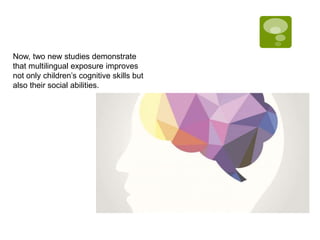
Now, two new studies demonstrate
that multilingual exposure improves
not only children’s cognitive skills but
also their social abilities.
1st study
Shows that multilingual children can be better at
communication than monolingual children
The group of children was taken in the United States, ages 4 to 6,
from different linguistic backgrounds, and presented them with a
situation in which they had to consider someone else’s perspective
to understand its meaning.
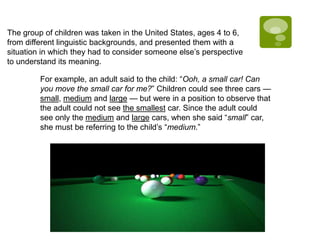
For example, an adult said to the child: “Ooh, a small car! Can
you move the small car for me?” Children could see three cars —
small, medium and large — but were in a position to observe that
the adult could not see the smallest car. Since the adult could
see only the medium and large cars, when she said “small” car,
she must be referring to the child’s “medium.”
Results
We found that bilingual children
were better than monolingual
children at this task.
If you think about it, this makes intuitive sense.
Interpreting someone’s utterance often requires
attending not just to its content, but also to the
surrounding context. What does a speaker
know or not know? What did she intend to
convey?
Children in multilingual environments have social
experiences that provide routine practice in
considering the perspectives of others: They have to
think about who speaks which language to whom,
who understands which content, and the times and
places in which different languages are spoken.
INTERESTING FACT
Children who were effectively
monolingual yet regularly
exposed to another language —
for example, those who had
grandparents who spoke another
language — were just as
talented as the bilingual children
at this task.
BUT
When all children got given a standard cognitive test of
executive function, it showed that bilingual children
performed better than monolingual children, and that the
kids who were effectively monolingual yet regularly exposed
to another language did not.
These “exposed” children performed like
monolinguals on the cognitive task, but like
bilinguals on the communication task.
2nd study
Effects of multilingual exposure on even younger
children
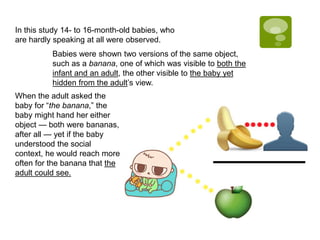
In this study 14- to 16-month-old babies, who
are hardly speaking at all were observed.
Babies were shown two versions of the same object,
such as a banana, one of which was visible to both the
infant and an adult, the other visible to the baby yet
hidden from the adult’s view.
When the adult asked the
baby for “the banana,” the
baby might hand her either
object — both were bananas,
after all — yet if the baby
understood the social
context, he would reach more
often for the banana that the
adult could see.
Results
We found that babies in monolingual
environments reached equally often for the two
bananas.
Babies in multilingual environments, including
those who were exposed to a second language
only minimally, already understood the importance
of adopting another’s perspective for
communication: They reached more often for the
banana that the adult could see.
To sum up
Multilingual exposure, it seems, facilitates the basic skills of interpersonal
understanding. Of course, becoming fully bilingual or multilingual is not
always easy or possible for everyone. But the social advantage we have
identified appears to emerge from merely being raised in an environment in
which multiple languages are experienced, not from being bilingual per se.
This is potentially good news for parents who are not bilingual themselves,
yet who want their children to enjoy some of the benefits of multilingualism.
Source
http://www.nytimes.com/2016/03/13/opinion/sunday/the-
superior-social-skills-of-bilinguals.html?_r=0

Bilingual

  • 1.
    Being Bilinguals Based on articleby Katherine Kinzler an associate professor of psychology and human development at Cornell University.
  • 2.
    Being bilingual hassome obvious advantages. Learning more than one language enables new conversations and new experiences. But in recent years, psychology researchers have demonstrated some less obvious advantages of bilingualism, too. For instance, bilingual children may enjoy certain cognitive benefits, such as improved executive function — which is critical for problem solving and other mentally demanding activities.
  • 3.
    Now, two newstudies demonstrate that multilingual exposure improves not only children’s cognitive skills but also their social abilities.
  • 4.
    1st study Shows thatmultilingual children can be better at communication than monolingual children
  • 5.
    The group ofchildren was taken in the United States, ages 4 to 6, from different linguistic backgrounds, and presented them with a situation in which they had to consider someone else’s perspective to understand its meaning. For example, an adult said to the child: “Ooh, a small car! Can you move the small car for me?” Children could see three cars — small, medium and large — but were in a position to observe that the adult could not see the smallest car. Since the adult could see only the medium and large cars, when she said “small” car, she must be referring to the child’s “medium.”
  • 6.
    Results We found thatbilingual children were better than monolingual children at this task. If you think about it, this makes intuitive sense. Interpreting someone’s utterance often requires attending not just to its content, but also to the surrounding context. What does a speaker know or not know? What did she intend to convey? Children in multilingual environments have social experiences that provide routine practice in considering the perspectives of others: They have to think about who speaks which language to whom, who understands which content, and the times and places in which different languages are spoken.
  • 7.
    INTERESTING FACT Children whowere effectively monolingual yet regularly exposed to another language — for example, those who had grandparents who spoke another language — were just as talented as the bilingual children at this task.
  • 8.
    BUT When all childrengot given a standard cognitive test of executive function, it showed that bilingual children performed better than monolingual children, and that the kids who were effectively monolingual yet regularly exposed to another language did not. These “exposed” children performed like monolinguals on the cognitive task, but like bilinguals on the communication task.
  • 9.
    2nd study Effects ofmultilingual exposure on even younger children
  • 10.
    In this study14- to 16-month-old babies, who are hardly speaking at all were observed. Babies were shown two versions of the same object, such as a banana, one of which was visible to both the infant and an adult, the other visible to the baby yet hidden from the adult’s view. When the adult asked the baby for “the banana,” the baby might hand her either object — both were bananas, after all — yet if the baby understood the social context, he would reach more often for the banana that the adult could see.
  • 11.
    Results We found thatbabies in monolingual environments reached equally often for the two bananas. Babies in multilingual environments, including those who were exposed to a second language only minimally, already understood the importance of adopting another’s perspective for communication: They reached more often for the banana that the adult could see.
  • 12.
    To sum up Multilingualexposure, it seems, facilitates the basic skills of interpersonal understanding. Of course, becoming fully bilingual or multilingual is not always easy or possible for everyone. But the social advantage we have identified appears to emerge from merely being raised in an environment in which multiple languages are experienced, not from being bilingual per se. This is potentially good news for parents who are not bilingual themselves, yet who want their children to enjoy some of the benefits of multilingualism.
  • 13.