{Open|Big|Linked} Data
Enabling better policy, services and cost efficiency in Government
Version 0.5

Pia Waugh
Director of Coordination and Gov 2.0
Technology and Procurement Division
Office of the Australian Government CTO

1
Benefits to Government in Opening Data

Cuts red tape
• Improves efficiencies in sharing data across government and with public
• Proactive automated publishing rather than manual retrospective approach
Improves Government Operations
• Enables collaboration and consistency across government and with public
• Improves policy analysis, development, implementation and reporting
• Improves service delivery by enabling thematic personalised approach to info
including mobile services that leverage cloud hosted data and automated APIs
• Improves data quality through enabling verifiable public contributions
Innovation
• Enables innovation and new opportunities in government, industry and research
• Enables greater capacity for public to contribute meaningfully to public policy

2
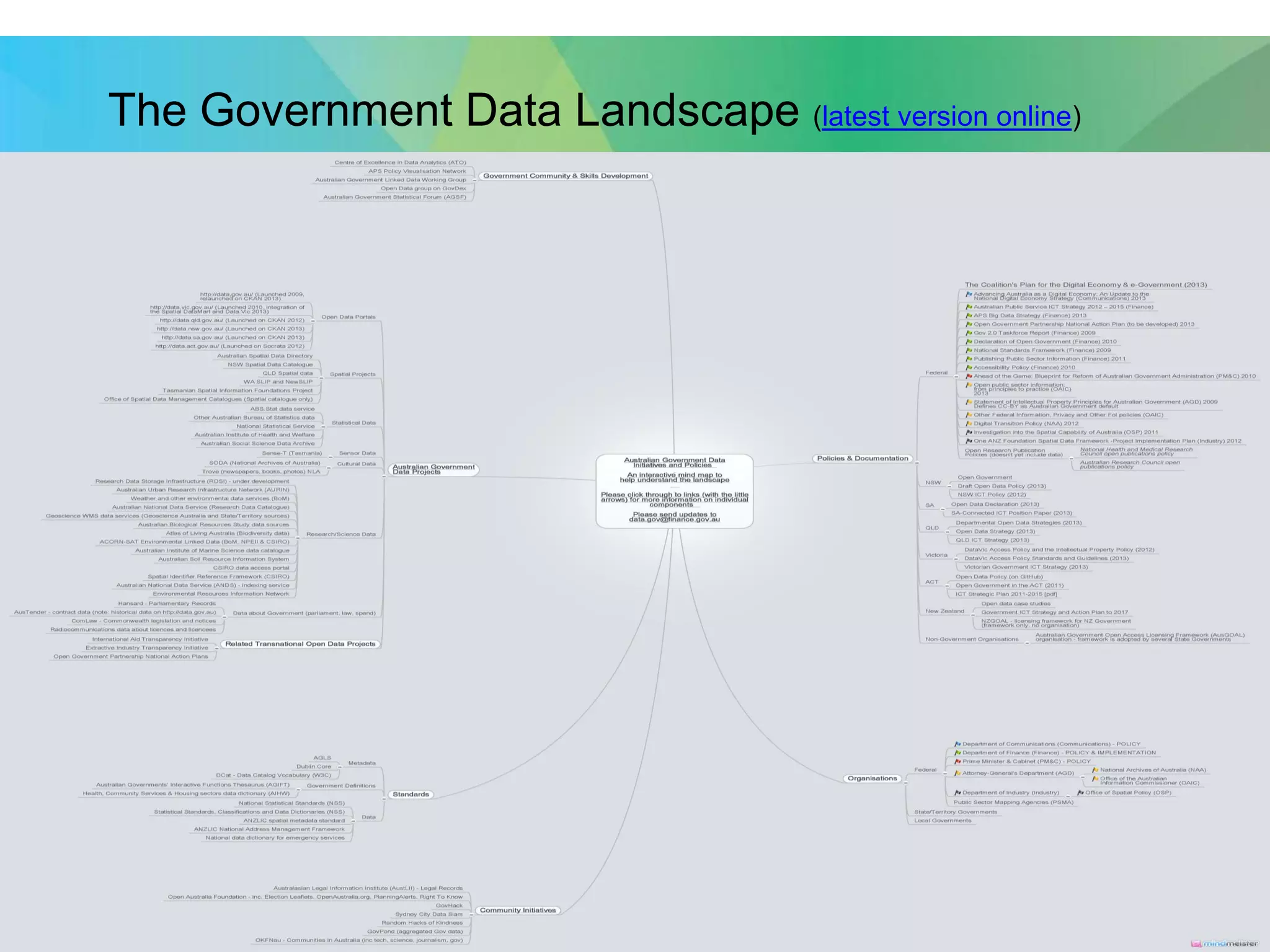
The Government Data Landscape (latest version online)

3
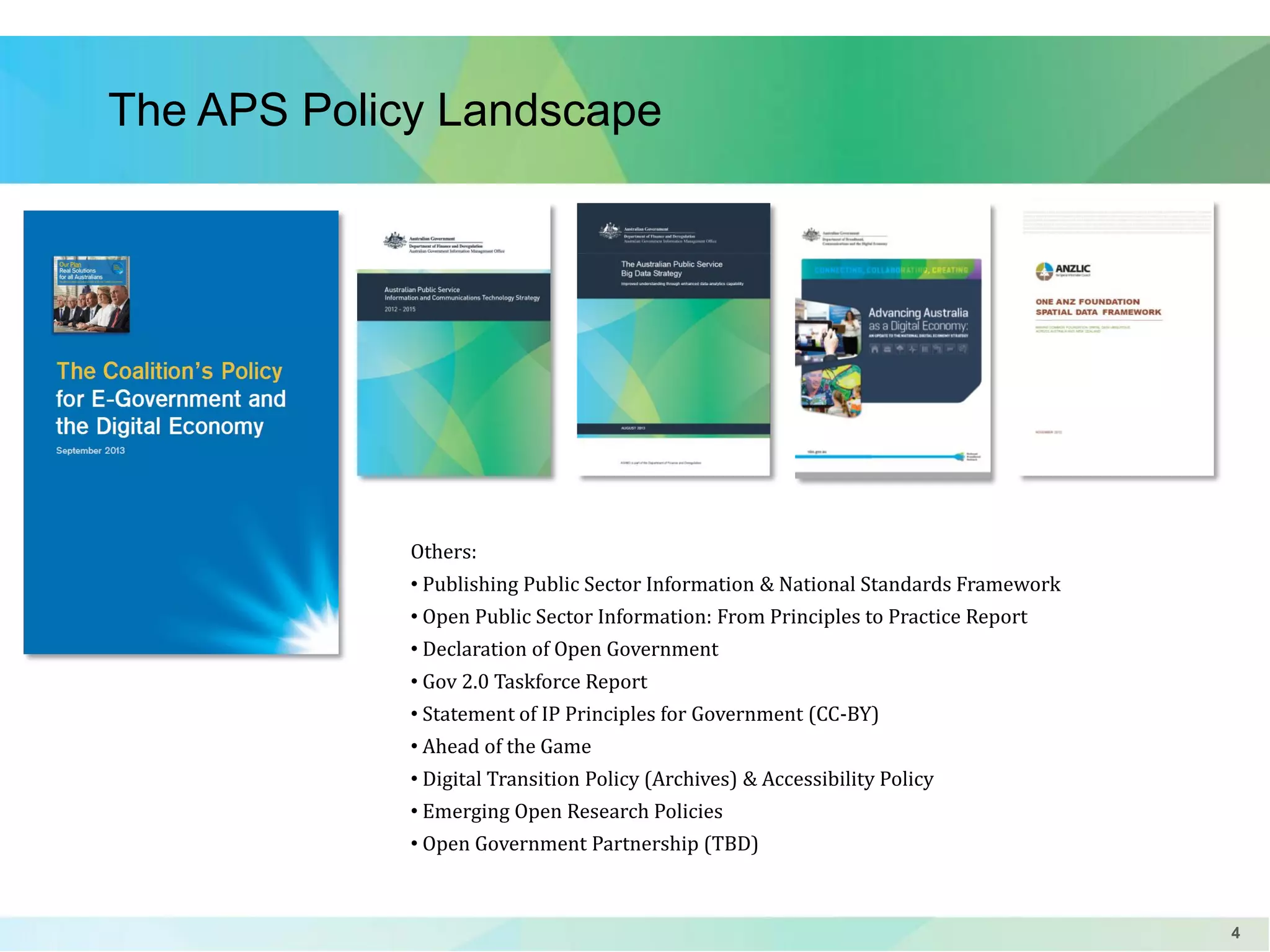
The APS Policy Landscape

Others:
• Publishing Public Sector Information & National Standards Framework
• Open Public Sector Information: From Principles to Practice Report

• Declaration of Open Government
• Gov 2.0 Taskforce Report
• Statement of IP Principles for Government (CC-BY)
• Ahead of the Game
• Digital Transition Policy (Archives) & Accessibility Policy
• Emerging Open Research Policies
• Open Government Partnership (TBD)

4
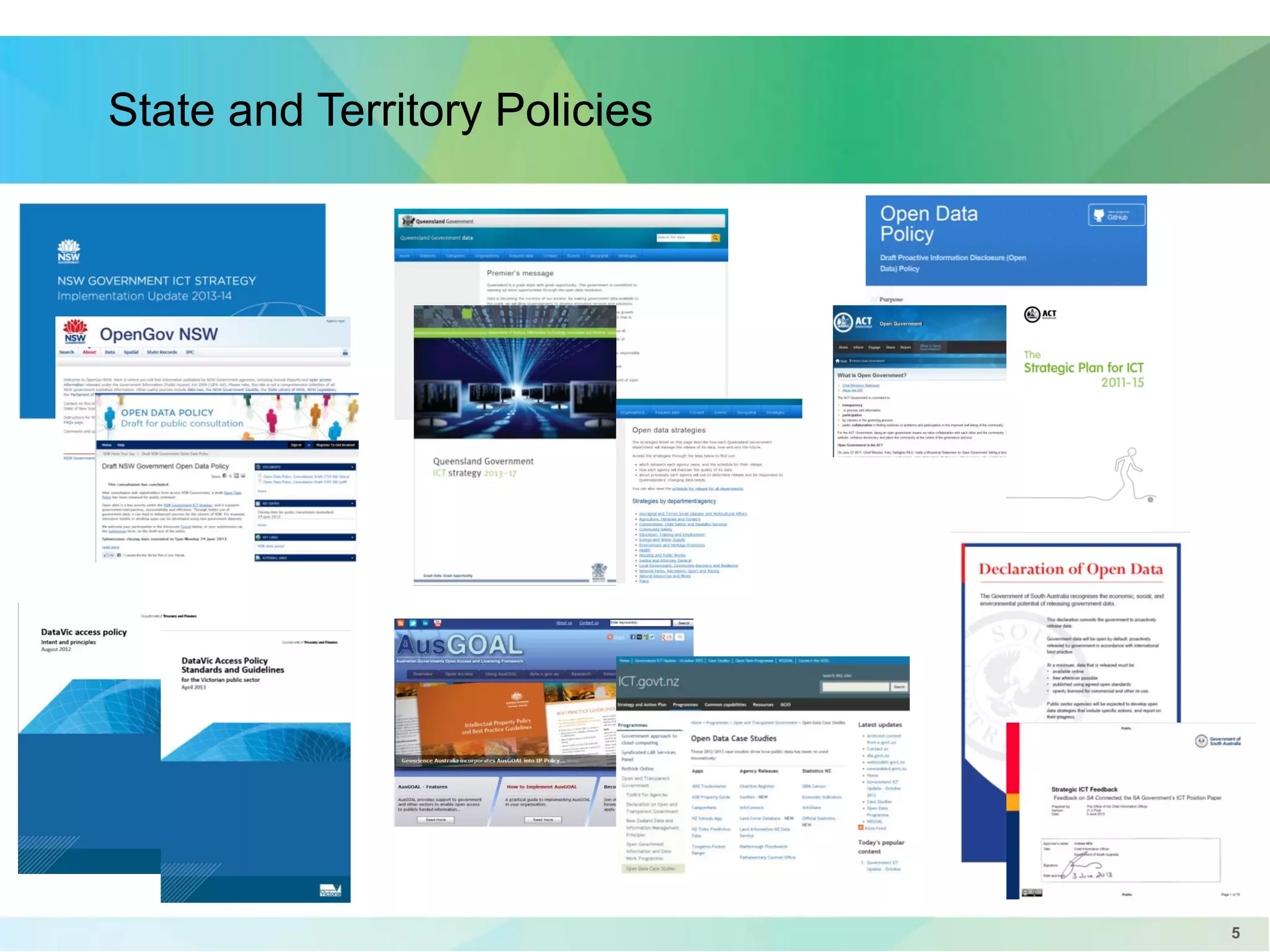
State and Territory Policies

5
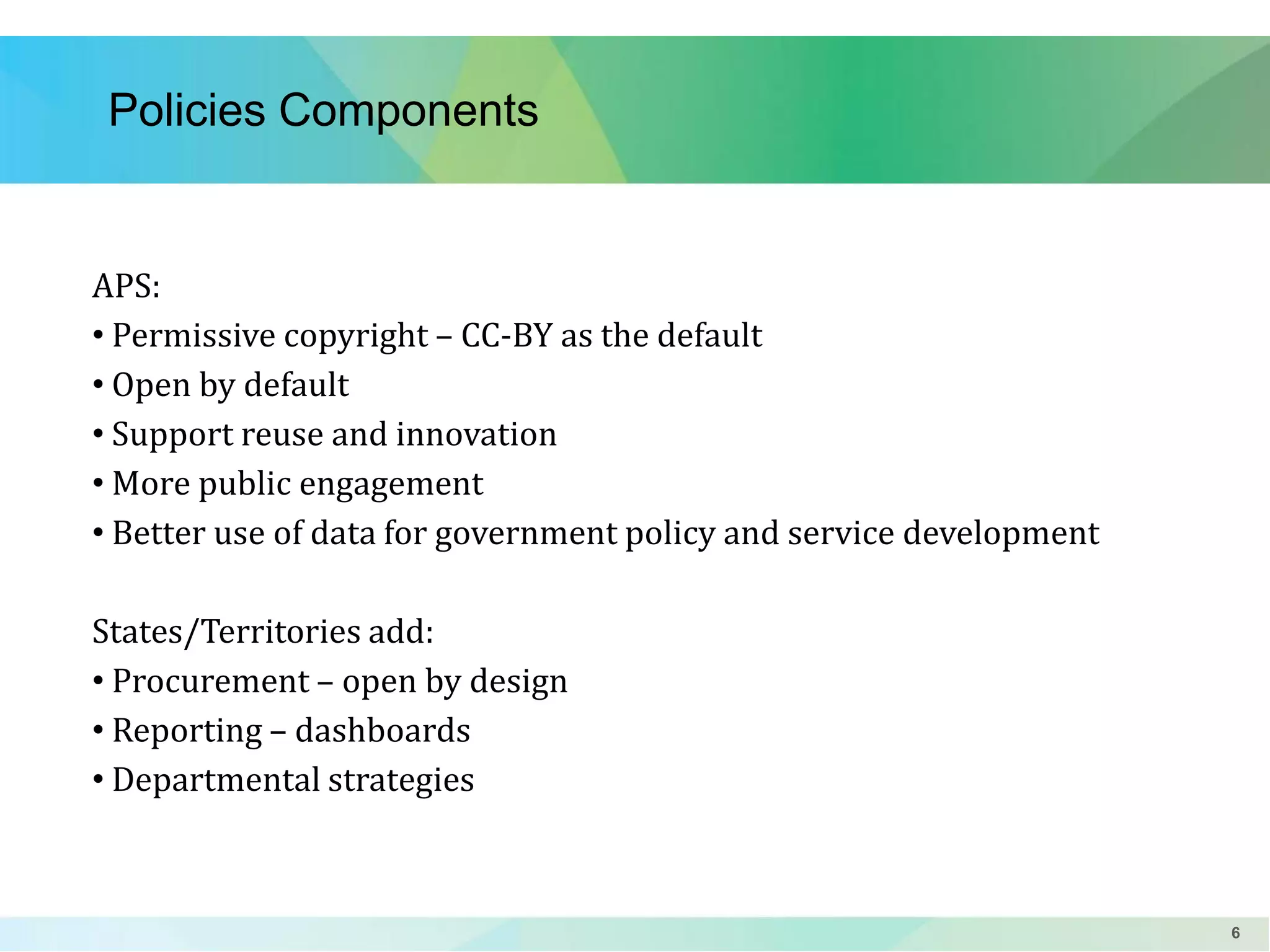
Policies Components

APS:
• Permissive copyright – CC-BY as the default
• Open by default
• Support reuse and innovation
• More public engagement
• Better use of data for government policy and service development
States/Territories add:
• Procurement – open by design
• Reporting – dashboards
• Departmental strategies

6
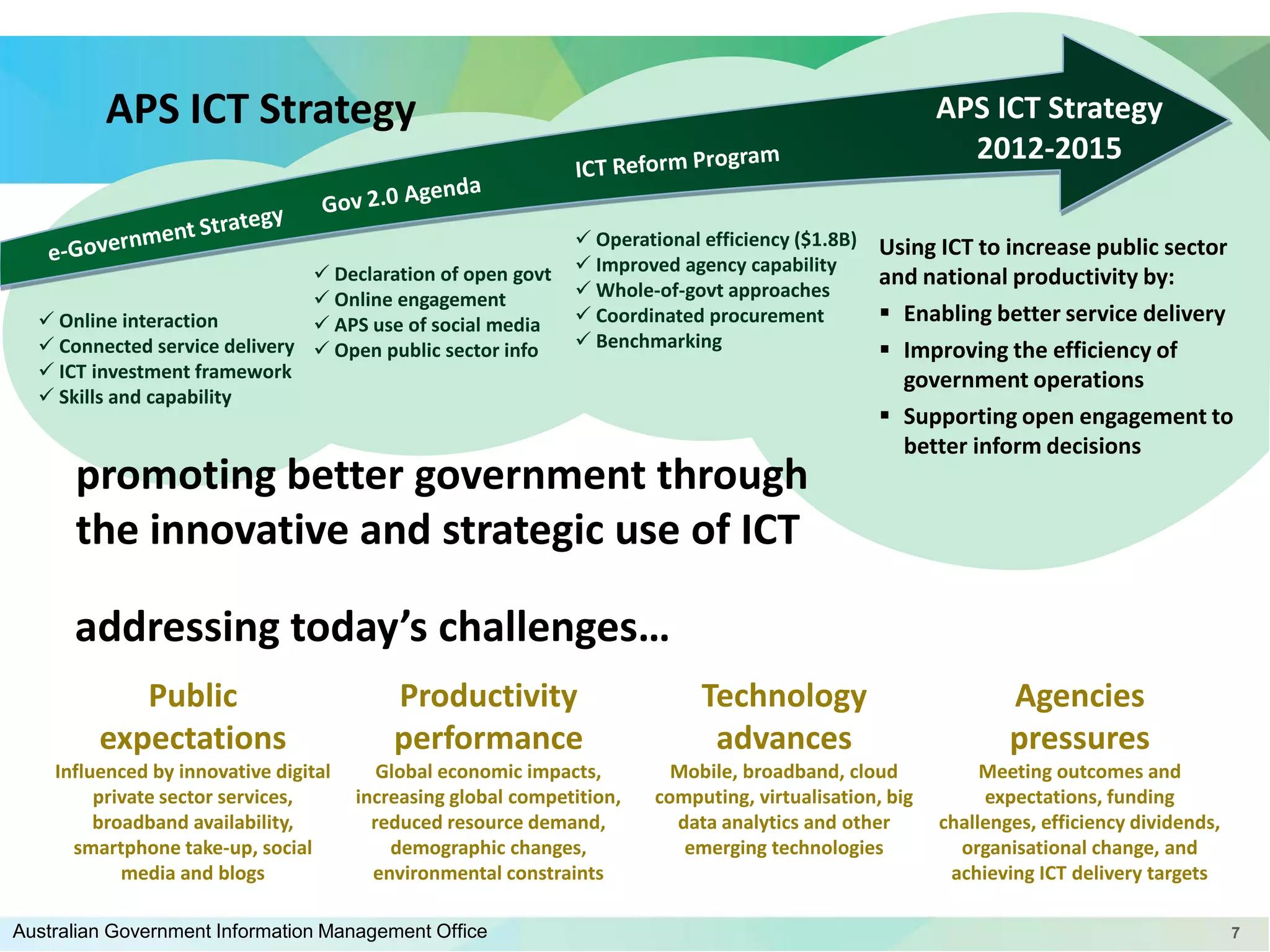
APS ICT Strategy

 Declaration of open govt
 Online engagement
 Online interaction
 APS use of social media
 Connected service delivery  Open public sector info
 ICT investment framework
 Skills and capability

APS ICT Strategy
2012-2015
 Operational efficiency ($1.8B)
 Improved agency capability
 Whole-of-govt approaches
 Coordinated procurement
 Benchmarking

promoting better government through
the innovative and strategic use of ICT

Using ICT to increase public sector
and national productivity by:
 Enabling better service delivery
 Improving the efficiency of
government operations
 Supporting open engagement to
better inform decisions

addressing today’s challenges…
Public
expectations

Productivity
performance

Technology
advances

Agencies
pressures

Influenced by innovative digital
private sector services,
broadband availability,
smartphone take-up, social
media and blogs

Global economic impacts,
increasing global competition,
reduced resource demand,
demographic changes,
environmental constraints

Mobile, broadband, cloud
computing, virtualisation, big
data analytics and other
emerging technologies

Meeting outcomes and
expectations, funding
challenges, efficiency dividends,
organisational change, and
achieving ICT delivery targets

Australian Government Information Management Office

7
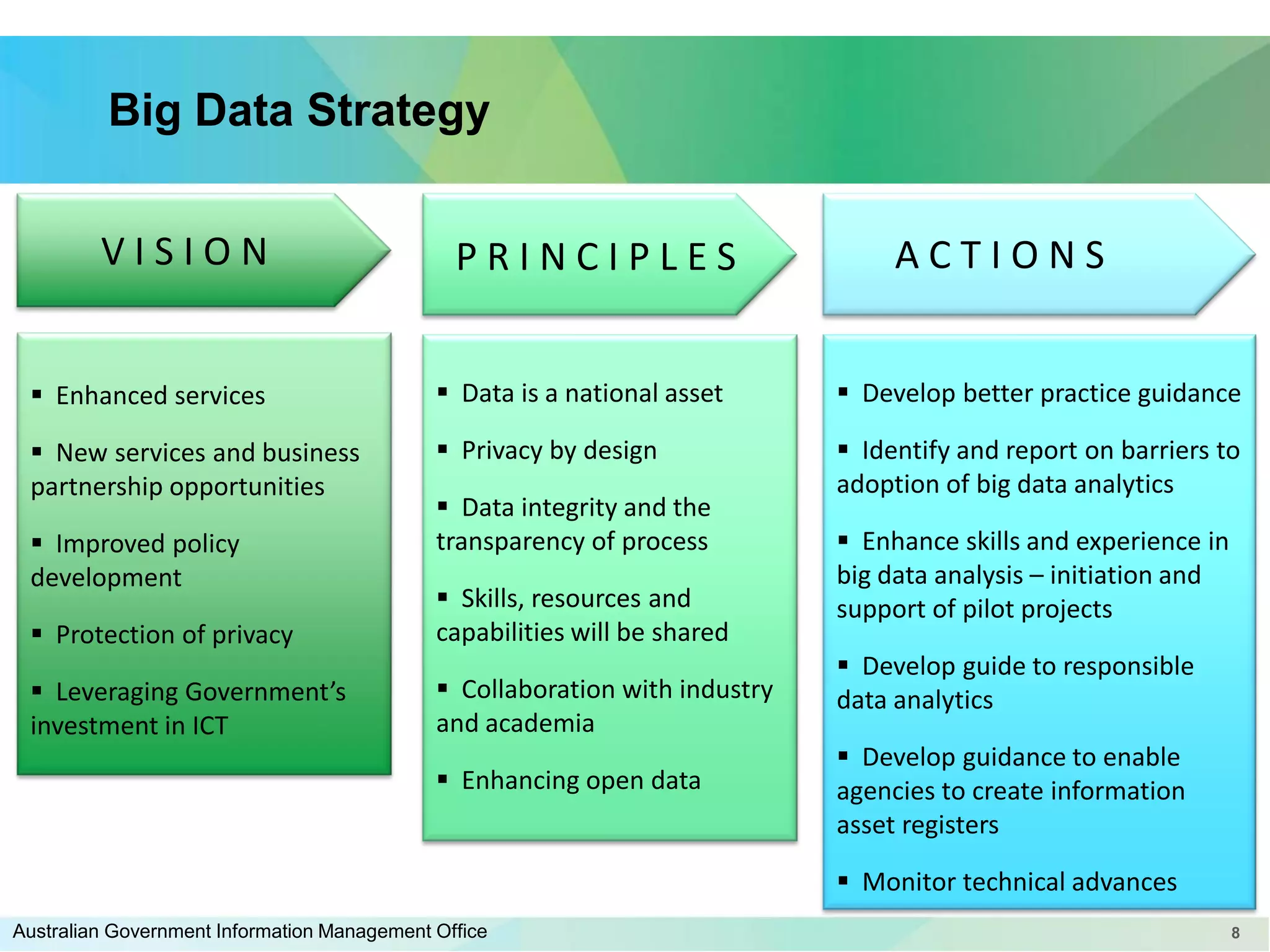
Big Data Strategy
VISION

PRINCIPLES

ACTIONS

 Enhanced services

 Data is a national asset

 Develop better practice guidance

 New services and business
partnership opportunities

 Privacy by design

 Identify and report on barriers to
adoption of big data analytics

 Improved policy
development

 Data integrity and the
transparency of process

 Protection of privacy

 Skills, resources and
capabilities will be shared

 Leveraging Government’s
investment in ICT

 Collaboration with industry
and academia
 Enhancing open data

 Enhance skills and experience in
big data analysis – initiation and
support of pilot projects
 Develop guide to responsible
data analytics
 Develop guidance to enable
agencies to create information
asset registers
 Monitor technical advances

Australian Government Information Management Office

8
Privacy and confidentiality

• Custom API approach that confidentialises on the fly (eg, ABS)
• Deidentification of data – to appropriate level
• Aggregation
• Leveraging existing processes for researcher (unit level) access rather
than conflating open data discussions
• Privacy Commissioner as point of reference and support
• Avoiding common identifiers across multiple datasets

9
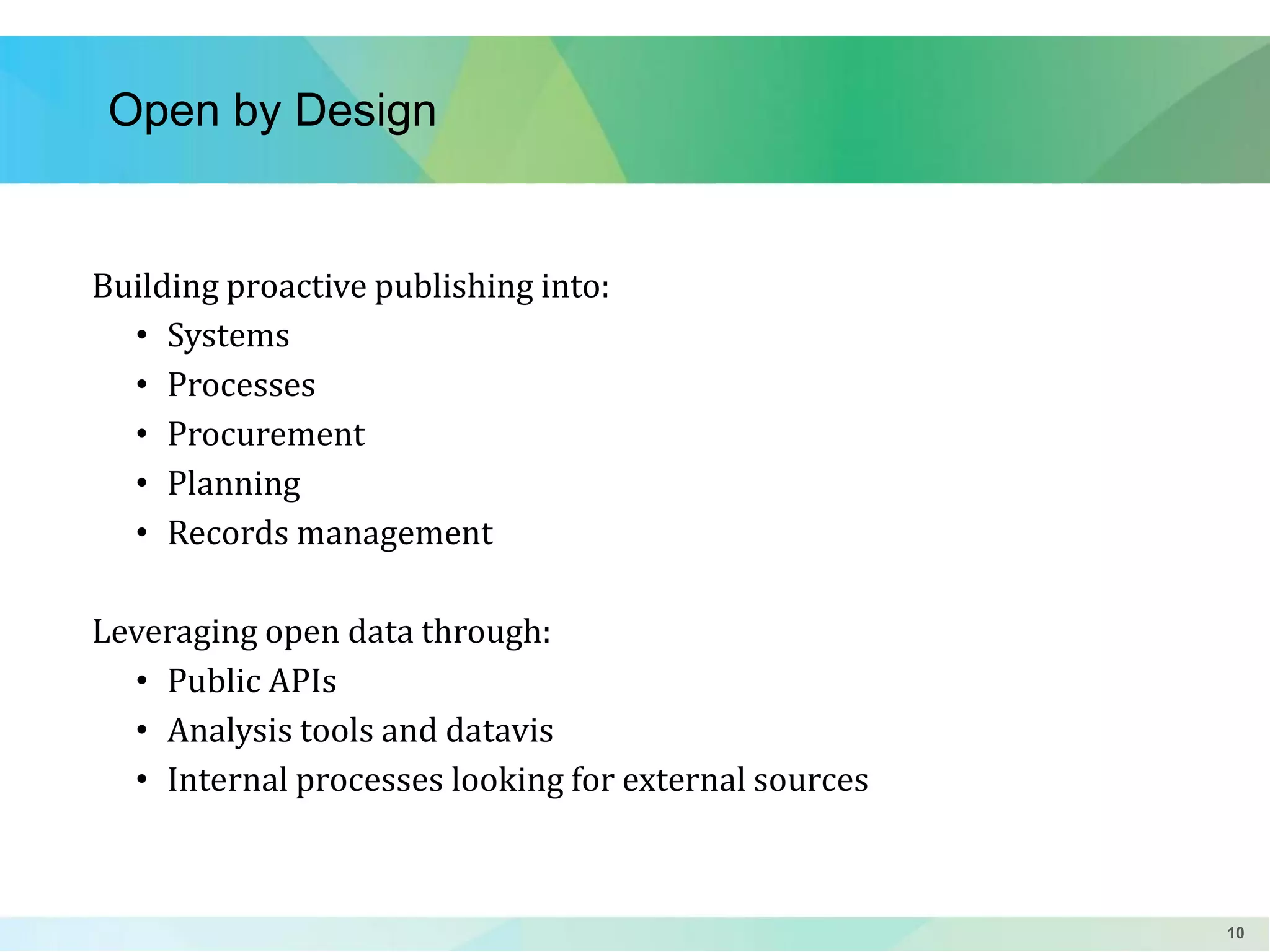
Open by Design

Building proactive publishing into:
• Systems
• Processes
• Procurement
• Planning
• Records management
Leveraging open data through:
• Public APIs
• Analysis tools and datavis
• Internal processes looking for external sources

10
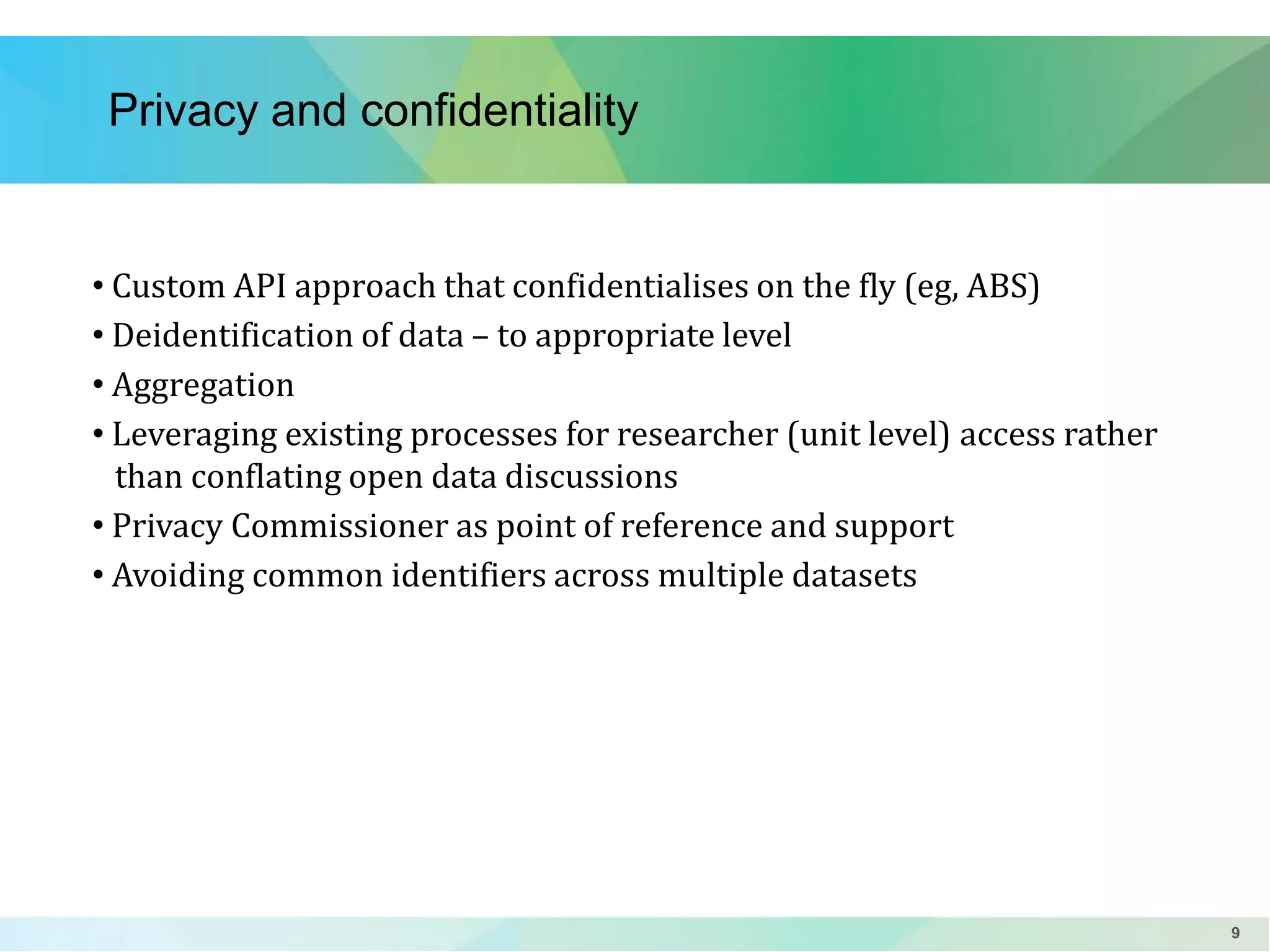
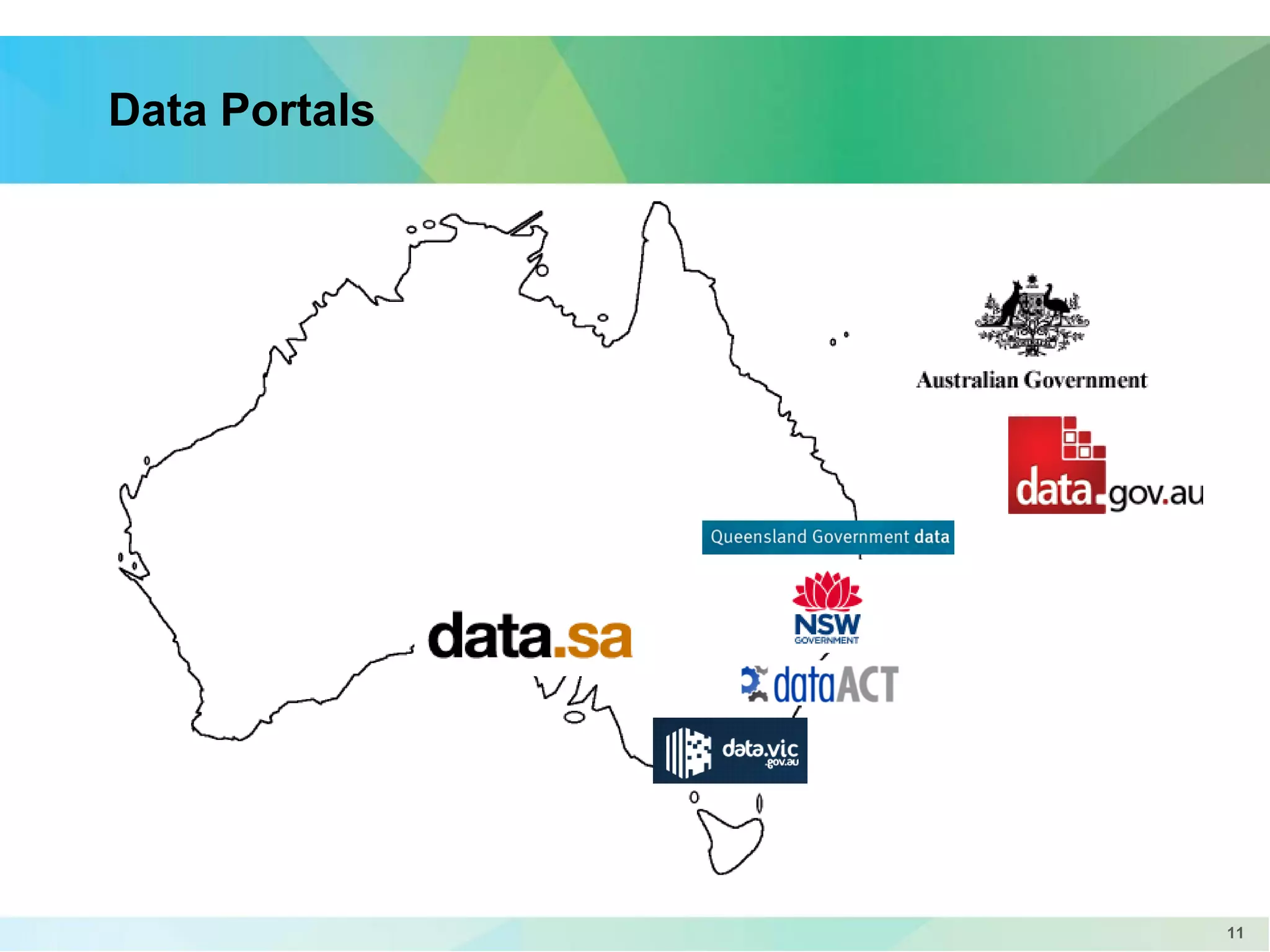
Data Portals

11
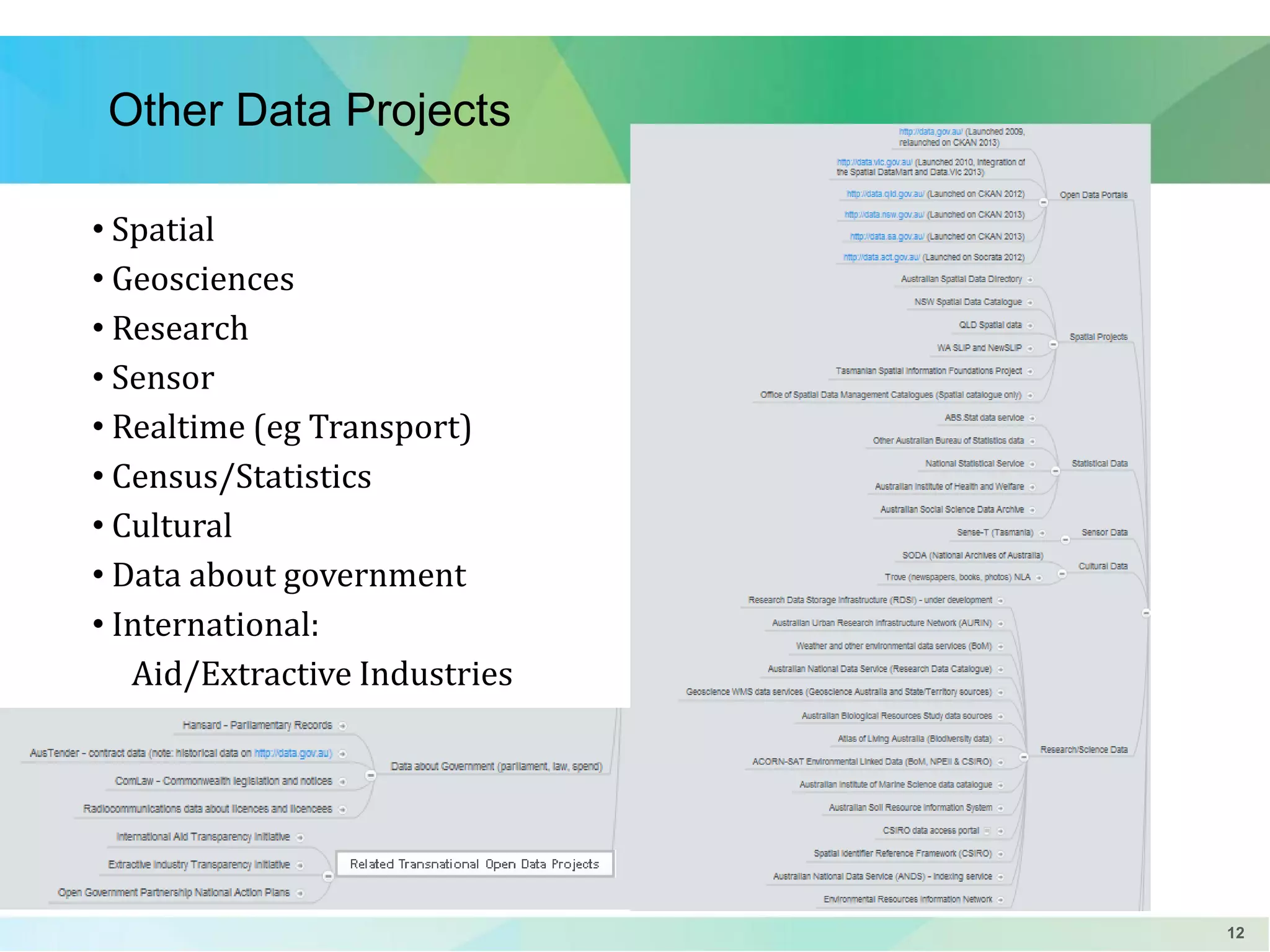
Other Data Projects
• Spatial
• Geosciences
• Research
• Sensor
• Realtime (eg Transport)
• Census/Statistics
• Cultural
• Data about government
• International:
Aid/Extractive Industries

12
Loads of Tools Available

• Publishing tools – CKAN, Socrata, bespoke
• Automation – FME, Kettle
• Data visualisation – Tableau, SuperDataHub,
SpatialKey
• Analysis – R, domain specialist software, Palantir
• API development
• Application development
• Linked data tools
• Metadata tools
13
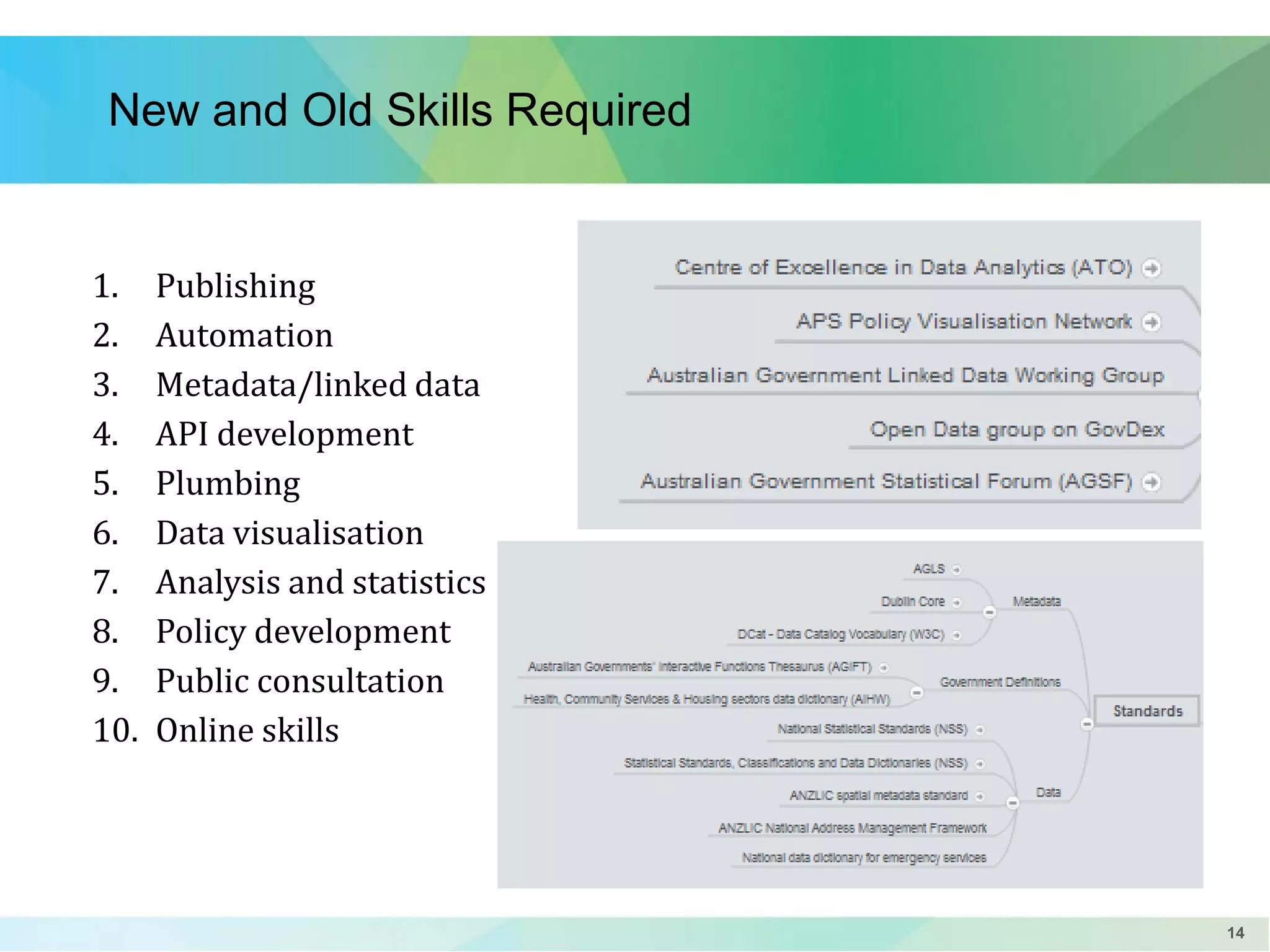
New and Old Skills Required

1.
2.
3.
4.
5.
6.
7.
8.
9.
10.

Publishing
Automation
Metadata/linked data
API development
Plumbing
Data visualisation
Analysis and statistics
Policy development
Public consultation
Online skills

14
Some Challenges

• Legislative
• Culture
• Systems
• Reactive vs proactive
• Metadata/semantic context
• Too much data
• Real time vs historic
• Definitions and common references
• Limited skills and over specialisation

15
data.gov.au

Free, cloud based, highly scalable platform for hosting government data.
Staged approach
1. Publishing (2013)
Improving the functionality and ease of
publishing for agencies with training and
documentation

2.

Value realisation (Early 2014)
Providing useful front end tools for data.gov.au
including data visualisation and analysis tools

3.

Data quality (Late 2014)
Looking at ways to provide agencies the ability
to accept iterative data improvements in a
verifiable way

Features
• Federated search making data
and data services easier to find
• Manual and automated publishing
options
• API access to government data
• Easy to publish, download and
interact with data online
• Basic data visualisation capability

16
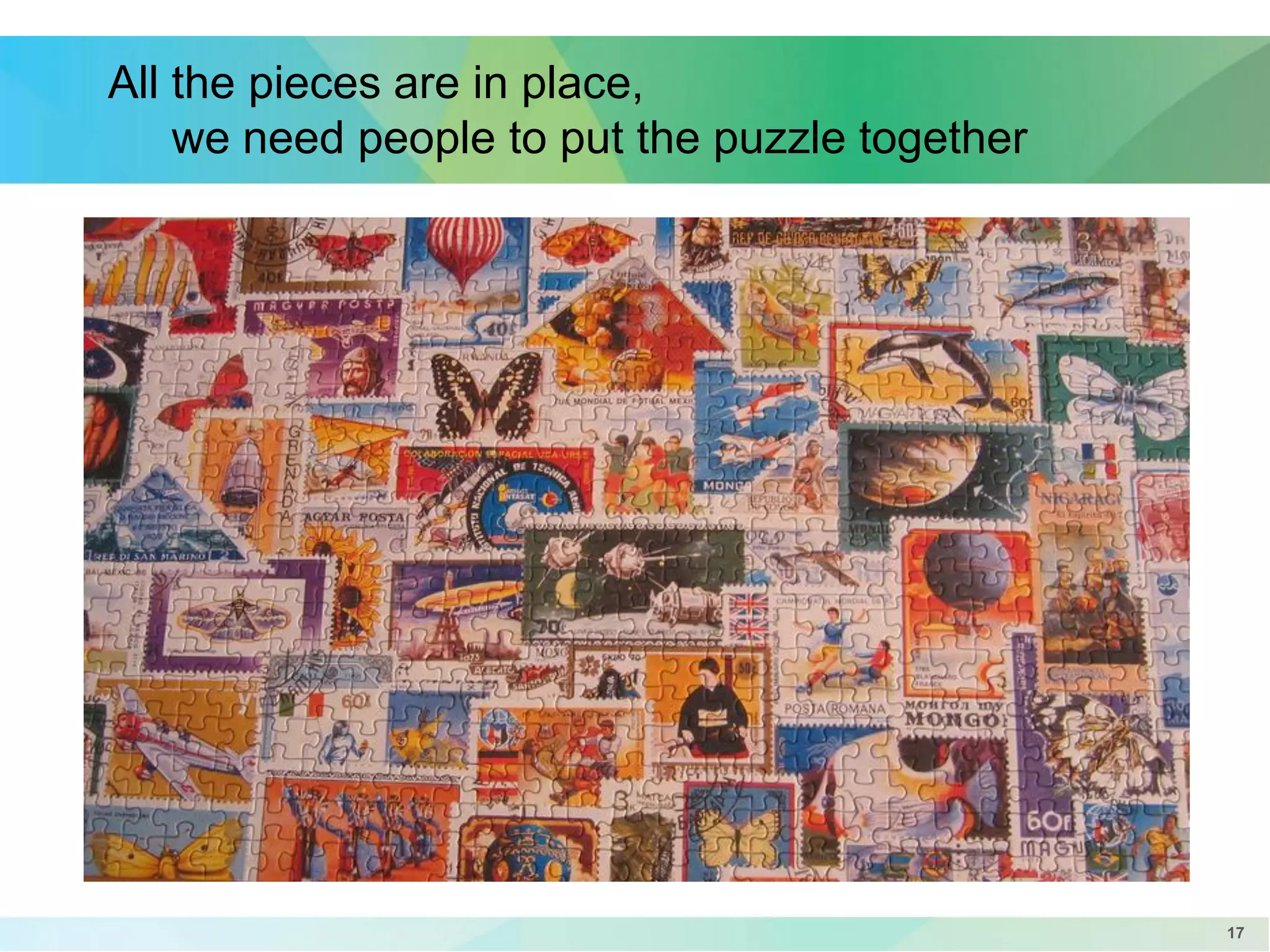
All the pieces are in place,
we need people to put the puzzle together

17
{Open|Big|Linked}
Data
Without data, you only have open, big & linked.

What {public|private} data do you need?

Questions?
18

Open data presentation 2013 v0 5

  • 1.
    {Open|Big|Linked} Data Enabling betterpolicy, services and cost efficiency in Government Version 0.5 Pia Waugh Director of Coordination and Gov 2.0 Technology and Procurement Division Office of the Australian Government CTO 1
  • 2.
    Benefits to Governmentin Opening Data Cuts red tape • Improves efficiencies in sharing data across government and with public • Proactive automated publishing rather than manual retrospective approach Improves Government Operations • Enables collaboration and consistency across government and with public • Improves policy analysis, development, implementation and reporting • Improves service delivery by enabling thematic personalised approach to info including mobile services that leverage cloud hosted data and automated APIs • Improves data quality through enabling verifiable public contributions Innovation • Enables innovation and new opportunities in government, industry and research • Enables greater capacity for public to contribute meaningfully to public policy 2
  • 3.
    The Government DataLandscape (latest version online) 3
  • 4.
    The APS PolicyLandscape Others: • Publishing Public Sector Information & National Standards Framework • Open Public Sector Information: From Principles to Practice Report • Declaration of Open Government • Gov 2.0 Taskforce Report • Statement of IP Principles for Government (CC-BY) • Ahead of the Game • Digital Transition Policy (Archives) & Accessibility Policy • Emerging Open Research Policies • Open Government Partnership (TBD) 4
  • 5.
  • 6.
    Policies Components APS: • Permissivecopyright – CC-BY as the default • Open by default • Support reuse and innovation • More public engagement • Better use of data for government policy and service development States/Territories add: • Procurement – open by design • Reporting – dashboards • Departmental strategies 6
  • 7.
    APS ICT Strategy Declaration of open govt  Online engagement  Online interaction  APS use of social media  Connected service delivery  Open public sector info  ICT investment framework  Skills and capability APS ICT Strategy 2012-2015  Operational efficiency ($1.8B)  Improved agency capability  Whole-of-govt approaches  Coordinated procurement  Benchmarking promoting better government through the innovative and strategic use of ICT Using ICT to increase public sector and national productivity by:  Enabling better service delivery  Improving the efficiency of government operations  Supporting open engagement to better inform decisions addressing today’s challenges… Public expectations Productivity performance Technology advances Agencies pressures Influenced by innovative digital private sector services, broadband availability, smartphone take-up, social media and blogs Global economic impacts, increasing global competition, reduced resource demand, demographic changes, environmental constraints Mobile, broadband, cloud computing, virtualisation, big data analytics and other emerging technologies Meeting outcomes and expectations, funding challenges, efficiency dividends, organisational change, and achieving ICT delivery targets Australian Government Information Management Office 7
  • 8.
    Big Data Strategy VISION PRINCIPLES ACTIONS Enhanced services  Data is a national asset  Develop better practice guidance  New services and business partnership opportunities  Privacy by design  Identify and report on barriers to adoption of big data analytics  Improved policy development  Data integrity and the transparency of process  Protection of privacy  Skills, resources and capabilities will be shared  Leveraging Government’s investment in ICT  Collaboration with industry and academia  Enhancing open data  Enhance skills and experience in big data analysis – initiation and support of pilot projects  Develop guide to responsible data analytics  Develop guidance to enable agencies to create information asset registers  Monitor technical advances Australian Government Information Management Office 8
  • 9.
    Privacy and confidentiality •Custom API approach that confidentialises on the fly (eg, ABS) • Deidentification of data – to appropriate level • Aggregation • Leveraging existing processes for researcher (unit level) access rather than conflating open data discussions • Privacy Commissioner as point of reference and support • Avoiding common identifiers across multiple datasets 9
  • 10.
    Open by Design Buildingproactive publishing into: • Systems • Processes • Procurement • Planning • Records management Leveraging open data through: • Public APIs • Analysis tools and datavis • Internal processes looking for external sources 10
  • 11.
  • 12.
    Other Data Projects •Spatial • Geosciences • Research • Sensor • Realtime (eg Transport) • Census/Statistics • Cultural • Data about government • International: Aid/Extractive Industries 12
  • 13.
    Loads of ToolsAvailable • Publishing tools – CKAN, Socrata, bespoke • Automation – FME, Kettle • Data visualisation – Tableau, SuperDataHub, SpatialKey • Analysis – R, domain specialist software, Palantir • API development • Application development • Linked data tools • Metadata tools 13
  • 14.
    New and OldSkills Required 1. 2. 3. 4. 5. 6. 7. 8. 9. 10. Publishing Automation Metadata/linked data API development Plumbing Data visualisation Analysis and statistics Policy development Public consultation Online skills 14
  • 15.
    Some Challenges • Legislative •Culture • Systems • Reactive vs proactive • Metadata/semantic context • Too much data • Real time vs historic • Definitions and common references • Limited skills and over specialisation 15
  • 16.
    data.gov.au Free, cloud based,highly scalable platform for hosting government data. Staged approach 1. Publishing (2013) Improving the functionality and ease of publishing for agencies with training and documentation 2. Value realisation (Early 2014) Providing useful front end tools for data.gov.au including data visualisation and analysis tools 3. Data quality (Late 2014) Looking at ways to provide agencies the ability to accept iterative data improvements in a verifiable way Features • Federated search making data and data services easier to find • Manual and automated publishing options • API access to government data • Easy to publish, download and interact with data online • Basic data visualisation capability 16
  • 17.
    All the piecesare in place, we need people to put the puzzle together 17
  • 18.
    {Open|Big|Linked} Data Without data, youonly have open, big & linked. What {public|private} data do you need? Questions? 18