

Reimagining Enterprise Risk:
A Global Study
The Finance Mountaineer’s View of the
Enterprise Risk Landscape
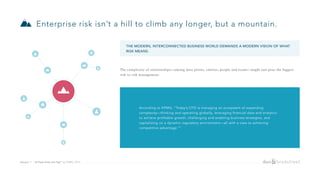
The complexity of relationships—among data points, entities, people and teams—might just pose the biggest
risk to risk management.
Enterprise risk isn’t a hill to climb any longer, but a mountain.
According to KPMG, “Today’s CFO is managing an ecosystem of expanding
complexity—thinking and operating globally, leveraging financial data and analytics
to achieve profitable growth, challenging and enabling business strategies, and
capitalizing on a dynamic regulatory environment—all with a view to achieving
competitive advantage.”1
Source: 1 - "A View From the Top" by KPMG, 2016.
THE MODERN, INTERCONNECTED BUSINESS WORLD DEMANDS A MODERN VISION OF WHAT
RISK MEANS.
The Climate Outside Core Macro Trends Affecting Enterprise Risk Management in Finance
Source: 2 - “The DNA of the CFO 2016 Study: Part 1,” conducted by Ernst & Young
“Today, organizations and their finance leaders are
challenged by a rapidly changing risk landscape.
Finding enough certainty to be able to make decisions
in this volatile risk landscape is a major challenge for
CFOs, and they are taking an increasing role in risk
management.” - EY
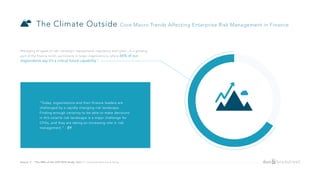
Managing all types of risk—strategic, reputational, regulatory and cyber—is a growing
part of the finance remit, particularly in larger organizations, where 66% of our
respondents say it’s a critical future capability.2
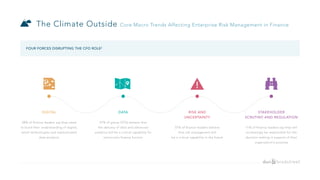
The Climate Outside Core Macro Trends Affecting Enterprise Risk Management in Finance
DIGITAL
58% of finance leaders say they need
to build their understanding of digital,
smart technologies and sophisticated
data analytics
DATA
57% of group CFOs believe that
the delivery of data and advanced
analytics will be a critical capability for
tomorrow’s finance funcion
RISK AND
UNCERTAINTY
57% of finance leaders believe
that risk management will
be a critical capability in the future
STAKEHOLDER
SCRUTINY AND REGULATION
71% of finance leaders say they will
increasingly be responsible for the
decision-making in support of their
organization’s purpose
!
FOUR FORCES DISRUPTING THE CFO ROLE2
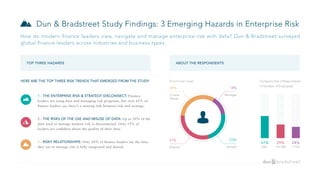
ABOUT THE RESPONDENTS
Dun & Bradstreet Study Findings: 3 Emerging Hazards in Enterprise Risk
Functional Level Company Size of Respondents
in Number of Employees
1 - THE ENTERPRISE RISK & STRATEGY DISCONNECT: Finance
leaders are using data and managing risk programs, but over 65% of
finance leaders say there’s a missing link between risk and strategy.
2 - THE RISKS OF THE USE AND MISUSE OF DATA: Up to 50% of the
data used to manage modern risk is disconnected. Only 15% of
leaders are confident about the quality of their data.
3 - RISKY RELATIONSHIPS: Only 20% of finance leaders say the data
they use to manage risk is fully integrated and shared.
29%
151-500
24%
1-150
47%
500+
31%
Director
14%
Manager
32%
C-Level
Owner
23%
VP/SVP
!
HERE ARE THE TOP THREE RISK TRENDS THAT EMERGED FROM THE STUDY:
TOP THREE HAZARDS
How do modern finance leaders view, navigate and manage enterprise risk with data? Dun & Bradstreet surveyed
global finance leaders across industries and business types.
THE FOG-VEILED SUMMIT
Risk and Strategy
Hazard 1
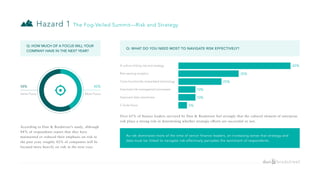
Hazard 1 The Fog-Veiled Summit—Risk and Strategy
Q: HOW MUCH OF A FOCUS WILL YOUR
COMPANY HAVE IN THE NEXT YEAR?
Q: WHAT DO YOU NEED MOST TO NAVIGATE RISK EFFECTIVELY?
According to Dun & Bradstreet’s study, although
84% of respondents report that they have
maintained or reduced their emphasis on risk in
the past year, roughly 42% of companies will be
focused more heavily on risk in the next year.
Over 65% of finance leaders surveyed by Dun & Bradstreet feel strongly that the cultural element of enterprise
risk plays a strong role in determining whether strategic efforts are successful or not.
58%
Same Focus
42%
More Focus
A culture linking risk and strategy
Risk-sensing analytics
Cross-functionally embedded technology
Improved risk management processes
Improved data cleanliness
C-Suite focus
65%
35%
25%
10%
10%
5%
As risk dominates more of the time of senior finance leaders, an increasing sense that strategy and
data must be linked to navigate risk effectively pervades the sentiment of respondents.
Hazard 2
TREACHEROUS TERRAIN
Emerging Risks From the Use and
Abuse of Data
45%
Moderate Role
Hazard 2 Treacherous Terrain—Emerging Risks From the Use and Abuse of Data
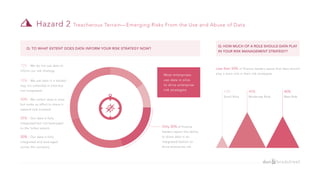
Most enterprises
use data in silos
to drive enterprise
risk strategies
Q: HOW MUCH OF A ROLE SHOULD DATA PLAY
IN YOUR RISK MANAGEMENT STRATEGY?
10% - We do not use data to
inform our risk strategy.
15% - We use data in a limited
way. It’s collected in silos but
not integrated.
30% - We collect data in silos
but make an effort to share it
upward and outward.
25% - Our data is fully
integrated but not leveraged
to the fullest extent.
20% - Our data is fully
integrated and leveraged
across the company.
Only 20% of finance
leaders report the ability
to share data in an
integrated fashion to
drive enterprise risk.
Less than 50% of finance leaders agree that data should
play a main role in their risk strategies.
10%
Small Role
40%
Main Role
Q: TO WHAT EXTENT DOES DATA INFORM YOUR RISK STRATEGY NOW?
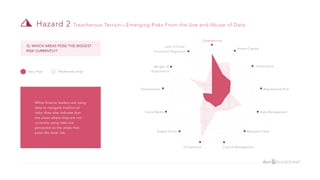
Q: WHICH AREAS POSE THE BIGGEST
RISK CURRENTLY?
Very High Moderately High
Hazard 2 Treacherous Terrain—Emerging Risks From the Use and Abuse of Data
Compliance
Reputational Risk
Governance
Globalization
Mergers &
Acquisitions
Human Capital
Cybersecurity
Lack of Cross-
Functional Alignment
Social Media
Supply Chain
Capital Management
Business Fraud
Data Management
While finance leaders are using
data to navigate traditional
risks, they also indicate that
the areas where they are not
currently using data are
perceived as the areas that
pose the most risk.
Hazard 2 Treacherous Terrain—Emerging Risks From the Use and Abuse of Data
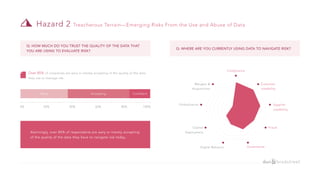
Q: WHERE ARE YOU CURRENTLY USING DATA TO NAVIGATE RISK?
Q: HOW MUCH DO YOU TRUST THE QUALITY OF THE DATA THAT
YOU ARE USING TO EVALUATE RISK?
Compliance
Customer
credibility
Supplier
credibility
Fraud
GovernanceDigital Behavior
Capital
Deployment
Globalization
Mergers &
Acquisitions
20%0% 40% 60% 80% 100%
Over 85% of companies are wary or merely accepting of the quality of the data
they use to manage risk.
Alarmingly, over 85% of respondents are wary or merely accepting
of the quality of the data they have to navigate risk today.
Wary ConfidentAccepting
PERILOUS FRONTIER
Rappelling From the Altitudes of
Missing Relationships
Hazard 3
Hazard 3 Perilous Frontier—Rappelling From the Altitudes of Missing Relationships
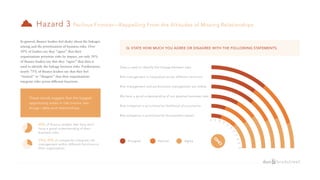
Risk mitigation is prioritized by the possible impact.
Risk mitigation is prioritized by likelihood of occurrence.
We have a good understanding of our greatest business risks.
Risk management and performance management are linked.
Risk management is integrated across different functions.
Data is used to identify the linkage between risks.
0%
10%
20%
30%
40%
50%
60%
70%
80%
90%
100%
Q: STATE HOW MUCH YOU AGREE OR DISAGREE WITH THE FOLLOWING STATEMENTS.
Disagree Neutral Agree
In general, finance leaders feel shaky about the linkages
among and the prioritization of business risks. Over
50% of leaders say they “agree” that their
organizations prioritize risks by impact, yet only 20%
of finance leaders say that they “agree” that data is
used to identify the linkage between risks. Furthermore,
nearly 75% of finance leaders say that they feel
“neutral” or “disagree” that their organizations
integrate risks across different functions.
60% of finance leaders feel they don’t
have a good understanding of their
business risks.
Only 30% of companies integrate risk
management within different functions in
their organization.
These trends suggest that the biggest
opportunity areas in risk involve two
things—data and relationships.
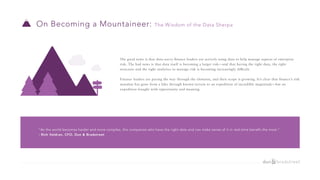
The good news is that data-savvy finance leaders are actively using data to help manage aspects of enterprise
risk. The bad news is that data itself is becoming a larger risk—and that having the right data, the right
structure and the right analytics to manage risk is becoming increasingly difficult.
Finance leaders are paving the way through the elements, and their scope is growing. It’s clear that finance’s risk
mandate has gone from a hike through known terrain to an expedition of incredible magnitude—but an
expedition fraught with opportunity and meaning.
On Becoming a Mountaineer: The Wisdom of the Data Sherpa
“As the world becomes harder and more complex, the companies who have the right data and can make sense of it in real-time benefit the most.”
- Rich Veldran, CFO, Dun & Bradstreet
What’s Your Risk
Mountaineering Profile?
Most financial leaders are keenly aware of the importance of data
and analytics to inform their strategic endeavors, but effectively
taking an integrated approach to moving the entire operation of
their companies in the right direction—up the right
mountain—and with the right supplies is not for the faint of heart.
Yet, in the wake of cyber-security threats, globalization, economic
disruption, digitization, reputational threats and regulatory
pressures, it’s never been more important to prepare and have an
expert mountaineer’s clear risk vision.
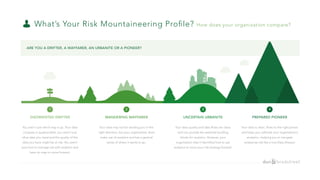
What’s Your Risk Mountaineering Profile? How does your organization compare?
DISORIENTED DRIFTER
You aren’t sure which way is up. Your data
compass is questionable, you aren’t sure
what data you need and the quality of the
data you have might be at risk. You aren’t
sure how to manage risk with analytics and
have no map to move forward.
WANDERING WAYFARER
Your data may not be sending you in the
right direction, but your organization does
make use of analytics and has a general
sense of where it wants to go.
UNCERTAIN URBANITE
Your data quality and data flows are clean
and can provide the essential building
blocks for analytics. However, your
organization hasn’t identified how to use
analytics to move your risk strategy forward.
PREPARED PIONEER
Your data is clean, flows to the right places
and helps you calibrate your organization’s
analytics—helping you to navigate
enterprise risk like a true Data Sherpa!
ARE YOU A DRIFTER, A WAYFARER, AN URBANITE OR A PIONEER?
1 2 3 4
Dun & Bradstreet can help you…
• Advance the relationships with the most potential upside
• Reduce the tension between risk and opportunity
• Bring together disconnected data
@dnbus
www.dnb.com

Reimagining Enterprise Risk: A Global Study

  • 1.
    Reimagining Enterprise Risk: AGlobal Study The Finance Mountaineer’s View of the Enterprise Risk Landscape
  • 2.
    The complexity ofrelationships—among data points, entities, people and teams—might just pose the biggest risk to risk management. Enterprise risk isn’t a hill to climb any longer, but a mountain. According to KPMG, “Today’s CFO is managing an ecosystem of expanding complexity—thinking and operating globally, leveraging financial data and analytics to achieve profitable growth, challenging and enabling business strategies, and capitalizing on a dynamic regulatory environment—all with a view to achieving competitive advantage.”1 Source: 1 - "A View From the Top" by KPMG, 2016. THE MODERN, INTERCONNECTED BUSINESS WORLD DEMANDS A MODERN VISION OF WHAT RISK MEANS.
  • 3.
    The Climate OutsideCore Macro Trends Affecting Enterprise Risk Management in Finance Source: 2 - “The DNA of the CFO 2016 Study: Part 1,” conducted by Ernst & Young “Today, organizations and their finance leaders are challenged by a rapidly changing risk landscape. Finding enough certainty to be able to make decisions in this volatile risk landscape is a major challenge for CFOs, and they are taking an increasing role in risk management.” - EY Managing all types of risk—strategic, reputational, regulatory and cyber—is a growing part of the finance remit, particularly in larger organizations, where 66% of our respondents say it’s a critical future capability.2
  • 4.
    The Climate OutsideCore Macro Trends Affecting Enterprise Risk Management in Finance DIGITAL 58% of finance leaders say they need to build their understanding of digital, smart technologies and sophisticated data analytics DATA 57% of group CFOs believe that the delivery of data and advanced analytics will be a critical capability for tomorrow’s finance funcion RISK AND UNCERTAINTY 57% of finance leaders believe that risk management will be a critical capability in the future STAKEHOLDER SCRUTINY AND REGULATION 71% of finance leaders say they will increasingly be responsible for the decision-making in support of their organization’s purpose ! FOUR FORCES DISRUPTING THE CFO ROLE2
  • 5.
    ABOUT THE RESPONDENTS Dun& Bradstreet Study Findings: 3 Emerging Hazards in Enterprise Risk Functional Level Company Size of Respondents in Number of Employees 1 - THE ENTERPRISE RISK & STRATEGY DISCONNECT: Finance leaders are using data and managing risk programs, but over 65% of finance leaders say there’s a missing link between risk and strategy. 2 - THE RISKS OF THE USE AND MISUSE OF DATA: Up to 50% of the data used to manage modern risk is disconnected. Only 15% of leaders are confident about the quality of their data. 3 - RISKY RELATIONSHIPS: Only 20% of finance leaders say the data they use to manage risk is fully integrated and shared. 29% 151-500 24% 1-150 47% 500+ 31% Director 14% Manager 32% C-Level Owner 23% VP/SVP ! HERE ARE THE TOP THREE RISK TRENDS THAT EMERGED FROM THE STUDY: TOP THREE HAZARDS How do modern finance leaders view, navigate and manage enterprise risk with data? Dun & Bradstreet surveyed global finance leaders across industries and business types.
  • 6.
    THE FOG-VEILED SUMMIT Riskand Strategy Hazard 1
  • 7.
    Hazard 1 TheFog-Veiled Summit—Risk and Strategy Q: HOW MUCH OF A FOCUS WILL YOUR COMPANY HAVE IN THE NEXT YEAR? Q: WHAT DO YOU NEED MOST TO NAVIGATE RISK EFFECTIVELY? According to Dun & Bradstreet’s study, although 84% of respondents report that they have maintained or reduced their emphasis on risk in the past year, roughly 42% of companies will be focused more heavily on risk in the next year. Over 65% of finance leaders surveyed by Dun & Bradstreet feel strongly that the cultural element of enterprise risk plays a strong role in determining whether strategic efforts are successful or not. 58% Same Focus 42% More Focus A culture linking risk and strategy Risk-sensing analytics Cross-functionally embedded technology Improved risk management processes Improved data cleanliness C-Suite focus 65% 35% 25% 10% 10% 5% As risk dominates more of the time of senior finance leaders, an increasing sense that strategy and data must be linked to navigate risk effectively pervades the sentiment of respondents.
  • 8.
    Hazard 2 TREACHEROUS TERRAIN EmergingRisks From the Use and Abuse of Data
  • 9.
    45% Moderate Role Hazard 2Treacherous Terrain—Emerging Risks From the Use and Abuse of Data Most enterprises use data in silos to drive enterprise risk strategies Q: HOW MUCH OF A ROLE SHOULD DATA PLAY IN YOUR RISK MANAGEMENT STRATEGY? 10% - We do not use data to inform our risk strategy. 15% - We use data in a limited way. It’s collected in silos but not integrated. 30% - We collect data in silos but make an effort to share it upward and outward. 25% - Our data is fully integrated but not leveraged to the fullest extent. 20% - Our data is fully integrated and leveraged across the company. Only 20% of finance leaders report the ability to share data in an integrated fashion to drive enterprise risk. Less than 50% of finance leaders agree that data should play a main role in their risk strategies. 10% Small Role 40% Main Role Q: TO WHAT EXTENT DOES DATA INFORM YOUR RISK STRATEGY NOW?
  • 10.
    Q: WHICH AREASPOSE THE BIGGEST RISK CURRENTLY? Very High Moderately High Hazard 2 Treacherous Terrain—Emerging Risks From the Use and Abuse of Data Compliance Reputational Risk Governance Globalization Mergers & Acquisitions Human Capital Cybersecurity Lack of Cross- Functional Alignment Social Media Supply Chain Capital Management Business Fraud Data Management While finance leaders are using data to navigate traditional risks, they also indicate that the areas where they are not currently using data are perceived as the areas that pose the most risk.
  • 11.
    Hazard 2 TreacherousTerrain—Emerging Risks From the Use and Abuse of Data Q: WHERE ARE YOU CURRENTLY USING DATA TO NAVIGATE RISK? Q: HOW MUCH DO YOU TRUST THE QUALITY OF THE DATA THAT YOU ARE USING TO EVALUATE RISK? Compliance Customer credibility Supplier credibility Fraud GovernanceDigital Behavior Capital Deployment Globalization Mergers & Acquisitions 20%0% 40% 60% 80% 100% Over 85% of companies are wary or merely accepting of the quality of the data they use to manage risk. Alarmingly, over 85% of respondents are wary or merely accepting of the quality of the data they have to navigate risk today. Wary ConfidentAccepting
  • 12.
    PERILOUS FRONTIER Rappelling Fromthe Altitudes of Missing Relationships Hazard 3
  • 13.
    Hazard 3 PerilousFrontier—Rappelling From the Altitudes of Missing Relationships Risk mitigation is prioritized by the possible impact. Risk mitigation is prioritized by likelihood of occurrence. We have a good understanding of our greatest business risks. Risk management and performance management are linked. Risk management is integrated across different functions. Data is used to identify the linkage between risks. 0% 10% 20% 30% 40% 50% 60% 70% 80% 90% 100% Q: STATE HOW MUCH YOU AGREE OR DISAGREE WITH THE FOLLOWING STATEMENTS. Disagree Neutral Agree In general, finance leaders feel shaky about the linkages among and the prioritization of business risks. Over 50% of leaders say they “agree” that their organizations prioritize risks by impact, yet only 20% of finance leaders say that they “agree” that data is used to identify the linkage between risks. Furthermore, nearly 75% of finance leaders say that they feel “neutral” or “disagree” that their organizations integrate risks across different functions. 60% of finance leaders feel they don’t have a good understanding of their business risks. Only 30% of companies integrate risk management within different functions in their organization. These trends suggest that the biggest opportunity areas in risk involve two things—data and relationships.
  • 14.
    The good newsis that data-savvy finance leaders are actively using data to help manage aspects of enterprise risk. The bad news is that data itself is becoming a larger risk—and that having the right data, the right structure and the right analytics to manage risk is becoming increasingly difficult. Finance leaders are paving the way through the elements, and their scope is growing. It’s clear that finance’s risk mandate has gone from a hike through known terrain to an expedition of incredible magnitude—but an expedition fraught with opportunity and meaning. On Becoming a Mountaineer: The Wisdom of the Data Sherpa “As the world becomes harder and more complex, the companies who have the right data and can make sense of it in real-time benefit the most.” - Rich Veldran, CFO, Dun & Bradstreet
  • 15.
    What’s Your Risk MountaineeringProfile? Most financial leaders are keenly aware of the importance of data and analytics to inform their strategic endeavors, but effectively taking an integrated approach to moving the entire operation of their companies in the right direction—up the right mountain—and with the right supplies is not for the faint of heart. Yet, in the wake of cyber-security threats, globalization, economic disruption, digitization, reputational threats and regulatory pressures, it’s never been more important to prepare and have an expert mountaineer’s clear risk vision.
  • 16.
    What’s Your RiskMountaineering Profile? How does your organization compare? DISORIENTED DRIFTER You aren’t sure which way is up. Your data compass is questionable, you aren’t sure what data you need and the quality of the data you have might be at risk. You aren’t sure how to manage risk with analytics and have no map to move forward. WANDERING WAYFARER Your data may not be sending you in the right direction, but your organization does make use of analytics and has a general sense of where it wants to go. UNCERTAIN URBANITE Your data quality and data flows are clean and can provide the essential building blocks for analytics. However, your organization hasn’t identified how to use analytics to move your risk strategy forward. PREPARED PIONEER Your data is clean, flows to the right places and helps you calibrate your organization’s analytics—helping you to navigate enterprise risk like a true Data Sherpa! ARE YOU A DRIFTER, A WAYFARER, AN URBANITE OR A PIONEER? 1 2 3 4
  • 17.
    Dun & Bradstreetcan help you… • Advance the relationships with the most potential upside • Reduce the tension between risk and opportunity • Bring together disconnected data @dnbus www.dnb.com