BIEL-010No. of Printed Pages : 3
B. Tech. IN ELECTRONICS AND
COMMUNICATION ENGINEERING
Term-End Examination
O
June, 2012
BIEL-010 : DIGITAL SIGNAL PROCESSING
Time : 3 Hours Maximum Marks : 70
Note : Attempt any seven questions. Each question carries
ten marks. Use of scientific calculator is permitted.
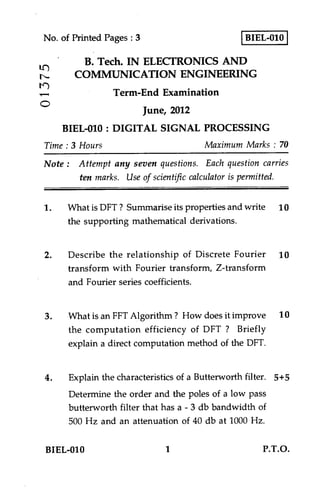
1. What is DFT ? Summarise its properties and write 10
the supporting mathematical derivations.
2. Describe the relationship of Discrete Fourier 10
transform with Fourier transform, Z-transform
and Fourier series coefficients.
3. What is an FFT Algorithm ? How does it improve 10
the computation efficiency of DFT ? Briefly
explain a direct computation method of the DFT.
4. Explain the characteristics of a Butterworth filter. 5+5
Determine the order and the poles of a low pass
butterworth filter that has a - 3 db bandwidth of
500 Hz and an attenuation of 40 db at 1000 Hz.
BIEL-010 1 P.T.O.
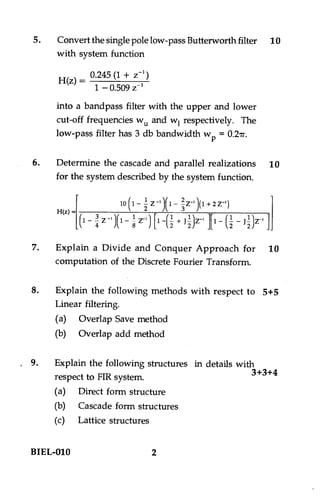
5. Convert the single pole low-pass Butterworth filter 10
with system function
H(z) — 0.245 (1 + z-1)
1 — 0.509 z-1
into a bandpass filter with the upper and lower
cut-off frequencies wu and w1 respectively. The
low-pass filter has 3 db bandwidth wp = 0.27r.
6. Determine the cascade and parallel realizations
for the system described by the system function.
10 (1 - -2 Z-1(1+ 2 Z-I )
2H(z) -1
(1 - 11-1Z-1) [141+ J1)Z-1 1[1- (1- J)Z 1
4 8 2 2 2
7. Explain a Divide and Conquer Approach for 10
computation of the Discrete Fourier Transform.
8. Explain the following methods with respect to 5+5
Linear filtering.
(a) Overlap Save method
(b) Overlap add method
10
, 9. Explain the following structures in details with
respect to FIR system. 3+3+4
(a) Direct form structure
(b) Cascade form structures
(c) Lattice structures
BIEL-010 2
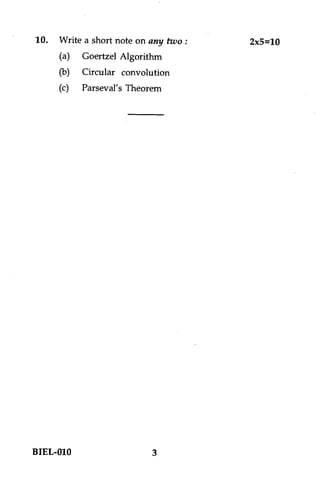
10. Write a short note on any two : 2x5=10
(a) Goertzel Algorithm
(b) Circular convolution
(c) Parseval's Theorem
BIEL-010 3

Biel 010 jun12

  • 1.
    BIEL-010No. of PrintedPages : 3 B. Tech. IN ELECTRONICS AND COMMUNICATION ENGINEERING Term-End Examination O June, 2012 BIEL-010 : DIGITAL SIGNAL PROCESSING Time : 3 Hours Maximum Marks : 70 Note : Attempt any seven questions. Each question carries ten marks. Use of scientific calculator is permitted. 1. What is DFT ? Summarise its properties and write 10 the supporting mathematical derivations. 2. Describe the relationship of Discrete Fourier 10 transform with Fourier transform, Z-transform and Fourier series coefficients. 3. What is an FFT Algorithm ? How does it improve 10 the computation efficiency of DFT ? Briefly explain a direct computation method of the DFT. 4. Explain the characteristics of a Butterworth filter. 5+5 Determine the order and the poles of a low pass butterworth filter that has a - 3 db bandwidth of 500 Hz and an attenuation of 40 db at 1000 Hz. BIEL-010 1 P.T.O.
  • 2.
    5. Convert thesingle pole low-pass Butterworth filter 10 with system function H(z) — 0.245 (1 + z-1) 1 — 0.509 z-1 into a bandpass filter with the upper and lower cut-off frequencies wu and w1 respectively. The low-pass filter has 3 db bandwidth wp = 0.27r. 6. Determine the cascade and parallel realizations for the system described by the system function. 10 (1 - -2 Z-1(1+ 2 Z-I ) 2H(z) -1 (1 - 11-1Z-1) [141+ J1)Z-1 1[1- (1- J)Z 1 4 8 2 2 2 7. Explain a Divide and Conquer Approach for 10 computation of the Discrete Fourier Transform. 8. Explain the following methods with respect to 5+5 Linear filtering. (a) Overlap Save method (b) Overlap add method 10 , 9. Explain the following structures in details with respect to FIR system. 3+3+4 (a) Direct form structure (b) Cascade form structures (c) Lattice structures BIEL-010 2
  • 3.
    10. Write ashort note on any two : 2x5=10 (a) Goertzel Algorithm (b) Circular convolution (c) Parseval's Theorem BIEL-010 3