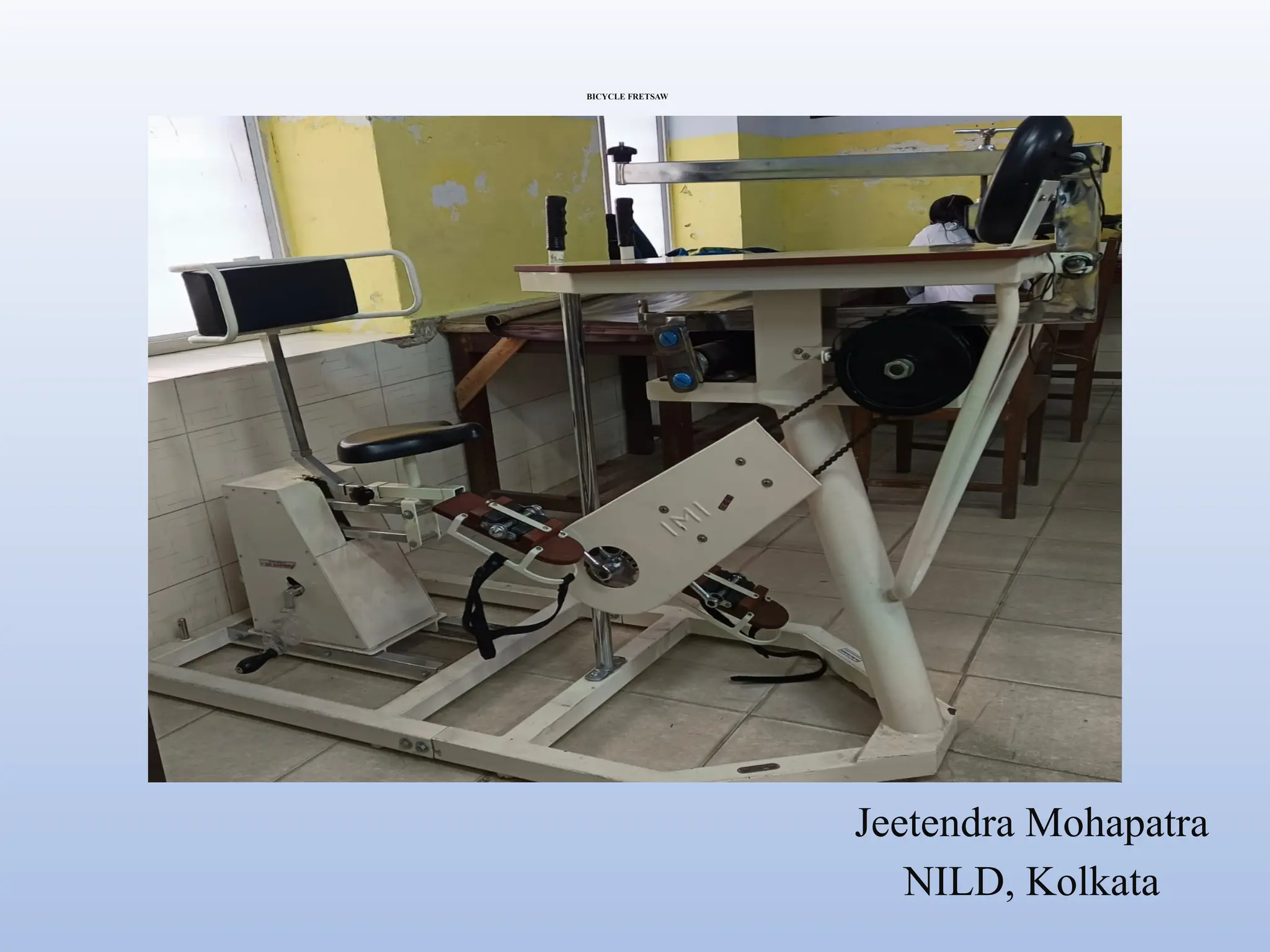
BICYCLE FRETSAW
Jeetendra Mohapatra
NILD, Kolkata
Introduction
• A bicycle fret saw machine is operated by means of cycle
chain activated by patient through cycling motion. Smooth
pedaling action aided with heavy fly wheel provides low
inertia for early treatment. [Integrated Bio-Medics &
Technologies (IBMT)]
• Fret-saw.
1. A saw with a relatively long, narrow blade, used in cutting
the thin woods, etc.
Description of Fretsaw Bicycle
• According to India medico instruments item no: IMI 1652, a fret saw bicycle have the
• FRAME: tubular steel frame with wide base give more stability.
• SEAT: the comfortable cycle seat fitted with upholstered back rest is adjustable in height .
seat slides with the frame for adjusting distance from pedals.
• FOOT REST: foot rest are having ankle and foot straps for holding foot securely in
position
• FLYWHEEL: Two, Cast-iron heavy fly wheels.
• HAND BAR: laminated work table is fitted with hand bar.
• COUNTER: Digital counter for pedal strokes.
• FINISH: Oven baked finish in black.
• Crank -
• Digital counter -
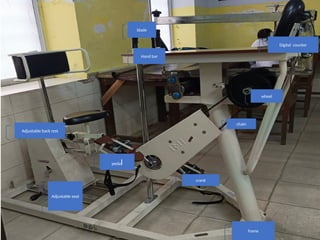
pedal
wheel
frame
chain
Hand bar
Adjustable seat
Adjustable back rest
Digital counter
crank
blade
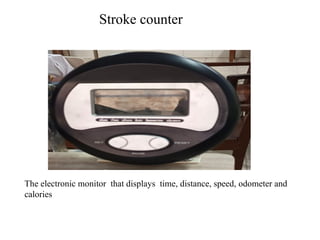
Stroke counter
The electronic monitor that displays time, distance, speed, odometer and
calories
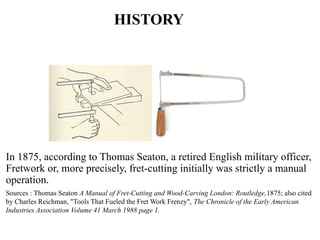
HISTORY
In 1875, according to Thomas Seaton, a retired English military officer,
Fretwork or, more precisely, fret-cutting initially was strictly a manual
operation.
Sources : Thomas Seaton A Manual of Fret-Cutting and Wood-Carving London: Routledge,1875; also cited
by Charles Reichman, "Tools That Fueled the Fret Work Frenzy", The Chronicle of the Early American
Industries Association Volume 41 March 1988 page 1.
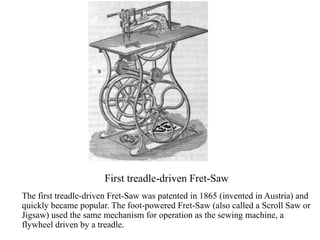
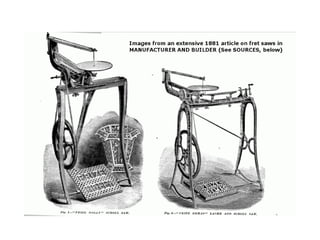
First treadle-driven Fret-Saw
The first treadle-driven Fret-Saw was patented in 1865 (invented in Austria) and
quickly became popular. The foot-powered Fret-Saw (also called a Scroll Saw or
Jigsaw) used the same mechanism for operation as the sewing machine, a
flywheel driven by a treadle.
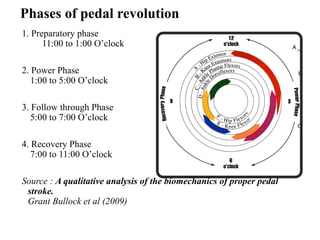
Phases of pedal revolution
1. Preparatory phase
11:00 to 1:00 O’clock
2. Power Phase
1:00 to 5:00 O’clock
3. Follow through Phase
5:00 to 7:00 O’clock
4. Recovery Phase
7:00 to 11:00 O’clock
Source : A qualitative analysis of the biomechanics of proper pedal
stroke.
Grant Bullock et al (2009)
Effective pedal stroke & the phases
• Correct pedalling is one of the primary factors that lead to
cycling efficiency.
• Efficient pedalling involves the movement of both legs working
simultaneously to produce a smooth , even and circular style.
• Correct pedalling technique is comprised of 4 phase and to
coach effective pedalling technique , we have to identify the
phases of pedal stroke and the mechanical approach.
OVERSTROKE – PREPARATION PHASE:
11am to 1pm
PURPOSE – Preps the leg and foot for the power
phase. Knee is at a flexed position, ready for the
‘push’ down phase.
MUSCLE RECRUITMENT –
1. The tibialis anterior contracts to lift the toe at 11am, then
2. The quadriceps contract to prepare the leg for big push down in the
power phase.
3. The ankle will go from a slight plantar flexed position at 11am as toes
lifts, to a neutral position at the 1pm
The main joint action=knee extension along with slight
hip flexion and extension.
DOWNSTROKE – POWER PHASE:
1pm to 5pm (most powerful section of the down stroke)
PURPOSE – Driving phase/peak of movement and the
most powerful phase of the revolution. It can contribute
anywhere up to 97% of the total power during the stroke.
MUSCLE RECRUITMENT – As this phase commences,
1. the knee extensors and hip extensors contract to create knee and hip
extension respectively.
2. The gastrocnemius and soleus (calves) contracts at around the 5pm to
cause a subtle drop in the toes (plantar flexion) as the foot moves into
the backstroke, or follow through phase.
BACKSTROKE – FOLLOW THROUGH PHASE:
5pm to 7pm
PURPOSE –Here the foot moves in a sweeping motion
Along the bottom of the revolution using the heel of the
foot to lead. This phase connects the power phase with
the upstroke phase.
MUSCLE RECRUITMENT –
1. The knee flexes with some slight hip extension and flexion as the foot
moves through the bottom of the revolution and begins the upward travel.
2. The toe at around the 5pm, drops slightly (plantar flexion) as the calves
contract.
3. At around the 7pm the hamstrings contract in preparation for the pulling
phase.
UPSTROKE – PULLING PHASE:
7pm to 11pm
PURPOSE – Can be viewed as the ‘momentum’
phase as it follows the back and down stroke phases.
This occurs as a result of the power generated when
the opposite leg pushes through the down stroke.
MUSCLE RECRUITMENT - As the pulling phase commences,
1. the hamstring and hip flexors contract to create knee and hip flexion
respectively.
2. The tibialis anterior contracts to subtly lift the toe.
From here, the foot moves into the preparation phase, or
over stroke.
Joint Movement & Workload
• In comparison to the maximum range of motion for individuals
by the American Academy of Orthopedics Surgeons (AAOS), a
normal ergometer cycle generated the following percentages of
ROM:
• 28% of Hip ROM
• 45% of Knee ROM
• 40% of Ankle ROM
(Source: Ericson et al., 1988)
Workload on Knee Joint
The workload on the knee joint rises significantly if:
(i) the intensity of cycling is increased
(ii) the height of the saddle is lowered
Compression force on Tibiofemoral joint:
-The largest compression force on this joint appears at between 60º and 100º.
-Compression forces on the knee ligament are statistically significantly reduced if
saddle height is increased.
Shear force:
- directed forward to the ACL reaches highest magnitude between 80º and 140º
- directed backward to the PCL peaks at between 330º and 80º
Active Muscle during Cycling
Active muscles in cycling are roughly divided into:
~ single-joint muscles
-Gluteus maximus
-Gluteus medius
-Vastus lateralis
-Vastus medialis
-Soleus
-Iliopsoas
~ two-joint muscles
-Tibialis anterior
-Rectus femoris
-Semimenbranosus
-Semitendinosus
-Biceps femoris
-Gastrocnemius (lateral head)
-Gastrocnemius (medial head)
Muscle Activity During Cycling
[Acc. to Ryan & Gregor (1992)]
Fig: Overview of muscle activity timing in lower extremities during cycling in relation
to the crank angle (1=TA, 2=SOL, 3=GM, 4=VL&VM, 5=RF, 6=BF and 7=GMax).
Based on the results of Ryan & Gregor, (1992)
Muscle Activity During Cycling
[Acc. to Ryan & Gregor (1992)]
• (1=TA, 2=SOL, 3=GM, 4=VL&VM, 5=RF,
6=BF and 7=GMax).
• GMax extends the hip
-active between 340º and 130º
-peaking at 80º
• VL & VM extends the knee
-active between 300º and 130º
-peaking at 30º
• RF acts as knee extensor & hip flexor
-active between 200º and 110º
-peaking at 20º
Muscle Activity During Cycling
[Acc. to Ryan & Gregor (1992)]
• SOL stabilizes the ankle joint
-active between 340º and 270º
-peaking at 90º when the forces exerted on
the pedal are the highest.
• GM & GL both flexes the knee and
stabilization of ankle joint
-active between 350º and 270º
-peaking at 110º
• TA stabilizes and flexes the ankle joint
-active throughout cycle
-peaking at 280º
Muscle Activity During Cycling
[Acc. to Ryan & Gregor (1992)]
• SM & ST flexes the knee
-active between 10º and 230º
-peaking at 100º
• BF flexes the knee and extends the
hip
-active between 350º and 230º
-peaking at 110º
Ergonomics of cycling
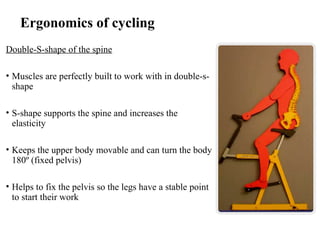
Double-S-shape of the spine
• Muscles are perfectly built to work with in double-s-
shape
• S-shape supports the spine and increases the
elasticity
• Keeps the upper body movable and can turn the body
180º (fixed pelvis)
• Helps to fix the pelvis so the legs have a stable point
to start their work
Losing the double-s-shape spine
• Some muscles will be partly overstretched and can’t work properly.
• Other muscles become unnaturally short and they could stay so if wrong
position is maintained so often or during a long time.
• The legs need the pelvis fixed on the saddle to start the movement. The
muscles trunk help to keep the pelvis still. If pelvis is not fixed, pt. will
lose the power in the movement.
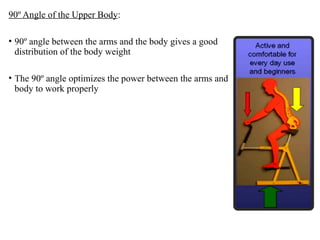
90º Angle of the Upper Body:
• 90º angle between the arms and the body gives a good
distribution of the body weight
• The 90º angle optimizes the power between the arms and
body to work properly
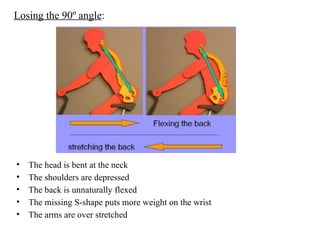
Losing the 90º angle:
• The head is bent at the neck
• The shoulders are depressed
• The back is unnaturally flexed
• The missing S-shape puts more weight on the wrist
• The arms are over stretched
Height of the Seat/Saddle:
• Proper height of seat/saddle prevents knee pain and gives maximal
pedaling power.
• The knee should be in maximal extension when the pedal is at bottom
dead centre (BDC).
• The pelvis and hips should not move sideways when the pedal is at the
top dead centre (TDC).
• Sitting too high is not dangerous as long as the double-S-shape is
maintained.
• Sitting too low can damage the knee and need a lot of extra power for
pedaling.
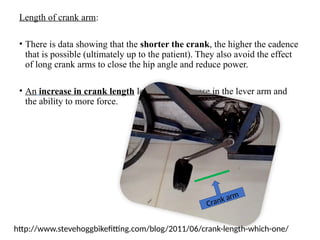
Length of crank arm:
• There is data showing that the shorter the crank, the higher the cadence
that is possible (ultimately up to the patient). They also avoid the effect
of long crank arms to close the hip angle and reduce power.
• An increase in crank length leads to an increase in the lever arm and
the ability to more force.
Crank arm
http://www.stevehoggbikefitting.com/blog/2011/06/crank-length-which-one/
Position of Foot on Pedal:
• Tiptoe pedaling
-gives freedom to the knees. The knee moves in different direction whether
opened or closed.
-another joint working against the knee is required i.e the ankle.
-if ankle is fixed, then knee will be forced in a wrong direction and will start
hurting.
• Avoid pedaling by the heel or the whole foot
-if a patient pedals like this, it usually means that he/she is sitting too low.
-using the heel shortens the effective length of the leg.
• Recommended cadence is between 80 and 100 rpm
Purpose of Therapy
• range of motion
• Proprioceptive awareness
• Strengthening training
• Improving endurance(C-V,C-R)
• Pre-gait training (reciprocal movement)
• Vocational training
Indications for therapy
• Spinal cord injury
• TBI
• Stroke patient (depends on Brunnstorm stages)
• Post fracture stiffness of lower extremity
• Cerebral palsy
• Arthritic condition (Hip & Knee)
• Total hip arthroplasty
• Total knee arthroplasty
• U/L Upper extremity amputee
Pre-requisite skills
• Muscle power : 2+ (minimum)
• Coordination in the lower limbs
• Sitting balance : fair to good
• Duration – 20 to 30 minutes
• Frequency – Most days of a week or 3 to 5 days a week
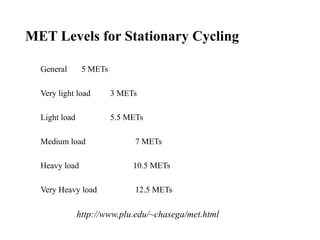
MET Levels for Stationary Cycling
General 5 METs
Very light load 3 METs
Light load 5.5 METs
Medium load 7 METs
Heavy load 10.5 METs
Very Heavy load 12.5 METs
http://www.plu.edu/~chasega/met.html
Contraindications for cycling
• Seizure
• Severe spasticity in the lower limbs
• Heterotrophic ossification
• Fracture of unknown origin
• Post operative cases : 1-4 weeks
• Severe Cardiac disease
Secondary Complications of Cycling
Due to prolonged cycling, poor body posture & poor tuning of gear
• Knee and hip pain
• Low back pain (LBP)
Modifications
• Crepe bandage/straps can be given to support the foot in proper
position.
• Sensors can be placed at the grip for measuring pulse rate (PR)and
heart rate (HR)
• Different types of grip can be added.
• Adjustable handle can be made
Precaution:
• Avoid bending forward from the waist.
• Avoid Lateral flexion of trunk in hemiplegics
• wear appropriate clothing. Neither loose nor tight
• If pain, dizziness or shortness of breath is occurs during
exercise immediately stop.
• Have the patient avoid breath holding, have the patient
exhale with each resisted effort.
• Avoid unnecessary movements as they compromise safety
and effectiveness.
THANKS !

Bicycle_Fretsaw_.pptx Static cycle for endurance training

  • 1.
  • 2.
    Introduction • A bicyclefret saw machine is operated by means of cycle chain activated by patient through cycling motion. Smooth pedaling action aided with heavy fly wheel provides low inertia for early treatment. [Integrated Bio-Medics & Technologies (IBMT)] • Fret-saw. 1. A saw with a relatively long, narrow blade, used in cutting the thin woods, etc.
  • 3.
    Description of FretsawBicycle • According to India medico instruments item no: IMI 1652, a fret saw bicycle have the • FRAME: tubular steel frame with wide base give more stability. • SEAT: the comfortable cycle seat fitted with upholstered back rest is adjustable in height . seat slides with the frame for adjusting distance from pedals. • FOOT REST: foot rest are having ankle and foot straps for holding foot securely in position • FLYWHEEL: Two, Cast-iron heavy fly wheels. • HAND BAR: laminated work table is fitted with hand bar. • COUNTER: Digital counter for pedal strokes. • FINISH: Oven baked finish in black. • Crank - • Digital counter -
  • 4.
  • 5.
    Stroke counter The electronicmonitor that displays time, distance, speed, odometer and calories
  • 6.
    HISTORY In 1875, accordingto Thomas Seaton, a retired English military officer, Fretwork or, more precisely, fret-cutting initially was strictly a manual operation. Sources : Thomas Seaton A Manual of Fret-Cutting and Wood-Carving London: Routledge,1875; also cited by Charles Reichman, "Tools That Fueled the Fret Work Frenzy", The Chronicle of the Early American Industries Association Volume 41 March 1988 page 1.
  • 7.
    First treadle-driven Fret-Saw Thefirst treadle-driven Fret-Saw was patented in 1865 (invented in Austria) and quickly became popular. The foot-powered Fret-Saw (also called a Scroll Saw or Jigsaw) used the same mechanism for operation as the sewing machine, a flywheel driven by a treadle.
  • 9.
    Phases of pedalrevolution 1. Preparatory phase 11:00 to 1:00 O’clock 2. Power Phase 1:00 to 5:00 O’clock 3. Follow through Phase 5:00 to 7:00 O’clock 4. Recovery Phase 7:00 to 11:00 O’clock Source : A qualitative analysis of the biomechanics of proper pedal stroke. Grant Bullock et al (2009)
  • 10.
    Effective pedal stroke& the phases • Correct pedalling is one of the primary factors that lead to cycling efficiency. • Efficient pedalling involves the movement of both legs working simultaneously to produce a smooth , even and circular style. • Correct pedalling technique is comprised of 4 phase and to coach effective pedalling technique , we have to identify the phases of pedal stroke and the mechanical approach.
  • 11.
    OVERSTROKE – PREPARATIONPHASE: 11am to 1pm PURPOSE – Preps the leg and foot for the power phase. Knee is at a flexed position, ready for the ‘push’ down phase. MUSCLE RECRUITMENT – 1. The tibialis anterior contracts to lift the toe at 11am, then 2. The quadriceps contract to prepare the leg for big push down in the power phase. 3. The ankle will go from a slight plantar flexed position at 11am as toes lifts, to a neutral position at the 1pm The main joint action=knee extension along with slight hip flexion and extension.
  • 12.
    DOWNSTROKE – POWERPHASE: 1pm to 5pm (most powerful section of the down stroke) PURPOSE – Driving phase/peak of movement and the most powerful phase of the revolution. It can contribute anywhere up to 97% of the total power during the stroke. MUSCLE RECRUITMENT – As this phase commences, 1. the knee extensors and hip extensors contract to create knee and hip extension respectively. 2. The gastrocnemius and soleus (calves) contracts at around the 5pm to cause a subtle drop in the toes (plantar flexion) as the foot moves into the backstroke, or follow through phase.
  • 13.
    BACKSTROKE – FOLLOWTHROUGH PHASE: 5pm to 7pm PURPOSE –Here the foot moves in a sweeping motion Along the bottom of the revolution using the heel of the foot to lead. This phase connects the power phase with the upstroke phase. MUSCLE RECRUITMENT – 1. The knee flexes with some slight hip extension and flexion as the foot moves through the bottom of the revolution and begins the upward travel. 2. The toe at around the 5pm, drops slightly (plantar flexion) as the calves contract. 3. At around the 7pm the hamstrings contract in preparation for the pulling phase.
  • 14.
    UPSTROKE – PULLINGPHASE: 7pm to 11pm PURPOSE – Can be viewed as the ‘momentum’ phase as it follows the back and down stroke phases. This occurs as a result of the power generated when the opposite leg pushes through the down stroke. MUSCLE RECRUITMENT - As the pulling phase commences, 1. the hamstring and hip flexors contract to create knee and hip flexion respectively. 2. The tibialis anterior contracts to subtly lift the toe. From here, the foot moves into the preparation phase, or over stroke.
  • 15.
    Joint Movement &Workload • In comparison to the maximum range of motion for individuals by the American Academy of Orthopedics Surgeons (AAOS), a normal ergometer cycle generated the following percentages of ROM: • 28% of Hip ROM • 45% of Knee ROM • 40% of Ankle ROM (Source: Ericson et al., 1988)
  • 16.
    Workload on KneeJoint The workload on the knee joint rises significantly if: (i) the intensity of cycling is increased (ii) the height of the saddle is lowered Compression force on Tibiofemoral joint: -The largest compression force on this joint appears at between 60º and 100º. -Compression forces on the knee ligament are statistically significantly reduced if saddle height is increased. Shear force: - directed forward to the ACL reaches highest magnitude between 80º and 140º - directed backward to the PCL peaks at between 330º and 80º
  • 17.
    Active Muscle duringCycling Active muscles in cycling are roughly divided into: ~ single-joint muscles -Gluteus maximus -Gluteus medius -Vastus lateralis -Vastus medialis -Soleus -Iliopsoas ~ two-joint muscles -Tibialis anterior -Rectus femoris -Semimenbranosus -Semitendinosus -Biceps femoris -Gastrocnemius (lateral head) -Gastrocnemius (medial head)
  • 18.
    Muscle Activity DuringCycling [Acc. to Ryan & Gregor (1992)] Fig: Overview of muscle activity timing in lower extremities during cycling in relation to the crank angle (1=TA, 2=SOL, 3=GM, 4=VL&VM, 5=RF, 6=BF and 7=GMax). Based on the results of Ryan & Gregor, (1992)
  • 19.
    Muscle Activity DuringCycling [Acc. to Ryan & Gregor (1992)] • (1=TA, 2=SOL, 3=GM, 4=VL&VM, 5=RF, 6=BF and 7=GMax). • GMax extends the hip -active between 340º and 130º -peaking at 80º • VL & VM extends the knee -active between 300º and 130º -peaking at 30º • RF acts as knee extensor & hip flexor -active between 200º and 110º -peaking at 20º
  • 20.
    Muscle Activity DuringCycling [Acc. to Ryan & Gregor (1992)] • SOL stabilizes the ankle joint -active between 340º and 270º -peaking at 90º when the forces exerted on the pedal are the highest. • GM & GL both flexes the knee and stabilization of ankle joint -active between 350º and 270º -peaking at 110º • TA stabilizes and flexes the ankle joint -active throughout cycle -peaking at 280º
  • 21.
    Muscle Activity DuringCycling [Acc. to Ryan & Gregor (1992)] • SM & ST flexes the knee -active between 10º and 230º -peaking at 100º • BF flexes the knee and extends the hip -active between 350º and 230º -peaking at 110º
  • 22.
    Ergonomics of cycling Double-S-shapeof the spine • Muscles are perfectly built to work with in double-s- shape • S-shape supports the spine and increases the elasticity • Keeps the upper body movable and can turn the body 180º (fixed pelvis) • Helps to fix the pelvis so the legs have a stable point to start their work
  • 23.
    Losing the double-s-shapespine • Some muscles will be partly overstretched and can’t work properly. • Other muscles become unnaturally short and they could stay so if wrong position is maintained so often or during a long time. • The legs need the pelvis fixed on the saddle to start the movement. The muscles trunk help to keep the pelvis still. If pelvis is not fixed, pt. will lose the power in the movement.
  • 24.
    90º Angle ofthe Upper Body: • 90º angle between the arms and the body gives a good distribution of the body weight • The 90º angle optimizes the power between the arms and body to work properly
  • 25.
    Losing the 90ºangle: • The head is bent at the neck • The shoulders are depressed • The back is unnaturally flexed • The missing S-shape puts more weight on the wrist • The arms are over stretched
  • 26.
    Height of theSeat/Saddle: • Proper height of seat/saddle prevents knee pain and gives maximal pedaling power. • The knee should be in maximal extension when the pedal is at bottom dead centre (BDC). • The pelvis and hips should not move sideways when the pedal is at the top dead centre (TDC). • Sitting too high is not dangerous as long as the double-S-shape is maintained. • Sitting too low can damage the knee and need a lot of extra power for pedaling.
  • 27.
    Length of crankarm: • There is data showing that the shorter the crank, the higher the cadence that is possible (ultimately up to the patient). They also avoid the effect of long crank arms to close the hip angle and reduce power. • An increase in crank length leads to an increase in the lever arm and the ability to more force. Crank arm http://www.stevehoggbikefitting.com/blog/2011/06/crank-length-which-one/
  • 28.
    Position of Footon Pedal: • Tiptoe pedaling -gives freedom to the knees. The knee moves in different direction whether opened or closed. -another joint working against the knee is required i.e the ankle. -if ankle is fixed, then knee will be forced in a wrong direction and will start hurting. • Avoid pedaling by the heel or the whole foot -if a patient pedals like this, it usually means that he/she is sitting too low. -using the heel shortens the effective length of the leg. • Recommended cadence is between 80 and 100 rpm
  • 29.
    Purpose of Therapy •range of motion • Proprioceptive awareness • Strengthening training • Improving endurance(C-V,C-R) • Pre-gait training (reciprocal movement) • Vocational training
  • 30.
    Indications for therapy •Spinal cord injury • TBI • Stroke patient (depends on Brunnstorm stages) • Post fracture stiffness of lower extremity • Cerebral palsy • Arthritic condition (Hip & Knee) • Total hip arthroplasty • Total knee arthroplasty • U/L Upper extremity amputee
  • 31.
    Pre-requisite skills • Musclepower : 2+ (minimum) • Coordination in the lower limbs • Sitting balance : fair to good • Duration – 20 to 30 minutes • Frequency – Most days of a week or 3 to 5 days a week
  • 32.
    MET Levels forStationary Cycling General 5 METs Very light load 3 METs Light load 5.5 METs Medium load 7 METs Heavy load 10.5 METs Very Heavy load 12.5 METs http://www.plu.edu/~chasega/met.html
  • 33.
    Contraindications for cycling •Seizure • Severe spasticity in the lower limbs • Heterotrophic ossification • Fracture of unknown origin • Post operative cases : 1-4 weeks • Severe Cardiac disease
  • 34.
    Secondary Complications ofCycling Due to prolonged cycling, poor body posture & poor tuning of gear • Knee and hip pain • Low back pain (LBP)
  • 35.
    Modifications • Crepe bandage/strapscan be given to support the foot in proper position. • Sensors can be placed at the grip for measuring pulse rate (PR)and heart rate (HR) • Different types of grip can be added. • Adjustable handle can be made
  • 36.
    Precaution: • Avoid bendingforward from the waist. • Avoid Lateral flexion of trunk in hemiplegics • wear appropriate clothing. Neither loose nor tight • If pain, dizziness or shortness of breath is occurs during exercise immediately stop. • Have the patient avoid breath holding, have the patient exhale with each resisted effort. • Avoid unnecessary movements as they compromise safety and effectiveness.
  • 37.