













CENTERS FOR MEDICARE & MEDICAID SERVICES


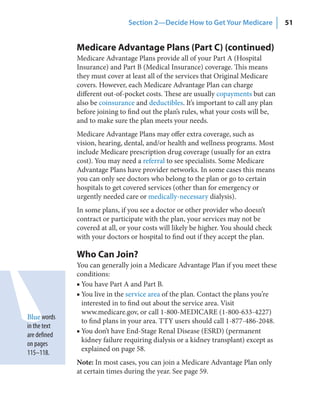
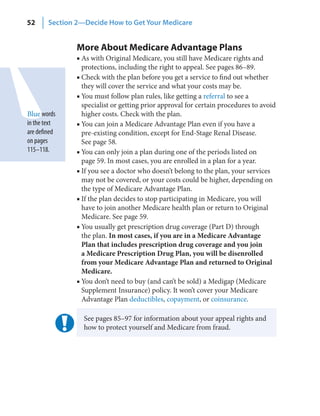
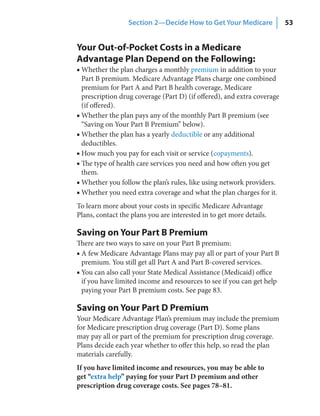
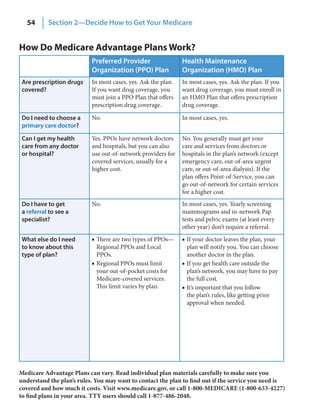
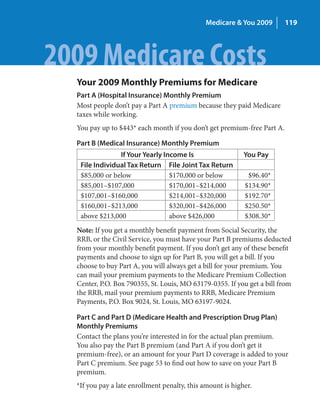
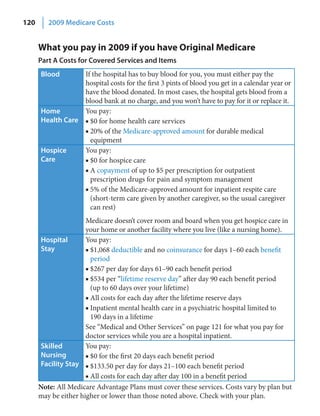
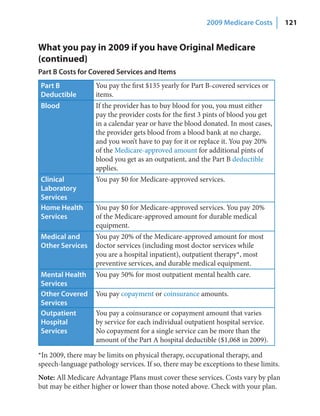
       Medicare
&You                                            2009


This is the official government handbook with
important information about the following:
  What's new
  2009 Medicare costs
  What Medicare covers
  Health and prescription drug plans
  Your Medicare rights
  Fraud and identity theft
Welcome to Medicare & You 2009
Medicare’s goal is to make it easy for you to get the highest
quality health care at the most affordable price. Medicare is
transforming itself from a program which simply pays the
bills to a program which actively supports a high quality
health care system.
What do we mean by a high quality health care system? It’s a
system that does the following:
■ Rewards providers for quality and efficiency
■ Uses objective standards to determine quality and efficiency
■ Communicates using an interconnected, computerized
  health information network, so providers can get a
  comprehensive view of the patient securely and without
  delay
■ Offers consumers complete, objective, easily accessible
  information, so they can make solid decisions about their
  own health care based on quality and price
Medicare shares quality information about providers in your
area at www.medicare.gov.
In addition, this “Medicare & You” handbook is another
way Medicare is working to make sure you have reliable
information to help you make good health care decisions.
Throughout this handbook, we have information about
how you can get the most out of your Medicare, including
Medicare health and prescription drug plan choices and
coverage, how to protect yourself and Medicare from fraud,
background on advance directives, and resources for detailed
information and personalized help. This information is
up-to-date between January 1, 2009–December 31, 2009.
You will get a new handbook every fall to help you compare
coverage and learn new and important information.
Are You Getting the Most Out of Medicare?
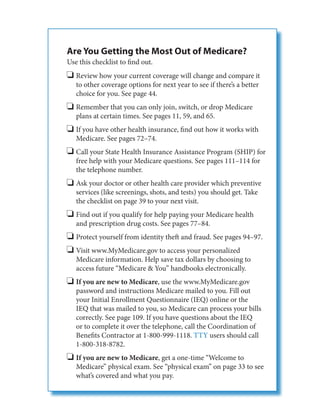
Use this checklist to find out.
   Review how your current coverage will change and compare it
   to other coverage options for next year to see if there’s a better
   choice for you. See page 44.
   Remember that you can only join, switch, or drop Medicare
   plans at certain times. See pages 11, 59, and 65.
   If you have other health insurance, find out how it works with
   Medicare. See pages 72–74.
   Call your State Health Insurance Assistance Program (SHIP) for
   free help with your Medicare questions. See pages 111–114 for
   the telephone number.
   Ask your doctor or other health care provider which preventive
   services (like screenings, shots, and tests) you should get. Take
   the checklist on page 39 to your next visit.
   Find out if you qualify for help paying your Medicare health
   and prescription drug costs. See pages 77–84.
   Protect yourself from identity theft and fraud. See pages 94–97.
   Visit www.MyMedicare.gov to access your personalized
   Medicare information. Help save tax dollars by choosing to
   access future “Medicare & You” handbooks electronically.
   If you are new to Medicare, use the www.MyMedicare.gov
   password and instructions Medicare mailed to you. Fill out
   your Initial Enrollment Questionnaire (IEQ) online or the
   IEQ that was mailed to you, so Medicare can process your bills
   correctly. See page 109. If you have questions about the IEQ
   or to complete it over the telephone, call the Coordination of
   Benefits Contractor at 1-800-999-1118. TTY users should call
   1-800-318-8782.
   If you are new to Medicare, get a one-time “Welcome to
   Medicare” physical exam. See “physical exam” on page 33 to see
   what’s covered and what you pay.
Important Information about
                This Handbook
                Please keep this handbook for future
                reference. Changes may occur after printing.
                Call 1-800-MEDICARE (1-800-633-4227),
                or visit www.medicare.gov to get the most
                current information. TTY users should call
                1-877-486-2048.
This box lets
you know that
                Did your household get more than one copy of
blue words
                “Medicare & You?” If you would like to get only
in the text
                one copy in the future, call 1-800-MEDICARE.
are defined
on pages
                “Medicare & You” isn’t a legal document.
115–118.
                Official Medicare Program legal guidance is
                contained in the relevant statutes, regulations,
                and rulings.

                The term “Medicare health plan” is used
                throughout this handbook to include all
                Medicare Advantage Plans, Medicare Cost
                Plans, Demonstration/Pilot Programs, and
                Programs of All-inclusive Care for the Elderly
                (PACE).


                This symbol highlights important information.
Contents        7
                                                  Medicare & You 2009


                      Index—A Quick Way to Find What You Need
                 11   Medicare Basics
                 11   What’s New and Important in 2009?
                 12   What Is Medicare?
                 14   Where to Get Your Medicare Questions Answered

                 15   Section 1—What’s Covered? (Part A and Part B)
                 19   Part A-Covered Services
                 25   Part B-Covered Services
                 38   What’s NOT Covered by Part A and Part B?
                 39   Preventive Services Checklist

                 41   Section 2—Decide How to Get Your Medicare
                 42   Your Medicare Choices
                 44   Things to Consider When Choosing or Changing Your Coverage
                 45   Original Medicare
                 50   Medicare Advantage Plans (like an HMO or PPO) (Part C)
                 59   When Can You Join, Switch, or Drop a Medicare Advantage Plan?
                 61   Other Medicare Health Plans
                 63   Medicare Prescription Drug Coverage (Part D)
                 65   When Can You Join, Switch, or Drop a Medicare Drug Plan?
                 74   How Your Bills Get Paid If You Have Other Health Insurance
                 75   Medigap (Medicare Supplement Insurance) Policies
                                                                          Continued _
                               What’s covered?
11 What’s new?        15       What’s not?                   41 Coverage choices
6    Medicare & You 2009


                 Contents                        (continued)

                         77    Section 3—Programs for People with Limited
                               Income and Resources
                         78    “Extra Help” Paying for Medicare Prescription Drug Coverage (Part D)
                         82    Medicaid
                         83    Medicare Savings Programs (Help from Medicaid to Pay Medicare
                               Premiums)

                         85    Section 4—Protecting Yourself and Medicare
                         86    Your Medicare Rights
                         86    What Is an Appeal?
                         92    How Medicare Uses Your Personal Information
                         94    Protect Yourself from Fraud and Identity Theft
                         96    Protect Yourself and Medicare from Billing Fraud

                         99    Section 5—Planning Ahead
                         107 Section 6—For More Information
                             (Phone, Websites, Publications)
                         115 Section 7—Definitions
                         119 2009 Medicare Costs
                         124 Tips to Help Prevent Medicare Fraud


     Need “extra help”             Fraud and                                  2009
78   with costs?              94   identity theft                119          Medicare costs
Medicare & You 2009                  7


Index                               A Quick Way to Find What You Need


The page number in bold provides the most detailed information.
A                                                 C (continued)
Abdominal Aortic Aneurysm 26                      Community-Based Programs 103
Acupuncture 38                                    Consolidated Omnibus Budget Reconciliation Act
Advance Beneficiary Notice 89                        (COBRA) 24, 72
Advance Directives 105–106                        Coordination of Benefits 14, 74
ALS (Amyotrophic Lateral Sclerosis) 17, 22        Copayment 51, 64, 66–67, 75, 78, 104, 115, 120–121
Ambulance Services 26                             Cosmetic Surgery 38
Ambulatory Surgical Center 26, 28, 38             Costs 16, 21, 25, 44, 53, 66–67, 75, 78, 119–122
Appeal 52, 86–91, 108–109                         Coverage Choices 13, 41–76
Artificial Limbs 34                               Coverage Determination (Part D) 90–91
Assignment 25, 46–47                              Coverage Gap 66–67, 78
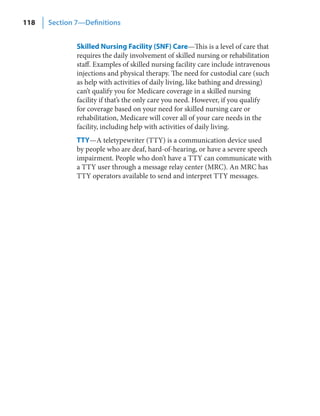
                                                  Covered Services (Part A and Part B) 19–20, 26–37, 39,
B                                                    120–121
Balance Exam 31
                                                  Creditable Prescription Drug Coverage 63, 65, 68,
Barium Enema 28                                      72–73, 116
Benefit Period 20, 115, 120                       Custodial Care 20, 38, 102, 116
Bills 46, 74, 89, 96
Blood 19, 26, 121                                 D
Bone Mass Measurement (Bone Density) 27           Deductible 25–37, 45, 51, 53, 55, 66, 75–76, 78, 83,
                                                     116, 117, 120–121
Braces (arm/leg/back/neck) 34
                                                  Definitions 115–118
Breast Exam 33, 39
                                                  Demonstrations/Pilot Programs 13, 62, 94
C                                                 Dental Care and Dentures 38
Cardiovascular Screenings 27, 39                  Department of Defense 14
Catastrophic Coverage 67                          Department of Health and Human Services (Office of
Chiropractic Services 27, 38                         Inspector General) 14, 95–97
Claims 45–46, 87, 108–109                         Department of Veterans Affairs 14, 68, 73
Clinical Laboratory Services 27, 121              Diabetes 29, 30–32, 39
Clinical Research Studies 20, 27                  Dialysis (Kidney Dialysis) 12, 18, 32, 51, 54, 56, 58
COBRA 24, 72                                      Discrimination 86, 97
Coinsurance 26–37, 45, 51, 66, 75, 78, 83, 115,   Disenroll 52, 56, 60
    120–121                                       Drug Plan 43, 63–71, 90–91, 122
Colonoscopy 28, 39                                Drugs (outpatient) 34, 70
Colorectal Cancer Screenings 28, 39
8     Index

The page number in bold provides the most detailed information.
D (continued)                                           H
Drugs (prescription) 12, 34, 38, 44–45, 54–56, 63–71,   Health Care Proxy 105–106
   117                                                  Health Maintenance Organization (HMO) 43, 50, 54
Durable Medical Equipment (like walkers) 19, 30–31,     Hearing Aids 31, 40
   34, 47, 120–121                                      Help with Costs 49, 53, 77–84
E                                                       Hepatitis B Shot 31, 39
EKGs 35                                                 Home Health Care 16, 19, 31, 82, 89, 102, 120
Eldercare Locator 103                                   Hospice Care 16, 19, 120
Electronic Handbook 122                                 Hospital Care (Inpatient Coverage) 16, 20, 30, 120
Electronic Health Record 101                            I
Emergency Room Services 30, 108                         Identity Theft 94–95, 97
Employer Coverage 24, 43–45, 49, 57–58, 61, 64, 68,     Immunizations 25, 30–31, 33, 38–39
   72, 74, 80                                           Indian Health Service 73
End-Stage Renal Disease (ESRD) 12, 18, 22, 32, 51, 58   Institution 56, 59, 65, 79, 81, 116
Enroll 23, 51, 59–60, 65, 76
Equipment (like walkers) 19, 30–31, 34, 47, 120–121     J
Exception (Part D) 70, 90–91                            Join
Extra Help (Help Paying Medicare Drug Costs) 63, 67,        Medicare Drug Plan 45, 49, 63–65, 68
   69, 78–81                                                Medicare Health Plan 51, 57–61
Eye Exam 30, 38                                         K
Eyeglasses 30, 38                                       Kidney Dialysis 12, 18, 32, 51, 54, 56, 58
F                                                       Kidney Transplant 12, 18, 36, 51, 58
Fecal Occult Blood Test 28, 39                          L
Federal Employee Health Benefits Program 14, 73         Late Enrollment Penalty
Federally-Qualified Health Center Services 30               Part A 18
Flexible Sigmoidoscopy 28                                   Part B 21, 23
Flu Shot 30, 39                                             Part D 68, 122
Foot Exam 31                                            Lifetime Reserve Days 116, 120
Formulary 44, 70, 78                                    Limited Income 49, 53, 77–84, 108, 116
Fraud 94–97, 124–125                                    Living Will 105–106
G                                                       Long-Term Care 20, 38, 62, 82, 102–104
Gap (Coverage) 66–67, 78                                Low-Income Subsidy (LIS) 63, 67, 69, 78–81
General Enrollment Period 18, 23                        M
Glaucoma Test 31, 39                                    Mammogram 32, 39, 54, 56
Group Health Plan (Employer) 21, 23–24, 61, 74          Medicaid 56, 59, 79, 81, 82, 83
                                                        Medical Equipment 19, 30–31, 34, 47, 120–121
Index         9

The page number in bold provides the most detailed information.
M (continued)                                         O (continued)
Medical Nutrition Therapy 32                          Outpatient Hospital Services 28, 33, 121
Medical Savings Account (MSA) Plans 55, 63            Oxygen 108
Medically Necessary 21, 30, 116
                                                      P
Medicare                                              Pap Test 33, 39, 54, 56
  Part A 16–20, 43, 119–120                           Part A 16–20, 43, 119–120
  Part B 21–37, 39, 43, 119, 121                      Part B 21–37, 39, 43, 119, 121
  Part C 43, 50–60, 88, 122                           Part C 43, 50–60, 88, 122
  Part D 43, 63–71, 90–91, 122                        Part D 43, 63–71, 90–91, 122
Medicare Advantage Plans 43, 50–60, 88, 122           Payment Options (premium) 71, 119
Medicare Authorization to Disclose Personal Health    Pelvic Exam 33, 39, 54, 56
  Information 108
                                                      Penalty
Medicare Beneficiary Ombudsman 98
                                                          Part A 18
Medicare Card (lost) 17
                                                          Part B 21, 23
Medicare Cost Plan 61
                                                          Part D 68, 122
Medicare Prescription Drug Coverage 43, 49, 63–71,
                                                      Personal Health Record 101
  72–73, 78–81, 90–91
                                                      Physical Exam 26, 30, 33, 38–39
Medicare Prescription Drug Plans (PDP) 43, 63–71,
  90–91, 122                                          Physical Therapy 19–20, 31–33, 118, 121
Medicare Savings Programs 79, 83                      Pilot/Demonstration Programs 62, 94
Medicare SELECT 57, 75                                Pneumococcal Shot 33
Medicare Summary Notice (MSN) 46, 77, 87, 92, 96–97   Power of Attorney 105
Medigap (Medicare Supplement Insurance) 24, 43, 45,   Practitioner Services 34
  52, 57, 59, 72, 75–76                               Preferred Provider Organization (PPO) Plan 54
Mental Health Care 20, 32, 110, 120–121               Premium 16–17, 21, 53, 66, 68, 71, 78, 83, 117, 119
                                                      Prescription Drugs 34, 38, 44–45, 54–56, 63–71,
N                                                         72–73, 78–79, 82, 103
Nursing Home 56, 81–82, 100, 102–104, 108, 110        Preventive Services 25–34, 39, 108–110
Nutrition Therapy Services 32                         Primary Care Doctor 45, 54–56, 117
O                                                     Privacy Notice 92–93
Occupational Therapy 19, 31–32, 121                   Private Contract 48
Office for Civil Rights 14, 97                        Private Fee-for-Service (PFFS) Plans 55, 63, 110
Office of Inspector General 14, 95–96                 Private Insurance 61, 72, 75–76, 102
Office of Personnel Management 14, 73                 Programs of All-inclusive Care for the Elderly (PACE) 62,
Ombudsman (Medicare Beneficiary) 98                       82, 103–104
Online 3, 60, 65, 80, 101, 109                        Prostate Screening (PSA Test) 34, 39
Original Medicare 43, 45–49, 75–76, 87–89, 120–121    Proxy (Health Care) 105–106
Orthotic Items 34                                     Publications 110
10      Index

 The page number in bold provides the most detailed information.
 Q                                                           S (continued)
 Quality of Care 14, 44, 88, 100, 109–110                    Supplies (medical) 19–20, 25, 29–34, 46–47, 96,
 Quality Improvement Organization (QIO) 14, 88, 99,             108
    113                                                      Surgical Dressing Services 35
 R                                                           T
 Railroad Retirement Board (RRB) 14, 17–18, 22–23,           Telemedicine 35
    46, 124                                                  Tests 26–29, 31–35, 38–39, 101
 Referral 26, 33, 44–45, 51–52, 54–56, 117                   Tiers (drug formulary) 70
 Religious Nonmedical Health Care Institution 16             Transplant Services 36
 Replacing a Medicare Card 17                                Travel 37
 Retiree Health Insurance 24, 43–45, 49, 57–58, 61, 64,      TRICARE 14, 24, 68, 73
    68, 72, 74                                               TTY 14, 118
 Rural Health Clinic 34
                                                             U
 S                                                           Union 24, 43–45, 49, 57–58, 61, 64, 68, 72, 74, 80
 Second Surgical Opinions 34                                 Urgently Needed Care 37, 51, 54, 56
 Service Area 44, 51, 59, 64–65, 117
 Shingles Vaccine 38                                         V
 Shots (vaccinations) 25, 30–31, 33, 38–39                   Vaccinations (shots) 25, 30–31, 33, 39–40
 Sigmoidoscopy 28, 39                                        Veterans’ Benefits (VA) 14, 68, 73
 Skilled Nursing Facility (SNF) Care 16, 20, 88, 102, 110,   Vision 51
     118                                                     W
 Smoking Cessation 34, 39                                    Walkers 30, 108
 SMP (Senior Medicare Patrol) Program 95                     Website 63, 70, 100, 107
 Social Security 14, 17–18, 21–23, 71, 80–81, 84             Welcome to Medicare Physical Exam 26, 30, 33, 39
 Special Enrollment Period 18, 23–24, 65, 72                 Wheelchairs 30, 108
 Special Needs Plan (SNP) 56, 58                             www.medicare.gov 100, 109
 Speech-language Pathology 19, 31, 35, 121                   www.MyMedicare.gov 39, 46, 87, 109
 State Health Insurance Assistance Program (SHIP) 14,
                                                             X
     111–114
                                                             X-ray 35
 State Medical Assistance (Medicaid) Office 53, 62, 80,
     82–83, 104
 State Pharmacy Assistance Program (SPAP) 82
 Substance Abuse 32
 Supplemental Policy (see Medigap) 24, 43, 45, 52, 57,
     59, 72, 75–76
 Supplemental Security Income (SSI) 79, 84
SectionMedicare & You 2009
                                                               #—Name of Section          11


           Medicare Basics
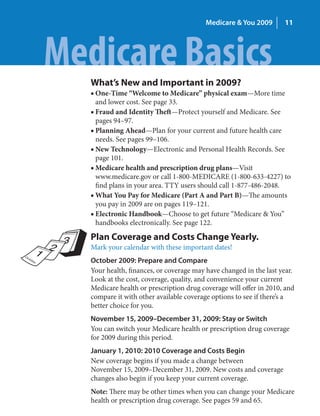
                         What’s New and Important in 2009?
                         ■ One-Time “Welcome to Medicare” physical exam—More time
                           and lower cost. See page 33.
                         ■ Fraud and Identity Theft—Protect yourself and Medicare. See
                           pages 94–97.
                         ■ Planning Ahead—Plan for your current and future health care
                           needs. See pages 99–106.
                         ■ New Technology—Electronic and Personal Health Records. See
                           page 101.
                         ■ Medicare health and prescription drug plans—Visit
                           www.medicare.gov or call 1-800-MEDICARE (1-800-633-4227) to
                           find plans in your area. TTY users should call 1-877-486-2048.
                         ■ What You Pay for Medicare (Part A and Part B)—The amounts
                           you pay in 2009 are on pages 119–121.
                         ■ Electronic Handbook—Choose to get future “Medicare & You”
                           handbooks electronically. See page 122.

             3
             7           Plan Coverage and Costs Change Yearly.
       1 2
         7       APRIL
                         Mark your calendar with these important dates!
Oc
  to
     be
       r                 October 2009: Prepare and Compare
                         Your health, finances, or coverage may have changed in the last year.
                         Look at the cost, coverage, quality, and convenience your current
                         Medicare health or prescription drug coverage will offer in 2010, and
                         compare it with other available coverage options to see if there’s a
                         better choice for you.
                         November 15, 2009–December 31, 2009: Stay or Switch
                         You can switch your Medicare health or prescription drug coverage
                         for 2009 during this period.
                         January 1, 2010: 2010 Coverage and Costs Begin
                         New coverage begins if you made a change between
                         November 15, 2009–December 31, 2009. New costs and coverage
                         changes also begin if you keep your current coverage.
                         Note: There may be other times when you can change your Medicare
                         health or prescription drug coverage. See pages 59 and 65.
12    Medicare Basics


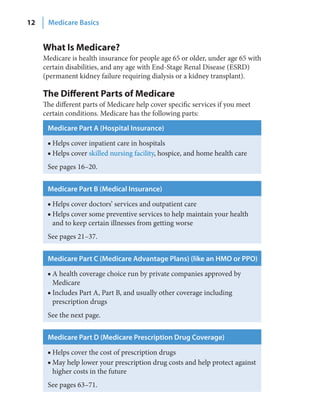
     What Is Medicare?
     Medicare is health insurance for people age 65 or older, under age 65 with
     certain disabilities, and any age with End-Stage Renal Disease (ESRD)
     (permanent kidney failure requiring dialysis or a kidney transplant).

     The Different Parts of Medicare
     The different parts of Medicare help cover specific services if you meet
     certain conditions. Medicare has the following parts:

      Medicare Part A (Hospital Insurance)

      ■ Helps cover inpatient care in hospitals
      ■ Helps cover skilled nursing facility, hospice, and home health care
      See pages 16–20.


      Medicare Part B (Medical Insurance)

      ■ Helps cover doctors’ services and outpatient care
      ■ Helps cover some preventive services to help maintain your health
        and to keep certain illnesses from getting worse
      See pages 21–37.


      Medicare Part C (Medicare Advantage Plans) (like an HMO or PPO)

      ■ A health coverage choice run by private companies approved by
        Medicare
      ■ Includes Part A, Part B, and usually other coverage including
        prescription drugs
      See the next page.


      Medicare Part D (Medicare Prescription Drug Coverage)

      ■ Helps cover the cost of prescription drugs
      ■ May help lower your prescription drug costs and help protect against
        higher costs in the future
      See pages 63–71.
Medicare Basics       13


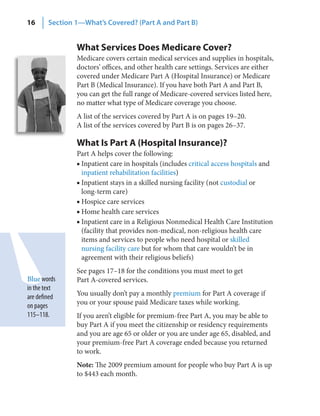
Your Medicare Coverage Choices
With Medicare, you can choose how you get your health and prescription drug
coverage. Below are brief descriptions of your coverage choices. Section 2 has
more details about these choices and information to help you decide.

 Original Medicare (See pages 45–49.)
 ■ Run by the Federal government.
 ■ Provides your Part A and Part B coverage.
 ■ You can join a Medicare Prescription Drug Plan to add drug coverage.
 ■ You can buy a Medigap (Medicare Supplement Insurance) policy (sold
   by private insurance companies) to help fill the gaps in Part A and Part B
   coverage. See pages 75–76.


 Medicare Advantage Plans (like an HMO or PPO) (See pages 50–60.)
 ■ Run by private companies approved by Medicare.
 ■ Provides your Part A and Part B coverage but can charge different amounts
   for certain services. May offer extra coverage and prescription drug
   coverage for an extra cost. Costs for items and services vary by plan.
 ■ If you want drug coverage, you must get it through your plan (in most cases).
 ■ You don’t need a Medigap policy.


 Other Medicare Health Plans (See pages 61–62 and 103–104.)
 ■ Plans that aren’t Medicare Advantage Plans but are still part of Medicare.
 ■ Include Medicare Cost Plans, Demonstration/Pilot Programs, and
   Programs of All-inclusive Care for the Elderly (PACE).
 ■ Some plans provide Part A and Part B coverage, and some also provide
   prescription drug coverage (Part D).


Note: You might also have health and/or prescription drug coverage from a
former or current employer or union. See pages 72–73.
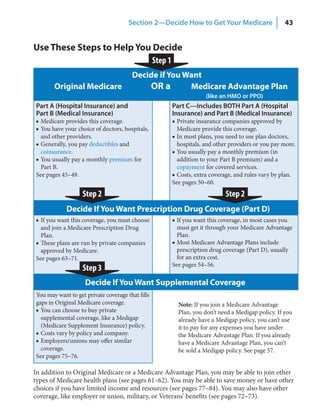
See page 43 for a chart that explains your Medicare coverage choices
and the decisions you need to make.
14    Medicare Basics


Where to Get Your Medicare Questions Answered
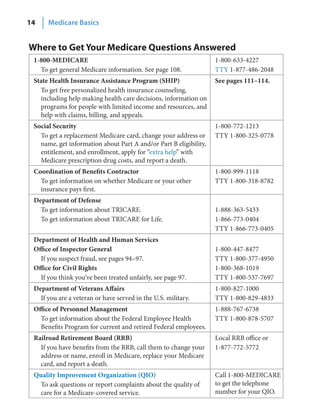
 1-800-MEDICARE                                                    1-800-633-4227
   To get general Medicare information. See page 108.              TTY 1-877-486-2048
 State Health Insurance Assistance Program (SHIP)                  See pages 111–114.
   To get free personalized health insurance counseling,
   including help making health care decisions, information on
   programs for people with limited income and resources, and
   help with claims, billing, and appeals.
 Social Security                                                   1-800-772-1213
   To get a replacement Medicare card, change your address or      TTY 1-800-325-0778
   name, get information about Part A and/or Part B eligibility,
   entitlement, and enrollment, apply for “extra help” with
   Medicare prescription drug costs, and report a death.
 Coordination of Benefits Contractor                               1-800-999-1118
   To get information on whether Medicare or your other            TTY 1-800-318-8782
   insurance pays first.
 Department of Defense
   To get information about TRICARE.                               1-888-363-5433
   To get information about TRICARE for Life.                      1-866-773-0404
                                                                   TTY 1-866-773-0405
 Department of Health and Human Services
 Office of Inspector General                                       1-800-447-8477
   If you suspect fraud, see pages 94–97.                          TTY 1-800-377-4950
 Office for Civil Rights                                           1-800-368-1019
   If you think you’ve been treated unfairly, see page 97.         TTY 1-800-537-7697
 Department of Veterans Affairs                                    1-800-827-1000
   If you are a veteran or have served in the U.S. military.       TTY 1-800-829-4833
 Office of Personnel Management                                    1-888-767-6738
   To get information about the Federal Employee Health            TTY 1-800-878-5707
   Benefits Program for current and retired Federal employees.
 Railroad Retirement Board (RRB)                                   Local RRB office or
   If you have benefits from the RRB, call them to change your     1-877-772-5772
   address or name, enroll in Medicare, replace your Medicare
   card, and report a death.
 Quality Improvement Organization (QIO)                            Call 1-800-MEDICARE
  To ask questions or report complaints about the quality of       to get the telephone
  care for a Medicare-covered service.                             number for your QIO.
SECTION            1        15


What’s
Covered?
(Part A
and Part B)

   M    edicare is here to help you stay healthy. We’re committed
        to providing you with information that can help you
   make informed health care decisions. This section explains what
   Medicare covers.
   Section 1 includes information about the following:
   Part A-Covered Services . . . . . . . . . . . . . . . . . . . . 16–20
   Part B-Covered Services . . . . . . . . . . . . . . . . . . . . 21–37
   What’s NOT Covered by Part A and Part B? . . . . . . . . . . . 38
   Preventive Services Checklist . . . . . . . . . . . . . . . . . . . 39
16      Section 1—What’s Covered? (Part A and Part B)


                What Services Does Medicare Cover?
                Medicare covers certain medical services and supplies in hospitals,
                doctors’ offices, and other health care settings. Services are either
                covered under Medicare Part A (Hospital Insurance) or Medicare
                Part B (Medical Insurance). If you have both Part A and Part B,
                you can get the full range of Medicare-covered services listed here,
                no matter what type of Medicare coverage you choose.
                A list of the services covered by Part A is on pages 19–20.
                A list of the services covered by Part B is on pages 26–37.

                What Is Part A (Hospital Insurance)?
                Part A helps cover the following:
                ■ Inpatient care in hospitals (includes critical access hospitals and
                  inpatient rehabilitation facilities)
                ■ Inpatient stays in a skilled nursing facility (not custodial or
                  long-term care)
                ■ Hospice care services
                ■ Home health care services
                ■ Inpatient care in a Religious Nonmedical Health Care Institution
                  (facility that provides non-medical, non-religious health care
                  items and services to people who need hospital or skilled
                  nursing facility care but for whom that care wouldn’t be in
                  agreement with their religious beliefs)
                See pages 17–18 for the conditions you must meet to get
Blue words      Part A-covered services.
in the text
are defined     You usually don’t pay a monthly premium for Part A coverage if
on pages        you or your spouse paid Medicare taxes while working.
115–118.        If you aren’t eligible for premium-free Part A, you may be able to
                buy Part A if you meet the citizenship or residency requirements
                and you are age 65 or older or you are under age 65, disabled, and
                your premium-free Part A coverage ended because you returned
                to work.
                Note: The 2009 premium amount for people who buy Part A is up
                to $443 each month.
Section 1—What’s Covered? (Part A and Part B)             17


What Is Part A (Hospital Insurance)? (continued)
In most cases, if you choose to buy Part A, you must also have Part B
and pay monthly premiums for both.
If you have limited income and resources, your state may help you pay
for Part A and/or Part B. See page 83.
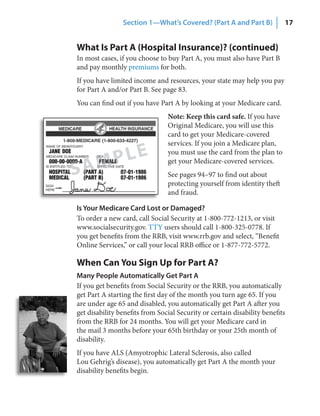
You can find out if you have Part A by looking at your Medicare card.
                                Note: Keep this card safe. If you have
                                Original Medicare, you will use this
                                card to get your Medicare-covered
                                services. If you join a Medicare plan,


    AM PLE                      you must use the card from the plan to
                                get your Medicare-covered services.
S                               See pages 94–97 to find out about
                                protecting yourself from identity theft
                                and fraud.

Is Your Medicare Card Lost or Damaged?
To order a new card, call Social Security at 1-800-772-1213, or visit
www.socialsecurity.gov. TTY users should call 1-800-325-0778. If
you get benefits from the RRB, visit www.rrb.gov and select, “Benefit
Online Services,” or call your local RRB office or 1-877-772-5772.

When Can You Sign Up for Part A?
Many People Automatically Get Part A
If you get benefits from Social Security or the RRB, you automatically
get Part A starting the first day of the month you turn age 65. If you
are under age 65 and disabled, you automatically get Part A after you
get disability benefits from Social Security or certain disability benefits
from the RRB for 24 months. You will get your Medicare card in
the mail 3 months before your 65th birthday or your 25th month of
disability.
If you have ALS (Amyotrophic Lateral Sclerosis, also called
Lou Gehrig’s disease), you automatically get Part A the month your
disability benefits begin.
18      Section 1—What’s Covered? (Part A and Part B)


                When Can You Sign Up for Part A? (continued)
                Some People Need to Sign up for Part A
                If you aren’t getting Social Security or RRB benefits (for instance,
                because you are still working), you will need to sign up for Part A.
                You will need to sign up even if you are eligible for premium-free
                Part A. You should contact Social Security 3 months before you
                turn age 65. If you worked for a railroad, contact the RRB to sign up.
                           If you have End-Stage Renal Disease (ESRD), you can
                           sign up for Part A by visiting your local Social Security
                           office or by calling Social Security at 1-800-772-1213.
                           TTY users should call 1-800-325-0778. To get more
                           information on how to enroll in Medicare if you have
                           ESRD, visit
                           www.medicare.gov/Publications/Pubs/pdf/10128.pdf
                           to view the booklet, “Medicare Coverage of Kidney
                           Dialysis and Kidney Transplant Services.”
                If you aren’t eligible for premium-free Part A, you can buy it
                during the following times:
                ■ Initial Enrollment Period—When you first become eligible for
                  Medicare (3 months before you turn age 65 to 3 months after the
                  month you turn age 65).
                ■ General Enrollment Period—Between January 1–March 31 each
                  year.
                ■ Special Enrollment Period—If you or your spouse (or family
                  member if you are disabled) is working and has group health plan
                  coverage through the employer or union. See page 23.
Blue words      ■ Special Enrollment Period for International Volunteers—If you
in the text       are serving as a volunteer in a foreign country. See page 23.
are defined     If you don’t buy Part A when you are first eligible, the monthly
on pages        premium may go up 10% unless you are eligible for a special
115–118.        enrollment period.
                For more information on Part A, call Social Security, or visit
                www.socialsecurity.gov. If you get benefits from the RRB, call your
                local RRB office or 1-877-772-5772.
Section 1—What’s Covered? (Part A and Part B)          19


Part A-Covered Services
Blood         If the hospital has to buy blood for you, you must either pay the
              hospital costs for the first 3 pints of blood you get in a calendar
              year or have the blood donated. In most cases, the hospital gets
              blood from a blood bank at no charge, and you won’t have to pay
              for it or replace it.
Home          Limited to medically-necessary part-time or intermittent skilled
Health        nursing care or physical therapy, speech-language pathology, or a
Services      continuing need for occupational therapy. Care must be ordered
              by a doctor and provided by a Medicare-certified home health
              agency. Home health services may also include medical social
              services, part-time or intermittent home health aide services,
              durable medical equipment (see page 30), and medical supplies
              for use at home. You must be homebound, which means that
              leaving home takes a lot of effort. Part A covers the cost of the
              first 100 home health visits following a hospital stay.
Hospice       For people with a terminal illness who are expected to live 6
Care          months or less (as certified by a doctor). Coverage may include
              drugs (for pain relief and symptom management), medical,
              nursing, social services, and other covered services as well as
              services not usually covered by Medicare (like grief counseling).
              Hospice care is usually given in your home (or other facility like
              a nursing home) by a Medicare-approved hospice. Medicare
              covers some short-term inpatient stays (for pain and symptom
              management that requires an inpatient stay) in a Medicare-
              approved facility, such as a hospice facility, hospital, or skilled
              nursing facility. Medicare also covers inpatient respite care (care
              given to a hospice patient so that the usual caregiver can rest).
              You can stay in a Medicare-approved facility up to 5 days each
              time you get respite care. Medicare may pay for covered services
              for health problems that aren’t related to your terminal illness.
              You can continue to get hospice care as long as the hospice
              medical director or hospice doctor recertifies that you are
              terminally ill.

See page 120 for specific costs and other information about these services.
20      Section 1—What’s Covered? (Part A and Part B)


     Part A-Covered Services
     Hospital    Includes semi-private room, meals, general nursing, drugs as
     Stays       part of your inpatient treatment, and other hospital services and
     (Inpatient) supplies. Examples include inpatient care you get in acute care
                 hospitals, critical access hospitals, inpatient rehabilitation facilities,
                 long-term care hospitals, inpatient care as part of a qualifying
                 clinical research study (see page 27), and mental health care. This
                 doesn’t include private-duty nursing, a television or telephone in
                 your room, or personal care items like razors or slipper socks. It
                 also doesn’t include a private room, unless medically necessary.
                 The doctor services you get while you are in a hospital are covered
                 under Part B. See page 30. For emergency room services, also see
                 page 30.
     Skilled       Includes semi-private room, meals, skilled nursing and
     Nursing       rehabilitative services, and other services and supplies (only after
     Facility      a 3-day minimum inpatient hospital stay for a related illness or
     Care          injury) for up to 100 days in a benefit period. To get care in a
                   skilled nursing facility, your doctor must certify that you need
                   daily skilled care like intravenous injections or physical therapy.
                   Medicare doesn’t cover long-term care or custodial care in this
                   setting. See pages 102–104.

     See page 120 for specific costs and other information about these services.
Section 1—What’s Covered? (Part A and Part B)             21


              What Is Part B (Medical Insurance)?
              Part B helps cover medically-necessary services like doctors’ services,
              outpatient care, and other medical services. Part B also covers some
              preventive services. You can find out if you have Part B by looking at
              your Medicare card. See the sample card on page 17.

              How Much Does Part B Cost?
              You pay the Part B premium each month. Most people will pay
              the standard premium amount, which is $96.40 in 2009. However,
              your monthly premium will be higher if you meet the following
              conditions:
              ■ You are single (file an individual tax return), and your yearly
                modified adjusted gross income in 2007 was more than $85,000.
              ■ You are married (file a joint tax return), and your yearly modified
                adjusted gross income in 2007 was more than $170,000.
              The 2009 Part B premium amounts are on page 119.
              Your modified adjusted gross income is your adjusted gross (taxable)
              income plus your tax exempt interest income. Social Security will
              notify you if you have to pay more than the standard premium. If
              you have to pay a higher amount for your Part B premium and you
              disagree, call Social Security.
Blue words
              If you have limited income and resources, see page 83 for
in the text
              information about help paying your Medicare premiums.
are defined
on pages      You also pay a Part B deductible each year before Medicare starts to
115–118.      pay its share. In 2009, the deductible amount is $135.

              What Is the Part B Late Enrollment Penalty?
              If you don’t sign up for Part B when you are first eligible, your
              monthly premium for Part B may go up 10% for each full 12-month
              period that you could have had Part B, but didn’t sign up for it. If
              you delay taking Part B because you or your spouse (or a family
              member, if you are disabled) is working and has group health plan
              coverage based on current employment, you may not have to pay the
              higher premium. See page 23 (“Special Enrollment Period”) for more
              information.
22   Section 1—What’s Covered? (Part A and Part B)


             When Can You Sign Up for Part B?
             If you get benefits from Social Security or the RRB, you will
             automatically get Part B starting the first day of the month you turn
             age 65. If you are under age 65 and disabled, you will automatically
             get Part B after you get disability benefits from Social Security or
             certain disability benefits from the RRB for 24 months. You will get
             your Medicare card in the mail about 3 months before your 65th
             birthday or your 25th month of disability. If you don’t want Part B,
             follow the instructions that come with the card, and send the card
             back. If you keep the card, you keep Part B and will pay Part B
             premiums.
             If you have ALS (Amyotrophic Lateral Sclerosis, also called
             Lou Gehrig’s disease), you automatically get Part B the month your
             disability benefits begin.
             If you have ESRD, you can sign up for Part B when you sign up for
             Part A. (See page 18 to find out how to get more information.)
             If you aren’t getting Social Security or RRB benefits, and you want
             to get Part B, you will need to sign up for Part B during your initial
             enrollment period (the period that begins 3 months before the
             month of your 65th birthday and ends 3 months after the month of
             your 65th birthday).
Section 1—What’s Covered? (Part A and Part B)              23


              When Can You Sign Up for Part B? (continued)
              If you didn’t sign up for Part B when you first became eligible, you
              may be able to sign up during one of these times:
              ■ General Enrollment Period—Between January 1–March 31 each
                year. Your coverage will begin on July 1. The cost of your Part B will
                go up 10% for each full 12-month period you could have had Part B
                but didn’t sign up for it, unless you qualify for a special enrollment
                period (see below). You may have to pay this late enrollment
                penalty as long as you have Part B.
              ■ Special Enrollment Period—If you wait to sign up for Part B
                because you or your spouse is working and has group health plan
                coverage based on that work, or if you are disabled and you or a
                family member is working and has group health plan coverage based
                on that work. You can sign up for Part B any time while you have
                group health plan coverage based on current employment or during
                the 8-month period that begins the month the employment ends, or
                the group health plan coverage ends, whichever happens first.
              ■ Special Enrollment Period for International Volunteers—If
                you waited to enroll in Part B because you had health insurance
                while volunteering in a foreign country. You can sign up during
                the 6-month period that begins the month you are no longer
                volunteering outside the United States, or the sponsoring
                organization is no longer tax exempt, or you no longer have health
                coverage outside the U.S., whichever comes first.
              Usually, you don’t pay a late enrollment penalty if you sign up for
              Part B during a special enrollment period.
              Call Social Security at 1-800-772-1213 for more information about
              your Medicare eligibility and to enroll in Part B. TTY users should
              call 1-800-325-0778. If you get RRB benefits, call your local RRB
Blue words    office or 1-877-772-5772. For general information about enrolling,
in the text   visit www.medicare.gov and select, “Find Out if You Are Eligible
are defined   for Medicare and When You Can Enroll.” You can also get free
on pages      personalized health insurance counseling from your State Health
115–118.      Insurance Assistance Program (SHIP). See pages 111–114 for the
              telephone number.
24   Section 1—What’s Covered? (Part A and Part B)


             Part B and TRICARE Coverage
             If you have Medicare and you also have TRICARE coverage (for
             active-duty military or retirees and their families), you will need
             to contact TRICARE to find out what you need to do if you want
             to keep TRICARE. For example, you may have to buy Part B if
             you or your spouse is no longer active duty.
             See page 73 for more information about TRICARE.
             Note: If you are in a Medicare Advantage Plan or choose to join a
             plan, tell the plan you have TRICARE.

             Part B and Group Health Plan Coverage from
             an Employer or Union
             Your Part B enrollment rights can be affected if you have coverage
             through an employer (including FEHBP) or union, and you or
             your spouse is still working.
             When the employment ends, three things happen:
             1. You may get a chance to elect COBRA coverage, which
                continues your health coverage through the employer’s plan
                (in most cases for only 18 months) and probably at a higher
                cost to you.
             2. You may get a special enrollment period to sign up for Part B
                without a penalty. This period only lasts for 8 months after
                your employment ends. This period will run whether or not
                you elect COBRA, so if you wait until your COBRA ends, your
                special enrollment period will probably be over.
             3. If you sign up for Part B, it will also start a 6-month Medigap
                open enrollment period which gives you a guaranteed right to
                buy a Medigap (Medicare Supplement Insurance) policy. Once
                this period starts, it also can’t be delayed or repeated. See
                pages 75–76.
Section 1—What’s Covered? (Part A and Part B)               25


              Part B-Covered Services
              Medically-necessary services—Services or supplies that are needed
              for the diagnosis or treatment of your medical condition and meet
              accepted standards of medical practice.
              Preventive services—Health care to prevent illness or detect illness
              at an early stage, when treatment is most likely to work best (for
              example, Pap tests, flu shots, and prostate cancer screenings).
              You will see this symbol next to preventive services on pages 26–37.
              Your doctor or other health care provider can help you better
              understand the preventive services Medicare covers and will tell you
              which services you need.
              Pages 26–37 include an alphabetical list of common services covered
              by Medicare Part B. To find out if Medicare covers a service that’s
              not included on this list, visit www.medicare.gov and select, “Find
              Out What Medicare Covers.” You can also call 1-800-MEDICARE
              (1-800-633-4227). TTY users should call 1-877-486-2048.

              What You Pay for Medicare Part B-Covered
              Services
              Costs for Part B services vary depending on whether you have
              Original Medicare or are in a Medicare health plan. The charts on
              pages 26–38 give general information about what you must pay
              if you have Original Medicare. You generally have to pay for the
              doctor’s visit, even if there is no cost for the service itself. If the Part B
Blue words    deductible applies, you must pay all costs until you meet the yearly
in the text   Part B deductible before Medicare begins to pay its share. See page 121
are defined   for the Part B deductible amount. Then, you typically pay 20% of the
on pages      Medicare-approved amount of the service. You can save money if you
115–118.      choose doctors or providers who accept assignment. See page 47. You
              also may be able to save money on your Medicare costs if you have
              limited income and resources. See pages 82–84.

                If you join a Medicare Advantage Plan (like an HMO or PPO)
                or have other insurance (like a Medigap policy, or employer or
                union coverage), your costs may be different from those shown
                on pages 26–37. For more information about the different costs,
                contact the plans you are interested in.
26    Section 1—What’s Covered? (Part A and Part B)


     Part B-Covered Services
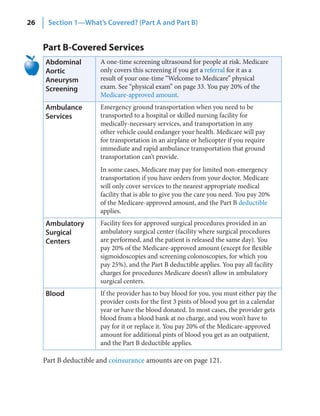
     Abdominal         A one-time screening ultrasound for people at risk. Medicare
     Aortic            only covers this screening if you get a referral for it as a
     Aneurysm          result of your one-time “Welcome to Medicare” physical
     Screening         exam. See “physical exam” on page 33. You pay 20% of the
                       Medicare-approved amount.
     Ambulance         Emergency ground transportation when you need to be
     Services          transported to a hospital or skilled nursing facility for
                       medically-necessary services, and transportation in any
                       other vehicle could endanger your health. Medicare will pay
                       for transportation in an airplane or helicopter if you require
                       immediate and rapid ambulance transportation that ground
                       transportation can’t provide.
                       In some cases, Medicare may pay for limited non-emergency
                       transportation if you have orders from your doctor. Medicare
                       will only cover services to the nearest appropriate medical
                       facility that is able to give you the care you need. You pay 20%
                       of the Medicare-approved amount, and the Part B deductible
                       applies.
     Ambulatory        Facility fees for approved surgical procedures provided in an
     Surgical          ambulatory surgical center (facility where surgical procedures
     Centers           are performed, and the patient is released the same day). You
                       pay 20% of the Medicare-approved amount (except for flexible
                       sigmoidoscopies and screening colonoscopies, for which you
                       pay 25%), and the Part B deductible applies. You pay all facility
                       charges for procedures Medicare doesn’t allow in ambulatory
                       surgical centers.
     Blood             If the provider has to buy blood for you, you must either pay the
                       provider costs for the first 3 pints of blood you get in a calendar
                       year or have the blood donated. In most cases, the provider gets
                       blood from a blood bank at no charge, and you won’t have to
                       pay for it or replace it. You pay 20% of the Medicare-approved
                       amount for additional pints of blood you get as an outpatient,
                       and the Part B deductible applies.

     Part B deductible and coinsurance amounts are on page 121.
Section 1—What’s Covered? (Part A and Part B)                   27


Part B-Covered Services
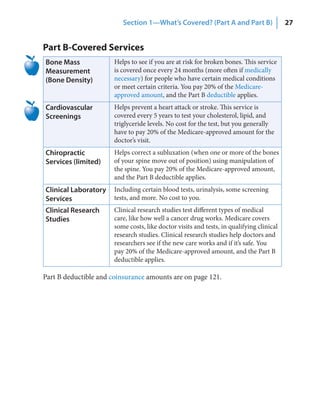
Bone Mass              Helps to see if you are at risk for broken bones. This service
Measurement            is covered once every 24 months (more often if medically
(Bone Density)         necessary) for people who have certain medical conditions
                       or meet certain criteria. You pay 20% of the Medicare-
                       approved amount, and the Part B deductible applies.
Cardiovascular         Helps prevent a heart attack or stroke. This service is
Screenings             covered every 5 years to test your cholesterol, lipid, and
                       triglyceride levels. No cost for the test, but you generally
                       have to pay 20% of the Medicare-approved amount for the
                       doctor’s visit.
Chiropractic           Helps correct a subluxation (when one or more of the bones
Services (limited)     of your spine move out of position) using manipulation of
                       the spine. You pay 20% of the Medicare-approved amount,
                       and the Part B deductible applies.
Clinical Laboratory    Including certain blood tests, urinalysis, some screening
Services               tests, and more. No cost to you.
Clinical Research      Clinical research studies test different types of medical
Studies                care, like how well a cancer drug works. Medicare covers
                       some costs, like doctor visits and tests, in qualifying clinical
                       research studies. Clinical research studies help doctors and
                       researchers see if the new care works and if it’s safe. You
                       pay 20% of the Medicare-approved amount, and the Part B
                       deductible applies.

Part B deductible and coinsurance amounts are on page 121.
28    Section 1—What’s Covered? (Part A and Part B)


     Part B-Covered Services
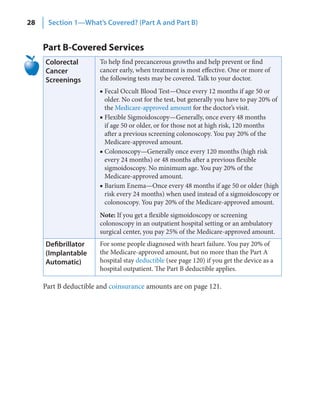
     Colorectal        To help find precancerous growths and help prevent or find
     Cancer            cancer early, when treatment is most effective. One or more of
     Screenings        the following tests may be covered. Talk to your doctor.
                       ■ Fecal Occult Blood Test—Once every 12 months if age 50 or
                         older. No cost for the test, but generally you have to pay 20% of
                         the Medicare-approved amount for the doctor’s visit.
                       ■ Flexible Sigmoidoscopy—Generally, once every 48 months
                         if age 50 or older, or for those not at high risk, 120 months
                         after a previous screening colonoscopy. You pay 20% of the
                         Medicare-approved amount.
                       ■ Colonoscopy—Generally once every 120 months (high risk
                         every 24 months) or 48 months after a previous flexible
                         sigmoidoscopy. No minimum age. You pay 20% of the
                         Medicare-approved amount.
                       ■ Barium Enema—Once every 48 months if age 50 or older (high
                         risk every 24 months) when used instead of a sigmoidoscopy or
                         colonoscopy. You pay 20% of the Medicare-approved amount.
                       Note: If you get a flexible sigmoidoscopy or screening
                       colonoscopy in an outpatient hospital setting or an ambulatory
                       surgical center, you pay 25% of the Medicare-approved amount.
     Defibrillator     For some people diagnosed with heart failure. You pay 20% of
     (Implantable      the Medicare-approved amount, but no more than the Part A
     Automatic)        hospital stay deductible (see page 120) if you get the device as a
                       hospital outpatient. The Part B deductible applies.

     Part B deductible and coinsurance amounts are on page 121.
Section 1—What’s Covered? (Part A and Part B)                  29


Part B-Covered Services
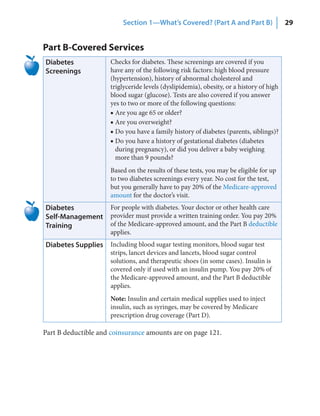
Diabetes             Checks for diabetes. These screenings are covered if you
Screenings           have any of the following risk factors: high blood pressure
                     (hypertension), history of abnormal cholesterol and
                     triglyceride levels (dyslipidemia), obesity, or a history of high
                     blood sugar (glucose). Tests are also covered if you answer
                     yes to two or more of the following questions:
                     ■ Are you age 65 or older?
                     ■ Are you overweight?
                     ■ Do you have a family history of diabetes (parents, siblings)?
                     ■ Do you have a history of gestational diabetes (diabetes
                       during pregnancy), or did you deliver a baby weighing
                       more than 9 pounds?
                     Based on the results of these tests, you may be eligible for up
                     to two diabetes screenings every year. No cost for the test,
                     but you generally have to pay 20% of the Medicare-approved
                     amount for the doctor’s visit.
Diabetes             For people with diabetes. Your doctor or other health care
Self‑Management      provider must provide a written training order. You pay 20%
Training             of the Medicare-approved amount, and the Part B deductible
                     applies.
Diabetes Supplies Including blood sugar testing monitors, blood sugar test
                     strips, lancet devices and lancets, blood sugar control
                     solutions, and therapeutic shoes (in some cases). Insulin is
                     covered only if used with an insulin pump. You pay 20% of
                     the Medicare-approved amount, and the Part B deductible
                     applies.
                     Note: Insulin and certain medical supplies used to inject
                     insulin, such as syringes, may be covered by Medicare
                     prescription drug coverage (Part D).

Part B deductible and coinsurance amounts are on page 121.
30    Section 1—What’s Covered? (Part A and Part B)


     Part B-Covered Services
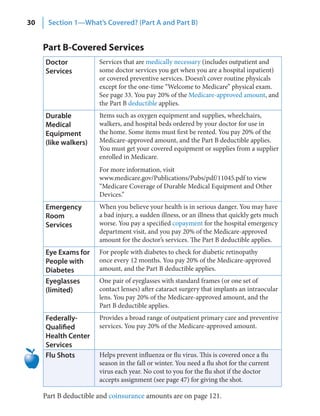
     Doctor            Services that are medically necessary (includes outpatient and
     Services          some doctor services you get when you are a hospital inpatient)
                       or covered preventive services. Doesn’t cover routine physicals
                       except for the one-time “Welcome to Medicare” physical exam.
                       See page 33. You pay 20% of the Medicare-approved amount, and
                       the Part B deductible applies.
     Durable           Items such as oxygen equipment and supplies, wheelchairs,
     Medical           walkers, and hospital beds ordered by your doctor for use in
     Equipment         the home. Some items must first be rented. You pay 20% of the
     (like walkers)    Medicare-approved amount, and the Part B deductible applies.
                       You must get your covered equipment or supplies from a supplier
                       enrolled in Medicare.
                       For more information, visit
                       www.medicare.gov/Publications/Pubs/pdf/11045.pdf to view
                       “Medicare Coverage of Durable Medical Equipment and Other
                       Devices.”
     Emergency         When you believe your health is in serious danger. You may have
     Room              a bad injury, a sudden illness, or an illness that quickly gets much
     Services          worse. You pay a specified copayment for the hospital emergency
                       department visit, and you pay 20% of the Medicare-approved
                       amount for the doctor’s services. The Part B deductible applies.
     Eye Exams for     For people with diabetes to check for diabetic retinopathy
     People with       once every 12 months. You pay 20% of the Medicare-approved
     Diabetes          amount, and the Part B deductible applies.
     Eyeglasses        One pair of eyeglasses with standard frames (or one set of
     (limited)         contact lenses) after cataract surgery that implants an intraocular
                       lens. You pay 20% of the Medicare-approved amount, and the
                       Part B deductible applies.
     Federally‑        Provides a broad range of outpatient primary care and preventive
     Qualified         services. You pay 20% of the Medicare-approved amount.
     Health Center
     Services
     Flu Shots         Helps prevent influenza or flu virus. This is covered once a flu
                       season in the fall or winter. You need a flu shot for the current
                       virus each year. No cost to you for the flu shot if the doctor
                       accepts assignment (see page 47) for giving the shot.

     Part B deductible and coinsurance amounts are on page 121.
Section 1—What’s Covered? (Part A and Part B)                31


Part B-Covered Services
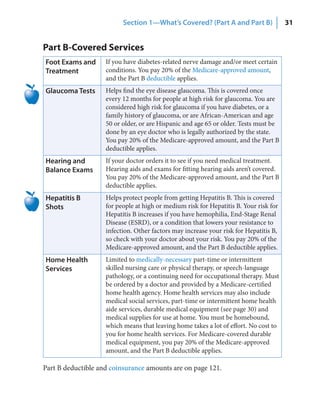
Foot Exams and      If you have diabetes-related nerve damage and/or meet certain
Treatment           conditions. You pay 20% of the Medicare-approved amount,
                    and the Part B deductible applies.
Glaucoma Tests      Helps find the eye disease glaucoma. This is covered once
                    every 12 months for people at high risk for glaucoma. You are
                    considered high risk for glaucoma if you have diabetes, or a
                    family history of glaucoma, or are African-American and age
                    50 or older, or are Hispanic and age 65 or older. Tests must be
                    done by an eye doctor who is legally authorized by the state.
                    You pay 20% of the Medicare-approved amount, and the Part B
                    deductible applies.
Hearing and         If your doctor orders it to see if you need medical treatment.
Balance Exams       Hearing aids and exams for fitting hearing aids aren’t covered.
                    You pay 20% of the Medicare-approved amount, and the Part B
                    deductible applies.
Hepatitis B         Helps protect people from getting Hepatitis B. This is covered
Shots               for people at high or medium risk for Hepatitis B. Your risk for
                    Hepatitis B increases if you have hemophilia, End-Stage Renal
                    Disease (ESRD), or a condition that lowers your resistance to
                    infection. Other factors may increase your risk for Hepatitis B,
                    so check with your doctor about your risk. You pay 20% of the
                    Medicare-approved amount, and the Part B deductible applies.
Home Health         Limited to medically-necessary part-time or intermittent
Services            skilled nursing care or physical therapy, or speech-language
                    pathology, or a continuing need for occupational therapy. Must
                    be ordered by a doctor and provided by a Medicare-certified
                    home health agency. Home health services may also include
                    medical social services, part-time or intermittent home health
                    aide services, durable medical equipment (see page 30) and
                    medical supplies for use at home. You must be homebound,
                    which means that leaving home takes a lot of effort. No cost to
                    you for home health services. For Medicare-covered durable
                    medical equipment, you pay 20% of the Medicare-approved
                    amount, and the Part B deductible applies.

Part B deductible and coinsurance amounts are on page 121.
32    Section 1—What’s Covered? (Part A and Part B)


     Part B-Covered Services
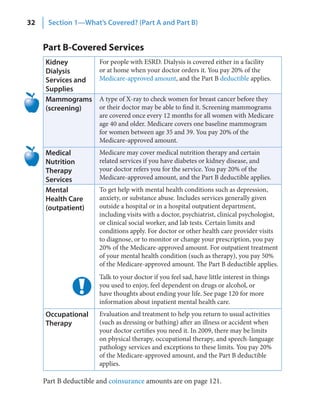
     Kidney            For people with ESRD. Dialysis is covered either in a facility
     Dialysis          or at home when your doctor orders it. You pay 20% of the
     Services and      Medicare-approved amount, and the Part B deductible applies.
     Supplies
     Mammograms        A type of X-ray to check women for breast cancer before they
     (screening)       or their doctor may be able to find it. Screening mammograms
                       are covered once every 12 months for all women with Medicare
                       age 40 and older. Medicare covers one baseline mammogram
                       for women between age 35 and 39. You pay 20% of the
                       Medicare-approved amount.
     Medical           Medicare may cover medical nutrition therapy and certain
     Nutrition         related services if you have diabetes or kidney disease, and
     Therapy           your doctor refers you for the service. You pay 20% of the
     Services          Medicare-approved amount, and the Part B deductible applies.
     Mental            To get help with mental health conditions such as depression,
     Health Care       anxiety, or substance abuse. Includes services generally given
     (outpatient)      outside a hospital or in a hospital outpatient department,
                       including visits with a doctor, psychiatrist, clinical psychologist,
                       or clinical social worker, and lab tests. Certain limits and
                       conditions apply. For doctor or other health care provider visits
                       to diagnose, or to monitor or change your prescription, you pay
                       20% of the Medicare-approved amount. For outpatient treatment
                       of your mental health condition (such as therapy), you pay 50%
                       of the Medicare-approved amount. The Part B deductible applies.
                       Talk to your doctor if you feel sad, have little interest in things
                       you used to enjoy, feel dependent on drugs or alcohol, or
                       have thoughts about ending your life. See page 120 for more
                       information about inpatient mental health care.
     Occupational      Evaluation and treatment to help you return to usual activities
     Therapy           (such as dressing or bathing) after an illness or accident when
                       your doctor certifies you need it. In 2009, there may be limits
                       on physical therapy, occupational therapy, and speech-language
                       pathology services and exceptions to these limits. You pay 20%
                       of the Medicare-approved amount, and the Part B deductible
                       applies.

     Part B deductible and coinsurance amounts are on page 121.
Section 1—What’s Covered? (Part A and Part B)                  33


Part B-Covered Services
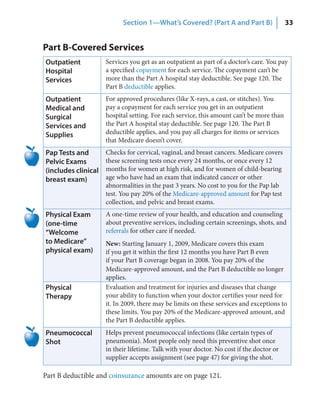
Outpatient           Services you get as an outpatient as part of a doctor’s care. You pay
Hospital             a specified copayment for each service. The copayment can’t be
Services             more than the Part A hospital stay deductible. See page 120. The
                     Part B deductible applies.
Outpatient           For approved procedures (like X-rays, a cast, or stitches). You
Medical and          pay a copayment for each service you get in an outpatient
Surgical             hospital setting. For each service, this amount can’t be more than
Services and         the Part A hospital stay deductible. See page 120. The Part B
Supplies             deductible applies, and you pay all charges for items or services
                     that Medicare doesn’t cover.
Pap Tests and        Checks for cervical, vaginal, and breast cancers. Medicare covers
Pelvic Exams         these screening tests once every 24 months, or once every 12
(includes clinical   months for women at high risk, and for women of child-bearing
breast exam)         age who have had an exam that indicated cancer or other
                     abnormalities in the past 3 years. No cost to you for the Pap lab
                     test. You pay 20% of the Medicare-approved amount for Pap test
                     collection, and pelvic and breast exams.
Physical Exam        A one-time review of your health, and education and counseling
(one‑time            about preventive services, including certain screenings, shots, and
“Welcome             referrals for other care if needed.
to Medicare”         New: Starting January 1, 2009, Medicare covers this exam
physical exam)       if you get it within the first 12 months you have Part B even
                     if your Part B coverage began in 2008. You pay 20% of the
                     Medicare-approved amount, and the Part B deductible no longer
                     applies.
Physical             Evaluation and treatment for injuries and diseases that change
Therapy              your ability to function when your doctor certifies your need for
                     it. In 2009, there may be limits on these services and exceptions to
                     these limits. You pay 20% of the Medicare-approved amount, and
                     the Part B deductible applies.
Pneumococcal         Helps prevent pneumococcal infections (like certain types of
Shot                 pneumonia). Most people only need this preventive shot once
                     in their lifetime. Talk with your doctor. No cost if the doctor or
                     supplier accepts assignment (see page 47) for giving the shot.

Part B deductible and coinsurance amounts are on page 121.
34    Section 1—What’s Covered? (Part A and Part B)


     Part B-Covered Services
     Practitioner        Such as services provided by physician assistants and nurse
     Services            practitioners. You pay 20% of the Medicare-approved amount,
     (Non‑doctor)        and the Part B deductible applies.
     Prescription        Includes a limited number of prescription drugs such as those
     Drugs (limited)     you get in a hospital outpatient department under certain
                         circumstances, injected drugs you get in a doctor’s office, certain
                         oral cancer drugs, and drugs used with some types of durable
                         medical equipment (like a nebulizer or infusion pump). You pay
                         20% of the Medicare-approved amount, and the Part B deductible
                         applies. Note: Other than the examples above, under Part B, you
                         pay 100% for most prescription drugs, unless you have Part D or
                         other drug coverage. For more information, see pages 63–71.
     Prostate Cancer     Helps detect prostate cancer. Medicare covers a digital rectal
     Screenings          exam and Prostate Specific Antigen (PSA) test once every 12
                         months for all men with Medicare over age 50. You pay 20%
                         of the Medicare-approved amount, and the Part B deductible
                         applies for the doctor’s visit. No cost to you for the PSA test.
     Prosthetic/         Including arm, leg, back, and neck braces; artificial eyes; artificial
     Orthotic Items      limbs (and their replacement parts); breast prostheses (after
                         mastectomy); and prosthetic devices needed to replace an internal
                         body part or function (including ostomy supplies, and parenteral
                         and enteral nutrition therapy) when ordered by a doctor. For
                         Medicare to cover your prosthetic or orthotic, you must go
                         to a supplier that is enrolled in Medicare. You pay 20% of the
                         Medicare-approved amount, and the Part B deductible applies.
     Rural Health        Provides a broad range of outpatient primary care services.
     Clinic Services     You pay 20% of the amount charged, and the Part B deductible
                         applies.
     Second Surgical     Covered in some cases for surgery that isn’t an emergency. In
     Opinions            some cases, Medicare covers third surgical opinions. You pay
                         20% of the Medicare-approved amount, and the Part B deductible
                         applies.
     Smoking             Includes up to 8 face-to-face visits in a 12-month period if you
     Cessation           are diagnosed with an illness caused or complicated by tobacco
     (counseling to      use, or you take a medicine that is affected by tobacco. You pay
     stop smoking)       20% of the Medicare-approved amount, and the Part B deductible
                         applies.

     Part B deductible and coinsurance amounts are on page 121.
Section 1—What’s Covered? (Part A and Part B)                35


Part B-Covered Services
Speech‑Language       Evaluation and treatment given to regain and strengthen
Pathology             speech and language skills including cognitive and
Services              swallowing skills when your doctor certifies your need for it.
                      In 2009, there may be limits on these services and exceptions
                      to these limits. You pay 20% of the Medicare-approved
                      amount, and the Part B deductible applies.
Surgical Dressing     For treatment of a surgical or surgically-treated wound. You
Services              pay 20% of the Medicare-approved amount, and the Part B
                      deductible applies.
Telemedicine          Medical or other health services given to a patient using
                      a communications system (like a computer, telephone,
                      or television) by a provider in a location different from
                      the patient’s. Available in some rural areas, under certain
                      conditions and only in a provider’s office, a hospital, or
                      a federally-qualified health center. You pay 20% of the
                      Medicare-approved amount, and the Part B deductible
                      applies.
Tests                 Including X-rays, MRIs, CT scans, EKGs, and some other
                      diagnostic tests. You pay 20% of the Medicare-approved
                      amount, and the Part B deductible applies. See “Clinical
                      Laboratory Services” on page 27 for other Part B-covered
                      tests. If you get the test as a hospital outpatient, you pay
                      a specified copayment that may be more than 20% of the
                      Medicare-approved amount but can’t be more than the
                      Part A hospital stay deductible. See page 120.

Part B deductible and coinsurance amounts are on page 121.
36    Section 1—What’s Covered? (Part A and Part B)


     Part B-Covered Services
     Transplants and          Including doctor services for heart, lung, kidney, pancreas,
     Immunosuppressive        intestine, and liver transplants under certain conditions
     Drugs                    and only in a Medicare-certified facility. Bone marrow and
                              cornea transplants are covered under certain conditions.
                              Immunosuppressive drugs are covered if Medicare paid
                              for the transplant, or an employer or union group health
                              plan that was required to pay before Medicare paid for the
                              transplant. You must have been entitled to Part A at the
                              time of the transplant and entitled to Part B at the time you
                              get immunosuppressive drugs, and the transplant must
                              have been performed in a Medicare-certified facility. You
                              pay 20% of the Medicare-approved amount, and the Part B
                              deductible applies.
                              If you are thinking of joining a Medicare Advantage Plan
                              and are on a transplant waiting list or believe you need a
                              transplant, check with the plan before you join to make
                              sure your doctors and hospitals are in the plan’s network.
                              Also, check the plan’s coverage rules.
                              Note: Medicare drug plans (Part D) may cover
                              immunosuppressive drugs, even if Medicare or an
                              employer or union group health plan didn’t pay for the
                              transplant.

     Part B deductible and coinsurance amounts are on page 121.
Section 1—What’s Covered? (Part A and Part B)                 37


Part B-Covered Services
Travel (health     Medicare generally doesn’t cover health care while you are
care needed        traveling outside the U.S. (the “U.S.” includes the 50 states, the
when traveling     District of Columbia, Puerto Rico, the Virgin Islands, Guam,
outside the        the Northern Mariana Islands, and American Samoa). There
United States)     are some exceptions including some cases where Medicare
                   may pay for services that you get while on board a ship within
                   the territorial waters adjoining the land areas of the U.S. In
                   rare cases, Medicare may pay for inpatient hospital, doctor,
                   or ambulance services you get in a foreign country in the
                   following situations:
                   1) If an emergency arose within the U.S. and the foreign
                   hospital is closer than the nearest U.S. hospital that can treat
                   your medical condition
                   2) If you are traveling through Canada without unreasonable
                   delay by the most direct route between Alaska and another
                   state when a medical emergency occurs and the Canadian
                   hospital is closer than the nearest U.S. hospital that can treat
                   the emergency
                   3) If you live in the U.S. and the foreign hospital is closer to
                   your home than the nearest U.S. hospital that can treat your
                   medical condition, regardless of whether an emergency exists
                   You pay 20% of the Medicare-approved amount, and the Part B
                   deductible applies.
Urgently‑          To treat a sudden illness or injury that isn’t a medical
Needed Care        emergency. You pay 20% of the Medicare-approved amount,
                   and the Part B deductible applies.

Part B deductible and coinsurance amounts are on page 121.
38      Section 1—What’s Covered? (Part A and Part B)


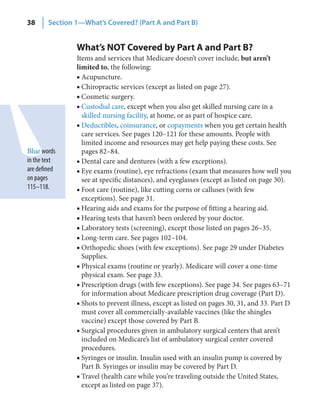
                What’s NOT Covered by Part A and Part B?
                Items and services that Medicare doesn’t cover include, but aren’t
                limited to, the following:
                ■ Acupuncture.
                ■ Chiropractic services (except as listed on page 27).
                ■ Cosmetic surgery.
                ■ Custodial care, except when you also get skilled nursing care in a
                  skilled nursing facility, at home, or as part of hospice care.
                ■ Deductibles, coinsurance, or copayments when you get certain health
                  care services. See pages 120–121 for these amounts. People with
                  limited income and resources may get help paying these costs. See
Blue words        pages 82–84.
in the text     ■ Dental care and dentures (with a few exceptions).
are defined     ■ Eye exams (routine), eye refractions (exam that measures how well you
on pages          see at specific distances), and eyeglasses (except as listed on page 30).
115–118.        ■ Foot care (routine), like cutting corns or calluses (with few
                  exceptions). See page 31.
                ■ Hearing aids and exams for the purpose of fitting a hearing aid.
                ■ Hearing tests that haven’t been ordered by your doctor.
                ■ Laboratory tests (screening), except those listed on pages 26–35.
                ■ Long-term care. See pages 102–104.
                ■ Orthopedic shoes (with few exceptions). See page 29 under Diabetes
                  Supplies.
                ■ Physical exams (routine or yearly). Medicare will cover a one-time
                  physical exam. See page 33.
                ■ Prescription drugs (with few exceptions). See page 34. See pages 63–71
                  for information about Medicare prescription drug coverage (Part D).
                ■ Shots to prevent illness, except as listed on pages 30, 31, and 33. Part D
                  must cover all commercially-available vaccines (like the shingles
                  vaccine) except those covered by Part B.
                ■ Surgical procedures given in ambulatory surgical centers that aren’t
                  included on Medicare’s list of ambulatory surgical center covered
                  procedures.
                ■ Syringes or insulin. Insulin used with an insulin pump is covered by
                  Part B. Syringes or insulin may be covered by Part D.
                ■ Travel (health care while you’re traveling outside the United States,
                  except as listed on page 37).
Section 1—What’s Covered? (Part A and Part B)            39


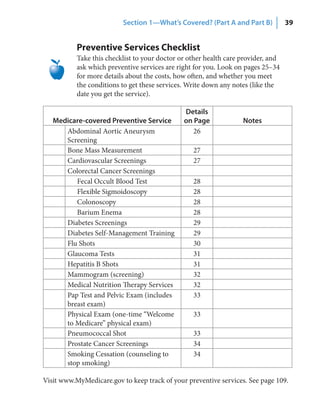
           Preventive Services Checklist
           Take this checklist to your doctor or other health care provider, and
           ask which preventive services are right for you. Look on pages 25–34
           for more details about the costs, how often, and whether you meet
           the conditions to get these services. Write down any notes (like the
           date you get the service).

                                               Details
   Medicare‑covered Preventive Service         on Page             Notes
      Abdominal Aortic Aneurysm                   26
      Screening
      Bone Mass Measurement                       27
      Cardiovascular Screenings                   27
      Colorectal Cancer Screenings
         Fecal Occult Blood Test                  28
         Flexible Sigmoidoscopy                   28
         Colonoscopy                              28
         Barium Enema                             28
      Diabetes Screenings                         29
      Diabetes Self-Management Training           29
      Flu Shots                                   30
      Glaucoma Tests                              31
      Hepatitis B Shots                           31
      Mammogram (screening)                       32
      Medical Nutrition Therapy Services          32
      Pap Test and Pelvic Exam (includes          33
      breast exam)
      Physical Exam (one-time “Welcome            33
      to Medicare” physical exam)
      Pneumococcal Shot                           33
      Prostate Cancer Screenings                  34
      Smoking Cessation (counseling to            34
      stop smoking)

Visit www.MyMedicare.gov to keep track of your preventive services. See page 109.
40   Section 1—What’s Covered? (Part A and Part B)


                                  Notes
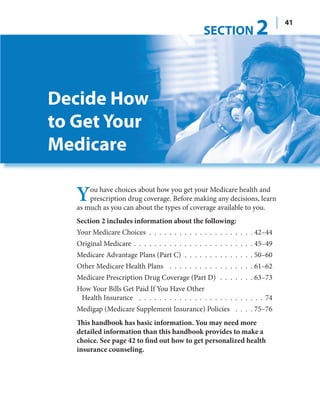
SECTION            2        41


Decide How
to Get Your
Medicare

   Y   ou have choices about how you get your Medicare health and
       prescription drug coverage. Before making any decisions, learn
   as much as you can about the types of coverage available to you.
   Section 2 includes information about the following:
   Your Medicare Choices . . . . . . . . . . . . . . . . . . . . . 42–44
   Original Medicare . . . . . . . . . . . . . . . . . . . . . . . . 45–49
   Medicare Advantage Plans (Part C) . . . . . . . . . . . . . . 50–60
   Other Medicare Health Plans . . . . . . . . . . . . . . . . . 61–62
   Medicare Prescription Drug Coverage (Part D) . . . . . . . 63–73
   How Your Bills Get Paid If You Have Other
    Health Insurance . . . . . . . . . . . . . . . . . . . . . . . . . 74
   Medigap (Medicare Supplement Insurance) Policies . . . . 75–76
   This handbook has basic information. You may need more
   detailed information than this handbook provides to make a
   choice. See page 42 to find out how to get personalized health
   insurance counseling.
42      Section 2—Decide How to Get Your Medicare


                Your Medicare Choices
                You can choose different ways to get your Medicare coverage. Most
                people choose either Original Medicare or a Medicare Advantage
                Plan (like an HMO or PPO). If you choose Original Medicare and
                you want drug coverage, you can join a Medicare Prescription Drug
                Plan. If you choose to join a Medicare Advantage Plan, the plan
                may include Medicare prescription drug coverage. In most cases,
                if you don’t make a choice, you will have Original Medicare. See
                page 43 for more information about your coverage choices and the
                decisions you need to make.
                Each year you should review your health and prescription needs
                because your health, finances, or coverage may have changed. If you
                decide other coverage will better meet your needs, you can switch
                plans during certain times. See pages 59 and 65.

                Need Help Deciding?
                1. Visit www.medicare.gov and select, “Compare Health Plans
                   and Medigap Policies in Your Area” or “Compare Medicare
Blue words         Prescription Drug Plans.”
in the text     2. Get free counseling about choosing coverage. See pages 111–114
are defined        for the telephone number of your State Health Insurance
on pages           Assistance Program (SHIP).
115–118.        3. Call 1-800-MEDICARE (1-800-633-4227), and say “Agent.”
                   TTY users should call 1-877-486-2048.
                Note: The plan you join will release your personal information to
                Medicare and other plans as necessary for treatment, payment,
                and health care operations. Medicare may release your personal
                information for research and other purposes. See pages 92–93
                to find out more about how Medicare can use your personal
                information.
Section 2—Decide How to Get Your Medicare               43


Use These Steps to Help You Decide

                                       Decide if You Want
       Original Medicare                   OR a       Medicare Advantage Plan
                                                               (like an HMO or PPO)
Part A (Hospital Insurance) and                   Part C—Includes BOTH Part A (Hospital
Part B (Medical Insurance)                        Insurance) and Part B (Medical Insurance)
■ Medicare provides this coverage.                ■ Private insurance companies approved by
■ You have your choice of doctors, hospitals,       Medicare provide this coverage.
  and other providers.                            ■ In most plans, you need to use plan doctors,
■ Generally, you pay deductibles and                hospitals, and other providers or you pay more.
  coinsurance.                                    ■ You usually pay a monthly premium (in
■ You usually pay a monthly premium for             addition to your Part B premium) and a
  Part B.                                           copayment for covered services.
See pages 45–49.                                  ■ Costs, extra coverage, and rules vary by plan.
                                                  See pages 50–60.
                   Step 2                                              Step 2
            Decide If You Want Prescription Drug Coverage (Part D)
■ If you want this coverage, you must choose      ■ If you want this coverage, in most cases you
  and join a Medicare Prescription Drug             must get it through your Medicare Advantage
  Plan.                                             Plan.
■ These plans are run by private companies        ■ Most Medicare Advantage Plans include
  approved by Medicare.                             prescription drug coverage (Part D), usually
See pages 63–71.                                    for an extra cost.
                                                  See pages 54–56.
                   Step 3
                    Decide If You Want Supplemental Coverage
You may want to get private coverage that fills
gaps in Original Medicare coverage.                 Note: If you join a Medicare Advantage
■ You can choose to buy private                     Plan, you don’t need a Medigap policy. If you
  supplemental coverage, like a Medigap             already have a Medigap policy, you can’t use
  (Medicare Supplement Insurance) policy.           it to pay for any expenses you have under
■ Costs vary by policy and company.                 the Medicare Advantage Plan. If you already
■ Employers/unions may offer similar                have a Medicare Advantage Plan, you can’t
  coverage.                                         be sold a Medigap policy. See page 57.
See pages 75–76.

In addition to Original Medicare or a Medicare Advantage Plan, you may be able to join other
types of Medicare health plans (see pages 61–62). You may be able to save money or have other
choices if you have limited income and resources (see pages 77–84). You may also have other
coverage, like employer or union, military, or Veterans’ benefits (see pages 72–73).
44      Section 2—Decide How to Get Your Medicare


                Things to Consider When Choosing or Changing
                Your Coverage
                ■ Coverage—When choosing between Original Medicare and a
                  Medicare health plan, does the plan provide extra coverage you want
                  that Original Medicare doesn’t cover?
                ■ Your other coverage—Do you have, or are you eligible for, other
                  types of health or prescription drug coverage? If so, read the
Blue words        materials you get from your insurer or plan, or call them to find out
in the text       how the coverage works with, or is affected by, Medicare. If you have
are defined       coverage through a former or current employer or union, talk to your
on pages          benefits administrator, insurer, or plan before making any changes to
115–118.          your coverage.
                ■ Cost—How much are your premiums and deductibles? How much
                  do you pay for services like hospital stays or doctor visits? Your costs
                  vary and may be different if you don’t follow the coverage rules.
                ■ Doctor and hospital choice—Do your doctors accept the coverage?
                  Are they accepting new patients? If you are considering a Medicare
                  health plan, do you have to choose your hospital and health care
                  providers from a network? Do you need a referral to see a specialist?
                ■ Prescription drugs—What are your drug needs? Do you need to
                  join a Medicare drug plan? What will your prescription drugs cost
                  under each plan? Are your drugs covered under the plan’s formulary
                  (drug list)? Formularies can change.
                ■ Quality of care—The quality of care and services given by plans and
                  other health care providers can vary. Medicare has information to
                  help you compare plans and providers. See page 100.
                ■ Convenience—Where are the doctors’ offices? What are their hours?
                  Which pharmacies can you use? Can you get your prescriptions by
                  mail?
                ■ Travel—Do you spend part of each year in another state? Will the
                  plan cover you there?

                 Your Medicare plan will send you an Evidence of Coverage
                 (EOC) and Annual Notice of Change (ANOC) each year. The
                 EOC gives you details about what the plan covers, how much
                 you pay, and more. The ANOC includes any changes in coverage,
                 costs, or service area that will be effective in January.
Section 2—Decide How to Get Your Medicare                            45


              Original Medicare
              Original Medicare is one of your health coverage choices as part of
              Medicare. You will have Original Medicare unless you choose to
              join a Medicare health plan.

              How Does Original Medicare Work?
              Under Original Medicare, you have your choice of doctors and
              hospitals. You don’t need a referral. You pay a separate amount for
              each service. Here are the general rules for how it works:

                          Original Medicare
Are prescription drugs   Only in limited situations like when you are a hospital inpatient.
covered?                 See pages 20 and 34. You can add comprehensive drug coverage by
                         joining a Medicare Prescription Drug Plan. See pages 63–71.
Do I need to choose a    No.
primary care doctor?
Can I get my health      Yes. You can go to any doctor, supplier, hospital, or other facility that
care from any doctor     is enrolled in Medicare and is accepting new Medicare patients.
or hospital?
Do I have to get         No.
a referral to see a
specialist?
Do I need a              You may already have employer or union coverage that may pay
supplemental policy?     costs that Original Medicare doesn’t. If not, you may want to buy a
                         Medigap (Medicare Supplement Insurance) policy. See pages 75–76.
What else do I need to   ■ Each year, you generally must pay a set amount for your health care
know about Original        (deductible) before Medicare pays its share. Then, Medicare pays
Medicare?                  its share, and you pay your share (coinsurance) for covered services
                           and supplies. See pages 120–121 to find out what you pay.
                         ■ If you have Part A, you can generally get the Part A-covered
                           services listed on pages 19–20.
                         ■ If you have Part B, you can generally get the services listed on
                           pages 26–37. You usually pay a monthly premium for Part B.
                           See page 119.
                         ■ You generally don’t need to file Medicare claims. Providers (like
                           doctors, hospitals, skilled nursing facilities, and home health
                           agencies) and suppliers are required by law to file Medicare claims
                           for the covered services and supplies you get.
46   Section 2—Decide How to Get Your Medicare


             Original Medicare Payment Information
             If you get a Medicare-covered service, you will get a Medicare
             Summary Notice (MSN) in the mail. The MSN shows all the services
             or supplies that were billed to Medicare during each 3-month period,
             what Medicare paid, and what you may owe the provider. The MSN
             isn’t a bill. When you get your MSN, you should do the following:
             ■ If you have other insurance, check to see if it covers anything that
               Medicare didn’t.
             ■ Keep your receipts and bills, and compare them to your MSN to be
               sure you got all the services, supplies, or equipment listed.
             ■ If you paid a bill before you got your MSN, compare your MSN with
               the bill to make sure you paid the right amount for your services.
             MSNs are mailed every 3 months. If you are due a refund check from
             Medicare, the MSN will be mailed as soon as the claim is processed.
             If you need to change your address on your MSN, call Social Security
             at 1-800-772-1213. TTY users should call 1-800-325-0778. If you get
             RRB benefits, call your local RRB office or 1-877-772-5772.
             Visit www.MyMedicare.gov to track your Medicare claims.
             See page 109.

             Your Out-of-Pocket Costs in Original Medicare
             Depend on the Following:
             ■ Whether you have Part A and/or Part B (most people have both).
             ■ Whether your doctor or supplier accepts “assignment.” See page 47.
             ■ How often you need health care.
             ■ What type of health care you need.
             ■ Whether you choose to get services or supplies Medicare doesn’t
               cover. If you do, you pay all the costs for these services.
             ■ Whether you have other health insurance that works with Medicare.
             ■ Whether you have Medicaid or get state help paying your Medicare
               costs. See pages 82–83.

               See pages 75–84 for more information about help to cover the
               costs that Original Medicare doesn’t cover.
Section 2—Decide How to Get Your Medicare             47


              “Assignment” in Original Medicare
              Assignment is an agreement between you, Medicare, and doctors,
              other health care providers, or suppliers. When you “assign” a
              claim, Medicare will pay the doctor, provider, or supplier directly
              for the services you get.
              Remember the following if your doctor, provider, or supplier
              accepts assignment:
              ■ Your out-of-pocket costs may be less.
              ■ Most doctors, providers, and suppliers accept assignment, but
                you should always check to make sure. In some cases they must
                accept assignment, like when they have a participation agreement
                with Medicare and give you Medicare-covered services.
              ■ If a doctor, provider, or supplier accepts assignment, they agree
                to only charge you the Medicare deductible or coinsurance
                amount and wait for Medicare to pay its share.
              ■ All doctors, providers, and suppliers that give you
                Medicare-covered services have to submit your claim to
                Medicare directly. They can’t charge you for submitting the claim.
              Remember the following if your doctor, provider, or supplier
              doesn’t accept assignment:
              ■ They still must submit a claim to Medicare when they give you
                Medicare-covered services. If they don’t submit the claim for
                these services, you should contact the company that handles
                bills for Medicare for your state to file a complaint. You can
Blue words      call 1-800-MEDICARE (1-800-633-4227) for their telephone
in the text     number. TTY users should call 1-877-486-2048. In the
are defined     meantime, you might have to pay the entire charge at the time of
on pages        service, and then submit your claim to Medicare to get paid back.
115–118.      ■ They may charge you more than the Medicare-approved amount,
                but there is a limit called “the limiting charge.” They can only
                charge you up to 15% over the Medicare-approved amount. The
                limiting charge applies only to certain services and doesn’t apply
                to some supplies and durable medical equipment.
              To find doctors and suppliers who accept assignment, visit
              www.medicare.gov and select, “Find a Doctor or Other Healthcare
              Professional” or “Find Suppliers of Medical Equipment in Your
              Area.” You can also call 1-800-MEDICARE.
48   Section 2—Decide How to Get Your Medicare


             What Is a Private Contract?
             A “private contract” is a written agreement between you and a
             doctor or other health care provider who has decided not to provide
             services through Medicare. The private contract only applies to the
             services provided by the doctor who asked you to sign it. You can’t be
             asked to sign a private contract in an emergency situation or when
             you need urgent care. You don’t have to sign a private contract with
             a doctor. You can go to another doctor who will provide services
             through Medicare. If you sign a private contract with your doctor,
             remember these rules:
             ■ Medicare won’t pay any amount for the services you get from this
               doctor.
             ■ You will have to pay whatever this doctor or provider charges you
               for the services you get.
             ■ If you have a Medigap (Medicare Supplement Insurance) policy,
               it won’t pay anything for the services you get. Call your Medigap
               insurance company before you get a service if you have questions.
             ■ Your doctor must tell you if Medicare would pay for a service if you
               got it from another doctor who accepts Medicare.
             ■ Your doctor must tell you if he or she has been excluded from
               Medicare.
             You are always free to get non-covered services on your own if you
             choose to pay for a service yourself. See page 38 for a list of services
             and items that Medicare doesn’t cover.
             You may want to contact your State Health Insurance Assistance
             Program (SHIP) to get help before signing a private contract with
             any doctor or other health care provider. See pages 111–114 for the
             telephone number.

               See pages 85–98 for information about your appeal rights and
               how to protect yourself and Medicare from fraud.
Section 2—Decide How to Get Your Medicare             49


              Adding Medicare Prescription Drug Coverage
              (Part D)
              If you have Original Medicare and you want Medicare drug
              coverage, you must join a Medicare Prescription Drug Plan. These
              plans are available through private companies that work with
              Medicare to provide prescription drug coverage. See pages 63–71
              for more details about Medicare prescription drug coverage.

                Call your employer or union’s benefits administrator before
                you make any changes to your coverage. If you drop your
                employer or union coverage, you may not be able to get it
                back. You also may not be able to drop your employer or
                union drug coverage without also dropping your employer
                or union health (doctor and hospital) coverage. If you drop
                coverage for yourself, you may also have to drop coverage for
                your spouse and dependants.


              Help Paying for a Medicare Drug Plan
Blue words    People with limited income and resources may qualify for “extra
in the text   help” paying their Medicare prescription drug coverage costs. If
are defined   you automatically qualify for “extra help,” you won’t pay a premium
on pages      if you join certain Medicare drug plans. If you don’t automatically
115–118.      qualify, you may still get help to pay your prescription drug costs.
              See pages 78–81 to find out if you may qualify for “extra help.”
50   Section 2—Decide How to Get Your Medicare


             Medicare Advantage Plans (Part C)
             Medicare Advantage Plans are health plan options (like an HMO
             or PPO) approved by Medicare and offered by private companies.
             These plans are part of Medicare and are sometimes called
             “Part C” or “MA Plans.” Medicare pays a fixed amount for your
             care every month to the companies offering Medicare Advantage
             Plans. These companies must follow rules set by Medicare.
             Medicare Advantage Plans provide your Medicare health
             coverage and usually Medicare drug coverage. They aren’t
             supplemental insurance.
             Not all Medicare Advantage Plans work the same way, so find out
             the plan’s rules before joining. See the chart that starts on page 54
             for an outline of these various plans’ rules. In all plan types, you
             are always covered for emergency and urgent care.
             Medicare Advantage Plans include the following:
             ■ Preferred Provider Organization (PPO) Plans. See page 54.
             ■ Health Maintenance Organization (HMO) Plans. See page 54.
             ■ Private Fee-for-Service (PFFS) Plans. See page 55.
             ■ Medical Savings Account (MSA) Plans. See page 55.
             ■ Special Needs Plans (SNP). See page 56.
             Note: There are other types of Medicare Advantage Plans that may
             be available; however, they are less common. Provider Sponsored
             Organizations (PSOs) are plans run by a provider or group of
             providers. In a PSO, you usually get your health care from the
             providers who are a part of the plan. Religious Fraternal Benefit
             (RFB) Plans are offered to members of certain religious groups.
             RFBs can be any plan type, including an HMO or PPO.
Section 2—Decide How to Get Your Medicare             51


              Medicare Advantage Plans (Part C) (continued)
              Medicare Advantage Plans provide all of your Part A (Hospital
              Insurance) and Part B (Medical Insurance) coverage. This means
              they must cover at least all of the services that Original Medicare
              covers. However, each Medicare Advantage Plan can charge
              different out-of-pocket costs. These are usually copayments but can
              also be coinsurance and deductibles. It’s important to call any plan
              before joining to find out the plan’s rules, what your costs will be,
              and to make sure the plan meets your needs.
              Medicare Advantage Plans may offer extra coverage, such as
              vision, hearing, dental, and/or health and wellness programs. Most
              include Medicare prescription drug coverage (usually for an extra
              cost). You may need a referral to see specialists. Some Medicare
              Advantage Plans have provider networks. In some cases this means
              you can only see doctors who belong to the plan or go to certain
              hospitals to get covered services (other than for emergency or
              urgently needed care or medically-necessary dialysis).
              In some plans, if you see a doctor or other provider who doesn’t
              contract or participate with the plan, your services may not be
              covered at all, or your costs will likely be higher. You should check
              with your doctors or hospital to find out if they accept the plan.

              Who Can Join?
              You can generally join a Medicare Advantage Plan if you meet these
              conditions:
              ■ You have Part A and Part B.
              ■ You live in the service area of the plan. Contact the plans you’re
                interested in to find out about the service area. Visit
                www.medicare.gov, or call 1-800-MEDICARE (1-800-633-4227)
Blue words
                to find plans in your area. TTY users should call 1-877-486-2048.
in the text
              ■ You don’t have End-Stage Renal Disease (ESRD) (permanent
are defined
                kidney failure requiring dialysis or a kidney transplant) except as
on pages
                explained on page 58.
115–118.
              Note: In most cases, you can join a Medicare Advantage Plan only
              at certain times during the year. See page 59.
52      Section 2—Decide How to Get Your Medicare


                More About Medicare Advantage Plans
                ■ As with Original Medicare, you still have Medicare rights and
                  protections, including the right to appeal. See pages 86–89.
                ■ Check with the plan before you get a service to find out whether
                  they will cover the service and what your costs may be.
                ■ You must follow plan rules, like getting a referral to see a
                  specialist or getting prior approval for certain procedures to avoid
Blue words        higher costs. Check with the plan.
in the text     ■ You can join a Medicare Advantage Plan even if you have a
are defined       pre-existing condition, except for End-Stage Renal Disease.
on pages          See page 58.
115–118.        ■ You can only join a plan during one of the periods listed on
                  page 59. In most cases, you are enrolled in a plan for a year.
                ■ If you see a doctor who doesn’t belong to the plan, your services
                  may not be covered, or your costs could be higher, depending on
                  the type of Medicare Advantage Plan.
                ■ If the plan decides to stop participating in Medicare, you will
                  have to join another Medicare health plan or return to Original
                  Medicare. See page 59.
                ■ You usually get prescription drug coverage (Part D) through
                  the plan. In most cases, if you are in a Medicare Advantage
                  Plan that includes prescription drug coverage and you join
                  a Medicare Prescription Drug Plan, you will be disenrolled
                  from your Medicare Advantage Plan and returned to Original
                  Medicare.
                ■ You don’t need to buy (and can’t be sold) a Medigap (Medicare
                  Supplement Insurance) policy. It won’t cover your Medicare
                  Advantage Plan deductibles, copayment, or coinsurance.

                  See pages 85–97 for information about your appeal rights and
                  how to protect yourself and Medicare from fraud.
Section 2—Decide How to Get Your Medicare              53


Your Out-of-Pocket Costs in a Medicare
Advantage Plan Depend on the Following:
■ Whether the plan charges a monthly premium in addition to your
  Part B premium. Medicare Advantage Plans charge one combined
  premium for Part A and Part B health coverage, Medicare
  prescription drug coverage (Part D) (if offered), and extra coverage
  (if offered).
■ Whether the plan pays any of the monthly Part B premium (see
  “Saving on Your Part B Premium” below).
■ Whether the plan has a yearly deductible or any additional
  deductibles.
■ How much you pay for each visit or service (copayments).
■ The type of health care services you need and how often you get
  them.
■ Whether you follow the plan’s rules, like using network providers.
■ Whether you need extra coverage and what the plan charges for it.
To learn more about your costs in specific Medicare Advantage
Plans, contact the plans you are interested in to get more details.

Saving on Your Part B Premium
There are two ways to save on your Part B premium:
■ A few Medicare Advantage Plans may pay all or part of your Part B
  premium. You still get all Part A and Part B-covered services.
■ You can also call your State Medical Assistance (Medicaid) office
  if you have limited income and resources to see if you can get help
  paying your Part B premium costs. See page 83.

Saving on Your Part D Premium
Your Medicare Advantage Plan’s premium may include the premium
for Medicare prescription drug coverage (Part D). Some plans
may pay all or part of the premium for prescription drug coverage.
Plans decide each year whether to offer this help, so read the plan
materials carefully.
If you have limited income and resources, you may be able to
get “extra help” paying for your Part D premium and other
prescription drug coverage costs. See pages 78–81.
54      Section 2—Decide How to Get Your Medicare


How Do Medicare Advantage Plans Work?
                           Preferred Provider                  Health Maintenance
                           Organization (PPO) Plan             Organization (HMO) Plan
Are prescription drugs     In most cases, yes. Ask the plan.   In most cases, yes. Ask the plan. If you
covered?                   If you want drug coverage, you      want drug coverage, you must enroll in
                           must join a PPO Plan that offers    an HMO Plan that offers prescription
                           prescription drug coverage.         drug coverage.

Do I need to choose a      No.                                 In most cases, yes.
primary care doctor?

Can I get my health        Yes. PPOs have network doctors      No. You generally must get your
care from any doctor       and hospitals, but you can also     care and services from doctors or
or hospital?               use out-of-network providers for    hospitals in the plan’s network (except
                           covered services, usually for a     emergency care, out-of-area urgent
                           higher cost.                        care, or out-of-area dialysis). If the
                                                               plan offers Point-of-Service, you can
                                                               go out-of-network for certain services
                                                               for a higher cost.
Do I have to get           No.                                 In most cases, yes. Yearly screening
a referral to see a                                            mammograms and in-network Pap
specialist?                                                    tests and pelvic exams (at least every
                                                               other year) don’t require a referral.
What else do I need        ■ There are two types of PPOs—      ■ If your doctor leaves the plan, your
to know about this           Regional PPOs and Local             plan will notify you. You can choose
type of plan?                PPOs.                               another doctor in the plan.
                           ■ Regional PPOs must limit          ■ If you get health care outside the
                             your out-of-pocket costs for        plan’s network, you may have to pay
                             Medicare-covered services.          the full cost.
                             This limit varies by plan.        ■ It’s important that you follow
                                                                 the plan’s rules, like getting prior
                                                                 approval when needed.


Medicare Advantage Plans can vary. Read individual plan materials carefully to make sure you
understand the plan’s rules. You may want to contact the plan to find out if the service you need is
covered and how much it costs. Visit www.medicare.gov, or call 1-800-MEDICARE (1-800-633-4227)
to find plans in your area. TTY users should call 1-877-486-2048.
Section 2—Decide How to Get Your Medicare                    55


How Do Medicare Advantage Plans Work? (continued)
                        Private Fee‑for‑Service           Medical Savings Account
                        (PFFS) Plan                       (MSA) Plan
Are prescription drugs Sometimes. If your PFFS Plan        No. You can join a Medicare Prescription
covered?               doesn’t offer drug coverage, you    Drug Plan to get drug coverage.
                       can join a Medicare Prescription
                       Drug Plan to get coverage.

Do I need to choose a   No.                                No.
primary care doctor?

Can I get my health     In most cases, yes. You can go to Yes. Some plans may have preferred
care from any doctor    any Medicare-approved doctor doctors and hospitals you could go to for
or hospital?            or hospital if they agree to      a lower cost.
                        treat you. Not all providers will
                        accept the plan’s payment terms
                        or agree to treat you.


Do I have to get        No.                               No.
a referral to see a
specialist?

What else do I need     ■ PFFS Plans aren’t the same as   ■ Medicare MSA Plans have two parts: a
to know about this        Original Medicare or Medigap.     high deductible health plan and a bank
type of plan?           ■ The plan decides how much it      account. Medicare gives the plan an
                          will pay doctors and hospitals    amount each year for your health care,
                          and how much you must pay         and the plan deposits a portion of this
                          for services.                     money into your account. The amount
                        ■ Doctors, hospitals, and other     deposited is usually less than your
                          providers may decide on a case- deductible amount so you will have to
                          by-case basis not to treat you.   pay out-of-pocket before your coverage
                                                            begins.
                        ■ Before you join a PFFS Plan,
                          make sure you find doctors,     ■ Money spent for Medicare-covered
                          hospitals, and other types of     Part A and Part B services counts
                          providers who agree to treat      toward your plan’s deductible. After you
                          you and accept the PFFS Plan’s    reach your deductible, your plan will
                          payment terms.                    cover your Medicare-covered services.
                                                          ■ Any money left in your account at the
                                                            end of the year remains in your account
                                                            along with the deposit for next year.
56      Section 2—Decide How to Get Your Medicare


How Do Medicare Advantage Plans Work? (continued)
                          Special Needs Plan
                          (SNP)
Are prescription drugs    Yes. All SNPs must provide Medicare prescription drug coverage (Part D).
covered?


Do I need to choose a     Generally, yes, or you may need to have a care coordinator to help plan
primary care doctor?      your care.

Can I get my health       You generally must get your care and services from doctors or hospitals
care from any doctor      in the plan’s network (except emergency care, out-of-area urgent care, or
or hospital?              out-of-area dialysis). Plans typically have specialists for the diseases or
                          conditions that affect their members.


Do I have to get          In most cases, yes. Yearly screening mammograms and an in-network Pap
a referral to see a       test and pelvic exam (at least every other year) don’t require a referral.
specialist?

What else do I need       ■ SNPs serve people who either 1) live in certain institutions (like a
to know about this          nursing home) or who require nursing care at home, or 2) are eligible
type of plan?               for both Medicare and Medicaid, or 3) have one or more specific chronic
                            or disabling conditions (like diabetes, congestive heart failure, a mental
                            health condition, or HIV/AIDS).
                          ■ A plan may limit plan membership to people in one of these groups
                            or further limit membership within these groups. It may also enroll a
                            limited number of other people.
                          ■ Plans should coordinate the services and providers you need to help you
                            stay healthy and follow your doctor’s orders.
                          ■ If you have Medicare and Medicaid, make sure that all of the plan
                            doctors or other health care providers you use accept Medicaid.
                          ■ If you live in an institution, make sure that plan doctors or other health
                            care providers serve people where you live.
                          ■ You may be disenrolled if you no longer meet the plan’s membership
                            requirements, like if you lose Medicaid or leave a nursing home. If you
                            are disenrolled, you will be returned to Original Medicare and will have
                            3 months to join another Medicare health or prescription drug plan.

Visit www.medicare.gov, or call 1-800-MEDICARE (1-800-633-4227) to find plans in your area.
TTY users should call 1-877-486-2048.
Section 2—Decide How to Get Your Medicare             57


              How Do Medicare Advantage Plans Work?
              (continued)
              Can You Join a Medicare Advantage Plan if You Have Employer
              or Union Coverage?
              Talk to your employer or union benefits administrator about
              their rules before you join a Medicare Advantage Plan. In some
              cases, joining a Medicare Advantage Plan might cause you to lose
              employer or union coverage. In other cases, if you join a Medicare
              Advantage Plan, you may still be able to use your employer or
              union coverage along with the plan you join. Remember, if you
              drop your employer or union coverage, you may not be able to get
              it back.

              What Happens if You Drop Your Medigap (Medicare
              Supplement Insurance) Policy When You Join a Medicare
              Advantage Plan?
              ■ In most cases, if you drop your Medigap policy, you won’t be able
                to get it back.
              ■ However, you may have special Medigap protections if this is
                the first time you have done either of the following:
                   — Joined a Medicare Advantage Plan or other Medicare health
                      plan
Blue words
                   — Bought a Medicare SELECT policy (a Medigap policy that
in the text
                      requires you to use specific hospitals and, in some cases,
are defined
                      specific doctors to get full coverage)
on pages
115–118.      ■ These protections give you a right to get your old Medigap policy
                back or buy a new one if you choose to leave your Medicare
                health plan or drop your Medicare SELECT policy within the first
                year. See page 76. In either case, the new Medigap policy can’t
                include prescription drug coverage.
              ■ However, you may be able to join a Medicare Prescription Drug
                Plan if you join a Medicare Advantage Plan and leave it within the
                first year.
              ■ Check with your State Health Insurance Assistance Program
                (SHIP) to see if your state offers other rights to buy Medigap
                policies. See pages 111–114 for the telephone number.
58   Section 2—Decide How to Get Your Medicare


             How Do Medicare Advantage Plans Work?
             (continued)
             Special Rules for People with End‑Stage Renal Disease (ESRD)
             If you have ESRD (permanent kidney failure requiring dialysis or
             a kidney transplant) and you have Original Medicare, you may
             join a Medicare Prescription Drug Plan. However, you usually
             can’t join a Medicare Advantage Plan.
             ■ If you are already in a Medicare Advantage Plan when you
               develop ESRD, you can stay in it or join another plan offered by
               the same company under certain circumstances.
             ■ If you have an employer or union health plan or other health
               coverage offered by a company that offers Medicare Advantage
               Plans, you may be able to join one of their Medicare Advantage
               Plans.
             ■ If you’ve had a successful kidney transplant, you may be able to
               join a Medicare Advantage Plan.
             If you have ESRD and are in a Medicare Advantage Plan, and the
             plan leaves Medicare or no longer provides coverage in your area,
             you have a one-time right to join another Medicare Advantage
             Plan. You don’t have to use your one-time right to join a new
             plan immediately. If you go directly to Original Medicare after
             your plan leaves or stops providing coverage, you will still have a
             one-time right to join a Medicare Advantage Plan later, as long as
             the plan you choose is accepting new members.
             You may also be able to join a Medicare Special Needs Plan (SNP)
             for people with ESRD if one is available in your area.
             For more information about ESRD, visit
             www.medicare.gov/Publications/Pubs/pdf/10128.pdf to view
             the booklet “Medicare Coverage of Kidney Dialysis and Kidney
             Transplant Services.”
Section 2—Decide How to Get Your Medicare              59


              When Can You Join, Switch, or Drop a Medicare
              Advantage Plan?
              You can join, switch, or drop a Medicare Advantage Plan at these
              times:
              ■ When you first become eligible for Medicare (3 months before
                you turn age 65 to 3 months after the month you turn age 65).
              ■ If you get Medicare due to a disability, you can join during the
                3 months before to 3 months after your 25th month of disability.
              ■ Between November 15–December 31 each year. Your coverage
                will begin on January 1 of the following year.
              ■ Between January 1–March 31 of each year. However, you can’t
                join or switch to a plan with prescription drug coverage during
                this time unless you already have Medicare prescription drug
                coverage (Part D). You also can’t drop a plan with prescription
                drug coverage or join, switch, or drop a Medicare Medical Savings
                Account Plan during this period.
              In most cases, you must stay enrolled for that calendar year starting
              the date your coverage begins. However, in certain situations, you
              may be able to join, switch, or drop a Medicare Advantage Plan at
              other times. Some of these situations include the following:
              ■ If you move out of your plan’s service area
Blue words    ■ If you have both Medicare and Medicaid
in the text
              ■ If you qualify for “extra help”
are defined
on pages      ■ If you live in an institution
115–118.      You can call your State Health Insurance Assistance Program
              (SHIP) for more information. See pages 111–114 for the telephone
              number.

              What Happens If Your Medicare Advantage
              Plan Leaves Medicare?
              If your plan leaves Medicare, it will send you a letter about your
              options. Generally, you will automatically return to Original
              Medicare if you don’t choose to join another Medicare Advantage
              Plan. You will also have the right to buy a Medigap policy. See
              pages 75–76.
60   Section 2—Decide How to Get Your Medicare


             How Do You Join a Medicare Advantage Plan?
             Once you choose a Medicare Advantage Plan, you may be able
             to join by completing a paper application, calling the plan, or
             enrolling online. Talk with the plan to find out how you can join.
             When you join a Medicare Advantage Plan, you will have to
             provide your Medicare number and the date your Part A and/or
             Part B coverage started. This information is on your Medicare card.

             How Do You Switch Medicare Advantage Plans?
             If you are already in a Medicare Advantage Plan and want to switch
             during one of the times listed on page 59, this is what you need to do:
             ■ To switch to a new Medicare Advantage Plan, simply join the
               plan you choose during a period listed on page 59. You will be
               disenrolled automatically from your old plan when your new
               plan’s coverage begins.
             ■ To switch to Original Medicare, contact your current plan or call
               1-800-MEDICARE (1-800-633-4227). TTY users should call
               1-877-486-2048.

               No one should call you or come to your home uninvited to
               sell Medicare products. See pages 94–97 for more information
               about how to protect yourself from identity theft and fraud.
               If you believe a plan has misled you, call 1-800-MEDICARE.
Section 2—Decide How to Get Your Medicare               61


              Other Medicare Health Plans
              Some people who have or are eligible for Medicare get their
              coverage from other types of Medicare health plans, or from other
              government or private insurance.
              Some types of Medicare plans that provide health care coverage
              aren’t Medicare Advantage Plans but are still part of Medicare.
              Some of these plans provide Part A (Hospital Insurance) and/or
              Part B (Medical Insurance) coverage, and some also provide Part D
              (Medicare prescription drug coverage). These plans have some of
              the same rules as Medicare Advantage Plans. Some of these rules are
              explained briefly below and on the next page. However, each type
              of plan has special rules and exceptions, so you should contact any
              plans you’re interested in to get more details.

              Medicare Cost Plans
              Medicare Cost Plans are a type of Medicare health plan available in
              certain areas of the country. You should know the following about
              Medicare Cost Plans:
              ■ You can join even if you only have Part B.
              ■ If you go to a non-network provider, the services are covered under
Blue words      Original Medicare. You would pay the Part B premium, and the
in the text     Part A and Part B coinsurance and deductibles.
are defined   ■ You can join any time the plan is accepting new members.
on pages
              ■ You can leave any time and return to Original Medicare.
115–118.
              ■ You can either get your Medicare prescription drug coverage from
                the plan (if offered), or you can join a Medicare Prescription Drug
                Plan to add prescription drug coverage.
              There is another type of Medicare Cost Plan that only provides
              coverage for Part B services. These plans never include Part D. Part A
              services are covered through Original Medicare. These plans are
              either sponsored by employer or union group health plans, or offered
              by companies that don’t provide Part A services.
              For more information about Medicare Cost Plans, contact the plans
              you’re interested in. You can also visit www.medicare.gov. Your State
              Health Insurance Assistance Program (SHIP) can also give you more
              information. See pages 111–114 for the telephone number.
62   Section 2—Decide How to Get Your Medicare


             Other Medicare Health Plans (continued)
             Demonstrations/Pilot Programs
             Demonstrations and pilot programs, sometimes called “research
             studies,” are special projects that test improvements in Medicare
             coverage, payment, and quality of care. They usually operate only
             for a limited time for a specific group of people and/or are offered
             only in specific areas. Check with the demonstration or pilot
             program for more information about how it works.
             For more information about current Medicare demonstrations
             and pilot programs, visit www.medicare.gov. You can also call
             1-800-MEDICARE (1-800-633-4227) and say “Agent.” TTY users
             should call 1-877-486-2048.

             Programs of All‑inclusive Care for the Elderly (PACE)
             PACE combines medical, social, and long-term care services, and
             prescription drug coverage for frail elderly and disabled people.
             This program provides community-based care and services to
             people who otherwise need nursing home-level of care.
             To qualify for PACE, you must meet the following conditions:
             ■ You are age 55 or older.
             ■ You live in the service area of a PACE organization.
             ■ You are certified by your state as meeting the need for nursing
               home-level care.
             ■ At the time you join, you are able to live safely in the community
               with the help of PACE services.
             PACE is only available in states that have chosen it as an optional
             Medicaid benefit. Call your State Medical Assistance (Medicaid)
             office to find out if you are eligible and if there is a PACE site near
             you. For more information, you can also visit
             www.medicare.gov/Publications/Pubs/pdf/11341.pdf to view the
             fact sheet “Quick Facts about Programs of All-inclusive Care for the
             Elderly (PACE).”
             See pages 103–104 for more information about PACE and
             long-term care.
Section 2—Decide How to Get Your Medicare              63


              Medicare Prescription Drug Coverage (Part D)
              Medicare offers prescription drug coverage (Part D) for everyone
              with Medicare. To get Medicare drug coverage, you must join
              a plan run by an insurance company or other private company
              approved by Medicare. Each plan can vary in cost and drugs
              covered. If you want Medicare drug coverage, you need to choose a
              plan that works with your health coverage.
              There are two ways to get Medicare prescription drug coverage:
              1. Medicare Prescription Drug Plans. These plans (sometimes
                 called “PDPs”) add drug coverage to Original Medicare, some
                 Medicare Cost Plans, some Medicare Private Fee-for-Service
                 (PFFS) Plans, and Medicare Medical Savings Account (MSA)
                 Plans.
              2. Medicare Advantage Plans (like an HMO or PPO) or other
                 Medicare health plans that offer Medicare prescription
                 drug coverage. You get all of your Part A and Part B coverage,
                 including prescription drug coverage (Part D), through these
                 plans. Medicare Advantage Plans with prescription drug
                 coverage are sometimes called “MA-PDs.”
              Both types of plans are called “Medicare drug plans” in this
              section.
Blue words
in the text   Even if you don’t take a lot of prescription drugs now, you should
are defined   still consider joining a Medicare drug plan. See page 44 for a list of
on pages      things to consider when choosing a plan. If you decide not to join a
115–118.      Medicare drug plan when you are first eligible, and you don’t have
              other creditable prescription drug coverage, you will likely pay a
              late enrollment penalty (higher premiums) if you choose to join
              later. See page 68 for more information on creditable coverage.
              Note: Discount cards, doctor samples, free clinics, drug discount
              websites, and manufacturer’s pharmacy assistance programs aren’t
              prescription drug coverage and aren’t creditable coverage.

                If you have limited income and resources, you may qualify for
                “extra help” from Medicare paying for prescription drug coverage.
                You may also be able to get help from your state. See pages 78–81.
64      Section 2—Decide How to Get Your Medicare


                How Do Medicare Drug Plans Work?
                Who Can Get Medicare Drug Coverage?
                To join a Medicare Prescription Drug Plan, you must have
                Medicare Part A and/or Part B. To join a Medicare Advantage Plan
                (like an HMO or PPO), you must have Part A and Part B. You
                must also live in the service area of the Medicare drug plan you
                want to join.

                  If you have employer or union coverage, call your benefits
                  administrator before you make any changes, or before you sign
                  up for any other coverage. If you drop your employer or union
                  coverage, you may not be able to get it back. You also may not
                  be able to drop your employer or union drug coverage without
                  also dropping your employer or union health (doctor and
                  hospital) coverage. If you drop coverage for yourself, you may
                  also have to drop coverage for your spouse and dependants.

                Choosing Medicare Prescription Drug Coverage (Part D)
                Joining a Medicare drug plan when you are first eligible means you
                won’t have to pay a late enrollment penalty. Every year (between
                November 15–December 31), you can switch to a different
                Medicare drug plan if your plan coverage is changing or your
                needs change. When you join or switch to a new Medicare drug
                plan, your coverage generally begins on January 1 of the following
Blue words      year. See page 68 for important information about the late
in the text     enrollment penalty.
are defined     After you join a Medicare drug plan, the plan will mail you
on pages        membership materials, including a card to use when you get your
115–118.        prescriptions filled. When you use the card, you may have to pay a
                copayment, coinsurance, and/or deductible charged by the plan.
Section 2—Decide How to Get Your Medicare              65


When Can You Join, Switch, or Drop a Medicare
Drug Plan?
You can join, switch, or drop a Medicare drug plan at these times:
■ When you first become eligible for Medicare.
■ Between November 15–December 31 each year. Your coverage
  will begin on January 1 of the following year.
In most cases, you must stay enrolled for that calendar year starting
the date your coverage begins. However, in certain situations, you
may be able to join, switch, or drop Medicare drug plans during
a special enrollment period (like if you move out of the service
area, lose other creditable prescription drug coverage, live in an
institution, or qualify for “extra help”).
Call your State Health Insurance Assistance Program (SHIP) for
more information. See pages 111–114 for the telephone number.

How Do You Join a Medicare Drug Plan?
Once you choose a Medicare drug plan, you may be able to join by
completing a paper application, calling the plan, or enrolling online.
Medicare drug plans aren’t allowed to call you to enroll you in a
plan. See pages 94–97 for more information about how to protect
yourself from fraud.
Contact the plan to find out how you can join. When you join
a Medicare drug plan, you will have to provide your Medicare
number and the date your Part A or Part B coverage started. This
information is on your Medicare card. Visit www.medicare.gov, or
call 1-800-MEDICARE (1-800-633-4227) for a list of the Medicare
plans in your area. TTY users should call 1-877-486-2048.

How Do You Switch Your Medicare Drug Plan?
Depending on your circumstances, you can switch to a new
Medicare drug plan simply by joining another drug plan during
one of the times listed above. You don’t need to cancel your old
Medicare drug plan or send them anything. Your old Medicare
drug plan coverage will end when your new drug plan begins. You
should get a letter from your new Medicare drug plan telling you
when your coverage begins.
66      Section 2—Decide How to Get Your Medicare


                How Much Does Medicare Drug Coverage Cost?
                Exact coverage and costs are different for each plan, but all
                Medicare drug plans must provide at least a standard level of
                coverage set by Medicare.
                Below and continued on page 67 are descriptions of the payments
                you make throughout the year in a Medicare drug plan. After the
                descriptions is an example of what someone may pay in a plan.
                Your actual drug plan costs will vary depending on the drugs you
                use, the plan you choose, whether you go to a pharmacy in your
Blue words      plan’s network, and whether you qualify for “extra help” paying
in the text     your Part D costs.
are defined     ■ Monthly premium—Most drug plans charge a monthly fee that
on pages          varies by plan. You pay this in addition to the Part B premium. If
115–118.          you belong to a Medicare Advantage Plan (like an HMO or PPO)
                  or a Medicare Cost Plan that includes Medicare prescription
                  drug coverage, the monthly premium may include an amount for
                  prescription drug coverage.
                ■ Yearly deductible—Amount you pay for your prescriptions
                  before your plan begins to pay. Some drug plans charge no
                  deductible.
                ■ Copayments or coinsurance—Amounts you pay for your
                  prescriptions after the deductible. You pay your share, and your
                  plan pays its share for covered drugs.
                ■ Coverage gap—Most Medicare drug plans have a coverage gap.
                  This means that after you and your plan have spent a certain
                  amount of money for covered drugs, you have to pay all costs
                  out-of-pocket for your drugs up to a limit. Your yearly deductible,
                  your coinsurance or copayments, and what you pay in the
                  coverage gap all count toward this out-of-pocket limit. The limit
                  doesn’t include the drug plan’s premium.
                 There are plans that offer some coverage during the gap, like for
                 generic drugs. However, plans with gap coverage may charge a
                 higher monthly premium. Check with the plan first to see if your
                 drugs would be covered during the gap.
Section 2—Decide How to Get Your Medicare              67


             How Much Does Medicare Drug Coverage Cost?
             (continued)
             ■ Catastrophic coverage—Once you reach your plan’s out-of-pocket
               limit during the coverage gap, you automatically get “catastrophic
               coverage.” Catastrophic coverage assures that once you have spent
               up to your plan’s out-of-pocket limit for covered drugs, you only
               pay a small coinsurance amount or a copayment for the rest of the
               year.
              Note: If you get “extra help” paying your drug costs, you won’t
              have a coverage gap and will pay a small or no copayment once you
              reach catastrophic coverage. See pages 78–81.
              The example below shows the costs for covered drugs in 2009 for a
              plan that has a coverage gap.

Ms. Smith joins the ABC Prescription Drug Plan. Her coverage begins on
January 1, 2009. She doesn’t get “extra help” and uses her Medicare drug plan
membership card when she buys prescriptions.

Monthly Premium—Ms. Smith pays a monthly premium throughout the year.
1. Yearly           2. Copayment or        3. Coverage Gap        4. Catastrophic
   Deductible          Coinsurance                                   Coverage

Ms. Smith pays       Ms. Smith pays a      Once Ms. Smith         Once Ms. Smith
the first $295 of    copayment, and her    and her plan have      has spent $4,350
her drug costs       plan pays its share   spent $2,700 for       out-of-pocket for the
before her plan      for each covered      covered drugs, she     year, her coverage
starts to pay its    drug until what       is in the coverage     gap ends. Now she
share.               they pay (plus the    gap. She will have     only pays a small
                     deductible) reaches   to pay all of her      copayment (like $6)
                     $2,700.               drug costs until she   for each drug until
                                           has spent $4,350.      the end of the year.


         Call the plans you’re interested in to get specific Medicare drug plan costs.
         You can also visit www.medicare.gov, or call 1-800-MEDICARE
         (1-800-633-4227). TTY users should call 1-877-486-2048.
68      Section 2—Decide How to Get Your Medicare


                What is the Part D Late Enrollment Penalty?
                The late enrollment penalty is an amount that is added to your
                Part D premium (for as long as you have Medicare drug coverage)
                if all of the following are true:
                ■ You don’t join a Medicare drug plan when you’re first eligible.
                ■ You don’t have other creditable prescription drug coverage.
                ■ You later decide to join a Medicare drug plan.

                Here are a Few Ways to Avoid Paying a Penalty:
                ■ Join a Medicare drug plan when you’re first eligible. You won’t
                  have to pay a penalty, even if you’ve never had prescription drug
                  coverage before.
                ■ Don’t go for more than 63 days without a Medicare drug plan
                  or other creditable coverage. Creditable coverage could include
Blue words        drug coverage from a former employer or union, TRICARE, or
in the text       the Department of Veterans Affairs. (You should get a notice
are defined       every year telling you whether the drug coverage you have is
on pages          creditable coverage. Keep this notice, because you may need it if
115–118.          you join a Medicare drug plan later.)
                ■ Let your Medicare drug plan know if you have other creditable
                  coverage. Watch carefully for a letter from your plan asking if you
                  have creditable coverage and complete the form they give you if
                  you do. If you don’t tell the plan about your creditable coverage,
                  you may have to pay a penalty.

                How Much Will Your Part D Late Enrollment
                Penalty Be?
                When you join a Medicare drug plan, the plan will tell you if you
                owe a penalty, and what your premium will be. To estimate your
                penalty amount, count the number of full months that you didn’t
                have creditable coverage after you were eligible to join a Medicare
                drug plan. If you multiply this number by $.30 (the “1% penalty
                calculation” number on page 122), you can estimate the amount
                that will be added each month to your Medicare drug plan’s
                premium for the current year. This penalty amount may increase
                every year.
Section 2—Decide How to Get Your Medicare               69


Important Drug Coverage Rules
The following information can help answer common questions as
you begin to use your coverage.

What If You Need to Fill a Prescription Before You Get Your
Medicare Drug Plan Membership Card?
About a week after you join a plan, you will get a letter from the plan
letting you know they got your information. Three to 5 weeks later,
you should get a welcome package with your membership card.
If you need to go to the pharmacy before your membership card
arrives, you can use any of the following as proof of membership in
your Medicare drug plan:
■ A letter from the plan
■ An enrollment confirmation number that you got from the plan,
  the plan name, and telephone number
You should also bring your Medicare and/or Medicaid card, proof
of any other prescription drug coverage, and a photo ID. If you
qualify for “extra help,” see page 81 for more information about
what you can use as proof of “extra help.” If you don’t have any of
the items listed above, and your pharmacist can’t get your drug plan
information any other way, you may have to pay out-of-pocket for
your prescriptions. If you do, save the receipts and contact your
plan to get money back.
If you want to know how Medicare prescription drug coverage
works with other drug coverage you may have, see pages 72–73.

  Enroll early in the month to give the plan time to mail your
  membership card, acknowledgement letter, and welcome
  package before your coverage becomes effective. This way,
  even if you go to the pharmacy on your first day of coverage,
  you can get your prescriptions filled without delay.
70      Section 2—Decide How to Get Your Medicare


                Important Drug Coverage Rules (continued)
                Plans may have the following coverage rules:
                ■ Prior authorization—You and/or your doctor must contact the
                  plan before you can fill certain prescriptions. Your doctor may
                  need to show that the drug is medically necessary for it to be
                  covered.
Blue words      ■ Quantity limits—Limits how many pills you can get at a time.
in the text
                ■ Step therapy—You must try one or more similar, lower cost drugs
are defined
                  before the plan will cover the drug your doctor prescribed.
on pages
115–118.        If your doctor believes that one of these coverage rules should be
                waived, you can ask for an exception. See pages 90–91.

                What Are “Tiers” or “Categories” on a Medicare Drug Plan’s
                Formulary?
                Many Medicare drug plans place drugs into different “tiers.” Drugs
                in each tier have a different cost. For example, a drug in a lower tier
                will cost you less than a drug in a higher tier. In some cases, if your
                drug is on a higher tier and your doctor thinks you need that drug
                instead of a similar drug on a lower tier, you can file an exception
                and ask your plan for a lower copayment. See pages 90–91.
                Note: Information about a plan’s list of covered drugs (called a
                formulary) isn’t included in this handbook because each plan has
                its own formulary. Formularies can change. Contact the plan for its
                current formulary, or visit the plan’s website.

                  In most cases the prescription drugs you get in an outpatient
                  setting like an emergency room aren’t covered by Part B. Your
                  Medicare drug plan may cover these drugs under certain
                  circumstances. You will likely need to pay out-of-pocket for
                  these drugs and submit a claim to your plan. Call your plan for
                  more information.
Section 2—Decide How to Get Your Medicare             71


Important Drug Coverage Rules (continued)
What Are the Ways to Pay Your Medicare Drug Plan Premium?
You have choices in the way you pay your Medicare drug plan
premium. Depending on your plan and your situation, you may be
able to pay your Medicare drug plan premium in one of four ways:
1. Deducted from your checking or savings account.
2. Charged to a credit or debit card.
3. Billed to you each month directly by the plan. (Some plans bill
   in advance for coverage the next month.)
4. Deducted from your Social Security payment. Contact your
   plan (not Social Security) to ask for this payment option. With
   this option, your first deductions usually take 2 months to start,
   and 2 months of premiums will likely be collected at one time.
For more information about your Medicare drug plan premium
or ways to pay for it, contact your plan.
Use the following resources to get more information about
Medicare prescription drug coverage:
■ Contact the plans you are interested in.
■ Visit www.medicare.gov/pdphome.asp to get general information,
  view publications, and find plans in your area.
■ Call 1-800-MEDICARE (1-800-633-4227) and say, “Drug
  Coverage.” TTY users should call 1-877-486-2048.
72      Section 2—Decide How to Get Your Medicare


     Other Private Insurance
     The charts on the next two pages provide information about how other
     insurance you have works with, or is affected by, Medicare prescription drug
     coverage (Part D).

       Employer or Union Health Coverage—Health coverage from your, your
       spouse’s, or other family member’s current or former employer or union. If you
       have prescription drug coverage based on your current or previous employment,
       your employer or union will notify you each year to let you know if your drug
       coverage is creditable. Keep the notices you get. Call your benefits administrator
       for more information.

       COBRA—A Federal statute that may allow you to temporarily keep employer
       or union health coverage after the employment ends or after you lose coverage
       as a dependent of the covered employee. As explained on page 24, there may
       be reasons why you should take Part B instead of COBRA. However, if you
       take COBRA and it includes creditable prescription drug coverage, you will
       have a special enrollment period to join a Medicare drug plan without paying a
       penalty when the COBRA coverage ends. Talk with your State Health Insurance
       Assistance Program (SHIP) to see if COBRA is a good choice for you. See
       pages 111–114 for the telephone number.

       Medigap (Medicare Supplement Insurance) Policy with Prescription Drug
       Coverage—If you have prescription drug coverage under a current Medigap
       policy, the issuer of the policy will notify you each year to let you know if
       the coverage is creditable. Most Medigap coverage isn’t creditable. You can’t
       join a Medicare drug plan and keep the prescription drug coverage in your
       Medigap policy. If you join, your Medigap insurance company must remove
       the prescription drug coverage under your Medigap policy and reduce your
       premiums. Call your Medigap insurance company for more information.


     Note: Keep any creditable coverage notice you get. You may need it if you
     decide to join a Medicare drug plan later.
Section 2—Decide How to Get Your Medicare             73


Other Government Insurance
 Federal Employee Health Benefits Program (FEHBP)—Health coverage for
 current and retired Federal employees and covered family members. Prescription
 drug coverage under FEHBP is considered creditable, and, in most cases, it will
 be to your advantage to keep your current coverage. If you join a Medicare drug
 plan, you can keep your FEHBP plan, and your plans will let you know who
 pays first. For more information, contact the Office of Personnel Management
 at 1-888-767-6738, or visit www.opm.gov/insure. TTY users should call
 1-800-878-5707. You can also call your plan if you have questions.

 Veterans’ Benefits—Health coverage for veterans and people who have served
 in the U.S. military. You may be able to get prescription drug coverage through
 the VA program. This coverage is considered creditable. You may join a Medicare
 drug plan, but if you do, you can’t use both types of coverage at the same time.
 In most cases, it will be to your advantage to keep your current coverage.
 For more information, call the U.S. Department of Veterans Affairs (VA) at
 1-800-827-1000, or visit www.va.gov. TTY users should call 1-800-829-4833.

 Military Benefits (TRICARE)—Health care program for active-duty service
 members, retirees, and their families. All people with TRICARE are eligible
 for TRICARE pharmacy benefits. Most people keep their TRICARE pharmacy
 benefits because they are considered creditable prescription drug coverage. You
 may also add Medicare prescription drug coverage. If you do, your Medicare
 drug plan pays first and TRICARE pays second. In most cases, it will be to
 your advantage to keep your current coverage. For more information, call the
 contractor that handles TRICARE claims at 1-866-773-0404, or visit
 www.tricare.osd.mil. TTY users should call 1-866-773-0405.

 Indian Health Services—Health care for people who are American Indian/
 Alaska Native through an Indian health care provider. If you get health care from
 one of these providers, you have creditable prescription drug coverage. If you
 get prescription drugs through an Indian health pharmacy, you pay nothing and
 your coverage won’t be interrupted. Joining a Medicare drug plan may help your
 Indian health provider with costs, because the drug plan pays part of the cost of
 your prescriptions. For more information, contact your local health care provider
 to find out how Medicare works with your health care system.
74   Section 2—Decide How to Get Your Medicare


             How Your Bills Get Paid If You Have Other
             Health Insurance
             When you have other insurance, there are rules that decide
             whether Medicare or your other insurance pays first. The
             insurance that pays first is called the “primary payer” and pays
             up to the limits of its coverage. The one that pays second, called
             the “secondary payer,” only pays if it covers any of the costs left
             uncovered by the primary coverage.
             If your other coverage is from an employer or union group health
             plan, these rules apply:
             ■ If you are retired, Medicare pays first.
             ■ If your coverage is based on your or a family member’s current
               employment, who pays first depends on your age, the size of the
               employer, and whether you have Medicare based on age, disability,
               or ESRD:
                  — If you are under age 65 and disabled, your plan pays first if
                     your employer has 100 or more employees.
                  — If you are over age 65 and still working, your plan pays first
                     if your employer has 20 or more employees.
             ■ If you have Medicare because you have ESRD, in all cases your
               plan pays first for the first 30 months you have Medicare.
             The following types of coverage always pay first:
             ■ No-fault insurance (including automobile insurance)
             ■ Liability (including automobile insurance)
             ■ Black lung benefits
             ■ Workers’ compensation

               If you have other insurance, tell your doctor, hospital,
               and pharmacy so your bills get paid correctly. If you have
               questions about who pays first, or you need to update your
               other insurance information, call Medicare’s Coordination
               of Benefits Contractor at 1-800-999-1118. TTY users should
               call 1-800-318-8782.
Section 2—Decide How to Get Your Medicare               75


              Medigap (Medicare Supplement Insurance)
              Policies
              Original Medicare pays for many, but not all, health care services
              and supplies. A Medigap policy, sold by private insurance
              companies, can help pay some of the health care costs (“gaps”) that
              Original Medicare doesn’t cover, like copayments, coinsurance,
              and deductibles. Some Medigap policies also offer coverage for
              services that Medicare doesn’t cover, like medical care when
              you travel outside the U.S. If you have Original Medicare and
              you buy a Medigap policy, both plans will pay their share of
              Medicare-approved amounts for covered health care costs. Medicare
              doesn’t pay any of the costs for a Medigap policy.
              Every Medigap policy must follow Federal and state laws designed
              to protect you, and it must be clearly identified as “Medicare
              Supplement Insurance.” Medigap insurance companies can sell you
              only a “standardized” Medigap policy identified in most states by
              letters (A through L). Each standardized Medigap policy must offer
              the same basic coverage, no matter which insurance company sells
              it. Cost is usually the only difference between Medigap policies sold
              by different insurance companies.
              In Massachusetts, Minnesota, and Wisconsin, Medigap policies are
              standardized in a different way. In some states, you may be able to
              buy another type of Medigap policy called Medicare SELECT (a
              Medigap policy that requires you to use specific hospitals and, in
              some cases, specific doctors to get full coverage).

              What Do You Need to Know If You Want to Buy a
              Medigap Policy?
              ■ Generally, you must have Parts A and B to buy a Medigap policy.
              ■ You pay a monthly premium for your Medigap policy to the private
Blue words      insurer, and you pay your monthly Part B premium. See page 119.
in the text   ■ A Medigap policy only covers one person. If you and your spouse
are defined     both want Medigap coverage, you each must buy separate Medigap
on pages        policies.
115–118.      ■ It’s important to compare Medigap policies since the costs can vary
                and may go up as you get older. (Prices may be limited by state law.)
76      Section 2—Decide How to Get Your Medicare


                What Do You Need to Know If You Want to Buy
                a Medigap Policy? (continued)
                ■ The best time to buy a Medigap policy is during the 6-month
                  period that begins on the first day of the month in which you are
                  both age 65 or older and enrolled in Part B. (Some states have
                  additional open enrollment periods.) After this initial enrollment
                  period, your option to buy a Medigap policy may be limited.
                ■ If you are under age 65, you may have additional rights to buy a
                  Medigap policy, depending on the laws in your state.
                ■ If you have a Medigap policy and join a Medicare Advantage Plan
                  (like an HMO or PPO), your Medigap policy can’t be used to pay
                  your Medicare Advantage Plan copayments and deductibles.
Blue words      ■ If you already have a Medicare Advantage Plan, it’s illegal for
in the text       anyone to sell you a Medigap policy unless you are switching
are defined       back to Original Medicare.
on pages
                ■ If you join a Medicare Advantage Plan for the first time, and
115–118.
                  you aren’t happy with the plan, you have the right to return to
                  Original Medicare within the first 12 months of joining. If you
                  joined when you were first eligible for Medicare, you can choose
                  from any Medigap policy. If you had a Medigap policy before,
                  you can get the same plan back (without any prescription drug
                  coverage) if the company still sells it.
                ■ You can’t have drug coverage in both your Medigap policy and a
                  Medicare drug plan. See page 72.
                For more information about Medigap policies, visit
                www.medicare.gov/Publications/Pubs/pdf/02110.pdf to view the
                booklet “Choosing a Medigap Policy: A Guide to Health Insurance
                for People with Medicare.” You can also call your State Insurance
                Department to get more information. Call 1-800-MEDICARE
                (1-800-633-4227) to get the telephone number. TTY users should
                call 1-877-486-2048.
                To find Medigap policies, visit www.medicare.gov and select,
                “Compare Medicare Health Plans and Medigap Policies in Your
                Area.” You can also call 1-800-MEDICARE or your State Health
                Insurance Assistance Program (SHIP). See pages 111–114 for the
                telephone number.
SECTION            3         77


Programs for
People with
Limited Income
and Resources

   T   here are Federal and state programs available for people with limited
       income and resources. These programs may help you save on your
   health care and prescription drug costs or provide extra income.
   Section 3 includes information about the following:
   “Extra Help” Paying for Medicare Prescription
      Drug Coverage (Part D) . . . . . . . . . . . . . . . . . . . 78–81
   Medicaid . . . . . . . . . . . . . . . . . . . . . . . . . . . . . . . 82
   State Pharmacy Assistance Programs (SPAPs) . . . . . . . . . . 82
   Programs of All-inclusive Care for the Elderly (PACE) . . . . . 82
   Medicare Savings Programs . . . . . . . . . . . . . . . . . . . . 83
   Supplemental Security Income (SSI) Benefits . . . . . . . . . . 84
   Programs for People Who Live in the U.S. Territories of
      Puerto Rico, the Virgin Islands, Guam, the Northern
      Mariana Islands, and American Samoa . . . . . . . . . . . . 84

     Keep all information you get from Medicare, Social Security,
     your Medicare health or prescription drug plan, Medigap policy,
     or employer or union. This may include a notice of award
     or denial, an Annual Notice of Change, notice of creditable
     prescription drug coverage, or a Medicare Summary Notice. You
     may need these documents to apply for the programs explained
     in this section. Also keep copies of any applications you submit.
78      Section 3—Programs for People with Limited Income and Resources


                Help for People with Limited Income and Resources
                If you have limited income and resources, you might qualify for help to
                pay for some health care and prescription drug costs.
                The U.S. Virgin Islands, Guam, American Samoa, the Commonwealth
                of Puerto Rico, and the Commonwealth of Northern Mariana Islands
                provide their residents help with Medicare drug costs. This help isn’t
                the same as the “extra help” described below. See page 84 for more
                information.

                “Extra Help” Paying for Medicare Prescription
                Drug Coverage (Part D)
                What is this program?
                You may qualify for “extra help” (also called the low-income subsidy)
                from Medicare to pay prescription drug costs if your yearly income and
                resources are below the following limits in 2009:
                ■ Income less than $16,245 and resources less than $12,510—Single
                  person
                ■ Income less than $21,855 and resources less than $25,010—Married
                  person living with a spouse and no other dependents
                These amounts will change in 2010. You may qualify if you have a
                higher income (like if you still work or if you live in Alaska or Hawaii).
                Resources include money in a checking or savings account, stocks, and
                bonds. Resources don’t include your home, car, burial plot, up to $1,500
                for burial expenses (per person), furniture, or other household items.

                If you qualify for “extra help” in 2009 and join a Medicare drug plan,
                you will get the following:
                ■ Help paying your Medicare drug plan’s monthly premium. Depending
                  on your income and resources and your plan’s premium, you may pay
                  a reduced premium or no premium for a basic plan. For an enhanced
                  plan (a plan that may cover more drugs and generally has a higher
Blue words
                  monthly premium), you must pay more for the extra coverage.
in the text
are defined     ■ Help paying any yearly deductible.
on pages        ■ Help paying coinsurance and copayments for prescription drugs that
115–118.          are on your plan’s formulary (list of covered drugs). You generally pay
                  all costs for drugs that aren’t on your plan’s formulary.
                ■ No coverage gap. See pages 66–67.
Section 3—Programs for People with Limited Income and Resources               79


      “Extra Help” Paying for Medicare Prescription Drug
      Coverage (Part D) (continued)
      You automatically qualify for “extra help” if you have Medicare and
      meet one of these conditions:
      ■ You have full Medicaid coverage. See page 82.
      ■ You get help from your state Medicaid program paying your Part B
        premiums (belong to a Medicare Savings Program). See page 83.
      ■ You get Supplemental Security Income (SSI) benefits. See page 84.

      What happens if you automatically qualify for “extra help?”
      Medicare will mail you a purple letter to let you know you automatically
      qualify for “extra help.” You don’t need to apply for “extra help” if you get
      this letter.
      ■ Keep the letter for your records.
      ■ If you aren’t already in a plan, you must join a Medicare drug plan to get
        this “extra help.”
      ■ If you don’t join a drug plan, Medicare will enroll you in one. If Medicare
        enrolls you in a plan, Medicare will send you a yellow or green letter
        letting you know when your coverage begins.
      ■ Different plans cover different drugs. Check to see if the plan you are
        enrolled in covers the drugs you use and if you can go to the pharmacies
        you want. Compare with other plans in your area.
      ■ You can switch to another Medicare drug plan at any time. Your coverage
        will be effective the first day of the next month.
      ■ In most cases, you will pay only a small amount for each covered
        prescription.
      ■ If you have Medicaid, Medicare will provide you with prescription drug
        coverage instead of Medicaid. However, some drugs that aren’t covered
        by Medicare prescription drug coverage may still be covered by Medicaid.
        Medicaid may still cover other care that Medicare doesn’t cover.
      ■ If you have Medicaid and live in certain institutions (like a nursing
        home), you may pay nothing for your covered prescription drugs.

        The exact amount you pay depends on the level of “extra help”
        you get. Look on the “extra help” letters you get, or contact your
        plan to find out your exact premium, deductible, and coinsurance
        or copayment amounts.
80      Section 3—Programs for People with Limited Income and Resources


                “Extra Help” Paying for Medicare Prescription
                Drug Coverage (Part D) (continued)
                If you don’t want to join a Medicare drug plan (for example,
                because you want to keep your employer or union coverage
                instead), call 1-800-MEDICARE (1-800-633-4227) or the plan
                listed in your letter. TTY users should call 1-877-486-2048. Tell
                them you don’t want to be in a Medicare drug plan (you want to
                “opt out”). If you continue to qualify for “extra help,” you won’t have
                to pay a penalty if you join later. See page 68.
                If you didn’t automatically qualify for “extra help,” you can apply:
                ■ Call Social Security at 1-800-772-1213 to apply by phone or to get
                  a paper application. TTY users should call 1-800-325-0778.
                ■ Visit www.socialsecurity.gov to apply online.
Blue words
                ■ Apply at your State Medical Assistance (Medicaid) office. Call
in the text
                  1-800-MEDICARE and say “Medicaid” to get their telephone
are defined
                  number, or visit www.medicare.gov.
on pages
115–118.        To get answers to your questions about “extra help” paying for your
                prescription drug costs, call your State Health Insurance Assistance
                Program (SHIP). See pages 111–114 for the telephone number.
                If you apply and qualify for “extra help,” you must join a
                Medicare drug plan to get this “extra help.” If you don’t join a
                drug plan, Medicare will enroll you in one. If Medicare enrolls
                you in a plan, Medicare will send you a green letter letting you
                know when your coverage begins. Check to see if the plan you
                are enrolled in covers the drugs you use and if you can go to the
                pharmacies you want. If not, you can switch plans at any time.
                If you have employer or union coverage and you join a Medicare
                drug plan, you may lose your employer or union coverage even
                if you qualify for “extra help.” Call your employer’s benefits
                administrator for more information before you join.
                Medicare gets data from your state or Social Security that tells
                whether you qualify for “extra help.” If Medicare doesn’t have the
                right information, you may be paying the wrong amount for your
                prescription drug coverage.
Section 3—Programs for People with Limited Income and Resources                   81


           “Extra Help” Paying for Medicare Prescription
           Drug Coverage (Part D) (continued)
           If you think you qualify for “extra help,” what can you do to make
           sure you pay the right amount?
           If you automatically qualify, you should have received a purple,
           yellow, or green letter from Medicare you can show to your plan as
           proof that you qualify. If you applied for “extra help,” you can show
           your “Notice of Award” from Social Security as proof that you qualify.
           You can also give your plan any of the following documents as proof
           that you qualify for “extra help.” Each item listed below must show
           that you were eligible for Medicaid during a month after June of 2008.

 Other Proof You Have Medicaid              Proof You Have Medicaid and
                                            Live in an Institution

■ A copy of your Medicaid card            ■ A bill from the institution (like
■ A copy of a state document that           a nursing home) or a copy of a
  shows you have Medicaid                   state document showing Medicaid
■ A print-out from a state electronic       payment to the institution for at
  enrollment file or screen print from      least a month
  your state’s Medicaid systems that      ■ A screen print from your state’s
  shows you have Medicaid                   Medicaid systems showing that you
■ Any other document from your              lived in the institution for at least a
  state that shows you have Medicaid        month


           Call your plan to find out how you can provide them with this
           information. If you think you qualify for “extra help” because you
           have Medicaid, but you don’t have proof, ask your plan for help.
           If you paid for prescriptions since you qualified for “extra help,” you
           may be able to get back some of these costs. Keep the receipts, and
           call your plan for more information.
           If your plan doesn’t correct a problem to help you pay the right
           amount for your prescriptions, you can file a complaint with your
           plan. You can also call 1-800-MEDICARE (1-800-633-4227) to file a
           complaint. TTY users should call 1-877-486-2048.
82      Section 3—Programs for People with Limited Income and Resources


                Medicaid
                Medicaid is a joint Federal and state program that helps pay medical
                costs if you have limited income and resources. Some people qualify
                for both Medicare and Medicaid (these people are also called
                “dual-eligibles”).
                ■ If you have Medicare and full Medicaid coverage, most of your
                  health care costs are covered whether you have Original Medicare
                  or are in a Medicare Advantage Plan (like an HMO or PPO).
                ■ Medicaid programs vary from state to state. They may also be called
                  by different names, such as “Medical Assistance” or “Medi-Cal.”
                ■ People with Medicaid may get coverage for services that aren’t fully
                  covered by Medicare, such as nursing home and home health care.
                ■ Each state may have different Medicaid eligibility income and
                  resource limits.
Blue words      ■ In some states, you may need Medicare to be eligible for Medicaid.
in the text     ■ Call your State Medical Assistance (Medicaid) office for more
are defined       information and to see if you qualify. Call 1-800-MEDICARE
on pages          (1-800-633-4227) and say “Medicaid” to get the telephone number
115–118.          for your State Medical Assistance office. TTY users should call
                  1-877-486-2048. You can also visit www.medicare.gov.

                State Pharmacy Assistance Programs (SPAPs)
                Many states have State Pharmacy Assistance Programs (SPAPs) that
                help certain people pay for prescription drugs based on financial
                need, age, or medical condition. Each SPAP makes its own rules
                about how to provide drug coverage to its members. Depending on
                your state, the SPAP will help you in different ways. To find out about
                the SPAP in your state, call your State Health Insurance Assistance
                Program (SHIP). See pages 111–114 for the telephone number.

                Programs of All-inclusive Care for the Elderly
                (PACE)
                PACE combines medical, social, and long-term care services, and
                prescription drug coverage for frail elderly and disabled people. This
                program allows people who need nursing home-level care to remain
                in the community. See pages 103–104 for more information.
Section 3—Programs for People with Limited Income and Resources                 83


      Medicare Savings Programs (Help from
      Medicaid to Pay Medicare Premiums)
      States have programs that pay Medicare premiums and, in some
      cases, may also pay Part A and Part B deductibles and coinsurance.
      These programs help people with Medicare save money each year.
      To qualify for a Medicare Savings Program, you must meet all of
      these conditions:
      ■ Have Part A.
      ■ Have monthly income less than $1,239 and resources less than
        $4,000—Single person.
      ■ Have monthly income less than $1,660 and resources less than
        $6,000—Married and living together.
      Note: These amounts may change each year. If you live in Alaska or
      Hawaii, income limits are slightly higher. Many states figure your
      income and resources differently, so you may be eligible in your
      state even if your income is higher. Resources include money in a
      checking or savings account, stocks, and bonds. Resources don’t
      include your home, car, burial plot, up to $1,500 for burial expenses
      (per person), furniture, or other household items.

      For More Information
      ■ Call or visit your State Medical Assistance (Medicaid) office for
        more information. The names of these programs may vary by state,
        so ask for information on Medicare Savings Programs. Call if you
        think you qualify for any of these programs, even if you aren’t sure.
      ■ Call 1-800-MEDICARE (1-800-633-4227), and say “Medicaid”
        to get the telephone number for your state. TTY users should call
        1-877-486-2048.
      ■ Visit www.medicare.gov/Publications/Pubs/pdf/10126.pdf to view
        the brochure “If You Need Help Paying Medicare Costs, There Are
        Programs That Can Help You.”
      ■ Contact your State Health Insurance Assistance Program (SHIP)
        for free health insurance counseling. See pages 111–114 for the
        telephone number.
84      Section 3—Programs for People with Limited Income and Resources


                Supplemental Security Income (SSI) Benefits
                SSI is a monthly amount paid by Social Security to people with
                limited income and resources who are disabled, blind, or age 65
                or older. SSI benefits provide cash to meet basic needs for food,
                clothing, and shelter. SSI benefits aren’t the same as Social Security
                benefits.
                To get SSI benefits, you must also meet these conditions:
                ■ Be a resident of the U.S. or the Northern Mariana Islands.
                ■ Not be out of the country for a full calendar month or more than 30
                  consecutive days.
                ■ Be either a U.S. citizen or national, or in one of certain categories
                  of eligible non–citizens. People who live in Puerto Rico, the Virgin
Blue words        Islands, Guam, or American Samoa generally can’t get SSI. You
in the text       can visit www.socialsecurity.gov and use the “Benefit Eligibility
are defined       Screening Tool” to find out if you may be eligible for SSI or other
on pages          benefits. Call Social Security at 1-800-772-1213, or contact your
115–118.          local Social Security office for more information. TTY users should
                  call 1-800-325-0778.

                Programs for People Who Live in the U.S.
                Territories of Puerto Rico, the Virgin Islands,
                Guam, the Northern Mariana Islands, and
                American Samoa
                There are programs in Puerto Rico, the Virgin Islands, Guam, the
                Northern Mariana Islands, and American Samoa to help people with
                limited income and resources pay their Medicare costs. Programs
                vary in these areas. Call your local Medical Assistance (Medicaid)
                office to find out more about their rules, or call 1-800-MEDICARE
                (1-800-633-4227) and say “Medicaid” for more information. TTY
                users should call 1-877-486-2048. You can also visit
                www.medicare.gov.

                  Free or low cost health insurance is available in your state for
                  uninsured children under age 19. Call 1-877-KIDS-NOW
                  (1-877-543-7669) for more information about the Children’s
                  Health Insurance Program.
SECTION            4         85


Protecting
Yourself
and Medicare

  Y    ou can protect yourself and Medicare by understanding your
       rights (including your right to appeal) and knowing how to
   identify and report fraud.
   Section 4 includes information about the following:
   Medicare Rights and Appeals Information . . . . . . . . . . 86–88
   Advance Beneficiary Notices (ABNs) . . . . . . . . . . . . . . . 89
   Appeals (Medicare Drug Plans) . . . . . . . . . . . . . . . . 90–91
   How Medicare Uses Your Personal Information . . . . . . . 92–93
   Protecting Yourself From Fraud and Identity Theft . . . . . 94–95
   Senior Medicare Patrol (SMP) . . . . . . . . . . . . . . . . . . . 95
   Billing Fraud . . . . . . . . . . . . . . . . . . . . . . . . . . . 96–97
   How Medicare Protects You . . . . . . . . . . . . . . . . . . . . 97
   Medicare’s Beneficiary Ombudsman . . . . . . . . . . . . . . . 98
86   Section 4—Protecting Yourself and Medicare


             Your Medicare Rights
             No matter what type of Medicare coverage you have, you have
             certain guaranteed rights. As a person with Medicare, you have the
             right to all of the following:
             ■ Be treated with dignity and respect at all times
             ■ Be protected from discrimination
             ■ Access to doctors, specialists, and hospitals
             ■ Have your questions about Medicare answered
             ■ Learn about all of your treatment choices and participate in
               treatment decisions
             ■ Get information in a way you understand from Medicare, its
               providers, and contractors under certain circumstances
             ■ Get emergency care when and where you need it
             ■ Get a decision about health care payment or services, or
               prescription drug coverage
             ■ Get a review of (appeal) certain decisions about health care
               payment, coverage of services, or prescription drug coverage
             ■ File complaints (sometimes called grievances), including
               complaints about the quality of your care
             ■ Have your personal and health information kept private

             What Is an Appeal?
             An appeal is the action you can take if you disagree with a coverage
             or payment decision made by Medicare or your Medicare plan. You
             can appeal if Medicare or your plan denies one of the following:
             ■ A request for a health care service, supply, or prescription that
               you think you should be able to get
             ■ A request for payment for health care or a prescription drug you
               already got
             ■ A request to change the amount you must pay for a prescription
               drug
             You can also appeal if Medicare or your plan stops paying for an
             item or service you think you still need.
             If you decide to file an appeal, ask your doctor, health care provider,
             or supplier for any information that may help your case.
Section 4—Protecting Yourself and Medicare           87


How to File an Appeal
How you file an appeal depends on the type of Medicare coverage you have:
■ If you have a Medicare Advantage Plan or a Medicare Prescription Drug
  Plan, look at your plan materials, call your plan, or visit
  www.medicare.gov to learn how to file an appeal.
■ If you have Original Medicare, you can file an appeal by following the
  instructions below:
      1. Get the Medicare Summary Notice (MSN) that shows the item
         or service you are appealing. Your MSN is the statement you get
         every 3 months that lists all the services billed to Medicare and
         tells you if Medicare paid for the services.
      2. Circle the item(s) on the MSN you disagree with, and write an
         explanation on the MSN of why you disagree.
      3. Sign, write your telephone number, and provide your Medicare
         number on the MSN. You may want to make a copy to keep for
         your records.
      4. Send the MSN, or a copy, to the Medicare contractor’s address
         listed on the MSN. You can also send any additional information
         you may have about your appeal.
      5. You must file the appeal within 120 days of the date you get the
         MSN. If you want to file an appeal, make sure you read your MSN
         carefully, and follow the instructions.
If you have Original Medicare or are in a Medicare Advantage Plan, you
can also file a fast appeal in some cases. See page 88.

Find Out If Medicare or Your Plan Was Billed for the Services You Got
You can find out what was billed in one of the following ways:
■ Ask your health care provider or supplier for an itemized statement.
  They should give this to you within 30 days.
■ Check with your health care provider or supplier to see if they
  submitted the bill to Medicare or your plan.
■ Check your MSN if you have Original Medicare to see if the service was
  billed to Medicare. If you are in a Medicare Advantage Plan, check with
  your plan.
■ View your Medicare claims by visiting www.MyMedicare.gov. You can
  also call 1-800-MEDICARE (1-800-633-4227). TTY users should call
  1-877-486-2048.
88      Section 4—Protecting Yourself and Medicare


                Your Right to a Fast Appeal in Original
                Medicare and a Medicare Advantage Plan
                If you are getting Medicare services from a hospital, skilled
                nursing facility, home health agency, comprehensive outpatient
                rehabilitation facility, or hospice, and you think your Medicare-
                covered services are ending too soon, you may have the right to
                a fast appeal (also called an “expedited review” or an “immediate
                appeal”). Your provider will give you a notice that will tell you how
                to ask for a fast appeal. If you don’t get this notice, ask for one. If
                you ask for this fast appeal, an independent reviewer will decide if
                your services should continue.
                ■ Ask your doctor for any information that may help your case if
                  you decide to file a fast appeal.
                ■ Contact your State Health Insurance Assistance Program
                  (SHIP) if you need help filing an appeal. See pages 111–114
                  for the telephone number. You can also call your local Quality
Blue words        Improvement Organization (QIO). Call 1-800-MEDICARE
in the text       (1-800-633-4227) to get their telephone number. TTY users
are defined       should call 1-877-486-2048. You can also visit www.medicare.gov.
on pages        ■ If you miss the timeframe for filing a fast appeal, find out if you
115–118.          have other appeal rights:
                     — If you have Original Medicare, call your local Quality
                        Improvement Organization (QIO).
                     — If you are in a Medicare Advantage Plan (like an HMO or
                        PPO), call your plan. Look in your plan materials to get the
                        telephone number.
Section 4—Protecting Yourself and Medicare             89


What Is an Advance Beneficiary Notice (ABN)?
If you have Original Medicare, your health care provider or
supplier may give you a notice called an “Advance Beneficiary
Notice” (ABN).
■ This notice says Medicare probably (or certainly) won’t pay for
  some services in certain situations.
■ You will be asked to choose whether to get the items or services
  listed on the ABN.
■ If you choose to get the items or services listed on the ABN, you
  will have to pay if Medicare doesn’t.
■ You will be asked to sign the ABN to say that you have read and
  understood the notice.
■ An ABN isn’t an official denial of coverage by Medicare. You
  could choose to get the items listed on the ABN and still ask your
  health care provider or supplier to submit the bill to Medicare or
  another insurer. If payment is denied, you can still file an appeal.
■ You can ask the company that handles bills for Medicare for a
  prior determination of coverage to find out if Medicare will cover
  the item or service in your situation. This information is only
  available for a limited number of services and items.
■ You may also get an ABN for other reasons, such as when your
  doctor reduces your home health care.
If you are in a Medicare Advantage Plan (like an HMO or PPO)
or Medicare Prescription Drug Plan, call your plan to find out if a
service or item will be covered.
For more information about ABNs, visit
www.medicare.gov/Publications/Pubs/pdf/10112.pdf to view the
booklet “Your Medicare Rights and Protections.” You can also
call 1-800-MEDICARE (1-800-633-4227). TTY users should call
1-877-486-2048.
90   Section 4—Protecting Yourself and Medicare


             Can You Appeal Your Medicare Drug Plan’s
             Decisions?
             If you have Medicare prescription drug coverage (Part D), you have
             the right to do all of the following (even if you haven’t bought a
             particular drug):
             ■ Get a written explanation (called a “coverage determination”) from
               your Medicare drug plan. A coverage determination is the first
               decision made by your Medicare drug plan (not the pharmacy)
               about your drug coverage, including whether a particular drug is
               covered, whether you have met all the requirements for getting a
               requested drug, how much you’re required to pay for a drug, and
               whether to make an exception to a plan rule when you request it.
             ■ Ask your drug plan for an exception if you or your doctor believes
               you need a drug that isn’t on your drug plan’s list of covered drugs.
             ■ Ask for an exception if you or your doctor believes that a coverage
               rule (such as prior authorization) should be waived.
             ■ Ask for an exception if you think you should pay less for a
               non-preferred drug because you or your doctor believes you can’t
               take any of the preferred drugs for the same condition.
             You or your doctor must contact your plan to ask for a coverage
             determination or an exception. If your network pharmacy can’t fill
             a prescription as written, the pharmacist will show you a notice that
             explains how to contact your Medicare drug plan so you can make
             your request. If the pharmacist doesn’t show you this notice, ask to
             see it.
             A standard request for a coverage determination or exception must
             be made in writing unless your plan accepts requests by phone. You
             or your doctor can call or write your plan for an expedited (fast)
             request. Your request will be expedited if your plan determines, or
             your doctor tells your plan, that your life or health may be at risk
             by waiting. If you are requesting an exception, your prescribing
             doctor must provide a statement explaining the medical reason
             why similar drugs covered by your plan won’t work or may be
             harmful to you.
Section 4—Protecting Yourself and Medicare              91


              Can You Appeal Your Medicare Drug Plan’s
              Decisions? (continued)
              Once your Medicare drug plan gets your request for a coverage
              determination or your doctor’s statement, the Medicare drug plan has
              72 hours (for a standard request) or 24 hours (for an expedited request)
              to notify you of its decision. If the drug plan doesn’t give you a prompt
              decision, and you can show that the delay would affect your health, the
              plan’s failure to act is considered to be a coverage determination.
              If you disagree with your Medicare drug plan’s coverage determination or
              exception decision, you have the right to appeal the decision. There are five
              levels of appeals available to you. The first level is appealing through your
              plan.

              If You Want to Appeal Your Drug Plan’s Coverage
              Determination Decision
              ■ You have 60 days from the date of the drug plan’s decision to request an
                appeal.
              ■ A standard request must be made in writing, unless your Medicare drug
                plan accepts requests by phone.
              ■ You or your doctor can call or write your plan for an expedited request.
              ■ The Medicare drug plan has 7 days (for a standard request) or 72 hours
                (for an expedited request) from the date it gets your request to notify you
                of its decision. You may have additional appeal rights if you don’t agree
                with the plan’s decision.
              ■ You can get help filing an appeal from your State Health Insurance
                Assistance Program (SHIP). See pages 111–114 for the telephone number.

Blue words    If your plan doesn’t respond to your request for a coverage determination,
in the text   an exception, or an appeal, you can file a complaint. Call your plan
are defined   or 1-800-MEDICARE (1-800-633-4227). TTY users should call
on pages      1-877-486-2048.
115–118.      After you appeal through your plan, you will get a notice explaining the
              next level of appeal. If you disagree with the plan’s decision, you can ask for
              an independent review of your case.
              For more information about your rights and the different levels of appeals,
              visit www.medicare.gov/Publications/Pubs/pdf/10112.pdf to view the
              booklet “Your Medicare Rights and Protections.” You can also call
              1-800-MEDICARE.
92    Section 4—Protecting Yourself and Medicare


                  How Medicare Uses Your Personal Information
                  You have the right to have your personal and health information kept
                  private. The next two pages describe how your information may be
                  used and given out and explain how you can get this information.

                    Notice of Privacy Practices for Original Medicare
          THIS NOTICE DESCRIBES HOW MEDICAL INFORMATION ABOUT YOU
       MAY BE USED AND DISCLOSED AND HOW YOU CAN GET ACCESS TO THIS
                        INFORMATION. PLEASE REVIEW IT CAREFULLY.
     By law, Medicare is required to protect the privacy of your personal medical information.
     Medicare is also required to give you this notice to tell you how Medicare may use and give
     out (“disclose”) your personal medical information held by Medicare.
     Medicare must use and give out your personal medical information to provide information
     to the following:
     ■ To you or someone who has the legal right to act for you (your personal representative)
     ■ To the Secretary of the Department of Health and Human Services, if necessary, to make
       sure your privacy is protected
     ■ Where required by law
     Medicare has the right to use and give out your personal medical information to pay for
     your health care and to operate the Medicare Program. Examples include the following:
     ■ Companies that pay bills for Medicare use your personal medical information to pay or
       deny your claims, to collect your premiums, to share your benefit payment with your
       other insurer(s), or to prepare your Medicare Summary Notice.
     ■ Medicare may use your personal medical information to make sure you and other people
       with Medicare get quality health care, to provide customer service to you, to resolve any
       complaints you have, or to contact you about research studies.
     Medicare may use or give out your personal medical information for the following
     purposes under limited circumstances:
     ■ To State and other Federal agencies that have the legal right to receive Medicare data
       (such as to make sure Medicare is making proper payments and to assist Federal/State
       Medicaid programs)
     ■ For public health activities (such as reporting disease outbreaks)
     ■ For government health care oversight activities (such as fraud and abuse investigations)
     ■ For judicial and administrative proceedings (such as in response to a court order)
     ■ For law enforcement purposes (such as providing limited information to locate a missing
       person)
     ■ For research studies, including surveys, that meet all privacy law requirements (such as
       research related to the prevention of disease or disability)
     ■ To avoid a serious and imminent threat to health or safety
     ■ To contact you about new or changed coverage under Medicare
     ■ To create a collection of information that can no longer be traced back to you
Section 4—Protecting Yourself and Medicare                   93


             How Medicare Uses Your Personal Information
             (continued)


By law, Medicare must have your written permission (an “authorization”) to use or give out
your personal medical information for any purpose that isn’t set out in this notice. You may
take back (“revoke”) your written permission at any time, except to the extent that Medicare
has already acted based on your permission.
By law, you have the right to take these actions:
■ See and get a copy of your personal medical information held by Medicare.
■ Have your personal medical information amended if you believe that it is wrong or if
  information is missing, and Medicare agrees. If Medicare disagrees, you may have a
  statement of your disagreement added to your personal medical information.
■ Get a listing of those getting your personal medical information from Medicare. The
  listing won’t cover your personal medical information that was given to you or your
  personal representative, that was given out to pay for your health care or for Medicare
  operations, or that was given out for law enforcement purposes.
■ Ask Medicare to communicate with you in a different manner or at a different place (for
  example, by sending materials to a P.O. Box instead of your home address).
■ Ask Medicare to limit how your personal medical information is used and given out to
  pay your claims and run the Medicare Program. Please note that Medicare may not be
  able to agree to your request.
■ Get a separate paper copy of this notice.
Visit www.medicare.gov for more information on the following:
■ Exercising your rights set out in this notice.
■ Filing a complaint, if you believe Original Medicare has violated these privacy rights.
  Filing a complaint won’t affect your coverage under Medicare.
You can also call 1-800-MEDICARE (1-800-633-4227) to get this information. Ask to speak
to a customer service representative about Medicare’s privacy notice. TTY users should call
1-877-486-2048.
You may file a complaint with the Secretary of the Department of Health and Human
Services. Call the Office for Civil Rights at 1-800-368-1019. TTY users should call
1-800-537-7697. You can also visit www.hhs.gov/ocr/hipaa.
By law, Medicare is required to follow the terms in this privacy notice. Medicare has
the right to change the way your personal medical information is used and given out. If
Medicare makes any changes to the way your personal medical information is used and
given out, you will get a new notice by mail within 60 days of the change.
The Notice of Privacy Practices for Original Medicare became effective April 14, 2003.
94      Section 4—Protecting Yourself and Medicare


                Protect Yourself from Fraud and Identity Theft
                Identity theft is a serious crime. Identity theft happens when
                someone uses your personal information without your consent
                to commit fraud or other crimes. Personal information includes
                things like your name and your Social Security, Medicare, or credit
                card numbers. Don’t be a victim of identity theft. Guard against
                identity theft by taking action to protect yourself.
                Keep your personal information safe. You have control over when
                you provide and who you allow to have your personal information.
                Generally, no one should call you or come to your home uninvited
                selling Medicare products. Don’t give your personal information
                to someone who does this. Only give personal information to
                doctors, other providers, and plans approved by Medicare, and
                to people in the community who work with Medicare, like your
Blue words
                State Health Insurance Assistance Program (SHIP) or Social
in the text
                Security. Call 1-800-MEDICARE (1-800-633-4227) if you aren’t
are defined
                sure if a provider is approved by Medicare. TTY users should call
on pages
                1-877-486-2048.
115–118.
                Medicare plans can’t ask you for credit card or banking information
                over the telephone, unless you are already a member of that plan. In
                most cases, Medicare plans can’t call you to enroll in a plan; instead,
                you must call them. Call 1-800-MEDICARE to report any plans
                that ask for your personal information over the telephone or that
                call to enroll you in a plan.
                Note: Medicare demonstrations or pilot programs are allowed
                to call you to see if you want to enroll. See page 62 for more
                information about demonstrations and pilot programs.
Section 4—Protecting Yourself and Medicare           95


Protect Yourself from Fraud and Identity Theft
(continued)

  If you think someone is using your personal information,
  you can call any of these numbers:
  ■ 1-800-MEDICARE (1-800-633-4227). TTY users should
    call 1-877-486-2048.
  ■ The Fraud Hotline of the HHS Office of Inspector General
    at 1-800-HHS-TIPS (1-800-447-8477). TTY users should
    call 1-800-377-4950. You can also send an email to
    HHSTips@oig.hhs.gov.
  ■ The Federal Trade Commission’s ID Theft Hotline at
    1-877-438-4338 to make a report. TTY users should call
    1-866-653-4261. For more information about identity
    theft, visit www.consumer.gov/idtheft.


The SMP (Senior Medicare Patrol) Program Can Help You
The SMP Program educates and empowers people with Medicare
to take an active role in detecting and preventing health care fraud
and abuse. There is a SMP Program in every state, the District of
Columbia, Guam, U.S. Virgin Islands, and Puerto Rico. For more
information or to find your local SMP Program, visit
www.smpresource.org.
96      Section 4—Protecting Yourself and Medicare


                Protect Yourself and Medicare from Billing Fraud
                Most doctors, pharmacists, plans, and other health care providers
                who work with Medicare are honest. Unfortunately, there may be
                some who are dishonest. Medicare is working with other government
                agencies to protect you and Medicare. Medicare fraud happens when
                Medicare is billed for services or supplies you never got. Medicare
Blue words      fraud costs Medicare a lot of money each year. You pay for it with
in the text     higher premiums.
are defined
on pages        The following are examples of possible Medicare fraud:
115–118.        ■ A health care provider bills Medicare for services you never got.
                ■ A supplier bills Medicare for equipment different than what they
                  provided to you.
                ■ Someone uses another person’s Medicare card to get medical care,
                  supplies, or equipment.
                ■ Someone bills Medicare for home medical equipment after it has
                  been returned.
                ■ A company offers a Medicare drug plan that hasn’t been approved
                  by Medicare.
                ■ A company uses false information to mislead you into joining a
                  Medicare plan.
                If you believe a Medicare plan or provider has misled you, call
                1-800-MEDICARE (1-800-633-4227). TTY users should call
                1-877-486-2048.
                When you get health care services, you may want to save the receipts
                you get from providers. Use your receipts to check for mistakes on
                statements you get. These include the Medicare Summary Notice
                if you have Original Medicare, or similar statements that list the
                services you got or prescriptions you filled.

                  If you suspect billing fraud, here’s what you can do:
                  1. Contact your health care provider to be sure the bill is correct.
                  2. Call 1-800-MEDICARE.
                  3. Call the Inspector General’s hotline at 1-800-HHS-TIPS
                      (1-800-447-8477). TTY users should call 1-800-377-4950.
                      You can also send an email to HHSTips@oig.hhs.gov.
Section 4—Protecting Yourself and Medicare             97


Fighting Fraud Can Pay
You may get a reward of up to $1,000 if you meet all these conditions:
■ You report suspected Medicare fraud.
■ The Inspector General’s Office reviews your suspicion.
■ The suspected fraud you report isn’t already being investigated.
■ Your report leads directly to the recovery of at least $100 of
  Medicare money.
For more information, call 1-800-MEDICARE (1-800-633-4227).
TTY users should call 1-877-486-2048.

  Note: For your protection, your full Medicare number is no
  longer printed on your Medicare Summary Notice. The first 5
  digits of your number are replaced with “Xs.”


How Medicare Protects You
Medicare works with other government agencies to protect Medicare
from fraud and to protect you from identity theft. With help from
honest health care providers, suppliers, law enforcement, and
citizens like you, Medicare is improving its ability to prevent fraud
and identity theft. Some dishonest health care providers have been
removed from Medicare, and some have gone to jail. These actions
are saving money for taxpayers and protecting Medicare for the
future. Below and on the next page are other ways Medicare is
working to protect you.

You Are Protected from Discrimination
Every company or agency that works with Medicare must obey
the law. You can’t be treated differently because of your race, color,
national origin, disability, age, religion, or sex. If you think that
you haven’t been treated fairly for any of these reasons, call the
Department of Health and Human Services, Office for Civil Rights
for your state, or call toll-free 1-800-368-1019. TTY users should
call 1-800-537-7697. You can also visit www.hhs.gov/ocr for more
information.
98      Section 4—Protecting Yourself and Medicare


                The Medicare Beneficiary Ombudsman
                An “ombudsman” is a person who reviews issues and helps to resolve
                them. The Medicare Beneficiary Ombudsman shares information
                with the Secretary of Health and Human Services, Congress, and
                other organizations about what works well and what doesn’t work
                well in Medicare. The Ombudsman helps improve the quality of the
                services and care you get from Medicare by reporting problems and
                making recommendations.

                How Does the Medicare Beneficiary Ombudsman Help You?
                The Ombudsman makes sure information is available to all people
                with Medicare about the following:
                ■ Your Medicare coverage
                ■ Information to help you make good health care decisions
                ■ Your Medicare rights and protections
                ■ How you can get issues resolved
Blue words      The Ombudsman reviews the concerns you raise through
in the text     1-800-MEDICARE (1-800-633-4227) and through your State
are defined     Health Insurance Assistance Program (SHIP). TTY users should
on pages        call 1-877-486-2048. For more information about the Medicare
115–118.        Beneficiary Ombudsman, visit www.medicare.gov and select,
                “Ombudsman.”
SECTION            5        99


Planning
Ahead

  T    his section gives you information to help you plan ahead to
       make important health care choices. Your family, friends, and
   partners in your community may be an important part of helping
   you manage and plan for your future health care. Whether it’s
   helping you compare plans or keeping a copy of your advance
   directives, be sure to ask for any help you may need from people
   you trust.
   Section 5 includes information about the following:
   Learn How to Compare the Quality of Plans and Providers . 100
   Learn About Electronic and Personal Health Records . . . . 101
   Plan for Long-Term Care . . . . . . . . . . . . . . . . . . 102–104
   Have Your Voice Heard Through Advance Directives
    (like a living will) . . . . . . . . . . . . . . . . . . . . . 105–106

     If you have a question or complaint about the quality of a
     Medicare-covered service, call your local Quality Improvement
     Organization (QIO). Call 1-800-MEDICARE (1-800-633-4227)
     to get your QIO’s telephone number. TTY users should call
     1-877-486-2048. You can also visit www.medicare.gov.
100   Section 5—Planning Ahead


             Learn How to Compare the Quality of Plans
             and Providers
             You can’t always plan ahead when you need health care, but when
             you can, take time to compare. Medicare collects information about
             the quality of care and services given by most Medicare plans and
             other health care providers and information about how satisfied
             people are with the care and services they get.
             Now you can compare the quality of care and services given
             by health and prescription drug plans, or health care providers
             nationwide by visiting www.medicare.gov or by calling your State
             Health Insurance Assistance Program (SHIP). See pages 111–114 for
             the telephone number.
                        When you, a family member, friend, or SHIP counselor
                        visit Medicare’s website, select one of the following:
                        ■ “Compare Health Plans and Medigap Policies”
                        ■ “Compare Medicare Prescription Drug Plans”
                        ■ “Compare Dialysis Facilities”
                        ■ “Compare Home Health Agencies”
                        ■ “Compare Hospitals”
                        ■ “Compare Nursing Homes”
             These search tools on www.medicare.gov give you a “snapshot” of the
             quality of care and services these plans and providers give. Find out
             more about the quality of care and services by doing the following:
             ■ Ask what your plan or provider does to ensure and improve quality
               of care and services. Every plan and health care provider should
               have someone you can talk to about quality.
             ■ Ask your doctor what he or she thinks about the quality of care or
               services the plan or other health care provider gives. Talk to your
               doctor about Medicare’s information about the quality of plans and
               providers.
Section 5—Planning Ahead          101


Learn About Electronic and Personal Health Records
One way to take an active role in your health is to learn about the new
technology that may be used to handle your health records. Two types
of health records that are stored electronically are 1) Electronic Health
Records which are records that your doctor, your doctor’s staff, or a
hospital keeps with information about your health and medical treatment
(like lab reports), primarily for your doctor’s or your hospital’s use and
2) Personal Health Records which are records you keep or control with
health information you want to keep track of.

Electronic Health Records
Many health care providers, like doctors, nurses, hospitals, and equipment
suppliers are starting to keep your information in a computer instead
of writing the information in a paper chart. These computer records are
called Electronic Health Records (EHRs).
         Medicare supports doctors and hospitals using this technology.
         Over time, EHRs will help your providers have the same
         knowledge about your conditions, treatments, tests, and
         prescriptions, which lowers the chances of medical errors and
         can help improve your overall quality of care.
         The Federal and state governments already have strict rules
         about protecting the privacy and security of electronic
         information. More work is being done to make sure that this
         new technology will be even more secure. You have a right to
         see and get a copy of your medical records, even when your
         information is in an EHR.

Personal Health Records
Personal Health Records (PHRs) are electronic records of your health
information that you create and control. You can keep track of your
health information, like the date of your last physical and test results,
major illnesses, allergies, or a list of your medicines online. PHRs help
you stay involved with your health care services. Sometimes health plans,
health care providers, or private companies offer ways for you to create
and keep PHRs.
If you decide not to keep track of your health information online with a
PHR, you should still try to keep your information in one place.
Visit www.medicare.gov for more information on EHRs and PHRs.
102      Section 5—Planning Ahead


                Plan for Long-Term Care
                What is Long‑Term Care?
                Long-term care is a variety of services including medical and
                non-medical care for people who have a chronic illness or disability.
                Long-term care can be provided at home, in the community,
                in assisted living, or in a nursing home. Most long-term care is
                non-skilled personal care assistance, such as help with everyday
                activities like dressing, bathing, and using the bathroom.

                Does Medicare pay for long‑term care?
                Medicare and most health insurance plans, including Medigap
                (Medicare Supplement Insurance) policies don’t pay for this
                type of care, called “custodial care.” Medicare only pays for
                medically-necessary skilled nursing facility or home health care if
                you meet certain conditions. See page 20.
 Blue words
 in the text    How can you pay for long‑term care?
 are defined    Long-Term Care Insurance—This type of private insurance policy
 on pages       can help pay for many types of long-term care, including both
 115–118.       skilled and non-skilled (custodial) care. Long-term care insurance
                can vary widely. Some policies may cover only nursing home care.
                Others may include coverage for a range of services like adult day
                care, assisted living, medical equipment, and informal home care.
                Note: Long-term care insurance doesn’t replace your Medicare
                coverage.
                Your current or former employer or union may offer long-term care
                insurance. Current and retired Federal employees, active and retired
                members of the uniformed services, and their qualified relatives can
                apply for coverage under the Federal Long-Term Care Insurance
                Program. If you have questions, visit www.opm.gov/insure/ltc or call
                the Office of Personnel Management at 1-888-767-6738. TTY users
                should call 1-800-878-5707.
                Personal Resources—You can use your savings to pay for long-term
                care. Some insurance companies let you use your life insurance
                policy to pay for long-term care. Ask your insurance agent how this
                works.
Section 5—Planning Ahead           103


Plan for Long-Term Care (continued)
How can you pay for long‑term care? (continued)
Medicaid—Medicaid is a joint Federal and state program that
pays for certain health services for people with limited income
and resources. If you qualify, you may be able to get help to pay for
nursing home care, or other health care costs. See page 82 for more
information about Medicaid.
Home and Community-Based Programs—If you are already
eligible for Medicaid, (or, in some states, would be eligible for
Medicaid coverage in a nursing home) you may be able to get
help with the costs of services that help you stay in your home
instead of going to a nursing home. Examples include homemaker
services, personal care, and respite care. For more information,
visit www.eldercare.gov. You can also call the Eldercare Locator at
1-800-677-1116 (weekdays 9:00 a.m. to 8:00 p.m. Eastern time) for
your local Area Agency on Aging telephone number.
Programs of All-inclusive Care for the Elderly (PACE)—PACE
is a Medicare and Medicaid program that allows people who
otherwise need nursing home-level of care to remain in the
community. PACE was created as a way to provide you, your family,
caregivers, and professional health care providers flexibility to
meet your health care needs and to help you continue living in the
community.
         PACE provides all the care and services covered by
         Medicare and Medicaid, as authorized by a team of health
         professionals, as well as additional medically-necessary
         care and services not covered by Medicare and Medicaid.
         PACE provides coverage for prescription drugs, doctor
         care, transportation, home care, check-ups, hospital visits,
         and even nursing home stays whenever necessary.
104      Section 5—Planning Ahead


                Plan for Long-Term Care (continued)
                How can you pay for long‑term care? (continued)
                Programs of All-inclusive Care for the Elderly (PACE)
                (continued)
                With PACE, your inability to pay will never keep you from getting
                the care you need. If you have Medicare, all Medicare-covered
                services are paid by Medicare. If you have Medicare and Medicaid,
                you will either have a small monthly payment or pay nothing for
                the long-term care portion of the PACE benefit. If you don’t have
                Medicaid, you will be charged a monthly premium to cover the
                long-term care portion of the PACE benefit and a premium for
                Medicare Part D drugs. However, with PACE, there is never a
                deductible or copayment for any drug, service, or care approved by
                the PACE team of health professionals.

                Long‑Term Care Resources
                Use the following resources to get more information about
                long-term care:
                ■ Visit www.medicare.gov and select, “Plan for Your Long-Term
                  Care Needs.”
                ■ Call 1-800-MEDICARE (1-800-633-4227). TTY users should call
                  1-877-486-2048.
                ■ Visit www.longtermcare.gov to learn more about planning for
                  long-term care and to get a free copy of the “Own Your Future
                  Planning Kit.”
 Blue words     ■ Call your State Insurance Department to get information about
 in the text      long-term care insurance. Call 1-800-MEDICARE to get the
 are defined      telephone number.
 on pages
                ■ Call the National Association of Insurance Commissioners at
 115–118.
                  1-866-470-6242 to get a copy of “A Shopper’s Guide to Long-Term
                  Care Insurance.”
                ■ Visit the Eldercare Locator at www.eldercare.gov to find your local
                  Aging and Disability Resource Center.
Section 5—Planning Ahead             105


Have Your Voice Heard Through Advance Directives
Advance directives are legal documents that allow you to put in writing
what kind of health care you would want if you were too ill to speak for
yourself. Advance directives most often include the following:
■ A living will
■ A health care proxy (durable power of attorney)
■ After-death wishes
Talking to your family, friends, and health care providers about your
wishes is important, but these legal documents ensure your wishes are
followed. It’s better to think about these important decisions before you
are ill or a crisis strikes.
A living will states which medical treatment you would accept or refuse
if your life is threatened. Dialysis for kidney failure, a breathing machine
if you can’t breathe on your own, CPR (cardiopulmonary resuscitation) if
your heart and breathing stop, or tube feeding if you can no longer eat are
examples of medical treatment you can choose to accept or refuse.
            A health care proxy (sometimes called a durable power of
            attorney for health care) is another way to make sure your
            voice is heard. You use it to name the person you wish to
            make health care decisions for you if you aren’t able to make
            them yourself. Having a health care proxy is important
            because if you suddenly aren’t able to make your own health
            care decisions, someone you trust will be able to make these
            decisions for you.
Advance directives can also include after-death wishes such as organ and
tissue donation.
If you already have advance directives, take time now to review them to
be sure you are still satisfied with your decisions and your health care
proxy is still willing and able to carry out your plans. Find out how to
cancel or update them in your state if they no longer reflect your wishes.
Make sure to give your new advance directives to your doctors, proxy,
and family members.
Each state has its own laws for creating advance directives. For more
information, contact your health care provider, an attorney, your local
office on aging, or your state health department.
106   Section 5—Planning Ahead


             Have Your Voice Heard Through Advance
             Directives (continued)
             Tips
             1. Keep your original advance directives where it’s easily found.
             2. Give the person you’ve named as your health care proxy, and
                other concerned family members or friends, a copy of your
                advance directives.
             3. Give your doctor a copy of your advance directives for your
                medical record. Provide a copy to any hospital or nursing home
                you stay in.
             4. Carry a card in your wallet that states you have advance
                directives.
SECTION            6        107


For More
Information
(Phone, Websites, Publications)


     M     edicare has free information sources to help you with your
           Medicare and related questions.
     Section 6 includes information about the following:
     1-800-MEDICARE . . . . . . . . . . . . . . . . . . . . . . . . 108
     www.MyMedicare.gov (for your personal
      Medicare information) . . . . . . . . . . . . . . . . . . . . . 109
     www.medicare.gov (for general information) . . . . . . . . . 109
     Medicare Publications . . . . . . . . . . . . . . . . . . . . . . 110
108   Section 6—For More Information


              1-800-MEDICARE (1-800-633-4227)
              TTY Users Should Call 1-877-486-2048.
              Get Information 24 Hours a Day, Including Weekends.
              ■ Speak clearly, and have your Medicare card in front of you.
                You’ll be asked for your Medicare number.
              ■ Say “agent” at any time to talk to a customer service
                representative, or use this chart.

               If you are calling about…                    Say …
               Medicare prescription drug coverage          “Drug Coverage”
               Claim or billing issues, or appeals          “Claims” or “Billing”
               Preventive services                          “Preventive Services”
               “Extra help” paying health or prescription   “Limited Income”
               drug costs
               Forms or Handbooks                           “Publications”
               Telephone numbers for your State             “Medicaid”
               Medical Assistance (Medicaid) office
               Outpatient doctor’s care                     “Doctor Service”
               Hospital visit or emergency room care        “Hospital Stay”
               Equipment or supplies like oxygen,           “Medical Supplies”
               wheelchairs, walkers, or diabetic supplies
               Information about your Part B deductible     “Deductible”
               Nursing Home Services                        “Nursing Home”

              People who get benefits from the RRB should call 1-800-833-4455
              with questions about Part B services and bills.

                Note: If you want Medicare to give your personal health
                information to someone other than you, you need to let
                Medicare know in writing. You can fill out a “Medicare
                Authorization to Disclose Personal Health Information” form.
                You can do this by visiting www.medicare.gov or by calling
                1-800-MEDICARE to get a copy of the form.
Section 6—For More Information               109


Get the Information You Need Online
Need Personalized Information?
Register at www.MyMedicare.gov, Medicare’s secure online service
for accessing your personal Medicare information:
■ Complete your Initial Enrollment Questionnaire.
■ Track your health care claims.
■ Check your Part B deductible status.
■ View your eligibility information.
■ Track the preventive services you can get.
■ Find your Medicare health or prescription drug plan, or search for a
  new one.
■ Keep your Medicare information in one convenient place.
■ Sign up to get your “Medicare & You” handbook electronically.
  See page 122.


                    “Using www.MyMedicare.gov is easy!
                    I keep up with my Medicare claims,
                    get copies of my Medicare Summary Notices,
                    and track which Medicare-covered
                    preventive services I can get.”

Need General Information about Medicare?
Visit www.medicare.gov:
■ See what Medicare health and prescription drug plans are in your
  area.
■ Find doctors and suppliers who participate in Medicare.
■ See what Medicare covers, including preventive services.
■ Get Medicare appeals information and forms.
■ Get information about the quality of care provided by nursing
  homes, hospitals, home health agencies, plans, and dialysis facilities.
■ Look up helpful telephone numbers for your area.
■ View Medicare publications.
If you don’t have a computer, your local library or senior center may
be able to help you look at this information. You can also call your
State Health Insurance Assistance Program (SHIP). See pages 111–114
for the telephone number.
110      Section 6—For More Information


                 Medicare Publications
                 To read, print, or download copies of booklets, brochures, or fact
                 sheets on the topics listed below or to see what’s available, visit
                 www.medicare.gov and select, “Find a Medicare Publication.” You
                 can search by keyword (such as “rights” or “mental health”), or
                 select “View All Medicare Publications.”
                 If the publication you want has a check box after “Order
                 Publication,” you can have a printed copy mailed to you. You
                 can also call 1-800-MEDICARE (1-800-633-4227), and say
                 “Publications” to find out if a printed copy can be mailed to you.
                 TTY users should call 1-877-486-2048.
                 Search for free booklets on Medicare topics like the following:
                 ■ Preventive services             ■ Hospital quality
                 ■ Hospice care                    ■ Comparing plans and health
                 ■ Home health care                  care providers
                 ■ Medicare prescription drug      ■ Mental health care
                   coverage, including “extra      ■ Kidney dialysis and transplant
 Blue words        help”                             services
 in the text     ■ Medicare Advantage Plans,       ■ Skilled nursing facility care
 are defined       including Medicare MSAs         ■ Fighting fraud
 on pages          and Medicare Private            ■ Rights and protections
 115–118.          Fee-for-Service Plans           ■ Coverage outside the U.S.
                 ■ Choosing a nursing home
Section 6—For More Information        111


This page has been intentionally left blank. The printed version contains
phone number information. For the most recent phone number information,
please visit http://www.medicare.gov/contacts/home.asp. Thank you.
112   Section 6—For More Information


      This page has been intentionally left blank. The printed version contains
      phone number information. For the most recent phone number information,
      please visit http://www.medicare.gov/contacts/home.asp. Thank you.
Section 6—For More Information        113


This page has been intentionally left blank. The printed version contains
phone number information. For the most recent phone number information,
please visit http://www.medicare.gov/contacts/home.asp. Thank you.
114   Section 6—For More Information


      This page has been intentionally left blank. The printed version contains
      phone number information. For the most recent phone number information,
      please visit http://www.medicare.gov/contacts/home.asp. Thank you.
SECTION            7         115


Definitions

   S  ection 7 includes definitions of words used throughout this
      handbook.
   Benefit Period—The way that Original Medicare measures your
   use of hospital and skilled nursing facility (SNF) services. A benefit
   period begins the day you go to a hospital or skilled nursing facility.
   The benefit period ends when you haven’t received any inpatient
   hospital care (or skilled care in a SNF) for 60 days in a row. If you
   go into a hospital or a skilled nursing facility after one benefit
   period has ended, a new benefit period begins.
   Coinsurance—An amount you may be required to pay as your
   share of the cost for services, after you pay any deductibles.
   Coinsurance is usually a percentage (for example, 20%).
   Copayment—An amount you may be required to pay as your
   share of the cost for a medical service or supply, like a doctor’s visit
   or a prescription. A copayment is usually a set amount, rather than
   a percentage. For example, you might pay $10 or $20 for a doctor’s
   visit or prescription.
116   Section 7—Definitions


              Creditable Prescription Drug Coverage—Prescription drug
              coverage (for example, from an employer or union) that is
              expected to pay, on average, at least as much as Medicare’s standard
              prescription drug coverage. People who have this kind of coverage
              when they become eligible for Medicare can generally keep that
              coverage without paying a penalty, if they decide to enroll in
              Medicare prescription drug coverage later.
              Critical Access Hospital—A small facility that provides outpatient
              services, as well as inpatient services on a limited basis, to people in
              rural areas.
              Custodial Care—Nonskilled personal care, such as help with
              activities of daily living like bathing, dressing, eating, getting in or
              out of a bed or chair, moving around, and using the bathroom. It
              may also include the kind of health-related care that most people do
              themselves, like using eye drops. In most cases, Medicare doesn’t pay.
              Deductible—The amount you must pay for health care or
              prescriptions, before Original Medicare, your prescription drug plan,
              or your other insurance begins to pay.
              Extra Help—A Medicare program to help people with limited
              income and resources pay Medicare prescription drug program
              costs, such as premiums, deductibles, and coinsurance.
              Inpatient Rehabilitation Facility—A hospital, or part of a hospital,
              that provides an intensive rehabilitation program to inpatients.
              Institution—A facility that meets Medicare’s definition of a
              long-term care facility, such as a nursing facility or skilled nursing
              facility, not including assisted or adult living facilities, or residential
              homes.
              Lifetime Reserve Days—In Original Medicare, these are additional
              days that Medicare will pay for when you are in a hospital for more
              than 90 days. You have a total of 60 reserve days that can be used
              during your lifetime. For each lifetime reserve day, Medicare pays
              all covered costs except for a daily coinsurance. See page 120 for the
              amount you will pay in 2009.
Section 7—Definitions          117


Medically Necessary—Services or supplies that are needed for
the diagnosis or treatment of your medical condition and that meet
accepted standards of medical practice.
Medicare-approved Amount—In Original Medicare, this is the
amount a doctor or supplier that accepts assignment can be paid.
It includes what Medicare pays and any deductible, coinsurance,
or copayment that you pay. It may be less than the actual amount a
doctor or supplier charges.
Premium—The periodic payment to Medicare, an insurance
company, or a health care plan for health or prescription drug
coverage.
Primary Care Doctor—Your primary care doctor is the doctor you
see first for most health problems. He or she makes sure you get
the care you need to keep you healthy. He or she also may talk with
other doctors and health care providers about your care and refer
you to them. In many Medicare Advantage Plans, you must see your
primary care doctor before you see any other health care provider.
Quality Improvement Organization (QIO)—A group of
practicing doctors and other health care experts paid by the Federal
government to check and improve the care given to people with
Medicare.
Referral—A written order from your primary care doctor for you
to see a specialist or get certain medical services. In many Health
Maintenance Organizations (HMOs), you need to get a referral
before you can get medical care from anyone except your primary
care doctor. If you don’t get a referral first, the plan may not pay for
the services.
Service Area—A geographic area where a health insurance plan
accepts members if it limits membership based on where people live.
For plans that limit which doctors and hospitals you may use, it’s
also generally the area where you can get routine (non-emergency)
services. The plan may disenroll you if you move out of the plan’s
service area.
118   Section 7—Definitions


              Skilled Nursing Facility (SNF) Care—This is a level of care that
              requires the daily involvement of skilled nursing or rehabilitation
              staff. Examples of skilled nursing facility care include intravenous
              injections and physical therapy. The need for custodial care (such
              as help with activities of daily living, like bathing and dressing)
              can’t qualify you for Medicare coverage in a skilled nursing
              facility if that’s the only care you need. However, if you qualify
              for coverage based on your need for skilled nursing care or
              rehabilitation, Medicare will cover all of your care needs in the
              facility, including help with activities of daily living.
              TTY—A teletypewriter (TTY) is a communication device used
              by people who are deaf, hard-of-hearing, or have a severe speech
              impairment. People who don’t have a TTY can communicate with
              a TTY user through a message relay center (MRC). An MRC has
              TTY operators available to send and interpret TTY messages.
Medicare & You 2009       119


2009 Medicare Costs
  Your 2009 Monthly Premiums for Medicare
  Part A (Hospital Insurance) Monthly Premium
  Most people don’t pay a Part A premium because they paid Medicare
  taxes while working.
  You pay up to $443* each month if you don’t get premium-free Part A.

  Part B (Medical Insurance) Monthly Premium
                If Your Yearly Income Is                    You Pay
   File Individual Tax Return File Joint Tax Return
   $85,000 or below              $170,000 or below           $96.40*
   $85,001–$107,000              $170,001–$214,000          $134.90*
   $107,001–$160,000             $214,001–$320,000          $192.70*
   $160,001–$213,000             $320,001–$426,000          $250.50*
   above $213,000                above $426,000             $308.30*
  Note: If you get a monthly benefit payment from Social Security, the
  RRB, or the Civil Service, you must have your Part B premiums deducted
  from your monthly benefit payment. If you don’t get any of these benefit
  payments and choose to sign up for Part B, you will get a bill. If you
  choose to buy Part A, you will always get a bill for your premium. You
  can mail your premium payments to the Medicare Premium Collection
  Center, P.O. Box 790355, St. Louis, MO 63179-0355. If you get a bill from
  the RRB, mail your premium payments to RRB, Medicare Premium
  Payments, P.O. Box 9024, St. Louis, MO 63197-9024.

  Part C and Part D (Medicare Health and Prescription Drug Plan)
  Monthly Premiums
  Contact the plans you’re interested in for the actual plan premium.
  You also pay the Part B premium (and Part A if you don’t get it
  premium-free), or an amount for your Part D coverage is added to your
  Part C premium. See page 53 to find out how to save on your Part B
  premium.
  *If you pay a late enrollment penalty, this amount is higher.
120      2009 Medicare Costs


      What you pay in 2009 if you have Original Medicare
      Part A Costs for Covered Services and Items
      Blood       If the hospital has to buy blood for you, you must either pay the
                  hospital costs for the first 3 pints of blood you get in a calendar year or
                  have the blood donated. In most cases, the hospital gets blood from a
                  blood bank at no charge, and you won’t have to pay for it or replace it.
      Home        You pay:
      Health Care ■ $0 for home health care services
                  ■ 20% of the Medicare-approved amount for durable medical
                    equipment
      Hospice     You pay:
      Care        ■ $0 for hospice care
                  ■ A copayment of up to $5 per prescription for outpatient
                    prescription drugs for pain and symptom management
                  ■ 5% of the Medicare-approved amount for inpatient respite care
                    (short-term care given by another caregiver, so the usual caregiver
                    can rest)
                      Medicare doesn’t cover room and board when you get hospice care in
                      your home or another facility where you live (like a nursing home).
      Hospital        You pay:
      Stay            ■ $1,068 deductible and no coinsurance for days 1–60 each benefit
                        period
                      ■ $267 per day for days 61–90 each benefit period
                      ■ $534 per “lifetime reserve day” after day 90 each benefit period
                        (up to 60 days over your lifetime)
                      ■ All costs for each day after the lifetime reserve days
                      ■ Inpatient mental health care in a psychiatric hospital limited to
                        190 days in a lifetime
                      See “Medical and Other Services” on page 121 for what you pay for
                      doctor services while you are a hospital inpatient.
      Skilled         You pay:
      Nursing         ■ $0 for the first 20 days each benefit period
      Facility Stay ■ $133.50 per day for days 21–100 each benefit period
                      ■ All costs for each day after day 100 in a benefit period
      Note: All Medicare Advantage Plans must cover these services. Costs vary by plan but
      may be either higher or lower than those noted above. Check with your plan.
2009 Medicare Costs          121


What you pay in 2009 if you have Original Medicare
(continued)
Part B Costs for Covered Services and Items
Part B             You pay the first $135 yearly for Part B-covered services or
Deductible         items.
Blood              If the provider has to buy blood for you, you must either
                   pay the provider costs for the first 3 pints of blood you get
                   in a calendar year or have the blood donated. In most cases,
                   the provider gets blood from a blood bank at no charge,
                   and you won’t have to pay for it or replace it. You pay 20%
                   of the Medicare-approved amount for additional pints of
                   blood you get as an outpatient, and the Part B deductible
                   applies.
Clinical           You pay $0 for Medicare-approved services.
Laboratory
Services
Home Health        You pay $0 for Medicare-approved services. You pay 20%
Services           of the Medicare-approved amount for durable medical
                   equipment.
Medical and        You pay 20% of the Medicare-approved amount for most
Other Services     doctor services (including most doctor services while
                   you are a hospital inpatient), outpatient therapy*, most
                   preventive services, and durable medical equipment.
Mental Health      You pay 50% for most outpatient mental health care.
Services
Other Covered      You pay copayment or coinsurance amounts.
Services
Outpatient         You pay a coinsurance or copayment amount that varies
Hospital           by service for each individual outpatient hospital service.
Services           No copayment for a single service can be more than the
                   amount of the Part A hospital deductible ($1,068 in 2009).

*In 2009, there may be limits on physical therapy, occupational therapy, and
speech-language pathology services. If so, there may be exceptions to these limits.
Note: All Medicare Advantage Plans must cover these services. Costs vary by plan
but may be either higher or lower than those noted above. Check with your plan.
122   2009 Medicare Costs


              Part C and Part D (Medicare Health and Prescription Drug
              Plans) Costs for Covered Services and Supplies
              Cost information for the Medicare plans in your area is available
              by visiting www.medicare.gov. You can also contact the plan, or
              call 1-800-MEDICARE (1-800-633-4227). TTY users should call
              1-877-486-2048. You can also call your State Health Insurance
              Assistance Program (SHIP). See pages 111–114 for the telephone
              number. Medicare Advantage Plans (like an HMO or PPO) must
              cover all Part A and Part B-covered services and supplies. Check
              your plan’s materials for actual amounts.
              The figures below are used to determine the Part D late
              enrollment penalty. The national base beneficiary premium
              amount can change each year. For more information about
              estimating your penalty amount, see page 68.
                                                                   2009
               Part D National Base Beneficiary Premium            $30.36
               1% Penalty Calculation                                $.30


                Medicare cares about what you think. If you have general
                comments about this handbook, call 1-800-MEDICARE or
                email us at medicareandyou@cms.hhs.gov. We won’t be able to
                respond to your comments about the handbook, but we will
                consider your feedback when writing future versions.


                Choose to Get Future Handbooks Electronically.
                Save tax dollars by signing up to access your future “Medicare
                & You” handbooks electronically (also called the eHandbook).
                Visit www.MyMedicare.gov to request the 2010 and future
                eHandbooks. We’ll send you an email next October when
                the new eHandbook is available. You won’t get a copy of your
                handbook in the mail if you choose to get it electronically.
123


Notes
124


                 Tips To Help Prevent
                   Medicare Fraud
      DOs
      DO protect your Medicare Number (on your Medicare
      card). Treat your Medicare card like it is a credit card. Don’t
      ever give it out except to your doctor or other Medicare
      provider. Never give your Medicare or Medicaid number in
      exchange for free medical equipment or any other free offer.
      Dishonest providers will use your numbers to get payment
      for services they never delivered.
      DO remember that nothing is ever “free.” Don’t accept offers
      of money or gifts for free medical care.
      DO ask questions! You have a right to know everything
      about your medical care including the costs billed to
      Medicare.
      DO educate yourself about Medicare. Know your rights and
      know what a provider can and can’t bill to Medicare.
      DO use a calendar to record all of your doctor’s
      appointments and what tests or X-rays you get. Then check
      your Medicare statements carefully to make sure you got
      each service listed and that all the details are correct.
      DO be cautious of any provider or plan representative who
      says he has been approved by the Federal government.
      DO be wary of providers who tell you that the item or
      service isn’t usually covered, but they “know how to bill
      Medicare” so Medicare will pay.
      DO make sure you understand how a plan works before you
      join.
125


           Tips To Help Prevent
             Medicare Fraud
DO always check your pills before you leave the pharmacy
to be sure you got the full amount. If you don’t get your full
prescription, report the problem to the pharmacist.
DO report suspected instances of fraud. See pages 88–89 to
find out who to call.
DO review your Medicare payment notice for errors. The
payment notice shows what services or supplies were billed
to Medicare, what Medicare paid, and what you owe. Make
sure Medicare wasn’t billed for health care services or
medical supplies and equipment you didn’t get. If you spend
time in a hospital, make sure the admission date, discharge
date, and diagnosis on your bill are correct.

DON’Ts
DON’T allow anyone, except your doctor or other Medicare
providers, to review your medical records or recommend
services.
DON’T contact your doctor to request a service that you
don’t need. Don’t let anyone persuade you to see a doctor
for care or services you don’t need.
DON’T accept medical supplies from a door-to-door
salesman. If someone comes to your door claiming to be
from Medicare or Medicaid, remember that Medicare and
Medicaid don’t send representatives to your home.
DON’T be influenced by certain media advertising about
your health. Many television and radio ads don’t have your
best interest at heart.
This page intentionally left blank.
U.S. DEPARTMENT OF HEALTH
AND HUMAN SERVICES
Centers for Medicare & Medicaid Services
7500 Security Boulevard
Baltimore, Maryland 21244-1850
Official Business
Penalty for Private Use, $300
CMS Publication No. 10050
March 2009


National Medicare Handbook


■ Also available in Spanish, Braille, Audiotape,
  Large Print (English and Spanish)
■ Suspect fraud? Call the Inspector General’s hotline
  at 1-800-HHS-TIPS (1-800-447-8477). TTY users
                                                                 www.medicare.gov
  should call 1-800-377-4950.
■ New address? Call Social Security at 1-800-772-1213.    1‑800‑MEDICARE (1‑800‑633‑4227)
  TTY users should call 1-800-325-0778.                         TTY 1‑877‑486‑2048

■ ¿Necesita usted una copia de este manual en Español?
  Llame GRATIS al 1-800-MEDICARE (1-800-633-4227).
  Los usuarios de TTY deberán llamar al 1-877-486-2048.          10% Recycled paper

Medicare&You2009

  • 1.
    CENTERS FOR MEDICARE& MEDICAID SERVICES Medicare &You 2009 This is the official government handbook with important information about the following: What's new 2009 Medicare costs What Medicare covers Health and prescription drug plans Your Medicare rights Fraud and identity theft
  • 2.
    Welcome to Medicare& You 2009 Medicare’s goal is to make it easy for you to get the highest quality health care at the most affordable price. Medicare is transforming itself from a program which simply pays the bills to a program which actively supports a high quality health care system. What do we mean by a high quality health care system? It’s a system that does the following: ■ Rewards providers for quality and efficiency ■ Uses objective standards to determine quality and efficiency ■ Communicates using an interconnected, computerized health information network, so providers can get a comprehensive view of the patient securely and without delay ■ Offers consumers complete, objective, easily accessible information, so they can make solid decisions about their own health care based on quality and price Medicare shares quality information about providers in your area at www.medicare.gov. In addition, this “Medicare & You” handbook is another way Medicare is working to make sure you have reliable information to help you make good health care decisions. Throughout this handbook, we have information about how you can get the most out of your Medicare, including Medicare health and prescription drug plan choices and coverage, how to protect yourself and Medicare from fraud, background on advance directives, and resources for detailed information and personalized help. This information is up-to-date between January 1, 2009–December 31, 2009. You will get a new handbook every fall to help you compare coverage and learn new and important information.
  • 3.
    Are You Gettingthe Most Out of Medicare? Use this checklist to find out. Review how your current coverage will change and compare it to other coverage options for next year to see if there’s a better choice for you. See page 44. Remember that you can only join, switch, or drop Medicare plans at certain times. See pages 11, 59, and 65. If you have other health insurance, find out how it works with Medicare. See pages 72–74. Call your State Health Insurance Assistance Program (SHIP) for free help with your Medicare questions. See pages 111–114 for the telephone number. Ask your doctor or other health care provider which preventive services (like screenings, shots, and tests) you should get. Take the checklist on page 39 to your next visit. Find out if you qualify for help paying your Medicare health and prescription drug costs. See pages 77–84. Protect yourself from identity theft and fraud. See pages 94–97. Visit www.MyMedicare.gov to access your personalized Medicare information. Help save tax dollars by choosing to access future “Medicare & You” handbooks electronically. If you are new to Medicare, use the www.MyMedicare.gov password and instructions Medicare mailed to you. Fill out your Initial Enrollment Questionnaire (IEQ) online or the IEQ that was mailed to you, so Medicare can process your bills correctly. See page 109. If you have questions about the IEQ or to complete it over the telephone, call the Coordination of Benefits Contractor at 1-800-999-1118. TTY users should call 1-800-318-8782. If you are new to Medicare, get a one-time “Welcome to Medicare” physical exam. See “physical exam” on page 33 to see what’s covered and what you pay.
  • 4.
    Important Information about This Handbook Please keep this handbook for future reference. Changes may occur after printing. Call 1-800-MEDICARE (1-800-633-4227), or visit www.medicare.gov to get the most current information. TTY users should call 1-877-486-2048. This box lets you know that Did your household get more than one copy of blue words “Medicare & You?” If you would like to get only in the text one copy in the future, call 1-800-MEDICARE. are defined on pages “Medicare & You” isn’t a legal document. 115–118. Official Medicare Program legal guidance is contained in the relevant statutes, regulations, and rulings. The term “Medicare health plan” is used throughout this handbook to include all Medicare Advantage Plans, Medicare Cost Plans, Demonstration/Pilot Programs, and Programs of All-inclusive Care for the Elderly (PACE). This symbol highlights important information.
  • 5.
    Contents 7 Medicare & You 2009 Index—A Quick Way to Find What You Need 11 Medicare Basics 11 What’s New and Important in 2009? 12 What Is Medicare? 14 Where to Get Your Medicare Questions Answered 15 Section 1—What’s Covered? (Part A and Part B) 19 Part A-Covered Services 25 Part B-Covered Services 38 What’s NOT Covered by Part A and Part B? 39 Preventive Services Checklist 41 Section 2—Decide How to Get Your Medicare 42 Your Medicare Choices 44 Things to Consider When Choosing or Changing Your Coverage 45 Original Medicare 50 Medicare Advantage Plans (like an HMO or PPO) (Part C) 59 When Can You Join, Switch, or Drop a Medicare Advantage Plan? 61 Other Medicare Health Plans 63 Medicare Prescription Drug Coverage (Part D) 65 When Can You Join, Switch, or Drop a Medicare Drug Plan? 74 How Your Bills Get Paid If You Have Other Health Insurance 75 Medigap (Medicare Supplement Insurance) Policies Continued _ What’s covered? 11 What’s new? 15 What’s not? 41 Coverage choices
  • 6.
    6 Medicare & You 2009 Contents (continued) 77 Section 3—Programs for People with Limited Income and Resources 78 “Extra Help” Paying for Medicare Prescription Drug Coverage (Part D) 82 Medicaid 83 Medicare Savings Programs (Help from Medicaid to Pay Medicare Premiums) 85 Section 4—Protecting Yourself and Medicare 86 Your Medicare Rights 86 What Is an Appeal? 92 How Medicare Uses Your Personal Information 94 Protect Yourself from Fraud and Identity Theft 96 Protect Yourself and Medicare from Billing Fraud 99 Section 5—Planning Ahead 107 Section 6—For More Information (Phone, Websites, Publications) 115 Section 7—Definitions 119 2009 Medicare Costs 124 Tips to Help Prevent Medicare Fraud Need “extra help” Fraud and 2009 78 with costs? 94 identity theft 119 Medicare costs
  • 7.
    Medicare & You2009 7 Index A Quick Way to Find What You Need The page number in bold provides the most detailed information. A C (continued) Abdominal Aortic Aneurysm 26 Community-Based Programs 103 Acupuncture 38 Consolidated Omnibus Budget Reconciliation Act Advance Beneficiary Notice 89 (COBRA) 24, 72 Advance Directives 105–106 Coordination of Benefits 14, 74 ALS (Amyotrophic Lateral Sclerosis) 17, 22 Copayment 51, 64, 66–67, 75, 78, 104, 115, 120–121 Ambulance Services 26 Cosmetic Surgery 38 Ambulatory Surgical Center 26, 28, 38 Costs 16, 21, 25, 44, 53, 66–67, 75, 78, 119–122 Appeal 52, 86–91, 108–109 Coverage Choices 13, 41–76 Artificial Limbs 34 Coverage Determination (Part D) 90–91 Assignment 25, 46–47 Coverage Gap 66–67, 78 Covered Services (Part A and Part B) 19–20, 26–37, 39, B 120–121 Balance Exam 31 Creditable Prescription Drug Coverage 63, 65, 68, Barium Enema 28 72–73, 116 Benefit Period 20, 115, 120 Custodial Care 20, 38, 102, 116 Bills 46, 74, 89, 96 Blood 19, 26, 121 D Bone Mass Measurement (Bone Density) 27 Deductible 25–37, 45, 51, 53, 55, 66, 75–76, 78, 83, 116, 117, 120–121 Braces (arm/leg/back/neck) 34 Definitions 115–118 Breast Exam 33, 39 Demonstrations/Pilot Programs 13, 62, 94 C Dental Care and Dentures 38 Cardiovascular Screenings 27, 39 Department of Defense 14 Catastrophic Coverage 67 Department of Health and Human Services (Office of Chiropractic Services 27, 38 Inspector General) 14, 95–97 Claims 45–46, 87, 108–109 Department of Veterans Affairs 14, 68, 73 Clinical Laboratory Services 27, 121 Diabetes 29, 30–32, 39 Clinical Research Studies 20, 27 Dialysis (Kidney Dialysis) 12, 18, 32, 51, 54, 56, 58 COBRA 24, 72 Discrimination 86, 97 Coinsurance 26–37, 45, 51, 66, 75, 78, 83, 115, Disenroll 52, 56, 60 120–121 Drug Plan 43, 63–71, 90–91, 122 Colonoscopy 28, 39 Drugs (outpatient) 34, 70 Colorectal Cancer Screenings 28, 39
  • 8.
    8 Index The page number in bold provides the most detailed information. D (continued) H Drugs (prescription) 12, 34, 38, 44–45, 54–56, 63–71, Health Care Proxy 105–106 117 Health Maintenance Organization (HMO) 43, 50, 54 Durable Medical Equipment (like walkers) 19, 30–31, Hearing Aids 31, 40 34, 47, 120–121 Help with Costs 49, 53, 77–84 E Hepatitis B Shot 31, 39 EKGs 35 Home Health Care 16, 19, 31, 82, 89, 102, 120 Eldercare Locator 103 Hospice Care 16, 19, 120 Electronic Handbook 122 Hospital Care (Inpatient Coverage) 16, 20, 30, 120 Electronic Health Record 101 I Emergency Room Services 30, 108 Identity Theft 94–95, 97 Employer Coverage 24, 43–45, 49, 57–58, 61, 64, 68, Immunizations 25, 30–31, 33, 38–39 72, 74, 80 Indian Health Service 73 End-Stage Renal Disease (ESRD) 12, 18, 22, 32, 51, 58 Institution 56, 59, 65, 79, 81, 116 Enroll 23, 51, 59–60, 65, 76 Equipment (like walkers) 19, 30–31, 34, 47, 120–121 J Exception (Part D) 70, 90–91 Join Extra Help (Help Paying Medicare Drug Costs) 63, 67, Medicare Drug Plan 45, 49, 63–65, 68 69, 78–81 Medicare Health Plan 51, 57–61 Eye Exam 30, 38 K Eyeglasses 30, 38 Kidney Dialysis 12, 18, 32, 51, 54, 56, 58 F Kidney Transplant 12, 18, 36, 51, 58 Fecal Occult Blood Test 28, 39 L Federal Employee Health Benefits Program 14, 73 Late Enrollment Penalty Federally-Qualified Health Center Services 30 Part A 18 Flexible Sigmoidoscopy 28 Part B 21, 23 Flu Shot 30, 39 Part D 68, 122 Foot Exam 31 Lifetime Reserve Days 116, 120 Formulary 44, 70, 78 Limited Income 49, 53, 77–84, 108, 116 Fraud 94–97, 124–125 Living Will 105–106 G Long-Term Care 20, 38, 62, 82, 102–104 Gap (Coverage) 66–67, 78 Low-Income Subsidy (LIS) 63, 67, 69, 78–81 General Enrollment Period 18, 23 M Glaucoma Test 31, 39 Mammogram 32, 39, 54, 56 Group Health Plan (Employer) 21, 23–24, 61, 74 Medicaid 56, 59, 79, 81, 82, 83 Medical Equipment 19, 30–31, 34, 47, 120–121
  • 9.
    Index 9 The page number in bold provides the most detailed information. M (continued) O (continued) Medical Nutrition Therapy 32 Outpatient Hospital Services 28, 33, 121 Medical Savings Account (MSA) Plans 55, 63 Oxygen 108 Medically Necessary 21, 30, 116 P Medicare Pap Test 33, 39, 54, 56 Part A 16–20, 43, 119–120 Part A 16–20, 43, 119–120 Part B 21–37, 39, 43, 119, 121 Part B 21–37, 39, 43, 119, 121 Part C 43, 50–60, 88, 122 Part C 43, 50–60, 88, 122 Part D 43, 63–71, 90–91, 122 Part D 43, 63–71, 90–91, 122 Medicare Advantage Plans 43, 50–60, 88, 122 Payment Options (premium) 71, 119 Medicare Authorization to Disclose Personal Health Pelvic Exam 33, 39, 54, 56 Information 108 Penalty Medicare Beneficiary Ombudsman 98 Part A 18 Medicare Card (lost) 17 Part B 21, 23 Medicare Cost Plan 61 Part D 68, 122 Medicare Prescription Drug Coverage 43, 49, 63–71, Personal Health Record 101 72–73, 78–81, 90–91 Physical Exam 26, 30, 33, 38–39 Medicare Prescription Drug Plans (PDP) 43, 63–71, 90–91, 122 Physical Therapy 19–20, 31–33, 118, 121 Medicare Savings Programs 79, 83 Pilot/Demonstration Programs 62, 94 Medicare SELECT 57, 75 Pneumococcal Shot 33 Medicare Summary Notice (MSN) 46, 77, 87, 92, 96–97 Power of Attorney 105 Medigap (Medicare Supplement Insurance) 24, 43, 45, Practitioner Services 34 52, 57, 59, 72, 75–76 Preferred Provider Organization (PPO) Plan 54 Mental Health Care 20, 32, 110, 120–121 Premium 16–17, 21, 53, 66, 68, 71, 78, 83, 117, 119 Prescription Drugs 34, 38, 44–45, 54–56, 63–71, N 72–73, 78–79, 82, 103 Nursing Home 56, 81–82, 100, 102–104, 108, 110 Preventive Services 25–34, 39, 108–110 Nutrition Therapy Services 32 Primary Care Doctor 45, 54–56, 117 O Privacy Notice 92–93 Occupational Therapy 19, 31–32, 121 Private Contract 48 Office for Civil Rights 14, 97 Private Fee-for-Service (PFFS) Plans 55, 63, 110 Office of Inspector General 14, 95–96 Private Insurance 61, 72, 75–76, 102 Office of Personnel Management 14, 73 Programs of All-inclusive Care for the Elderly (PACE) 62, Ombudsman (Medicare Beneficiary) 98 82, 103–104 Online 3, 60, 65, 80, 101, 109 Prostate Screening (PSA Test) 34, 39 Original Medicare 43, 45–49, 75–76, 87–89, 120–121 Proxy (Health Care) 105–106 Orthotic Items 34 Publications 110
  • 10.
    10 Index The page number in bold provides the most detailed information. Q S (continued) Quality of Care 14, 44, 88, 100, 109–110 Supplies (medical) 19–20, 25, 29–34, 46–47, 96, Quality Improvement Organization (QIO) 14, 88, 99, 108 113 Surgical Dressing Services 35 R T Railroad Retirement Board (RRB) 14, 17–18, 22–23, Telemedicine 35 46, 124 Tests 26–29, 31–35, 38–39, 101 Referral 26, 33, 44–45, 51–52, 54–56, 117 Tiers (drug formulary) 70 Religious Nonmedical Health Care Institution 16 Transplant Services 36 Replacing a Medicare Card 17 Travel 37 Retiree Health Insurance 24, 43–45, 49, 57–58, 61, 64, TRICARE 14, 24, 68, 73 68, 72, 74 TTY 14, 118 Rural Health Clinic 34 U S Union 24, 43–45, 49, 57–58, 61, 64, 68, 72, 74, 80 Second Surgical Opinions 34 Urgently Needed Care 37, 51, 54, 56 Service Area 44, 51, 59, 64–65, 117 Shingles Vaccine 38 V Shots (vaccinations) 25, 30–31, 33, 38–39 Vaccinations (shots) 25, 30–31, 33, 39–40 Sigmoidoscopy 28, 39 Veterans’ Benefits (VA) 14, 68, 73 Skilled Nursing Facility (SNF) Care 16, 20, 88, 102, 110, Vision 51 118 W Smoking Cessation 34, 39 Walkers 30, 108 SMP (Senior Medicare Patrol) Program 95 Website 63, 70, 100, 107 Social Security 14, 17–18, 21–23, 71, 80–81, 84 Welcome to Medicare Physical Exam 26, 30, 33, 39 Special Enrollment Period 18, 23–24, 65, 72 Wheelchairs 30, 108 Special Needs Plan (SNP) 56, 58 www.medicare.gov 100, 109 Speech-language Pathology 19, 31, 35, 121 www.MyMedicare.gov 39, 46, 87, 109 State Health Insurance Assistance Program (SHIP) 14, X 111–114 X-ray 35 State Medical Assistance (Medicaid) Office 53, 62, 80, 82–83, 104 State Pharmacy Assistance Program (SPAP) 82 Substance Abuse 32 Supplemental Policy (see Medigap) 24, 43, 45, 52, 57, 59, 72, 75–76 Supplemental Security Income (SSI) 79, 84
  • 11.
    SectionMedicare & You2009 #—Name of Section 11 Medicare Basics What’s New and Important in 2009? ■ One-Time “Welcome to Medicare” physical exam—More time and lower cost. See page 33. ■ Fraud and Identity Theft—Protect yourself and Medicare. See pages 94–97. ■ Planning Ahead—Plan for your current and future health care needs. See pages 99–106. ■ New Technology—Electronic and Personal Health Records. See page 101. ■ Medicare health and prescription drug plans—Visit www.medicare.gov or call 1-800-MEDICARE (1-800-633-4227) to find plans in your area. TTY users should call 1-877-486-2048. ■ What You Pay for Medicare (Part A and Part B)—The amounts you pay in 2009 are on pages 119–121. ■ Electronic Handbook—Choose to get future “Medicare & You” handbooks electronically. See page 122. 3 7 Plan Coverage and Costs Change Yearly. 1 2 7 APRIL Mark your calendar with these important dates! Oc to be r October 2009: Prepare and Compare Your health, finances, or coverage may have changed in the last year. Look at the cost, coverage, quality, and convenience your current Medicare health or prescription drug coverage will offer in 2010, and compare it with other available coverage options to see if there’s a better choice for you. November 15, 2009–December 31, 2009: Stay or Switch You can switch your Medicare health or prescription drug coverage for 2009 during this period. January 1, 2010: 2010 Coverage and Costs Begin New coverage begins if you made a change between November 15, 2009–December 31, 2009. New costs and coverage changes also begin if you keep your current coverage. Note: There may be other times when you can change your Medicare health or prescription drug coverage. See pages 59 and 65.
  • 12.
    12 Medicare Basics What Is Medicare? Medicare is health insurance for people age 65 or older, under age 65 with certain disabilities, and any age with End-Stage Renal Disease (ESRD) (permanent kidney failure requiring dialysis or a kidney transplant). The Different Parts of Medicare The different parts of Medicare help cover specific services if you meet certain conditions. Medicare has the following parts: Medicare Part A (Hospital Insurance) ■ Helps cover inpatient care in hospitals ■ Helps cover skilled nursing facility, hospice, and home health care See pages 16–20. Medicare Part B (Medical Insurance) ■ Helps cover doctors’ services and outpatient care ■ Helps cover some preventive services to help maintain your health and to keep certain illnesses from getting worse See pages 21–37. Medicare Part C (Medicare Advantage Plans) (like an HMO or PPO) ■ A health coverage choice run by private companies approved by Medicare ■ Includes Part A, Part B, and usually other coverage including prescription drugs See the next page. Medicare Part D (Medicare Prescription Drug Coverage) ■ Helps cover the cost of prescription drugs ■ May help lower your prescription drug costs and help protect against higher costs in the future See pages 63–71.
  • 13.
    Medicare Basics 13 Your Medicare Coverage Choices With Medicare, you can choose how you get your health and prescription drug coverage. Below are brief descriptions of your coverage choices. Section 2 has more details about these choices and information to help you decide. Original Medicare (See pages 45–49.) ■ Run by the Federal government. ■ Provides your Part A and Part B coverage. ■ You can join a Medicare Prescription Drug Plan to add drug coverage. ■ You can buy a Medigap (Medicare Supplement Insurance) policy (sold by private insurance companies) to help fill the gaps in Part A and Part B coverage. See pages 75–76. Medicare Advantage Plans (like an HMO or PPO) (See pages 50–60.) ■ Run by private companies approved by Medicare. ■ Provides your Part A and Part B coverage but can charge different amounts for certain services. May offer extra coverage and prescription drug coverage for an extra cost. Costs for items and services vary by plan. ■ If you want drug coverage, you must get it through your plan (in most cases). ■ You don’t need a Medigap policy. Other Medicare Health Plans (See pages 61–62 and 103–104.) ■ Plans that aren’t Medicare Advantage Plans but are still part of Medicare. ■ Include Medicare Cost Plans, Demonstration/Pilot Programs, and Programs of All-inclusive Care for the Elderly (PACE). ■ Some plans provide Part A and Part B coverage, and some also provide prescription drug coverage (Part D). Note: You might also have health and/or prescription drug coverage from a former or current employer or union. See pages 72–73. See page 43 for a chart that explains your Medicare coverage choices and the decisions you need to make.
  • 14.
    14 Medicare Basics Where to Get Your Medicare Questions Answered 1-800-MEDICARE 1-800-633-4227 To get general Medicare information. See page 108. TTY 1-877-486-2048 State Health Insurance Assistance Program (SHIP) See pages 111–114. To get free personalized health insurance counseling, including help making health care decisions, information on programs for people with limited income and resources, and help with claims, billing, and appeals. Social Security 1-800-772-1213 To get a replacement Medicare card, change your address or TTY 1-800-325-0778 name, get information about Part A and/or Part B eligibility, entitlement, and enrollment, apply for “extra help” with Medicare prescription drug costs, and report a death. Coordination of Benefits Contractor 1-800-999-1118 To get information on whether Medicare or your other TTY 1-800-318-8782 insurance pays first. Department of Defense To get information about TRICARE. 1-888-363-5433 To get information about TRICARE for Life. 1-866-773-0404 TTY 1-866-773-0405 Department of Health and Human Services Office of Inspector General 1-800-447-8477 If you suspect fraud, see pages 94–97. TTY 1-800-377-4950 Office for Civil Rights 1-800-368-1019 If you think you’ve been treated unfairly, see page 97. TTY 1-800-537-7697 Department of Veterans Affairs 1-800-827-1000 If you are a veteran or have served in the U.S. military. TTY 1-800-829-4833 Office of Personnel Management 1-888-767-6738 To get information about the Federal Employee Health TTY 1-800-878-5707 Benefits Program for current and retired Federal employees. Railroad Retirement Board (RRB) Local RRB office or If you have benefits from the RRB, call them to change your 1-877-772-5772 address or name, enroll in Medicare, replace your Medicare card, and report a death. Quality Improvement Organization (QIO) Call 1-800-MEDICARE To ask questions or report complaints about the quality of to get the telephone care for a Medicare-covered service. number for your QIO.
  • 15.
    SECTION 1 15 What’s Covered? (Part A and Part B) M edicare is here to help you stay healthy. We’re committed to providing you with information that can help you make informed health care decisions. This section explains what Medicare covers. Section 1 includes information about the following: Part A-Covered Services . . . . . . . . . . . . . . . . . . . . 16–20 Part B-Covered Services . . . . . . . . . . . . . . . . . . . . 21–37 What’s NOT Covered by Part A and Part B? . . . . . . . . . . . 38 Preventive Services Checklist . . . . . . . . . . . . . . . . . . . 39
  • 16.
    16 Section 1—What’s Covered? (Part A and Part B) What Services Does Medicare Cover? Medicare covers certain medical services and supplies in hospitals, doctors’ offices, and other health care settings. Services are either covered under Medicare Part A (Hospital Insurance) or Medicare Part B (Medical Insurance). If you have both Part A and Part B, you can get the full range of Medicare-covered services listed here, no matter what type of Medicare coverage you choose. A list of the services covered by Part A is on pages 19–20. A list of the services covered by Part B is on pages 26–37. What Is Part A (Hospital Insurance)? Part A helps cover the following: ■ Inpatient care in hospitals (includes critical access hospitals and inpatient rehabilitation facilities) ■ Inpatient stays in a skilled nursing facility (not custodial or long-term care) ■ Hospice care services ■ Home health care services ■ Inpatient care in a Religious Nonmedical Health Care Institution (facility that provides non-medical, non-religious health care items and services to people who need hospital or skilled nursing facility care but for whom that care wouldn’t be in agreement with their religious beliefs) See pages 17–18 for the conditions you must meet to get Blue words Part A-covered services. in the text are defined You usually don’t pay a monthly premium for Part A coverage if on pages you or your spouse paid Medicare taxes while working. 115–118. If you aren’t eligible for premium-free Part A, you may be able to buy Part A if you meet the citizenship or residency requirements and you are age 65 or older or you are under age 65, disabled, and your premium-free Part A coverage ended because you returned to work. Note: The 2009 premium amount for people who buy Part A is up to $443 each month.
  • 17.
    Section 1—What’s Covered?(Part A and Part B) 17 What Is Part A (Hospital Insurance)? (continued) In most cases, if you choose to buy Part A, you must also have Part B and pay monthly premiums for both. If you have limited income and resources, your state may help you pay for Part A and/or Part B. See page 83. You can find out if you have Part A by looking at your Medicare card. Note: Keep this card safe. If you have Original Medicare, you will use this card to get your Medicare-covered services. If you join a Medicare plan, AM PLE you must use the card from the plan to get your Medicare-covered services. S See pages 94–97 to find out about protecting yourself from identity theft and fraud. Is Your Medicare Card Lost or Damaged? To order a new card, call Social Security at 1-800-772-1213, or visit www.socialsecurity.gov. TTY users should call 1-800-325-0778. If you get benefits from the RRB, visit www.rrb.gov and select, “Benefit Online Services,” or call your local RRB office or 1-877-772-5772. When Can You Sign Up for Part A? Many People Automatically Get Part A If you get benefits from Social Security or the RRB, you automatically get Part A starting the first day of the month you turn age 65. If you are under age 65 and disabled, you automatically get Part A after you get disability benefits from Social Security or certain disability benefits from the RRB for 24 months. You will get your Medicare card in the mail 3 months before your 65th birthday or your 25th month of disability. If you have ALS (Amyotrophic Lateral Sclerosis, also called Lou Gehrig’s disease), you automatically get Part A the month your disability benefits begin.
  • 18.
    18 Section 1—What’s Covered? (Part A and Part B) When Can You Sign Up for Part A? (continued) Some People Need to Sign up for Part A If you aren’t getting Social Security or RRB benefits (for instance, because you are still working), you will need to sign up for Part A. You will need to sign up even if you are eligible for premium-free Part A. You should contact Social Security 3 months before you turn age 65. If you worked for a railroad, contact the RRB to sign up. If you have End-Stage Renal Disease (ESRD), you can sign up for Part A by visiting your local Social Security office or by calling Social Security at 1-800-772-1213. TTY users should call 1-800-325-0778. To get more information on how to enroll in Medicare if you have ESRD, visit www.medicare.gov/Publications/Pubs/pdf/10128.pdf to view the booklet, “Medicare Coverage of Kidney Dialysis and Kidney Transplant Services.” If you aren’t eligible for premium-free Part A, you can buy it during the following times: ■ Initial Enrollment Period—When you first become eligible for Medicare (3 months before you turn age 65 to 3 months after the month you turn age 65). ■ General Enrollment Period—Between January 1–March 31 each year. ■ Special Enrollment Period—If you or your spouse (or family member if you are disabled) is working and has group health plan coverage through the employer or union. See page 23. Blue words ■ Special Enrollment Period for International Volunteers—If you in the text are serving as a volunteer in a foreign country. See page 23. are defined If you don’t buy Part A when you are first eligible, the monthly on pages premium may go up 10% unless you are eligible for a special 115–118. enrollment period. For more information on Part A, call Social Security, or visit www.socialsecurity.gov. If you get benefits from the RRB, call your local RRB office or 1-877-772-5772.
  • 19.
    Section 1—What’s Covered?(Part A and Part B) 19 Part A-Covered Services Blood If the hospital has to buy blood for you, you must either pay the hospital costs for the first 3 pints of blood you get in a calendar year or have the blood donated. In most cases, the hospital gets blood from a blood bank at no charge, and you won’t have to pay for it or replace it. Home Limited to medically-necessary part-time or intermittent skilled Health nursing care or physical therapy, speech-language pathology, or a Services continuing need for occupational therapy. Care must be ordered by a doctor and provided by a Medicare-certified home health agency. Home health services may also include medical social services, part-time or intermittent home health aide services, durable medical equipment (see page 30), and medical supplies for use at home. You must be homebound, which means that leaving home takes a lot of effort. Part A covers the cost of the first 100 home health visits following a hospital stay. Hospice For people with a terminal illness who are expected to live 6 Care months or less (as certified by a doctor). Coverage may include drugs (for pain relief and symptom management), medical, nursing, social services, and other covered services as well as services not usually covered by Medicare (like grief counseling). Hospice care is usually given in your home (or other facility like a nursing home) by a Medicare-approved hospice. Medicare covers some short-term inpatient stays (for pain and symptom management that requires an inpatient stay) in a Medicare- approved facility, such as a hospice facility, hospital, or skilled nursing facility. Medicare also covers inpatient respite care (care given to a hospice patient so that the usual caregiver can rest). You can stay in a Medicare-approved facility up to 5 days each time you get respite care. Medicare may pay for covered services for health problems that aren’t related to your terminal illness. You can continue to get hospice care as long as the hospice medical director or hospice doctor recertifies that you are terminally ill. See page 120 for specific costs and other information about these services.
  • 20.
    20 Section 1—What’s Covered? (Part A and Part B) Part A-Covered Services Hospital Includes semi-private room, meals, general nursing, drugs as Stays part of your inpatient treatment, and other hospital services and (Inpatient) supplies. Examples include inpatient care you get in acute care hospitals, critical access hospitals, inpatient rehabilitation facilities, long-term care hospitals, inpatient care as part of a qualifying clinical research study (see page 27), and mental health care. This doesn’t include private-duty nursing, a television or telephone in your room, or personal care items like razors or slipper socks. It also doesn’t include a private room, unless medically necessary. The doctor services you get while you are in a hospital are covered under Part B. See page 30. For emergency room services, also see page 30. Skilled Includes semi-private room, meals, skilled nursing and Nursing rehabilitative services, and other services and supplies (only after Facility a 3-day minimum inpatient hospital stay for a related illness or Care injury) for up to 100 days in a benefit period. To get care in a skilled nursing facility, your doctor must certify that you need daily skilled care like intravenous injections or physical therapy. Medicare doesn’t cover long-term care or custodial care in this setting. See pages 102–104. See page 120 for specific costs and other information about these services.
  • 21.
    Section 1—What’s Covered?(Part A and Part B) 21 What Is Part B (Medical Insurance)? Part B helps cover medically-necessary services like doctors’ services, outpatient care, and other medical services. Part B also covers some preventive services. You can find out if you have Part B by looking at your Medicare card. See the sample card on page 17. How Much Does Part B Cost? You pay the Part B premium each month. Most people will pay the standard premium amount, which is $96.40 in 2009. However, your monthly premium will be higher if you meet the following conditions: ■ You are single (file an individual tax return), and your yearly modified adjusted gross income in 2007 was more than $85,000. ■ You are married (file a joint tax return), and your yearly modified adjusted gross income in 2007 was more than $170,000. The 2009 Part B premium amounts are on page 119. Your modified adjusted gross income is your adjusted gross (taxable) income plus your tax exempt interest income. Social Security will notify you if you have to pay more than the standard premium. If you have to pay a higher amount for your Part B premium and you disagree, call Social Security. Blue words If you have limited income and resources, see page 83 for in the text information about help paying your Medicare premiums. are defined on pages You also pay a Part B deductible each year before Medicare starts to 115–118. pay its share. In 2009, the deductible amount is $135. What Is the Part B Late Enrollment Penalty? If you don’t sign up for Part B when you are first eligible, your monthly premium for Part B may go up 10% for each full 12-month period that you could have had Part B, but didn’t sign up for it. If you delay taking Part B because you or your spouse (or a family member, if you are disabled) is working and has group health plan coverage based on current employment, you may not have to pay the higher premium. See page 23 (“Special Enrollment Period”) for more information.
  • 22.
    22 Section 1—What’s Covered? (Part A and Part B) When Can You Sign Up for Part B? If you get benefits from Social Security or the RRB, you will automatically get Part B starting the first day of the month you turn age 65. If you are under age 65 and disabled, you will automatically get Part B after you get disability benefits from Social Security or certain disability benefits from the RRB for 24 months. You will get your Medicare card in the mail about 3 months before your 65th birthday or your 25th month of disability. If you don’t want Part B, follow the instructions that come with the card, and send the card back. If you keep the card, you keep Part B and will pay Part B premiums. If you have ALS (Amyotrophic Lateral Sclerosis, also called Lou Gehrig’s disease), you automatically get Part B the month your disability benefits begin. If you have ESRD, you can sign up for Part B when you sign up for Part A. (See page 18 to find out how to get more information.) If you aren’t getting Social Security or RRB benefits, and you want to get Part B, you will need to sign up for Part B during your initial enrollment period (the period that begins 3 months before the month of your 65th birthday and ends 3 months after the month of your 65th birthday).
  • 23.
    Section 1—What’s Covered?(Part A and Part B) 23 When Can You Sign Up for Part B? (continued) If you didn’t sign up for Part B when you first became eligible, you may be able to sign up during one of these times: ■ General Enrollment Period—Between January 1–March 31 each year. Your coverage will begin on July 1. The cost of your Part B will go up 10% for each full 12-month period you could have had Part B but didn’t sign up for it, unless you qualify for a special enrollment period (see below). You may have to pay this late enrollment penalty as long as you have Part B. ■ Special Enrollment Period—If you wait to sign up for Part B because you or your spouse is working and has group health plan coverage based on that work, or if you are disabled and you or a family member is working and has group health plan coverage based on that work. You can sign up for Part B any time while you have group health plan coverage based on current employment or during the 8-month period that begins the month the employment ends, or the group health plan coverage ends, whichever happens first. ■ Special Enrollment Period for International Volunteers—If you waited to enroll in Part B because you had health insurance while volunteering in a foreign country. You can sign up during the 6-month period that begins the month you are no longer volunteering outside the United States, or the sponsoring organization is no longer tax exempt, or you no longer have health coverage outside the U.S., whichever comes first. Usually, you don’t pay a late enrollment penalty if you sign up for Part B during a special enrollment period. Call Social Security at 1-800-772-1213 for more information about your Medicare eligibility and to enroll in Part B. TTY users should call 1-800-325-0778. If you get RRB benefits, call your local RRB Blue words office or 1-877-772-5772. For general information about enrolling, in the text visit www.medicare.gov and select, “Find Out if You Are Eligible are defined for Medicare and When You Can Enroll.” You can also get free on pages personalized health insurance counseling from your State Health 115–118. Insurance Assistance Program (SHIP). See pages 111–114 for the telephone number.
  • 24.
    24 Section 1—What’s Covered? (Part A and Part B) Part B and TRICARE Coverage If you have Medicare and you also have TRICARE coverage (for active-duty military or retirees and their families), you will need to contact TRICARE to find out what you need to do if you want to keep TRICARE. For example, you may have to buy Part B if you or your spouse is no longer active duty. See page 73 for more information about TRICARE. Note: If you are in a Medicare Advantage Plan or choose to join a plan, tell the plan you have TRICARE. Part B and Group Health Plan Coverage from an Employer or Union Your Part B enrollment rights can be affected if you have coverage through an employer (including FEHBP) or union, and you or your spouse is still working. When the employment ends, three things happen: 1. You may get a chance to elect COBRA coverage, which continues your health coverage through the employer’s plan (in most cases for only 18 months) and probably at a higher cost to you. 2. You may get a special enrollment period to sign up for Part B without a penalty. This period only lasts for 8 months after your employment ends. This period will run whether or not you elect COBRA, so if you wait until your COBRA ends, your special enrollment period will probably be over. 3. If you sign up for Part B, it will also start a 6-month Medigap open enrollment period which gives you a guaranteed right to buy a Medigap (Medicare Supplement Insurance) policy. Once this period starts, it also can’t be delayed or repeated. See pages 75–76.
  • 25.
    Section 1—What’s Covered?(Part A and Part B) 25 Part B-Covered Services Medically-necessary services—Services or supplies that are needed for the diagnosis or treatment of your medical condition and meet accepted standards of medical practice. Preventive services—Health care to prevent illness or detect illness at an early stage, when treatment is most likely to work best (for example, Pap tests, flu shots, and prostate cancer screenings). You will see this symbol next to preventive services on pages 26–37. Your doctor or other health care provider can help you better understand the preventive services Medicare covers and will tell you which services you need. Pages 26–37 include an alphabetical list of common services covered by Medicare Part B. To find out if Medicare covers a service that’s not included on this list, visit www.medicare.gov and select, “Find Out What Medicare Covers.” You can also call 1-800-MEDICARE (1-800-633-4227). TTY users should call 1-877-486-2048. What You Pay for Medicare Part B-Covered Services Costs for Part B services vary depending on whether you have Original Medicare or are in a Medicare health plan. The charts on pages 26–38 give general information about what you must pay if you have Original Medicare. You generally have to pay for the doctor’s visit, even if there is no cost for the service itself. If the Part B Blue words deductible applies, you must pay all costs until you meet the yearly in the text Part B deductible before Medicare begins to pay its share. See page 121 are defined for the Part B deductible amount. Then, you typically pay 20% of the on pages Medicare-approved amount of the service. You can save money if you 115–118. choose doctors or providers who accept assignment. See page 47. You also may be able to save money on your Medicare costs if you have limited income and resources. See pages 82–84. If you join a Medicare Advantage Plan (like an HMO or PPO) or have other insurance (like a Medigap policy, or employer or union coverage), your costs may be different from those shown on pages 26–37. For more information about the different costs, contact the plans you are interested in.
  • 26.
    26 Section 1—What’s Covered? (Part A and Part B) Part B-Covered Services Abdominal A one-time screening ultrasound for people at risk. Medicare Aortic only covers this screening if you get a referral for it as a Aneurysm result of your one-time “Welcome to Medicare” physical Screening exam. See “physical exam” on page 33. You pay 20% of the Medicare-approved amount. Ambulance Emergency ground transportation when you need to be Services transported to a hospital or skilled nursing facility for medically-necessary services, and transportation in any other vehicle could endanger your health. Medicare will pay for transportation in an airplane or helicopter if you require immediate and rapid ambulance transportation that ground transportation can’t provide. In some cases, Medicare may pay for limited non-emergency transportation if you have orders from your doctor. Medicare will only cover services to the nearest appropriate medical facility that is able to give you the care you need. You pay 20% of the Medicare-approved amount, and the Part B deductible applies. Ambulatory Facility fees for approved surgical procedures provided in an Surgical ambulatory surgical center (facility where surgical procedures Centers are performed, and the patient is released the same day). You pay 20% of the Medicare-approved amount (except for flexible sigmoidoscopies and screening colonoscopies, for which you pay 25%), and the Part B deductible applies. You pay all facility charges for procedures Medicare doesn’t allow in ambulatory surgical centers. Blood If the provider has to buy blood for you, you must either pay the provider costs for the first 3 pints of blood you get in a calendar year or have the blood donated. In most cases, the provider gets blood from a blood bank at no charge, and you won’t have to pay for it or replace it. You pay 20% of the Medicare-approved amount for additional pints of blood you get as an outpatient, and the Part B deductible applies. Part B deductible and coinsurance amounts are on page 121.
  • 27.
    Section 1—What’s Covered?(Part A and Part B) 27 Part B-Covered Services Bone Mass Helps to see if you are at risk for broken bones. This service Measurement is covered once every 24 months (more often if medically (Bone Density) necessary) for people who have certain medical conditions or meet certain criteria. You pay 20% of the Medicare- approved amount, and the Part B deductible applies. Cardiovascular Helps prevent a heart attack or stroke. This service is Screenings covered every 5 years to test your cholesterol, lipid, and triglyceride levels. No cost for the test, but you generally have to pay 20% of the Medicare-approved amount for the doctor’s visit. Chiropractic Helps correct a subluxation (when one or more of the bones Services (limited) of your spine move out of position) using manipulation of the spine. You pay 20% of the Medicare-approved amount, and the Part B deductible applies. Clinical Laboratory Including certain blood tests, urinalysis, some screening Services tests, and more. No cost to you. Clinical Research Clinical research studies test different types of medical Studies care, like how well a cancer drug works. Medicare covers some costs, like doctor visits and tests, in qualifying clinical research studies. Clinical research studies help doctors and researchers see if the new care works and if it’s safe. You pay 20% of the Medicare-approved amount, and the Part B deductible applies. Part B deductible and coinsurance amounts are on page 121.
  • 28.
    28 Section 1—What’s Covered? (Part A and Part B) Part B-Covered Services Colorectal To help find precancerous growths and help prevent or find Cancer cancer early, when treatment is most effective. One or more of Screenings the following tests may be covered. Talk to your doctor. ■ Fecal Occult Blood Test—Once every 12 months if age 50 or older. No cost for the test, but generally you have to pay 20% of the Medicare-approved amount for the doctor’s visit. ■ Flexible Sigmoidoscopy—Generally, once every 48 months if age 50 or older, or for those not at high risk, 120 months after a previous screening colonoscopy. You pay 20% of the Medicare-approved amount. ■ Colonoscopy—Generally once every 120 months (high risk every 24 months) or 48 months after a previous flexible sigmoidoscopy. No minimum age. You pay 20% of the Medicare-approved amount. ■ Barium Enema—Once every 48 months if age 50 or older (high risk every 24 months) when used instead of a sigmoidoscopy or colonoscopy. You pay 20% of the Medicare-approved amount. Note: If you get a flexible sigmoidoscopy or screening colonoscopy in an outpatient hospital setting or an ambulatory surgical center, you pay 25% of the Medicare-approved amount. Defibrillator For some people diagnosed with heart failure. You pay 20% of (Implantable the Medicare-approved amount, but no more than the Part A Automatic) hospital stay deductible (see page 120) if you get the device as a hospital outpatient. The Part B deductible applies. Part B deductible and coinsurance amounts are on page 121.
  • 29.
    Section 1—What’s Covered?(Part A and Part B) 29 Part B-Covered Services Diabetes Checks for diabetes. These screenings are covered if you Screenings have any of the following risk factors: high blood pressure (hypertension), history of abnormal cholesterol and triglyceride levels (dyslipidemia), obesity, or a history of high blood sugar (glucose). Tests are also covered if you answer yes to two or more of the following questions: ■ Are you age 65 or older? ■ Are you overweight? ■ Do you have a family history of diabetes (parents, siblings)? ■ Do you have a history of gestational diabetes (diabetes during pregnancy), or did you deliver a baby weighing more than 9 pounds? Based on the results of these tests, you may be eligible for up to two diabetes screenings every year. No cost for the test, but you generally have to pay 20% of the Medicare-approved amount for the doctor’s visit. Diabetes For people with diabetes. Your doctor or other health care Self‑Management provider must provide a written training order. You pay 20% Training of the Medicare-approved amount, and the Part B deductible applies. Diabetes Supplies Including blood sugar testing monitors, blood sugar test strips, lancet devices and lancets, blood sugar control solutions, and therapeutic shoes (in some cases). Insulin is covered only if used with an insulin pump. You pay 20% of the Medicare-approved amount, and the Part B deductible applies. Note: Insulin and certain medical supplies used to inject insulin, such as syringes, may be covered by Medicare prescription drug coverage (Part D). Part B deductible and coinsurance amounts are on page 121.
  • 30.
    30 Section 1—What’s Covered? (Part A and Part B) Part B-Covered Services Doctor Services that are medically necessary (includes outpatient and Services some doctor services you get when you are a hospital inpatient) or covered preventive services. Doesn’t cover routine physicals except for the one-time “Welcome to Medicare” physical exam. See page 33. You pay 20% of the Medicare-approved amount, and the Part B deductible applies. Durable Items such as oxygen equipment and supplies, wheelchairs, Medical walkers, and hospital beds ordered by your doctor for use in Equipment the home. Some items must first be rented. You pay 20% of the (like walkers) Medicare-approved amount, and the Part B deductible applies. You must get your covered equipment or supplies from a supplier enrolled in Medicare. For more information, visit www.medicare.gov/Publications/Pubs/pdf/11045.pdf to view “Medicare Coverage of Durable Medical Equipment and Other Devices.” Emergency When you believe your health is in serious danger. You may have Room a bad injury, a sudden illness, or an illness that quickly gets much Services worse. You pay a specified copayment for the hospital emergency department visit, and you pay 20% of the Medicare-approved amount for the doctor’s services. The Part B deductible applies. Eye Exams for For people with diabetes to check for diabetic retinopathy People with once every 12 months. You pay 20% of the Medicare-approved Diabetes amount, and the Part B deductible applies. Eyeglasses One pair of eyeglasses with standard frames (or one set of (limited) contact lenses) after cataract surgery that implants an intraocular lens. You pay 20% of the Medicare-approved amount, and the Part B deductible applies. Federally‑ Provides a broad range of outpatient primary care and preventive Qualified services. You pay 20% of the Medicare-approved amount. Health Center Services Flu Shots Helps prevent influenza or flu virus. This is covered once a flu season in the fall or winter. You need a flu shot for the current virus each year. No cost to you for the flu shot if the doctor accepts assignment (see page 47) for giving the shot. Part B deductible and coinsurance amounts are on page 121.
  • 31.
    Section 1—What’s Covered?(Part A and Part B) 31 Part B-Covered Services Foot Exams and If you have diabetes-related nerve damage and/or meet certain Treatment conditions. You pay 20% of the Medicare-approved amount, and the Part B deductible applies. Glaucoma Tests Helps find the eye disease glaucoma. This is covered once every 12 months for people at high risk for glaucoma. You are considered high risk for glaucoma if you have diabetes, or a family history of glaucoma, or are African-American and age 50 or older, or are Hispanic and age 65 or older. Tests must be done by an eye doctor who is legally authorized by the state. You pay 20% of the Medicare-approved amount, and the Part B deductible applies. Hearing and If your doctor orders it to see if you need medical treatment. Balance Exams Hearing aids and exams for fitting hearing aids aren’t covered. You pay 20% of the Medicare-approved amount, and the Part B deductible applies. Hepatitis B Helps protect people from getting Hepatitis B. This is covered Shots for people at high or medium risk for Hepatitis B. Your risk for Hepatitis B increases if you have hemophilia, End-Stage Renal Disease (ESRD), or a condition that lowers your resistance to infection. Other factors may increase your risk for Hepatitis B, so check with your doctor about your risk. You pay 20% of the Medicare-approved amount, and the Part B deductible applies. Home Health Limited to medically-necessary part-time or intermittent Services skilled nursing care or physical therapy, or speech-language pathology, or a continuing need for occupational therapy. Must be ordered by a doctor and provided by a Medicare-certified home health agency. Home health services may also include medical social services, part-time or intermittent home health aide services, durable medical equipment (see page 30) and medical supplies for use at home. You must be homebound, which means that leaving home takes a lot of effort. No cost to you for home health services. For Medicare-covered durable medical equipment, you pay 20% of the Medicare-approved amount, and the Part B deductible applies. Part B deductible and coinsurance amounts are on page 121.
  • 32.
    32 Section 1—What’s Covered? (Part A and Part B) Part B-Covered Services Kidney For people with ESRD. Dialysis is covered either in a facility Dialysis or at home when your doctor orders it. You pay 20% of the Services and Medicare-approved amount, and the Part B deductible applies. Supplies Mammograms A type of X-ray to check women for breast cancer before they (screening) or their doctor may be able to find it. Screening mammograms are covered once every 12 months for all women with Medicare age 40 and older. Medicare covers one baseline mammogram for women between age 35 and 39. You pay 20% of the Medicare-approved amount. Medical Medicare may cover medical nutrition therapy and certain Nutrition related services if you have diabetes or kidney disease, and Therapy your doctor refers you for the service. You pay 20% of the Services Medicare-approved amount, and the Part B deductible applies. Mental To get help with mental health conditions such as depression, Health Care anxiety, or substance abuse. Includes services generally given (outpatient) outside a hospital or in a hospital outpatient department, including visits with a doctor, psychiatrist, clinical psychologist, or clinical social worker, and lab tests. Certain limits and conditions apply. For doctor or other health care provider visits to diagnose, or to monitor or change your prescription, you pay 20% of the Medicare-approved amount. For outpatient treatment of your mental health condition (such as therapy), you pay 50% of the Medicare-approved amount. The Part B deductible applies. Talk to your doctor if you feel sad, have little interest in things you used to enjoy, feel dependent on drugs or alcohol, or have thoughts about ending your life. See page 120 for more information about inpatient mental health care. Occupational Evaluation and treatment to help you return to usual activities Therapy (such as dressing or bathing) after an illness or accident when your doctor certifies you need it. In 2009, there may be limits on physical therapy, occupational therapy, and speech-language pathology services and exceptions to these limits. You pay 20% of the Medicare-approved amount, and the Part B deductible applies. Part B deductible and coinsurance amounts are on page 121.
  • 33.
    Section 1—What’s Covered?(Part A and Part B) 33 Part B-Covered Services Outpatient Services you get as an outpatient as part of a doctor’s care. You pay Hospital a specified copayment for each service. The copayment can’t be Services more than the Part A hospital stay deductible. See page 120. The Part B deductible applies. Outpatient For approved procedures (like X-rays, a cast, or stitches). You Medical and pay a copayment for each service you get in an outpatient Surgical hospital setting. For each service, this amount can’t be more than Services and the Part A hospital stay deductible. See page 120. The Part B Supplies deductible applies, and you pay all charges for items or services that Medicare doesn’t cover. Pap Tests and Checks for cervical, vaginal, and breast cancers. Medicare covers Pelvic Exams these screening tests once every 24 months, or once every 12 (includes clinical months for women at high risk, and for women of child-bearing breast exam) age who have had an exam that indicated cancer or other abnormalities in the past 3 years. No cost to you for the Pap lab test. You pay 20% of the Medicare-approved amount for Pap test collection, and pelvic and breast exams. Physical Exam A one-time review of your health, and education and counseling (one‑time about preventive services, including certain screenings, shots, and “Welcome referrals for other care if needed. to Medicare” New: Starting January 1, 2009, Medicare covers this exam physical exam) if you get it within the first 12 months you have Part B even if your Part B coverage began in 2008. You pay 20% of the Medicare-approved amount, and the Part B deductible no longer applies. Physical Evaluation and treatment for injuries and diseases that change Therapy your ability to function when your doctor certifies your need for it. In 2009, there may be limits on these services and exceptions to these limits. You pay 20% of the Medicare-approved amount, and the Part B deductible applies. Pneumococcal Helps prevent pneumococcal infections (like certain types of Shot pneumonia). Most people only need this preventive shot once in their lifetime. Talk with your doctor. No cost if the doctor or supplier accepts assignment (see page 47) for giving the shot. Part B deductible and coinsurance amounts are on page 121.
  • 34.
    34 Section 1—What’s Covered? (Part A and Part B) Part B-Covered Services Practitioner Such as services provided by physician assistants and nurse Services practitioners. You pay 20% of the Medicare-approved amount, (Non‑doctor) and the Part B deductible applies. Prescription Includes a limited number of prescription drugs such as those Drugs (limited) you get in a hospital outpatient department under certain circumstances, injected drugs you get in a doctor’s office, certain oral cancer drugs, and drugs used with some types of durable medical equipment (like a nebulizer or infusion pump). You pay 20% of the Medicare-approved amount, and the Part B deductible applies. Note: Other than the examples above, under Part B, you pay 100% for most prescription drugs, unless you have Part D or other drug coverage. For more information, see pages 63–71. Prostate Cancer Helps detect prostate cancer. Medicare covers a digital rectal Screenings exam and Prostate Specific Antigen (PSA) test once every 12 months for all men with Medicare over age 50. You pay 20% of the Medicare-approved amount, and the Part B deductible applies for the doctor’s visit. No cost to you for the PSA test. Prosthetic/ Including arm, leg, back, and neck braces; artificial eyes; artificial Orthotic Items limbs (and their replacement parts); breast prostheses (after mastectomy); and prosthetic devices needed to replace an internal body part or function (including ostomy supplies, and parenteral and enteral nutrition therapy) when ordered by a doctor. For Medicare to cover your prosthetic or orthotic, you must go to a supplier that is enrolled in Medicare. You pay 20% of the Medicare-approved amount, and the Part B deductible applies. Rural Health Provides a broad range of outpatient primary care services. Clinic Services You pay 20% of the amount charged, and the Part B deductible applies. Second Surgical Covered in some cases for surgery that isn’t an emergency. In Opinions some cases, Medicare covers third surgical opinions. You pay 20% of the Medicare-approved amount, and the Part B deductible applies. Smoking Includes up to 8 face-to-face visits in a 12-month period if you Cessation are diagnosed with an illness caused or complicated by tobacco (counseling to use, or you take a medicine that is affected by tobacco. You pay stop smoking) 20% of the Medicare-approved amount, and the Part B deductible applies. Part B deductible and coinsurance amounts are on page 121.
  • 35.
    Section 1—What’s Covered?(Part A and Part B) 35 Part B-Covered Services Speech‑Language Evaluation and treatment given to regain and strengthen Pathology speech and language skills including cognitive and Services swallowing skills when your doctor certifies your need for it. In 2009, there may be limits on these services and exceptions to these limits. You pay 20% of the Medicare-approved amount, and the Part B deductible applies. Surgical Dressing For treatment of a surgical or surgically-treated wound. You Services pay 20% of the Medicare-approved amount, and the Part B deductible applies. Telemedicine Medical or other health services given to a patient using a communications system (like a computer, telephone, or television) by a provider in a location different from the patient’s. Available in some rural areas, under certain conditions and only in a provider’s office, a hospital, or a federally-qualified health center. You pay 20% of the Medicare-approved amount, and the Part B deductible applies. Tests Including X-rays, MRIs, CT scans, EKGs, and some other diagnostic tests. You pay 20% of the Medicare-approved amount, and the Part B deductible applies. See “Clinical Laboratory Services” on page 27 for other Part B-covered tests. If you get the test as a hospital outpatient, you pay a specified copayment that may be more than 20% of the Medicare-approved amount but can’t be more than the Part A hospital stay deductible. See page 120. Part B deductible and coinsurance amounts are on page 121.
  • 36.
    36 Section 1—What’s Covered? (Part A and Part B) Part B-Covered Services Transplants and Including doctor services for heart, lung, kidney, pancreas, Immunosuppressive intestine, and liver transplants under certain conditions Drugs and only in a Medicare-certified facility. Bone marrow and cornea transplants are covered under certain conditions. Immunosuppressive drugs are covered if Medicare paid for the transplant, or an employer or union group health plan that was required to pay before Medicare paid for the transplant. You must have been entitled to Part A at the time of the transplant and entitled to Part B at the time you get immunosuppressive drugs, and the transplant must have been performed in a Medicare-certified facility. You pay 20% of the Medicare-approved amount, and the Part B deductible applies. If you are thinking of joining a Medicare Advantage Plan and are on a transplant waiting list or believe you need a transplant, check with the plan before you join to make sure your doctors and hospitals are in the plan’s network. Also, check the plan’s coverage rules. Note: Medicare drug plans (Part D) may cover immunosuppressive drugs, even if Medicare or an employer or union group health plan didn’t pay for the transplant. Part B deductible and coinsurance amounts are on page 121.
  • 37.
    Section 1—What’s Covered?(Part A and Part B) 37 Part B-Covered Services Travel (health Medicare generally doesn’t cover health care while you are care needed traveling outside the U.S. (the “U.S.” includes the 50 states, the when traveling District of Columbia, Puerto Rico, the Virgin Islands, Guam, outside the the Northern Mariana Islands, and American Samoa). There United States) are some exceptions including some cases where Medicare may pay for services that you get while on board a ship within the territorial waters adjoining the land areas of the U.S. In rare cases, Medicare may pay for inpatient hospital, doctor, or ambulance services you get in a foreign country in the following situations: 1) If an emergency arose within the U.S. and the foreign hospital is closer than the nearest U.S. hospital that can treat your medical condition 2) If you are traveling through Canada without unreasonable delay by the most direct route between Alaska and another state when a medical emergency occurs and the Canadian hospital is closer than the nearest U.S. hospital that can treat the emergency 3) If you live in the U.S. and the foreign hospital is closer to your home than the nearest U.S. hospital that can treat your medical condition, regardless of whether an emergency exists You pay 20% of the Medicare-approved amount, and the Part B deductible applies. Urgently‑ To treat a sudden illness or injury that isn’t a medical Needed Care emergency. You pay 20% of the Medicare-approved amount, and the Part B deductible applies. Part B deductible and coinsurance amounts are on page 121.
  • 38.
    38 Section 1—What’s Covered? (Part A and Part B) What’s NOT Covered by Part A and Part B? Items and services that Medicare doesn’t cover include, but aren’t limited to, the following: ■ Acupuncture. ■ Chiropractic services (except as listed on page 27). ■ Cosmetic surgery. ■ Custodial care, except when you also get skilled nursing care in a skilled nursing facility, at home, or as part of hospice care. ■ Deductibles, coinsurance, or copayments when you get certain health care services. See pages 120–121 for these amounts. People with limited income and resources may get help paying these costs. See Blue words pages 82–84. in the text ■ Dental care and dentures (with a few exceptions). are defined ■ Eye exams (routine), eye refractions (exam that measures how well you on pages see at specific distances), and eyeglasses (except as listed on page 30). 115–118. ■ Foot care (routine), like cutting corns or calluses (with few exceptions). See page 31. ■ Hearing aids and exams for the purpose of fitting a hearing aid. ■ Hearing tests that haven’t been ordered by your doctor. ■ Laboratory tests (screening), except those listed on pages 26–35. ■ Long-term care. See pages 102–104. ■ Orthopedic shoes (with few exceptions). See page 29 under Diabetes Supplies. ■ Physical exams (routine or yearly). Medicare will cover a one-time physical exam. See page 33. ■ Prescription drugs (with few exceptions). See page 34. See pages 63–71 for information about Medicare prescription drug coverage (Part D). ■ Shots to prevent illness, except as listed on pages 30, 31, and 33. Part D must cover all commercially-available vaccines (like the shingles vaccine) except those covered by Part B. ■ Surgical procedures given in ambulatory surgical centers that aren’t included on Medicare’s list of ambulatory surgical center covered procedures. ■ Syringes or insulin. Insulin used with an insulin pump is covered by Part B. Syringes or insulin may be covered by Part D. ■ Travel (health care while you’re traveling outside the United States, except as listed on page 37).
  • 39.
    Section 1—What’s Covered?(Part A and Part B) 39 Preventive Services Checklist Take this checklist to your doctor or other health care provider, and ask which preventive services are right for you. Look on pages 25–34 for more details about the costs, how often, and whether you meet the conditions to get these services. Write down any notes (like the date you get the service). Details Medicare‑covered Preventive Service on Page Notes Abdominal Aortic Aneurysm 26 Screening Bone Mass Measurement 27 Cardiovascular Screenings 27 Colorectal Cancer Screenings Fecal Occult Blood Test 28 Flexible Sigmoidoscopy 28 Colonoscopy 28 Barium Enema 28 Diabetes Screenings 29 Diabetes Self-Management Training 29 Flu Shots 30 Glaucoma Tests 31 Hepatitis B Shots 31 Mammogram (screening) 32 Medical Nutrition Therapy Services 32 Pap Test and Pelvic Exam (includes 33 breast exam) Physical Exam (one-time “Welcome 33 to Medicare” physical exam) Pneumococcal Shot 33 Prostate Cancer Screenings 34 Smoking Cessation (counseling to 34 stop smoking) Visit www.MyMedicare.gov to keep track of your preventive services. See page 109.
  • 40.
    40 Section 1—What’s Covered? (Part A and Part B) Notes
  • 41.
    SECTION 2 41 Decide How to Get Your Medicare Y ou have choices about how you get your Medicare health and prescription drug coverage. Before making any decisions, learn as much as you can about the types of coverage available to you. Section 2 includes information about the following: Your Medicare Choices . . . . . . . . . . . . . . . . . . . . . 42–44 Original Medicare . . . . . . . . . . . . . . . . . . . . . . . . 45–49 Medicare Advantage Plans (Part C) . . . . . . . . . . . . . . 50–60 Other Medicare Health Plans . . . . . . . . . . . . . . . . . 61–62 Medicare Prescription Drug Coverage (Part D) . . . . . . . 63–73 How Your Bills Get Paid If You Have Other Health Insurance . . . . . . . . . . . . . . . . . . . . . . . . . 74 Medigap (Medicare Supplement Insurance) Policies . . . . 75–76 This handbook has basic information. You may need more detailed information than this handbook provides to make a choice. See page 42 to find out how to get personalized health insurance counseling.
  • 42.
    42 Section 2—Decide How to Get Your Medicare Your Medicare Choices You can choose different ways to get your Medicare coverage. Most people choose either Original Medicare or a Medicare Advantage Plan (like an HMO or PPO). If you choose Original Medicare and you want drug coverage, you can join a Medicare Prescription Drug Plan. If you choose to join a Medicare Advantage Plan, the plan may include Medicare prescription drug coverage. In most cases, if you don’t make a choice, you will have Original Medicare. See page 43 for more information about your coverage choices and the decisions you need to make. Each year you should review your health and prescription needs because your health, finances, or coverage may have changed. If you decide other coverage will better meet your needs, you can switch plans during certain times. See pages 59 and 65. Need Help Deciding? 1. Visit www.medicare.gov and select, “Compare Health Plans and Medigap Policies in Your Area” or “Compare Medicare Blue words Prescription Drug Plans.” in the text 2. Get free counseling about choosing coverage. See pages 111–114 are defined for the telephone number of your State Health Insurance on pages Assistance Program (SHIP). 115–118. 3. Call 1-800-MEDICARE (1-800-633-4227), and say “Agent.” TTY users should call 1-877-486-2048. Note: The plan you join will release your personal information to Medicare and other plans as necessary for treatment, payment, and health care operations. Medicare may release your personal information for research and other purposes. See pages 92–93 to find out more about how Medicare can use your personal information.
  • 43.
    Section 2—Decide Howto Get Your Medicare 43 Use These Steps to Help You Decide Decide if You Want Original Medicare OR a Medicare Advantage Plan (like an HMO or PPO) Part A (Hospital Insurance) and Part C—Includes BOTH Part A (Hospital Part B (Medical Insurance) Insurance) and Part B (Medical Insurance) ■ Medicare provides this coverage. ■ Private insurance companies approved by ■ You have your choice of doctors, hospitals, Medicare provide this coverage. and other providers. ■ In most plans, you need to use plan doctors, ■ Generally, you pay deductibles and hospitals, and other providers or you pay more. coinsurance. ■ You usually pay a monthly premium (in ■ You usually pay a monthly premium for addition to your Part B premium) and a Part B. copayment for covered services. See pages 45–49. ■ Costs, extra coverage, and rules vary by plan. See pages 50–60. Step 2 Step 2 Decide If You Want Prescription Drug Coverage (Part D) ■ If you want this coverage, you must choose ■ If you want this coverage, in most cases you and join a Medicare Prescription Drug must get it through your Medicare Advantage Plan. Plan. ■ These plans are run by private companies ■ Most Medicare Advantage Plans include approved by Medicare. prescription drug coverage (Part D), usually See pages 63–71. for an extra cost. See pages 54–56. Step 3 Decide If You Want Supplemental Coverage You may want to get private coverage that fills gaps in Original Medicare coverage. Note: If you join a Medicare Advantage ■ You can choose to buy private Plan, you don’t need a Medigap policy. If you supplemental coverage, like a Medigap already have a Medigap policy, you can’t use (Medicare Supplement Insurance) policy. it to pay for any expenses you have under ■ Costs vary by policy and company. the Medicare Advantage Plan. If you already ■ Employers/unions may offer similar have a Medicare Advantage Plan, you can’t coverage. be sold a Medigap policy. See page 57. See pages 75–76. In addition to Original Medicare or a Medicare Advantage Plan, you may be able to join other types of Medicare health plans (see pages 61–62). You may be able to save money or have other choices if you have limited income and resources (see pages 77–84). You may also have other coverage, like employer or union, military, or Veterans’ benefits (see pages 72–73).
  • 44.
    44 Section 2—Decide How to Get Your Medicare Things to Consider When Choosing or Changing Your Coverage ■ Coverage—When choosing between Original Medicare and a Medicare health plan, does the plan provide extra coverage you want that Original Medicare doesn’t cover? ■ Your other coverage—Do you have, or are you eligible for, other types of health or prescription drug coverage? If so, read the Blue words materials you get from your insurer or plan, or call them to find out in the text how the coverage works with, or is affected by, Medicare. If you have are defined coverage through a former or current employer or union, talk to your on pages benefits administrator, insurer, or plan before making any changes to 115–118. your coverage. ■ Cost—How much are your premiums and deductibles? How much do you pay for services like hospital stays or doctor visits? Your costs vary and may be different if you don’t follow the coverage rules. ■ Doctor and hospital choice—Do your doctors accept the coverage? Are they accepting new patients? If you are considering a Medicare health plan, do you have to choose your hospital and health care providers from a network? Do you need a referral to see a specialist? ■ Prescription drugs—What are your drug needs? Do you need to join a Medicare drug plan? What will your prescription drugs cost under each plan? Are your drugs covered under the plan’s formulary (drug list)? Formularies can change. ■ Quality of care—The quality of care and services given by plans and other health care providers can vary. Medicare has information to help you compare plans and providers. See page 100. ■ Convenience—Where are the doctors’ offices? What are their hours? Which pharmacies can you use? Can you get your prescriptions by mail? ■ Travel—Do you spend part of each year in another state? Will the plan cover you there? Your Medicare plan will send you an Evidence of Coverage (EOC) and Annual Notice of Change (ANOC) each year. The EOC gives you details about what the plan covers, how much you pay, and more. The ANOC includes any changes in coverage, costs, or service area that will be effective in January.
  • 45.
    Section 2—Decide Howto Get Your Medicare 45 Original Medicare Original Medicare is one of your health coverage choices as part of Medicare. You will have Original Medicare unless you choose to join a Medicare health plan. How Does Original Medicare Work? Under Original Medicare, you have your choice of doctors and hospitals. You don’t need a referral. You pay a separate amount for each service. Here are the general rules for how it works: Original Medicare Are prescription drugs Only in limited situations like when you are a hospital inpatient. covered? See pages 20 and 34. You can add comprehensive drug coverage by joining a Medicare Prescription Drug Plan. See pages 63–71. Do I need to choose a No. primary care doctor? Can I get my health Yes. You can go to any doctor, supplier, hospital, or other facility that care from any doctor is enrolled in Medicare and is accepting new Medicare patients. or hospital? Do I have to get No. a referral to see a specialist? Do I need a You may already have employer or union coverage that may pay supplemental policy? costs that Original Medicare doesn’t. If not, you may want to buy a Medigap (Medicare Supplement Insurance) policy. See pages 75–76. What else do I need to ■ Each year, you generally must pay a set amount for your health care know about Original (deductible) before Medicare pays its share. Then, Medicare pays Medicare? its share, and you pay your share (coinsurance) for covered services and supplies. See pages 120–121 to find out what you pay. ■ If you have Part A, you can generally get the Part A-covered services listed on pages 19–20. ■ If you have Part B, you can generally get the services listed on pages 26–37. You usually pay a monthly premium for Part B. See page 119. ■ You generally don’t need to file Medicare claims. Providers (like doctors, hospitals, skilled nursing facilities, and home health agencies) and suppliers are required by law to file Medicare claims for the covered services and supplies you get.
  • 46.
    46 Section 2—Decide How to Get Your Medicare Original Medicare Payment Information If you get a Medicare-covered service, you will get a Medicare Summary Notice (MSN) in the mail. The MSN shows all the services or supplies that were billed to Medicare during each 3-month period, what Medicare paid, and what you may owe the provider. The MSN isn’t a bill. When you get your MSN, you should do the following: ■ If you have other insurance, check to see if it covers anything that Medicare didn’t. ■ Keep your receipts and bills, and compare them to your MSN to be sure you got all the services, supplies, or equipment listed. ■ If you paid a bill before you got your MSN, compare your MSN with the bill to make sure you paid the right amount for your services. MSNs are mailed every 3 months. If you are due a refund check from Medicare, the MSN will be mailed as soon as the claim is processed. If you need to change your address on your MSN, call Social Security at 1-800-772-1213. TTY users should call 1-800-325-0778. If you get RRB benefits, call your local RRB office or 1-877-772-5772. Visit www.MyMedicare.gov to track your Medicare claims. See page 109. Your Out-of-Pocket Costs in Original Medicare Depend on the Following: ■ Whether you have Part A and/or Part B (most people have both). ■ Whether your doctor or supplier accepts “assignment.” See page 47. ■ How often you need health care. ■ What type of health care you need. ■ Whether you choose to get services or supplies Medicare doesn’t cover. If you do, you pay all the costs for these services. ■ Whether you have other health insurance that works with Medicare. ■ Whether you have Medicaid or get state help paying your Medicare costs. See pages 82–83. See pages 75–84 for more information about help to cover the costs that Original Medicare doesn’t cover.
  • 47.
    Section 2—Decide Howto Get Your Medicare 47 “Assignment” in Original Medicare Assignment is an agreement between you, Medicare, and doctors, other health care providers, or suppliers. When you “assign” a claim, Medicare will pay the doctor, provider, or supplier directly for the services you get. Remember the following if your doctor, provider, or supplier accepts assignment: ■ Your out-of-pocket costs may be less. ■ Most doctors, providers, and suppliers accept assignment, but you should always check to make sure. In some cases they must accept assignment, like when they have a participation agreement with Medicare and give you Medicare-covered services. ■ If a doctor, provider, or supplier accepts assignment, they agree to only charge you the Medicare deductible or coinsurance amount and wait for Medicare to pay its share. ■ All doctors, providers, and suppliers that give you Medicare-covered services have to submit your claim to Medicare directly. They can’t charge you for submitting the claim. Remember the following if your doctor, provider, or supplier doesn’t accept assignment: ■ They still must submit a claim to Medicare when they give you Medicare-covered services. If they don’t submit the claim for these services, you should contact the company that handles bills for Medicare for your state to file a complaint. You can Blue words call 1-800-MEDICARE (1-800-633-4227) for their telephone in the text number. TTY users should call 1-877-486-2048. In the are defined meantime, you might have to pay the entire charge at the time of on pages service, and then submit your claim to Medicare to get paid back. 115–118. ■ They may charge you more than the Medicare-approved amount, but there is a limit called “the limiting charge.” They can only charge you up to 15% over the Medicare-approved amount. The limiting charge applies only to certain services and doesn’t apply to some supplies and durable medical equipment. To find doctors and suppliers who accept assignment, visit www.medicare.gov and select, “Find a Doctor or Other Healthcare Professional” or “Find Suppliers of Medical Equipment in Your Area.” You can also call 1-800-MEDICARE.
  • 48.
    48 Section 2—Decide How to Get Your Medicare What Is a Private Contract? A “private contract” is a written agreement between you and a doctor or other health care provider who has decided not to provide services through Medicare. The private contract only applies to the services provided by the doctor who asked you to sign it. You can’t be asked to sign a private contract in an emergency situation or when you need urgent care. You don’t have to sign a private contract with a doctor. You can go to another doctor who will provide services through Medicare. If you sign a private contract with your doctor, remember these rules: ■ Medicare won’t pay any amount for the services you get from this doctor. ■ You will have to pay whatever this doctor or provider charges you for the services you get. ■ If you have a Medigap (Medicare Supplement Insurance) policy, it won’t pay anything for the services you get. Call your Medigap insurance company before you get a service if you have questions. ■ Your doctor must tell you if Medicare would pay for a service if you got it from another doctor who accepts Medicare. ■ Your doctor must tell you if he or she has been excluded from Medicare. You are always free to get non-covered services on your own if you choose to pay for a service yourself. See page 38 for a list of services and items that Medicare doesn’t cover. You may want to contact your State Health Insurance Assistance Program (SHIP) to get help before signing a private contract with any doctor or other health care provider. See pages 111–114 for the telephone number. See pages 85–98 for information about your appeal rights and how to protect yourself and Medicare from fraud.
  • 49.
    Section 2—Decide Howto Get Your Medicare 49 Adding Medicare Prescription Drug Coverage (Part D) If you have Original Medicare and you want Medicare drug coverage, you must join a Medicare Prescription Drug Plan. These plans are available through private companies that work with Medicare to provide prescription drug coverage. See pages 63–71 for more details about Medicare prescription drug coverage. Call your employer or union’s benefits administrator before you make any changes to your coverage. If you drop your employer or union coverage, you may not be able to get it back. You also may not be able to drop your employer or union drug coverage without also dropping your employer or union health (doctor and hospital) coverage. If you drop coverage for yourself, you may also have to drop coverage for your spouse and dependants. Help Paying for a Medicare Drug Plan Blue words People with limited income and resources may qualify for “extra in the text help” paying their Medicare prescription drug coverage costs. If are defined you automatically qualify for “extra help,” you won’t pay a premium on pages if you join certain Medicare drug plans. If you don’t automatically 115–118. qualify, you may still get help to pay your prescription drug costs. See pages 78–81 to find out if you may qualify for “extra help.”
  • 50.
    50 Section 2—Decide How to Get Your Medicare Medicare Advantage Plans (Part C) Medicare Advantage Plans are health plan options (like an HMO or PPO) approved by Medicare and offered by private companies. These plans are part of Medicare and are sometimes called “Part C” or “MA Plans.” Medicare pays a fixed amount for your care every month to the companies offering Medicare Advantage Plans. These companies must follow rules set by Medicare. Medicare Advantage Plans provide your Medicare health coverage and usually Medicare drug coverage. They aren’t supplemental insurance. Not all Medicare Advantage Plans work the same way, so find out the plan’s rules before joining. See the chart that starts on page 54 for an outline of these various plans’ rules. In all plan types, you are always covered for emergency and urgent care. Medicare Advantage Plans include the following: ■ Preferred Provider Organization (PPO) Plans. See page 54. ■ Health Maintenance Organization (HMO) Plans. See page 54. ■ Private Fee-for-Service (PFFS) Plans. See page 55. ■ Medical Savings Account (MSA) Plans. See page 55. ■ Special Needs Plans (SNP). See page 56. Note: There are other types of Medicare Advantage Plans that may be available; however, they are less common. Provider Sponsored Organizations (PSOs) are plans run by a provider or group of providers. In a PSO, you usually get your health care from the providers who are a part of the plan. Religious Fraternal Benefit (RFB) Plans are offered to members of certain religious groups. RFBs can be any plan type, including an HMO or PPO.
  • 51.
    Section 2—Decide Howto Get Your Medicare 51 Medicare Advantage Plans (Part C) (continued) Medicare Advantage Plans provide all of your Part A (Hospital Insurance) and Part B (Medical Insurance) coverage. This means they must cover at least all of the services that Original Medicare covers. However, each Medicare Advantage Plan can charge different out-of-pocket costs. These are usually copayments but can also be coinsurance and deductibles. It’s important to call any plan before joining to find out the plan’s rules, what your costs will be, and to make sure the plan meets your needs. Medicare Advantage Plans may offer extra coverage, such as vision, hearing, dental, and/or health and wellness programs. Most include Medicare prescription drug coverage (usually for an extra cost). You may need a referral to see specialists. Some Medicare Advantage Plans have provider networks. In some cases this means you can only see doctors who belong to the plan or go to certain hospitals to get covered services (other than for emergency or urgently needed care or medically-necessary dialysis). In some plans, if you see a doctor or other provider who doesn’t contract or participate with the plan, your services may not be covered at all, or your costs will likely be higher. You should check with your doctors or hospital to find out if they accept the plan. Who Can Join? You can generally join a Medicare Advantage Plan if you meet these conditions: ■ You have Part A and Part B. ■ You live in the service area of the plan. Contact the plans you’re interested in to find out about the service area. Visit www.medicare.gov, or call 1-800-MEDICARE (1-800-633-4227) Blue words to find plans in your area. TTY users should call 1-877-486-2048. in the text ■ You don’t have End-Stage Renal Disease (ESRD) (permanent are defined kidney failure requiring dialysis or a kidney transplant) except as on pages explained on page 58. 115–118. Note: In most cases, you can join a Medicare Advantage Plan only at certain times during the year. See page 59.
  • 52.
    52 Section 2—Decide How to Get Your Medicare More About Medicare Advantage Plans ■ As with Original Medicare, you still have Medicare rights and protections, including the right to appeal. See pages 86–89. ■ Check with the plan before you get a service to find out whether they will cover the service and what your costs may be. ■ You must follow plan rules, like getting a referral to see a specialist or getting prior approval for certain procedures to avoid Blue words higher costs. Check with the plan. in the text ■ You can join a Medicare Advantage Plan even if you have a are defined pre-existing condition, except for End-Stage Renal Disease. on pages See page 58. 115–118. ■ You can only join a plan during one of the periods listed on page 59. In most cases, you are enrolled in a plan for a year. ■ If you see a doctor who doesn’t belong to the plan, your services may not be covered, or your costs could be higher, depending on the type of Medicare Advantage Plan. ■ If the plan decides to stop participating in Medicare, you will have to join another Medicare health plan or return to Original Medicare. See page 59. ■ You usually get prescription drug coverage (Part D) through the plan. In most cases, if you are in a Medicare Advantage Plan that includes prescription drug coverage and you join a Medicare Prescription Drug Plan, you will be disenrolled from your Medicare Advantage Plan and returned to Original Medicare. ■ You don’t need to buy (and can’t be sold) a Medigap (Medicare Supplement Insurance) policy. It won’t cover your Medicare Advantage Plan deductibles, copayment, or coinsurance. See pages 85–97 for information about your appeal rights and how to protect yourself and Medicare from fraud.
  • 53.
    Section 2—Decide Howto Get Your Medicare 53 Your Out-of-Pocket Costs in a Medicare Advantage Plan Depend on the Following: ■ Whether the plan charges a monthly premium in addition to your Part B premium. Medicare Advantage Plans charge one combined premium for Part A and Part B health coverage, Medicare prescription drug coverage (Part D) (if offered), and extra coverage (if offered). ■ Whether the plan pays any of the monthly Part B premium (see “Saving on Your Part B Premium” below). ■ Whether the plan has a yearly deductible or any additional deductibles. ■ How much you pay for each visit or service (copayments). ■ The type of health care services you need and how often you get them. ■ Whether you follow the plan’s rules, like using network providers. ■ Whether you need extra coverage and what the plan charges for it. To learn more about your costs in specific Medicare Advantage Plans, contact the plans you are interested in to get more details. Saving on Your Part B Premium There are two ways to save on your Part B premium: ■ A few Medicare Advantage Plans may pay all or part of your Part B premium. You still get all Part A and Part B-covered services. ■ You can also call your State Medical Assistance (Medicaid) office if you have limited income and resources to see if you can get help paying your Part B premium costs. See page 83. Saving on Your Part D Premium Your Medicare Advantage Plan’s premium may include the premium for Medicare prescription drug coverage (Part D). Some plans may pay all or part of the premium for prescription drug coverage. Plans decide each year whether to offer this help, so read the plan materials carefully. If you have limited income and resources, you may be able to get “extra help” paying for your Part D premium and other prescription drug coverage costs. See pages 78–81.
  • 54.
    54 Section 2—Decide How to Get Your Medicare How Do Medicare Advantage Plans Work? Preferred Provider Health Maintenance Organization (PPO) Plan Organization (HMO) Plan Are prescription drugs In most cases, yes. Ask the plan. In most cases, yes. Ask the plan. If you covered? If you want drug coverage, you want drug coverage, you must enroll in must join a PPO Plan that offers an HMO Plan that offers prescription prescription drug coverage. drug coverage. Do I need to choose a No. In most cases, yes. primary care doctor? Can I get my health Yes. PPOs have network doctors No. You generally must get your care from any doctor and hospitals, but you can also care and services from doctors or or hospital? use out-of-network providers for hospitals in the plan’s network (except covered services, usually for a emergency care, out-of-area urgent higher cost. care, or out-of-area dialysis). If the plan offers Point-of-Service, you can go out-of-network for certain services for a higher cost. Do I have to get No. In most cases, yes. Yearly screening a referral to see a mammograms and in-network Pap specialist? tests and pelvic exams (at least every other year) don’t require a referral. What else do I need ■ There are two types of PPOs— ■ If your doctor leaves the plan, your to know about this Regional PPOs and Local plan will notify you. You can choose type of plan? PPOs. another doctor in the plan. ■ Regional PPOs must limit ■ If you get health care outside the your out-of-pocket costs for plan’s network, you may have to pay Medicare-covered services. the full cost. This limit varies by plan. ■ It’s important that you follow the plan’s rules, like getting prior approval when needed. Medicare Advantage Plans can vary. Read individual plan materials carefully to make sure you understand the plan’s rules. You may want to contact the plan to find out if the service you need is covered and how much it costs. Visit www.medicare.gov, or call 1-800-MEDICARE (1-800-633-4227) to find plans in your area. TTY users should call 1-877-486-2048.
  • 55.
    Section 2—Decide Howto Get Your Medicare 55 How Do Medicare Advantage Plans Work? (continued) Private Fee‑for‑Service Medical Savings Account (PFFS) Plan (MSA) Plan Are prescription drugs Sometimes. If your PFFS Plan No. You can join a Medicare Prescription covered? doesn’t offer drug coverage, you Drug Plan to get drug coverage. can join a Medicare Prescription Drug Plan to get coverage. Do I need to choose a No. No. primary care doctor? Can I get my health In most cases, yes. You can go to Yes. Some plans may have preferred care from any doctor any Medicare-approved doctor doctors and hospitals you could go to for or hospital? or hospital if they agree to a lower cost. treat you. Not all providers will accept the plan’s payment terms or agree to treat you. Do I have to get No. No. a referral to see a specialist? What else do I need ■ PFFS Plans aren’t the same as ■ Medicare MSA Plans have two parts: a to know about this Original Medicare or Medigap. high deductible health plan and a bank type of plan? ■ The plan decides how much it account. Medicare gives the plan an will pay doctors and hospitals amount each year for your health care, and how much you must pay and the plan deposits a portion of this for services. money into your account. The amount ■ Doctors, hospitals, and other deposited is usually less than your providers may decide on a case- deductible amount so you will have to by-case basis not to treat you. pay out-of-pocket before your coverage begins. ■ Before you join a PFFS Plan, make sure you find doctors, ■ Money spent for Medicare-covered hospitals, and other types of Part A and Part B services counts providers who agree to treat toward your plan’s deductible. After you you and accept the PFFS Plan’s reach your deductible, your plan will payment terms. cover your Medicare-covered services. ■ Any money left in your account at the end of the year remains in your account along with the deposit for next year.
  • 56.
    56 Section 2—Decide How to Get Your Medicare How Do Medicare Advantage Plans Work? (continued) Special Needs Plan (SNP) Are prescription drugs Yes. All SNPs must provide Medicare prescription drug coverage (Part D). covered? Do I need to choose a Generally, yes, or you may need to have a care coordinator to help plan primary care doctor? your care. Can I get my health You generally must get your care and services from doctors or hospitals care from any doctor in the plan’s network (except emergency care, out-of-area urgent care, or or hospital? out-of-area dialysis). Plans typically have specialists for the diseases or conditions that affect their members. Do I have to get In most cases, yes. Yearly screening mammograms and an in-network Pap a referral to see a test and pelvic exam (at least every other year) don’t require a referral. specialist? What else do I need ■ SNPs serve people who either 1) live in certain institutions (like a to know about this nursing home) or who require nursing care at home, or 2) are eligible type of plan? for both Medicare and Medicaid, or 3) have one or more specific chronic or disabling conditions (like diabetes, congestive heart failure, a mental health condition, or HIV/AIDS). ■ A plan may limit plan membership to people in one of these groups or further limit membership within these groups. It may also enroll a limited number of other people. ■ Plans should coordinate the services and providers you need to help you stay healthy and follow your doctor’s orders. ■ If you have Medicare and Medicaid, make sure that all of the plan doctors or other health care providers you use accept Medicaid. ■ If you live in an institution, make sure that plan doctors or other health care providers serve people where you live. ■ You may be disenrolled if you no longer meet the plan’s membership requirements, like if you lose Medicaid or leave a nursing home. If you are disenrolled, you will be returned to Original Medicare and will have 3 months to join another Medicare health or prescription drug plan. Visit www.medicare.gov, or call 1-800-MEDICARE (1-800-633-4227) to find plans in your area. TTY users should call 1-877-486-2048.
  • 57.
    Section 2—Decide Howto Get Your Medicare 57 How Do Medicare Advantage Plans Work? (continued) Can You Join a Medicare Advantage Plan if You Have Employer or Union Coverage? Talk to your employer or union benefits administrator about their rules before you join a Medicare Advantage Plan. In some cases, joining a Medicare Advantage Plan might cause you to lose employer or union coverage. In other cases, if you join a Medicare Advantage Plan, you may still be able to use your employer or union coverage along with the plan you join. Remember, if you drop your employer or union coverage, you may not be able to get it back. What Happens if You Drop Your Medigap (Medicare Supplement Insurance) Policy When You Join a Medicare Advantage Plan? ■ In most cases, if you drop your Medigap policy, you won’t be able to get it back. ■ However, you may have special Medigap protections if this is the first time you have done either of the following: — Joined a Medicare Advantage Plan or other Medicare health plan Blue words — Bought a Medicare SELECT policy (a Medigap policy that in the text requires you to use specific hospitals and, in some cases, are defined specific doctors to get full coverage) on pages 115–118. ■ These protections give you a right to get your old Medigap policy back or buy a new one if you choose to leave your Medicare health plan or drop your Medicare SELECT policy within the first year. See page 76. In either case, the new Medigap policy can’t include prescription drug coverage. ■ However, you may be able to join a Medicare Prescription Drug Plan if you join a Medicare Advantage Plan and leave it within the first year. ■ Check with your State Health Insurance Assistance Program (SHIP) to see if your state offers other rights to buy Medigap policies. See pages 111–114 for the telephone number.
  • 58.
    58 Section 2—Decide How to Get Your Medicare How Do Medicare Advantage Plans Work? (continued) Special Rules for People with End‑Stage Renal Disease (ESRD) If you have ESRD (permanent kidney failure requiring dialysis or a kidney transplant) and you have Original Medicare, you may join a Medicare Prescription Drug Plan. However, you usually can’t join a Medicare Advantage Plan. ■ If you are already in a Medicare Advantage Plan when you develop ESRD, you can stay in it or join another plan offered by the same company under certain circumstances. ■ If you have an employer or union health plan or other health coverage offered by a company that offers Medicare Advantage Plans, you may be able to join one of their Medicare Advantage Plans. ■ If you’ve had a successful kidney transplant, you may be able to join a Medicare Advantage Plan. If you have ESRD and are in a Medicare Advantage Plan, and the plan leaves Medicare or no longer provides coverage in your area, you have a one-time right to join another Medicare Advantage Plan. You don’t have to use your one-time right to join a new plan immediately. If you go directly to Original Medicare after your plan leaves or stops providing coverage, you will still have a one-time right to join a Medicare Advantage Plan later, as long as the plan you choose is accepting new members. You may also be able to join a Medicare Special Needs Plan (SNP) for people with ESRD if one is available in your area. For more information about ESRD, visit www.medicare.gov/Publications/Pubs/pdf/10128.pdf to view the booklet “Medicare Coverage of Kidney Dialysis and Kidney Transplant Services.”
  • 59.
    Section 2—Decide Howto Get Your Medicare 59 When Can You Join, Switch, or Drop a Medicare Advantage Plan? You can join, switch, or drop a Medicare Advantage Plan at these times: ■ When you first become eligible for Medicare (3 months before you turn age 65 to 3 months after the month you turn age 65). ■ If you get Medicare due to a disability, you can join during the 3 months before to 3 months after your 25th month of disability. ■ Between November 15–December 31 each year. Your coverage will begin on January 1 of the following year. ■ Between January 1–March 31 of each year. However, you can’t join or switch to a plan with prescription drug coverage during this time unless you already have Medicare prescription drug coverage (Part D). You also can’t drop a plan with prescription drug coverage or join, switch, or drop a Medicare Medical Savings Account Plan during this period. In most cases, you must stay enrolled for that calendar year starting the date your coverage begins. However, in certain situations, you may be able to join, switch, or drop a Medicare Advantage Plan at other times. Some of these situations include the following: ■ If you move out of your plan’s service area Blue words ■ If you have both Medicare and Medicaid in the text ■ If you qualify for “extra help” are defined on pages ■ If you live in an institution 115–118. You can call your State Health Insurance Assistance Program (SHIP) for more information. See pages 111–114 for the telephone number. What Happens If Your Medicare Advantage Plan Leaves Medicare? If your plan leaves Medicare, it will send you a letter about your options. Generally, you will automatically return to Original Medicare if you don’t choose to join another Medicare Advantage Plan. You will also have the right to buy a Medigap policy. See pages 75–76.
  • 60.
    60 Section 2—Decide How to Get Your Medicare How Do You Join a Medicare Advantage Plan? Once you choose a Medicare Advantage Plan, you may be able to join by completing a paper application, calling the plan, or enrolling online. Talk with the plan to find out how you can join. When you join a Medicare Advantage Plan, you will have to provide your Medicare number and the date your Part A and/or Part B coverage started. This information is on your Medicare card. How Do You Switch Medicare Advantage Plans? If you are already in a Medicare Advantage Plan and want to switch during one of the times listed on page 59, this is what you need to do: ■ To switch to a new Medicare Advantage Plan, simply join the plan you choose during a period listed on page 59. You will be disenrolled automatically from your old plan when your new plan’s coverage begins. ■ To switch to Original Medicare, contact your current plan or call 1-800-MEDICARE (1-800-633-4227). TTY users should call 1-877-486-2048. No one should call you or come to your home uninvited to sell Medicare products. See pages 94–97 for more information about how to protect yourself from identity theft and fraud. If you believe a plan has misled you, call 1-800-MEDICARE.
  • 61.
    Section 2—Decide Howto Get Your Medicare 61 Other Medicare Health Plans Some people who have or are eligible for Medicare get their coverage from other types of Medicare health plans, or from other government or private insurance. Some types of Medicare plans that provide health care coverage aren’t Medicare Advantage Plans but are still part of Medicare. Some of these plans provide Part A (Hospital Insurance) and/or Part B (Medical Insurance) coverage, and some also provide Part D (Medicare prescription drug coverage). These plans have some of the same rules as Medicare Advantage Plans. Some of these rules are explained briefly below and on the next page. However, each type of plan has special rules and exceptions, so you should contact any plans you’re interested in to get more details. Medicare Cost Plans Medicare Cost Plans are a type of Medicare health plan available in certain areas of the country. You should know the following about Medicare Cost Plans: ■ You can join even if you only have Part B. ■ If you go to a non-network provider, the services are covered under Blue words Original Medicare. You would pay the Part B premium, and the in the text Part A and Part B coinsurance and deductibles. are defined ■ You can join any time the plan is accepting new members. on pages ■ You can leave any time and return to Original Medicare. 115–118. ■ You can either get your Medicare prescription drug coverage from the plan (if offered), or you can join a Medicare Prescription Drug Plan to add prescription drug coverage. There is another type of Medicare Cost Plan that only provides coverage for Part B services. These plans never include Part D. Part A services are covered through Original Medicare. These plans are either sponsored by employer or union group health plans, or offered by companies that don’t provide Part A services. For more information about Medicare Cost Plans, contact the plans you’re interested in. You can also visit www.medicare.gov. Your State Health Insurance Assistance Program (SHIP) can also give you more information. See pages 111–114 for the telephone number.
  • 62.
    62 Section 2—Decide How to Get Your Medicare Other Medicare Health Plans (continued) Demonstrations/Pilot Programs Demonstrations and pilot programs, sometimes called “research studies,” are special projects that test improvements in Medicare coverage, payment, and quality of care. They usually operate only for a limited time for a specific group of people and/or are offered only in specific areas. Check with the demonstration or pilot program for more information about how it works. For more information about current Medicare demonstrations and pilot programs, visit www.medicare.gov. You can also call 1-800-MEDICARE (1-800-633-4227) and say “Agent.” TTY users should call 1-877-486-2048. Programs of All‑inclusive Care for the Elderly (PACE) PACE combines medical, social, and long-term care services, and prescription drug coverage for frail elderly and disabled people. This program provides community-based care and services to people who otherwise need nursing home-level of care. To qualify for PACE, you must meet the following conditions: ■ You are age 55 or older. ■ You live in the service area of a PACE organization. ■ You are certified by your state as meeting the need for nursing home-level care. ■ At the time you join, you are able to live safely in the community with the help of PACE services. PACE is only available in states that have chosen it as an optional Medicaid benefit. Call your State Medical Assistance (Medicaid) office to find out if you are eligible and if there is a PACE site near you. For more information, you can also visit www.medicare.gov/Publications/Pubs/pdf/11341.pdf to view the fact sheet “Quick Facts about Programs of All-inclusive Care for the Elderly (PACE).” See pages 103–104 for more information about PACE and long-term care.
  • 63.
    Section 2—Decide Howto Get Your Medicare 63 Medicare Prescription Drug Coverage (Part D) Medicare offers prescription drug coverage (Part D) for everyone with Medicare. To get Medicare drug coverage, you must join a plan run by an insurance company or other private company approved by Medicare. Each plan can vary in cost and drugs covered. If you want Medicare drug coverage, you need to choose a plan that works with your health coverage. There are two ways to get Medicare prescription drug coverage: 1. Medicare Prescription Drug Plans. These plans (sometimes called “PDPs”) add drug coverage to Original Medicare, some Medicare Cost Plans, some Medicare Private Fee-for-Service (PFFS) Plans, and Medicare Medical Savings Account (MSA) Plans. 2. Medicare Advantage Plans (like an HMO or PPO) or other Medicare health plans that offer Medicare prescription drug coverage. You get all of your Part A and Part B coverage, including prescription drug coverage (Part D), through these plans. Medicare Advantage Plans with prescription drug coverage are sometimes called “MA-PDs.” Both types of plans are called “Medicare drug plans” in this section. Blue words in the text Even if you don’t take a lot of prescription drugs now, you should are defined still consider joining a Medicare drug plan. See page 44 for a list of on pages things to consider when choosing a plan. If you decide not to join a 115–118. Medicare drug plan when you are first eligible, and you don’t have other creditable prescription drug coverage, you will likely pay a late enrollment penalty (higher premiums) if you choose to join later. See page 68 for more information on creditable coverage. Note: Discount cards, doctor samples, free clinics, drug discount websites, and manufacturer’s pharmacy assistance programs aren’t prescription drug coverage and aren’t creditable coverage. If you have limited income and resources, you may qualify for “extra help” from Medicare paying for prescription drug coverage. You may also be able to get help from your state. See pages 78–81.
  • 64.
    64 Section 2—Decide How to Get Your Medicare How Do Medicare Drug Plans Work? Who Can Get Medicare Drug Coverage? To join a Medicare Prescription Drug Plan, you must have Medicare Part A and/or Part B. To join a Medicare Advantage Plan (like an HMO or PPO), you must have Part A and Part B. You must also live in the service area of the Medicare drug plan you want to join. If you have employer or union coverage, call your benefits administrator before you make any changes, or before you sign up for any other coverage. If you drop your employer or union coverage, you may not be able to get it back. You also may not be able to drop your employer or union drug coverage without also dropping your employer or union health (doctor and hospital) coverage. If you drop coverage for yourself, you may also have to drop coverage for your spouse and dependants. Choosing Medicare Prescription Drug Coverage (Part D) Joining a Medicare drug plan when you are first eligible means you won’t have to pay a late enrollment penalty. Every year (between November 15–December 31), you can switch to a different Medicare drug plan if your plan coverage is changing or your needs change. When you join or switch to a new Medicare drug plan, your coverage generally begins on January 1 of the following Blue words year. See page 68 for important information about the late in the text enrollment penalty. are defined After you join a Medicare drug plan, the plan will mail you on pages membership materials, including a card to use when you get your 115–118. prescriptions filled. When you use the card, you may have to pay a copayment, coinsurance, and/or deductible charged by the plan.
  • 65.
    Section 2—Decide Howto Get Your Medicare 65 When Can You Join, Switch, or Drop a Medicare Drug Plan? You can join, switch, or drop a Medicare drug plan at these times: ■ When you first become eligible for Medicare. ■ Between November 15–December 31 each year. Your coverage will begin on January 1 of the following year. In most cases, you must stay enrolled for that calendar year starting the date your coverage begins. However, in certain situations, you may be able to join, switch, or drop Medicare drug plans during a special enrollment period (like if you move out of the service area, lose other creditable prescription drug coverage, live in an institution, or qualify for “extra help”). Call your State Health Insurance Assistance Program (SHIP) for more information. See pages 111–114 for the telephone number. How Do You Join a Medicare Drug Plan? Once you choose a Medicare drug plan, you may be able to join by completing a paper application, calling the plan, or enrolling online. Medicare drug plans aren’t allowed to call you to enroll you in a plan. See pages 94–97 for more information about how to protect yourself from fraud. Contact the plan to find out how you can join. When you join a Medicare drug plan, you will have to provide your Medicare number and the date your Part A or Part B coverage started. This information is on your Medicare card. Visit www.medicare.gov, or call 1-800-MEDICARE (1-800-633-4227) for a list of the Medicare plans in your area. TTY users should call 1-877-486-2048. How Do You Switch Your Medicare Drug Plan? Depending on your circumstances, you can switch to a new Medicare drug plan simply by joining another drug plan during one of the times listed above. You don’t need to cancel your old Medicare drug plan or send them anything. Your old Medicare drug plan coverage will end when your new drug plan begins. You should get a letter from your new Medicare drug plan telling you when your coverage begins.
  • 66.
    66 Section 2—Decide How to Get Your Medicare How Much Does Medicare Drug Coverage Cost? Exact coverage and costs are different for each plan, but all Medicare drug plans must provide at least a standard level of coverage set by Medicare. Below and continued on page 67 are descriptions of the payments you make throughout the year in a Medicare drug plan. After the descriptions is an example of what someone may pay in a plan. Your actual drug plan costs will vary depending on the drugs you use, the plan you choose, whether you go to a pharmacy in your Blue words plan’s network, and whether you qualify for “extra help” paying in the text your Part D costs. are defined ■ Monthly premium—Most drug plans charge a monthly fee that on pages varies by plan. You pay this in addition to the Part B premium. If 115–118. you belong to a Medicare Advantage Plan (like an HMO or PPO) or a Medicare Cost Plan that includes Medicare prescription drug coverage, the monthly premium may include an amount for prescription drug coverage. ■ Yearly deductible—Amount you pay for your prescriptions before your plan begins to pay. Some drug plans charge no deductible. ■ Copayments or coinsurance—Amounts you pay for your prescriptions after the deductible. You pay your share, and your plan pays its share for covered drugs. ■ Coverage gap—Most Medicare drug plans have a coverage gap. This means that after you and your plan have spent a certain amount of money for covered drugs, you have to pay all costs out-of-pocket for your drugs up to a limit. Your yearly deductible, your coinsurance or copayments, and what you pay in the coverage gap all count toward this out-of-pocket limit. The limit doesn’t include the drug plan’s premium. There are plans that offer some coverage during the gap, like for generic drugs. However, plans with gap coverage may charge a higher monthly premium. Check with the plan first to see if your drugs would be covered during the gap.
  • 67.
    Section 2—Decide Howto Get Your Medicare 67 How Much Does Medicare Drug Coverage Cost? (continued) ■ Catastrophic coverage—Once you reach your plan’s out-of-pocket limit during the coverage gap, you automatically get “catastrophic coverage.” Catastrophic coverage assures that once you have spent up to your plan’s out-of-pocket limit for covered drugs, you only pay a small coinsurance amount or a copayment for the rest of the year. Note: If you get “extra help” paying your drug costs, you won’t have a coverage gap and will pay a small or no copayment once you reach catastrophic coverage. See pages 78–81. The example below shows the costs for covered drugs in 2009 for a plan that has a coverage gap. Ms. Smith joins the ABC Prescription Drug Plan. Her coverage begins on January 1, 2009. She doesn’t get “extra help” and uses her Medicare drug plan membership card when she buys prescriptions. Monthly Premium—Ms. Smith pays a monthly premium throughout the year. 1. Yearly 2. Copayment or 3. Coverage Gap 4. Catastrophic Deductible Coinsurance Coverage Ms. Smith pays Ms. Smith pays a Once Ms. Smith Once Ms. Smith the first $295 of copayment, and her and her plan have has spent $4,350 her drug costs plan pays its share spent $2,700 for out-of-pocket for the before her plan for each covered covered drugs, she year, her coverage starts to pay its drug until what is in the coverage gap ends. Now she share. they pay (plus the gap. She will have only pays a small deductible) reaches to pay all of her copayment (like $6) $2,700. drug costs until she for each drug until has spent $4,350. the end of the year. Call the plans you’re interested in to get specific Medicare drug plan costs. You can also visit www.medicare.gov, or call 1-800-MEDICARE (1-800-633-4227). TTY users should call 1-877-486-2048.
  • 68.
    68 Section 2—Decide How to Get Your Medicare What is the Part D Late Enrollment Penalty? The late enrollment penalty is an amount that is added to your Part D premium (for as long as you have Medicare drug coverage) if all of the following are true: ■ You don’t join a Medicare drug plan when you’re first eligible. ■ You don’t have other creditable prescription drug coverage. ■ You later decide to join a Medicare drug plan. Here are a Few Ways to Avoid Paying a Penalty: ■ Join a Medicare drug plan when you’re first eligible. You won’t have to pay a penalty, even if you’ve never had prescription drug coverage before. ■ Don’t go for more than 63 days without a Medicare drug plan or other creditable coverage. Creditable coverage could include Blue words drug coverage from a former employer or union, TRICARE, or in the text the Department of Veterans Affairs. (You should get a notice are defined every year telling you whether the drug coverage you have is on pages creditable coverage. Keep this notice, because you may need it if 115–118. you join a Medicare drug plan later.) ■ Let your Medicare drug plan know if you have other creditable coverage. Watch carefully for a letter from your plan asking if you have creditable coverage and complete the form they give you if you do. If you don’t tell the plan about your creditable coverage, you may have to pay a penalty. How Much Will Your Part D Late Enrollment Penalty Be? When you join a Medicare drug plan, the plan will tell you if you owe a penalty, and what your premium will be. To estimate your penalty amount, count the number of full months that you didn’t have creditable coverage after you were eligible to join a Medicare drug plan. If you multiply this number by $.30 (the “1% penalty calculation” number on page 122), you can estimate the amount that will be added each month to your Medicare drug plan’s premium for the current year. This penalty amount may increase every year.
  • 69.
    Section 2—Decide Howto Get Your Medicare 69 Important Drug Coverage Rules The following information can help answer common questions as you begin to use your coverage. What If You Need to Fill a Prescription Before You Get Your Medicare Drug Plan Membership Card? About a week after you join a plan, you will get a letter from the plan letting you know they got your information. Three to 5 weeks later, you should get a welcome package with your membership card. If you need to go to the pharmacy before your membership card arrives, you can use any of the following as proof of membership in your Medicare drug plan: ■ A letter from the plan ■ An enrollment confirmation number that you got from the plan, the plan name, and telephone number You should also bring your Medicare and/or Medicaid card, proof of any other prescription drug coverage, and a photo ID. If you qualify for “extra help,” see page 81 for more information about what you can use as proof of “extra help.” If you don’t have any of the items listed above, and your pharmacist can’t get your drug plan information any other way, you may have to pay out-of-pocket for your prescriptions. If you do, save the receipts and contact your plan to get money back. If you want to know how Medicare prescription drug coverage works with other drug coverage you may have, see pages 72–73. Enroll early in the month to give the plan time to mail your membership card, acknowledgement letter, and welcome package before your coverage becomes effective. This way, even if you go to the pharmacy on your first day of coverage, you can get your prescriptions filled without delay.
  • 70.
    70 Section 2—Decide How to Get Your Medicare Important Drug Coverage Rules (continued) Plans may have the following coverage rules: ■ Prior authorization—You and/or your doctor must contact the plan before you can fill certain prescriptions. Your doctor may need to show that the drug is medically necessary for it to be covered. Blue words ■ Quantity limits—Limits how many pills you can get at a time. in the text ■ Step therapy—You must try one or more similar, lower cost drugs are defined before the plan will cover the drug your doctor prescribed. on pages 115–118. If your doctor believes that one of these coverage rules should be waived, you can ask for an exception. See pages 90–91. What Are “Tiers” or “Categories” on a Medicare Drug Plan’s Formulary? Many Medicare drug plans place drugs into different “tiers.” Drugs in each tier have a different cost. For example, a drug in a lower tier will cost you less than a drug in a higher tier. In some cases, if your drug is on a higher tier and your doctor thinks you need that drug instead of a similar drug on a lower tier, you can file an exception and ask your plan for a lower copayment. See pages 90–91. Note: Information about a plan’s list of covered drugs (called a formulary) isn’t included in this handbook because each plan has its own formulary. Formularies can change. Contact the plan for its current formulary, or visit the plan’s website. In most cases the prescription drugs you get in an outpatient setting like an emergency room aren’t covered by Part B. Your Medicare drug plan may cover these drugs under certain circumstances. You will likely need to pay out-of-pocket for these drugs and submit a claim to your plan. Call your plan for more information.
  • 71.
    Section 2—Decide Howto Get Your Medicare 71 Important Drug Coverage Rules (continued) What Are the Ways to Pay Your Medicare Drug Plan Premium? You have choices in the way you pay your Medicare drug plan premium. Depending on your plan and your situation, you may be able to pay your Medicare drug plan premium in one of four ways: 1. Deducted from your checking or savings account. 2. Charged to a credit or debit card. 3. Billed to you each month directly by the plan. (Some plans bill in advance for coverage the next month.) 4. Deducted from your Social Security payment. Contact your plan (not Social Security) to ask for this payment option. With this option, your first deductions usually take 2 months to start, and 2 months of premiums will likely be collected at one time. For more information about your Medicare drug plan premium or ways to pay for it, contact your plan. Use the following resources to get more information about Medicare prescription drug coverage: ■ Contact the plans you are interested in. ■ Visit www.medicare.gov/pdphome.asp to get general information, view publications, and find plans in your area. ■ Call 1-800-MEDICARE (1-800-633-4227) and say, “Drug Coverage.” TTY users should call 1-877-486-2048.
  • 72.
    72 Section 2—Decide How to Get Your Medicare Other Private Insurance The charts on the next two pages provide information about how other insurance you have works with, or is affected by, Medicare prescription drug coverage (Part D). Employer or Union Health Coverage—Health coverage from your, your spouse’s, or other family member’s current or former employer or union. If you have prescription drug coverage based on your current or previous employment, your employer or union will notify you each year to let you know if your drug coverage is creditable. Keep the notices you get. Call your benefits administrator for more information. COBRA—A Federal statute that may allow you to temporarily keep employer or union health coverage after the employment ends or after you lose coverage as a dependent of the covered employee. As explained on page 24, there may be reasons why you should take Part B instead of COBRA. However, if you take COBRA and it includes creditable prescription drug coverage, you will have a special enrollment period to join a Medicare drug plan without paying a penalty when the COBRA coverage ends. Talk with your State Health Insurance Assistance Program (SHIP) to see if COBRA is a good choice for you. See pages 111–114 for the telephone number. Medigap (Medicare Supplement Insurance) Policy with Prescription Drug Coverage—If you have prescription drug coverage under a current Medigap policy, the issuer of the policy will notify you each year to let you know if the coverage is creditable. Most Medigap coverage isn’t creditable. You can’t join a Medicare drug plan and keep the prescription drug coverage in your Medigap policy. If you join, your Medigap insurance company must remove the prescription drug coverage under your Medigap policy and reduce your premiums. Call your Medigap insurance company for more information. Note: Keep any creditable coverage notice you get. You may need it if you decide to join a Medicare drug plan later.
  • 73.
    Section 2—Decide Howto Get Your Medicare 73 Other Government Insurance Federal Employee Health Benefits Program (FEHBP)—Health coverage for current and retired Federal employees and covered family members. Prescription drug coverage under FEHBP is considered creditable, and, in most cases, it will be to your advantage to keep your current coverage. If you join a Medicare drug plan, you can keep your FEHBP plan, and your plans will let you know who pays first. For more information, contact the Office of Personnel Management at 1-888-767-6738, or visit www.opm.gov/insure. TTY users should call 1-800-878-5707. You can also call your plan if you have questions. Veterans’ Benefits—Health coverage for veterans and people who have served in the U.S. military. You may be able to get prescription drug coverage through the VA program. This coverage is considered creditable. You may join a Medicare drug plan, but if you do, you can’t use both types of coverage at the same time. In most cases, it will be to your advantage to keep your current coverage. For more information, call the U.S. Department of Veterans Affairs (VA) at 1-800-827-1000, or visit www.va.gov. TTY users should call 1-800-829-4833. Military Benefits (TRICARE)—Health care program for active-duty service members, retirees, and their families. All people with TRICARE are eligible for TRICARE pharmacy benefits. Most people keep their TRICARE pharmacy benefits because they are considered creditable prescription drug coverage. You may also add Medicare prescription drug coverage. If you do, your Medicare drug plan pays first and TRICARE pays second. In most cases, it will be to your advantage to keep your current coverage. For more information, call the contractor that handles TRICARE claims at 1-866-773-0404, or visit www.tricare.osd.mil. TTY users should call 1-866-773-0405. Indian Health Services—Health care for people who are American Indian/ Alaska Native through an Indian health care provider. If you get health care from one of these providers, you have creditable prescription drug coverage. If you get prescription drugs through an Indian health pharmacy, you pay nothing and your coverage won’t be interrupted. Joining a Medicare drug plan may help your Indian health provider with costs, because the drug plan pays part of the cost of your prescriptions. For more information, contact your local health care provider to find out how Medicare works with your health care system.
  • 74.
    74 Section 2—Decide How to Get Your Medicare How Your Bills Get Paid If You Have Other Health Insurance When you have other insurance, there are rules that decide whether Medicare or your other insurance pays first. The insurance that pays first is called the “primary payer” and pays up to the limits of its coverage. The one that pays second, called the “secondary payer,” only pays if it covers any of the costs left uncovered by the primary coverage. If your other coverage is from an employer or union group health plan, these rules apply: ■ If you are retired, Medicare pays first. ■ If your coverage is based on your or a family member’s current employment, who pays first depends on your age, the size of the employer, and whether you have Medicare based on age, disability, or ESRD: — If you are under age 65 and disabled, your plan pays first if your employer has 100 or more employees. — If you are over age 65 and still working, your plan pays first if your employer has 20 or more employees. ■ If you have Medicare because you have ESRD, in all cases your plan pays first for the first 30 months you have Medicare. The following types of coverage always pay first: ■ No-fault insurance (including automobile insurance) ■ Liability (including automobile insurance) ■ Black lung benefits ■ Workers’ compensation If you have other insurance, tell your doctor, hospital, and pharmacy so your bills get paid correctly. If you have questions about who pays first, or you need to update your other insurance information, call Medicare’s Coordination of Benefits Contractor at 1-800-999-1118. TTY users should call 1-800-318-8782.
  • 75.
    Section 2—Decide Howto Get Your Medicare 75 Medigap (Medicare Supplement Insurance) Policies Original Medicare pays for many, but not all, health care services and supplies. A Medigap policy, sold by private insurance companies, can help pay some of the health care costs (“gaps”) that Original Medicare doesn’t cover, like copayments, coinsurance, and deductibles. Some Medigap policies also offer coverage for services that Medicare doesn’t cover, like medical care when you travel outside the U.S. If you have Original Medicare and you buy a Medigap policy, both plans will pay their share of Medicare-approved amounts for covered health care costs. Medicare doesn’t pay any of the costs for a Medigap policy. Every Medigap policy must follow Federal and state laws designed to protect you, and it must be clearly identified as “Medicare Supplement Insurance.” Medigap insurance companies can sell you only a “standardized” Medigap policy identified in most states by letters (A through L). Each standardized Medigap policy must offer the same basic coverage, no matter which insurance company sells it. Cost is usually the only difference between Medigap policies sold by different insurance companies. In Massachusetts, Minnesota, and Wisconsin, Medigap policies are standardized in a different way. In some states, you may be able to buy another type of Medigap policy called Medicare SELECT (a Medigap policy that requires you to use specific hospitals and, in some cases, specific doctors to get full coverage). What Do You Need to Know If You Want to Buy a Medigap Policy? ■ Generally, you must have Parts A and B to buy a Medigap policy. ■ You pay a monthly premium for your Medigap policy to the private Blue words insurer, and you pay your monthly Part B premium. See page 119. in the text ■ A Medigap policy only covers one person. If you and your spouse are defined both want Medigap coverage, you each must buy separate Medigap on pages policies. 115–118. ■ It’s important to compare Medigap policies since the costs can vary and may go up as you get older. (Prices may be limited by state law.)
  • 76.
    76 Section 2—Decide How to Get Your Medicare What Do You Need to Know If You Want to Buy a Medigap Policy? (continued) ■ The best time to buy a Medigap policy is during the 6-month period that begins on the first day of the month in which you are both age 65 or older and enrolled in Part B. (Some states have additional open enrollment periods.) After this initial enrollment period, your option to buy a Medigap policy may be limited. ■ If you are under age 65, you may have additional rights to buy a Medigap policy, depending on the laws in your state. ■ If you have a Medigap policy and join a Medicare Advantage Plan (like an HMO or PPO), your Medigap policy can’t be used to pay your Medicare Advantage Plan copayments and deductibles. Blue words ■ If you already have a Medicare Advantage Plan, it’s illegal for in the text anyone to sell you a Medigap policy unless you are switching are defined back to Original Medicare. on pages ■ If you join a Medicare Advantage Plan for the first time, and 115–118. you aren’t happy with the plan, you have the right to return to Original Medicare within the first 12 months of joining. If you joined when you were first eligible for Medicare, you can choose from any Medigap policy. If you had a Medigap policy before, you can get the same plan back (without any prescription drug coverage) if the company still sells it. ■ You can’t have drug coverage in both your Medigap policy and a Medicare drug plan. See page 72. For more information about Medigap policies, visit www.medicare.gov/Publications/Pubs/pdf/02110.pdf to view the booklet “Choosing a Medigap Policy: A Guide to Health Insurance for People with Medicare.” You can also call your State Insurance Department to get more information. Call 1-800-MEDICARE (1-800-633-4227) to get the telephone number. TTY users should call 1-877-486-2048. To find Medigap policies, visit www.medicare.gov and select, “Compare Medicare Health Plans and Medigap Policies in Your Area.” You can also call 1-800-MEDICARE or your State Health Insurance Assistance Program (SHIP). See pages 111–114 for the telephone number.
  • 77.
    SECTION 3 77 Programs for People with Limited Income and Resources T here are Federal and state programs available for people with limited income and resources. These programs may help you save on your health care and prescription drug costs or provide extra income. Section 3 includes information about the following: “Extra Help” Paying for Medicare Prescription Drug Coverage (Part D) . . . . . . . . . . . . . . . . . . . 78–81 Medicaid . . . . . . . . . . . . . . . . . . . . . . . . . . . . . . . 82 State Pharmacy Assistance Programs (SPAPs) . . . . . . . . . . 82 Programs of All-inclusive Care for the Elderly (PACE) . . . . . 82 Medicare Savings Programs . . . . . . . . . . . . . . . . . . . . 83 Supplemental Security Income (SSI) Benefits . . . . . . . . . . 84 Programs for People Who Live in the U.S. Territories of Puerto Rico, the Virgin Islands, Guam, the Northern Mariana Islands, and American Samoa . . . . . . . . . . . . 84 Keep all information you get from Medicare, Social Security, your Medicare health or prescription drug plan, Medigap policy, or employer or union. This may include a notice of award or denial, an Annual Notice of Change, notice of creditable prescription drug coverage, or a Medicare Summary Notice. You may need these documents to apply for the programs explained in this section. Also keep copies of any applications you submit.
  • 78.
    78 Section 3—Programs for People with Limited Income and Resources Help for People with Limited Income and Resources If you have limited income and resources, you might qualify for help to pay for some health care and prescription drug costs. The U.S. Virgin Islands, Guam, American Samoa, the Commonwealth of Puerto Rico, and the Commonwealth of Northern Mariana Islands provide their residents help with Medicare drug costs. This help isn’t the same as the “extra help” described below. See page 84 for more information. “Extra Help” Paying for Medicare Prescription Drug Coverage (Part D) What is this program? You may qualify for “extra help” (also called the low-income subsidy) from Medicare to pay prescription drug costs if your yearly income and resources are below the following limits in 2009: ■ Income less than $16,245 and resources less than $12,510—Single person ■ Income less than $21,855 and resources less than $25,010—Married person living with a spouse and no other dependents These amounts will change in 2010. You may qualify if you have a higher income (like if you still work or if you live in Alaska or Hawaii). Resources include money in a checking or savings account, stocks, and bonds. Resources don’t include your home, car, burial plot, up to $1,500 for burial expenses (per person), furniture, or other household items. If you qualify for “extra help” in 2009 and join a Medicare drug plan, you will get the following: ■ Help paying your Medicare drug plan’s monthly premium. Depending on your income and resources and your plan’s premium, you may pay a reduced premium or no premium for a basic plan. For an enhanced plan (a plan that may cover more drugs and generally has a higher Blue words monthly premium), you must pay more for the extra coverage. in the text are defined ■ Help paying any yearly deductible. on pages ■ Help paying coinsurance and copayments for prescription drugs that 115–118. are on your plan’s formulary (list of covered drugs). You generally pay all costs for drugs that aren’t on your plan’s formulary. ■ No coverage gap. See pages 66–67.
  • 79.
    Section 3—Programs forPeople with Limited Income and Resources 79 “Extra Help” Paying for Medicare Prescription Drug Coverage (Part D) (continued) You automatically qualify for “extra help” if you have Medicare and meet one of these conditions: ■ You have full Medicaid coverage. See page 82. ■ You get help from your state Medicaid program paying your Part B premiums (belong to a Medicare Savings Program). See page 83. ■ You get Supplemental Security Income (SSI) benefits. See page 84. What happens if you automatically qualify for “extra help?” Medicare will mail you a purple letter to let you know you automatically qualify for “extra help.” You don’t need to apply for “extra help” if you get this letter. ■ Keep the letter for your records. ■ If you aren’t already in a plan, you must join a Medicare drug plan to get this “extra help.” ■ If you don’t join a drug plan, Medicare will enroll you in one. If Medicare enrolls you in a plan, Medicare will send you a yellow or green letter letting you know when your coverage begins. ■ Different plans cover different drugs. Check to see if the plan you are enrolled in covers the drugs you use and if you can go to the pharmacies you want. Compare with other plans in your area. ■ You can switch to another Medicare drug plan at any time. Your coverage will be effective the first day of the next month. ■ In most cases, you will pay only a small amount for each covered prescription. ■ If you have Medicaid, Medicare will provide you with prescription drug coverage instead of Medicaid. However, some drugs that aren’t covered by Medicare prescription drug coverage may still be covered by Medicaid. Medicaid may still cover other care that Medicare doesn’t cover. ■ If you have Medicaid and live in certain institutions (like a nursing home), you may pay nothing for your covered prescription drugs. The exact amount you pay depends on the level of “extra help” you get. Look on the “extra help” letters you get, or contact your plan to find out your exact premium, deductible, and coinsurance or copayment amounts.
  • 80.
    80 Section 3—Programs for People with Limited Income and Resources “Extra Help” Paying for Medicare Prescription Drug Coverage (Part D) (continued) If you don’t want to join a Medicare drug plan (for example, because you want to keep your employer or union coverage instead), call 1-800-MEDICARE (1-800-633-4227) or the plan listed in your letter. TTY users should call 1-877-486-2048. Tell them you don’t want to be in a Medicare drug plan (you want to “opt out”). If you continue to qualify for “extra help,” you won’t have to pay a penalty if you join later. See page 68. If you didn’t automatically qualify for “extra help,” you can apply: ■ Call Social Security at 1-800-772-1213 to apply by phone or to get a paper application. TTY users should call 1-800-325-0778. ■ Visit www.socialsecurity.gov to apply online. Blue words ■ Apply at your State Medical Assistance (Medicaid) office. Call in the text 1-800-MEDICARE and say “Medicaid” to get their telephone are defined number, or visit www.medicare.gov. on pages 115–118. To get answers to your questions about “extra help” paying for your prescription drug costs, call your State Health Insurance Assistance Program (SHIP). See pages 111–114 for the telephone number. If you apply and qualify for “extra help,” you must join a Medicare drug plan to get this “extra help.” If you don’t join a drug plan, Medicare will enroll you in one. If Medicare enrolls you in a plan, Medicare will send you a green letter letting you know when your coverage begins. Check to see if the plan you are enrolled in covers the drugs you use and if you can go to the pharmacies you want. If not, you can switch plans at any time. If you have employer or union coverage and you join a Medicare drug plan, you may lose your employer or union coverage even if you qualify for “extra help.” Call your employer’s benefits administrator for more information before you join. Medicare gets data from your state or Social Security that tells whether you qualify for “extra help.” If Medicare doesn’t have the right information, you may be paying the wrong amount for your prescription drug coverage.
  • 81.
    Section 3—Programs forPeople with Limited Income and Resources 81 “Extra Help” Paying for Medicare Prescription Drug Coverage (Part D) (continued) If you think you qualify for “extra help,” what can you do to make sure you pay the right amount? If you automatically qualify, you should have received a purple, yellow, or green letter from Medicare you can show to your plan as proof that you qualify. If you applied for “extra help,” you can show your “Notice of Award” from Social Security as proof that you qualify. You can also give your plan any of the following documents as proof that you qualify for “extra help.” Each item listed below must show that you were eligible for Medicaid during a month after June of 2008. Other Proof You Have Medicaid Proof You Have Medicaid and Live in an Institution ■ A copy of your Medicaid card ■ A bill from the institution (like ■ A copy of a state document that a nursing home) or a copy of a shows you have Medicaid state document showing Medicaid ■ A print-out from a state electronic payment to the institution for at enrollment file or screen print from least a month your state’s Medicaid systems that ■ A screen print from your state’s shows you have Medicaid Medicaid systems showing that you ■ Any other document from your lived in the institution for at least a state that shows you have Medicaid month Call your plan to find out how you can provide them with this information. If you think you qualify for “extra help” because you have Medicaid, but you don’t have proof, ask your plan for help. If you paid for prescriptions since you qualified for “extra help,” you may be able to get back some of these costs. Keep the receipts, and call your plan for more information. If your plan doesn’t correct a problem to help you pay the right amount for your prescriptions, you can file a complaint with your plan. You can also call 1-800-MEDICARE (1-800-633-4227) to file a complaint. TTY users should call 1-877-486-2048.
  • 82.
    82 Section 3—Programs for People with Limited Income and Resources Medicaid Medicaid is a joint Federal and state program that helps pay medical costs if you have limited income and resources. Some people qualify for both Medicare and Medicaid (these people are also called “dual-eligibles”). ■ If you have Medicare and full Medicaid coverage, most of your health care costs are covered whether you have Original Medicare or are in a Medicare Advantage Plan (like an HMO or PPO). ■ Medicaid programs vary from state to state. They may also be called by different names, such as “Medical Assistance” or “Medi-Cal.” ■ People with Medicaid may get coverage for services that aren’t fully covered by Medicare, such as nursing home and home health care. ■ Each state may have different Medicaid eligibility income and resource limits. Blue words ■ In some states, you may need Medicare to be eligible for Medicaid. in the text ■ Call your State Medical Assistance (Medicaid) office for more are defined information and to see if you qualify. Call 1-800-MEDICARE on pages (1-800-633-4227) and say “Medicaid” to get the telephone number 115–118. for your State Medical Assistance office. TTY users should call 1-877-486-2048. You can also visit www.medicare.gov. State Pharmacy Assistance Programs (SPAPs) Many states have State Pharmacy Assistance Programs (SPAPs) that help certain people pay for prescription drugs based on financial need, age, or medical condition. Each SPAP makes its own rules about how to provide drug coverage to its members. Depending on your state, the SPAP will help you in different ways. To find out about the SPAP in your state, call your State Health Insurance Assistance Program (SHIP). See pages 111–114 for the telephone number. Programs of All-inclusive Care for the Elderly (PACE) PACE combines medical, social, and long-term care services, and prescription drug coverage for frail elderly and disabled people. This program allows people who need nursing home-level care to remain in the community. See pages 103–104 for more information.
  • 83.
    Section 3—Programs forPeople with Limited Income and Resources 83 Medicare Savings Programs (Help from Medicaid to Pay Medicare Premiums) States have programs that pay Medicare premiums and, in some cases, may also pay Part A and Part B deductibles and coinsurance. These programs help people with Medicare save money each year. To qualify for a Medicare Savings Program, you must meet all of these conditions: ■ Have Part A. ■ Have monthly income less than $1,239 and resources less than $4,000—Single person. ■ Have monthly income less than $1,660 and resources less than $6,000—Married and living together. Note: These amounts may change each year. If you live in Alaska or Hawaii, income limits are slightly higher. Many states figure your income and resources differently, so you may be eligible in your state even if your income is higher. Resources include money in a checking or savings account, stocks, and bonds. Resources don’t include your home, car, burial plot, up to $1,500 for burial expenses (per person), furniture, or other household items. For More Information ■ Call or visit your State Medical Assistance (Medicaid) office for more information. The names of these programs may vary by state, so ask for information on Medicare Savings Programs. Call if you think you qualify for any of these programs, even if you aren’t sure. ■ Call 1-800-MEDICARE (1-800-633-4227), and say “Medicaid” to get the telephone number for your state. TTY users should call 1-877-486-2048. ■ Visit www.medicare.gov/Publications/Pubs/pdf/10126.pdf to view the brochure “If You Need Help Paying Medicare Costs, There Are Programs That Can Help You.” ■ Contact your State Health Insurance Assistance Program (SHIP) for free health insurance counseling. See pages 111–114 for the telephone number.
  • 84.
    84 Section 3—Programs for People with Limited Income and Resources Supplemental Security Income (SSI) Benefits SSI is a monthly amount paid by Social Security to people with limited income and resources who are disabled, blind, or age 65 or older. SSI benefits provide cash to meet basic needs for food, clothing, and shelter. SSI benefits aren’t the same as Social Security benefits. To get SSI benefits, you must also meet these conditions: ■ Be a resident of the U.S. or the Northern Mariana Islands. ■ Not be out of the country for a full calendar month or more than 30 consecutive days. ■ Be either a U.S. citizen or national, or in one of certain categories of eligible non–citizens. People who live in Puerto Rico, the Virgin Blue words Islands, Guam, or American Samoa generally can’t get SSI. You in the text can visit www.socialsecurity.gov and use the “Benefit Eligibility are defined Screening Tool” to find out if you may be eligible for SSI or other on pages benefits. Call Social Security at 1-800-772-1213, or contact your 115–118. local Social Security office for more information. TTY users should call 1-800-325-0778. Programs for People Who Live in the U.S. Territories of Puerto Rico, the Virgin Islands, Guam, the Northern Mariana Islands, and American Samoa There are programs in Puerto Rico, the Virgin Islands, Guam, the Northern Mariana Islands, and American Samoa to help people with limited income and resources pay their Medicare costs. Programs vary in these areas. Call your local Medical Assistance (Medicaid) office to find out more about their rules, or call 1-800-MEDICARE (1-800-633-4227) and say “Medicaid” for more information. TTY users should call 1-877-486-2048. You can also visit www.medicare.gov. Free or low cost health insurance is available in your state for uninsured children under age 19. Call 1-877-KIDS-NOW (1-877-543-7669) for more information about the Children’s Health Insurance Program.
  • 85.
    SECTION 4 85 Protecting Yourself and Medicare Y ou can protect yourself and Medicare by understanding your rights (including your right to appeal) and knowing how to identify and report fraud. Section 4 includes information about the following: Medicare Rights and Appeals Information . . . . . . . . . . 86–88 Advance Beneficiary Notices (ABNs) . . . . . . . . . . . . . . . 89 Appeals (Medicare Drug Plans) . . . . . . . . . . . . . . . . 90–91 How Medicare Uses Your Personal Information . . . . . . . 92–93 Protecting Yourself From Fraud and Identity Theft . . . . . 94–95 Senior Medicare Patrol (SMP) . . . . . . . . . . . . . . . . . . . 95 Billing Fraud . . . . . . . . . . . . . . . . . . . . . . . . . . . 96–97 How Medicare Protects You . . . . . . . . . . . . . . . . . . . . 97 Medicare’s Beneficiary Ombudsman . . . . . . . . . . . . . . . 98
  • 86.
    86 Section 4—Protecting Yourself and Medicare Your Medicare Rights No matter what type of Medicare coverage you have, you have certain guaranteed rights. As a person with Medicare, you have the right to all of the following: ■ Be treated with dignity and respect at all times ■ Be protected from discrimination ■ Access to doctors, specialists, and hospitals ■ Have your questions about Medicare answered ■ Learn about all of your treatment choices and participate in treatment decisions ■ Get information in a way you understand from Medicare, its providers, and contractors under certain circumstances ■ Get emergency care when and where you need it ■ Get a decision about health care payment or services, or prescription drug coverage ■ Get a review of (appeal) certain decisions about health care payment, coverage of services, or prescription drug coverage ■ File complaints (sometimes called grievances), including complaints about the quality of your care ■ Have your personal and health information kept private What Is an Appeal? An appeal is the action you can take if you disagree with a coverage or payment decision made by Medicare or your Medicare plan. You can appeal if Medicare or your plan denies one of the following: ■ A request for a health care service, supply, or prescription that you think you should be able to get ■ A request for payment for health care or a prescription drug you already got ■ A request to change the amount you must pay for a prescription drug You can also appeal if Medicare or your plan stops paying for an item or service you think you still need. If you decide to file an appeal, ask your doctor, health care provider, or supplier for any information that may help your case.
  • 87.
    Section 4—Protecting Yourselfand Medicare 87 How to File an Appeal How you file an appeal depends on the type of Medicare coverage you have: ■ If you have a Medicare Advantage Plan or a Medicare Prescription Drug Plan, look at your plan materials, call your plan, or visit www.medicare.gov to learn how to file an appeal. ■ If you have Original Medicare, you can file an appeal by following the instructions below: 1. Get the Medicare Summary Notice (MSN) that shows the item or service you are appealing. Your MSN is the statement you get every 3 months that lists all the services billed to Medicare and tells you if Medicare paid for the services. 2. Circle the item(s) on the MSN you disagree with, and write an explanation on the MSN of why you disagree. 3. Sign, write your telephone number, and provide your Medicare number on the MSN. You may want to make a copy to keep for your records. 4. Send the MSN, or a copy, to the Medicare contractor’s address listed on the MSN. You can also send any additional information you may have about your appeal. 5. You must file the appeal within 120 days of the date you get the MSN. If you want to file an appeal, make sure you read your MSN carefully, and follow the instructions. If you have Original Medicare or are in a Medicare Advantage Plan, you can also file a fast appeal in some cases. See page 88. Find Out If Medicare or Your Plan Was Billed for the Services You Got You can find out what was billed in one of the following ways: ■ Ask your health care provider or supplier for an itemized statement. They should give this to you within 30 days. ■ Check with your health care provider or supplier to see if they submitted the bill to Medicare or your plan. ■ Check your MSN if you have Original Medicare to see if the service was billed to Medicare. If you are in a Medicare Advantage Plan, check with your plan. ■ View your Medicare claims by visiting www.MyMedicare.gov. You can also call 1-800-MEDICARE (1-800-633-4227). TTY users should call 1-877-486-2048.
  • 88.
    88 Section 4—Protecting Yourself and Medicare Your Right to a Fast Appeal in Original Medicare and a Medicare Advantage Plan If you are getting Medicare services from a hospital, skilled nursing facility, home health agency, comprehensive outpatient rehabilitation facility, or hospice, and you think your Medicare- covered services are ending too soon, you may have the right to a fast appeal (also called an “expedited review” or an “immediate appeal”). Your provider will give you a notice that will tell you how to ask for a fast appeal. If you don’t get this notice, ask for one. If you ask for this fast appeal, an independent reviewer will decide if your services should continue. ■ Ask your doctor for any information that may help your case if you decide to file a fast appeal. ■ Contact your State Health Insurance Assistance Program (SHIP) if you need help filing an appeal. See pages 111–114 for the telephone number. You can also call your local Quality Blue words Improvement Organization (QIO). Call 1-800-MEDICARE in the text (1-800-633-4227) to get their telephone number. TTY users are defined should call 1-877-486-2048. You can also visit www.medicare.gov. on pages ■ If you miss the timeframe for filing a fast appeal, find out if you 115–118. have other appeal rights: — If you have Original Medicare, call your local Quality Improvement Organization (QIO). — If you are in a Medicare Advantage Plan (like an HMO or PPO), call your plan. Look in your plan materials to get the telephone number.
  • 89.
    Section 4—Protecting Yourselfand Medicare 89 What Is an Advance Beneficiary Notice (ABN)? If you have Original Medicare, your health care provider or supplier may give you a notice called an “Advance Beneficiary Notice” (ABN). ■ This notice says Medicare probably (or certainly) won’t pay for some services in certain situations. ■ You will be asked to choose whether to get the items or services listed on the ABN. ■ If you choose to get the items or services listed on the ABN, you will have to pay if Medicare doesn’t. ■ You will be asked to sign the ABN to say that you have read and understood the notice. ■ An ABN isn’t an official denial of coverage by Medicare. You could choose to get the items listed on the ABN and still ask your health care provider or supplier to submit the bill to Medicare or another insurer. If payment is denied, you can still file an appeal. ■ You can ask the company that handles bills for Medicare for a prior determination of coverage to find out if Medicare will cover the item or service in your situation. This information is only available for a limited number of services and items. ■ You may also get an ABN for other reasons, such as when your doctor reduces your home health care. If you are in a Medicare Advantage Plan (like an HMO or PPO) or Medicare Prescription Drug Plan, call your plan to find out if a service or item will be covered. For more information about ABNs, visit www.medicare.gov/Publications/Pubs/pdf/10112.pdf to view the booklet “Your Medicare Rights and Protections.” You can also call 1-800-MEDICARE (1-800-633-4227). TTY users should call 1-877-486-2048.
  • 90.
    90 Section 4—Protecting Yourself and Medicare Can You Appeal Your Medicare Drug Plan’s Decisions? If you have Medicare prescription drug coverage (Part D), you have the right to do all of the following (even if you haven’t bought a particular drug): ■ Get a written explanation (called a “coverage determination”) from your Medicare drug plan. A coverage determination is the first decision made by your Medicare drug plan (not the pharmacy) about your drug coverage, including whether a particular drug is covered, whether you have met all the requirements for getting a requested drug, how much you’re required to pay for a drug, and whether to make an exception to a plan rule when you request it. ■ Ask your drug plan for an exception if you or your doctor believes you need a drug that isn’t on your drug plan’s list of covered drugs. ■ Ask for an exception if you or your doctor believes that a coverage rule (such as prior authorization) should be waived. ■ Ask for an exception if you think you should pay less for a non-preferred drug because you or your doctor believes you can’t take any of the preferred drugs for the same condition. You or your doctor must contact your plan to ask for a coverage determination or an exception. If your network pharmacy can’t fill a prescription as written, the pharmacist will show you a notice that explains how to contact your Medicare drug plan so you can make your request. If the pharmacist doesn’t show you this notice, ask to see it. A standard request for a coverage determination or exception must be made in writing unless your plan accepts requests by phone. You or your doctor can call or write your plan for an expedited (fast) request. Your request will be expedited if your plan determines, or your doctor tells your plan, that your life or health may be at risk by waiting. If you are requesting an exception, your prescribing doctor must provide a statement explaining the medical reason why similar drugs covered by your plan won’t work or may be harmful to you.
  • 91.
    Section 4—Protecting Yourselfand Medicare 91 Can You Appeal Your Medicare Drug Plan’s Decisions? (continued) Once your Medicare drug plan gets your request for a coverage determination or your doctor’s statement, the Medicare drug plan has 72 hours (for a standard request) or 24 hours (for an expedited request) to notify you of its decision. If the drug plan doesn’t give you a prompt decision, and you can show that the delay would affect your health, the plan’s failure to act is considered to be a coverage determination. If you disagree with your Medicare drug plan’s coverage determination or exception decision, you have the right to appeal the decision. There are five levels of appeals available to you. The first level is appealing through your plan. If You Want to Appeal Your Drug Plan’s Coverage Determination Decision ■ You have 60 days from the date of the drug plan’s decision to request an appeal. ■ A standard request must be made in writing, unless your Medicare drug plan accepts requests by phone. ■ You or your doctor can call or write your plan for an expedited request. ■ The Medicare drug plan has 7 days (for a standard request) or 72 hours (for an expedited request) from the date it gets your request to notify you of its decision. You may have additional appeal rights if you don’t agree with the plan’s decision. ■ You can get help filing an appeal from your State Health Insurance Assistance Program (SHIP). See pages 111–114 for the telephone number. Blue words If your plan doesn’t respond to your request for a coverage determination, in the text an exception, or an appeal, you can file a complaint. Call your plan are defined or 1-800-MEDICARE (1-800-633-4227). TTY users should call on pages 1-877-486-2048. 115–118. After you appeal through your plan, you will get a notice explaining the next level of appeal. If you disagree with the plan’s decision, you can ask for an independent review of your case. For more information about your rights and the different levels of appeals, visit www.medicare.gov/Publications/Pubs/pdf/10112.pdf to view the booklet “Your Medicare Rights and Protections.” You can also call 1-800-MEDICARE.
  • 92.
    92 Section 4—Protecting Yourself and Medicare How Medicare Uses Your Personal Information You have the right to have your personal and health information kept private. The next two pages describe how your information may be used and given out and explain how you can get this information. Notice of Privacy Practices for Original Medicare THIS NOTICE DESCRIBES HOW MEDICAL INFORMATION ABOUT YOU MAY BE USED AND DISCLOSED AND HOW YOU CAN GET ACCESS TO THIS INFORMATION. PLEASE REVIEW IT CAREFULLY. By law, Medicare is required to protect the privacy of your personal medical information. Medicare is also required to give you this notice to tell you how Medicare may use and give out (“disclose”) your personal medical information held by Medicare. Medicare must use and give out your personal medical information to provide information to the following: ■ To you or someone who has the legal right to act for you (your personal representative) ■ To the Secretary of the Department of Health and Human Services, if necessary, to make sure your privacy is protected ■ Where required by law Medicare has the right to use and give out your personal medical information to pay for your health care and to operate the Medicare Program. Examples include the following: ■ Companies that pay bills for Medicare use your personal medical information to pay or deny your claims, to collect your premiums, to share your benefit payment with your other insurer(s), or to prepare your Medicare Summary Notice. ■ Medicare may use your personal medical information to make sure you and other people with Medicare get quality health care, to provide customer service to you, to resolve any complaints you have, or to contact you about research studies. Medicare may use or give out your personal medical information for the following purposes under limited circumstances: ■ To State and other Federal agencies that have the legal right to receive Medicare data (such as to make sure Medicare is making proper payments and to assist Federal/State Medicaid programs) ■ For public health activities (such as reporting disease outbreaks) ■ For government health care oversight activities (such as fraud and abuse investigations) ■ For judicial and administrative proceedings (such as in response to a court order) ■ For law enforcement purposes (such as providing limited information to locate a missing person) ■ For research studies, including surveys, that meet all privacy law requirements (such as research related to the prevention of disease or disability) ■ To avoid a serious and imminent threat to health or safety ■ To contact you about new or changed coverage under Medicare ■ To create a collection of information that can no longer be traced back to you
  • 93.
    Section 4—Protecting Yourselfand Medicare 93 How Medicare Uses Your Personal Information (continued) By law, Medicare must have your written permission (an “authorization”) to use or give out your personal medical information for any purpose that isn’t set out in this notice. You may take back (“revoke”) your written permission at any time, except to the extent that Medicare has already acted based on your permission. By law, you have the right to take these actions: ■ See and get a copy of your personal medical information held by Medicare. ■ Have your personal medical information amended if you believe that it is wrong or if information is missing, and Medicare agrees. If Medicare disagrees, you may have a statement of your disagreement added to your personal medical information. ■ Get a listing of those getting your personal medical information from Medicare. The listing won’t cover your personal medical information that was given to you or your personal representative, that was given out to pay for your health care or for Medicare operations, or that was given out for law enforcement purposes. ■ Ask Medicare to communicate with you in a different manner or at a different place (for example, by sending materials to a P.O. Box instead of your home address). ■ Ask Medicare to limit how your personal medical information is used and given out to pay your claims and run the Medicare Program. Please note that Medicare may not be able to agree to your request. ■ Get a separate paper copy of this notice. Visit www.medicare.gov for more information on the following: ■ Exercising your rights set out in this notice. ■ Filing a complaint, if you believe Original Medicare has violated these privacy rights. Filing a complaint won’t affect your coverage under Medicare. You can also call 1-800-MEDICARE (1-800-633-4227) to get this information. Ask to speak to a customer service representative about Medicare’s privacy notice. TTY users should call 1-877-486-2048. You may file a complaint with the Secretary of the Department of Health and Human Services. Call the Office for Civil Rights at 1-800-368-1019. TTY users should call 1-800-537-7697. You can also visit www.hhs.gov/ocr/hipaa. By law, Medicare is required to follow the terms in this privacy notice. Medicare has the right to change the way your personal medical information is used and given out. If Medicare makes any changes to the way your personal medical information is used and given out, you will get a new notice by mail within 60 days of the change. The Notice of Privacy Practices for Original Medicare became effective April 14, 2003.
  • 94.
    94 Section 4—Protecting Yourself and Medicare Protect Yourself from Fraud and Identity Theft Identity theft is a serious crime. Identity theft happens when someone uses your personal information without your consent to commit fraud or other crimes. Personal information includes things like your name and your Social Security, Medicare, or credit card numbers. Don’t be a victim of identity theft. Guard against identity theft by taking action to protect yourself. Keep your personal information safe. You have control over when you provide and who you allow to have your personal information. Generally, no one should call you or come to your home uninvited selling Medicare products. Don’t give your personal information to someone who does this. Only give personal information to doctors, other providers, and plans approved by Medicare, and to people in the community who work with Medicare, like your Blue words State Health Insurance Assistance Program (SHIP) or Social in the text Security. Call 1-800-MEDICARE (1-800-633-4227) if you aren’t are defined sure if a provider is approved by Medicare. TTY users should call on pages 1-877-486-2048. 115–118. Medicare plans can’t ask you for credit card or banking information over the telephone, unless you are already a member of that plan. In most cases, Medicare plans can’t call you to enroll in a plan; instead, you must call them. Call 1-800-MEDICARE to report any plans that ask for your personal information over the telephone or that call to enroll you in a plan. Note: Medicare demonstrations or pilot programs are allowed to call you to see if you want to enroll. See page 62 for more information about demonstrations and pilot programs.
  • 95.
    Section 4—Protecting Yourselfand Medicare 95 Protect Yourself from Fraud and Identity Theft (continued) If you think someone is using your personal information, you can call any of these numbers: ■ 1-800-MEDICARE (1-800-633-4227). TTY users should call 1-877-486-2048. ■ The Fraud Hotline of the HHS Office of Inspector General at 1-800-HHS-TIPS (1-800-447-8477). TTY users should call 1-800-377-4950. You can also send an email to HHSTips@oig.hhs.gov. ■ The Federal Trade Commission’s ID Theft Hotline at 1-877-438-4338 to make a report. TTY users should call 1-866-653-4261. For more information about identity theft, visit www.consumer.gov/idtheft. The SMP (Senior Medicare Patrol) Program Can Help You The SMP Program educates and empowers people with Medicare to take an active role in detecting and preventing health care fraud and abuse. There is a SMP Program in every state, the District of Columbia, Guam, U.S. Virgin Islands, and Puerto Rico. For more information or to find your local SMP Program, visit www.smpresource.org.
  • 96.
    96 Section 4—Protecting Yourself and Medicare Protect Yourself and Medicare from Billing Fraud Most doctors, pharmacists, plans, and other health care providers who work with Medicare are honest. Unfortunately, there may be some who are dishonest. Medicare is working with other government agencies to protect you and Medicare. Medicare fraud happens when Medicare is billed for services or supplies you never got. Medicare Blue words fraud costs Medicare a lot of money each year. You pay for it with in the text higher premiums. are defined on pages The following are examples of possible Medicare fraud: 115–118. ■ A health care provider bills Medicare for services you never got. ■ A supplier bills Medicare for equipment different than what they provided to you. ■ Someone uses another person’s Medicare card to get medical care, supplies, or equipment. ■ Someone bills Medicare for home medical equipment after it has been returned. ■ A company offers a Medicare drug plan that hasn’t been approved by Medicare. ■ A company uses false information to mislead you into joining a Medicare plan. If you believe a Medicare plan or provider has misled you, call 1-800-MEDICARE (1-800-633-4227). TTY users should call 1-877-486-2048. When you get health care services, you may want to save the receipts you get from providers. Use your receipts to check for mistakes on statements you get. These include the Medicare Summary Notice if you have Original Medicare, or similar statements that list the services you got or prescriptions you filled. If you suspect billing fraud, here’s what you can do: 1. Contact your health care provider to be sure the bill is correct. 2. Call 1-800-MEDICARE. 3. Call the Inspector General’s hotline at 1-800-HHS-TIPS (1-800-447-8477). TTY users should call 1-800-377-4950. You can also send an email to HHSTips@oig.hhs.gov.
  • 97.
    Section 4—Protecting Yourselfand Medicare 97 Fighting Fraud Can Pay You may get a reward of up to $1,000 if you meet all these conditions: ■ You report suspected Medicare fraud. ■ The Inspector General’s Office reviews your suspicion. ■ The suspected fraud you report isn’t already being investigated. ■ Your report leads directly to the recovery of at least $100 of Medicare money. For more information, call 1-800-MEDICARE (1-800-633-4227). TTY users should call 1-877-486-2048. Note: For your protection, your full Medicare number is no longer printed on your Medicare Summary Notice. The first 5 digits of your number are replaced with “Xs.” How Medicare Protects You Medicare works with other government agencies to protect Medicare from fraud and to protect you from identity theft. With help from honest health care providers, suppliers, law enforcement, and citizens like you, Medicare is improving its ability to prevent fraud and identity theft. Some dishonest health care providers have been removed from Medicare, and some have gone to jail. These actions are saving money for taxpayers and protecting Medicare for the future. Below and on the next page are other ways Medicare is working to protect you. You Are Protected from Discrimination Every company or agency that works with Medicare must obey the law. You can’t be treated differently because of your race, color, national origin, disability, age, religion, or sex. If you think that you haven’t been treated fairly for any of these reasons, call the Department of Health and Human Services, Office for Civil Rights for your state, or call toll-free 1-800-368-1019. TTY users should call 1-800-537-7697. You can also visit www.hhs.gov/ocr for more information.
  • 98.
    98 Section 4—Protecting Yourself and Medicare The Medicare Beneficiary Ombudsman An “ombudsman” is a person who reviews issues and helps to resolve them. The Medicare Beneficiary Ombudsman shares information with the Secretary of Health and Human Services, Congress, and other organizations about what works well and what doesn’t work well in Medicare. The Ombudsman helps improve the quality of the services and care you get from Medicare by reporting problems and making recommendations. How Does the Medicare Beneficiary Ombudsman Help You? The Ombudsman makes sure information is available to all people with Medicare about the following: ■ Your Medicare coverage ■ Information to help you make good health care decisions ■ Your Medicare rights and protections ■ How you can get issues resolved Blue words The Ombudsman reviews the concerns you raise through in the text 1-800-MEDICARE (1-800-633-4227) and through your State are defined Health Insurance Assistance Program (SHIP). TTY users should on pages call 1-877-486-2048. For more information about the Medicare 115–118. Beneficiary Ombudsman, visit www.medicare.gov and select, “Ombudsman.”
  • 99.
    SECTION 5 99 Planning Ahead T his section gives you information to help you plan ahead to make important health care choices. Your family, friends, and partners in your community may be an important part of helping you manage and plan for your future health care. Whether it’s helping you compare plans or keeping a copy of your advance directives, be sure to ask for any help you may need from people you trust. Section 5 includes information about the following: Learn How to Compare the Quality of Plans and Providers . 100 Learn About Electronic and Personal Health Records . . . . 101 Plan for Long-Term Care . . . . . . . . . . . . . . . . . . 102–104 Have Your Voice Heard Through Advance Directives (like a living will) . . . . . . . . . . . . . . . . . . . . . 105–106 If you have a question or complaint about the quality of a Medicare-covered service, call your local Quality Improvement Organization (QIO). Call 1-800-MEDICARE (1-800-633-4227) to get your QIO’s telephone number. TTY users should call 1-877-486-2048. You can also visit www.medicare.gov.
  • 100.
    100 Section 5—Planning Ahead Learn How to Compare the Quality of Plans and Providers You can’t always plan ahead when you need health care, but when you can, take time to compare. Medicare collects information about the quality of care and services given by most Medicare plans and other health care providers and information about how satisfied people are with the care and services they get. Now you can compare the quality of care and services given by health and prescription drug plans, or health care providers nationwide by visiting www.medicare.gov or by calling your State Health Insurance Assistance Program (SHIP). See pages 111–114 for the telephone number. When you, a family member, friend, or SHIP counselor visit Medicare’s website, select one of the following: ■ “Compare Health Plans and Medigap Policies” ■ “Compare Medicare Prescription Drug Plans” ■ “Compare Dialysis Facilities” ■ “Compare Home Health Agencies” ■ “Compare Hospitals” ■ “Compare Nursing Homes” These search tools on www.medicare.gov give you a “snapshot” of the quality of care and services these plans and providers give. Find out more about the quality of care and services by doing the following: ■ Ask what your plan or provider does to ensure and improve quality of care and services. Every plan and health care provider should have someone you can talk to about quality. ■ Ask your doctor what he or she thinks about the quality of care or services the plan or other health care provider gives. Talk to your doctor about Medicare’s information about the quality of plans and providers.
  • 101.
    Section 5—Planning Ahead 101 Learn About Electronic and Personal Health Records One way to take an active role in your health is to learn about the new technology that may be used to handle your health records. Two types of health records that are stored electronically are 1) Electronic Health Records which are records that your doctor, your doctor’s staff, or a hospital keeps with information about your health and medical treatment (like lab reports), primarily for your doctor’s or your hospital’s use and 2) Personal Health Records which are records you keep or control with health information you want to keep track of. Electronic Health Records Many health care providers, like doctors, nurses, hospitals, and equipment suppliers are starting to keep your information in a computer instead of writing the information in a paper chart. These computer records are called Electronic Health Records (EHRs). Medicare supports doctors and hospitals using this technology. Over time, EHRs will help your providers have the same knowledge about your conditions, treatments, tests, and prescriptions, which lowers the chances of medical errors and can help improve your overall quality of care. The Federal and state governments already have strict rules about protecting the privacy and security of electronic information. More work is being done to make sure that this new technology will be even more secure. You have a right to see and get a copy of your medical records, even when your information is in an EHR. Personal Health Records Personal Health Records (PHRs) are electronic records of your health information that you create and control. You can keep track of your health information, like the date of your last physical and test results, major illnesses, allergies, or a list of your medicines online. PHRs help you stay involved with your health care services. Sometimes health plans, health care providers, or private companies offer ways for you to create and keep PHRs. If you decide not to keep track of your health information online with a PHR, you should still try to keep your information in one place. Visit www.medicare.gov for more information on EHRs and PHRs.
  • 102.
    102 Section 5—Planning Ahead Plan for Long-Term Care What is Long‑Term Care? Long-term care is a variety of services including medical and non-medical care for people who have a chronic illness or disability. Long-term care can be provided at home, in the community, in assisted living, or in a nursing home. Most long-term care is non-skilled personal care assistance, such as help with everyday activities like dressing, bathing, and using the bathroom. Does Medicare pay for long‑term care? Medicare and most health insurance plans, including Medigap (Medicare Supplement Insurance) policies don’t pay for this type of care, called “custodial care.” Medicare only pays for medically-necessary skilled nursing facility or home health care if you meet certain conditions. See page 20. Blue words in the text How can you pay for long‑term care? are defined Long-Term Care Insurance—This type of private insurance policy on pages can help pay for many types of long-term care, including both 115–118. skilled and non-skilled (custodial) care. Long-term care insurance can vary widely. Some policies may cover only nursing home care. Others may include coverage for a range of services like adult day care, assisted living, medical equipment, and informal home care. Note: Long-term care insurance doesn’t replace your Medicare coverage. Your current or former employer or union may offer long-term care insurance. Current and retired Federal employees, active and retired members of the uniformed services, and their qualified relatives can apply for coverage under the Federal Long-Term Care Insurance Program. If you have questions, visit www.opm.gov/insure/ltc or call the Office of Personnel Management at 1-888-767-6738. TTY users should call 1-800-878-5707. Personal Resources—You can use your savings to pay for long-term care. Some insurance companies let you use your life insurance policy to pay for long-term care. Ask your insurance agent how this works.
  • 103.
    Section 5—Planning Ahead 103 Plan for Long-Term Care (continued) How can you pay for long‑term care? (continued) Medicaid—Medicaid is a joint Federal and state program that pays for certain health services for people with limited income and resources. If you qualify, you may be able to get help to pay for nursing home care, or other health care costs. See page 82 for more information about Medicaid. Home and Community-Based Programs—If you are already eligible for Medicaid, (or, in some states, would be eligible for Medicaid coverage in a nursing home) you may be able to get help with the costs of services that help you stay in your home instead of going to a nursing home. Examples include homemaker services, personal care, and respite care. For more information, visit www.eldercare.gov. You can also call the Eldercare Locator at 1-800-677-1116 (weekdays 9:00 a.m. to 8:00 p.m. Eastern time) for your local Area Agency on Aging telephone number. Programs of All-inclusive Care for the Elderly (PACE)—PACE is a Medicare and Medicaid program that allows people who otherwise need nursing home-level of care to remain in the community. PACE was created as a way to provide you, your family, caregivers, and professional health care providers flexibility to meet your health care needs and to help you continue living in the community. PACE provides all the care and services covered by Medicare and Medicaid, as authorized by a team of health professionals, as well as additional medically-necessary care and services not covered by Medicare and Medicaid. PACE provides coverage for prescription drugs, doctor care, transportation, home care, check-ups, hospital visits, and even nursing home stays whenever necessary.
  • 104.
    104 Section 5—Planning Ahead Plan for Long-Term Care (continued) How can you pay for long‑term care? (continued) Programs of All-inclusive Care for the Elderly (PACE) (continued) With PACE, your inability to pay will never keep you from getting the care you need. If you have Medicare, all Medicare-covered services are paid by Medicare. If you have Medicare and Medicaid, you will either have a small monthly payment or pay nothing for the long-term care portion of the PACE benefit. If you don’t have Medicaid, you will be charged a monthly premium to cover the long-term care portion of the PACE benefit and a premium for Medicare Part D drugs. However, with PACE, there is never a deductible or copayment for any drug, service, or care approved by the PACE team of health professionals. Long‑Term Care Resources Use the following resources to get more information about long-term care: ■ Visit www.medicare.gov and select, “Plan for Your Long-Term Care Needs.” ■ Call 1-800-MEDICARE (1-800-633-4227). TTY users should call 1-877-486-2048. ■ Visit www.longtermcare.gov to learn more about planning for long-term care and to get a free copy of the “Own Your Future Planning Kit.” Blue words ■ Call your State Insurance Department to get information about in the text long-term care insurance. Call 1-800-MEDICARE to get the are defined telephone number. on pages ■ Call the National Association of Insurance Commissioners at 115–118. 1-866-470-6242 to get a copy of “A Shopper’s Guide to Long-Term Care Insurance.” ■ Visit the Eldercare Locator at www.eldercare.gov to find your local Aging and Disability Resource Center.
  • 105.
    Section 5—Planning Ahead 105 Have Your Voice Heard Through Advance Directives Advance directives are legal documents that allow you to put in writing what kind of health care you would want if you were too ill to speak for yourself. Advance directives most often include the following: ■ A living will ■ A health care proxy (durable power of attorney) ■ After-death wishes Talking to your family, friends, and health care providers about your wishes is important, but these legal documents ensure your wishes are followed. It’s better to think about these important decisions before you are ill or a crisis strikes. A living will states which medical treatment you would accept or refuse if your life is threatened. Dialysis for kidney failure, a breathing machine if you can’t breathe on your own, CPR (cardiopulmonary resuscitation) if your heart and breathing stop, or tube feeding if you can no longer eat are examples of medical treatment you can choose to accept or refuse. A health care proxy (sometimes called a durable power of attorney for health care) is another way to make sure your voice is heard. You use it to name the person you wish to make health care decisions for you if you aren’t able to make them yourself. Having a health care proxy is important because if you suddenly aren’t able to make your own health care decisions, someone you trust will be able to make these decisions for you. Advance directives can also include after-death wishes such as organ and tissue donation. If you already have advance directives, take time now to review them to be sure you are still satisfied with your decisions and your health care proxy is still willing and able to carry out your plans. Find out how to cancel or update them in your state if they no longer reflect your wishes. Make sure to give your new advance directives to your doctors, proxy, and family members. Each state has its own laws for creating advance directives. For more information, contact your health care provider, an attorney, your local office on aging, or your state health department.
  • 106.
    106 Section 5—Planning Ahead Have Your Voice Heard Through Advance Directives (continued) Tips 1. Keep your original advance directives where it’s easily found. 2. Give the person you’ve named as your health care proxy, and other concerned family members or friends, a copy of your advance directives. 3. Give your doctor a copy of your advance directives for your medical record. Provide a copy to any hospital or nursing home you stay in. 4. Carry a card in your wallet that states you have advance directives.
  • 107.
    SECTION 6 107 For More Information (Phone, Websites, Publications) M edicare has free information sources to help you with your Medicare and related questions. Section 6 includes information about the following: 1-800-MEDICARE . . . . . . . . . . . . . . . . . . . . . . . . 108 www.MyMedicare.gov (for your personal Medicare information) . . . . . . . . . . . . . . . . . . . . . 109 www.medicare.gov (for general information) . . . . . . . . . 109 Medicare Publications . . . . . . . . . . . . . . . . . . . . . . 110
  • 108.
    108 Section 6—For More Information 1-800-MEDICARE (1-800-633-4227) TTY Users Should Call 1-877-486-2048. Get Information 24 Hours a Day, Including Weekends. ■ Speak clearly, and have your Medicare card in front of you. You’ll be asked for your Medicare number. ■ Say “agent” at any time to talk to a customer service representative, or use this chart. If you are calling about… Say … Medicare prescription drug coverage “Drug Coverage” Claim or billing issues, or appeals “Claims” or “Billing” Preventive services “Preventive Services” “Extra help” paying health or prescription “Limited Income” drug costs Forms or Handbooks “Publications” Telephone numbers for your State “Medicaid” Medical Assistance (Medicaid) office Outpatient doctor’s care “Doctor Service” Hospital visit or emergency room care “Hospital Stay” Equipment or supplies like oxygen, “Medical Supplies” wheelchairs, walkers, or diabetic supplies Information about your Part B deductible “Deductible” Nursing Home Services “Nursing Home” People who get benefits from the RRB should call 1-800-833-4455 with questions about Part B services and bills. Note: If you want Medicare to give your personal health information to someone other than you, you need to let Medicare know in writing. You can fill out a “Medicare Authorization to Disclose Personal Health Information” form. You can do this by visiting www.medicare.gov or by calling 1-800-MEDICARE to get a copy of the form.
  • 109.
    Section 6—For MoreInformation 109 Get the Information You Need Online Need Personalized Information? Register at www.MyMedicare.gov, Medicare’s secure online service for accessing your personal Medicare information: ■ Complete your Initial Enrollment Questionnaire. ■ Track your health care claims. ■ Check your Part B deductible status. ■ View your eligibility information. ■ Track the preventive services you can get. ■ Find your Medicare health or prescription drug plan, or search for a new one. ■ Keep your Medicare information in one convenient place. ■ Sign up to get your “Medicare & You” handbook electronically. See page 122. “Using www.MyMedicare.gov is easy! I keep up with my Medicare claims, get copies of my Medicare Summary Notices, and track which Medicare-covered preventive services I can get.” Need General Information about Medicare? Visit www.medicare.gov: ■ See what Medicare health and prescription drug plans are in your area. ■ Find doctors and suppliers who participate in Medicare. ■ See what Medicare covers, including preventive services. ■ Get Medicare appeals information and forms. ■ Get information about the quality of care provided by nursing homes, hospitals, home health agencies, plans, and dialysis facilities. ■ Look up helpful telephone numbers for your area. ■ View Medicare publications. If you don’t have a computer, your local library or senior center may be able to help you look at this information. You can also call your State Health Insurance Assistance Program (SHIP). See pages 111–114 for the telephone number.
  • 110.
    110 Section 6—For More Information Medicare Publications To read, print, or download copies of booklets, brochures, or fact sheets on the topics listed below or to see what’s available, visit www.medicare.gov and select, “Find a Medicare Publication.” You can search by keyword (such as “rights” or “mental health”), or select “View All Medicare Publications.” If the publication you want has a check box after “Order Publication,” you can have a printed copy mailed to you. You can also call 1-800-MEDICARE (1-800-633-4227), and say “Publications” to find out if a printed copy can be mailed to you. TTY users should call 1-877-486-2048. Search for free booklets on Medicare topics like the following: ■ Preventive services ■ Hospital quality ■ Hospice care ■ Comparing plans and health ■ Home health care care providers ■ Medicare prescription drug ■ Mental health care coverage, including “extra ■ Kidney dialysis and transplant Blue words help” services in the text ■ Medicare Advantage Plans, ■ Skilled nursing facility care are defined including Medicare MSAs ■ Fighting fraud on pages and Medicare Private ■ Rights and protections 115–118. Fee-for-Service Plans ■ Coverage outside the U.S. ■ Choosing a nursing home
  • 111.
    Section 6—For MoreInformation 111 This page has been intentionally left blank. The printed version contains phone number information. For the most recent phone number information, please visit http://www.medicare.gov/contacts/home.asp. Thank you.
  • 112.
    112 Section 6—For More Information This page has been intentionally left blank. The printed version contains phone number information. For the most recent phone number information, please visit http://www.medicare.gov/contacts/home.asp. Thank you.
  • 113.
    Section 6—For MoreInformation 113 This page has been intentionally left blank. The printed version contains phone number information. For the most recent phone number information, please visit http://www.medicare.gov/contacts/home.asp. Thank you.
  • 114.
    114 Section 6—For More Information This page has been intentionally left blank. The printed version contains phone number information. For the most recent phone number information, please visit http://www.medicare.gov/contacts/home.asp. Thank you.
  • 115.
    SECTION 7 115 Definitions S ection 7 includes definitions of words used throughout this handbook. Benefit Period—The way that Original Medicare measures your use of hospital and skilled nursing facility (SNF) services. A benefit period begins the day you go to a hospital or skilled nursing facility. The benefit period ends when you haven’t received any inpatient hospital care (or skilled care in a SNF) for 60 days in a row. If you go into a hospital or a skilled nursing facility after one benefit period has ended, a new benefit period begins. Coinsurance—An amount you may be required to pay as your share of the cost for services, after you pay any deductibles. Coinsurance is usually a percentage (for example, 20%). Copayment—An amount you may be required to pay as your share of the cost for a medical service or supply, like a doctor’s visit or a prescription. A copayment is usually a set amount, rather than a percentage. For example, you might pay $10 or $20 for a doctor’s visit or prescription.
  • 116.
    116 Section 7—Definitions Creditable Prescription Drug Coverage—Prescription drug coverage (for example, from an employer or union) that is expected to pay, on average, at least as much as Medicare’s standard prescription drug coverage. People who have this kind of coverage when they become eligible for Medicare can generally keep that coverage without paying a penalty, if they decide to enroll in Medicare prescription drug coverage later. Critical Access Hospital—A small facility that provides outpatient services, as well as inpatient services on a limited basis, to people in rural areas. Custodial Care—Nonskilled personal care, such as help with activities of daily living like bathing, dressing, eating, getting in or out of a bed or chair, moving around, and using the bathroom. It may also include the kind of health-related care that most people do themselves, like using eye drops. In most cases, Medicare doesn’t pay. Deductible—The amount you must pay for health care or prescriptions, before Original Medicare, your prescription drug plan, or your other insurance begins to pay. Extra Help—A Medicare program to help people with limited income and resources pay Medicare prescription drug program costs, such as premiums, deductibles, and coinsurance. Inpatient Rehabilitation Facility—A hospital, or part of a hospital, that provides an intensive rehabilitation program to inpatients. Institution—A facility that meets Medicare’s definition of a long-term care facility, such as a nursing facility or skilled nursing facility, not including assisted or adult living facilities, or residential homes. Lifetime Reserve Days—In Original Medicare, these are additional days that Medicare will pay for when you are in a hospital for more than 90 days. You have a total of 60 reserve days that can be used during your lifetime. For each lifetime reserve day, Medicare pays all covered costs except for a daily coinsurance. See page 120 for the amount you will pay in 2009.
  • 117.
    Section 7—Definitions 117 Medically Necessary—Services or supplies that are needed for the diagnosis or treatment of your medical condition and that meet accepted standards of medical practice. Medicare-approved Amount—In Original Medicare, this is the amount a doctor or supplier that accepts assignment can be paid. It includes what Medicare pays and any deductible, coinsurance, or copayment that you pay. It may be less than the actual amount a doctor or supplier charges. Premium—The periodic payment to Medicare, an insurance company, or a health care plan for health or prescription drug coverage. Primary Care Doctor—Your primary care doctor is the doctor you see first for most health problems. He or she makes sure you get the care you need to keep you healthy. He or she also may talk with other doctors and health care providers about your care and refer you to them. In many Medicare Advantage Plans, you must see your primary care doctor before you see any other health care provider. Quality Improvement Organization (QIO)—A group of practicing doctors and other health care experts paid by the Federal government to check and improve the care given to people with Medicare. Referral—A written order from your primary care doctor for you to see a specialist or get certain medical services. In many Health Maintenance Organizations (HMOs), you need to get a referral before you can get medical care from anyone except your primary care doctor. If you don’t get a referral first, the plan may not pay for the services. Service Area—A geographic area where a health insurance plan accepts members if it limits membership based on where people live. For plans that limit which doctors and hospitals you may use, it’s also generally the area where you can get routine (non-emergency) services. The plan may disenroll you if you move out of the plan’s service area.
  • 118.
    118 Section 7—Definitions Skilled Nursing Facility (SNF) Care—This is a level of care that requires the daily involvement of skilled nursing or rehabilitation staff. Examples of skilled nursing facility care include intravenous injections and physical therapy. The need for custodial care (such as help with activities of daily living, like bathing and dressing) can’t qualify you for Medicare coverage in a skilled nursing facility if that’s the only care you need. However, if you qualify for coverage based on your need for skilled nursing care or rehabilitation, Medicare will cover all of your care needs in the facility, including help with activities of daily living. TTY—A teletypewriter (TTY) is a communication device used by people who are deaf, hard-of-hearing, or have a severe speech impairment. People who don’t have a TTY can communicate with a TTY user through a message relay center (MRC). An MRC has TTY operators available to send and interpret TTY messages.
  • 119.
    Medicare & You2009 119 2009 Medicare Costs Your 2009 Monthly Premiums for Medicare Part A (Hospital Insurance) Monthly Premium Most people don’t pay a Part A premium because they paid Medicare taxes while working. You pay up to $443* each month if you don’t get premium-free Part A. Part B (Medical Insurance) Monthly Premium If Your Yearly Income Is You Pay File Individual Tax Return File Joint Tax Return $85,000 or below $170,000 or below $96.40* $85,001–$107,000 $170,001–$214,000 $134.90* $107,001–$160,000 $214,001–$320,000 $192.70* $160,001–$213,000 $320,001–$426,000 $250.50* above $213,000 above $426,000 $308.30* Note: If you get a monthly benefit payment from Social Security, the RRB, or the Civil Service, you must have your Part B premiums deducted from your monthly benefit payment. If you don’t get any of these benefit payments and choose to sign up for Part B, you will get a bill. If you choose to buy Part A, you will always get a bill for your premium. You can mail your premium payments to the Medicare Premium Collection Center, P.O. Box 790355, St. Louis, MO 63179-0355. If you get a bill from the RRB, mail your premium payments to RRB, Medicare Premium Payments, P.O. Box 9024, St. Louis, MO 63197-9024. Part C and Part D (Medicare Health and Prescription Drug Plan) Monthly Premiums Contact the plans you’re interested in for the actual plan premium. You also pay the Part B premium (and Part A if you don’t get it premium-free), or an amount for your Part D coverage is added to your Part C premium. See page 53 to find out how to save on your Part B premium. *If you pay a late enrollment penalty, this amount is higher.
  • 120.
    120 2009 Medicare Costs What you pay in 2009 if you have Original Medicare Part A Costs for Covered Services and Items Blood If the hospital has to buy blood for you, you must either pay the hospital costs for the first 3 pints of blood you get in a calendar year or have the blood donated. In most cases, the hospital gets blood from a blood bank at no charge, and you won’t have to pay for it or replace it. Home You pay: Health Care ■ $0 for home health care services ■ 20% of the Medicare-approved amount for durable medical equipment Hospice You pay: Care ■ $0 for hospice care ■ A copayment of up to $5 per prescription for outpatient prescription drugs for pain and symptom management ■ 5% of the Medicare-approved amount for inpatient respite care (short-term care given by another caregiver, so the usual caregiver can rest) Medicare doesn’t cover room and board when you get hospice care in your home or another facility where you live (like a nursing home). Hospital You pay: Stay ■ $1,068 deductible and no coinsurance for days 1–60 each benefit period ■ $267 per day for days 61–90 each benefit period ■ $534 per “lifetime reserve day” after day 90 each benefit period (up to 60 days over your lifetime) ■ All costs for each day after the lifetime reserve days ■ Inpatient mental health care in a psychiatric hospital limited to 190 days in a lifetime See “Medical and Other Services” on page 121 for what you pay for doctor services while you are a hospital inpatient. Skilled You pay: Nursing ■ $0 for the first 20 days each benefit period Facility Stay ■ $133.50 per day for days 21–100 each benefit period ■ All costs for each day after day 100 in a benefit period Note: All Medicare Advantage Plans must cover these services. Costs vary by plan but may be either higher or lower than those noted above. Check with your plan.
  • 121.
    2009 Medicare Costs 121 What you pay in 2009 if you have Original Medicare (continued) Part B Costs for Covered Services and Items Part B You pay the first $135 yearly for Part B-covered services or Deductible items. Blood If the provider has to buy blood for you, you must either pay the provider costs for the first 3 pints of blood you get in a calendar year or have the blood donated. In most cases, the provider gets blood from a blood bank at no charge, and you won’t have to pay for it or replace it. You pay 20% of the Medicare-approved amount for additional pints of blood you get as an outpatient, and the Part B deductible applies. Clinical You pay $0 for Medicare-approved services. Laboratory Services Home Health You pay $0 for Medicare-approved services. You pay 20% Services of the Medicare-approved amount for durable medical equipment. Medical and You pay 20% of the Medicare-approved amount for most Other Services doctor services (including most doctor services while you are a hospital inpatient), outpatient therapy*, most preventive services, and durable medical equipment. Mental Health You pay 50% for most outpatient mental health care. Services Other Covered You pay copayment or coinsurance amounts. Services Outpatient You pay a coinsurance or copayment amount that varies Hospital by service for each individual outpatient hospital service. Services No copayment for a single service can be more than the amount of the Part A hospital deductible ($1,068 in 2009). *In 2009, there may be limits on physical therapy, occupational therapy, and speech-language pathology services. If so, there may be exceptions to these limits. Note: All Medicare Advantage Plans must cover these services. Costs vary by plan but may be either higher or lower than those noted above. Check with your plan.
  • 122.
    122 2009 Medicare Costs Part C and Part D (Medicare Health and Prescription Drug Plans) Costs for Covered Services and Supplies Cost information for the Medicare plans in your area is available by visiting www.medicare.gov. You can also contact the plan, or call 1-800-MEDICARE (1-800-633-4227). TTY users should call 1-877-486-2048. You can also call your State Health Insurance Assistance Program (SHIP). See pages 111–114 for the telephone number. Medicare Advantage Plans (like an HMO or PPO) must cover all Part A and Part B-covered services and supplies. Check your plan’s materials for actual amounts. The figures below are used to determine the Part D late enrollment penalty. The national base beneficiary premium amount can change each year. For more information about estimating your penalty amount, see page 68. 2009 Part D National Base Beneficiary Premium $30.36 1% Penalty Calculation $.30 Medicare cares about what you think. If you have general comments about this handbook, call 1-800-MEDICARE or email us at medicareandyou@cms.hhs.gov. We won’t be able to respond to your comments about the handbook, but we will consider your feedback when writing future versions. Choose to Get Future Handbooks Electronically. Save tax dollars by signing up to access your future “Medicare & You” handbooks electronically (also called the eHandbook). Visit www.MyMedicare.gov to request the 2010 and future eHandbooks. We’ll send you an email next October when the new eHandbook is available. You won’t get a copy of your handbook in the mail if you choose to get it electronically.
  • 123.
  • 124.
    124 Tips To Help Prevent Medicare Fraud DOs DO protect your Medicare Number (on your Medicare card). Treat your Medicare card like it is a credit card. Don’t ever give it out except to your doctor or other Medicare provider. Never give your Medicare or Medicaid number in exchange for free medical equipment or any other free offer. Dishonest providers will use your numbers to get payment for services they never delivered. DO remember that nothing is ever “free.” Don’t accept offers of money or gifts for free medical care. DO ask questions! You have a right to know everything about your medical care including the costs billed to Medicare. DO educate yourself about Medicare. Know your rights and know what a provider can and can’t bill to Medicare. DO use a calendar to record all of your doctor’s appointments and what tests or X-rays you get. Then check your Medicare statements carefully to make sure you got each service listed and that all the details are correct. DO be cautious of any provider or plan representative who says he has been approved by the Federal government. DO be wary of providers who tell you that the item or service isn’t usually covered, but they “know how to bill Medicare” so Medicare will pay. DO make sure you understand how a plan works before you join.
  • 125.
    125 Tips To Help Prevent Medicare Fraud DO always check your pills before you leave the pharmacy to be sure you got the full amount. If you don’t get your full prescription, report the problem to the pharmacist. DO report suspected instances of fraud. See pages 88–89 to find out who to call. DO review your Medicare payment notice for errors. The payment notice shows what services or supplies were billed to Medicare, what Medicare paid, and what you owe. Make sure Medicare wasn’t billed for health care services or medical supplies and equipment you didn’t get. If you spend time in a hospital, make sure the admission date, discharge date, and diagnosis on your bill are correct. DON’Ts DON’T allow anyone, except your doctor or other Medicare providers, to review your medical records or recommend services. DON’T contact your doctor to request a service that you don’t need. Don’t let anyone persuade you to see a doctor for care or services you don’t need. DON’T accept medical supplies from a door-to-door salesman. If someone comes to your door claiming to be from Medicare or Medicaid, remember that Medicare and Medicaid don’t send representatives to your home. DON’T be influenced by certain media advertising about your health. Many television and radio ads don’t have your best interest at heart.
  • 126.
  • 128.
    U.S. DEPARTMENT OFHEALTH AND HUMAN SERVICES Centers for Medicare & Medicaid Services 7500 Security Boulevard Baltimore, Maryland 21244-1850 Official Business Penalty for Private Use, $300 CMS Publication No. 10050 March 2009 National Medicare Handbook ■ Also available in Spanish, Braille, Audiotape, Large Print (English and Spanish) ■ Suspect fraud? Call the Inspector General’s hotline at 1-800-HHS-TIPS (1-800-447-8477). TTY users www.medicare.gov should call 1-800-377-4950. ■ New address? Call Social Security at 1-800-772-1213. 1‑800‑MEDICARE (1‑800‑633‑4227) TTY users should call 1-800-325-0778. TTY 1‑877‑486‑2048 ■ ¿Necesita usted una copia de este manual en Español? Llame GRATIS al 1-800-MEDICARE (1-800-633-4227). Los usuarios de TTY deberán llamar al 1-877-486-2048. 10% Recycled paper