An assessment of key internal and
external drivers shaping
professional accounting bodies‟
sustainability agendas

John Purcell – Policy Adviser Corporate
Regulation
A specific and generic model for assessing an
accounting body‟s sustainability agenda

A professional accounting body, similar to any at least
 moderately complex organisation, is impacted upon by a
 range of drivers occurring within its operating and
 competitive environment.
These drivers are by no means constant with either new
 drivers emerging or existing drivers changing in intensity.
These drivers can inturn be analysed from the
 perspective of their influence on the business model
 through which the body operates.
A specific and generic model for assessing an
accounting body‟s sustainability agenda

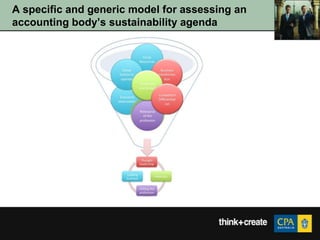
An analysis of the operating and competitive environment
 can enable particular drivers to be grouped, and inturn,
 matched with components of the business model.
The components of the business model are by no means
 static. Each interacts and supports the other. Further,
 changing emphasis can be given to a component based on
 strategic intent and the prominence at any particular time of
 a driver, or group of drivers.
A specific and generic model for assessing an
accounting body‟s sustainability agenda
A specific and generic model for assessing an
accounting body‟s sustainability agenda

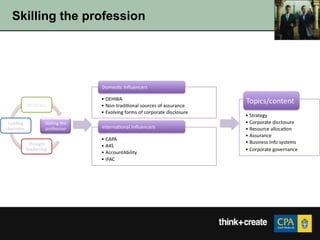
Applying an outcomes oriented approach, the respective
 components of the business model can, and indeed should,
 be understood and evaluated in terms of specific topics or
 content generated.
In contrast to the broader drivers which shape the emphasis
 within the business model, topic and content associated with
 each component are more specifically influenced by factors
 arising at both a domestic and international level.
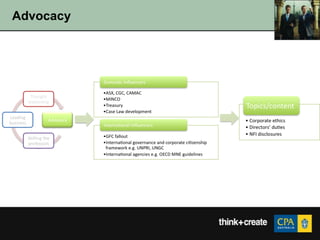
Advocacy

 Underlying these more practical considerations are the imperatives that
  the profession act and promote ethical business conduct. This explains
  the wider attributes of the business model.
 An accounting body‟s advocacy activities are focused on policymakers -
  governments, their departments, agencies and various advisory
  mechanisms – who set the context within which business functions and
  within which accountants are key professionals.
 The performance of many facets of accounting practice are guided by
  codes of ethical conduct and an overarching requirement to act in the
  public interest – themes which are directly reflected in an accounting
  body‟s advocacy activities.
Advocacy
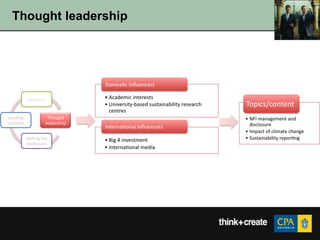
Thought leadership

 One of the critical contributions which professional accounting bodies
  can make is in the domain of contributing to and promoting thought
  leadership.
 Increasingly thought leadership moves beyond largely technical issues
  addressing wider concerns around the proper conduct and purpose of
  business and economic activity.
 The nature of a professional accounting body forms an important bridge
  between academia and the business community, and may serve the
  further practical purpose of promoting informed public debate.
 Ideally, thought leadership both translates advocacy into effective
  business change and contributes to well-informed advocacy.
Thought leadership
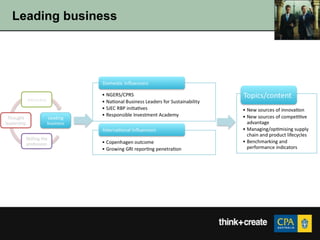
Leading business

 The following quotations emphasis the widely acknowledged reaching of
 a critical turning point in our understanding of how the numerous
 instruments and institutions through which commerce is conducted
 should operate.

 “Today we are in the midst of a rapid global transformation with
 increased demand on corporations to perform not only financially but to
 be good corporate citizens”
 And further;
 “In a world of changing expectations, companies must account for the
 way they impact the communities and environments where the operate.”
 KPMG International Survey of Corporate Responsibility reporting 2008
Leading business

  “Sustainable development will be one of the - if not the most – critical
  drivers of business over the next decade as companies realise that their
  survival hinges on how well they respond to environmental, social and
  governance (ESG) issues.”
  ‘Sustainability key to economic survival’ Sara Rich, The Australian 22
  April 2009

 The commencement of society‟s disentanglement from the cumulative
  negative effect of past actions demands a pivotal role to be played by
  business.
 These developments will take place within appropriate domestic and
  international policy settings.
 Internally, organisation will need to adjust in such critical aspects as how
  they allocate resource and indentify and manage risk.
Leading business
Skilling the profession

   Changes in the global economic environment have direct consequences for how
   accountants are educated across the full spectrum of their professional learning, and
   also, in terms of how they operate within their organisations on a day-to-day basis.

 The critical issue is around how existing skills will be adapted, in contrast to new
  skills developed, to address organisation performance in relation to both the financial
  and non-financial dimensions of business behaviour.
 This will be played out in the practical dimensions of organisation adaptiveness,
  ethics, governance, competitive advantage, reputation and management of risk.
 The aptitudes of awareness, subtlety and capacity to work across traditional
  organisation boundaries focus not only on technical skills, but more importantly on
  those in the areas of leadership, personal and business effectiveness.

   The addressing of these challenges is critical to both future organisation
   effectiveness and ensuring that accountants remain key players within organisations.
Skilling the profession
The shaping of accounting practice into the future


 The multifaceted nature of how the accounting profession can itself
  adapt, and at the same time foster the adaptiveness of business, can be
  looked at from the perspective of how professional bodies recognise
  discrete, though interrelated, areas of skill as part of developing its
  graduate and professional education programs.

 This structure of organising professional accounting skills recognises
  four categories against which respectively nine specific attributes are
  identified. By way of illustration, the nine areas of technical skill and a
  selection of three each of the leadership, personal effectiveness and
  business skills is provided in the following.
The shaping of accounting practice into the future


 Technical skills – tax, financial planning, forensic accounting, financial
  accounting, audit & assurance, insolvency, management accounting, finance/
  financial risk management and corporate governance.
 Leadership skills – strategy, change management and innovation.
 Personal effectiveness skills – results, ethical behaviour and interpersonal skills.
 Business skills – technology, regulatory environment and project management.

  The manner in which changes taking place in the realm of sustainability impacts
  upon the role of accountants in terms of the interaction of different facets of skills
  can be illustrated from the emergence of sustainability reporting. There are of
  course many other areas where these changes are impacting upon the roles of
  accountants – not least supply-chain management and capital investment
  appraisal.
Sustainability reporting and the role of
accountants

  Given the widely accepted benefits of sustainability reporting, emerging
  international trends and the evident significant take-up by leading global
  and Australian companies, CPA Australia has commissioned a soon to
  be released research project The Role of Accountants and Accounting in
  Improving Sustainability Management and Reporting.

  The methodology applied consisted of approximately 100 interviews,
  field study observations and data collection across five organisations.
  The case study organisations were: a large publicly listed insurance
  company, an unlisted construction/ mining company, a listed medium
  size pharmaceutical company a large water utility and a large
  metropolitan council.
Sustainability reporting and the role of
accountants

Some preliminary conclusions from the research project –
 What is actually happening inside reporting organisations.

Some preliminary conclusions from the research project –
 Accounting systems and sustainability data.
Sustainability reporting and the role of
accountants

  This „snap-shot‟ of the current state of play in sustainability reporting is
  not unexpected given its comparatively recent emergence as a major
  component of corporate disclosure.

  The results do however point to how different components of
  accountants‟ skills can be drawn upon to improve the quality and utility
  of sustainability reporting.
In conclusion and to go „full circle‟

 It is irrefutable that there are a multiplicity of factors compelling a
  convergence of understanding of the centrality of sustainability to
  business behaviour.
 This is reflected in Monday‟s announcement of the formalising of
  an alliance between the International Federation of Accountants,
  the Global Reporting Initiative and HRH‟s Accounting for
  Sustainability project, creating the International Integrated
  Reporting Committee.
 The IIRC creates the necessary impetus to give effect to the two
  proposition launched at the May 2010 GRI global sustainability
  conference:
In conclusion and to go „full circle‟

 “By 2015, all large and medium-size companies in OECD countries
 and large emerging economies should be required to report on
 their ESG performance and, if they do not do so, to explain why.

 By 2020, there should be a generally accepted and applied
 international standard which would effectively integrate financial
 and ESG reporting by all organisations.”

Bhert Presentation 4 Aug 1 J Purcell

  • 1.
    An assessment ofkey internal and external drivers shaping professional accounting bodies‟ sustainability agendas John Purcell – Policy Adviser Corporate Regulation
  • 2.
    A specific andgeneric model for assessing an accounting body‟s sustainability agenda A professional accounting body, similar to any at least moderately complex organisation, is impacted upon by a range of drivers occurring within its operating and competitive environment. These drivers are by no means constant with either new drivers emerging or existing drivers changing in intensity. These drivers can inturn be analysed from the perspective of their influence on the business model through which the body operates.
  • 3.
    A specific andgeneric model for assessing an accounting body‟s sustainability agenda An analysis of the operating and competitive environment can enable particular drivers to be grouped, and inturn, matched with components of the business model. The components of the business model are by no means static. Each interacts and supports the other. Further, changing emphasis can be given to a component based on strategic intent and the prominence at any particular time of a driver, or group of drivers.
  • 4.
    A specific andgeneric model for assessing an accounting body‟s sustainability agenda
  • 5.
    A specific andgeneric model for assessing an accounting body‟s sustainability agenda Applying an outcomes oriented approach, the respective components of the business model can, and indeed should, be understood and evaluated in terms of specific topics or content generated. In contrast to the broader drivers which shape the emphasis within the business model, topic and content associated with each component are more specifically influenced by factors arising at both a domestic and international level.
  • 6.
    Advocacy  Underlying thesemore practical considerations are the imperatives that the profession act and promote ethical business conduct. This explains the wider attributes of the business model.  An accounting body‟s advocacy activities are focused on policymakers - governments, their departments, agencies and various advisory mechanisms – who set the context within which business functions and within which accountants are key professionals.  The performance of many facets of accounting practice are guided by codes of ethical conduct and an overarching requirement to act in the public interest – themes which are directly reflected in an accounting body‟s advocacy activities.
  • 7.
  • 8.
    Thought leadership  Oneof the critical contributions which professional accounting bodies can make is in the domain of contributing to and promoting thought leadership.  Increasingly thought leadership moves beyond largely technical issues addressing wider concerns around the proper conduct and purpose of business and economic activity.  The nature of a professional accounting body forms an important bridge between academia and the business community, and may serve the further practical purpose of promoting informed public debate.  Ideally, thought leadership both translates advocacy into effective business change and contributes to well-informed advocacy.
  • 9.
  • 10.
    Leading business Thefollowing quotations emphasis the widely acknowledged reaching of a critical turning point in our understanding of how the numerous instruments and institutions through which commerce is conducted should operate. “Today we are in the midst of a rapid global transformation with increased demand on corporations to perform not only financially but to be good corporate citizens” And further; “In a world of changing expectations, companies must account for the way they impact the communities and environments where the operate.” KPMG International Survey of Corporate Responsibility reporting 2008
  • 11.
    Leading business “Sustainable development will be one of the - if not the most – critical drivers of business over the next decade as companies realise that their survival hinges on how well they respond to environmental, social and governance (ESG) issues.” ‘Sustainability key to economic survival’ Sara Rich, The Australian 22 April 2009  The commencement of society‟s disentanglement from the cumulative negative effect of past actions demands a pivotal role to be played by business.  These developments will take place within appropriate domestic and international policy settings.  Internally, organisation will need to adjust in such critical aspects as how they allocate resource and indentify and manage risk.
  • 12.
  • 13.
    Skilling the profession Changes in the global economic environment have direct consequences for how accountants are educated across the full spectrum of their professional learning, and also, in terms of how they operate within their organisations on a day-to-day basis.  The critical issue is around how existing skills will be adapted, in contrast to new skills developed, to address organisation performance in relation to both the financial and non-financial dimensions of business behaviour.  This will be played out in the practical dimensions of organisation adaptiveness, ethics, governance, competitive advantage, reputation and management of risk.  The aptitudes of awareness, subtlety and capacity to work across traditional organisation boundaries focus not only on technical skills, but more importantly on those in the areas of leadership, personal and business effectiveness. The addressing of these challenges is critical to both future organisation effectiveness and ensuring that accountants remain key players within organisations.
  • 14.
  • 15.
    The shaping ofaccounting practice into the future  The multifaceted nature of how the accounting profession can itself adapt, and at the same time foster the adaptiveness of business, can be looked at from the perspective of how professional bodies recognise discrete, though interrelated, areas of skill as part of developing its graduate and professional education programs.  This structure of organising professional accounting skills recognises four categories against which respectively nine specific attributes are identified. By way of illustration, the nine areas of technical skill and a selection of three each of the leadership, personal effectiveness and business skills is provided in the following.
  • 16.
    The shaping ofaccounting practice into the future  Technical skills – tax, financial planning, forensic accounting, financial accounting, audit & assurance, insolvency, management accounting, finance/ financial risk management and corporate governance.  Leadership skills – strategy, change management and innovation.  Personal effectiveness skills – results, ethical behaviour and interpersonal skills.  Business skills – technology, regulatory environment and project management. The manner in which changes taking place in the realm of sustainability impacts upon the role of accountants in terms of the interaction of different facets of skills can be illustrated from the emergence of sustainability reporting. There are of course many other areas where these changes are impacting upon the roles of accountants – not least supply-chain management and capital investment appraisal.
  • 17.
    Sustainability reporting andthe role of accountants Given the widely accepted benefits of sustainability reporting, emerging international trends and the evident significant take-up by leading global and Australian companies, CPA Australia has commissioned a soon to be released research project The Role of Accountants and Accounting in Improving Sustainability Management and Reporting. The methodology applied consisted of approximately 100 interviews, field study observations and data collection across five organisations. The case study organisations were: a large publicly listed insurance company, an unlisted construction/ mining company, a listed medium size pharmaceutical company a large water utility and a large metropolitan council.
  • 18.
    Sustainability reporting andthe role of accountants Some preliminary conclusions from the research project – What is actually happening inside reporting organisations. Some preliminary conclusions from the research project – Accounting systems and sustainability data.
  • 19.
    Sustainability reporting andthe role of accountants This „snap-shot‟ of the current state of play in sustainability reporting is not unexpected given its comparatively recent emergence as a major component of corporate disclosure. The results do however point to how different components of accountants‟ skills can be drawn upon to improve the quality and utility of sustainability reporting.
  • 20.
    In conclusion andto go „full circle‟  It is irrefutable that there are a multiplicity of factors compelling a convergence of understanding of the centrality of sustainability to business behaviour.  This is reflected in Monday‟s announcement of the formalising of an alliance between the International Federation of Accountants, the Global Reporting Initiative and HRH‟s Accounting for Sustainability project, creating the International Integrated Reporting Committee.  The IIRC creates the necessary impetus to give effect to the two proposition launched at the May 2010 GRI global sustainability conference:
  • 21.
    In conclusion andto go „full circle‟ “By 2015, all large and medium-size companies in OECD countries and large emerging economies should be required to report on their ESG performance and, if they do not do so, to explain why. By 2020, there should be a generally accepted and applied international standard which would effectively integrate financial and ESG reporting by all organisations.”