Page 1 | Proprietary and Copyrighted Information
A Relevant Accountancy
Profession
Sanjay Rughani
CEO, Standard Chartered Bank
Tanzania
Deputy Chair, IFAC Professional
Accountants in Business Committee
NBAA
2 December 2016
Page 2 | Proprietary and Copyrighted Information
Agenda
• The economic and business environment that we face
• What are we trying to achieve?
• A profession contributing to sustainable development
• A profession catching up to a new paradigm - Integrated
thinking and reporting
• Technology and effective risk management
• What does it mean for PAIBs?
• IFAC and the development of the profession
• Communications and leveraging our influence
Page 3 | Proprietary and Copyrighted Information
• Global, regional, and local economic pressures, including:
– Sustainable development agenda
– Post-Brexit IMF global growth downgrade;
– China deceleration, commodity prices, weighing on developing
countries
– Political uncertainty
• Continued concern of threat
of significant failures of
companies & econonmies
• Response: more regulation of
governance, reporting, assurance
Recent Global Outlook
Page 4 | Proprietary and Copyrighted Information
The Issues Facing Business – The Perfect Storm
Globalisation
Talent
Technology /
Digitisation
Urbanisation
Societal
expectations /
Regulations
Environmental
resource
constraints
Page 5 | Proprietary and Copyrighted Information
Leveraging the Experience of the PAIB Committee
Leverage the IFAC PAIB Committee
which helps to:
• Share knowledge, ideas, experiences
• Create effective connections between
IFAC and PAOs on PAIB matters
• Build capacity of IFAC and wider PAIB
community
• Deliver greater value to participants
• Utilize the Report of the PAIB
Committee Meetings and Actions for
PAOs; see http://www.ifac.org/about-
ifac/professional-accountants-business
Page 6 | Proprietary and Copyrighted Information
What Are We Working Towards?
Work towards better public sector and
business – trusted for a better society
PAIBs with credibility and visibility in their
organisations
PAIBs and professionalism seen as helping
organisations respond to the challenges they
face
Page 7 | Proprietary and Copyrighted Information
A Profession Contributing to Development
The Sustainable Development Goals
The 2030 Agenda for Sustainable
Development: A Snapshot of the
Accountancy Profession’s Contribution
- Publication out.
“It is important for our profession to be
conscious of how we contribute, both
directly and indirectly, to the Goals. The
skillset, experience, and influence
professional accountants possess
gives them enormous scope to shape
solutions to sustainable development
challenges.”
IFAC CEO, Fayez Choudhury
Page 8 | Proprietary and Copyrighted Information
• Boost the talent pool
• Contribute to societal goals, e.g., financial literacy
• Enable equal access to the profession
Example
Goal 4: Quality Education
Page 9 | Proprietary and Copyrighted Information
• Accountancy linked to prosperity and improved
living
– Nexus 2: The Accountancy Profession—A
Global Value Add
• Quality accounting professionals contributing to
economic growth on a sustainable basis
• Commitment to build capacity of the profession
Example
Goal 8: Decent Work and Economic Growth
Page 10 | Proprietary and Copyrighted Information
• Advocate for good
governance focused on
smart regulation, rule of
law, and well functioning
national institutions
• Enhance the capacity of
accountants to contribute
their expertise to
implementing governance
and controls that hinder
fraud, corruption, and
money laundering
Relevant for Africa – Key Areas Include…
SDGs
Page 11 | Proprietary and Copyrighted Information
• Promote the importance of external public sector
auditing in monitoring and reporting on national efforts to
implement the SDGs and their targets
• Accelerate efforts to influence and drive sound public
sector governance and financial management
• Facilitate the profession’s contribution to integrated
reporting as a means to rebalance economic and capital
market decision making in favor of long-term value
creation and investment
Relevant for Africa – Key Areas Include…
SDGs
Page 12 | Proprietary and Copyrighted Information
Credit: The New Yorker
Sustainable Organizations, Markets, Economies
Page 13 | Proprietary and Copyrighted Information
The Profession Catching Up to a New Paradigm
Source: OCEAN TOMO LLC
January,1,2015
Page 14 | Proprietary and Copyrighted Information
Pacioli created a lens through which a business and
its performance could be viewed and a way to hold
its owners to account.
While Pacioli’s focus was purely financial, Mervyn
King spearheaded a multi-capital approach to reflect
how value is created in a knowledge-based
resource constrained global economy.
—Paul Druckman, Financial Management, March 2016
From Pacioli to King
Page 15 | Proprietary and Copyrighted Information
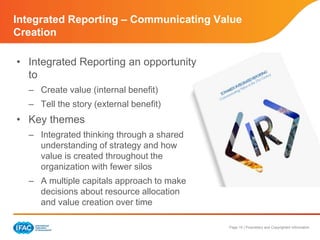
• Integrated Reporting an opportunity
to
– Create value (internal benefit)
– Tell the story (external benefit)
• Key themes
– Integrated thinking through a shared
understanding of strategy and how
value is created throughout the
organization with fewer silos
– A multiple capitals approach to make
decisions about resource allocation
and value creation over time
Integrated Reporting – Communicating Value
Creation
Page 16 | Proprietary and Copyrighted Information
IFAC publication:
• Vision and Framework for
Integrated Thinking
• Explores contribution of finance
professionals - enabling the
business partner agenda
• Ensures a focus on the
information and decisions that
matter to the organization and
its potential success
• Enhances the relevance of
finance professionals
Creating Value with Integrated Thinking
Page 17 | Proprietary and Copyrighted Information
Public company reporting has
become so complicated that what
matters to investors can get lost.
Our priority is to provide
meaningful information that all
investors can readily access. For
investors to make investment and
voting decisions, we don’t believe
that more information is
necessarily better. Instead, we’ve
challenged ourselves to provide
better information…
—Jeff Immelt, GE 2015
Integrated Summary Report
<IR> – Telling the Story
Page 18 | Proprietary and Copyrighted Information
• A profession engaged and
connected
• Exchanging ideas, knowledge
and experiences
• Sharing resources
• Get involved:
– Quarterly webinars
– Network webpage http://www.ifac.org/about-ifac/professional-
accountants-business/integrated-reporting-pao-network
• Lead contact Michael Nugent – michaelnugent@ifac.org
<IR> Network for
Professional Accountancy Organizations
Page 19 | Proprietary and Copyrighted Information
Tech Impacting Business & the Finance Function
• PAIB Committee discussions covering
– Technology, outsourcing, finance business partnering, talent
management & career pathways
• Tech driving massive change & challenging relevance to
business
– Automation of roles
– Competition for PAIB space – risk, data scientists etc
– Impact on finance functions and career pathways
• PAO implications – providing members with relevant skills
Page 20 | Proprietary and Copyrighted Information
Technology and Digital Capability
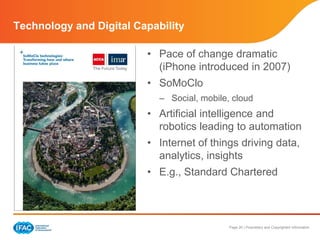
• Pace of change dramatic
(iPhone introduced in 2007)
• SoMoClo
– Social, mobile, cloud
• Artificial intelligence and
robotics leading to automation
• Internet of things driving data,
analytics, insights
• E.g., Standard Chartered
Page 21 | Proprietary and Copyrighted Information
From Bolt-on to Built-in – Effective Approach
to Risk
• Managing Risk as an
Integral Part of Managing an
Organization
• From bolt-on to built-in: fully
integrating management of
risk into our organizational
planning & control cycles
• Establishing risk
management capabilities of
PAIBs to achieve
organizational objectives
Page 22 | Proprietary and Copyrighted Information
What does it mean for
PAIBs?
A Relevant Profession
Page 23 | Proprietary and Copyrighted Information
• Shifting emphasis from
maximizing profits for
shareholders to maintaining value
creation in a sustainable manner
• Professional accountants as chief
value officers can facilitate an
understanding of value creation in
an organization
Chief Financial Officer to Chief Value Officer
Page 24 | Proprietary and Copyrighted Information
An Evolution for the Finance Function – Financial
Reporting to Integrated Reporting
My main task is only to make sure the
numbers are right.
My main task is to make sure
numbers make sense.
My main task is to manage
information flows.
My main task is to explain how we
create value with our capitals.
My main task is to make sure we
think integrated.
Page 25 | Proprietary and Copyrighted Information
Delivering Value to Organizations
• PAIBs need to build on their deep financial acumen by
developing skills and competencies needed
• Helping us to
– Apply our professional qualities in complex and uncertain
environments
– Be strategically aware and with business understanding to enable
our effective contribution to the achievement of business objectives
– Engage in emerging areas such as Integrated Reporting, managing
uncertainty and risk, and performance management & analytics
• Engage IFAC, PAFA and NBAA for support
Page 26 | Proprietary and Copyrighted Information
IFAC and the
Profession
The Development of the Profession
Page 27 | Proprietary and Copyrighted Information
IFAC Overview
Strengthening Organizations, Advancing Economies
Page 28 | Proprietary and Copyrighted Information
Strengthening Organizations, Advancing
Economies
IFAC Member Bodies
IFAC Associates
PAO established
No PAO
The Profession in Africa
Page 29 | Proprietary and Copyrighted Information
PAO Capacity Building
IFAC has a long history of building capacity and strengthening
professional accountancy organizations (PAOs). Well-equipped
PAOs ensure a sustainable supply of professional accountants
that support high-quality accounting practices and financial
information in both the public and private sectors.
We are focused on continuous engagement with the profession
in Africa. Together, we can ensure that the profession is
relevant in the context of the fast-changing world around us.
Through collaboration and sharing of knowledge and
experiences, our collective leadership will ultimately help Africa
deal with the challenges of sustainable development.
Page 30 | Proprietary and Copyrighted Information
PAO Capacity Building
Engaging Professional Accountants
in Business: How to Build a More
Relevant PAO and Profession
- Publication out as part of PAO Capacity
Building Guidance Series
- Capacity Building Program supporting
the development and growth of PAOs
around the world including managing
peer-to-peer projects to support PAOs
including in Ghana, Rwanda, and
Uganda using a grant from the UK
Department for International
Development
Page 31 | Proprietary and Copyrighted Information
Communications and Leveraging our Influence
• To support a strong profession with a powerful voice in
areas including
– Combatting fraud and corruption
– Beyond financial reporting
– Fairness in corporate taxation
– Encouraging high quality and smart regulation
– Sound public and private sector governance and financial
management
– Contribution of professional accountants to sustainable
organizations, markets and economies
Page 32 | Proprietary and Copyrighted Information
• www.ifac.org/gateway
• News, views,
resources, thought
leadership, Knowledge
Sharing
• Leverage the
Gateway!
IFAC Global Knowledge Gateway
Register on the Gateway to:
• Get The Latest, a customizable update
sent 2x per month
• Join & initiate discussions
• Recommend viewpoints & discussions
• Suggest new content
Page 33 | Proprietary and Copyrighted Information
Questions
www.ifac.org

A Relevant Accountancy Profession

  • 1.
    Page 1 |Proprietary and Copyrighted Information A Relevant Accountancy Profession Sanjay Rughani CEO, Standard Chartered Bank Tanzania Deputy Chair, IFAC Professional Accountants in Business Committee NBAA 2 December 2016
  • 2.
    Page 2 |Proprietary and Copyrighted Information Agenda • The economic and business environment that we face • What are we trying to achieve? • A profession contributing to sustainable development • A profession catching up to a new paradigm - Integrated thinking and reporting • Technology and effective risk management • What does it mean for PAIBs? • IFAC and the development of the profession • Communications and leveraging our influence
  • 3.
    Page 3 |Proprietary and Copyrighted Information • Global, regional, and local economic pressures, including: – Sustainable development agenda – Post-Brexit IMF global growth downgrade; – China deceleration, commodity prices, weighing on developing countries – Political uncertainty • Continued concern of threat of significant failures of companies & econonmies • Response: more regulation of governance, reporting, assurance Recent Global Outlook
  • 4.
    Page 4 |Proprietary and Copyrighted Information The Issues Facing Business – The Perfect Storm Globalisation Talent Technology / Digitisation Urbanisation Societal expectations / Regulations Environmental resource constraints
  • 5.
    Page 5 |Proprietary and Copyrighted Information Leveraging the Experience of the PAIB Committee Leverage the IFAC PAIB Committee which helps to: • Share knowledge, ideas, experiences • Create effective connections between IFAC and PAOs on PAIB matters • Build capacity of IFAC and wider PAIB community • Deliver greater value to participants • Utilize the Report of the PAIB Committee Meetings and Actions for PAOs; see http://www.ifac.org/about- ifac/professional-accountants-business
  • 6.
    Page 6 |Proprietary and Copyrighted Information What Are We Working Towards? Work towards better public sector and business – trusted for a better society PAIBs with credibility and visibility in their organisations PAIBs and professionalism seen as helping organisations respond to the challenges they face
  • 7.
    Page 7 |Proprietary and Copyrighted Information A Profession Contributing to Development The Sustainable Development Goals The 2030 Agenda for Sustainable Development: A Snapshot of the Accountancy Profession’s Contribution - Publication out. “It is important for our profession to be conscious of how we contribute, both directly and indirectly, to the Goals. The skillset, experience, and influence professional accountants possess gives them enormous scope to shape solutions to sustainable development challenges.” IFAC CEO, Fayez Choudhury
  • 8.
    Page 8 |Proprietary and Copyrighted Information • Boost the talent pool • Contribute to societal goals, e.g., financial literacy • Enable equal access to the profession Example Goal 4: Quality Education
  • 9.
    Page 9 |Proprietary and Copyrighted Information • Accountancy linked to prosperity and improved living – Nexus 2: The Accountancy Profession—A Global Value Add • Quality accounting professionals contributing to economic growth on a sustainable basis • Commitment to build capacity of the profession Example Goal 8: Decent Work and Economic Growth
  • 10.
    Page 10 |Proprietary and Copyrighted Information • Advocate for good governance focused on smart regulation, rule of law, and well functioning national institutions • Enhance the capacity of accountants to contribute their expertise to implementing governance and controls that hinder fraud, corruption, and money laundering Relevant for Africa – Key Areas Include… SDGs
  • 11.
    Page 11 |Proprietary and Copyrighted Information • Promote the importance of external public sector auditing in monitoring and reporting on national efforts to implement the SDGs and their targets • Accelerate efforts to influence and drive sound public sector governance and financial management • Facilitate the profession’s contribution to integrated reporting as a means to rebalance economic and capital market decision making in favor of long-term value creation and investment Relevant for Africa – Key Areas Include… SDGs
  • 12.
    Page 12 |Proprietary and Copyrighted Information Credit: The New Yorker Sustainable Organizations, Markets, Economies Sustainable Organizations, Markets, Economies
  • 13.
    Page 13 |Proprietary and Copyrighted Information The Profession Catching Up to a New Paradigm Source: OCEAN TOMO LLC January,1,2015
  • 14.
    Page 14 |Proprietary and Copyrighted Information Pacioli created a lens through which a business and its performance could be viewed and a way to hold its owners to account. While Pacioli’s focus was purely financial, Mervyn King spearheaded a multi-capital approach to reflect how value is created in a knowledge-based resource constrained global economy. —Paul Druckman, Financial Management, March 2016 From Pacioli to King
  • 15.
    Page 15 |Proprietary and Copyrighted Information • Integrated Reporting an opportunity to – Create value (internal benefit) – Tell the story (external benefit) • Key themes – Integrated thinking through a shared understanding of strategy and how value is created throughout the organization with fewer silos – A multiple capitals approach to make decisions about resource allocation and value creation over time Integrated Reporting – Communicating Value Creation
  • 16.
    Page 16 |Proprietary and Copyrighted Information IFAC publication: • Vision and Framework for Integrated Thinking • Explores contribution of finance professionals - enabling the business partner agenda • Ensures a focus on the information and decisions that matter to the organization and its potential success • Enhances the relevance of finance professionals Creating Value with Integrated Thinking
  • 17.
    Page 17 |Proprietary and Copyrighted Information Public company reporting has become so complicated that what matters to investors can get lost. Our priority is to provide meaningful information that all investors can readily access. For investors to make investment and voting decisions, we don’t believe that more information is necessarily better. Instead, we’ve challenged ourselves to provide better information… —Jeff Immelt, GE 2015 Integrated Summary Report <IR> – Telling the Story
  • 18.
    Page 18 |Proprietary and Copyrighted Information • A profession engaged and connected • Exchanging ideas, knowledge and experiences • Sharing resources • Get involved: – Quarterly webinars – Network webpage http://www.ifac.org/about-ifac/professional- accountants-business/integrated-reporting-pao-network • Lead contact Michael Nugent – michaelnugent@ifac.org <IR> Network for Professional Accountancy Organizations
  • 19.
    Page 19 |Proprietary and Copyrighted Information Tech Impacting Business & the Finance Function • PAIB Committee discussions covering – Technology, outsourcing, finance business partnering, talent management & career pathways • Tech driving massive change & challenging relevance to business – Automation of roles – Competition for PAIB space – risk, data scientists etc – Impact on finance functions and career pathways • PAO implications – providing members with relevant skills
  • 20.
    Page 20 |Proprietary and Copyrighted Information Technology and Digital Capability • Pace of change dramatic (iPhone introduced in 2007) • SoMoClo – Social, mobile, cloud • Artificial intelligence and robotics leading to automation • Internet of things driving data, analytics, insights • E.g., Standard Chartered
  • 21.
    Page 21 |Proprietary and Copyrighted Information From Bolt-on to Built-in – Effective Approach to Risk • Managing Risk as an Integral Part of Managing an Organization • From bolt-on to built-in: fully integrating management of risk into our organizational planning & control cycles • Establishing risk management capabilities of PAIBs to achieve organizational objectives
  • 22.
    Page 22 |Proprietary and Copyrighted Information What does it mean for PAIBs? A Relevant Profession
  • 23.
    Page 23 |Proprietary and Copyrighted Information • Shifting emphasis from maximizing profits for shareholders to maintaining value creation in a sustainable manner • Professional accountants as chief value officers can facilitate an understanding of value creation in an organization Chief Financial Officer to Chief Value Officer
  • 24.
    Page 24 |Proprietary and Copyrighted Information An Evolution for the Finance Function – Financial Reporting to Integrated Reporting My main task is only to make sure the numbers are right. My main task is to make sure numbers make sense. My main task is to manage information flows. My main task is to explain how we create value with our capitals. My main task is to make sure we think integrated.
  • 25.
    Page 25 |Proprietary and Copyrighted Information Delivering Value to Organizations • PAIBs need to build on their deep financial acumen by developing skills and competencies needed • Helping us to – Apply our professional qualities in complex and uncertain environments – Be strategically aware and with business understanding to enable our effective contribution to the achievement of business objectives – Engage in emerging areas such as Integrated Reporting, managing uncertainty and risk, and performance management & analytics • Engage IFAC, PAFA and NBAA for support
  • 26.
    Page 26 |Proprietary and Copyrighted Information IFAC and the Profession The Development of the Profession
  • 27.
    Page 27 |Proprietary and Copyrighted Information IFAC Overview Strengthening Organizations, Advancing Economies
  • 28.
    Page 28 |Proprietary and Copyrighted Information Strengthening Organizations, Advancing Economies IFAC Member Bodies IFAC Associates PAO established No PAO The Profession in Africa
  • 29.
    Page 29 |Proprietary and Copyrighted Information PAO Capacity Building IFAC has a long history of building capacity and strengthening professional accountancy organizations (PAOs). Well-equipped PAOs ensure a sustainable supply of professional accountants that support high-quality accounting practices and financial information in both the public and private sectors. We are focused on continuous engagement with the profession in Africa. Together, we can ensure that the profession is relevant in the context of the fast-changing world around us. Through collaboration and sharing of knowledge and experiences, our collective leadership will ultimately help Africa deal with the challenges of sustainable development.
  • 30.
    Page 30 |Proprietary and Copyrighted Information PAO Capacity Building Engaging Professional Accountants in Business: How to Build a More Relevant PAO and Profession - Publication out as part of PAO Capacity Building Guidance Series - Capacity Building Program supporting the development and growth of PAOs around the world including managing peer-to-peer projects to support PAOs including in Ghana, Rwanda, and Uganda using a grant from the UK Department for International Development
  • 31.
    Page 31 |Proprietary and Copyrighted Information Communications and Leveraging our Influence • To support a strong profession with a powerful voice in areas including – Combatting fraud and corruption – Beyond financial reporting – Fairness in corporate taxation – Encouraging high quality and smart regulation – Sound public and private sector governance and financial management – Contribution of professional accountants to sustainable organizations, markets and economies
  • 32.
    Page 32 |Proprietary and Copyrighted Information • www.ifac.org/gateway • News, views, resources, thought leadership, Knowledge Sharing • Leverage the Gateway! IFAC Global Knowledge Gateway Register on the Gateway to: • Get The Latest, a customizable update sent 2x per month • Join & initiate discussions • Recommend viewpoints & discussions • Suggest new content
  • 33.
    Page 33 |Proprietary and Copyrighted Information Questions
  • 34.

Editor's Notes

  • #4 The Sustainable Development Goals – turning these into national policy initiatives will impact business. The Goals represent an agenda for people, planet, and prosperity that will guide the actions and financing decisions of governments and business. They are putting into the spotlight the need for responsible business through accountable governance and accountable relationships as a fundamental premise of capital and financial markets.   This sustainable development agenda is in the context of low growth. Brexit has global economic implications – every medium term forecast is expecting a slow down in 2017 and despite indicators showing continued growth of the UK economy now, partly because of the drop in the £, next year and 2018 has to present challenges. The sustainable development agenda must be viewed as a business opportunity to innovate and improve value creation over time.   Interest rate policy divergence between USA and the rest of the western world – expected rising in Fed interest rates vs. continued cuts to zero and negative interest rates in the other western economies – EU, UK, etc over the next 6 months will present challenges but also what innovations in financial products for business might this drive. Quant Easing – what is going to be the long term effect of all this QE – where is the new normality and when will it emerge. Such large scale QE has never been done before, never seen such large scale interventions – the latest QE by the BoE has significantly increased UK national debt.   The next Uber disruptor – heavy expectations are that the most significant of these, again a next generation, will emerge from the UK high tech centre in the lower part of North London – where else are these hot spots and how can conventional business models adapt and prepare better for the wave of the unexpected. This is a big wave than we have seen at any point in time since the Spinning Jenny and Jethro Tull  
  • #5 The Middle East and Gulf countries of course have specific challenges at this time with a challenging environment for economic growth and government spending. More broadly, the role of professional accountants in business and finance leaders in particular is more expansive, involved and complex because the business world is increasingly complex. We experiencing constant regulatory change, and the speed of technological change is mind-boggling.  The trends and issues facing are things that we have to help our organizations respond to. Twenty years ago, personal computers were becoming small and affordable enough for families to buy for home use. Ten years ago there were no iPads… iPhones… or social media. IBM’s Watson computer—just an idea less than 10 years ago—can now diagnose cancer faster than any human. Anyone with a smartphone has more computing power than NASA did in 1985. Technology will be increasingly woven into the fabric of our profession. Professionals and firms must become experts in order to ensure relevance. We’ll need to advise clients and employers on technology tools, and leverage them to our advantage. Impact of digital world is bringing about major structural change through greater mobile technology, connectivity and volumes/speed of data. The world’s stock of data is doubling every 20 months while the number of internet-connected devices has reached 12bn and mobile phone payments are expected to exceed $1trn by 2017. McKinsey identified 12 disruptive technologies which could have potential impact of $14-33trn per year in 2025. These developments facilitate a data-driven and technological era of business – leading to new business models and creating greater potential for customisation. For accountants, digitisation and disruptive technology are key challenges for their role in organizations. Other key trends include ‘trust in business’, need for better regulation, and attracting talent. In terms of the Middle East, some of these trends and issues present specific challenges for business leaders and government: Geopolitical risk and the impact on business and trade Increasing regulatory and compliance requirements, and taxation, e.g., VAT Creating jobs for the young For governments: Enhancing public financial management, including improved accounting and reporting arrangements, is essential to supporting more effective and efficient public services, increasing economic growth and minimising the incidence of fraud and corruption. Accountants will have a significant role to play in helping the region to address weak accountability mechanisms and need for transparency.
  • #6  The creative and innovative approach to our meetings enables the crowd-sourcing of knowledge, ideas and experiences for IFAC and the profession. Impactful knowledge sharing of innovative practices in the organizations that committee members work for provides invaluable feedback and insights on emerging themes and trends. Insights from the meeting then: Feed into existing initiatives, shaping their direction Transformed into outputs that are shared widely, including this meeting report and the Global Knowledge Gateway Used to identify issues requiring further exploration at subsequent meetings, and by the profession
  • #7 Our focus is on accountants facilitating better business and public sector – trusted for a better society PAIBs/finance leaders seen as part of the solution PAIBs with credibility and visibility in their organizations Underlying message focused on PAIB relevance & skills
  • #13 A public interest About better reporting and management but there is a broader societal agenda. Time has gone where business can privatize wealth at the same time as allowing society to pick up the risks of negative impacts. All elements of society have to benefit from wealth creation.
  • #14 A professional interest – we need to remain relevant to a changing business landscape and higher expectations The profession catching up to a world where value is mainly the outcome of assets which are not on the balance sheet. Link to relevance. The Most Important Determinants of Value This graph shows the break up of the market capitalization of S&P’s top 500 US companies. It shows that 40 years ago over 80% of market cap was explained by net assets in the f/s. Now that position has completely reversed less than 20% can be explained through the balance sheet. What explains the rest? Other factors, such as relationships, intellectual and human capital, make up an increasing proportion of a company’s value. INSTEAD OF FOCUSING ON FINACIAL CAPITAL, <IR> INTRODUCED A MULTILE CAPITALS MODEL. SOME CALL THE DIFFERENCE INTELLECTUAL CAPITAL – <IR> BREAKS THAT DOWN SLIGHTLY DIFFERENTLY, BUT THE RESULT IS SIMILAR. <IR> enables the clear and concise communication of value creation, allowing investors to evaluate how all relevant capitals that a business uses and affects are incorporated. The IIRC is not trying to monetize everything (which is a common misperception), but rather is trying to ensure investors have the information they need to assess the ability of an organization to create value over time.
  • #18 GE (General Electric) Transformation to a digital industrial business model “Shows investors GE through the lens of management”
  • #21 Why are we interested in tech Digitalization of economies is an opportunity and risk for the profession PAIBs need new skills and competence around tech if they are to add value in this space Tech innovation goes hand in hand with finance transformation and IR Tech firms are competitors for millennials SoMoClo build on each other and allow for easier interaction and accessibility Financial tech that can have a significant impact on the way financial resources are accessed, moved and managed e.g., payment systems and mobile money Innovation in data – capture, process, store, analyse, visualize, and share AI and robotics leading to automation – impacting both finance but also how people do business and how value is delivered to customers Internet of things – physical things and industrial processes connected to the internet Example: American Express Business Travel, integrated solution Cloud delivery model: Scalable Adaptable and flexible Lower cost of ownership From reporting to customer centric real time metrics and performance insights Accounting and financials integrated in the system Drill down on topics e.g., how technology impacting organizational business models and PAIBs Future of work and / or future of learning and education
  • #22 VT
  • #24 Mervyn King is publishing a new book “Chief Value Officer”, which puts forward the role of CFO as changing from maximizing profits for shareholders to maintaining value creation in a sustainable manner. Mervyn is putting forward the CFO as now more of a value officer than a financial officer. Consequently, the CFO should be known as the Chief Value Officer. The basis of this perspective is:   The information and analysis they provide to support decisions needs to include a better, more expansive understanding of the disparate sources and drivers of longer term value to enable better strategy and implementation through changes to the business model. Financial statements on their own are critical but not sufficient in discharging the board’s duty to be accountable. Integrated thinking and reporting provides a way and an additional incentive for CFOs, and their finance teams, to focus on the information and the decisions that matter to the company and its potential success. Professional accountants as chief value officers can facilitate an understanding of value creation in a company.
  • #25 How GENERALI the global insurance company describes its transition to Integrated thinking and reporting
  • #26 PAIBs need to build on their deep financial acumen underpinned by accounting and analysis skills by developing professional skills and competences needed in terms of Applying their professional qualities in complex and uncertain environments, This has implications for professional judgment, which is more important than ever, and ethical leadership Strategic awareness and business understanding to enable their effective contribution to the achievement of business objectives Feeling comfortable working in emerging areas such as in business reporting (e.g., <IR>), the integration of risk and control into governance and management systems, and performance management (e.g., big data) Engage with the ICAP PAIB Committee for support and utilize resources such as the Global Knowledge Gateway.
  • #28 27
  • #29 When you dig a little deeper, the map of Africa and professional accountancy organization (PAO) development really looks more like this. As many of you are aware, there is a great deal of activity going on regionally in Africa—PAOs being established, PAOs mentoring each other, collaborating, cooperating, sharing knowledge. For example, Ordre National des Experts Comptables et Comptables Agréés du Sénégal, which became an IFAC member in 2013, is helping L’Ordre des Experts Comptables agréés de Guinée in its capacity building and growth initiatives. The Institute of Chartered Accountants (Ghana) worked hand in hand with Ordre National des Experts-Comptables et Comptables Agréés du Togo on its application with IFAC—resulting in ONECCA becoming an IFAC associate in 2013. In all parts of the world this idea of like helping like is important to growth and development; this is certainly true in accountancy and certainly true in Africa. But we also know there is more to be done and quite a few PAOs that need more help before they are ready to make the commitments embodied in the IFAC Statements of Membership Obligations. And there are countries in Africa who don’t yet have an established PAO—where the accountancy profession is still in fledgling stages. All of which is to say, at IFAC, we are fully aware of the growth and development already going on in Africa. Your regional body, PAFA, also has as one of its strategic objectives, the need for PAO capacity building, and is working with PAOs to facilitate adherence to the IFAC SMOs. We encourage PAOs to become members/associates of PAFA in preparing for membership of IFAC.
  • #30 29
  • #33 Knowledge sharing enabled by the IFAC Global Knowledge Gateway, a platform designed to bring together news, views, resources, and thought leadership for the worldwide accountancy profession – launched in 2014 and for use by PAOs. The Gateway allows professionals to access resources from around the world learn about emerging areas of the profession stay connected to the most pressing accountancy issues and news of the day interact by exchanging views, making recommendations, and sharing information and resources. Ten topic areas: Business reporting Ethics Financial leadership & development Governance Performance and financial management Risk management & internal control Sustainability Audit & assurance Practice management Islamic Finance The Latest is a bi-weekly newsletter which summarizes the news, resources and discussions added every two weeks. You can tailor the e-mail to focus on some or all of the above areas. To register visit www.ifac.org.