BUSINESS SUSTAINABILITY
AND ACCOUNTABILITY
REPORTING
Zabihollah Rezaee, PhD, CPA, CMA,
CIA, CFE, CGFM, CSOXP, CGOVP,
CGRCP
And
James M. Lukawitz, PhD, CPA
The University of Memphis
2011 Global Finance Conference in
Bangkok, Thailand, April 3-5, 2011
Introduction
• In today’s business environment, global businesses are under close scrutiny and profound
pressure from lawmakers, regulators, the investment community, and their diverse
stakeholders to focus on sustainability and accept accountability and responsibility for their
multiple bottom lines (MBL) of economic, governance, social, ethical, and environmental
(EGSEE) performance.
• Sustainability is the process of integrating economic, governance, social ethics, and
environmental (EGSEE) dimensions into all the decision-making and accountability
processes and measuring and reporting log-term and enduring performance in all EGSE E
areas.
• This definition suggests that all sustainability performance factors (EGSEE) add value and
thus internalizes some environmental, ethics, governance and social factors that have not
traditionally been reported in the conventional corporate reporting.
• Business sustainability is a process of enabling organizations to design and implement
strategies that contribute to enduring performance in all EGSEE areas.
• Business sustainability not only ensures long-term profitability and competition advantage
but also help in maintaining the well-being of the society, the planet and people.
• Business sustainability and corporate accountability is all about adding value in all areas of
economic, ethics, governance, social and environmental (EGSEE) matters and events.
• Many public companies are now voluntarily manage, measure, recognize and disclose
their commitment and events and transactions relevant to EGSEE.
Proposes Of presentation
• Define Business Sustainability.
• Discuss Dimensions of Business Sustainability
(EGSEE) and Demand for EGSEE performance
• Present Accounting and Assurance of Sustainability
Reporting.
• Present Results of a Survey Conducted To
Determine the Value of Sustainability Reporting.
• Much of the Presentation is from Z. Rezaee
“Business Sustainability and Accountability
Reporting” forthcoming Book, John Wiley & Sons,
2011.
Demand for Business
Sustainability
• The 2007-2008 financial crisis, its resulted economic downturn and regulatory responses along with
global competition encourage organizations of all types and sizes to pay a keen attention to their
sustainability programs composes of EGSEE activities.
• In the post-financial crisis and new regulatory framework era, corporations are under more pressure
from variety of stakeholders to provide accurate, reliable and relevant financial and non-financial
information pertaining to their economic performance, strategic objectives, governance, risk and social
responsibility.
• On May 4, 2010, the International Federation of Accountants (IFAC) and the Prince’s Accounting for
Sustainability (A4S) Project agreed to collaborate in promoting sustainability organizations .
• Particularly the IFAC and A4S’ sustainability project addresses:
• “Raising awareness and facilitating sharing and collaboration across the global accountancy community,
for example, through the development of a community website for professional accountancy
organizations, business leaders, academics, and other experts to exchange ideas and share good
sustainability practice;
• Establishing an international integrated reporting committee to develop a new reporting model that will
better reflect the interconnected impact of financial, environmental, social, and governance factors on
the long-term performance and condition of an organization; and
• Incorporating accounting for sustainability within professional training and education.”
What sustainability means in practice?
• Minimize or eliminate negative impact on nature
and natural resources
• Apply natural processes and technologies, which
regenerate nature
• Respect human and social values and interests
(employees, consumers, local communities)
• Listen to signals from society and environmen.
The balance of ecological and social footprint
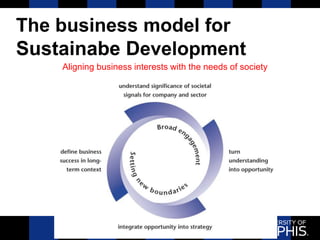
The business model for
Sustainabe Development
Aligning business interests with the needs of society
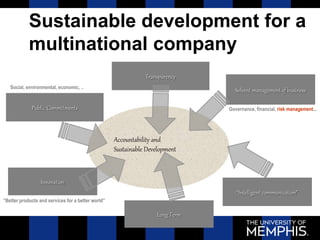
Sustainable development for a
multinational company
Solvent management of business
Governance, financial, risk management...
Long Term
“Intelligent communication”
Transparency
Innovation
“Better products and services for a better world”
Public Commitments
Social, environmental, economic, ..
Accountability and
Sustainable Development
Benefits of Sustainabe
Development strategy
• Helps Opportunity to detect new products and
services
“Better products for a better world”
• Efficient way to transmit and strengthen business
culture
• Useful tool to manage risk properly …
… in a changing world
• Key issue to make an impact on our positive
reputation
• Way to share useful information with stakeholders…
Advantages of applying corporate
sustainability
 Helps preparing for environmental and social risks as well as for
seizing business opportunities
 Implementing substantial cost savings
 Inspires creativity for developing new products and services
 Reaching new markets and customers
 Strengthens corporate image and reputation internally and externally
 Motivation for the employees
 Differentiates from competitors
 Positive social and/or environmental impact
Major obstacles
 No real understanding of the importance of SD by
managers
 Confusion around CSR and sustainable
development
 Lack of real pressure from demand side (consumer
awareness)
 No obvious links between corporate sustainability
and financial performance
 Lack of generally accepted benchmarks and
indicators for measuring coprorate sustainability
Main areas
 Energy and climate change
 Poverty and inclusive business
 Business role in tomorrow’s society
 Ecosystem services
 Technology and innovation
 Accountability, transparency, governance
 Human rights
 Corporate social responsibility
 Ethical behavior
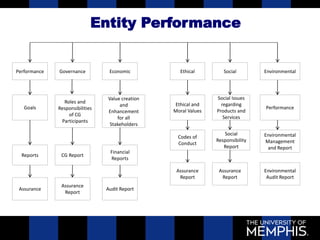
Entity Performance
Performance
Goals
Governance
Roles and
Responsibilities
of CG
Participants
Economic
Value creation
and
Enhancement
for all
Stakeholders
Reports
Assurance
CG Report
Assurance
Report
Audit Report
Financial
Reports
Ethical
Ethical and
Moral Values
Codes of
Conduct
Assurance
Report
Social
Social Issues
regarding
Products and
Services
Social
Responsibility
Report
Assurance
Report
Environmental
Environmental
Audit Report
Environmental
Management
and Report
Performance
Accounting for business
sustainability
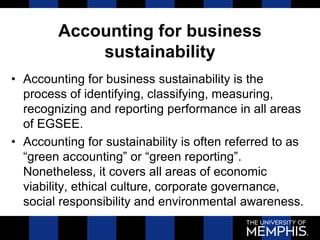
• Accounting for business sustainability is the
process of identifying, classifying, measuring,
recognizing and reporting performance in all areas
of EGSEE.
• Accounting for sustainability is often referred to as
“green accounting” or “green reporting”.
Nonetheless, it covers all areas of economic
viability, ethical culture, corporate governance,
social responsibility and environmental awareness.
Assurance Standards in Sustainability Reporting
• Assurance standards on different dimensions of sustainability performance very
in terms of vigorousness and general acceptability.
• auditing standards either PCAOB Auditing standards in the United States of
International Auditing and Assurance Standards (IAAS) governing reporting and
assurance on economics activities.
• Assurance standards on other dimensions of sustainability including
governance, ethics, social and environmental standards are yet to be fully-
developed and globally accepted.
• The International Standard on Assurance Engagements (ISAE) 3000 issued by
the IAAS Board in 2004 provides guidance for assurance on non-financial
dimension of sustainability.
• AA1000AS issued in 2008 by the AccountAbility (AA) a global nonprofit
organization that established management, reporting and assurance guidance
for nonfinancial dimensions of sustainability performance.
• American Certified Public Accountants (AICPA) AT 101.
• The Canadian Institute of Charted Accountants (CICA) Handbook Section 5025.
Method and Procedures
• Three methods are used in gathering data pertaining to sustainability reporting.
• First, we review the related literature, including published papers and
publications of professional organizations, in gathering information in developing
different sections of the questionnaire.
• Second, we conduct a survey of accounting practitioners participated at the
professional meetings of local chapters of Certified Public Accountants (CPA),
Institute of Internal Auditors (IIA) and Institute of Management Accountants
(IMA) in both Midsouth and Southwest regions.
• We prepared, pilot-tested, revised, and then submitted the questionnaire to the
participants.
• The instrument was pilot-tested using an MBA class in the Midsouth region of
the United States.
• Finally, we examined the financial statements for the Fortune 100 US
Companies to determine their sustainability disclosures and their use of the GRI
procedures.
RESULTS
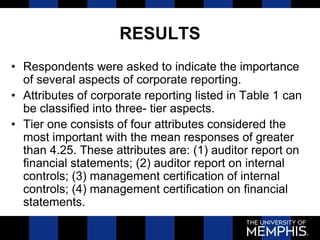
• Respondents were asked to indicate the importance
of several aspects of corporate reporting.
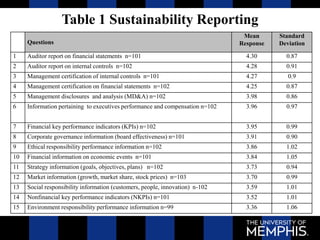
• Attributes of corporate reporting listed in Table 1 can
be classified into three- tier aspects.
• Tier one consists of four attributes considered the
most important with the mean responses of greater
than 4.25. These attributes are: (1) auditor report on
financial statements; (2) auditor report on internal
controls; (3) management certification of internal
controls; (4) management certification on financial
statements.
Questions
Mean
Response
Standard
Deviation
1 Auditor report on financial statements n=101 4.30 0.87
2 Auditor report on internal controls n=102 4.28 0.91
3 Management certification of internal controls n=101 4.27 0.9
4 Management certification on financial statements n=102 4.25 0.87
5 Management disclosures and analysis (MD&A) n=102 3.98 0.86
6 Information pertaining to executives performance and compensation n=102 3.96 0.97
7 Financial key performance indicators (KPIs) n=102 3.95 0.99
8 Corporate governance information (board effectiveness) n=101 3.91 0.90
9 Ethical responsibility performance information n=102 3.86 1.02
10 Financial information on economic events n=101 3.84 1.05
11 Strategy information (goals, objectives, plans) n=102 3.73 0.94
12 Market information (growth, market share, stock prices) n=103 3.70 0.99
13 Social responsibility information (customers, people, innovation) n-102 3.59 1.01
14 Nonfinancial key performance indicators (NKPIs) n=101 3.52 1.01
15 Environment responsibility performance information n=99 3.36 1.06
Table 1 Sustainability Reporting
Results
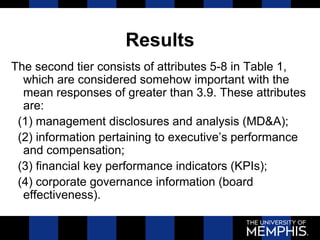
The second tier consists of attributes 5-8 in Table 1,
which are considered somehow important with the
mean responses of greater than 3.9. These attributes
are:
(1) management disclosures and analysis (MD&A);
(2) information pertaining to executive’s performance
and compensation;
(3) financial key performance indicators (KPIs);
(4) corporate governance information (board
effectiveness).
RESULTS
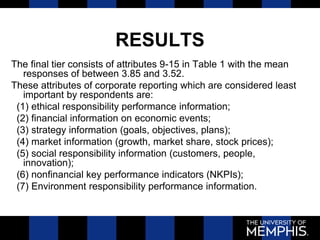
The final tier consists of attributes 9-15 in Table 1 with the mean
responses of between 3.85 and 3.52.
These attributes of corporate reporting which are considered least
important by respondents are:
(1) ethical responsibility performance information;
(2) financial information on economic events;
(3) strategy information (goals, objectives, plans);
(4) market information (growth, market share, stock prices);
(5) social responsibility information (customers, people,
innovation);
(6) nonfinancial key performance indicators (NKPIs);
(7) Environment responsibility performance information.
RESULTS
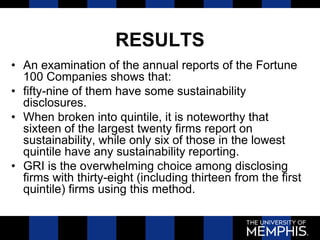
• An examination of the annual reports of the Fortune
100 Companies shows that:
• fifty-nine of them have some sustainability
disclosures.
• When broken into quintile, it is noteworthy that
sixteen of the largest twenty firms report on
sustainability, while only six of those in the lowest
quintile have any sustainability reporting.
• GRI is the overwhelming choice among disclosing
firms with thirty-eight (including thirteen from the first
quintile) firms using this method.
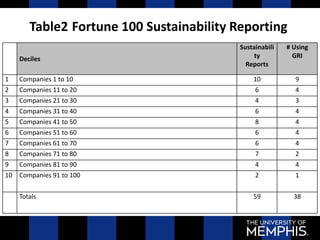
Deciles
Sustainabili
ty
Reports
# Using
GRI
1 Companies 1 to 10 10 9
2 Companies 11 to 20 6 4
3 Companies 21 to 30 4 3
4 Companies 31 to 40 6 4
5 Companies 41 to 50 8 4
6 Companies 51 to 60 6 4
7 Companies 61 to 70 6 4
8 Companies 71 to 80 7 2
9 Companies 81 to 90 4 4
10 Companies 91 to 100 2 1
Totals 59 38
Table2 Fortune 100 Sustainability Reporting
CONCLUSION
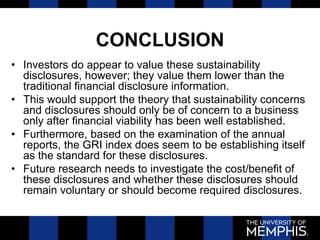
• Investors do appear to value these sustainability
disclosures, however; they value them lower than the
traditional financial disclosure information.
• This would support the theory that sustainability concerns
and disclosures should only be of concern to a business
only after financial viability has been well established.
• Furthermore, based on the examination of the annual
reports, the GRI index does seem to be establishing itself
as the standard for these disclosures.
• Future research needs to investigate the cost/benefit of
these disclosures and whether these disclosures should
remain voluntary or should become required disclosures.

Bangkok bus services case study demostration

  • 1.
    BUSINESS SUSTAINABILITY AND ACCOUNTABILITY REPORTING ZabihollahRezaee, PhD, CPA, CMA, CIA, CFE, CGFM, CSOXP, CGOVP, CGRCP And James M. Lukawitz, PhD, CPA The University of Memphis 2011 Global Finance Conference in Bangkok, Thailand, April 3-5, 2011
  • 2.
    Introduction • In today’sbusiness environment, global businesses are under close scrutiny and profound pressure from lawmakers, regulators, the investment community, and their diverse stakeholders to focus on sustainability and accept accountability and responsibility for their multiple bottom lines (MBL) of economic, governance, social, ethical, and environmental (EGSEE) performance. • Sustainability is the process of integrating economic, governance, social ethics, and environmental (EGSEE) dimensions into all the decision-making and accountability processes and measuring and reporting log-term and enduring performance in all EGSE E areas. • This definition suggests that all sustainability performance factors (EGSEE) add value and thus internalizes some environmental, ethics, governance and social factors that have not traditionally been reported in the conventional corporate reporting. • Business sustainability is a process of enabling organizations to design and implement strategies that contribute to enduring performance in all EGSEE areas. • Business sustainability not only ensures long-term profitability and competition advantage but also help in maintaining the well-being of the society, the planet and people. • Business sustainability and corporate accountability is all about adding value in all areas of economic, ethics, governance, social and environmental (EGSEE) matters and events. • Many public companies are now voluntarily manage, measure, recognize and disclose their commitment and events and transactions relevant to EGSEE.
  • 3.
    Proposes Of presentation •Define Business Sustainability. • Discuss Dimensions of Business Sustainability (EGSEE) and Demand for EGSEE performance • Present Accounting and Assurance of Sustainability Reporting. • Present Results of a Survey Conducted To Determine the Value of Sustainability Reporting. • Much of the Presentation is from Z. Rezaee “Business Sustainability and Accountability Reporting” forthcoming Book, John Wiley & Sons, 2011.
  • 4.
    Demand for Business Sustainability •The 2007-2008 financial crisis, its resulted economic downturn and regulatory responses along with global competition encourage organizations of all types and sizes to pay a keen attention to their sustainability programs composes of EGSEE activities. • In the post-financial crisis and new regulatory framework era, corporations are under more pressure from variety of stakeholders to provide accurate, reliable and relevant financial and non-financial information pertaining to their economic performance, strategic objectives, governance, risk and social responsibility. • On May 4, 2010, the International Federation of Accountants (IFAC) and the Prince’s Accounting for Sustainability (A4S) Project agreed to collaborate in promoting sustainability organizations . • Particularly the IFAC and A4S’ sustainability project addresses: • “Raising awareness and facilitating sharing and collaboration across the global accountancy community, for example, through the development of a community website for professional accountancy organizations, business leaders, academics, and other experts to exchange ideas and share good sustainability practice; • Establishing an international integrated reporting committee to develop a new reporting model that will better reflect the interconnected impact of financial, environmental, social, and governance factors on the long-term performance and condition of an organization; and • Incorporating accounting for sustainability within professional training and education.”
  • 5.
    What sustainability meansin practice? • Minimize or eliminate negative impact on nature and natural resources • Apply natural processes and technologies, which regenerate nature • Respect human and social values and interests (employees, consumers, local communities) • Listen to signals from society and environmen. The balance of ecological and social footprint
  • 6.
    The business modelfor Sustainabe Development Aligning business interests with the needs of society
  • 7.
    Sustainable development fora multinational company Solvent management of business Governance, financial, risk management... Long Term “Intelligent communication” Transparency Innovation “Better products and services for a better world” Public Commitments Social, environmental, economic, .. Accountability and Sustainable Development
  • 8.
    Benefits of Sustainabe Developmentstrategy • Helps Opportunity to detect new products and services “Better products for a better world” • Efficient way to transmit and strengthen business culture • Useful tool to manage risk properly … … in a changing world • Key issue to make an impact on our positive reputation • Way to share useful information with stakeholders…
  • 9.
    Advantages of applyingcorporate sustainability  Helps preparing for environmental and social risks as well as for seizing business opportunities  Implementing substantial cost savings  Inspires creativity for developing new products and services  Reaching new markets and customers  Strengthens corporate image and reputation internally and externally  Motivation for the employees  Differentiates from competitors  Positive social and/or environmental impact
  • 10.
    Major obstacles  Noreal understanding of the importance of SD by managers  Confusion around CSR and sustainable development  Lack of real pressure from demand side (consumer awareness)  No obvious links between corporate sustainability and financial performance  Lack of generally accepted benchmarks and indicators for measuring coprorate sustainability
  • 11.
    Main areas  Energyand climate change  Poverty and inclusive business  Business role in tomorrow’s society  Ecosystem services  Technology and innovation  Accountability, transparency, governance  Human rights  Corporate social responsibility  Ethical behavior
  • 12.
    Entity Performance Performance Goals Governance Roles and Responsibilities ofCG Participants Economic Value creation and Enhancement for all Stakeholders Reports Assurance CG Report Assurance Report Audit Report Financial Reports Ethical Ethical and Moral Values Codes of Conduct Assurance Report Social Social Issues regarding Products and Services Social Responsibility Report Assurance Report Environmental Environmental Audit Report Environmental Management and Report Performance
  • 13.
    Accounting for business sustainability •Accounting for business sustainability is the process of identifying, classifying, measuring, recognizing and reporting performance in all areas of EGSEE. • Accounting for sustainability is often referred to as “green accounting” or “green reporting”. Nonetheless, it covers all areas of economic viability, ethical culture, corporate governance, social responsibility and environmental awareness.
  • 14.
    Assurance Standards inSustainability Reporting • Assurance standards on different dimensions of sustainability performance very in terms of vigorousness and general acceptability. • auditing standards either PCAOB Auditing standards in the United States of International Auditing and Assurance Standards (IAAS) governing reporting and assurance on economics activities. • Assurance standards on other dimensions of sustainability including governance, ethics, social and environmental standards are yet to be fully- developed and globally accepted. • The International Standard on Assurance Engagements (ISAE) 3000 issued by the IAAS Board in 2004 provides guidance for assurance on non-financial dimension of sustainability. • AA1000AS issued in 2008 by the AccountAbility (AA) a global nonprofit organization that established management, reporting and assurance guidance for nonfinancial dimensions of sustainability performance. • American Certified Public Accountants (AICPA) AT 101. • The Canadian Institute of Charted Accountants (CICA) Handbook Section 5025.
  • 15.
    Method and Procedures •Three methods are used in gathering data pertaining to sustainability reporting. • First, we review the related literature, including published papers and publications of professional organizations, in gathering information in developing different sections of the questionnaire. • Second, we conduct a survey of accounting practitioners participated at the professional meetings of local chapters of Certified Public Accountants (CPA), Institute of Internal Auditors (IIA) and Institute of Management Accountants (IMA) in both Midsouth and Southwest regions. • We prepared, pilot-tested, revised, and then submitted the questionnaire to the participants. • The instrument was pilot-tested using an MBA class in the Midsouth region of the United States. • Finally, we examined the financial statements for the Fortune 100 US Companies to determine their sustainability disclosures and their use of the GRI procedures.
  • 16.
    RESULTS • Respondents wereasked to indicate the importance of several aspects of corporate reporting. • Attributes of corporate reporting listed in Table 1 can be classified into three- tier aspects. • Tier one consists of four attributes considered the most important with the mean responses of greater than 4.25. These attributes are: (1) auditor report on financial statements; (2) auditor report on internal controls; (3) management certification of internal controls; (4) management certification on financial statements.
  • 17.
    Questions Mean Response Standard Deviation 1 Auditor reporton financial statements n=101 4.30 0.87 2 Auditor report on internal controls n=102 4.28 0.91 3 Management certification of internal controls n=101 4.27 0.9 4 Management certification on financial statements n=102 4.25 0.87 5 Management disclosures and analysis (MD&A) n=102 3.98 0.86 6 Information pertaining to executives performance and compensation n=102 3.96 0.97 7 Financial key performance indicators (KPIs) n=102 3.95 0.99 8 Corporate governance information (board effectiveness) n=101 3.91 0.90 9 Ethical responsibility performance information n=102 3.86 1.02 10 Financial information on economic events n=101 3.84 1.05 11 Strategy information (goals, objectives, plans) n=102 3.73 0.94 12 Market information (growth, market share, stock prices) n=103 3.70 0.99 13 Social responsibility information (customers, people, innovation) n-102 3.59 1.01 14 Nonfinancial key performance indicators (NKPIs) n=101 3.52 1.01 15 Environment responsibility performance information n=99 3.36 1.06 Table 1 Sustainability Reporting
  • 18.
    Results The second tierconsists of attributes 5-8 in Table 1, which are considered somehow important with the mean responses of greater than 3.9. These attributes are: (1) management disclosures and analysis (MD&A); (2) information pertaining to executive’s performance and compensation; (3) financial key performance indicators (KPIs); (4) corporate governance information (board effectiveness).
  • 19.
    RESULTS The final tierconsists of attributes 9-15 in Table 1 with the mean responses of between 3.85 and 3.52. These attributes of corporate reporting which are considered least important by respondents are: (1) ethical responsibility performance information; (2) financial information on economic events; (3) strategy information (goals, objectives, plans); (4) market information (growth, market share, stock prices); (5) social responsibility information (customers, people, innovation); (6) nonfinancial key performance indicators (NKPIs); (7) Environment responsibility performance information.
  • 20.
    RESULTS • An examinationof the annual reports of the Fortune 100 Companies shows that: • fifty-nine of them have some sustainability disclosures. • When broken into quintile, it is noteworthy that sixteen of the largest twenty firms report on sustainability, while only six of those in the lowest quintile have any sustainability reporting. • GRI is the overwhelming choice among disclosing firms with thirty-eight (including thirteen from the first quintile) firms using this method.
  • 21.
    Deciles Sustainabili ty Reports # Using GRI 1 Companies1 to 10 10 9 2 Companies 11 to 20 6 4 3 Companies 21 to 30 4 3 4 Companies 31 to 40 6 4 5 Companies 41 to 50 8 4 6 Companies 51 to 60 6 4 7 Companies 61 to 70 6 4 8 Companies 71 to 80 7 2 9 Companies 81 to 90 4 4 10 Companies 91 to 100 2 1 Totals 59 38 Table2 Fortune 100 Sustainability Reporting
  • 22.
    CONCLUSION • Investors doappear to value these sustainability disclosures, however; they value them lower than the traditional financial disclosure information. • This would support the theory that sustainability concerns and disclosures should only be of concern to a business only after financial viability has been well established. • Furthermore, based on the examination of the annual reports, the GRI index does seem to be establishing itself as the standard for these disclosures. • Future research needs to investigate the cost/benefit of these disclosures and whether these disclosures should remain voluntary or should become required disclosures.