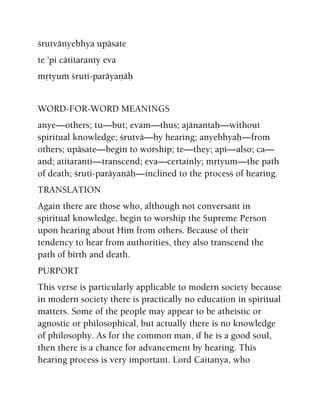
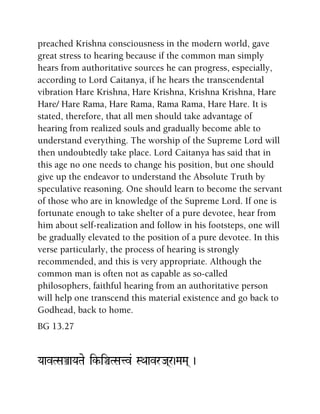
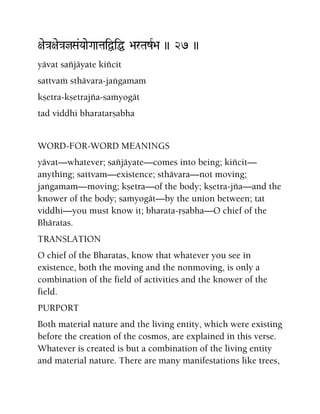
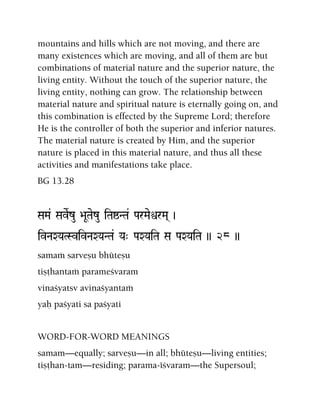
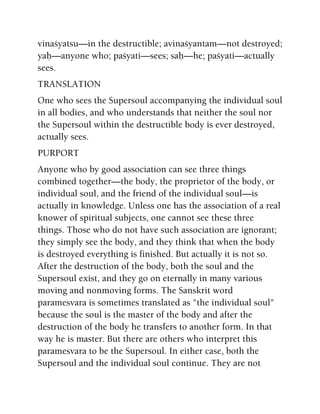
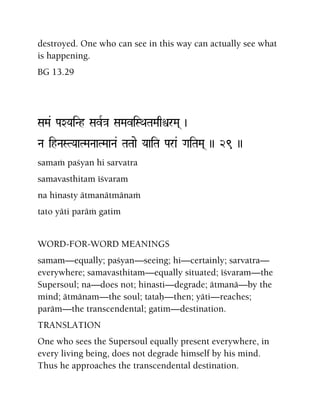
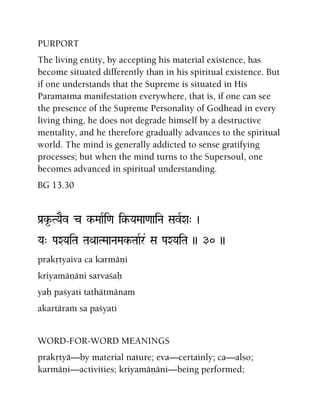
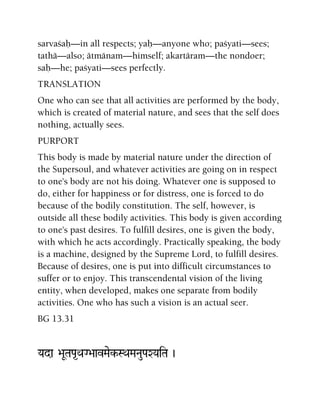
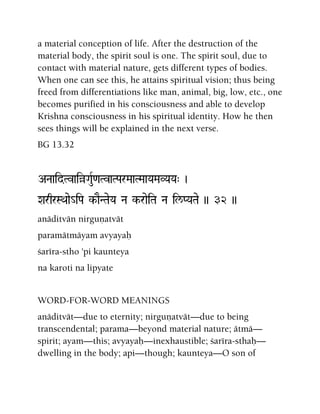
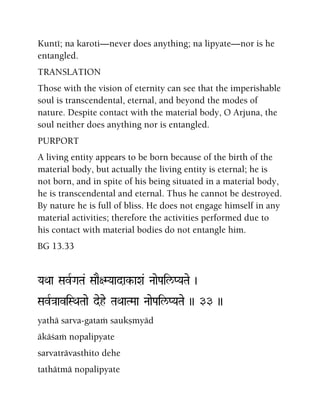
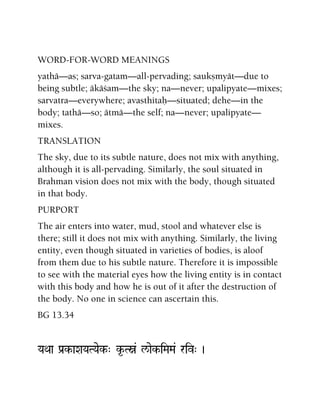
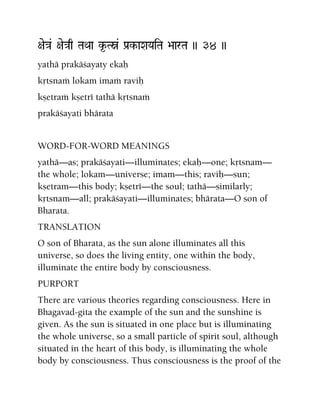
- Chapter 13 -
Nature, the Enjoyer, and Consciousness
One who understands the difference between the body, the
soul and the Supersoul beyond them both attains liberation
from this material world.
BG 13.1, BG 13.2, BG 13.1-2
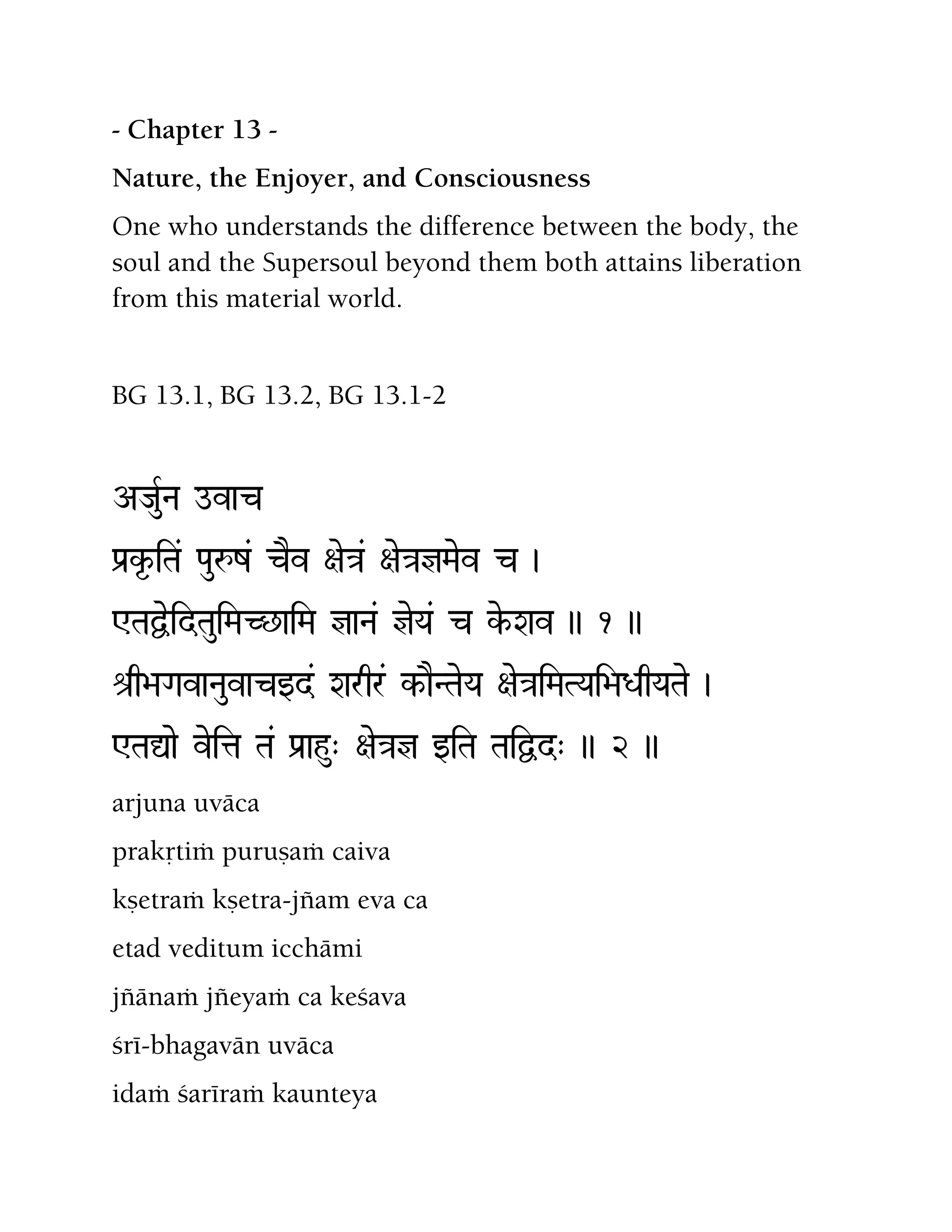
AJauRNa ovac
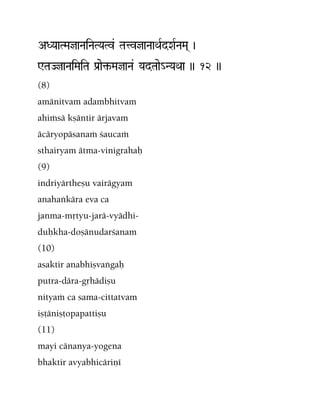
Pa[k*-iTa& Pauåz& cEv +ae}a& +ae}ajMaev c )
WTaÜeidTauiMaC^aiMa jaNa& jeYa& c ke-Xav )) 1 ))
é[q>aGavaNauvacwd& Xarqr& k-aENTaeYa +ae}aiMaTYai>aDaqYaTae )
WTaÛae veita Ta& Pa[ahu" +ae}aj wiTa TaiÜd" )) 2 ))
arjuna uväca
prakåtià puruñaà caiva
kñetraà kñetra-jïam eva ca
etad veditum icchämi
jïänaà jïeyaà ca keçava
çré-bhagavän uväca
idaà çaréraà kaunteya
kñetram ity abhidhéyate
etad yo vetti taà prähuù
kñetra-jïa iti tad-vidaù
WORD-FOR-WORD MEANINGS
arjunaù uväca—Arjuna said; prakåtim—nature; puruñam—the
enjoyer; ca—also; eva—certainly; kñetram—the field; kñetra-
jïam—the knower of the field; eva—certainly; ca—also;
etat—all this; veditum—to understand; icchämi—I wish;
jïänam—knowledge; jïeyam—the object of knowledge; ca—
also; keçava—O Kåñëa; çré-bhagavän uväca—the Personality
of Godhead said; idam—this; çaréram—body; kaunteya—O
son of Kunté; kñetram—the field; iti—thus; abhidhéyate—is
called; etat—this; yaù—one who; vetti—knows; tam—he;
prähuù—is called; kñetra-jïaù—the knower of the field; iti—
thus; tat—vidaù—by those who know this.
TRANSLATION
Arjuna said: O my dear Krishna, I wish to know about prakriti
[nature], purusha [the enjoyer], and the field and the knower
of the field, and of knowledge and the object of knowledge.
The Supreme Personality of Godhead said: This body, O son
of Kunti, is called the field, and one who knows this body is
called the knower of the field.
PURPORT
Arjuna was inquisitive about prakriti (nature), purusha (the
enjoyer), kshetra (the field), kshetra-jna (its knower), and
knowledge and the object of knowledge. When he inquired
about all these, Krishna said that this body is called the field
and that one who knows this body is called the knower of the
field. This body is the field of activity for the conditioned soul.
The conditioned soul is entrapped in material existence, and
he attempts to lord it over material nature. And so, according
to his capacity to dominate material nature, he gets a field of
activity. That field of activity is the body. And what is the
body? The body is made of senses. The conditioned soul
wants to enjoy sense gratification, and, according to his
capacity to enjoy sense gratification, he is offered a body, or
field of activity. Therefore the body is called kshetra, or the
field of activity for the conditioned soul. Now, the person,
who should not identify himself with the body, is called
kshetra-jna, the knower of the field. It is not very difficult to
understand the difference between the field and its knower,
the body and the knower of the body. Any person can
consider that from childhood to old age he undergoes so
many changes of body and yet is still one person, remaining.
Thus there is a difference between the knower of the field of
activities and the actual field of activities. A living conditioned
soul can thus understand that he is different from the body. It
is described in the beginning—dehino 'smin—that the living
entity is within the body and that the body is changing from
childhood to boyhood and from boyhood to youth and from
youth to old age, and the person who owns the body knows
that the body is changing. The owner is distinctly kshetra-jna.
Sometimes we think, "I am happy," "I am a man," "I am a
woman," "I am a dog," "I am a cat." These are the bodily
designations of the knower. But the knower is different from
the body. Although we may use many articles—our clothes,
etc.—we know that we are different from the things used.
Similarly, we also understand by a little contemplation that we
are different from the body. I or you or anyone else who owns
the body is called kshetra-jna, the knower of the field of
activities, and the body is called kshetra, the field of activities
itself.
In the first six chapters of Bhagavad-gita the knower of the
body (the living entity) and the position by which he can
understand the Supreme Lord are described. In the middle six
chapters of the Bhagavad-gita the Supreme Personality of
Godhead and the relationship between the individual soul and
the Supersoul in regard to devotional service are described.
The superior position of the Supreme Personality of Godhead
and the subordinate position of the individual soul are
definitely defined in these chapters. The living entities are
subordinate under all circumstances, but in their forgetfulness
they are suffering. When enlightened by pious activities, they
approach the Supreme Lord in different capacities—as the
distressed, those in want of money, the inquisitive, and those
in search of knowledge. That is also described. Now, starting
with the Thirteenth Chapter, how the living entity comes into
contact with material nature and how he is delivered by the
Supreme Lord through the different methods of fruitive
activities, cultivation of knowledge, and the discharge of
devotional service are explained. Although the living entity is
completely different from the material body, he somehow
becomes related. This also is explained.
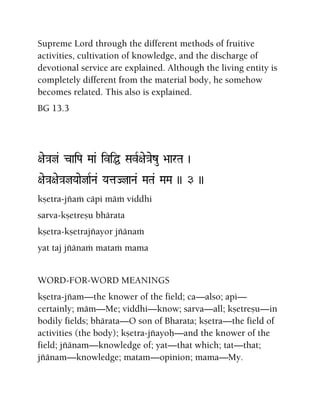
BG 13.3
+ae}aj& caiPa Maa& iviÖ SavR+ae}aezu >aarTa )
+ae}a+ae}ajYaaejaRNa& YataJjaNa& MaTa& MaMa )) 3 ))
kñetra-jïaà cäpi mäà viddhi
sarva-kñetreñu bhärata
kñetra-kñetrajïayor jïänaà
yat taj jïänaà mataà mama
WORD-FOR-WORD MEANINGS
kñetra-jïam—the knower of the field; ca—also; api—
certainly; mäm—Me; viddhi—know; sarva—all; kñetreñu—in
bodily fields; bhärata—O son of Bharata; kñetra—the field of
activities (the body); kñetra-jïayoù—and the knower of the
field; jïänam—knowledge of; yat—that which; tat—that;
jïänam—knowledge; matam—opinion; mama—My.
TRANSLATION
O scion of Bharata, you should understand that I am also the
knower in all bodies, and to understand this body and its
knower is called knowledge. That is My opinion.
PURPORT
While discussing the subject of the body and the knower of
the body, the soul and the Supersoul, we shall find three
different topics of study: the Lord, the living entity, and
matter. In every field of activities, in every body, there are two
souls: the individual soul and the Supersoul. Because the
Supersoul is the plenary expansion of the Supreme Personality
of Godhead, Krishna, Krishna says, "I am also the knower, but
I am not the individual knower of the body. I am the
superknower. I am present in every body as the Paramatma, or
Supersoul."
One who studies the subject matter of the field of activity and
the knower of the field very minutely, in terms of this
Bhagavad-gita, can attain to knowledge.
The Lord says, "I am the knower of the field of activities in
every individual body." The individual may be the knower of
his own body, but he is not in knowledge of other bodies. The
Supreme Personality of Godhead, who is present as the
Supersoul in all bodies, knows everything about all bodies. He
knows all the different bodies of all the various species of life.
A citizen may know everything about his patch of land, but
the king knows not only his palace but all the properties
possessed by the individual citizens. Similarly, one may be the
proprietor of the body individually, but the Supreme Lord is
the proprietor of all bodies. The king is the original proprietor
of the kingdom, and the citizen is the secondary proprietor.
Similarly, the Supreme Lord is the supreme proprietor of all
bodies.
The body consists of the senses. The Supreme Lord is
Hrishikesa, Which means "the controller of the senses." He is
the original controller of the senses, just as the king is the
original controller of all the activities of the state; the citizens
are secondary controllers. The Lord says, "I am also the
knower." This means that He is the superknower; the
individual soul knows only his particular body. In the Vedic
literature, it is stated as follows:
kshetrani hi sarirani
bijam capi subhasubhe
tani vetti sa yogatma
tatah kshetra-jna ucyate
This body is called the kshetra, and within it dwells the owner
of the body and the Supreme Lord, who knows both the body
and the owner of the body. Therefore He is called the knower
of all fields. The distinction between the field of activities, the
knower of activities, and the supreme knower of activities is
described as follows. Perfect knowledge of the constitution of
the body, the constitution of the individual soul, and the
constitution of the Supersoul is known in terms of Vedic
literature as jnana. That is the opinion of Krishna. To
understand both the soul and the Supersoul as one yet distinct
is knowledge. One who does not understand the field of
activity and the knower of activity is not in perfect knowledge.
One has to understand the position of prakriti (nature),
purusha (the enjoyer of nature) and isvara (the knower who
dominates or controls nature and the individual soul). One
should not confuse the three in their different capacities. One
should not confuse the painter, the painting and the easel.
This material world, which is the field of activities, is nature,
and the enjoyer of nature is the living entity, and above them
both is the supreme controller, the Personality of Godhead. It
is stated in the Vedic language (in the Svetasvatara Upanishad
1.12), bhokta bhogyam preritaram ca matva/ sarvam proktam
tri vidham-brahmam etat. There are three Brahman
conceptions: prakriti is Brahman as the field of activities, and
the jiva (individual soul) is also Brahman and is trying to
control material nature, and the controller of both of them is
also Brahman, but He is the factual controller.
In this chapter it will also be explained that out of the two
knowers, one is fallible and the other is infallible. One is
superior and the other is subordinate. One who understands
the two knowers of the field to be one and the same
contradicts the Supreme Personality of Godhead, who states
here very clearly, "I am also the knower of the field of
activity." One who misunderstands a rope to be a serpent is
not in knowledge. There are different kinds of bodies, and
there are different owners of the bodies. Because each
individual soul has his individual capacity for lording it over
material nature, there are different bodies. But the Supreme
also is present in them as the controller. The word ca is
significant, for it indicates the total number of bodies. That is
the opinion of Srila Baladeva Vidyabhushana. Krishna is the
Supersoul present in each and every body apart from the
individual soul. And Krishna explicitly says here that real
knowledge is to know that the Supersoul is the controller of
both the field of activities and the finite enjoyer.
BG 13.4
TaT+ae}a& YaÀ Yaad*Kc YaiÜk-air YaTaê YaTa( )
Sa c Yaae YaTPa[>aavê TaTSaMaaSaeNa Mae é*<au )) 4 ))
tat kñetraà yac ca yädåk ca
yad-vikäri yataç ca yat
sa ca yo yat-prabhävaç ca
tat samäsena me çåëu
WORD-FOR-WORD MEANINGS
tat—that; kñetram—field of activities; yat—what; ca—also;
yädåk—as it is; ca—also; yat—having what; vikäri—changes;
yataù—from which; ca—also; yat—what; saù—he; ca—also;
yaù—who; yat—having what; prabhävaù—influence; ca—
also; tat—that; samäsena—in summary; me—from Me; çåëu—
understand.
TRANSLATION
Now please hear My brief description of this field of activity
and how it is constituted, what its changes are, whence it is
produced, who that knower of the field of activities is, and
what his influences are.
PURPORT
The Lord is describing the field of activities and the knower of
the field of activities in their constitutional positions. One has
to know how this body is constituted, the materials of which
this body is made, under whose control this body is working,
how the changes are taking place, wherefrom the changes are
coming, what the causes are, what the reasons are, what the
ultimate goal of the individual soul is, and what the actual
form of the individual soul is. One should also know the
distinction between the individual living soul and the
Supersoul, their different influences, their potentials, etc. One
just has to understand this Bhagavad-gita directly from the
description given by the Supreme Personality of Godhead, and
all this will be clarified. But one should be careful not to
consider the Supreme Personality of Godhead in every body to
be one with the individual soul, the jiva. This is something
like equating the potent and the impotent.
BG 13.5
‰izi>abRhuDaa GaqTa& ^Ndaei>aivRivDaE" Pa*Qak(- )
b]øSaU}aPadEêEv heTauMaiÙivRiNaiêTaE" )) 5 ))
åñibhir bahudhä gétaà
chandobhir vividhaiù påthak
brahma-sütra-padaiç caiva
hetumadbhir viniçcitaiù
WORD-FOR-WORD MEANINGS
åñibhiù—by the wise sages; bahudhä—in many ways; gétam—
described; chandobhiù—by Vedic hymns; vividhaiù—various;
påthak—variously; brahma-sütra—of the Vedänta; padaiù—by
the aphorisms; ca—also; eva—certainly; hetu-madbhiù—with
cause and effect; viniçcitaiù—certain.
TRANSLATION
That knowledge of the field of activities and of the knower of
activities is described by various sages in various Vedic
writings. It is especially presented in Vedanta-sutra with all
reasoning as to cause and effect.
PURPORT
The Supreme Personality of Godhead, Krishna, is the highest
authority in explaining this knowledge. Still, as a matter of
course, learned scholars and standard authorities always give
evidence from previous authorities. Krishna is explaining this
most controversial point regarding the duality and nonduality
of the soul and the Supersoul by referring to a scripture, the
Vedanta, which is accepted as authority. First He says, "This is
according to different sages." As far as the sages are
concerned, besides Himself, Vyasadeva (the author of the
Vedanta-sutra) is a great sage, and in the Vedanta-sutra
duality is perfectly explained. And Vyasadeva's father,
Parasara, is also a great sage, and he writes in his books of
religiosity, aham tvam ca tathanye. .. "we—you, I and the
various other living entities—are all transcendental, although
in material bodies. Now we are fallen into the ways of the
three modes of material nature according to our different
karma. As such, some are on higher levels, and some are in
the lower nature. The higher and lower natures exist due to
ignorance and are being manifested in an infinite number of
living entities. But the Supersoul, which is infallible, is
uncontaminated by the three qualities of nature and is
transcendental." Similarly, in the original Vedas, a distinction
between the soul, the Supersoul and the body is made,
especially in the Katha Upanishad. There are many great sages
who have explained this, and Parasara is considered principal
among them.
The word chandobhih refers to the various Vedic literatures.
The Taittiriya Upanishad, for example, which is a branch of
the Yajur Veda, describes nature, the living entity and the
Supreme Personality of Godhead.
As stated before, kshetra is the field of activities, and there are
two kinds of kshetra-jna: the individual living entity and the
supreme living entity. As stated in the Taittiriya Upanishad
(2.5), brahma puccham pratishtha. There is a manifestation of
the Supreme Lord's energy known as anna-maya, dependence
upon food for existence. This is a materialistic realization of
the Supreme. Then, in prana-maya, after realizing the
Supreme Absolute Truth in food, one can realize the Absolute
Truth in the living symptoms or life forms. In jnana-maya,
realization extends beyond the living symptoms to the point
of thinking, feeling and willing. Then there is Brahman
realization, called vijnana-maya, in which the living entity's
mind and life symptoms are distinguished from the living
entity himself. The next and supreme stage is ananda-maya,
realization of the all-blissful nature. Thus there are five stages
of Brahman realization, which are called brahma puccham.
Out of these, the first three—anna-maya, prana-maya and
jnana-maya—involve the fields of activities of the living
entities. Transcendental to all these fields of activities is the
Supreme Lord, who is called ananda-maya. The Vedanta-sutra
also describes the Supreme by saying, ananda-mayo 'bhyasat:
the Supreme Personality of Godhead is by nature full of joy.
To enjoy His transcendental bliss, He expands into vijnana-
maya, prana-maya, jnana-maya and anna-maya. In the field of
activities the living entity is considered to be the enjoyer, and
different from him is the ananda-maya. That means that if the
living entity decides to enjoy in dovetailing himself with the
ananda-maya, then he becomes perfect. This is the real picture
of the Supreme Lord as the supreme knower of the field, the
living entity as the subordinate knower, and the nature of the
field of activities. One has to search for this truth in the
Vedanta-sutra, or Brahma-sutra.
It is mentioned here that the codes of the Brahma-sutra are
very nicely arranged according to cause and effect. Some of
the sutras, or aphorisms, are na viyad asruteh (2.3.2), natma
sruteh (2.3.18), and parat tu tac-chruteh (2.3.40). The first
aphorism indicates the field of activities, the second indicates
the living entity, and the third indicates the Supreme Lord,
the summum bonum among all the manifestations of various
entities.
BG 13.6, BG 13.7, BG 13.6-7
Maha>aUTaaNYahªarae buiÖrVYa¢-Maev c )
wiNd]Yaai<a dXaEk&- c PaÄ ceiNd]YaGaaecra" )) 6 ))
wC^a Üez" Sau%& du"%& SaºaTaêeTaNaa Da*iTa" )
WTaT+ae}a& SaMaaSaeNa Saivk-arMaudaôTaMa( )) 7 ))
mahä-bhütäny ahaìkäro
buddhir avyaktam eva ca
indriyäëi daçaikaà ca
païca cendriya-gocaräù
icchä dveñaù sukhaà duùkhaà
saìghätaç cetanä dhåtiù
etat kñetraà samäsena
sa-vikäram udähåtam
WORD-FOR-WORD MEANINGS
mahä-bhütäni—the great elements; ahaìkäraù—false ego;
buddhiù—intelligence; avyaktam—the unmanifested; eva—
certainly; ca—also; indriyäëi—the senses; daça-ekam—eleven;
ca—also; païca—five; ca—also; indriya-go-caräù—the objects
of the senses; icchä—desire; dveñaù—hatred; sukham—
happiness; duùkham—distress; saìghätaù—the aggregate;
cetanä—living symptoms; dhåtiù—conviction; etat—all this;
kñetram—the field of activities; samäsena—in summary; sa—
vikäram—with interactions; udähåtam—exemplified.
TRANSLATION
The five great elements, false ego, intelligence, the
unmanifested, the ten senses and the mind, the five sense
objects, desire, hatred, happiness, distress, the aggregate, the
life symptoms, and convictions—all these are considered, in
summary, to be the field of activities and its interactions.
PURPORT
From all the authoritative statements of the great sages, the
Vedic hymns and the aphorisms of the Vedanta-sutra, the
components of this world can be understood as follows. First
there are earth, water, fire, air and ether. These are the five
great elements (maha-bhuta). Then there are false ego,
intelligence and the unmanifested stage of the three modes of
nature. Then there are five senses for acquiring knowledge:
the eyes, ears, nose, tongue and skin. Then five working
senses: voice, legs, hands, anus and genitals. Then, above the
senses, there is the mind, which is within and which can be
called the sense within. Therefore, including the mind, there
are eleven senses altogether. Then there are the five objects of
the senses: smell, taste, form, touch and sound. Now the
aggregate of these twenty-four elements is called the field of
activity. If one makes an analytical study of these twenty-four
subjects, then he can very well understand the field of activity.
Then there are desire, hatred, happiness and distress, which
are interactions, representations of the five great elements in
the gross body. The living symptoms, represented by
consciousness, and convictions are the manifestation of the
subtle body—mind, ego and intelligence. These subtle
elements are included within the field of activities.
The five great elements are a gross representation of the false
ego, which in turn represents the primal stage of false ego
technically called the materialistic conception, or tamasa-
buddhi, intelligence in ignorance. This, further, represents the
unmanifested stage of the three modes of material nature. The
unmanifested modes of material nature are called pradhana.
One who desires to know the twenty-four elements in detail
along with their interactions should study the philosophy in
more detail. In Bhagavad-gita, a summary only is given.
The body is the representation of all these factors, and there
are changes of the body, which are six in number: the body is
born, it grows, it stays, it produces by-products, then it begins
to decay, and at the last stage it vanishes. Therefore the field is
a nonpermanent material thing. However, the kshetra-jna, the
knower of the field, its proprietor, is different.
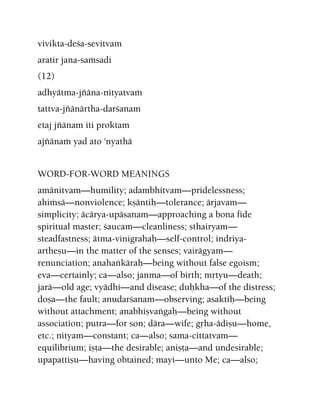
AMaaiNaTvMadiM>aTvMaih&Saa +aaiNTaraJaRvMa( )
AacaYaaeRPaaSaNa& XaaEc& SQaEYaRMaaTMaiviNaGa]h" )) 8 ))
wiNd]YaaQaeRzu vEraGYaMaNahªar Wv c )
JaNMaMa*TYauJaraVYaaiDadu"%daezaNaudXaRNaMa( )) 9 ))
ASai¢-rNai>aZv(r)" Pau}adarGa*haidzu )
iNaTYa& c SaMaictaTviMaíaiNaíaePaPaitazu )) 10 ))
MaiYa caNaNYaYaaeGaeNa >ai¢-rVYai>acair<aq )
iviv¢-deXaSaeivTvMariTaJaRNaSa&Said )) 11 ))
ADYaaTMajaNaiNaTYaTv& TatvjaNaaQaRdXaRNaMa( )
WTaJjaNaiMaiTa Pa[ae¢-MajaNa& YadTaae_NYaQaa )) 12 ))
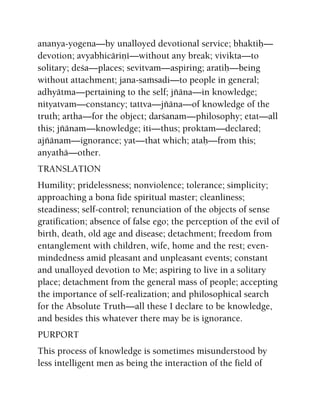
(8)
amänitvam adambhitvam
ahiàsä kñäntir ärjavam
äcäryopäsanaà çaucaà
sthairyam ätma-vinigrahaù
(9)
indriyärtheñu vairägyam
anahaìkära eva ca
janma-måtyu-jarä-vyädhi-
duùkha-doñänudarçanam
(10)
asaktir anabhiñvaìgaù
putra-dära-gåhädiñu
nityaà ca sama-cittatvam
iñöäniñöopapattiñu
(11)
mayi cänanya-yogena
bhaktir avyabhicäriëé
vivikta-deça-sevitvam
aratir jana-saàsadi
(12)
adhyätma-jïäna-nityatvaà
tattva-jïänärtha-darçanam
etaj jïänam iti proktam
ajïänaà yad ato 'nyathä
WORD-FOR-WORD MEANINGS
amänitvam—humility; adambhitvam—pridelessness;
ahiàsä—nonviolence; kñäntiù—tolerance; ärjavam—
simplicity; äcärya-upäsanam—approaching a bona fide
spiritual master; çaucam—cleanliness; sthairyam—
steadfastness; ätma-vinigrahaù—self-control; indriya-
artheñu—in the matter of the senses; vairägyam—
renunciation; anahaìkäraù—being without false egoism;
eva—certainly; ca—also; janma—of birth; måtyu—death;
jarä—old age; vyädhi—and disease; duùkha—of the distress;
doña—the fault; anudarçanam—observing; asaktiù—being
without attachment; anabhiñvaìgaù—being without
association; putra—for son; dära—wife; gåha-ädiñu—home,
etc.; nityam—constant; ca—also; sama-cittatvam—
equilibrium; iñöa—the desirable; aniñöa—and undesirable;
upapattiñu—having obtained; mayi—unto Me; ca—also;
ananya-yogena—by unalloyed devotional service; bhaktiù—
devotion; avyabhicäriëé—without any break; vivikta—to
solitary; deça—places; sevitvam—aspiring; aratiù—being
without attachment; jana-saàsadi—to people in general;
adhyätma—pertaining to the self; jïäna—in knowledge;
nityatvam—constancy; tattva—jïäna—of knowledge of the
truth; artha—for the object; darçanam—philosophy; etat—all
this; jïänam—knowledge; iti—thus; proktam—declared;
ajïänam—ignorance; yat—that which; ataù—from this;
anyathä—other.
TRANSLATION
Humility; pridelessness; nonviolence; tolerance; simplicity;
approaching a bona fide spiritual master; cleanliness;
steadiness; self-control; renunciation of the objects of sense
gratification; absence of false ego; the perception of the evil of
birth, death, old age and disease; detachment; freedom from
entanglement with children, wife, home and the rest; even-
mindedness amid pleasant and unpleasant events; constant
and unalloyed devotion to Me; aspiring to live in a solitary
place; detachment from the general mass of people; accepting
the importance of self-realization; and philosophical search
for the Absolute Truth—all these I declare to be knowledge,
and besides this whatever there may be is ignorance.
PURPORT
This process of knowledge is sometimes misunderstood by
less intelligent men as being the interaction of the field of
activity. But actually this is the real process of knowledge. If
one accepts this process, then the possibility of approaching
the Absolute Truth exists. This is not the interaction of the
twenty-four elements, as described before. This is actually the
means to get out of the entanglement of those elements. The
embodied soul is entrapped by the body, which is a casing
made of the twenty-four elements, and the process of
knowledge as described here is the means to get out of it. Of
all the descriptions of the process of knowledge, the most
important point is described in the first line of the eleventh
verse. Mayi cananya-yogena bhaktir avyabhicarini: the process
of knowledge terminates in unalloyed devotional service to
the Lord. So if one does not approach, or is not able to
approach, the transcendental service of the Lord, then the
other nineteen items are of no particular value. But if one
takes to devotional service in full Krishna consciousness, the
other nineteen items automatically develop within him. As
stated in Srimad-Bhagavatam (5.18.12), yasyasti bhaktir
bhagavaty akincana sarvair gunais tatra samasate surah. All
the good qualities of knowledge develop in one who has
attained the stage of devotional service. The principle of
accepting a spiritual master, as mentioned in the eighth verse,
is essential. Even for one who takes to devotional service, it is
most important. Transcendental life begins when one accepts
a bona fide spiritual master. The Supreme Personality of
Godhead, Sri Krishna, clearly states here that this process of
knowledge is the actual path. Anything speculated beyond
this is nonsense.
As for the knowledge outlined here, the items may be
analyzed as follows. Humility means that one should not be
anxious to have the satisfaction of being honored by others.
The material conception of life makes us very eager to receive
honor from others, but from the point of view of a man in
perfect knowledge—who knows that he is not this body—
anything, honor or dishonor, pertaining to this body is
useless. One should not be hankering after this material
deception. People are very anxious to be famous for their
religion, and consequently sometimes it is found that without
understanding the principles of religion one enters into some
group which is not actually following religious principles and
then wants to advertise himself as a religious mentor. As for
actual advancement in spiritual science, one should have a
test to see how far he is progressing. He can judge by these
items.
Nonviolence is generally taken to mean not killing or
destroying the body, but actually nonviolence means not to
put others into distress. People in general are trapped by
ignorance in the material concept of life, and they perpetually
suffer material pains. So unless one elevates people to spiritual
knowledge, one is practicing violence. One should try his best
to distribute real knowledge to the people, so that they may
become enlightened and leave this material entanglement.
That is nonviolence.
Tolerance means that one should be practiced to bear insult
and dishonor from others. If one is engaged in the
advancement of spiritual knowledge, there will be so many
insults and much dishonor from others. This is expected
because material nature is so constituted. Even a boy like
Prahlada, who, only five years old, was engaged in the
cultivation of spiritual knowledge, was endangered when his
father became antagonistic to his devotion. The father tried to
kill him in so many ways, but Prahlada tolerated him. So there
may be many impediments to making advancement in
spiritual knowledge, but we should be tolerant and continue
our progress with determination.
Simplicity means that without diplomacy one should be so
straightforward that he can disclose the real truth even to an
enemy. As for acceptance of the spiritual master, that is
essential, because without the instruction of a bona fide
spiritual master one cannot progress in the spiritual science.
One should approach the spiritual master with all humility
and offer him all services so that he will be pleased to bestow
his blessings upon the disciple. Because a bona fide spiritual
master is a representative of Krishna, if he bestows any
blessings upon his disciple, that will make the disciple
immediately advanced without the disciple's following the
regulative principles. Or, the regulative principles will be
easier for one who has served the spiritual master without
reservation.
Cleanliness is essential for making advancement in spiritual
life. There are two kinds of cleanliness: external and internal.
External cleanliness means taking a bath, but for internal
cleanliness one has to think of Krishna always and chant Hare
Krishna, Hare Krishna, Krishna Krishna, Hare Hare/ Hare
Rama, Hare Rama, Rama Rama, Hare Hare. This process
cleans the accumulated dust of past karma from the mind.
Steadiness means that one should be very determined to make
progress in spiritual life. Without such determination, one
cannot make tangible progress. And self-control means that
one should not accept anything which is detrimental to the
path of spiritual progress. One should become accustomed to
this and reject anything which is against the path of spiritual
progress. This is real renunciation. The senses are so strong
that they are always anxious to have sense gratification. One
should not cater to these demands, which are not necessary.
The senses should only be gratified to keep the body fit so that
one can discharge his duty in advancing in spiritual life. The
most important and uncontrollable sense is the tongue. If one
can control the tongue, then there is every possibility of
controlling the other senses. The function of the tongue is to
taste and to vibrate. Therefore, by systematic regulation, the
tongue should always be engaged in tasting the remnants of
foodstuffs offered to Krishna and chanting Hare Krishna. As
far as the eyes are concerned, they should not be allowed to
see anything but the beautiful form of Krishna. That will
control the eyes. Similarly, the ears should be engaged in
hearing about Krishna and the nose in smelling the flowers
offered to Krishna. This is the process of devotional service,
and it is understood here that Bhagavad-gita is simply
expounding the science of devotional service. Devotional
service is the main and sole objective. Unintelligent
commentators on the Bhagavad-gita try to divert the mind of
the reader to other subjects, but there is no other subject in
Bhagavad-gita than devotional service.
False ego means accepting this body as oneself. When one
understands that he is not his body and is spirit soul, he
comes to his real ego. Ego is there. False ego is condemned,
but not real ego. In the Vedic literature (Brihad-aranyaka
Upanishad 1.4.10) it is said, aham brahmasmi: I am Brahman,
I am spirit. This "I am," the sense of self, also exists in the
liberated stage of self-realization. This sense of "I am" is ego,
but when the sense of "I am" is applied to this false body it is
false ego. When the sense of self is applied to reality, that is
real ego. There are some philosophers who say we should give
up our ego, but we cannot give up our ego, because ego means
identity. We ought, of course, to give up the false
identification with the body.
One should try to understand the distress of accepting birth,
death, old age and disease. There are descriptions in various
Vedic literatures of birth. In the Srimad-Bhagavatam the world
of the unborn, the child's stay in the womb of the mother, its
suffering, etc., are all very graphically described. It should be
thoroughly understood that birth is distressful. Because we
forget how much distress we have suffered within the womb
of the mother, we do not make any solution to the repetition
of birth and death. Similarly at the time of death there are all
kinds of sufferings, and they are also mentioned in the
authoritative scriptures. These should be discussed. And as far
as disease and old age are concerned, everyone gets practical
experience. No one wants to be diseased, and no one wants to
become old, but there is no avoiding these. Unless we have a
pessimistic view of this material life, considering the distresses
of birth, death, old age and disease, there is no impetus for
our making advancement in spiritual life.
As for detachment from children, wife and home, it is not
meant that one should have no feeling for these. They are
natural objects of affection. But when they are not favorable to
spiritual progress, then one should not be attached to them.
The best process for making the home pleasant is Krishna
consciousness. If one is in full Krishna consciousness, he can
make his home very happy, because this process of Krishna
consciousness is very easy. One need only chant Hare
Krishna, Hare Krishna, Krishna Krishna, Hare Hare/ Hare
Rama, Hare Rama, Rama Rama, Hare Hare, accept the
remnants of foodstuffs offered to Krishna, have some
discussion on books like Bhagavad-gita and Srimad-
Bhagavatam, and engage oneself in Deity worship. These four
things will make one happy. One should train the members of
his family in this way. The family members can sit down
morning and evening and chant together Hare Krishna, Hare
Krishna, Krishna Krishna, Hare Hare/ Hare Rama, Hare Rama,
Rama Rama, Hare Hare. If one can mold his family life in this
way to develop Krishna consciousness, following these four
principles, then there is no need to change from family life to
renounced life. But if it is not congenial, not favorable for
spiritual advancement, then family life should be abandoned.
One must sacrifice everything to realize or serve Krishna, just
as Arjuna did. Arjuna did not want to kill his family members,
but when he understood that these family members were
impediments to his Krishna realization, he accepted the
instruction of Krishna and fought and killed them. In all
cases, one should be detached from the happiness and distress
of family life, because in this world one can never be fully
happy or fully miserable.
Happiness and distress are concomitant factors of material
life. One should learn to tolerate, as advised in Bhagavad-gita.
One can never restrict the coming and going of happiness and
distress, so one should be detached from the materialistic way
of life and be automatically equipoised in both cases.
Generally, when we get something desirable we are very
happy, and when we get something undesirable we are
distressed. But if we are actually in the spiritual position these
things will not agitate us. To reach that stage, we have to
practice unbreakable devotional service. Devotional service to
Krishna without deviation means engaging oneself in the nine
processes of devotional service—chanting, hearing,
worshiping, offering respect, etc.—as described in the last
verse of the Ninth Chapter. That process should be followed.
Naturally, when one is adapted to the spiritual way of life, he
will not want to mix with materialistic men. That would go
against his grain. One may test himself by seeing how far he is
inclined to live in a solitary place, without unwanted
association. Naturally a devotee has no taste for unnecessary
sporting or cinema—going or enjoying some social function,
because he understands that these are simply a waste of time.
There are many research scholars and philosophers who study
sex life or some other subject, but according to Bhagavad-gita
such research work and philosophical speculation have no
value. That is more or less nonsensical. According to
Bhagavad-gita, one should make research, by philosophical
discretion, into the nature of the soul. One should make
research to understand the self. That is recommended here.
As far as self-realization is concerned, it is clearly stated here
that bhakti-yoga is especially practical. As soon as there is a
question of devotion, one must consider the relationship
between the Supersoul and the individual soul. The individual
soul and the Supersoul cannot be one, at least not in the
bhakti conception, the devotional conception of life. This
service of the individual soul to the Supreme Soul is eternal,
nityam, as it is clearly stated. So bhakti, or devotional service,
is eternal. One should be established in that philosophical
conviction.
In the Srimad-Bhagavatam (1.2.11) this is explained. Vadanti
tat tattva-vidas tattvam yaj jnanam advayam. "Those who are
actually knowers of the Absolute Truth know that the Self is
realized in three different phases, as Brahman, Paramatma and
Bhagavan." Bhagavan is the last word in the realization of the
Absolute Truth; therefore one should reach up to that
platform of understanding the Supreme Personality of
Godhead and thus engage in the devotional service of the
Lord. That is the perfection of knowledge.
Beginning from practicing humility up to the point of
realization of the Supreme Truth, the Absolute Personality of
Godhead, this process is just like a staircase beginning from
the ground floor and going up to the top floor. Now on this
staircase there are so many people who have reached the first
floor, the second or the third floor, etc., but unless one
reaches the top floor, which is the understanding of Krishna,
he is at a lower stage of knowledge. If anyone wants to
compete with God and at the same time make advancement in
spiritual knowledge, he will be frustrated. It is clearly stated
that without humility, understanding is not truly possible. To
think oneself God is most puffed up. Although the living
entity is always being kicked by the stringent laws of material
nature, he still thinks, "I am God" because of ignorance. The
beginning of knowledge, therefore, is amanitva, humility. One
should be humble and know that he is subordinate to the
Supreme Lord. Due to rebellion against the Supreme Lord,
one becomes subordinate to material nature. One must know
and be convinced of this truth.
BG 13.13
jeYa& YataTPa[v+YaaiMa YaJjaTvaMa*TaMaénuTae )
ANaaidMaTPar& b]ø Na SataàaSaduCYaTae )) 13 ))
jïeyaà yat tat pravakñyämi
yaj jïätvämåtam açnute
anädi mat-paraà brahma
na sat tan näsad ucyate
WORD-FOR-WORD MEANINGS
jïeyam—the knowable; yat—which; tat—that; pravakñyämi—
I shall now explain; yat—which; jïätvä—knowing; amåtam—
nectar; açnute—one tastes; anädi—beginningless; mat-
param—subordinate to Me; brahma—spirit; na—neither;
sat—cause; tat—that; na—nor; asat—effect; ucyate—is said to
be.
TRANSLATION
I shall now explain the knowable, knowing which you will
taste the eternal. Brahman, the spirit, beginningless and
subordinate to Me, lies beyond the cause and effect of this
material world.
PURPORT
The Lord has explained the field of activities and the knower
of the field. He has also explained the process of knowing the
knower of the field of activities. Now He begins to explain the
knowable, first the soul and then the Supersoul. By knowledge
of the knower, both the soul and the Supersoul, one can relish
the nectar of life. As explained in the Second Chapter, the
living entity is eternal. This is also confirmed here. There is no
specific date at which the jiva was born. Nor can anyone trace
out the history of the jivatma's manifestation from the
Supreme Lord. Therefore it is beginningless. The Vedic
literature confirms this: na jayate mriyate va vipascit (Katha
Upanishad 1.2.18). The knower of the body is never born and
never dies, and he is full of knowledge.
The Supreme Lord as the Supersoul is also stated in the Vedic
literature (Svetasvatara Upanishad 6.16) to be pradhana-
kshetrajna-patir gunesah, the chief knower of the body and
the master of the three modes of material nature. In the smriti
it is said, dasa-bhuto harer eva nanyasyaiva kadacana. The
living entities are eternally in the service of the Supreme Lord.
This is also confirmed by Lord Caitanya in His teachings.
Therefore the description of Brahman mentioned in this verse
is in relation to the individual soul, and when the word
Brahman is applied to the living entity, it is to be understood
that he is vijnana-brahma as opposed to ananda-brahma.
Ananda-brahma is the Supreme Brahman Personality of
Godhead.
BG 13.14
SavRTa" Paai<aPaad& TaTSavRTaae_i+aiXaraeMau%Ma( )
SavRTa" é[uiTaMaçaeke- SavRMaav*TYa iTaïiTa )) 14 ))
sarvataù päëi-pädaà tat
sarvato 'kñi-çiro-mukham
sarvataù çrutimal loke
sarvam ävåtya tiñöhati
WORD-FOR-WORD MEANINGS
sarvataù—everywhere; päëi—hands; pädam—legs; tat—that;
sarvataù—everywhere; akñi—eyes; çiraù—heads; mukham—
faces; sarvataù—everywhere; çruti-mat—having ears; loke—in
the world; sarvam—everything; ävåtya—covering; tiñöhati—
exists.
TRANSLATION
Everywhere are His hands and legs, His eyes, heads and faces,
and He has ears everywhere. In this way the Supersoul exists,
pervading everything.
PURPORT
As the sun exists diffusing its unlimited rays, so does the
Supersoul, or Supreme Personality of Godhead. He exists in
His all-pervading form, and in Him exist all the individual
living entities, beginning from the first great teacher, Brahma,
down to the small ants. There are unlimited heads, legs, hands
and eyes, and unlimited living entities. All are existing in and
on the Supersoul. Therefore the Supersoul is all-pervading.
The individual soul, however, cannot say that he has his
hands, legs and eyes everywhere. That is not possible. If he
thinks that under ignorance he is not conscious that his hands
and legs are diffused all over but when he attains to proper
knowledge he will come to that stage, his thinking is
contradictory. This means that the individual soul, having
become conditioned by material nature, is not supreme. The
Supreme is different from the individual soul. The Supreme
Lord can extend His hand without limit; the individual soul
cannot. In Bhagavad-gita the Lord says that if anyone offers
Him a flower, or a fruit, or a little water, He accepts it. If the
Lord is a far distance away, how can He accept things? This is
the omnipotence of the Lord: even though He is situated in
His own abode, far, far away from earth, He can extend His
hand to accept what anyone offers. That is His potency. In the
Brahma-samhita (5.37) it is stated, goloka eva nivasaty
akhilatma-bhutah: although He is always engaged in pastimes
in His transcendental planet, He is all-pervading. The
individual soul cannot claim that he is all-pervading.
Therefore this verse describes the Supreme Soul, the
Personality of Godhead, not the individual soul.
BG 13.15
SaveRiNd]YaGau<aa>aaSa& SaveRiNd]YaivviJaRTaMa( )
ASa¢&- SavR>a*ÀEv iNaGauR<a& Gau<a>aae¢*- c )) 15 ))
sarvendriya-guëäbhäsaà
sarvendriya-vivarjitam
asaktaà sarva-bhåc caiva
nirguëaà guëa-bhoktå ca
WORD-FOR-WORD MEANINGS
sarva—of all; indriya—senses; guëa—of the qualities;
äbhäsam—the original source; sarva—all; indriya—senses;
vivarjitam—being without; asaktam—without attachment;
sarva-bhåt—the maintainer of everyone; ca—also; eva—
certainly; nirguëam—without material qualities; guëa-
bhoktå—master of the guëas; ca—also.
TRANSLATION
The Supersoul is the original source of all senses, yet He is
without senses. He is unattached, although He is the
maintainer of all living beings. He transcends the modes of
nature, and at the same time He is the master of all the modes
of material nature.
PURPORT
The Supreme Lord, although the source of all the senses of the
living entities, doesn't have material senses like they have.
Actually, the individual souls have spiritual senses, but in
conditioned life they are covered with the material elements,
and therefore the sense activities are exhibited through
matter. The Supreme Lord's senses are not so covered. His
senses are transcendental and are therefore called nirguna.
Guna means the material modes, but His senses are without
material covering. It should be understood that His senses are
not exactly like ours. Although He is the source of all our
sensory activities, He has His transcendental senses, which are
uncontaminated. This is very nicely explained in the
Svetasvatara Upanishad (3.19) in the verse apani-pado javano
grahita. The Supreme Personality of Godhead has no hands
which are materially contaminated, but He has His hands and
accepts whatever sacrifice is offered to Him. That is the
distinction between the conditioned soul and the Supersoul.
He has no material eyes, but He has eyes—otherwise how
could He see? He sees everything—past, present and future.
He lives within the heart of the living being, and He knows
what we have done in the past, what we are doing now, and
what is awaiting us in the future. This is also confirmed in
Bhagavad-gita: He knows everything, but no one knows Him.
It is said that the Supreme Lord has no legs like us, but He can
travel throughout space because He has spiritual legs. In other
words, the Lord is not impersonal; He has His eyes, legs,
hands and everything else, and because we are part and parcel
of the Supreme Lord we also have these things. But His hands,
legs, eyes and senses are not contaminated by material nature.
Bhagavad-gita also confirms that when the Lord appears He
appears as He is by His internal potency. He is not
contaminated by the material energy, because He is the Lord
of material energy. In the Vedic literature we find that His
whole embodiment is spiritual. He has His eternal form, called
sac-cid-ananda-vigraha [Bs. 5.1]. He is full of all opulence. He
is the proprietor of all wealth and the owner of all energy. He
is the most intelligent and is full of knowledge. These are
some of the symptoms of the Supreme Personality of
Godhead. He is the maintainer of all living entities and the
witness of all activity. As far as we can understand from Vedic
literature, the Supreme Lord is always transcendental.
Although we do not see His head, face, hands or legs, He has
them, and when we are elevated to the transcendental
situation we can see the Lord's form. Due to materially
contaminated senses, we cannot see His form. Therefore the
impersonalists, who are still materially affected, cannot
understand the Personality of Godhead.
BG 13.16
bihrNTaê >aUTaaNaaMacr& crMaev c )
SaU+MaTvatadivjeYa& dUrSQa& caiNTake- c TaTa( )) 16 ))
bahir antaç ca bhütänäm
acaraà caram eva ca
sükñmatvät tad avijïeyaà
düra-sthaà cäntike ca tat
WORD-FOR-WORD MEANINGS
bahiù—outside; antaù—inside; ca—also; bhütänäm—of all
living entities; acaram—not moving; caram—moving; eva—
also; ca—and; sükñmatvät—on account of being subtle; tat—
that; avijïeyam—unknowable; düra-stham—far away; ca—
also; antike—near; ca—and; tat—that.
TRANSLATION
The Supreme Truth exists outside and inside of all living
beings, the moving and the nonmoving. Because He is subtle,
He is beyond the power of the material senses to see or to
know. Although far, far away, He is also near to all.
PURPORT
In Vedic literature we understand that Narayana, the Supreme
Person, is residing both outside and inside of every living
entity. He is present in both the spiritual and material worlds.
Although He is far, far away, still He is near to us. These are
the statements of Vedic literature. Asino duram vrajati sayano
yati sarvatah (Katha Upanishad 1.2.21). And because He is
always engaged in transcendental bliss, we cannot understand
how He is enjoying His full opulence. We cannot see or
understand with these material senses. Therefore in the Vedic
language it is said that to understand Him our material mind
and senses cannot act. But one who has purified his mind and
senses by practicing Krishna consciousness in devotional
service can see Him constantly. It is confirmed in Brahma-
samhita that the devotee who has developed love for the
Supreme God can see Him always, without cessation. And it is
confirmed in Bhagavad-gita (11.54) that He can be seen and
understood only by devotional service. Bhaktya tv ananyaya
sakyah.
BG 13.17
Aiv>a¢&- c >aUTaezu iv>a¢-iMav c iSQaTaMa( )
>aUTa>aTa*R c TaJjeYa& Ga]iSaZ<au Pa[>aivZ<au c )) 17 ))
avibhaktaà ca bhüteñu
vibhaktam iva ca sthitam
bhüta-bhartå ca taj jïeyaà
grasiñëu prabhaviñëu ca
WORD-FOR-WORD MEANINGS
avibhaktam—without division; ca—also; bhüteñu—in all
living beings; vibhaktam—divided; iva—as if; ca—also;
sthitam—situated; bhüta—bhartå—the maintainer of all living
entities; ca—also; tat—that; jïeyam—to be understood;
grasiñëu—devouring; prabhaviñëu—developing; ca—also.
TRANSLATION
Although the Supersoul appears to be divided among all
beings, He is never divided. He is situated as one. Although
He is the maintainer of every living entity, it is to be
understood that He devours and develops all.
PURPORT
The Lord is situated in everyone's heart as the Supersoul. Does
this mean that He has become divided? No. Actually, He is
one. The example is given of the sun: The sun, at the
meridian, is situated in its place. But if one goes for five
thousand miles in all directions and asks, "Where is the sun?"
everyone will say that it is shining on his head. In the Vedic
literature this example is given to show that although He is
undivided, He is situated as if divided. Also it is said in Vedic
literature that one Vishnu is present everywhere by His
omnipotence, just as the sun appears in many places to many
persons. And the Supreme Lord, although the maintainer of
every living entity, devours everything at the time of
annihilation. This was confirmed in the Eleventh Chapter
when the Lord said that He had come to devour all the
warriors assembled at Kurukshetra. He also mentioned that in
the form of time He devours also. He is the annihilator, the
killer of all. When there is creation, He develops all from their
original state, and at the time of annihilation He devours
them. The Vedic hymns confirm the fact that He is the origin
of all living entities and the rest of all. After creation,
everything rests in His omnipotence, and after annihilation
everything again returns to rest in Him. These are the
confirmations of Vedic hymns. Yato va imani bhutani jayante
yena jatani jivanti yat prayanty abhisam-visanti tad brahma
tad vijijnasasva (Taittiriya Upanishad 3.1).
BG 13.18
JYaaeiTazaMaiPa TaJJYaaeiTaSTaMaSa" ParMauCYaTae )
jaNa& jeYa& jaNaGaMYa& ôid SavRSYa iviïTaMa( )) 18 ))
jyotiñäm api taj jyotis
tamasaù param ucyate
jïänaà jïeyaà jïäna-gamyaà
hådi sarvasya viñöhitam
WORD-FOR-WORD MEANINGS
jyotiñäm—in all luminous objects; api—also; tat—that;
jyotiù—the source of light; tamasaù—the darkness; param—
beyond; ucyate—is said; jïänam—knowledge; jïeyam—to be
known; jïäna-gamyam—to be approached by knowledge;
hådi—in the heart; sarvasya—of everyone; viñöhitam—
situated.
TRANSLATION
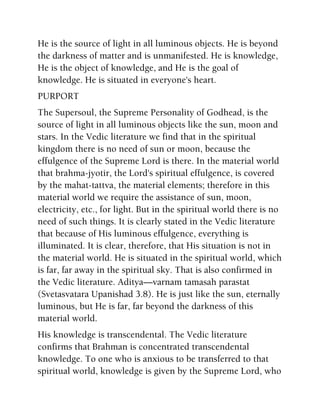
He is the source of light in all luminous objects. He is beyond
the darkness of matter and is unmanifested. He is knowledge,
He is the object of knowledge, and He is the goal of
knowledge. He is situated in everyone's heart.
PURPORT
The Supersoul, the Supreme Personality of Godhead, is the
source of light in all luminous objects like the sun, moon and
stars. In the Vedic literature we find that in the spiritual
kingdom there is no need of sun or moon, because the
effulgence of the Supreme Lord is there. In the material world
that brahma-jyotir, the Lord's spiritual effulgence, is covered
by the mahat-tattva, the material elements; therefore in this
material world we require the assistance of sun, moon,
electricity, etc., for light. But in the spiritual world there is no
need of such things. It is clearly stated in the Vedic literature
that because of His luminous effulgence, everything is
illuminated. It is clear, therefore, that His situation is not in
the material world. He is situated in the spiritual world, which
is far, far away in the spiritual sky. That is also confirmed in
the Vedic literature. Aditya—varnam tamasah parastat
(Svetasvatara Upanishad 3.8). He is just like the sun, eternally
luminous, but He is far, far beyond the darkness of this
material world.
His knowledge is transcendental. The Vedic literature
confirms that Brahman is concentrated transcendental
knowledge. To one who is anxious to be transferred to that
spiritual world, knowledge is given by the Supreme Lord, who
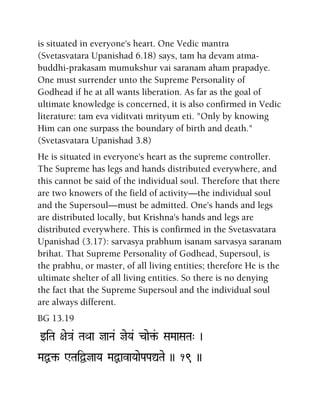
is situated in everyone's heart. One Vedic mantra
(Svetasvatara Upanishad 6.18) says, tam ha devam atma-
buddhi-prakasam mumukshur vai saranam aham prapadye.
One must surrender unto the Supreme Personality of
Godhead if he at all wants liberation. As far as the goal of
ultimate knowledge is concerned, it is also confirmed in Vedic
literature: tam eva viditvati mrityum eti. "Only by knowing
Him can one surpass the boundary of birth and death."
(Svetasvatara Upanishad 3.8)
He is situated in everyone's heart as the supreme controller.
The Supreme has legs and hands distributed everywhere, and
this cannot be said of the individual soul. Therefore that there
are two knowers of the field of activity—the individual soul
and the Supersoul—must be admitted. One's hands and legs
are distributed locally, but Krishna's hands and legs are
distributed everywhere. This is confirmed in the Svetasvatara
Upanishad (3.17): sarvasya prabhum isanam sarvasya saranam
brihat. That Supreme Personality of Godhead, Supersoul, is
the prabhu, or master, of all living entities; therefore He is the
ultimate shelter of all living entities. So there is no denying
the fact that the Supreme Supersoul and the individual soul
are always different.
BG 13.19
wiTa +ae}a& TaQaa jaNa& jeYa& cae¢&- SaMaaSaTa" )
MaÙ¢- WTaiÜjaYa MaÙavaYaaePaPaÛTae )) 19 ))
iti kñetraà tathä jïänaà
jïeyaà coktaà samäsataù
mad-bhakta etad vijïäya
mad-bhäväyopapadyate
WORD-FOR-WORD MEANINGS
iti—thus; kñetram—the field of activities (the body); tathä—
also; jïänam—knowledge; jïeyam—the knowable; ca—also;
uktam—described; samäsataù—in summary; mat—bhaktaù—
My devotee; etat—all this; vijïäya—after understanding; mat-
bhäväya—to My nature; upapadyate—attains.
TRANSLATION
Thus the field of activities [the body], knowledge and the
knowable have been summarily described by Me. Only My
devotees can understand this thoroughly and thus attain to
My nature.
PURPORT
The Lord has described in summary the body, knowledge and
the knowable. This knowledge is of three things: the knower,
the knowable and the process of knowing. Combined, these
are called vijnana, or the science of knowledge. Perfect
knowledge can be understood by the unalloyed devotees of
the Lord directly. Others are unable to understand. The
monists say that at the ultimate stage these three items
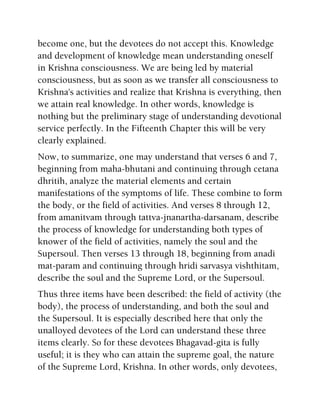
become one, but the devotees do not accept this. Knowledge
and development of knowledge mean understanding oneself
in Krishna consciousness. We are being led by material
consciousness, but as soon as we transfer all consciousness to
Krishna's activities and realize that Krishna is everything, then
we attain real knowledge. In other words, knowledge is
nothing but the preliminary stage of understanding devotional
service perfectly. In the Fifteenth Chapter this will be very
clearly explained.
Now, to summarize, one may understand that verses 6 and 7,
beginning from maha-bhutani and continuing through cetana
dhritih, analyze the material elements and certain
manifestations of the symptoms of life. These combine to form
the body, or the field of activities. And verses 8 through 12,
from amanitvam through tattva-jnanartha-darsanam, describe
the process of knowledge for understanding both types of
knower of the field of activities, namely the soul and the
Supersoul. Then verses 13 through 18, beginning from anadi
mat-param and continuing through hridi sarvasya vishthitam,
describe the soul and the Supreme Lord, or the Supersoul.
Thus three items have been described: the field of activity (the
body), the process of understanding, and both the soul and
the Supersoul. It is especially described here that only the
unalloyed devotees of the Lord can understand these three
items clearly. So for these devotees Bhagavad-gita is fully
useful; it is they who can attain the supreme goal, the nature
of the Supreme Lord, Krishna. In other words, only devotees,
and not others, can understand Bhagavad-gita and derive the
desired result.
BG 13.20
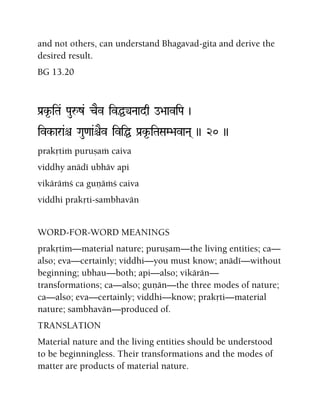
Pa[k*-iTa& Pauåz& cEv ivÖyNaadq o>aaviPa )
ivk-ara&ê Gau<aa&êEv iviÖ Pa[k*-iTaSaM>avaNa( )) 20 ))
prakåtià puruñaà caiva
viddhy anädé ubhäv api
vikäräàç ca guëäàç caiva
viddhi prakåti-sambhavän
WORD-FOR-WORD MEANINGS
prakåtim—material nature; puruñam—the living entities; ca—
also; eva—certainly; viddhi—you must know; anädé—without
beginning; ubhau—both; api—also; vikärän—
transformations; ca—also; guëän—the three modes of nature;
ca—also; eva—certainly; viddhi—know; prakåti—material
nature; sambhavän—produced of.
TRANSLATION
Material nature and the living entities should be understood
to be beginningless. Their transformations and the modes of
matter are products of material nature.
PURPORT
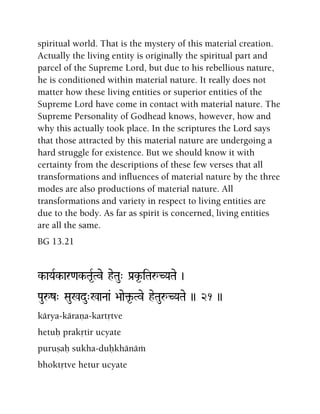
By the knowledge given in this chapter, one can understand
the body (the field of activities) and the knowers of the body
(both the individual soul and the Supersoul). The body is the
field of activity and is composed of material nature. The
individual soul that is embodied and enjoying the activities of
the body is the purusha, or the living entity. He is one
knower, and the other is the Supersoul. Of course, it is to be
understood that both the Supersoul and the individual entity
are different manifestations of the Supreme Personality of
Godhead. The living entity is in the category of His energy,
and the Supersoul is in the category of His personal
expansion.
Both material nature and the living entity are eternal. That is
to say that they existed before the creation. The material
manifestation is from the energy of the Supreme Lord, and so
also are the living entities, but the living entities are of the
superior energy. Both the living entities and material nature
existed before this cosmos was manifested. Material nature
was absorbed in the Supreme Personality of Godhead, Maha-
vishnu, and when it was required, it was manifested by the
agency of mahat-tattva. Similarly, the living entities are also in
Him, and because they are conditioned, they are averse to
serving the Supreme Lord. Thus they are not allowed to enter
into the spiritual sky. But with the coming forth of material
nature these living entities are again given a chance to act in
the material world and prepare themselves to enter into the
spiritual world. That is the mystery of this material creation.
Actually the living entity is originally the spiritual part and
parcel of the Supreme Lord, but due to his rebellious nature,
he is conditioned within material nature. It really does not
matter how these living entities or superior entities of the
Supreme Lord have come in contact with material nature. The
Supreme Personality of Godhead knows, however, how and
why this actually took place. In the scriptures the Lord says
that those attracted by this material nature are undergoing a
hard struggle for existence. But we should know it with
certainty from the descriptions of these few verses that all
transformations and influences of material nature by the three
modes are also productions of material nature. All
transformations and variety in respect to living entities are
due to the body. As far as spirit is concerned, living entities
are all the same.
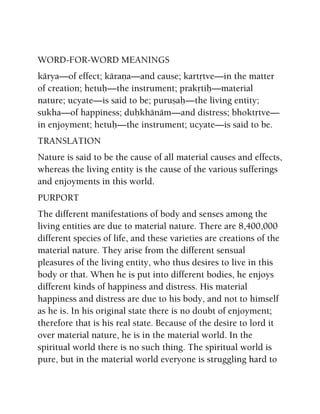
BG 13.21
k-aYaRk-ar<ak-Ta*RTve heTau" Pa[k*-iTaåCYaTae )
Pauåz" Sau%du"%aNaa& >aae¢*-Tve heTauåCYaTae )) 21 ))
kärya-käraëa-kartåtve
hetuù prakåtir ucyate
puruñaù sukha-duùkhänäà
bhoktåtve hetur ucyate
WORD-FOR-WORD MEANINGS
kärya—of effect; käraëa—and cause; kartåtve—in the matter
of creation; hetuù—the instrument; prakåtiù—material
nature; ucyate—is said to be; puruñaù—the living entity;
sukha—of happiness; duùkhänäm—and distress; bhoktåtve—
in enjoyment; hetuù—the instrument; ucyate—is said to be.
TRANSLATION
Nature is said to be the cause of all material causes and effects,
whereas the living entity is the cause of the various sufferings
and enjoyments in this world.
PURPORT
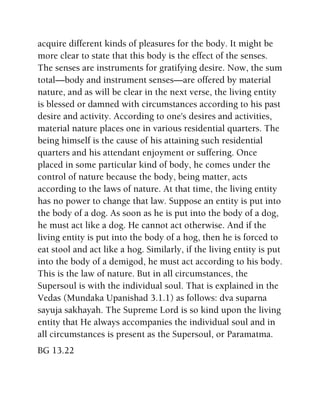
The different manifestations of body and senses among the
living entities are due to material nature. There are 8,400,000
different species of life, and these varieties are creations of the
material nature. They arise from the different sensual
pleasures of the living entity, who thus desires to live in this
body or that. When he is put into different bodies, he enjoys
different kinds of happiness and distress. His material
happiness and distress are due to his body, and not to himself
as he is. In his original state there is no doubt of enjoyment;
therefore that is his real state. Because of the desire to lord it
over material nature, he is in the material world. In the
spiritual world there is no such thing. The spiritual world is
pure, but in the material world everyone is struggling hard to
acquire different kinds of pleasures for the body. It might be
more clear to state that this body is the effect of the senses.
The senses are instruments for gratifying desire. Now, the sum
total—body and instrument senses—are offered by material
nature, and as will be clear in the next verse, the living entity
is blessed or damned with circumstances according to his past
desire and activity. According to one's desires and activities,
material nature places one in various residential quarters. The
being himself is the cause of his attaining such residential
quarters and his attendant enjoyment or suffering. Once
placed in some particular kind of body, he comes under the
control of nature because the body, being matter, acts
according to the laws of nature. At that time, the living entity
has no power to change that law. Suppose an entity is put into
the body of a dog. As soon as he is put into the body of a dog,
he must act like a dog. He cannot act otherwise. And if the
living entity is put into the body of a hog, then he is forced to
eat stool and act like a hog. Similarly, if the living entity is put
into the body of a demigod, he must act according to his body.
This is the law of nature. But in all circumstances, the
Supersoul is with the individual soul. That is explained in the
Vedas (Mundaka Upanishad 3.1.1) as follows: dva suparna
sayuja sakhayah. The Supreme Lord is so kind upon the living
entity that He always accompanies the individual soul and in
all circumstances is present as the Supersoul, or Paramatma.
BG 13.22
Pauåz" Pa[k*-iTaSQaae ih >au»e Pa[k*-iTaJaaNGau<aaNa( )
k-ar<a& Gau<aSa(r)ae_SYa SadSaÛaeiNaJaNMaSau )) 22 ))
puruñaù prakåti-stho hi
bhuìkte prakåti-jän guëän
käraëaà guëa-saìgo 'sya
sad-asad-yoni-janmasu
WORD-FOR-WORD MEANINGS
puruñaù—the living entity; prakåti-sthaù—being situated in
the material energy; hi—certainly; bhuìkte—enjoys; prakåti—
jän—produced by the material nature; guëän—the modes of
nature; käraëam—the cause; guëa-saìgaù—the association
with the modes of nature; asya—of the living entity; sat-asat—
in good and bad; yoni—species of life; janmasu—in births.
TRANSLATION
The living entity in material nature thus follows the ways of
life, enjoying the three modes of nature. This is due to his
association with that material nature. Thus he meets with
good and evil among various species.
PURPORT
This verse is very important for an understanding of how the
living entities transmigrate from one body to another. It is
explained in the Second Chapter that the living entity is
transmigrating from one body to another just as one changes
dress. This change of dress is due to his attachment to
material existence. As long as he is captivated by this false
manifestation, he has to continue transmigrating from one
body to another. Due to his desire to lord it over material
nature, he is put into such undesirable circumstances. Under
the influence of material desire, the entity is born sometimes
as a demigod, sometimes as a man, sometimes as a beast, as a
bird, as a worm, as an aquatic, as a saintly man, as a bug. This
is going on. And in all cases the living entity thinks himself to
be the master of his circumstances, yet he is under the
influence of material nature.
How he is put into such different bodies is explained here. It
is due to association with the different modes of nature. One
has to rise, therefore, above the three material modes and
become situated in the transcendental position. That is called
Krishna consciousness. Unless one is situated in Krishna
consciousness, his material consciousness will oblige him to
transfer from one body to another because he has material
desires since time immemorial. But he has to change that
conception. That change can be effected only by hearing from
authoritative sources. The best example is here: Arjuna is
hearing the science of God from Krishna. The living entity, if
he submits to this hearing process, will lose his long-
cherished desire to dominate material nature, and gradually
and proportionately, as he reduces his long desire to
dominate, he comes to enjoy spiritual happiness. In a Vedic
mantra it is said that as he becomes learned in association
with the Supreme Personality of Godhead, he proportionately
relishes his eternal blissful life.
BG 13.23
oPad]íaNauMaNTaa c >aTaaR >aae¢-a Maheìr" )
ParMaaTMaeiTa caPYau¢-ae dehe_iSMaNPauåz" Par" )) 23 ))
upadrañöänumantä ca
bhartä bhoktä maheçvaraù
paramätmeti cäpy ukto
dehe 'smin puruñaù paraù
WORD-FOR-WORD MEANINGS
upadrañöä—overseer; anumantä—permitter; ca—also;
bhartä—master; bhoktä—supreme enjoyer; mahä-éçvaraù—
the Supreme Lord; parama-ätmä—the Supersoul; iti—also;
ca—and; api—indeed; uktaù—is said; dehe—in the body;
asmin—this; puruñaù—enjoyer; paraù—transcendental.
TRANSLATION
Yet in this body there is another, a transcendental enjoyer,
who is the Lord, the supreme proprietor, who exists as the
overseer and permitter, and who is known as the Supersoul.
PURPORT
It is stated here that the Supersoul, who is always with the
individual soul, is the representation of the Supreme Lord. He
is not an ordinary living entity. Because the monist
philosophers take the knower of the body to be one, they
think that there is no difference between the Supersoul and
the individual soul. To clarify this, the Lord says that He is
represented as the Paramatma in every body. He is different
from the individual soul; He is para, transcendental. The
individual soul enjoys the activities of a particular field, but
the Supersoul is present not as finite enjoyer nor as one taking
part in bodily activities, but as the witness, overseer, permitter
and supreme enjoyer. His name is Paramatma, not atma, and
He is transcendental. It is distinctly clear that the atma and
Paramatma are different. The Supersoul, the Paramatma, has
legs and hands everywhere, but the individual soul does not.
And because the Paramatma is the Supreme Lord, He is
present within to sanction the individual soul's desiring
material enjoyment. Without the sanction of the Supreme
Soul, the individual soul cannot do anything. The individual
is bhukta, or the sustained, and the Lord is bhokta, or the
maintainer. There are innumerable living entities, and He is
staying in them as a friend.
The fact is that every individual living entity is eternally part
and parcel of the Supreme Lord, and both of them are very
intimately related as friends. But the living entity has the
tendency to reject the sanction of the Supreme Lord and act
independently in an attempt to dominate nature, and because
he has this tendency he is called the marginal energy of the
Supreme Lord. The living entity can be situated either in the
material energy or in the spiritual energy. As long as he is
conditioned by the material energy, the Supreme Lord, as his
friend, the Supersoul, stays with him just to get him to return
to the spiritual energy. The Lord is always eager to take him
back to the spiritual energy, but due to his minute
independence the individual entity is continually rejecting the
association of spiritual light. This misuse of independence is
the cause of his material strife in the conditioned nature. The
Lord, therefore, is always giving instruction from within and
from without. From without He gives instructions as stated in
Bhagavad-gita, and from within He tries to convince the living
entity that his activities in the material field are not conducive
to real happiness. "Just give it up and turn your faith toward
Me. Then you will be happy," He says. Thus the intelligent
person who places his faith in the Paramatma or the Supreme
Personality of Godhead begins to advance toward a blissful
eternal life of knowledge.
BG 13.24
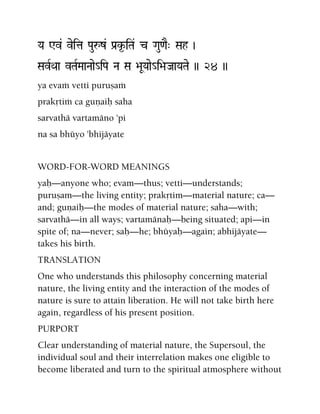
Ya Wv& veita Pauåz& Pa[k*-iTa& c Gau<aE" Sah )
SavRQaa vTaRMaaNaae_iPa Na Sa >aUYaae_i>aJaaYaTae )) 24 ))
ya evaà vetti puruñaà
prakåtià ca guëaiù saha
sarvathä vartamäno 'pi
na sa bhüyo 'bhijäyate
WORD-FOR-WORD MEANINGS
yaù—anyone who; evam—thus; vetti—understands;
puruñam—the living entity; prakåtim—material nature; ca—
and; guëaiù—the modes of material nature; saha—with;
sarvathä—in all ways; vartamänaù—being situated; api—in
spite of; na—never; saù—he; bhüyaù—again; abhijäyate—
takes his birth.
TRANSLATION
One who understands this philosophy concerning material
nature, the living entity and the interaction of the modes of
nature is sure to attain liberation. He will not take birth here
again, regardless of his present position.
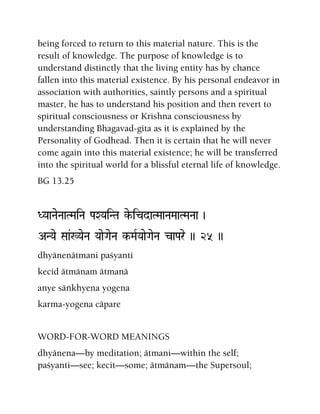
PURPORT
Clear understanding of material nature, the Supersoul, the
individual soul and their interrelation makes one eligible to
become liberated and turn to the spiritual atmosphere without
being forced to return to this material nature. This is the
result of knowledge. The purpose of knowledge is to
understand distinctly that the living entity has by chance
fallen into this material existence. By his personal endeavor in
association with authorities, saintly persons and a spiritual
master, he has to understand his position and then revert to
spiritual consciousness or Krishna consciousness by
understanding Bhagavad-gita as it is explained by the
Personality of Godhead. Then it is certain that he will never
come again into this material existence; he will be transferred
into the spiritual world for a blissful eternal life of knowledge.
BG 13.25
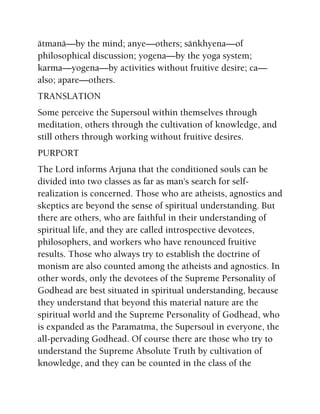
DYaaNaeNaaTMaiNa PaXYaiNTa ke-icdaTMaaNaMaaTMaNaa )
ANYae Saa&:YaeNa YaaeGaeNa k-MaRYaaeGaeNa caPare )) 25 ))
dhyänenätmani paçyanti
kecid ätmänam ätmanä
anye säìkhyena yogena
karma-yogena cäpare
WORD-FOR-WORD MEANINGS
dhyänena—by meditation; ätmani—within the self;
paçyanti—see; kecit—some; ätmänam—the Supersoul;
ätmanä—by the mind; anye—others; säìkhyena—of
philosophical discussion; yogena—by the yoga system;
karma—yogena—by activities without fruitive desire; ca—
also; apare—others.
TRANSLATION
Some perceive the Supersoul within themselves through
meditation, others through the cultivation of knowledge, and
still others through working without fruitive desires.
PURPORT
The Lord informs Arjuna that the conditioned souls can be
divided into two classes as far as man's search for self-
realization is concerned. Those who are atheists, agnostics and
skeptics are beyond the sense of spiritual understanding. But
there are others, who are faithful in their understanding of
spiritual life, and they are called introspective devotees,
philosophers, and workers who have renounced fruitive
results. Those who always try to establish the doctrine of
monism are also counted among the atheists and agnostics. In
other words, only the devotees of the Supreme Personality of
Godhead are best situated in spiritual understanding, because
they understand that beyond this material nature are the
spiritual world and the Supreme Personality of Godhead, who
is expanded as the Paramatma, the Supersoul in everyone, the
all-pervading Godhead. Of course there are those who try to
understand the Supreme Absolute Truth by cultivation of
knowledge, and they can be counted in the class of the
faithful. The Sankhya philosophers analyze this material
world into twenty-four elements, and they place the
individual soul as the twenty-fifth item. When they are able to
understand the nature of the individual soul to be
transcendental to the material elements, they are able to
understand also that above the individual soul there is the
Supreme Personality of Godhead. He is the twenty-sixth
element. Thus gradually they also come to the standard of
devotional service in Krishna consciousness. Those who work
without fruitive results are also perfect in their attitude. They
are given a chance to advance to the platform of devotional
service in Krishna consciousness. Here it is stated that there
are some people who are pure in consciousness and who try
to find out the Supersoul by meditation, and when they
discover the Supersoul within themselves, they become
transcendentally situated. Similarly, there are others who also
try to understand the Supreme Soul by cultivation of
knowledge, and there are others who cultivate the hatha-yoga
system and who try to satisfy the Supreme Personality of
Godhead by childish activities.
BG 13.26
ANYae TvevMaJaaNaNTa" é[uTvaNYae>Ya oPaaSaTae )
Tae_iPa caiTaTarNTYaev Ma*TYau& é[uiTaParaYa<aa" )) 26 ))
anye tv evam ajänantaù
çrutvänyebhya upäsate
te 'pi cätitaranty eva
måtyuà çruti-paräyaëäù
WORD-FOR-WORD MEANINGS
anye—others; tu—but; evam—thus; ajänantaù—without
spiritual knowledge; çrutvä—by hearing; anyebhyaù—from
others; upäsate—begin to worship; te—they; api—also; ca—
and; atitaranti—transcend; eva—certainly; måtyum—the path
of death; çruti-paräyaëäù—inclined to the process of hearing.
TRANSLATION
Again there are those who, although not conversant in
spiritual knowledge, begin to worship the Supreme Person
upon hearing about Him from others. Because of their
tendency to hear from authorities, they also transcend the
path of birth and death.
PURPORT
This verse is particularly applicable to modern society because
in modern society there is practically no education in spiritual
matters. Some of the people may appear to be atheistic or
agnostic or philosophical, but actually there is no knowledge
of philosophy. As for the common man, if he is a good soul,
then there is a chance for advancement by hearing. This
hearing process is very important. Lord Caitanya, who
preached Krishna consciousness in the modern world, gave
great stress to hearing because if the common man simply
hears from authoritative sources he can progress, especially,
according to Lord Caitanya, if he hears the transcendental
vibration Hare Krishna, Hare Krishna, Krishna Krishna, Hare
Hare/ Hare Rama, Hare Rama, Rama Rama, Hare Hare. It is
stated, therefore, that all men should take advantage of
hearing from realized souls and gradually become able to
understand everything. The worship of the Supreme Lord will
then undoubtedly take place. Lord Caitanya has said that in
this age no one needs to change his position, but one should
give up the endeavor to understand the Absolute Truth by
speculative reasoning. One should learn to become the servant
of those who are in knowledge of the Supreme Lord. If one is
fortunate enough to take shelter of a pure devotee, hear from
him about self-realization and follow in his footsteps, one will
be gradually elevated to the position of a pure devotee. In this
verse particularly, the process of hearing is strongly
recommended, and this is very appropriate. Although the
common man is often not as capable as so-called
philosophers, faithful hearing from an authoritative person
will help one transcend this material existence and go back to
Godhead, back to home.
BG 13.27
YaavTSaÅaYaTae ik-iÄTSatv& SQaavrJa(r)MaMa( )
+ae}a+ae}ajSa&YaaeGaataiÜiÖ >arTazR>a )) 27 ))
yävat saïjäyate kiïcit
sattvaà sthävara-jaìgamam
kñetra-kñetrajïa-saàyogät
tad viddhi bharatarñabha
WORD-FOR-WORD MEANINGS
yävat—whatever; saïjäyate—comes into being; kiïcit—
anything; sattvam—existence; sthävara—not moving;
jaìgamam—moving; kñetra—of the body; kñetra-jïa—and the
knower of the body; saàyogät—by the union between; tat
viddhi—you must know it; bharata-åñabha—O chief of the
Bhäratas.
TRANSLATION
O chief of the Bharatas, know that whatever you see in
existence, both the moving and the nonmoving, is only a
combination of the field of activities and the knower of the
field.
PURPORT
Both material nature and the living entity, which were existing
before the creation of the cosmos, are explained in this verse.
Whatever is created is but a combination of the living entity
and material nature. There are many manifestations like trees,
mountains and hills which are not moving, and there are
many existences which are moving, and all of them are but
combinations of material nature and the superior nature, the
living entity. Without the touch of the superior nature, the
living entity, nothing can grow. The relationship between
material nature and spiritual nature is eternally going on, and
this combination is effected by the Supreme Lord; therefore
He is the controller of both the superior and inferior natures.
The material nature is created by Him, and the superior
nature is placed in this material nature, and thus all these
activities and manifestations take place.
BG 13.28
SaMa& SaveRzu >aUTaezu iTaïNTa& ParMaeìrMa( )
ivNaXYaTSvivNaXYaNTa& Ya" PaXYaiTa Sa PaXYaiTa )) 28 ))
samaà sarveñu bhüteñu
tiñöhantaà parameçvaram
vinaçyatsv avinaçyantaà
yaù paçyati sa paçyati
WORD-FOR-WORD MEANINGS
samam—equally; sarveñu—in all; bhüteñu—living entities;
tiñöhan-tam—residing; parama-éçvaram—the Supersoul;
vinaçyatsu—in the destructible; avinaçyantam—not destroyed;
yaù—anyone who; paçyati—sees; saù—he; paçyati—actually
sees.
TRANSLATION
One who sees the Supersoul accompanying the individual soul
in all bodies, and who understands that neither the soul nor
the Supersoul within the destructible body is ever destroyed,
actually sees.
PURPORT
Anyone who by good association can see three things
combined together—the body, the proprietor of the body, or
individual soul, and the friend of the individual soul—is
actually in knowledge. Unless one has the association of a real
knower of spiritual subjects, one cannot see these three
things. Those who do not have such association are ignorant;
they simply see the body, and they think that when the body
is destroyed everything is finished. But actually it is not so.
After the destruction of the body, both the soul and the
Supersoul exist, and they go on eternally in many various
moving and nonmoving forms. The Sanskrit word
paramesvara is sometimes translated as "the individual soul"
because the soul is the master of the body and after the
destruction of the body he transfers to another form. In that
way he is master. But there are others who interpret this
paramesvara to be the Supersoul. In either case, both the
Supersoul and the individual soul continue. They are not
destroyed. One who can see in this way can actually see what
is happening.
BG 13.29
SaMa& PaXYaiNh SavR}a SaMaviSQaTaMaqìrMa( )
Na ihNaSTYaaTMaNaaTMaaNa& TaTaae YaaiTa Para& GaiTaMa( )) 29 ))
samaà paçyan hi sarvatra
samavasthitam éçvaram
na hinasty ätmanätmänaà
tato yäti paräà gatim
WORD-FOR-WORD MEANINGS
samam—equally; paçyan—seeing; hi—certainly; sarvatra—
everywhere; samavasthitam—equally situated; éçvaram—the
Supersoul; na—does not; hinasti—degrade; ätmanä—by the
mind; ätmänam—the soul; tataù—then; yäti—reaches;
paräm—the transcendental; gatim—destination.
TRANSLATION
One who sees the Supersoul equally present everywhere, in
every living being, does not degrade himself by his mind.
Thus he approaches the transcendental destination.
PURPORT
The living entity, by accepting his material existence, has
become situated differently than in his spiritual existence. But
if one understands that the Supreme is situated in His
Paramatma manifestation everywhere, that is, if one can see
the presence of the Supreme Personality of Godhead in every
living thing, he does not degrade himself by a destructive
mentality, and he therefore gradually advances to the spiritual
world. The mind is generally addicted to sense gratifying
processes; but when the mind turns to the Supersoul, one
becomes advanced in spiritual understanding.
BG 13.30
Pa[k*-TYaEv c k-MaaRi<a i§-YaMaa<aaiNa SavRXa" )
Ya" PaXYaiTa TaQaaTMaaNaMak-TaaRr& Sa PaXYaiTa )) 30 ))
prakåtyaiva ca karmäëi
kriyamäëäni sarvaçaù
yaù paçyati tathätmänam
akartäraà sa paçyati
WORD-FOR-WORD MEANINGS
prakåtyä—by material nature; eva—certainly; ca—also;
karmäëi—activities; kriyamäëäni—being performed;
sarvaçaù—in all respects; yaù—anyone who; paçyati—sees;
tathä—also; ätmänam—himself; akartäram—the nondoer;
saù—he; paçyati—sees perfectly.
TRANSLATION
One who can see that all activities are performed by the body,
which is created of material nature, and sees that the self does
nothing, actually sees.
PURPORT
This body is made by material nature under the direction of
the Supersoul, and whatever activities are going on in respect
to one's body are not his doing. Whatever one is supposed to
do, either for happiness or for distress, one is forced to do
because of the bodily constitution. The self, however, is
outside all these bodily activities. This body is given according
to one's past desires. To fulfill desires, one is given the body,
with which he acts accordingly. Practically speaking, the body
is a machine, designed by the Supreme Lord, to fulfill desires.
Because of desires, one is put into difficult circumstances to
suffer or to enjoy. This transcendental vision of the living
entity, when developed, makes one separate from bodily
activities. One who has such a vision is an actual seer.
BG 13.31
Yada >aUTaPa*QaG>aavMaek-SQaMaNauPaXYaiTa )
TaTa Wv c ivSTaar& b]ø SaMPaÛTae Tada )) 31 ))
yadä bhüta-påthag-bhävam
eka-stham anupaçyati
tata eva ca vistäraà
brahma sampadyate tadä
WORD-FOR-WORD MEANINGS
yadä—when; bhüta—of living entities; påthak-bhävam—
separated identities; eka-stham—situated in one; anupaçyati—
one tries to see through authority; tataù eva—thereafter; ca—
also; vistäram—the expansion; brahma—the Absolute;
sampadyate—he attains; tadä—at that time.
TRANSLATION
When a sensible man ceases to see different identities due to
different material bodies and he sees how beings are expanded
everywhere, he attains to the Brahman conception.
PURPORT
When one can see that the various bodies of living entities
arise due to the different desires of the individual soul and do
not actually belong to the soul itself, one actually sees. In the
material conception of life, we find someone a demigod,
someone a human being, a dog, a cat, etc. This is material
vision, not actual vision. This material differentiation is due to
a material conception of life. After the destruction of the
material body, the spirit soul is one. The spirit soul, due to
contact with material nature, gets different types of bodies.
When one can see this, he attains spiritual vision; thus being
freed from differentiations like man, animal, big, low, etc., one
becomes purified in his consciousness and able to develop
Krishna consciousness in his spiritual identity. How he then
sees things will be explained in the next verse.
BG 13.32
ANaaidTvaiàGauR<aTvaTParMaaTMaaYaMaVYaYa" )
XarqrSQaae_iPa k-aENTaeYa Na k-raeiTa Na il/PYaTae )) 32 ))
anäditvän nirguëatvät
paramätmäyam avyayaù
çaréra-stho 'pi kaunteya
na karoti na lipyate
WORD-FOR-WORD MEANINGS
anäditvät—due to eternity; nirguëatvät—due to being
transcendental; parama—beyond material nature; ätmä—
spirit; ayam—this; avyayaù—inexhaustible; çaréra-sthaù—
dwelling in the body; api—though; kaunteya—O son of
Kunté; na karoti—never does anything; na lipyate—nor is he
entangled.
TRANSLATION
Those with the vision of eternity can see that the imperishable
soul is transcendental, eternal, and beyond the modes of
nature. Despite contact with the material body, O Arjuna, the
soul neither does anything nor is entangled.
PURPORT
A living entity appears to be born because of the birth of the
material body, but actually the living entity is eternal; he is
not born, and in spite of his being situated in a material body,
he is transcendental and eternal. Thus he cannot be destroyed.
By nature he is full of bliss. He does not engage himself in any
material activities; therefore the activities performed due to
his contact with material bodies do not entangle him.
BG 13.33
YaQaa SavRGaTa& SaaE+MYaadak-aXa& NaaePail/PYaTae )
SavR}aaviSQaTaae dehe TaQaaTMaa NaaePail/PYaTae )) 33 ))
yathä sarva-gataà saukñmyäd
äkäçaà nopalipyate
sarvaträvasthito dehe
tathätmä nopalipyate
WORD-FOR-WORD MEANINGS
yathä—as; sarva-gatam—all-pervading; saukñmyät—due to
being subtle; äkäçam—the sky; na—never; upalipyate—mixes;
sarvatra—everywhere; avasthitaù—situated; dehe—in the
body; tathä—so; ätmä—the self; na—never; upalipyate—
mixes.
TRANSLATION
The sky, due to its subtle nature, does not mix with anything,
although it is all-pervading. Similarly, the soul situated in
Brahman vision does not mix with the body, though situated
in that body.
PURPORT
The air enters into water, mud, stool and whatever else is
there; still it does not mix with anything. Similarly, the living
entity, even though situated in varieties of bodies, is aloof
from them due to his subtle nature. Therefore it is impossible
to see with the material eyes how the living entity is in contact
with this body and how he is out of it after the destruction of
the body. No one in science can ascertain this.
BG 13.34
YaQaa Pa[k-aXaYaTYaek-" k*-Tò& l/aek-iMaMa& riv" )
+ae}a& +ae}aq TaQaa k*-Tò& Pa[k-aXaYaiTa >aarTa )) 34 ))
yathä prakäçayaty ekaù
kåtsnaà lokam imaà raviù
kñetraà kñetré tathä kåtsnaà
prakäçayati bhärata
WORD-FOR-WORD MEANINGS
yathä—as; prakäçayati—illuminates; ekaù—one; kåtsnam—
the whole; lokam—universe; imam—this; raviù—sun;
kñetram—this body; kñetré—the soul; tathä—similarly;
kåtsnam—all; prakäçayati—illuminates; bhärata—O son of
Bharata.
TRANSLATION
O son of Bharata, as the sun alone illuminates all this
universe, so does the living entity, one within the body,
illuminate the entire body by consciousness.
PURPORT
There are various theories regarding consciousness. Here in
Bhagavad-gita the example of the sun and the sunshine is
given. As the sun is situated in one place but is illuminating
the whole universe, so a small particle of spirit soul, although
situated in the heart of this body, is illuminating the whole
body by consciousness. Thus consciousness is the proof of the
presence of the soul, as sunshine or light is the proof of the
presence of the sun. When the soul is present in the body,
there is consciousness all over the body, and as soon as the
soul has passed from the body there is no more consciousness.
This can be easily understood by any intelligent man.
Therefore consciousness is not a product of the combinations
of matter. It is the symptom of the living entity. The
consciousness of the living entity, although qualitatively one
with the supreme consciousness, is not supreme, because the
consciousness of one particular body does not share that of
another body. But the Supersoul, which is situated in all
bodies as the friend of the individual soul, is conscious of all
bodies. That is the difference between supreme consciousness
and individual consciousness.
BG 13.35
+ae}a+ae}ajYaaerevMaNTar& jaNac+auza )
>aUTaPa[k*-iTaMaae+a& c Yae ivduYaaRiNTa Tae ParMa( )) 35 ))
kñetra-kñetrajïayor evam
antaraà jïäna-cakñuñä
bhüta-prakåti-mokñaà ca
ye vidur yänti te param
WORD-FOR-WORD MEANINGS
kñetra—of the body; kñetra-jïayoù—of the proprietor of the
body; evam—thus; antaram—the difference; jïäna—
cakñuñä—by the vision of knowledge; bhüta—of the living
entity; prakåti—from material nature; mokñam—the
liberation; ca—also; ye—those who; viduù—know; yänti—
approach; te—they; param—the Supreme.
TRANSLATION
Those who see with eyes of knowledge the difference between
the body and the knower of the body, and can also understand
the process of liberation from bondage in material nature,
attain to the supreme goal.
PURPORT
The purport of this Thirteenth Chapter is that one should
know the distinction between the body, the owner of the
body, and the Supersoul. One should recognize the process of
liberation, as described in verses eight through twelve. Then
one can go on to the supreme destination.
A faithful person should at first have some good association to
hear of God and thus gradually become enlightened. If one
accepts a spiritual master, one can learn to distinguish
between matter and spirit, and that becomes the steppingstone
for further spiritual realization. A spiritual master, by various
instructions, teaches his students to get free from the material
concept of life. For instance, in Bhagavad-gita we find Krishna
instructing Arjuna to free him from materialistic
considerations.
One can understand that this body is matter; it can be
analyzed with its twenty-four elements. The body is the gross
manifestation. And the subtle manifestation is the mind and
psychological effects. And the symptoms of life are the
interaction of these features. But over and above this, there is
the soul, and there is also the Supersoul. The soul and the
Supersoul are two. This material world is working by the
conjunction of the soul and the twenty-four material
elements. One who can see the constitution of the whole
material manifestation as this combination of the soul and
material elements and can also see the situation of the
Supreme Soul becomes eligible for transfer to the spiritual
world. These things are meant for contemplation and for
realization, and one should have a complete understanding of
this chapter with the help of the spiritual master.
Thus end the Bhaktivedanta Purports to the Thirteenth
Chapter of the Srimad Bhagavad-gita in the matter of Nature,
the Enjoyer and Consciousness.

Bg 13

  • 1.
    - Chapter 13- Nature, the Enjoyer, and Consciousness One who understands the difference between the body, the soul and the Supersoul beyond them both attains liberation from this material world. BG 13.1, BG 13.2, BG 13.1-2 AJauRNa ovac Pa[k*-iTa& Pauåz& cEv +ae}a& +ae}ajMaev c ) WTaÜeidTauiMaC^aiMa jaNa& jeYa& c ke-Xav )) 1 )) é[q>aGavaNauvacwd& Xarqr& k-aENTaeYa +ae}aiMaTYai>aDaqYaTae ) WTaÛae veita Ta& Pa[ahu" +ae}aj wiTa TaiÜd" )) 2 )) arjuna uväca prakåtià puruñaà caiva kñetraà kñetra-jïam eva ca etad veditum icchämi jïänaà jïeyaà ca keçava çré-bhagavän uväca idaà çaréraà kaunteya
  • 2.
    kñetram ity abhidhéyate etadyo vetti taà prähuù kñetra-jïa iti tad-vidaù WORD-FOR-WORD MEANINGS arjunaù uväca—Arjuna said; prakåtim—nature; puruñam—the enjoyer; ca—also; eva—certainly; kñetram—the field; kñetra- jïam—the knower of the field; eva—certainly; ca—also; etat—all this; veditum—to understand; icchämi—I wish; jïänam—knowledge; jïeyam—the object of knowledge; ca— also; keçava—O Kåñëa; çré-bhagavän uväca—the Personality of Godhead said; idam—this; çaréram—body; kaunteya—O son of Kunté; kñetram—the field; iti—thus; abhidhéyate—is called; etat—this; yaù—one who; vetti—knows; tam—he; prähuù—is called; kñetra-jïaù—the knower of the field; iti— thus; tat—vidaù—by those who know this. TRANSLATION Arjuna said: O my dear Krishna, I wish to know about prakriti [nature], purusha [the enjoyer], and the field and the knower of the field, and of knowledge and the object of knowledge. The Supreme Personality of Godhead said: This body, O son of Kunti, is called the field, and one who knows this body is called the knower of the field. PURPORT
  • 3.
    Arjuna was inquisitiveabout prakriti (nature), purusha (the enjoyer), kshetra (the field), kshetra-jna (its knower), and knowledge and the object of knowledge. When he inquired about all these, Krishna said that this body is called the field and that one who knows this body is called the knower of the field. This body is the field of activity for the conditioned soul. The conditioned soul is entrapped in material existence, and he attempts to lord it over material nature. And so, according to his capacity to dominate material nature, he gets a field of activity. That field of activity is the body. And what is the body? The body is made of senses. The conditioned soul wants to enjoy sense gratification, and, according to his capacity to enjoy sense gratification, he is offered a body, or field of activity. Therefore the body is called kshetra, or the field of activity for the conditioned soul. Now, the person, who should not identify himself with the body, is called kshetra-jna, the knower of the field. It is not very difficult to understand the difference between the field and its knower, the body and the knower of the body. Any person can consider that from childhood to old age he undergoes so many changes of body and yet is still one person, remaining. Thus there is a difference between the knower of the field of activities and the actual field of activities. A living conditioned soul can thus understand that he is different from the body. It is described in the beginning—dehino 'smin—that the living entity is within the body and that the body is changing from childhood to boyhood and from boyhood to youth and from youth to old age, and the person who owns the body knows
  • 4.
    that the bodyis changing. The owner is distinctly kshetra-jna. Sometimes we think, "I am happy," "I am a man," "I am a woman," "I am a dog," "I am a cat." These are the bodily designations of the knower. But the knower is different from the body. Although we may use many articles—our clothes, etc.—we know that we are different from the things used. Similarly, we also understand by a little contemplation that we are different from the body. I or you or anyone else who owns the body is called kshetra-jna, the knower of the field of activities, and the body is called kshetra, the field of activities itself. In the first six chapters of Bhagavad-gita the knower of the body (the living entity) and the position by which he can understand the Supreme Lord are described. In the middle six chapters of the Bhagavad-gita the Supreme Personality of Godhead and the relationship between the individual soul and the Supersoul in regard to devotional service are described. The superior position of the Supreme Personality of Godhead and the subordinate position of the individual soul are definitely defined in these chapters. The living entities are subordinate under all circumstances, but in their forgetfulness they are suffering. When enlightened by pious activities, they approach the Supreme Lord in different capacities—as the distressed, those in want of money, the inquisitive, and those in search of knowledge. That is also described. Now, starting with the Thirteenth Chapter, how the living entity comes into contact with material nature and how he is delivered by the
  • 5.
    Supreme Lord throughthe different methods of fruitive activities, cultivation of knowledge, and the discharge of devotional service are explained. Although the living entity is completely different from the material body, he somehow becomes related. This also is explained. BG 13.3 +ae}aj& caiPa Maa& iviÖ SavR+ae}aezu >aarTa ) +ae}a+ae}ajYaaejaRNa& YataJjaNa& MaTa& MaMa )) 3 )) kñetra-jïaà cäpi mäà viddhi sarva-kñetreñu bhärata kñetra-kñetrajïayor jïänaà yat taj jïänaà mataà mama WORD-FOR-WORD MEANINGS kñetra-jïam—the knower of the field; ca—also; api— certainly; mäm—Me; viddhi—know; sarva—all; kñetreñu—in bodily fields; bhärata—O son of Bharata; kñetra—the field of activities (the body); kñetra-jïayoù—and the knower of the field; jïänam—knowledge of; yat—that which; tat—that; jïänam—knowledge; matam—opinion; mama—My.
  • 6.
    TRANSLATION O scion ofBharata, you should understand that I am also the knower in all bodies, and to understand this body and its knower is called knowledge. That is My opinion. PURPORT While discussing the subject of the body and the knower of the body, the soul and the Supersoul, we shall find three different topics of study: the Lord, the living entity, and matter. In every field of activities, in every body, there are two souls: the individual soul and the Supersoul. Because the Supersoul is the plenary expansion of the Supreme Personality of Godhead, Krishna, Krishna says, "I am also the knower, but I am not the individual knower of the body. I am the superknower. I am present in every body as the Paramatma, or Supersoul." One who studies the subject matter of the field of activity and the knower of the field very minutely, in terms of this Bhagavad-gita, can attain to knowledge. The Lord says, "I am the knower of the field of activities in every individual body." The individual may be the knower of his own body, but he is not in knowledge of other bodies. The Supreme Personality of Godhead, who is present as the Supersoul in all bodies, knows everything about all bodies. He knows all the different bodies of all the various species of life. A citizen may know everything about his patch of land, but the king knows not only his palace but all the properties
  • 7.
    possessed by theindividual citizens. Similarly, one may be the proprietor of the body individually, but the Supreme Lord is the proprietor of all bodies. The king is the original proprietor of the kingdom, and the citizen is the secondary proprietor. Similarly, the Supreme Lord is the supreme proprietor of all bodies. The body consists of the senses. The Supreme Lord is Hrishikesa, Which means "the controller of the senses." He is the original controller of the senses, just as the king is the original controller of all the activities of the state; the citizens are secondary controllers. The Lord says, "I am also the knower." This means that He is the superknower; the individual soul knows only his particular body. In the Vedic literature, it is stated as follows: kshetrani hi sarirani bijam capi subhasubhe tani vetti sa yogatma tatah kshetra-jna ucyate This body is called the kshetra, and within it dwells the owner of the body and the Supreme Lord, who knows both the body and the owner of the body. Therefore He is called the knower of all fields. The distinction between the field of activities, the knower of activities, and the supreme knower of activities is described as follows. Perfect knowledge of the constitution of the body, the constitution of the individual soul, and the
  • 8.
    constitution of theSupersoul is known in terms of Vedic literature as jnana. That is the opinion of Krishna. To understand both the soul and the Supersoul as one yet distinct is knowledge. One who does not understand the field of activity and the knower of activity is not in perfect knowledge. One has to understand the position of prakriti (nature), purusha (the enjoyer of nature) and isvara (the knower who dominates or controls nature and the individual soul). One should not confuse the three in their different capacities. One should not confuse the painter, the painting and the easel. This material world, which is the field of activities, is nature, and the enjoyer of nature is the living entity, and above them both is the supreme controller, the Personality of Godhead. It is stated in the Vedic language (in the Svetasvatara Upanishad 1.12), bhokta bhogyam preritaram ca matva/ sarvam proktam tri vidham-brahmam etat. There are three Brahman conceptions: prakriti is Brahman as the field of activities, and the jiva (individual soul) is also Brahman and is trying to control material nature, and the controller of both of them is also Brahman, but He is the factual controller. In this chapter it will also be explained that out of the two knowers, one is fallible and the other is infallible. One is superior and the other is subordinate. One who understands the two knowers of the field to be one and the same contradicts the Supreme Personality of Godhead, who states here very clearly, "I am also the knower of the field of activity." One who misunderstands a rope to be a serpent is
  • 9.
    not in knowledge.There are different kinds of bodies, and there are different owners of the bodies. Because each individual soul has his individual capacity for lording it over material nature, there are different bodies. But the Supreme also is present in them as the controller. The word ca is significant, for it indicates the total number of bodies. That is the opinion of Srila Baladeva Vidyabhushana. Krishna is the Supersoul present in each and every body apart from the individual soul. And Krishna explicitly says here that real knowledge is to know that the Supersoul is the controller of both the field of activities and the finite enjoyer. BG 13.4 TaT+ae}a& YaÀ Yaad*Kc YaiÜk-air YaTaê YaTa( ) Sa c Yaae YaTPa[>aavê TaTSaMaaSaeNa Mae é*<au )) 4 )) tat kñetraà yac ca yädåk ca yad-vikäri yataç ca yat sa ca yo yat-prabhävaç ca tat samäsena me çåëu WORD-FOR-WORD MEANINGS tat—that; kñetram—field of activities; yat—what; ca—also; yädåk—as it is; ca—also; yat—having what; vikäri—changes;
  • 10.
    yataù—from which; ca—also;yat—what; saù—he; ca—also; yaù—who; yat—having what; prabhävaù—influence; ca— also; tat—that; samäsena—in summary; me—from Me; çåëu— understand. TRANSLATION Now please hear My brief description of this field of activity and how it is constituted, what its changes are, whence it is produced, who that knower of the field of activities is, and what his influences are. PURPORT The Lord is describing the field of activities and the knower of the field of activities in their constitutional positions. One has to know how this body is constituted, the materials of which this body is made, under whose control this body is working, how the changes are taking place, wherefrom the changes are coming, what the causes are, what the reasons are, what the ultimate goal of the individual soul is, and what the actual form of the individual soul is. One should also know the distinction between the individual living soul and the Supersoul, their different influences, their potentials, etc. One just has to understand this Bhagavad-gita directly from the description given by the Supreme Personality of Godhead, and all this will be clarified. But one should be careful not to consider the Supreme Personality of Godhead in every body to be one with the individual soul, the jiva. This is something like equating the potent and the impotent.
  • 11.
    BG 13.5 ‰izi>abRhuDaa GaqTa&^Ndaei>aivRivDaE" Pa*Qak(- ) b]øSaU}aPadEêEv heTauMaiÙivRiNaiêTaE" )) 5 )) åñibhir bahudhä gétaà chandobhir vividhaiù påthak brahma-sütra-padaiç caiva hetumadbhir viniçcitaiù WORD-FOR-WORD MEANINGS åñibhiù—by the wise sages; bahudhä—in many ways; gétam— described; chandobhiù—by Vedic hymns; vividhaiù—various; påthak—variously; brahma-sütra—of the Vedänta; padaiù—by the aphorisms; ca—also; eva—certainly; hetu-madbhiù—with cause and effect; viniçcitaiù—certain. TRANSLATION That knowledge of the field of activities and of the knower of activities is described by various sages in various Vedic writings. It is especially presented in Vedanta-sutra with all reasoning as to cause and effect. PURPORT
  • 12.
    The Supreme Personalityof Godhead, Krishna, is the highest authority in explaining this knowledge. Still, as a matter of course, learned scholars and standard authorities always give evidence from previous authorities. Krishna is explaining this most controversial point regarding the duality and nonduality of the soul and the Supersoul by referring to a scripture, the Vedanta, which is accepted as authority. First He says, "This is according to different sages." As far as the sages are concerned, besides Himself, Vyasadeva (the author of the Vedanta-sutra) is a great sage, and in the Vedanta-sutra duality is perfectly explained. And Vyasadeva's father, Parasara, is also a great sage, and he writes in his books of religiosity, aham tvam ca tathanye. .. "we—you, I and the various other living entities—are all transcendental, although in material bodies. Now we are fallen into the ways of the three modes of material nature according to our different karma. As such, some are on higher levels, and some are in the lower nature. The higher and lower natures exist due to ignorance and are being manifested in an infinite number of living entities. But the Supersoul, which is infallible, is uncontaminated by the three qualities of nature and is transcendental." Similarly, in the original Vedas, a distinction between the soul, the Supersoul and the body is made, especially in the Katha Upanishad. There are many great sages who have explained this, and Parasara is considered principal among them.
  • 13.
    The word chandobhihrefers to the various Vedic literatures. The Taittiriya Upanishad, for example, which is a branch of the Yajur Veda, describes nature, the living entity and the Supreme Personality of Godhead. As stated before, kshetra is the field of activities, and there are two kinds of kshetra-jna: the individual living entity and the supreme living entity. As stated in the Taittiriya Upanishad (2.5), brahma puccham pratishtha. There is a manifestation of the Supreme Lord's energy known as anna-maya, dependence upon food for existence. This is a materialistic realization of the Supreme. Then, in prana-maya, after realizing the Supreme Absolute Truth in food, one can realize the Absolute Truth in the living symptoms or life forms. In jnana-maya, realization extends beyond the living symptoms to the point of thinking, feeling and willing. Then there is Brahman realization, called vijnana-maya, in which the living entity's mind and life symptoms are distinguished from the living entity himself. The next and supreme stage is ananda-maya, realization of the all-blissful nature. Thus there are five stages of Brahman realization, which are called brahma puccham. Out of these, the first three—anna-maya, prana-maya and jnana-maya—involve the fields of activities of the living entities. Transcendental to all these fields of activities is the Supreme Lord, who is called ananda-maya. The Vedanta-sutra also describes the Supreme by saying, ananda-mayo 'bhyasat: the Supreme Personality of Godhead is by nature full of joy. To enjoy His transcendental bliss, He expands into vijnana-
  • 14.
    maya, prana-maya, jnana-mayaand anna-maya. In the field of activities the living entity is considered to be the enjoyer, and different from him is the ananda-maya. That means that if the living entity decides to enjoy in dovetailing himself with the ananda-maya, then he becomes perfect. This is the real picture of the Supreme Lord as the supreme knower of the field, the living entity as the subordinate knower, and the nature of the field of activities. One has to search for this truth in the Vedanta-sutra, or Brahma-sutra. It is mentioned here that the codes of the Brahma-sutra are very nicely arranged according to cause and effect. Some of the sutras, or aphorisms, are na viyad asruteh (2.3.2), natma sruteh (2.3.18), and parat tu tac-chruteh (2.3.40). The first aphorism indicates the field of activities, the second indicates the living entity, and the third indicates the Supreme Lord, the summum bonum among all the manifestations of various entities. BG 13.6, BG 13.7, BG 13.6-7 Maha>aUTaaNYahªarae buiÖrVYa¢-Maev c ) wiNd]Yaai<a dXaEk&- c PaÄ ceiNd]YaGaaecra" )) 6 )) wC^a Üez" Sau%& du"%& SaºaTaêeTaNaa Da*iTa" ) WTaT+ae}a& SaMaaSaeNa Saivk-arMaudaôTaMa( )) 7 ))
  • 15.
    mahä-bhütäny ahaìkäro buddhir avyaktameva ca indriyäëi daçaikaà ca païca cendriya-gocaräù icchä dveñaù sukhaà duùkhaà saìghätaç cetanä dhåtiù etat kñetraà samäsena sa-vikäram udähåtam WORD-FOR-WORD MEANINGS mahä-bhütäni—the great elements; ahaìkäraù—false ego; buddhiù—intelligence; avyaktam—the unmanifested; eva— certainly; ca—also; indriyäëi—the senses; daça-ekam—eleven; ca—also; païca—five; ca—also; indriya-go-caräù—the objects of the senses; icchä—desire; dveñaù—hatred; sukham— happiness; duùkham—distress; saìghätaù—the aggregate; cetanä—living symptoms; dhåtiù—conviction; etat—all this; kñetram—the field of activities; samäsena—in summary; sa— vikäram—with interactions; udähåtam—exemplified. TRANSLATION The five great elements, false ego, intelligence, the unmanifested, the ten senses and the mind, the five sense objects, desire, hatred, happiness, distress, the aggregate, the
  • 16.
    life symptoms, andconvictions—all these are considered, in summary, to be the field of activities and its interactions. PURPORT From all the authoritative statements of the great sages, the Vedic hymns and the aphorisms of the Vedanta-sutra, the components of this world can be understood as follows. First there are earth, water, fire, air and ether. These are the five great elements (maha-bhuta). Then there are false ego, intelligence and the unmanifested stage of the three modes of nature. Then there are five senses for acquiring knowledge: the eyes, ears, nose, tongue and skin. Then five working senses: voice, legs, hands, anus and genitals. Then, above the senses, there is the mind, which is within and which can be called the sense within. Therefore, including the mind, there are eleven senses altogether. Then there are the five objects of the senses: smell, taste, form, touch and sound. Now the aggregate of these twenty-four elements is called the field of activity. If one makes an analytical study of these twenty-four subjects, then he can very well understand the field of activity. Then there are desire, hatred, happiness and distress, which are interactions, representations of the five great elements in the gross body. The living symptoms, represented by consciousness, and convictions are the manifestation of the subtle body—mind, ego and intelligence. These subtle elements are included within the field of activities. The five great elements are a gross representation of the false ego, which in turn represents the primal stage of false ego
  • 17.
    technically called thematerialistic conception, or tamasa- buddhi, intelligence in ignorance. This, further, represents the unmanifested stage of the three modes of material nature. The unmanifested modes of material nature are called pradhana. One who desires to know the twenty-four elements in detail along with their interactions should study the philosophy in more detail. In Bhagavad-gita, a summary only is given. The body is the representation of all these factors, and there are changes of the body, which are six in number: the body is born, it grows, it stays, it produces by-products, then it begins to decay, and at the last stage it vanishes. Therefore the field is a nonpermanent material thing. However, the kshetra-jna, the knower of the field, its proprietor, is different. AMaaiNaTvMadiM>aTvMaih&Saa +aaiNTaraJaRvMa( ) AacaYaaeRPaaSaNa& XaaEc& SQaEYaRMaaTMaiviNaGa]h" )) 8 )) wiNd]YaaQaeRzu vEraGYaMaNahªar Wv c ) JaNMaMa*TYauJaraVYaaiDadu"%daezaNaudXaRNaMa( )) 9 )) ASai¢-rNai>aZv(r)" Pau}adarGa*haidzu ) iNaTYa& c SaMaictaTviMaíaiNaíaePaPaitazu )) 10 )) MaiYa caNaNYaYaaeGaeNa >ai¢-rVYai>acair<aq ) iviv¢-deXaSaeivTvMariTaJaRNaSa&Said )) 11 ))
  • 18.
    ADYaaTMajaNaiNaTYaTv& TatvjaNaaQaRdXaRNaMa( ) WTaJjaNaiMaiTaPa[ae¢-MajaNa& YadTaae_NYaQaa )) 12 )) (8) amänitvam adambhitvam ahiàsä kñäntir ärjavam äcäryopäsanaà çaucaà sthairyam ätma-vinigrahaù (9) indriyärtheñu vairägyam anahaìkära eva ca janma-måtyu-jarä-vyädhi- duùkha-doñänudarçanam (10) asaktir anabhiñvaìgaù putra-dära-gåhädiñu nityaà ca sama-cittatvam iñöäniñöopapattiñu (11) mayi cänanya-yogena bhaktir avyabhicäriëé
  • 19.
    vivikta-deça-sevitvam aratir jana-saàsadi (12) adhyätma-jïäna-nityatvaà tattva-jïänärtha-darçanam etaj jïänamiti proktam ajïänaà yad ato 'nyathä WORD-FOR-WORD MEANINGS amänitvam—humility; adambhitvam—pridelessness; ahiàsä—nonviolence; kñäntiù—tolerance; ärjavam— simplicity; äcärya-upäsanam—approaching a bona fide spiritual master; çaucam—cleanliness; sthairyam— steadfastness; ätma-vinigrahaù—self-control; indriya- artheñu—in the matter of the senses; vairägyam— renunciation; anahaìkäraù—being without false egoism; eva—certainly; ca—also; janma—of birth; måtyu—death; jarä—old age; vyädhi—and disease; duùkha—of the distress; doña—the fault; anudarçanam—observing; asaktiù—being without attachment; anabhiñvaìgaù—being without association; putra—for son; dära—wife; gåha-ädiñu—home, etc.; nityam—constant; ca—also; sama-cittatvam— equilibrium; iñöa—the desirable; aniñöa—and undesirable; upapattiñu—having obtained; mayi—unto Me; ca—also;
  • 20.
    ananya-yogena—by unalloyed devotionalservice; bhaktiù— devotion; avyabhicäriëé—without any break; vivikta—to solitary; deça—places; sevitvam—aspiring; aratiù—being without attachment; jana-saàsadi—to people in general; adhyätma—pertaining to the self; jïäna—in knowledge; nityatvam—constancy; tattva—jïäna—of knowledge of the truth; artha—for the object; darçanam—philosophy; etat—all this; jïänam—knowledge; iti—thus; proktam—declared; ajïänam—ignorance; yat—that which; ataù—from this; anyathä—other. TRANSLATION Humility; pridelessness; nonviolence; tolerance; simplicity; approaching a bona fide spiritual master; cleanliness; steadiness; self-control; renunciation of the objects of sense gratification; absence of false ego; the perception of the evil of birth, death, old age and disease; detachment; freedom from entanglement with children, wife, home and the rest; even- mindedness amid pleasant and unpleasant events; constant and unalloyed devotion to Me; aspiring to live in a solitary place; detachment from the general mass of people; accepting the importance of self-realization; and philosophical search for the Absolute Truth—all these I declare to be knowledge, and besides this whatever there may be is ignorance. PURPORT This process of knowledge is sometimes misunderstood by less intelligent men as being the interaction of the field of
  • 21.
    activity. But actuallythis is the real process of knowledge. If one accepts this process, then the possibility of approaching the Absolute Truth exists. This is not the interaction of the twenty-four elements, as described before. This is actually the means to get out of the entanglement of those elements. The embodied soul is entrapped by the body, which is a casing made of the twenty-four elements, and the process of knowledge as described here is the means to get out of it. Of all the descriptions of the process of knowledge, the most important point is described in the first line of the eleventh verse. Mayi cananya-yogena bhaktir avyabhicarini: the process of knowledge terminates in unalloyed devotional service to the Lord. So if one does not approach, or is not able to approach, the transcendental service of the Lord, then the other nineteen items are of no particular value. But if one takes to devotional service in full Krishna consciousness, the other nineteen items automatically develop within him. As stated in Srimad-Bhagavatam (5.18.12), yasyasti bhaktir bhagavaty akincana sarvair gunais tatra samasate surah. All the good qualities of knowledge develop in one who has attained the stage of devotional service. The principle of accepting a spiritual master, as mentioned in the eighth verse, is essential. Even for one who takes to devotional service, it is most important. Transcendental life begins when one accepts a bona fide spiritual master. The Supreme Personality of Godhead, Sri Krishna, clearly states here that this process of knowledge is the actual path. Anything speculated beyond this is nonsense.
  • 22.
    As for theknowledge outlined here, the items may be analyzed as follows. Humility means that one should not be anxious to have the satisfaction of being honored by others. The material conception of life makes us very eager to receive honor from others, but from the point of view of a man in perfect knowledge—who knows that he is not this body— anything, honor or dishonor, pertaining to this body is useless. One should not be hankering after this material deception. People are very anxious to be famous for their religion, and consequently sometimes it is found that without understanding the principles of religion one enters into some group which is not actually following religious principles and then wants to advertise himself as a religious mentor. As for actual advancement in spiritual science, one should have a test to see how far he is progressing. He can judge by these items. Nonviolence is generally taken to mean not killing or destroying the body, but actually nonviolence means not to put others into distress. People in general are trapped by ignorance in the material concept of life, and they perpetually suffer material pains. So unless one elevates people to spiritual knowledge, one is practicing violence. One should try his best to distribute real knowledge to the people, so that they may become enlightened and leave this material entanglement. That is nonviolence. Tolerance means that one should be practiced to bear insult and dishonor from others. If one is engaged in the
  • 23.
    advancement of spiritualknowledge, there will be so many insults and much dishonor from others. This is expected because material nature is so constituted. Even a boy like Prahlada, who, only five years old, was engaged in the cultivation of spiritual knowledge, was endangered when his father became antagonistic to his devotion. The father tried to kill him in so many ways, but Prahlada tolerated him. So there may be many impediments to making advancement in spiritual knowledge, but we should be tolerant and continue our progress with determination. Simplicity means that without diplomacy one should be so straightforward that he can disclose the real truth even to an enemy. As for acceptance of the spiritual master, that is essential, because without the instruction of a bona fide spiritual master one cannot progress in the spiritual science. One should approach the spiritual master with all humility and offer him all services so that he will be pleased to bestow his blessings upon the disciple. Because a bona fide spiritual master is a representative of Krishna, if he bestows any blessings upon his disciple, that will make the disciple immediately advanced without the disciple's following the regulative principles. Or, the regulative principles will be easier for one who has served the spiritual master without reservation. Cleanliness is essential for making advancement in spiritual life. There are two kinds of cleanliness: external and internal. External cleanliness means taking a bath, but for internal
  • 24.
    cleanliness one hasto think of Krishna always and chant Hare Krishna, Hare Krishna, Krishna Krishna, Hare Hare/ Hare Rama, Hare Rama, Rama Rama, Hare Hare. This process cleans the accumulated dust of past karma from the mind. Steadiness means that one should be very determined to make progress in spiritual life. Without such determination, one cannot make tangible progress. And self-control means that one should not accept anything which is detrimental to the path of spiritual progress. One should become accustomed to this and reject anything which is against the path of spiritual progress. This is real renunciation. The senses are so strong that they are always anxious to have sense gratification. One should not cater to these demands, which are not necessary. The senses should only be gratified to keep the body fit so that one can discharge his duty in advancing in spiritual life. The most important and uncontrollable sense is the tongue. If one can control the tongue, then there is every possibility of controlling the other senses. The function of the tongue is to taste and to vibrate. Therefore, by systematic regulation, the tongue should always be engaged in tasting the remnants of foodstuffs offered to Krishna and chanting Hare Krishna. As far as the eyes are concerned, they should not be allowed to see anything but the beautiful form of Krishna. That will control the eyes. Similarly, the ears should be engaged in hearing about Krishna and the nose in smelling the flowers offered to Krishna. This is the process of devotional service, and it is understood here that Bhagavad-gita is simply
  • 25.
    expounding the scienceof devotional service. Devotional service is the main and sole objective. Unintelligent commentators on the Bhagavad-gita try to divert the mind of the reader to other subjects, but there is no other subject in Bhagavad-gita than devotional service. False ego means accepting this body as oneself. When one understands that he is not his body and is spirit soul, he comes to his real ego. Ego is there. False ego is condemned, but not real ego. In the Vedic literature (Brihad-aranyaka Upanishad 1.4.10) it is said, aham brahmasmi: I am Brahman, I am spirit. This "I am," the sense of self, also exists in the liberated stage of self-realization. This sense of "I am" is ego, but when the sense of "I am" is applied to this false body it is false ego. When the sense of self is applied to reality, that is real ego. There are some philosophers who say we should give up our ego, but we cannot give up our ego, because ego means identity. We ought, of course, to give up the false identification with the body. One should try to understand the distress of accepting birth, death, old age and disease. There are descriptions in various Vedic literatures of birth. In the Srimad-Bhagavatam the world of the unborn, the child's stay in the womb of the mother, its suffering, etc., are all very graphically described. It should be thoroughly understood that birth is distressful. Because we forget how much distress we have suffered within the womb of the mother, we do not make any solution to the repetition of birth and death. Similarly at the time of death there are all
  • 26.
    kinds of sufferings,and they are also mentioned in the authoritative scriptures. These should be discussed. And as far as disease and old age are concerned, everyone gets practical experience. No one wants to be diseased, and no one wants to become old, but there is no avoiding these. Unless we have a pessimistic view of this material life, considering the distresses of birth, death, old age and disease, there is no impetus for our making advancement in spiritual life. As for detachment from children, wife and home, it is not meant that one should have no feeling for these. They are natural objects of affection. But when they are not favorable to spiritual progress, then one should not be attached to them. The best process for making the home pleasant is Krishna consciousness. If one is in full Krishna consciousness, he can make his home very happy, because this process of Krishna consciousness is very easy. One need only chant Hare Krishna, Hare Krishna, Krishna Krishna, Hare Hare/ Hare Rama, Hare Rama, Rama Rama, Hare Hare, accept the remnants of foodstuffs offered to Krishna, have some discussion on books like Bhagavad-gita and Srimad- Bhagavatam, and engage oneself in Deity worship. These four things will make one happy. One should train the members of his family in this way. The family members can sit down morning and evening and chant together Hare Krishna, Hare Krishna, Krishna Krishna, Hare Hare/ Hare Rama, Hare Rama, Rama Rama, Hare Hare. If one can mold his family life in this way to develop Krishna consciousness, following these four
  • 27.
    principles, then thereis no need to change from family life to renounced life. But if it is not congenial, not favorable for spiritual advancement, then family life should be abandoned. One must sacrifice everything to realize or serve Krishna, just as Arjuna did. Arjuna did not want to kill his family members, but when he understood that these family members were impediments to his Krishna realization, he accepted the instruction of Krishna and fought and killed them. In all cases, one should be detached from the happiness and distress of family life, because in this world one can never be fully happy or fully miserable. Happiness and distress are concomitant factors of material life. One should learn to tolerate, as advised in Bhagavad-gita. One can never restrict the coming and going of happiness and distress, so one should be detached from the materialistic way of life and be automatically equipoised in both cases. Generally, when we get something desirable we are very happy, and when we get something undesirable we are distressed. But if we are actually in the spiritual position these things will not agitate us. To reach that stage, we have to practice unbreakable devotional service. Devotional service to Krishna without deviation means engaging oneself in the nine processes of devotional service—chanting, hearing, worshiping, offering respect, etc.—as described in the last verse of the Ninth Chapter. That process should be followed. Naturally, when one is adapted to the spiritual way of life, he will not want to mix with materialistic men. That would go
  • 28.
    against his grain.One may test himself by seeing how far he is inclined to live in a solitary place, without unwanted association. Naturally a devotee has no taste for unnecessary sporting or cinema—going or enjoying some social function, because he understands that these are simply a waste of time. There are many research scholars and philosophers who study sex life or some other subject, but according to Bhagavad-gita such research work and philosophical speculation have no value. That is more or less nonsensical. According to Bhagavad-gita, one should make research, by philosophical discretion, into the nature of the soul. One should make research to understand the self. That is recommended here. As far as self-realization is concerned, it is clearly stated here that bhakti-yoga is especially practical. As soon as there is a question of devotion, one must consider the relationship between the Supersoul and the individual soul. The individual soul and the Supersoul cannot be one, at least not in the bhakti conception, the devotional conception of life. This service of the individual soul to the Supreme Soul is eternal, nityam, as it is clearly stated. So bhakti, or devotional service, is eternal. One should be established in that philosophical conviction. In the Srimad-Bhagavatam (1.2.11) this is explained. Vadanti tat tattva-vidas tattvam yaj jnanam advayam. "Those who are actually knowers of the Absolute Truth know that the Self is realized in three different phases, as Brahman, Paramatma and Bhagavan." Bhagavan is the last word in the realization of the
  • 29.
    Absolute Truth; thereforeone should reach up to that platform of understanding the Supreme Personality of Godhead and thus engage in the devotional service of the Lord. That is the perfection of knowledge. Beginning from practicing humility up to the point of realization of the Supreme Truth, the Absolute Personality of Godhead, this process is just like a staircase beginning from the ground floor and going up to the top floor. Now on this staircase there are so many people who have reached the first floor, the second or the third floor, etc., but unless one reaches the top floor, which is the understanding of Krishna, he is at a lower stage of knowledge. If anyone wants to compete with God and at the same time make advancement in spiritual knowledge, he will be frustrated. It is clearly stated that without humility, understanding is not truly possible. To think oneself God is most puffed up. Although the living entity is always being kicked by the stringent laws of material nature, he still thinks, "I am God" because of ignorance. The beginning of knowledge, therefore, is amanitva, humility. One should be humble and know that he is subordinate to the Supreme Lord. Due to rebellion against the Supreme Lord, one becomes subordinate to material nature. One must know and be convinced of this truth. BG 13.13 jeYa& YataTPa[v+YaaiMa YaJjaTvaMa*TaMaénuTae )
  • 30.
    ANaaidMaTPar& b]ø NaSataàaSaduCYaTae )) 13 )) jïeyaà yat tat pravakñyämi yaj jïätvämåtam açnute anädi mat-paraà brahma na sat tan näsad ucyate WORD-FOR-WORD MEANINGS jïeyam—the knowable; yat—which; tat—that; pravakñyämi— I shall now explain; yat—which; jïätvä—knowing; amåtam— nectar; açnute—one tastes; anädi—beginningless; mat- param—subordinate to Me; brahma—spirit; na—neither; sat—cause; tat—that; na—nor; asat—effect; ucyate—is said to be. TRANSLATION I shall now explain the knowable, knowing which you will taste the eternal. Brahman, the spirit, beginningless and subordinate to Me, lies beyond the cause and effect of this material world. PURPORT The Lord has explained the field of activities and the knower of the field. He has also explained the process of knowing the knower of the field of activities. Now He begins to explain the knowable, first the soul and then the Supersoul. By knowledge
  • 31.
    of the knower,both the soul and the Supersoul, one can relish the nectar of life. As explained in the Second Chapter, the living entity is eternal. This is also confirmed here. There is no specific date at which the jiva was born. Nor can anyone trace out the history of the jivatma's manifestation from the Supreme Lord. Therefore it is beginningless. The Vedic literature confirms this: na jayate mriyate va vipascit (Katha Upanishad 1.2.18). The knower of the body is never born and never dies, and he is full of knowledge. The Supreme Lord as the Supersoul is also stated in the Vedic literature (Svetasvatara Upanishad 6.16) to be pradhana- kshetrajna-patir gunesah, the chief knower of the body and the master of the three modes of material nature. In the smriti it is said, dasa-bhuto harer eva nanyasyaiva kadacana. The living entities are eternally in the service of the Supreme Lord. This is also confirmed by Lord Caitanya in His teachings. Therefore the description of Brahman mentioned in this verse is in relation to the individual soul, and when the word Brahman is applied to the living entity, it is to be understood that he is vijnana-brahma as opposed to ananda-brahma. Ananda-brahma is the Supreme Brahman Personality of Godhead. BG 13.14 SavRTa" Paai<aPaad& TaTSavRTaae_i+aiXaraeMau%Ma( )
  • 32.
    SavRTa" é[uiTaMaçaeke- SavRMaav*TYaiTaïiTa )) 14 )) sarvataù päëi-pädaà tat sarvato 'kñi-çiro-mukham sarvataù çrutimal loke sarvam ävåtya tiñöhati WORD-FOR-WORD MEANINGS sarvataù—everywhere; päëi—hands; pädam—legs; tat—that; sarvataù—everywhere; akñi—eyes; çiraù—heads; mukham— faces; sarvataù—everywhere; çruti-mat—having ears; loke—in the world; sarvam—everything; ävåtya—covering; tiñöhati— exists. TRANSLATION Everywhere are His hands and legs, His eyes, heads and faces, and He has ears everywhere. In this way the Supersoul exists, pervading everything. PURPORT As the sun exists diffusing its unlimited rays, so does the Supersoul, or Supreme Personality of Godhead. He exists in His all-pervading form, and in Him exist all the individual living entities, beginning from the first great teacher, Brahma, down to the small ants. There are unlimited heads, legs, hands and eyes, and unlimited living entities. All are existing in and
  • 33.
    on the Supersoul.Therefore the Supersoul is all-pervading. The individual soul, however, cannot say that he has his hands, legs and eyes everywhere. That is not possible. If he thinks that under ignorance he is not conscious that his hands and legs are diffused all over but when he attains to proper knowledge he will come to that stage, his thinking is contradictory. This means that the individual soul, having become conditioned by material nature, is not supreme. The Supreme is different from the individual soul. The Supreme Lord can extend His hand without limit; the individual soul cannot. In Bhagavad-gita the Lord says that if anyone offers Him a flower, or a fruit, or a little water, He accepts it. If the Lord is a far distance away, how can He accept things? This is the omnipotence of the Lord: even though He is situated in His own abode, far, far away from earth, He can extend His hand to accept what anyone offers. That is His potency. In the Brahma-samhita (5.37) it is stated, goloka eva nivasaty akhilatma-bhutah: although He is always engaged in pastimes in His transcendental planet, He is all-pervading. The individual soul cannot claim that he is all-pervading. Therefore this verse describes the Supreme Soul, the Personality of Godhead, not the individual soul. BG 13.15 SaveRiNd]YaGau<aa>aaSa& SaveRiNd]YaivviJaRTaMa( )
  • 34.
    ASa¢&- SavR>a*ÀEv iNaGauR<a&Gau<a>aae¢*- c )) 15 )) sarvendriya-guëäbhäsaà sarvendriya-vivarjitam asaktaà sarva-bhåc caiva nirguëaà guëa-bhoktå ca WORD-FOR-WORD MEANINGS sarva—of all; indriya—senses; guëa—of the qualities; äbhäsam—the original source; sarva—all; indriya—senses; vivarjitam—being without; asaktam—without attachment; sarva-bhåt—the maintainer of everyone; ca—also; eva— certainly; nirguëam—without material qualities; guëa- bhoktå—master of the guëas; ca—also. TRANSLATION The Supersoul is the original source of all senses, yet He is without senses. He is unattached, although He is the maintainer of all living beings. He transcends the modes of nature, and at the same time He is the master of all the modes of material nature. PURPORT The Supreme Lord, although the source of all the senses of the living entities, doesn't have material senses like they have. Actually, the individual souls have spiritual senses, but in
  • 35.
    conditioned life theyare covered with the material elements, and therefore the sense activities are exhibited through matter. The Supreme Lord's senses are not so covered. His senses are transcendental and are therefore called nirguna. Guna means the material modes, but His senses are without material covering. It should be understood that His senses are not exactly like ours. Although He is the source of all our sensory activities, He has His transcendental senses, which are uncontaminated. This is very nicely explained in the Svetasvatara Upanishad (3.19) in the verse apani-pado javano grahita. The Supreme Personality of Godhead has no hands which are materially contaminated, but He has His hands and accepts whatever sacrifice is offered to Him. That is the distinction between the conditioned soul and the Supersoul. He has no material eyes, but He has eyes—otherwise how could He see? He sees everything—past, present and future. He lives within the heart of the living being, and He knows what we have done in the past, what we are doing now, and what is awaiting us in the future. This is also confirmed in Bhagavad-gita: He knows everything, but no one knows Him. It is said that the Supreme Lord has no legs like us, but He can travel throughout space because He has spiritual legs. In other words, the Lord is not impersonal; He has His eyes, legs, hands and everything else, and because we are part and parcel of the Supreme Lord we also have these things. But His hands, legs, eyes and senses are not contaminated by material nature.
  • 36.
    Bhagavad-gita also confirmsthat when the Lord appears He appears as He is by His internal potency. He is not contaminated by the material energy, because He is the Lord of material energy. In the Vedic literature we find that His whole embodiment is spiritual. He has His eternal form, called sac-cid-ananda-vigraha [Bs. 5.1]. He is full of all opulence. He is the proprietor of all wealth and the owner of all energy. He is the most intelligent and is full of knowledge. These are some of the symptoms of the Supreme Personality of Godhead. He is the maintainer of all living entities and the witness of all activity. As far as we can understand from Vedic literature, the Supreme Lord is always transcendental. Although we do not see His head, face, hands or legs, He has them, and when we are elevated to the transcendental situation we can see the Lord's form. Due to materially contaminated senses, we cannot see His form. Therefore the impersonalists, who are still materially affected, cannot understand the Personality of Godhead. BG 13.16 bihrNTaê >aUTaaNaaMacr& crMaev c ) SaU+MaTvatadivjeYa& dUrSQa& caiNTake- c TaTa( )) 16 )) bahir antaç ca bhütänäm acaraà caram eva ca
  • 37.
    sükñmatvät tad avijïeyaà düra-sthaàcäntike ca tat WORD-FOR-WORD MEANINGS bahiù—outside; antaù—inside; ca—also; bhütänäm—of all living entities; acaram—not moving; caram—moving; eva— also; ca—and; sükñmatvät—on account of being subtle; tat— that; avijïeyam—unknowable; düra-stham—far away; ca— also; antike—near; ca—and; tat—that. TRANSLATION The Supreme Truth exists outside and inside of all living beings, the moving and the nonmoving. Because He is subtle, He is beyond the power of the material senses to see or to know. Although far, far away, He is also near to all. PURPORT In Vedic literature we understand that Narayana, the Supreme Person, is residing both outside and inside of every living entity. He is present in both the spiritual and material worlds. Although He is far, far away, still He is near to us. These are the statements of Vedic literature. Asino duram vrajati sayano yati sarvatah (Katha Upanishad 1.2.21). And because He is always engaged in transcendental bliss, we cannot understand how He is enjoying His full opulence. We cannot see or understand with these material senses. Therefore in the Vedic language it is said that to understand Him our material mind
  • 38.
    and senses cannotact. But one who has purified his mind and senses by practicing Krishna consciousness in devotional service can see Him constantly. It is confirmed in Brahma- samhita that the devotee who has developed love for the Supreme God can see Him always, without cessation. And it is confirmed in Bhagavad-gita (11.54) that He can be seen and understood only by devotional service. Bhaktya tv ananyaya sakyah. BG 13.17 Aiv>a¢&- c >aUTaezu iv>a¢-iMav c iSQaTaMa( ) >aUTa>aTa*R c TaJjeYa& Ga]iSaZ<au Pa[>aivZ<au c )) 17 )) avibhaktaà ca bhüteñu vibhaktam iva ca sthitam bhüta-bhartå ca taj jïeyaà grasiñëu prabhaviñëu ca WORD-FOR-WORD MEANINGS avibhaktam—without division; ca—also; bhüteñu—in all living beings; vibhaktam—divided; iva—as if; ca—also; sthitam—situated; bhüta—bhartå—the maintainer of all living entities; ca—also; tat—that; jïeyam—to be understood; grasiñëu—devouring; prabhaviñëu—developing; ca—also.
  • 39.
    TRANSLATION Although the Supersoulappears to be divided among all beings, He is never divided. He is situated as one. Although He is the maintainer of every living entity, it is to be understood that He devours and develops all. PURPORT The Lord is situated in everyone's heart as the Supersoul. Does this mean that He has become divided? No. Actually, He is one. The example is given of the sun: The sun, at the meridian, is situated in its place. But if one goes for five thousand miles in all directions and asks, "Where is the sun?" everyone will say that it is shining on his head. In the Vedic literature this example is given to show that although He is undivided, He is situated as if divided. Also it is said in Vedic literature that one Vishnu is present everywhere by His omnipotence, just as the sun appears in many places to many persons. And the Supreme Lord, although the maintainer of every living entity, devours everything at the time of annihilation. This was confirmed in the Eleventh Chapter when the Lord said that He had come to devour all the warriors assembled at Kurukshetra. He also mentioned that in the form of time He devours also. He is the annihilator, the killer of all. When there is creation, He develops all from their original state, and at the time of annihilation He devours them. The Vedic hymns confirm the fact that He is the origin of all living entities and the rest of all. After creation, everything rests in His omnipotence, and after annihilation
  • 40.
    everything again returnsto rest in Him. These are the confirmations of Vedic hymns. Yato va imani bhutani jayante yena jatani jivanti yat prayanty abhisam-visanti tad brahma tad vijijnasasva (Taittiriya Upanishad 3.1). BG 13.18 JYaaeiTazaMaiPa TaJJYaaeiTaSTaMaSa" ParMauCYaTae ) jaNa& jeYa& jaNaGaMYa& ôid SavRSYa iviïTaMa( )) 18 )) jyotiñäm api taj jyotis tamasaù param ucyate jïänaà jïeyaà jïäna-gamyaà hådi sarvasya viñöhitam WORD-FOR-WORD MEANINGS jyotiñäm—in all luminous objects; api—also; tat—that; jyotiù—the source of light; tamasaù—the darkness; param— beyond; ucyate—is said; jïänam—knowledge; jïeyam—to be known; jïäna-gamyam—to be approached by knowledge; hådi—in the heart; sarvasya—of everyone; viñöhitam— situated. TRANSLATION
  • 41.
    He is thesource of light in all luminous objects. He is beyond the darkness of matter and is unmanifested. He is knowledge, He is the object of knowledge, and He is the goal of knowledge. He is situated in everyone's heart. PURPORT The Supersoul, the Supreme Personality of Godhead, is the source of light in all luminous objects like the sun, moon and stars. In the Vedic literature we find that in the spiritual kingdom there is no need of sun or moon, because the effulgence of the Supreme Lord is there. In the material world that brahma-jyotir, the Lord's spiritual effulgence, is covered by the mahat-tattva, the material elements; therefore in this material world we require the assistance of sun, moon, electricity, etc., for light. But in the spiritual world there is no need of such things. It is clearly stated in the Vedic literature that because of His luminous effulgence, everything is illuminated. It is clear, therefore, that His situation is not in the material world. He is situated in the spiritual world, which is far, far away in the spiritual sky. That is also confirmed in the Vedic literature. Aditya—varnam tamasah parastat (Svetasvatara Upanishad 3.8). He is just like the sun, eternally luminous, but He is far, far beyond the darkness of this material world. His knowledge is transcendental. The Vedic literature confirms that Brahman is concentrated transcendental knowledge. To one who is anxious to be transferred to that spiritual world, knowledge is given by the Supreme Lord, who
  • 42.
    is situated ineveryone's heart. One Vedic mantra (Svetasvatara Upanishad 6.18) says, tam ha devam atma- buddhi-prakasam mumukshur vai saranam aham prapadye. One must surrender unto the Supreme Personality of Godhead if he at all wants liberation. As far as the goal of ultimate knowledge is concerned, it is also confirmed in Vedic literature: tam eva viditvati mrityum eti. "Only by knowing Him can one surpass the boundary of birth and death." (Svetasvatara Upanishad 3.8) He is situated in everyone's heart as the supreme controller. The Supreme has legs and hands distributed everywhere, and this cannot be said of the individual soul. Therefore that there are two knowers of the field of activity—the individual soul and the Supersoul—must be admitted. One's hands and legs are distributed locally, but Krishna's hands and legs are distributed everywhere. This is confirmed in the Svetasvatara Upanishad (3.17): sarvasya prabhum isanam sarvasya saranam brihat. That Supreme Personality of Godhead, Supersoul, is the prabhu, or master, of all living entities; therefore He is the ultimate shelter of all living entities. So there is no denying the fact that the Supreme Supersoul and the individual soul are always different. BG 13.19 wiTa +ae}a& TaQaa jaNa& jeYa& cae¢&- SaMaaSaTa" ) MaÙ¢- WTaiÜjaYa MaÙavaYaaePaPaÛTae )) 19 ))
  • 43.
    iti kñetraà tathäjïänaà jïeyaà coktaà samäsataù mad-bhakta etad vijïäya mad-bhäväyopapadyate WORD-FOR-WORD MEANINGS iti—thus; kñetram—the field of activities (the body); tathä— also; jïänam—knowledge; jïeyam—the knowable; ca—also; uktam—described; samäsataù—in summary; mat—bhaktaù— My devotee; etat—all this; vijïäya—after understanding; mat- bhäväya—to My nature; upapadyate—attains. TRANSLATION Thus the field of activities [the body], knowledge and the knowable have been summarily described by Me. Only My devotees can understand this thoroughly and thus attain to My nature. PURPORT The Lord has described in summary the body, knowledge and the knowable. This knowledge is of three things: the knower, the knowable and the process of knowing. Combined, these are called vijnana, or the science of knowledge. Perfect knowledge can be understood by the unalloyed devotees of the Lord directly. Others are unable to understand. The monists say that at the ultimate stage these three items
  • 44.
    become one, butthe devotees do not accept this. Knowledge and development of knowledge mean understanding oneself in Krishna consciousness. We are being led by material consciousness, but as soon as we transfer all consciousness to Krishna's activities and realize that Krishna is everything, then we attain real knowledge. In other words, knowledge is nothing but the preliminary stage of understanding devotional service perfectly. In the Fifteenth Chapter this will be very clearly explained. Now, to summarize, one may understand that verses 6 and 7, beginning from maha-bhutani and continuing through cetana dhritih, analyze the material elements and certain manifestations of the symptoms of life. These combine to form the body, or the field of activities. And verses 8 through 12, from amanitvam through tattva-jnanartha-darsanam, describe the process of knowledge for understanding both types of knower of the field of activities, namely the soul and the Supersoul. Then verses 13 through 18, beginning from anadi mat-param and continuing through hridi sarvasya vishthitam, describe the soul and the Supreme Lord, or the Supersoul. Thus three items have been described: the field of activity (the body), the process of understanding, and both the soul and the Supersoul. It is especially described here that only the unalloyed devotees of the Lord can understand these three items clearly. So for these devotees Bhagavad-gita is fully useful; it is they who can attain the supreme goal, the nature of the Supreme Lord, Krishna. In other words, only devotees,
  • 45.
    and not others,can understand Bhagavad-gita and derive the desired result. BG 13.20 Pa[k*-iTa& Pauåz& cEv ivÖyNaadq o>aaviPa ) ivk-ara&ê Gau<aa&êEv iviÖ Pa[k*-iTaSaM>avaNa( )) 20 )) prakåtià puruñaà caiva viddhy anädé ubhäv api vikäräàç ca guëäàç caiva viddhi prakåti-sambhavän WORD-FOR-WORD MEANINGS prakåtim—material nature; puruñam—the living entities; ca— also; eva—certainly; viddhi—you must know; anädé—without beginning; ubhau—both; api—also; vikärän— transformations; ca—also; guëän—the three modes of nature; ca—also; eva—certainly; viddhi—know; prakåti—material nature; sambhavän—produced of. TRANSLATION Material nature and the living entities should be understood to be beginningless. Their transformations and the modes of matter are products of material nature.
  • 46.
    PURPORT By the knowledgegiven in this chapter, one can understand the body (the field of activities) and the knowers of the body (both the individual soul and the Supersoul). The body is the field of activity and is composed of material nature. The individual soul that is embodied and enjoying the activities of the body is the purusha, or the living entity. He is one knower, and the other is the Supersoul. Of course, it is to be understood that both the Supersoul and the individual entity are different manifestations of the Supreme Personality of Godhead. The living entity is in the category of His energy, and the Supersoul is in the category of His personal expansion. Both material nature and the living entity are eternal. That is to say that they existed before the creation. The material manifestation is from the energy of the Supreme Lord, and so also are the living entities, but the living entities are of the superior energy. Both the living entities and material nature existed before this cosmos was manifested. Material nature was absorbed in the Supreme Personality of Godhead, Maha- vishnu, and when it was required, it was manifested by the agency of mahat-tattva. Similarly, the living entities are also in Him, and because they are conditioned, they are averse to serving the Supreme Lord. Thus they are not allowed to enter into the spiritual sky. But with the coming forth of material nature these living entities are again given a chance to act in the material world and prepare themselves to enter into the
  • 47.
    spiritual world. Thatis the mystery of this material creation. Actually the living entity is originally the spiritual part and parcel of the Supreme Lord, but due to his rebellious nature, he is conditioned within material nature. It really does not matter how these living entities or superior entities of the Supreme Lord have come in contact with material nature. The Supreme Personality of Godhead knows, however, how and why this actually took place. In the scriptures the Lord says that those attracted by this material nature are undergoing a hard struggle for existence. But we should know it with certainty from the descriptions of these few verses that all transformations and influences of material nature by the three modes are also productions of material nature. All transformations and variety in respect to living entities are due to the body. As far as spirit is concerned, living entities are all the same. BG 13.21 k-aYaRk-ar<ak-Ta*RTve heTau" Pa[k*-iTaåCYaTae ) Pauåz" Sau%du"%aNaa& >aae¢*-Tve heTauåCYaTae )) 21 )) kärya-käraëa-kartåtve hetuù prakåtir ucyate puruñaù sukha-duùkhänäà bhoktåtve hetur ucyate
  • 48.
    WORD-FOR-WORD MEANINGS kärya—of effect;käraëa—and cause; kartåtve—in the matter of creation; hetuù—the instrument; prakåtiù—material nature; ucyate—is said to be; puruñaù—the living entity; sukha—of happiness; duùkhänäm—and distress; bhoktåtve— in enjoyment; hetuù—the instrument; ucyate—is said to be. TRANSLATION Nature is said to be the cause of all material causes and effects, whereas the living entity is the cause of the various sufferings and enjoyments in this world. PURPORT The different manifestations of body and senses among the living entities are due to material nature. There are 8,400,000 different species of life, and these varieties are creations of the material nature. They arise from the different sensual pleasures of the living entity, who thus desires to live in this body or that. When he is put into different bodies, he enjoys different kinds of happiness and distress. His material happiness and distress are due to his body, and not to himself as he is. In his original state there is no doubt of enjoyment; therefore that is his real state. Because of the desire to lord it over material nature, he is in the material world. In the spiritual world there is no such thing. The spiritual world is pure, but in the material world everyone is struggling hard to
  • 49.
    acquire different kindsof pleasures for the body. It might be more clear to state that this body is the effect of the senses. The senses are instruments for gratifying desire. Now, the sum total—body and instrument senses—are offered by material nature, and as will be clear in the next verse, the living entity is blessed or damned with circumstances according to his past desire and activity. According to one's desires and activities, material nature places one in various residential quarters. The being himself is the cause of his attaining such residential quarters and his attendant enjoyment or suffering. Once placed in some particular kind of body, he comes under the control of nature because the body, being matter, acts according to the laws of nature. At that time, the living entity has no power to change that law. Suppose an entity is put into the body of a dog. As soon as he is put into the body of a dog, he must act like a dog. He cannot act otherwise. And if the living entity is put into the body of a hog, then he is forced to eat stool and act like a hog. Similarly, if the living entity is put into the body of a demigod, he must act according to his body. This is the law of nature. But in all circumstances, the Supersoul is with the individual soul. That is explained in the Vedas (Mundaka Upanishad 3.1.1) as follows: dva suparna sayuja sakhayah. The Supreme Lord is so kind upon the living entity that He always accompanies the individual soul and in all circumstances is present as the Supersoul, or Paramatma. BG 13.22
  • 50.
    Pauåz" Pa[k*-iTaSQaae ih>au»e Pa[k*-iTaJaaNGau<aaNa( ) k-ar<a& Gau<aSa(r)ae_SYa SadSaÛaeiNaJaNMaSau )) 22 )) puruñaù prakåti-stho hi bhuìkte prakåti-jän guëän käraëaà guëa-saìgo 'sya sad-asad-yoni-janmasu WORD-FOR-WORD MEANINGS puruñaù—the living entity; prakåti-sthaù—being situated in the material energy; hi—certainly; bhuìkte—enjoys; prakåti— jän—produced by the material nature; guëän—the modes of nature; käraëam—the cause; guëa-saìgaù—the association with the modes of nature; asya—of the living entity; sat-asat— in good and bad; yoni—species of life; janmasu—in births. TRANSLATION The living entity in material nature thus follows the ways of life, enjoying the three modes of nature. This is due to his association with that material nature. Thus he meets with good and evil among various species. PURPORT
  • 51.
    This verse isvery important for an understanding of how the living entities transmigrate from one body to another. It is explained in the Second Chapter that the living entity is transmigrating from one body to another just as one changes dress. This change of dress is due to his attachment to material existence. As long as he is captivated by this false manifestation, he has to continue transmigrating from one body to another. Due to his desire to lord it over material nature, he is put into such undesirable circumstances. Under the influence of material desire, the entity is born sometimes as a demigod, sometimes as a man, sometimes as a beast, as a bird, as a worm, as an aquatic, as a saintly man, as a bug. This is going on. And in all cases the living entity thinks himself to be the master of his circumstances, yet he is under the influence of material nature. How he is put into such different bodies is explained here. It is due to association with the different modes of nature. One has to rise, therefore, above the three material modes and become situated in the transcendental position. That is called Krishna consciousness. Unless one is situated in Krishna consciousness, his material consciousness will oblige him to transfer from one body to another because he has material desires since time immemorial. But he has to change that conception. That change can be effected only by hearing from authoritative sources. The best example is here: Arjuna is hearing the science of God from Krishna. The living entity, if he submits to this hearing process, will lose his long-
  • 52.
    cherished desire todominate material nature, and gradually and proportionately, as he reduces his long desire to dominate, he comes to enjoy spiritual happiness. In a Vedic mantra it is said that as he becomes learned in association with the Supreme Personality of Godhead, he proportionately relishes his eternal blissful life. BG 13.23 oPad]íaNauMaNTaa c >aTaaR >aae¢-a Maheìr" ) ParMaaTMaeiTa caPYau¢-ae dehe_iSMaNPauåz" Par" )) 23 )) upadrañöänumantä ca bhartä bhoktä maheçvaraù paramätmeti cäpy ukto dehe 'smin puruñaù paraù WORD-FOR-WORD MEANINGS upadrañöä—overseer; anumantä—permitter; ca—also; bhartä—master; bhoktä—supreme enjoyer; mahä-éçvaraù— the Supreme Lord; parama-ätmä—the Supersoul; iti—also; ca—and; api—indeed; uktaù—is said; dehe—in the body; asmin—this; puruñaù—enjoyer; paraù—transcendental. TRANSLATION
  • 53.
    Yet in thisbody there is another, a transcendental enjoyer, who is the Lord, the supreme proprietor, who exists as the overseer and permitter, and who is known as the Supersoul. PURPORT It is stated here that the Supersoul, who is always with the individual soul, is the representation of the Supreme Lord. He is not an ordinary living entity. Because the monist philosophers take the knower of the body to be one, they think that there is no difference between the Supersoul and the individual soul. To clarify this, the Lord says that He is represented as the Paramatma in every body. He is different from the individual soul; He is para, transcendental. The individual soul enjoys the activities of a particular field, but the Supersoul is present not as finite enjoyer nor as one taking part in bodily activities, but as the witness, overseer, permitter and supreme enjoyer. His name is Paramatma, not atma, and He is transcendental. It is distinctly clear that the atma and Paramatma are different. The Supersoul, the Paramatma, has legs and hands everywhere, but the individual soul does not. And because the Paramatma is the Supreme Lord, He is present within to sanction the individual soul's desiring material enjoyment. Without the sanction of the Supreme Soul, the individual soul cannot do anything. The individual is bhukta, or the sustained, and the Lord is bhokta, or the maintainer. There are innumerable living entities, and He is staying in them as a friend.
  • 54.
    The fact isthat every individual living entity is eternally part and parcel of the Supreme Lord, and both of them are very intimately related as friends. But the living entity has the tendency to reject the sanction of the Supreme Lord and act independently in an attempt to dominate nature, and because he has this tendency he is called the marginal energy of the Supreme Lord. The living entity can be situated either in the material energy or in the spiritual energy. As long as he is conditioned by the material energy, the Supreme Lord, as his friend, the Supersoul, stays with him just to get him to return to the spiritual energy. The Lord is always eager to take him back to the spiritual energy, but due to his minute independence the individual entity is continually rejecting the association of spiritual light. This misuse of independence is the cause of his material strife in the conditioned nature. The Lord, therefore, is always giving instruction from within and from without. From without He gives instructions as stated in Bhagavad-gita, and from within He tries to convince the living entity that his activities in the material field are not conducive to real happiness. "Just give it up and turn your faith toward Me. Then you will be happy," He says. Thus the intelligent person who places his faith in the Paramatma or the Supreme Personality of Godhead begins to advance toward a blissful eternal life of knowledge. BG 13.24
  • 55.
    Ya Wv& veitaPauåz& Pa[k*-iTa& c Gau<aE" Sah ) SavRQaa vTaRMaaNaae_iPa Na Sa >aUYaae_i>aJaaYaTae )) 24 )) ya evaà vetti puruñaà prakåtià ca guëaiù saha sarvathä vartamäno 'pi na sa bhüyo 'bhijäyate WORD-FOR-WORD MEANINGS yaù—anyone who; evam—thus; vetti—understands; puruñam—the living entity; prakåtim—material nature; ca— and; guëaiù—the modes of material nature; saha—with; sarvathä—in all ways; vartamänaù—being situated; api—in spite of; na—never; saù—he; bhüyaù—again; abhijäyate— takes his birth. TRANSLATION One who understands this philosophy concerning material nature, the living entity and the interaction of the modes of nature is sure to attain liberation. He will not take birth here again, regardless of his present position. PURPORT Clear understanding of material nature, the Supersoul, the individual soul and their interrelation makes one eligible to become liberated and turn to the spiritual atmosphere without
  • 56.
    being forced toreturn to this material nature. This is the result of knowledge. The purpose of knowledge is to understand distinctly that the living entity has by chance fallen into this material existence. By his personal endeavor in association with authorities, saintly persons and a spiritual master, he has to understand his position and then revert to spiritual consciousness or Krishna consciousness by understanding Bhagavad-gita as it is explained by the Personality of Godhead. Then it is certain that he will never come again into this material existence; he will be transferred into the spiritual world for a blissful eternal life of knowledge. BG 13.25 DYaaNaeNaaTMaiNa PaXYaiNTa ke-icdaTMaaNaMaaTMaNaa ) ANYae Saa&:YaeNa YaaeGaeNa k-MaRYaaeGaeNa caPare )) 25 )) dhyänenätmani paçyanti kecid ätmänam ätmanä anye säìkhyena yogena karma-yogena cäpare WORD-FOR-WORD MEANINGS dhyänena—by meditation; ätmani—within the self; paçyanti—see; kecit—some; ätmänam—the Supersoul;
  • 57.
    ätmanä—by the mind;anye—others; säìkhyena—of philosophical discussion; yogena—by the yoga system; karma—yogena—by activities without fruitive desire; ca— also; apare—others. TRANSLATION Some perceive the Supersoul within themselves through meditation, others through the cultivation of knowledge, and still others through working without fruitive desires. PURPORT The Lord informs Arjuna that the conditioned souls can be divided into two classes as far as man's search for self- realization is concerned. Those who are atheists, agnostics and skeptics are beyond the sense of spiritual understanding. But there are others, who are faithful in their understanding of spiritual life, and they are called introspective devotees, philosophers, and workers who have renounced fruitive results. Those who always try to establish the doctrine of monism are also counted among the atheists and agnostics. In other words, only the devotees of the Supreme Personality of Godhead are best situated in spiritual understanding, because they understand that beyond this material nature are the spiritual world and the Supreme Personality of Godhead, who is expanded as the Paramatma, the Supersoul in everyone, the all-pervading Godhead. Of course there are those who try to understand the Supreme Absolute Truth by cultivation of knowledge, and they can be counted in the class of the
  • 58.
    faithful. The Sankhyaphilosophers analyze this material world into twenty-four elements, and they place the individual soul as the twenty-fifth item. When they are able to understand the nature of the individual soul to be transcendental to the material elements, they are able to understand also that above the individual soul there is the Supreme Personality of Godhead. He is the twenty-sixth element. Thus gradually they also come to the standard of devotional service in Krishna consciousness. Those who work without fruitive results are also perfect in their attitude. They are given a chance to advance to the platform of devotional service in Krishna consciousness. Here it is stated that there are some people who are pure in consciousness and who try to find out the Supersoul by meditation, and when they discover the Supersoul within themselves, they become transcendentally situated. Similarly, there are others who also try to understand the Supreme Soul by cultivation of knowledge, and there are others who cultivate the hatha-yoga system and who try to satisfy the Supreme Personality of Godhead by childish activities. BG 13.26 ANYae TvevMaJaaNaNTa" é[uTvaNYae>Ya oPaaSaTae ) Tae_iPa caiTaTarNTYaev Ma*TYau& é[uiTaParaYa<aa" )) 26 )) anye tv evam ajänantaù
  • 59.
    çrutvänyebhya upäsate te 'picätitaranty eva måtyuà çruti-paräyaëäù WORD-FOR-WORD MEANINGS anye—others; tu—but; evam—thus; ajänantaù—without spiritual knowledge; çrutvä—by hearing; anyebhyaù—from others; upäsate—begin to worship; te—they; api—also; ca— and; atitaranti—transcend; eva—certainly; måtyum—the path of death; çruti-paräyaëäù—inclined to the process of hearing. TRANSLATION Again there are those who, although not conversant in spiritual knowledge, begin to worship the Supreme Person upon hearing about Him from others. Because of their tendency to hear from authorities, they also transcend the path of birth and death. PURPORT This verse is particularly applicable to modern society because in modern society there is practically no education in spiritual matters. Some of the people may appear to be atheistic or agnostic or philosophical, but actually there is no knowledge of philosophy. As for the common man, if he is a good soul, then there is a chance for advancement by hearing. This hearing process is very important. Lord Caitanya, who
  • 60.
    preached Krishna consciousnessin the modern world, gave great stress to hearing because if the common man simply hears from authoritative sources he can progress, especially, according to Lord Caitanya, if he hears the transcendental vibration Hare Krishna, Hare Krishna, Krishna Krishna, Hare Hare/ Hare Rama, Hare Rama, Rama Rama, Hare Hare. It is stated, therefore, that all men should take advantage of hearing from realized souls and gradually become able to understand everything. The worship of the Supreme Lord will then undoubtedly take place. Lord Caitanya has said that in this age no one needs to change his position, but one should give up the endeavor to understand the Absolute Truth by speculative reasoning. One should learn to become the servant of those who are in knowledge of the Supreme Lord. If one is fortunate enough to take shelter of a pure devotee, hear from him about self-realization and follow in his footsteps, one will be gradually elevated to the position of a pure devotee. In this verse particularly, the process of hearing is strongly recommended, and this is very appropriate. Although the common man is often not as capable as so-called philosophers, faithful hearing from an authoritative person will help one transcend this material existence and go back to Godhead, back to home. BG 13.27 YaavTSaÅaYaTae ik-iÄTSatv& SQaavrJa(r)MaMa( )
  • 61.
    +ae}a+ae}ajSa&YaaeGaataiÜiÖ >arTazR>a ))27 )) yävat saïjäyate kiïcit sattvaà sthävara-jaìgamam kñetra-kñetrajïa-saàyogät tad viddhi bharatarñabha WORD-FOR-WORD MEANINGS yävat—whatever; saïjäyate—comes into being; kiïcit— anything; sattvam—existence; sthävara—not moving; jaìgamam—moving; kñetra—of the body; kñetra-jïa—and the knower of the body; saàyogät—by the union between; tat viddhi—you must know it; bharata-åñabha—O chief of the Bhäratas. TRANSLATION O chief of the Bharatas, know that whatever you see in existence, both the moving and the nonmoving, is only a combination of the field of activities and the knower of the field. PURPORT Both material nature and the living entity, which were existing before the creation of the cosmos, are explained in this verse. Whatever is created is but a combination of the living entity and material nature. There are many manifestations like trees,
  • 62.
    mountains and hillswhich are not moving, and there are many existences which are moving, and all of them are but combinations of material nature and the superior nature, the living entity. Without the touch of the superior nature, the living entity, nothing can grow. The relationship between material nature and spiritual nature is eternally going on, and this combination is effected by the Supreme Lord; therefore He is the controller of both the superior and inferior natures. The material nature is created by Him, and the superior nature is placed in this material nature, and thus all these activities and manifestations take place. BG 13.28 SaMa& SaveRzu >aUTaezu iTaïNTa& ParMaeìrMa( ) ivNaXYaTSvivNaXYaNTa& Ya" PaXYaiTa Sa PaXYaiTa )) 28 )) samaà sarveñu bhüteñu tiñöhantaà parameçvaram vinaçyatsv avinaçyantaà yaù paçyati sa paçyati WORD-FOR-WORD MEANINGS samam—equally; sarveñu—in all; bhüteñu—living entities; tiñöhan-tam—residing; parama-éçvaram—the Supersoul;
  • 63.
    vinaçyatsu—in the destructible;avinaçyantam—not destroyed; yaù—anyone who; paçyati—sees; saù—he; paçyati—actually sees. TRANSLATION One who sees the Supersoul accompanying the individual soul in all bodies, and who understands that neither the soul nor the Supersoul within the destructible body is ever destroyed, actually sees. PURPORT Anyone who by good association can see three things combined together—the body, the proprietor of the body, or individual soul, and the friend of the individual soul—is actually in knowledge. Unless one has the association of a real knower of spiritual subjects, one cannot see these three things. Those who do not have such association are ignorant; they simply see the body, and they think that when the body is destroyed everything is finished. But actually it is not so. After the destruction of the body, both the soul and the Supersoul exist, and they go on eternally in many various moving and nonmoving forms. The Sanskrit word paramesvara is sometimes translated as "the individual soul" because the soul is the master of the body and after the destruction of the body he transfers to another form. In that way he is master. But there are others who interpret this paramesvara to be the Supersoul. In either case, both the Supersoul and the individual soul continue. They are not
  • 64.
    destroyed. One whocan see in this way can actually see what is happening. BG 13.29 SaMa& PaXYaiNh SavR}a SaMaviSQaTaMaqìrMa( ) Na ihNaSTYaaTMaNaaTMaaNa& TaTaae YaaiTa Para& GaiTaMa( )) 29 )) samaà paçyan hi sarvatra samavasthitam éçvaram na hinasty ätmanätmänaà tato yäti paräà gatim WORD-FOR-WORD MEANINGS samam—equally; paçyan—seeing; hi—certainly; sarvatra— everywhere; samavasthitam—equally situated; éçvaram—the Supersoul; na—does not; hinasti—degrade; ätmanä—by the mind; ätmänam—the soul; tataù—then; yäti—reaches; paräm—the transcendental; gatim—destination. TRANSLATION One who sees the Supersoul equally present everywhere, in every living being, does not degrade himself by his mind. Thus he approaches the transcendental destination.
  • 65.
    PURPORT The living entity,by accepting his material existence, has become situated differently than in his spiritual existence. But if one understands that the Supreme is situated in His Paramatma manifestation everywhere, that is, if one can see the presence of the Supreme Personality of Godhead in every living thing, he does not degrade himself by a destructive mentality, and he therefore gradually advances to the spiritual world. The mind is generally addicted to sense gratifying processes; but when the mind turns to the Supersoul, one becomes advanced in spiritual understanding. BG 13.30 Pa[k*-TYaEv c k-MaaRi<a i§-YaMaa<aaiNa SavRXa" ) Ya" PaXYaiTa TaQaaTMaaNaMak-TaaRr& Sa PaXYaiTa )) 30 )) prakåtyaiva ca karmäëi kriyamäëäni sarvaçaù yaù paçyati tathätmänam akartäraà sa paçyati WORD-FOR-WORD MEANINGS prakåtyä—by material nature; eva—certainly; ca—also; karmäëi—activities; kriyamäëäni—being performed;
  • 66.
    sarvaçaù—in all respects;yaù—anyone who; paçyati—sees; tathä—also; ätmänam—himself; akartäram—the nondoer; saù—he; paçyati—sees perfectly. TRANSLATION One who can see that all activities are performed by the body, which is created of material nature, and sees that the self does nothing, actually sees. PURPORT This body is made by material nature under the direction of the Supersoul, and whatever activities are going on in respect to one's body are not his doing. Whatever one is supposed to do, either for happiness or for distress, one is forced to do because of the bodily constitution. The self, however, is outside all these bodily activities. This body is given according to one's past desires. To fulfill desires, one is given the body, with which he acts accordingly. Practically speaking, the body is a machine, designed by the Supreme Lord, to fulfill desires. Because of desires, one is put into difficult circumstances to suffer or to enjoy. This transcendental vision of the living entity, when developed, makes one separate from bodily activities. One who has such a vision is an actual seer. BG 13.31 Yada >aUTaPa*QaG>aavMaek-SQaMaNauPaXYaiTa )
  • 67.
    TaTa Wv civSTaar& b]ø SaMPaÛTae Tada )) 31 )) yadä bhüta-påthag-bhävam eka-stham anupaçyati tata eva ca vistäraà brahma sampadyate tadä WORD-FOR-WORD MEANINGS yadä—when; bhüta—of living entities; påthak-bhävam— separated identities; eka-stham—situated in one; anupaçyati— one tries to see through authority; tataù eva—thereafter; ca— also; vistäram—the expansion; brahma—the Absolute; sampadyate—he attains; tadä—at that time. TRANSLATION When a sensible man ceases to see different identities due to different material bodies and he sees how beings are expanded everywhere, he attains to the Brahman conception. PURPORT When one can see that the various bodies of living entities arise due to the different desires of the individual soul and do not actually belong to the soul itself, one actually sees. In the material conception of life, we find someone a demigod, someone a human being, a dog, a cat, etc. This is material vision, not actual vision. This material differentiation is due to
  • 68.
    a material conceptionof life. After the destruction of the material body, the spirit soul is one. The spirit soul, due to contact with material nature, gets different types of bodies. When one can see this, he attains spiritual vision; thus being freed from differentiations like man, animal, big, low, etc., one becomes purified in his consciousness and able to develop Krishna consciousness in his spiritual identity. How he then sees things will be explained in the next verse. BG 13.32 ANaaidTvaiàGauR<aTvaTParMaaTMaaYaMaVYaYa" ) XarqrSQaae_iPa k-aENTaeYa Na k-raeiTa Na il/PYaTae )) 32 )) anäditvän nirguëatvät paramätmäyam avyayaù çaréra-stho 'pi kaunteya na karoti na lipyate WORD-FOR-WORD MEANINGS anäditvät—due to eternity; nirguëatvät—due to being transcendental; parama—beyond material nature; ätmä— spirit; ayam—this; avyayaù—inexhaustible; çaréra-sthaù— dwelling in the body; api—though; kaunteya—O son of
  • 69.
    Kunté; na karoti—neverdoes anything; na lipyate—nor is he entangled. TRANSLATION Those with the vision of eternity can see that the imperishable soul is transcendental, eternal, and beyond the modes of nature. Despite contact with the material body, O Arjuna, the soul neither does anything nor is entangled. PURPORT A living entity appears to be born because of the birth of the material body, but actually the living entity is eternal; he is not born, and in spite of his being situated in a material body, he is transcendental and eternal. Thus he cannot be destroyed. By nature he is full of bliss. He does not engage himself in any material activities; therefore the activities performed due to his contact with material bodies do not entangle him. BG 13.33 YaQaa SavRGaTa& SaaE+MYaadak-aXa& NaaePail/PYaTae ) SavR}aaviSQaTaae dehe TaQaaTMaa NaaePail/PYaTae )) 33 )) yathä sarva-gataà saukñmyäd äkäçaà nopalipyate sarvaträvasthito dehe tathätmä nopalipyate
  • 70.
    WORD-FOR-WORD MEANINGS yathä—as; sarva-gatam—all-pervading;saukñmyät—due to being subtle; äkäçam—the sky; na—never; upalipyate—mixes; sarvatra—everywhere; avasthitaù—situated; dehe—in the body; tathä—so; ätmä—the self; na—never; upalipyate— mixes. TRANSLATION The sky, due to its subtle nature, does not mix with anything, although it is all-pervading. Similarly, the soul situated in Brahman vision does not mix with the body, though situated in that body. PURPORT The air enters into water, mud, stool and whatever else is there; still it does not mix with anything. Similarly, the living entity, even though situated in varieties of bodies, is aloof from them due to his subtle nature. Therefore it is impossible to see with the material eyes how the living entity is in contact with this body and how he is out of it after the destruction of the body. No one in science can ascertain this. BG 13.34 YaQaa Pa[k-aXaYaTYaek-" k*-Tò& l/aek-iMaMa& riv" )
  • 71.
    +ae}a& +ae}aq TaQaak*-Tò& Pa[k-aXaYaiTa >aarTa )) 34 )) yathä prakäçayaty ekaù kåtsnaà lokam imaà raviù kñetraà kñetré tathä kåtsnaà prakäçayati bhärata WORD-FOR-WORD MEANINGS yathä—as; prakäçayati—illuminates; ekaù—one; kåtsnam— the whole; lokam—universe; imam—this; raviù—sun; kñetram—this body; kñetré—the soul; tathä—similarly; kåtsnam—all; prakäçayati—illuminates; bhärata—O son of Bharata. TRANSLATION O son of Bharata, as the sun alone illuminates all this universe, so does the living entity, one within the body, illuminate the entire body by consciousness. PURPORT There are various theories regarding consciousness. Here in Bhagavad-gita the example of the sun and the sunshine is given. As the sun is situated in one place but is illuminating the whole universe, so a small particle of spirit soul, although situated in the heart of this body, is illuminating the whole body by consciousness. Thus consciousness is the proof of the
  • 72.
    presence of thesoul, as sunshine or light is the proof of the presence of the sun. When the soul is present in the body, there is consciousness all over the body, and as soon as the soul has passed from the body there is no more consciousness. This can be easily understood by any intelligent man. Therefore consciousness is not a product of the combinations of matter. It is the symptom of the living entity. The consciousness of the living entity, although qualitatively one with the supreme consciousness, is not supreme, because the consciousness of one particular body does not share that of another body. But the Supersoul, which is situated in all bodies as the friend of the individual soul, is conscious of all bodies. That is the difference between supreme consciousness and individual consciousness. BG 13.35 +ae}a+ae}ajYaaerevMaNTar& jaNac+auza ) >aUTaPa[k*-iTaMaae+a& c Yae ivduYaaRiNTa Tae ParMa( )) 35 )) kñetra-kñetrajïayor evam antaraà jïäna-cakñuñä bhüta-prakåti-mokñaà ca ye vidur yänti te param
  • 73.
    WORD-FOR-WORD MEANINGS kñetra—of thebody; kñetra-jïayoù—of the proprietor of the body; evam—thus; antaram—the difference; jïäna— cakñuñä—by the vision of knowledge; bhüta—of the living entity; prakåti—from material nature; mokñam—the liberation; ca—also; ye—those who; viduù—know; yänti— approach; te—they; param—the Supreme. TRANSLATION Those who see with eyes of knowledge the difference between the body and the knower of the body, and can also understand the process of liberation from bondage in material nature, attain to the supreme goal. PURPORT The purport of this Thirteenth Chapter is that one should know the distinction between the body, the owner of the body, and the Supersoul. One should recognize the process of liberation, as described in verses eight through twelve. Then one can go on to the supreme destination. A faithful person should at first have some good association to hear of God and thus gradually become enlightened. If one accepts a spiritual master, one can learn to distinguish between matter and spirit, and that becomes the steppingstone for further spiritual realization. A spiritual master, by various instructions, teaches his students to get free from the material concept of life. For instance, in Bhagavad-gita we find Krishna
  • 74.
    instructing Arjuna tofree him from materialistic considerations. One can understand that this body is matter; it can be analyzed with its twenty-four elements. The body is the gross manifestation. And the subtle manifestation is the mind and psychological effects. And the symptoms of life are the interaction of these features. But over and above this, there is the soul, and there is also the Supersoul. The soul and the Supersoul are two. This material world is working by the conjunction of the soul and the twenty-four material elements. One who can see the constitution of the whole material manifestation as this combination of the soul and material elements and can also see the situation of the Supreme Soul becomes eligible for transfer to the spiritual world. These things are meant for contemplation and for realization, and one should have a complete understanding of this chapter with the help of the spiritual master. Thus end the Bhaktivedanta Purports to the Thirteenth Chapter of the Srimad Bhagavad-gita in the matter of Nature, the Enjoyer and Consciousness.