- Chapter 8 -
Attaining the Supreme
By remembering Lord Krishna in devotion throughout one's
life, and especially at the time of death, one can attain to His
supreme abode, beyond the material world.
BG 8.1
AJauRNa ovac
ik&- Tad(b]ø ik-MaDYaaTMa& ik&- k-MaR PauåzaetaMa )
AiDa>aUTa& c ik&- Pa[ae¢-MaiDadEv& ik-MauCYaTae )) 1 ))
arjuna uväca
kià tad brahma kim adhyätmaà
kià karma puruñottama
adhibhütaà ca kià proktam
adhidaivaà kim ucyate
WORD-FOR-WORD MEANINGS
arjunaù uväca—Arjuna said; kim—what; tat—that; brahma—
Brahman; kim—what; adhyätmam—the self; kim—what;
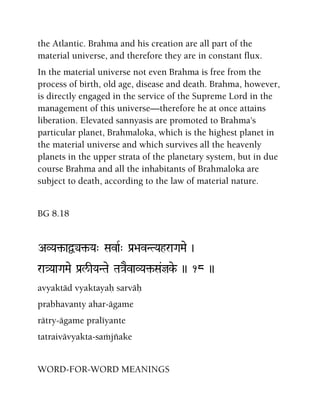
karma—fruitive activities; puruña-uttama—O Supreme
Person; adhibhütam—the material manifestation; ca—and;
kim—what; proktam—is called; adhidaivam—the demigods;
kim—what; ucyate—is called.
TRANSLATION
Arjuna inquired: O my Lord, O Supreme Person, what is
Brahman? What is the self? What are fruitive activities? What
is this material manifestation? And what are the demigods?
Please explain this to me.
PURPORT
In this chapter Lord Krishna answers different questions from
Arjuna, beginning with "What is Brahman?" The Lord also
explains karma (fruitive activities), devotional service and
yoga principles, and devotional service in its pure form. The
Srimad-Bhagavatam explains that the Supreme Absolute Truth
is known as Brahman, Paramatma and Bhagavan. In addition,
the living entity, the individual soul, is also called Brahman.
Arjuna also inquires about atma, which refers to body, soul
and mind. According to the Vedic dictionary, atma refers to
the mind, soul, body and senses also.
Arjuna has addressed the Supreme Lord as Purushottama,
Supreme Person, which means that he was putting these
questions not simply to a friend but to the Supreme Person,
knowing Him to be the supreme authority able to give
definitive answers.
BG 8.2
AiDaYaj" k-Qa& k-ae_}a dehe_iSMaNMaDauSaUdNa )
Pa[Yaa<ak-ale/ c k-Qa& jeYaae_iSa iNaYaTaaTMai>a" )) 2 ))
adhiyajïaù kathaà ko 'tra
dehe 'smin madhusüdana
prayäëa-käle ca kathaà
jïeyo 'si niyatätmabhiù
WORD-FOR-WORD MEANINGS
adhiyajïaù—the Lord of sacrifice; katham—how; kaù—who;
atra—here; dehe—in the body; asmin—this; madhusüdana—
O Madhusüdana; prayäëa-käle—at the time of death; ca—and;
katham—how; jïeyaù asi—You can be known; niyata-
ätmabhiù—by the self-controlled.
TRANSLATION
Who is the Lord of sacrifice, and how does He live in the
body, O Madhusudana? And how can those engaged in
devotional service know You at the time of death?
PURPORT
"Lord of sacrifice" may refer to either Indra or Vishnu. Vishnu
is the chief of the primal demigods, including Brahma and
Siva, and Indra is the chief of the administrative demigods.
Both Indra and Vishnu are worshiped by yajna performances.
But here Arjuna asks who is actually the Lord of yajna
(sacrifice) and how the Lord is residing within the body of the
living entity.
Arjuna addresses the Lord as Madhusudana because Krishna
once killed a demon named Madhu. Actually these questions,
which are of the nature of doubts, should not have arisen in
the mind of Arjuna, because Arjuna is a Krishna conscious
devotee. Therefore these doubts are like demons. Since
Krishna is so expert in killing demons, Arjuna here addresses
Him as Madhusudana so that Krishna might kill the demonic
doubts that arise in Arjuna's mind.
Now the word prayana-kale in this verse is very significant
because whatever we do in life will be tested at the time of
death. Arjuna is very anxious to know of those who are
constantly engaged in Krishna consciousness. What should be
their position at that final moment? At the time of death all
the bodily functions are disrupted, and the mind is not in a
proper condition. Thus disturbed by the bodily situation, one
may not be able to remember the Supreme Lord. Maharaja
Kulasekhara, a great devotee, prays, "My dear Lord, just now I
am quite healthy, and it is better that I die immediately so that
the swan of my mind can seek entrance at the stem of Your
lotus feet." The metaphor is used because the swan, a bird of
the water, takes pleasure in digging into the lotus flowers; its
sporting proclivity is to enter the lotus flower. Maharaja
Kulasekhara says to the Lord, "Now my mind is undisturbed,
and I am quite healthy. If I die immediately, thinking of Your
lotus feet, then I am sure that my performance of Your
devotional service will become perfect. But if I have to wait for
my natural death, then I do not know what will happen,
because at that time the bodily functions will be disrupted, my
throat will be choked up, and I do not know whether I shall
be able to chant Your name. Better let me die immediately."
Arjuna questions how a person can fix his mind on Krishna's
lotus feet at such a time.
BG 8.3
é[q>aGavaNauvac
A+ar& b]ø ParMa& Sv>aavae_DYaaTMaMauCYaTae )
>aUTa>aavaeÙvk-rae ivSaGaR" k-MaRSa&ijTa" )) 3 ))
çré-bhagavän uväca
akñaraà brahma paramaà
svabhävo 'dhyätmam ucyate
bhüta-bhävodbhava-karo
visargaù karma-saàjïitaù
WORD-FOR-WORD MEANINGS
çré-bhagavän uväca—the Supreme Personality of Godhead
said; akñaram—indestructible; brahma—Brahman;
paramam—transcendental; svabhävaù—eternal nature;
adhyätmam—the self; ucyate—is called; bhüta-bhäva-
udbhava-karaù—producing the material bodies of the living
entities; visargaù—creation; karma—fruitive activities;
saàjïitaù—is called.
TRANSLATION
The Supreme Personality of Godhead said: The indestructible,
transcendental living entity is called Brahman, and his eternal
nature is called adhyatma, the self. Action pertaining to the
development of the material bodies of the living entities is
called karma, or fruitive activities.
PURPORT
Brahman is indestructible and eternally existing, and its
constitution is not changed at any time. But beyond Brahman
there is Para-brahman. Brahman refers to the living entity, and
Para-brahman refers to the Supreme Personality of Godhead.
The constitutional position of the living entity is different
from the position he takes in the material world. In material
consciousness his nature is to try to be the lord of matter, but
in spiritual consciousness, Krishna consciousness, his position
is to serve the Supreme. When the living entity is in material
consciousness, he has to take on various bodies in the
material world. That is called karma, or varied creation by the
force of material consciousness.
In Vedic literature the living entity is called jivatma and
Brahman, but he is never called Para-brahman. The living
entity (jivatma) takes different positions—sometimes he
merges into the dark material nature and identifies himself
with matter, and sometimes he identifies himself with the
superior, spiritual nature. Therefore he is called the Supreme
Lord's marginal energy. According to his identification with
material or spiritual nature, he receives a material or spiritual
body. In material nature he may take a body from any of the
8,400,000 species of life, but in spiritual nature he has only
one body. In material nature he is manifested sometimes as a
man, demigod, animal, beast, bird, etc., according to his
karma. To attain material heavenly planets and enjoy their
facilities, he sometimes performs sacrifices (yajna), but when
his merit is exhausted he returns to earth again in the form of
a man. This process is called karma.
The Chandogya Upanishad describes the Vedic sacrificial
process. On the sacrificial altar, five kinds of offerings are
made into five kinds of fire. The five kinds of fire are
conceived of as the heavenly planets, clouds, the earth, man
and woman, and the five kinds of sacrificial offerings are faith,
the enjoyer on the moon, rain, grains and semen.
In the process of sacrifice, the living entity makes specific
sacrifices to attain specific heavenly planets and consequently
reaches them. When the merit of sacrifice is exhausted, the
living entity descends to earth in the form of rain, then takes
on the form of grains, and the grains are eaten by man and
transformed into semen, which impregnates a woman, and
thus the living entity once again attains the human form to
perform sacrifice and so repeat the same cycle. In this way, the
living entity perpetually comes and goes on the material path.
The Krishna conscious person, however, avoids such
sacrifices. He takes directly to Krishna consciousness and
thereby prepares himself to return to Godhead.
Impersonalist commentators on the Bhagavad-gita
unreasonably assume that Brahman takes the form of jiva in
the material world, and to substantiate this they refer to
Chapter Fifteen, verse 7, of the Gita. But in this verse the Lord
also speaks of the living entity as "an eternal fragment of
Myself." The fragment of God, the living entity, may fall down
into the material world, but the Supreme Lord (Acyuta) never
falls down. Therefore this assumption that the Supreme
Brahman assumes the form of jiva is not acceptable. It is
important to remember that in Vedic literature Brahman (the
living entity) is distinguished from Para-brahman (the
Supreme Lord).
BG 8.4
AiDa>aUTa& +arae >aav" PauåzêaiDadEvTaMa( )
AiDaYajae_hMaeva}a dehe deh>a*Taa& vr )) 4 ))
adhibhütaà kñaro bhävaù
puruñaç cädhidaivatam
adhiyajïo 'ham evätra
dehe deha-bhåtäà vara
WORD-FOR-WORD MEANINGS
adhibhütam—the physical manifestation; kñaraù—constantly
changing; bhävaù—nature; puruñaù—the universal form,
including all the demigods, like the sun and moon; ca—and;
adhidaivatam—called adhidaiva; adhiyajïaù—the Supersoul;
aham—I (Kåñëa); eva—certainly; atra—in this; dehe—body;
deha-bhåtäm—of the embodied; vara—O best.
TRANSLATION
O best of the embodied beings, the physical nature, which is
constantly changing, is called adhibhuta [the material
manifestation]. The universal form of the Lord, which
includes all the demigods, like those of the sun and moon, is
called adhidaiva. And I, the Supreme Lord, represented as the
Supersoul in the heart of every embodied being, am called
adhiyajna [the Lord of sacrifice].
PURPORT
The physical nature is constantly changing. Material bodies
generally pass through six stages: they are born, they grow,
they remain for some duration, they produce some by-
products, they dwindle, and then they vanish. This physical
nature is called adhibhuta. It is created at a certain point and
will be annihilated at a certain point. The conception of the
universal form of the Supreme Lord, which includes all the
demigods and their different planets, is called adhidaivata.
And present in the body along with the individual soul is the
Supersoul, a plenary representation of Lord Krishna. The
Supersoul is called the Paramatma or adhiyajna and is situated
in the heart. The word eva is particularly important in the con
of this verse because by this word the Lord stresses that the
Paramatma is not different from Him. The Supersoul, the
Supreme Personality of Godhead, seated beside the individual
soul, is the witness of the individual soul's activities and is the
source of the soul's various types of consciousness. The
Supersoul gives the individual soul an opportunity to act
freely and witnesses his activities. The functions of all these
different manifestations of the Supreme Lord automatically
become clarified for the pure Krishna conscious devotee
engaged in transcendental service to the Lord. The gigantic
universal form of the Lord called adhidaivata is contemplated
by the neophyte who cannot approach the Supreme Lord in
His manifestation as Supersoul. The neophyte is advised to
contemplate the universal form, or virat-purusha, whose legs
are considered the lower planets, whose eyes are considered
the sun and moon, and whose head is considered the upper
planetary system.
BG 8.5
ANTak-ale/ c MaaMaev SMarNMau¤-a k-le/vrMa( )
Ya" Pa[YaaiTa Sa MaÙav& YaaiTa NaaSTYa}a Sa&XaYa" )) 5 ))
anta-käle ca mäm eva
smaran muktvä kalevaram
yaù prayäti sa mad-bhävaà
yäti nästy atra saàçayaù
WORD-FOR-WORD MEANINGS
anta-käle—at the end of life; ca—also; mäm—Me; eva—
certainly; smaran—remembering; muktvä—quitting;
kalevaram—the body; yaù—he who; prayäti—goes; saù—he;
mat-bhävam—My nature; yäti—achieves; na—not; asti—there
is; atra—here; saàçayaù—doubt.
TRANSLATION
And whoever, at the end of his life, quits his body
remembering Me alone at once attains My nature. Of this
there is no doubt.
PURPORT
In this verse the importance of Krishna consciousness is
stressed. Anyone who quits his body in Krishna consciousness
is at once transferred to the transcendental nature of the
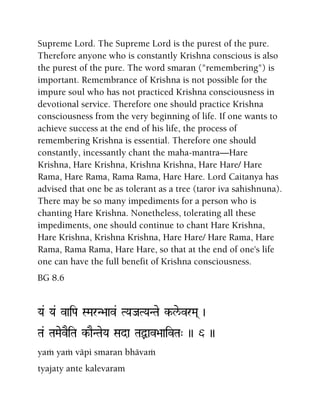
Supreme Lord. The Supreme Lord is the purest of the pure.
Therefore anyone who is constantly Krishna conscious is also
the purest of the pure. The word smaran ("remembering") is
important. Remembrance of Krishna is not possible for the
impure soul who has not practiced Krishna consciousness in
devotional service. Therefore one should practice Krishna
consciousness from the very beginning of life. If one wants to
achieve success at the end of his life, the process of
remembering Krishna is essential. Therefore one should
constantly, incessantly chant the maha-mantra—Hare
Krishna, Hare Krishna, Krishna Krishna, Hare Hare/ Hare
Rama, Hare Rama, Rama Rama, Hare Hare. Lord Caitanya has
advised that one be as tolerant as a tree (taror iva sahishnuna).
There may be so many impediments for a person who is
chanting Hare Krishna. Nonetheless, tolerating all these
impediments, one should continue to chant Hare Krishna,
Hare Krishna, Krishna Krishna, Hare Hare/ Hare Rama, Hare
Rama, Rama Rama, Hare Hare, so that at the end of one's life
one can have the full benefit of Krishna consciousness.
BG 8.6
Ya& Ya& vaiPa SMarN>aav& TYaJaTYaNTae k-le/vrMa( )
Ta& TaMaevEiTa k-aENTaeYa Sada TaÙav>aaivTa" )) 6 ))
yaà yaà väpi smaran bhävaà
tyajaty ante kalevaram
taà tam evaiti kaunteya
sadä tad-bhäva-bhävitaù
WORD-FOR-WORD MEANINGS
yam yam—whatever; vä api—at all; smaran—remembering;
bhävam—nature; tyajati—gives up; ante—at the end;
kalevaram—this body; tam tam—similar; eva—certainly; eti—
gets; kaunteya—O son of Kunté; sadä—always; tat—that;
bhäva—state of being; bhävitaù—remembering.
TRANSLATION
Whatever state of being one remembers when he quits his
body, O son of Kunti, that state he will attain without fail.
PURPORT
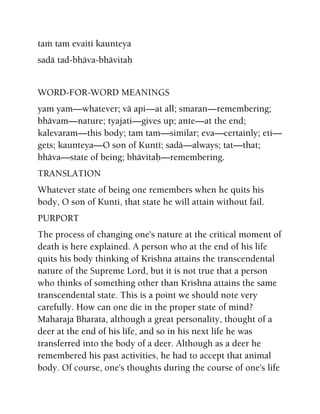
The process of changing one's nature at the critical moment of
death is here explained. A person who at the end of his life
quits his body thinking of Krishna attains the transcendental
nature of the Supreme Lord, but it is not true that a person
who thinks of something other than Krishna attains the same
transcendental state. This is a point we should note very
carefully. How can one die in the proper state of mind?
Maharaja Bharata, although a great personality, thought of a
deer at the end of his life, and so in his next life he was
transferred into the body of a deer. Although as a deer he
remembered his past activities, he had to accept that animal
body. Of course, one's thoughts during the course of one's life
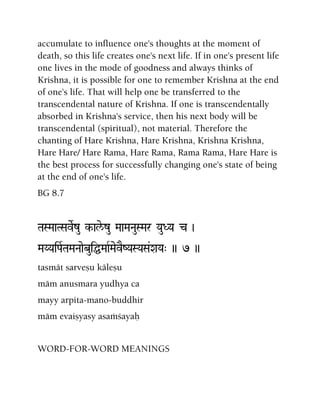
accumulate to influence one's thoughts at the moment of
death, so this life creates one's next life. If in one's present life
one lives in the mode of goodness and always thinks of
Krishna, it is possible for one to remember Krishna at the end
of one's life. That will help one be transferred to the
transcendental nature of Krishna. If one is transcendentally
absorbed in Krishna's service, then his next body will be
transcendental (spiritual), not material. Therefore the
chanting of Hare Krishna, Hare Krishna, Krishna Krishna,
Hare Hare/ Hare Rama, Hare Rama, Rama Rama, Hare Hare is
the best process for successfully changing one's state of being
at the end of one's life.
BG 8.7
TaSMaaTSaveRzu k-ale/zu MaaMaNauSMar YauDYa c )
MaYYaiPaRTaMaNaaebuiÖMaaRMaevEZYaSYaSa&XaYa" )) 7 ))
tasmät sarveñu käleñu
mäm anusmara yudhya ca
mayy arpita-mano-buddhir
mäm evaiñyasy asaàçayaù
WORD-FOR-WORD MEANINGS
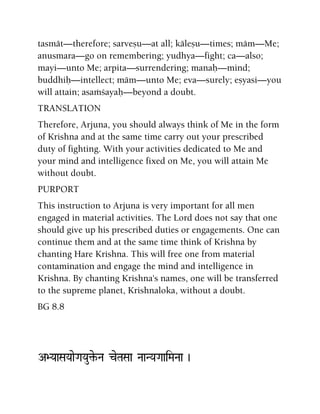
tasmät—therefore; sarveñu—at all; käleñu—times; mäm—Me;
anusmara—go on remembering; yudhya—fight; ca—also;
mayi—unto Me; arpita—surrendering; manaù—mind;
buddhiù—intellect; mäm—unto Me; eva—surely; eñyasi—you
will attain; asaàçayaù—beyond a doubt.
TRANSLATION
Therefore, Arjuna, you should always think of Me in the form
of Krishna and at the same time carry out your prescribed
duty of fighting. With your activities dedicated to Me and
your mind and intelligence fixed on Me, you will attain Me
without doubt.
PURPORT
This instruction to Arjuna is very important for all men
engaged in material activities. The Lord does not say that one
should give up his prescribed duties or engagements. One can
continue them and at the same time think of Krishna by
chanting Hare Krishna. This will free one from material
contamination and engage the mind and intelligence in
Krishna. By chanting Krishna's names, one will be transferred
to the supreme planet, Krishnaloka, without a doubt.
BG 8.8
A>YaaSaYaaeGaYau¢e-Na ceTaSaa NaaNYaGaaiMaNaa )
ParMa& Pauåz& idVYa& YaaiTa PaaQaaRNauicNTaYaNa( )) 8 ))
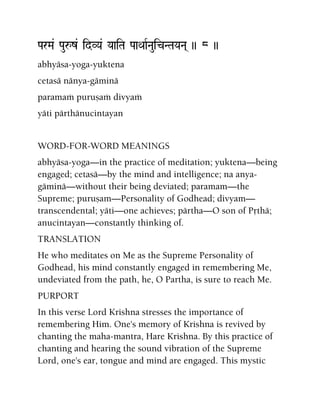
abhyäsa-yoga-yuktena
cetasä nänya-gäminä
paramaà puruñaà divyaà
yäti pärthänucintayan
WORD-FOR-WORD MEANINGS
abhyäsa-yoga—in the practice of meditation; yuktena—being
engaged; cetasä—by the mind and intelligence; na anya-
gäminä—without their being deviated; paramam—the
Supreme; puruñam—Personality of Godhead; divyam—
transcendental; yäti—one achieves; pärtha—O son of Påthä;
anucintayan—constantly thinking of.
TRANSLATION
He who meditates on Me as the Supreme Personality of
Godhead, his mind constantly engaged in remembering Me,
undeviated from the path, he, O Partha, is sure to reach Me.
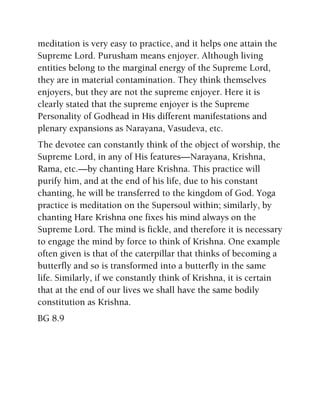
PURPORT
In this verse Lord Krishna stresses the importance of
remembering Him. One's memory of Krishna is revived by
chanting the maha-mantra, Hare Krishna. By this practice of
chanting and hearing the sound vibration of the Supreme
Lord, one's ear, tongue and mind are engaged. This mystic
meditation is very easy to practice, and it helps one attain the
Supreme Lord. Purusham means enjoyer. Although living
entities belong to the marginal energy of the Supreme Lord,
they are in material contamination. They think themselves
enjoyers, but they are not the supreme enjoyer. Here it is
clearly stated that the supreme enjoyer is the Supreme
Personality of Godhead in His different manifestations and
plenary expansions as Narayana, Vasudeva, etc.
The devotee can constantly think of the object of worship, the
Supreme Lord, in any of His features—Narayana, Krishna,
Rama, etc.—by chanting Hare Krishna. This practice will
purify him, and at the end of his life, due to his constant
chanting, he will be transferred to the kingdom of God. Yoga
practice is meditation on the Supersoul within; similarly, by
chanting Hare Krishna one fixes his mind always on the
Supreme Lord. The mind is fickle, and therefore it is necessary
to engage the mind by force to think of Krishna. One example
often given is that of the caterpillar that thinks of becoming a
butterfly and so is transformed into a butterfly in the same
life. Similarly, if we constantly think of Krishna, it is certain
that at the end of our lives we shall have the same bodily
constitution as Krishna.
BG 8.9
k-iv& Paura<aMaNauXaaiSaTaar‚
Ma<aaer<aqYaa&SaMaNauSMareÛ" )
SavRSYa DaaTaarMaicNTYaæPa‚
MaaidTYav<a| TaMaSa" ParSTaaTa( )) 9 ))
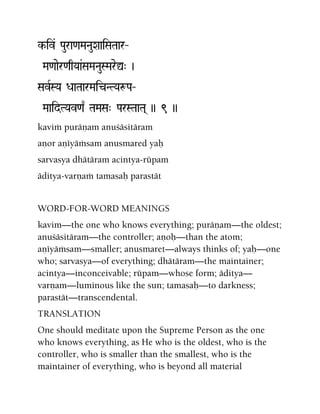
kavià puräëam anuçäsitäram
aëor aëéyäàsam anusmared yaù
sarvasya dhätäram acintya-rüpam
äditya-varëaà tamasaù parastät
WORD-FOR-WORD MEANINGS
kavim—the one who knows everything; puräëam—the oldest;
anuçäsitäram—the controller; aëoù—than the atom;
aëéyäàsam—smaller; anusmaret—always thinks of; yaù—one
who; sarvasya—of everything; dhätäram—the maintainer;
acintya—inconceivable; rüpam—whose form; äditya—
varëam—luminous like the sun; tamasaù—to darkness;
parastät—transcendental.
TRANSLATION
One should meditate upon the Supreme Person as the one
who knows everything, as He who is the oldest, who is the
controller, who is smaller than the smallest, who is the
maintainer of everything, who is beyond all material
conception, who is inconceivable, and who is always a person.
He is luminous like the sun, and He is transcendental, beyond
this material nature.
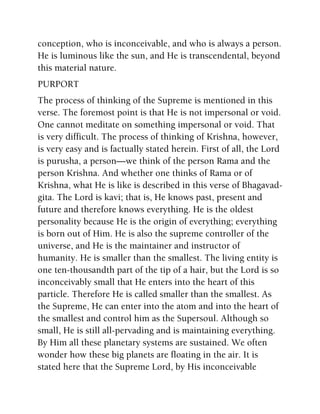
PURPORT
The process of thinking of the Supreme is mentioned in this
verse. The foremost point is that He is not impersonal or void.
One cannot meditate on something impersonal or void. That
is very difficult. The process of thinking of Krishna, however,
is very easy and is factually stated herein. First of all, the Lord
is purusha, a person—we think of the person Rama and the
person Krishna. And whether one thinks of Rama or of
Krishna, what He is like is described in this verse of Bhagavad-
gita. The Lord is kavi; that is, He knows past, present and
future and therefore knows everything. He is the oldest
personality because He is the origin of everything; everything
is born out of Him. He is also the supreme controller of the
universe, and He is the maintainer and instructor of
humanity. He is smaller than the smallest. The living entity is
one ten-thousandth part of the tip of a hair, but the Lord is so
inconceivably small that He enters into the heart of this
particle. Therefore He is called smaller than the smallest. As
the Supreme, He can enter into the atom and into the heart of
the smallest and control him as the Supersoul. Although so
small, He is still all-pervading and is maintaining everything.
By Him all these planetary systems are sustained. We often
wonder how these big planets are floating in the air. It is
stated here that the Supreme Lord, by His inconceivable
energy, is sustaining all these big planets and systems of
galaxies. The word acintya ("inconceivable") is very
significant in this connection. God's energy is beyond our
conception, beyond our thinking jurisdiction, and is therefore
called inconceivable (acintya). Who can argue this point? He
pervades this material world and yet is beyond it. We cannot
comprehend even this material world, which is insignificant
compared to the spiritual world—so how can we comprehend
what is beyond? Acintya means that which is beyond this
material world, that which our argument, logic and
philosophical speculation cannot touch, that which is
inconceivable. Therefore intelligent persons, avoiding useless
argument and speculation, should accept what is stated in
scriptures like the Vedas, Bhagavad-gita and Srimad-
Bhagavatam and follow the principles they set down. This will
lead one to understanding.
BG 8.10
Pa[Yaa<ak-ale/ MaNaSaacle/Na
>a¢-ya Yau¢-ae YaaeGable/Na cEv )
>a]uvaeMaRDYae Pa[a<aMaaveXYa SaMYa‚
KSa Ta& Par& PauåzMauPaEiTa idVYaMa( )) 10 ))
prayäëa-käle manasäcalena
bhaktyä yukto yoga-balena caiva
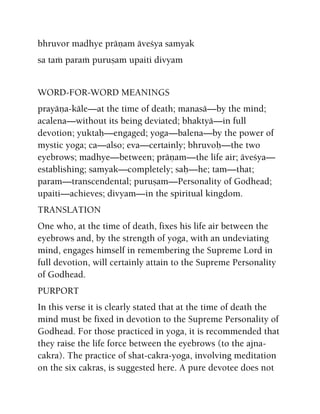
bhruvor madhye präëam äveçya samyak
sa taà paraà puruñam upaiti divyam
WORD-FOR-WORD MEANINGS
prayäëa-käle—at the time of death; manasä—by the mind;
acalena—without its being deviated; bhaktyä—in full
devotion; yuktaù—engaged; yoga—balena—by the power of
mystic yoga; ca—also; eva—certainly; bhruvoù—the two
eyebrows; madhye—between; präëam—the life air; äveçya—
establishing; samyak—completely; saù—he; tam—that;
param—transcendental; puruñam—Personality of Godhead;
upaiti—achieves; divyam—in the spiritual kingdom.
TRANSLATION
One who, at the time of death, fixes his life air between the
eyebrows and, by the strength of yoga, with an undeviating
mind, engages himself in remembering the Supreme Lord in
full devotion, will certainly attain to the Supreme Personality
of Godhead.
PURPORT
In this verse it is clearly stated that at the time of death the
mind must be fixed in devotion to the Supreme Personality of
Godhead. For those practiced in yoga, it is recommended that
they raise the life force between the eyebrows (to the ajna-
cakra). The practice of shat-cakra-yoga, involving meditation
on the six cakras, is suggested here. A pure devotee does not
practice such yoga, but because he is always engaged in
Krishna consciousness, at death he can remember the
Supreme Personality of Godhead by His grace. This is
explained in verse fourteen.
The particular use of the word yoga-balena is significant in
this verse because without practice of yoga—whether shat-
cakra-yoga or bhakti-yoga—one cannot come to this
transcendental state of being at the time of death. One cannot
suddenly remember the Supreme Lord at death; one must
have practiced some yoga system, especially the system of
bhakti-yoga. Since one's mind at death is very disturbed, one
should practice transcendence through yoga during one's life.
BG 8.11
Yad+ar& vedivdae vdiNTa
ivXaiNTa YaÛTaYaae vqTaraGaa" )
YaidC^NTaae b]øcYa| criNTa
Tatae Pad& Sa°he<a Pa[v+Yae )) 11 ))
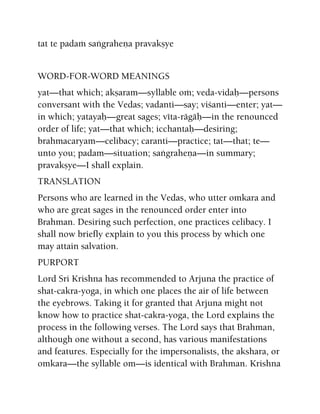
yad akñaraà veda-vido vadanti
viçanti yad yatayo véta-rägäù
yad icchanto brahmacaryaà caranti
tat te padaà saìgraheëa pravakñye
WORD-FOR-WORD MEANINGS
yat—that which; akñaram—syllable oà; veda-vidaù—persons
conversant with the Vedas; vadanti—say; viçanti—enter; yat—
in which; yatayaù—great sages; véta-rägäù—in the renounced
order of life; yat—that which; icchantaù—desiring;
brahmacaryam—celibacy; caranti—practice; tat—that; te—
unto you; padam—situation; saìgraheëa—in summary;
pravakñye—I shall explain.
TRANSLATION
Persons who are learned in the Vedas, who utter omkara and
who are great sages in the renounced order enter into
Brahman. Desiring such perfection, one practices celibacy. I
shall now briefly explain to you this process by which one
may attain salvation.
PURPORT
Lord Sri Krishna has recommended to Arjuna the practice of
shat-cakra-yoga, in which one places the air of life between
the eyebrows. Taking it for granted that Arjuna might not
know how to practice shat-cakra-yoga, the Lord explains the
process in the following verses. The Lord says that Brahman,
although one without a second, has various manifestations
and features. Especially for the impersonalists, the akshara, or
omkara—the syllable om—is identical with Brahman. Krishna
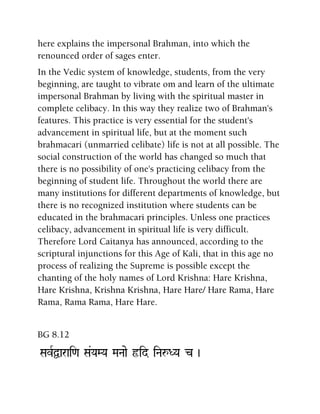
here explains the impersonal Brahman, into which the
renounced order of sages enter.
In the Vedic system of knowledge, students, from the very
beginning, are taught to vibrate om and learn of the ultimate
impersonal Brahman by living with the spiritual master in
complete celibacy. In this way they realize two of Brahman's
features. This practice is very essential for the student's
advancement in spiritual life, but at the moment such
brahmacari (unmarried celibate) life is not at all possible. The
social construction of the world has changed so much that
there is no possibility of one's practicing celibacy from the
beginning of student life. Throughout the world there are
many institutions for different departments of knowledge, but
there is no recognized institution where students can be
educated in the brahmacari principles. Unless one practices
celibacy, advancement in spiritual life is very difficult.
Therefore Lord Caitanya has announced, according to the
scriptural injunctions for this Age of Kali, that in this age no
process of realizing the Supreme is possible except the
chanting of the holy names of Lord Krishna: Hare Krishna,
Hare Krishna, Krishna Krishna, Hare Hare/ Hare Rama, Hare
Rama, Rama Rama, Hare Hare.
BG 8.12
SavRÜarai<a Sa&YaMYa MaNaae ôid iNaåDYa c )
MaUDNYaaRDaaYaaTMaNa" Pa[a<aMaaiSQaTaae YaaeGaDaar<aaMa( )) 12 ))
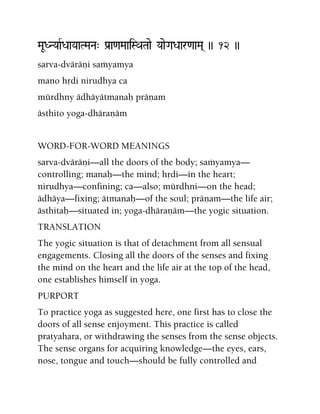
sarva-dväräëi saàyamya
mano hådi nirudhya ca
mürdhny ädhäyätmanaù präëam
ästhito yoga-dhäraëäm
WORD-FOR-WORD MEANINGS
sarva-dväräëi—all the doors of the body; saàyamya—
controlling; manaù—the mind; hådi—in the heart;
nirudhya—confining; ca—also; mürdhni—on the head;
ädhäya—fixing; ätmanaù—of the soul; präëam—the life air;
ästhitaù—situated in; yoga-dhäraëäm—the yogic situation.
TRANSLATION
The yogic situation is that of detachment from all sensual
engagements. Closing all the doors of the senses and fixing
the mind on the heart and the life air at the top of the head,
one establishes himself in yoga.
PURPORT
To practice yoga as suggested here, one first has to close the
doors of all sense enjoyment. This practice is called
pratyahara, or withdrawing the senses from the sense objects.
The sense organs for acquiring knowledge—the eyes, ears,
nose, tongue and touch—should be fully controlled and
should not be allowed to engage in self-gratification. In this
way the mind focuses on the Supersoul in the heart, and the
life force is raised to the top of the head. In the Sixth Chapter
this process is described in detail. But as mentioned before,
this practice is not practical in this age. The best process is
Krishna consciousness. If one is always able to fix his mind on
Krishna in devotional service, it is very easy for him to remain
in an undisturbed transcendental trance, or in samadhi.
BG 8.13
p wTYaek-a+ar& b]ø VYaahrNMaaMaNauSMarNa( )
Ya" Pa[YaaiTa TYaJaNdeh& Sa YaaiTa ParMaa& GaiTaMa( )) 13 ))
oà ity ekäkñaraà brahma
vyäharan mäm anusmaran
yaù prayäti tyajan dehaà
sa yäti paramäà gatim
WORD-FOR-WORD MEANINGS
oà—the combination of letters oà (oàkära); iti—thus; eka—
akñaram—the one syllable; brahma—absolute; vyäharan—
vibrating; mäm—Me (Kåñëa); anusmaran—remembering;
yaù—anyone who; prayäti—leaves; tyajan—quitting;
deham—this body; saù—he; yäti—achieves; paramäm—the
supreme; gatim—destination.
TRANSLATION
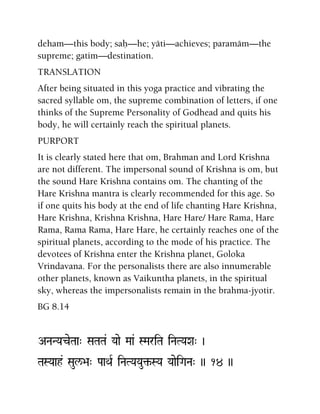
After being situated in this yoga practice and vibrating the
sacred syllable om, the supreme combination of letters, if one
thinks of the Supreme Personality of Godhead and quits his
body, he will certainly reach the spiritual planets.
PURPORT
It is clearly stated here that om, Brahman and Lord Krishna
are not different. The impersonal sound of Krishna is om, but
the sound Hare Krishna contains om. The chanting of the
Hare Krishna mantra is clearly recommended for this age. So
if one quits his body at the end of life chanting Hare Krishna,
Hare Krishna, Krishna Krishna, Hare Hare/ Hare Rama, Hare
Rama, Rama Rama, Hare Hare, he certainly reaches one of the
spiritual planets, according to the mode of his practice. The
devotees of Krishna enter the Krishna planet, Goloka
Vrindavana. For the personalists there are also innumerable
other planets, known as Vaikuntha planets, in the spiritual
sky, whereas the impersonalists remain in the brahma-jyotir.
BG 8.14
ANaNYaceTaa" SaTaTa& Yaae Maa& SMariTa iNaTYaXa" )
TaSYaah& Saul/>a" PaaQaR iNaTYaYau¢-SYa YaaeiGaNa" )) 14 ))
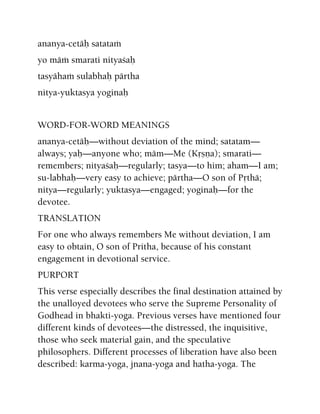
ananya-cetäù satataà
yo mäà smarati nityaçaù
tasyähaà sulabhaù pärtha
nitya-yuktasya yoginaù
WORD-FOR-WORD MEANINGS
ananya-cetäù—without deviation of the mind; satatam—
always; yaù—anyone who; mäm—Me (Kåñëa); smarati—
remembers; nityaçaù—regularly; tasya—to him; aham—I am;
su-labhaù—very easy to achieve; pärtha—O son of Påthä;
nitya—regularly; yuktasya—engaged; yoginaù—for the
devotee.
TRANSLATION
For one who always remembers Me without deviation, I am
easy to obtain, O son of Pritha, because of his constant
engagement in devotional service.
PURPORT
This verse especially describes the final destination attained by
the unalloyed devotees who serve the Supreme Personality of
Godhead in bhakti-yoga. Previous verses have mentioned four
different kinds of devotees—the distressed, the inquisitive,
those who seek material gain, and the speculative
philosophers. Different processes of liberation have also been
described: karma-yoga, jnana-yoga and hatha-yoga. The
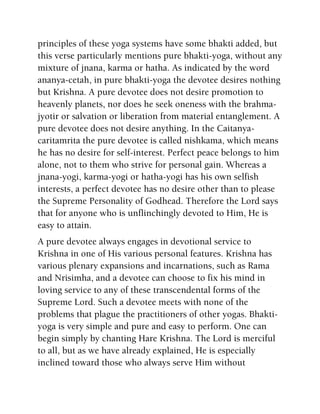
principles of these yoga systems have some bhakti added, but
this verse particularly mentions pure bhakti-yoga, without any
mixture of jnana, karma or hatha. As indicated by the word
ananya-cetah, in pure bhakti-yoga the devotee desires nothing
but Krishna. A pure devotee does not desire promotion to
heavenly planets, nor does he seek oneness with the brahma-
jyotir or salvation or liberation from material entanglement. A
pure devotee does not desire anything. In the Caitanya-
caritamrita the pure devotee is called nishkama, which means
he has no desire for self-interest. Perfect peace belongs to him
alone, not to them who strive for personal gain. Whereas a
jnana-yogi, karma-yogi or hatha-yogi has his own selfish
interests, a perfect devotee has no desire other than to please
the Supreme Personality of Godhead. Therefore the Lord says
that for anyone who is unflinchingly devoted to Him, He is
easy to attain.
A pure devotee always engages in devotional service to
Krishna in one of His various personal features. Krishna has
various plenary expansions and incarnations, such as Rama
and Nrisimha, and a devotee can choose to fix his mind in
loving service to any of these transcendental forms of the
Supreme Lord. Such a devotee meets with none of the
problems that plague the practitioners of other yogas. Bhakti-
yoga is very simple and pure and easy to perform. One can
begin simply by chanting Hare Krishna. The Lord is merciful
to all, but as we have already explained, He is especially
inclined toward those who always serve Him without
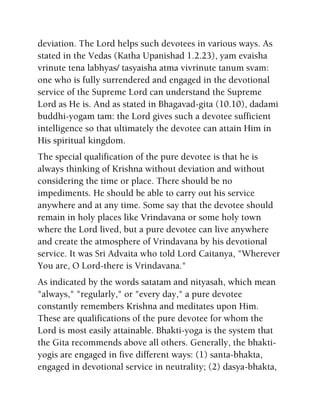
deviation. The Lord helps such devotees in various ways. As
stated in the Vedas (Katha Upanishad 1.2.23), yam evaisha
vrinute tena labhyas/ tasyaisha atma vivrinute tanum svam:
one who is fully surrendered and engaged in the devotional
service of the Supreme Lord can understand the Supreme
Lord as He is. And as stated in Bhagavad-gita (10.10), dadami
buddhi-yogam tam: the Lord gives such a devotee sufficient
intelligence so that ultimately the devotee can attain Him in
His spiritual kingdom.
The special qualification of the pure devotee is that he is
always thinking of Krishna without deviation and without
considering the time or place. There should be no
impediments. He should be able to carry out his service
anywhere and at any time. Some say that the devotee should
remain in holy places like Vrindavana or some holy town
where the Lord lived, but a pure devotee can live anywhere
and create the atmosphere of Vrindavana by his devotional
service. It was Sri Advaita who told Lord Caitanya, "Wherever
You are, O Lord-there is Vrindavana."
As indicated by the words satatam and nityasah, which mean
"always," "regularly," or "every day," a pure devotee
constantly remembers Krishna and meditates upon Him.
These are qualifications of the pure devotee for whom the
Lord is most easily attainable. Bhakti-yoga is the system that
the Gita recommends above all others. Generally, the bhakti-
yogis are engaged in five different ways: (1) santa-bhakta,
engaged in devotional service in neutrality; (2) dasya-bhakta,
engaged in devotional service as servant; (3) sakhya-bhakta,
engaged as friend; (4) vatsalya-bhakta, engaged as parent; and
(5) madhurya-bhakta, engaged as conjugal lover of the
Supreme Lord. In any of these ways, the pure devotee is
always constantly engaged in the transcendental loving service
of the Supreme Lord and cannot forget the Supreme Lord, and
so for him the Lord is easily attained. A pure devotee cannot
forget the Supreme Lord for a moment, and similarly the
Supreme Lord cannot forget His pure devotee for a moment.
This is the great blessing of the Krishna conscious process of
chanting the maha-mantra—Hare Krishna, Hare Krishna,
Krishna Krishna, Hare Hare/ Hare Rama, Hare Rama, Rama
Rama, Hare Hare.
BG 8.15
MaaMauPaeTYa PauNaJaRNMa du"%al/YaMaXaaìTaMa( )
NaaPanuviNTa MahaTMaaNa" Sa&iSaiÖ& ParMaa& GaTaa" )) 15 ))
mäm upetya punar janma
duùkhälayam açäçvatam
näpnuvanti mahätmänaù
saàsiddhià paramäà gatäù
WORD-FOR-WORD MEANINGS
mäm—Me; upetya—achieving; punaù—again; janma—birth;
duùkha-älayam—place of miseries; açäçvatam—temporary;
na—never; äpnuvanti—attain; mahä-ätmänaù—the great
souls; saàsiddhim—perfection; paramäm—ultimate; gatäù—
having achieved.
TRANSLATION
After attaining Me, the great souls, who are yogis in devotion,
never return to this temporary world, which is full of miseries,
because they have attained the highest perfection.
PURPORT
Since this temporary material world is full of the miseries of
birth, old age, disease and death, naturally he who achieves
the highest perfection and attains the supreme planet,
Krishnaloka, Goloka Vrindavana, does not wish to return. The
supreme planet is described in Vedic literature as avyakta and
akshara and parama gati; in other words, that planet is beyond
our material vision, and it is inexplicable, but it is the highest
goal, the destination for the mahatmas (great souls). The
mahatmas receive transcendental messages from the realized
devotees and thus gradually develop devotional service in
Krishna consciousness and become so absorbed in
transcendental service that they no longer desire elevation to
any of the material planets, nor do they even want to be
transferred to any spiritual planet. They only want Krishna
and Krishna's association, and nothing else. That is the
highest perfection of life. This verse specifically mentions the
personalist devotees of the Supreme Lord, Krishna. These
devotees in Krishna consciousness achieve the highest
perfection of life. In other words, they are the supreme souls.
BG 8.16
Aab]ø>auvNaaçaek-a" PauNaraviTaRNaae_JauRNa )
MaaMauPaeTYa Tau k-aENTaeYa PauNaJaRNMa Na ivÛTae )) 16 ))
ä-brahma-bhuvanäl lokäù
punar ävartino 'rjuna
mäm upetya tu kaunteya
punar janma na vidyate
WORD-FOR-WORD MEANINGS
ä-brahma-bhuvanät—up to the Brahmaloka planet; lokäù—
the planetary systems; punaù—again; ävartinaù—returning;
arjuna—O Arjuna; mäm—unto Me; upetya—arriving; tu—
but; kaunteya—O son of Kunté; punaù janma—rebirth; na—
never; vidyate—takes place.
TRANSLATION
From the highest planet in the material world down to the
lowest, all are places of misery wherein repeated birth and
death take place. But one who attains to My abode, O son of
Kunti, never takes birth again.
PURPORT
All kinds of yogis-karma, jnana, hatha, etc.—eventually have
to attain devotional perfection in bhakti-yoga, or Krishna
consciousness, before they can go to Krishna's transcendental
abode and never return. Those who attain the highest material
planets, the planets of the demigods, are again subjected to
repeated birth and death. As persons on earth are elevated to
higher planets, people on higher planets such as Brahmaloka,
Candraloka and Indraloka fall down to earth. The practice of
sacrifice called pancagni-vidya, recommended in the
Chandogya Upanishad, enables one to achieve Brahmaloka,
but if, on Brahmaloka, one does not cultivate Krishna
consciousness, then he must return to earth. Those who
progress in Krishna consciousness on the higher planets are
gradually elevated to higher and higher planets and at the
time of universal devastation are transferred to the eternal
spiritual kingdom. Baladeva Vidyabhushana, in his
commentary on Bhagavad-gita, quotes this verse:
brahmana saha te sarve
samprapte pratisancare
parasyante kritatmanah
pravisanti param padam
"When there is devastation of this material universe, Brahma
and his devotees, who are constantly engaged in Krishna
consciousness, are all transferred to the spiritual universe and
to specific spiritual planets according to their desires."
BG 8.17
SahóYauGaPaYaRNTaMahYaRd(b]ø<aae ivdu" )
rai}a& YauGaSahóaNTaa& Tae_haera}aivdae JaNaa" )) 17 ))
sahasra-yuga-paryantam
ahar yad brahmaëo viduù
rätrià yuga-sahasräntäà
te 'ho-rätra-vido janäù
WORD-FOR-WORD MEANINGS
sahasra—one thousand; yuga—millenniums; paryantam—
including; ahaù—day; yat—that which; brahmaëaù—of
Brahmä; viduù—they know; rätrim—night; yuga—
millenniums; sahasra-antäm—similarly, ending after one
thousand; te—they; ahaù-rätra—day and night; vidaù—who
understand; janäù—people.
TRANSLATION
By human calculation, a thousand ages taken together form
the duration of Brahma's one day. And such also is the
duration of his night.
PURPORT
The duration of the material universe is limited. It is
manifested in cycles of kalpas. A kalpa is a day of Brahma, and
one day of Brahma consists of a thousand cycles of four yugas,
or ages: Satya, Treta, Dvapara and Kali. The cycle of Satya is
characterized by virtue, wisdom and religion, there being
practically no ignorance and vice, and the yuga lasts
1,728,000 years. In the Treta-yuga vice is introduced, and this
yuga lasts 1,296,000 years. In the Dvapara-yuga there is an
even greater decline in virtue and religion, vice increasing,
and this yuga lasts 864,000 years. And finally in Kali-yuga
(the yuga we have now been experiencing over the past 5,000
years) there is an abundance of strife, ignorance, irreligion
and vice, true virtue being practically nonexistent, and this
yuga lasts 432,000 years. In Kali-yuga vice increases to such a
point that at the termination of the yuga the Supreme Lord
Himself appears as the Kalki avatara, vanquishes the demons,
saves His devotees, and commences another Satya-yuga. Then
the process is set rolling again. These four yugas, rotating a
thousand times, comprise one day of Brahma, and the same
number comprise one night. Brahma lives one hundred of
such "years" and then dies. These "hundred years" by earth
calculations total to 311 trillion and 40 billion earth years. By
these calculations the life of Brahma seems fantastic and
interminable, but from the viewpoint of eternity it is as brief
as a lightning flash. In the Causal Ocean there are
innumerable Brahmas rising and disappearing like bubbles in
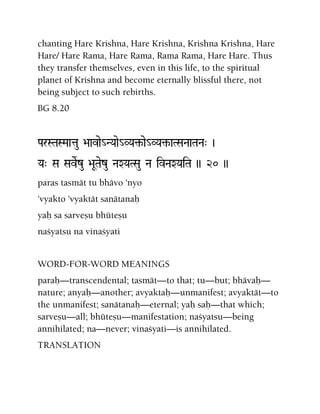
the Atlantic. Brahma and his creation are all part of the
material universe, and therefore they are in constant flux.
In the material universe not even Brahma is free from the
process of birth, old age, disease and death. Brahma, however,
is directly engaged in the service of the Supreme Lord in the
management of this universe—therefore he at once attains
liberation. Elevated sannyasis are promoted to Brahma's
particular planet, Brahmaloka, which is the highest planet in
the material universe and which survives all the heavenly
planets in the upper strata of the planetary system, but in due
course Brahma and all the inhabitants of Brahmaloka are
subject to death, according to the law of material nature.
BG 8.18
AVYa¢-aÜy¢-Ya" SavaR" Pa[>avNTYahraGaMae )
ra}YaaGaMae Pa[l/IYaNTae Ta}aEvaVYa¢-Sa&jke- )) 18 ))
avyaktäd vyaktayaù sarväù
prabhavanty ahar-ägame
rätry-ägame praléyante
tatraivävyakta-saàjïake
WORD-FOR-WORD MEANINGS
avyaktät—from the unmanifest; vyaktayaù—living entities;
sarväù—all; prabhavanti—become manifest; ahaù-ägame—at
the beginning of the day; rätri-ägame—at the fall of night;
praléyante—are annihilated; tatra—into that; eva—certainly;
avyakta—the unmanifest; saàjïake—which is called.
TRANSLATION
At the beginning of Brahma's day, all living entities become
manifest from the unmanifest state, and thereafter, when the
night falls, they are merged into the unmanifest again.
BG 8.19
>aUTaGa]aMa" Sa WvaYa& >aUTva >aUTva Pa[l/IYaTae )
ra}YaaGaMae_vXa" PaaQaR Pa[>avTYahraGaMae )) 19 ))
bhüta-grämaù sa eväyaà
bhütvä bhütvä praléyate
rätry-ägame 'vaçaù pärtha
prabhavaty ahar-ägame
WORD-FOR-WORD MEANINGS
bhüta—grämaù—the aggregate of all living entities; saù—
these; eva—certainly; ayam—this; bhütvä bhütvä—repeatedly
taking birth; praléyate—is annihilated; rätri—of night;
ägame—on the arrival; avaçaù—automatically; pärtha—O son
of Påthä; prabhavati—is manifest; ahaù—of daytime; ägame—
on the arrival.
TRANSLATION
Again and again, when Brahma's day arrives, all living entities
come into being, and with the arrival of Brahma's night they
are helplessly annihilated.
PURPORT
The less intelligent, who try to remain within this material
world, may be elevated to higher planets and then again must
come down to this planet earth. During the daytime of
Brahma they can exhibit their activities on higher and lower
planets within this material world, but at the coming of
Brahma's night they are all annihilated. In the day they receive
various bodies for material activities, and at night they no
longer have bodies but remain compact in the body of Vishnu.
Then again they are manifest at the arrival of Brahma's day.
Bhutva bhutva praliyate [BG. 8.19]: during the day they
become manifest, and at night they are annihilated again.
Ultimately, when Brahma's life is finished, they are all
annihilated and remain unmanifest for millions and millions
of years. And when Brahma is born again in another
millennium they are again manifest. In this way they are
captivated by the spell of the material world. But those
intelligent persons who take to Krishna consciousness use the
human life fully in the devotional service of the Lord,
chanting Hare Krishna, Hare Krishna, Krishna Krishna, Hare
Hare/ Hare Rama, Hare Rama, Rama Rama, Hare Hare. Thus
they transfer themselves, even in this life, to the spiritual
planet of Krishna and become eternally blissful there, not
being subject to such rebirths.
BG 8.20
ParSTaSMaatau >aavae_NYaae_VYa¢-ae_VYa¢-aTSaNaaTaNa" )
Ya" Sa SaveRzu >aUTaezu NaXYaTSau Na ivNaXYaiTa )) 20 ))
paras tasmät tu bhävo 'nyo
'vyakto 'vyaktät sanätanaù
yaù sa sarveñu bhüteñu
naçyatsu na vinaçyati
WORD-FOR-WORD MEANINGS
paraù—transcendental; tasmät—to that; tu—but; bhävaù—
nature; anyaù—another; avyaktaù—unmanifest; avyaktät—to
the unmanifest; sanätanaù—eternal; yaù saù—that which;
sarveñu—all; bhüteñu—manifestation; naçyatsu—being
annihilated; na—never; vinaçyati—is annihilated.
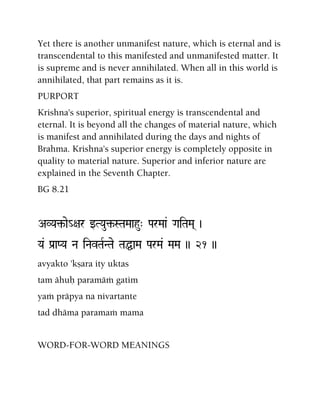
TRANSLATION
Yet there is another unmanifest nature, which is eternal and is
transcendental to this manifested and unmanifested matter. It
is supreme and is never annihilated. When all in this world is
annihilated, that part remains as it is.
PURPORT
Krishna's superior, spiritual energy is transcendental and
eternal. It is beyond all the changes of material nature, which
is manifest and annihilated during the days and nights of
Brahma. Krishna's superior energy is completely opposite in
quality to material nature. Superior and inferior nature are
explained in the Seventh Chapter.
BG 8.21
AVYa¢-ae_+ar wTYau¢-STaMaahu" ParMaa& GaiTaMa( )
Ya& Pa[aPYa Na iNavTaRNTae TaÖaMa ParMa& MaMa )) 21 ))
avyakto 'kñara ity uktas
tam ähuù paramäà gatim
yaà präpya na nivartante
tad dhäma paramaà mama
WORD-FOR-WORD MEANINGS
avyaktaù—unmanifested; akñaraù—infallible; iti—thus;
uktaù—is said; tam—that; ähuù—is known; paramäm—the
ultimate; gatim—destination; yam—which; präpya—gaining;
na—never; nivartante—come back; tat—that; dhäma—abode;
paramam—supreme; mama—My.
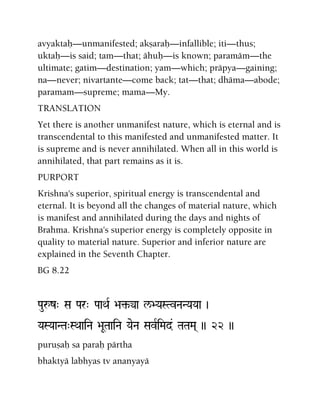
TRANSLATION
Yet there is another unmanifest nature, which is eternal and is
transcendental to this manifested and unmanifested matter. It
is supreme and is never annihilated. When all in this world is
annihilated, that part remains as it is.
PURPORT
Krishna's superior, spiritual energy is transcendental and
eternal. It is beyond all the changes of material nature, which
is manifest and annihilated during the days and nights of
Brahma. Krishna's superior energy is completely opposite in
quality to material nature. Superior and inferior nature are
explained in the Seventh Chapter.
BG 8.22
Pauåz" Sa Par" PaaQaR >a¢-ya l/>YaSTvNaNYaYaa )
YaSYaaNTa"SQaaiNa >aUTaaiNa YaeNa SavRiMad& TaTaMa( )) 22 ))
puruñaù sa paraù pärtha
bhaktyä labhyas tv ananyayä
yasyäntaù-sthäni bhütäni
yena sarvam idaà tatam
WORD-FOR-WORD MEANINGS
puruñaù—the Supreme Personality; saù—He; paraù—the
Supreme, than whom no one is greater; pärtha—O son of
Påthä; bhaktyä—by devotional service; labhyaù—can be
achieved; tu—but; ananyayä—unalloyed, undeviating;
yasya—whom; antaù-sthäni—within; bhütäni—all of this
material manifestation; yena—by whom; sarvam—all; idam—
whatever we can see; tatam—is pervaded.
TRANSLATION
The Supreme Personality of Godhead, who is greater than all,
is attainable by unalloyed devotion. Although He is present in
His abode, He is all-pervading, and everything is situated
within Him.
PURPORT
It is here clearly stated that the supreme destination, from
which there is no return, is the abode of Krishna, the Supreme
Person. The Brahma-samhita describes this supreme abode as
ananda-cinmaya-rasa, a place where everything is full of
spiritual bliss. All the variegatedness manifest there is of the
quality of spiritual bliss—nothing there is material. That
variegatedness is expanded as the spiritual expansion of the
Supreme Godhead Himself, for the manifestation there is
totally of the spiritual energy, as explained in Chapter Seven.
As far as this material world is concerned, although the Lord
is always in His supreme abode, He is nonetheless all-
pervading by His material energy. So by His spiritual and
material energies He is present everywhere—both in the
material and in the spiritual universes. Yasyantah-sthani
means that everything is sustained within Him, within either
His spiritual or material energy. The Lord is all-pervading by
these two energies.
To enter Krishna's supreme abode or the innumerable
Vaikuntha planets is possible only by bhakti, devotional
service, as clearly indicated here by the word bhaktya. No
other process can help one attain that supreme abode. The
Vedas (Gopala-tapani Upanishad 1.21) also describe the
supreme abode and the Supreme Personality of Godhead. Eko
vasi sarva-gah krishnah. In that abode there is only one
Supreme Personality of Godhead, whose name is Krishna. He
is the supreme merciful Deity, and although situated there as
one He has expanded Himself into millions and millions of
plenary expansions. The Vedas compare the Lord to a tree
standing still yet bearing many varieties of fruits, flowers and
changing leaves. The plenary expansions of the Lord who
preside over the Vaikuntha planets are four-armed, and they
are known by a variety of names—Purushottama, Trivikrama,
Kesava, Madhava, Aniruddha, Hrishikesa, Sankarshana,
Pradyumna, Sridhara, Vasudeva, Damodara, Janardana,
Narayana, Vamana, Padmanabha, etc.
The Brahma-samhita (5.37) also confirms that although the
Lord is always in the supreme abode, Goloka Vrindavana, He
is all-pervading, so that everything is going on nicely (goloka
eva nivasaty akhilatma-bhutah). As stated in the Vedas
(Svetasvatara Upanishad 6.8), parasya saktir vividhaiva
sruyate/ svabhaviki jnana-bala-kriya ca: [Cc. Madhya 13.65,
purport] His energies are so expansive that they systematically
conduct everything in the cosmic manifestation without a
flaw, although the Supreme Lord is far, far away.
BG 8.23
Ya}a k-ale/ TvNaav*itaMaav*ita& cEv YaaeiGaNa" )
Pa[YaaTaa YaaiNTa Ta& k-al&/ v+YaaiMa >arTazR>a )) 23 ))
yatra käle tv anävåttim
ävåttià caiva yoginaù
prayätä yänti taà kälaà
vakñyämi bharatarñabha
WORD-FOR-WORD MEANINGS
yatra—at which; käle—time; tu—and; anävåttim—no return;
ävåttim—return; ca—also; eva—certainly; yoginaù—different
kinds of mystics; prayätäù—having departed; yänti—attain;
tam—that; kälam—time; vakñyämi—I shall describe; bharata-
åñabha—O best of the Bhäratas.
TRANSLATION
O best of the Bharatas, I shall now explain to you the different
times at which, passing away from this world, the yogi does or
does not come back.
PURPORT
The unalloyed devotees of the Supreme Lord, who are totally
surrendered souls, do not care when they leave their bodies or
by what method. They leave everything in Krishna's hands
and so easily and happily return to Godhead. But those who
are not unalloyed devotees and who depend instead on such
methods of spiritual realization as karma-yoga, jnana-yoga
and hatha-yoga must leave the body at a suitable time and
thereby be assured whether or not they will return to the
world of birth and death.
If the yogi is perfect he can select the time and situation for
leaving this material world. But if he is not so expert his
success depends on his accidentally passing away at a certain
suitable time. The suitable times at which one passes away
and does not come back are explained by the Lord in the next
verse. According to Acarya Baladeva Vidyabhushana, the
Sanskrit word kala used herein refers to the presiding deity of
time.
BG 8.24
AiGanJYaaeRiTarh" éu(c)-" z<MaaSaa otaraYa<aMa( )
Ta}a Pa[YaaTaa GaC^iNTa b]ø b]øivdae JaNaa" )) 24 ))
agnir jyotir ahaù çuklaù
ñaë-mäsä uttaräyaëam
tatra prayätä gacchanti
brahma brahma-vido janäù
WORD-FOR-WORD MEANINGS
agniù—fire; jyotiù—light; ahaù—day; çuklaù—the white
fortnight; ñaö-mäsäù—the six months; uttara—ayanam—when
the sun passes on the northern side; tatra—there; prayätäù—
those who pass away; gacchanti—go; brahma—to the
Absolute; brahma-vidaù—who know the Absolute; janäù—
persons.
TRANSLATION
Those who know the Supreme Brahman attain that Supreme
by passing away from the world during the influence of the
fiery god, in the light, at an auspicious moment of the day,
during the fortnight of the waxing moon, or during the six
months when the sun travels in the north.
PURPORT
When fire, light, day and the fortnight of the moon are
mentioned, it is to be understood that over all of them there
are various presiding deities who make arrangements for the
passage of the soul. At the time of death, the mind carries one
on the path to a new life. If one leaves the body at the time
designated above, either accidentally or by arrangement, it is
possible for him to attain the impersonal brahma-jyotir.
Mystics who are advanced in yoga practice can arrange the
time and place to leave the body. Others have no control—if
by accident they leave at an auspicious moment, then they
will not return to the cycle of birth and death, but otherwise
there is every possibility that they will have to return.
However, for the pure devotee in Krishna consciousness, there
is no fear of returning, whether he leaves the body at an
auspicious or inauspicious moment, by accident or
arrangement.
BG 8.25
DaUMaae rai}aSTaQaa k*-Z<a" z<MaaSaa di+a<aaYaNaMa( )
Ta}a caNd]MaSa& JYaaeiTaYaaeRGaq Pa[aPYa iNavTaRTae )) 25 ))
dhümo rätris tathä kåñëaù
ñaë-mäsä dakñiëäyanam
tatra cändramasaà jyotir
yogé präpya nivartate
WORD-FOR-WORD MEANINGS
dhümaù—smoke; rätriù—night; tathä—also; kåñëaù—the
fortnight of the dark moon; ñaö-mäsäù—the six months;
dakñiëa-ayanam—when the sun passes on the southern side;
tatra—there; cändra-masam—the moon planet; jyotiù—the
light; yogé—the mystic; präpya—achieving; nivartate—comes
back.
TRANSLATION
The mystic who passes away from this world during the
smoke, the night, the fortnight of the waning moon, or the six
months when the sun passes to the south reaches the moon
planet but again comes back.
PURPORT
In the Third Canto of Srimad-Bhagavatam Kapila Muni
mentions that those who are expert in fruitive activities and
sacrificial methods on earth attain to the moon at death. These
elevated souls live on the moon for about 10,000 years (by
demigod calculations) and enjoy life by drinking soma-rasa.
They eventually return to earth. This means that on the moon
there are higher classes of living beings, though they may not
be perceived by the gross senses.
BG 8.26
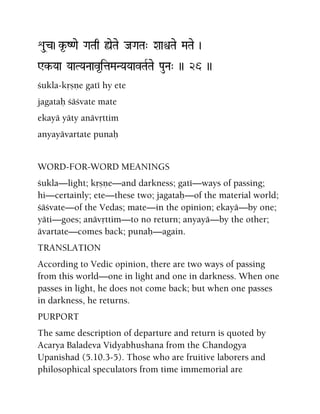
éu(c)-k*-Z<ae GaTaq ùeTae JaGaTa" XaaìTae MaTae )
Wk-Yaa YaaTYaNaav*itaMaNYaYaavTaRTae PauNa" )) 26 ))
çukla-kåñëe gaté hy ete
jagataù çäçvate mate
ekayä yäty anävåttim
anyayävartate punaù
WORD-FOR-WORD MEANINGS
çukla—light; kåñëe—and darkness; gaté—ways of passing;
hi—certainly; ete—these two; jagataù—of the material world;
çäçvate—of the Vedas; mate—in the opinion; ekayä—by one;
yäti—goes; anävåttim—to no return; anyayä—by the other;
ävartate—comes back; punaù—again.
TRANSLATION
According to Vedic opinion, there are two ways of passing
from this world—one in light and one in darkness. When one
passes in light, he does not come back; but when one passes
in darkness, he returns.
PURPORT
The same description of departure and return is quoted by
Acarya Baladeva Vidyabhushana from the Chandogya
Upanishad (5.10.3-5). Those who are fruitive laborers and
philosophical speculators from time immemorial are
constantly going and coming. Actually they do not attain
ultimate salvation, for they do not surrender to Krishna.
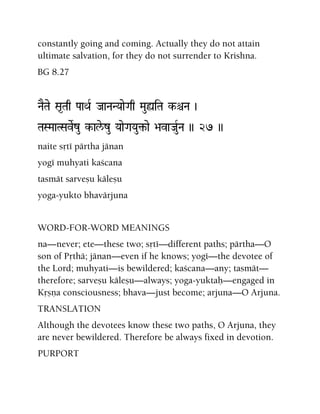
BG 8.27
NaETae Sa*Taq PaaQaR JaaNaNYaaeGaq MauùiTa k-êNa )
TaSMaaTSaveRzu k-ale/zu YaaeGaYau¢-ae >avaJauRNa )) 27 ))
naite såté pärtha jänan
yogé muhyati kaçcana
tasmät sarveñu käleñu
yoga-yukto bhavärjuna
WORD-FOR-WORD MEANINGS
na—never; ete—these two; såté—different paths; pärtha—O
son of Påthä; jänan—even if he knows; yogé—the devotee of
the Lord; muhyati—is bewildered; kaçcana—any; tasmät—
therefore; sarveñu käleñu—always; yoga-yuktaù—engaged in
Kåñëa consciousness; bhava—just become; arjuna—O Arjuna.
TRANSLATION
Although the devotees know these two paths, O Arjuna, they
are never bewildered. Therefore be always fixed in devotion.
PURPORT
Krishna is here advising Arjuna that he should not be
disturbed by the different paths the soul can take when
leaving the material world. A devotee of the Supreme Lord
should not worry whether he will depart by arrangement or
by accident. The devotee should be firmly established in
Krishna consciousness and chant Hare Krishna. He should
know that concern over either of these two paths is
troublesome. The best way to be absorbed in Krishna
consciousness is to be always dovetailed in His service, and
this will make one's path to the spiritual kingdom safe, certain
and direct. The word yoga-yukta is especially significant in
this verse. One who is firm in yoga is constantly engaged in
Krishna consciousness in all his activities. Sri Rupa Gosvami
advises, anasaktasya vishayan yatharham upayunjatah: one
should be unattached in material affairs and do everything in
Krishna consciousness. By this system, which is called yukta-
vairagya, one attains perfection. Therefore the devotee is not
disturbed by these descriptions, because he knows that his
passage to the supreme abode is guaranteed by devotional
service.
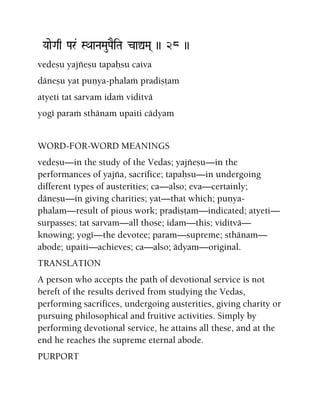
BG 8.28
vedezu Yajezu TaPa"Sau cEv
daNaezu YaTPau<Yaf-l&/ Pa[idíMa( )
ATYaeiTa TaTSavRiMad& ividTva
YaaeGaq Par& SQaaNaMauPaEiTa caÛMa( )) 28 ))
vedeñu yajïeñu tapaùsu caiva
däneñu yat puëya-phalaà pradiñöam
atyeti tat sarvam idaà viditvä
yogé paraà sthänam upaiti cädyam
WORD-FOR-WORD MEANINGS
vedeñu—in the study of the Vedas; yajïeñu—in the
performances of yajïa, sacrifice; tapaùsu—in undergoing
different types of austerities; ca—also; eva—certainly;
däneñu—in giving charities; yat—that which; puëya-
phalam—result of pious work; pradiñöam—indicated; atyeti—
surpasses; tat sarvam—all those; idam—this; viditvä—
knowing; yogé—the devotee; param—supreme; sthänam—
abode; upaiti—achieves; ca—also; ädyam—original.
TRANSLATION
A person who accepts the path of devotional service is not
bereft of the results derived from studying the Vedas,
performing sacrifices, undergoing austerities, giving charity or
pursuing philosophical and fruitive activities. Simply by
performing devotional service, he attains all these, and at the
end he reaches the supreme eternal abode.
PURPORT
This verse is the summation of the Seventh and Eighth
chapters, which particularly deal with Krishna consciousness
and devotional service. One has to study the Vedas under the
guidance of the spiritual master and undergo many austerities
and penances while living under his care. A brahmacari has to
live in the home of the spiritual master just like a servant, and
he must beg alms from door to door and bring them to the
spiritual master. He takes food only under the master's order,
and if the master neglects to call the student for food that day,
the student fasts. These are some of the Vedic principles for
observing brahmacarya.
After the student studies the Vedas under the master for some
time—at least from from age five to twenty—he becomes a
man of perfect character. Study of the Vedas is not meant for
the recreation of armchair speculators, but for the formation
of character. After this training, the brahmacari is allowed to
enter into household life and marry. When he is a
householder, he has to perform many sacrifices so that he may
achieve further enlightenment. He must also give charity
according to the country, time and candidate, discriminating
among charity in goodness, in passion and in ignorance, as
described in Bhagavad-gita. Then after retiring from
household life, upon accepting the order of vanaprastha, he
undergoes severe penances—living in forests, dressing with
tree bark, not shaving, etc. By carrying out the orders of
brahmacarya, householder life, vanaprastha and finally
sannyasa, one becomes elevated to the perfectional stage of
life. Some are then elevated to the heavenly kingdoms, and
when they become even more advanced they are liberated in
the spiritual sky, either in the impersonal brahma-jyotir or in
the Vaikuntha planets or Krishnaloka. This is the path
outlined by Vedic literatures.
The beauty of Krishna consciousness, however, is that by one
stroke, by engaging in devotional service, one can surpass all
the rituals of the different orders of life.
The words idam viditva indicate that one should understand
the instructions given by Sri Krishna in this chapter and the
Seventh Chapter of Bhagavad-gita. One should try to
understand these chapters not by scholarship or mental
speculation but by hearing them in association with devotees.
Chapters Seven through Twelve are the essence of Bhagavad-
gita. The first six and the last six chapters are like coverings
for the middle six chapters, which are especially protected by
the Lord. If one is fortunate enough to understand Bhagavad-
gita—especially these middle six chapters—in the association
of devotees, then his life at once becomes glorified beyond all
penances, sacrifices, charities, speculations, etc., for one can
achieve all the results of these activities simply by Krishna
consciousness.
One who has a little faith in Bhagavad-gita should learn
Bhagavad-gita from a devotee, because in the beginning of the
Fourth Chapter it is stated clearly that Bhagavad-gita can be
understood only by devotees; no one else can perfectly
understand the purpose of Bhagavad-gita. One should
therefore learn Bhagavad-gita from a devotee of Krishna, not
from mental speculators. This is a sign of faith. When one
searches for a devotee and fortunately gets a devotee's
association one actually begins to study and understand
Bhagavad-gita. By advancement in the association of the
devotee one is placed in devotional service, and this service
dispels all one's misgivings about Krishna, or God, and
Krishna's activities, form, pastimes, name and other features.
After these misgivings have been perfectly cleared away, one
becomes fixed in one's study. Then one relishes the study of
Bhagavad-gita and attains the state of feeling always Krishna
conscious. In the advanced stage, one falls completely in love
with Krishna. This highest perfectional stage of life enables
the devotee to be transferred to Krishna's abode in the
spiritual sky, Goloka Vrindavana, where the devotee becomes
eternally happy.
Thus end the Bhaktivedanta Purports to the Eighth Chapter of
the Srimad Bhagavad-gita in the matter of Attaining the
Supreme.

Bg 08

  • 1.
    - Chapter 8- Attaining the Supreme By remembering Lord Krishna in devotion throughout one's life, and especially at the time of death, one can attain to His supreme abode, beyond the material world. BG 8.1 AJauRNa ovac ik&- Tad(b]ø ik-MaDYaaTMa& ik&- k-MaR PauåzaetaMa ) AiDa>aUTa& c ik&- Pa[ae¢-MaiDadEv& ik-MauCYaTae )) 1 )) arjuna uväca kià tad brahma kim adhyätmaà kià karma puruñottama adhibhütaà ca kià proktam adhidaivaà kim ucyate WORD-FOR-WORD MEANINGS arjunaù uväca—Arjuna said; kim—what; tat—that; brahma— Brahman; kim—what; adhyätmam—the self; kim—what;
  • 2.
    karma—fruitive activities; puruña-uttama—OSupreme Person; adhibhütam—the material manifestation; ca—and; kim—what; proktam—is called; adhidaivam—the demigods; kim—what; ucyate—is called. TRANSLATION Arjuna inquired: O my Lord, O Supreme Person, what is Brahman? What is the self? What are fruitive activities? What is this material manifestation? And what are the demigods? Please explain this to me. PURPORT In this chapter Lord Krishna answers different questions from Arjuna, beginning with "What is Brahman?" The Lord also explains karma (fruitive activities), devotional service and yoga principles, and devotional service in its pure form. The Srimad-Bhagavatam explains that the Supreme Absolute Truth is known as Brahman, Paramatma and Bhagavan. In addition, the living entity, the individual soul, is also called Brahman. Arjuna also inquires about atma, which refers to body, soul and mind. According to the Vedic dictionary, atma refers to the mind, soul, body and senses also. Arjuna has addressed the Supreme Lord as Purushottama, Supreme Person, which means that he was putting these questions not simply to a friend but to the Supreme Person, knowing Him to be the supreme authority able to give definitive answers.
  • 3.
    BG 8.2 AiDaYaj" k-Qa&k-ae_}a dehe_iSMaNMaDauSaUdNa ) Pa[Yaa<ak-ale/ c k-Qa& jeYaae_iSa iNaYaTaaTMai>a" )) 2 )) adhiyajïaù kathaà ko 'tra dehe 'smin madhusüdana prayäëa-käle ca kathaà jïeyo 'si niyatätmabhiù WORD-FOR-WORD MEANINGS adhiyajïaù—the Lord of sacrifice; katham—how; kaù—who; atra—here; dehe—in the body; asmin—this; madhusüdana— O Madhusüdana; prayäëa-käle—at the time of death; ca—and; katham—how; jïeyaù asi—You can be known; niyata- ätmabhiù—by the self-controlled. TRANSLATION Who is the Lord of sacrifice, and how does He live in the body, O Madhusudana? And how can those engaged in devotional service know You at the time of death? PURPORT "Lord of sacrifice" may refer to either Indra or Vishnu. Vishnu is the chief of the primal demigods, including Brahma and
  • 4.
    Siva, and Indrais the chief of the administrative demigods. Both Indra and Vishnu are worshiped by yajna performances. But here Arjuna asks who is actually the Lord of yajna (sacrifice) and how the Lord is residing within the body of the living entity. Arjuna addresses the Lord as Madhusudana because Krishna once killed a demon named Madhu. Actually these questions, which are of the nature of doubts, should not have arisen in the mind of Arjuna, because Arjuna is a Krishna conscious devotee. Therefore these doubts are like demons. Since Krishna is so expert in killing demons, Arjuna here addresses Him as Madhusudana so that Krishna might kill the demonic doubts that arise in Arjuna's mind. Now the word prayana-kale in this verse is very significant because whatever we do in life will be tested at the time of death. Arjuna is very anxious to know of those who are constantly engaged in Krishna consciousness. What should be their position at that final moment? At the time of death all the bodily functions are disrupted, and the mind is not in a proper condition. Thus disturbed by the bodily situation, one may not be able to remember the Supreme Lord. Maharaja Kulasekhara, a great devotee, prays, "My dear Lord, just now I am quite healthy, and it is better that I die immediately so that the swan of my mind can seek entrance at the stem of Your lotus feet." The metaphor is used because the swan, a bird of the water, takes pleasure in digging into the lotus flowers; its sporting proclivity is to enter the lotus flower. Maharaja
  • 5.
    Kulasekhara says tothe Lord, "Now my mind is undisturbed, and I am quite healthy. If I die immediately, thinking of Your lotus feet, then I am sure that my performance of Your devotional service will become perfect. But if I have to wait for my natural death, then I do not know what will happen, because at that time the bodily functions will be disrupted, my throat will be choked up, and I do not know whether I shall be able to chant Your name. Better let me die immediately." Arjuna questions how a person can fix his mind on Krishna's lotus feet at such a time. BG 8.3 é[q>aGavaNauvac A+ar& b]ø ParMa& Sv>aavae_DYaaTMaMauCYaTae ) >aUTa>aavaeÙvk-rae ivSaGaR" k-MaRSa&ijTa" )) 3 )) çré-bhagavän uväca akñaraà brahma paramaà svabhävo 'dhyätmam ucyate bhüta-bhävodbhava-karo visargaù karma-saàjïitaù
  • 6.
    WORD-FOR-WORD MEANINGS çré-bhagavän uväca—theSupreme Personality of Godhead said; akñaram—indestructible; brahma—Brahman; paramam—transcendental; svabhävaù—eternal nature; adhyätmam—the self; ucyate—is called; bhüta-bhäva- udbhava-karaù—producing the material bodies of the living entities; visargaù—creation; karma—fruitive activities; saàjïitaù—is called. TRANSLATION The Supreme Personality of Godhead said: The indestructible, transcendental living entity is called Brahman, and his eternal nature is called adhyatma, the self. Action pertaining to the development of the material bodies of the living entities is called karma, or fruitive activities. PURPORT Brahman is indestructible and eternally existing, and its constitution is not changed at any time. But beyond Brahman there is Para-brahman. Brahman refers to the living entity, and Para-brahman refers to the Supreme Personality of Godhead. The constitutional position of the living entity is different from the position he takes in the material world. In material consciousness his nature is to try to be the lord of matter, but in spiritual consciousness, Krishna consciousness, his position is to serve the Supreme. When the living entity is in material consciousness, he has to take on various bodies in the
  • 7.
    material world. Thatis called karma, or varied creation by the force of material consciousness. In Vedic literature the living entity is called jivatma and Brahman, but he is never called Para-brahman. The living entity (jivatma) takes different positions—sometimes he merges into the dark material nature and identifies himself with matter, and sometimes he identifies himself with the superior, spiritual nature. Therefore he is called the Supreme Lord's marginal energy. According to his identification with material or spiritual nature, he receives a material or spiritual body. In material nature he may take a body from any of the 8,400,000 species of life, but in spiritual nature he has only one body. In material nature he is manifested sometimes as a man, demigod, animal, beast, bird, etc., according to his karma. To attain material heavenly planets and enjoy their facilities, he sometimes performs sacrifices (yajna), but when his merit is exhausted he returns to earth again in the form of a man. This process is called karma. The Chandogya Upanishad describes the Vedic sacrificial process. On the sacrificial altar, five kinds of offerings are made into five kinds of fire. The five kinds of fire are conceived of as the heavenly planets, clouds, the earth, man and woman, and the five kinds of sacrificial offerings are faith, the enjoyer on the moon, rain, grains and semen. In the process of sacrifice, the living entity makes specific sacrifices to attain specific heavenly planets and consequently reaches them. When the merit of sacrifice is exhausted, the
  • 8.
    living entity descendsto earth in the form of rain, then takes on the form of grains, and the grains are eaten by man and transformed into semen, which impregnates a woman, and thus the living entity once again attains the human form to perform sacrifice and so repeat the same cycle. In this way, the living entity perpetually comes and goes on the material path. The Krishna conscious person, however, avoids such sacrifices. He takes directly to Krishna consciousness and thereby prepares himself to return to Godhead. Impersonalist commentators on the Bhagavad-gita unreasonably assume that Brahman takes the form of jiva in the material world, and to substantiate this they refer to Chapter Fifteen, verse 7, of the Gita. But in this verse the Lord also speaks of the living entity as "an eternal fragment of Myself." The fragment of God, the living entity, may fall down into the material world, but the Supreme Lord (Acyuta) never falls down. Therefore this assumption that the Supreme Brahman assumes the form of jiva is not acceptable. It is important to remember that in Vedic literature Brahman (the living entity) is distinguished from Para-brahman (the Supreme Lord). BG 8.4 AiDa>aUTa& +arae >aav" PauåzêaiDadEvTaMa( ) AiDaYajae_hMaeva}a dehe deh>a*Taa& vr )) 4 ))
  • 9.
    adhibhütaà kñaro bhävaù puruñaçcädhidaivatam adhiyajïo 'ham evätra dehe deha-bhåtäà vara WORD-FOR-WORD MEANINGS adhibhütam—the physical manifestation; kñaraù—constantly changing; bhävaù—nature; puruñaù—the universal form, including all the demigods, like the sun and moon; ca—and; adhidaivatam—called adhidaiva; adhiyajïaù—the Supersoul; aham—I (Kåñëa); eva—certainly; atra—in this; dehe—body; deha-bhåtäm—of the embodied; vara—O best. TRANSLATION O best of the embodied beings, the physical nature, which is constantly changing, is called adhibhuta [the material manifestation]. The universal form of the Lord, which includes all the demigods, like those of the sun and moon, is called adhidaiva. And I, the Supreme Lord, represented as the Supersoul in the heart of every embodied being, am called adhiyajna [the Lord of sacrifice]. PURPORT The physical nature is constantly changing. Material bodies generally pass through six stages: they are born, they grow, they remain for some duration, they produce some by-
  • 10.
    products, they dwindle,and then they vanish. This physical nature is called adhibhuta. It is created at a certain point and will be annihilated at a certain point. The conception of the universal form of the Supreme Lord, which includes all the demigods and their different planets, is called adhidaivata. And present in the body along with the individual soul is the Supersoul, a plenary representation of Lord Krishna. The Supersoul is called the Paramatma or adhiyajna and is situated in the heart. The word eva is particularly important in the con of this verse because by this word the Lord stresses that the Paramatma is not different from Him. The Supersoul, the Supreme Personality of Godhead, seated beside the individual soul, is the witness of the individual soul's activities and is the source of the soul's various types of consciousness. The Supersoul gives the individual soul an opportunity to act freely and witnesses his activities. The functions of all these different manifestations of the Supreme Lord automatically become clarified for the pure Krishna conscious devotee engaged in transcendental service to the Lord. The gigantic universal form of the Lord called adhidaivata is contemplated by the neophyte who cannot approach the Supreme Lord in His manifestation as Supersoul. The neophyte is advised to contemplate the universal form, or virat-purusha, whose legs are considered the lower planets, whose eyes are considered the sun and moon, and whose head is considered the upper planetary system. BG 8.5
  • 11.
    ANTak-ale/ c MaaMaevSMarNMau¤-a k-le/vrMa( ) Ya" Pa[YaaiTa Sa MaÙav& YaaiTa NaaSTYa}a Sa&XaYa" )) 5 )) anta-käle ca mäm eva smaran muktvä kalevaram yaù prayäti sa mad-bhävaà yäti nästy atra saàçayaù WORD-FOR-WORD MEANINGS anta-käle—at the end of life; ca—also; mäm—Me; eva— certainly; smaran—remembering; muktvä—quitting; kalevaram—the body; yaù—he who; prayäti—goes; saù—he; mat-bhävam—My nature; yäti—achieves; na—not; asti—there is; atra—here; saàçayaù—doubt. TRANSLATION And whoever, at the end of his life, quits his body remembering Me alone at once attains My nature. Of this there is no doubt. PURPORT In this verse the importance of Krishna consciousness is stressed. Anyone who quits his body in Krishna consciousness is at once transferred to the transcendental nature of the
  • 12.
    Supreme Lord. TheSupreme Lord is the purest of the pure. Therefore anyone who is constantly Krishna conscious is also the purest of the pure. The word smaran ("remembering") is important. Remembrance of Krishna is not possible for the impure soul who has not practiced Krishna consciousness in devotional service. Therefore one should practice Krishna consciousness from the very beginning of life. If one wants to achieve success at the end of his life, the process of remembering Krishna is essential. Therefore one should constantly, incessantly chant the maha-mantra—Hare Krishna, Hare Krishna, Krishna Krishna, Hare Hare/ Hare Rama, Hare Rama, Rama Rama, Hare Hare. Lord Caitanya has advised that one be as tolerant as a tree (taror iva sahishnuna). There may be so many impediments for a person who is chanting Hare Krishna. Nonetheless, tolerating all these impediments, one should continue to chant Hare Krishna, Hare Krishna, Krishna Krishna, Hare Hare/ Hare Rama, Hare Rama, Rama Rama, Hare Hare, so that at the end of one's life one can have the full benefit of Krishna consciousness. BG 8.6 Ya& Ya& vaiPa SMarN>aav& TYaJaTYaNTae k-le/vrMa( ) Ta& TaMaevEiTa k-aENTaeYa Sada TaÙav>aaivTa" )) 6 )) yaà yaà väpi smaran bhävaà tyajaty ante kalevaram
  • 13.
    taà tam evaitikaunteya sadä tad-bhäva-bhävitaù WORD-FOR-WORD MEANINGS yam yam—whatever; vä api—at all; smaran—remembering; bhävam—nature; tyajati—gives up; ante—at the end; kalevaram—this body; tam tam—similar; eva—certainly; eti— gets; kaunteya—O son of Kunté; sadä—always; tat—that; bhäva—state of being; bhävitaù—remembering. TRANSLATION Whatever state of being one remembers when he quits his body, O son of Kunti, that state he will attain without fail. PURPORT The process of changing one's nature at the critical moment of death is here explained. A person who at the end of his life quits his body thinking of Krishna attains the transcendental nature of the Supreme Lord, but it is not true that a person who thinks of something other than Krishna attains the same transcendental state. This is a point we should note very carefully. How can one die in the proper state of mind? Maharaja Bharata, although a great personality, thought of a deer at the end of his life, and so in his next life he was transferred into the body of a deer. Although as a deer he remembered his past activities, he had to accept that animal body. Of course, one's thoughts during the course of one's life
  • 14.
    accumulate to influenceone's thoughts at the moment of death, so this life creates one's next life. If in one's present life one lives in the mode of goodness and always thinks of Krishna, it is possible for one to remember Krishna at the end of one's life. That will help one be transferred to the transcendental nature of Krishna. If one is transcendentally absorbed in Krishna's service, then his next body will be transcendental (spiritual), not material. Therefore the chanting of Hare Krishna, Hare Krishna, Krishna Krishna, Hare Hare/ Hare Rama, Hare Rama, Rama Rama, Hare Hare is the best process for successfully changing one's state of being at the end of one's life. BG 8.7 TaSMaaTSaveRzu k-ale/zu MaaMaNauSMar YauDYa c ) MaYYaiPaRTaMaNaaebuiÖMaaRMaevEZYaSYaSa&XaYa" )) 7 )) tasmät sarveñu käleñu mäm anusmara yudhya ca mayy arpita-mano-buddhir mäm evaiñyasy asaàçayaù WORD-FOR-WORD MEANINGS
  • 15.
    tasmät—therefore; sarveñu—at all;käleñu—times; mäm—Me; anusmara—go on remembering; yudhya—fight; ca—also; mayi—unto Me; arpita—surrendering; manaù—mind; buddhiù—intellect; mäm—unto Me; eva—surely; eñyasi—you will attain; asaàçayaù—beyond a doubt. TRANSLATION Therefore, Arjuna, you should always think of Me in the form of Krishna and at the same time carry out your prescribed duty of fighting. With your activities dedicated to Me and your mind and intelligence fixed on Me, you will attain Me without doubt. PURPORT This instruction to Arjuna is very important for all men engaged in material activities. The Lord does not say that one should give up his prescribed duties or engagements. One can continue them and at the same time think of Krishna by chanting Hare Krishna. This will free one from material contamination and engage the mind and intelligence in Krishna. By chanting Krishna's names, one will be transferred to the supreme planet, Krishnaloka, without a doubt. BG 8.8 A>YaaSaYaaeGaYau¢e-Na ceTaSaa NaaNYaGaaiMaNaa )
  • 16.
    ParMa& Pauåz& idVYa&YaaiTa PaaQaaRNauicNTaYaNa( )) 8 )) abhyäsa-yoga-yuktena cetasä nänya-gäminä paramaà puruñaà divyaà yäti pärthänucintayan WORD-FOR-WORD MEANINGS abhyäsa-yoga—in the practice of meditation; yuktena—being engaged; cetasä—by the mind and intelligence; na anya- gäminä—without their being deviated; paramam—the Supreme; puruñam—Personality of Godhead; divyam— transcendental; yäti—one achieves; pärtha—O son of Påthä; anucintayan—constantly thinking of. TRANSLATION He who meditates on Me as the Supreme Personality of Godhead, his mind constantly engaged in remembering Me, undeviated from the path, he, O Partha, is sure to reach Me. PURPORT In this verse Lord Krishna stresses the importance of remembering Him. One's memory of Krishna is revived by chanting the maha-mantra, Hare Krishna. By this practice of chanting and hearing the sound vibration of the Supreme Lord, one's ear, tongue and mind are engaged. This mystic
  • 17.
    meditation is veryeasy to practice, and it helps one attain the Supreme Lord. Purusham means enjoyer. Although living entities belong to the marginal energy of the Supreme Lord, they are in material contamination. They think themselves enjoyers, but they are not the supreme enjoyer. Here it is clearly stated that the supreme enjoyer is the Supreme Personality of Godhead in His different manifestations and plenary expansions as Narayana, Vasudeva, etc. The devotee can constantly think of the object of worship, the Supreme Lord, in any of His features—Narayana, Krishna, Rama, etc.—by chanting Hare Krishna. This practice will purify him, and at the end of his life, due to his constant chanting, he will be transferred to the kingdom of God. Yoga practice is meditation on the Supersoul within; similarly, by chanting Hare Krishna one fixes his mind always on the Supreme Lord. The mind is fickle, and therefore it is necessary to engage the mind by force to think of Krishna. One example often given is that of the caterpillar that thinks of becoming a butterfly and so is transformed into a butterfly in the same life. Similarly, if we constantly think of Krishna, it is certain that at the end of our lives we shall have the same bodily constitution as Krishna. BG 8.9
  • 18.
    k-iv& Paura<aMaNauXaaiSaTaar‚ Ma<aaer<aqYaa&SaMaNauSMareÛ" ) SavRSYaDaaTaarMaicNTYaæPa‚ MaaidTYav<a| TaMaSa" ParSTaaTa( )) 9 )) kavià puräëam anuçäsitäram aëor aëéyäàsam anusmared yaù sarvasya dhätäram acintya-rüpam äditya-varëaà tamasaù parastät WORD-FOR-WORD MEANINGS kavim—the one who knows everything; puräëam—the oldest; anuçäsitäram—the controller; aëoù—than the atom; aëéyäàsam—smaller; anusmaret—always thinks of; yaù—one who; sarvasya—of everything; dhätäram—the maintainer; acintya—inconceivable; rüpam—whose form; äditya— varëam—luminous like the sun; tamasaù—to darkness; parastät—transcendental. TRANSLATION One should meditate upon the Supreme Person as the one who knows everything, as He who is the oldest, who is the controller, who is smaller than the smallest, who is the maintainer of everything, who is beyond all material
  • 19.
    conception, who isinconceivable, and who is always a person. He is luminous like the sun, and He is transcendental, beyond this material nature. PURPORT The process of thinking of the Supreme is mentioned in this verse. The foremost point is that He is not impersonal or void. One cannot meditate on something impersonal or void. That is very difficult. The process of thinking of Krishna, however, is very easy and is factually stated herein. First of all, the Lord is purusha, a person—we think of the person Rama and the person Krishna. And whether one thinks of Rama or of Krishna, what He is like is described in this verse of Bhagavad- gita. The Lord is kavi; that is, He knows past, present and future and therefore knows everything. He is the oldest personality because He is the origin of everything; everything is born out of Him. He is also the supreme controller of the universe, and He is the maintainer and instructor of humanity. He is smaller than the smallest. The living entity is one ten-thousandth part of the tip of a hair, but the Lord is so inconceivably small that He enters into the heart of this particle. Therefore He is called smaller than the smallest. As the Supreme, He can enter into the atom and into the heart of the smallest and control him as the Supersoul. Although so small, He is still all-pervading and is maintaining everything. By Him all these planetary systems are sustained. We often wonder how these big planets are floating in the air. It is stated here that the Supreme Lord, by His inconceivable
  • 20.
    energy, is sustainingall these big planets and systems of galaxies. The word acintya ("inconceivable") is very significant in this connection. God's energy is beyond our conception, beyond our thinking jurisdiction, and is therefore called inconceivable (acintya). Who can argue this point? He pervades this material world and yet is beyond it. We cannot comprehend even this material world, which is insignificant compared to the spiritual world—so how can we comprehend what is beyond? Acintya means that which is beyond this material world, that which our argument, logic and philosophical speculation cannot touch, that which is inconceivable. Therefore intelligent persons, avoiding useless argument and speculation, should accept what is stated in scriptures like the Vedas, Bhagavad-gita and Srimad- Bhagavatam and follow the principles they set down. This will lead one to understanding. BG 8.10 Pa[Yaa<ak-ale/ MaNaSaacle/Na >a¢-ya Yau¢-ae YaaeGable/Na cEv ) >a]uvaeMaRDYae Pa[a<aMaaveXYa SaMYa‚ KSa Ta& Par& PauåzMauPaEiTa idVYaMa( )) 10 )) prayäëa-käle manasäcalena bhaktyä yukto yoga-balena caiva
  • 21.
    bhruvor madhye präëamäveçya samyak sa taà paraà puruñam upaiti divyam WORD-FOR-WORD MEANINGS prayäëa-käle—at the time of death; manasä—by the mind; acalena—without its being deviated; bhaktyä—in full devotion; yuktaù—engaged; yoga—balena—by the power of mystic yoga; ca—also; eva—certainly; bhruvoù—the two eyebrows; madhye—between; präëam—the life air; äveçya— establishing; samyak—completely; saù—he; tam—that; param—transcendental; puruñam—Personality of Godhead; upaiti—achieves; divyam—in the spiritual kingdom. TRANSLATION One who, at the time of death, fixes his life air between the eyebrows and, by the strength of yoga, with an undeviating mind, engages himself in remembering the Supreme Lord in full devotion, will certainly attain to the Supreme Personality of Godhead. PURPORT In this verse it is clearly stated that at the time of death the mind must be fixed in devotion to the Supreme Personality of Godhead. For those practiced in yoga, it is recommended that they raise the life force between the eyebrows (to the ajna- cakra). The practice of shat-cakra-yoga, involving meditation on the six cakras, is suggested here. A pure devotee does not
  • 22.
    practice such yoga,but because he is always engaged in Krishna consciousness, at death he can remember the Supreme Personality of Godhead by His grace. This is explained in verse fourteen. The particular use of the word yoga-balena is significant in this verse because without practice of yoga—whether shat- cakra-yoga or bhakti-yoga—one cannot come to this transcendental state of being at the time of death. One cannot suddenly remember the Supreme Lord at death; one must have practiced some yoga system, especially the system of bhakti-yoga. Since one's mind at death is very disturbed, one should practice transcendence through yoga during one's life. BG 8.11 Yad+ar& vedivdae vdiNTa ivXaiNTa YaÛTaYaae vqTaraGaa" ) YaidC^NTaae b]øcYa| criNTa Tatae Pad& Sa°he<a Pa[v+Yae )) 11 )) yad akñaraà veda-vido vadanti viçanti yad yatayo véta-rägäù yad icchanto brahmacaryaà caranti
  • 23.
    tat te padaàsaìgraheëa pravakñye WORD-FOR-WORD MEANINGS yat—that which; akñaram—syllable oà; veda-vidaù—persons conversant with the Vedas; vadanti—say; viçanti—enter; yat— in which; yatayaù—great sages; véta-rägäù—in the renounced order of life; yat—that which; icchantaù—desiring; brahmacaryam—celibacy; caranti—practice; tat—that; te— unto you; padam—situation; saìgraheëa—in summary; pravakñye—I shall explain. TRANSLATION Persons who are learned in the Vedas, who utter omkara and who are great sages in the renounced order enter into Brahman. Desiring such perfection, one practices celibacy. I shall now briefly explain to you this process by which one may attain salvation. PURPORT Lord Sri Krishna has recommended to Arjuna the practice of shat-cakra-yoga, in which one places the air of life between the eyebrows. Taking it for granted that Arjuna might not know how to practice shat-cakra-yoga, the Lord explains the process in the following verses. The Lord says that Brahman, although one without a second, has various manifestations and features. Especially for the impersonalists, the akshara, or omkara—the syllable om—is identical with Brahman. Krishna
  • 24.
    here explains theimpersonal Brahman, into which the renounced order of sages enter. In the Vedic system of knowledge, students, from the very beginning, are taught to vibrate om and learn of the ultimate impersonal Brahman by living with the spiritual master in complete celibacy. In this way they realize two of Brahman's features. This practice is very essential for the student's advancement in spiritual life, but at the moment such brahmacari (unmarried celibate) life is not at all possible. The social construction of the world has changed so much that there is no possibility of one's practicing celibacy from the beginning of student life. Throughout the world there are many institutions for different departments of knowledge, but there is no recognized institution where students can be educated in the brahmacari principles. Unless one practices celibacy, advancement in spiritual life is very difficult. Therefore Lord Caitanya has announced, according to the scriptural injunctions for this Age of Kali, that in this age no process of realizing the Supreme is possible except the chanting of the holy names of Lord Krishna: Hare Krishna, Hare Krishna, Krishna Krishna, Hare Hare/ Hare Rama, Hare Rama, Rama Rama, Hare Hare. BG 8.12 SavRÜarai<a Sa&YaMYa MaNaae ôid iNaåDYa c )
  • 25.
    MaUDNYaaRDaaYaaTMaNa" Pa[a<aMaaiSQaTaae YaaeGaDaar<aaMa()) 12 )) sarva-dväräëi saàyamya mano hådi nirudhya ca mürdhny ädhäyätmanaù präëam ästhito yoga-dhäraëäm WORD-FOR-WORD MEANINGS sarva-dväräëi—all the doors of the body; saàyamya— controlling; manaù—the mind; hådi—in the heart; nirudhya—confining; ca—also; mürdhni—on the head; ädhäya—fixing; ätmanaù—of the soul; präëam—the life air; ästhitaù—situated in; yoga-dhäraëäm—the yogic situation. TRANSLATION The yogic situation is that of detachment from all sensual engagements. Closing all the doors of the senses and fixing the mind on the heart and the life air at the top of the head, one establishes himself in yoga. PURPORT To practice yoga as suggested here, one first has to close the doors of all sense enjoyment. This practice is called pratyahara, or withdrawing the senses from the sense objects. The sense organs for acquiring knowledge—the eyes, ears, nose, tongue and touch—should be fully controlled and
  • 26.
    should not beallowed to engage in self-gratification. In this way the mind focuses on the Supersoul in the heart, and the life force is raised to the top of the head. In the Sixth Chapter this process is described in detail. But as mentioned before, this practice is not practical in this age. The best process is Krishna consciousness. If one is always able to fix his mind on Krishna in devotional service, it is very easy for him to remain in an undisturbed transcendental trance, or in samadhi. BG 8.13 p wTYaek-a+ar& b]ø VYaahrNMaaMaNauSMarNa( ) Ya" Pa[YaaiTa TYaJaNdeh& Sa YaaiTa ParMaa& GaiTaMa( )) 13 )) oà ity ekäkñaraà brahma vyäharan mäm anusmaran yaù prayäti tyajan dehaà sa yäti paramäà gatim WORD-FOR-WORD MEANINGS oà—the combination of letters oà (oàkära); iti—thus; eka— akñaram—the one syllable; brahma—absolute; vyäharan— vibrating; mäm—Me (Kåñëa); anusmaran—remembering; yaù—anyone who; prayäti—leaves; tyajan—quitting;
  • 27.
    deham—this body; saù—he;yäti—achieves; paramäm—the supreme; gatim—destination. TRANSLATION After being situated in this yoga practice and vibrating the sacred syllable om, the supreme combination of letters, if one thinks of the Supreme Personality of Godhead and quits his body, he will certainly reach the spiritual planets. PURPORT It is clearly stated here that om, Brahman and Lord Krishna are not different. The impersonal sound of Krishna is om, but the sound Hare Krishna contains om. The chanting of the Hare Krishna mantra is clearly recommended for this age. So if one quits his body at the end of life chanting Hare Krishna, Hare Krishna, Krishna Krishna, Hare Hare/ Hare Rama, Hare Rama, Rama Rama, Hare Hare, he certainly reaches one of the spiritual planets, according to the mode of his practice. The devotees of Krishna enter the Krishna planet, Goloka Vrindavana. For the personalists there are also innumerable other planets, known as Vaikuntha planets, in the spiritual sky, whereas the impersonalists remain in the brahma-jyotir. BG 8.14 ANaNYaceTaa" SaTaTa& Yaae Maa& SMariTa iNaTYaXa" ) TaSYaah& Saul/>a" PaaQaR iNaTYaYau¢-SYa YaaeiGaNa" )) 14 ))
  • 28.
    ananya-cetäù satataà yo mäàsmarati nityaçaù tasyähaà sulabhaù pärtha nitya-yuktasya yoginaù WORD-FOR-WORD MEANINGS ananya-cetäù—without deviation of the mind; satatam— always; yaù—anyone who; mäm—Me (Kåñëa); smarati— remembers; nityaçaù—regularly; tasya—to him; aham—I am; su-labhaù—very easy to achieve; pärtha—O son of Påthä; nitya—regularly; yuktasya—engaged; yoginaù—for the devotee. TRANSLATION For one who always remembers Me without deviation, I am easy to obtain, O son of Pritha, because of his constant engagement in devotional service. PURPORT This verse especially describes the final destination attained by the unalloyed devotees who serve the Supreme Personality of Godhead in bhakti-yoga. Previous verses have mentioned four different kinds of devotees—the distressed, the inquisitive, those who seek material gain, and the speculative philosophers. Different processes of liberation have also been described: karma-yoga, jnana-yoga and hatha-yoga. The
  • 29.
    principles of theseyoga systems have some bhakti added, but this verse particularly mentions pure bhakti-yoga, without any mixture of jnana, karma or hatha. As indicated by the word ananya-cetah, in pure bhakti-yoga the devotee desires nothing but Krishna. A pure devotee does not desire promotion to heavenly planets, nor does he seek oneness with the brahma- jyotir or salvation or liberation from material entanglement. A pure devotee does not desire anything. In the Caitanya- caritamrita the pure devotee is called nishkama, which means he has no desire for self-interest. Perfect peace belongs to him alone, not to them who strive for personal gain. Whereas a jnana-yogi, karma-yogi or hatha-yogi has his own selfish interests, a perfect devotee has no desire other than to please the Supreme Personality of Godhead. Therefore the Lord says that for anyone who is unflinchingly devoted to Him, He is easy to attain. A pure devotee always engages in devotional service to Krishna in one of His various personal features. Krishna has various plenary expansions and incarnations, such as Rama and Nrisimha, and a devotee can choose to fix his mind in loving service to any of these transcendental forms of the Supreme Lord. Such a devotee meets with none of the problems that plague the practitioners of other yogas. Bhakti- yoga is very simple and pure and easy to perform. One can begin simply by chanting Hare Krishna. The Lord is merciful to all, but as we have already explained, He is especially inclined toward those who always serve Him without
  • 30.
    deviation. The Lordhelps such devotees in various ways. As stated in the Vedas (Katha Upanishad 1.2.23), yam evaisha vrinute tena labhyas/ tasyaisha atma vivrinute tanum svam: one who is fully surrendered and engaged in the devotional service of the Supreme Lord can understand the Supreme Lord as He is. And as stated in Bhagavad-gita (10.10), dadami buddhi-yogam tam: the Lord gives such a devotee sufficient intelligence so that ultimately the devotee can attain Him in His spiritual kingdom. The special qualification of the pure devotee is that he is always thinking of Krishna without deviation and without considering the time or place. There should be no impediments. He should be able to carry out his service anywhere and at any time. Some say that the devotee should remain in holy places like Vrindavana or some holy town where the Lord lived, but a pure devotee can live anywhere and create the atmosphere of Vrindavana by his devotional service. It was Sri Advaita who told Lord Caitanya, "Wherever You are, O Lord-there is Vrindavana." As indicated by the words satatam and nityasah, which mean "always," "regularly," or "every day," a pure devotee constantly remembers Krishna and meditates upon Him. These are qualifications of the pure devotee for whom the Lord is most easily attainable. Bhakti-yoga is the system that the Gita recommends above all others. Generally, the bhakti- yogis are engaged in five different ways: (1) santa-bhakta, engaged in devotional service in neutrality; (2) dasya-bhakta,
  • 31.
    engaged in devotionalservice as servant; (3) sakhya-bhakta, engaged as friend; (4) vatsalya-bhakta, engaged as parent; and (5) madhurya-bhakta, engaged as conjugal lover of the Supreme Lord. In any of these ways, the pure devotee is always constantly engaged in the transcendental loving service of the Supreme Lord and cannot forget the Supreme Lord, and so for him the Lord is easily attained. A pure devotee cannot forget the Supreme Lord for a moment, and similarly the Supreme Lord cannot forget His pure devotee for a moment. This is the great blessing of the Krishna conscious process of chanting the maha-mantra—Hare Krishna, Hare Krishna, Krishna Krishna, Hare Hare/ Hare Rama, Hare Rama, Rama Rama, Hare Hare. BG 8.15 MaaMauPaeTYa PauNaJaRNMa du"%al/YaMaXaaìTaMa( ) NaaPanuviNTa MahaTMaaNa" Sa&iSaiÖ& ParMaa& GaTaa" )) 15 )) mäm upetya punar janma duùkhälayam açäçvatam näpnuvanti mahätmänaù saàsiddhià paramäà gatäù WORD-FOR-WORD MEANINGS
  • 32.
    mäm—Me; upetya—achieving; punaù—again;janma—birth; duùkha-älayam—place of miseries; açäçvatam—temporary; na—never; äpnuvanti—attain; mahä-ätmänaù—the great souls; saàsiddhim—perfection; paramäm—ultimate; gatäù— having achieved. TRANSLATION After attaining Me, the great souls, who are yogis in devotion, never return to this temporary world, which is full of miseries, because they have attained the highest perfection. PURPORT Since this temporary material world is full of the miseries of birth, old age, disease and death, naturally he who achieves the highest perfection and attains the supreme planet, Krishnaloka, Goloka Vrindavana, does not wish to return. The supreme planet is described in Vedic literature as avyakta and akshara and parama gati; in other words, that planet is beyond our material vision, and it is inexplicable, but it is the highest goal, the destination for the mahatmas (great souls). The mahatmas receive transcendental messages from the realized devotees and thus gradually develop devotional service in Krishna consciousness and become so absorbed in transcendental service that they no longer desire elevation to any of the material planets, nor do they even want to be transferred to any spiritual planet. They only want Krishna and Krishna's association, and nothing else. That is the highest perfection of life. This verse specifically mentions the
  • 33.
    personalist devotees ofthe Supreme Lord, Krishna. These devotees in Krishna consciousness achieve the highest perfection of life. In other words, they are the supreme souls. BG 8.16 Aab]ø>auvNaaçaek-a" PauNaraviTaRNaae_JauRNa ) MaaMauPaeTYa Tau k-aENTaeYa PauNaJaRNMa Na ivÛTae )) 16 )) ä-brahma-bhuvanäl lokäù punar ävartino 'rjuna mäm upetya tu kaunteya punar janma na vidyate WORD-FOR-WORD MEANINGS ä-brahma-bhuvanät—up to the Brahmaloka planet; lokäù— the planetary systems; punaù—again; ävartinaù—returning; arjuna—O Arjuna; mäm—unto Me; upetya—arriving; tu— but; kaunteya—O son of Kunté; punaù janma—rebirth; na— never; vidyate—takes place. TRANSLATION From the highest planet in the material world down to the lowest, all are places of misery wherein repeated birth and
  • 34.
    death take place.But one who attains to My abode, O son of Kunti, never takes birth again. PURPORT All kinds of yogis-karma, jnana, hatha, etc.—eventually have to attain devotional perfection in bhakti-yoga, or Krishna consciousness, before they can go to Krishna's transcendental abode and never return. Those who attain the highest material planets, the planets of the demigods, are again subjected to repeated birth and death. As persons on earth are elevated to higher planets, people on higher planets such as Brahmaloka, Candraloka and Indraloka fall down to earth. The practice of sacrifice called pancagni-vidya, recommended in the Chandogya Upanishad, enables one to achieve Brahmaloka, but if, on Brahmaloka, one does not cultivate Krishna consciousness, then he must return to earth. Those who progress in Krishna consciousness on the higher planets are gradually elevated to higher and higher planets and at the time of universal devastation are transferred to the eternal spiritual kingdom. Baladeva Vidyabhushana, in his commentary on Bhagavad-gita, quotes this verse: brahmana saha te sarve samprapte pratisancare parasyante kritatmanah pravisanti param padam
  • 35.
    "When there isdevastation of this material universe, Brahma and his devotees, who are constantly engaged in Krishna consciousness, are all transferred to the spiritual universe and to specific spiritual planets according to their desires." BG 8.17 SahóYauGaPaYaRNTaMahYaRd(b]ø<aae ivdu" ) rai}a& YauGaSahóaNTaa& Tae_haera}aivdae JaNaa" )) 17 )) sahasra-yuga-paryantam ahar yad brahmaëo viduù rätrià yuga-sahasräntäà te 'ho-rätra-vido janäù WORD-FOR-WORD MEANINGS sahasra—one thousand; yuga—millenniums; paryantam— including; ahaù—day; yat—that which; brahmaëaù—of Brahmä; viduù—they know; rätrim—night; yuga— millenniums; sahasra-antäm—similarly, ending after one thousand; te—they; ahaù-rätra—day and night; vidaù—who understand; janäù—people. TRANSLATION By human calculation, a thousand ages taken together form the duration of Brahma's one day. And such also is the duration of his night.
  • 36.
    PURPORT The duration ofthe material universe is limited. It is manifested in cycles of kalpas. A kalpa is a day of Brahma, and one day of Brahma consists of a thousand cycles of four yugas, or ages: Satya, Treta, Dvapara and Kali. The cycle of Satya is characterized by virtue, wisdom and religion, there being practically no ignorance and vice, and the yuga lasts 1,728,000 years. In the Treta-yuga vice is introduced, and this yuga lasts 1,296,000 years. In the Dvapara-yuga there is an even greater decline in virtue and religion, vice increasing, and this yuga lasts 864,000 years. And finally in Kali-yuga (the yuga we have now been experiencing over the past 5,000 years) there is an abundance of strife, ignorance, irreligion and vice, true virtue being practically nonexistent, and this yuga lasts 432,000 years. In Kali-yuga vice increases to such a point that at the termination of the yuga the Supreme Lord Himself appears as the Kalki avatara, vanquishes the demons, saves His devotees, and commences another Satya-yuga. Then the process is set rolling again. These four yugas, rotating a thousand times, comprise one day of Brahma, and the same number comprise one night. Brahma lives one hundred of such "years" and then dies. These "hundred years" by earth calculations total to 311 trillion and 40 billion earth years. By these calculations the life of Brahma seems fantastic and interminable, but from the viewpoint of eternity it is as brief as a lightning flash. In the Causal Ocean there are innumerable Brahmas rising and disappearing like bubbles in
  • 37.
    the Atlantic. Brahmaand his creation are all part of the material universe, and therefore they are in constant flux. In the material universe not even Brahma is free from the process of birth, old age, disease and death. Brahma, however, is directly engaged in the service of the Supreme Lord in the management of this universe—therefore he at once attains liberation. Elevated sannyasis are promoted to Brahma's particular planet, Brahmaloka, which is the highest planet in the material universe and which survives all the heavenly planets in the upper strata of the planetary system, but in due course Brahma and all the inhabitants of Brahmaloka are subject to death, according to the law of material nature. BG 8.18 AVYa¢-aÜy¢-Ya" SavaR" Pa[>avNTYahraGaMae ) ra}YaaGaMae Pa[l/IYaNTae Ta}aEvaVYa¢-Sa&jke- )) 18 )) avyaktäd vyaktayaù sarväù prabhavanty ahar-ägame rätry-ägame praléyante tatraivävyakta-saàjïake WORD-FOR-WORD MEANINGS
  • 38.
    avyaktät—from the unmanifest;vyaktayaù—living entities; sarväù—all; prabhavanti—become manifest; ahaù-ägame—at the beginning of the day; rätri-ägame—at the fall of night; praléyante—are annihilated; tatra—into that; eva—certainly; avyakta—the unmanifest; saàjïake—which is called. TRANSLATION At the beginning of Brahma's day, all living entities become manifest from the unmanifest state, and thereafter, when the night falls, they are merged into the unmanifest again. BG 8.19 >aUTaGa]aMa" Sa WvaYa& >aUTva >aUTva Pa[l/IYaTae ) ra}YaaGaMae_vXa" PaaQaR Pa[>avTYahraGaMae )) 19 )) bhüta-grämaù sa eväyaà bhütvä bhütvä praléyate rätry-ägame 'vaçaù pärtha prabhavaty ahar-ägame WORD-FOR-WORD MEANINGS bhüta—grämaù—the aggregate of all living entities; saù— these; eva—certainly; ayam—this; bhütvä bhütvä—repeatedly taking birth; praléyate—is annihilated; rätri—of night;
  • 39.
    ägame—on the arrival;avaçaù—automatically; pärtha—O son of Påthä; prabhavati—is manifest; ahaù—of daytime; ägame— on the arrival. TRANSLATION Again and again, when Brahma's day arrives, all living entities come into being, and with the arrival of Brahma's night they are helplessly annihilated. PURPORT The less intelligent, who try to remain within this material world, may be elevated to higher planets and then again must come down to this planet earth. During the daytime of Brahma they can exhibit their activities on higher and lower planets within this material world, but at the coming of Brahma's night they are all annihilated. In the day they receive various bodies for material activities, and at night they no longer have bodies but remain compact in the body of Vishnu. Then again they are manifest at the arrival of Brahma's day. Bhutva bhutva praliyate [BG. 8.19]: during the day they become manifest, and at night they are annihilated again. Ultimately, when Brahma's life is finished, they are all annihilated and remain unmanifest for millions and millions of years. And when Brahma is born again in another millennium they are again manifest. In this way they are captivated by the spell of the material world. But those intelligent persons who take to Krishna consciousness use the human life fully in the devotional service of the Lord,
  • 40.
    chanting Hare Krishna,Hare Krishna, Krishna Krishna, Hare Hare/ Hare Rama, Hare Rama, Rama Rama, Hare Hare. Thus they transfer themselves, even in this life, to the spiritual planet of Krishna and become eternally blissful there, not being subject to such rebirths. BG 8.20 ParSTaSMaatau >aavae_NYaae_VYa¢-ae_VYa¢-aTSaNaaTaNa" ) Ya" Sa SaveRzu >aUTaezu NaXYaTSau Na ivNaXYaiTa )) 20 )) paras tasmät tu bhävo 'nyo 'vyakto 'vyaktät sanätanaù yaù sa sarveñu bhüteñu naçyatsu na vinaçyati WORD-FOR-WORD MEANINGS paraù—transcendental; tasmät—to that; tu—but; bhävaù— nature; anyaù—another; avyaktaù—unmanifest; avyaktät—to the unmanifest; sanätanaù—eternal; yaù saù—that which; sarveñu—all; bhüteñu—manifestation; naçyatsu—being annihilated; na—never; vinaçyati—is annihilated. TRANSLATION
  • 41.
    Yet there isanother unmanifest nature, which is eternal and is transcendental to this manifested and unmanifested matter. It is supreme and is never annihilated. When all in this world is annihilated, that part remains as it is. PURPORT Krishna's superior, spiritual energy is transcendental and eternal. It is beyond all the changes of material nature, which is manifest and annihilated during the days and nights of Brahma. Krishna's superior energy is completely opposite in quality to material nature. Superior and inferior nature are explained in the Seventh Chapter. BG 8.21 AVYa¢-ae_+ar wTYau¢-STaMaahu" ParMaa& GaiTaMa( ) Ya& Pa[aPYa Na iNavTaRNTae TaÖaMa ParMa& MaMa )) 21 )) avyakto 'kñara ity uktas tam ähuù paramäà gatim yaà präpya na nivartante tad dhäma paramaà mama WORD-FOR-WORD MEANINGS
  • 42.
    avyaktaù—unmanifested; akñaraù—infallible; iti—thus; uktaù—issaid; tam—that; ähuù—is known; paramäm—the ultimate; gatim—destination; yam—which; präpya—gaining; na—never; nivartante—come back; tat—that; dhäma—abode; paramam—supreme; mama—My. TRANSLATION Yet there is another unmanifest nature, which is eternal and is transcendental to this manifested and unmanifested matter. It is supreme and is never annihilated. When all in this world is annihilated, that part remains as it is. PURPORT Krishna's superior, spiritual energy is transcendental and eternal. It is beyond all the changes of material nature, which is manifest and annihilated during the days and nights of Brahma. Krishna's superior energy is completely opposite in quality to material nature. Superior and inferior nature are explained in the Seventh Chapter. BG 8.22 Pauåz" Sa Par" PaaQaR >a¢-ya l/>YaSTvNaNYaYaa ) YaSYaaNTa"SQaaiNa >aUTaaiNa YaeNa SavRiMad& TaTaMa( )) 22 )) puruñaù sa paraù pärtha bhaktyä labhyas tv ananyayä
  • 43.
    yasyäntaù-sthäni bhütäni yena sarvamidaà tatam WORD-FOR-WORD MEANINGS puruñaù—the Supreme Personality; saù—He; paraù—the Supreme, than whom no one is greater; pärtha—O son of Påthä; bhaktyä—by devotional service; labhyaù—can be achieved; tu—but; ananyayä—unalloyed, undeviating; yasya—whom; antaù-sthäni—within; bhütäni—all of this material manifestation; yena—by whom; sarvam—all; idam— whatever we can see; tatam—is pervaded. TRANSLATION The Supreme Personality of Godhead, who is greater than all, is attainable by unalloyed devotion. Although He is present in His abode, He is all-pervading, and everything is situated within Him. PURPORT It is here clearly stated that the supreme destination, from which there is no return, is the abode of Krishna, the Supreme Person. The Brahma-samhita describes this supreme abode as ananda-cinmaya-rasa, a place where everything is full of spiritual bliss. All the variegatedness manifest there is of the quality of spiritual bliss—nothing there is material. That variegatedness is expanded as the spiritual expansion of the Supreme Godhead Himself, for the manifestation there is
  • 44.
    totally of thespiritual energy, as explained in Chapter Seven. As far as this material world is concerned, although the Lord is always in His supreme abode, He is nonetheless all- pervading by His material energy. So by His spiritual and material energies He is present everywhere—both in the material and in the spiritual universes. Yasyantah-sthani means that everything is sustained within Him, within either His spiritual or material energy. The Lord is all-pervading by these two energies. To enter Krishna's supreme abode or the innumerable Vaikuntha planets is possible only by bhakti, devotional service, as clearly indicated here by the word bhaktya. No other process can help one attain that supreme abode. The Vedas (Gopala-tapani Upanishad 1.21) also describe the supreme abode and the Supreme Personality of Godhead. Eko vasi sarva-gah krishnah. In that abode there is only one Supreme Personality of Godhead, whose name is Krishna. He is the supreme merciful Deity, and although situated there as one He has expanded Himself into millions and millions of plenary expansions. The Vedas compare the Lord to a tree standing still yet bearing many varieties of fruits, flowers and changing leaves. The plenary expansions of the Lord who preside over the Vaikuntha planets are four-armed, and they are known by a variety of names—Purushottama, Trivikrama, Kesava, Madhava, Aniruddha, Hrishikesa, Sankarshana, Pradyumna, Sridhara, Vasudeva, Damodara, Janardana, Narayana, Vamana, Padmanabha, etc.
  • 45.
    The Brahma-samhita (5.37)also confirms that although the Lord is always in the supreme abode, Goloka Vrindavana, He is all-pervading, so that everything is going on nicely (goloka eva nivasaty akhilatma-bhutah). As stated in the Vedas (Svetasvatara Upanishad 6.8), parasya saktir vividhaiva sruyate/ svabhaviki jnana-bala-kriya ca: [Cc. Madhya 13.65, purport] His energies are so expansive that they systematically conduct everything in the cosmic manifestation without a flaw, although the Supreme Lord is far, far away. BG 8.23 Ya}a k-ale/ TvNaav*itaMaav*ita& cEv YaaeiGaNa" ) Pa[YaaTaa YaaiNTa Ta& k-al&/ v+YaaiMa >arTazR>a )) 23 )) yatra käle tv anävåttim ävåttià caiva yoginaù prayätä yänti taà kälaà vakñyämi bharatarñabha WORD-FOR-WORD MEANINGS yatra—at which; käle—time; tu—and; anävåttim—no return; ävåttim—return; ca—also; eva—certainly; yoginaù—different kinds of mystics; prayätäù—having departed; yänti—attain;
  • 46.
    tam—that; kälam—time; vakñyämi—Ishall describe; bharata- åñabha—O best of the Bhäratas. TRANSLATION O best of the Bharatas, I shall now explain to you the different times at which, passing away from this world, the yogi does or does not come back. PURPORT The unalloyed devotees of the Supreme Lord, who are totally surrendered souls, do not care when they leave their bodies or by what method. They leave everything in Krishna's hands and so easily and happily return to Godhead. But those who are not unalloyed devotees and who depend instead on such methods of spiritual realization as karma-yoga, jnana-yoga and hatha-yoga must leave the body at a suitable time and thereby be assured whether or not they will return to the world of birth and death. If the yogi is perfect he can select the time and situation for leaving this material world. But if he is not so expert his success depends on his accidentally passing away at a certain suitable time. The suitable times at which one passes away and does not come back are explained by the Lord in the next verse. According to Acarya Baladeva Vidyabhushana, the Sanskrit word kala used herein refers to the presiding deity of time. BG 8.24
  • 47.
    AiGanJYaaeRiTarh" éu(c)-" z<MaaSaaotaraYa<aMa( ) Ta}a Pa[YaaTaa GaC^iNTa b]ø b]øivdae JaNaa" )) 24 )) agnir jyotir ahaù çuklaù ñaë-mäsä uttaräyaëam tatra prayätä gacchanti brahma brahma-vido janäù WORD-FOR-WORD MEANINGS agniù—fire; jyotiù—light; ahaù—day; çuklaù—the white fortnight; ñaö-mäsäù—the six months; uttara—ayanam—when the sun passes on the northern side; tatra—there; prayätäù— those who pass away; gacchanti—go; brahma—to the Absolute; brahma-vidaù—who know the Absolute; janäù— persons. TRANSLATION Those who know the Supreme Brahman attain that Supreme by passing away from the world during the influence of the fiery god, in the light, at an auspicious moment of the day, during the fortnight of the waxing moon, or during the six months when the sun travels in the north. PURPORT
  • 48.
    When fire, light,day and the fortnight of the moon are mentioned, it is to be understood that over all of them there are various presiding deities who make arrangements for the passage of the soul. At the time of death, the mind carries one on the path to a new life. If one leaves the body at the time designated above, either accidentally or by arrangement, it is possible for him to attain the impersonal brahma-jyotir. Mystics who are advanced in yoga practice can arrange the time and place to leave the body. Others have no control—if by accident they leave at an auspicious moment, then they will not return to the cycle of birth and death, but otherwise there is every possibility that they will have to return. However, for the pure devotee in Krishna consciousness, there is no fear of returning, whether he leaves the body at an auspicious or inauspicious moment, by accident or arrangement. BG 8.25 DaUMaae rai}aSTaQaa k*-Z<a" z<MaaSaa di+a<aaYaNaMa( ) Ta}a caNd]MaSa& JYaaeiTaYaaeRGaq Pa[aPYa iNavTaRTae )) 25 )) dhümo rätris tathä kåñëaù ñaë-mäsä dakñiëäyanam tatra cändramasaà jyotir yogé präpya nivartate
  • 49.
    WORD-FOR-WORD MEANINGS dhümaù—smoke; rätriù—night;tathä—also; kåñëaù—the fortnight of the dark moon; ñaö-mäsäù—the six months; dakñiëa-ayanam—when the sun passes on the southern side; tatra—there; cändra-masam—the moon planet; jyotiù—the light; yogé—the mystic; präpya—achieving; nivartate—comes back. TRANSLATION The mystic who passes away from this world during the smoke, the night, the fortnight of the waning moon, or the six months when the sun passes to the south reaches the moon planet but again comes back. PURPORT In the Third Canto of Srimad-Bhagavatam Kapila Muni mentions that those who are expert in fruitive activities and sacrificial methods on earth attain to the moon at death. These elevated souls live on the moon for about 10,000 years (by demigod calculations) and enjoy life by drinking soma-rasa. They eventually return to earth. This means that on the moon there are higher classes of living beings, though they may not be perceived by the gross senses. BG 8.26
  • 50.
    éu(c)-k*-Z<ae GaTaq ùeTaeJaGaTa" XaaìTae MaTae ) Wk-Yaa YaaTYaNaav*itaMaNYaYaavTaRTae PauNa" )) 26 )) çukla-kåñëe gaté hy ete jagataù çäçvate mate ekayä yäty anävåttim anyayävartate punaù WORD-FOR-WORD MEANINGS çukla—light; kåñëe—and darkness; gaté—ways of passing; hi—certainly; ete—these two; jagataù—of the material world; çäçvate—of the Vedas; mate—in the opinion; ekayä—by one; yäti—goes; anävåttim—to no return; anyayä—by the other; ävartate—comes back; punaù—again. TRANSLATION According to Vedic opinion, there are two ways of passing from this world—one in light and one in darkness. When one passes in light, he does not come back; but when one passes in darkness, he returns. PURPORT The same description of departure and return is quoted by Acarya Baladeva Vidyabhushana from the Chandogya Upanishad (5.10.3-5). Those who are fruitive laborers and philosophical speculators from time immemorial are
  • 51.
    constantly going andcoming. Actually they do not attain ultimate salvation, for they do not surrender to Krishna. BG 8.27 NaETae Sa*Taq PaaQaR JaaNaNYaaeGaq MauùiTa k-êNa ) TaSMaaTSaveRzu k-ale/zu YaaeGaYau¢-ae >avaJauRNa )) 27 )) naite såté pärtha jänan yogé muhyati kaçcana tasmät sarveñu käleñu yoga-yukto bhavärjuna WORD-FOR-WORD MEANINGS na—never; ete—these two; såté—different paths; pärtha—O son of Påthä; jänan—even if he knows; yogé—the devotee of the Lord; muhyati—is bewildered; kaçcana—any; tasmät— therefore; sarveñu käleñu—always; yoga-yuktaù—engaged in Kåñëa consciousness; bhava—just become; arjuna—O Arjuna. TRANSLATION Although the devotees know these two paths, O Arjuna, they are never bewildered. Therefore be always fixed in devotion. PURPORT
  • 52.
    Krishna is hereadvising Arjuna that he should not be disturbed by the different paths the soul can take when leaving the material world. A devotee of the Supreme Lord should not worry whether he will depart by arrangement or by accident. The devotee should be firmly established in Krishna consciousness and chant Hare Krishna. He should know that concern over either of these two paths is troublesome. The best way to be absorbed in Krishna consciousness is to be always dovetailed in His service, and this will make one's path to the spiritual kingdom safe, certain and direct. The word yoga-yukta is especially significant in this verse. One who is firm in yoga is constantly engaged in Krishna consciousness in all his activities. Sri Rupa Gosvami advises, anasaktasya vishayan yatharham upayunjatah: one should be unattached in material affairs and do everything in Krishna consciousness. By this system, which is called yukta- vairagya, one attains perfection. Therefore the devotee is not disturbed by these descriptions, because he knows that his passage to the supreme abode is guaranteed by devotional service. BG 8.28 vedezu Yajezu TaPa"Sau cEv daNaezu YaTPau<Yaf-l&/ Pa[idíMa( ) ATYaeiTa TaTSavRiMad& ividTva
  • 53.
    YaaeGaq Par& SQaaNaMauPaEiTacaÛMa( )) 28 )) vedeñu yajïeñu tapaùsu caiva däneñu yat puëya-phalaà pradiñöam atyeti tat sarvam idaà viditvä yogé paraà sthänam upaiti cädyam WORD-FOR-WORD MEANINGS vedeñu—in the study of the Vedas; yajïeñu—in the performances of yajïa, sacrifice; tapaùsu—in undergoing different types of austerities; ca—also; eva—certainly; däneñu—in giving charities; yat—that which; puëya- phalam—result of pious work; pradiñöam—indicated; atyeti— surpasses; tat sarvam—all those; idam—this; viditvä— knowing; yogé—the devotee; param—supreme; sthänam— abode; upaiti—achieves; ca—also; ädyam—original. TRANSLATION A person who accepts the path of devotional service is not bereft of the results derived from studying the Vedas, performing sacrifices, undergoing austerities, giving charity or pursuing philosophical and fruitive activities. Simply by performing devotional service, he attains all these, and at the end he reaches the supreme eternal abode. PURPORT
  • 54.
    This verse isthe summation of the Seventh and Eighth chapters, which particularly deal with Krishna consciousness and devotional service. One has to study the Vedas under the guidance of the spiritual master and undergo many austerities and penances while living under his care. A brahmacari has to live in the home of the spiritual master just like a servant, and he must beg alms from door to door and bring them to the spiritual master. He takes food only under the master's order, and if the master neglects to call the student for food that day, the student fasts. These are some of the Vedic principles for observing brahmacarya. After the student studies the Vedas under the master for some time—at least from from age five to twenty—he becomes a man of perfect character. Study of the Vedas is not meant for the recreation of armchair speculators, but for the formation of character. After this training, the brahmacari is allowed to enter into household life and marry. When he is a householder, he has to perform many sacrifices so that he may achieve further enlightenment. He must also give charity according to the country, time and candidate, discriminating among charity in goodness, in passion and in ignorance, as described in Bhagavad-gita. Then after retiring from household life, upon accepting the order of vanaprastha, he undergoes severe penances—living in forests, dressing with tree bark, not shaving, etc. By carrying out the orders of brahmacarya, householder life, vanaprastha and finally sannyasa, one becomes elevated to the perfectional stage of
  • 55.
    life. Some arethen elevated to the heavenly kingdoms, and when they become even more advanced they are liberated in the spiritual sky, either in the impersonal brahma-jyotir or in the Vaikuntha planets or Krishnaloka. This is the path outlined by Vedic literatures. The beauty of Krishna consciousness, however, is that by one stroke, by engaging in devotional service, one can surpass all the rituals of the different orders of life. The words idam viditva indicate that one should understand the instructions given by Sri Krishna in this chapter and the Seventh Chapter of Bhagavad-gita. One should try to understand these chapters not by scholarship or mental speculation but by hearing them in association with devotees. Chapters Seven through Twelve are the essence of Bhagavad- gita. The first six and the last six chapters are like coverings for the middle six chapters, which are especially protected by the Lord. If one is fortunate enough to understand Bhagavad- gita—especially these middle six chapters—in the association of devotees, then his life at once becomes glorified beyond all penances, sacrifices, charities, speculations, etc., for one can achieve all the results of these activities simply by Krishna consciousness. One who has a little faith in Bhagavad-gita should learn Bhagavad-gita from a devotee, because in the beginning of the Fourth Chapter it is stated clearly that Bhagavad-gita can be understood only by devotees; no one else can perfectly understand the purpose of Bhagavad-gita. One should
  • 56.
    therefore learn Bhagavad-gitafrom a devotee of Krishna, not from mental speculators. This is a sign of faith. When one searches for a devotee and fortunately gets a devotee's association one actually begins to study and understand Bhagavad-gita. By advancement in the association of the devotee one is placed in devotional service, and this service dispels all one's misgivings about Krishna, or God, and Krishna's activities, form, pastimes, name and other features. After these misgivings have been perfectly cleared away, one becomes fixed in one's study. Then one relishes the study of Bhagavad-gita and attains the state of feeling always Krishna conscious. In the advanced stage, one falls completely in love with Krishna. This highest perfectional stage of life enables the devotee to be transferred to Krishna's abode in the spiritual sky, Goloka Vrindavana, where the devotee becomes eternally happy. Thus end the Bhaktivedanta Purports to the Eighth Chapter of the Srimad Bhagavad-gita in the matter of Attaining the Supreme.