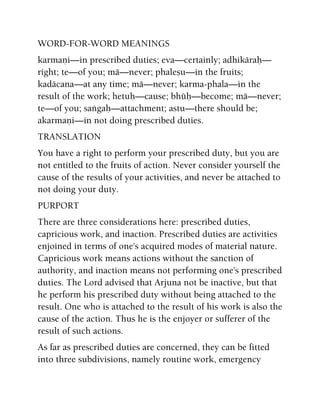
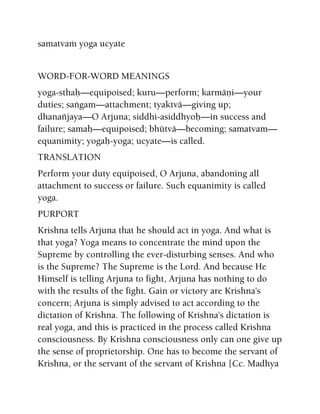
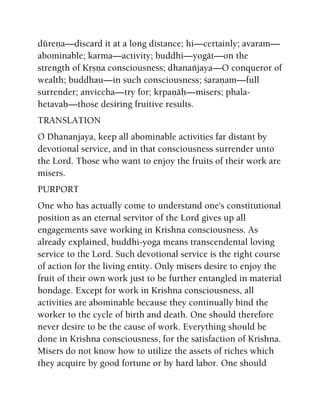
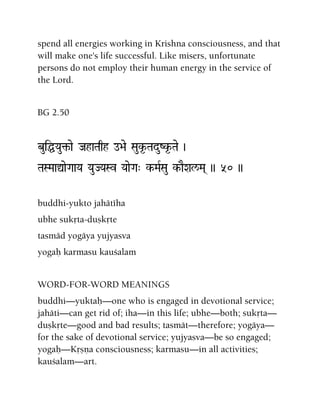
- Chapter 2 -
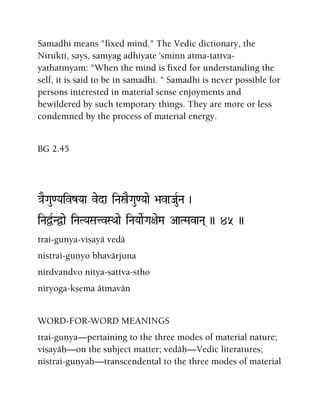
Contents of the Gita Summarized
Arjuna submits to Lord Kåñëa as His disciple, and Kåñëa
begins His teachings to Arjuna by explaining the fundamental
distinction between the temporary material body and the
eternal spiritual soul. The Lord explains the process of
transmigration, the nature of selfless service to the Supreme
and the characteristics of a self-realized person.
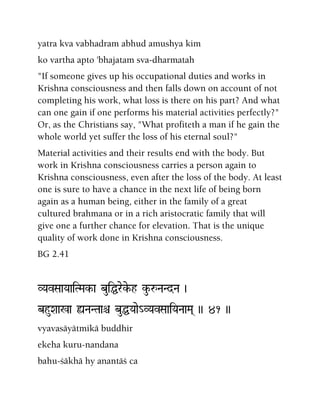
BG 2.1
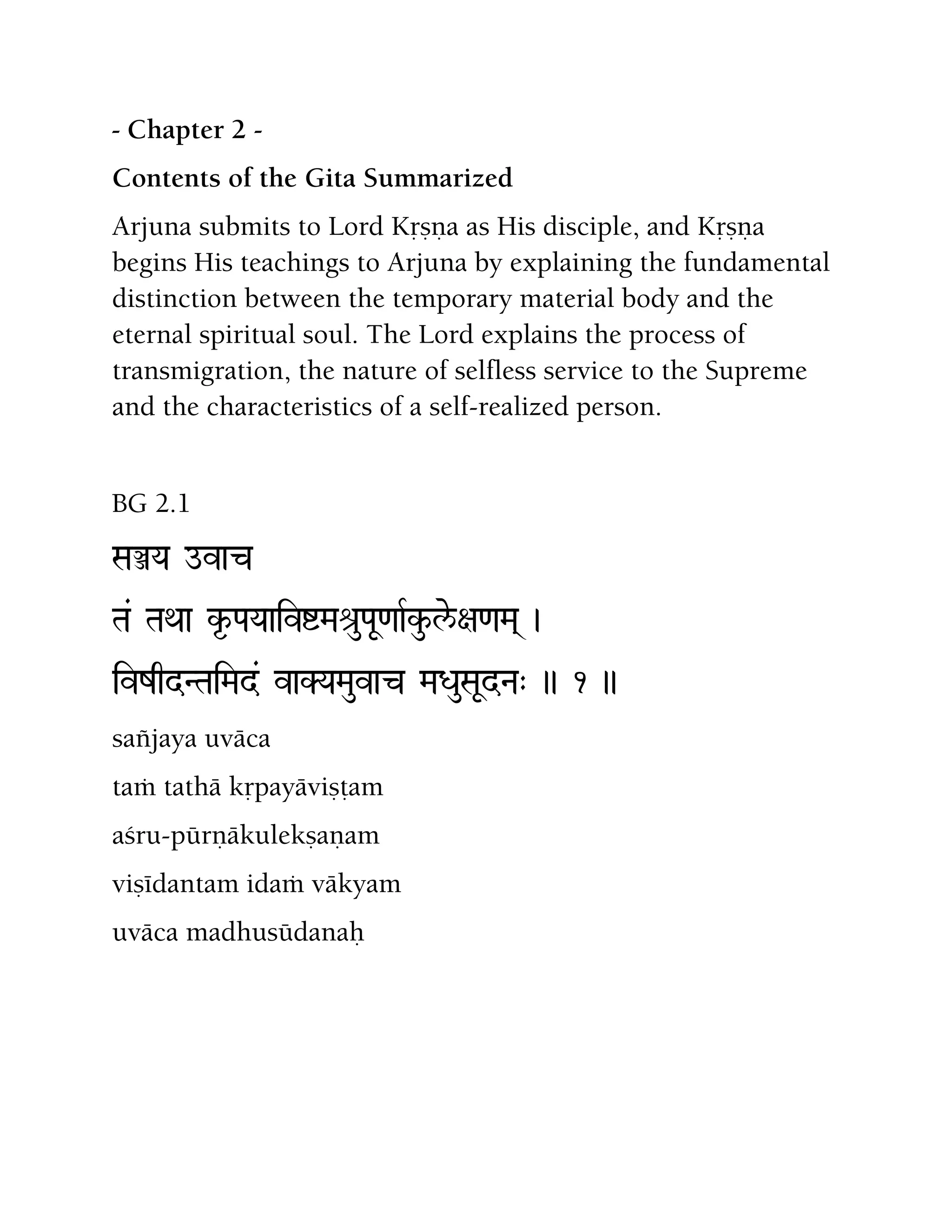
SaÅYa ovac
Ta& TaQaa k*-PaYaaivíMaé[uPaU<aaRku-le/+a<aMa( )
ivzqdNTaiMad& vaKYaMauvac MaDauSaUdNa" )) 1 ))
saïjaya uväca
taà tathä kåpayäviñöam
açru-pürëäkulekñaëam
viñédantam idaà väkyam
uväca madhusüdanaù
WORD-FOR-WORD MEANINGS
saïjayaù uväca—Saïjaya said; tam—unto Arjuna; tathä—
thus; kåpayä—by compassion; äviñöam—overwhelmed; açru-
pürëa-äkula—full of tears; ékñaëam—eyes; viñédantam—
lamenting; idam—these; väkyam—words; uväca—said;
madhu-südanaù—the killer of Madhu.
TRANSLATION
Sanjaya said: Seeing Arjuna full of compassion, his mind
depressed, his eyes full of tears, Madhusudana, Krishna, spoke
the following words.
PURPORT
Material compassion, lamentation and tears are all signs of
ignorance of the real self. Compassion for the eternal soul is
self-realization. The word "Madhusudana" is significant in
this verse. Lord Krishna killed the demon Madhu, and now
Arjuna wanted Krishna to kill the demon of misunderstanding
that had overtaken him in the discharge of his duty. No one
knows where compassion should be applied. Compassion for
the dress of a drowning man is senseless. A man fallen in the
ocean of nescience cannot be saved simply by rescuing his
outward dress—the gross material body. One who does not
know this and laments for the outward dress is called a sudra,
or one who laments unnecessarily. Arjuna was a kshatriya,
and this conduct was not expected from him. Lord Krishna,
however, can dissipate the lamentation of the ignorant man,
and for this purpose the Bhagavad-gita was sung by Him. This
chapter instructs us in self-realization by an analytical study of
the material body and the spirit soul, as explained by the
supreme authority, Lord Sri Krishna. This realization is
possible when one works without attachment to fruitive
results and is situated in the fixed conception of the real self.
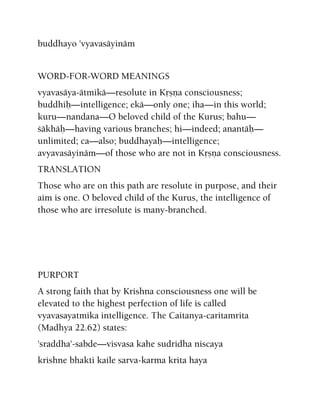
BG 2.2
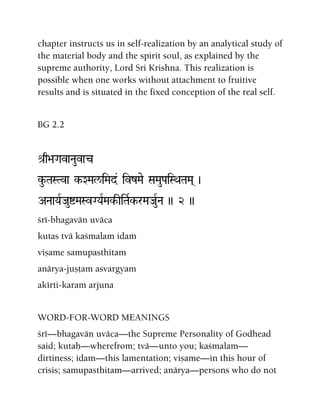
é[q>aGavaNauvac
ku-TaSTva k-XMal/iMad& ivzMae SaMauPaiSQaTaMa( )
ANaaYaRJauíMaSvGYaRMak-IiTaRk-rMaJauRNa )) 2 ))
çré-bhagavän uväca
kutas tvä kaçmalam idaà
viñame samupasthitam
anärya-juñöam asvargyam
akérti-karam arjuna
WORD-FOR-WORD MEANINGS
çré—bhagavän uväca—the Supreme Personality of Godhead
said; kutaù—wherefrom; tvä—unto you; kaçmalam—
dirtiness; idam—this lamentation; viñame—in this hour of
crisis; samupasthitam—arrived; anärya—persons who do not
know the value of life; juñöam—practiced by; asvargyam—
which does not lead to higher planets; akérti—infamy;
karam—the cause of; arjuna—O Arjuna.
TRANSLATION
The Supreme Personality of Godhead said: My dear Arjuna,
how have these impurities come upon you? They are not at all
befitting a man who knows the value of life. They lead not to
higher planets but to infamy.
PURPORT
Krishna and the Supreme Personality of Godhead are
identical. Therefore Lord Krishna is referred to as Bhagavan
throughout the Gita. Bhagavan is the ultimate in the Absolute
Truth. Absolute Truth is realized in three phases of
understanding, namely Brahman, or the impersonal all-
pervasive spirit; Paramatma, or the localized aspect of the
Supreme within the heart of all living entities; and Bhagavan,
or the Supreme Personality of Godhead, Lord Krishna. In the
Srimad-Bhagavatam (1.2.11) this conception of the Absolute
Truth is explained thus:
vadanti tat tattva-vidas
tattvam yaj jnanam advayam
brahmeti paramatmeti
bhagavan iti sabdyate
"The Absolute Truth is realized in three phases of
understanding by the knower of the Absolute Truth, and all of
them are identical. Such phases of the Absolute Truth are
expressed as Brahman, Paramatma, and Bhagavan."
These three divine aspects can be explained by the example of
the sun, which also has three different aspects, namely the
sunshine, the sun's surface and the sun planet itself. One who
studies the sunshine only is the preliminary student. One who
understands the sun's surface is further advanced. And one
who can enter into the sun planet is the highest. Ordinary
students who are satisfied by simply understanding the
sunshine—its universal pervasiveness and the glaring
effulgence of its impersonal nature—may be compared to
those who can realize only the Brahman feature of the
Absolute Truth. The student who has advanced still further
can know the sun disc, which is compared to knowledge of
the Paramatma feature of the Absolute Truth. And the student
who can enter into the heart of the sun planet is compared to
those who realize the personal features of the Supreme
Absolute Truth. Therefore, the bhaktas, or the
transcendentalists who have realized the Bhagavan feature of
the Absolute Truth, are the topmost transcendentalists,
although all students who are engaged in the study of the
Absolute Truth are engaged in the same subject matter. The
sunshine, the sun disc and the inner affairs of the sun planet
cannot be separated from one another, and yet the students of
the three different phases are not in the same category.
The Sanskrit word bhagavan is explained by the great
authority Parasara Muni, the father of Vyasadeva. The
Supreme Personality who possesses all riches, all strength, all
fame, all beauty, all knowledge and all renunciation is called
Bhagavan. There are many persons who are very rich, very
powerful, very beautiful, very famous, very learned, and very
much detached, but no one can claim that he possesses all
riches, all strength, etc., entirely. Only Krishna can claim this
because He is the Supreme Personality of Godhead. No living
entity, including Brahma, Lord Siva, or Narayana, can possess
opulences as fully as Krishna. Therefore it is concluded in the
Brahma-samhita by Lord Brahma himself that Lord Krishna is
the Supreme Personality of Godhead. No one is equal to or
above Him. He is the primeval Lord, or Bhagavan, known as
Govinda, and He is the supreme cause of all causes:
isvarah paramah krishnah
sac-cid-ananda-vigrahah
anadir adir govindah
sarva-karana-karanam
"There are many personalities possessing the qualities of
Bhagavan, but Krishna is the supreme because none can excel
Him. He is the Supreme Person, and His body is eternal, full
of knowledge and bliss. He is the primeval Lord Govinda and
the cause of all causes." (Brahma-samhita 5.1)
In the Bhagavatam also there is a list of many incarnations of
the Supreme Personality of Godhead, but Krishna is described
as the original Personality of Godhead, from whom many,
many incarnations and Personalities of Godhead expand:
ete camsa-kalah pumsah
krishnas tu bhagavan svayam
indrari-vyakulam lokam
mridayanti yuge yuge
"All the lists of the incarnations of Godhead submitted
herewith are either plenary expansions or parts of the plenary
expansions of the Supreme Godhead, but Krishna is the
Supreme Personality of Godhead Himself." (SB 1.3.28)
Therefore, Krishna is the original Supreme Personality of
Godhead, the Absolute Truth, the source of both the
Supersoul and the impersonal Brahman.
In the presence of the Supreme Personality of Godhead,
Arjuna's lamentation for his kinsmen is certainly unbecoming,
and therefore Krishna expressed His surprise with the word
kutah, "wherefrom." Such impurities were never expected
from a person belonging to the civilized class of men known
as Aryans. The word Aryan is applicable to persons who know
the value of life and have a civilization based on spiritual
realization. Persons who are led by the material conception of
life do not know that the aim of life is realization of the
Absolute Truth, Vishnu, or Bhagavan, and they are captivated
by the external features of the material world, and therefore
they do not know what liberation is. Persons who have no
knowledge of liberation from material bondage are called non-
Aryans. Although Arjuna was a kshatriya, he was deviating
from his prescribed duties by declining to fight. This act of
cowardice is described as befitting the non-Aryans. Such
deviation from duty does not help one in the progress of
spiritual life, nor does it even give one the opportunity to
become famous in this world. Lord Krishna did not approve of
the so-called compassion of Arjuna for his kinsmen.
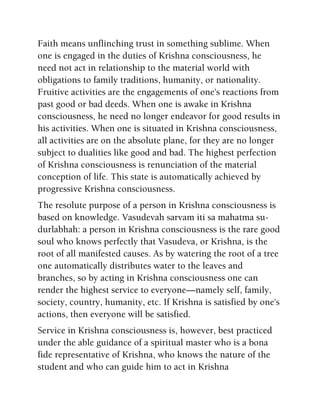
BG 2.3
(c)E-BYa& Maa SMa GaMa" PaaQaR NaETatvYYauPaPaÛTae )
+aud]& ôdYadaEbRLYa& TYa¤-aeitaï ParNTaPa )) 3 ))
klaibyaà mä sma gamaù pärtha
naitat tvayy upapadyate
kñudraà hådaya-daurbalyaà
tyaktvottiñöha parantapa
WORD-FOR-WORD MEANINGS
klaibyam—impotence; mä sma—do not; gamaù—take to;
pärtha—O son of Påthä; na—never; etat—this; tvayi—unto
you; upapadyate—is befitting; kñudram—petty; hådaya—of
the heart; daurbalyam—weakness; tyaktvä—giving up;
uttiñöha—get up; param—tapa—O chastiser of the enemies.
TRANSLATION
O son of Pritha, do not yield to this degrading impotence. It
does not become you. Give up such petty weakness of heart
and arise, O chastiser of the enemy.
PURPORT
Arjuna was addressed as the son of Pritha, who happened to
be the sister of Krishna's father Vasudeva. Therefore Arjuna
had a blood relationship with Krishna. If the son of a
kshatriya declines to fight, he is a kshatriya in name only, and
if the son of a brahmana acts impiously, he is a brahmana in
name only. Such kshatriyas and brahmanas are unworthy sons
of their fathers; therefore, Krishna did not want Arjuna to
become an unworthy son of a kshatriya. Arjuna was the most
intimate friend of Krishna, and Krishna was directly guiding
him on the chariot; but in spite of all these credits, if Arjuna
abandoned the battle he would be committing an infamous
act. Therefore Krishna said that such an attitude in Arjuna did
not fit his personality. Arjuna might argue that he would give
up the battle on the grounds of his magnanimous attitude for
the most respectable Bhishma and his relatives, but Krishna
considered that sort of magnanimity mere weakness of heart.
Such false magnanimity was not approved by any authority.
Therefore, such magnanimity or so-called nonviolence should
be given up by persons like Arjuna under the direct guidance
of Krishna.
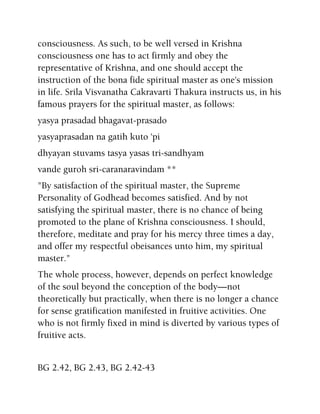
BG 2.4
AJauRNa ovac
k-Qa& >aqZMaMah& Sa&:Yae d]ae<a& c MaDauSaUdNa )
wzui>a" Pa[iTaYaaeTSYaaiMa PaUJaahaRvirSaUdNa )) 4 ))
arjuna uväca
kathaà bhéñmam ahaà saìkhye
droëaà ca madhusüdana
iñubhiù pratiyotsyämi
püjärhäv ari-südana
WORD-FOR-WORD MEANINGS
arjunaù uväca—Arjuna said; katham—how; bhéñmam—
Bhéñma; aham—I; saìkhye—in the fight; droëam—Droëa;
ca—also; madhu—südana—O killer of Madhu; iñubhiù—with
arrows; pratiyotsyämi—shall counterattack; püjä-arhau—
those who are worshipable; ari—südana—O killer of the
enemies.
TRANSLATION
Arjuna said: O killer of enemies, O killer of Madhu, how can I
counterattack with arrows in battle men like Bhishma and
Drona, who are worthy of my worship?
PURPORT
Respectable superiors like Bhishma the grandfather and
Dronacarya the teacher are always worshipable. Even if they
attack, they should not be counterattacked. It is general
etiquette that superiors are not to be offered even a verbal
fight. Even if they are sometimes harsh in behavior, they
should not be harshly treated. Then, how is it possible for
Arjuna to counterattack them? Would Krishna ever attack His
own grandfather, Ugrasena, or His teacher, Sandipani Muni?
These were some of the arguments offered by Arjuna to
Krishna.
BG 2.5
GauæNahTva ih MahaNau>aavaNa(
é[eYaae >aae¢u-& >aE+YaMaPaqh l/aeke- )
hTvaQaRk-aMaa&STau GauæiNahEv
>auÅqYa >aaeGaaNåiDarPa[idGDaaNa( )) 5 ))
gurün ahatvä hi mahänubhävän
çreyo bhoktuà bhaikñyam apéha loke
hatvärtha-kämäàs tu gurün ihaiva
bhuïjéya bhogän rudhira-pradigdhän
WORD-FOR-WORD MEANINGS
gurün—the superiors; ahatvä—not killing; hi—certainly;
mahä—anubhävän—great souls; çreyaù—it is better;
bhoktum—to enjoy life; bhaikñyam—by begging; api—even;
iha—in this life; loke—in this world; hatvä—killing; artha—
gain; kämän—desiring; tu—but; gurün—superiors; iha—in
this world; eva—certainly; bhuïjéya—one has to enjoy;
bhogän—enjoyable things; rudhira—blood; pradigdhän—
tainted with.
TRANSLATION
It would be better to live in this world by begging than to live
at the cost of the lives of great souls who are my teachers.
Even though desiring worldly gain, they are superiors. If they
are killed, everything we enjoy will be tainted with blood.
PURPORT
According to scriptural codes, a teacher who engages in an
abominable action and has lost his sense of discrimination is
fit to be abandoned. Bhishma and Drona were obliged to take
the side of Duryodhana because of his financial assistance,
although they should not have accepted such a position
simply on financial considerations. Under the circumstances,
they have lost the respectability of teachers. But Arjuna thinks
that nevertheless they remain his superiors, and therefore to
enjoy material profits after killing them would mean to enjoy
spoils tainted with blood.
BG 2.6
Na cETaiÜÚ" k-Taràae GarqYaae
YaÜa JaYaeMa Yaid va Naae JaYaeYau" )
YaaNaev hTva Na iJaJaqivzaMa‚
STae_viSQaTaa" Pa[Mau%e DaaTaRraía" )) 6 ))
na caitad vidmaù kataran no garéyo
yad vä jayema yadi vä no jayeyuù
yän eva hatvä na jijéviñämas
te 'vasthitäù pramukhe dhärtaräñöräù
WORD-FOR-WORD MEANINGS
na—nor; ca—also; etat—this; vidmaù—do we know;
katarat—which; naù—for us; garéyaù—better; yat vä—
whether; jayema—we may conquer; yadi—if; vä—or; naù—
us; jayeyuù—they conquer; yän—those who; eva—certainly;
hatvä—by killing; na—never; jijéviñämaù—we would want to
live; te—all of them; avasthitäù—are situated; pramukhe—in
the front; dhärtaräñöräù—the sons of Dhåtaräñöra.
TRANSLATION
Nor do we know which is better—conquering them or being
conquered by them. If we killed the sons of Dhritarashtra, we
should not care to live. Yet they are now standing before us on
the battlefield.
PURPORT
Arjuna did not know whether he should fight and risk
unnecessary violence, although fighting is the duty of the
kshatriyas, or whether he should refrain and live by begging.
If he did not conquer the enemy, begging would be his only
means of subsistence. Nor was there certainty of victory,
because either side might emerge victorious. Even if victory
awaited them (and their cause was justified), still, if the sons
of Dhritarashtra died in battle, it would be very difficult to live
in their absence. Under the circumstances, that would be
another kind of defeat for them. All these considerations by
Arjuna definitely proved that not only was he a great devotee
of the Lord but he was also highly enlightened and had
complete control over his mind and senses. His desire to live
by begging, although he was born in the royal household, is
another sign of detachment. He was truly virtuous, as these
qualities, combined with his faith in the words of instruction
of Sri Krishna (his spiritual master), indicate. It is concluded
that Arjuna was quite fit for liberation. Unless the senses are
controlled, there is no chance of elevation to the platform of
knowledge, and without knowledge and devotion there is no
chance of liberation. Arjuna was competent in all these
attributes, over and above his enormous attributes in his
material relationships.
BG 2.7
k-aPaR<YadaezaePahTaSv>aav"
Pa*C^aiMa Tva& DaMaRSaMMaU!ceTaa" )
YaC^eYa" SYaaiàiêTa& b]Uih TaNMae
iXaZYaSTae_h& XaaiDa Maa& Tva& Pa[PaàMa( )) 7 ))
kärpaëya-doñopahata-svabhävaù
påcchämi tväà dharma-sammüòha-cetäù
yac chreyaù syän niçcitaà brühi tan me
çiñyas te 'haà çädhi mäà tväà prapannam
WORD-FOR-WORD MEANINGS
kärpaëya—of miserliness; doña—by the weakness; upahata—
being afflicted; sva-bhävaù—characteristics; påcchämi—I am
asking; tväm—unto You; dharma—religion; sammüòha—
bewildered; cetäù—in heart; yat—what; çreyaù—all-good;
syät—may be; niçcitam—confidently; brühi—tell; tat—that;
me—unto me; çiñyaù—disciple; te—Your; aham—I am;
çädhi—just instruct; mäm—me; tväm—unto You;
prapannam—surrendered.
TRANSLATION
Now I am confused about my duty and have lost all
composure because of miserly weakness. In this condition I
am asking You to tell me for certain what is best for me. Now
I am Your disciple, and a soul surrendered unto You. Please
instruct me.
PURPORT
By nature's own way the complete system of material activities
is a source of perplexity for everyone. In every step there is
perplexity, and therefore it behooves one to approach a bona
fide spiritual master who can give one proper guidance for
executing the purpose of life. All Vedic literatures advise us to
approach a bona fide spiritual master to get free from the
perplexities of life, which happen without our desire. They are
like a forest fire that somehow blazes without being set by
anyone. Similarly, the world situation is such' that perplexities
of life automatically appear, without our wanting such
confusion. No one wants fire, and yet it takes place, and we
become perplexed. The Vedic wisdom therefore advises that
in order to solve the perplexities of life and to understand the
science of the solution, one must approach a spiritual master
who is in the disciplic succession. A person with a bona fide
spiritual master is supposed to know everything. One should
not, therefore, remain in material perplexities but should
approach a spiritual master. This is the purport of this verse.
Who is the man in material perplexities? It is he who does not
understand the problems of life. In the Brihad-aranyaka
Upanishad (3.8.10) the perplexed man is described as follows:
yo va etad aksharam gargy aviditvasmal lokat praiti sa
kripanah. "He is a miserly man who does not solve the
problems of life as a human and who thus quits this world
like the cats and dogs, without understanding the science of
self-realization." This human form of life is a most valuable
asset for the living entity who can utilize it for solving the
problems of life; therefore, one who does not utilize this
opportunity properly is a miser. On the other hand, there is
the brahmana, or he who is intelligent enough to utilize this
body to solve all the problems of life. Ya etad aksharam gargi
viditvasmal lokat praiti sa brahmanah.
The kripanas, or miserly persons, waste their time in being
overly affectionate for family, society, country, etc., in the
material conception of life. One is often attached to family life,
namely to wife, children and other members, on the basis of
"skin disease." The kripana thinks that he is able to protect
his family members from death; or the kripana thinks that his
family or society can save him from the verge of death. Such
family attachment can be found even in the lower animals,
who take care of children also. Being intelligent, Arjuna could
understand that his affection for family members and his wish
to protect them from death were the causes of his perplexities.
Although he could understand that his duty to fight was
awaiting him, still, on account of miserly weakness, he could
not discharge the duties. He is therefore asking Lord Krishna,
the supreme spiritual master, to make a definite solution. He
offers himself to Krishna as a disciple. He wants to stop
friendly talks. Talks between the master and the disciple are
serious, and now Arjuna wants to talk very seriously before
the recognized spiritual master. Krishna is therefore the
original spiritual master of the science of Bhagavad-gita, and
Arjuna is the first disciple for understanding the Gita. How
Arjuna understands the Bhagavad-gita is stated in the Gita
itself. And yet foolish mundane scholars explain that one need
not submit to Krishna as a person, but to "the unborn within
Krishna." There is no difference between Krishna's within and
without. And one who has no sense of this understanding is
the greatest fool in trying to understand Bhagavad-gita.
BG 2.8
Na ih Pa[PaXYaaiMa MaMaaPaNauÛa‚
ÛC^aek-MauC^aez<aiMaiNd]Yaa<aaMa( )
AvaPYa >aUMaavSaPaÒMa*Ö&
raJYa& Saura<aaMaiPa caiDaPaTYaMa( )) 8 ))
na hi prapaçyämi mamäpanudyäd
yac chokam ucchoñaëam indriyäëäm
aväpya bhümäv asapatnam åddhaà
räjyaà suräëäm api cädhipatyam
WORD-FOR-WORD MEANINGS
na—do not; hi—certainly; prapaçyämi—I see; mama—my;
apanudyät—can drive away; yat—that which; çokam—
lamentation; ucchoñaëam—drying up; indriyäëäm—of the
senses; aväpya—achieving; bhümau—on the earth;
asapatnam—without rival; åddham—prosperous; räjyam—
kingdom; suräëäm—of the demigods; api—even; ca—also;
ädhipatyam—supremacy.
TRANSLATION
I can find no means to drive away this grief which is drying up
my senses. I will not be able to dispel it even if I win a
prosperous, unrivaled kingdom on earth with sovereignty like
that of the demigods in heaven.
PURPORT
Although Arjuna was putting forward so many arguments
based on knowledge of the principles of religion and moral
codes, it appears that he was unable to solve his real problem
without the help of the spiritual master, Lord Sri Krishna. He
could understand that his so-called knowledge was useless in
driving away his problems, which were drying up his whole
existence; and it was impossible for him to solve such
perplexities without the help of a spiritual master like Lord
Krishna. Academic knowledge, scholarship, high position,
etc., are all useless in solving the problems of life; help can be
given only by a spiritual master like Krishna. Therefore, the
conclusion is that a spiritual master who is one hundred
percent Krishna conscious is the bona fide spiritual master,
for he can solve the problems of life. Lord Caitanya said that
one who is master in the science of Krishna consciousness,
regardless of his social position, is the real spiritual master.
kiba vipra, kiba nyasi, sudra kene naya
yei krishna-tattva-vetta, sei 'guru' haya
"It does not matter whether a person is a vipra [learned
scholar in Vedic wisdom] or is born in a lower family, or is in
the renounced order of life-if he is master in the science of
Krishna, he is the perfect and bona fide spiritual master."
(Caitanya-caritamrita, Madhya 8.128) So without being a
master in the science of Krishna consciousness, no one is a
bona fide spiritual master. It is also said in Vedic literature:
shat-karma-nipuno vipro
mantra-tantra-visaradah
avaishnavo gurur na syad
vaishnavah sva-paco guruh
"A scholarly brahmana, expert in all subjects of Vedic
knowledge, is unfit to become a spiritual master without being
a Vaishnava, or expert in the science of Krishna
consciousness. But a person born in a family of a lower caste
can become a spiritual master if he is a Vaishnava, or Krishna
conscious." (Padma Purana)
The problems of material existence—birth, old age, disease
and death—cannot be counteracted by accumulation of
wealth and economic development. In many parts of the
world there are states which are replete with all facilities of
life, which are full of wealth and economically developed, yet
the problems of material existence are still present. They are
seeking peace in different ways, but they can achieve real
happiness only if they consult Krishna, or the Bhagavad-gita
and Srimad-Bhagavatam—which constitute the science of
Krishna—through the bona fide representative of Krishna, the
man in Krishna consciousness.
If economic development and material comforts could drive
away one's lamentations for family, social, national or
international inebrieties, then Arjuna would not have said that
even an unrivaled kingdom on earth or supremacy like that of
the demigods in the heavenly planets would be unable to
drive away his lamentations. He sought, therefore, refuge in
Krishna consciousness, and that is the right path for peace
and harmony. Economic development or supremacy over the
world can be finished at any moment by the cataclysms of
material nature. Even elevation into a higher planetary
situation, as men are now seeking on the moon planet, can
also be finished at one stroke. The Bhagavad-gita confirms
this: kshine punye martya-lokam visanti. "When the results of
pious activities are finished, one falls down again from the
peak of happiness to the lowest status of life." Many
politicians of the world have fallen down in that way. Such
downfalls only constitute more causes for lamentation.
Therefore, if we want to curb lamentation for good, then we
have to take shelter of Krishna, as Arjuna is seeking to do. So
Arjuna asked Krishna to solve his problem definitely, and that
is the way of Krishna consciousness.
BG 2.9
SaÅYa ovac
WvMau¤-a ôzqke-Xa& Gau@ake-Xa" ParNTaPa" )
Na YaaeTSYa wiTa GaaeivNdMau¤-a TaUZ<aq& b>aUv h )) 9 ))
saïjaya uväca
evam uktvä håñékeçaà
guòäkeçaù parantapaù
na yotsya iti govindam
uktvä tüñëéà babhüva ha
WORD-FOR-WORD MEANINGS
saïjayaù uväca—Saïjaya said; evam—thus; uktvä—speaking;
håñékeçam—unto Kåñëa, the master of the senses;
guòäkeçaù—Arjuna, the master of curbing ignorance;
parantapaù—the chastiser of the enemies; na yotsye—I shall
not fight; iti—thus; govindam—unto Kåñëa, the giver of
pleasure to the senses; uktvä—saying; tüñëém—silent;
babhüva—became; ha—certainly.
TRANSLATION
Sanjaya said: Having spoken thus, Arjuna, chastiser of
enemies, told Krishna, "Govinda, I shall not fight," and fell
silent.
PURPORT
Dhritarashtra must have been very glad to understand that
Arjuna was not going to fight and was instead leaving the
battlefield for the begging profession. But Sanjaya
disappointed him again in relating that Arjuna was competent
to kill his enemies (parantapah). Although Arjuna was, for the
time being, overwhelmed with false grief due to family
affection, he surrendered unto Krishna, the supreme spiritual
master, as a disciple. This indicated that he would soon be
free from the false lamentation resulting from family affection
and would be enlightened with perfect knowledge of self-
realization, or Krishna consciousness, and would then surely
fight. Thus Dhritarashtra's joy would be frustrated, since
Arjuna would be enlightened by Krishna and would fight to
the end.
BG 2.10
TaMauvac ôzqke-Xa" Pa[hSaiàv >aarTa
SaeNaYaaeå>aYaaeMaRDYae ivzqdNTaiMad& vc" )) 10 ))
tam uväca håñékeçaù
prahasann iva bhärata
senayor ubhayor madhye
viñédantam idaà vacaù
WORD-FOR-WORD MEANINGS
tam—unto him; uväca—said; håñékeçaù—the master of the
senses, Kåñëa; prahasan—smiling; iva—like that; bhärata—O
Dhåtaräñöra, descendant of Bharata; senayoù—of the armies;
ubhayoù—of both parties; madhye—between; viñédantam—
unto the lamenting one; idam—the following; vacaù—words.
TRANSLATION
O descendant of Bharata, at that time Krishna, smiling, in the
midst of both the armies, spoke the following words to the
grief-stricken Arjuna.
PURPORT
The talk was going on between intimate friends, namely the
Hrishikesa and the Gudakesa. As friends, both of them were
on the same level, but one of them voluntarily became a
student of the other. Krishna was smiling because a friend had
chosen to become a disciple. As Lord of all, He is always in
the superior position as the master of everyone, and yet the
Lord agrees to be a friend, a son, or a lover for a devotee who
wants Him in such a role. But when He was accepted as the
master, He at once assumed the role and talked with the
disciple like the master—with gravity, as it is required. It
appears that the talk between the master and the disciple was
openly exchanged in the presence of both armies so that all
were benefited. So the talks of Bhagavad-gita are not for any
particular person, society, or community, but they are for all,
and friends or enemies are equally entitled to hear them.
BG 2.11
é[q>aGavaNauvac
AXaaeCYaaNaNvXaaecSTv& Pa[javada&ê >aazSae )
GaTaaSaUNaGaTaaSaU&ê NaaNauXaaeciNTa Pai<@Taa" )) 11 ))
çré-bhagavän uväca
açocyän anvaçocas tvaà
prajïä-vädäàç ca bhäñase
gatäsün agatäsüàç ca
nänuçocanti paëòitäù
WORD-FOR-WORD MEANINGS
çré—bhagavän uväca—the Supreme Personality of Godhead
said; açocyän—not worthy of lamentation; anvaçocaù—you
are lamenting; tvam—you; prajïä—vädän—learned talks;
ca—also; bhäñase—speaking; gata—lost; asün—life; agata—
not passed; asün—life; ca—also; na—never; anuçocanti—
lament; paëòitäù—the learned.
TRANSLATION
The Supreme Personality of Godhead said: While speaking
learned words, you are mourning for what is not worthy of
grief. Those who are wise lament neither for the living nor for
the dead.
PURPORT
The Lord at once took the position of the teacher and
chastised the student, calling him, indirectly, a fool. The Lord
said, "You are talking like a learned man, but you do not
know that one who is learned—one who knows what is body
and what is soul—does not lament for any stage of the body,
neither in the living nor in the dead condition." As explained
in later chapters, it will be clear that knowledge means to
know matter and spirit and the controller of both. Arjuna
argued that religious principles should be given more
importance than politics or sociology, but he did not know
that knowledge of matter, soul and the Supreme is even more
important than religious formularies. And because he was
lacking in that knowledge, he should not have posed himself
as a very learned man. As he did not happen to be a very
learned man, he was consequently lamenting for something
which was unworthy of lamentation. The body is born and is
destined to be vanquished today or tomorrow; therefore the
body is not as important as the soul. One who knows this is
actually learned, and for him there is no cause for
lamentation, regardless of the condition of the material body.
BG 2.12
NaTvevah& JaaTau NaaSa& Na Tv& NaeMae JaNaaiDaPaa" )
Na cEv Na>aivZYaaMa" SaveR vYaMaTa" ParMa( )) 12 ))
na tv evähaà jätu näsaà
na tvaà neme janädhipäù
na caiva na bhaviñyämaù
sarve vayam ataù param
WORD-FOR-WORD MEANINGS
na—never; tu—but; eva—certainly; aham—I; jätu—at any
time; na—did not; äsam—exist; na—not; tvam—you; na—
not; ime—all these; jana-adhipäù—kings; na—never; ca—
also; eva—certainly; na—not; bhaviñyämaù—shall exist; sarve
vayam—all of us; ataù param—hereafter.
TRANSLATION
Never was there a time when I did not exist, nor you, nor all
these kings; nor in the future shall any of us cease to be.
PURPORT
In the Vedas—in the Katha Upanishad as well as in the
Svetasvatara Upanishad—it is said that the Supreme
Personality of Godhead is the maintainer of innumerable
living entities, in terms of their different situations according
to individual work and reaction of work. That Supreme
Personality of Godhead is also, by His plenary portions, alive
in the heart of every living entity. Only saintly persons who
can see, within and without, the same Supreme Lord can
actually attain to perfect and eternal peace.
nityo nityanam cetanas cetananam
eko bahunam yo vidadhati kaman
tam atma-stham ye 'nupasyanti dhiras
tesham santih sasvati netaresham
(Katha Upanishad 2.2.13)
The same Vedic truth given to Arjuna is given to all persons in
the world who pose themselves as very learned but factually
have but a poor fund of knowledge. The Lord says clearly that
He Himself, Arjuna and all the kings who are assembled on
the battlefield are eternally individual beings and that the
Lord is eternally the maintainer of the individual living
entities both in their conditioned and in their liberated
situations. The Supreme Personality of Godhead is the
supreme individual person, and Arjuna, the Lord's eternal
associate, and all the kings assembled there are individual
eternal persons. It is not that they did not exist as individuals
in the past, and it is not that they will not remain eternal
persons. Their individuality existed in the past, and their
individuality will continue in the future without interruption.
Therefore, there is no cause for lamentation for anyone.
The Mayavadi theory that after liberation the individual soul,
separated by the covering of maya, or illusion, will merge into
the impersonal Brahman and lose its individual existence is
not supported herein by Lord Krishna, the supreme authority.
Nor is the theory that we only think of individuality in the
conditioned state supported herein. Krishna clearly says
herein that in the future also the individuality of the Lord and
others, as it is confirmed in the Upanishads, will continue
eternally. This statement of Krishna's is authoritative because
Krishna cannot be subject to illusion. If individuality were not
a fact, then Krishna would not have stressed it so much-even
for the future. The Mayavadi may argue that the individuality
spoken of by Krishna is not spiritual, but material. Even
accepting the argument that the individuality is material, then
how can one distinguish Krishna's individuality? Krishna
affirms His individuality in the past and confirms His
individuality in the future also. He has confirmed His
individuality in many ways, and impersonal Brahman has
been declared to be subordinate to Him. Krishna has
maintained spiritual individuality all along; if He is accepted
as an ordinary conditioned soul in individual consciousness,
then His Bhagavad-gita has no value as authoritative scripture.
A common man with all the four defects of human frailty is
unable to teach that which is worth hearing. The Gita is above
such literature. No mundane book compares with the
Bhagavad-gita. When one accepts Krishna as an ordinary man,
the Gita loses all importance. The Mayavadi argues that the
plurality mentioned in this verse is conventional and that it
refers to the body. But previous to this verse such a bodily
conception is already condemned. After condemning the
bodily conception of the living entities, how was it possible
for Krishna to place a conventional proposition on the body
again? Therefore, individuality is maintained on spiritual
grounds and is thus confirmed by great acaryas like Sri
Ramanuja and others. It is clearly mentioned in many places
in the Gita that this spiritual individuality is understood by
those who are devotees of the Lord. Those who are envious of
Krishna as the Supreme Personality of Godhead have no bona
fide access to the great literature. The nondevotee's approach
to the teachings of the Gita is something like that of a bee
licking on a bottle of honey. One cannot have a taste of honey
unless one opens the bottle. Similarly, the mysticism of the
Bhagavad-gita can be understood only by devotees, and no
one else can taste it, as it is stated in the Fourth Chapter of the
book. Nor can the Gita be touched by persons who envy the
very existence of the Lord. Therefore, the Mayavadi
explanation of the Gita is a most misleading presentation of
the whole truth. Lord Caitanya has forbidden us to read
commentations made by the Mayavadis and warns that one
who takes to such an understanding of the Mayavadi
philosophy loses all power to understand the real mystery of
the Gita. If individuality refers to the empirical universe, then
there is no need of teaching by the Lord. The plurality of the
individual soul and the Lord is an eternal fact, and it is
confirmed by the Vedas as above mentioned.
BG 2.13
deihNaae_iSMaNYaQaa dehe k-aEMaar& YaaEvNa& Jara )
TaQaa dehaNTarPa[aiáDasrSTa}a Na MauùiTa )) 13 ))
dehino 'smin yathä dehe
kaumäraà yauvanaà jarä
tathä dehäntara-präptir
dhéras tatra na muhyati
WORD-FOR-WORD MEANINGS
dehinaù—of the embodied; asmin—in this; yathä—as; dehe—
in the body; kaumäram—boyhood; yauvanam—youth; jarä—
old age; tathä—similarly; deha-antara—of transference of the
body; präptiù—achievement; dhéraù—the sober; tatra—
thereupon; na—never; muhyati—is deluded.
TRANSLATION
As the embodied soul continuously passes, in this body, from
boyhood to youth to old age, the soul similarly passes into
another body at death. A sober person is not bewildered by
such a change.
PURPORT
Since every living entity is an individual soul, each is changing
his body every moment, manifesting sometimes as a child,
sometimes as a youth, and sometimes as an old man. Yet the
same spirit soul is there and does not undergo any change.
This individual soul finally changes the body at death and
transmigrates to another body; and since it is sure to have
another body in the next birth—either material or spiritual—
there was no cause for lamentation by Arjuna on account of
death, neither for Bhishma nor for Drona, for whom he was so
much concerned. Rather, he should rejoice for their changing
bodies from old to new ones, thereby rejuvenating their
energy. Such changes of body account for varieties of
enjoyment or suffering, according to one's work in life. So
Bhishma and Drona, being noble souls, were surely going to
have spiritual bodies in the next life, or at least life in
heavenly bodies for superior enjoyment of material existence.
So, in either case, there was no cause of lamentation.
Any man who has perfect knowledge of the constitution of the
individual soul, the Supersoul, and nature—both material and
spiritual—is called a dhira, or a most sober man. Such a man
is never deluded by the change of bodies.
The Mayavadi theory of oneness of the spirit soul cannot be
entertained, on the ground that the spirit soul cannot be cut
into pieces as a fragmental portion. Such cutting into different
individual souls would make the Supreme cleavable or
changeable, against the principle of the Supreme Soul's being
unchangeable. As confirmed in the Gita, the fragmental
portions of the Supreme exist eternally (sanatana) and are
called kshara; that is, they have a tendency to fall down into
material nature. These fragmental portions are eternally so,
and even after liberation the individual soul remains the
same—fragmental. But once liberated, he lives an eternal life
in bliss and knowledge with the Personality of Godhead. The
theory of reflection can be applied to the Supersoul, who is
present in each and every individual body and is known as the
Paramatma. He is different from the individual living entity.
When the sky is reflected in water, the reflections represent
both the sun and the moon and the stars also. The stars can be
compared to the living entities and the sun or the moon to the
Supreme Lord. The individual fragmental spirit soul is
represented by Arjuna, and the Supreme Soul is the
Personality of Godhead Sri Krishna. They are not on the same
level, as it will be apparent in the beginning of the Fourth
Chapter. If Arjuna is on the same level with Krishna, and
Krishna is not superior to Arjuna, then their relationship of
instructor and instructed becomes meaningless. If both of
them are deluded by the illusory energy (maya), then there is
no need of one being the instructor and the other the
instructed. Such instruction would be useless because, in the
clutches of maya, no one can be an authoritative instructor.
Under the circumstances, it is admitted that Lord Krishna is
the Supreme Lord, superior in position to the living entity,
Arjuna, who is a forgetful soul deluded by maya.
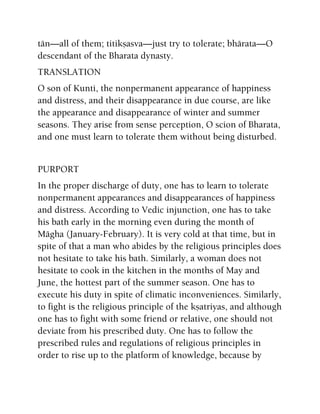
BG 2.14
Maa}aaSPaXaaRSTau k-aENTaeYa XaqTaaeZ<aSau%du"%da" )
AaGaMaaPaaiYaNaae_iNaTYaaSTaa&iSTaiTa+aSv >aarTa )) 14 ))
mäträ-sparçäs tu kaunteya
çétoñëa-sukha-duùkha-däù
ägamäpäyino 'nityäs
täàs titikñasva bhärata
WORD-FOR-WORD MEANINGS
mäträ—sparçäù—sensory perception; tu—only; kaunteya—O
son of Kunté; çéta—winter; uñëa—summer; sukha—
happiness; duùkha—and pain; däù—giving; ägama—
appearing; apäyinaù—disappearing; anityäù—nonpermanent;
tän—all of them; titikñasva—just try to tolerate; bhärata—O
descendant of the Bharata dynasty.
TRANSLATION
O son of Kunti, the nonpermanent appearance of happiness
and distress, and their disappearance in due course, are like
the appearance and disappearance of winter and summer
seasons. They arise from sense perception, O scion of Bharata,
and one must learn to tolerate them without being disturbed.
PURPORT
In the proper discharge of duty, one has to learn to tolerate
nonpermanent appearances and disappearances of happiness
and distress. According to Vedic injunction, one has to take
his bath early in the morning even during the month of
Mägha (January-February). It is very cold at that time, but in
spite of that a man who abides by the religious principles does
not hesitate to take his bath. Similarly, a woman does not
hesitate to cook in the kitchen in the months of May and
June, the hottest part of the summer season. One has to
execute his duty in spite of climatic inconveniences. Similarly,
to fight is the religious principle of the kñatriyas, and although
one has to fight with some friend or relative, one should not
deviate from his prescribed duty. One has to follow the
prescribed rules and regulations of religious principles in
order to rise up to the platform of knowledge, because by
knowledge and devotion only can one liberate himself from
the clutches of mäyä (illusion).
The two different names of address given to Arjuna are also
significant. To address him as Kaunteya signifies his great
blood relations from his mother's side; and to address him as
Bhärata signifies his greatness from his father's side. From
both sides he is supposed to have a great heritage. A great
heritage brings responsibility in the matter of proper
discharge of duties; therefore, he cannot avoid fighting.
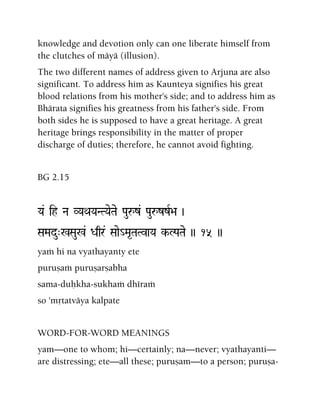
BG 2.15
Ya& ih Na VYaQaYaNTYaeTae Pauåz& PauåzzR>a )
SaMadu"%Sau%& Daqr& Saae_Ma*TaTvaYa k-LPaTae )) 15 ))
yaà hi na vyathayanty ete
puruñaà puruñarñabha
sama-duùkha-sukhaà dhéraà
so 'måtatväya kalpate
WORD-FOR-WORD MEANINGS
yam—one to whom; hi—certainly; na—never; vyathayanti—
are distressing; ete—all these; puruñam—to a person; puruña-
åñabha—O best among men; sama—unaltered; duùkha—in
distress; sukham—and happiness; dhéram—patient; saù—he;
amåtatväya—for liberation; kalpate—is considered eligible.
TRANSLATION
O best among men [Arjuna], the person who is not disturbed
by happiness and distress and is steady in both is certainly
eligible for liberation.
PURPORT
Anyone who is steady in his determination for the advanced
stage of spiritual realization and can equally tolerate the
onslaughts of distress and happiness is certainly a person
eligible for liberation. In the varnasrama institution, the
fourth stage of life, namely the renounced order (sannyasa), is
a painstaking situation. But one who is serious about making
his life perfect surely adopts the sannyasa order of life in spite
of all difficulties. The difficulties usually arise from having to
sever family relationships, to give up the connection of wife
and children. But if anyone is able to tolerate such difficulties,
surely his path to spiritual realization is complete. Similarly,
in Arjuna's discharge of duties as a kshatriya, he is advised to
persevere, even if it is difficult to fight with his family
members or similarly beloved persons. Lord Caitanya took
sannyasa at the age of twenty-four, and His dependents, young
wife as well as old mother, had no one else to look after them.
Yet for a higher cause He took sannyasa and was steady in the
discharge of higher duties. That is the way of achieving
liberation from material bondage.
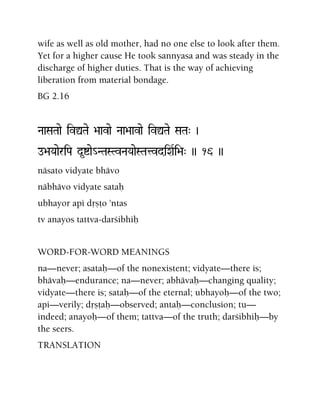
BG 2.16
NaaSaTaae ivÛTae >aavae Naa>aavae ivÛTae SaTa" )
o>aYaaeriPa d*íae_NTaSTvNaYaaeSTatvdiXaRi>a" )) 16 ))
näsato vidyate bhävo
näbhävo vidyate sataù
ubhayor api dåñöo 'ntas
tv anayos tattva-darçibhiù
WORD-FOR-WORD MEANINGS
na—never; asataù—of the nonexistent; vidyate—there is;
bhävaù—endurance; na—never; abhävaù—changing quality;
vidyate—there is; sataù—of the eternal; ubhayoù—of the two;
api—verily; dåñöaù—observed; antaù—conclusion; tu—
indeed; anayoù—of them; tattva—of the truth; darçibhiù—by
the seers.
TRANSLATION
Those who are seers of the truth have concluded that of the
nonexistent [the material body] there is no endurance and of
the eternal [the soul] there is no change. This they have
concluded by studying the nature of both.
PURPORT
There is no endurance of the changing body. That the body is
changing every moment by the actions and reactions of the
different cells is admitted by modern medical science; and
thus growth and old age are taking place in the body. But the
spirit soul exists permanently, remaining the same despite all
changes of the body and the mind. That is the difference
between matter and spirit. By nature, the body is ever
changing, and the soul is eternal. This conclusion is
established by all classes of seers of the truth, both
impersonalist and personalist. In the Vishnu Purana (2.12.38)
it is stated that Vishnu and His abodes all have self-
illuminated spiritual existence (jyotimshi vishnur bhuvanani
vishnuh). The words existent and nonexistent refer only to
spirit and matter. That is the version of all seers of truth.
This is the beginning of the instruction by the Lord to the
living entities who are bewildered by the influence of
ignorance. Removal of ignorance involves the reestablishment
of the eternal relationship between the worshiper and the
worshipable and the consequent understanding of the
difference between the part-and-parcel living entities and the
Supreme Personality of Godhead. One can understand the
nature of the Supreme by thorough study of oneself, the
difference between oneself and the Supreme being understood
as the relationship between the part and the whole. In the
Vedanta-sutras, as well as in the Srimad-Bhagavatam, the
Supreme has been accepted as the origin of all emanations.
Such emanations are experienced by superior and inferior
natural sequences. The living entities belong to the superior
nature, as it will be revealed in the Seventh Chapter. Although
there is no difference between the energy and the energetic,
the energetic is accepted as the Supreme, and energy or nature
is accepted as the subordinate. The living entities, therefore,
are always subordinate to the Supreme Lord, as in the case of
the master and the servant, or the teacher and the taught.
Such clear knowledge is impossible to understand under the
spell of ignorance, and to drive away such ignorance the Lord
teaches the Bhagavad-gita for the enlightenment of all living
entities for all time.
BG 2.17
AivNaaiXa Tau TaiÜiÖ YaeNa SavRiMad& TaTaMa( )
ivNaaXaMaVYaYaSYaaSYa Na k-iêTk-TauRMahRiTa )) 17 ))
avinäçi tu tad viddhi
yena sarvam idaà tatam
vinäçam avyayasyäsya
na kaçcit kartum arhati
WORD-FOR-WORD MEANINGS
avinäçi—imperishable; tu—but; tat—that; viddhi—know it;
yena—by whom; sarvam—all of the body; idam—this;
tatam—pervaded; vinäçam—destruction; avyayasya—of the
imperishable; asya—of it; na kaçcit—no one; kartum—to do;
arhati—is able.
TRANSLATION
That which pervades the entire body you should know to be
indestructible. No one is able to destroy that imperishable
soul.
PURPORT
This verse more clearly explains the real nature of the soul,
which is spread all over the body. Anyone can understand
what is spread all over the body: it is consciousness. Everyone
is conscious of the pains and pleasures of the body in part or
as a whole. This spreading of consciousness is limited within
one's own body. The pains and pleasures of one body are
unknown to another. Therefore, each and every body is the
embodiment of an individual soul, and the symptom of the
soul's presence is perceived as individual consciousness. This
soul is described as one ten-thousandth part of the upper
portion of the hair point in size. The Svetasvatara Upanishad
(5.9) confirms this:
balagra-sata-bhagasya
satadha kalpitasya ca
bhago jivah sa vijneyah
sa canantyaya kalpate
"When the upper point of a hair is divided into one hundred
parts and again each of such parts is further divided into one
hundred parts, each such part is the measurement of the
dimension of the spirit soul." Similarly the same version is
stated:
kesagra-sata-bhagasya
satamsah sadrisatmakah
jivah sukshma-svarupo 'yam
sankhyatito hi cit-kanah
[Cc. Madhya 19.140]
"There are innumerable particles of spiritual atoms, which are
measured as one ten-thousandth of the upper portion of the
hair."
Therefore, the individual particle of spirit soul is a spiritual
atom smaller than the material atoms, and such atoms are
innumerable. This very small spiritual spark is the basic
principle of the material body, and the influence of such a
spiritual spark is spread all over the body as the influence of
the active principle of some medicine spreads throughout the
body. This current of the spirit soul is felt all over the body as
consciousness, and that is the proof of the presence of the
soul. Any layman can understand that the material body
minus consciousness is a dead body, and this consciousness
cannot be revived in the body by any means of material
administration. Therefore, consciousness is not due to any
amount of material combination, but to the spirit soul. In the
Mundaka Upanishad (3.1.9) the measurement of the atomic
spirit soul is further explained:
esho 'nur atma cetasa veditavyo
yasmin pranah pancadha samvivesa
pranais cittam sarvam otam prajanam
yasmin visuddhe vibhavaty esha atma
"The soul is atomic in size and can be perceived by perfect
intelligence. This atomic soul is floating in the five kinds of air
(prana, apana, vyana, samana and udana), is situated within
the heart, and spreads its influence all over the body of the
embodied living entities. When the soul is purified from the
contamination of the five kinds of material air, its spiritual
influence is exhibited."
The hatha-yoga system is meant for controlling the five kinds
of air encircling the pure soul by different kinds of sitting
postures—not for any material profit, but for liberation of the
minute soul from the entanglement of the material
atmosphere.
So the constitution of the atomic soul is admitted in all Vedic
literatures, and it is also actually felt in the practical
experience of any sane man. Only the insane man can think of
this atomic soul as all-pervading vishnu-tattva.
The influence of the atomic soul can be spread all over a
particular body. According to the Mundaka Upanishad, this
atomic soul is situated in the heart of every living entity, and
because the measurement of the atomic soul is beyond the
power of appreciation of the material scientists, some of them
assert foolishly that there is no soul. The individual atomic
soul is definitely there in the heart along with the Supersoul,
and thus all the energies of bodily movement are emanating
from this part of the body. The corpuscles which carry the
oxygen from the lungs gather energy from the soul. When the
soul passes away from this position, the activity of the blood,
generating fusion, ceases. Medical science accepts the
importance of the red corpuscles, but it cannot ascertain that
the source of the energy is the soul. Medical science, however,
does admit that the heart is the seat of all energies of the body.
Such atomic particles of the spirit whole are compared to the
sunshine molecules. In the sunshine there are innumerable
radiant molecules. Similarly, the fragmental parts of the
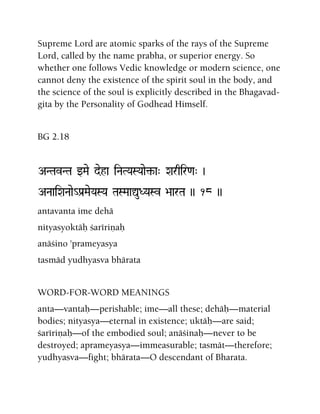
Supreme Lord are atomic sparks of the rays of the Supreme
Lord, called by the name prabha, or superior energy. So
whether one follows Vedic knowledge or modern science, one
cannot deny the existence of the spirit soul in the body, and
the science of the soul is explicitly described in the Bhagavad-
gita by the Personality of Godhead Himself.
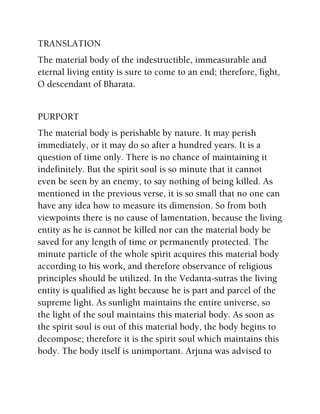
BG 2.18
ANTavNTa wMae deha iNaTYaSYaae¢-a" Xarqir<a" )
ANaaiXaNaae_Pa[MaeYaSYa TaSMaaÛuDYaSv >aarTa )) 18 ))
antavanta ime dehä
nityasyoktäù çarériëaù
anäçino 'prameyasya
tasmäd yudhyasva bhärata
WORD-FOR-WORD MEANINGS
anta—vantaù—perishable; ime—all these; dehäù—material
bodies; nityasya—eternal in existence; uktäù—are said;
çarériëaù—of the embodied soul; anäçinaù—never to be
destroyed; aprameyasya—immeasurable; tasmät—therefore;
yudhyasva—fight; bhärata—O descendant of Bharata.
TRANSLATION
The material body of the indestructible, immeasurable and
eternal living entity is sure to come to an end; therefore, fight,
O descendant of Bharata.
PURPORT
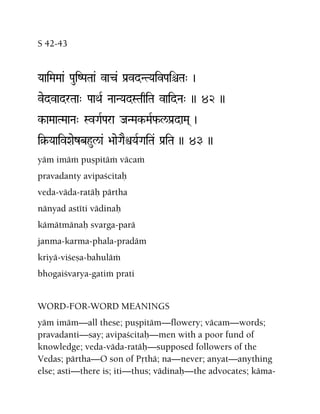
The material body is perishable by nature. It may perish
immediately, or it may do so after a hundred years. It is a
question of time only. There is no chance of maintaining it
indefinitely. But the spirit soul is so minute that it cannot
even be seen by an enemy, to say nothing of being killed. As
mentioned in the previous verse, it is so small that no one can
have any idea how to measure its dimension. So from both
viewpoints there is no cause of lamentation, because the living
entity as he is cannot be killed nor can the material body be
saved for any length of time or permanently protected. The
minute particle of the whole spirit acquires this material body
according to his work, and therefore observance of religious
principles should be utilized. In the Vedanta-sutras the living
entity is qualified as light because he is part and parcel of the
supreme light. As sunlight maintains the entire universe, so
the light of the soul maintains this material body. As soon as
the spirit soul is out of this material body, the body begins to
decompose; therefore it is the spirit soul which maintains this
body. The body itself is unimportant. Arjuna was advised to
fight and not sacrifice the cause of religion for material, bodily
considerations.
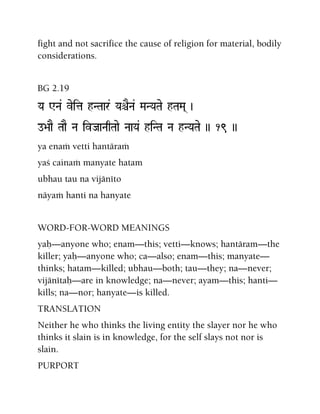
BG 2.19
Ya WNa& veita hNTaar& YaêENa& MaNYaTae hTaMa( )
o>aaE TaaE Na ivJaaNaqTaae NaaYa& hiNTa Na hNYaTae )) 19 ))
ya enaà vetti hantäraà
yaç cainaà manyate hatam
ubhau tau na vijänéto
näyaà hanti na hanyate
WORD-FOR-WORD MEANINGS
yaù—anyone who; enam—this; vetti—knows; hantäram—the
killer; yaù—anyone who; ca—also; enam—this; manyate—
thinks; hatam—killed; ubhau—both; tau—they; na—never;
vijänétaù—are in knowledge; na—never; ayam—this; hanti—
kills; na—nor; hanyate—is killed.
TRANSLATION
Neither he who thinks the living entity the slayer nor he who
thinks it slain is in knowledge, for the self slays not nor is
slain.
PURPORT
When an embodied living entity is hurt by fatal weapons, it is
to be known that the living entity within the body is not
killed. The spirit soul is so small that it is impossible to kill
him by any material weapon, as will be evident from
subsequent verses. Nor is the living entity killable, because of
his spiritual constitution. What is killed, or is supposed to be
killed, is the body only. This, however, does not at all
encourage killing of the body. The Vedic injunction is ma
himsyat sarva bhutani: never commit violence to anyone. Nor
does understanding that the living entity is not killed
encourage animal slaughter. Killing the body of anyone
without authority is abominable and is punishable by the law
of the state as well as by the law of the Lord. Arjuna, however,
is being engaged in killing for the principle of religion, and
not whimsically.
BG 2.20
Na JaaYaTae iMa]YaTae va k-daic‚
àaYa& >aUTva >aivTaa va Na >aUYa" )
AJaae iNaTYa" XaaìTaae_Ya& Paura<aae
Na hNYaTae hNYaMaaNae Xarqre )) 20 ))
na jäyate mriyate vä kadäcin
näyaà bhütvä bhavitä vä na bhüyaù
ajo nityaù çäçvato 'yaà puräëo
na hanyate hanyamäne çarére
WORD-FOR-WORD MEANINGS
na—never; jäyate—takes birth; mriyate—dies; vä—either;
kadäcit—at any time (past, present or future); na—never;
ayam—this; bhütvä—having come into being; bhavitä—will
come to be; vä—or; na—not; bhüyaù—or is again coming to
be; ajaù—unborn; nityaù—eternal; çäçvataù—permanent;
ayam—this; puräëaù—the oldest; na—never; hanyate—is
killed; hanyamäne—being killed; çarére—the body.
TRANSLATION
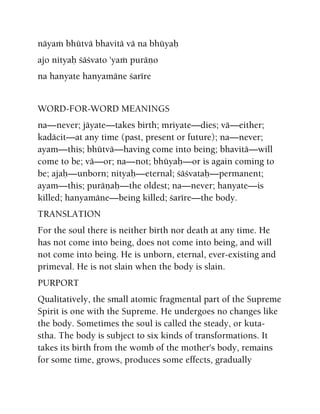
For the soul there is neither birth nor death at any time. He
has not come into being, does not come into being, and will
not come into being. He is unborn, eternal, ever-existing and
primeval. He is not slain when the body is slain.
PURPORT
Qualitatively, the small atomic fragmental part of the Supreme
Spirit is one with the Supreme. He undergoes no changes like
the body. Sometimes the soul is called the steady, or kuta-
stha. The body is subject to six kinds of transformations. It
takes its birth from the womb of the mother's body, remains
for some time, grows, produces some effects, gradually
dwindles, and at last vanishes into oblivion. The soul,
however, does not go through such changes. The soul is not
born, but, because he takes on a material body, the body takes
its birth. The soul does not take birth there, and the soul does
not die. Anything which has birth also has death. And because
the soul has no birth, he therefore has no past, present or
future. He is eternal, ever-existing, and primeval—that is,
there is no trace in history of his coming into being. Under the
impression of the body, we seek the history of birth, etc., of
the soul. The soul does not at any time become old, as the
body does. The so-called old man, therefore, feels himself to
be in the same spirit as in his childhood or youth. The
changes of the body do not affect the soul. The soul does not
deteriorate like a tree, nor anything material. The soul has no
by-product either. The by-products of the body, namely
children, are also different individual souls; and, owing to the
body, they appear as children of a particular man. The body
develops because of the soul's presence, but the soul has
neither offshoots nor change. Therefore, the soul is free from
the six changes of the body.
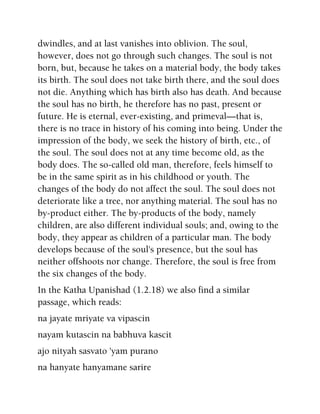
In the Katha Upanishad (1.2.18) we also find a similar
passage, which reads:
na jayate mriyate va vipascin
nayam kutascin na babhuva kascit
ajo nityah sasvato 'yam purano
na hanyate hanyamane sarire
The meaning and purport of this verse is the same as in the
Bhagavad-gita, but here in this verse there is one special word,
vipascit, which means learned or with knowledge.
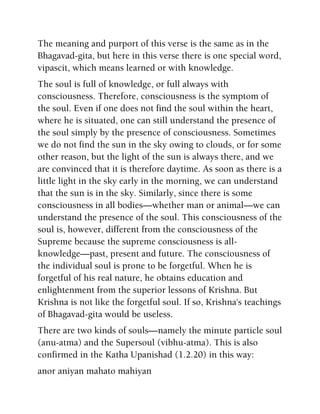
The soul is full of knowledge, or full always with
consciousness. Therefore, consciousness is the symptom of
the soul. Even if one does not find the soul within the heart,
where he is situated, one can still understand the presence of
the soul simply by the presence of consciousness. Sometimes
we do not find the sun in the sky owing to clouds, or for some
other reason, but the light of the sun is always there, and we
are convinced that it is therefore daytime. As soon as there is a
little light in the sky early in the morning, we can understand
that the sun is in the sky. Similarly, since there is some
consciousness in all bodies—whether man or animal—we can
understand the presence of the soul. This consciousness of the
soul is, however, different from the consciousness of the
Supreme because the supreme consciousness is all-
knowledge—past, present and future. The consciousness of
the individual soul is prone to be forgetful. When he is
forgetful of his real nature, he obtains education and
enlightenment from the superior lessons of Krishna. But
Krishna is not like the forgetful soul. If so, Krishna's teachings
of Bhagavad-gita would be useless.
There are two kinds of souls—namely the minute particle soul
(anu-atma) and the Supersoul (vibhu-atma). This is also
confirmed in the Katha Upanishad (1.2.20) in this way:
anor aniyan mahato mahiyan
atmasya jantor nihito guhayam
tam akratuh pasyati vita-soko
dhatuh prasadan mahimanam atmanah
"Both the Supersoul [Paramatma] and the atomic soul
[jivatma] are situated on the same tree of the body within the
same heart of the living being, and only one who has become
free from all material desires as well as lamentations can, by
the grace of the Supreme, understand the glories of the soul."
Krishna is the fountainhead of the Supersoul also, as it will be
disclosed in the following chapters, and Arjuna is the atomic
soul, forgetful of his real nature; therefore he requires to be
enlightened by Krishna, or by His bona fide representative
(the spiritual master).
BG 2.21
vedaivNaaiXaNa& iNaTYa& Ya WNaMaJaMaVYaYaMa( )
k-Qa& Sa Pauåz" PaaQaR k&- gaaTaYaiTa hiNTa k-Ma( )) 21 ))
vedävinäçinaà nityaà
ya enam ajam avyayam
kathaà sa puruñaù pärtha
kaà ghätayati hanti kam
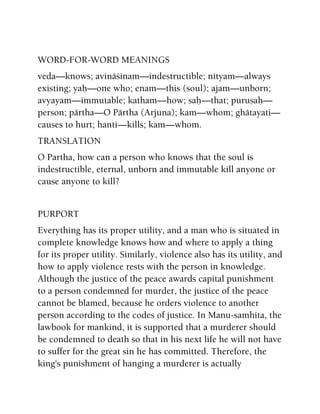
WORD-FOR-WORD MEANINGS
veda—knows; avinäçinam—indestructible; nityam—always
existing; yaù—one who; enam—this (soul); ajam—unborn;
avyayam—immutable; katham—how; saù—that; puruñaù—
person; pärtha—O Pärtha (Arjuna); kam—whom; ghätayati—
causes to hurt; hanti—kills; kam—whom.
TRANSLATION
O Partha, how can a person who knows that the soul is
indestructible, eternal, unborn and immutable kill anyone or
cause anyone to kill?
PURPORT
Everything has its proper utility, and a man who is situated in
complete knowledge knows how and where to apply a thing
for its proper utility. Similarly, violence also has its utility, and
how to apply violence rests with the person in knowledge.
Although the justice of the peace awards capital punishment
to a person condemned for murder, the justice of the peace
cannot be blamed, because he orders violence to another
person according to the codes of justice. In Manu-samhita, the
lawbook for mankind, it is supported that a murderer should
be condemned to death so that in his next life he will not have
to suffer for the great sin he has committed. Therefore, the
king's punishment of hanging a murderer is actually
beneficial. Similarly, when Krishna orders fighting, it must be
concluded that violence is for supreme justice, and thus
Arjuna should follow the instruction, knowing well that such
violence, committed in the act of fighting for Krishna, is not
violence at all because, at any rate, the man, or rather the soul,
cannot be killed; so for the administration of justice, so-called
violence is permitted. A surgical operation is not meant to kill
the patient, but to cure him. Therefore the fighting to be
executed by Arjuna at the instruction of Krishna is with full
knowledge, so there is no possibility of sinful reaction.
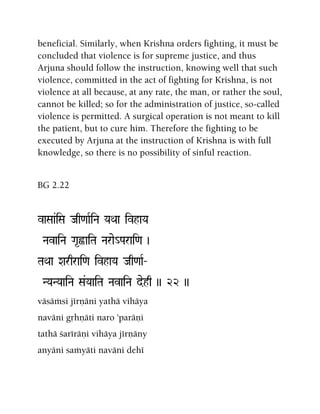
BG 2.22
vaSaa&iSa Jaq<aaRiNa YaQaa ivhaYa
NavaiNa Ga*õaiTa Narae_Parai<a )
TaQaa Xarqrai<a ivhaYa Jaq<aaR‚
NYaNYaaiNa Sa&YaaiTa NavaiNa dehq )) 22 ))
väsäàsi jérëäni yathä vihäya
naväni gåhëäti naro 'paräëi
tathä çaréräëi vihäya jérëäny
anyäni saàyäti naväni dehé
WORD-FOR-WORD MEANINGS
väsäàsi—garments; jérëäni—old and worn out; yathä—just
as; vihäya—giving up; naväni—new garments; gåhëäti—does
accept; naraù—a man; aparäëi—others; tathä—in the same
way; çaréräëi—bodies; vihäya—giving up; jirëäni—old and
useless; anyäni—different; saàyäti—verily accepts; naväni—
new sets; dehé—the embodied.
TRANSLATION
As a person puts on new garments, giving up old ones, the
soul similarly accepts new material bodies, giving up the old
and useless ones.
PURPORT
Change of body by the atomic individual soul is an accepted
fact. Even the modern scientists who do not believe in the
existence of the soul, but at the same time cannot explain the
source of energy from the heart, have to accept continuous
changes of body which appear from childhood to boyhood
and from boyhood to youth and again from youth to old age.
From old age, the change is transferred to another body. This
has already been explained in a previous verse (2.13).
Transference of the atomic individual soul to another body is
made possible by the grace of the Supersoul. The Supersoul
fulfills the desire of the atomic soul as one friend fulfills the
desire of another. The Vedas, like the Mundaka Upanishad, as
well as the Svetasvatara Upanishad, compare the soul and the
Supersoul to two friendly birds sitting on the same tree. One
of the birds (the individual atomic soul) is eating the fruit of
the tree, and the other bird (Krishna) is simply watching His
friend. Of these two birds—although they are the same in
quality—one is captivated by the fruits of the material tree,
while the other is simply witnessing the activities of His
friend. Krishna is the witnessing bird, and Arjuna is the eating
bird. Although they are friends, one is still the master and the
other is the servant. Forgetfulness of this relationship by the
atomic soul is the cause of one's changing his position from
one tree to another, or from one body to another. The jiva
soul is struggling very hard on the tree of the material body,
but as soon as he agrees to accept the other bird as the
supreme spiritual master—as Arjuna agreed to do by
voluntary surrender unto Krishna for instruction—the
subordinate bird immediately becomes free from all
lamentations. Both the Mundaka Upanishad (3.1.2) and
Svetasvatara Upanishad (4.7) confirm this:
samane vrikshe purusho nimagno
'nisaya socati muhyamanah
jushtam yada pasyaty anyam isam
asya mahimanam iti vita-sokah
"Although the two birds are in the same tree, the eating bird is
fully engrossed with anxiety and moroseness as the enjoyer of
the fruits of the tree. But if in some way or other he turns his
face to his friend who is the Lord and knows His glories—at
once the suffering bird becomes free from all anxieties."
Arjuna has now turned his face towards his eternal friend,
Krishna, and is understanding the Bhagavad-gita from Him.
And thus, hearing from Krishna, he can understand the
supreme glories of the Lord and be free from lamentation.
Arjuna is advised herewith by the Lord not to lament for the
bodily change of his old grandfather and his teacher. He
should rather be happy to kill their bodies in the righteous
fight so that they may be cleansed at once of all reactions from
various bodily activities. One who lays down his life on the
sacrificial altar, or in the proper battlefield, is at once cleansed
of bodily reactions and promoted to a higher status of life. So
there was no cause for Arjuna's lamentation.
BG 2.23
NaENa& i^NdiNTa Xañai<a NaENa& dhiTa Paavk-" )
Na cENa& (c)e-dYaNTYaaPaae Na XaaezYaiTa MaaåTa" )) 23 ))
nainaà chindanti çasträëi
nainaà dahati pävakaù
na cainaà kledayanty äpo
na çoñayati märutaù
WORD-FOR-WORD MEANINGS
na—never; enam—this soul; chindanti—can cut to pieces;
çasträëi—weapons; na—never; enam—this soul; dahati—
burns; pävakaù—fire; na—never; ca—also; enam—this soul;
kledayanti—moistens; äpaù—water; na—never; çoñayati—
dries; märutaù—wind.
TRANSLATION
The soul can never be cut to pieces by any weapon, nor
burned by fire, nor moistened by water, nor withered by the
wind.
PURPORT
All kinds of weapons—swords, flame weapons, rain weapons,
tornado weapons, etc.—are unable to kill the spirit soul. It
appears that there were many kinds of weapons made of earth,
water, air, ether, etc., in addition to the modern weapons of
fire. Even the nuclear weapons of the modern age are
classified as fire weapons, but formerly there were other
weapons made of all different types of material elements.
Firearms were counteracted by water weapons, which are now
unknown to modern science. Nor do modern scientists have
knowledge of tornado weapons. Nonetheless, the soul can
never be cut into pieces, nor annihilated by any number of
weapons, regardless of scientific devices.
The Mayavadi cannot explain how the individual soul came
into existence simply by ignorance and consequently became
covered by the illusory energy. Nor was it ever possible to cut
the individual souls from the original Supreme Soul; rather,
the individual souls are eternally separated parts of the
Supreme Soul. Because they are atomic individual souls
eternally (sanatana), they are prone to be covered by the
illusory energy, and thus they become separated from the
association of the Supreme Lord, just as the sparks of a fire,
although one in quality with the fire, are prone to be
extinguished when out of the fire. In the Varaha Purana, the
living entities are described as separated parts and parcels of
the Supreme. They are eternally so, according to the
Bhagavad-gita also. So, even after being liberated from
illusion, the living entity remains a separate identity, as is
evident from the teachings of the Lord to Arjuna. Arjuna
became liberated by the knowledge received from Krishna, but
he never became one with Krishna.
BG 2.24
AC^eÛae_YaMadaùae_YaMa(c)e-Ûae_XaaeZYa Wv c )
iNaTYa" SavRGaTa" SQaa<aurcl/ae_Ya& SaNaaTaNa" )) 24 ))
acchedyo 'yam adähyo 'yam
akledyo 'çoñya eva ca
nityaù sarva-gataù sthäëur
acalo 'yaà sanätanaù
WORD-FOR-WORD MEANINGS
acchedyaù—unbreakable; ayam—this soul; adähyaù—unable
to be burned; ayam—this soul; akledyaù—insoluble;
açoñyaù—not able to be dried; eva—certainly; ca—and;
nityaù—everlasting; sarva-gataù—all—pervading; sthäëuù—
unchangeable; acalaù—immovable; ayam—this soul;
sanätanaù—eternally the same.
TRANSLATION
This individual soul is unbreakable and insoluble, and can be
neither burned nor dried. He is everlasting, present
everywhere, unchangeable, immovable and eternally the same.
PURPORT
All these qualifications of the atomic soul definitely prove that
the individual soul is eternally the atomic particle of the spirit
whole, and he remains the same atom eternally, without
change. The theory of monism is very difficult to apply in this
case, because the individual soul is never expected to become
one homogeneously. After liberation from material
contamination, the atomic soul may prefer to remain as a
spiritual spark in the effulgent rays of the Supreme Personality
of Godhead, but the intelligent souls enter into the spiritual
planets to associate with the Personality of Godhead.
The word sarva-gata ("all-pervading") is significant because
there is no doubt that living entities are all over God's
creation. They live on the land, in the water, in the air, within
the earth and even within fire. The belief that they are
sterilized in fire is not acceptable, because it is clearly stated
here that the soul cannot be burned by fire. Therefore, there is
no doubt that there are living entities also in the sun planet
with suitable bodies to live there. If the sun globe is
uninhabited, then the word sarva-gata—"living
everywhere"—becomes meaningless.
BG 2.25
AVYa¢-ae_YaMaicNTYaae_YaMaivk-aYaaeR_YaMauCYaTae )
TaSMaadev& ividTvENa& NaaNauXaaeicTauMahRiSa )) 25 ))
avyakto 'yam acintyo 'yam
avikäryo 'yam ucyate
tasmäd evaà viditvainaà
nänuçocitum arhasi
WORD-FOR-WORD MEANINGS
avyaktaù—invisible; ayam—this soul; acintyaù—
inconceivable; ayam—this soul; avikäryaù—unchangeable;
ayam—this soul; ucyate—is said; tasmät—therefore; evam—
like this; viditvä—knowing it well; enam—this soul; na—do
not; anuçocitum—to lament; arhasi—you deserve.
TRANSLATION
It is said that the soul is invisible, inconceivable and
immutable. Knowing this, you should not grieve for the body.
PURPORT
As described previously, the magnitude of the soul is so small
for our material calculation that he cannot be seen even by the
most powerful microscope; therefore, he is invisible. As far as
the soul's existence is concerned, no one can establish his
existence experimentally beyond the proof of sruti, or Vedic
wisdom. We have to accept this truth, because there is no
other source of understanding the existence of the soul,
although it is a fact by perception. There are many things we
have to accept solely on grounds of superior authority. No one
can deny the existence of his father, based upon the authority
of his mother. There is no source of understanding the
identity of the father except by the authority of the mother.
Similarly, there is no source of understanding the soul except
by studying the Vedas. In other words, the soul is
inconceivable by human experimental knowledge. The soul is
consciousness and conscious—that also is the statement of the
Vedas, and we have to accept that. Unlike the bodily changes,
there is no change in the soul. As eternally unchangeable, the
soul remains atomic in comparison to the infinite Supreme
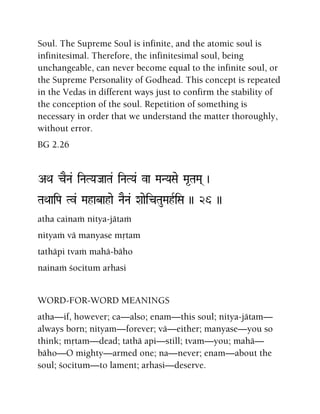
Soul. The Supreme Soul is infinite, and the atomic soul is
infinitesimal. Therefore, the infinitesimal soul, being
unchangeable, can never become equal to the infinite soul, or
the Supreme Personality of Godhead. This concept is repeated
in the Vedas in different ways just to confirm the stability of
the conception of the soul. Repetition of something is
necessary in order that we understand the matter thoroughly,
without error.
BG 2.26
AQa cENa& iNaTYaJaaTa& iNaTYa& va MaNYaSae Ma*TaMa( )
TaQaaiPa Tv& Mahabahae NaENa& XaaeicTauMahRiSa )) 26 ))
atha cainaà nitya-jätaà
nityaà vä manyase måtam
tathäpi tvaà mahä-bäho
nainaà çocitum arhasi
WORD-FOR-WORD MEANINGS
atha—if, however; ca—also; enam—this soul; nitya-jätam—
always born; nityam—forever; vä—either; manyase—you so
think; måtam—dead; tathä api—still; tvam—you; mahä—
bäho—O mighty—armed one; na—never; enam—about the
soul; çocitum—to lament; arhasi—deserve.
TRANSLATION
If, however, you think that the soul [or the symptoms of life]
is always born and dies forever, you still have no reason to
lament, O mighty-armed.
PURPORT
There is always a class of philosophers, almost akin to the
Buddhists, who do not believe in the separate existence of the
soul beyond the body. When Lord Krishna spoke the
Bhagavad-gita, it appears that such philosophers existed, and
they were known as the lokayatikas and vaibhashikas. Such
philosophers maintain that life symptoms take place at a
certain mature condition of material combination. The
modern material scientist and materialist philosophers also
think similarly. According to them, the body is a combination
of physical elements, and at a certain stage the life symptoms
develop by interaction of the physical and chemical elements.
The science of anthropology is based on this philosophy.
Currently, many pseudo religions—now becoming
fashionable in America—are also adhering to this philosophy,
as are the nihilistic nondevotional Buddhist sects.
Even if Arjuna did not believe in the existence of the soul—as
in the vaibhashika philosophy—there would still have been
no cause for lamentation. No one laments the loss of a certain
bulk of chemicals and stops discharging his prescribed duty.
On the other hand, in modern science and scientific warfare,
so many tons of chemicals are wasted for achieving victory
over the enemy. According to the vaibhashika philosophy, the
so-called soul or atma vanishes along with the deterioration of
the body. So, in any case, whether Arjuna accepted the Vedic
conclusion that there is an atomic soul or he did not believe in
the existence of the soul, he had no reason to lament.
According to this theory, since there are so many living
entities generating out of matter every moment, and so many
of them are being vanquished every moment, there is no need
to grieve for such incidents. If there were no rebirth for the
soul, Arjuna had no reason to be afraid of being affected by
sinful reactions due to his killing his grandfather and teacher.
But at the same time, Krishna sarcastically addressed Arjuna
as maha-bahu, mighty-armed, because He, at least, did not
accept the theory of the vaibhashikas, which leaves aside the
Vedic wisdom. As a kshatriya, Arjuna belonged to the Vedic
culture, and it behooved him to continue to follow its
principles.
BG 2.27
JaaTaSYa ih Da]uvae Ma*TYauDa]uRv& JaNMa Ma*TaSYa c )
TaSMaadPairhaYaeR_QaeR Na Tv& XaaeicTauMahRiSa )) 27 ))
jätasya hi dhruvo måtyur
dhruvaà janma måtasya ca
tasmäd aparihärye 'rthe
na tvaà çocitum arhasi
WORD-FOR-WORD MEANINGS
jätasya—of one who has taken his birth; hi—certainly;
dhruvaù—a fact; måtyuù—death; dhruvam—it is also a fact;
janma—birth; måtasya—of the dead; ca—also; tasmät—
therefore; aparihärye—of that which is unavoidable; arthe—in
the matter; na—do not; tvam—you; çocitum—to lament;
arhasi—deserve.
TRANSLATION
One who has taken his birth is sure to die, and after death one
is sure to take birth again. Therefore, in the unavoidable
discharge of your duty, you should not lament.
PURPORT
One has to take birth according to one's activities of life. And
after finishing one term of activities, one has to die to take
birth for the next. In this way one is going through one cycle
of birth and death after another without liberation. This cycle
of birth and death does not, however, support unnecessary
murder, slaughter and war. But at the same time, violence and
war are inevitable factors in human society for keeping law
and order.
The Battle of Kurukshetra, being the will of the Supreme, was
an inevitable event, and to fight for the right cause is the duty
of a kshatriya. Why should Arjuna be afraid of or aggrieved at
the death of his relatives since he was discharging his proper
duty? He did not deserve to break the law, thereby becoming
subjected to the reactions of sinful acts, of which he was so
afraid. By avoiding the discharge of his proper duty, he would
not be able to stop the death of his relatives, and he would be
degraded due to his selection of the wrong path of action.
BG 2.28
AVYa¢-adqiNa >aUTaaiNa VYa¢-MaDYaaiNa >aarTa )
AVYa¢-iNaDaNaaNYaev Ta}a k-a PairdevNaa )) 28 ))
avyaktädéni bhütäni
vyakta-madhyäni bhärata
avyakta-nidhanäny eva
tatra kä paridevanä
WORD-FOR-WORD MEANINGS
avyakta—ädéni—in the beginning unmanifested; bhütäni—all
that are created; vyakta—manifested; madhyäni—in the
middle; bhärata—O descendant of Bharata; avyakta—
nonmanifested; nidhanäni—when vanquished; eva—it is all
like that; tatra—therefore; kä—what; paridevanä—
lamentation.
TRANSLATION
All created beings are unmanifest in their beginning, manifest
in their interim state, and unmanifest again when annihilated.
So what need is there for lamentation?
PURPORT
Accepting that there are two classes of philosophers, one
believing in the existence of the soul and the other not
believing in the existence of the soul, there is no cause for
lamentation in either case. Nonbelievers in the existence of
the soul are called atheists by followers of Vedic wisdom. Yet
even if, for argument's sake, we accept this atheistic theory,
there is still no cause for lamentation. Apart from the separate
existence of the soul, the material elements remain
unmanifested before creation. From this subtle state of
nonmanifestation comes manifestation, just as from ether, air
is generated; from air, fire is generated; from fire, water is
generated; and from water, earth becomes manifested. From
the earth, many varieties of manifestations take place. Take,
for example, a big skyscraper manifested from the earth.
When it is dismantled, the manifestation becomes again
unmanifested and remains as atoms in the ultimate stage. The
law of conservation of energy remains, but in course of time
things are manifested and unmanifested—that is the
difference. Then what cause is there for lamentation either in
the stage of manifestation or in unmanifestation? Somehow or
other, even in the unmanifested stage, things are not lost.
Both at the beginning and at the end, all elements remain
unmanifested, and only in the middle are they manifested, and
this does not make any real material difference.
And if we accept the Vedic conclusion as stated in the
Bhagavad-gita that these material bodies are perishable in due
course of time (antavanta ime dehah) but that the soul is
eternal (nityasyoktah saririnah), then we must remember
always that the body is like a dress; therefore why lament the
changing of a dress? The material body has no factual
existence in relation to the eternal soul. It is something like a
dream. In a dream we may think of flying in the sky, or sitting
on a chariot as a king, but when we wake up we can see that
we are neither in the sky nor seated on the chariot. The Vedic
wisdom encourages self-realization on the basis of the
nonexistence of the material body. Therefore, in either case,
whether one believes in the existence of the soul or one does
not believe in the existence of the soul, there is no cause for
lamentation for loss of the body.
BG 2.29
AaêYaRvTPaXYaiTa k-iêdeNa‚
MaaêYaRvÜdiTa TaQaEv caNYa" )
AaêYaRvÀENaMaNYa" é*<aaeiTa
é[uTvaPYaeNa& ved Na cEv k-iêTa( )) 29 ))
äçcarya-vat paçyati kaçcid enam
äçcarya-vad vadati tathaiva cänyaù
äçcarya-vac cainam anyaù çåëoti
çrutväpy enaà veda na caiva kaçcit
WORD-FOR-WORD MEANINGS
äçcarya-vat—as amazing; paçyati—sees; kaçcit—someone;
enam—this soul; äçcarya-vat—as amazing; vadati—speaks of;
tathä—thus; eva—certainly; ca—also; anyaù—another;
äçcarya-vat—similarly amazing; ca—also; enam—this soul;
anyaù—another; çåëoti—hears of; çrutvä—having heard;
api—even; enam—this soul; veda—knows; na—never; ca—
and; eva—certainly; kaçcit—someone.
TRANSLATION
Some look on the soul as amazing, some describe him as
amazing, and some hear of him as amazing, while others, even
after hearing about him, cannot understand him at all.
PURPORT
Since Gitopanishad is largely based on the principles of the
Upanishads, it is not surprising to also find this passage in the
Katha Upanishad (1.2.7):
sravanayapi bahubhir yo na labhyah
srinvanto 'pi bahavo yam na vidyuh
ascaryo vakta kusalo 'sya labdha
ascaryo 'sya jnata kusalanusishtah
The fact that the atomic soul is within the body of a gigantic
animal, in the body of a gigantic banyan tree, and also in the
microbic germs, millions and billions of which occupy only an
inch of space, is certainly very amazing. Men with a poor fund
of knowledge and men who are not austere cannot understand
the wonders of the individual atomic spark of spirit, even
though it is explained by the greatest authority of knowledge,
who imparted lessons even to Brahma, the first living being in
the universe. Owing to a gross material conception of things,
most men in this age cannot imagine how such a small
particle can become both so great and so small. So men look
at the soul proper as wonderful either by constitution or by
description. Illusioned by the material energy, people are so
engrossed in subject matters for sense gratification that they
have very little time to understand the question of self-
understanding, even though it is a fact that without this self-
understanding all activities result in ultimate defeat in the
struggle for existence. Perhaps they have no idea that one
must think of the soul, and thus make a solution to the
material miseries.
Some people who are inclined to hear about the soul may be
attending lectures, in good association, but sometimes, owing
to ignorance, they are misguided by acceptance of the
Supersoul and the atomic soul as one without distinction of
magnitude. It is very difficult to find a man who perfectly
understands the position of the Supersoul, the atomic soul,
their respective functions and relationships and all other
major and minor details. And it is still more difficult to find a
man who has actually derived full benefit from knowledge of
the soul, and who is able to describe the position of the soul
in different aspects. But if, somehow or other, one is able to
understand the subject matter of the soul, then one's life is
successful.
The easiest process for understanding the subject matter of
self, however, is to accept the statements of the Bhagavad-gita
spoken by the greatest authority, Lord Krishna, without being
deviated by other theories. But it also requires a great deal of
penance and sacrifice, either in this life or in the previous
ones, before one is able to accept Krishna as the Supreme
Personality of Godhead. Krishna can, however, be known as
such by the causeless mercy of the pure devotee and by no
other way.
BG 2.30
dehq iNaTYaMavDYaae_Ya& dehe SavRSYa >aarTa )
TaSMaaTSavaRi<a >aUTaaiNa Na Tv& XaaeicTauMahRiSa )) 30 ))
dehé nityam avadhyo 'yaà
dehe sarvasya bhärata
tasmät sarväëi bhütäni
na tvaà çocitum arhasi
WORD-FOR-WORD MEANINGS
dehé—the owner of the material body; nityam—eternally;
avadhyaù—cannot be killed; ayam—this soul; dehe—in the
body; sarvasya—of everyone; bhärata—O descendant of
Bharata; tasmät—therefore; sarväëi—all; bhütäni—living
entities (that are born); na—never; tvam—you; çocitum—to
lament; arhasi—deserve.
TRANSLATION
O descendant of Bharata, he who dwells in the body can never
be slain. Therefore you need not grieve for any living being.
PURPORT
The Lord now concludes the chapter of instruction on the
immutable spirit soul. In describing the immortal soul in
various ways, Lord Krishna establishes that the soul is
immortal and the body is temporary. Therefore Arjuna as a
kshatriya should not abandon his duty out of fear that his
grandfather and teacher—Bhishma and Drona—will die in the
battle. On the authority of Sri Krishna, one has to believe that
there is a soul different from the material body, not that there
is no such thing as soul, or that living symptoms develop at a
certain stage of material maturity resulting from the
interaction of chemicals. Though the soul is immortal,
violence is not encouraged, but at the time of war it is not
discouraged when there is actual need for it. That need must
be justified in terms of the sanction of the Lord, and not
capriciously.
BG 2.31
SvDaMaRMaiPa cave+Ya Na ivk-iMPaTauMahRiSa )
DaMYaaRiÖ YauÖaC^eYaae_NYaT+ai}aYaSYa Na ivÛTae )) 31 ))
sva-dharmam api cävekñya
na vikampitum arhasi
dharmyäd dhi yuddhäc chreyo 'nyat
kñatriyasya na vidyate
WORD-FOR-WORD MEANINGS
sva-dharmam—one's own religious principles; api—also; ca—
indeed; avekñya—considering; na—never; vikampitum—to
hesitate; arhasi—you deserve; dharmyät—for religious
principles; hi—indeed; yuddhät—than fighting; çreyaù—
better engagement; anyat—any other; kñatriyasya—of the
kñatriya; na—does not; vidyate—exist.
TRANSLATION
Considering your specific duty as a kshatriya, you should
know that there is no better engagement for you than fighting
on religious principles; and so there is no need for hesitation.
PURPORT
Out of the four orders of social administration, the second
order, for the matter of good administration, is called
kshatriya. Kshat means hurt. One who gives protection from
harm is called kshatriya (trayate—to give protection). The
kshatriyas are trained for killing in the forest. A kshatriya
would go into the forest and challenge a tiger face to face and
fight with the tiger with his sword. When the tiger was killed,
it would be offered the royal order of cremation. This system
has been followed even up to the present day by the kshatriya
kings of Jaipur state. The kshatriyas are specially trained for
challenging and killing because religious violence is
sometimes a necessary factor. Therefore, kshatriyas are never
meant for accepting directly the order of sannyasa, or
renunciation. Nonviolence in politics may be a diplomacy, but
it is never a factor or principle. In the religious law books it is
stated:
ahaveshu mitho 'nyonyam
jighamsanto mahi-kshitah
yuddhamanah param saktya
svargam yanty aparan-mukhah
yajneshu pasavo brahman
hanyante satatam dvijaih
samskritah kila mantrais ca
te 'pi svargam avapnuvan
"In the battlefield, a king or kshatriya, while fighting another
king envious of him, is eligible for achieving the heavenly
planets after death, as the brahmanas also attain the heavenly
planets by sacrificing animals in the sacrificial fire." Therefore,
killing on the battlefield on religious principles and killing
animals in the sacrificial fire are not at all considered to be
acts of violence, because everyone is benefited by the religious
principles involved. The animal sacrificed gets a human life
immediately without undergoing the gradual evolutionary
process from one form to another, and the kshatriyas killed on
the battlefield also attain the heavenly planets, as do the
brahmanas who attain them by offering sacrifice.
There are two kinds of sva-dharmas, specific duties. As long as
one is not liberated, one has to perform the duties of his
particular body in accordance with religious principles in
order to achieve liberation. When one is liberated, one's sva-
dharma—specific duty—becomes spiritual and is not in the
material bodily concept. In the bodily conception of life there
are specific duties for the brahmanas and kshatriyas
respectively, and these duties are unavoidable. Such sva-
dharma is ordained by the Lord, and this will be clarified in
the Fourth Chapter. On the bodily plane sva-dharma is called
varnasrama-dharma, or man's steppingstone for spiritual
understanding. Human civilization begins from the stage of
varnasrama-dharma, or specific duties in terms of the specific
modes of nature of the body obtained. Discharging one's
specific duty in any field of action in accordance with the
orders of higher authorities serves to elevate one to a higher
status of life.
BG 2.32
Yad*C^Yaa caePaPaà& SvGaRÜarMaPaav*TaMa( )
Saui%Na" +ai}aYaa" PaaQaR l/>aNTae YauÖMaqd*XaMa( )) 32 ))
yadåcchayä copapannaà
svarga-dväram apävåtam
sukhinaù kñatriyäù pärtha
labhante yuddham édåçam
WORD-FOR-WORD MEANINGS
yadåcchayä—by its own accord; ca—also; upapannam—
arrived at; svarga—of the heavenly planets; dväram—door;
apävåtam—wide open; sukhinaù—very happy; kñatriyäù—the
members of the royal order; pärtha—O son of Påthä;
labhante—do achieve; yuddham—war; édåçam—like this.
TRANSLATION
O Partha, happy are the kshatriyas to whom such fighting
opportunities come unsought, opening for them the doors of
the heavenly planets.
PURPORT
As supreme teacher of the world, Lord Krishna condemns the
attitude of Arjuna, who said, "I do not find any good in this
fighting. It will cause perpetual habitation in hell." Such
statements by Arjuna were due to ignorance only. He wanted
to become nonviolent in the discharge of his specific duty. For
a kshatriya to be on the battlefield and to become nonviolent
is the philosophy of fools. In the Parasara-smriti, or religious
codes made by Parasara, the great sage and father of
Vyasadeva, it is stated:
kshatriyo hi praja rakshan
sastra-panih pradandayan
nirjitya para-sainyadi
kshitim dharmena palayet
"The kshatriya's duty is to protect the citizens from all kinds
of difficulties, and for that reason he has to apply violence in
suitable cases for law and order. Therefore he has to conquer
the soldiers of inimical kings, and thus, with religious
principles, he should rule over the world."
Considering all aspects, Arjuna had no reason to refrain from
fighting. If he should conquer his enemies, he would enjoy
the kingdom; and if he should die in the battle, he would be
elevated to the heavenly planets, whose doors were wide open
to him. Fighting would be for his benefit in either case.
BG 2.33
AQa cetviMaMa& DaMYa| Sa°aMa& Na k-irZYaiSa )
TaTa" SvDaMa| k-IiTa| c ihTva PaaPaMavaPSYaiSa )) 33 ))
atha cet tvam imaà dharmyaà
saìgrämaà na kariñyasi
tataù sva-dharmaà kértià ca
hitvä päpam aväpsyasi
WORD-FOR-WORD MEANINGS
atha—therefore; cet—if; tvam—you; imam—this;
dharmyam—as a religious duty; saìgrämam—fighting; na—
do not; kariñyasi—perform; tataù—then; sva-dharmam—your
religious duty; kértim—reputation; ca—also; hitvä—losing;
päpam—sinful reaction; aväpsyasi—will gain.
TRANSLATION
If, however, you do not perform your religious duty of
fighting, then you will certainly incur sins for neglecting your
duties and thus lose your reputation as a fighter.
PURPORT
Arjuna was a famous fighter, and he attained fame by fighting
many great demigods, including even Lord Siva. After fighting
and defeating Lord Siva in the dress of a hunter, Arjuna
pleased the lord and received as a reward a weapon called
pasupata-astra. Everyone knew that he was a great warrior.
Even Dronacarya gave him benedictions and awarded him the
special weapon by which he could kill even his teacher. So he
was credited with so many military certificates from many
authorities, including his adopted father Indra, the heavenly
king. But if he abandoned the battle, not only would he
neglect his specific duty as a kshatriya, but he would lose all
his fame and good name and thus prepare his royal road to
hell. In other words, he would go to hell not by fighting but
by withdrawing from battle.
BG 2.34
Ak-IiTa| caiPa >aUTaaiNa k-QaiYaZYaiNTa Tae_VYaYaaMa( )
SaM>aaivTaSYa cak-IiTaRMaRr<aadiTairCYaTae )) 34 ))
akértià cäpi bhütäni
kathayiñyanti te 'vyayäm
sambhävitasya cäkértir
maraëäd atiricyate
WORD-FOR-WORD MEANINGS
akértim—infamy; ca—also; api—over and above; bhütäni—all
people; kathayiñyanti—will speak; te—of you; avyayäm—
forever; sambhävitasya—for a respectable man; ca—also;
akértiù—ill fame; maraëät—than death; atiricyate—becomes
more.
TRANSLATION
People will always speak of your infamy, and for a respectable
person, dishonor is worse than death.
PURPORT
Both as friend and philosopher to Arjuna, Lord Krishna now
gives His final judgment regarding Arjuna's refusal to fight.
The Lord says, "Arjuna, if you leave the battlefield before the
battle even begins, people will call you a coward. And if you
think that people may call you bad names but that you will
save your life by fleeing the battlefield, then My advice is that
you'd do better to die in the battle. For a respectable man like
you, ill fame is worse than death. So, you should not flee for
fear of your life; better to die in the battle. That will save you
from the ill fame of misusing My friendship and from losing
your prestige in society."
So, the final judgment of the Lord was for Arjuna to die in the
battle and not withdraw.
BG 2.35
>aYaad]<aaduParTa& Ma&SYaNTae Tva& MaharQaa" )
Yaeza& c Tv& bhuMaTaae >aUTva YaaSYaiSa l/agavMa( )) 35 ))
bhayäd raëäd uparataà
maàsyante tväà mahä-rathäù
yeñäà ca tvaà bahu-mato
bhütvä yäsyasi läghavam
WORD-FOR-WORD MEANINGS
bhayät—out of fear; raëät—from the battlefield; uparatam—
ceased; maàsyante—they will consider; tväm—you; mahä—
rathäù—the great generals; yeñäm—for whom; ca—also;
tvam—you; bahu—mataù—in great estimation; bhütvä—
having been; yäsyasi—you will go; läghavam—decreased in
value.
TRANSLATION
The great generals who have highly esteemed your name and
fame will think that you have left the battlefield out of fear
only, and thus they will consider you insignificant.
PURPORT
Lord Krishna continued to give His verdict to Arjuna: "Do not
think that the great generals like Duryodhana, Karna, and
other contemporaries will think that you have left the
battlefield out of compassion for your brothers and
grandfather. They will think that you have left out of fear for
your life. And thus their high estimation of your personality
will go to hell."
BG 2.36
AvaCYavada&ê bhUNvidZYaiNTa TavaihTaa" )
iNaNdNTaSTav SaaMaQYa| TaTaae du"%Tar& Nau ik-Ma( )) 36 ))
aväcya-vädäàç ca bahün
vadiñyanti tavähitäù
nindantas tava sämarthyaà
tato duùkhataraà nu kim
WORD-FOR-WORD MEANINGS
aväcya—unkind; vädän—fabricated words; ca—also; bahün—
many; vadiñyanti—will say; tava—your; ahitäù—enemies;
nindantaù—while vilifying; tava—your; sämarthyam—ability;
tataù—than that; duùkha—taram—more painful; nu—of
course; kim—what is there.
TRANSLATION
Your enemies will describe you in many unkind words and
scorn your ability. What could be more painful for you?
PURPORT
Lord Krishna was astonished in the beginning at Arjuna's
uncalled—for plea for compassion, and He described his
compassion as befitting the non-Aryans. Now in so many
words, He has proved His statements against Arjuna's so-
called compassion.
BG 2.37
hTaae va Pa[aPSYaiSa SvGa| iJaTva va >aae+YaSae MahqMa( )
TaSMaaduitaï k-aENTaeYa YauÖaYa k*-TaiNaêYa" )) 37 ))
hato vä präpsyasi svargaà
jitvä vä bhokñyase mahém
tasmäd uttiñöha kaunteya
yuddhäya kåta-niçcayaù
WORD-FOR-WORD MEANINGS
hataù—being killed; vä—either; präpsyasi—you gain;
svargam—the heavenly kingdom; jitvä—by conquering; vä—
or; bhokñyase—you enjoy; mahém—the world; tasmät—
therefore; uttiñöha—get up; kaunteya—O son of Kunté;
yuddhäya—to fight; kåta—determined; niçcayaù—in
certainty.
TRANSLATION
O son of Kunti, either you will be killed on the battlefield and
attain the heavenly planets, or you will conquer and enjoy the
earthly kingdom. Therefore, get up with determination and
fight.
PURPORT
Even though there was no certainty of victory for Arjuna's
side, he still had to fight; for, even being killed there, he could
be elevated into the heavenly planets.
BG 2.38
Sau%du"%e SaMae k*-Tva l/a>aal/a>aaE JaYaaJaYaaE )
TaTaae YauÖaYa YauJYaSv NaEv& PaaPaMavaPSYaiSa )) 38 ))
sukha-duùkhe same kåtvä
läbhäläbhau jayäjayau
tato yuddhäya yujyasva
naivaà päpam aväpsyasi
WORD-FOR-WORD MEANINGS
sukha—happiness; duùkhe—and distress; same—in
equanimity; kåtvä—doing so; läbha—aläbhau—both profit
and loss; jaya—ajayau—both victory and defeat; tataù—
thereafter; yuddhäya—for the sake of fighting; yujyasva—
engage (fight); na—never; evam—in this way; päpam—sinful
reaction; aväpsyasi—you will gain.
TRANSLATION
Do thou fight for the sake of fighting, without considering
happiness or distress, loss or gain, victory or defeat—and by
so doing you shall never incur sin.
PURPORT
Lord Krishna now directly says that Arjuna should fight for
the sake of fighting because He desires the battle. There is no
consideration of happiness or distress, profit or loss, victory or
defeat in the activities of Krishna consciousness. That
everything should be performed for the sake of Krishna is
transcendental consciousness; so there is no reaction to
material activities. He who acts for his own sense gratification,
either in goodness or in passion, is subject to the reaction,
good or bad. But he who has completely surrendered himself
in the activities of Krishna consciousness is no longer obliged
to anyone, nor is he a debtor to anyone, as one is in the
ordinary course of activities. It is said:
devarshi-bhutapta-nrinam pitriinam
na kinkaro nayam rini ca rajan
sarvatmana yah saranam saranyam
gato mukundam parihritya kartam
"Anyone who has completely surrendered unto Krishna,
Mukunda, giving up all other duties, is no longer a debtor,
nor is he obliged to anyone—not the demigods, nor the sages,
nor the people in general, nor kinsmen, nor humanity, nor
forefathers." (SB 11.5.41) That is the indirect hint given by
Krishna to Arjuna in this verse, and the matter will be more
clearly explained in the following verses.
BG 2.39
Wza Tae_i>aihTaa Saa&:Yae buiÖYaaeRGae iTvMaa& é*<au )
buÖya Yau¢-ae YaYaa PaaQaR k-MaRbNDa& Pa[haSYaiSa )) 39 ))
eñä te 'bhihitä säìkhye
buddhir yoge tv imäà çåëu
buddhyä yukto yayä pärtha
karma-bandhaà prahäsyasi
WORD-FOR-WORD MEANINGS
eñä—all this; te—unto you; abhihitä—described; säìkhye—in
analytical study; buddhiù—intelligence; yoge—in work
without fruitive result; tu—but; imäm—this; çåëu—just hear;
buddhyä—by intelligence; yuktaù—dovetailed; yayä—by
which; pärtha—O son of Påthä; karma—bandham—bondage
of reaction; prahäsyasi—you can be released from.
TRANSLATION
Thus far I have described this knowledge to you through
analytical study. Now listen as I explain it in terms of working
without fruitive results. O son of Pritha, when you act in such
knowledge you can free yourself from the bondage of works.
PURPORT
According to the Nirukti, or the Vedic dictionary, sankhya
means that which describes things in detail, and sankhya
refers to that philosophy which describes the real nature of
the soul. And yoga involves controlling the senses. Arjuna's
proposal not to fight was based on sense gratification.
Forgetting his prime duty, he wanted to cease fighting,
because he thought that by not killing his relatives and
kinsmen he would be happier than by enjoying the kingdom
after conquering his cousins and brothers, the sons of
Dhritarashtra. In both ways, the basic principles were for
sense gratification. Happiness derived from conquering them
and happiness derived by seeing kinsmen alive are both on the
basis of personal sense gratification, even at a sacrifice of
wisdom and duty. Krishna, therefore, wanted to explain to
Arjuna that by killing the body of his grandfather he would
not be killing the soul proper, and He explained that all
individual persons, including the Lord Himself, are eternal
individuals; they were individuals in the past, they are
individuals in the present, and they will continue to remain
individuals in the future, because all of us are individual souls
eternally. We simply change our bodily dress in different
manners, but actually we keep our individuality even after
liberation from the bondage of material dress. An analytical
study of the soul and the body has been very graphically
explained by Lord Krishna. And this descriptive knowledge of
the soul and the body from different angles of vision has been
described here as Sankhya, in terms of the Nirukti dictionary.
This Sankhya has nothing to do with Sankhya philosophy of
the atheist Kapila. Long before the imposter, Kapila's Sankhya,
the Sankhya philosophy, was expounded in the Srimad-
Bhagavatam by the true Lord Kapila, the incarnation of Lord
Krishna, who explained it to His mother, Devahuti. It is
clearly explained by Him that the purusha, or the Supreme
Lord, is active and that He creates by looking over the
prakriti. This is accepted in the Vedas and in the Gita. The
description in the Vedas indicates that the Lord glanced over
the prakriti, or nature, and impregnated it with atomic
individual souls. All these individuals are working in the
material world for sense gratification, and under the spell of
material energy they are thinking of being enjoyers. This
mentality is dragged to the last point of liberation when the
living entity wants to become one with the Lord. This is the
last snare of maya, or sense gratificatory illusion, and it is only
after many, many births of such sense gratificatory activities
that a great soul surrenders unto Vasudeva, Lord Krishna,
thereby fulfilling the search after the ultimate truth.
Arjuna has already accepted Krishna as his spiritual master by
surrendering himself unto Him: sishyas te 'ham sadhi mam
tvam prapannam. Consequently, Krishna will now tell him
about the working process in buddhi-yoga, or karma-yoga, or
in other words, the practice of devotional service only for the
sense gratification of the Lord. This buddhi-yoga is clearly
explained in Chapter Ten, verse ten, as being direct
communion with the Lord, who is sitting as Paramatma in
everyone's heart. But such communion does not take place
without devotional service. One who is therefore situated in
devotional or transcendental loving service to the Lord, or, in
other words, in Krishna consciousness, attains to this stage of
buddhi-yoga by the special grace of the Lord. The Lord says,
therefore, that only to those who are always engaged in
devotional service out of transcendental love does He award
the pure knowledge of devotion in love. In that way the
devotee can reach Him easily in the ever-blissful kingdom of
God.
Thus the buddhi-yoga mentioned in this verse is the
devotional service of the Lord, and the word Sankhya
mentioned herein has nothing to do with the atheistic
sankhya-yoga enunciated by the imposter Kapila. One should
not, therefore, misunderstand that the sankhya-yoga
mentioned herein has any connection with the atheistic
Sankhya. Nor did that philosophy have any influence during
that time; nor would Lord Krishna care to mention such
godless philosophical speculations. Real Sankhya philosophy
is described by Lord Kapila in the Srimad-Bhagavatam, but
even that Sankhya has nothing to do with the current topics.
Here, Sankhya means analytical description of the body and
the soul. Lord Krishna made an analytical description of the
soul just to bring Arjuna to the point of buddhi-yoga, or
bhakti-yoga. Therefore, Lord Krishna's Sankhya and Lord
Kapila's Sankhya, as described in the Bhagavatam, are one and
the same. They are all bhakti-yoga. Lord Krishna said,
therefore, that only the less intelligent class of men make a
distinction between sankhya-yoga and bhakti-yoga (sankhya-
yogau prithag balah pravadanti na panditah).
Of course, atheistic sankhya-yoga has nothing to do with
bhakti-yoga, yet the unintelligent claim that the atheistic
sankhya-yoga is referred to in the Bhagavad-gita.
One should therefore understand that buddhi-yoga means to
work in Krishna consciousness, in the full bliss and
knowledge of devotional service. One who works for the
satisfaction of the Lord only, however difficult such work may
be, is working under the principles of buddhi-yoga and finds
himself always in transcendental bliss. By such transcendental
engagement, one achieves all transcendental understanding
automatically, by the grace of the Lord, and thus his liberation
is complete in itself, without his making extraneous endeavors
to acquire knowledge. There is much difference between work
in Krishna consciousness and work for fruitive results,
especially in the matter of sense gratification for achieving
results in terms of family or material happiness. Buddhi-yoga
is therefore the transcendental quality of the work that we
perform.
BG 2.40
Naehai>a§-MaNaaXaae_iSTa Pa[TYavaYaae Na ivÛTae )
SvLPaMaPYaSYa DaMaRSYa }aaYaTae MahTaae >aYaaTa( )) 40 ))
nehäbhikrama-näço 'sti
pratyaväyo na vidyate
sv-alpam apy asya dharmasya
träyate mahato bhayät
WORD-FOR-WORD MEANINGS
na—there is not; iha—in this yoga; abhikrama—in
endeavoring; näçaù—loss; asti—there is; pratyaväyaù—
diminution; na—never; vidyate—there is; su—alpam—a little;
api—although; asya—of this; dharmasya—occupation;
träyate—releases; mahataù—from very great; bhayät—danger.
TRANSLATION
In this endeavor there is no loss or diminution, and a little
advancement on this path can protect one from the most
dangerous type of fear.
PURPORT
Activity in Krishna consciousness, or acting for the benefit of
Krishna without expectation of sense gratification, is the
highest transcendental quality of work. Even a small
beginning of such activity finds no impediment, nor can that
small beginning be lost at any stage. Any work begun on the
material plane has to be completed, otherwise the whole
attempt becomes a failure. But any work begun in Krishna
consciousness has a permanent effect, even though not
finished. The performer of such work is therefore not at a loss
even if his work in Krishna consciousness is incomplete. One
percent done in Krishna consciousness bears permanent
results, so that the next beginning is from the point of two
percent, whereas in material activity without a hundred
percent success there is no profit. Ajamila performed his duty
in some percentage of Krishna consciousness, but the result
he enjoyed at the end was a hundred percent, by the grace of
the Lord. There is a nice verse in this connection in Srimad-
Bhagavatam (1.5.17):
tyaktva sva-dharmam caranambujam harer
bhajann apakvo 'tha patet tato yadi
yatra kva vabhadram abhud amushya kim
ko vartha apto 'bhajatam sva-dharmatah
"If someone gives up his occupational duties and works in
Krishna consciousness and then falls down on account of not
completing his work, what loss is there on his part? And what
can one gain if one performs his material activities perfectly?"
Or, as the Christians say, "What profiteth a man if he gain the
whole world yet suffer the loss of his eternal soul?"
Material activities and their results end with the body. But
work in Krishna consciousness carries a person again to
Krishna consciousness, even after the loss of the body. At least
one is sure to have a chance in the next life of being born
again as a human being, either in the family of a great
cultured brahmana or in a rich aristocratic family that will
give one a further chance for elevation. That is the unique
quality of work done in Krishna consciousness.
BG 2.41
VYavSaaYaaiTMak-a buiÖreke-h ku-åNaNdNa )
bhuXaa%a ùNaNTaaê buÖYaae_VYavSaaiYaNaaMa( )) 41 ))
vyavasäyätmikä buddhir
ekeha kuru-nandana
bahu-çäkhä hy anantäç ca
buddhayo 'vyavasäyinäm
WORD-FOR-WORD MEANINGS
vyavasäya-ätmikä—resolute in Kåñëa consciousness;
buddhiù—intelligence; ekä—only one; iha—in this world;
kuru—nandana—O beloved child of the Kurus; bahu—
çäkhäù—having various branches; hi—indeed; anantäù—
unlimited; ca—also; buddhayaù—intelligence;
avyavasäyinäm—of those who are not in Kåñëa consciousness.
TRANSLATION
Those who are on this path are resolute in purpose, and their
aim is one. O beloved child of the Kurus, the intelligence of
those who are irresolute is many-branched.
PURPORT
A strong faith that by Krishna consciousness one will be
elevated to the highest perfection of life is called
vyavasayatmika intelligence. The Caitanya-caritamrita
(Madhya 22.62) states:
'sraddha'-sabde—visvasa kahe sudridha niscaya
krishne bhakti kaile sarva-karma krita haya
Faith means unflinching trust in something sublime. When
one is engaged in the duties of Krishna consciousness, he
need not act in relationship to the material world with
obligations to family traditions, humanity, or nationality.
Fruitive activities are the engagements of one's reactions from
past good or bad deeds. When one is awake in Krishna
consciousness, he need no longer endeavor for good results in
his activities. When one is situated in Krishna consciousness,
all activities are on the absolute plane, for they are no longer
subject to dualities like good and bad. The highest perfection
of Krishna consciousness is renunciation of the material
conception of life. This state is automatically achieved by
progressive Krishna consciousness.
The resolute purpose of a person in Krishna consciousness is
based on knowledge. Vasudevah sarvam iti sa mahatma su-
durlabhah: a person in Krishna consciousness is the rare good
soul who knows perfectly that Vasudeva, or Krishna, is the
root of all manifested causes. As by watering the root of a tree
one automatically distributes water to the leaves and
branches, so by acting in Krishna consciousness one can
render the highest service to everyone—namely self, family,
society, country, humanity, etc. If Krishna is satisfied by one's
actions, then everyone will be satisfied.
Service in Krishna consciousness is, however, best practiced
under the able guidance of a spiritual master who is a bona
fide representative of Krishna, who knows the nature of the
student and who can guide him to act in Krishna
consciousness. As such, to be well versed in Krishna
consciousness one has to act firmly and obey the
representative of Krishna, and one should accept the
instruction of the bona fide spiritual master as one's mission
in life. Srila Visvanatha Cakravarti Thakura instructs us, in his
famous prayers for the spiritual master, as follows:
yasya prasadad bhagavat-prasado
yasyaprasadan na gatih kuto 'pi
dhyayan stuvams tasya yasas tri-sandhyam
vande guroh sri-caranaravindam **
"By satisfaction of the spiritual master, the Supreme
Personality of Godhead becomes satisfied. And by not
satisfying the spiritual master, there is no chance of being
promoted to the plane of Krishna consciousness. I should,
therefore, meditate and pray for his mercy three times a day,
and offer my respectful obeisances unto him, my spiritual
master."
The whole process, however, depends on perfect knowledge
of the soul beyond the conception of the body—not
theoretically but practically, when there is no longer a chance
for sense gratification manifested in fruitive activities. One
who is not firmly fixed in mind is diverted by various types of
fruitive acts.
BG 2.42, BG 2.43, BG 2.42-43
S 42-43
YaaiMaMaa& PauiZPaTaa& vac& Pa[vdNTYaivPaiêTa" )
vedvadrTaa" PaaQaR NaaNYadSTaqiTa vaidNa" )) 42 ))
k-aMaaTMaaNa" SvGaRPara JaNMak-MaRf-l/Pa[daMa( )
i§-YaaivXaezbhul/a& >aaeGaEìYaRGaiTa& Pa[iTa )) 43 ))
yäm imäà puñpitäà väcaà
pravadanty avipaçcitaù
veda-väda-ratäù pärtha
nänyad astéti vädinaù
kämätmänaù svarga-parä
janma-karma-phala-pradäm
kriyä-viçeña-bahuläà
bhogaiçvarya-gatià prati
WORD-FOR-WORD MEANINGS
yäm imäm—all these; puñpitäm—flowery; väcam—words;
pravadanti—say; avipaçcitaù—men with a poor fund of
knowledge; veda-väda-ratäù—supposed followers of the
Vedas; pärtha—O son of Påthä; na—never; anyat—anything
else; asti—there is; iti—thus; vädinaù—the advocates; käma-
ätmänaù—desirous of sense gratification; svarga—paräù—
aiming to achieve heavenly planets; janma-karma-phala-
pradäm—resulting in good birth and other fruitive reactions;
kriyä-viçeña—pompous ceremonies; bahuläm—various;
bhoga—in sense enjoyment; aiçvarya—and opulence; gatim—
progress; prati—towards.
TRANSLATION
Men of small knowledge are very much attached to the
flowery words of the Vedas, which recommend various
fruitive activities for elevation to heavenly planets, resultant
good birth, power, and so forth. Being desirous of sense
gratification and opulent life, they say that there is nothing
more than this.
PURPORT
People in general are not very intelligent, and due to their
ignorance they are most attached to the fruitive activities
recommended in the karma-kanda portions of the Vedas.
They do not want anything more than sense gratificatory
proposals for enjoying life in heaven, where wine and women
are available and material opulence is very common. In the
Vedas many sacrifices are recommended for elevation to the
heavenly planets, especially the Jyotishtoma sacrifices. In fact,
it is stated that anyone desiring elevation to heavenly planets
must perform these sacrifices, and men with a poor fund of
knowledge think that this is the whole purpose of Vedic
wisdom. It is very difficult for such inexperienced persons to
be situated in the determined action of Krishna consciousness.
As fools are attached to the flowers of poisonous trees without
knowing the results of such attractions, unenlightened men
are similarly attracted by such heavenly opulence and the
sense enjoyment thereof.
In the karma-kanda section of the Vedas it is said, apama
somam amrita abhuma and akshayyam ha vai caturmasya-
yajinah sukritam bhavati. In other words, those who perform
the four-month penances become eligible to drink the soma-
rasa beverages to become immortal and happy forever. Even
on this earth some are very eager to have soma-rasa to become
strong and fit to enjoy sense gratifications. Such persons have
no faith in liberation from material bondage, and they are very
much attached to the pompous ceremonies of Vedic sacrifices.
They are generally sensual, and they do not want anything
other than the heavenly pleasures of life. It is understood that
there are gardens called Nandana-kanana in which there is
good opportunity for association with angelic, beautiful
women and having a profuse supply of soma-rasa wine. Such
bodily happiness is certainly sensual; therefore there are those
who are purely attached to such material, temporary
happiness, as lords of the material world.
BG 2.44
>aaeGaEìYaRPa[Sa¢-aNaa& TaYaaPaôTaceTaSaaMa( )
VYavSaaYaaiTMak-a buiÖ" SaMaaDaaE Na ivDaqYaTae )) 44 ))
bhogaiçvarya-prasaktänäà
tayäpahåta-cetasäm
vyavasäyätmikä buddhiù
samädhau na vidhéyate
WORD-FOR-WORD MEANINGS
bhoga—to material enjoyment; aiçvarya—and opulence;
prasaktänäm—for those who are attached; tayä—by such
things; apahåta-cetasäm—bewildered in mind; vyavasäya-
ätmikä—fixed in determination; buddhiù—devotional service
to the Lord; samädhau—in the controlled mind; na—never;
vidhéyate—does take place.
TRANSLATION
In the minds of those who are too attached to sense
enjoyment and material opulence, and who are bewildered by
such things, the resolute determination for devotional service
to the Supreme Lord does not take place.
PURPORT
Samadhi means "fixed mind." The Vedic dictionary, the
Nirukti, says, samyag adhiyate 'sminn atma-tattva-
yathatmyam: "When the mind is fixed for understanding the
self, it is said to be in samadhi. " Samadhi is never possible for
persons interested in material sense enjoyments and
bewildered by such temporary things. They are more or less
condemned by the process of material energy.
BG 2.45
}aEGau<YaivzYaa veda iNañEGau<Yaae >avaJauRNa )
iNaÜRNÜae iNaTYaSatvSQaae iNaYaaeRGa+aeMa AaTMavaNa( )) 45 ))
trai-guëya-viñayä vedä
nistrai-guëyo bhavärjuna
nirdvandvo nitya-sattva-stho
niryoga-kñema ätmavän
WORD-FOR-WORD MEANINGS
trai-guëya—pertaining to the three modes of material nature;
viñayäù—on the subject matter; vedäù—Vedic literatures;
nistrai-guëyaù—transcendental to the three modes of material
nature; bhava—be; arjuna—O Arjuna; nirdvandvaù—without
duality; nitya-sattva-sthaù—in a pure state of spiritual
existence; niryoga-kñemaù—free from ideas of gain and
protection; ätma-vän—established in the self.
TRANSLATION
The Vedas deal mainly with the subject of the three modes of
material nature. O Arjuna, become transcendental to these
three modes. Be free from all dualities and from all anxieties
for gain and safety, and be established in the self.
PURPORT
All material activities involve actions and reactions in the
three modes of material nature. They are meant for fruitive
results, which cause bondage in the material world. The Vedas
deal mostly with fruitive activities to gradually elevate the
general public from the field of sense gratification to a
position on the transcendental plane. Arjuna, as a student and
friend of Lord Krishna, is advised to raise himself to the
transcendental position of Vedanta philosophy where, in the
beginning, there is brahma-jijnasa, or questions on the
supreme transcendence. All the living entities who are in the
material world are struggling very hard for existence. For
them the Lord, after creation of the material world, gave the
Vedic wisdom advising how to live and get rid of the material
entanglement. When the activities for sense gratification,
namely the karma-kanda chapter, are finished, then the
chance for spiritual realization is offered in the form of the
Upanishads, which are part of different Vedas, as the
Bhagavad-gita is a part of the fifth Veda, namely the
Mahabharata. The Upanishads mark the beginning of
transcendental life.
As long as the material body exists, there are actions and
reactions in the material modes. One has to learn tolerance in
the face of dualities such as happiness and distress, or cold
and warmth, and by tolerating such dualities become free
from anxieties regarding gain and loss. This transcendental
position is achieved in full Krishna consciousness when one is
fully dependent on the good will of Krishna. BG 2.46
YaavaNaQaR odPaaNae SavRTa" SaMPl/uTaaedke- )
TaavaNSaveRzu vedezu b]aø<aSYa ivJaaNaTa" )) 46 ))
yävän artha udapäne
sarvataù samplutodake
tävän sarveñu vedeñu
brähmaëasya vijänataù
WORD-FOR-WORD MEANINGS
yävän—all that; arthaù—is meant; uda—päne—in a well of
water; sarvataù—in all respects; sampluta-udake—in a great
reservoir of water; tävän—similarly; sarveñu—in all; vedeñu—
Vedic literatures; brähmaëasya—of the man who knows the
Supreme Brahman; vijänataù—who is in complete knowledge.
TRANSLATION
All purposes served by a small well can at once be served by a
great reservoir of water. Similarly, all the purposes of the
Vedas can be served to one who knows the purpose behind
them.
PURPORT
The rituals and sacrifices mentioned in the karma-kanda
division of the Vedic literature are meant to encourage gradual
development of self-realization. And the purpose of self-
realization is clearly stated in the Fifteenth Chapter of the
Bhagavad-gita (15.15): the purpose of studying the Vedas is to
know Lord Krishna, the primeval cause of everything. So, self-
realization means understanding Krishna and one's eternal
relationship with Him. The relationship of the living entities
with Krishna is also mentioned in the Fifteenth Chapter of
Bhagavad-gita (15.7). The living entities are parts and parcels
of Krishna; therefore, revival of Krishna consciousness by the
individual living entity is the highest perfectional stage of
Vedic knowledge. This is confirmed in the Srimad-
Bhagavatam (3.33.7) as follows:
aho bata sva-paco 'to gariyan
yaj-jihvagre vartate nama tubhyam
tepus tapas te juhuvuh sasnur arya
brahmanucur nama grinanti ye te
"O my Lord, a person who is chanting Your holy name,
although born of a low family like that of a candala [dog-
eater], is situated on the highest platform of self-realization.
Such a person must have performed all kinds of penances and
sacrifices according to Vedic rituals and studied the Vedic
literatures many, many times after taking his bath in all the
holy places of pilgrimage. Such a person is considered to be
the best of the Aryan family.
So one must be intelligent enough to understand the purpose
of the Vedas, without being attached to the rituals only, and
must not desire to be elevated to the heavenly kingdoms for a
better quality of sense gratification. It is not possible for the
common man in this age to follow all the rules and
regulations of the Vedic rituals, nor is it possible to study all
of the Vedanta and the Upanishads thoroughly. It requires
much time, energy, knowledge and resources to execute the
purposes of the Vedas. This is hardly possible in this age. The
best purpose of Vedic culture is served, however, by chanting
the holy name of the Lord, as recommended by Lord
Caitanya, the deliverer of all fallen souls. When Lord Caitanya
was asked by a great Vedic scholar, Prakasananda Sarasvati,
why He, the Lord, was chanting the holy name of the Lord
like a sentimentalist instead of studying Vedanta philosophy,
the Lord replied that His spiritual master had found Him to be
a great fool and thus asked Him to chant the holy name of
Lord Krishna. He did so, and became ecstatic like a madman.
In this Age of Kali, most of the population is foolish and not
adequately educated to understand Vedanta philosophy; the
best purpose of Vedanta philosophy is served by inoffensively
chanting the holy name of the Lord. Vedanta is the last word
in Vedic wisdom, and the author and knower of the Vedanta
philosophy is Lord Krishna; and the highest Vedantist is the
great soul who takes pleasure in chanting the holy name of
the Lord. That is the ultimate purpose of all Vedic mysticism.
BG 2.47
k-MaR<YaevaiDak-arSTae Maa f-le/zu k-dacNa )
Maa k-MaRf-l/heTau>aURMaaR Tae Sa(r)ae_STvk-MaRi<a )) 47 ))
karmaëy evädhikäras te
mä phaleñu kadäcana
mä karma-phala-hetur bhür
mä te saìgo 'stv akarmaëi
WORD-FOR-WORD MEANINGS
karmaëi—in prescribed duties; eva—certainly; adhikäraù—
right; te—of you; mä—never; phaleñu—in the fruits;
kadäcana—at any time; mä—never; karma-phala—in the
result of the work; hetuù—cause; bhüù—become; mä—never;
te—of you; saìgaù—attachment; astu—there should be;
akarmaëi—in not doing prescribed duties.
TRANSLATION
You have a right to perform your prescribed duty, but you are
not entitled to the fruits of action. Never consider yourself the
cause of the results of your activities, and never be attached to
not doing your duty.
PURPORT
There are three considerations here: prescribed duties,
capricious work, and inaction. Prescribed duties are activities
enjoined in terms of one's acquired modes of material nature.
Capricious work means actions without the sanction of
authority, and inaction means not performing one's prescribed
duties. The Lord advised that Arjuna not be inactive, but that
he perform his prescribed duty without being attached to the
result. One who is attached to the result of his work is also the
cause of the action. Thus he is the enjoyer or sufferer of the
result of such actions.
As far as prescribed duties are concerned, they can be fitted
into three subdivisions, namely routine work, emergency
work and desired activities. Routine work performed as an
obligation in terms of the scriptural injunctions, without
desire for results, is action in the mode of goodness. Work
with results becomes the cause of bondage; therefore such
work is not auspicious. Everyone has his proprietary right in
regard to prescribed duties, but should act without attachment
to the result; such disinterested obligatory duties doubtlessly
lead one to the path of liberation.
Arjuna was therefore advised by the Lord to fight as a matter
of duty without attachment to the result. His nonparticipation
in the battle is another side of attachment. Such attachment
never leads one to the path of salvation. Any attachment,
positive or negative, is cause for bondage. Inaction is sinful.
Therefore, fighting as a matter of duty was the only auspicious
path of salvation for Arjuna.
BG 2.48
YaaeGaSQa" ku-å k-MaaRi<a Sa(r)& TYa¤-a DaNaÅYa )
iSaÖyiSaÖyae" SaMaae >aUTva SaMaTv& YaaeGa oCYaTae )) 48 ))
yoga-sthaù kuru karmäëi
saìgaà tyaktvä dhanaïjaya
siddhy-asiddhyoù samo bhütvä
samatvaà yoga ucyate
WORD-FOR-WORD MEANINGS
yoga-sthaù—equipoised; kuru—perform; karmäëi—your
duties; saìgam—attachment; tyaktvä—giving up;
dhanaïjaya—O Arjuna; siddhi-asiddhyoù—in success and
failure; samaù—equipoised; bhütvä—becoming; samatvam—
equanimity; yogaù-yoga; ucyate—is called.
TRANSLATION
Perform your duty equipoised, O Arjuna, abandoning all
attachment to success or failure. Such equanimity is called
yoga.
PURPORT
Krishna tells Arjuna that he should act in yoga. And what is
that yoga? Yoga means to concentrate the mind upon the
Supreme by controlling the ever-disturbing senses. And who
is the Supreme? The Supreme is the Lord. And because He
Himself is telling Arjuna to fight, Arjuna has nothing to do
with the results of the fight. Gain or victory are Krishna's
concern; Arjuna is simply advised to act according to the
dictation of Krishna. The following of Krishna's dictation is
real yoga, and this is practiced in the process called Krishna
consciousness. By Krishna consciousness only can one give up
the sense of proprietorship. One has to become the servant of
Krishna, or the servant of the servant of Krishna [Cc. Madhya
13.80]. That is the right way to discharge duty in Krishna
consciousness, which alone can help one to act in yoga.
Arjuna is a kshatriya, and as such he is participating in the
varnasrama-dharma institution. It is said in the Vishnu Purana
that in the varnasrama-dharma, the whole aim is to satisfy
Vishnu. No one should satisfy himself, as is the rule in the
material world, but one should satisfy Krishna. So unless one
satisfies Krishna, one cannot correctly observe the principles
of varnasrama-dharma. Indirectly, Arjuna was advised to act
as Krishna told him.
BG 2.49
dUre<a ùvr& k-MaR buiÖYaaeGaaÖNaÅYa )
buÖaE Xar<aMaiNvC^ k*-Pa<aa" f-l/heTav" )) 49 ))
düreëa hy avaraà karma
buddhi-yogäd dhanaïjaya
buddhau çaraëam anviccha
kåpaëäù phala-hetavaù
WORD-FOR-WORD MEANINGS
düreëa—discard it at a long distance; hi—certainly; avaram—
abominable; karma—activity; buddhi—yogät—on the
strength of Kåñëa consciousness; dhanaïjaya—O conqueror of
wealth; buddhau—in such consciousness; çaraëam—full
surrender; anviccha—try for; kåpaëäù—misers; phala-
hetavaù—those desiring fruitive results.
TRANSLATION
O Dhananjaya, keep all abominable activities far distant by
devotional service, and in that consciousness surrender unto
the Lord. Those who want to enjoy the fruits of their work are
misers.
PURPORT
One who has actually come to understand one's constitutional
position as an eternal servitor of the Lord gives up all
engagements save working in Krishna consciousness. As
already explained, buddhi-yoga means transcendental loving
service to the Lord. Such devotional service is the right course
of action for the living entity. Only misers desire to enjoy the
fruit of their own work just to be further entangled in material
bondage. Except for work in Krishna consciousness, all
activities are abominable because they continually bind the
worker to the cycle of birth and death. One should therefore
never desire to be the cause of work. Everything should be
done in Krishna consciousness, for the satisfaction of Krishna.
Misers do not know how to utilize the assets of riches which
they acquire by good fortune or by hard labor. One should
spend all energies working in Krishna consciousness, and that
will make one's life successful. Like misers, unfortunate
persons do not employ their human energy in the service of
the Lord.
BG 2.50
buiÖYau¢-ae JahaTaqh o>ae Sauk*-TaduZk*-Tae )
TaSMaaÛaeGaaYa YauJYaSv YaaeGa" k-MaRSau k-aEXal/Ma( )) 50 ))
buddhi-yukto jahätéha
ubhe sukåta-duñkåte
tasmäd yogäya yujyasva
yogaù karmasu kauçalam
WORD-FOR-WORD MEANINGS
buddhi—yuktaù—one who is engaged in devotional service;
jahäti—can get rid of; iha—in this life; ubhe—both; sukåta—
duñkåte—good and bad results; tasmät—therefore; yogäya—
for the sake of devotional service; yujyasva—be so engaged;
yogaù—Kåñëa consciousness; karmasu—in all activities;
kauçalam—art.
TRANSLATION
A man engaged in devotional service rids himself of both good
and bad reactions even in this life. Therefore strive for yoga,
which is the art of all work.
PURPORT
Since time immemorial each living entity has accumulated the
various reactions of his good and bad work. As such, he is
continuously ignorant of his real constitutional position.
One's ignorance can be removed by the instruction of the
Bhagavad-gita, which teaches one to surrender unto Lord Sri
Krishna in all respects and become liberated from the chained
victimization of action and reaction, birth after birth. Arjuna
is therefore advised to act in Krishna consciousness, the
purifying process of resultant action.
BG 2.51
k-MaRJa& buiÖYau¢-a ih f-l&/ TYa¤-a MaNaqiz<a" )
JaNMabNDaiviNaMauR¢-a" Pad& GaC^NTYaNaaMaYaMa( )) 51 ))
karma-jaà buddhi-yuktä hi
phalaà tyaktvä manéñiëaù
janma-bandha-vinirmuktäù
padaà gacchanty anämayam
WORD-FOR-WORD MEANINGS
karma-jam—due to fruitive activities; buddhi-yuktäù—being
engaged in devotional service; hi—certainly; phalam—results;
tyaktvä—giving up; manéñiëaù—great sages or devotees;
janma-bandha—from the bondage of birth and death;
vinirmuktäù—liberated; padam—position; gacchanti—they
reach; anämayam—without miseries.
TRANSLATION
By thus engaging in devotional service to the Lord, great sages
or devotees free themselves from the results of work in the
material world. In this way they become free from the cycle of
birth and death and attain the state beyond all miseries [by
going back to Godhead].
PURPORT
The liberated living entities belong to that place where there
are no material miseries. The Bhagavatam (10.14.58) says:
samasrita ye pada-pallava-plavam
mahat-padam punya-yaso murareh
bhavambudhir vatsa-padam param padam
padam padam yad vipadam na tesham
"For one who has accepted the boat of the lotus feet of the
Lord, who is the shelter of the cosmic manifestation and is
famous as Mukunda, or the giver of mukti, the ocean of the
material world is like the water contained in a calf's footprint.
param padam, or the place where there are no material
miseries, or Vaikuntha, is his goal, not the place where there
is danger in every step of life."
Owing to ignorance, one does not know that this material
world is a miserable place where there are dangers at every
step. Out of ignorance only, less intelligent persons try to
adjust to the situation by fruitive activities, thinking that the
resultant actions will make them happy. They do not know
that no kind of material body anywhere within the universe
can give life without miseries. The miseries of life, namely
birth, death, old age and diseases, are present everywhere
within the material world. But one who understands his real
constitutional position as the eternal servitor of the Lord, and
thus knows the position of the Personality of Godhead,
engages himself in the transcendental loving service of the
Lord. Consequently he becomes qualified to enter into the
Vaikuntha planets, where there is neither material, miserable
life nor the influence of time and death. To know one's
constitutional position means to know also the sublime
position of the Lord. One who wrongly thinks that the living
entity's position and the Lord's position are on the same level
is to be understood to be in darkness and therefore unable to
engage himself in the devotional service of the Lord. He
becomes a lord himself and thus paves the way for the
repetition of birth and death. But one who, understanding that
his position is to serve, transfers himself to the service of the
Lord, at once becomes eligible for Vaikunthaloka. Service for
the cause of the Lord is called karma-yoga or buddhi-yoga, or
in plain words, devotional service to the Lord. BG 2.52
Yada Tae Maaehk-il/l&/ buiÖVYaRiTaTairZYaiTa )
Tada GaNTaaiSa iNaveRd& é[aeTaVYaSYa é[uTaSYa c )) 52 ))
yadä te moha-kalilaà
buddhir vyatitariñyati
tadä gantäsi nirvedaà
çrotavyasya çrutasya ca
WORD-FOR-WORD MEANINGS
yadä—when; te—your; moha—of illusion; kalilam—dense
forest; buddhiù—transcendental service with intelligence;
vyatitariñyati—surpasses; tadä—at that time; gantä asi—you
shall go; nirvedam—callousness; çrotavyasya—toward all that
is to be heard; çrutasya—all that is already heard; ca—also.
TRANSLATION
When your intelligence has passed out of the dense forest of
delusion, you shall become indifferent to all that has been
heard and all that is to be heard.
PURPORT
There are many good examples in the lives of the great
devotees of the Lord of those who became indifferent to the
rituals of the Vedas simply by devotional service to the Lord.
When a person factually understands Krishna and his
relationship with Krishna, he naturally becomes completely
indifferent to the rituals of fruitive activities, even though an
experienced brahmana. Sri Madhavendra Puri, a great devotee
and acarya in the line of the devotees, says:
sandhya-vandana bhadram astu bhavato bhoh snana tubhyam
namo
bho devah pitaras ca tarpana-vidhau naham kshamah
kshamyatam
yatra kvapi nishadya yadava-kulottamsasya kamsa-dvishah
smaram smaram agham harami tad alam manye kim anyena
me
"O my prayers three times a day, all glory to you. O bathing, I
offer my obeisances unto you. O demigods! O forefathers!
Please excuse me for my inability to offer you my respects.
Now wherever I sit, I can remember the great descendant of
the Yadu dynasty [Krishna], the enemy of Kamsa, and thereby
I can free myself from all sinful bondage. I think this is
sufficient for me."
The Vedic rites and rituals are imperative for neophytes:
comprehending all kinds of prayer three times a day, taking a
bath early in the morning, offering respects to the forefathers,
etc. But when one is fully in Krishna consciousness and is
engaged in His transcendental loving service, one becomes
indifferent to all these regulative principles because he has
already attained perfection. If one can reach the platform of
understanding by service to the Supreme Lord Krishna, he has
no longer to execute different types of penances and sacrifices
as recommended in revealed scriptures. And, similarly, if one
has not understood that the purpose of the Vedas is to reach
Krishna and simply engages in the rituals, etc., then he is
uselessly wasting time in such engagements. Persons in
Krishna consciousness transcend the limit of sabda-brahma,
or the range of the Vedas and Upanishads.
BG 2.53
é[uiTaivPa[iTaPaàa Tae Yada SQaaSYaiTa iNaêl/a )
SaMaaDaavcl/a buiÖSTada YaaeGaMavaPSYaiSa )) 53 ))
çruti-vipratipannä te
yadä sthäsyati niçcalä
samädhäv acalä buddhis
tadä yogam aväpsyasi
WORD-FOR-WORD MEANINGS
çruti—of Vedic revelation; vipratipannä—without being
influenced by the fruitive results; te—your; yadä—when;
sthäsyati—remains; niçcalä—unmoved; samädhau—in
transcendental consciousness, or Kåñëa consciousness;
acalä—unflinching; buddhiù—intelligence; tadä—at that
time; yogam—self-realization; aväpsyasi—you will achieve.
TRANSLATION
When your mind is no longer disturbed by the flowery
language of the Vedas, and when it remains fixed in the trance
of self-realization, then you will have attained the divine
consciousness.
PURPORT
To say that one is in samadhi is to say that one has fully
realized Krishna consciousness; that is, one in full samadhi
has realized Brahman, Paramatma and Bhagavan. The highest
perfection of self-realization is to understand that one is
eternally the servitor of Krishna and that one's only business
is to discharge one's duties in Krishna consciousness. A
Krishna conscious person, or unflinching devotee of the Lord,
should not be disturbed by the flowery language of the Vedas
nor be engaged in fruitive activities for promotion to the
heavenly kingdom. In Krishna consciousness, one comes
directly into communion with Krishna, and thus all directions
from Krishna may be understood in that transcendental state.
One is sure to achieve results by such activities and attain
conclusive knowledge. One has only to carry out the orders of
Krishna or His representative, the spiritual master.
BG 2.54
AJauRNa ovac
iSQaTaPa[jSYa k-a >aaza SaMaaiDaSQaSYa ke-Xav )
iSQaTaDaq" ik&- Pa[>aazeTa ik-MaaSaqTa v]JaeTa ik-Ma( )) 54 ))
arjuna uväca
sthita-prajïasya kä bhäñä
samädhi-sthasya keçava
sthita-dhéù kià prabhäñeta
kim äséta vrajeta kim
WORD-FOR-WORD MEANINGS
arjunaù uväca—Arjuna said; sthita-prajïasya—of one who is
situated in fixed Kåñëa consciousness; kä—what; bhäñä—
language; samädhi-sthasya—of one situated in trance;
keçava—O Kåñëa; sthita-dhéù—one fixed in Kåñëa
consciousness; kim—what; prabhäñeta—speaks; kim—how;
äséta—does remain still; vrajeta—walks; kim—how.
TRANSLATION
Arjuna said: O Krishna, what are the symptoms of one whose
consciousness is thus merged in transcendence? How does he
speak, and what is his language? How does he sit, and how
does he walk?
PURPORT
As there are symptoms for each and every man, in terms of his
particular situation, similarly one who is Krishna conscious
has his particular nature—talking, walking, thinking, feeling,
etc. As a rich man has his symptoms by which he is known as
a rich man, as a diseased man has his symptoms by which he
is known as diseased, or as a learned man has his symptoms,
so a man in transcendental consciousness of Krishna has
specific symptoms in various dealings. One can know his
specific symptoms from the Bhagavad-gita. Most important is
how the man in Krishna consciousness speaks; for speech is
the most important quality of any man. It is said that a fool is
undiscovered as long as he does not speak, and certainly a
well-dressed fool cannot be identified unless he speaks, but as
soon as he speaks, he reveals himself at once. The immediate
symptom of a Krishna conscious man is that he speaks only of
Krishna and of matters relating to Him. Other symptoms then
automatically follow, as stated below.
BG 2.55
é[q>aGavaNauvac
Pa[JahaiTa Yada k-aMaaNSavaRNPaaQaR MaNaaeGaTaaNa( )
AaTMaNYaevaTMaNaa Tauí" iSQaTaPa[jSTadaeCYaTae )) 55 ))
çré-bhagavän uväca
prajahäti yadä kämän
sarvän pärtha mano-gatän
ätmany evätmanä tuñöaù
sthita-prajïas tadocyate
WORD-FOR-WORD MEANINGS
çré—bhagavän uväca—the Supreme Personality of Godhead
said; prajahäti—gives up; yadä—when; kämän—desires for
sense gratification; sarvän—of all varieties; pärtha—O son of
Påthä; manaù-gatän—of mental concoction; ätmani—in the
pure state of the soul; eva—certainly; ätmanä—by the purified
mind; tuñöaù—satisfied; sthita-prajïaù—transcendentally
situated; tadä—at that time; ucyate—is said.
TRANSLATION
The Supreme Personality of Godhead said: O Partha, when a
man gives up all varieties of desire for sense gratification,
which arise from mental concoction, and when his mind, thus
purified, finds satisfaction in the self alone, then he is said to
be in pure transcendental consciousness.
PURPORT
The Bhagavatam affirms that any person who is fully in
Krishna consciousness, or devotional service of the Lord, has
all the good qualities of the great sages, whereas a person who
is not so transcendentally situated has no good qualifications,
because he is sure to be taking refuge in his own mental
concoctions. Consequently, it is rightly said herein that one
has to give up all kinds of sense desire manufactured by
mental concoction. Artificially, such sense desires cannot be
stopped. But if one is engaged in Krishna consciousness, then,
automatically, sense desires subside without extraneous
efforts. Therefore, one has to engage himself in Krishna
consciousness without hesitation, for this devotional service
will instantly help one onto the platform of transcendental
consciousness. The highly developed soul always remains
satisfied in himself by realizing himself as the eternal servitor
of the Supreme Lord. Such a transcendentally situated person
has no sense desires resulting from petty materialism; rather,
he remains always happy in his natural position of eternally
serving the Supreme Lord.
BG 2.56
du"%eZvNauiÜGanMaNaa" Sau%ezu ivGaTaSPa*h" )
vqTaraGa>aYa§-aeDa" iSQaTaDaqMauRiNaåCYaTae )) 56 ))
duùkheñv anudvigna-manäù
sukheñu vigata-spåhaù
véta-räga-bhaya-krodhaù
sthita-dhér munir ucyate
WORD-FOR-WORD MEANINGS
duùkheñu—in the threefold miseries; anudvigna—manäù—
without being agitated in mind; sukheñu—in happiness;
vigata—spåhaù—without being interested; véta—free from;
räga—attachment; bhaya—fear; krodhaù—and anger; sthita—
dhéù—whose mind is steady; muniù—a sage; ucyate—is
called.
TRANSLATION
One who is not disturbed in mind even amidst the threefold
miseries or elated when there is happiness, and who is free
from attachment, fear and anger, is called a sage of steady
mind.
PURPORT
The word muni means one who can agitate his mind in
various ways for mental speculation without coming to a
factual conclusion. It is said that every muni has a different
angle of vision, and unless a muni differs from other munis,
he cannot be called a muni in the strict sense of the term.
Nasav rishir yasya matam na bhinnam (Mahabharata, Vana-
parva 313.117). But a sthita-dhir muni, as mentioned herein
by the Lord, is different from an ordinary muni. The sthita-
dhir muni is always in Krishna consciousness, for he has
exhausted all his business of creative speculation. He is called
prasanta-nihsesha-mano-rathantara (Stotra-ratna 43), or one
who has surpassed the stage of mental speculations and has
come to the conclusion that Lord Sri Krishna, or Vasudeva, is
everything (vasudevah sarvam iti sa mahatma su-durlabhah).
He is called a muni fixed in mind. Such a fully Krishna
conscious person is not at all disturbed by the onslaughts of
the threefold miseries, for he accepts all miseries as the mercy
of the Lord, thinking himself only worthy of more trouble due
to his past misdeeds; and he sees that his miseries, by the
grace of the Lord, are minimized to the lowest. Similarly,
when he is happy he gives credit to the Lord, thinking himself
unworthy of the happiness; he realizes that it is due only to
the Lord's grace that he is in such a comfortable condition and
able to render better service to the Lord. And, for the service
of the Lord, he is always daring and active and is not
influenced by attachment or aversion. Attachment means
accepting things for one's own sense gratification, and
detachment is the absence of such sensual attachment. But
one fixed in Krishna consciousness has neither attachment
nor detachment because his life is dedicated in the service of
the Lord. Consequently he is not at all angry even when his
attempts are unsuccessful. Success or no success, a Krishna
conscious person is always steady in his determination.
BG 2.57
Ya" SavR}aaNai>aòehSTataTPa[aPYa éu>aaéu>aMa( )
Naai>aNaNdiTa Na Üeií TaSYa Pa[ja Pa[iTaiïTaa )) 57 ))
yaù sarvatränabhisnehas
tat tat präpya çubhäçubham
näbhinandati na dveñöi
tasya prajïä pratiñöhitä
WORD-FOR-WORD MEANINGS
yaù—one who; sarvatra—everywhere; anabhisnehaù—
without affection; tat—that; tat—that; präpya—achieving;
çubha—good; açubham—evil; na—never; abhinandati—
praises; na—never; dveñöi—envies; tasya—his; prajïä—
perfect knowledge; pratiñöhitä—fixed.
TRANSLATION
In the material world, one who is unaffected by whatever
good or evil he may obtain, neither praising it nor despising it,
is firmly fixed in perfect knowledge.
PURPORT
There is always some upheaval in the material world which
may be good or evil. One who is not agitated by such material
upheavals, who is unaffected by good and evil, is to be
understood to be fixed in Krishna consciousness. As long as
one is in the material world there is always the possibility of
good and evil because this world is full of duality. But one
who is fixed in Krishna consciousness is not affected by good
and evil, because he is simply concerned with Krishna, who is
all-good absolute. Such consciousness in Krishna situates one
in a perfect transcendental position called, technically,
samadhi.
BG 2.58
Yada Sa&hrTae caYa& kU-MaaeR_(r)aNaqv SavRXa" )
wiNd]Yaa<aqiNd]YaaQaeR>YaSTaSYa Pa[ja Pa[iTaiïTaa )) 58 ))
yadä saàharate cäyaà
kürmo 'ìgänéva sarvaçaù
indriyäëéndriyärthebhyas
tasya prajïä pratiñöhitä
WORD-FOR-WORD MEANINGS
yadä—when; saàharate—winds up; ca—also; ayam—he;
kürmaù—tortoise; aìgäni—limbs; iva—like; sarvaçaù—
altogether; indriyäëi—senses; indriya-arthebhyaù—from the
sense objects; tasya—his; prajïä—consciousness; pratiñöhitä—
fixed.
TRANSLATION
One who is able to withdraw his senses from sense objects, as
the tortoise draws its limbs within the shell, is firmly fixed in
perfect consciousness.
PURPORT
The test of a yogi, devotee, or self-realized soul is that he is
able to control the senses according to his plan. Most people,
however, are servants of the senses and are thus directed by
the dictation of the senses. That is the answer to the question
as to how the yogi is situated. The senses are compared to
venomous serpents. They want to act very loosely and without
restriction. The yogi, or the devotee, must be very strong to
control the serpents—like a snake charmer. He never allows
them to act independently. There are many injunctions in the
revealed scriptures; some of them are do-not's, and some of
them are do's. Unless one is able to follow the do's and the do-
not's, restricting oneself from sense enjoyment, it is not
possible to be firmly fixed in Krishna consciousness. The best
example, set herein, is the tortoise. The tortoise can at any
moment wind up its senses and exhibit them again at any time
for particular purposes. Similarly, the senses of the Krishna
conscious persons are used only for some particular purpose
in the service of the Lord and are withdrawn otherwise.
Arjuna is being taught here to use his senses for the service of
the Lord, instead of for his own satisfaction. Keeping the
senses always in the service of the Lord is the example set by
the analogy of the tortoise, who keeps the senses within.
BG 2.59
ivzYaa iviNavTaRNTae iNaraharSYa deihNa" )
rSavJa| rSaae_PYaSYa Par& d*îa iNavTaRTae )) 59 ))
viñayä vinivartante
nirähärasya dehinaù
rasa-varjaà raso 'py asya
paraà dåñövä nivartate
WORD-FOR-WORD MEANINGS
viñayäù—objects for sense enjoyment; vinivartante—are
practiced to be refrained from; nirähärasya—by negative
restrictions; dehinaù—for the embodied; rasa-varjam—giving
up the taste; rasaù—sense of enjoyment; api—although there
is; asya—his; param—far superior things; dåñövä—by
experiencing; nivartate—he ceases from.
TRANSLATION
The embodied soul may be restricted from sense enjoyment,
though the taste for sense objects remains. But, ceasing such
engagements by experiencing a higher taste, he is fixed in
consciousness.
PURPORT
Unless one is transcendentally situated, it is not possible to
cease from sense enjoyment. The process of restriction from
sense enjoyment by rules and regulations is something like
restricting a diseased person from certain types of eatables.
The patient, however, neither likes such restrictions nor loses
his taste for eatables. Similarly, sense restriction by some
spiritual process like ashtanga-yoga, in the matter of yama,
niyama, asana, pranayama, pratyahara, dharana, dhyana, etc.,
is recommended for less intelligent persons who have no
better knowledge. But one who has tasted the beauty of the
Supreme Lord Krishna, in the course of his advancement in
Krishna consciousness, no longer has a taste for dead, material
things. Therefore, restrictions are there for the less intelligent
neophytes in the spiritual advancement of life, but such
restrictions are only good until one actually has a taste for
Krishna consciousness. When one is actually Krishna
conscious, he automatically loses his taste for pale things.
BG 2.60
YaTaTaae ùiPa k-aENTaeYa PauåzSYa ivPaiêTa" )
wiNd]Yaai<a Pa[MaaQaqiNa hriNTa Pa[Sa>a& MaNa" )) 60 ))
yatato hy api kaunteya
puruñasya vipaçcitaù
indriyäëi pramäthéni
haranti prasabhaà manaù
WORD-FOR-WORD MEANINGS
yatataù—while endeavoring; hi—certainly; api—in spite of;
kaunteya—O son of Kunté; puruñasya—of a man; vipaçcitaù—
full of discriminating knowledge; indriyäëi—the senses;
pramäthéni—agitating; haranti—throw; prasabham—by force;
manaù—the mind.
TRANSLATION
The senses are so strong and impetuous, O Arjuna, that they
forcibly carry away the mind even of a man of discrimination
who is endeavoring to control them.
PURPORT
There are many learned sages, philosophers and
transcendentalists who try to conquer the senses, but in spite
of their endeavors, even the greatest of them sometimes fall
victim to material sense enjoyment due to the agitated mind.
Even Visvamitra, a great sage and perfect yogi, was misled by
Menaka into sex enjoyment, although the yogi was
endeavoring for sense control with severe types of penance
and yoga practice. And, of course, there are so many similar
instances in the history of the world. Therefore, it is very
difficult to control the mind and senses without being fully
Krishna conscious. Without engaging the mind in Krishna,
one cannot cease such material engagements. A practical
example is given by Sri Yamunacarya, a great saint and
devotee, who says:
yad-avadhi mama cetah krishna-padaravinde
nava-nava-rasa-dhamany udyatam rantum asit
tad-avadhi bata nari-sangame smaryamane
bhavati mukha-vikarah sushthu nishthivanam ca
"Since my mind has been engaged in the service of the lotus
feet of Lord Krishna, and I have been enjoying an ever new
transcendental humor, whenever I think of sex life with a
woman, my face at once turns from it, and I spit at the
thought."
Krishna consciousness is such a transcendentally nice thing
that automatically material enjoyment becomes distasteful. It
is as if a hungry man had satisfied his hunger by a sufficient
quantity of nutritious eatables. Maharaja Ambarisha also
conquered a great yogi, Durvasa Muni, simply because his
mind was engaged in Krishna consciousness (sa vai manah
krishna-padaravindayor vacamsi vaikuntha-gunanuvarnane).
BG 2.61
TaaiNa SavaRi<a Sa&YaMYa Yau¢- AaSaqTa MaTPar" )
vXae ih YaSYaeiNd]Yaai<a TaSYa Pa[ja Pa[iTaiïTaa )) 61 ))
täni sarväëi saàyamya
yukta äséta mat-paraù
vaçe hi yasyendriyäëi
tasya prajïä pratiñöhitä
WORD-FOR-WORD MEANINGS
täni—those senses; sarväëi—all; saàyamya—keeping under
control; yuktaù—engaged; äséta—should be situated; mat-
paraù—in relationship with Me; vaçe—in full subjugation;
hi—certainly; yasya—one whose; indriyäëi—senses; tasya—
his; prajïä—consciousness; pratiñöhitä—fixed.
TRANSLATION
One who restrains his senses, keeping them under full
control, and fixes his consciousness upon Me, is known as a
man of steady intelligence.
PURPORT
That the highest conception of yoga perfection is Krishna
consciousness is clearly explained in this verse. And unless
one is Krishna conscious it is not at all possible to control the
senses. As cited above, the great sage Durvasa Muni picked a
quarrel with Maharaja Ambarisha, and Durvasa Muni
unnecessarily became angry out of pride and therefore could
not check his senses. On the other hand, the king, although
not as powerful a yogi as the sage, but a devotee of the Lord,
silently tolerated all the sage's injustices and thereby emerged
victorious. The king was able to control his senses because of
the following qualifications, as mentioned in the Srimad-
Bhagavatam (9.4.18-20):sa vai manah krishna-padaravindayor
vacamsi vaikuntha-gunanuvarnane
karau harer mandira-marjanadishu
srutim cakaracyuta-sat-kathodaye
mukunda-lingalaya-darsane drisau
tad-bhritya-gatra-sparse 'nga-sangamam
ghranam ca tat-pada-saroja-saurabhe
srimat-tulasya rasanam tad-arpite
padau hareh kshetra-padanusarpane
siro hrishikesa-padabhivandane
kamam ca dasye na tu kama-kamyaya
yathottama-sloka-janasraya ratih
"King Ambarisha fixed his mind on the lotus feet of Lord
Krishna, engaged his words in describing the abode of the
Lord, his hands in cleansing the temple of the Lord, his ears in
hearing the pastimes of the Lord, his eyes in seeing the form
of the Lord, his body in touching the body of the devotee, his
nostrils in smelling the flavor of the flowers offered to the
lotus feet of the Lord, his tongue in tasting the tulasi leaves
offered to Him, his legs in traveling to the holy place where
His temple is situated, his head in offering obeisances unto the
Lord, and his desires in fulfilling the desires of the Lord... and
all these qualifications made him fit to become a mat-para
devotee of the Lord."
The word mat-para is most significant in this connection.
How one can become mat-para is described in the life of
Maharaja Ambarisha. Srila Baladeva Vidyabhushana, a great
scholar and acarya in the line of the mat-para, remarks, mad-
bhakti-prabhavena sarvendriya-vijaya-purvika svatma-drishtih
sulabheti bhavah. "The senses can be completely controlled
only by the strength of devotional service to Krishna." Also,
the example of fire is sometimes given: "As a blazing fire
burns everything within a room, Lord Vishnu, situated in the
heart of the yogi, burns up all kinds of impurities." The Yoga-
sutra also prescribes meditation on Vishnu, and not
meditation on the void. The so-called yogis who meditate on
something other than the Vishnu form simply waste their time
in a vain search after some phantasmagoria.
We have to be Krishna conscious—devoted to the Personality
of Godhead. This is the aim of the real yoga.
BG 2.62
DYaaYaTaae ivzYaaNPau&Sa" Sa(r)STaezUPaJaaYaTae )
Sa(r)aTSaÅaYaTae k-aMa" k-aMaaT§-aeDaae_i>aJaaYaTae )) 62 ))
dhyäyato viñayän puàsaù
saìgas teñüpajäyate
saìgät saïjäyate kämaù
kämät krodho 'bhijäyate
WORD-FOR-WORD MEANINGS
dhyäyataù—while contemplating; viñayän—sense objects;
puàsaù—of a person; saìgaù—attachment; teñu—in the
sense objects; upajäyate—develops; saìgät—from attachment;
saïjäyate—develops; kämaù—desire; kämät—from desire;
krodhaù—anger; abhijäyate—becomes manifest.
TRANSLATION
While contemplating the objects of the senses, a person
develops attachment for them, and from such attachment lust
develops, and from lust anger arises.
PURPORT
One who is not Krishna conscious is subjected to material
desires while contemplating the objects of the senses. The
senses require real engagements, and if they are not engaged
in the transcendental loving service of the Lord, they will
certainly seek engagement in the service of materialism. In the
material world everyone, including Lord Siva and Lord
Brahma—to say nothing of other demigods in the heavenly
planets—is subjected to the influence of sense objects, and the
only method to get out of this puzzle of material existence is
to become Krishna conscious. Lord Siva was deep in
meditation, but when Parvati agitated him for sense pleasure,
he agreed to the proposal, and as a result Kartikeya was born.
When Haridasa Thakura was a young devotee of the Lord, he
was similarly allured by the incarnation of Maya-devi, but
Haridasa easily passed the test because of his unalloyed
devotion to Lord Krishna. As illustrated in the above-
mentioned verse of Sri Yamunacarya, a sincere devotee of the
Lord shuns all material sense enjoyment due to his higher
taste for spiritual enjoyment in the association of the Lord.
That is the secret of success. One who is not, therefore, in
Krishna consciousness, however powerful he may be in
controlling the senses by artificial repression, is sure
ultimately to fail, for the slightest thought of sense pleasure
will agitate him to gratify his desires.
BG 2.63
§-aeDaaÙviTa SaMMaaeh" SaMMaaehaTSMa*iTaiv>a]Ma" )
SMa*iTa>a]&Xaad(buiÖNaaXaae buiÖNaaXaaTPa[<aXYaiTa )) 63 ))
krodhäd bhavati sammohaù
sammohät småti-vibhramaù
småti-bhraàçäd buddhi-näço
buddhi-näçät praëaçyati
WORD-FOR-WORD MEANINGS
krodhät—from anger; bhavati—takes place; sammohaù—
perfect illusion; sammohät—from illusion; småti—of memory;
vibhramaù—bewilderment; småti-bhraàçät—after
bewilderment of memory; buddhi-näçaù—loss of intelligence;
buddhi-näçät—and from loss of intelligence; praëaçyati—one
falls down.
TRANSLATION
From anger, complete delusion arises, and from delusion
bewilderment of memory. When memory is bewildered,
intelligence is lost, and when intelligence is lost one falls
down again into the material pool.
PURPORT
Srila Rupa Gosvami has given us this direction:
prapancikataya buddhya
hari-sambandhi-vastunah
mumukshubhih parityago
vairagyam phalgu kathyate
(Bhakti-rasamrita-sindhu 1.2.256)
By development of Krishna consciousness one can know that
everything has its use in the service of the Lord. Those who
are without knowledge of Krishna consciousness artificially
try to avoid material objects, and as a result, although they
desire liberation from material bondage, they do not attain to
the perfect stage of renunciation. Their so-called renunciation
is called phalgu, or less important. On the other hand, a
person in Krishna consciousness knows how to use
everything in the service of the Lord; therefore he does not
become a victim of material consciousness. For example, for
an impersonalist, the Lord, or the Absolute, being impersonal,
cannot eat. Whereas an impersonalist tries to avoid good
eatables, a devotee knows that Krishna is the supreme enjoyer
and that He eats all that is offered to Him in devotion. So,
after offering good eatables to the Lord, the devotee takes the
remnants, called prasadam. Thus everything becomes
spiritualized, and there is no danger of a downfall. The
devotee takes prasadam in Krishna consciousness, whereas
the nondevotee rejects it as material. The impersonalist,
therefore, cannot enjoy life, due to his artificial renunciation;
and for this reason, a slight agitation of the mind pulls him
down again into the pool of material existence. It is said that
such a soul, even though rising up to the point of liberation,
falls down again due to his not having support in devotional
service.
BG 2.64
raGaÜezivMau¢E-STau ivzYaaiNaiNd]YaEêrNa( )
AaTMavXYaEivRDaeYaaTMaa Pa[SaadMaiDaGaC^iTa )) 64 ))
räga-dveña-vimuktais tu
viñayän indriyaiç caran
ätma-vaçyair vidheyätmä
prasädam adhigacchati
WORD-FOR-WORD MEANINGS
räga—attachment; dveña—and detachment; vimuktaiù—by
one who has become free from; tu—but; viñayän—sense
objects; indriyaiù—by the senses; caran—acting upon; ätma-
vaçyaiù—under one's control; vidheya-ätmä—one who
follows regulated freedom; prasädam—the mercy of the Lord;
adhigacchati—attains.
TRANSLATION
But a person free from all attachment and aversion and able to
control his senses through regulative principles of freedom
can obtain the complete mercy of the Lord.
PURPORT
It is already explained that one may externally control the
senses by some artificial process, but unless the senses are
engaged in the transcendental service of the Lord, there is
every chance of a fall. Although the person in full Krishna
consciousness may apparently be on the sensual plane,
because of his being Krishna conscious he has no attachment
to sensual activities. The Krishna conscious person is
concerned only with the satisfaction of Krishna, and nothing
else. Therefore he is transcendental to all attachment and
detachment. If Krishna wants, the devotee can do anything
which is ordinarily undesirable; and if Krishna does not want,
he shall not do that which he would have ordinarily done for
his own satisfaction. Therefore to act or not to act is within
his control because he acts only under the direction of
Krishna. This consciousness is the causeless mercy of the
Lord, which the devotee can achieve in spite of his being
attached to the sensual platform.
BG 2.65
Pa[Saade SavRdu"%aNaa& haiNarSYaaePaJaaYaTae )
Pa[SaàceTaSaae ùaéu buiÖ" PaYaRviTaïTae )) 65 ))
prasäde sarva-duùkhänäà
hänir asyopajäyate
prasanna-cetaso hy äçu
buddhiù paryavatiñöhate
WORD-FOR-WORD MEANINGS
prasäde—on achievement of the causeless mercy of the Lord;
sarva—of all; duùkhänäm—material miseries; häniù—
destruction; asya—his; upajäyate—takes place; prasanna-
cetasaù—of the happy—minded; hi—certainly; äçu—very
soon; buddhiù—intelligence; pari—sufficiently; avatiñöhate—
becomes established.
TRANSLATION
For one thus satisfied [in Krishna consciousness], the
threefold miseries of material existence exist no longer; in
such satisfied consciousness, one's intelligence is soon well
established.
BG 2.66
NaaiSTa buiÖrYau¢-SYa Na caYau¢-SYa >aavNaa )
Na ca>aavYaTa" XaaiNTarXaaNTaSYa ku-Ta" Sau%Ma( )) 66 ))
nästi buddhir ayuktasya
na cäyuktasya bhävanä
na cäbhävayataù çäntir
açäntasya kutaù sukham
WORD-FOR-WORD MEANINGS
na asti—there cannot be; buddhiù—transcendental
intelligence; ayuktasya—of one who is not connected (with
Kåñëa consciousness); na—not; ca—and; ayuktasya—of one
devoid of Kåñëa consciousness; bhävanä—fixed mind (in
happiness); na—not; ca—and; abhävayataù—of one who is
not fixed; çäntiù—peace; açäntasya—of the unpeaceful;
kutaù—where is; sukham—happiness.
TRANSLATION
One who is not connected with the Supreme [in Krishna
consciousness] can have neither transcendental intelligence
nor a steady mind, without which there is no possibility of
peace. And how can there be any happiness without peace?
PURPORT
Unless one is in Krishna consciousness, there is no possibility
of peace. So it is confirmed in the Fifth Chapter (5.29) that
when one understands that Krishna is the only enjoyer of all
the good results of sacrifice and penance, that He is the
proprietor of all universal manifestations, and that He is the
real friend of all living entities, then only can one have real
peace. Therefore, if one is not in Krishna consciousness, there
cannot be a final goal for the mind. Disturbance is due to want
of an ultimate goal, and when one is certain that Krishna is
the enjoyer, proprietor and friend of everyone and everything,
then one can, with a steady mind, bring about peace.
Therefore, one who is engaged without a relationship with
Krishna is certainly always in distress and is without peace,
however much he may make a show of peace and spiritual
advancement in life. Krishna consciousness is a self-
manifested peaceful condition which can be achieved only in
relationship with Krishna.
BG 2.67
wiNd]Yaa<aa& ih crTaa& YaNMaNaae_NauivDaqYaTae )
TadSYa hriTa Pa[ja& vaYauNaaRviMavaM>aiSa )) 67 ))
indriyäëäà hi caratäà
yan mano 'nuvidhéyate
tad asya harati prajïäà
väyur nävam ivämbhasi
WORD-FOR-WORD MEANINGS
indriyäëäm—of the senses; hi—certainly; caratäm—while
roaming; yat—with which; manaù—the mind; anuvidhéyate—
becomes constantly engaged; tat—that; asya—his; harati—
takes away; prajïäm—intelligence; väyuù—wind; nävam—a
boat; iva—like; ambhasi—on the water.
TRANSLATION
As a strong wind sweeps away a boat on the water, even one
of the roaming senses on which the mind focuses can carry
away a man's intelligence.
PURPORT
Unless all of the senses are engaged in the service of the Lord,
even one of them engaged in sense gratification can deviate
the devotee from the path of transcendental advancement. As
mentioned in the life of Maharaja Ambarisha, all of the senses
must be engaged in Krishna consciousness, for that is the
correct technique for controlling the mind.
BG 2.68
TaSMaaÛSYa Mahabahae iNaGa*hqTaaiNa SavRXa" )
wiNd]Yaa<aqiNd]YaaQaeR>YaSTaSYa Pa[ja Pa[iTaiïTaa )) 68 ))
tasmäd yasya mahä-bäho
nigåhétäni sarvaçaù
indriyäëéndriyärthebhyas
tasya prajïä pratiñöhitä
WORD-FOR-WORD MEANINGS
tasmät—therefore; yasya—whose; mahä—bäho—O mighty—
armed one; nigåhétäni—so curbed down; sarvaçaù—all
around; indriyäëi—the senses; indriya-arthebhyaù—from
sense objects; tasya—his; prajïä—intelligence; pratiñöhitä—
fixed.
TRANSLATION
Therefore, O mighty-armed, one whose senses are restrained
from their objects is certainly of steady intelligence.
PURPORT
One can curb the forces of sense gratification only by means
of Krishna consciousness, or engaging all the senses in the
transcendental loving service of the Lord. As enemies are
curbed by superior force, the senses can similarly be curbed,
not by any human endeavor, but only by keeping them
engaged in the service of the Lord. One who has understood
this—that only by Krishna consciousness is one really
established in intelligence and that one should practice this
art under the guidance of a bona fide spiritual master—is
called sadhaka, or a suitable candidate for liberation.
BG 2.69
Yaa iNaXaa SavR>aUTaaNaa& TaSYaa& JaaGaiTaR Sa&YaMaq )
YaSYaa& JaaGa]iTa >aUTaaiNa Saa iNaXaa PaXYaTaae MauNae" )) 69 ))
yä niçä sarva-bhütänäà
tasyäà jägarti saàyamé
yasyäà jägrati bhütäni
sä niçä paçyato muneù
WORD-FOR-WORD MEANINGS
yä—what; niçä—is night; sarva—all; bhütänäm—of living
entities; tasyäm—in that; jägarti—is wakeful; saàyamé—the
self-controlled; yasyäm—in which; jägrati—are awake;
bhütäni—all beings; sä—that is; niçä—night; paçyataù—for
the introspective; muneù—sage.
TRANSLATION
What is night for all beings is the time of awakening for the
self-controlled; and the time of awakening for all beings is
night for the introspective sage.
PURPORT
There are two classes of intelligent men. One is intelligent in
material activities for sense gratification, and the other is
introspective and awake to the cultivation of self-realization.
Activities of the introspective sage, or thoughtful man, are
night for persons materially absorbed. Materialistic persons
remain asleep in such a night due to their ignorance of self-
realization. The introspective sage remains alert in the "night"
of the materialistic men. The sage feels transcendental
pleasure in the gradual advancement of spiritual culture,
whereas the man in materialistic activities, being asleep to
self-realization, dreams of varieties of sense pleasure, feeling
sometimes happy and sometimes distressed in his sleeping
condition. The introspective man is always indifferent to
materialistic happiness and distress. He goes on with his self-
realization activities undisturbed by material reactions.
BG 2.70
AaPaUYaRMaa<aMacl/Pa[iTaï&
SaMaud]MaaPa" Pa[ivXaiNTa YaÜTa( )
TaÜTk-aMaa Ya& Pa[ivXaiNTa SaveR
Sa XaaiNTaMaaPanaeiTa Na k-aMak-aMaq )) 70 ))
äpüryamäëam acala-pratiñöhaà
samudram äpaù praviçanti yadvat
tadvat kämä yaà praviçanti sarve
sa çäntim äpnoti na käma-kämé
WORD-FOR-WORD MEANINGS
äpüryamäëam—always being filled; acala-pratiñöham—
steadily situated; samudram—the ocean; äpaù—waters;
praviçanti—enter; yadvat—as; tadvat—so; kämäù—desires;
yam—unto whom; praviçanti—enter; sarve—all; saù—that
person; çäntim—peace; äpnoti—achieves; na—not; käma—
kämé—one who desires to fulfill desires.
TRANSLATION
A person who is not disturbed by the incessant flow of
desires—that enter like rivers into the ocean, which is ever
being filled but is always still—can alone achieve peace, and
not the man who strives to satisfy such desires.
PURPORT
Although the vast ocean is always filled with water, it is
always, especially during the rainy season, being filled with
much more water. But the ocean remains the same—steady; it
is not agitated, nor does it cross beyond the limit of its brink.
That is also true of a person fixed in Krishna consciousness.
As long as one has the material body, the demands of the body
for sense gratification will continue. The devotee, however, is
not disturbed by such desires, because of his fullness. A
Krishna conscious man is not in need of anything, because the
Lord fulfills all his material necessities. Therefore he is like
the ocean—always full in himself. Desires may come to him
like the waters of the rivers that flow into the ocean, but he is
steady in his activities, and he is not even slightly disturbed by
desires for sense gratification. That is the proof of a Krishna
conscious man—one who has lost all inclinations for material
sense gratification, although the desires are present. Because
he remains satisfied in the transcendental loving service of the
Lord, he can remain steady, like the ocean, and therefore
enjoy full peace. Others, however, who want to fulfill desires
even up to the limit of liberation, what to speak of material
success, never attain peace. The fruitive workers, the
salvationists, and also the yogis who are after mystic powers
are all unhappy because of unfulfilled desires. But the person
in Krishna consciousness is happy in the service of the Lord,
and he has no desires to be fulfilled. In fact, he does not even
desire liberation from the so-called material bondage. The
devotees of Krishna have no material desires, and therefore
they are in perfect peace.
BG 2.71
ivhaYa k-aMaaNYa" SavaRNPauMaa&êriTa iNa"SPa*h" )
iNaMaRMaae iNarhªar" Sa XaaiNTaMaiDaGaC^iTa )) 71 ))
vihäya kämän yaù sarvän
pumäàç carati niùspåhaù
nirmamo nirahaìkäraù
sa çäntim adhigacchati
WORD-FOR-WORD MEANINGS
vihäya—giving up; kämän—material desires for sense
gratification; yaù—who; sarvän—all; pumän—a person;
carati—lives; niùspåhaù—desireless; nirmamaù—without a
sense of proprietorship; nirahaìkäraù—without false ego;
saù—he; çäntim—perfect peace; adhigacchati—attains.
TRANSLATION
A person who has given up all desires for sense gratification,
who lives free from desires, who has given up all sense of
proprietorship and is devoid of false ego—he alone can attain
real peace.
PURPORT
To become desireless means not to desire anything for sense
gratification. In other words, desire for becoming Krishna
conscious is actually desirelessness. To understand one's
actual position as the eternal servitor of Krishna, without
falsely claiming this material body to be oneself and without
falsely claiming proprietorship over anything in the world, is
the perfect stage of Krishna consciousness. One who is
situated in this perfect stage knows that because Krishna is the
proprietor of everything, everything must be used for the
satisfaction of Krishna. Arjuna did not want to fight for his
own sense satisfaction, but when he became fully Krishna
conscious he fought because Krishna wanted him to fight. For
himself there was no desire to fight, but for Krishna the same
Arjuna fought to his best ability. Real desirelessness is desire
for the satisfaction of Krishna, not an artificial attempt to
abolish desires. The living entity cannot be desireless or
senseless, but he does have to change the quality of the
desires. A materially desireless person certainly knows that
everything belongs to Krishna (isavasyam idam sarvam [Iso
mantra 1]), and therefore he does not falsely claim
proprietorship over anything. This transcendental knowledge
is based on self-realization-namely, knowing perfectly well
that every living entity is an eternal part and parcel of Krishna
in spiritual identity, and that the eternal position of the living
entity is therefore never on the level of Krishna or greater than
Him. This understanding of Krishna consciousness is the
basic principle of real peace.
BG 2.72
Wza b]aøq iSQaiTa" PaaQaR NaENaa& Pa[aPYa ivMauùiTa )
iSQaTvaSYaaMaNTak-ale/_iPa b]øiNavaR<aMa*C^iTa )) 72 ))
eñä brähmé sthitiù pärtha
nainäà präpya vimuhyati
sthitväsyäm anta-käle 'pi
brahma-nirväëam åcchati
WORD-FOR-WORD MEANINGS
eñä—this; brähmé—spiritual; sthitiù—situation; pärtha—O
son of Påthä; na—never; enäm—this; präpya—achieving;
vimuhyati—one is bewildered; sthitvä—being situated;
asyäm—in this; anta-käle—at the end of life; api—also;
brahma-nirväëam—the spiritual kingdom of God; åcchati—
one attains.
TRANSLATION
That is the way of the spiritual and godly life, after attaining
which a man is not bewildered. If one is thus situated even at
the hour of death, one can enter into the kingdom of God.
PURPORT
One can attain Krishna consciousness or divine life at once,
within a second—or one may not attain such a state of life
even after millions of births. It is only a matter of
understanding and accepting the fact. Khatvanga Maharaja
attained this state of life just a few minutes before his death,
by surrendering unto Krishna. Nirvana means ending the
process of materialistic life. According to Buddhist
philosophy, there is only void after the completion of this
material life, but Bhagavad-gita teaches differently. Actual life
begins after the completion of this material life. For the gross
materialist it is sufficient to know that one has to end this
materialistic way of life, but for persons who are spiritually
advanced, there is another life after this materialistic life.
Before ending this life, if one fortunately becomes Krishna
conscious, he at once attains the stage of brahma-nirvana.
There is no difference between the kingdom of God and the
devotional service of the Lord. Since both of them are on the
absolute plane, to be engaged in the transcendental loving
service of the Lord is to have attained the spiritual kingdom.
In the material world there are activities of sense gratification,
whereas in the spiritual world there are activities of Krishna
consciousness. Attainment of Krishna consciousness even
during this life is immediate attainment of Brahman, and one
who is situated in Krishna consciousness has certainly already
entered into the kingdom of God.
Brahman is just the opposite of matter. Therefore brahmi
sthiti means "not on the platform of material activities."
Devotional service of the Lord is accepted in the Bhagavad-
gita as the liberated stage (sa gunan samatityaitan brahma-
bhuyaya kalpate). Therefore, brahmi sthiti is liberation from
material bondage.
Srila Bhaktivinoda Thakura has summarized this Second
Chapter of the Bhagavad-gita as being the contents for the
whole text. In the Bhagavad-gita, the subject matters are
karma-yoga, jnana-yoga, and bhakti-yoga. In the Second
Chapter karma-yoga and jnana-yoga have been clearly
discussed, and a glimpse of bhakti-yoga has also been given,
as the contents for the complete text.
Thus end the Bhaktivedanta Purports to the Second Chapter
of the Srimad Bhagavad-gita in the matter of its Contents.

Bg 02

  • 1.
    - Chapter 2- Contents of the Gita Summarized Arjuna submits to Lord Kåñëa as His disciple, and Kåñëa begins His teachings to Arjuna by explaining the fundamental distinction between the temporary material body and the eternal spiritual soul. The Lord explains the process of transmigration, the nature of selfless service to the Supreme and the characteristics of a self-realized person. BG 2.1 SaÅYa ovac Ta& TaQaa k*-PaYaaivíMaé[uPaU<aaRku-le/+a<aMa( ) ivzqdNTaiMad& vaKYaMauvac MaDauSaUdNa" )) 1 )) saïjaya uväca taà tathä kåpayäviñöam açru-pürëäkulekñaëam viñédantam idaà väkyam uväca madhusüdanaù
  • 2.
    WORD-FOR-WORD MEANINGS saïjayaù uväca—Saïjayasaid; tam—unto Arjuna; tathä— thus; kåpayä—by compassion; äviñöam—overwhelmed; açru- pürëa-äkula—full of tears; ékñaëam—eyes; viñédantam— lamenting; idam—these; väkyam—words; uväca—said; madhu-südanaù—the killer of Madhu. TRANSLATION Sanjaya said: Seeing Arjuna full of compassion, his mind depressed, his eyes full of tears, Madhusudana, Krishna, spoke the following words. PURPORT Material compassion, lamentation and tears are all signs of ignorance of the real self. Compassion for the eternal soul is self-realization. The word "Madhusudana" is significant in this verse. Lord Krishna killed the demon Madhu, and now Arjuna wanted Krishna to kill the demon of misunderstanding that had overtaken him in the discharge of his duty. No one knows where compassion should be applied. Compassion for the dress of a drowning man is senseless. A man fallen in the ocean of nescience cannot be saved simply by rescuing his outward dress—the gross material body. One who does not know this and laments for the outward dress is called a sudra, or one who laments unnecessarily. Arjuna was a kshatriya, and this conduct was not expected from him. Lord Krishna, however, can dissipate the lamentation of the ignorant man, and for this purpose the Bhagavad-gita was sung by Him. This
  • 3.
    chapter instructs usin self-realization by an analytical study of the material body and the spirit soul, as explained by the supreme authority, Lord Sri Krishna. This realization is possible when one works without attachment to fruitive results and is situated in the fixed conception of the real self. BG 2.2 é[q>aGavaNauvac ku-TaSTva k-XMal/iMad& ivzMae SaMauPaiSQaTaMa( ) ANaaYaRJauíMaSvGYaRMak-IiTaRk-rMaJauRNa )) 2 )) çré-bhagavän uväca kutas tvä kaçmalam idaà viñame samupasthitam anärya-juñöam asvargyam akérti-karam arjuna WORD-FOR-WORD MEANINGS çré—bhagavän uväca—the Supreme Personality of Godhead said; kutaù—wherefrom; tvä—unto you; kaçmalam— dirtiness; idam—this lamentation; viñame—in this hour of crisis; samupasthitam—arrived; anärya—persons who do not
  • 4.
    know the valueof life; juñöam—practiced by; asvargyam— which does not lead to higher planets; akérti—infamy; karam—the cause of; arjuna—O Arjuna. TRANSLATION The Supreme Personality of Godhead said: My dear Arjuna, how have these impurities come upon you? They are not at all befitting a man who knows the value of life. They lead not to higher planets but to infamy. PURPORT Krishna and the Supreme Personality of Godhead are identical. Therefore Lord Krishna is referred to as Bhagavan throughout the Gita. Bhagavan is the ultimate in the Absolute Truth. Absolute Truth is realized in three phases of understanding, namely Brahman, or the impersonal all- pervasive spirit; Paramatma, or the localized aspect of the Supreme within the heart of all living entities; and Bhagavan, or the Supreme Personality of Godhead, Lord Krishna. In the Srimad-Bhagavatam (1.2.11) this conception of the Absolute Truth is explained thus: vadanti tat tattva-vidas tattvam yaj jnanam advayam brahmeti paramatmeti bhagavan iti sabdyate
  • 5.
    "The Absolute Truthis realized in three phases of understanding by the knower of the Absolute Truth, and all of them are identical. Such phases of the Absolute Truth are expressed as Brahman, Paramatma, and Bhagavan." These three divine aspects can be explained by the example of the sun, which also has three different aspects, namely the sunshine, the sun's surface and the sun planet itself. One who studies the sunshine only is the preliminary student. One who understands the sun's surface is further advanced. And one who can enter into the sun planet is the highest. Ordinary students who are satisfied by simply understanding the sunshine—its universal pervasiveness and the glaring effulgence of its impersonal nature—may be compared to those who can realize only the Brahman feature of the Absolute Truth. The student who has advanced still further can know the sun disc, which is compared to knowledge of the Paramatma feature of the Absolute Truth. And the student who can enter into the heart of the sun planet is compared to those who realize the personal features of the Supreme Absolute Truth. Therefore, the bhaktas, or the transcendentalists who have realized the Bhagavan feature of the Absolute Truth, are the topmost transcendentalists, although all students who are engaged in the study of the Absolute Truth are engaged in the same subject matter. The sunshine, the sun disc and the inner affairs of the sun planet cannot be separated from one another, and yet the students of the three different phases are not in the same category.
  • 6.
    The Sanskrit wordbhagavan is explained by the great authority Parasara Muni, the father of Vyasadeva. The Supreme Personality who possesses all riches, all strength, all fame, all beauty, all knowledge and all renunciation is called Bhagavan. There are many persons who are very rich, very powerful, very beautiful, very famous, very learned, and very much detached, but no one can claim that he possesses all riches, all strength, etc., entirely. Only Krishna can claim this because He is the Supreme Personality of Godhead. No living entity, including Brahma, Lord Siva, or Narayana, can possess opulences as fully as Krishna. Therefore it is concluded in the Brahma-samhita by Lord Brahma himself that Lord Krishna is the Supreme Personality of Godhead. No one is equal to or above Him. He is the primeval Lord, or Bhagavan, known as Govinda, and He is the supreme cause of all causes: isvarah paramah krishnah sac-cid-ananda-vigrahah anadir adir govindah sarva-karana-karanam "There are many personalities possessing the qualities of Bhagavan, but Krishna is the supreme because none can excel Him. He is the Supreme Person, and His body is eternal, full of knowledge and bliss. He is the primeval Lord Govinda and the cause of all causes." (Brahma-samhita 5.1)
  • 7.
    In the Bhagavatamalso there is a list of many incarnations of the Supreme Personality of Godhead, but Krishna is described as the original Personality of Godhead, from whom many, many incarnations and Personalities of Godhead expand: ete camsa-kalah pumsah krishnas tu bhagavan svayam indrari-vyakulam lokam mridayanti yuge yuge "All the lists of the incarnations of Godhead submitted herewith are either plenary expansions or parts of the plenary expansions of the Supreme Godhead, but Krishna is the Supreme Personality of Godhead Himself." (SB 1.3.28) Therefore, Krishna is the original Supreme Personality of Godhead, the Absolute Truth, the source of both the Supersoul and the impersonal Brahman. In the presence of the Supreme Personality of Godhead, Arjuna's lamentation for his kinsmen is certainly unbecoming, and therefore Krishna expressed His surprise with the word kutah, "wherefrom." Such impurities were never expected from a person belonging to the civilized class of men known as Aryans. The word Aryan is applicable to persons who know the value of life and have a civilization based on spiritual realization. Persons who are led by the material conception of life do not know that the aim of life is realization of the Absolute Truth, Vishnu, or Bhagavan, and they are captivated
  • 8.
    by the externalfeatures of the material world, and therefore they do not know what liberation is. Persons who have no knowledge of liberation from material bondage are called non- Aryans. Although Arjuna was a kshatriya, he was deviating from his prescribed duties by declining to fight. This act of cowardice is described as befitting the non-Aryans. Such deviation from duty does not help one in the progress of spiritual life, nor does it even give one the opportunity to become famous in this world. Lord Krishna did not approve of the so-called compassion of Arjuna for his kinsmen. BG 2.3 (c)E-BYa& Maa SMa GaMa" PaaQaR NaETatvYYauPaPaÛTae ) +aud]& ôdYadaEbRLYa& TYa¤-aeitaï ParNTaPa )) 3 )) klaibyaà mä sma gamaù pärtha naitat tvayy upapadyate kñudraà hådaya-daurbalyaà tyaktvottiñöha parantapa WORD-FOR-WORD MEANINGS klaibyam—impotence; mä sma—do not; gamaù—take to; pärtha—O son of Påthä; na—never; etat—this; tvayi—unto you; upapadyate—is befitting; kñudram—petty; hådaya—of
  • 9.
    the heart; daurbalyam—weakness;tyaktvä—giving up; uttiñöha—get up; param—tapa—O chastiser of the enemies. TRANSLATION O son of Pritha, do not yield to this degrading impotence. It does not become you. Give up such petty weakness of heart and arise, O chastiser of the enemy. PURPORT Arjuna was addressed as the son of Pritha, who happened to be the sister of Krishna's father Vasudeva. Therefore Arjuna had a blood relationship with Krishna. If the son of a kshatriya declines to fight, he is a kshatriya in name only, and if the son of a brahmana acts impiously, he is a brahmana in name only. Such kshatriyas and brahmanas are unworthy sons of their fathers; therefore, Krishna did not want Arjuna to become an unworthy son of a kshatriya. Arjuna was the most intimate friend of Krishna, and Krishna was directly guiding him on the chariot; but in spite of all these credits, if Arjuna abandoned the battle he would be committing an infamous act. Therefore Krishna said that such an attitude in Arjuna did not fit his personality. Arjuna might argue that he would give up the battle on the grounds of his magnanimous attitude for the most respectable Bhishma and his relatives, but Krishna considered that sort of magnanimity mere weakness of heart. Such false magnanimity was not approved by any authority. Therefore, such magnanimity or so-called nonviolence should
  • 10.
    be given upby persons like Arjuna under the direct guidance of Krishna. BG 2.4 AJauRNa ovac k-Qa& >aqZMaMah& Sa&:Yae d]ae<a& c MaDauSaUdNa ) wzui>a" Pa[iTaYaaeTSYaaiMa PaUJaahaRvirSaUdNa )) 4 )) arjuna uväca kathaà bhéñmam ahaà saìkhye droëaà ca madhusüdana iñubhiù pratiyotsyämi püjärhäv ari-südana WORD-FOR-WORD MEANINGS arjunaù uväca—Arjuna said; katham—how; bhéñmam— Bhéñma; aham—I; saìkhye—in the fight; droëam—Droëa; ca—also; madhu—südana—O killer of Madhu; iñubhiù—with arrows; pratiyotsyämi—shall counterattack; püjä-arhau— those who are worshipable; ari—südana—O killer of the enemies.
  • 11.
    TRANSLATION Arjuna said: Okiller of enemies, O killer of Madhu, how can I counterattack with arrows in battle men like Bhishma and Drona, who are worthy of my worship? PURPORT Respectable superiors like Bhishma the grandfather and Dronacarya the teacher are always worshipable. Even if they attack, they should not be counterattacked. It is general etiquette that superiors are not to be offered even a verbal fight. Even if they are sometimes harsh in behavior, they should not be harshly treated. Then, how is it possible for Arjuna to counterattack them? Would Krishna ever attack His own grandfather, Ugrasena, or His teacher, Sandipani Muni? These were some of the arguments offered by Arjuna to Krishna. BG 2.5 GauæNahTva ih MahaNau>aavaNa( é[eYaae >aae¢u-& >aE+YaMaPaqh l/aeke- ) hTvaQaRk-aMaa&STau GauæiNahEv >auÅqYa >aaeGaaNåiDarPa[idGDaaNa( )) 5 )) gurün ahatvä hi mahänubhävän
  • 12.
    çreyo bhoktuà bhaikñyamapéha loke hatvärtha-kämäàs tu gurün ihaiva bhuïjéya bhogän rudhira-pradigdhän WORD-FOR-WORD MEANINGS gurün—the superiors; ahatvä—not killing; hi—certainly; mahä—anubhävän—great souls; çreyaù—it is better; bhoktum—to enjoy life; bhaikñyam—by begging; api—even; iha—in this life; loke—in this world; hatvä—killing; artha— gain; kämän—desiring; tu—but; gurün—superiors; iha—in this world; eva—certainly; bhuïjéya—one has to enjoy; bhogän—enjoyable things; rudhira—blood; pradigdhän— tainted with. TRANSLATION It would be better to live in this world by begging than to live at the cost of the lives of great souls who are my teachers. Even though desiring worldly gain, they are superiors. If they are killed, everything we enjoy will be tainted with blood. PURPORT According to scriptural codes, a teacher who engages in an abominable action and has lost his sense of discrimination is fit to be abandoned. Bhishma and Drona were obliged to take the side of Duryodhana because of his financial assistance,
  • 13.
    although they shouldnot have accepted such a position simply on financial considerations. Under the circumstances, they have lost the respectability of teachers. But Arjuna thinks that nevertheless they remain his superiors, and therefore to enjoy material profits after killing them would mean to enjoy spoils tainted with blood. BG 2.6 Na cETaiÜÚ" k-Taràae GarqYaae YaÜa JaYaeMa Yaid va Naae JaYaeYau" ) YaaNaev hTva Na iJaJaqivzaMa‚ STae_viSQaTaa" Pa[Mau%e DaaTaRraía" )) 6 )) na caitad vidmaù kataran no garéyo yad vä jayema yadi vä no jayeyuù yän eva hatvä na jijéviñämas te 'vasthitäù pramukhe dhärtaräñöräù WORD-FOR-WORD MEANINGS
  • 14.
    na—nor; ca—also; etat—this;vidmaù—do we know; katarat—which; naù—for us; garéyaù—better; yat vä— whether; jayema—we may conquer; yadi—if; vä—or; naù— us; jayeyuù—they conquer; yän—those who; eva—certainly; hatvä—by killing; na—never; jijéviñämaù—we would want to live; te—all of them; avasthitäù—are situated; pramukhe—in the front; dhärtaräñöräù—the sons of Dhåtaräñöra. TRANSLATION Nor do we know which is better—conquering them or being conquered by them. If we killed the sons of Dhritarashtra, we should not care to live. Yet they are now standing before us on the battlefield. PURPORT Arjuna did not know whether he should fight and risk unnecessary violence, although fighting is the duty of the kshatriyas, or whether he should refrain and live by begging. If he did not conquer the enemy, begging would be his only means of subsistence. Nor was there certainty of victory, because either side might emerge victorious. Even if victory awaited them (and their cause was justified), still, if the sons of Dhritarashtra died in battle, it would be very difficult to live in their absence. Under the circumstances, that would be another kind of defeat for them. All these considerations by Arjuna definitely proved that not only was he a great devotee of the Lord but he was also highly enlightened and had complete control over his mind and senses. His desire to live
  • 15.
    by begging, althoughhe was born in the royal household, is another sign of detachment. He was truly virtuous, as these qualities, combined with his faith in the words of instruction of Sri Krishna (his spiritual master), indicate. It is concluded that Arjuna was quite fit for liberation. Unless the senses are controlled, there is no chance of elevation to the platform of knowledge, and without knowledge and devotion there is no chance of liberation. Arjuna was competent in all these attributes, over and above his enormous attributes in his material relationships. BG 2.7 k-aPaR<YadaezaePahTaSv>aav" Pa*C^aiMa Tva& DaMaRSaMMaU!ceTaa" ) YaC^eYa" SYaaiàiêTa& b]Uih TaNMae iXaZYaSTae_h& XaaiDa Maa& Tva& Pa[PaàMa( )) 7 )) kärpaëya-doñopahata-svabhävaù påcchämi tväà dharma-sammüòha-cetäù yac chreyaù syän niçcitaà brühi tan me çiñyas te 'haà çädhi mäà tväà prapannam
  • 16.
    WORD-FOR-WORD MEANINGS kärpaëya—of miserliness;doña—by the weakness; upahata— being afflicted; sva-bhävaù—characteristics; påcchämi—I am asking; tväm—unto You; dharma—religion; sammüòha— bewildered; cetäù—in heart; yat—what; çreyaù—all-good; syät—may be; niçcitam—confidently; brühi—tell; tat—that; me—unto me; çiñyaù—disciple; te—Your; aham—I am; çädhi—just instruct; mäm—me; tväm—unto You; prapannam—surrendered. TRANSLATION Now I am confused about my duty and have lost all composure because of miserly weakness. In this condition I am asking You to tell me for certain what is best for me. Now I am Your disciple, and a soul surrendered unto You. Please instruct me. PURPORT By nature's own way the complete system of material activities is a source of perplexity for everyone. In every step there is perplexity, and therefore it behooves one to approach a bona fide spiritual master who can give one proper guidance for executing the purpose of life. All Vedic literatures advise us to approach a bona fide spiritual master to get free from the perplexities of life, which happen without our desire. They are like a forest fire that somehow blazes without being set by
  • 17.
    anyone. Similarly, theworld situation is such' that perplexities of life automatically appear, without our wanting such confusion. No one wants fire, and yet it takes place, and we become perplexed. The Vedic wisdom therefore advises that in order to solve the perplexities of life and to understand the science of the solution, one must approach a spiritual master who is in the disciplic succession. A person with a bona fide spiritual master is supposed to know everything. One should not, therefore, remain in material perplexities but should approach a spiritual master. This is the purport of this verse. Who is the man in material perplexities? It is he who does not understand the problems of life. In the Brihad-aranyaka Upanishad (3.8.10) the perplexed man is described as follows: yo va etad aksharam gargy aviditvasmal lokat praiti sa kripanah. "He is a miserly man who does not solve the problems of life as a human and who thus quits this world like the cats and dogs, without understanding the science of self-realization." This human form of life is a most valuable asset for the living entity who can utilize it for solving the problems of life; therefore, one who does not utilize this opportunity properly is a miser. On the other hand, there is the brahmana, or he who is intelligent enough to utilize this body to solve all the problems of life. Ya etad aksharam gargi viditvasmal lokat praiti sa brahmanah. The kripanas, or miserly persons, waste their time in being overly affectionate for family, society, country, etc., in the material conception of life. One is often attached to family life,
  • 18.
    namely to wife,children and other members, on the basis of "skin disease." The kripana thinks that he is able to protect his family members from death; or the kripana thinks that his family or society can save him from the verge of death. Such family attachment can be found even in the lower animals, who take care of children also. Being intelligent, Arjuna could understand that his affection for family members and his wish to protect them from death were the causes of his perplexities. Although he could understand that his duty to fight was awaiting him, still, on account of miserly weakness, he could not discharge the duties. He is therefore asking Lord Krishna, the supreme spiritual master, to make a definite solution. He offers himself to Krishna as a disciple. He wants to stop friendly talks. Talks between the master and the disciple are serious, and now Arjuna wants to talk very seriously before the recognized spiritual master. Krishna is therefore the original spiritual master of the science of Bhagavad-gita, and Arjuna is the first disciple for understanding the Gita. How Arjuna understands the Bhagavad-gita is stated in the Gita itself. And yet foolish mundane scholars explain that one need not submit to Krishna as a person, but to "the unborn within Krishna." There is no difference between Krishna's within and without. And one who has no sense of this understanding is the greatest fool in trying to understand Bhagavad-gita. BG 2.8
  • 19.
    Na ih Pa[PaXYaaiMaMaMaaPaNauÛa‚ ÛC^aek-MauC^aez<aiMaiNd]Yaa<aaMa( ) AvaPYa >aUMaavSaPaÒMa*Ö& raJYa& Saura<aaMaiPa caiDaPaTYaMa( )) 8 )) na hi prapaçyämi mamäpanudyäd yac chokam ucchoñaëam indriyäëäm aväpya bhümäv asapatnam åddhaà räjyaà suräëäm api cädhipatyam WORD-FOR-WORD MEANINGS na—do not; hi—certainly; prapaçyämi—I see; mama—my; apanudyät—can drive away; yat—that which; çokam— lamentation; ucchoñaëam—drying up; indriyäëäm—of the senses; aväpya—achieving; bhümau—on the earth; asapatnam—without rival; åddham—prosperous; räjyam— kingdom; suräëäm—of the demigods; api—even; ca—also; ädhipatyam—supremacy. TRANSLATION I can find no means to drive away this grief which is drying up my senses. I will not be able to dispel it even if I win a prosperous, unrivaled kingdom on earth with sovereignty like that of the demigods in heaven.
  • 20.
    PURPORT Although Arjuna wasputting forward so many arguments based on knowledge of the principles of religion and moral codes, it appears that he was unable to solve his real problem without the help of the spiritual master, Lord Sri Krishna. He could understand that his so-called knowledge was useless in driving away his problems, which were drying up his whole existence; and it was impossible for him to solve such perplexities without the help of a spiritual master like Lord Krishna. Academic knowledge, scholarship, high position, etc., are all useless in solving the problems of life; help can be given only by a spiritual master like Krishna. Therefore, the conclusion is that a spiritual master who is one hundred percent Krishna conscious is the bona fide spiritual master, for he can solve the problems of life. Lord Caitanya said that one who is master in the science of Krishna consciousness, regardless of his social position, is the real spiritual master. kiba vipra, kiba nyasi, sudra kene naya yei krishna-tattva-vetta, sei 'guru' haya "It does not matter whether a person is a vipra [learned scholar in Vedic wisdom] or is born in a lower family, or is in the renounced order of life-if he is master in the science of Krishna, he is the perfect and bona fide spiritual master."
  • 21.
    (Caitanya-caritamrita, Madhya 8.128)So without being a master in the science of Krishna consciousness, no one is a bona fide spiritual master. It is also said in Vedic literature: shat-karma-nipuno vipro mantra-tantra-visaradah avaishnavo gurur na syad vaishnavah sva-paco guruh "A scholarly brahmana, expert in all subjects of Vedic knowledge, is unfit to become a spiritual master without being a Vaishnava, or expert in the science of Krishna consciousness. But a person born in a family of a lower caste can become a spiritual master if he is a Vaishnava, or Krishna conscious." (Padma Purana) The problems of material existence—birth, old age, disease and death—cannot be counteracted by accumulation of wealth and economic development. In many parts of the world there are states which are replete with all facilities of life, which are full of wealth and economically developed, yet the problems of material existence are still present. They are seeking peace in different ways, but they can achieve real happiness only if they consult Krishna, or the Bhagavad-gita and Srimad-Bhagavatam—which constitute the science of Krishna—through the bona fide representative of Krishna, the man in Krishna consciousness.
  • 22.
    If economic developmentand material comforts could drive away one's lamentations for family, social, national or international inebrieties, then Arjuna would not have said that even an unrivaled kingdom on earth or supremacy like that of the demigods in the heavenly planets would be unable to drive away his lamentations. He sought, therefore, refuge in Krishna consciousness, and that is the right path for peace and harmony. Economic development or supremacy over the world can be finished at any moment by the cataclysms of material nature. Even elevation into a higher planetary situation, as men are now seeking on the moon planet, can also be finished at one stroke. The Bhagavad-gita confirms this: kshine punye martya-lokam visanti. "When the results of pious activities are finished, one falls down again from the peak of happiness to the lowest status of life." Many politicians of the world have fallen down in that way. Such downfalls only constitute more causes for lamentation. Therefore, if we want to curb lamentation for good, then we have to take shelter of Krishna, as Arjuna is seeking to do. So Arjuna asked Krishna to solve his problem definitely, and that is the way of Krishna consciousness. BG 2.9 SaÅYa ovac WvMau¤-a ôzqke-Xa& Gau@ake-Xa" ParNTaPa" )
  • 23.
    Na YaaeTSYa wiTaGaaeivNdMau¤-a TaUZ<aq& b>aUv h )) 9 )) saïjaya uväca evam uktvä håñékeçaà guòäkeçaù parantapaù na yotsya iti govindam uktvä tüñëéà babhüva ha WORD-FOR-WORD MEANINGS saïjayaù uväca—Saïjaya said; evam—thus; uktvä—speaking; håñékeçam—unto Kåñëa, the master of the senses; guòäkeçaù—Arjuna, the master of curbing ignorance; parantapaù—the chastiser of the enemies; na yotsye—I shall not fight; iti—thus; govindam—unto Kåñëa, the giver of pleasure to the senses; uktvä—saying; tüñëém—silent; babhüva—became; ha—certainly. TRANSLATION Sanjaya said: Having spoken thus, Arjuna, chastiser of enemies, told Krishna, "Govinda, I shall not fight," and fell silent. PURPORT Dhritarashtra must have been very glad to understand that Arjuna was not going to fight and was instead leaving the
  • 24.
    battlefield for thebegging profession. But Sanjaya disappointed him again in relating that Arjuna was competent to kill his enemies (parantapah). Although Arjuna was, for the time being, overwhelmed with false grief due to family affection, he surrendered unto Krishna, the supreme spiritual master, as a disciple. This indicated that he would soon be free from the false lamentation resulting from family affection and would be enlightened with perfect knowledge of self- realization, or Krishna consciousness, and would then surely fight. Thus Dhritarashtra's joy would be frustrated, since Arjuna would be enlightened by Krishna and would fight to the end. BG 2.10 TaMauvac ôzqke-Xa" Pa[hSaiàv >aarTa SaeNaYaaeå>aYaaeMaRDYae ivzqdNTaiMad& vc" )) 10 )) tam uväca håñékeçaù prahasann iva bhärata senayor ubhayor madhye viñédantam idaà vacaù WORD-FOR-WORD MEANINGS
  • 25.
    tam—unto him; uväca—said;håñékeçaù—the master of the senses, Kåñëa; prahasan—smiling; iva—like that; bhärata—O Dhåtaräñöra, descendant of Bharata; senayoù—of the armies; ubhayoù—of both parties; madhye—between; viñédantam— unto the lamenting one; idam—the following; vacaù—words. TRANSLATION O descendant of Bharata, at that time Krishna, smiling, in the midst of both the armies, spoke the following words to the grief-stricken Arjuna. PURPORT The talk was going on between intimate friends, namely the Hrishikesa and the Gudakesa. As friends, both of them were on the same level, but one of them voluntarily became a student of the other. Krishna was smiling because a friend had chosen to become a disciple. As Lord of all, He is always in the superior position as the master of everyone, and yet the Lord agrees to be a friend, a son, or a lover for a devotee who wants Him in such a role. But when He was accepted as the master, He at once assumed the role and talked with the disciple like the master—with gravity, as it is required. It appears that the talk between the master and the disciple was openly exchanged in the presence of both armies so that all were benefited. So the talks of Bhagavad-gita are not for any particular person, society, or community, but they are for all, and friends or enemies are equally entitled to hear them.
  • 26.
    BG 2.11 é[q>aGavaNauvac AXaaeCYaaNaNvXaaecSTv& Pa[javada&ê>aazSae ) GaTaaSaUNaGaTaaSaU&ê NaaNauXaaeciNTa Pai<@Taa" )) 11 )) çré-bhagavän uväca açocyän anvaçocas tvaà prajïä-vädäàç ca bhäñase gatäsün agatäsüàç ca nänuçocanti paëòitäù WORD-FOR-WORD MEANINGS çré—bhagavän uväca—the Supreme Personality of Godhead said; açocyän—not worthy of lamentation; anvaçocaù—you are lamenting; tvam—you; prajïä—vädän—learned talks; ca—also; bhäñase—speaking; gata—lost; asün—life; agata— not passed; asün—life; ca—also; na—never; anuçocanti— lament; paëòitäù—the learned. TRANSLATION
  • 27.
    The Supreme Personalityof Godhead said: While speaking learned words, you are mourning for what is not worthy of grief. Those who are wise lament neither for the living nor for the dead. PURPORT The Lord at once took the position of the teacher and chastised the student, calling him, indirectly, a fool. The Lord said, "You are talking like a learned man, but you do not know that one who is learned—one who knows what is body and what is soul—does not lament for any stage of the body, neither in the living nor in the dead condition." As explained in later chapters, it will be clear that knowledge means to know matter and spirit and the controller of both. Arjuna argued that religious principles should be given more importance than politics or sociology, but he did not know that knowledge of matter, soul and the Supreme is even more important than religious formularies. And because he was lacking in that knowledge, he should not have posed himself as a very learned man. As he did not happen to be a very learned man, he was consequently lamenting for something which was unworthy of lamentation. The body is born and is destined to be vanquished today or tomorrow; therefore the body is not as important as the soul. One who knows this is actually learned, and for him there is no cause for lamentation, regardless of the condition of the material body.
  • 28.
    BG 2.12 NaTvevah& JaaTauNaaSa& Na Tv& NaeMae JaNaaiDaPaa" ) Na cEv Na>aivZYaaMa" SaveR vYaMaTa" ParMa( )) 12 )) na tv evähaà jätu näsaà na tvaà neme janädhipäù na caiva na bhaviñyämaù sarve vayam ataù param WORD-FOR-WORD MEANINGS na—never; tu—but; eva—certainly; aham—I; jätu—at any time; na—did not; äsam—exist; na—not; tvam—you; na— not; ime—all these; jana-adhipäù—kings; na—never; ca— also; eva—certainly; na—not; bhaviñyämaù—shall exist; sarve vayam—all of us; ataù param—hereafter. TRANSLATION Never was there a time when I did not exist, nor you, nor all these kings; nor in the future shall any of us cease to be. PURPORT
  • 29.
    In the Vedas—inthe Katha Upanishad as well as in the Svetasvatara Upanishad—it is said that the Supreme Personality of Godhead is the maintainer of innumerable living entities, in terms of their different situations according to individual work and reaction of work. That Supreme Personality of Godhead is also, by His plenary portions, alive in the heart of every living entity. Only saintly persons who can see, within and without, the same Supreme Lord can actually attain to perfect and eternal peace. nityo nityanam cetanas cetananam eko bahunam yo vidadhati kaman tam atma-stham ye 'nupasyanti dhiras tesham santih sasvati netaresham (Katha Upanishad 2.2.13) The same Vedic truth given to Arjuna is given to all persons in the world who pose themselves as very learned but factually have but a poor fund of knowledge. The Lord says clearly that He Himself, Arjuna and all the kings who are assembled on the battlefield are eternally individual beings and that the Lord is eternally the maintainer of the individual living entities both in their conditioned and in their liberated situations. The Supreme Personality of Godhead is the supreme individual person, and Arjuna, the Lord's eternal associate, and all the kings assembled there are individual eternal persons. It is not that they did not exist as individuals
  • 30.
    in the past,and it is not that they will not remain eternal persons. Their individuality existed in the past, and their individuality will continue in the future without interruption. Therefore, there is no cause for lamentation for anyone. The Mayavadi theory that after liberation the individual soul, separated by the covering of maya, or illusion, will merge into the impersonal Brahman and lose its individual existence is not supported herein by Lord Krishna, the supreme authority. Nor is the theory that we only think of individuality in the conditioned state supported herein. Krishna clearly says herein that in the future also the individuality of the Lord and others, as it is confirmed in the Upanishads, will continue eternally. This statement of Krishna's is authoritative because Krishna cannot be subject to illusion. If individuality were not a fact, then Krishna would not have stressed it so much-even for the future. The Mayavadi may argue that the individuality spoken of by Krishna is not spiritual, but material. Even accepting the argument that the individuality is material, then how can one distinguish Krishna's individuality? Krishna affirms His individuality in the past and confirms His individuality in the future also. He has confirmed His individuality in many ways, and impersonal Brahman has been declared to be subordinate to Him. Krishna has maintained spiritual individuality all along; if He is accepted as an ordinary conditioned soul in individual consciousness, then His Bhagavad-gita has no value as authoritative scripture. A common man with all the four defects of human frailty is
  • 31.
    unable to teachthat which is worth hearing. The Gita is above such literature. No mundane book compares with the Bhagavad-gita. When one accepts Krishna as an ordinary man, the Gita loses all importance. The Mayavadi argues that the plurality mentioned in this verse is conventional and that it refers to the body. But previous to this verse such a bodily conception is already condemned. After condemning the bodily conception of the living entities, how was it possible for Krishna to place a conventional proposition on the body again? Therefore, individuality is maintained on spiritual grounds and is thus confirmed by great acaryas like Sri Ramanuja and others. It is clearly mentioned in many places in the Gita that this spiritual individuality is understood by those who are devotees of the Lord. Those who are envious of Krishna as the Supreme Personality of Godhead have no bona fide access to the great literature. The nondevotee's approach to the teachings of the Gita is something like that of a bee licking on a bottle of honey. One cannot have a taste of honey unless one opens the bottle. Similarly, the mysticism of the Bhagavad-gita can be understood only by devotees, and no one else can taste it, as it is stated in the Fourth Chapter of the book. Nor can the Gita be touched by persons who envy the very existence of the Lord. Therefore, the Mayavadi explanation of the Gita is a most misleading presentation of the whole truth. Lord Caitanya has forbidden us to read commentations made by the Mayavadis and warns that one who takes to such an understanding of the Mayavadi philosophy loses all power to understand the real mystery of
  • 32.
    the Gita. Ifindividuality refers to the empirical universe, then there is no need of teaching by the Lord. The plurality of the individual soul and the Lord is an eternal fact, and it is confirmed by the Vedas as above mentioned. BG 2.13 deihNaae_iSMaNYaQaa dehe k-aEMaar& YaaEvNa& Jara ) TaQaa dehaNTarPa[aiáDasrSTa}a Na MauùiTa )) 13 )) dehino 'smin yathä dehe kaumäraà yauvanaà jarä tathä dehäntara-präptir dhéras tatra na muhyati WORD-FOR-WORD MEANINGS dehinaù—of the embodied; asmin—in this; yathä—as; dehe— in the body; kaumäram—boyhood; yauvanam—youth; jarä— old age; tathä—similarly; deha-antara—of transference of the body; präptiù—achievement; dhéraù—the sober; tatra— thereupon; na—never; muhyati—is deluded. TRANSLATION
  • 33.
    As the embodiedsoul continuously passes, in this body, from boyhood to youth to old age, the soul similarly passes into another body at death. A sober person is not bewildered by such a change. PURPORT Since every living entity is an individual soul, each is changing his body every moment, manifesting sometimes as a child, sometimes as a youth, and sometimes as an old man. Yet the same spirit soul is there and does not undergo any change. This individual soul finally changes the body at death and transmigrates to another body; and since it is sure to have another body in the next birth—either material or spiritual— there was no cause for lamentation by Arjuna on account of death, neither for Bhishma nor for Drona, for whom he was so much concerned. Rather, he should rejoice for their changing bodies from old to new ones, thereby rejuvenating their energy. Such changes of body account for varieties of enjoyment or suffering, according to one's work in life. So Bhishma and Drona, being noble souls, were surely going to have spiritual bodies in the next life, or at least life in heavenly bodies for superior enjoyment of material existence. So, in either case, there was no cause of lamentation. Any man who has perfect knowledge of the constitution of the individual soul, the Supersoul, and nature—both material and
  • 34.
    spiritual—is called adhira, or a most sober man. Such a man is never deluded by the change of bodies. The Mayavadi theory of oneness of the spirit soul cannot be entertained, on the ground that the spirit soul cannot be cut into pieces as a fragmental portion. Such cutting into different individual souls would make the Supreme cleavable or changeable, against the principle of the Supreme Soul's being unchangeable. As confirmed in the Gita, the fragmental portions of the Supreme exist eternally (sanatana) and are called kshara; that is, they have a tendency to fall down into material nature. These fragmental portions are eternally so, and even after liberation the individual soul remains the same—fragmental. But once liberated, he lives an eternal life in bliss and knowledge with the Personality of Godhead. The theory of reflection can be applied to the Supersoul, who is present in each and every individual body and is known as the Paramatma. He is different from the individual living entity. When the sky is reflected in water, the reflections represent both the sun and the moon and the stars also. The stars can be compared to the living entities and the sun or the moon to the Supreme Lord. The individual fragmental spirit soul is represented by Arjuna, and the Supreme Soul is the Personality of Godhead Sri Krishna. They are not on the same level, as it will be apparent in the beginning of the Fourth Chapter. If Arjuna is on the same level with Krishna, and Krishna is not superior to Arjuna, then their relationship of instructor and instructed becomes meaningless. If both of
  • 35.
    them are deludedby the illusory energy (maya), then there is no need of one being the instructor and the other the instructed. Such instruction would be useless because, in the clutches of maya, no one can be an authoritative instructor. Under the circumstances, it is admitted that Lord Krishna is the Supreme Lord, superior in position to the living entity, Arjuna, who is a forgetful soul deluded by maya. BG 2.14 Maa}aaSPaXaaRSTau k-aENTaeYa XaqTaaeZ<aSau%du"%da" ) AaGaMaaPaaiYaNaae_iNaTYaaSTaa&iSTaiTa+aSv >aarTa )) 14 )) mäträ-sparçäs tu kaunteya çétoñëa-sukha-duùkha-däù ägamäpäyino 'nityäs täàs titikñasva bhärata WORD-FOR-WORD MEANINGS mäträ—sparçäù—sensory perception; tu—only; kaunteya—O son of Kunté; çéta—winter; uñëa—summer; sukha— happiness; duùkha—and pain; däù—giving; ägama— appearing; apäyinaù—disappearing; anityäù—nonpermanent;
  • 36.
    tän—all of them;titikñasva—just try to tolerate; bhärata—O descendant of the Bharata dynasty. TRANSLATION O son of Kunti, the nonpermanent appearance of happiness and distress, and their disappearance in due course, are like the appearance and disappearance of winter and summer seasons. They arise from sense perception, O scion of Bharata, and one must learn to tolerate them without being disturbed. PURPORT In the proper discharge of duty, one has to learn to tolerate nonpermanent appearances and disappearances of happiness and distress. According to Vedic injunction, one has to take his bath early in the morning even during the month of Mägha (January-February). It is very cold at that time, but in spite of that a man who abides by the religious principles does not hesitate to take his bath. Similarly, a woman does not hesitate to cook in the kitchen in the months of May and June, the hottest part of the summer season. One has to execute his duty in spite of climatic inconveniences. Similarly, to fight is the religious principle of the kñatriyas, and although one has to fight with some friend or relative, one should not deviate from his prescribed duty. One has to follow the prescribed rules and regulations of religious principles in order to rise up to the platform of knowledge, because by
  • 37.
    knowledge and devotiononly can one liberate himself from the clutches of mäyä (illusion). The two different names of address given to Arjuna are also significant. To address him as Kaunteya signifies his great blood relations from his mother's side; and to address him as Bhärata signifies his greatness from his father's side. From both sides he is supposed to have a great heritage. A great heritage brings responsibility in the matter of proper discharge of duties; therefore, he cannot avoid fighting. BG 2.15 Ya& ih Na VYaQaYaNTYaeTae Pauåz& PauåzzR>a ) SaMadu"%Sau%& Daqr& Saae_Ma*TaTvaYa k-LPaTae )) 15 )) yaà hi na vyathayanty ete puruñaà puruñarñabha sama-duùkha-sukhaà dhéraà so 'måtatväya kalpate WORD-FOR-WORD MEANINGS yam—one to whom; hi—certainly; na—never; vyathayanti— are distressing; ete—all these; puruñam—to a person; puruña-
  • 38.
    åñabha—O best amongmen; sama—unaltered; duùkha—in distress; sukham—and happiness; dhéram—patient; saù—he; amåtatväya—for liberation; kalpate—is considered eligible. TRANSLATION O best among men [Arjuna], the person who is not disturbed by happiness and distress and is steady in both is certainly eligible for liberation. PURPORT Anyone who is steady in his determination for the advanced stage of spiritual realization and can equally tolerate the onslaughts of distress and happiness is certainly a person eligible for liberation. In the varnasrama institution, the fourth stage of life, namely the renounced order (sannyasa), is a painstaking situation. But one who is serious about making his life perfect surely adopts the sannyasa order of life in spite of all difficulties. The difficulties usually arise from having to sever family relationships, to give up the connection of wife and children. But if anyone is able to tolerate such difficulties, surely his path to spiritual realization is complete. Similarly, in Arjuna's discharge of duties as a kshatriya, he is advised to persevere, even if it is difficult to fight with his family members or similarly beloved persons. Lord Caitanya took sannyasa at the age of twenty-four, and His dependents, young
  • 39.
    wife as wellas old mother, had no one else to look after them. Yet for a higher cause He took sannyasa and was steady in the discharge of higher duties. That is the way of achieving liberation from material bondage. BG 2.16 NaaSaTaae ivÛTae >aavae Naa>aavae ivÛTae SaTa" ) o>aYaaeriPa d*íae_NTaSTvNaYaaeSTatvdiXaRi>a" )) 16 )) näsato vidyate bhävo näbhävo vidyate sataù ubhayor api dåñöo 'ntas tv anayos tattva-darçibhiù WORD-FOR-WORD MEANINGS na—never; asataù—of the nonexistent; vidyate—there is; bhävaù—endurance; na—never; abhävaù—changing quality; vidyate—there is; sataù—of the eternal; ubhayoù—of the two; api—verily; dåñöaù—observed; antaù—conclusion; tu— indeed; anayoù—of them; tattva—of the truth; darçibhiù—by the seers. TRANSLATION
  • 40.
    Those who areseers of the truth have concluded that of the nonexistent [the material body] there is no endurance and of the eternal [the soul] there is no change. This they have concluded by studying the nature of both. PURPORT There is no endurance of the changing body. That the body is changing every moment by the actions and reactions of the different cells is admitted by modern medical science; and thus growth and old age are taking place in the body. But the spirit soul exists permanently, remaining the same despite all changes of the body and the mind. That is the difference between matter and spirit. By nature, the body is ever changing, and the soul is eternal. This conclusion is established by all classes of seers of the truth, both impersonalist and personalist. In the Vishnu Purana (2.12.38) it is stated that Vishnu and His abodes all have self- illuminated spiritual existence (jyotimshi vishnur bhuvanani vishnuh). The words existent and nonexistent refer only to spirit and matter. That is the version of all seers of truth. This is the beginning of the instruction by the Lord to the living entities who are bewildered by the influence of ignorance. Removal of ignorance involves the reestablishment of the eternal relationship between the worshiper and the worshipable and the consequent understanding of the difference between the part-and-parcel living entities and the
  • 41.
    Supreme Personality ofGodhead. One can understand the nature of the Supreme by thorough study of oneself, the difference between oneself and the Supreme being understood as the relationship between the part and the whole. In the Vedanta-sutras, as well as in the Srimad-Bhagavatam, the Supreme has been accepted as the origin of all emanations. Such emanations are experienced by superior and inferior natural sequences. The living entities belong to the superior nature, as it will be revealed in the Seventh Chapter. Although there is no difference between the energy and the energetic, the energetic is accepted as the Supreme, and energy or nature is accepted as the subordinate. The living entities, therefore, are always subordinate to the Supreme Lord, as in the case of the master and the servant, or the teacher and the taught. Such clear knowledge is impossible to understand under the spell of ignorance, and to drive away such ignorance the Lord teaches the Bhagavad-gita for the enlightenment of all living entities for all time. BG 2.17 AivNaaiXa Tau TaiÜiÖ YaeNa SavRiMad& TaTaMa( ) ivNaaXaMaVYaYaSYaaSYa Na k-iêTk-TauRMahRiTa )) 17 )) avinäçi tu tad viddhi
  • 42.
    yena sarvam idaàtatam vinäçam avyayasyäsya na kaçcit kartum arhati WORD-FOR-WORD MEANINGS avinäçi—imperishable; tu—but; tat—that; viddhi—know it; yena—by whom; sarvam—all of the body; idam—this; tatam—pervaded; vinäçam—destruction; avyayasya—of the imperishable; asya—of it; na kaçcit—no one; kartum—to do; arhati—is able. TRANSLATION That which pervades the entire body you should know to be indestructible. No one is able to destroy that imperishable soul. PURPORT This verse more clearly explains the real nature of the soul, which is spread all over the body. Anyone can understand what is spread all over the body: it is consciousness. Everyone is conscious of the pains and pleasures of the body in part or as a whole. This spreading of consciousness is limited within one's own body. The pains and pleasures of one body are unknown to another. Therefore, each and every body is the embodiment of an individual soul, and the symptom of the
  • 43.
    soul's presence isperceived as individual consciousness. This soul is described as one ten-thousandth part of the upper portion of the hair point in size. The Svetasvatara Upanishad (5.9) confirms this: balagra-sata-bhagasya satadha kalpitasya ca bhago jivah sa vijneyah sa canantyaya kalpate "When the upper point of a hair is divided into one hundred parts and again each of such parts is further divided into one hundred parts, each such part is the measurement of the dimension of the spirit soul." Similarly the same version is stated: kesagra-sata-bhagasya satamsah sadrisatmakah jivah sukshma-svarupo 'yam sankhyatito hi cit-kanah [Cc. Madhya 19.140] "There are innumerable particles of spiritual atoms, which are measured as one ten-thousandth of the upper portion of the hair." Therefore, the individual particle of spirit soul is a spiritual atom smaller than the material atoms, and such atoms are
  • 44.
    innumerable. This verysmall spiritual spark is the basic principle of the material body, and the influence of such a spiritual spark is spread all over the body as the influence of the active principle of some medicine spreads throughout the body. This current of the spirit soul is felt all over the body as consciousness, and that is the proof of the presence of the soul. Any layman can understand that the material body minus consciousness is a dead body, and this consciousness cannot be revived in the body by any means of material administration. Therefore, consciousness is not due to any amount of material combination, but to the spirit soul. In the Mundaka Upanishad (3.1.9) the measurement of the atomic spirit soul is further explained: esho 'nur atma cetasa veditavyo yasmin pranah pancadha samvivesa pranais cittam sarvam otam prajanam yasmin visuddhe vibhavaty esha atma "The soul is atomic in size and can be perceived by perfect intelligence. This atomic soul is floating in the five kinds of air (prana, apana, vyana, samana and udana), is situated within the heart, and spreads its influence all over the body of the embodied living entities. When the soul is purified from the contamination of the five kinds of material air, its spiritual influence is exhibited."
  • 45.
    The hatha-yoga systemis meant for controlling the five kinds of air encircling the pure soul by different kinds of sitting postures—not for any material profit, but for liberation of the minute soul from the entanglement of the material atmosphere. So the constitution of the atomic soul is admitted in all Vedic literatures, and it is also actually felt in the practical experience of any sane man. Only the insane man can think of this atomic soul as all-pervading vishnu-tattva. The influence of the atomic soul can be spread all over a particular body. According to the Mundaka Upanishad, this atomic soul is situated in the heart of every living entity, and because the measurement of the atomic soul is beyond the power of appreciation of the material scientists, some of them assert foolishly that there is no soul. The individual atomic soul is definitely there in the heart along with the Supersoul, and thus all the energies of bodily movement are emanating from this part of the body. The corpuscles which carry the oxygen from the lungs gather energy from the soul. When the soul passes away from this position, the activity of the blood, generating fusion, ceases. Medical science accepts the importance of the red corpuscles, but it cannot ascertain that the source of the energy is the soul. Medical science, however, does admit that the heart is the seat of all energies of the body. Such atomic particles of the spirit whole are compared to the sunshine molecules. In the sunshine there are innumerable radiant molecules. Similarly, the fragmental parts of the
  • 46.
    Supreme Lord areatomic sparks of the rays of the Supreme Lord, called by the name prabha, or superior energy. So whether one follows Vedic knowledge or modern science, one cannot deny the existence of the spirit soul in the body, and the science of the soul is explicitly described in the Bhagavad- gita by the Personality of Godhead Himself. BG 2.18 ANTavNTa wMae deha iNaTYaSYaae¢-a" Xarqir<a" ) ANaaiXaNaae_Pa[MaeYaSYa TaSMaaÛuDYaSv >aarTa )) 18 )) antavanta ime dehä nityasyoktäù çarériëaù anäçino 'prameyasya tasmäd yudhyasva bhärata WORD-FOR-WORD MEANINGS anta—vantaù—perishable; ime—all these; dehäù—material bodies; nityasya—eternal in existence; uktäù—are said; çarériëaù—of the embodied soul; anäçinaù—never to be destroyed; aprameyasya—immeasurable; tasmät—therefore; yudhyasva—fight; bhärata—O descendant of Bharata.
  • 47.
    TRANSLATION The material bodyof the indestructible, immeasurable and eternal living entity is sure to come to an end; therefore, fight, O descendant of Bharata. PURPORT The material body is perishable by nature. It may perish immediately, or it may do so after a hundred years. It is a question of time only. There is no chance of maintaining it indefinitely. But the spirit soul is so minute that it cannot even be seen by an enemy, to say nothing of being killed. As mentioned in the previous verse, it is so small that no one can have any idea how to measure its dimension. So from both viewpoints there is no cause of lamentation, because the living entity as he is cannot be killed nor can the material body be saved for any length of time or permanently protected. The minute particle of the whole spirit acquires this material body according to his work, and therefore observance of religious principles should be utilized. In the Vedanta-sutras the living entity is qualified as light because he is part and parcel of the supreme light. As sunlight maintains the entire universe, so the light of the soul maintains this material body. As soon as the spirit soul is out of this material body, the body begins to decompose; therefore it is the spirit soul which maintains this body. The body itself is unimportant. Arjuna was advised to
  • 48.
    fight and notsacrifice the cause of religion for material, bodily considerations. BG 2.19 Ya WNa& veita hNTaar& YaêENa& MaNYaTae hTaMa( ) o>aaE TaaE Na ivJaaNaqTaae NaaYa& hiNTa Na hNYaTae )) 19 )) ya enaà vetti hantäraà yaç cainaà manyate hatam ubhau tau na vijänéto näyaà hanti na hanyate WORD-FOR-WORD MEANINGS yaù—anyone who; enam—this; vetti—knows; hantäram—the killer; yaù—anyone who; ca—also; enam—this; manyate— thinks; hatam—killed; ubhau—both; tau—they; na—never; vijänétaù—are in knowledge; na—never; ayam—this; hanti— kills; na—nor; hanyate—is killed. TRANSLATION Neither he who thinks the living entity the slayer nor he who thinks it slain is in knowledge, for the self slays not nor is slain. PURPORT
  • 49.
    When an embodiedliving entity is hurt by fatal weapons, it is to be known that the living entity within the body is not killed. The spirit soul is so small that it is impossible to kill him by any material weapon, as will be evident from subsequent verses. Nor is the living entity killable, because of his spiritual constitution. What is killed, or is supposed to be killed, is the body only. This, however, does not at all encourage killing of the body. The Vedic injunction is ma himsyat sarva bhutani: never commit violence to anyone. Nor does understanding that the living entity is not killed encourage animal slaughter. Killing the body of anyone without authority is abominable and is punishable by the law of the state as well as by the law of the Lord. Arjuna, however, is being engaged in killing for the principle of religion, and not whimsically. BG 2.20 Na JaaYaTae iMa]YaTae va k-daic‚ àaYa& >aUTva >aivTaa va Na >aUYa" ) AJaae iNaTYa" XaaìTaae_Ya& Paura<aae Na hNYaTae hNYaMaaNae Xarqre )) 20 )) na jäyate mriyate vä kadäcin
  • 50.
    näyaà bhütvä bhavitävä na bhüyaù ajo nityaù çäçvato 'yaà puräëo na hanyate hanyamäne çarére WORD-FOR-WORD MEANINGS na—never; jäyate—takes birth; mriyate—dies; vä—either; kadäcit—at any time (past, present or future); na—never; ayam—this; bhütvä—having come into being; bhavitä—will come to be; vä—or; na—not; bhüyaù—or is again coming to be; ajaù—unborn; nityaù—eternal; çäçvataù—permanent; ayam—this; puräëaù—the oldest; na—never; hanyate—is killed; hanyamäne—being killed; çarére—the body. TRANSLATION For the soul there is neither birth nor death at any time. He has not come into being, does not come into being, and will not come into being. He is unborn, eternal, ever-existing and primeval. He is not slain when the body is slain. PURPORT Qualitatively, the small atomic fragmental part of the Supreme Spirit is one with the Supreme. He undergoes no changes like the body. Sometimes the soul is called the steady, or kuta- stha. The body is subject to six kinds of transformations. It takes its birth from the womb of the mother's body, remains for some time, grows, produces some effects, gradually
  • 51.
    dwindles, and atlast vanishes into oblivion. The soul, however, does not go through such changes. The soul is not born, but, because he takes on a material body, the body takes its birth. The soul does not take birth there, and the soul does not die. Anything which has birth also has death. And because the soul has no birth, he therefore has no past, present or future. He is eternal, ever-existing, and primeval—that is, there is no trace in history of his coming into being. Under the impression of the body, we seek the history of birth, etc., of the soul. The soul does not at any time become old, as the body does. The so-called old man, therefore, feels himself to be in the same spirit as in his childhood or youth. The changes of the body do not affect the soul. The soul does not deteriorate like a tree, nor anything material. The soul has no by-product either. The by-products of the body, namely children, are also different individual souls; and, owing to the body, they appear as children of a particular man. The body develops because of the soul's presence, but the soul has neither offshoots nor change. Therefore, the soul is free from the six changes of the body. In the Katha Upanishad (1.2.18) we also find a similar passage, which reads: na jayate mriyate va vipascin nayam kutascin na babhuva kascit ajo nityah sasvato 'yam purano na hanyate hanyamane sarire
  • 52.
    The meaning andpurport of this verse is the same as in the Bhagavad-gita, but here in this verse there is one special word, vipascit, which means learned or with knowledge. The soul is full of knowledge, or full always with consciousness. Therefore, consciousness is the symptom of the soul. Even if one does not find the soul within the heart, where he is situated, one can still understand the presence of the soul simply by the presence of consciousness. Sometimes we do not find the sun in the sky owing to clouds, or for some other reason, but the light of the sun is always there, and we are convinced that it is therefore daytime. As soon as there is a little light in the sky early in the morning, we can understand that the sun is in the sky. Similarly, since there is some consciousness in all bodies—whether man or animal—we can understand the presence of the soul. This consciousness of the soul is, however, different from the consciousness of the Supreme because the supreme consciousness is all- knowledge—past, present and future. The consciousness of the individual soul is prone to be forgetful. When he is forgetful of his real nature, he obtains education and enlightenment from the superior lessons of Krishna. But Krishna is not like the forgetful soul. If so, Krishna's teachings of Bhagavad-gita would be useless. There are two kinds of souls—namely the minute particle soul (anu-atma) and the Supersoul (vibhu-atma). This is also confirmed in the Katha Upanishad (1.2.20) in this way: anor aniyan mahato mahiyan
  • 53.
    atmasya jantor nihitoguhayam tam akratuh pasyati vita-soko dhatuh prasadan mahimanam atmanah "Both the Supersoul [Paramatma] and the atomic soul [jivatma] are situated on the same tree of the body within the same heart of the living being, and only one who has become free from all material desires as well as lamentations can, by the grace of the Supreme, understand the glories of the soul." Krishna is the fountainhead of the Supersoul also, as it will be disclosed in the following chapters, and Arjuna is the atomic soul, forgetful of his real nature; therefore he requires to be enlightened by Krishna, or by His bona fide representative (the spiritual master). BG 2.21 vedaivNaaiXaNa& iNaTYa& Ya WNaMaJaMaVYaYaMa( ) k-Qa& Sa Pauåz" PaaQaR k&- gaaTaYaiTa hiNTa k-Ma( )) 21 )) vedävinäçinaà nityaà ya enam ajam avyayam kathaà sa puruñaù pärtha kaà ghätayati hanti kam
  • 54.
    WORD-FOR-WORD MEANINGS veda—knows; avinäçinam—indestructible;nityam—always existing; yaù—one who; enam—this (soul); ajam—unborn; avyayam—immutable; katham—how; saù—that; puruñaù— person; pärtha—O Pärtha (Arjuna); kam—whom; ghätayati— causes to hurt; hanti—kills; kam—whom. TRANSLATION O Partha, how can a person who knows that the soul is indestructible, eternal, unborn and immutable kill anyone or cause anyone to kill? PURPORT Everything has its proper utility, and a man who is situated in complete knowledge knows how and where to apply a thing for its proper utility. Similarly, violence also has its utility, and how to apply violence rests with the person in knowledge. Although the justice of the peace awards capital punishment to a person condemned for murder, the justice of the peace cannot be blamed, because he orders violence to another person according to the codes of justice. In Manu-samhita, the lawbook for mankind, it is supported that a murderer should be condemned to death so that in his next life he will not have to suffer for the great sin he has committed. Therefore, the king's punishment of hanging a murderer is actually
  • 55.
    beneficial. Similarly, whenKrishna orders fighting, it must be concluded that violence is for supreme justice, and thus Arjuna should follow the instruction, knowing well that such violence, committed in the act of fighting for Krishna, is not violence at all because, at any rate, the man, or rather the soul, cannot be killed; so for the administration of justice, so-called violence is permitted. A surgical operation is not meant to kill the patient, but to cure him. Therefore the fighting to be executed by Arjuna at the instruction of Krishna is with full knowledge, so there is no possibility of sinful reaction. BG 2.22 vaSaa&iSa Jaq<aaRiNa YaQaa ivhaYa NavaiNa Ga*õaiTa Narae_Parai<a ) TaQaa Xarqrai<a ivhaYa Jaq<aaR‚ NYaNYaaiNa Sa&YaaiTa NavaiNa dehq )) 22 )) väsäàsi jérëäni yathä vihäya naväni gåhëäti naro 'paräëi tathä çaréräëi vihäya jérëäny anyäni saàyäti naväni dehé
  • 56.
    WORD-FOR-WORD MEANINGS väsäàsi—garments; jérëäni—oldand worn out; yathä—just as; vihäya—giving up; naväni—new garments; gåhëäti—does accept; naraù—a man; aparäëi—others; tathä—in the same way; çaréräëi—bodies; vihäya—giving up; jirëäni—old and useless; anyäni—different; saàyäti—verily accepts; naväni— new sets; dehé—the embodied. TRANSLATION As a person puts on new garments, giving up old ones, the soul similarly accepts new material bodies, giving up the old and useless ones. PURPORT Change of body by the atomic individual soul is an accepted fact. Even the modern scientists who do not believe in the existence of the soul, but at the same time cannot explain the source of energy from the heart, have to accept continuous changes of body which appear from childhood to boyhood and from boyhood to youth and again from youth to old age. From old age, the change is transferred to another body. This has already been explained in a previous verse (2.13). Transference of the atomic individual soul to another body is made possible by the grace of the Supersoul. The Supersoul fulfills the desire of the atomic soul as one friend fulfills the
  • 57.
    desire of another.The Vedas, like the Mundaka Upanishad, as well as the Svetasvatara Upanishad, compare the soul and the Supersoul to two friendly birds sitting on the same tree. One of the birds (the individual atomic soul) is eating the fruit of the tree, and the other bird (Krishna) is simply watching His friend. Of these two birds—although they are the same in quality—one is captivated by the fruits of the material tree, while the other is simply witnessing the activities of His friend. Krishna is the witnessing bird, and Arjuna is the eating bird. Although they are friends, one is still the master and the other is the servant. Forgetfulness of this relationship by the atomic soul is the cause of one's changing his position from one tree to another, or from one body to another. The jiva soul is struggling very hard on the tree of the material body, but as soon as he agrees to accept the other bird as the supreme spiritual master—as Arjuna agreed to do by voluntary surrender unto Krishna for instruction—the subordinate bird immediately becomes free from all lamentations. Both the Mundaka Upanishad (3.1.2) and Svetasvatara Upanishad (4.7) confirm this: samane vrikshe purusho nimagno 'nisaya socati muhyamanah jushtam yada pasyaty anyam isam asya mahimanam iti vita-sokah "Although the two birds are in the same tree, the eating bird is fully engrossed with anxiety and moroseness as the enjoyer of
  • 58.
    the fruits ofthe tree. But if in some way or other he turns his face to his friend who is the Lord and knows His glories—at once the suffering bird becomes free from all anxieties." Arjuna has now turned his face towards his eternal friend, Krishna, and is understanding the Bhagavad-gita from Him. And thus, hearing from Krishna, he can understand the supreme glories of the Lord and be free from lamentation. Arjuna is advised herewith by the Lord not to lament for the bodily change of his old grandfather and his teacher. He should rather be happy to kill their bodies in the righteous fight so that they may be cleansed at once of all reactions from various bodily activities. One who lays down his life on the sacrificial altar, or in the proper battlefield, is at once cleansed of bodily reactions and promoted to a higher status of life. So there was no cause for Arjuna's lamentation. BG 2.23 NaENa& i^NdiNTa Xañai<a NaENa& dhiTa Paavk-" ) Na cENa& (c)e-dYaNTYaaPaae Na XaaezYaiTa MaaåTa" )) 23 )) nainaà chindanti çasträëi nainaà dahati pävakaù na cainaà kledayanty äpo na çoñayati märutaù
  • 59.
    WORD-FOR-WORD MEANINGS na—never; enam—thissoul; chindanti—can cut to pieces; çasträëi—weapons; na—never; enam—this soul; dahati— burns; pävakaù—fire; na—never; ca—also; enam—this soul; kledayanti—moistens; äpaù—water; na—never; çoñayati— dries; märutaù—wind. TRANSLATION The soul can never be cut to pieces by any weapon, nor burned by fire, nor moistened by water, nor withered by the wind. PURPORT All kinds of weapons—swords, flame weapons, rain weapons, tornado weapons, etc.—are unable to kill the spirit soul. It appears that there were many kinds of weapons made of earth, water, air, ether, etc., in addition to the modern weapons of fire. Even the nuclear weapons of the modern age are classified as fire weapons, but formerly there were other weapons made of all different types of material elements. Firearms were counteracted by water weapons, which are now unknown to modern science. Nor do modern scientists have knowledge of tornado weapons. Nonetheless, the soul can never be cut into pieces, nor annihilated by any number of weapons, regardless of scientific devices. The Mayavadi cannot explain how the individual soul came into existence simply by ignorance and consequently became
  • 60.
    covered by theillusory energy. Nor was it ever possible to cut the individual souls from the original Supreme Soul; rather, the individual souls are eternally separated parts of the Supreme Soul. Because they are atomic individual souls eternally (sanatana), they are prone to be covered by the illusory energy, and thus they become separated from the association of the Supreme Lord, just as the sparks of a fire, although one in quality with the fire, are prone to be extinguished when out of the fire. In the Varaha Purana, the living entities are described as separated parts and parcels of the Supreme. They are eternally so, according to the Bhagavad-gita also. So, even after being liberated from illusion, the living entity remains a separate identity, as is evident from the teachings of the Lord to Arjuna. Arjuna became liberated by the knowledge received from Krishna, but he never became one with Krishna. BG 2.24 AC^eÛae_YaMadaùae_YaMa(c)e-Ûae_XaaeZYa Wv c ) iNaTYa" SavRGaTa" SQaa<aurcl/ae_Ya& SaNaaTaNa" )) 24 )) acchedyo 'yam adähyo 'yam akledyo 'çoñya eva ca nityaù sarva-gataù sthäëur
  • 61.
    acalo 'yaà sanätanaù WORD-FOR-WORDMEANINGS acchedyaù—unbreakable; ayam—this soul; adähyaù—unable to be burned; ayam—this soul; akledyaù—insoluble; açoñyaù—not able to be dried; eva—certainly; ca—and; nityaù—everlasting; sarva-gataù—all—pervading; sthäëuù— unchangeable; acalaù—immovable; ayam—this soul; sanätanaù—eternally the same. TRANSLATION This individual soul is unbreakable and insoluble, and can be neither burned nor dried. He is everlasting, present everywhere, unchangeable, immovable and eternally the same. PURPORT All these qualifications of the atomic soul definitely prove that the individual soul is eternally the atomic particle of the spirit whole, and he remains the same atom eternally, without change. The theory of monism is very difficult to apply in this case, because the individual soul is never expected to become one homogeneously. After liberation from material contamination, the atomic soul may prefer to remain as a spiritual spark in the effulgent rays of the Supreme Personality of Godhead, but the intelligent souls enter into the spiritual planets to associate with the Personality of Godhead.
  • 62.
    The word sarva-gata("all-pervading") is significant because there is no doubt that living entities are all over God's creation. They live on the land, in the water, in the air, within the earth and even within fire. The belief that they are sterilized in fire is not acceptable, because it is clearly stated here that the soul cannot be burned by fire. Therefore, there is no doubt that there are living entities also in the sun planet with suitable bodies to live there. If the sun globe is uninhabited, then the word sarva-gata—"living everywhere"—becomes meaningless. BG 2.25 AVYa¢-ae_YaMaicNTYaae_YaMaivk-aYaaeR_YaMauCYaTae ) TaSMaadev& ividTvENa& NaaNauXaaeicTauMahRiSa )) 25 )) avyakto 'yam acintyo 'yam avikäryo 'yam ucyate tasmäd evaà viditvainaà nänuçocitum arhasi WORD-FOR-WORD MEANINGS avyaktaù—invisible; ayam—this soul; acintyaù— inconceivable; ayam—this soul; avikäryaù—unchangeable;
  • 63.
    ayam—this soul; ucyate—issaid; tasmät—therefore; evam— like this; viditvä—knowing it well; enam—this soul; na—do not; anuçocitum—to lament; arhasi—you deserve. TRANSLATION It is said that the soul is invisible, inconceivable and immutable. Knowing this, you should not grieve for the body. PURPORT As described previously, the magnitude of the soul is so small for our material calculation that he cannot be seen even by the most powerful microscope; therefore, he is invisible. As far as the soul's existence is concerned, no one can establish his existence experimentally beyond the proof of sruti, or Vedic wisdom. We have to accept this truth, because there is no other source of understanding the existence of the soul, although it is a fact by perception. There are many things we have to accept solely on grounds of superior authority. No one can deny the existence of his father, based upon the authority of his mother. There is no source of understanding the identity of the father except by the authority of the mother. Similarly, there is no source of understanding the soul except by studying the Vedas. In other words, the soul is inconceivable by human experimental knowledge. The soul is consciousness and conscious—that also is the statement of the Vedas, and we have to accept that. Unlike the bodily changes, there is no change in the soul. As eternally unchangeable, the soul remains atomic in comparison to the infinite Supreme
  • 64.
    Soul. The SupremeSoul is infinite, and the atomic soul is infinitesimal. Therefore, the infinitesimal soul, being unchangeable, can never become equal to the infinite soul, or the Supreme Personality of Godhead. This concept is repeated in the Vedas in different ways just to confirm the stability of the conception of the soul. Repetition of something is necessary in order that we understand the matter thoroughly, without error. BG 2.26 AQa cENa& iNaTYaJaaTa& iNaTYa& va MaNYaSae Ma*TaMa( ) TaQaaiPa Tv& Mahabahae NaENa& XaaeicTauMahRiSa )) 26 )) atha cainaà nitya-jätaà nityaà vä manyase måtam tathäpi tvaà mahä-bäho nainaà çocitum arhasi WORD-FOR-WORD MEANINGS atha—if, however; ca—also; enam—this soul; nitya-jätam— always born; nityam—forever; vä—either; manyase—you so think; måtam—dead; tathä api—still; tvam—you; mahä— bäho—O mighty—armed one; na—never; enam—about the soul; çocitum—to lament; arhasi—deserve.
  • 65.
    TRANSLATION If, however, youthink that the soul [or the symptoms of life] is always born and dies forever, you still have no reason to lament, O mighty-armed. PURPORT There is always a class of philosophers, almost akin to the Buddhists, who do not believe in the separate existence of the soul beyond the body. When Lord Krishna spoke the Bhagavad-gita, it appears that such philosophers existed, and they were known as the lokayatikas and vaibhashikas. Such philosophers maintain that life symptoms take place at a certain mature condition of material combination. The modern material scientist and materialist philosophers also think similarly. According to them, the body is a combination of physical elements, and at a certain stage the life symptoms develop by interaction of the physical and chemical elements. The science of anthropology is based on this philosophy. Currently, many pseudo religions—now becoming fashionable in America—are also adhering to this philosophy, as are the nihilistic nondevotional Buddhist sects. Even if Arjuna did not believe in the existence of the soul—as in the vaibhashika philosophy—there would still have been no cause for lamentation. No one laments the loss of a certain bulk of chemicals and stops discharging his prescribed duty. On the other hand, in modern science and scientific warfare,
  • 66.
    so many tonsof chemicals are wasted for achieving victory over the enemy. According to the vaibhashika philosophy, the so-called soul or atma vanishes along with the deterioration of the body. So, in any case, whether Arjuna accepted the Vedic conclusion that there is an atomic soul or he did not believe in the existence of the soul, he had no reason to lament. According to this theory, since there are so many living entities generating out of matter every moment, and so many of them are being vanquished every moment, there is no need to grieve for such incidents. If there were no rebirth for the soul, Arjuna had no reason to be afraid of being affected by sinful reactions due to his killing his grandfather and teacher. But at the same time, Krishna sarcastically addressed Arjuna as maha-bahu, mighty-armed, because He, at least, did not accept the theory of the vaibhashikas, which leaves aside the Vedic wisdom. As a kshatriya, Arjuna belonged to the Vedic culture, and it behooved him to continue to follow its principles. BG 2.27 JaaTaSYa ih Da]uvae Ma*TYauDa]uRv& JaNMa Ma*TaSYa c ) TaSMaadPairhaYaeR_QaeR Na Tv& XaaeicTauMahRiSa )) 27 )) jätasya hi dhruvo måtyur
  • 67.
    dhruvaà janma måtasyaca tasmäd aparihärye 'rthe na tvaà çocitum arhasi WORD-FOR-WORD MEANINGS jätasya—of one who has taken his birth; hi—certainly; dhruvaù—a fact; måtyuù—death; dhruvam—it is also a fact; janma—birth; måtasya—of the dead; ca—also; tasmät— therefore; aparihärye—of that which is unavoidable; arthe—in the matter; na—do not; tvam—you; çocitum—to lament; arhasi—deserve. TRANSLATION One who has taken his birth is sure to die, and after death one is sure to take birth again. Therefore, in the unavoidable discharge of your duty, you should not lament. PURPORT One has to take birth according to one's activities of life. And after finishing one term of activities, one has to die to take birth for the next. In this way one is going through one cycle of birth and death after another without liberation. This cycle of birth and death does not, however, support unnecessary murder, slaughter and war. But at the same time, violence and war are inevitable factors in human society for keeping law and order.
  • 68.
    The Battle ofKurukshetra, being the will of the Supreme, was an inevitable event, and to fight for the right cause is the duty of a kshatriya. Why should Arjuna be afraid of or aggrieved at the death of his relatives since he was discharging his proper duty? He did not deserve to break the law, thereby becoming subjected to the reactions of sinful acts, of which he was so afraid. By avoiding the discharge of his proper duty, he would not be able to stop the death of his relatives, and he would be degraded due to his selection of the wrong path of action. BG 2.28 AVYa¢-adqiNa >aUTaaiNa VYa¢-MaDYaaiNa >aarTa ) AVYa¢-iNaDaNaaNYaev Ta}a k-a PairdevNaa )) 28 )) avyaktädéni bhütäni vyakta-madhyäni bhärata avyakta-nidhanäny eva tatra kä paridevanä WORD-FOR-WORD MEANINGS
  • 69.
    avyakta—ädéni—in the beginningunmanifested; bhütäni—all that are created; vyakta—manifested; madhyäni—in the middle; bhärata—O descendant of Bharata; avyakta— nonmanifested; nidhanäni—when vanquished; eva—it is all like that; tatra—therefore; kä—what; paridevanä— lamentation. TRANSLATION All created beings are unmanifest in their beginning, manifest in their interim state, and unmanifest again when annihilated. So what need is there for lamentation? PURPORT Accepting that there are two classes of philosophers, one believing in the existence of the soul and the other not believing in the existence of the soul, there is no cause for lamentation in either case. Nonbelievers in the existence of the soul are called atheists by followers of Vedic wisdom. Yet even if, for argument's sake, we accept this atheistic theory, there is still no cause for lamentation. Apart from the separate existence of the soul, the material elements remain unmanifested before creation. From this subtle state of nonmanifestation comes manifestation, just as from ether, air is generated; from air, fire is generated; from fire, water is generated; and from water, earth becomes manifested. From the earth, many varieties of manifestations take place. Take, for example, a big skyscraper manifested from the earth. When it is dismantled, the manifestation becomes again
  • 70.
    unmanifested and remainsas atoms in the ultimate stage. The law of conservation of energy remains, but in course of time things are manifested and unmanifested—that is the difference. Then what cause is there for lamentation either in the stage of manifestation or in unmanifestation? Somehow or other, even in the unmanifested stage, things are not lost. Both at the beginning and at the end, all elements remain unmanifested, and only in the middle are they manifested, and this does not make any real material difference. And if we accept the Vedic conclusion as stated in the Bhagavad-gita that these material bodies are perishable in due course of time (antavanta ime dehah) but that the soul is eternal (nityasyoktah saririnah), then we must remember always that the body is like a dress; therefore why lament the changing of a dress? The material body has no factual existence in relation to the eternal soul. It is something like a dream. In a dream we may think of flying in the sky, or sitting on a chariot as a king, but when we wake up we can see that we are neither in the sky nor seated on the chariot. The Vedic wisdom encourages self-realization on the basis of the nonexistence of the material body. Therefore, in either case, whether one believes in the existence of the soul or one does not believe in the existence of the soul, there is no cause for lamentation for loss of the body. BG 2.29
  • 71.
    AaêYaRvTPaXYaiTa k-iêdeNa‚ MaaêYaRvÜdiTa TaQaEvcaNYa" ) AaêYaRvÀENaMaNYa" é*<aaeiTa é[uTvaPYaeNa& ved Na cEv k-iêTa( )) 29 )) äçcarya-vat paçyati kaçcid enam äçcarya-vad vadati tathaiva cänyaù äçcarya-vac cainam anyaù çåëoti çrutväpy enaà veda na caiva kaçcit WORD-FOR-WORD MEANINGS äçcarya-vat—as amazing; paçyati—sees; kaçcit—someone; enam—this soul; äçcarya-vat—as amazing; vadati—speaks of; tathä—thus; eva—certainly; ca—also; anyaù—another; äçcarya-vat—similarly amazing; ca—also; enam—this soul; anyaù—another; çåëoti—hears of; çrutvä—having heard; api—even; enam—this soul; veda—knows; na—never; ca— and; eva—certainly; kaçcit—someone. TRANSLATION Some look on the soul as amazing, some describe him as amazing, and some hear of him as amazing, while others, even after hearing about him, cannot understand him at all.
  • 72.
    PURPORT Since Gitopanishad islargely based on the principles of the Upanishads, it is not surprising to also find this passage in the Katha Upanishad (1.2.7): sravanayapi bahubhir yo na labhyah srinvanto 'pi bahavo yam na vidyuh ascaryo vakta kusalo 'sya labdha ascaryo 'sya jnata kusalanusishtah The fact that the atomic soul is within the body of a gigantic animal, in the body of a gigantic banyan tree, and also in the microbic germs, millions and billions of which occupy only an inch of space, is certainly very amazing. Men with a poor fund of knowledge and men who are not austere cannot understand the wonders of the individual atomic spark of spirit, even though it is explained by the greatest authority of knowledge, who imparted lessons even to Brahma, the first living being in the universe. Owing to a gross material conception of things, most men in this age cannot imagine how such a small particle can become both so great and so small. So men look at the soul proper as wonderful either by constitution or by description. Illusioned by the material energy, people are so engrossed in subject matters for sense gratification that they have very little time to understand the question of self- understanding, even though it is a fact that without this self- understanding all activities result in ultimate defeat in the
  • 73.
    struggle for existence.Perhaps they have no idea that one must think of the soul, and thus make a solution to the material miseries. Some people who are inclined to hear about the soul may be attending lectures, in good association, but sometimes, owing to ignorance, they are misguided by acceptance of the Supersoul and the atomic soul as one without distinction of magnitude. It is very difficult to find a man who perfectly understands the position of the Supersoul, the atomic soul, their respective functions and relationships and all other major and minor details. And it is still more difficult to find a man who has actually derived full benefit from knowledge of the soul, and who is able to describe the position of the soul in different aspects. But if, somehow or other, one is able to understand the subject matter of the soul, then one's life is successful. The easiest process for understanding the subject matter of self, however, is to accept the statements of the Bhagavad-gita spoken by the greatest authority, Lord Krishna, without being deviated by other theories. But it also requires a great deal of penance and sacrifice, either in this life or in the previous ones, before one is able to accept Krishna as the Supreme Personality of Godhead. Krishna can, however, be known as such by the causeless mercy of the pure devotee and by no other way.
  • 74.
    BG 2.30 dehq iNaTYaMavDYaae_Ya&dehe SavRSYa >aarTa ) TaSMaaTSavaRi<a >aUTaaiNa Na Tv& XaaeicTauMahRiSa )) 30 )) dehé nityam avadhyo 'yaà dehe sarvasya bhärata tasmät sarväëi bhütäni na tvaà çocitum arhasi WORD-FOR-WORD MEANINGS dehé—the owner of the material body; nityam—eternally; avadhyaù—cannot be killed; ayam—this soul; dehe—in the body; sarvasya—of everyone; bhärata—O descendant of Bharata; tasmät—therefore; sarväëi—all; bhütäni—living entities (that are born); na—never; tvam—you; çocitum—to lament; arhasi—deserve. TRANSLATION O descendant of Bharata, he who dwells in the body can never be slain. Therefore you need not grieve for any living being. PURPORT
  • 75.
    The Lord nowconcludes the chapter of instruction on the immutable spirit soul. In describing the immortal soul in various ways, Lord Krishna establishes that the soul is immortal and the body is temporary. Therefore Arjuna as a kshatriya should not abandon his duty out of fear that his grandfather and teacher—Bhishma and Drona—will die in the battle. On the authority of Sri Krishna, one has to believe that there is a soul different from the material body, not that there is no such thing as soul, or that living symptoms develop at a certain stage of material maturity resulting from the interaction of chemicals. Though the soul is immortal, violence is not encouraged, but at the time of war it is not discouraged when there is actual need for it. That need must be justified in terms of the sanction of the Lord, and not capriciously. BG 2.31 SvDaMaRMaiPa cave+Ya Na ivk-iMPaTauMahRiSa ) DaMYaaRiÖ YauÖaC^eYaae_NYaT+ai}aYaSYa Na ivÛTae )) 31 )) sva-dharmam api cävekñya na vikampitum arhasi dharmyäd dhi yuddhäc chreyo 'nyat
  • 76.
    kñatriyasya na vidyate WORD-FOR-WORDMEANINGS sva-dharmam—one's own religious principles; api—also; ca— indeed; avekñya—considering; na—never; vikampitum—to hesitate; arhasi—you deserve; dharmyät—for religious principles; hi—indeed; yuddhät—than fighting; çreyaù— better engagement; anyat—any other; kñatriyasya—of the kñatriya; na—does not; vidyate—exist. TRANSLATION Considering your specific duty as a kshatriya, you should know that there is no better engagement for you than fighting on religious principles; and so there is no need for hesitation. PURPORT Out of the four orders of social administration, the second order, for the matter of good administration, is called kshatriya. Kshat means hurt. One who gives protection from harm is called kshatriya (trayate—to give protection). The kshatriyas are trained for killing in the forest. A kshatriya would go into the forest and challenge a tiger face to face and fight with the tiger with his sword. When the tiger was killed, it would be offered the royal order of cremation. This system has been followed even up to the present day by the kshatriya kings of Jaipur state. The kshatriyas are specially trained for
  • 77.
    challenging and killingbecause religious violence is sometimes a necessary factor. Therefore, kshatriyas are never meant for accepting directly the order of sannyasa, or renunciation. Nonviolence in politics may be a diplomacy, but it is never a factor or principle. In the religious law books it is stated: ahaveshu mitho 'nyonyam jighamsanto mahi-kshitah yuddhamanah param saktya svargam yanty aparan-mukhah yajneshu pasavo brahman hanyante satatam dvijaih samskritah kila mantrais ca te 'pi svargam avapnuvan "In the battlefield, a king or kshatriya, while fighting another king envious of him, is eligible for achieving the heavenly planets after death, as the brahmanas also attain the heavenly planets by sacrificing animals in the sacrificial fire." Therefore, killing on the battlefield on religious principles and killing animals in the sacrificial fire are not at all considered to be acts of violence, because everyone is benefited by the religious principles involved. The animal sacrificed gets a human life immediately without undergoing the gradual evolutionary process from one form to another, and the kshatriyas killed on
  • 78.
    the battlefield alsoattain the heavenly planets, as do the brahmanas who attain them by offering sacrifice. There are two kinds of sva-dharmas, specific duties. As long as one is not liberated, one has to perform the duties of his particular body in accordance with religious principles in order to achieve liberation. When one is liberated, one's sva- dharma—specific duty—becomes spiritual and is not in the material bodily concept. In the bodily conception of life there are specific duties for the brahmanas and kshatriyas respectively, and these duties are unavoidable. Such sva- dharma is ordained by the Lord, and this will be clarified in the Fourth Chapter. On the bodily plane sva-dharma is called varnasrama-dharma, or man's steppingstone for spiritual understanding. Human civilization begins from the stage of varnasrama-dharma, or specific duties in terms of the specific modes of nature of the body obtained. Discharging one's specific duty in any field of action in accordance with the orders of higher authorities serves to elevate one to a higher status of life. BG 2.32 Yad*C^Yaa caePaPaà& SvGaRÜarMaPaav*TaMa( ) Saui%Na" +ai}aYaa" PaaQaR l/>aNTae YauÖMaqd*XaMa( )) 32 ))
  • 79.
    yadåcchayä copapannaà svarga-dväram apävåtam sukhinaùkñatriyäù pärtha labhante yuddham édåçam WORD-FOR-WORD MEANINGS yadåcchayä—by its own accord; ca—also; upapannam— arrived at; svarga—of the heavenly planets; dväram—door; apävåtam—wide open; sukhinaù—very happy; kñatriyäù—the members of the royal order; pärtha—O son of Påthä; labhante—do achieve; yuddham—war; édåçam—like this. TRANSLATION O Partha, happy are the kshatriyas to whom such fighting opportunities come unsought, opening for them the doors of the heavenly planets. PURPORT As supreme teacher of the world, Lord Krishna condemns the attitude of Arjuna, who said, "I do not find any good in this fighting. It will cause perpetual habitation in hell." Such statements by Arjuna were due to ignorance only. He wanted to become nonviolent in the discharge of his specific duty. For a kshatriya to be on the battlefield and to become nonviolent is the philosophy of fools. In the Parasara-smriti, or religious
  • 80.
    codes made byParasara, the great sage and father of Vyasadeva, it is stated: kshatriyo hi praja rakshan sastra-panih pradandayan nirjitya para-sainyadi kshitim dharmena palayet "The kshatriya's duty is to protect the citizens from all kinds of difficulties, and for that reason he has to apply violence in suitable cases for law and order. Therefore he has to conquer the soldiers of inimical kings, and thus, with religious principles, he should rule over the world." Considering all aspects, Arjuna had no reason to refrain from fighting. If he should conquer his enemies, he would enjoy the kingdom; and if he should die in the battle, he would be elevated to the heavenly planets, whose doors were wide open to him. Fighting would be for his benefit in either case. BG 2.33 AQa cetviMaMa& DaMYa| Sa°aMa& Na k-irZYaiSa ) TaTa" SvDaMa| k-IiTa| c ihTva PaaPaMavaPSYaiSa )) 33 )) atha cet tvam imaà dharmyaà saìgrämaà na kariñyasi
  • 81.
    tataù sva-dharmaà kértiàca hitvä päpam aväpsyasi WORD-FOR-WORD MEANINGS atha—therefore; cet—if; tvam—you; imam—this; dharmyam—as a religious duty; saìgrämam—fighting; na— do not; kariñyasi—perform; tataù—then; sva-dharmam—your religious duty; kértim—reputation; ca—also; hitvä—losing; päpam—sinful reaction; aväpsyasi—will gain. TRANSLATION If, however, you do not perform your religious duty of fighting, then you will certainly incur sins for neglecting your duties and thus lose your reputation as a fighter. PURPORT Arjuna was a famous fighter, and he attained fame by fighting many great demigods, including even Lord Siva. After fighting and defeating Lord Siva in the dress of a hunter, Arjuna pleased the lord and received as a reward a weapon called pasupata-astra. Everyone knew that he was a great warrior. Even Dronacarya gave him benedictions and awarded him the special weapon by which he could kill even his teacher. So he was credited with so many military certificates from many authorities, including his adopted father Indra, the heavenly
  • 82.
    king. But ifhe abandoned the battle, not only would he neglect his specific duty as a kshatriya, but he would lose all his fame and good name and thus prepare his royal road to hell. In other words, he would go to hell not by fighting but by withdrawing from battle. BG 2.34 Ak-IiTa| caiPa >aUTaaiNa k-QaiYaZYaiNTa Tae_VYaYaaMa( ) SaM>aaivTaSYa cak-IiTaRMaRr<aadiTairCYaTae )) 34 )) akértià cäpi bhütäni kathayiñyanti te 'vyayäm sambhävitasya cäkértir maraëäd atiricyate WORD-FOR-WORD MEANINGS akértim—infamy; ca—also; api—over and above; bhütäni—all people; kathayiñyanti—will speak; te—of you; avyayäm— forever; sambhävitasya—for a respectable man; ca—also; akértiù—ill fame; maraëät—than death; atiricyate—becomes more. TRANSLATION
  • 83.
    People will alwaysspeak of your infamy, and for a respectable person, dishonor is worse than death. PURPORT Both as friend and philosopher to Arjuna, Lord Krishna now gives His final judgment regarding Arjuna's refusal to fight. The Lord says, "Arjuna, if you leave the battlefield before the battle even begins, people will call you a coward. And if you think that people may call you bad names but that you will save your life by fleeing the battlefield, then My advice is that you'd do better to die in the battle. For a respectable man like you, ill fame is worse than death. So, you should not flee for fear of your life; better to die in the battle. That will save you from the ill fame of misusing My friendship and from losing your prestige in society." So, the final judgment of the Lord was for Arjuna to die in the battle and not withdraw. BG 2.35 >aYaad]<aaduParTa& Ma&SYaNTae Tva& MaharQaa" ) Yaeza& c Tv& bhuMaTaae >aUTva YaaSYaiSa l/agavMa( )) 35 )) bhayäd raëäd uparataà maàsyante tväà mahä-rathäù
  • 84.
    yeñäà ca tvaàbahu-mato bhütvä yäsyasi läghavam WORD-FOR-WORD MEANINGS bhayät—out of fear; raëät—from the battlefield; uparatam— ceased; maàsyante—they will consider; tväm—you; mahä— rathäù—the great generals; yeñäm—for whom; ca—also; tvam—you; bahu—mataù—in great estimation; bhütvä— having been; yäsyasi—you will go; läghavam—decreased in value. TRANSLATION The great generals who have highly esteemed your name and fame will think that you have left the battlefield out of fear only, and thus they will consider you insignificant. PURPORT Lord Krishna continued to give His verdict to Arjuna: "Do not think that the great generals like Duryodhana, Karna, and other contemporaries will think that you have left the battlefield out of compassion for your brothers and grandfather. They will think that you have left out of fear for your life. And thus their high estimation of your personality will go to hell." BG 2.36
  • 85.
    AvaCYavada&ê bhUNvidZYaiNTa TavaihTaa") iNaNdNTaSTav SaaMaQYa| TaTaae du"%Tar& Nau ik-Ma( )) 36 )) aväcya-vädäàç ca bahün vadiñyanti tavähitäù nindantas tava sämarthyaà tato duùkhataraà nu kim WORD-FOR-WORD MEANINGS aväcya—unkind; vädän—fabricated words; ca—also; bahün— many; vadiñyanti—will say; tava—your; ahitäù—enemies; nindantaù—while vilifying; tava—your; sämarthyam—ability; tataù—than that; duùkha—taram—more painful; nu—of course; kim—what is there. TRANSLATION Your enemies will describe you in many unkind words and scorn your ability. What could be more painful for you? PURPORT Lord Krishna was astonished in the beginning at Arjuna's uncalled—for plea for compassion, and He described his compassion as befitting the non-Aryans. Now in so many
  • 86.
    words, He hasproved His statements against Arjuna's so- called compassion. BG 2.37 hTaae va Pa[aPSYaiSa SvGa| iJaTva va >aae+YaSae MahqMa( ) TaSMaaduitaï k-aENTaeYa YauÖaYa k*-TaiNaêYa" )) 37 )) hato vä präpsyasi svargaà jitvä vä bhokñyase mahém tasmäd uttiñöha kaunteya yuddhäya kåta-niçcayaù WORD-FOR-WORD MEANINGS hataù—being killed; vä—either; präpsyasi—you gain; svargam—the heavenly kingdom; jitvä—by conquering; vä— or; bhokñyase—you enjoy; mahém—the world; tasmät— therefore; uttiñöha—get up; kaunteya—O son of Kunté; yuddhäya—to fight; kåta—determined; niçcayaù—in certainty. TRANSLATION O son of Kunti, either you will be killed on the battlefield and attain the heavenly planets, or you will conquer and enjoy the
  • 87.
    earthly kingdom. Therefore,get up with determination and fight. PURPORT Even though there was no certainty of victory for Arjuna's side, he still had to fight; for, even being killed there, he could be elevated into the heavenly planets. BG 2.38 Sau%du"%e SaMae k*-Tva l/a>aal/a>aaE JaYaaJaYaaE ) TaTaae YauÖaYa YauJYaSv NaEv& PaaPaMavaPSYaiSa )) 38 )) sukha-duùkhe same kåtvä läbhäläbhau jayäjayau tato yuddhäya yujyasva naivaà päpam aväpsyasi WORD-FOR-WORD MEANINGS sukha—happiness; duùkhe—and distress; same—in equanimity; kåtvä—doing so; läbha—aläbhau—both profit
  • 88.
    and loss; jaya—ajayau—bothvictory and defeat; tataù— thereafter; yuddhäya—for the sake of fighting; yujyasva— engage (fight); na—never; evam—in this way; päpam—sinful reaction; aväpsyasi—you will gain. TRANSLATION Do thou fight for the sake of fighting, without considering happiness or distress, loss or gain, victory or defeat—and by so doing you shall never incur sin. PURPORT Lord Krishna now directly says that Arjuna should fight for the sake of fighting because He desires the battle. There is no consideration of happiness or distress, profit or loss, victory or defeat in the activities of Krishna consciousness. That everything should be performed for the sake of Krishna is transcendental consciousness; so there is no reaction to material activities. He who acts for his own sense gratification, either in goodness or in passion, is subject to the reaction, good or bad. But he who has completely surrendered himself in the activities of Krishna consciousness is no longer obliged to anyone, nor is he a debtor to anyone, as one is in the ordinary course of activities. It is said: devarshi-bhutapta-nrinam pitriinam na kinkaro nayam rini ca rajan sarvatmana yah saranam saranyam
  • 89.
    gato mukundam parihrityakartam "Anyone who has completely surrendered unto Krishna, Mukunda, giving up all other duties, is no longer a debtor, nor is he obliged to anyone—not the demigods, nor the sages, nor the people in general, nor kinsmen, nor humanity, nor forefathers." (SB 11.5.41) That is the indirect hint given by Krishna to Arjuna in this verse, and the matter will be more clearly explained in the following verses. BG 2.39 Wza Tae_i>aihTaa Saa&:Yae buiÖYaaeRGae iTvMaa& é*<au ) buÖya Yau¢-ae YaYaa PaaQaR k-MaRbNDa& Pa[haSYaiSa )) 39 )) eñä te 'bhihitä säìkhye buddhir yoge tv imäà çåëu buddhyä yukto yayä pärtha karma-bandhaà prahäsyasi WORD-FOR-WORD MEANINGS eñä—all this; te—unto you; abhihitä—described; säìkhye—in analytical study; buddhiù—intelligence; yoge—in work
  • 90.
    without fruitive result;tu—but; imäm—this; çåëu—just hear; buddhyä—by intelligence; yuktaù—dovetailed; yayä—by which; pärtha—O son of Påthä; karma—bandham—bondage of reaction; prahäsyasi—you can be released from. TRANSLATION Thus far I have described this knowledge to you through analytical study. Now listen as I explain it in terms of working without fruitive results. O son of Pritha, when you act in such knowledge you can free yourself from the bondage of works. PURPORT According to the Nirukti, or the Vedic dictionary, sankhya means that which describes things in detail, and sankhya refers to that philosophy which describes the real nature of the soul. And yoga involves controlling the senses. Arjuna's proposal not to fight was based on sense gratification. Forgetting his prime duty, he wanted to cease fighting, because he thought that by not killing his relatives and kinsmen he would be happier than by enjoying the kingdom after conquering his cousins and brothers, the sons of Dhritarashtra. In both ways, the basic principles were for sense gratification. Happiness derived from conquering them and happiness derived by seeing kinsmen alive are both on the basis of personal sense gratification, even at a sacrifice of wisdom and duty. Krishna, therefore, wanted to explain to Arjuna that by killing the body of his grandfather he would
  • 91.
    not be killingthe soul proper, and He explained that all individual persons, including the Lord Himself, are eternal individuals; they were individuals in the past, they are individuals in the present, and they will continue to remain individuals in the future, because all of us are individual souls eternally. We simply change our bodily dress in different manners, but actually we keep our individuality even after liberation from the bondage of material dress. An analytical study of the soul and the body has been very graphically explained by Lord Krishna. And this descriptive knowledge of the soul and the body from different angles of vision has been described here as Sankhya, in terms of the Nirukti dictionary. This Sankhya has nothing to do with Sankhya philosophy of the atheist Kapila. Long before the imposter, Kapila's Sankhya, the Sankhya philosophy, was expounded in the Srimad- Bhagavatam by the true Lord Kapila, the incarnation of Lord Krishna, who explained it to His mother, Devahuti. It is clearly explained by Him that the purusha, or the Supreme Lord, is active and that He creates by looking over the prakriti. This is accepted in the Vedas and in the Gita. The description in the Vedas indicates that the Lord glanced over the prakriti, or nature, and impregnated it with atomic individual souls. All these individuals are working in the material world for sense gratification, and under the spell of material energy they are thinking of being enjoyers. This mentality is dragged to the last point of liberation when the living entity wants to become one with the Lord. This is the last snare of maya, or sense gratificatory illusion, and it is only
  • 92.
    after many, manybirths of such sense gratificatory activities that a great soul surrenders unto Vasudeva, Lord Krishna, thereby fulfilling the search after the ultimate truth. Arjuna has already accepted Krishna as his spiritual master by surrendering himself unto Him: sishyas te 'ham sadhi mam tvam prapannam. Consequently, Krishna will now tell him about the working process in buddhi-yoga, or karma-yoga, or in other words, the practice of devotional service only for the sense gratification of the Lord. This buddhi-yoga is clearly explained in Chapter Ten, verse ten, as being direct communion with the Lord, who is sitting as Paramatma in everyone's heart. But such communion does not take place without devotional service. One who is therefore situated in devotional or transcendental loving service to the Lord, or, in other words, in Krishna consciousness, attains to this stage of buddhi-yoga by the special grace of the Lord. The Lord says, therefore, that only to those who are always engaged in devotional service out of transcendental love does He award the pure knowledge of devotion in love. In that way the devotee can reach Him easily in the ever-blissful kingdom of God. Thus the buddhi-yoga mentioned in this verse is the devotional service of the Lord, and the word Sankhya mentioned herein has nothing to do with the atheistic sankhya-yoga enunciated by the imposter Kapila. One should not, therefore, misunderstand that the sankhya-yoga mentioned herein has any connection with the atheistic
  • 93.
    Sankhya. Nor didthat philosophy have any influence during that time; nor would Lord Krishna care to mention such godless philosophical speculations. Real Sankhya philosophy is described by Lord Kapila in the Srimad-Bhagavatam, but even that Sankhya has nothing to do with the current topics. Here, Sankhya means analytical description of the body and the soul. Lord Krishna made an analytical description of the soul just to bring Arjuna to the point of buddhi-yoga, or bhakti-yoga. Therefore, Lord Krishna's Sankhya and Lord Kapila's Sankhya, as described in the Bhagavatam, are one and the same. They are all bhakti-yoga. Lord Krishna said, therefore, that only the less intelligent class of men make a distinction between sankhya-yoga and bhakti-yoga (sankhya- yogau prithag balah pravadanti na panditah). Of course, atheistic sankhya-yoga has nothing to do with bhakti-yoga, yet the unintelligent claim that the atheistic sankhya-yoga is referred to in the Bhagavad-gita. One should therefore understand that buddhi-yoga means to work in Krishna consciousness, in the full bliss and knowledge of devotional service. One who works for the satisfaction of the Lord only, however difficult such work may be, is working under the principles of buddhi-yoga and finds himself always in transcendental bliss. By such transcendental engagement, one achieves all transcendental understanding automatically, by the grace of the Lord, and thus his liberation is complete in itself, without his making extraneous endeavors to acquire knowledge. There is much difference between work
  • 94.
    in Krishna consciousnessand work for fruitive results, especially in the matter of sense gratification for achieving results in terms of family or material happiness. Buddhi-yoga is therefore the transcendental quality of the work that we perform. BG 2.40 Naehai>a§-MaNaaXaae_iSTa Pa[TYavaYaae Na ivÛTae ) SvLPaMaPYaSYa DaMaRSYa }aaYaTae MahTaae >aYaaTa( )) 40 )) nehäbhikrama-näço 'sti pratyaväyo na vidyate sv-alpam apy asya dharmasya träyate mahato bhayät WORD-FOR-WORD MEANINGS na—there is not; iha—in this yoga; abhikrama—in endeavoring; näçaù—loss; asti—there is; pratyaväyaù— diminution; na—never; vidyate—there is; su—alpam—a little; api—although; asya—of this; dharmasya—occupation; träyate—releases; mahataù—from very great; bhayät—danger. TRANSLATION
  • 95.
    In this endeavorthere is no loss or diminution, and a little advancement on this path can protect one from the most dangerous type of fear. PURPORT Activity in Krishna consciousness, or acting for the benefit of Krishna without expectation of sense gratification, is the highest transcendental quality of work. Even a small beginning of such activity finds no impediment, nor can that small beginning be lost at any stage. Any work begun on the material plane has to be completed, otherwise the whole attempt becomes a failure. But any work begun in Krishna consciousness has a permanent effect, even though not finished. The performer of such work is therefore not at a loss even if his work in Krishna consciousness is incomplete. One percent done in Krishna consciousness bears permanent results, so that the next beginning is from the point of two percent, whereas in material activity without a hundred percent success there is no profit. Ajamila performed his duty in some percentage of Krishna consciousness, but the result he enjoyed at the end was a hundred percent, by the grace of the Lord. There is a nice verse in this connection in Srimad- Bhagavatam (1.5.17): tyaktva sva-dharmam caranambujam harer bhajann apakvo 'tha patet tato yadi
  • 96.
    yatra kva vabhadramabhud amushya kim ko vartha apto 'bhajatam sva-dharmatah "If someone gives up his occupational duties and works in Krishna consciousness and then falls down on account of not completing his work, what loss is there on his part? And what can one gain if one performs his material activities perfectly?" Or, as the Christians say, "What profiteth a man if he gain the whole world yet suffer the loss of his eternal soul?" Material activities and their results end with the body. But work in Krishna consciousness carries a person again to Krishna consciousness, even after the loss of the body. At least one is sure to have a chance in the next life of being born again as a human being, either in the family of a great cultured brahmana or in a rich aristocratic family that will give one a further chance for elevation. That is the unique quality of work done in Krishna consciousness. BG 2.41 VYavSaaYaaiTMak-a buiÖreke-h ku-åNaNdNa ) bhuXaa%a ùNaNTaaê buÖYaae_VYavSaaiYaNaaMa( )) 41 )) vyavasäyätmikä buddhir ekeha kuru-nandana bahu-çäkhä hy anantäç ca
  • 97.
    buddhayo 'vyavasäyinäm WORD-FOR-WORD MEANINGS vyavasäya-ätmikä—resolutein Kåñëa consciousness; buddhiù—intelligence; ekä—only one; iha—in this world; kuru—nandana—O beloved child of the Kurus; bahu— çäkhäù—having various branches; hi—indeed; anantäù— unlimited; ca—also; buddhayaù—intelligence; avyavasäyinäm—of those who are not in Kåñëa consciousness. TRANSLATION Those who are on this path are resolute in purpose, and their aim is one. O beloved child of the Kurus, the intelligence of those who are irresolute is many-branched. PURPORT A strong faith that by Krishna consciousness one will be elevated to the highest perfection of life is called vyavasayatmika intelligence. The Caitanya-caritamrita (Madhya 22.62) states: 'sraddha'-sabde—visvasa kahe sudridha niscaya krishne bhakti kaile sarva-karma krita haya
  • 98.
    Faith means unflinchingtrust in something sublime. When one is engaged in the duties of Krishna consciousness, he need not act in relationship to the material world with obligations to family traditions, humanity, or nationality. Fruitive activities are the engagements of one's reactions from past good or bad deeds. When one is awake in Krishna consciousness, he need no longer endeavor for good results in his activities. When one is situated in Krishna consciousness, all activities are on the absolute plane, for they are no longer subject to dualities like good and bad. The highest perfection of Krishna consciousness is renunciation of the material conception of life. This state is automatically achieved by progressive Krishna consciousness. The resolute purpose of a person in Krishna consciousness is based on knowledge. Vasudevah sarvam iti sa mahatma su- durlabhah: a person in Krishna consciousness is the rare good soul who knows perfectly that Vasudeva, or Krishna, is the root of all manifested causes. As by watering the root of a tree one automatically distributes water to the leaves and branches, so by acting in Krishna consciousness one can render the highest service to everyone—namely self, family, society, country, humanity, etc. If Krishna is satisfied by one's actions, then everyone will be satisfied. Service in Krishna consciousness is, however, best practiced under the able guidance of a spiritual master who is a bona fide representative of Krishna, who knows the nature of the student and who can guide him to act in Krishna
  • 99.
    consciousness. As such,to be well versed in Krishna consciousness one has to act firmly and obey the representative of Krishna, and one should accept the instruction of the bona fide spiritual master as one's mission in life. Srila Visvanatha Cakravarti Thakura instructs us, in his famous prayers for the spiritual master, as follows: yasya prasadad bhagavat-prasado yasyaprasadan na gatih kuto 'pi dhyayan stuvams tasya yasas tri-sandhyam vande guroh sri-caranaravindam ** "By satisfaction of the spiritual master, the Supreme Personality of Godhead becomes satisfied. And by not satisfying the spiritual master, there is no chance of being promoted to the plane of Krishna consciousness. I should, therefore, meditate and pray for his mercy three times a day, and offer my respectful obeisances unto him, my spiritual master." The whole process, however, depends on perfect knowledge of the soul beyond the conception of the body—not theoretically but practically, when there is no longer a chance for sense gratification manifested in fruitive activities. One who is not firmly fixed in mind is diverted by various types of fruitive acts. BG 2.42, BG 2.43, BG 2.42-43
  • 100.
    S 42-43 YaaiMaMaa& PauiZPaTaa&vac& Pa[vdNTYaivPaiêTa" ) vedvadrTaa" PaaQaR NaaNYadSTaqiTa vaidNa" )) 42 )) k-aMaaTMaaNa" SvGaRPara JaNMak-MaRf-l/Pa[daMa( ) i§-YaaivXaezbhul/a& >aaeGaEìYaRGaiTa& Pa[iTa )) 43 )) yäm imäà puñpitäà väcaà pravadanty avipaçcitaù veda-väda-ratäù pärtha nänyad astéti vädinaù kämätmänaù svarga-parä janma-karma-phala-pradäm kriyä-viçeña-bahuläà bhogaiçvarya-gatià prati WORD-FOR-WORD MEANINGS yäm imäm—all these; puñpitäm—flowery; väcam—words; pravadanti—say; avipaçcitaù—men with a poor fund of knowledge; veda-väda-ratäù—supposed followers of the Vedas; pärtha—O son of Påthä; na—never; anyat—anything else; asti—there is; iti—thus; vädinaù—the advocates; käma-
  • 101.
    ätmänaù—desirous of sensegratification; svarga—paräù— aiming to achieve heavenly planets; janma-karma-phala- pradäm—resulting in good birth and other fruitive reactions; kriyä-viçeña—pompous ceremonies; bahuläm—various; bhoga—in sense enjoyment; aiçvarya—and opulence; gatim— progress; prati—towards. TRANSLATION Men of small knowledge are very much attached to the flowery words of the Vedas, which recommend various fruitive activities for elevation to heavenly planets, resultant good birth, power, and so forth. Being desirous of sense gratification and opulent life, they say that there is nothing more than this. PURPORT People in general are not very intelligent, and due to their ignorance they are most attached to the fruitive activities recommended in the karma-kanda portions of the Vedas. They do not want anything more than sense gratificatory proposals for enjoying life in heaven, where wine and women are available and material opulence is very common. In the Vedas many sacrifices are recommended for elevation to the heavenly planets, especially the Jyotishtoma sacrifices. In fact, it is stated that anyone desiring elevation to heavenly planets must perform these sacrifices, and men with a poor fund of knowledge think that this is the whole purpose of Vedic wisdom. It is very difficult for such inexperienced persons to
  • 102.
    be situated inthe determined action of Krishna consciousness. As fools are attached to the flowers of poisonous trees without knowing the results of such attractions, unenlightened men are similarly attracted by such heavenly opulence and the sense enjoyment thereof. In the karma-kanda section of the Vedas it is said, apama somam amrita abhuma and akshayyam ha vai caturmasya- yajinah sukritam bhavati. In other words, those who perform the four-month penances become eligible to drink the soma- rasa beverages to become immortal and happy forever. Even on this earth some are very eager to have soma-rasa to become strong and fit to enjoy sense gratifications. Such persons have no faith in liberation from material bondage, and they are very much attached to the pompous ceremonies of Vedic sacrifices. They are generally sensual, and they do not want anything other than the heavenly pleasures of life. It is understood that there are gardens called Nandana-kanana in which there is good opportunity for association with angelic, beautiful women and having a profuse supply of soma-rasa wine. Such bodily happiness is certainly sensual; therefore there are those who are purely attached to such material, temporary happiness, as lords of the material world. BG 2.44
  • 103.
    >aaeGaEìYaRPa[Sa¢-aNaa& TaYaaPaôTaceTaSaaMa( ) VYavSaaYaaiTMak-abuiÖ" SaMaaDaaE Na ivDaqYaTae )) 44 )) bhogaiçvarya-prasaktänäà tayäpahåta-cetasäm vyavasäyätmikä buddhiù samädhau na vidhéyate WORD-FOR-WORD MEANINGS bhoga—to material enjoyment; aiçvarya—and opulence; prasaktänäm—for those who are attached; tayä—by such things; apahåta-cetasäm—bewildered in mind; vyavasäya- ätmikä—fixed in determination; buddhiù—devotional service to the Lord; samädhau—in the controlled mind; na—never; vidhéyate—does take place. TRANSLATION In the minds of those who are too attached to sense enjoyment and material opulence, and who are bewildered by such things, the resolute determination for devotional service to the Supreme Lord does not take place. PURPORT
  • 104.
    Samadhi means "fixedmind." The Vedic dictionary, the Nirukti, says, samyag adhiyate 'sminn atma-tattva- yathatmyam: "When the mind is fixed for understanding the self, it is said to be in samadhi. " Samadhi is never possible for persons interested in material sense enjoyments and bewildered by such temporary things. They are more or less condemned by the process of material energy. BG 2.45 }aEGau<YaivzYaa veda iNañEGau<Yaae >avaJauRNa ) iNaÜRNÜae iNaTYaSatvSQaae iNaYaaeRGa+aeMa AaTMavaNa( )) 45 )) trai-guëya-viñayä vedä nistrai-guëyo bhavärjuna nirdvandvo nitya-sattva-stho niryoga-kñema ätmavän WORD-FOR-WORD MEANINGS trai-guëya—pertaining to the three modes of material nature; viñayäù—on the subject matter; vedäù—Vedic literatures; nistrai-guëyaù—transcendental to the three modes of material
  • 105.
    nature; bhava—be; arjuna—OArjuna; nirdvandvaù—without duality; nitya-sattva-sthaù—in a pure state of spiritual existence; niryoga-kñemaù—free from ideas of gain and protection; ätma-vän—established in the self. TRANSLATION The Vedas deal mainly with the subject of the three modes of material nature. O Arjuna, become transcendental to these three modes. Be free from all dualities and from all anxieties for gain and safety, and be established in the self. PURPORT All material activities involve actions and reactions in the three modes of material nature. They are meant for fruitive results, which cause bondage in the material world. The Vedas deal mostly with fruitive activities to gradually elevate the general public from the field of sense gratification to a position on the transcendental plane. Arjuna, as a student and friend of Lord Krishna, is advised to raise himself to the transcendental position of Vedanta philosophy where, in the beginning, there is brahma-jijnasa, or questions on the supreme transcendence. All the living entities who are in the material world are struggling very hard for existence. For them the Lord, after creation of the material world, gave the Vedic wisdom advising how to live and get rid of the material
  • 106.
    entanglement. When theactivities for sense gratification, namely the karma-kanda chapter, are finished, then the chance for spiritual realization is offered in the form of the Upanishads, which are part of different Vedas, as the Bhagavad-gita is a part of the fifth Veda, namely the Mahabharata. The Upanishads mark the beginning of transcendental life. As long as the material body exists, there are actions and reactions in the material modes. One has to learn tolerance in the face of dualities such as happiness and distress, or cold and warmth, and by tolerating such dualities become free from anxieties regarding gain and loss. This transcendental position is achieved in full Krishna consciousness when one is fully dependent on the good will of Krishna. BG 2.46 YaavaNaQaR odPaaNae SavRTa" SaMPl/uTaaedke- ) TaavaNSaveRzu vedezu b]aø<aSYa ivJaaNaTa" )) 46 )) yävän artha udapäne sarvataù samplutodake tävän sarveñu vedeñu brähmaëasya vijänataù
  • 107.
    WORD-FOR-WORD MEANINGS yävän—all that;arthaù—is meant; uda—päne—in a well of water; sarvataù—in all respects; sampluta-udake—in a great reservoir of water; tävän—similarly; sarveñu—in all; vedeñu— Vedic literatures; brähmaëasya—of the man who knows the Supreme Brahman; vijänataù—who is in complete knowledge. TRANSLATION All purposes served by a small well can at once be served by a great reservoir of water. Similarly, all the purposes of the Vedas can be served to one who knows the purpose behind them. PURPORT The rituals and sacrifices mentioned in the karma-kanda division of the Vedic literature are meant to encourage gradual development of self-realization. And the purpose of self- realization is clearly stated in the Fifteenth Chapter of the Bhagavad-gita (15.15): the purpose of studying the Vedas is to know Lord Krishna, the primeval cause of everything. So, self- realization means understanding Krishna and one's eternal relationship with Him. The relationship of the living entities with Krishna is also mentioned in the Fifteenth Chapter of Bhagavad-gita (15.7). The living entities are parts and parcels of Krishna; therefore, revival of Krishna consciousness by the individual living entity is the highest perfectional stage of Vedic knowledge. This is confirmed in the Srimad- Bhagavatam (3.33.7) as follows:
  • 108.
    aho bata sva-paco'to gariyan yaj-jihvagre vartate nama tubhyam tepus tapas te juhuvuh sasnur arya brahmanucur nama grinanti ye te "O my Lord, a person who is chanting Your holy name, although born of a low family like that of a candala [dog- eater], is situated on the highest platform of self-realization. Such a person must have performed all kinds of penances and sacrifices according to Vedic rituals and studied the Vedic literatures many, many times after taking his bath in all the holy places of pilgrimage. Such a person is considered to be the best of the Aryan family. So one must be intelligent enough to understand the purpose of the Vedas, without being attached to the rituals only, and must not desire to be elevated to the heavenly kingdoms for a better quality of sense gratification. It is not possible for the common man in this age to follow all the rules and regulations of the Vedic rituals, nor is it possible to study all of the Vedanta and the Upanishads thoroughly. It requires much time, energy, knowledge and resources to execute the purposes of the Vedas. This is hardly possible in this age. The best purpose of Vedic culture is served, however, by chanting the holy name of the Lord, as recommended by Lord Caitanya, the deliverer of all fallen souls. When Lord Caitanya was asked by a great Vedic scholar, Prakasananda Sarasvati, why He, the Lord, was chanting the holy name of the Lord
  • 109.
    like a sentimentalistinstead of studying Vedanta philosophy, the Lord replied that His spiritual master had found Him to be a great fool and thus asked Him to chant the holy name of Lord Krishna. He did so, and became ecstatic like a madman. In this Age of Kali, most of the population is foolish and not adequately educated to understand Vedanta philosophy; the best purpose of Vedanta philosophy is served by inoffensively chanting the holy name of the Lord. Vedanta is the last word in Vedic wisdom, and the author and knower of the Vedanta philosophy is Lord Krishna; and the highest Vedantist is the great soul who takes pleasure in chanting the holy name of the Lord. That is the ultimate purpose of all Vedic mysticism. BG 2.47 k-MaR<YaevaiDak-arSTae Maa f-le/zu k-dacNa ) Maa k-MaRf-l/heTau>aURMaaR Tae Sa(r)ae_STvk-MaRi<a )) 47 )) karmaëy evädhikäras te mä phaleñu kadäcana mä karma-phala-hetur bhür mä te saìgo 'stv akarmaëi
  • 110.
    WORD-FOR-WORD MEANINGS karmaëi—in prescribedduties; eva—certainly; adhikäraù— right; te—of you; mä—never; phaleñu—in the fruits; kadäcana—at any time; mä—never; karma-phala—in the result of the work; hetuù—cause; bhüù—become; mä—never; te—of you; saìgaù—attachment; astu—there should be; akarmaëi—in not doing prescribed duties. TRANSLATION You have a right to perform your prescribed duty, but you are not entitled to the fruits of action. Never consider yourself the cause of the results of your activities, and never be attached to not doing your duty. PURPORT There are three considerations here: prescribed duties, capricious work, and inaction. Prescribed duties are activities enjoined in terms of one's acquired modes of material nature. Capricious work means actions without the sanction of authority, and inaction means not performing one's prescribed duties. The Lord advised that Arjuna not be inactive, but that he perform his prescribed duty without being attached to the result. One who is attached to the result of his work is also the cause of the action. Thus he is the enjoyer or sufferer of the result of such actions. As far as prescribed duties are concerned, they can be fitted into three subdivisions, namely routine work, emergency
  • 111.
    work and desiredactivities. Routine work performed as an obligation in terms of the scriptural injunctions, without desire for results, is action in the mode of goodness. Work with results becomes the cause of bondage; therefore such work is not auspicious. Everyone has his proprietary right in regard to prescribed duties, but should act without attachment to the result; such disinterested obligatory duties doubtlessly lead one to the path of liberation. Arjuna was therefore advised by the Lord to fight as a matter of duty without attachment to the result. His nonparticipation in the battle is another side of attachment. Such attachment never leads one to the path of salvation. Any attachment, positive or negative, is cause for bondage. Inaction is sinful. Therefore, fighting as a matter of duty was the only auspicious path of salvation for Arjuna. BG 2.48 YaaeGaSQa" ku-å k-MaaRi<a Sa(r)& TYa¤-a DaNaÅYa ) iSaÖyiSaÖyae" SaMaae >aUTva SaMaTv& YaaeGa oCYaTae )) 48 )) yoga-sthaù kuru karmäëi saìgaà tyaktvä dhanaïjaya siddhy-asiddhyoù samo bhütvä
  • 112.
    samatvaà yoga ucyate WORD-FOR-WORDMEANINGS yoga-sthaù—equipoised; kuru—perform; karmäëi—your duties; saìgam—attachment; tyaktvä—giving up; dhanaïjaya—O Arjuna; siddhi-asiddhyoù—in success and failure; samaù—equipoised; bhütvä—becoming; samatvam— equanimity; yogaù-yoga; ucyate—is called. TRANSLATION Perform your duty equipoised, O Arjuna, abandoning all attachment to success or failure. Such equanimity is called yoga. PURPORT Krishna tells Arjuna that he should act in yoga. And what is that yoga? Yoga means to concentrate the mind upon the Supreme by controlling the ever-disturbing senses. And who is the Supreme? The Supreme is the Lord. And because He Himself is telling Arjuna to fight, Arjuna has nothing to do with the results of the fight. Gain or victory are Krishna's concern; Arjuna is simply advised to act according to the dictation of Krishna. The following of Krishna's dictation is real yoga, and this is practiced in the process called Krishna consciousness. By Krishna consciousness only can one give up the sense of proprietorship. One has to become the servant of Krishna, or the servant of the servant of Krishna [Cc. Madhya
  • 113.
    13.80]. That isthe right way to discharge duty in Krishna consciousness, which alone can help one to act in yoga. Arjuna is a kshatriya, and as such he is participating in the varnasrama-dharma institution. It is said in the Vishnu Purana that in the varnasrama-dharma, the whole aim is to satisfy Vishnu. No one should satisfy himself, as is the rule in the material world, but one should satisfy Krishna. So unless one satisfies Krishna, one cannot correctly observe the principles of varnasrama-dharma. Indirectly, Arjuna was advised to act as Krishna told him. BG 2.49 dUre<a ùvr& k-MaR buiÖYaaeGaaÖNaÅYa ) buÖaE Xar<aMaiNvC^ k*-Pa<aa" f-l/heTav" )) 49 )) düreëa hy avaraà karma buddhi-yogäd dhanaïjaya buddhau çaraëam anviccha kåpaëäù phala-hetavaù WORD-FOR-WORD MEANINGS
  • 114.
    düreëa—discard it ata long distance; hi—certainly; avaram— abominable; karma—activity; buddhi—yogät—on the strength of Kåñëa consciousness; dhanaïjaya—O conqueror of wealth; buddhau—in such consciousness; çaraëam—full surrender; anviccha—try for; kåpaëäù—misers; phala- hetavaù—those desiring fruitive results. TRANSLATION O Dhananjaya, keep all abominable activities far distant by devotional service, and in that consciousness surrender unto the Lord. Those who want to enjoy the fruits of their work are misers. PURPORT One who has actually come to understand one's constitutional position as an eternal servitor of the Lord gives up all engagements save working in Krishna consciousness. As already explained, buddhi-yoga means transcendental loving service to the Lord. Such devotional service is the right course of action for the living entity. Only misers desire to enjoy the fruit of their own work just to be further entangled in material bondage. Except for work in Krishna consciousness, all activities are abominable because they continually bind the worker to the cycle of birth and death. One should therefore never desire to be the cause of work. Everything should be done in Krishna consciousness, for the satisfaction of Krishna. Misers do not know how to utilize the assets of riches which they acquire by good fortune or by hard labor. One should
  • 115.
    spend all energiesworking in Krishna consciousness, and that will make one's life successful. Like misers, unfortunate persons do not employ their human energy in the service of the Lord. BG 2.50 buiÖYau¢-ae JahaTaqh o>ae Sauk*-TaduZk*-Tae ) TaSMaaÛaeGaaYa YauJYaSv YaaeGa" k-MaRSau k-aEXal/Ma( )) 50 )) buddhi-yukto jahätéha ubhe sukåta-duñkåte tasmäd yogäya yujyasva yogaù karmasu kauçalam WORD-FOR-WORD MEANINGS buddhi—yuktaù—one who is engaged in devotional service; jahäti—can get rid of; iha—in this life; ubhe—both; sukåta— duñkåte—good and bad results; tasmät—therefore; yogäya— for the sake of devotional service; yujyasva—be so engaged; yogaù—Kåñëa consciousness; karmasu—in all activities; kauçalam—art.
  • 116.
    TRANSLATION A man engagedin devotional service rids himself of both good and bad reactions even in this life. Therefore strive for yoga, which is the art of all work. PURPORT Since time immemorial each living entity has accumulated the various reactions of his good and bad work. As such, he is continuously ignorant of his real constitutional position. One's ignorance can be removed by the instruction of the Bhagavad-gita, which teaches one to surrender unto Lord Sri Krishna in all respects and become liberated from the chained victimization of action and reaction, birth after birth. Arjuna is therefore advised to act in Krishna consciousness, the purifying process of resultant action. BG 2.51 k-MaRJa& buiÖYau¢-a ih f-l&/ TYa¤-a MaNaqiz<a" ) JaNMabNDaiviNaMauR¢-a" Pad& GaC^NTYaNaaMaYaMa( )) 51 )) karma-jaà buddhi-yuktä hi phalaà tyaktvä manéñiëaù janma-bandha-vinirmuktäù padaà gacchanty anämayam
  • 117.
    WORD-FOR-WORD MEANINGS karma-jam—due tofruitive activities; buddhi-yuktäù—being engaged in devotional service; hi—certainly; phalam—results; tyaktvä—giving up; manéñiëaù—great sages or devotees; janma-bandha—from the bondage of birth and death; vinirmuktäù—liberated; padam—position; gacchanti—they reach; anämayam—without miseries. TRANSLATION By thus engaging in devotional service to the Lord, great sages or devotees free themselves from the results of work in the material world. In this way they become free from the cycle of birth and death and attain the state beyond all miseries [by going back to Godhead]. PURPORT The liberated living entities belong to that place where there are no material miseries. The Bhagavatam (10.14.58) says: samasrita ye pada-pallava-plavam mahat-padam punya-yaso murareh bhavambudhir vatsa-padam param padam padam padam yad vipadam na tesham
  • 118.
    "For one whohas accepted the boat of the lotus feet of the Lord, who is the shelter of the cosmic manifestation and is famous as Mukunda, or the giver of mukti, the ocean of the material world is like the water contained in a calf's footprint. param padam, or the place where there are no material miseries, or Vaikuntha, is his goal, not the place where there is danger in every step of life." Owing to ignorance, one does not know that this material world is a miserable place where there are dangers at every step. Out of ignorance only, less intelligent persons try to adjust to the situation by fruitive activities, thinking that the resultant actions will make them happy. They do not know that no kind of material body anywhere within the universe can give life without miseries. The miseries of life, namely birth, death, old age and diseases, are present everywhere within the material world. But one who understands his real constitutional position as the eternal servitor of the Lord, and thus knows the position of the Personality of Godhead, engages himself in the transcendental loving service of the Lord. Consequently he becomes qualified to enter into the Vaikuntha planets, where there is neither material, miserable life nor the influence of time and death. To know one's constitutional position means to know also the sublime position of the Lord. One who wrongly thinks that the living entity's position and the Lord's position are on the same level is to be understood to be in darkness and therefore unable to engage himself in the devotional service of the Lord. He
  • 119.
    becomes a lordhimself and thus paves the way for the repetition of birth and death. But one who, understanding that his position is to serve, transfers himself to the service of the Lord, at once becomes eligible for Vaikunthaloka. Service for the cause of the Lord is called karma-yoga or buddhi-yoga, or in plain words, devotional service to the Lord. BG 2.52 Yada Tae Maaehk-il/l&/ buiÖVYaRiTaTairZYaiTa ) Tada GaNTaaiSa iNaveRd& é[aeTaVYaSYa é[uTaSYa c )) 52 )) yadä te moha-kalilaà buddhir vyatitariñyati tadä gantäsi nirvedaà çrotavyasya çrutasya ca WORD-FOR-WORD MEANINGS yadä—when; te—your; moha—of illusion; kalilam—dense forest; buddhiù—transcendental service with intelligence; vyatitariñyati—surpasses; tadä—at that time; gantä asi—you shall go; nirvedam—callousness; çrotavyasya—toward all that is to be heard; çrutasya—all that is already heard; ca—also. TRANSLATION
  • 120.
    When your intelligencehas passed out of the dense forest of delusion, you shall become indifferent to all that has been heard and all that is to be heard. PURPORT There are many good examples in the lives of the great devotees of the Lord of those who became indifferent to the rituals of the Vedas simply by devotional service to the Lord. When a person factually understands Krishna and his relationship with Krishna, he naturally becomes completely indifferent to the rituals of fruitive activities, even though an experienced brahmana. Sri Madhavendra Puri, a great devotee and acarya in the line of the devotees, says: sandhya-vandana bhadram astu bhavato bhoh snana tubhyam namo bho devah pitaras ca tarpana-vidhau naham kshamah kshamyatam yatra kvapi nishadya yadava-kulottamsasya kamsa-dvishah smaram smaram agham harami tad alam manye kim anyena me "O my prayers three times a day, all glory to you. O bathing, I offer my obeisances unto you. O demigods! O forefathers! Please excuse me for my inability to offer you my respects. Now wherever I sit, I can remember the great descendant of the Yadu dynasty [Krishna], the enemy of Kamsa, and thereby
  • 121.
    I can freemyself from all sinful bondage. I think this is sufficient for me." The Vedic rites and rituals are imperative for neophytes: comprehending all kinds of prayer three times a day, taking a bath early in the morning, offering respects to the forefathers, etc. But when one is fully in Krishna consciousness and is engaged in His transcendental loving service, one becomes indifferent to all these regulative principles because he has already attained perfection. If one can reach the platform of understanding by service to the Supreme Lord Krishna, he has no longer to execute different types of penances and sacrifices as recommended in revealed scriptures. And, similarly, if one has not understood that the purpose of the Vedas is to reach Krishna and simply engages in the rituals, etc., then he is uselessly wasting time in such engagements. Persons in Krishna consciousness transcend the limit of sabda-brahma, or the range of the Vedas and Upanishads. BG 2.53 é[uiTaivPa[iTaPaàa Tae Yada SQaaSYaiTa iNaêl/a ) SaMaaDaavcl/a buiÖSTada YaaeGaMavaPSYaiSa )) 53 )) çruti-vipratipannä te yadä sthäsyati niçcalä
  • 122.
    samädhäv acalä buddhis tadäyogam aväpsyasi WORD-FOR-WORD MEANINGS çruti—of Vedic revelation; vipratipannä—without being influenced by the fruitive results; te—your; yadä—when; sthäsyati—remains; niçcalä—unmoved; samädhau—in transcendental consciousness, or Kåñëa consciousness; acalä—unflinching; buddhiù—intelligence; tadä—at that time; yogam—self-realization; aväpsyasi—you will achieve. TRANSLATION When your mind is no longer disturbed by the flowery language of the Vedas, and when it remains fixed in the trance of self-realization, then you will have attained the divine consciousness. PURPORT To say that one is in samadhi is to say that one has fully realized Krishna consciousness; that is, one in full samadhi has realized Brahman, Paramatma and Bhagavan. The highest perfection of self-realization is to understand that one is eternally the servitor of Krishna and that one's only business is to discharge one's duties in Krishna consciousness. A Krishna conscious person, or unflinching devotee of the Lord,
  • 123.
    should not bedisturbed by the flowery language of the Vedas nor be engaged in fruitive activities for promotion to the heavenly kingdom. In Krishna consciousness, one comes directly into communion with Krishna, and thus all directions from Krishna may be understood in that transcendental state. One is sure to achieve results by such activities and attain conclusive knowledge. One has only to carry out the orders of Krishna or His representative, the spiritual master. BG 2.54 AJauRNa ovac iSQaTaPa[jSYa k-a >aaza SaMaaiDaSQaSYa ke-Xav ) iSQaTaDaq" ik&- Pa[>aazeTa ik-MaaSaqTa v]JaeTa ik-Ma( )) 54 )) arjuna uväca sthita-prajïasya kä bhäñä samädhi-sthasya keçava sthita-dhéù kià prabhäñeta kim äséta vrajeta kim WORD-FOR-WORD MEANINGS arjunaù uväca—Arjuna said; sthita-prajïasya—of one who is situated in fixed Kåñëa consciousness; kä—what; bhäñä—
  • 124.
    language; samädhi-sthasya—of onesituated in trance; keçava—O Kåñëa; sthita-dhéù—one fixed in Kåñëa consciousness; kim—what; prabhäñeta—speaks; kim—how; äséta—does remain still; vrajeta—walks; kim—how. TRANSLATION Arjuna said: O Krishna, what are the symptoms of one whose consciousness is thus merged in transcendence? How does he speak, and what is his language? How does he sit, and how does he walk? PURPORT As there are symptoms for each and every man, in terms of his particular situation, similarly one who is Krishna conscious has his particular nature—talking, walking, thinking, feeling, etc. As a rich man has his symptoms by which he is known as a rich man, as a diseased man has his symptoms by which he is known as diseased, or as a learned man has his symptoms, so a man in transcendental consciousness of Krishna has specific symptoms in various dealings. One can know his specific symptoms from the Bhagavad-gita. Most important is how the man in Krishna consciousness speaks; for speech is the most important quality of any man. It is said that a fool is undiscovered as long as he does not speak, and certainly a well-dressed fool cannot be identified unless he speaks, but as soon as he speaks, he reveals himself at once. The immediate symptom of a Krishna conscious man is that he speaks only of
  • 125.
    Krishna and ofmatters relating to Him. Other symptoms then automatically follow, as stated below. BG 2.55 é[q>aGavaNauvac Pa[JahaiTa Yada k-aMaaNSavaRNPaaQaR MaNaaeGaTaaNa( ) AaTMaNYaevaTMaNaa Tauí" iSQaTaPa[jSTadaeCYaTae )) 55 )) çré-bhagavän uväca prajahäti yadä kämän sarvän pärtha mano-gatän ätmany evätmanä tuñöaù sthita-prajïas tadocyate WORD-FOR-WORD MEANINGS çré—bhagavän uväca—the Supreme Personality of Godhead said; prajahäti—gives up; yadä—when; kämän—desires for sense gratification; sarvän—of all varieties; pärtha—O son of Påthä; manaù-gatän—of mental concoction; ätmani—in the pure state of the soul; eva—certainly; ätmanä—by the purified mind; tuñöaù—satisfied; sthita-prajïaù—transcendentally situated; tadä—at that time; ucyate—is said. TRANSLATION
  • 126.
    The Supreme Personalityof Godhead said: O Partha, when a man gives up all varieties of desire for sense gratification, which arise from mental concoction, and when his mind, thus purified, finds satisfaction in the self alone, then he is said to be in pure transcendental consciousness. PURPORT The Bhagavatam affirms that any person who is fully in Krishna consciousness, or devotional service of the Lord, has all the good qualities of the great sages, whereas a person who is not so transcendentally situated has no good qualifications, because he is sure to be taking refuge in his own mental concoctions. Consequently, it is rightly said herein that one has to give up all kinds of sense desire manufactured by mental concoction. Artificially, such sense desires cannot be stopped. But if one is engaged in Krishna consciousness, then, automatically, sense desires subside without extraneous efforts. Therefore, one has to engage himself in Krishna consciousness without hesitation, for this devotional service will instantly help one onto the platform of transcendental consciousness. The highly developed soul always remains satisfied in himself by realizing himself as the eternal servitor of the Supreme Lord. Such a transcendentally situated person has no sense desires resulting from petty materialism; rather, he remains always happy in his natural position of eternally serving the Supreme Lord.
  • 127.
    BG 2.56 du"%eZvNauiÜGanMaNaa" Sau%ezuivGaTaSPa*h" ) vqTaraGa>aYa§-aeDa" iSQaTaDaqMauRiNaåCYaTae )) 56 )) duùkheñv anudvigna-manäù sukheñu vigata-spåhaù véta-räga-bhaya-krodhaù sthita-dhér munir ucyate WORD-FOR-WORD MEANINGS duùkheñu—in the threefold miseries; anudvigna—manäù— without being agitated in mind; sukheñu—in happiness; vigata—spåhaù—without being interested; véta—free from; räga—attachment; bhaya—fear; krodhaù—and anger; sthita— dhéù—whose mind is steady; muniù—a sage; ucyate—is called. TRANSLATION One who is not disturbed in mind even amidst the threefold miseries or elated when there is happiness, and who is free from attachment, fear and anger, is called a sage of steady mind. PURPORT
  • 128.
    The word munimeans one who can agitate his mind in various ways for mental speculation without coming to a factual conclusion. It is said that every muni has a different angle of vision, and unless a muni differs from other munis, he cannot be called a muni in the strict sense of the term. Nasav rishir yasya matam na bhinnam (Mahabharata, Vana- parva 313.117). But a sthita-dhir muni, as mentioned herein by the Lord, is different from an ordinary muni. The sthita- dhir muni is always in Krishna consciousness, for he has exhausted all his business of creative speculation. He is called prasanta-nihsesha-mano-rathantara (Stotra-ratna 43), or one who has surpassed the stage of mental speculations and has come to the conclusion that Lord Sri Krishna, or Vasudeva, is everything (vasudevah sarvam iti sa mahatma su-durlabhah). He is called a muni fixed in mind. Such a fully Krishna conscious person is not at all disturbed by the onslaughts of the threefold miseries, for he accepts all miseries as the mercy of the Lord, thinking himself only worthy of more trouble due to his past misdeeds; and he sees that his miseries, by the grace of the Lord, are minimized to the lowest. Similarly, when he is happy he gives credit to the Lord, thinking himself unworthy of the happiness; he realizes that it is due only to the Lord's grace that he is in such a comfortable condition and able to render better service to the Lord. And, for the service of the Lord, he is always daring and active and is not influenced by attachment or aversion. Attachment means accepting things for one's own sense gratification, and detachment is the absence of such sensual attachment. But
  • 129.
    one fixed inKrishna consciousness has neither attachment nor detachment because his life is dedicated in the service of the Lord. Consequently he is not at all angry even when his attempts are unsuccessful. Success or no success, a Krishna conscious person is always steady in his determination. BG 2.57 Ya" SavR}aaNai>aòehSTataTPa[aPYa éu>aaéu>aMa( ) Naai>aNaNdiTa Na Üeií TaSYa Pa[ja Pa[iTaiïTaa )) 57 )) yaù sarvatränabhisnehas tat tat präpya çubhäçubham näbhinandati na dveñöi tasya prajïä pratiñöhitä WORD-FOR-WORD MEANINGS yaù—one who; sarvatra—everywhere; anabhisnehaù— without affection; tat—that; tat—that; präpya—achieving; çubha—good; açubham—evil; na—never; abhinandati— praises; na—never; dveñöi—envies; tasya—his; prajïä— perfect knowledge; pratiñöhitä—fixed. TRANSLATION
  • 130.
    In the materialworld, one who is unaffected by whatever good or evil he may obtain, neither praising it nor despising it, is firmly fixed in perfect knowledge. PURPORT There is always some upheaval in the material world which may be good or evil. One who is not agitated by such material upheavals, who is unaffected by good and evil, is to be understood to be fixed in Krishna consciousness. As long as one is in the material world there is always the possibility of good and evil because this world is full of duality. But one who is fixed in Krishna consciousness is not affected by good and evil, because he is simply concerned with Krishna, who is all-good absolute. Such consciousness in Krishna situates one in a perfect transcendental position called, technically, samadhi. BG 2.58 Yada Sa&hrTae caYa& kU-MaaeR_(r)aNaqv SavRXa" ) wiNd]Yaa<aqiNd]YaaQaeR>YaSTaSYa Pa[ja Pa[iTaiïTaa )) 58 )) yadä saàharate cäyaà kürmo 'ìgänéva sarvaçaù
  • 131.
    indriyäëéndriyärthebhyas tasya prajïä pratiñöhitä WORD-FOR-WORDMEANINGS yadä—when; saàharate—winds up; ca—also; ayam—he; kürmaù—tortoise; aìgäni—limbs; iva—like; sarvaçaù— altogether; indriyäëi—senses; indriya-arthebhyaù—from the sense objects; tasya—his; prajïä—consciousness; pratiñöhitä— fixed. TRANSLATION One who is able to withdraw his senses from sense objects, as the tortoise draws its limbs within the shell, is firmly fixed in perfect consciousness. PURPORT The test of a yogi, devotee, or self-realized soul is that he is able to control the senses according to his plan. Most people, however, are servants of the senses and are thus directed by the dictation of the senses. That is the answer to the question as to how the yogi is situated. The senses are compared to venomous serpents. They want to act very loosely and without restriction. The yogi, or the devotee, must be very strong to control the serpents—like a snake charmer. He never allows them to act independently. There are many injunctions in the revealed scriptures; some of them are do-not's, and some of them are do's. Unless one is able to follow the do's and the do-
  • 132.
    not's, restricting oneselffrom sense enjoyment, it is not possible to be firmly fixed in Krishna consciousness. The best example, set herein, is the tortoise. The tortoise can at any moment wind up its senses and exhibit them again at any time for particular purposes. Similarly, the senses of the Krishna conscious persons are used only for some particular purpose in the service of the Lord and are withdrawn otherwise. Arjuna is being taught here to use his senses for the service of the Lord, instead of for his own satisfaction. Keeping the senses always in the service of the Lord is the example set by the analogy of the tortoise, who keeps the senses within. BG 2.59 ivzYaa iviNavTaRNTae iNaraharSYa deihNa" ) rSavJa| rSaae_PYaSYa Par& d*îa iNavTaRTae )) 59 )) viñayä vinivartante nirähärasya dehinaù rasa-varjaà raso 'py asya paraà dåñövä nivartate
  • 133.
    WORD-FOR-WORD MEANINGS viñayäù—objects forsense enjoyment; vinivartante—are practiced to be refrained from; nirähärasya—by negative restrictions; dehinaù—for the embodied; rasa-varjam—giving up the taste; rasaù—sense of enjoyment; api—although there is; asya—his; param—far superior things; dåñövä—by experiencing; nivartate—he ceases from. TRANSLATION The embodied soul may be restricted from sense enjoyment, though the taste for sense objects remains. But, ceasing such engagements by experiencing a higher taste, he is fixed in consciousness. PURPORT Unless one is transcendentally situated, it is not possible to cease from sense enjoyment. The process of restriction from sense enjoyment by rules and regulations is something like restricting a diseased person from certain types of eatables. The patient, however, neither likes such restrictions nor loses his taste for eatables. Similarly, sense restriction by some spiritual process like ashtanga-yoga, in the matter of yama, niyama, asana, pranayama, pratyahara, dharana, dhyana, etc., is recommended for less intelligent persons who have no better knowledge. But one who has tasted the beauty of the Supreme Lord Krishna, in the course of his advancement in
  • 134.
    Krishna consciousness, nolonger has a taste for dead, material things. Therefore, restrictions are there for the less intelligent neophytes in the spiritual advancement of life, but such restrictions are only good until one actually has a taste for Krishna consciousness. When one is actually Krishna conscious, he automatically loses his taste for pale things. BG 2.60 YaTaTaae ùiPa k-aENTaeYa PauåzSYa ivPaiêTa" ) wiNd]Yaai<a Pa[MaaQaqiNa hriNTa Pa[Sa>a& MaNa" )) 60 )) yatato hy api kaunteya puruñasya vipaçcitaù indriyäëi pramäthéni haranti prasabhaà manaù WORD-FOR-WORD MEANINGS yatataù—while endeavoring; hi—certainly; api—in spite of; kaunteya—O son of Kunté; puruñasya—of a man; vipaçcitaù— full of discriminating knowledge; indriyäëi—the senses; pramäthéni—agitating; haranti—throw; prasabham—by force; manaù—the mind. TRANSLATION
  • 135.
    The senses areso strong and impetuous, O Arjuna, that they forcibly carry away the mind even of a man of discrimination who is endeavoring to control them. PURPORT There are many learned sages, philosophers and transcendentalists who try to conquer the senses, but in spite of their endeavors, even the greatest of them sometimes fall victim to material sense enjoyment due to the agitated mind. Even Visvamitra, a great sage and perfect yogi, was misled by Menaka into sex enjoyment, although the yogi was endeavoring for sense control with severe types of penance and yoga practice. And, of course, there are so many similar instances in the history of the world. Therefore, it is very difficult to control the mind and senses without being fully Krishna conscious. Without engaging the mind in Krishna, one cannot cease such material engagements. A practical example is given by Sri Yamunacarya, a great saint and devotee, who says: yad-avadhi mama cetah krishna-padaravinde nava-nava-rasa-dhamany udyatam rantum asit tad-avadhi bata nari-sangame smaryamane bhavati mukha-vikarah sushthu nishthivanam ca "Since my mind has been engaged in the service of the lotus feet of Lord Krishna, and I have been enjoying an ever new transcendental humor, whenever I think of sex life with a
  • 136.
    woman, my faceat once turns from it, and I spit at the thought." Krishna consciousness is such a transcendentally nice thing that automatically material enjoyment becomes distasteful. It is as if a hungry man had satisfied his hunger by a sufficient quantity of nutritious eatables. Maharaja Ambarisha also conquered a great yogi, Durvasa Muni, simply because his mind was engaged in Krishna consciousness (sa vai manah krishna-padaravindayor vacamsi vaikuntha-gunanuvarnane). BG 2.61 TaaiNa SavaRi<a Sa&YaMYa Yau¢- AaSaqTa MaTPar" ) vXae ih YaSYaeiNd]Yaai<a TaSYa Pa[ja Pa[iTaiïTaa )) 61 )) täni sarväëi saàyamya yukta äséta mat-paraù vaçe hi yasyendriyäëi tasya prajïä pratiñöhitä WORD-FOR-WORD MEANINGS
  • 137.
    täni—those senses; sarväëi—all;saàyamya—keeping under control; yuktaù—engaged; äséta—should be situated; mat- paraù—in relationship with Me; vaçe—in full subjugation; hi—certainly; yasya—one whose; indriyäëi—senses; tasya— his; prajïä—consciousness; pratiñöhitä—fixed. TRANSLATION One who restrains his senses, keeping them under full control, and fixes his consciousness upon Me, is known as a man of steady intelligence. PURPORT That the highest conception of yoga perfection is Krishna consciousness is clearly explained in this verse. And unless one is Krishna conscious it is not at all possible to control the senses. As cited above, the great sage Durvasa Muni picked a quarrel with Maharaja Ambarisha, and Durvasa Muni unnecessarily became angry out of pride and therefore could not check his senses. On the other hand, the king, although not as powerful a yogi as the sage, but a devotee of the Lord, silently tolerated all the sage's injustices and thereby emerged victorious. The king was able to control his senses because of the following qualifications, as mentioned in the Srimad- Bhagavatam (9.4.18-20):sa vai manah krishna-padaravindayor vacamsi vaikuntha-gunanuvarnane karau harer mandira-marjanadishu srutim cakaracyuta-sat-kathodaye
  • 138.
    mukunda-lingalaya-darsane drisau tad-bhritya-gatra-sparse 'nga-sangamam ghranamca tat-pada-saroja-saurabhe srimat-tulasya rasanam tad-arpite padau hareh kshetra-padanusarpane siro hrishikesa-padabhivandane kamam ca dasye na tu kama-kamyaya yathottama-sloka-janasraya ratih "King Ambarisha fixed his mind on the lotus feet of Lord Krishna, engaged his words in describing the abode of the Lord, his hands in cleansing the temple of the Lord, his ears in hearing the pastimes of the Lord, his eyes in seeing the form of the Lord, his body in touching the body of the devotee, his nostrils in smelling the flavor of the flowers offered to the lotus feet of the Lord, his tongue in tasting the tulasi leaves offered to Him, his legs in traveling to the holy place where His temple is situated, his head in offering obeisances unto the Lord, and his desires in fulfilling the desires of the Lord... and all these qualifications made him fit to become a mat-para devotee of the Lord." The word mat-para is most significant in this connection. How one can become mat-para is described in the life of Maharaja Ambarisha. Srila Baladeva Vidyabhushana, a great
  • 139.
    scholar and acaryain the line of the mat-para, remarks, mad- bhakti-prabhavena sarvendriya-vijaya-purvika svatma-drishtih sulabheti bhavah. "The senses can be completely controlled only by the strength of devotional service to Krishna." Also, the example of fire is sometimes given: "As a blazing fire burns everything within a room, Lord Vishnu, situated in the heart of the yogi, burns up all kinds of impurities." The Yoga- sutra also prescribes meditation on Vishnu, and not meditation on the void. The so-called yogis who meditate on something other than the Vishnu form simply waste their time in a vain search after some phantasmagoria. We have to be Krishna conscious—devoted to the Personality of Godhead. This is the aim of the real yoga. BG 2.62 DYaaYaTaae ivzYaaNPau&Sa" Sa(r)STaezUPaJaaYaTae ) Sa(r)aTSaÅaYaTae k-aMa" k-aMaaT§-aeDaae_i>aJaaYaTae )) 62 )) dhyäyato viñayän puàsaù saìgas teñüpajäyate saìgät saïjäyate kämaù kämät krodho 'bhijäyate
  • 140.
    WORD-FOR-WORD MEANINGS dhyäyataù—while contemplating;viñayän—sense objects; puàsaù—of a person; saìgaù—attachment; teñu—in the sense objects; upajäyate—develops; saìgät—from attachment; saïjäyate—develops; kämaù—desire; kämät—from desire; krodhaù—anger; abhijäyate—becomes manifest. TRANSLATION While contemplating the objects of the senses, a person develops attachment for them, and from such attachment lust develops, and from lust anger arises. PURPORT One who is not Krishna conscious is subjected to material desires while contemplating the objects of the senses. The senses require real engagements, and if they are not engaged in the transcendental loving service of the Lord, they will certainly seek engagement in the service of materialism. In the material world everyone, including Lord Siva and Lord Brahma—to say nothing of other demigods in the heavenly planets—is subjected to the influence of sense objects, and the only method to get out of this puzzle of material existence is to become Krishna conscious. Lord Siva was deep in meditation, but when Parvati agitated him for sense pleasure, he agreed to the proposal, and as a result Kartikeya was born. When Haridasa Thakura was a young devotee of the Lord, he was similarly allured by the incarnation of Maya-devi, but Haridasa easily passed the test because of his unalloyed
  • 141.
    devotion to LordKrishna. As illustrated in the above- mentioned verse of Sri Yamunacarya, a sincere devotee of the Lord shuns all material sense enjoyment due to his higher taste for spiritual enjoyment in the association of the Lord. That is the secret of success. One who is not, therefore, in Krishna consciousness, however powerful he may be in controlling the senses by artificial repression, is sure ultimately to fail, for the slightest thought of sense pleasure will agitate him to gratify his desires. BG 2.63 §-aeDaaÙviTa SaMMaaeh" SaMMaaehaTSMa*iTaiv>a]Ma" ) SMa*iTa>a]&Xaad(buiÖNaaXaae buiÖNaaXaaTPa[<aXYaiTa )) 63 )) krodhäd bhavati sammohaù sammohät småti-vibhramaù småti-bhraàçäd buddhi-näço buddhi-näçät praëaçyati WORD-FOR-WORD MEANINGS krodhät—from anger; bhavati—takes place; sammohaù— perfect illusion; sammohät—from illusion; småti—of memory; vibhramaù—bewilderment; småti-bhraàçät—after
  • 142.
    bewilderment of memory;buddhi-näçaù—loss of intelligence; buddhi-näçät—and from loss of intelligence; praëaçyati—one falls down. TRANSLATION From anger, complete delusion arises, and from delusion bewilderment of memory. When memory is bewildered, intelligence is lost, and when intelligence is lost one falls down again into the material pool. PURPORT Srila Rupa Gosvami has given us this direction: prapancikataya buddhya hari-sambandhi-vastunah mumukshubhih parityago vairagyam phalgu kathyate (Bhakti-rasamrita-sindhu 1.2.256) By development of Krishna consciousness one can know that everything has its use in the service of the Lord. Those who are without knowledge of Krishna consciousness artificially try to avoid material objects, and as a result, although they desire liberation from material bondage, they do not attain to the perfect stage of renunciation. Their so-called renunciation is called phalgu, or less important. On the other hand, a person in Krishna consciousness knows how to use
  • 143.
    everything in theservice of the Lord; therefore he does not become a victim of material consciousness. For example, for an impersonalist, the Lord, or the Absolute, being impersonal, cannot eat. Whereas an impersonalist tries to avoid good eatables, a devotee knows that Krishna is the supreme enjoyer and that He eats all that is offered to Him in devotion. So, after offering good eatables to the Lord, the devotee takes the remnants, called prasadam. Thus everything becomes spiritualized, and there is no danger of a downfall. The devotee takes prasadam in Krishna consciousness, whereas the nondevotee rejects it as material. The impersonalist, therefore, cannot enjoy life, due to his artificial renunciation; and for this reason, a slight agitation of the mind pulls him down again into the pool of material existence. It is said that such a soul, even though rising up to the point of liberation, falls down again due to his not having support in devotional service. BG 2.64 raGaÜezivMau¢E-STau ivzYaaiNaiNd]YaEêrNa( ) AaTMavXYaEivRDaeYaaTMaa Pa[SaadMaiDaGaC^iTa )) 64 )) räga-dveña-vimuktais tu viñayän indriyaiç caran
  • 144.
    ätma-vaçyair vidheyätmä prasädam adhigacchati WORD-FOR-WORDMEANINGS räga—attachment; dveña—and detachment; vimuktaiù—by one who has become free from; tu—but; viñayän—sense objects; indriyaiù—by the senses; caran—acting upon; ätma- vaçyaiù—under one's control; vidheya-ätmä—one who follows regulated freedom; prasädam—the mercy of the Lord; adhigacchati—attains. TRANSLATION But a person free from all attachment and aversion and able to control his senses through regulative principles of freedom can obtain the complete mercy of the Lord. PURPORT It is already explained that one may externally control the senses by some artificial process, but unless the senses are engaged in the transcendental service of the Lord, there is every chance of a fall. Although the person in full Krishna consciousness may apparently be on the sensual plane, because of his being Krishna conscious he has no attachment to sensual activities. The Krishna conscious person is concerned only with the satisfaction of Krishna, and nothing
  • 145.
    else. Therefore heis transcendental to all attachment and detachment. If Krishna wants, the devotee can do anything which is ordinarily undesirable; and if Krishna does not want, he shall not do that which he would have ordinarily done for his own satisfaction. Therefore to act or not to act is within his control because he acts only under the direction of Krishna. This consciousness is the causeless mercy of the Lord, which the devotee can achieve in spite of his being attached to the sensual platform. BG 2.65 Pa[Saade SavRdu"%aNaa& haiNarSYaaePaJaaYaTae ) Pa[SaàceTaSaae ùaéu buiÖ" PaYaRviTaïTae )) 65 )) prasäde sarva-duùkhänäà hänir asyopajäyate prasanna-cetaso hy äçu buddhiù paryavatiñöhate WORD-FOR-WORD MEANINGS prasäde—on achievement of the causeless mercy of the Lord; sarva—of all; duùkhänäm—material miseries; häniù— destruction; asya—his; upajäyate—takes place; prasanna-
  • 146.
    cetasaù—of the happy—minded;hi—certainly; äçu—very soon; buddhiù—intelligence; pari—sufficiently; avatiñöhate— becomes established. TRANSLATION For one thus satisfied [in Krishna consciousness], the threefold miseries of material existence exist no longer; in such satisfied consciousness, one's intelligence is soon well established. BG 2.66 NaaiSTa buiÖrYau¢-SYa Na caYau¢-SYa >aavNaa ) Na ca>aavYaTa" XaaiNTarXaaNTaSYa ku-Ta" Sau%Ma( )) 66 )) nästi buddhir ayuktasya na cäyuktasya bhävanä na cäbhävayataù çäntir açäntasya kutaù sukham WORD-FOR-WORD MEANINGS na asti—there cannot be; buddhiù—transcendental intelligence; ayuktasya—of one who is not connected (with Kåñëa consciousness); na—not; ca—and; ayuktasya—of one
  • 147.
    devoid of Kåñëaconsciousness; bhävanä—fixed mind (in happiness); na—not; ca—and; abhävayataù—of one who is not fixed; çäntiù—peace; açäntasya—of the unpeaceful; kutaù—where is; sukham—happiness. TRANSLATION One who is not connected with the Supreme [in Krishna consciousness] can have neither transcendental intelligence nor a steady mind, without which there is no possibility of peace. And how can there be any happiness without peace? PURPORT Unless one is in Krishna consciousness, there is no possibility of peace. So it is confirmed in the Fifth Chapter (5.29) that when one understands that Krishna is the only enjoyer of all the good results of sacrifice and penance, that He is the proprietor of all universal manifestations, and that He is the real friend of all living entities, then only can one have real peace. Therefore, if one is not in Krishna consciousness, there cannot be a final goal for the mind. Disturbance is due to want of an ultimate goal, and when one is certain that Krishna is the enjoyer, proprietor and friend of everyone and everything, then one can, with a steady mind, bring about peace. Therefore, one who is engaged without a relationship with Krishna is certainly always in distress and is without peace, however much he may make a show of peace and spiritual advancement in life. Krishna consciousness is a self-
  • 148.
    manifested peaceful conditionwhich can be achieved only in relationship with Krishna. BG 2.67 wiNd]Yaa<aa& ih crTaa& YaNMaNaae_NauivDaqYaTae ) TadSYa hriTa Pa[ja& vaYauNaaRviMavaM>aiSa )) 67 )) indriyäëäà hi caratäà yan mano 'nuvidhéyate tad asya harati prajïäà väyur nävam ivämbhasi WORD-FOR-WORD MEANINGS indriyäëäm—of the senses; hi—certainly; caratäm—while roaming; yat—with which; manaù—the mind; anuvidhéyate— becomes constantly engaged; tat—that; asya—his; harati— takes away; prajïäm—intelligence; väyuù—wind; nävam—a boat; iva—like; ambhasi—on the water. TRANSLATION As a strong wind sweeps away a boat on the water, even one of the roaming senses on which the mind focuses can carry away a man's intelligence.
  • 149.
    PURPORT Unless all ofthe senses are engaged in the service of the Lord, even one of them engaged in sense gratification can deviate the devotee from the path of transcendental advancement. As mentioned in the life of Maharaja Ambarisha, all of the senses must be engaged in Krishna consciousness, for that is the correct technique for controlling the mind. BG 2.68 TaSMaaÛSYa Mahabahae iNaGa*hqTaaiNa SavRXa" ) wiNd]Yaa<aqiNd]YaaQaeR>YaSTaSYa Pa[ja Pa[iTaiïTaa )) 68 )) tasmäd yasya mahä-bäho nigåhétäni sarvaçaù indriyäëéndriyärthebhyas tasya prajïä pratiñöhitä WORD-FOR-WORD MEANINGS tasmät—therefore; yasya—whose; mahä—bäho—O mighty— armed one; nigåhétäni—so curbed down; sarvaçaù—all around; indriyäëi—the senses; indriya-arthebhyaù—from sense objects; tasya—his; prajïä—intelligence; pratiñöhitä— fixed.
  • 150.
    TRANSLATION Therefore, O mighty-armed,one whose senses are restrained from their objects is certainly of steady intelligence. PURPORT One can curb the forces of sense gratification only by means of Krishna consciousness, or engaging all the senses in the transcendental loving service of the Lord. As enemies are curbed by superior force, the senses can similarly be curbed, not by any human endeavor, but only by keeping them engaged in the service of the Lord. One who has understood this—that only by Krishna consciousness is one really established in intelligence and that one should practice this art under the guidance of a bona fide spiritual master—is called sadhaka, or a suitable candidate for liberation. BG 2.69 Yaa iNaXaa SavR>aUTaaNaa& TaSYaa& JaaGaiTaR Sa&YaMaq ) YaSYaa& JaaGa]iTa >aUTaaiNa Saa iNaXaa PaXYaTaae MauNae" )) 69 )) yä niçä sarva-bhütänäà tasyäà jägarti saàyamé yasyäà jägrati bhütäni sä niçä paçyato muneù
  • 151.
    WORD-FOR-WORD MEANINGS yä—what; niçä—isnight; sarva—all; bhütänäm—of living entities; tasyäm—in that; jägarti—is wakeful; saàyamé—the self-controlled; yasyäm—in which; jägrati—are awake; bhütäni—all beings; sä—that is; niçä—night; paçyataù—for the introspective; muneù—sage. TRANSLATION What is night for all beings is the time of awakening for the self-controlled; and the time of awakening for all beings is night for the introspective sage. PURPORT There are two classes of intelligent men. One is intelligent in material activities for sense gratification, and the other is introspective and awake to the cultivation of self-realization. Activities of the introspective sage, or thoughtful man, are night for persons materially absorbed. Materialistic persons remain asleep in such a night due to their ignorance of self- realization. The introspective sage remains alert in the "night" of the materialistic men. The sage feels transcendental pleasure in the gradual advancement of spiritual culture, whereas the man in materialistic activities, being asleep to self-realization, dreams of varieties of sense pleasure, feeling sometimes happy and sometimes distressed in his sleeping condition. The introspective man is always indifferent to
  • 152.
    materialistic happiness anddistress. He goes on with his self- realization activities undisturbed by material reactions. BG 2.70 AaPaUYaRMaa<aMacl/Pa[iTaï& SaMaud]MaaPa" Pa[ivXaiNTa YaÜTa( ) TaÜTk-aMaa Ya& Pa[ivXaiNTa SaveR Sa XaaiNTaMaaPanaeiTa Na k-aMak-aMaq )) 70 )) äpüryamäëam acala-pratiñöhaà samudram äpaù praviçanti yadvat tadvat kämä yaà praviçanti sarve sa çäntim äpnoti na käma-kämé WORD-FOR-WORD MEANINGS äpüryamäëam—always being filled; acala-pratiñöham— steadily situated; samudram—the ocean; äpaù—waters; praviçanti—enter; yadvat—as; tadvat—so; kämäù—desires; yam—unto whom; praviçanti—enter; sarve—all; saù—that person; çäntim—peace; äpnoti—achieves; na—not; käma— kämé—one who desires to fulfill desires. TRANSLATION
  • 153.
    A person whois not disturbed by the incessant flow of desires—that enter like rivers into the ocean, which is ever being filled but is always still—can alone achieve peace, and not the man who strives to satisfy such desires. PURPORT Although the vast ocean is always filled with water, it is always, especially during the rainy season, being filled with much more water. But the ocean remains the same—steady; it is not agitated, nor does it cross beyond the limit of its brink. That is also true of a person fixed in Krishna consciousness. As long as one has the material body, the demands of the body for sense gratification will continue. The devotee, however, is not disturbed by such desires, because of his fullness. A Krishna conscious man is not in need of anything, because the Lord fulfills all his material necessities. Therefore he is like the ocean—always full in himself. Desires may come to him like the waters of the rivers that flow into the ocean, but he is steady in his activities, and he is not even slightly disturbed by desires for sense gratification. That is the proof of a Krishna conscious man—one who has lost all inclinations for material sense gratification, although the desires are present. Because he remains satisfied in the transcendental loving service of the Lord, he can remain steady, like the ocean, and therefore enjoy full peace. Others, however, who want to fulfill desires
  • 154.
    even up tothe limit of liberation, what to speak of material success, never attain peace. The fruitive workers, the salvationists, and also the yogis who are after mystic powers are all unhappy because of unfulfilled desires. But the person in Krishna consciousness is happy in the service of the Lord, and he has no desires to be fulfilled. In fact, he does not even desire liberation from the so-called material bondage. The devotees of Krishna have no material desires, and therefore they are in perfect peace. BG 2.71 ivhaYa k-aMaaNYa" SavaRNPauMaa&êriTa iNa"SPa*h" ) iNaMaRMaae iNarhªar" Sa XaaiNTaMaiDaGaC^iTa )) 71 )) vihäya kämän yaù sarvän pumäàç carati niùspåhaù nirmamo nirahaìkäraù sa çäntim adhigacchati WORD-FOR-WORD MEANINGS vihäya—giving up; kämän—material desires for sense gratification; yaù—who; sarvän—all; pumän—a person; carati—lives; niùspåhaù—desireless; nirmamaù—without a
  • 155.
    sense of proprietorship;nirahaìkäraù—without false ego; saù—he; çäntim—perfect peace; adhigacchati—attains. TRANSLATION A person who has given up all desires for sense gratification, who lives free from desires, who has given up all sense of proprietorship and is devoid of false ego—he alone can attain real peace. PURPORT To become desireless means not to desire anything for sense gratification. In other words, desire for becoming Krishna conscious is actually desirelessness. To understand one's actual position as the eternal servitor of Krishna, without falsely claiming this material body to be oneself and without falsely claiming proprietorship over anything in the world, is the perfect stage of Krishna consciousness. One who is situated in this perfect stage knows that because Krishna is the proprietor of everything, everything must be used for the satisfaction of Krishna. Arjuna did not want to fight for his own sense satisfaction, but when he became fully Krishna conscious he fought because Krishna wanted him to fight. For himself there was no desire to fight, but for Krishna the same Arjuna fought to his best ability. Real desirelessness is desire for the satisfaction of Krishna, not an artificial attempt to abolish desires. The living entity cannot be desireless or senseless, but he does have to change the quality of the
  • 156.
    desires. A materiallydesireless person certainly knows that everything belongs to Krishna (isavasyam idam sarvam [Iso mantra 1]), and therefore he does not falsely claim proprietorship over anything. This transcendental knowledge is based on self-realization-namely, knowing perfectly well that every living entity is an eternal part and parcel of Krishna in spiritual identity, and that the eternal position of the living entity is therefore never on the level of Krishna or greater than Him. This understanding of Krishna consciousness is the basic principle of real peace. BG 2.72 Wza b]aøq iSQaiTa" PaaQaR NaENaa& Pa[aPYa ivMauùiTa ) iSQaTvaSYaaMaNTak-ale/_iPa b]øiNavaR<aMa*C^iTa )) 72 )) eñä brähmé sthitiù pärtha nainäà präpya vimuhyati sthitväsyäm anta-käle 'pi brahma-nirväëam åcchati WORD-FOR-WORD MEANINGS
  • 157.
    eñä—this; brähmé—spiritual; sthitiù—situation;pärtha—O son of Påthä; na—never; enäm—this; präpya—achieving; vimuhyati—one is bewildered; sthitvä—being situated; asyäm—in this; anta-käle—at the end of life; api—also; brahma-nirväëam—the spiritual kingdom of God; åcchati— one attains. TRANSLATION That is the way of the spiritual and godly life, after attaining which a man is not bewildered. If one is thus situated even at the hour of death, one can enter into the kingdom of God. PURPORT One can attain Krishna consciousness or divine life at once, within a second—or one may not attain such a state of life even after millions of births. It is only a matter of understanding and accepting the fact. Khatvanga Maharaja attained this state of life just a few minutes before his death, by surrendering unto Krishna. Nirvana means ending the process of materialistic life. According to Buddhist philosophy, there is only void after the completion of this material life, but Bhagavad-gita teaches differently. Actual life begins after the completion of this material life. For the gross materialist it is sufficient to know that one has to end this materialistic way of life, but for persons who are spiritually
  • 158.
    advanced, there isanother life after this materialistic life. Before ending this life, if one fortunately becomes Krishna conscious, he at once attains the stage of brahma-nirvana. There is no difference between the kingdom of God and the devotional service of the Lord. Since both of them are on the absolute plane, to be engaged in the transcendental loving service of the Lord is to have attained the spiritual kingdom. In the material world there are activities of sense gratification, whereas in the spiritual world there are activities of Krishna consciousness. Attainment of Krishna consciousness even during this life is immediate attainment of Brahman, and one who is situated in Krishna consciousness has certainly already entered into the kingdom of God. Brahman is just the opposite of matter. Therefore brahmi sthiti means "not on the platform of material activities." Devotional service of the Lord is accepted in the Bhagavad- gita as the liberated stage (sa gunan samatityaitan brahma- bhuyaya kalpate). Therefore, brahmi sthiti is liberation from material bondage. Srila Bhaktivinoda Thakura has summarized this Second Chapter of the Bhagavad-gita as being the contents for the whole text. In the Bhagavad-gita, the subject matters are karma-yoga, jnana-yoga, and bhakti-yoga. In the Second Chapter karma-yoga and jnana-yoga have been clearly discussed, and a glimpse of bhakti-yoga has also been given, as the contents for the complete text.
  • 159.
    Thus end theBhaktivedanta Purports to the Second Chapter of the Srimad Bhagavad-gita in the matter of its Contents.