Prem Ras Siddhant By my Master Kripalu Maharaji [email_address]
Ultimate Goal of All Living Beings Prayojanam (provision) anuddishya ( without) mando’pi(even a dumb) na (does not) pravartate(work) Without provision even a dumb does not work. Khala binu(without) svaratha(provision) para (other) apakari (harm), je binu kaja dahine bamye ( Ramayana) Wicked cause harm to others without cause
Para upakara vachana mana kaya Santa sahaja subhava khagaraya Bhurja taru sama santa kripala Parahita saha nita vipati visala ( Ramayan) Jo kahu ki dekahim vipati, sukhi hohim manahu jaga nripati ( Ramayan)
Para dukha dukha, sukha sukha dekhe para ( Ramayana) sarveṣām — for all; api — indeed; bhūtānām — created living beings; nṛpa — O King; sva-ātmā — one's own self; eva — certainly; vallabhaḥ — dearmost; itare — others; apatya — children; vitta — wealth; ādyāḥ — and so on; tat — of that self; vallabhatayā — based on the dearness; eva hi — indeed. ( Bhag 10.14.50)
So now its proved that even in this diverse living entities in diverse actions and in everything diverse, there is only 1 provision of all. To see bliss. Why?
Anando brahmeti vyajanat, anandaddhyeva khalvimani bhutani jayante, anandena jatani jivanti, anandam prayantyabhisamvishantit (Taittiriya Upanishad 3.6) He knew Bliss as Brahman; for from Bliss, indeed, all these beings originate; Having been born, they are sustained by Bliss; they move towards and merge in Bliss.
Ananda evadhastat ananda uparishtat , anandah purastat anandah pashchat, ananda uttaratah, anando dakshinatah ananda evedam’ sarvam Bliss below, bliss above, bliss east, bliss west, bliss north, bliss south, bliss outside, bliss inside Him
So what if God is bliss? How does that answer the question why everyone which are diverse in all external  features with work, apperance, thinking seek only 1 thing ie bliss?
mama — My; eva — certainly; aḿśaḥ — fragmental particle; jīva-loke — in the world of conditional life; jīva-bhūtaḥ — the conditioned living entity; sanātanaḥ — eternal  ( Gita 15.7) Every individual soul is an eternal part of Mine( God )
God is Bliss Personified; therefore being a part of Him, every individual soul naturally seeks Bliss. Besides this, every living being, without having been taught to do so, naturally loves divine qualities, such as truth, non-violence, peace, forgiveness, kindness etc
Even the most foolish person, after innumerable lives of effort will not be able to eradicate his innate nature to love and appreciate divine qualities and instead  love falsehood, theft, immorality etc
is it possible for soul not to act for satisfaction of its desire of bliss even for a second? na — nor; hi — certainly; kaścit — anyone; kṣaṇam — a moment; api — also; jātu — at any time; tiṣṭhati — remains; akarma-kṛt — without doing  action ;  ( Gita 3.5) No one can remain inactive even for a moment ( Gita 3.5)
Hence we can conclude that every soul desires only Bliss and is constantly making an effort for its attainment every moment to moment ( a moment = smallest measure of time ) Since when this endeavour is going on?
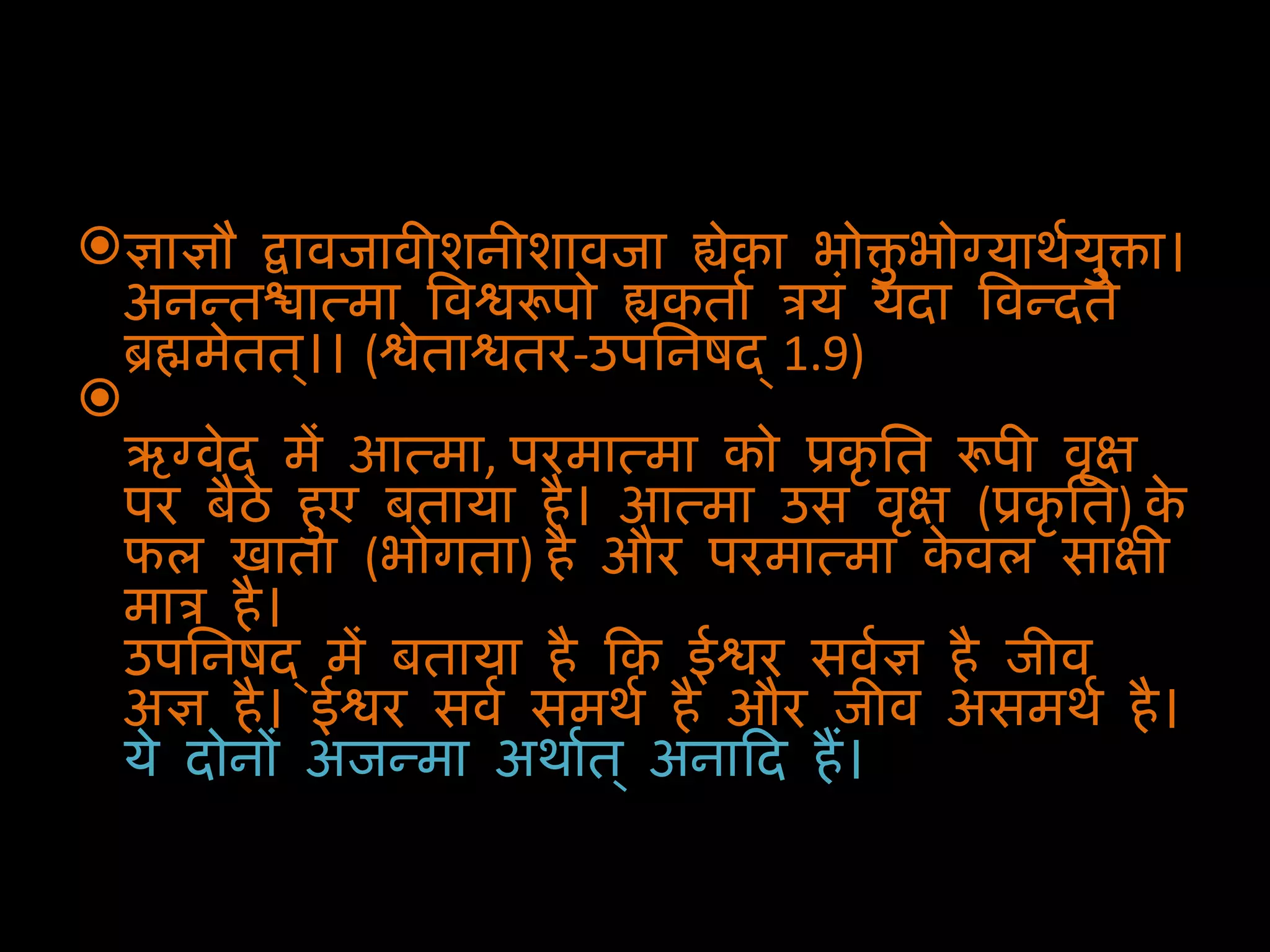
ज्ञाज्ञौ द्वावजावीशनीशावजा ह्येका भोक्तुभोग्यार्थयुक्ता। अनन्तश्चात्मा विश्वरूपो ह्यकर्ता त्रयं यदा विन्दते ब्रह्ममेतत्।।   ( श्वेताश्वतर - उपनिषद्   1.9) ऋग्वेद में आत्मा ,  परमात्मा को प्रकृति रूपी वृक्ष पर बैठे हुए बताया है। आत्मा उस वृक्ष  ( प्रकृति )  के फल खाता  ( भोगता )  है और परमात्मा केवल साक्षी मात्र है। उपनिषद् में बताया है कि ईश्वर सर्वज्ञ है जीव अज्ञ है। ईश्वर सर्व समर्थ है और जीव असमर्थ है।  ये दोनों अजन्मा अर्थात् अनादि हैं।
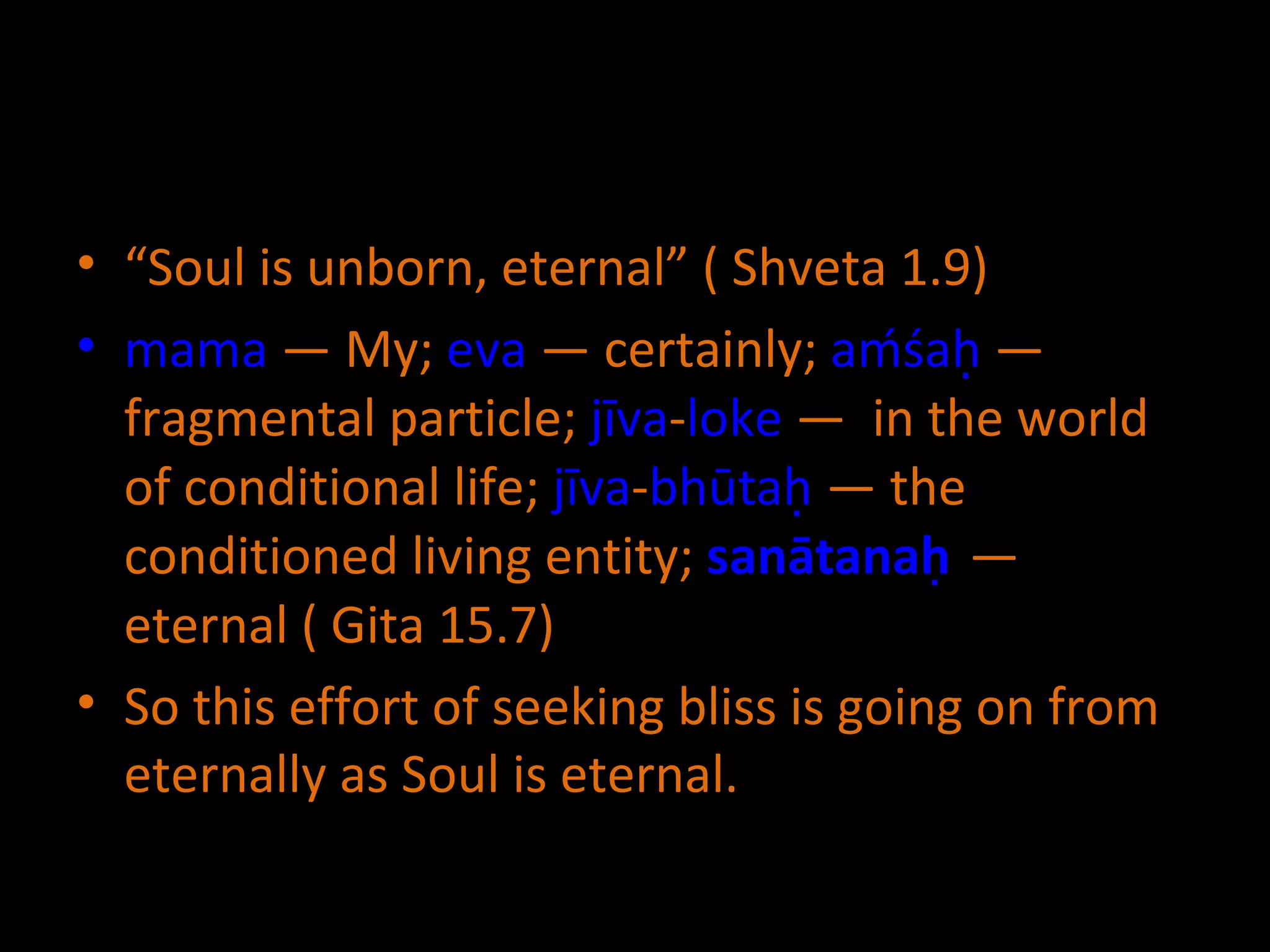
“ Soul is unborn, eternal” ( Shveta 1.9) mama  — My;  eva  — certainly;  aḿśaḥ  — fragmental particle;  jīva - loke  —  in  the world of conditional life;  jīva - bhūtaḥ  — the conditioned living entity;  sanātanaḥ   — eternal  ( Gita 15.7) So this effort of seeking bliss is going on from eternally as Soul is eternal.
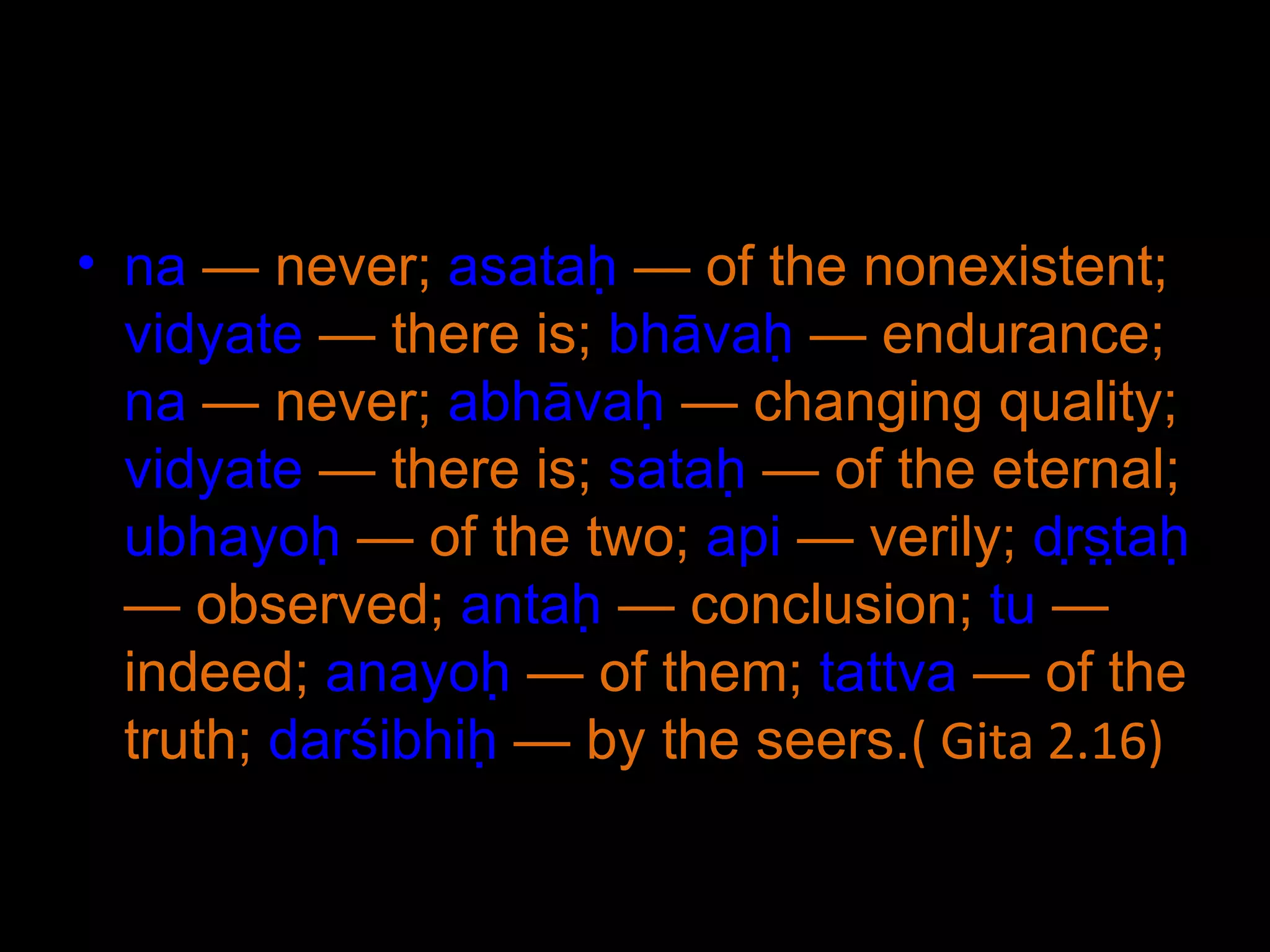
na  — never;  asataḥ  — of the nonexistent;  vidyate  — there is;  bhāvaḥ  — endurance;  na  — never;  abhāvaḥ  — changing quality;  vidyate  — there is;  sataḥ  — of the eternal;  ubhayoḥ  — of the two;  api  — verily;  dṛṣṭaḥ  — observed;  antaḥ  — conclusion;  tu  — indeed;  anayoḥ  — of them;  tattva  — of the truth;  darśibhiḥ  — by the seers. ( Gita 2.16)
Those who are seers of the truth have concluded that of the nonexistent [the material body] there is no endurance and of the eternal [the soul] there is no change. This they have concluded by studying the nature of both. ( Gita 2.16)
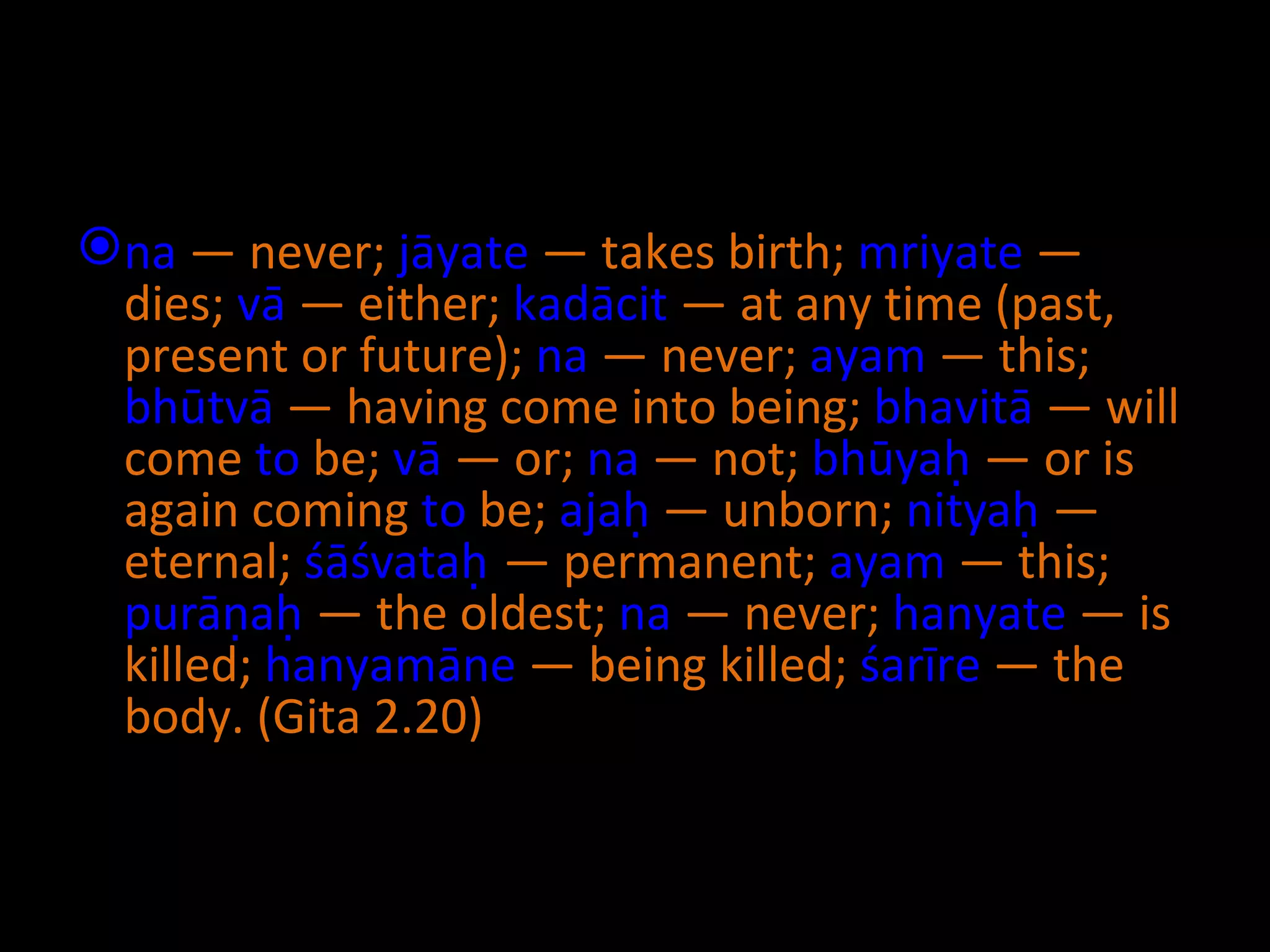
na  — never;  jāyate  — takes birth;  mriyate  — dies;  vā  — either;  kadācit  — at any time (past, present or future);  na  — never;  ayam  — this;  bhūtvā  — having come into being;  bhavitā  — will come  to  be;  vā  — or;  na  — not;  bhūyaḥ  — or is again coming  to  be;  ajaḥ  — unborn;  nityaḥ  — eternal;  śāśvataḥ  — permanent;  ayam  — this;  purāṇaḥ  — the oldest;  na  — never;  hanyate  — is killed;  hanyamāne  — being killed;  śarīre  — the body.  (Gita 2.20)
For the soul there is neither birth nor death at any time. He has not come into being, does not come into being, and will not come into being. He is unborn, eternal, ever-existing and primeval. He is not slain when the body is slain. ( Gita 2.20)
Hence it has been proved that we have been striving every moment since beginning-less time to attain Bliss and will continue to do so. Inspite of our continuous efforts of infinite lifetimes, we have not as yet attained this Bliss. What is the reason for this?
So why the soul has not found it yet inspite of searching for it eternally each moment to moment. Because it has not understood  1. what is bliss,  2. where it will be found and  3. how it will be found
What is Bliss? Yo vai bhuma tatsukham nalpe sukhamasti bhuma tveva vijijnasitavyah ( Chhan Up 7.23.1) The infinite ( bhuman ) is bliss. There is no bliss in anything finite. Infinity only is bliss. This Infinity we must desire to understand.
Where bliss is found? Where such everlasting and unlimited Bliss can be found? Material View : Happiness is attainable only when the individual acquires the cherished objects of his every desire. Refutation : Fulfilment of 1 desire will lead to new even stronger desire and hence happiness is not everylasting and is limited.
Where bliss is found? Jyom pratilabha lobha adhikayi ( Ramayan) yat  — what;  pṛthivyām  — within this world;  vrīhi  — food grains, rice;  yavam  — barley;  hiraṇyam  — gold;  paśavaḥ  — animals;  striyaḥ  — wives or other women;  na   duhyanti  —  do  not give;  manaḥ - prītim  — satisfaction of the mind;  puḿsaḥ  —  to   a  person;  kāma - hatasya  — because of being victimized by lusty desires;  te  — they  ( Bhag 9.19.13)
Where bliss is found? “ If all the objects of the universe ( here rice, barley and other food grains, gold, animals and women etc means whole world ) were available to one man, the disease of desire would nevertheless keep on increasing”  ( Bhag 9.19.13) Hence material view point is not correct
Where bliss is found? God Spiritual View :  Raso vai sah, rasam’ahyevayam labdhvanandi bhavanti ( Taitti Up 2.7) God is bliss. It is only by attaining Him, that the individual soul can become Blissful Tameva viditvati mrityumeti nanyah pantha vidyate’yanayte ( Shveta Up 3.8, 6.15) Only by knowing Him can the individual soul overcome material afflictions. There is no other way”
Does God exist?Empirically? Now the question arises Is there an entity called God, and should we accept that He exist merely because the scriptures say so, or is there any concrete proof of His existense? Empirical Evidence Fallacy :Empirically we cannot get knowledge of our father, letter A, existence of subtle objects like mind, intellect.
Does God exist? Inferentially? Orderly apperance of Universe Creation of sun, moon, stars Movement of sun,moon are governed by rules whose controller must be All powerful God World is upheld in space. Efforts involved in supporting earth and other planets must be due to God
Laws existing in creation must have some lawmaker who must be All-Knowing in order to implement and enforce these laws. For eg Law of Karma requires that the lawmaker is aware of uncountable karma of uncountable  souls.
Any work in the world is possible only when  Equipment, the doer, the knowledge, desire & effort are present. Nature doesnt have conciousness and doer means a conscious being. Pot creation example .  Apply all those ingredients into Universe Creation.
Professor Eddington declared “Some unknown imperceptible power is working behind some unperceived action but we do not know anything about it. We come across some such unknown element in our research, which is beyond explanation in material terms”
Any object possessing form is created from a source material that is subtler and more permanent in comparison to it. Thread is subtler then cloth since cloth gets form from thread If atom have a form, then they must be created from a source subtler & more permanent than them. Thats can be only God.
Nature of God : Beyond Maya Indriyebhyah para hyartha arthebhyash cha param manah Manasastu para buddhir buddheratma mahan parah ( Katha Up 1.3.10) Mahatah paraavyaktamavyaktat purushah parah Purushan na param kinchit sa kashtha sa para gatih ( Katha up 1.3.11)
Nature of God : Beyond Maya Beyond the senses are the senses objects, beyond the sense objects is the mind, beyond the mind is the intellect, beyond the intellect is the soul, beyond the soul is Maya and beyond the Maya is Brahman (God)
Nature of God : Divine Divyohyamurtah purushah ( Veda) “ God is Divine and the senses, mind and intellect are material”
Nature of God: Supreme Illuminator Tameva bhantamanubhati sarvain tasya bhasa sarvamidam vibhati ( Katha Up 2.2.15, Mundaka Up 2.2.10, Shveta Up 6.14) “ He is the Supreme Illuminator, and the senses, mind and intellect are illumined by Him”. The illumined cannot possibly illumine its illuminator. Hence he is totally unknowable.
Nature of God:Contradictions Abode of various simultaneously contradictory qualities Anaraniyan mahato mahiyan atma guhayam nihiti’sya jantoh Tamakratum pashyati vitashoko dhatuh prasadan mahimanamisham ( Shveta Up 3.20) “ He is smaller then the smallest atomic particle, Bigger then the biggest space.”( pg42)
The Grace of God Tamakratuh pashyati vitashoko Dhatuh prasadan mahimanamatmanah ( Katha Up 1.2.20) The Self, smaller than small, greater than great, is hidden in the heart of that creature. A man who is free from desires and free from grief, sees the majesty of the Self by the grace of the Creator.'
The Grace of God Nayamatma pravachanena labhyo Na medhaya na bahuna shrutena Yamevaisha vrinute tena labhayas Tasyaishna atma vivrinute tanum’svam ( Katha Up 1.2.23) That Self cannot be gained by the Veda, nor by understanding, nor by much learning. He whom the Self chooses, by him the Self can be gained. The Self chooses him (his body) as his own.
The Grace of God tat - prasādāt  — by His grace;  parām  — transcendental;  śāntim  — peace;  sthānam  — the abode;  prāpsyasi  — you will get;  śāśvatam  — eternal. ( Gita 18.62) By His grace you will attain transcendental peace and the supreme and eternal abode.
The Grace of God arjunaḥ   uvāca  —  Arjuna  said;  naṣṭaḥ  — dispelled;  mohaḥ  — illusion;  smṛtiḥ  — memory;  labdhā  — regained;  tvat - prasādāt  — by Your mercy;  mayā  — by  me ;  acyuta  —  O  infallible  Kṛṣṇa  ( Gita 18.73) By your grace alone, I have attained Divine Knowledge and my ignorance has been dispelled forever.
Bhag 10.14.29 atha  — therefore;  api  — indeed;  te  — Your;  deva  — my Lord;  pada - ambuja - dvaya  — of the two lotus feet;  prasāda  — of the mercy;  leśa  — by only  a  trace;  anugṛhītaḥ  — favored;  eva  — certainly;  hi  — indeed;  jānāti  — one knows;  tattvam  — the truth;  bhagavat  — of the Supreme Personality of Godhead;  mahimnaḥ  — of the greatness;  na  — never;  ca  — and;  anyaḥ  — another;  ekaḥ  — one;  api  — although;  ciram  — for  a  long period;  vicinvan  — speculating
The Grace of God No one can know God even if he endeavours to know Him for innumerable lifetimes, but when God imparts His Grace to a soul, he can know Him and attain Divine Bliss for eternity ( Bhag10.14.29)
The Grace of God Soi janai jehi dehu janai Janata tumahim tumahim hvai jai Tumharihim kripa tumahim raghunandana Janata bhagata bhagata ura chandana Rama kripa binu sunu khagarai Jani na jai rama prabhutai  Only by His Grace that one can be freed from the bondage of Maya
The Grace of God Rajata sipa maham bhasa jimi, yatha bhanu kara vari Tadapi mrisha tihum kala maham, bhrama na sakai kou tari Jasu kripa asa bhrama miti jai, girija so kripalu ragharai ( Ramayan  ) Only by God Grace, one can be freed from delusion
Rama kripa nasahim saba roga :-Ramayan Only by God grace goes all mental afflictions Binu satsanga viveka na hoi Rama kripa binu sulabha na soi. Aba mohim bha bharosa hanumanta Binu hari kripa milahim nahim santa Association of genuine saints not possible without Grace of God
Santa vishuddha milahim puni tehi Rama kripa kari chitavahim jehi Only by grace of God, that one attains the association of a true Saint. So does that mean everything God will do?
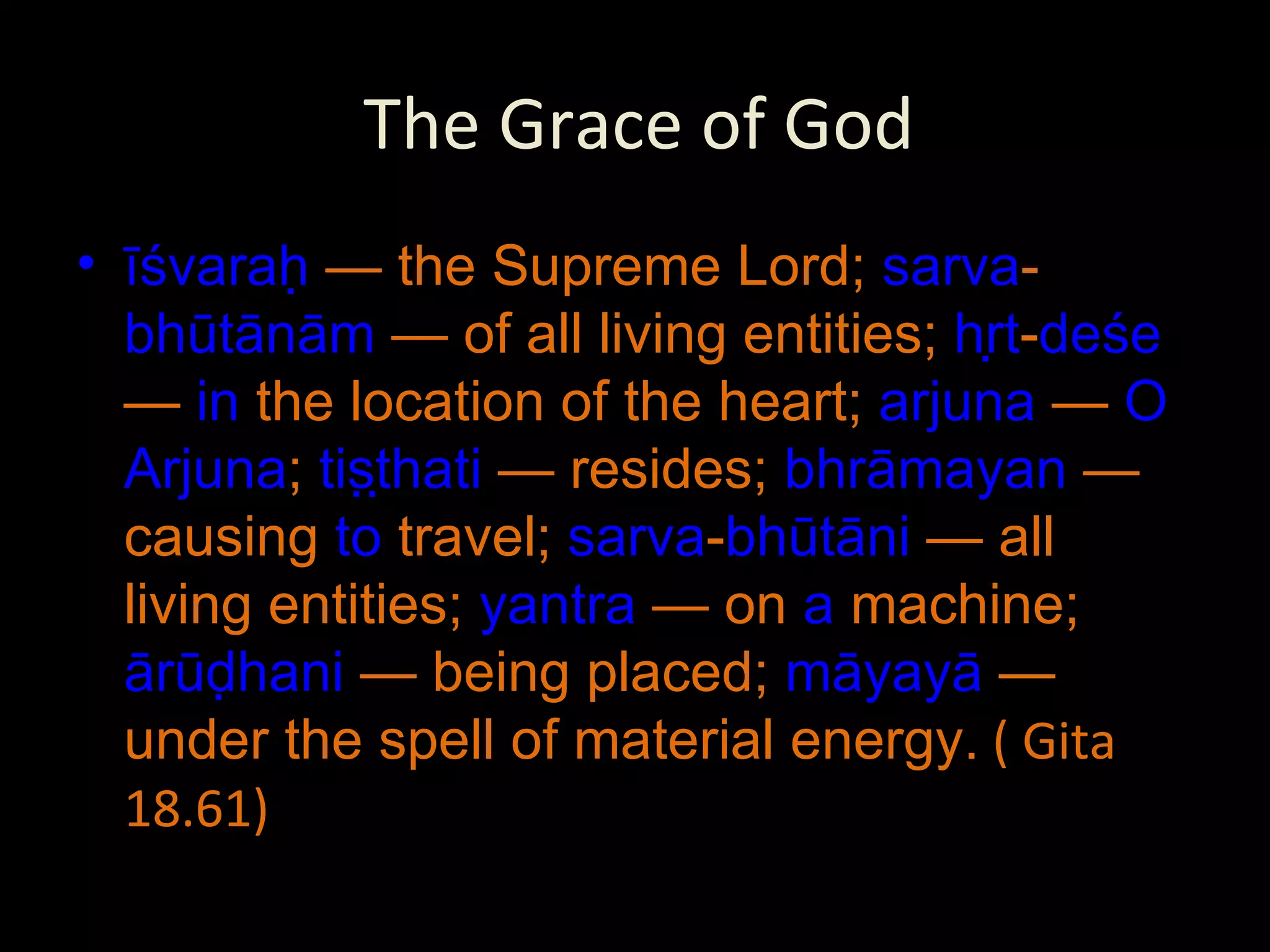
The Grace of God īśvaraḥ  — the Supreme Lord;  sarva - bhūtānām  — of all living entities;  hṛt - deśe  —  in  the location of the heart;  arjuna  —  O   Arjuna ;  tiṣṭhati  — resides;  bhrāmayan  — causing  to  travel;  sarva - bhūtāni  — all living entities;  yantra  — on  a  machine;  ārūḍhani  — being placed;  māyayā  — under the spell of material energy.  ( Gita 18.61)
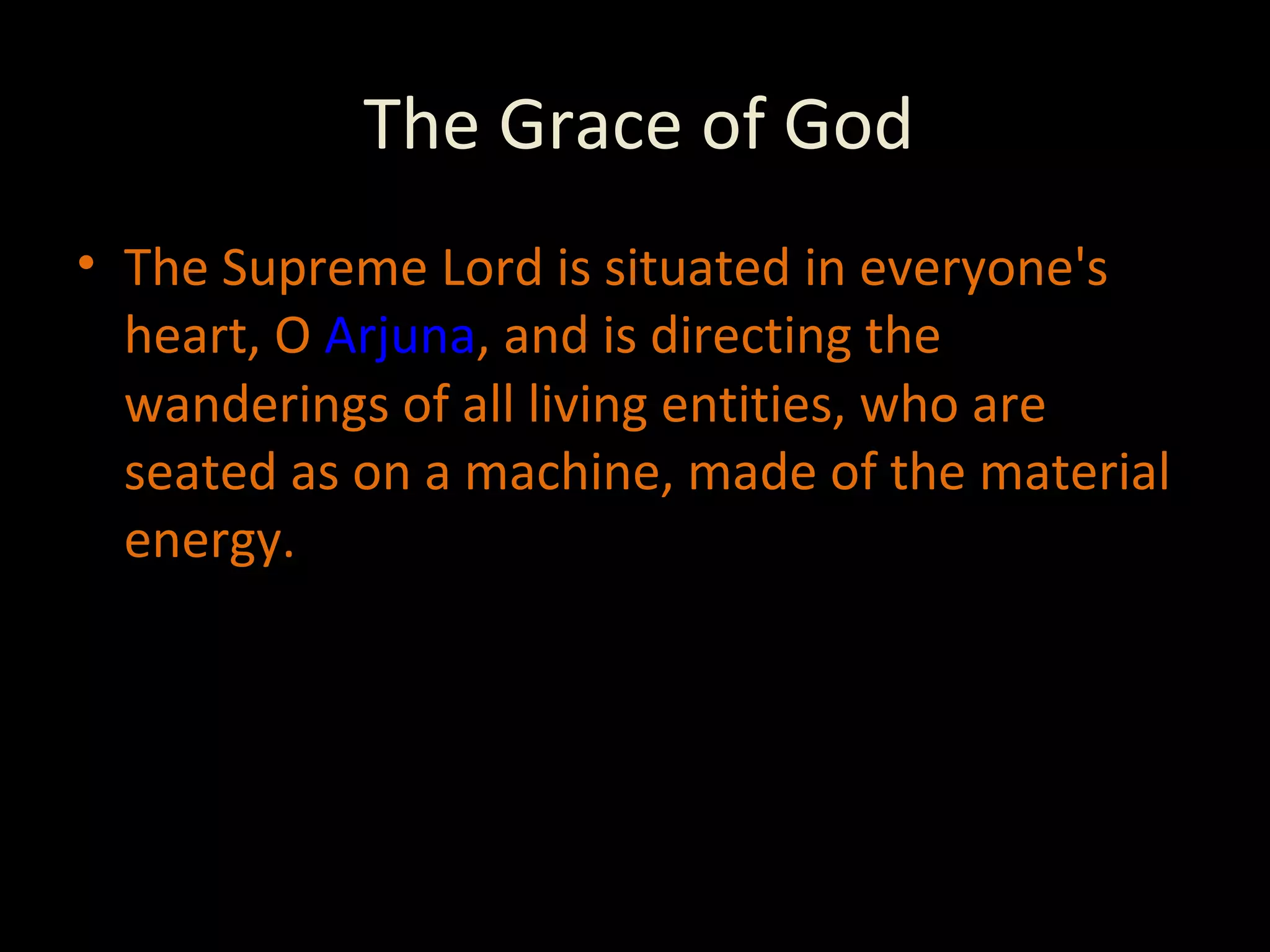
The Grace of God The Supreme Lord is situated in everyone's heart, O  Arjuna , and is directing the wanderings of all living entities, who are seated as on a machine, made of the material energy.
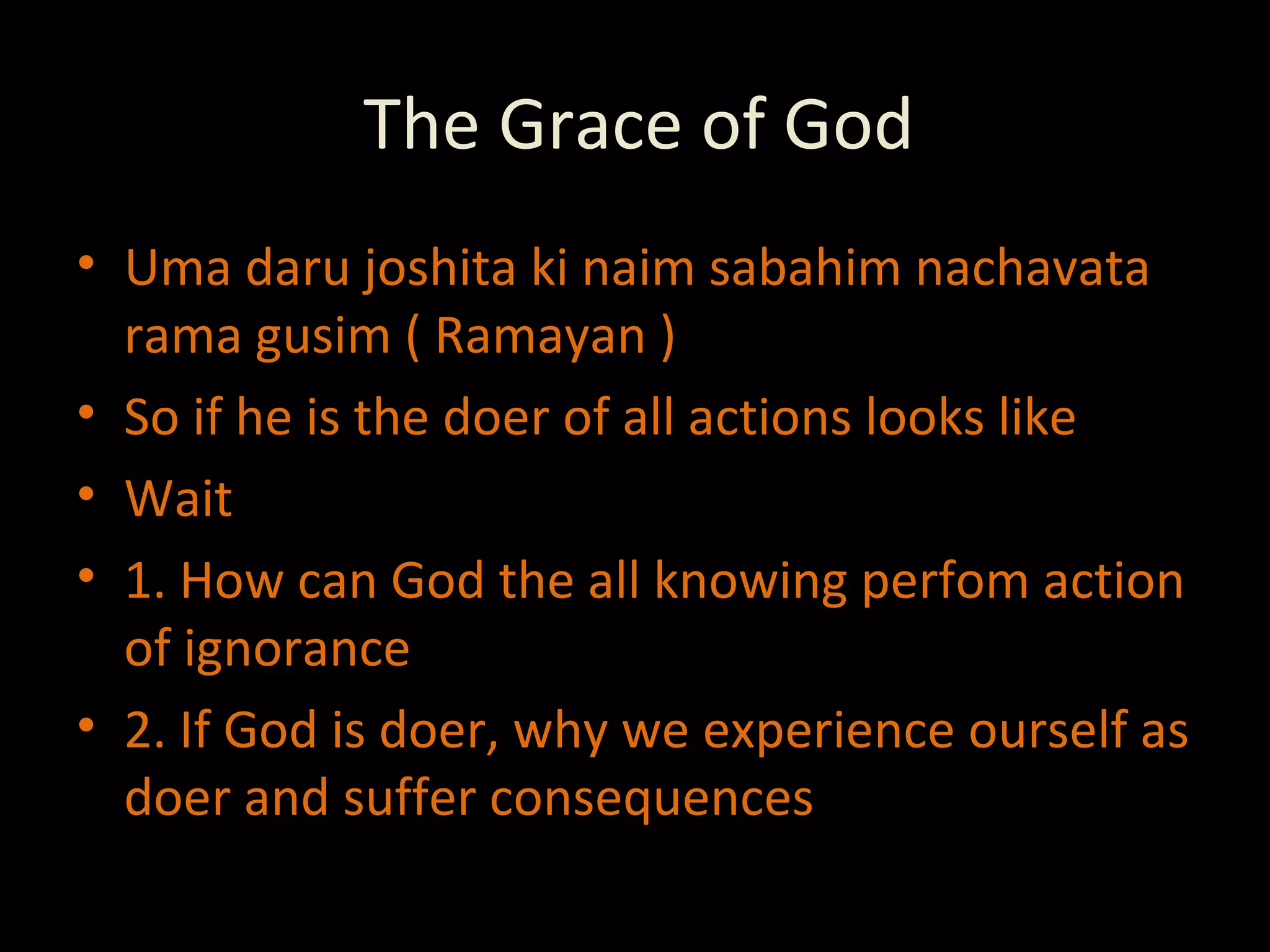
The Grace of God Uma daru joshita ki naim sabahim nachavata rama gusim ( Ramayan ) So if he is the doer of all actions looks like Wait 1. How can God the all knowing perfom action of ignorance  2. If God is doer, why we experience ourself as doer and suffer consequences
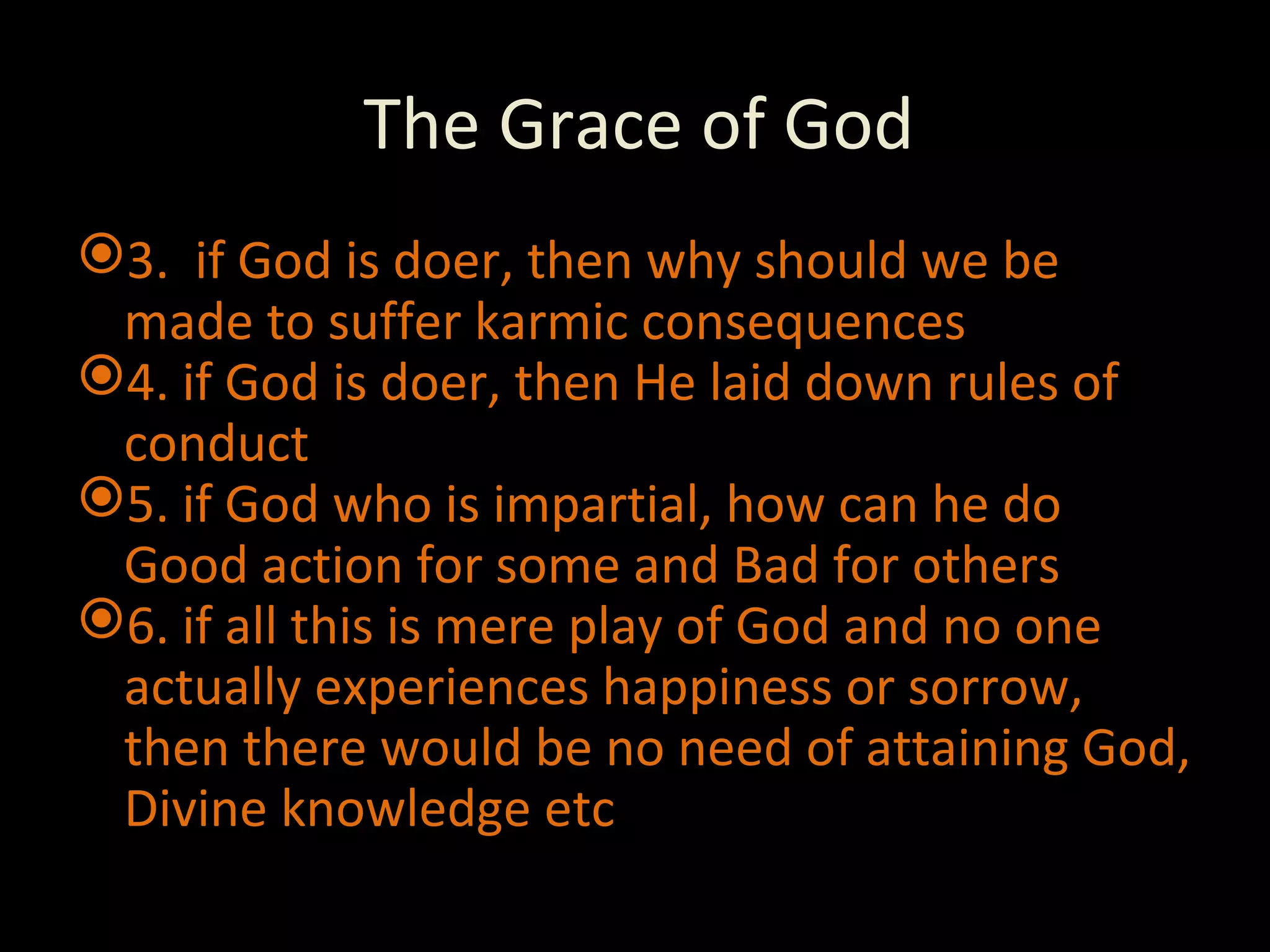
The Grace of God 3.  if God is doer, then why should we be made to suffer karmic consequences 4. if God is doer, then He laid down rules of conduct 5. if God who is impartial, how can he do Good action for some and Bad for others 6. if all this is mere play of God and no one actually experiences happiness or sorrow, then there would be no need of attaining God, Divine knowledge etc
The Grace of God Can we leave everything on fate? Purvajanamakritam karma taddaivamiti kathyate ( Hitopadesha ) The fruits of actions performed with a freedom of will in past lives are designated as fate in the present life.
The Grace of God Nara tanu bhava varidhi kaham bero Sanmukha maruta anugraha mero Karnadhara sadguru drirha nava Durlabha saja sulabha kari pava Jo na tarai bhavasagara, nara samaja asa pai  So krita nindaka manda mati, atama hana gati jai
The Grace of God So paratra dukha pavai, sira dhuni dhuni pachhitaya Kalahim karmahim ishvarahim, mithya dosha lagaya
Surrender Yo brahmanam vidadhati purvam Yo vai vedamsh cha prahinoti tasmai Tam’ha devamatmabuddhiprakasham Mumukshurvai sharanamaham prapadye ( Shveta Up. 6.18) Tapah prabhavad devaprasadacha ( Shveta Up 6.21)
Surrender Surrender to the supreme Lord, Who is the creator of the even Brahma and other gods and by Whose Grace, the soul and intellect are illumined” Tameva sharanam gachchha sarvabhavena bharata Tatprasadat param shantim sthanam prapsyasi shashvatam ( Gita 18.62)
“ Surrender to the Supreme Lord alone with all your being, then you will receive His Grace by which you will attain the Divine Abode and Everlasting Peace” What is the reason that surrendering is so compulsory?
daivī  — transcendental;  hi  — certainly;  eṣā  — this;  guṇa - mayī  — consisting of the three modes of material nature;  mama  — My;  māyā  — energy;  duratyayā  — very difficult  to  overcome;  mām  — unto  Me ;  eva  — certainly;  ye  — those who;  prapadyante  — surrender;  māyām   etām  — this illusory energy;  taranti  — overcome;  te  — they ( Gita 7.14)”
This divine energy of Mine, consisting of the three modes of material nature, is difficult to overcome. But those who have surrendered unto Me can easily cross beyond it. ( Gita 7.14)
tasmāt  — therefore;  tvam  — you;  uddhava  —  O   Uddhava ;  utsṛjya  — giving up;  codanām  — the regulations of the Vedas;  praticodanām  — the injunctions of supplementary Vedic literatures;  pravṛttim  — injunctions;  ca  — and;  nivṛttim  — prohibitions;  ca  — also;  śrotavyam  — that which is  to  be heard;  śrutam  — that which has been heard;  eva  — indeed;  ca  — also ( Bhag 11.12.14)
mām  —  to   Me ;  ekam  — alone;  eva  — actually;  śaraṇam  — shelter;  ātmānam  — the Supersoul within the heart;  sarva - dehinām  — of all conditioned souls;  yāhi  — you must  go ;  sarva - ātma - bhāvena  — with exclusive devotion;  mayā  — by My mercy;  syāḥ  — you should be;  hi  — certainly;  akutaḥ - bhayaḥ  — free from fear  in  all circumstances.  ( Bhag 11.12.15)
Therefore, My dear  Uddhava , abandon the Vedic mantras as well as the procedures of supplementary Vedic literatures and their positive and negative injunctions. Disregard that which has been heard and that which is to be heard. Simply take shelter of Me alone, for I am the Supreme Personality of Godhead, situated within the heart of all conditioned souls.
Take shelter of Me wholeheartedly, and by My grace be free from fear in all circumstances. Mana krama vachana chhamri chaturai Bhajatahim kripa karahim raghurai ( Ramayana) “ It is only through complete surrender that one can attain Grace and be liberated from the bondage of Maya”
All the scriptural evidence implies that we must surrender to God. God Grace is dependent upon surrender. Phirata sada maya kara prera Kala karma svabhava guna ghera Those who do not surrender, revolve in 8.4 million species governed by  1. Time 2. Destiny 3.Their own karmas  4. Three Gunas
So God depends our surrender as condition for His Grace. So is it like a worldly business transaction? No. Because surrender means not to do anything . Ie Doing actions whatsoever without the feeling of doership.
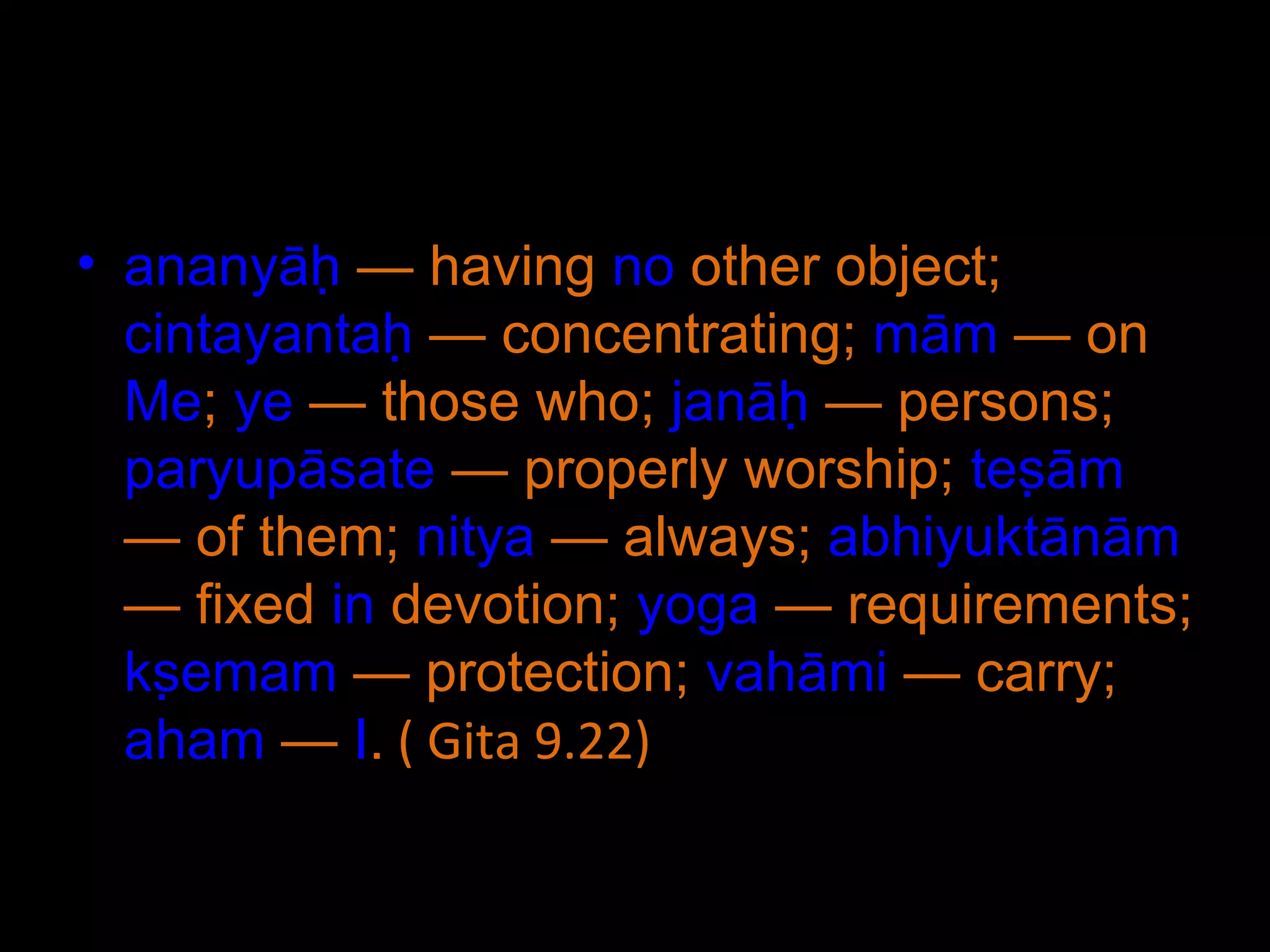
ananyāḥ  — having  no  other object;  cintayantaḥ  — concentrating;  mām  — on  Me ;  ye  — those who;  janāḥ  — persons;  paryupāsate  — properly worship;  teṣām  — of them;  nitya  — always;  abhiyuktānām  — fixed  in  devotion;  yoga  — requirements;  kṣemam  — protection;  vahāmi  — carry;  aham  —  I .  ( Gita 9.22)
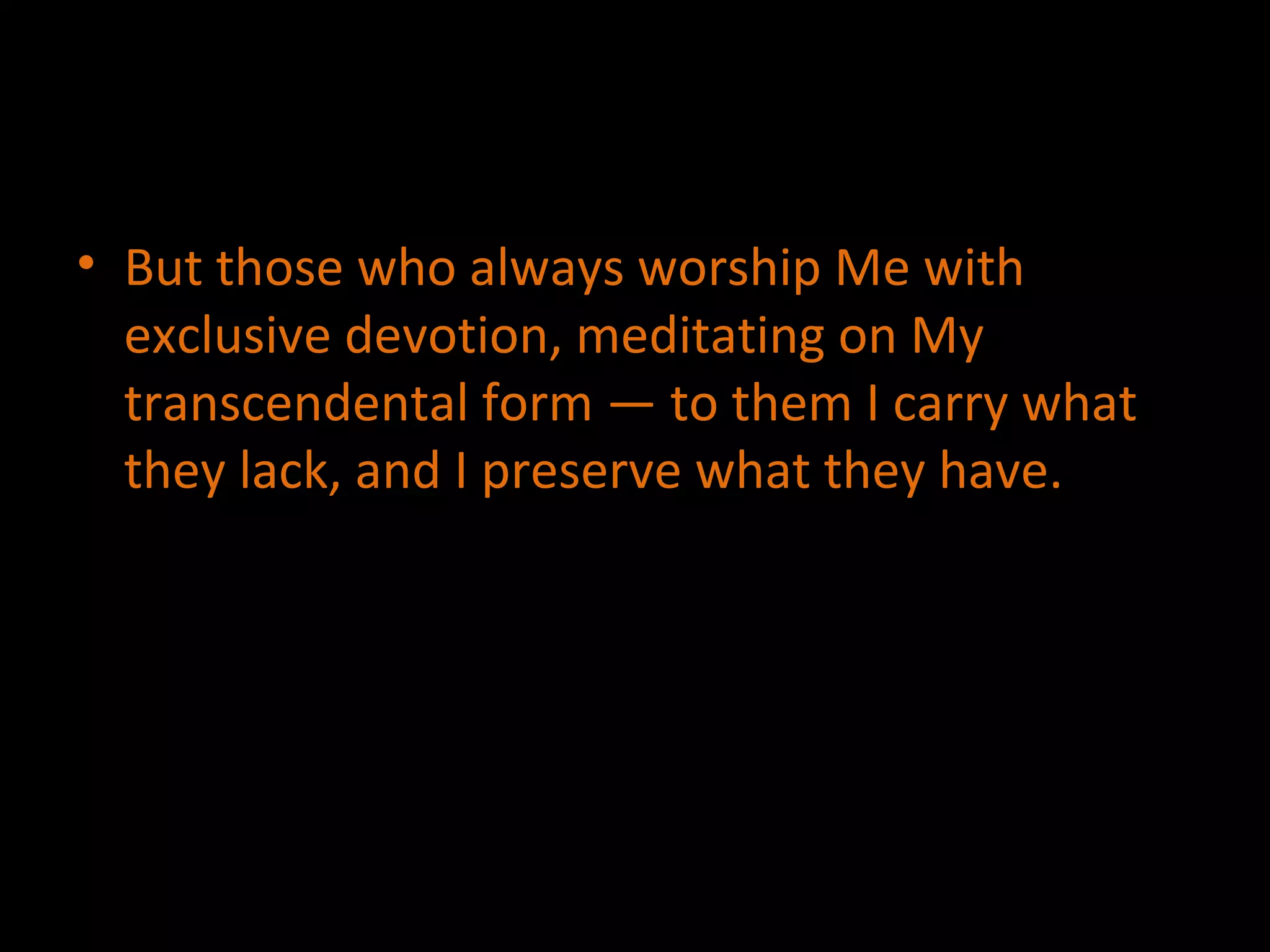
those who always worship Me with exclusive devotion, meditating on My transcendental form — to them I carry what they lack, and I preserve what they have.
What is Surrender Simple but profound wisdom of  yielding  to rather than  opposing  the flow of life. Relinquish inner resistance to what  is  because  is  is created by God  Inner resistance is to say “no” to what  is  , through mental judgement and emotional negativity.
Surrender is perfectly compatible with taking action, initiating change, or achieving goals. But in  the surrendered state a totally different energy, a different quality, flows into your doing. It connects you to the source-energy of Divine. This is surrendered action.
Example of Surrender When Draupadi saw no help coming from anyone, she tried to protect herself and clenched her sari between her teeth. Failure of protect herself would mean getting naked in front of assembly of her husbands, uncles, cousins, enemies of her husband and in front of public.
When Duhshasana pulled her sari with a jerk, she lost hold of it and was totally helpless. Now, she surrendered herself completely to Lord Krishna. She came to a state of doing nothing. It was only when she ceased to expect protection from all sources including her own strength, that she surrendered.
So when we depend only on the protection of God and no other source including our own strength, we can truely surrender as surrender means not to do anything. If we depend on our own strength, then we will do something to protect ourselves and it will not be true surrender.
sarva - dharmān  — all varieties of religion;  parityajya  — abandoning;  mām  — unto  Me ;  ekam  — only;  śaraṇam  — for surrender;  vraja  —  go ;  aham  —  I ;  tvām  — you;  sarva  — all;  pāpebhyaḥ  — from sinful reactions;  mokṣayiṣyāmi  — will deliver;  mā  —  do  not;  śucaḥ  — worry.  ( Gita 18.66)
Abandon all varieties of religion and just surrender unto Me. I shall deliver you from all sinful reactions. Do not fear. Now what we have to surrender to God? We have  1. Body  2. Senses 3. Mind 4. Intellect
Mana eva manushyanam karnam bandhamokshayoh ( Panchadashi ) “ The mind alone is the cause of bondage and of liberation”
cetaḥ  — consciousness;  khalu  — indeed;  asya  — of him;  bandhāya  — for bondage;  muktaye  — for liberation;  ca  — and;  ātmanaḥ  — of the living entity;  matam  — is considered;  guṇeṣu  —  in  the three modes of nature;  saktam  — attracted;  bandhāya  — for conditional life;  ratam  — attached;  vā  — or;  puḿsi  —  in  the Supreme Personality of Godhead;  muktaye  — for liberation. ( Bhag 3.25.15)
The stage in which the consciousness of the living entity is attracted by the three modes of material nature is called conditional life. But when that same consciousness is attached to the Supreme Personality of Godhead, one is situated in the consciousness of liberation.
Remember this rule You are where your mind is. At the time of death, you will go where your mind is. Since mind is already attached to material world, it needs to be removed from material world and then surrendered to God. So we will now discuss nature of soul, world and detachment.
Nature of the Soul Soul is  1. Eternal 2. Does not die or take birth 3. Cannot be burnt, or drown in water, even God cannot destroy it what to speak of others. 4. Divine , being an energy of Divine God 5. Does not change. Remains same
Nature of Material World Samsaratiti samsarah; gachchhatiti jagat “ That which is in a state of constant flux and is ever-changing is referred to as the world” Made of Maya Mayam tu prakritim vidyamayinam tu maheshvaram, tasyavayavabhutaistu vyap tam sarvamidam jagat ( Shevta Up 4.10)
“ Maya is not an illusion or false notion. It is a power of God” Ajamekam lohitshuklakrishnam bahvih prajah srijamanam sarupah, aja hyeko jushamano’nushete jahatyenam bhuktabhogamajo’nyah ( Shevta Up 4.5) Daivi hyesha gunamayi mama maya duratyaya ( Gita 7.14)
So dasi raghuvira ki samujhe mithya sopi Maya is diavi ( divine ) ie of God. Mama maya ( My Maya ) So its duratyaya ( cannot be surpassed ) Mind is material and world is material but God is Divine. Hence mind gets naturally attracted to world but not to God. How can divine power of God, Maya create material mind and world?
Nature of God includes contradiction. Further even we see how the concious human being produces material hair , material nails.
Two Worlds External World : Created by Maya , is real world but is changing constantly. Inner World : Created by subtle impressions by desires for various gross material objects. Inner world is more powerful then external world. It effects us even when external world is absent ( in dreams)
Presence of External world however makes inner world further strong. One thing is certain and that is , if the intellect makes a firm decision that the objects of the external world cannot fulfill our goal of Supreme Bliss, then the internal desires will automatically come to an end.
THE FIRST STEP So the first step is to make a FIRM DECISION, through CONSTANT REFLECTION, that there is not a trace of true happiness in the material world.
Reflection If any object contains happiness, then everyone should receive happiness from it. Also, the happiness should be permanent and not followed by misery. Neither of these condition is fulfilled by anything material.
Liquor A drunkard experiences happiness at the very mention of liquor and becomes happier when he actually drinks it. But the same liquor is a source of displeasure to a teetotaller. Does the liquor contain happiness experienced by drunkard or revulsion experiened by teetotaller?
Umesh Dies On hearing the death news of Umesh, His wife : Fell unconscious His son :  Cried but didnt fell unconscious His friend : cried less then son His sevant : didnt cry but felt sad His neighbour : Felt neither happiness nor distress. His debtor : Happy that he wont have to pay
Umesh comes back to life! Wife : Fainted again out of happiness Son : Shed tears of joy Friend : Became happy  Servant : Great relief for him Neighbour : no difference Debtor : Sad that now he will have to pay
Umesh is source of ? Is  Umesh a source of happiness or sadness? To what degress? People imagined Umesh to be a source of happiness to the extent of their own desires were fulfilled by him. They naively thought that Umesh was the source of happiness they were experiencing.
Conclusion is that a person derives happiness from an object that he himself mentally ascribes to , but naively assumes that it is the object itself that contains happiness. One more point : If one doesnt experience happiness from any object, then one will not experience sorrow from that object either.
2 nd  point : The happiness we experience from any object, constantly diminishes. Eg. Mother crying for lost son and then son comes, first embrace, second embrace, go and play. Eg. Chocolate : First chocolate, second yes, third ok, forth no no.
Eg. A thirsty man love water and not when his thirst is quenched Eg. A lustful man longs for a woman but when that lustful craving is absent, that same woman becomes burdensome. Eg. People think happiness in beauty. A ugly child lost and his mother loves that ugly child rather then other good looking child in front of her at police station.
One man is ready to shoot a beautiful woman and another stands between them ready to die for her. On enquiry, the man ready to shoot is husband and the other her lover. If there is happiness in beauty, both of them would have experienced it equally.
Liquor smells disgusting to a teetotaller, pleasurable to alcoholic, Onion/Garlic smell disgusting to one man and aromatic to another.  Beauty, fragrance etc do not contain happiness. However, if someone repeatedly thinks of a particular object to be a source of happiness, he becomes attached to it.
dhyāyataḥ  — while contemplating;  viṣayān  — sense objects;  puḿsaḥ  — of  a  person;  sańgaḥ  — attachment;  teṣu  —  in  the sense objects;  upajāyate  — develops  ( Gita 2.62) Consequently, one experiences happiness from that object and sorrow when deprived from it.
3 rd  truth : Attaintment of any wordly object is always preceded, accompanied and followed by unhappiness. Eg. A woman desires to have child. To fulfil her desire, she gets married and loses her independence. Then even after many years, no child. Then medicines , then finally child, then 9 months  and tensions and then worries of right upbringing till the child is adult
And then worries about his marriage , character, behavior and his childerns. 4 th  truth : There is definitely an experience of momentary happiness when a desire is fulfilled but it is immediately followed by greed for more. If desire is not fulfilled, then comes anger or fear.
5 th  truth : Major delusion : whatever i have is not sufficient to make me happy. Eg. A poor villager sees  prime minister limousine and dreams of sitting in it one day. Later he becomes driver but his happiness is no more in sitting in that car all day.
Before an object is acquired, one experiences pleasure in the delusive hope of attaining happiness in the future if the object is acquired. But the moment we acquire it, the experience  is quite the opposite. Instead of happiness, one begins to experience sorrow.
Therefore, one should abandon this foolish expectation of attainting a higher level of happiness upon acquiring better material objects. The happiness experienced by a begger in embracing her ugly, lame child = experience  of queen embarcing her beautiful delicate prince.
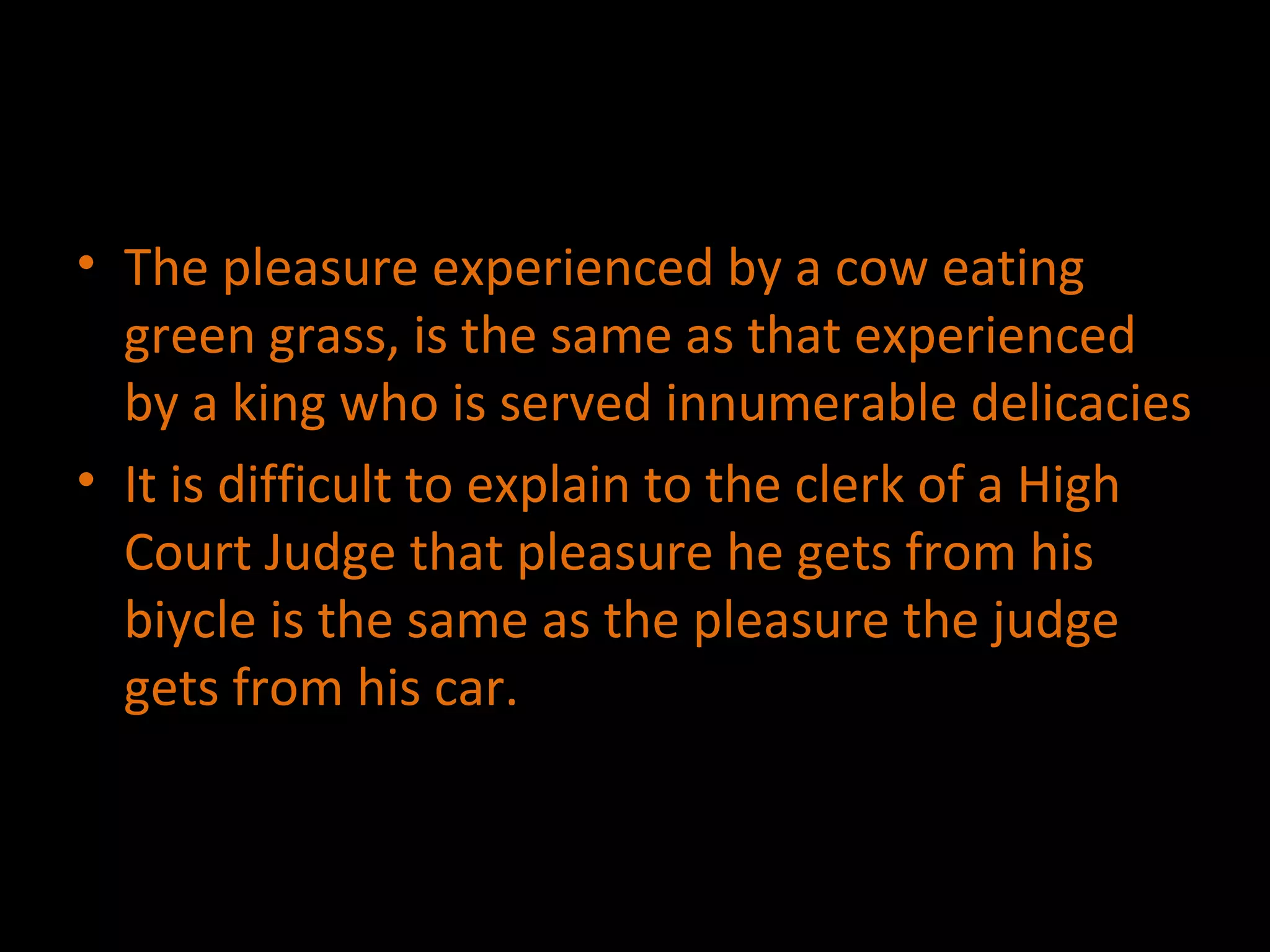
The pleasure experienced by a cow eating green grass, is the same as that experienced by a king who is served innumerable delicacies It is difficult to explain to the clerk of a High Court Judge that pleasure he gets from his biycle is the same as the pleasure the judge gets from his car.
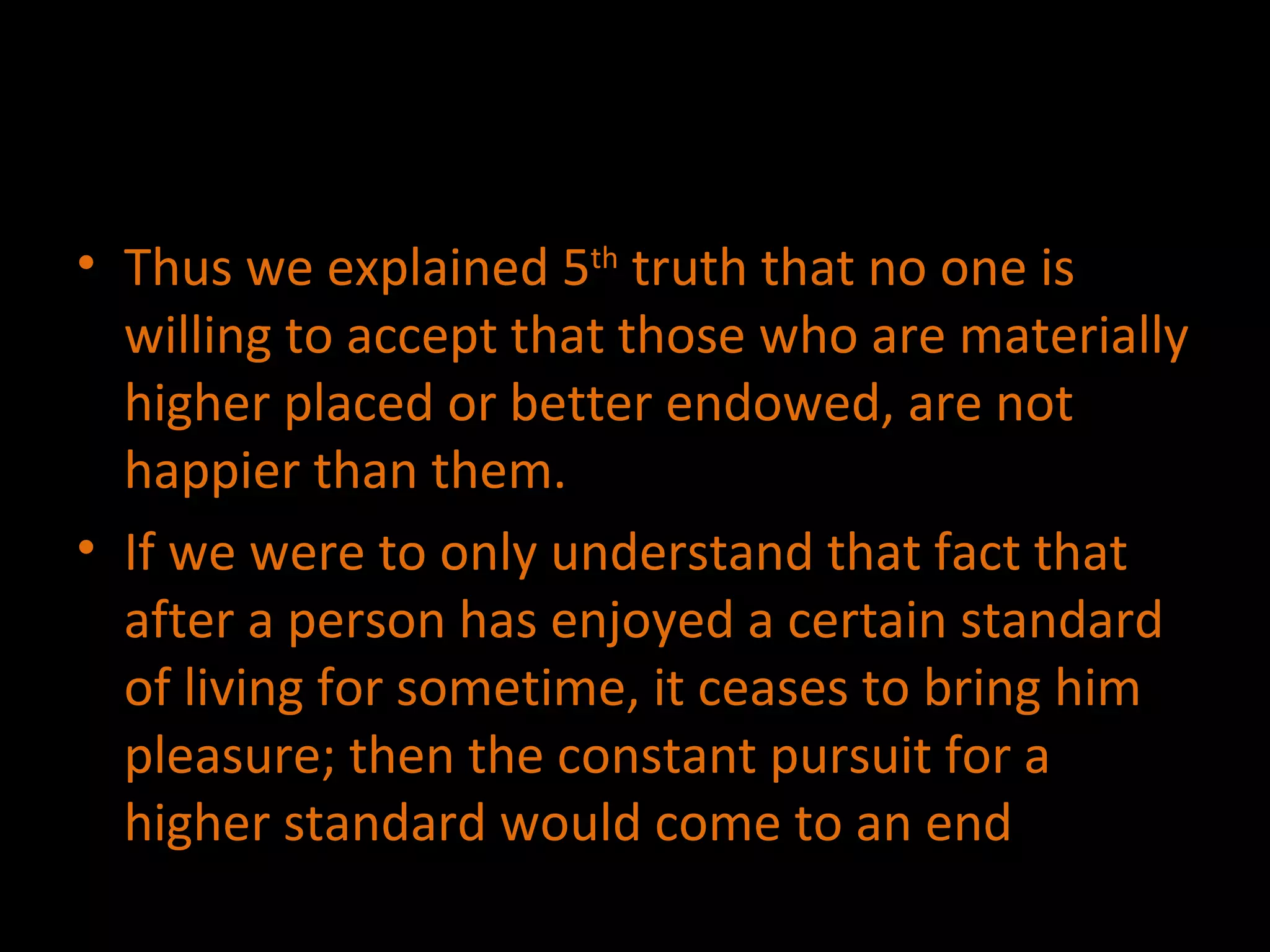
Thus we explained 5 th  truth that no one is willing to accept that those who are materially higher placed or better endowed, are not happier than them. If we were to only understand that fact that after a person has enjoyed a certain standard of living for sometime, it ceases to bring him pleasure; then the constant pursuit for a higher standard would come to an end
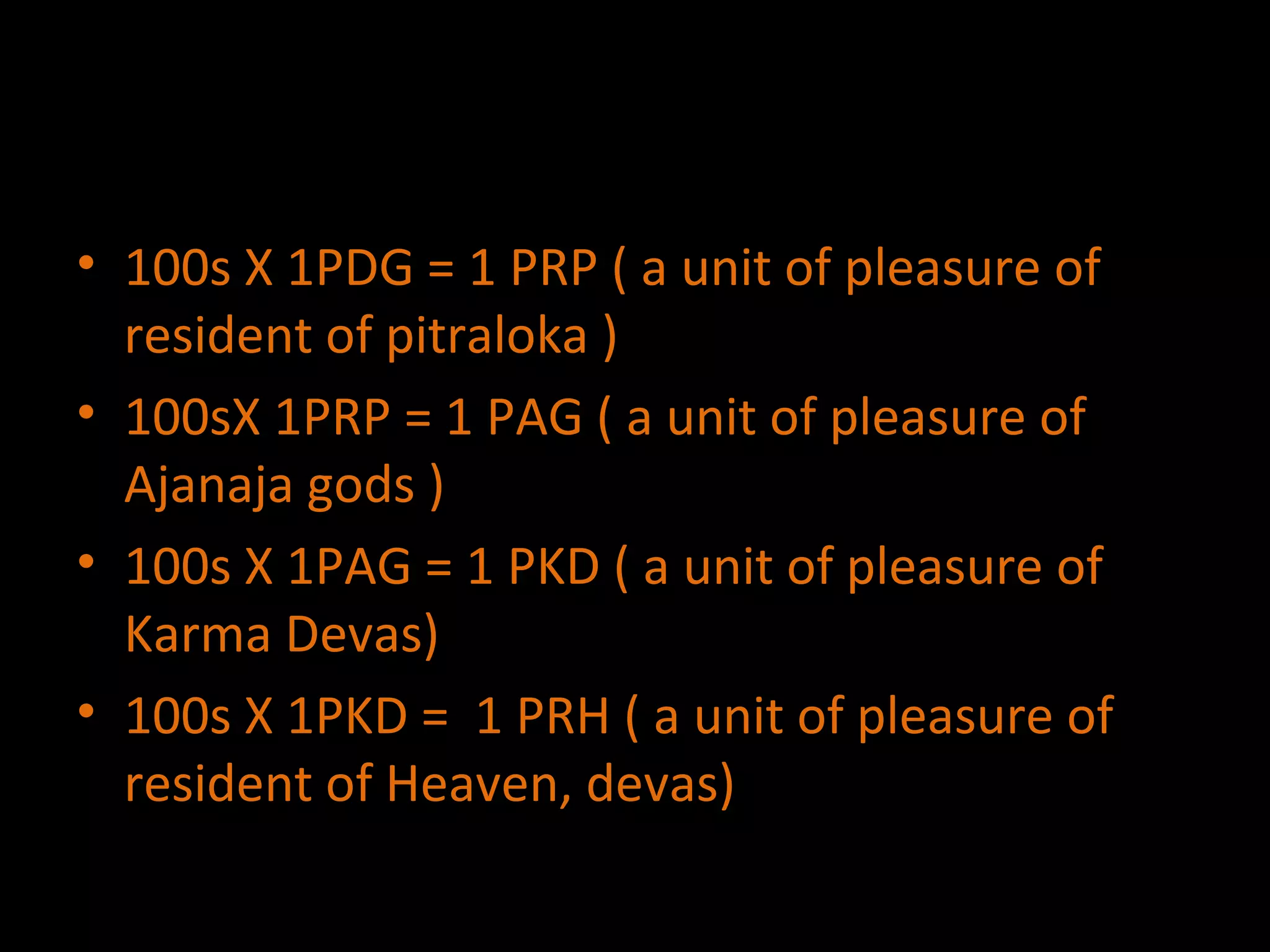
Various level of Material Happiness You are going to be astonished now!!!! 1 PKE ( a unit of pleasure of king of earth) : a person alone ruling entire planet earth, is young, healthy, intelligent, subjects are favourable, enjoys luxuries. 100sX 1PKE = 1 PMG ( a unit of pleasure of Manava Gandharva) 100xX1PMG = 1PDG ( Deva Gandharvas)
100s X 1PDG = 1 PRP ( a unit of pleasure of resident of pitraloka ) 100sX 1PRP = 1 PAG ( a unit of pleasure of Ajanaja gods ) 100s X 1PAG = 1 PKD ( a unit of pleasure of Karma Devas) 100s X 1PKD =  1 PRH ( a unit of pleasure of resident of Heaven, devas)
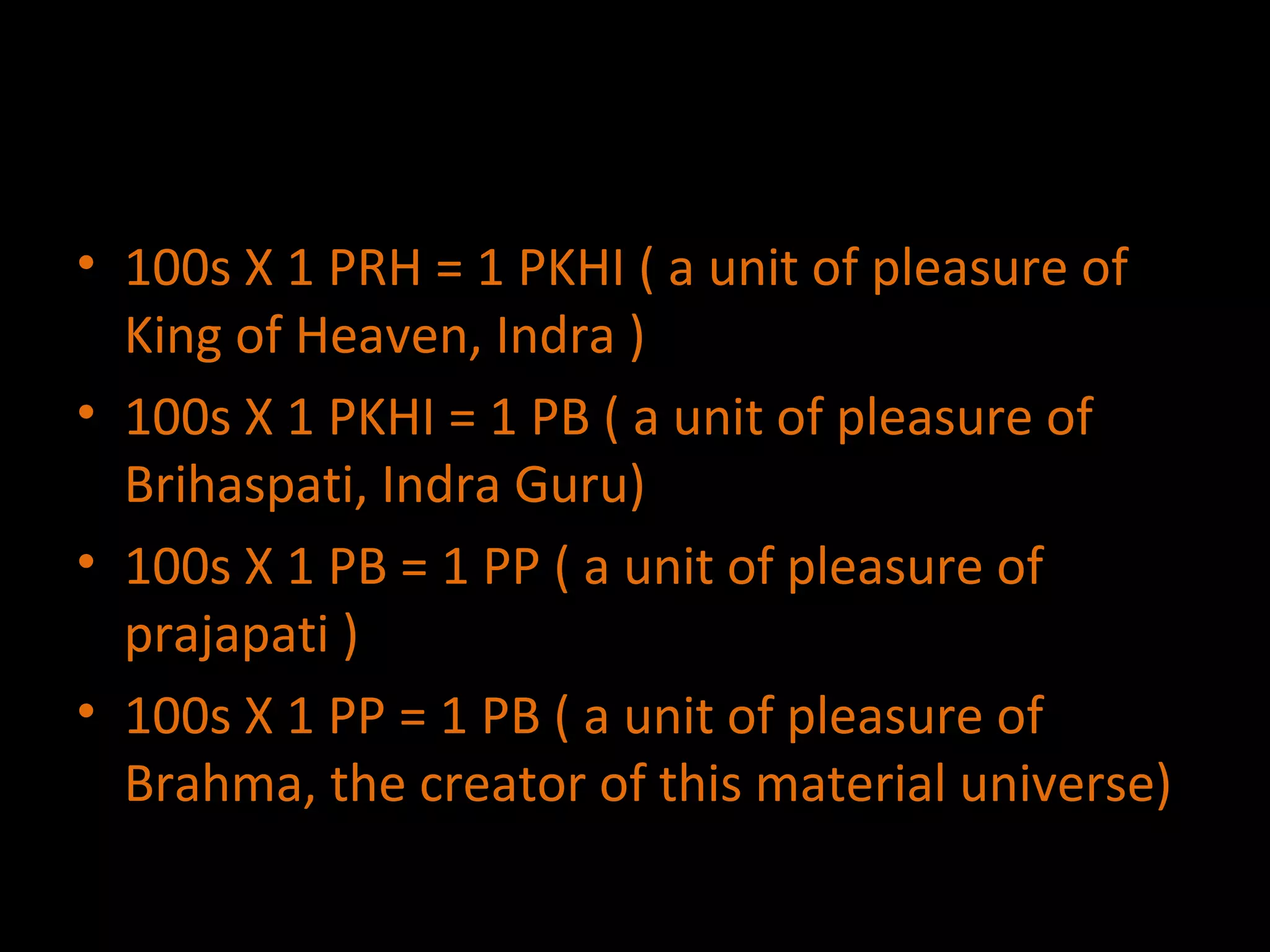
100s X 1 PRH = 1 PKHI ( a unit of pleasure of King of Heaven, Indra ) 100s X 1 PKHI = 1 PB ( a unit of pleasure of  Brihaspati, Indra Guru) 100s X 1 PB = 1 PP ( a unit of pleasure of prajapati ) 100s X 1 PP = 1 PB ( a unit of pleasure of Brahma, the creator of this material universe)
All of these are material abodes and are limited. Beyond all this, is divine , which is unlimited pleasure. ā - brahma - bhuvanāt  — up  to  the Brahmaloka planet;  lokāḥ  — the planetary systems;  punaḥ  — again;  āvartinaḥ  — returning;  arjuna  —  O   Arjuna ;  ( Gita 8.16) From the highest planet in the material world down to the lowest, all are places of misery wherein repeated birth and death take place.
mām  — unto  Me ;  upetya  — arriving;  tu  — but;  kaunteya  —  O  son of  Kuntī ;  punaḥ   janma  — rebirth;  na  — never;  vidyate  — takes place.  ( Gita 8.16) But one who attains to My abode, O son of  Kuntī , never takes birth again
Now, when true happiness is not attainable, even from the enjoyments of the abode of Brahma, is it not suprising and foolish to expect true happiness by desiring to become millionaires and billionaires in this material world.
yat  — what;  pṛthivyām  — within this world;  vrīhi  — food grains, rice;  yavam  — barley;  hiraṇyam  — gold;  paśavaḥ  — animals;  striyaḥ  — wives or other women;  na   duhyanti  —  do  not give;  manaḥ - prītim  — satisfaction of the mind;  puḿsaḥ  —  to   a  person;  kāma - hatasya  — because of being victimized by lusty desires;  te  — they.  ( Bhag 9.19.13)
“ If all the objects of the universe ( here rice, barley and other food grains, gold, animals and women etc means whole world ) were available to one man, the disease of desire would nevertheless keep on increasing”  ( Bhag 9.19.13)
nr  — human;  deham  — body;  ādyam  — the source of all favorable results;  su - labham  — effortlessly obtained;  su - durlabham  — although impossible  to  obtain even with great endeavor;  plavam  —  a  boat;  su - kalpam  — extremely well suited for its purpose;
guru  — having the spiritual master;  karṇa - dhāram  —  as  the captain of the boat;  mayā  — by  Me ;  anukūlena  — with favorable;  nabhasvatā  — winds;  īritam  — impelled;  pumān  —  a  person;  bhava  — of material existence;  abdhim  — the ocean;  na  — does not;  taret  — cross over;  saḥ  —  he ;  ātma - hā  — the killer of his own soul.
The human body, which can award all benefit in life, is automatically obtained by the laws of nature, although it is a very rare achievement. This human body can be compared to a perfectly constructed boat having the spiritual master as the captain and the instructions of the Personality of Godhead as favorable winds impelling it on its course.
Considering all these advantages, a human being who does not utilize his human life to cross the ocean of material existence must be considered the killer of his own soul. ( Bhag 11.20.17)
3 Gunas The three gunas keep fluctuating all day and night in each person. Hence talk to other person when he is in right mood Due to lack of sattvika qualities, when only a person is exposed to sattva in abundance, he occasionally is dominated by this mode. There is abundance of raja and hence easily overpowered by it even with slightest exposure.
Tamas is the most powerful of all guna. You are in prayer : Sattva You child, wife touches you while in prayer : Rajas Neighbour comes angrily and makes statements : you go into Tamas and become angry as well.
God and saints appear to us to be endowed with these gunas because of our own perception is colored by these gunas When everyone is suffering with these 3 gunas, amicablity is possible between 2 person only when their gunas match  in degree and in time.
Husband wife while on way to movie theater, hears kirtan. Wife sattva arises and she says, lets go to kirtan. We can go to movie later. However huband still dominated by rajas ( passion) guna and says “ oh you suddenly appear so be very religious. You can attend kirtan if you wish. I will go to movies only”
Such arguments are simply a result of differences in the degree of intensity of the gunas in each individual. If you understood the play of these constantly changing gunas, you would be surprised if even one person agreed with you the whole day.
Unfortunately, you have wrong understanding. That is why is surprises you even if one person contradicts you. The reality is there is neither agreement nor opposition in this world. Whatever we observe, is due to the interaction of the 3 gunas.
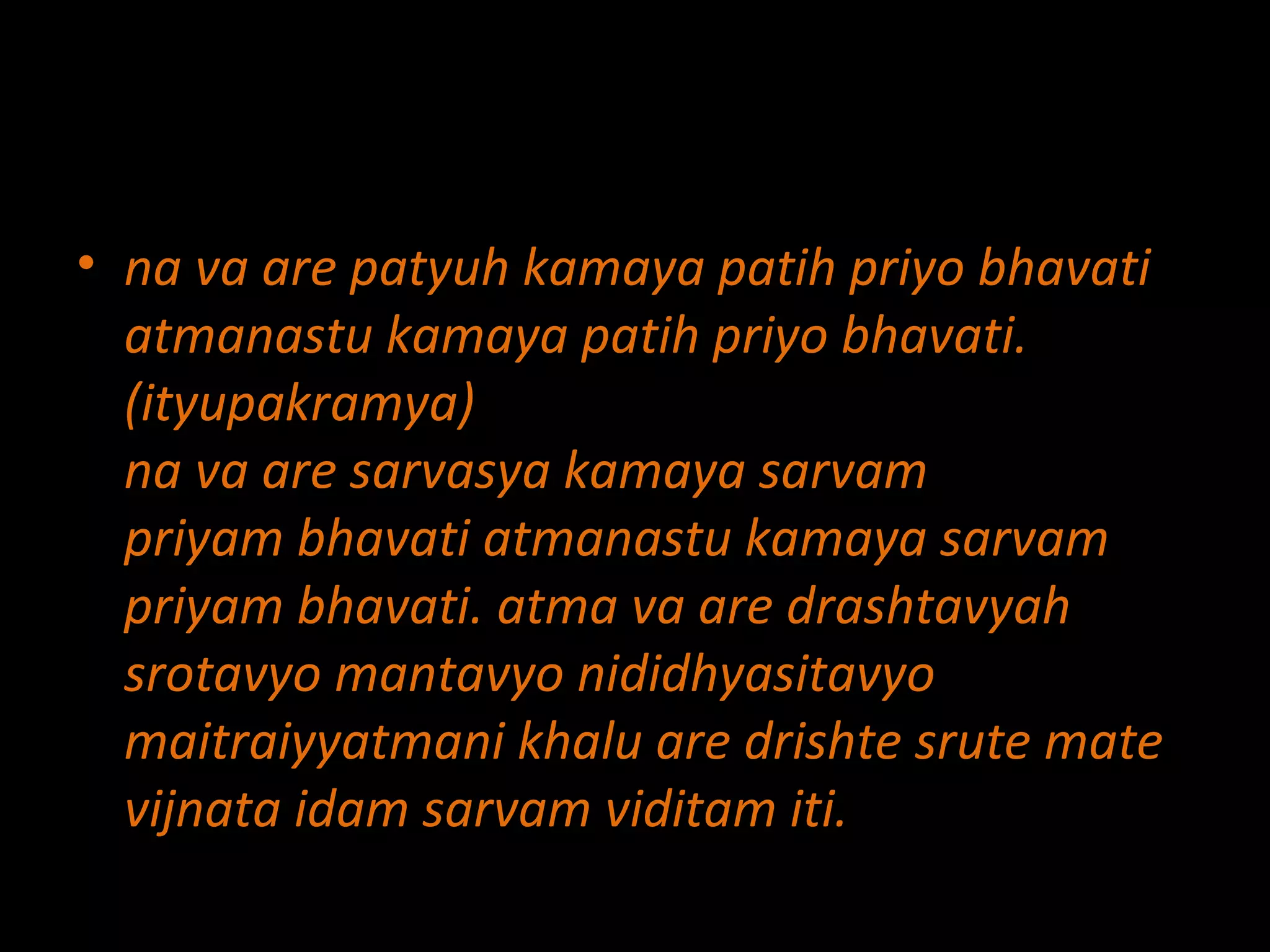
na va are patyuh kamaya patih priyo bhavati atmanastu kamaya patih priyo bhavati. (ityupakramya) na va are sarvasya kamaya sarvam priyam bhavati atmanastu kamaya sarvam priyam bhavati. atma va are drashtavyah srotavyo mantavyo nididhyasitavyo maitraiyyatmani khalu are drishte srute mate vijnata idam sarvam viditam iti.
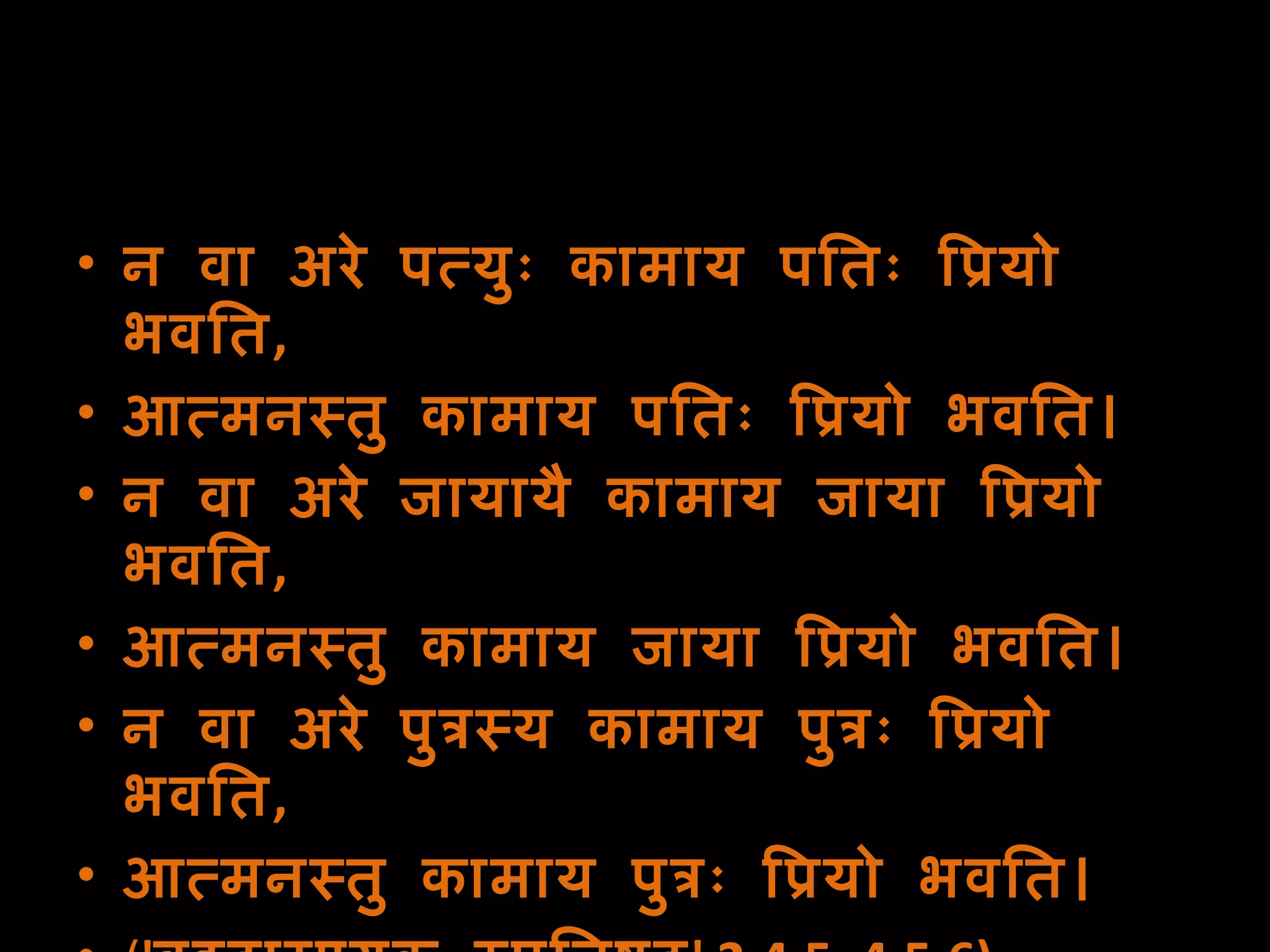
न वा अरे पत्युः कामाय पतिः प्रियो भवति , आत्मनस्तु कामाय पतिः प्रियो भवति। न वा अरे जायायै कामाय जाया प्रियो भवति , आत्मनस्तु कामाय जाया प्रियो भवति। न वा अरे पुत्रस्य कामाय पुत्रः प्रियो भवति , आत्मनस्तु कामाय पुत्रः प्रियो भवति। ( ' वृहदारण्यक उपनिषद '  2.4.5, 4.5.6)
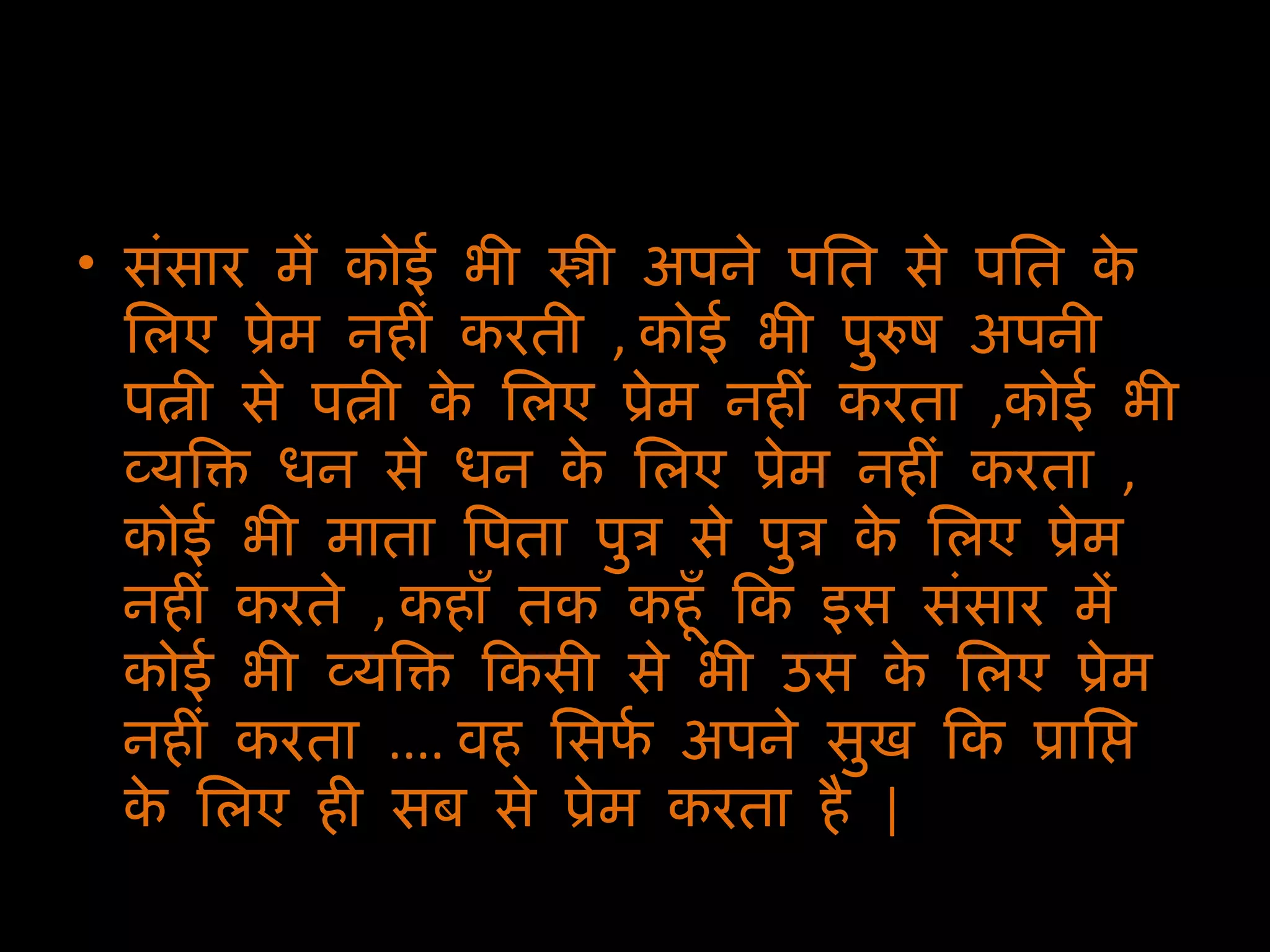
संसार में कोई भी स्त्री अपने पति से पति के लिए प्रेम नहीं करती  ,  कोई भी पुरुष अपनी पत्नी से पत्नी के लिए प्रेम नहीं करता  , कोई भी व्यक्ति धन से धन के लिए प्रेम नहीं करता  ,  कोई भी माता पिता पुत्र से पुत्र के लिए प्रेम नहीं करते  ,  कहाँ तक कहूँ कि इस संसार में कोई भी व्यक्ति किसी से भी उस के लिए प्रेम नहीं करता  ....  वह सिर्फ अपने सुख कि प्राप्ति के लिए ही सब से प्रेम करता है  |
पत्नी को पति इसलिए प्रिय नहीं होता ,  क्योंकि वह पति है ,  वरन् पत्नी को पति इसलिए प्रिय होता है ,  क्योंकि पति से उसके हित की सिद्धि होती है। इसी प्रकार पति के लिए पत्नी इसलिए नहीं प्रिय होती क्योंकि वह पत्नी है। पति के लिए पत्नी इसलिए प्रिय होती है ,  क्योंकि पत्नी से पति क्योंकि पत्नी से पति के स्वार्थ की सिद्धि होती है।
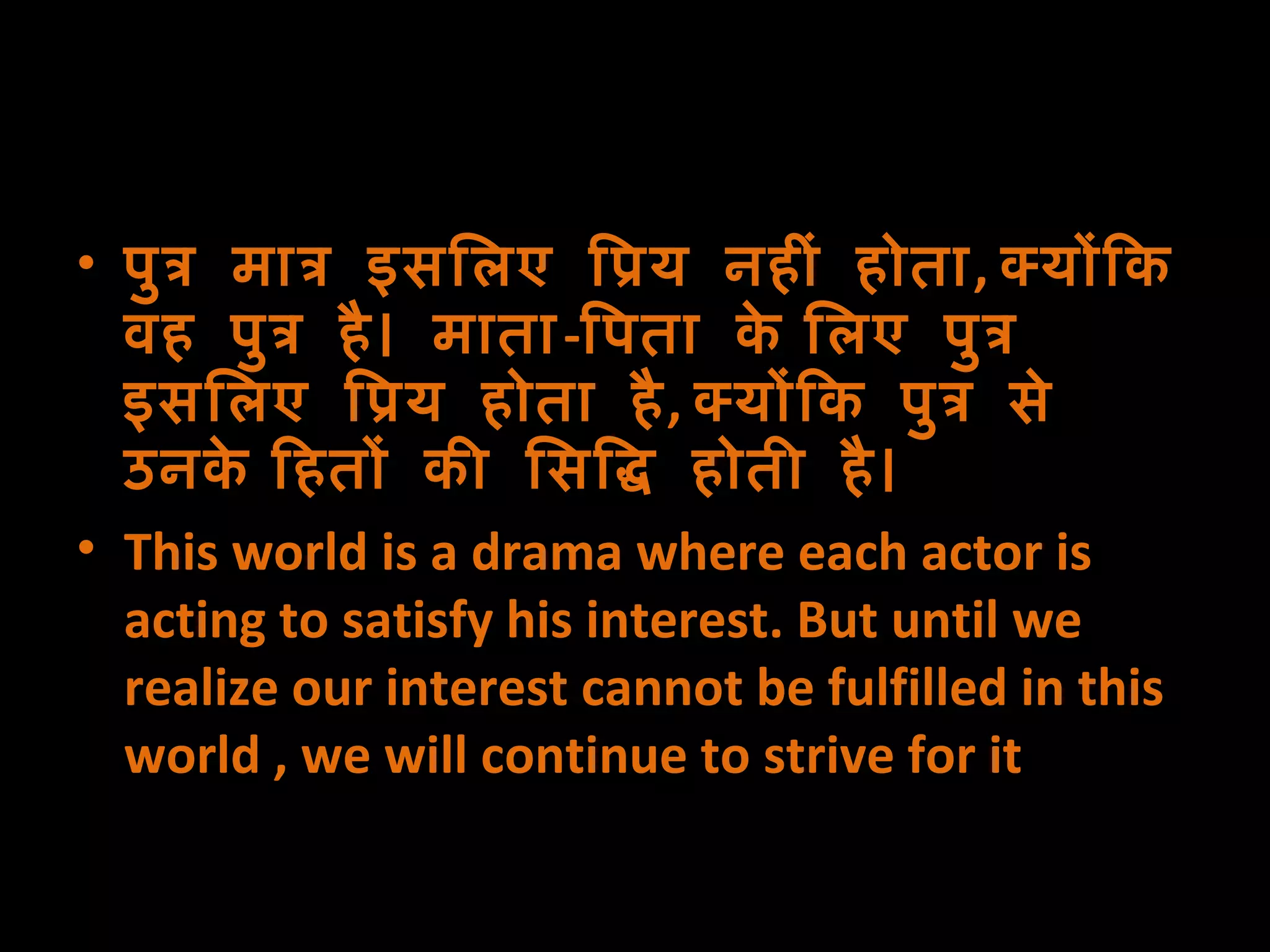
पुत्र मात्र इसलिए प्रिय नहीं होता ,  क्योंकि वह पुत्र है। माता - पिता के लिए पुत्र इसलिए प्रिय होता है ,  क्योंकि पुत्र से उनके हितों की सिद्धि होती है। This world is a drama where each actor is acting to satisfy his interest. But until we realize our interest cannot be fulfilled in this world , we will continue to strive for it
So one who has understood this, will have neither attachment nor aversion in this world and will attach himself to God. This world doesnt have bliss.
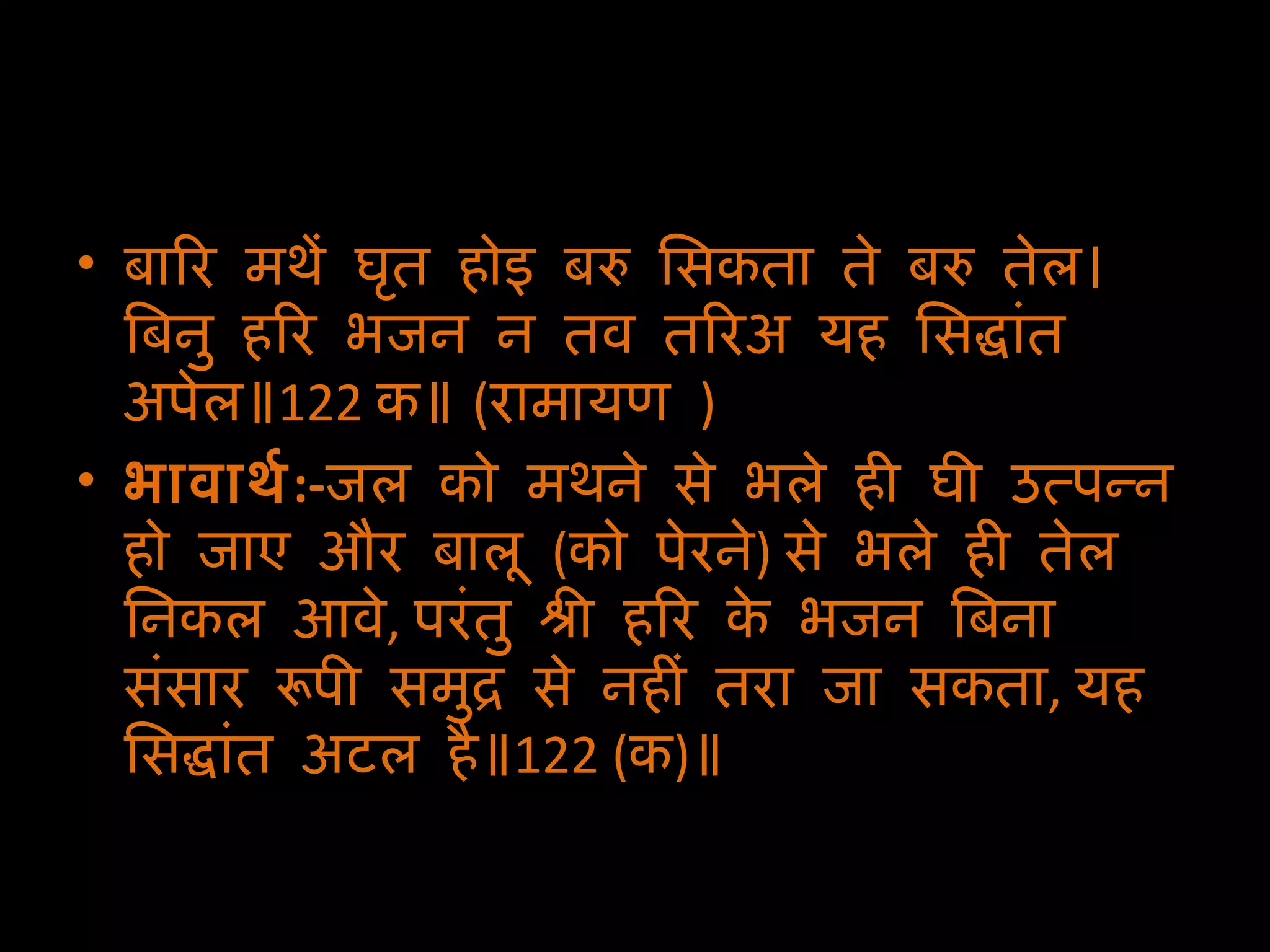
बारि मथें घृत होइ बरु सिकता ते बरु तेल। बिनु हरि भजन न तव तरिअ यह सिद्धांत अपेल॥ 122  क॥   ( रामायण  ) भावार्थ :- जल को मथने से भले ही घी उत्पन्न हो जाए और बालू  ( को पेरने )  से भले ही तेल निकल आवे ,  परंतु श्री हरि के भजन बिना संसार रूपी समुद्र से नहीं तरा जा सकता ,  यह सिद्धांत अटल है॥ 122 ( क ) ॥
A foolish is brought in jail and keep without food for 1 week. After 1 week, in golden utensils, he is given delicious food but his well-wisher says him there is poison in food. The fool will not eat it even though he has not seen poison, nor even tasted nor seen anyone putting poison in food. But we so intelligent , keep seeing posion, tasting it daily but still dont listen to saints and scriptures.
śrī - bhagavān   uvāca  — the Personality of Godhead said;  yasya  — whom;  aham  —  I ;  anugṛhṇāmi  — favor;  hariṣye  —  I  will take away;  tat  — his;  dhanam  — wealth;  śanaiḥ  — gradually;  tataḥ  — then;  adhanam  — poor;  tyajanti  — abandon;  asya  — his;  sva - janāḥ  — relatives and friends;  duḥkha - duḥkhitam  — who suffers one distress after another. ( Bhag 10.88.8)
The Personality of Godhead said: If I especially favor someone, I gradually deprive him of his wealth. Then the relatives and friends of such a poverty-stricken man abandon him. In this way he suffers one distress after another. सुख के माथे सिल पड़े जो नाम हृदयते जाय  | बलिहारी वा दुःख की जो पल पल नाम रटाय  ||  ( Kabir Dhoha )
Nature of Detachment Attachment can be of positive type or negative type. Ideal situation of detachment is described in this kabir doha. कबिरा खड़ा बजार में सबकी माँगे खैर | ना काहू से दोस्ती ना काहू से बैर ||
Mother lost her child in mela ( funfare) She saw very similar child and thought he is hers and went to him. On seeing that the child was not her, she didnt got attached to this child thinking i didnt find mine but this is equally good neither she got angry to this child that why you werent my child .
A drunkard goes to market for wine and as he comes across different shops, he doesnt get angry on those shops why they are not my wine shop, nor does he wait on those shops to buy something else. He goes without stop to the his shop where he will get wine without being angry or attached to any other shop.
Remember that till mind is attached or averted to anything in this world, complete attachment to God is not possible and hence God Realization is not possible either. Till the knowledge “there is neither happiness nor suffering in this world” is mature and firm in us, real detachment is not possible.
How to make tattva gyan firm? To make the tattva gyan firm , 1. deep thought on nature of the world and 2. repeated thought is needed. Thinking only a once or few times will not work as we have contradictory thought from innumerable lifetimes. To cut this contradictory thoughts, you have to think again and again following
janma  — of birth;  mṛtyu  — death;  jarā  — old  age ;  vyādhi  — and disease;  duḥkha  — of the distress;  doṣa  — the fault;  anudarśanam  — observing;  (Gita 13.8) So the knowledge of nature of world consist of individual state ( birth,death,disease,old age) and behavior ( relationships based to satify self alone versus divine relationship of soul)
The Most Auspicious Day The most auspicious day will be the day your mind becomes free of all material attachments by *repeatly* *deep* thinking about nature of world. This free mind has to be surrendered to God. This free mind is not free from samskaras or potential tendencies from innumerable past lives.
Hence it is still natural that desire will arise occasionally.  However the active new sanskars of the tattva gyan should be able to bring back the sadhak to bhakti. A person lost on way , after understanding that he is going in wrong way, must stop and take the right way to reach home
After having stopped going to sansar for pleasure, the soul must go to God. Also some say that, there is no need for vairagya, just attach mind to God and vairagya etc will happen. This is not correct . Why will anyone love God and with what will he love Him? We will love with mind because God is Ocean of bliss.
This view will be immediately be opposed by the intellect. Because although people do accept that God is a source of happiness, yet at the same time they also accept the world as a source of happiness too. Wordly happiness can actually be seen and experienced. Why then will anyone abandon it to grope in the dark?
Taking this into consideration, how will the mind possibly love God? It is easy to talk about loving God, but very difficult to pratise without detachment. A deer, seeing shimmering sand in a desert, believes that there certainly must be water there, and pursues this belief, dying of thirst in the process.
In the same way, until the firm decision of the intellect that there is happiness in the world, is not changed, true love for God will not be possible even in innumerable lives, because there will always be this constant hope of attainting happiness in the world some time or the other.
Thus to state that direct devotion to God will take care of everything, is only deceiving oneself. After all, it is the intellect that governs the mind. ( Katha Up 1.3.10) When the decision of the intellect is that there is happiness in the world, then who will let the mind be attached to God. Will the mind attach itself to God?
That is absolutely impossible. Even when Krishna & Ram where present on Earth, not everybody mind got attracted to them. Hence the mind will not get attracted by itself. It must be taken there with the command of Intellect. We need a Guru who can explain the divinity
The Saint “ guru binu bhava nidhi tarai na koi” Most real Gurus hide themselves  गोपनीयं गोपनीयं गोपनीयं  प्रयत्नतः yaḥ  — one who;  tu  — but;  ātma - ratiḥ  — taking pleasure  in  the self;  eva  — certainly;  syāt  — remains;  ātma - tṛptaḥ  — self-illuminated;  ca  — and;  mānavaḥ  —  a   man ;  ātmani  —  in  himself;  eva  — only;  ca  — and;  santuṣṭaḥ  — perfectly satiated;
tasya  — his;  kāryam  — duty;  na  — does not;  vidyate  — exist. (Gita 3.17) “ One who becomes a Saint ceases to work” ( Gita 3.17)
anyāḥ  — having  no  other object;  cintayantaḥ  — concentrating;  mām  — on  Me ;  ye  — those who;  janāḥ  — persons;  paryupāsate  — properly worship;  teṣām  — of them;  nitya  — always;  abhiyuktānām  — fixed  in  devotion;  yoga  — requirements;  kṣemam  — protection;  vahāmi  — carry;  aham  —  I . (Gita 9.22)
But those who always worship Me with exclusive devotion, meditating on My transcendental form — to them I carry what they lack, and I preserve what they have.( Gita 9.22) Jo karai so hari karai ( Kabira) So long as we are the doers, God does not perform our actions and we ourselves bear the consequences of these actions.
Once we surrender ie reach a state of doing nothing, then God does everything If anyone questions the actions of God ( done via Saint) , asking why He performs unrighteous actions, then this question itself is naive because God has no selfish motive. Why the actions of God are beyond our comprehension, because He is All-Knowing and we are ignorant. He is Divine and we are
Material. He is unlimited and we are limited. He is inspirer and we are inspired. He is the Illuminator and we are illumined. He is Governor of Maya and we are governed by Maya. The implication is that God and His actions are totally beyond the comprehension of our material, defective and limited senses, mind and intellect.
Practical Sadhana tasmāt  — therefore;  sarveṣu  — at all;  kāleṣu  — times;  mām  —  Me ;  anusmara  —  go  on remembering;  yudhya  — fight;  ca  — also  ( Gita 8.7) “ Remember Me every moment and continue to perform physical actions”
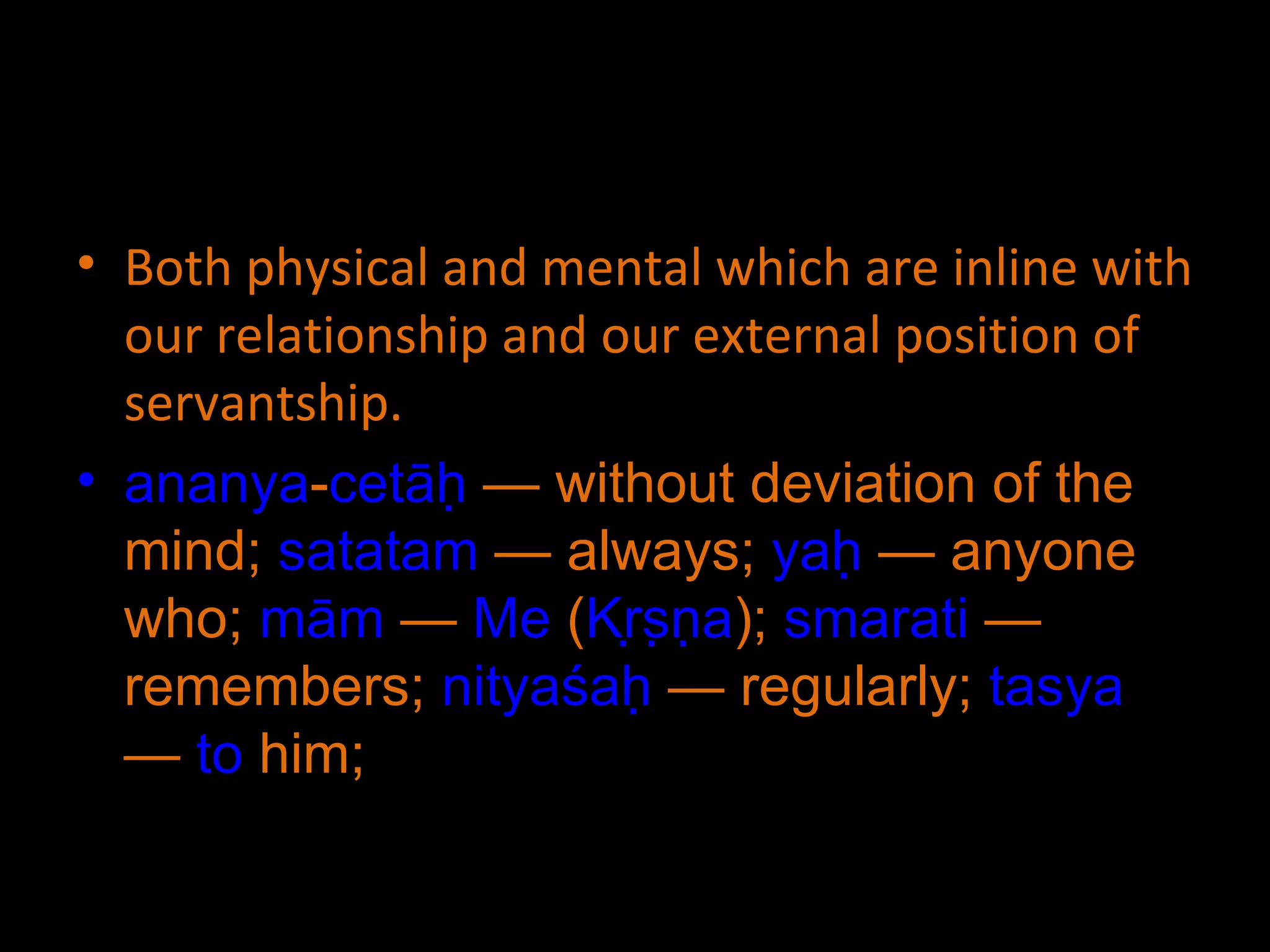
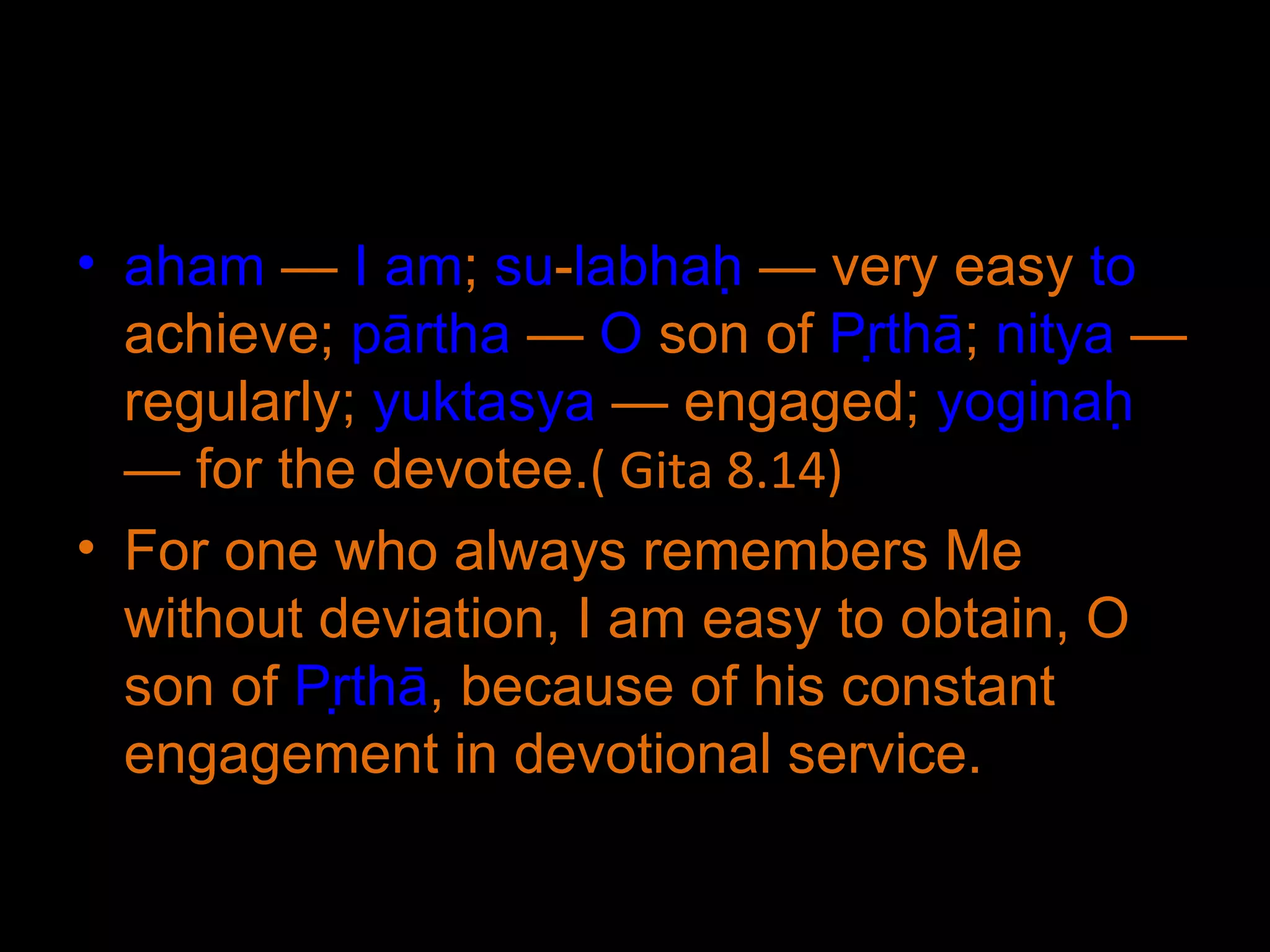
ananya - cetāḥ  — without deviation of the mind;  satatam  — always;  yaḥ  — anyone who;  mām  —  Me  ( Kṛṣṇa );  smarati  — remembers;  nityaśaḥ  — regularly;  tasya  —  to  him;  aham  —  I   am ;  su - labhaḥ  — very easy  to  achieve;  pārtha  —  O  son of  Pṛthā ;  nitya  — regularly;  yuktasya  — engaged;  yoginaḥ  — for the devotee. ( Gita 8.14)
or one who always remembers Me without deviation, I am easy to obtain, O son of  Pṛthā , because of his constant engagement in devotional service. तेषां  of them  सतत - युक्तानां  constantly united  भजतां  worship  प्रीति - पूर्वकम्  with love  ददामि  I give  बुद्धि - योगं  mental disposition  तं  that  यॆन  by which  माम्  Me  उपयान्ति  approach  ते  they ( Gita 10.10)
To those that are constantly united (with Me) and worship Me with love, I give the mental disposition (devotional attitude). By that attitude they approach Me. All verses insist that remembrance of God must be constant.
There are 2 types of action Those with only mind+intellect  Those with mind+intellect+attachment A wife making food for her london returned husband versus the home servant making it. A nurse/doctor versus the mother delivering. Cashier giving millions versus giving his own money.
All activities that we perform indifferently ie we receive no pleasure from, but are performed out of compulsion, involve mind and intellect but not attachment. Duties performed on a daily basis in a detached spirit, constitute the larger portion of our activities. Who desires to remain subordinate to a boss all day at work? But one has to do it.
A guest knocking door at night example of etiquette in this world ie actions peformed without attachment where there is no love but mere appropriate external behaviour Father rushing to Doctor example where he drives to doctor is mind+intellect with attachment not to Doctor but to his son. Same way, work in this world with mind+intellect with attachment not to anything but God.
How will we perform better if we dont have attachment? This is naive question because duties cannot be performed properly where there is attachment. Mother giving chocolate to each child Surgeon cannot do operation of his own son. Judge cannot give impartial judgement if
He is attached to either party When we love a person, we experience happiness when we see, hear or touch that person. The result is that the mind does not remain in a balanced state, and work becomes irregular. The same happens when the mind is affected by anger, jealousy, greed, etc
Work is bound to suffer. It is only when one is devoid of love and hate, that work can be performed perfectly. So we should center our love in God alone and limit ourselves to the performace of duties in the world to accomplish both material and spiritual goal easily.  Duties of the material world will be performed properly and we will also achieve our goal of
Attaining God. This is refered as Art of doing action in Gita yogaḥ  —  Kṛṣṇa  consciousness;  karmasu  —  in  all activities;  kauśalam  — art.  ( Gita 2.50) Fix the mind on God and continue to work with your senses and body, just as a wheel moves, but the axle remains fixed.
Some say that work is hampered when love for God increases. This does not happen in the beginning, but it does happen in an advanced stage of spiritual practice. However, there is no need to be concerned about it. Even if you are eventually unable to perform your duties, there is nothing to worry about, because you will be freed of responsibilities.
But if you deliberately disregard your duties, and do not even love God, then you will be punished for your negligence. At first you will have to practise this, but later on it will happen naturally. When a person first learns to ride a bicycle, he experiences great difficulty. After some practice, his hands continue to guide the handlebars, his feet keep on pedalling, and he
Even carries on a conversation with his friend.  In the same way, after a little practice, karmayoga will become natural. The three most important and indispensable requirements for practical sadhana are 1. Nishkamata 2. Ananyata 3. Rupadhyana
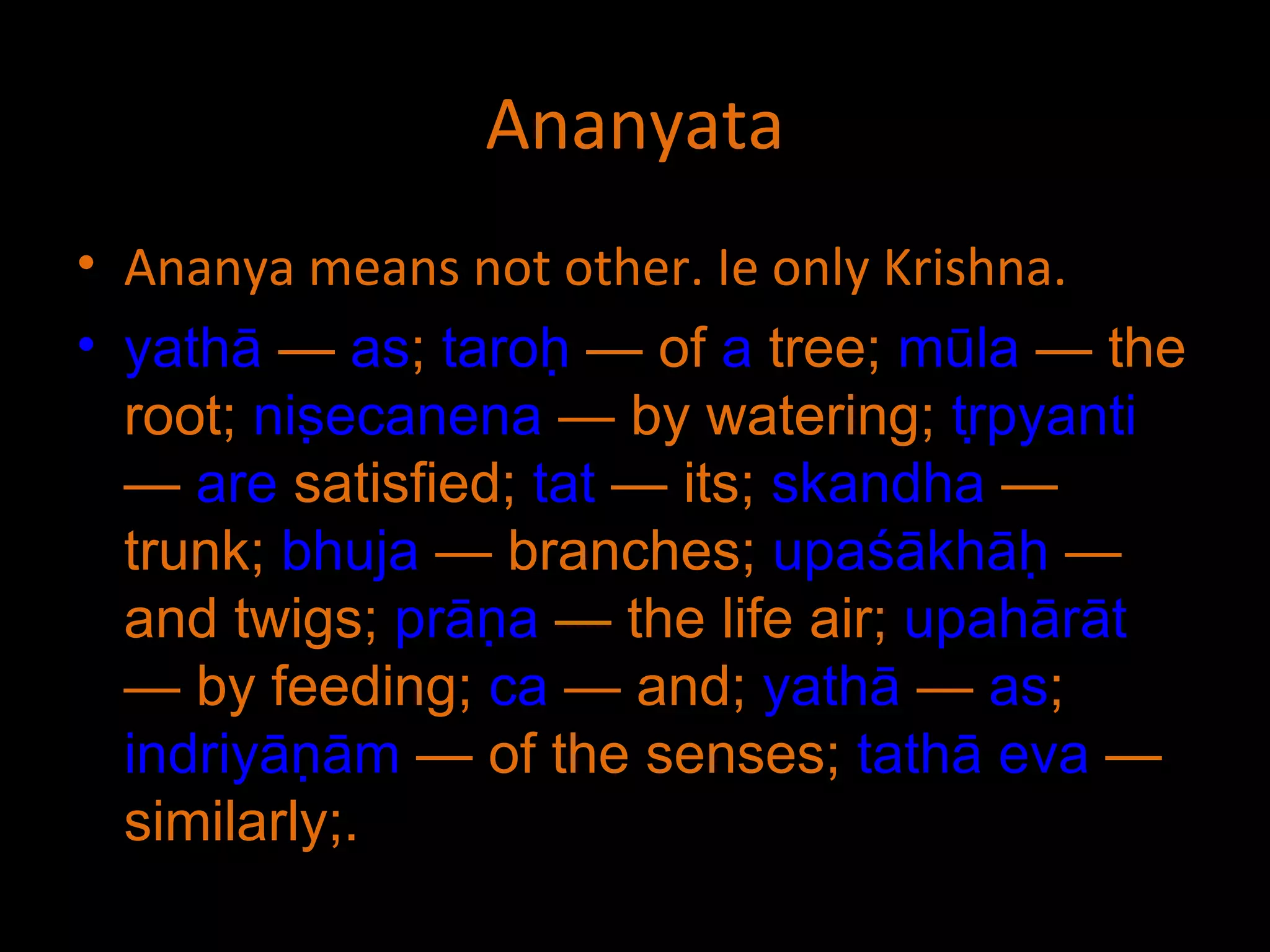
Ananyata Ananya means not other. Ie only Krishna. yathā  —  as ;  taroḥ  — of  a  tree;  mūla  — the root;  niṣecanena  — by watering;  tṛpyanti  —  are  satisfied;  tat  — its;  skandha  — trunk;  bhuja  — branches;  upaśākhāḥ  — and twigs;  prāṇa  — the life air;  upahārāt  — by feeding;  ca  — and;  yathā  —  as ;  indriyāṇām  — of the senses;  tathā   eva  — similarly;.
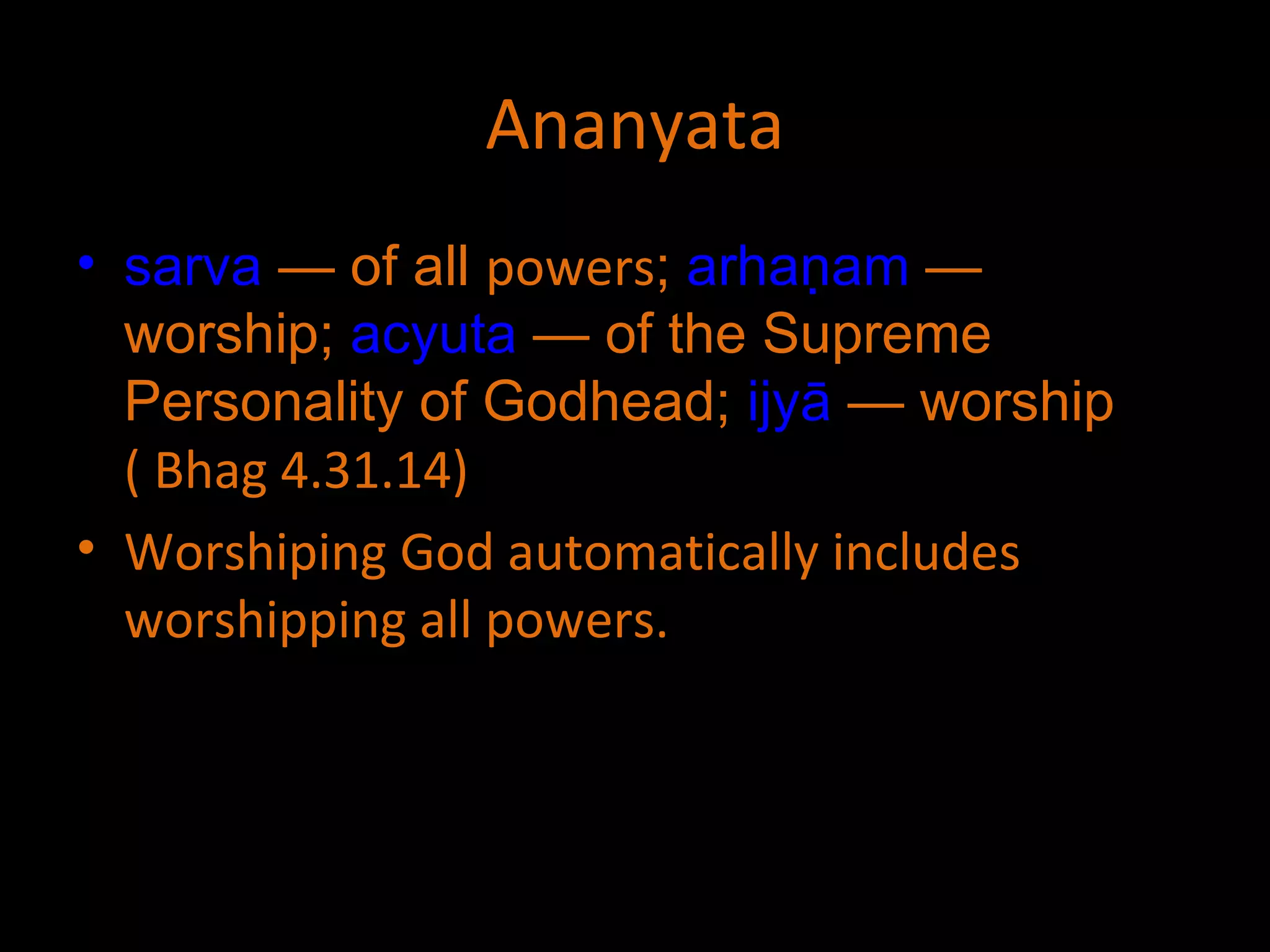
Ananyata sarva  — of all  powers ;  arhaṇam  — worship;  acyuta  — of the Supreme Personality of Godhead;  ijyā  — worship  ( Bhag 4.31.14) Worshiping God automatically includes worshipping all powers.
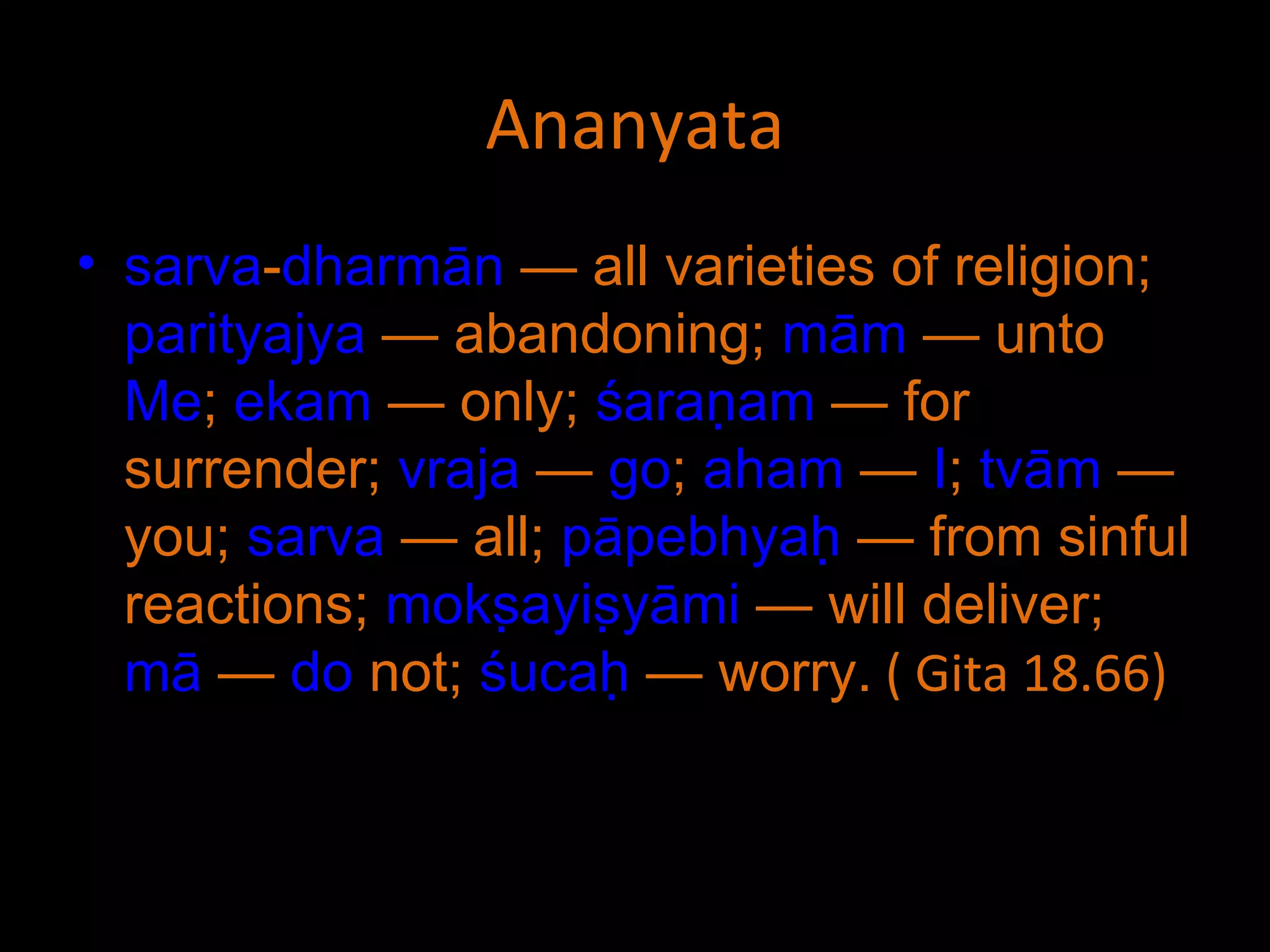
Ananyata sarva - dharmān  — all varieties of religion;  parityajya  — abandoning;  mām  — unto  Me ;  ekam  — only;  śaraṇam  — for surrender;  vraja  —  go ;  aham  —  I ;  tvām  — you;  sarva  — all;  pāpebhyaḥ  — from sinful reactions;  mokṣayiṣyāmi  — will deliver;  mā  —  do  not;  śucaḥ  — worry.  ( Gita 18.66)
Roopdhyan Just like when one studies for IAS thinking that once he becomes IAS officer, he will get respect, money , position , power and this motivates him to work hard, in same way why can you think once you get God, innumerable Indras, Varuns, Yamaraj, Kuber will be standing in your service, Maya will not come near you, the three afflictions, the three effects of sin, the three imperfections, the three types of
Bodies binding you, etc will not plague you any more. You will attain never-ending Divine Bliss and in addition, a Divine body. This sadhana of roopdhyan is really easy when actually reflected upon.
Make any form and imbible divine feelings in it. Do whatever it takes to keep your mind it in full time for sometime in a day and for rest of the day, keep that form , show all the work you do to Him and feel that you are servant of Hari-Guru and whatever you are doing , is to please them. Whatever you are doing , you should be able to feel that you are doing for them.
Roopdhyan If a sadhak doesnt practise  roopdhyan, he will eventually doubt even the words of the scriptures because he will think that even after practising sankirtan for a long time his sinful tendencies have not reduced. Sadhana bhakti means to keep oneself in constant presence of Hari-Guru ( Roopdhyan ) while constantly remembering our relationship and performing actions
Both physical and mental which are inline with our relationship and our external position of servantship. ananya - cetāḥ  — without deviation of the mind;  satatam  — always;  yaḥ  — anyone who;  mām  —  Me  ( Kṛṣṇa );  smarati  — remembers;  nityaśaḥ  — regularly;  tasya  —  to  him;
aham  —  I   am ;  su - labhaḥ  — very easy  to  achieve;  pārtha  —  O  son of  Pṛthā ;  nitya  — regularly;  yuktasya  — engaged;  yoginaḥ  — for the devotee. ( Gita 8.14) For one who always remembers Me without deviation, I am easy to obtain, O son of  Pṛthā , because of his constant engagement in devotional service.
ananyāḥ  — having  no  other object;  cintayantaḥ  — concentrating;  mām  — on  Me ;  ye  — those who;  janāḥ  — persons;  paryupāsate  — properly worship;  teṣām  — of them;  nitya  — always;  abhiyuktānām  — fixed  in  devotion;  yoga  — requirements;  kṣemam  — protection;  vahāmi  — carry;  aham  —  I .  ( Gita 9.22)
But those who always worship Me with exclusive devotion, meditating on My transcendental form — to them I carry what they lack, and I preserve what they have.
ye  — those who;  tu  — but;  sarvāṇi  — all;  karmāṇi  — activities;  mayi  — unto  Me ;  sannyasya  — giving up;  mat - parāḥ  — being attached  to   Me ;  ananyena  — without division;  eva  — certainly;  yogena  — by practice of such  bhakti - yoga ;  mām  — upon  Me ;  dhyāyantaḥ  — meditating;  upāsate  — worship;  ( Gita 12.6)
mayi  — upon  Me ;  eva  — certainly;  manaḥ  — mind;  ādhatsva  — fix;  mayi  — upon  Me ;  buddhim  — intelligence;  niveśaya  — apply;  ( Gita 12.8) Just fix your mind upon Me, the Supreme Personality of Godhead, and engage all your intelligence in Me.
Until  a sadhak reaches an advanced stage of practising roopdhyan, he will not be able to restrain his mind and consequently will not experience the bliss. Without any actual experience, the devotee becomes exhausted with his efforts and starts losing hope. Thus, becoming dejected, he once again gets inclined towards wordly pleasure.
Read entire roopdhyan book from page 7 Each page has so much condensed information its not feasible to create ppt.

Prem Ras Siddhant

  • 1.
    Prem Ras SiddhantBy my Master Kripalu Maharaji [email_address]
  • 2.
    Ultimate Goal ofAll Living Beings Prayojanam (provision) anuddishya ( without) mando’pi(even a dumb) na (does not) pravartate(work) Without provision even a dumb does not work. Khala binu(without) svaratha(provision) para (other) apakari (harm), je binu kaja dahine bamye ( Ramayana) Wicked cause harm to others without cause
  • 3.
    Para upakara vachanamana kaya Santa sahaja subhava khagaraya Bhurja taru sama santa kripala Parahita saha nita vipati visala ( Ramayan) Jo kahu ki dekahim vipati, sukhi hohim manahu jaga nripati ( Ramayan)
  • 4.
    Para dukha dukha,sukha sukha dekhe para ( Ramayana) sarveṣām — for all; api — indeed; bhūtānām — created living beings; nṛpa — O King; sva-ātmā — one's own self; eva — certainly; vallabhaḥ — dearmost; itare — others; apatya — children; vitta — wealth; ādyāḥ — and so on; tat — of that self; vallabhatayā — based on the dearness; eva hi — indeed. ( Bhag 10.14.50)
  • 5.
    So now itsproved that even in this diverse living entities in diverse actions and in everything diverse, there is only 1 provision of all. To see bliss. Why?
  • 6.
    Anando brahmeti vyajanat,anandaddhyeva khalvimani bhutani jayante, anandena jatani jivanti, anandam prayantyabhisamvishantit (Taittiriya Upanishad 3.6) He knew Bliss as Brahman; for from Bliss, indeed, all these beings originate; Having been born, they are sustained by Bliss; they move towards and merge in Bliss.
  • 7.
    Ananda evadhastat anandauparishtat , anandah purastat anandah pashchat, ananda uttaratah, anando dakshinatah ananda evedam’ sarvam Bliss below, bliss above, bliss east, bliss west, bliss north, bliss south, bliss outside, bliss inside Him
  • 8.
    So what ifGod is bliss? How does that answer the question why everyone which are diverse in all external features with work, apperance, thinking seek only 1 thing ie bliss?
  • 9.
    mama — My;eva — certainly; aḿśaḥ — fragmental particle; jīva-loke — in the world of conditional life; jīva-bhūtaḥ — the conditioned living entity; sanātanaḥ — eternal ( Gita 15.7) Every individual soul is an eternal part of Mine( God )
  • 10.
    God is BlissPersonified; therefore being a part of Him, every individual soul naturally seeks Bliss. Besides this, every living being, without having been taught to do so, naturally loves divine qualities, such as truth, non-violence, peace, forgiveness, kindness etc
  • 11.
    Even the mostfoolish person, after innumerable lives of effort will not be able to eradicate his innate nature to love and appreciate divine qualities and instead love falsehood, theft, immorality etc
  • 12.
    is it possiblefor soul not to act for satisfaction of its desire of bliss even for a second? na — nor; hi — certainly; kaścit — anyone; kṣaṇam — a moment; api — also; jātu — at any time; tiṣṭhati — remains; akarma-kṛt — without doing action ; ( Gita 3.5) No one can remain inactive even for a moment ( Gita 3.5)
  • 13.
    Hence we canconclude that every soul desires only Bliss and is constantly making an effort for its attainment every moment to moment ( a moment = smallest measure of time ) Since when this endeavour is going on?
  • 14.
    ज्ञाज्ञौ द्वावजावीशनीशावजा ह्येकाभोक्तुभोग्यार्थयुक्ता। अनन्तश्चात्मा विश्वरूपो ह्यकर्ता त्रयं यदा विन्दते ब्रह्ममेतत्।। ( श्वेताश्वतर - उपनिषद् 1.9) ऋग्वेद में आत्मा , परमात्मा को प्रकृति रूपी वृक्ष पर बैठे हुए बताया है। आत्मा उस वृक्ष ( प्रकृति ) के फल खाता ( भोगता ) है और परमात्मा केवल साक्षी मात्र है। उपनिषद् में बताया है कि ईश्वर सर्वज्ञ है जीव अज्ञ है। ईश्वर सर्व समर्थ है और जीव असमर्थ है। ये दोनों अजन्मा अर्थात् अनादि हैं।
  • 15.
    “ Soul isunborn, eternal” ( Shveta 1.9) mama — My; eva — certainly; aḿśaḥ — fragmental particle; jīva - loke — in the world of conditional life; jīva - bhūtaḥ — the conditioned living entity; sanātanaḥ — eternal ( Gita 15.7) So this effort of seeking bliss is going on from eternally as Soul is eternal.
  • 16.
    na —never; asataḥ — of the nonexistent; vidyate — there is; bhāvaḥ — endurance; na — never; abhāvaḥ — changing quality; vidyate — there is; sataḥ — of the eternal; ubhayoḥ — of the two; api — verily; dṛṣṭaḥ — observed; antaḥ — conclusion; tu — indeed; anayoḥ — of them; tattva — of the truth; darśibhiḥ — by the seers. ( Gita 2.16)
  • 17.
    Those who areseers of the truth have concluded that of the nonexistent [the material body] there is no endurance and of the eternal [the soul] there is no change. This they have concluded by studying the nature of both. ( Gita 2.16)
  • 18.
    na —never; jāyate — takes birth; mriyate — dies; vā — either; kadācit — at any time (past, present or future); na — never; ayam — this; bhūtvā — having come into being; bhavitā — will come to be; vā — or; na — not; bhūyaḥ — or is again coming to be; ajaḥ — unborn; nityaḥ — eternal; śāśvataḥ — permanent; ayam — this; purāṇaḥ — the oldest; na — never; hanyate — is killed; hanyamāne — being killed; śarīre — the body. (Gita 2.20)
  • 19.
    For the soulthere is neither birth nor death at any time. He has not come into being, does not come into being, and will not come into being. He is unborn, eternal, ever-existing and primeval. He is not slain when the body is slain. ( Gita 2.20)
  • 20.
    Hence it hasbeen proved that we have been striving every moment since beginning-less time to attain Bliss and will continue to do so. Inspite of our continuous efforts of infinite lifetimes, we have not as yet attained this Bliss. What is the reason for this?
  • 21.
    So why thesoul has not found it yet inspite of searching for it eternally each moment to moment. Because it has not understood 1. what is bliss, 2. where it will be found and 3. how it will be found
  • 22.
    What is Bliss?Yo vai bhuma tatsukham nalpe sukhamasti bhuma tveva vijijnasitavyah ( Chhan Up 7.23.1) The infinite ( bhuman ) is bliss. There is no bliss in anything finite. Infinity only is bliss. This Infinity we must desire to understand.
  • 23.
    Where bliss isfound? Where such everlasting and unlimited Bliss can be found? Material View : Happiness is attainable only when the individual acquires the cherished objects of his every desire. Refutation : Fulfilment of 1 desire will lead to new even stronger desire and hence happiness is not everylasting and is limited.
  • 24.
    Where bliss isfound? Jyom pratilabha lobha adhikayi ( Ramayan) yat — what; pṛthivyām — within this world; vrīhi — food grains, rice; yavam — barley; hiraṇyam — gold; paśavaḥ — animals; striyaḥ — wives or other women; na duhyanti — do not give; manaḥ - prītim — satisfaction of the mind; puḿsaḥ — to a person; kāma - hatasya — because of being victimized by lusty desires; te — they ( Bhag 9.19.13)
  • 25.
    Where bliss isfound? “ If all the objects of the universe ( here rice, barley and other food grains, gold, animals and women etc means whole world ) were available to one man, the disease of desire would nevertheless keep on increasing” ( Bhag 9.19.13) Hence material view point is not correct
  • 26.
    Where bliss isfound? God Spiritual View : Raso vai sah, rasam’ahyevayam labdhvanandi bhavanti ( Taitti Up 2.7) God is bliss. It is only by attaining Him, that the individual soul can become Blissful Tameva viditvati mrityumeti nanyah pantha vidyate’yanayte ( Shveta Up 3.8, 6.15) Only by knowing Him can the individual soul overcome material afflictions. There is no other way”
  • 27.
    Does God exist?Empirically?Now the question arises Is there an entity called God, and should we accept that He exist merely because the scriptures say so, or is there any concrete proof of His existense? Empirical Evidence Fallacy :Empirically we cannot get knowledge of our father, letter A, existence of subtle objects like mind, intellect.
  • 28.
    Does God exist?Inferentially? Orderly apperance of Universe Creation of sun, moon, stars Movement of sun,moon are governed by rules whose controller must be All powerful God World is upheld in space. Efforts involved in supporting earth and other planets must be due to God
  • 29.
    Laws existing increation must have some lawmaker who must be All-Knowing in order to implement and enforce these laws. For eg Law of Karma requires that the lawmaker is aware of uncountable karma of uncountable souls.
  • 30.
    Any work inthe world is possible only when Equipment, the doer, the knowledge, desire & effort are present. Nature doesnt have conciousness and doer means a conscious being. Pot creation example . Apply all those ingredients into Universe Creation.
  • 31.
    Professor Eddington declared“Some unknown imperceptible power is working behind some unperceived action but we do not know anything about it. We come across some such unknown element in our research, which is beyond explanation in material terms”
  • 32.
    Any object possessingform is created from a source material that is subtler and more permanent in comparison to it. Thread is subtler then cloth since cloth gets form from thread If atom have a form, then they must be created from a source subtler & more permanent than them. Thats can be only God.
  • 33.
    Nature of God: Beyond Maya Indriyebhyah para hyartha arthebhyash cha param manah Manasastu para buddhir buddheratma mahan parah ( Katha Up 1.3.10) Mahatah paraavyaktamavyaktat purushah parah Purushan na param kinchit sa kashtha sa para gatih ( Katha up 1.3.11)
  • 34.
    Nature of God: Beyond Maya Beyond the senses are the senses objects, beyond the sense objects is the mind, beyond the mind is the intellect, beyond the intellect is the soul, beyond the soul is Maya and beyond the Maya is Brahman (God)
  • 35.
    Nature of God: Divine Divyohyamurtah purushah ( Veda) “ God is Divine and the senses, mind and intellect are material”
  • 36.
    Nature of God:Supreme Illuminator Tameva bhantamanubhati sarvain tasya bhasa sarvamidam vibhati ( Katha Up 2.2.15, Mundaka Up 2.2.10, Shveta Up 6.14) “ He is the Supreme Illuminator, and the senses, mind and intellect are illumined by Him”. The illumined cannot possibly illumine its illuminator. Hence he is totally unknowable.
  • 37.
    Nature of God:ContradictionsAbode of various simultaneously contradictory qualities Anaraniyan mahato mahiyan atma guhayam nihiti’sya jantoh Tamakratum pashyati vitashoko dhatuh prasadan mahimanamisham ( Shveta Up 3.20) “ He is smaller then the smallest atomic particle, Bigger then the biggest space.”( pg42)
  • 38.
    The Grace ofGod Tamakratuh pashyati vitashoko Dhatuh prasadan mahimanamatmanah ( Katha Up 1.2.20) The Self, smaller than small, greater than great, is hidden in the heart of that creature. A man who is free from desires and free from grief, sees the majesty of the Self by the grace of the Creator.'
  • 39.
    The Grace ofGod Nayamatma pravachanena labhyo Na medhaya na bahuna shrutena Yamevaisha vrinute tena labhayas Tasyaishna atma vivrinute tanum’svam ( Katha Up 1.2.23) That Self cannot be gained by the Veda, nor by understanding, nor by much learning. He whom the Self chooses, by him the Self can be gained. The Self chooses him (his body) as his own.
  • 40.
    The Grace ofGod tat - prasādāt — by His grace; parām — transcendental; śāntim — peace; sthānam — the abode; prāpsyasi — you will get; śāśvatam — eternal. ( Gita 18.62) By His grace you will attain transcendental peace and the supreme and eternal abode.
  • 41.
    The Grace ofGod arjunaḥ uvāca — Arjuna said; naṣṭaḥ — dispelled; mohaḥ — illusion; smṛtiḥ — memory; labdhā — regained; tvat - prasādāt — by Your mercy; mayā — by me ; acyuta — O infallible Kṛṣṇa ( Gita 18.73) By your grace alone, I have attained Divine Knowledge and my ignorance has been dispelled forever.
  • 42.
    Bhag 10.14.29 atha — therefore; api — indeed; te — Your; deva — my Lord; pada - ambuja - dvaya — of the two lotus feet; prasāda — of the mercy; leśa — by only a trace; anugṛhītaḥ — favored; eva — certainly; hi — indeed; jānāti — one knows; tattvam — the truth; bhagavat — of the Supreme Personality of Godhead; mahimnaḥ — of the greatness; na — never; ca — and; anyaḥ — another; ekaḥ — one; api — although; ciram — for a long period; vicinvan — speculating
  • 43.
    The Grace ofGod No one can know God even if he endeavours to know Him for innumerable lifetimes, but when God imparts His Grace to a soul, he can know Him and attain Divine Bliss for eternity ( Bhag10.14.29)
  • 44.
    The Grace ofGod Soi janai jehi dehu janai Janata tumahim tumahim hvai jai Tumharihim kripa tumahim raghunandana Janata bhagata bhagata ura chandana Rama kripa binu sunu khagarai Jani na jai rama prabhutai Only by His Grace that one can be freed from the bondage of Maya
  • 45.
    The Grace ofGod Rajata sipa maham bhasa jimi, yatha bhanu kara vari Tadapi mrisha tihum kala maham, bhrama na sakai kou tari Jasu kripa asa bhrama miti jai, girija so kripalu ragharai ( Ramayan ) Only by God Grace, one can be freed from delusion
  • 46.
    Rama kripa nasahimsaba roga :-Ramayan Only by God grace goes all mental afflictions Binu satsanga viveka na hoi Rama kripa binu sulabha na soi. Aba mohim bha bharosa hanumanta Binu hari kripa milahim nahim santa Association of genuine saints not possible without Grace of God
  • 47.
    Santa vishuddha milahimpuni tehi Rama kripa kari chitavahim jehi Only by grace of God, that one attains the association of a true Saint. So does that mean everything God will do?
  • 48.
    The Grace ofGod īśvaraḥ — the Supreme Lord; sarva - bhūtānām — of all living entities; hṛt - deśe — in the location of the heart; arjuna — O Arjuna ; tiṣṭhati — resides; bhrāmayan — causing to travel; sarva - bhūtāni — all living entities; yantra — on a machine; ārūḍhani — being placed; māyayā — under the spell of material energy. ( Gita 18.61)
  • 49.
    The Grace ofGod The Supreme Lord is situated in everyone's heart, O Arjuna , and is directing the wanderings of all living entities, who are seated as on a machine, made of the material energy.
  • 50.
    The Grace ofGod Uma daru joshita ki naim sabahim nachavata rama gusim ( Ramayan ) So if he is the doer of all actions looks like Wait 1. How can God the all knowing perfom action of ignorance 2. If God is doer, why we experience ourself as doer and suffer consequences
  • 51.
    The Grace ofGod 3. if God is doer, then why should we be made to suffer karmic consequences 4. if God is doer, then He laid down rules of conduct 5. if God who is impartial, how can he do Good action for some and Bad for others 6. if all this is mere play of God and no one actually experiences happiness or sorrow, then there would be no need of attaining God, Divine knowledge etc
  • 52.
    The Grace ofGod Can we leave everything on fate? Purvajanamakritam karma taddaivamiti kathyate ( Hitopadesha ) The fruits of actions performed with a freedom of will in past lives are designated as fate in the present life.
  • 53.
    The Grace ofGod Nara tanu bhava varidhi kaham bero Sanmukha maruta anugraha mero Karnadhara sadguru drirha nava Durlabha saja sulabha kari pava Jo na tarai bhavasagara, nara samaja asa pai So krita nindaka manda mati, atama hana gati jai
  • 54.
    The Grace ofGod So paratra dukha pavai, sira dhuni dhuni pachhitaya Kalahim karmahim ishvarahim, mithya dosha lagaya
  • 55.
    Surrender Yo brahmanamvidadhati purvam Yo vai vedamsh cha prahinoti tasmai Tam’ha devamatmabuddhiprakasham Mumukshurvai sharanamaham prapadye ( Shveta Up. 6.18) Tapah prabhavad devaprasadacha ( Shveta Up 6.21)
  • 56.
    Surrender Surrender tothe supreme Lord, Who is the creator of the even Brahma and other gods and by Whose Grace, the soul and intellect are illumined” Tameva sharanam gachchha sarvabhavena bharata Tatprasadat param shantim sthanam prapsyasi shashvatam ( Gita 18.62)
  • 57.
    “ Surrender tothe Supreme Lord alone with all your being, then you will receive His Grace by which you will attain the Divine Abode and Everlasting Peace” What is the reason that surrendering is so compulsory?
  • 58.
    daivī —transcendental; hi — certainly; eṣā — this; guṇa - mayī — consisting of the three modes of material nature; mama — My; māyā — energy; duratyayā — very difficult to overcome; mām — unto Me ; eva — certainly; ye — those who; prapadyante — surrender; māyām etām — this illusory energy; taranti — overcome; te — they ( Gita 7.14)”
  • 59.
    This divine energyof Mine, consisting of the three modes of material nature, is difficult to overcome. But those who have surrendered unto Me can easily cross beyond it. ( Gita 7.14)
  • 60.
    tasmāt —therefore; tvam — you; uddhava — O Uddhava ; utsṛjya — giving up; codanām — the regulations of the Vedas; praticodanām — the injunctions of supplementary Vedic literatures; pravṛttim — injunctions; ca — and; nivṛttim — prohibitions; ca — also; śrotavyam — that which is to be heard; śrutam — that which has been heard; eva — indeed; ca — also ( Bhag 11.12.14)
  • 61.
    mām — to Me ; ekam — alone; eva — actually; śaraṇam — shelter; ātmānam — the Supersoul within the heart; sarva - dehinām — of all conditioned souls; yāhi — you must go ; sarva - ātma - bhāvena — with exclusive devotion; mayā — by My mercy; syāḥ — you should be; hi — certainly; akutaḥ - bhayaḥ — free from fear in all circumstances. ( Bhag 11.12.15)
  • 62.
    Therefore, My dear Uddhava , abandon the Vedic mantras as well as the procedures of supplementary Vedic literatures and their positive and negative injunctions. Disregard that which has been heard and that which is to be heard. Simply take shelter of Me alone, for I am the Supreme Personality of Godhead, situated within the heart of all conditioned souls.
  • 63.
    Take shelter ofMe wholeheartedly, and by My grace be free from fear in all circumstances. Mana krama vachana chhamri chaturai Bhajatahim kripa karahim raghurai ( Ramayana) “ It is only through complete surrender that one can attain Grace and be liberated from the bondage of Maya”
  • 64.
    All the scripturalevidence implies that we must surrender to God. God Grace is dependent upon surrender. Phirata sada maya kara prera Kala karma svabhava guna ghera Those who do not surrender, revolve in 8.4 million species governed by 1. Time 2. Destiny 3.Their own karmas 4. Three Gunas
  • 65.
    So God dependsour surrender as condition for His Grace. So is it like a worldly business transaction? No. Because surrender means not to do anything . Ie Doing actions whatsoever without the feeling of doership.
  • 66.
    ananyāḥ —having no other object; cintayantaḥ — concentrating; mām — on Me ; ye — those who; janāḥ — persons; paryupāsate — properly worship; teṣām — of them; nitya — always; abhiyuktānām — fixed in devotion; yoga — requirements; kṣemam — protection; vahāmi — carry; aham — I . ( Gita 9.22)
  • 67.
    those who alwaysworship Me with exclusive devotion, meditating on My transcendental form — to them I carry what they lack, and I preserve what they have.
  • 68.
    What is SurrenderSimple but profound wisdom of yielding to rather than opposing the flow of life. Relinquish inner resistance to what is because is is created by God Inner resistance is to say “no” to what is , through mental judgement and emotional negativity.
  • 69.
    Surrender is perfectlycompatible with taking action, initiating change, or achieving goals. But in the surrendered state a totally different energy, a different quality, flows into your doing. It connects you to the source-energy of Divine. This is surrendered action.
  • 70.
    Example of SurrenderWhen Draupadi saw no help coming from anyone, she tried to protect herself and clenched her sari between her teeth. Failure of protect herself would mean getting naked in front of assembly of her husbands, uncles, cousins, enemies of her husband and in front of public.
  • 71.
    When Duhshasana pulledher sari with a jerk, she lost hold of it and was totally helpless. Now, she surrendered herself completely to Lord Krishna. She came to a state of doing nothing. It was only when she ceased to expect protection from all sources including her own strength, that she surrendered.
  • 72.
    So when wedepend only on the protection of God and no other source including our own strength, we can truely surrender as surrender means not to do anything. If we depend on our own strength, then we will do something to protect ourselves and it will not be true surrender.
  • 73.
    sarva - dharmān — all varieties of religion; parityajya — abandoning; mām — unto Me ; ekam — only; śaraṇam — for surrender; vraja — go ; aham — I ; tvām — you; sarva — all; pāpebhyaḥ — from sinful reactions; mokṣayiṣyāmi — will deliver; mā — do not; śucaḥ — worry. ( Gita 18.66)
  • 74.
    Abandon all varietiesof religion and just surrender unto Me. I shall deliver you from all sinful reactions. Do not fear. Now what we have to surrender to God? We have 1. Body 2. Senses 3. Mind 4. Intellect
  • 75.
    Mana eva manushyanamkarnam bandhamokshayoh ( Panchadashi ) “ The mind alone is the cause of bondage and of liberation”
  • 76.
    cetaḥ —consciousness; khalu — indeed; asya — of him; bandhāya — for bondage; muktaye — for liberation; ca — and; ātmanaḥ — of the living entity; matam — is considered; guṇeṣu — in the three modes of nature; saktam — attracted; bandhāya — for conditional life; ratam — attached; vā — or; puḿsi — in the Supreme Personality of Godhead; muktaye — for liberation. ( Bhag 3.25.15)
  • 77.
    The stage inwhich the consciousness of the living entity is attracted by the three modes of material nature is called conditional life. But when that same consciousness is attached to the Supreme Personality of Godhead, one is situated in the consciousness of liberation.
  • 78.
    Remember this ruleYou are where your mind is. At the time of death, you will go where your mind is. Since mind is already attached to material world, it needs to be removed from material world and then surrendered to God. So we will now discuss nature of soul, world and detachment.
  • 79.
    Nature of theSoul Soul is 1. Eternal 2. Does not die or take birth 3. Cannot be burnt, or drown in water, even God cannot destroy it what to speak of others. 4. Divine , being an energy of Divine God 5. Does not change. Remains same
  • 80.
    Nature of MaterialWorld Samsaratiti samsarah; gachchhatiti jagat “ That which is in a state of constant flux and is ever-changing is referred to as the world” Made of Maya Mayam tu prakritim vidyamayinam tu maheshvaram, tasyavayavabhutaistu vyap tam sarvamidam jagat ( Shevta Up 4.10)
  • 81.
    “ Maya isnot an illusion or false notion. It is a power of God” Ajamekam lohitshuklakrishnam bahvih prajah srijamanam sarupah, aja hyeko jushamano’nushete jahatyenam bhuktabhogamajo’nyah ( Shevta Up 4.5) Daivi hyesha gunamayi mama maya duratyaya ( Gita 7.14)
  • 82.
    So dasi raghuviraki samujhe mithya sopi Maya is diavi ( divine ) ie of God. Mama maya ( My Maya ) So its duratyaya ( cannot be surpassed ) Mind is material and world is material but God is Divine. Hence mind gets naturally attracted to world but not to God. How can divine power of God, Maya create material mind and world?
  • 83.
    Nature of Godincludes contradiction. Further even we see how the concious human being produces material hair , material nails.
  • 84.
    Two Worlds ExternalWorld : Created by Maya , is real world but is changing constantly. Inner World : Created by subtle impressions by desires for various gross material objects. Inner world is more powerful then external world. It effects us even when external world is absent ( in dreams)
  • 85.
    Presence of Externalworld however makes inner world further strong. One thing is certain and that is , if the intellect makes a firm decision that the objects of the external world cannot fulfill our goal of Supreme Bliss, then the internal desires will automatically come to an end.
  • 86.
    THE FIRST STEPSo the first step is to make a FIRM DECISION, through CONSTANT REFLECTION, that there is not a trace of true happiness in the material world.
  • 87.
    Reflection If anyobject contains happiness, then everyone should receive happiness from it. Also, the happiness should be permanent and not followed by misery. Neither of these condition is fulfilled by anything material.
  • 88.
    Liquor A drunkardexperiences happiness at the very mention of liquor and becomes happier when he actually drinks it. But the same liquor is a source of displeasure to a teetotaller. Does the liquor contain happiness experienced by drunkard or revulsion experiened by teetotaller?
  • 89.
    Umesh Dies Onhearing the death news of Umesh, His wife : Fell unconscious His son : Cried but didnt fell unconscious His friend : cried less then son His sevant : didnt cry but felt sad His neighbour : Felt neither happiness nor distress. His debtor : Happy that he wont have to pay
  • 90.
    Umesh comes backto life! Wife : Fainted again out of happiness Son : Shed tears of joy Friend : Became happy Servant : Great relief for him Neighbour : no difference Debtor : Sad that now he will have to pay
  • 91.
    Umesh is sourceof ? Is Umesh a source of happiness or sadness? To what degress? People imagined Umesh to be a source of happiness to the extent of their own desires were fulfilled by him. They naively thought that Umesh was the source of happiness they were experiencing.
  • 92.
    Conclusion is thata person derives happiness from an object that he himself mentally ascribes to , but naively assumes that it is the object itself that contains happiness. One more point : If one doesnt experience happiness from any object, then one will not experience sorrow from that object either.
  • 93.
    2 nd point : The happiness we experience from any object, constantly diminishes. Eg. Mother crying for lost son and then son comes, first embrace, second embrace, go and play. Eg. Chocolate : First chocolate, second yes, third ok, forth no no.
  • 94.
    Eg. A thirstyman love water and not when his thirst is quenched Eg. A lustful man longs for a woman but when that lustful craving is absent, that same woman becomes burdensome. Eg. People think happiness in beauty. A ugly child lost and his mother loves that ugly child rather then other good looking child in front of her at police station.
  • 95.
    One man isready to shoot a beautiful woman and another stands between them ready to die for her. On enquiry, the man ready to shoot is husband and the other her lover. If there is happiness in beauty, both of them would have experienced it equally.
  • 96.
    Liquor smells disgustingto a teetotaller, pleasurable to alcoholic, Onion/Garlic smell disgusting to one man and aromatic to another. Beauty, fragrance etc do not contain happiness. However, if someone repeatedly thinks of a particular object to be a source of happiness, he becomes attached to it.
  • 97.
    dhyāyataḥ —while contemplating; viṣayān — sense objects; puḿsaḥ — of a person; sańgaḥ — attachment; teṣu — in the sense objects; upajāyate — develops ( Gita 2.62) Consequently, one experiences happiness from that object and sorrow when deprived from it.
  • 98.
    3 rd truth : Attaintment of any wordly object is always preceded, accompanied and followed by unhappiness. Eg. A woman desires to have child. To fulfil her desire, she gets married and loses her independence. Then even after many years, no child. Then medicines , then finally child, then 9 months and tensions and then worries of right upbringing till the child is adult
  • 99.
    And then worriesabout his marriage , character, behavior and his childerns. 4 th truth : There is definitely an experience of momentary happiness when a desire is fulfilled but it is immediately followed by greed for more. If desire is not fulfilled, then comes anger or fear.
  • 100.
    5 th truth : Major delusion : whatever i have is not sufficient to make me happy. Eg. A poor villager sees prime minister limousine and dreams of sitting in it one day. Later he becomes driver but his happiness is no more in sitting in that car all day.
  • 101.
    Before an objectis acquired, one experiences pleasure in the delusive hope of attaining happiness in the future if the object is acquired. But the moment we acquire it, the experience is quite the opposite. Instead of happiness, one begins to experience sorrow.
  • 102.
    Therefore, one shouldabandon this foolish expectation of attainting a higher level of happiness upon acquiring better material objects. The happiness experienced by a begger in embracing her ugly, lame child = experience of queen embarcing her beautiful delicate prince.
  • 103.
    The pleasure experiencedby a cow eating green grass, is the same as that experienced by a king who is served innumerable delicacies It is difficult to explain to the clerk of a High Court Judge that pleasure he gets from his biycle is the same as the pleasure the judge gets from his car.
  • 104.
    Thus we explained5 th truth that no one is willing to accept that those who are materially higher placed or better endowed, are not happier than them. If we were to only understand that fact that after a person has enjoyed a certain standard of living for sometime, it ceases to bring him pleasure; then the constant pursuit for a higher standard would come to an end
  • 105.
    Various level ofMaterial Happiness You are going to be astonished now!!!! 1 PKE ( a unit of pleasure of king of earth) : a person alone ruling entire planet earth, is young, healthy, intelligent, subjects are favourable, enjoys luxuries. 100sX 1PKE = 1 PMG ( a unit of pleasure of Manava Gandharva) 100xX1PMG = 1PDG ( Deva Gandharvas)
  • 106.
    100s X 1PDG= 1 PRP ( a unit of pleasure of resident of pitraloka ) 100sX 1PRP = 1 PAG ( a unit of pleasure of Ajanaja gods ) 100s X 1PAG = 1 PKD ( a unit of pleasure of Karma Devas) 100s X 1PKD = 1 PRH ( a unit of pleasure of resident of Heaven, devas)
  • 107.
    100s X 1PRH = 1 PKHI ( a unit of pleasure of King of Heaven, Indra ) 100s X 1 PKHI = 1 PB ( a unit of pleasure of Brihaspati, Indra Guru) 100s X 1 PB = 1 PP ( a unit of pleasure of prajapati ) 100s X 1 PP = 1 PB ( a unit of pleasure of Brahma, the creator of this material universe)
  • 108.
    All of theseare material abodes and are limited. Beyond all this, is divine , which is unlimited pleasure. ā - brahma - bhuvanāt — up to the Brahmaloka planet; lokāḥ — the planetary systems; punaḥ — again; āvartinaḥ — returning; arjuna — O Arjuna ; ( Gita 8.16) From the highest planet in the material world down to the lowest, all are places of misery wherein repeated birth and death take place.
  • 109.
    mām —unto Me ; upetya — arriving; tu — but; kaunteya — O son of Kuntī ; punaḥ janma — rebirth; na — never; vidyate — takes place. ( Gita 8.16) But one who attains to My abode, O son of Kuntī , never takes birth again
  • 110.
    Now, when truehappiness is not attainable, even from the enjoyments of the abode of Brahma, is it not suprising and foolish to expect true happiness by desiring to become millionaires and billionaires in this material world.
  • 111.
    yat —what; pṛthivyām — within this world; vrīhi — food grains, rice; yavam — barley; hiraṇyam — gold; paśavaḥ — animals; striyaḥ — wives or other women; na duhyanti — do not give; manaḥ - prītim — satisfaction of the mind; puḿsaḥ — to a person; kāma - hatasya — because of being victimized by lusty desires; te — they. ( Bhag 9.19.13)
  • 112.
    “ If allthe objects of the universe ( here rice, barley and other food grains, gold, animals and women etc means whole world ) were available to one man, the disease of desire would nevertheless keep on increasing” ( Bhag 9.19.13)
  • 113.
    nr —human; deham — body; ādyam — the source of all favorable results; su - labham — effortlessly obtained; su - durlabham — although impossible to obtain even with great endeavor; plavam — a boat; su - kalpam — extremely well suited for its purpose;
  • 114.
    guru —having the spiritual master; karṇa - dhāram — as the captain of the boat; mayā — by Me ; anukūlena — with favorable; nabhasvatā — winds; īritam — impelled; pumān — a person; bhava — of material existence; abdhim — the ocean; na — does not; taret — cross over; saḥ — he ; ātma - hā — the killer of his own soul.
  • 115.
    The human body,which can award all benefit in life, is automatically obtained by the laws of nature, although it is a very rare achievement. This human body can be compared to a perfectly constructed boat having the spiritual master as the captain and the instructions of the Personality of Godhead as favorable winds impelling it on its course.
  • 116.
    Considering all theseadvantages, a human being who does not utilize his human life to cross the ocean of material existence must be considered the killer of his own soul. ( Bhag 11.20.17)
  • 117.
    3 Gunas Thethree gunas keep fluctuating all day and night in each person. Hence talk to other person when he is in right mood Due to lack of sattvika qualities, when only a person is exposed to sattva in abundance, he occasionally is dominated by this mode. There is abundance of raja and hence easily overpowered by it even with slightest exposure.
  • 118.
    Tamas is themost powerful of all guna. You are in prayer : Sattva You child, wife touches you while in prayer : Rajas Neighbour comes angrily and makes statements : you go into Tamas and become angry as well.
  • 119.
    God and saintsappear to us to be endowed with these gunas because of our own perception is colored by these gunas When everyone is suffering with these 3 gunas, amicablity is possible between 2 person only when their gunas match in degree and in time.
  • 120.
    Husband wife whileon way to movie theater, hears kirtan. Wife sattva arises and she says, lets go to kirtan. We can go to movie later. However huband still dominated by rajas ( passion) guna and says “ oh you suddenly appear so be very religious. You can attend kirtan if you wish. I will go to movies only”
  • 121.
    Such arguments aresimply a result of differences in the degree of intensity of the gunas in each individual. If you understood the play of these constantly changing gunas, you would be surprised if even one person agreed with you the whole day.
  • 122.
    Unfortunately, you havewrong understanding. That is why is surprises you even if one person contradicts you. The reality is there is neither agreement nor opposition in this world. Whatever we observe, is due to the interaction of the 3 gunas.
  • 123.
    na va arepatyuh kamaya patih priyo bhavati atmanastu kamaya patih priyo bhavati. (ityupakramya) na va are sarvasya kamaya sarvam priyam bhavati atmanastu kamaya sarvam priyam bhavati. atma va are drashtavyah srotavyo mantavyo nididhyasitavyo maitraiyyatmani khalu are drishte srute mate vijnata idam sarvam viditam iti.
  • 124.
    न वा अरे पत्युःकामाय पतिः प्रियो भवति , आत्मनस्तु कामाय पतिः प्रियो भवति। न वा अरे जायायै कामाय जाया प्रियो भवति , आत्मनस्तु कामाय जाया प्रियो भवति। न वा अरे पुत्रस्य कामाय पुत्रः प्रियो भवति , आत्मनस्तु कामाय पुत्रः प्रियो भवति। ( ' वृहदारण्यक उपनिषद ' 2.4.5, 4.5.6)
  • 125.
    संसार में कोईभी स्त्री अपने पति से पति के लिए प्रेम नहीं करती , कोई भी पुरुष अपनी पत्नी से पत्नी के लिए प्रेम नहीं करता , कोई भी व्यक्ति धन से धन के लिए प्रेम नहीं करता , कोई भी माता पिता पुत्र से पुत्र के लिए प्रेम नहीं करते , कहाँ तक कहूँ कि इस संसार में कोई भी व्यक्ति किसी से भी उस के लिए प्रेम नहीं करता .... वह सिर्फ अपने सुख कि प्राप्ति के लिए ही सब से प्रेम करता है |
  • 126.
    पत्नी को पतिइसलिए प्रिय नहीं होता , क्योंकि वह पति है , वरन् पत्नी को पति इसलिए प्रिय होता है , क्योंकि पति से उसके हित की सिद्धि होती है। इसी प्रकार पति के लिए पत्नी इसलिए नहीं प्रिय होती क्योंकि वह पत्नी है। पति के लिए पत्नी इसलिए प्रिय होती है , क्योंकि पत्नी से पति क्योंकि पत्नी से पति के स्वार्थ की सिद्धि होती है।
  • 127.
    पुत्र मात्र इसलिएप्रिय नहीं होता , क्योंकि वह पुत्र है। माता - पिता के लिए पुत्र इसलिए प्रिय होता है , क्योंकि पुत्र से उनके हितों की सिद्धि होती है। This world is a drama where each actor is acting to satisfy his interest. But until we realize our interest cannot be fulfilled in this world , we will continue to strive for it
  • 128.
    So one whohas understood this, will have neither attachment nor aversion in this world and will attach himself to God. This world doesnt have bliss.
  • 129.
    बारि मथें घृतहोइ बरु सिकता ते बरु तेल। बिनु हरि भजन न तव तरिअ यह सिद्धांत अपेल॥ 122 क॥ ( रामायण  ) भावार्थ :- जल को मथने से भले ही घी उत्पन्न हो जाए और बालू ( को पेरने ) से भले ही तेल निकल आवे , परंतु श्री हरि के भजन बिना संसार रूपी समुद्र से नहीं तरा जा सकता , यह सिद्धांत अटल है॥ 122 ( क ) ॥
  • 130.
    A foolish isbrought in jail and keep without food for 1 week. After 1 week, in golden utensils, he is given delicious food but his well-wisher says him there is poison in food. The fool will not eat it even though he has not seen poison, nor even tasted nor seen anyone putting poison in food. But we so intelligent , keep seeing posion, tasting it daily but still dont listen to saints and scriptures.
  • 131.
    śrī - bhagavān uvāca — the Personality of Godhead said; yasya — whom; aham — I ; anugṛhṇāmi — favor; hariṣye — I will take away; tat — his; dhanam — wealth; śanaiḥ — gradually; tataḥ — then; adhanam — poor; tyajanti — abandon; asya — his; sva - janāḥ — relatives and friends; duḥkha - duḥkhitam — who suffers one distress after another. ( Bhag 10.88.8)
  • 132.
    The Personality ofGodhead said: If I especially favor someone, I gradually deprive him of his wealth. Then the relatives and friends of such a poverty-stricken man abandon him. In this way he suffers one distress after another. सुख के माथे सिल पड़े जो नाम हृदयते जाय | बलिहारी वा दुःख की जो पल पल नाम रटाय || ( Kabir Dhoha )
  • 133.
    Nature of DetachmentAttachment can be of positive type or negative type. Ideal situation of detachment is described in this kabir doha. कबिरा खड़ा बजार में सबकी माँगे खैर | ना काहू से दोस्ती ना काहू से बैर ||
  • 134.
    Mother lost herchild in mela ( funfare) She saw very similar child and thought he is hers and went to him. On seeing that the child was not her, she didnt got attached to this child thinking i didnt find mine but this is equally good neither she got angry to this child that why you werent my child .
  • 135.
    A drunkard goesto market for wine and as he comes across different shops, he doesnt get angry on those shops why they are not my wine shop, nor does he wait on those shops to buy something else. He goes without stop to the his shop where he will get wine without being angry or attached to any other shop.
  • 136.
    Remember that tillmind is attached or averted to anything in this world, complete attachment to God is not possible and hence God Realization is not possible either. Till the knowledge “there is neither happiness nor suffering in this world” is mature and firm in us, real detachment is not possible.
  • 137.
    How to maketattva gyan firm? To make the tattva gyan firm , 1. deep thought on nature of the world and 2. repeated thought is needed. Thinking only a once or few times will not work as we have contradictory thought from innumerable lifetimes. To cut this contradictory thoughts, you have to think again and again following
  • 138.
    janma —of birth; mṛtyu — death; jarā — old age ; vyādhi — and disease; duḥkha — of the distress; doṣa — the fault; anudarśanam — observing; (Gita 13.8) So the knowledge of nature of world consist of individual state ( birth,death,disease,old age) and behavior ( relationships based to satify self alone versus divine relationship of soul)
  • 139.
    The Most AuspiciousDay The most auspicious day will be the day your mind becomes free of all material attachments by *repeatly* *deep* thinking about nature of world. This free mind has to be surrendered to God. This free mind is not free from samskaras or potential tendencies from innumerable past lives.
  • 140.
    Hence it isstill natural that desire will arise occasionally. However the active new sanskars of the tattva gyan should be able to bring back the sadhak to bhakti. A person lost on way , after understanding that he is going in wrong way, must stop and take the right way to reach home
  • 141.
    After having stoppedgoing to sansar for pleasure, the soul must go to God. Also some say that, there is no need for vairagya, just attach mind to God and vairagya etc will happen. This is not correct . Why will anyone love God and with what will he love Him? We will love with mind because God is Ocean of bliss.
  • 142.
    This view willbe immediately be opposed by the intellect. Because although people do accept that God is a source of happiness, yet at the same time they also accept the world as a source of happiness too. Wordly happiness can actually be seen and experienced. Why then will anyone abandon it to grope in the dark?
  • 143.
    Taking this intoconsideration, how will the mind possibly love God? It is easy to talk about loving God, but very difficult to pratise without detachment. A deer, seeing shimmering sand in a desert, believes that there certainly must be water there, and pursues this belief, dying of thirst in the process.
  • 144.
    In the sameway, until the firm decision of the intellect that there is happiness in the world, is not changed, true love for God will not be possible even in innumerable lives, because there will always be this constant hope of attainting happiness in the world some time or the other.
  • 145.
    Thus to statethat direct devotion to God will take care of everything, is only deceiving oneself. After all, it is the intellect that governs the mind. ( Katha Up 1.3.10) When the decision of the intellect is that there is happiness in the world, then who will let the mind be attached to God. Will the mind attach itself to God?
  • 146.
    That is absolutelyimpossible. Even when Krishna & Ram where present on Earth, not everybody mind got attracted to them. Hence the mind will not get attracted by itself. It must be taken there with the command of Intellect. We need a Guru who can explain the divinity
  • 147.
    The Saint “guru binu bhava nidhi tarai na koi” Most real Gurus hide themselves गोपनीयं गोपनीयं गोपनीयं प्रयत्नतः yaḥ — one who; tu — but; ātma - ratiḥ — taking pleasure in the self; eva — certainly; syāt — remains; ātma - tṛptaḥ — self-illuminated; ca — and; mānavaḥ — a man ; ātmani — in himself; eva — only; ca — and; santuṣṭaḥ — perfectly satiated;
  • 148.
    tasya —his; kāryam — duty; na — does not; vidyate — exist. (Gita 3.17) “ One who becomes a Saint ceases to work” ( Gita 3.17)
  • 149.
    anyāḥ —having no other object; cintayantaḥ — concentrating; mām — on Me ; ye — those who; janāḥ — persons; paryupāsate — properly worship; teṣām — of them; nitya — always; abhiyuktānām — fixed in devotion; yoga — requirements; kṣemam — protection; vahāmi — carry; aham — I . (Gita 9.22)
  • 150.
    But those whoalways worship Me with exclusive devotion, meditating on My transcendental form — to them I carry what they lack, and I preserve what they have.( Gita 9.22) Jo karai so hari karai ( Kabira) So long as we are the doers, God does not perform our actions and we ourselves bear the consequences of these actions.
  • 151.
    Once we surrenderie reach a state of doing nothing, then God does everything If anyone questions the actions of God ( done via Saint) , asking why He performs unrighteous actions, then this question itself is naive because God has no selfish motive. Why the actions of God are beyond our comprehension, because He is All-Knowing and we are ignorant. He is Divine and we are
  • 152.
    Material. He isunlimited and we are limited. He is inspirer and we are inspired. He is the Illuminator and we are illumined. He is Governor of Maya and we are governed by Maya. The implication is that God and His actions are totally beyond the comprehension of our material, defective and limited senses, mind and intellect.
  • 153.
    Practical Sadhana tasmāt — therefore; sarveṣu — at all; kāleṣu — times; mām — Me ; anusmara — go on remembering; yudhya — fight; ca — also ( Gita 8.7) “ Remember Me every moment and continue to perform physical actions”
  • 154.
    ananya - cetāḥ — without deviation of the mind; satatam — always; yaḥ — anyone who; mām — Me ( Kṛṣṇa ); smarati — remembers; nityaśaḥ — regularly; tasya — to him; aham — I am ; su - labhaḥ — very easy to achieve; pārtha — O son of Pṛthā ; nitya — regularly; yuktasya — engaged; yoginaḥ — for the devotee. ( Gita 8.14)
  • 155.
    or one whoalways remembers Me without deviation, I am easy to obtain, O son of Pṛthā , because of his constant engagement in devotional service. तेषां of them सतत - युक्तानां constantly united भजतां worship प्रीति - पूर्वकम् with love ददामि I give बुद्धि - योगं mental disposition तं that यॆन by which माम् Me उपयान्ति approach ते they ( Gita 10.10)
  • 156.
    To those thatare constantly united (with Me) and worship Me with love, I give the mental disposition (devotional attitude). By that attitude they approach Me. All verses insist that remembrance of God must be constant.
  • 157.
    There are 2types of action Those with only mind+intellect Those with mind+intellect+attachment A wife making food for her london returned husband versus the home servant making it. A nurse/doctor versus the mother delivering. Cashier giving millions versus giving his own money.
  • 158.
    All activities thatwe perform indifferently ie we receive no pleasure from, but are performed out of compulsion, involve mind and intellect but not attachment. Duties performed on a daily basis in a detached spirit, constitute the larger portion of our activities. Who desires to remain subordinate to a boss all day at work? But one has to do it.
  • 159.
    A guest knockingdoor at night example of etiquette in this world ie actions peformed without attachment where there is no love but mere appropriate external behaviour Father rushing to Doctor example where he drives to doctor is mind+intellect with attachment not to Doctor but to his son. Same way, work in this world with mind+intellect with attachment not to anything but God.
  • 160.
    How will weperform better if we dont have attachment? This is naive question because duties cannot be performed properly where there is attachment. Mother giving chocolate to each child Surgeon cannot do operation of his own son. Judge cannot give impartial judgement if
  • 161.
    He is attachedto either party When we love a person, we experience happiness when we see, hear or touch that person. The result is that the mind does not remain in a balanced state, and work becomes irregular. The same happens when the mind is affected by anger, jealousy, greed, etc
  • 162.
    Work is boundto suffer. It is only when one is devoid of love and hate, that work can be performed perfectly. So we should center our love in God alone and limit ourselves to the performace of duties in the world to accomplish both material and spiritual goal easily. Duties of the material world will be performed properly and we will also achieve our goal of
  • 163.
    Attaining God. Thisis refered as Art of doing action in Gita yogaḥ — Kṛṣṇa consciousness; karmasu — in all activities; kauśalam — art. ( Gita 2.50) Fix the mind on God and continue to work with your senses and body, just as a wheel moves, but the axle remains fixed.
  • 164.
    Some say thatwork is hampered when love for God increases. This does not happen in the beginning, but it does happen in an advanced stage of spiritual practice. However, there is no need to be concerned about it. Even if you are eventually unable to perform your duties, there is nothing to worry about, because you will be freed of responsibilities.
  • 165.
    But if youdeliberately disregard your duties, and do not even love God, then you will be punished for your negligence. At first you will have to practise this, but later on it will happen naturally. When a person first learns to ride a bicycle, he experiences great difficulty. After some practice, his hands continue to guide the handlebars, his feet keep on pedalling, and he
  • 166.
    Even carries ona conversation with his friend. In the same way, after a little practice, karmayoga will become natural. The three most important and indispensable requirements for practical sadhana are 1. Nishkamata 2. Ananyata 3. Rupadhyana
  • 167.
    Ananyata Ananya meansnot other. Ie only Krishna. yathā — as ; taroḥ — of a tree; mūla — the root; niṣecanena — by watering; tṛpyanti — are satisfied; tat — its; skandha — trunk; bhuja — branches; upaśākhāḥ — and twigs; prāṇa — the life air; upahārāt — by feeding; ca — and; yathā — as ; indriyāṇām — of the senses; tathā eva — similarly;.
  • 168.
    Ananyata sarva — of all powers ; arhaṇam — worship; acyuta — of the Supreme Personality of Godhead; ijyā — worship ( Bhag 4.31.14) Worshiping God automatically includes worshipping all powers.
  • 169.
    Ananyata sarva -dharmān — all varieties of religion; parityajya — abandoning; mām — unto Me ; ekam — only; śaraṇam — for surrender; vraja — go ; aham — I ; tvām — you; sarva — all; pāpebhyaḥ — from sinful reactions; mokṣayiṣyāmi — will deliver; mā — do not; śucaḥ — worry. ( Gita 18.66)
  • 170.
    Roopdhyan Just likewhen one studies for IAS thinking that once he becomes IAS officer, he will get respect, money , position , power and this motivates him to work hard, in same way why can you think once you get God, innumerable Indras, Varuns, Yamaraj, Kuber will be standing in your service, Maya will not come near you, the three afflictions, the three effects of sin, the three imperfections, the three types of
  • 171.
    Bodies binding you,etc will not plague you any more. You will attain never-ending Divine Bliss and in addition, a Divine body. This sadhana of roopdhyan is really easy when actually reflected upon.
  • 172.
    Make any formand imbible divine feelings in it. Do whatever it takes to keep your mind it in full time for sometime in a day and for rest of the day, keep that form , show all the work you do to Him and feel that you are servant of Hari-Guru and whatever you are doing , is to please them. Whatever you are doing , you should be able to feel that you are doing for them.
  • 173.
    Roopdhyan If asadhak doesnt practise roopdhyan, he will eventually doubt even the words of the scriptures because he will think that even after practising sankirtan for a long time his sinful tendencies have not reduced. Sadhana bhakti means to keep oneself in constant presence of Hari-Guru ( Roopdhyan ) while constantly remembering our relationship and performing actions
  • 174.
    Both physical andmental which are inline with our relationship and our external position of servantship. ananya - cetāḥ — without deviation of the mind; satatam — always; yaḥ — anyone who; mām — Me ( Kṛṣṇa ); smarati — remembers; nityaśaḥ — regularly; tasya — to him;
  • 175.
    aham — I am ; su - labhaḥ — very easy to achieve; pārtha — O son of Pṛthā ; nitya — regularly; yuktasya — engaged; yoginaḥ — for the devotee. ( Gita 8.14) For one who always remembers Me without deviation, I am easy to obtain, O son of Pṛthā , because of his constant engagement in devotional service.
  • 176.
    ananyāḥ —having no other object; cintayantaḥ — concentrating; mām — on Me ; ye — those who; janāḥ — persons; paryupāsate — properly worship; teṣām — of them; nitya — always; abhiyuktānām — fixed in devotion; yoga — requirements; kṣemam — protection; vahāmi — carry; aham — I . ( Gita 9.22)
  • 177.
    But those whoalways worship Me with exclusive devotion, meditating on My transcendental form — to them I carry what they lack, and I preserve what they have.
  • 178.
    ye —those who; tu — but; sarvāṇi — all; karmāṇi — activities; mayi — unto Me ; sannyasya — giving up; mat - parāḥ — being attached to Me ; ananyena — without division; eva — certainly; yogena — by practice of such bhakti - yoga ; mām — upon Me ; dhyāyantaḥ — meditating; upāsate — worship; ( Gita 12.6)
  • 179.
    mayi —upon Me ; eva — certainly; manaḥ — mind; ādhatsva — fix; mayi — upon Me ; buddhim — intelligence; niveśaya — apply; ( Gita 12.8) Just fix your mind upon Me, the Supreme Personality of Godhead, and engage all your intelligence in Me.
  • 180.
    Until asadhak reaches an advanced stage of practising roopdhyan, he will not be able to restrain his mind and consequently will not experience the bliss. Without any actual experience, the devotee becomes exhausted with his efforts and starts losing hope. Thus, becoming dejected, he once again gets inclined towards wordly pleasure.
  • 181.
    Read entire roopdhyanbook from page 7 Each page has so much condensed information its not feasible to create ppt.