Dr. RITESH
Dr. Ritesh mankar M.D.
Dr. RITESH MANKAR MD
Cardiovascular Drugs
B blocker & CA channel blocker
v
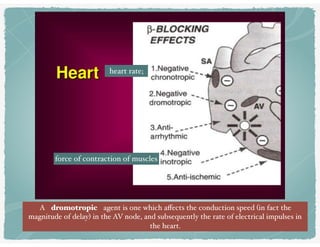
A dromotropic agent is one which affects the conduction speed (in fact the
magnitude of delay) in the AV node, and subsequently the rate of electrical impulses in
the heart.
heart rate; 
force of contraction of muscles
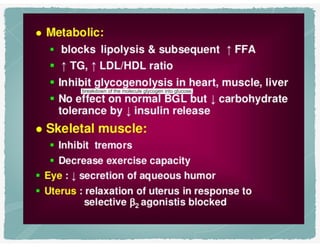
breakdown of the molecule glycogen into glucose,
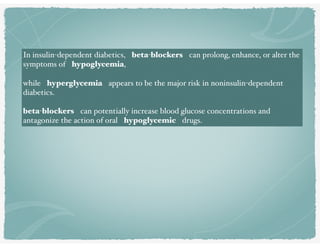
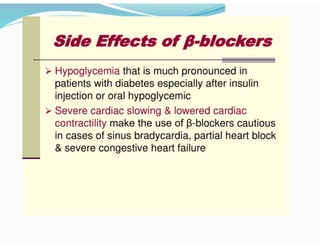
In insulin-dependent diabetics, beta-blockers can prolong, enhance, or alter the
symptoms of hypoglycemia,
while hyperglycemia appears to be the major risk in noninsulin-dependent
diabetics. 
beta-blockers can potentially increase blood glucose concentrations and
antagonize the action of oral hypoglycemic drugs.
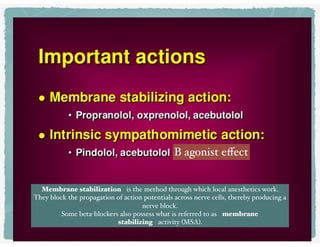
B agonist effect
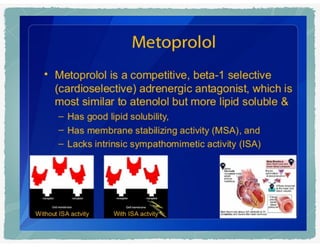
Membrane stabilization is the method through which local anesthetics work.
They block the propagation of action potentials across nerve cells, thereby producing a
nerve block.
Some beta-blockers also possess what is referred to as membrane
stabilizing activity (MSA).
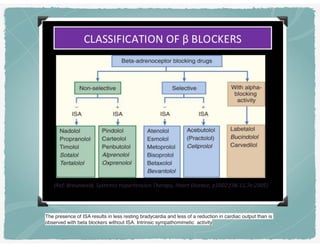
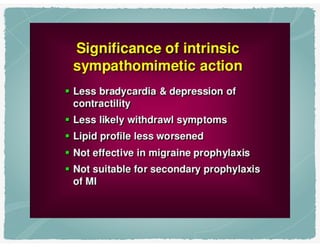
The presence of ISA results in less resting bradycardia and less of a reduction in cardiac output than is
observed with beta blockers without ISA. Intrinsic sympathomimetic activity
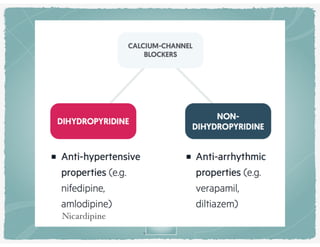
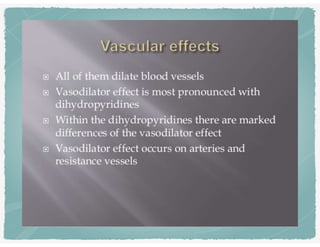
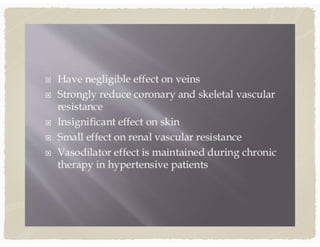
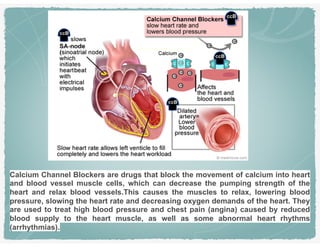
Calcium Channel Blockers are drugs that block the movement of calcium into heart
and blood vessel muscle cells, which can decrease the pumping strength of the
heart and relax blood vessels.This causes the muscles to relax, lowering blood
pressure, slowing the heart rate and decreasing oxygen demands of the heart. They
are used to treat high blood pressure and chest pain (angina) caused by reduced
blood supply to the heart muscle, as well as some abnormal heart rhythms
(arrhythmias).
v
Nicardipine
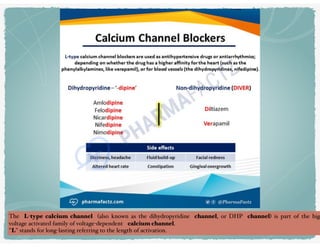
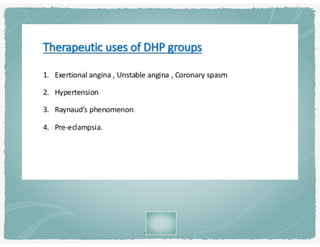
The L-type calcium channel (also known as the dihydropyridine channel, or DHP channel) is part of the high
voltage activated family of voltage-dependent calcium channel.
"L" stands for long-lasting referring to the length of activation. 
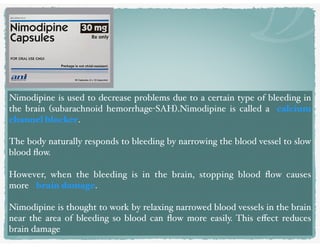
Nimodipine is used to decrease problems due to a certain type of bleeding in
the brain (subarachnoid hemorrhage-SAH).Nimodipine is called a calcium
channel blocker.
The body naturally responds to bleeding by narrowing the blood vessel to slow
blood flow.
However, when the bleeding is in the brain, stopping blood flow causes
more brain damage.
Nimodipine is thought to work by relaxing narrowed blood vessels in the brain
near the area of bleeding so blood can flow more easily. This effect reduces
brain damage
v
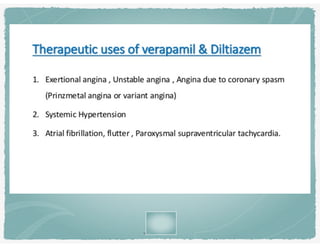
Verapamil is used to treat high blood pressure
Verapamil belongs to a class of drugs known as calcium channel blockers.
It works by relaxing blood vessels so blood can flow more easily.
Verapamil is also used to prevent chest pain (angina).
It may help to increase your ability to exercise and decrease how often you may
get angina attacks.
Verapamil is also used to control heart rate if you have a fast/irregular heartbeat
(such as atrial fibrillation).
It helps to lower the heart rate, helping feel more comfortable and increase your
ability to exercise.
v
v
v
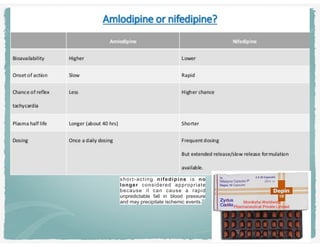
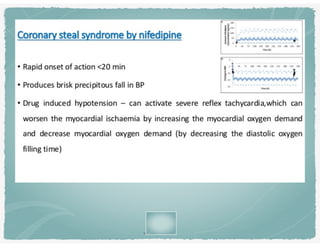
short-acting nifedipine is no
longer considered appropriate
because it can cause a rapid
unpredictable fall in blood pressure
and may precipitate ischemic events.
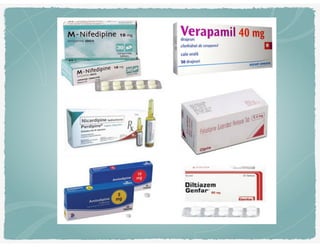
Amlodipine
Pharmacokinetically it is the most distinct DHP. It has complete but slow oral
absorption: peak after 6 to 9 hr—the early vasodilator side effects (palpitation,
flushing, headache, postural dizziness) are largely avoided. Because of less extensive
and less vari- able first pass metabolism, its oral bioavailability is higher and more
consistent. Volume of distribution and t1⁄2 are exceptionally long: diurnal fluctuation
in blood level is small and action extends over the next morning.
Dose: 5–10 mg OD; AMLOPRES, AMCARD, AMLOPIN, MYODURA 2.5, 5, 10 mg
tabs.
S(–)Amlodipine The single enantiomer prepa- ration is effective at half the dose and is
claimed to cause less ankle edema.

Dose: 2.5–5 mg OD;
S-NUMLO, S-AMCARD, ASOMEX, ESAM 2.5, 5 mg tabs.
Nifedipine
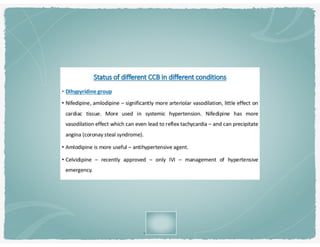
It is the prototype DHP with a rapid onset and short duration of action.
arteriolar dilatation → t.p.r. decreases, BP falls.
it does not depress SA node or A-V conduction.
Reflex sympathetic stimulation of heart predominates → tachycardia, increased contractility
and c.o. (no decrease in venous return along with lowering of afterload aid increase in c.o.).
Coronary flow is increased.
Nifedipine has mild natriuretic action, but significant diuresis does not occur.
Dose: 5–20 mg BD–TDS oral.

CALCIGARD, DEPIN, NIFELAT 5, 10 mg tab, also 10 mg, 20 mg S.R. (RETARD) tab;
NICARDIA 5, 10 mg tab; 10, 20, 30 mg SR tab.
Adverse effects
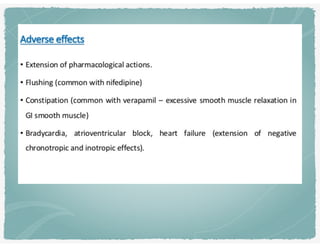
Frequent side effects are palpitation, flushing, ankle edema, hypotension, headache,
drowsiness and nausea.
can be minimized by low starting dose, fractionation of dose or use of retard formulation.
Nifedipine has paradoxically increased the frequency of angina in some patients.
Higher mortality among post MI patients has been confirmed. However, it has been safely
administered with β blockers and digoxin.
By its relaxant effect on bladder nifedipine can increase urine voiding difficulty in elderly
males. It has also been reported to hamper diabetes control by decreasing insulin release.
Nitrendipine
DHP with oral bioavailability of 10–30% and elimination t1⁄2 of 4–12 hours.
It has been shown to release NO from the endothelium and which may be the additional
mechanisms of vasodilator action.
The endothelial NO is claimed to retard atherosclerosis.
Ventricular contractility and A-V conduction are not depressed.
Nitrendipine is indicated in hypertension and angina pectoris.
Dose: 5–20 mg OD; NITREPIN, CARDIF 10, 20 mg tabs.
v
v
v
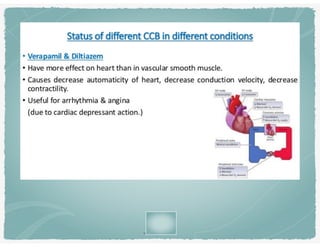
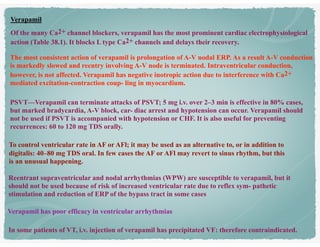
Verapamil
Of the many Ca2+ channel blockers, verapamil has the most prominent cardiac electrophysiological
action (Table 38.1). It blocks L type Ca2+ channels and delays their recovery.
The most consistent action of verapamil is prolongation of A-V nodal ERP. As a result A-V conduction
is markedly slowed and reentry involving A-V node is terminated. Intraventricular conduction,
however, is not affected. Verapamil has negative inotropic action due to interference with Ca2+
mediated excitation-contraction coup- ling in myocardium.
PSVT—Verapamil can terminate attacks of PSVT; 5 mg i.v. over 2–3 min is effective in 80% cases,
but marked bradycardia, A-V block, car- diac arrest and hypotension can occur. Verapamil should
not be used if PSVT is accompanied with hypotension or CHF. It is also useful for preventing
recurrences: 60 to 120 mg TDS orally.
To control ventricular rate in AF or AFl; it may be used as an alternative to, or in addition to
digitalis: 40–80 mg TDS oral. In few cases the AF or AFl may revert to sinus rhythm, but this
is an unusual happening.
Reentrant supraventricular and nodal arrhythmias (WPW) are susceptible to verapamil, but it
should not be used because of risk of increased ventricular rate due to reflex sym- pathetic
stimulation and reduction of ERP of the bypass tract in some cases
Verapamil has poor efficacy in ventricular arrhythmias
In some patients of VT, i.v. injection of verapamil has precipitated VF: therefore contraindicated.
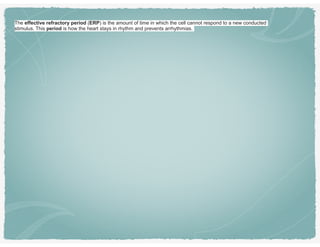
The effective refractory period (ERP) is the amount of time in which the cell cannot respond to a new conducted
stimulus. This period is how the heart stays in rhythm and prevents arrhythmias.
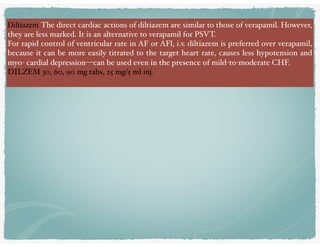
Diltiazem The direct cardiac actions of diltiazem are similar to those of verapamil. However,
they are less marked. It is an alternative to verapamil for PSVT.
For rapid control of ventricular rate in AF or AFl, i.v. diltiazem is preferred over verapamil,
because it can be more easily titrated to the target heart rate, causes less hypotension and
myo- cardial depression—can be used even in the presence of mild-to-moderate CHF.

DILZEM 30, 60, 90 mg tabs, 25 mg/5 ml inj.
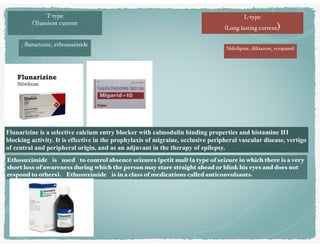
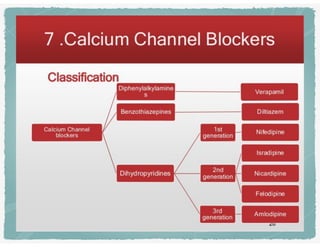
Flunarizine is a selective calcium entry blocker with calmodulin binding properties and histamine H1
blocking activity. It is effective in the prophylaxis of migraine, occlusive peripheral vascular disease, vertigo
of central and peripheral origin, and as an adjuvant in the therapy of epilepsy.
, flunarizine, ethosuximide
T-type
(Transient current
L-type
(Long lasting current)
Nifedipine, diltiazem, verapamil
Ethosuximide is used to control absence seizures (petit mal) (a type of seizure in which there is a very
short loss of awareness during which the person may stare straight ahead or blink his eyes and does not
respond to others). Ethosuximide is in a class of medications called anticonvulsants.
Antihypertensive Drugs
HYPERTENSION
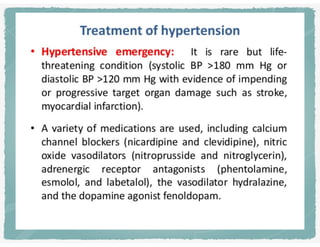
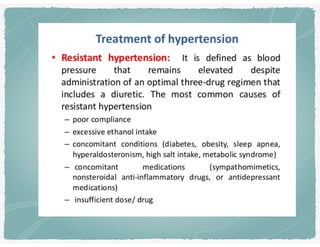
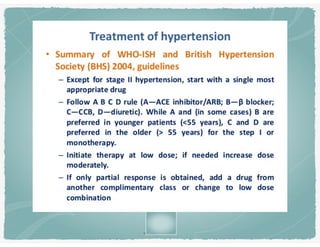
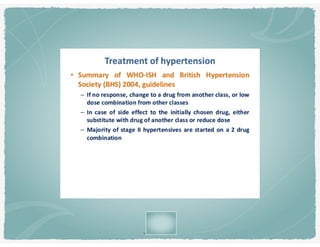
The JNC 7* (2003) and WHO-ISH@ guidelines (2003) have
defined it to be
140 mm Hg systolic and 90 mm Hg diastolic,
though risk appears to increase even above 120/80 mm Hg.
Epidemiological studies have confirmed that higher the pressure
(systolic or diastolic or both) greater is the risk of
cardiovascular disease.

v
v
v
v
v
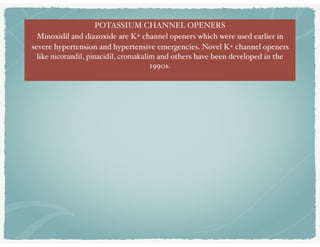
POTASSIUM CHANNEL OPENERS
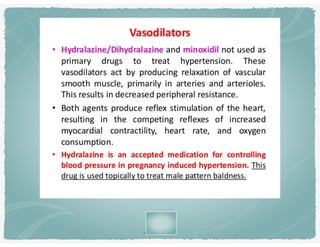
Minoxidil and diazoxide are K+ channel openers which were used earlier in
severe hypertension and hypertensive emergencies. Novel K+ channel openers
like nicorandil, pinacidil, cromakalim and others have been developed in the
1990s.

"Beta blockers" & "Calcium channel blockers (CCBs)"

  • 1.
    Dr. RITESH Dr. Riteshmankar M.D. Dr. RITESH MANKAR MD Cardiovascular Drugs B blocker & CA channel blocker
  • 2.
  • 4.
    A dromotropic agent is onewhich affects the conduction speed (in fact the magnitude of delay) in the AV node, and subsequently the rate of electrical impulses in the heart. heart rate;  force of contraction of muscles
  • 8.
    breakdown of themolecule glycogen into glucose,
  • 9.
    In insulin-dependent diabetics, beta-blockers canprolong, enhance, or alter the symptoms of hypoglycemia, while hyperglycemia appears to be the major risk in noninsulin-dependent diabetics.  beta-blockers can potentially increase blood glucose concentrations and antagonize the action of oral hypoglycemic drugs.
  • 10.
    B agonist effect Membranestabilization is the method through which local anesthetics work. They block the propagation of action potentials across nerve cells, thereby producing a nerve block. Some beta-blockers also possess what is referred to as membrane stabilizing activity (MSA).
  • 13.
    The presence ofISA results in less resting bradycardia and less of a reduction in cardiac output than is observed with beta blockers without ISA. Intrinsic sympathomimetic activity
  • 36.
    Calcium Channel Blockersare drugs that block the movement of calcium into heart and blood vessel muscle cells, which can decrease the pumping strength of the heart and relax blood vessels.This causes the muscles to relax, lowering blood pressure, slowing the heart rate and decreasing oxygen demands of the heart. They are used to treat high blood pressure and chest pain (angina) caused by reduced blood supply to the heart muscle, as well as some abnormal heart rhythms (arrhythmias).
  • 37.
  • 39.
    The L-type calcium channel (alsoknown as the dihydropyridine channel, or DHP channel) is part of the high voltage activated family of voltage-dependent calcium channel. "L" stands for long-lasting referring to the length of activation. 
  • 44.
    Nimodipine is usedto decrease problems due to a certain type of bleeding in the brain (subarachnoid hemorrhage-SAH).Nimodipine is called a calcium channel blocker. The body naturally responds to bleeding by narrowing the blood vessel to slow blood flow. However, when the bleeding is in the brain, stopping blood flow causes more brain damage. Nimodipine is thought to work by relaxing narrowed blood vessels in the brain near the area of bleeding so blood can flow more easily. This effect reduces brain damage
  • 45.
    v Verapamil is used totreat high blood pressure Verapamil belongs to a class of drugs known as calcium channel blockers. It works by relaxing blood vessels so blood can flow more easily. Verapamil is also used to prevent chest pain (angina). It may help to increase your ability to exercise and decrease how often you may get angina attacks. Verapamil is also used to control heart rate if you have a fast/irregular heartbeat (such as atrial fibrillation). It helps to lower the heart rate, helping feel more comfortable and increase your ability to exercise.
  • 46.
  • 47.
  • 48.
  • 49.
    short-acting nifedipine isno longer considered appropriate because it can cause a rapid unpredictable fall in blood pressure and may precipitate ischemic events.
  • 50.
    Amlodipine Pharmacokinetically it isthe most distinct DHP. It has complete but slow oral absorption: peak after 6 to 9 hr—the early vasodilator side effects (palpitation, flushing, headache, postural dizziness) are largely avoided. Because of less extensive and less vari- able first pass metabolism, its oral bioavailability is higher and more consistent. Volume of distribution and t1⁄2 are exceptionally long: diurnal fluctuation in blood level is small and action extends over the next morning. Dose: 5–10 mg OD; AMLOPRES, AMCARD, AMLOPIN, MYODURA 2.5, 5, 10 mg tabs. S(–)Amlodipine The single enantiomer prepa- ration is effective at half the dose and is claimed to cause less ankle edema.
 Dose: 2.5–5 mg OD; S-NUMLO, S-AMCARD, ASOMEX, ESAM 2.5, 5 mg tabs.
  • 51.
    Nifedipine It is theprototype DHP with a rapid onset and short duration of action. arteriolar dilatation → t.p.r. decreases, BP falls. it does not depress SA node or A-V conduction. Reflex sympathetic stimulation of heart predominates → tachycardia, increased contractility and c.o. (no decrease in venous return along with lowering of afterload aid increase in c.o.). Coronary flow is increased. Nifedipine has mild natriuretic action, but significant diuresis does not occur. Dose: 5–20 mg BD–TDS oral.
 CALCIGARD, DEPIN, NIFELAT 5, 10 mg tab, also 10 mg, 20 mg S.R. (RETARD) tab; NICARDIA 5, 10 mg tab; 10, 20, 30 mg SR tab. Adverse effects Frequent side effects are palpitation, flushing, ankle edema, hypotension, headache, drowsiness and nausea. can be minimized by low starting dose, fractionation of dose or use of retard formulation. Nifedipine has paradoxically increased the frequency of angina in some patients. Higher mortality among post MI patients has been confirmed. However, it has been safely administered with β blockers and digoxin. By its relaxant effect on bladder nifedipine can increase urine voiding difficulty in elderly males. It has also been reported to hamper diabetes control by decreasing insulin release.
  • 52.
    Nitrendipine DHP with oralbioavailability of 10–30% and elimination t1⁄2 of 4–12 hours. It has been shown to release NO from the endothelium and which may be the additional mechanisms of vasodilator action. The endothelial NO is claimed to retard atherosclerosis. Ventricular contractility and A-V conduction are not depressed. Nitrendipine is indicated in hypertension and angina pectoris. Dose: 5–20 mg OD; NITREPIN, CARDIF 10, 20 mg tabs.
  • 54.
  • 55.
  • 56.
  • 60.
    Verapamil Of the manyCa2+ channel blockers, verapamil has the most prominent cardiac electrophysiological action (Table 38.1). It blocks L type Ca2+ channels and delays their recovery. The most consistent action of verapamil is prolongation of A-V nodal ERP. As a result A-V conduction is markedly slowed and reentry involving A-V node is terminated. Intraventricular conduction, however, is not affected. Verapamil has negative inotropic action due to interference with Ca2+ mediated excitation-contraction coup- ling in myocardium. PSVT—Verapamil can terminate attacks of PSVT; 5 mg i.v. over 2–3 min is effective in 80% cases, but marked bradycardia, A-V block, car- diac arrest and hypotension can occur. Verapamil should not be used if PSVT is accompanied with hypotension or CHF. It is also useful for preventing recurrences: 60 to 120 mg TDS orally. To control ventricular rate in AF or AFl; it may be used as an alternative to, or in addition to digitalis: 40–80 mg TDS oral. In few cases the AF or AFl may revert to sinus rhythm, but this is an unusual happening. Reentrant supraventricular and nodal arrhythmias (WPW) are susceptible to verapamil, but it should not be used because of risk of increased ventricular rate due to reflex sym- pathetic stimulation and reduction of ERP of the bypass tract in some cases Verapamil has poor efficacy in ventricular arrhythmias In some patients of VT, i.v. injection of verapamil has precipitated VF: therefore contraindicated.
  • 61.
    The effective refractoryperiod (ERP) is the amount of time in which the cell cannot respond to a new conducted stimulus. This period is how the heart stays in rhythm and prevents arrhythmias.
  • 62.
    Diltiazem The directcardiac actions of diltiazem are similar to those of verapamil. However, they are less marked. It is an alternative to verapamil for PSVT. For rapid control of ventricular rate in AF or AFl, i.v. diltiazem is preferred over verapamil, because it can be more easily titrated to the target heart rate, causes less hypotension and myo- cardial depression—can be used even in the presence of mild-to-moderate CHF.
 DILZEM 30, 60, 90 mg tabs, 25 mg/5 ml inj.
  • 63.
    Flunarizine is aselective calcium entry blocker with calmodulin binding properties and histamine H1 blocking activity. It is effective in the prophylaxis of migraine, occlusive peripheral vascular disease, vertigo of central and peripheral origin, and as an adjuvant in the therapy of epilepsy. , flunarizine, ethosuximide T-type (Transient current L-type (Long lasting current) Nifedipine, diltiazem, verapamil Ethosuximide is used to control absence seizures (petit mal) (a type of seizure in which there is a very short loss of awareness during which the person may stare straight ahead or blink his eyes and does not respond to others). Ethosuximide is in a class of medications called anticonvulsants.
  • 64.
    Antihypertensive Drugs HYPERTENSION The JNC7* (2003) and WHO-ISH@ guidelines (2003) have defined it to be 140 mm Hg systolic and 90 mm Hg diastolic, though risk appears to increase even above 120/80 mm Hg. Epidemiological studies have confirmed that higher the pressure (systolic or diastolic or both) greater is the risk of cardiovascular disease.

  • 66.
  • 67.
  • 70.
  • 71.
  • 72.
  • 74.
    POTASSIUM CHANNEL OPENERS Minoxidiland diazoxide are K+ channel openers which were used earlier in severe hypertension and hypertensive emergencies. Novel K+ channel openers like nicorandil, pinacidil, cromakalim and others have been developed in the 1990s.