How to Secure Containerized
Applications
Presenter: Douglas Coburn
3/9/20
How did we get here?
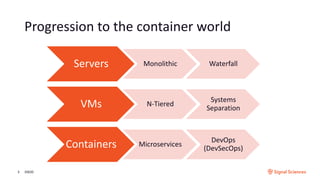
Progression to the container world
3/9/203
Servers Monolithic Waterfall
VMs N-Tiered
Systems
Separation
Containers Microservices
DevOps
(DevSecOps)
For many organizations the shift to containers and
microservices requires deconstructing an existing
monolithic application. This requires spawning off a
function to its own container and adding an additional
communication layer. Usually the additional
communication layer is a form of HTTP (REST, SOAP,
HTTP2/gRPC, etc).
3/9/204
This is important why?
3/9/205
• Introduces new complexity around security concerns
• Who is allowed to use the function?
• How do they authenticate to that function?
• Are the sanity checks for inputs from the monolithic application included?
• How is the environment that the function runs in secured?
• Benefits
• Ability to update one function/part of the “application”
• Easier to maintain a smaller code base for a specific microservice
• App Owners can focus on smaller parts of the overall application
“
The other way you can expose this is if the “insecure API service”
is enabled. As the name suggests, this isn’t something you want
to expose on an untrusted network. But we’ve seen this happen
before, so it’s definitely something you should check.
3/9/206
https://techbeacon.com/enterprise-it/hackers-guide-kubernetes-security
East/West Traffic
3/9/207
East/West and North/South Traffic
3/9/208
• Because apps are highly distributed, 70-80% of traffic is now east-west traffic in data
centers. Traditional monitoring technologies at the edge of data centers monitor what is
coming in and going out of the data center, but they do not monitor what is really inside
of the data center. Hybrid cloud makes workload protection issues even worse because
every app on public cloud still relies on the services that are delivered on on-premises
data center infrastructure.
• https://www.cisco.com/c/en/us/solutions/data-center-virtualization/what-is-dc-
analytics.html
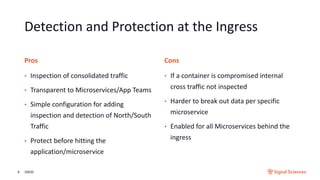
Detection and Protection at the Ingress
3/9/209
Pros Cons
• Inspection of consolidated traffic
• Transparent to Microservices/App Teams
• Simple configuration for adding
inspection and detection of North/South
Traffic
• Protect before hitting the
application/microservice
• If a container is compromised internal
cross traffic not inspected
• Harder to break out data per specific
microservice
• Enabled for all Microservices behind the
ingress
Envoy + Istio in a Service Mesh
3/9/2010
• Best of both worlds detection at the ingress and service layers
• Monitor East/West and North/South Traffic
• Transparent to the app teams, they can just deploy and Istio + Envoy handles the
communication
• App team does not need to worry about modifying their code
Compromised Web App can mean
Compromised Kubernetes Cluster
3/9/2011
• If you gain access to the container environment running the web app you become
trusted
• Some examples of compromised clusters:
• https://medium.com/handy-tech/analysis-of-a-kubernetes-hack-backdooring-through-kubelet-
823be5c3d67c
• https://github.com/kayrus/kubelet-exploit
An example pipeline
3/9/2012
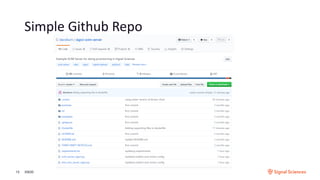
Simple Github Repo
3/9/2013
A configuration file
3/9/2014
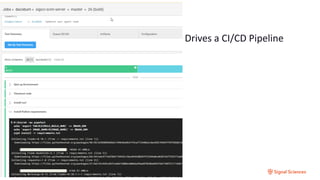
Drives a CI/CD Pipeline
3/9/2015
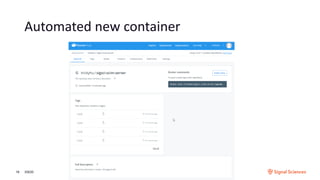
Automated new container
3/9/2016
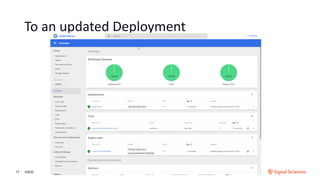
To an updated Deployment
3/9/2017
The Container Security Focus
3/9/2018
“
The app is part of the container also and yet it often
seems to be ignored in the container strategy.
3/9/2019
Douglas Coburn – Director of Professional Services, Signal Sciences
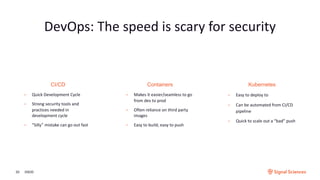
CI/CD
• Quick Development Cycle
• Strong security tools and
practices needed in
development cycle
• “Silly” mistake can go out fast
Kubernetes
• Easy to deploy to
• Can be automated from CI/CD
pipeline
• Quick to scale out a “bad” push
Containers
• Makes it easier/seamless to go
from dev to prod
• Often reliance on third party
images
• Easy to build, easy to push
DevOps: The speed is scary for security
3/9/2020
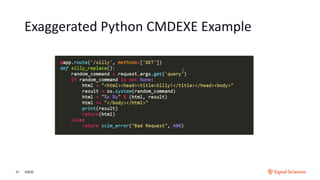
Exaggerated Python CMDEXE Example
3/9/2021
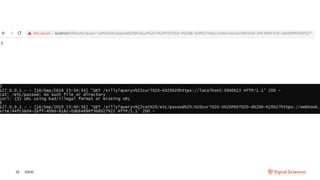
3/9/2022
Over the top example… but highlights the
need
3/9/2023
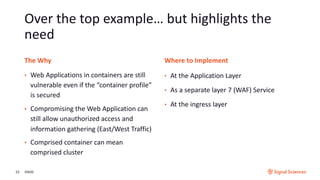
The Why Where to Implement
• Web Applications in containers are still
vulnerable even if the “container profile”
is secured
• Compromising the Web Application can
still allow unauthorized access and
information gathering (East/West Traffic)
• Comprised container can mean
comprised cluster
• At the Application Layer
• As a separate layer 7 (WAF) Service
• At the ingress layer
3/9/2024

Best Practices to Secure Containerized Apps with Next-Gen WAF

  • 1.
    How to SecureContainerized Applications Presenter: Douglas Coburn 3/9/20
  • 2.
    How did weget here?
  • 3.
    Progression to thecontainer world 3/9/203 Servers Monolithic Waterfall VMs N-Tiered Systems Separation Containers Microservices DevOps (DevSecOps)
  • 4.
    For many organizationsthe shift to containers and microservices requires deconstructing an existing monolithic application. This requires spawning off a function to its own container and adding an additional communication layer. Usually the additional communication layer is a form of HTTP (REST, SOAP, HTTP2/gRPC, etc). 3/9/204
  • 5.
    This is importantwhy? 3/9/205 • Introduces new complexity around security concerns • Who is allowed to use the function? • How do they authenticate to that function? • Are the sanity checks for inputs from the monolithic application included? • How is the environment that the function runs in secured? • Benefits • Ability to update one function/part of the “application” • Easier to maintain a smaller code base for a specific microservice • App Owners can focus on smaller parts of the overall application
  • 6.
    “ The other wayyou can expose this is if the “insecure API service” is enabled. As the name suggests, this isn’t something you want to expose on an untrusted network. But we’ve seen this happen before, so it’s definitely something you should check. 3/9/206 https://techbeacon.com/enterprise-it/hackers-guide-kubernetes-security
  • 7.
  • 8.
    East/West and North/SouthTraffic 3/9/208 • Because apps are highly distributed, 70-80% of traffic is now east-west traffic in data centers. Traditional monitoring technologies at the edge of data centers monitor what is coming in and going out of the data center, but they do not monitor what is really inside of the data center. Hybrid cloud makes workload protection issues even worse because every app on public cloud still relies on the services that are delivered on on-premises data center infrastructure. • https://www.cisco.com/c/en/us/solutions/data-center-virtualization/what-is-dc- analytics.html
  • 9.
    Detection and Protectionat the Ingress 3/9/209 Pros Cons • Inspection of consolidated traffic • Transparent to Microservices/App Teams • Simple configuration for adding inspection and detection of North/South Traffic • Protect before hitting the application/microservice • If a container is compromised internal cross traffic not inspected • Harder to break out data per specific microservice • Enabled for all Microservices behind the ingress
  • 10.
    Envoy + Istioin a Service Mesh 3/9/2010 • Best of both worlds detection at the ingress and service layers • Monitor East/West and North/South Traffic • Transparent to the app teams, they can just deploy and Istio + Envoy handles the communication • App team does not need to worry about modifying their code
  • 11.
    Compromised Web Appcan mean Compromised Kubernetes Cluster 3/9/2011 • If you gain access to the container environment running the web app you become trusted • Some examples of compromised clusters: • https://medium.com/handy-tech/analysis-of-a-kubernetes-hack-backdooring-through-kubelet- 823be5c3d67c • https://github.com/kayrus/kubelet-exploit
  • 12.
  • 13.
  • 14.
  • 15.
    Drives a CI/CDPipeline 3/9/2015
  • 16.
  • 17.
    To an updatedDeployment 3/9/2017
  • 18.
    The Container SecurityFocus 3/9/2018
  • 19.
    “ The app ispart of the container also and yet it often seems to be ignored in the container strategy. 3/9/2019 Douglas Coburn – Director of Professional Services, Signal Sciences
  • 20.
    CI/CD • Quick DevelopmentCycle • Strong security tools and practices needed in development cycle • “Silly” mistake can go out fast Kubernetes • Easy to deploy to • Can be automated from CI/CD pipeline • Quick to scale out a “bad” push Containers • Makes it easier/seamless to go from dev to prod • Often reliance on third party images • Easy to build, easy to push DevOps: The speed is scary for security 3/9/2020
  • 21.
    Exaggerated Python CMDEXEExample 3/9/2021
  • 22.
  • 23.
    Over the topexample… but highlights the need 3/9/2023 The Why Where to Implement • Web Applications in containers are still vulnerable even if the “container profile” is secured • Compromising the Web Application can still allow unauthorized access and information gathering (East/West Traffic) • Comprised container can mean comprised cluster • At the Application Layer • As a separate layer 7 (WAF) Service • At the ingress layer
  • 24.