Bernard Tschumi (1944) is an architect, writer, and educator, commonly
associated with deconstructivism.
He works and lives in New York City and Paris. He studied in Paris and at ETH in
Zurich, where he received his degree in architecture in 1969.
During the 1970s, through drawings and written texts, Bernard Tschumi insisted
that there is no architecture without events, without actions or activity.
BINARD TSCHUMI
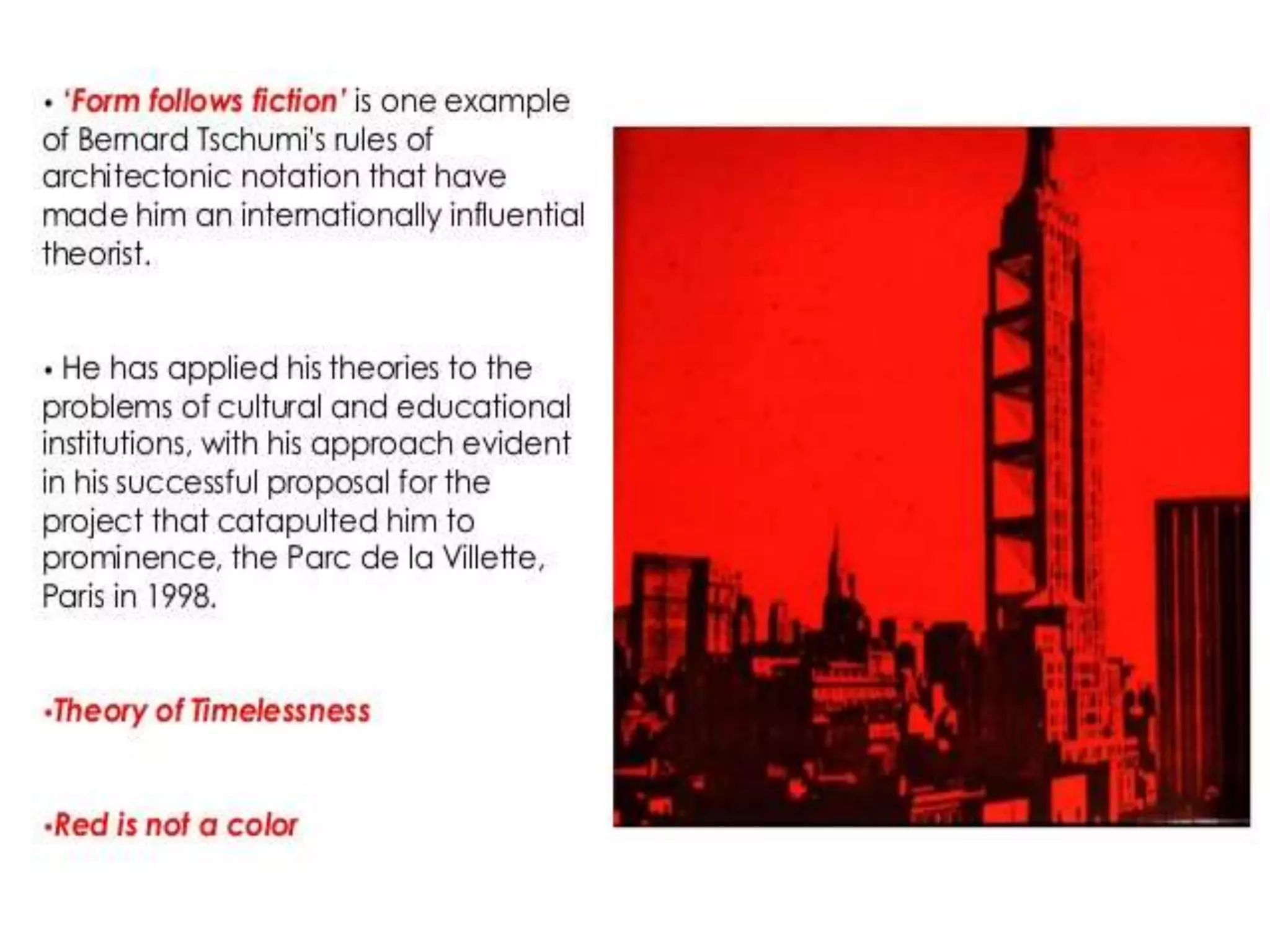
•Bernard commonly associated with deconstructivism.
•In 1970 Tschumi has argued that there is no fixed relationship
between architectural form and the events that take place within it.
•According to him Architecture’s role is not to express an extant
social structure , but to function as a tool for questioning that
structure and revise it.
•Architecture by nature is fundamentally useless, setting it apart
from building.
Theory
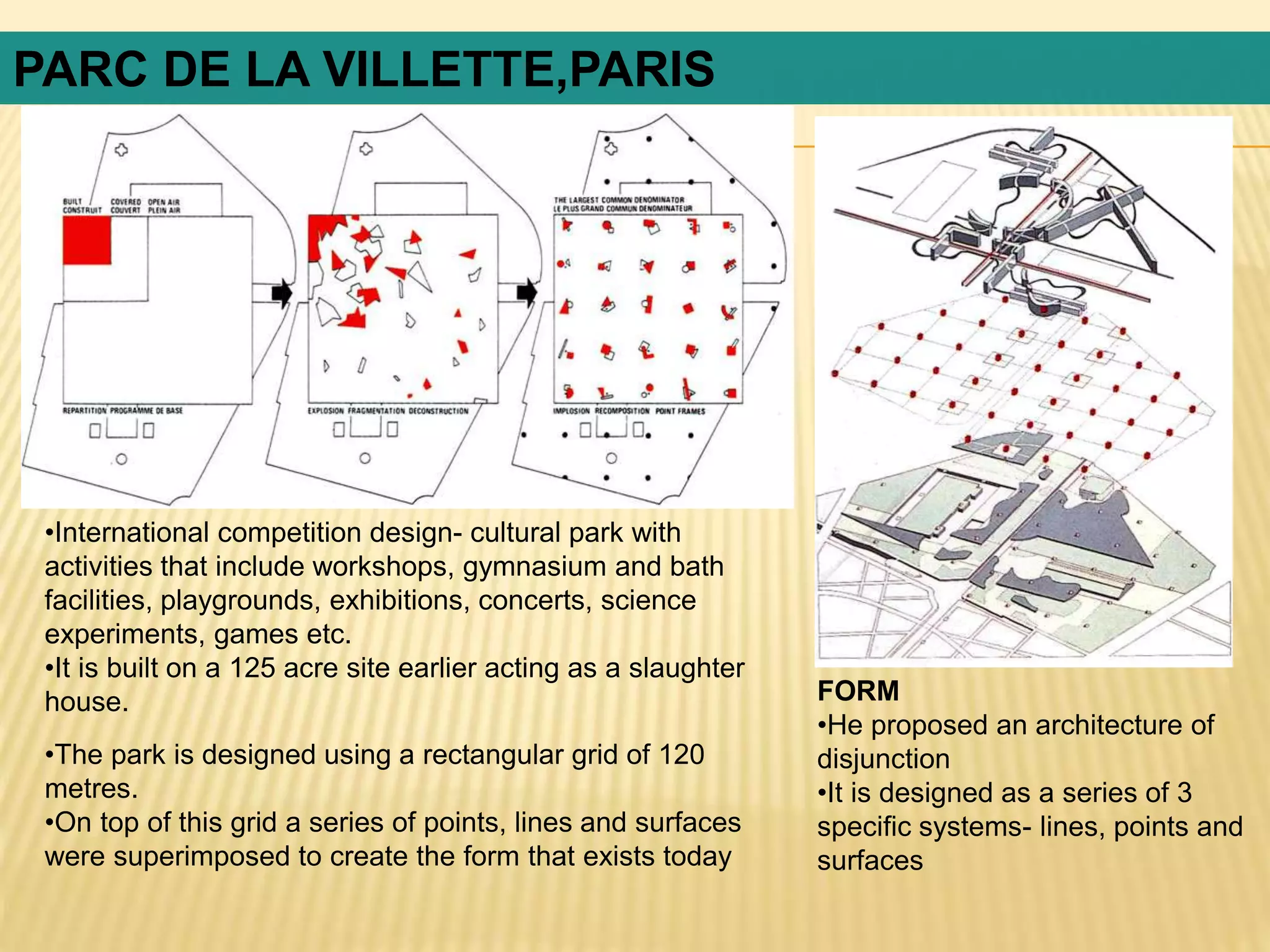
•International competition design- cultural park with
activities that include workshops, gymnasium and bath
facilities, playgrounds, exhibitions, concerts, science
experiments, games etc.
•It is built on a 125 acre site earlier acting as a slaughter
house. FORM
•He proposed an architecture of
disjunction
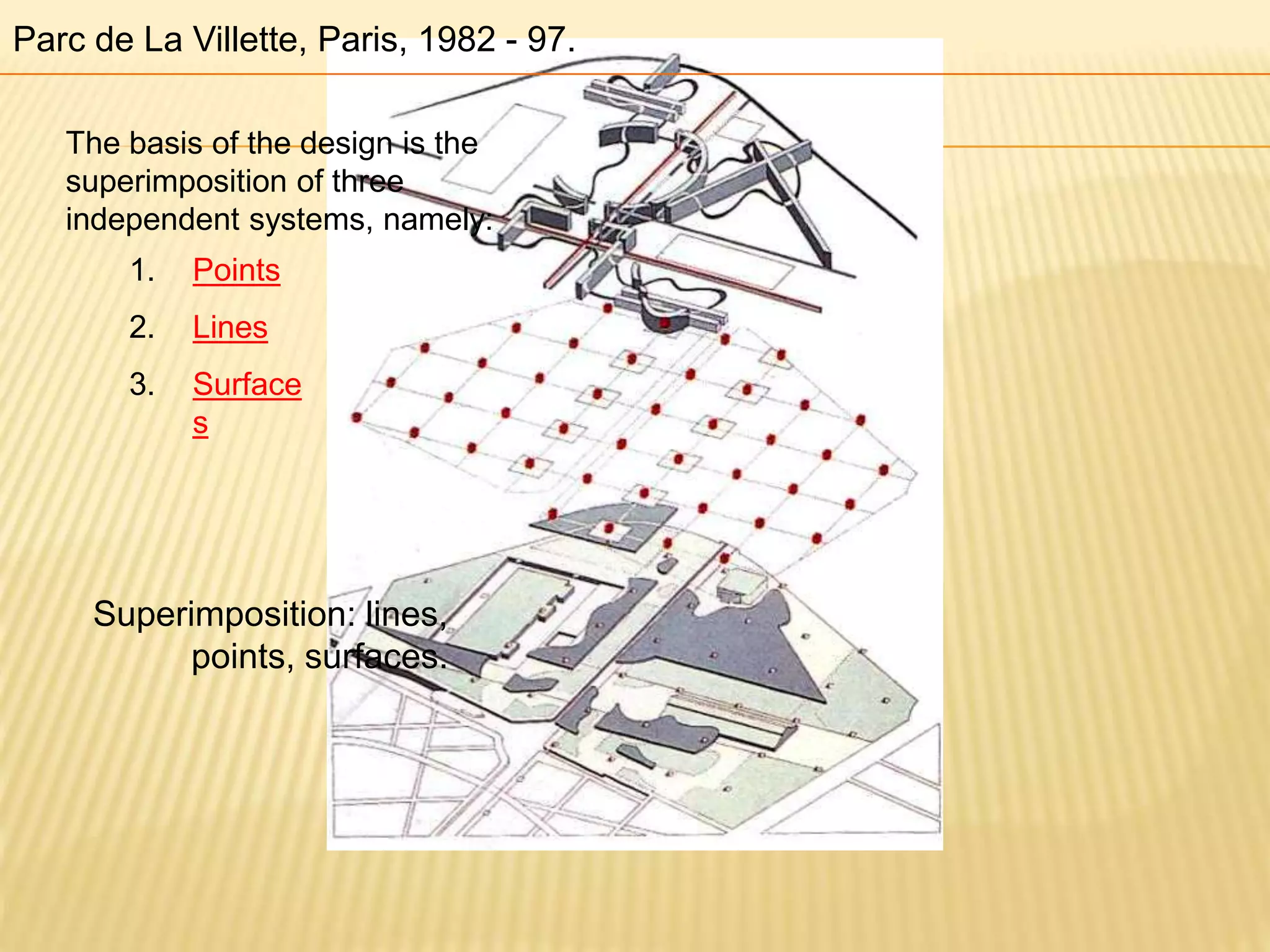
•It is designed as a series of 3
specific systems- lines, points and
surfaces
PARC DE LA VILLETTE,PARIS
•The park is designed using a rectangular grid of 120
metres.
•On top of this grid a series of points, lines and surfaces
were superimposed to create the form that exists today
Parc de La Villette, Paris, 1982 - 97.
1. Points
2. Lines
3. Surface
s
The basis of the design is the
superimposition of three
independent systems, namely:
Superimposition: lines,
points, surfaces.
•The lines of the park are composed
of two major perpendicular axes
running parallel to the orthogonal
grid.
•These form the major walkways of
the park.
•A curved walkway threads its way
through the linear one
CIRCULATION
LINES, POINTS,SURFACE
LINES
LINES, POINTS,SURFACE
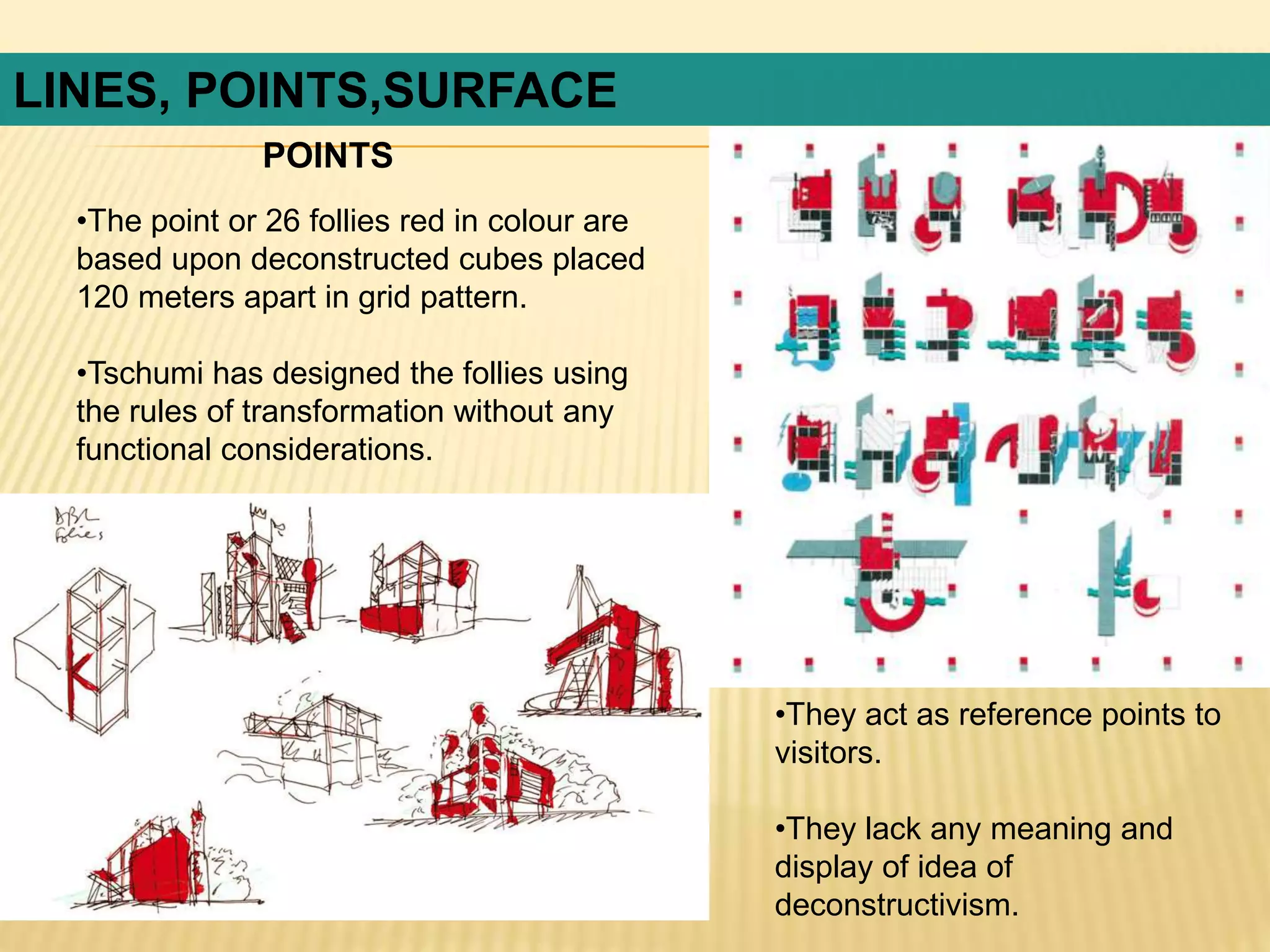
•The point or 26 follies red in colour are
based upon deconstructed cubes placed
120 meters apart in grid pattern.
•Tschumi has designed the follies using
the rules of transformation without any
functional considerations.
•They act as reference points to
visitors.
•They lack any meaning and
display of idea of
deconstructivism.
POINTS
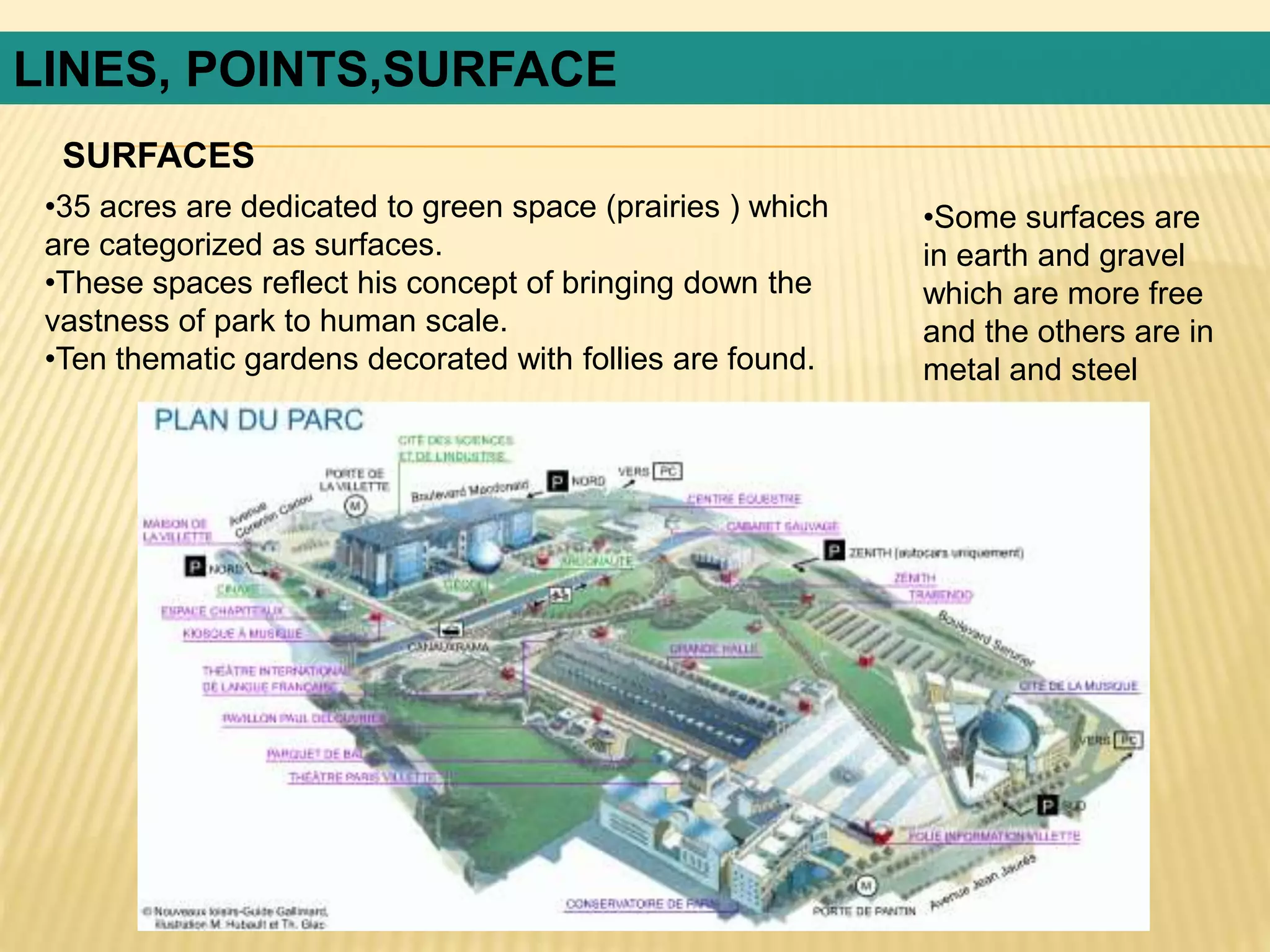
•35 acres are dedicated to green space (prairies ) which
are categorized as surfaces.
•These spaces reflect his concept of bringing down the
vastness of park to human scale.
•Ten thematic gardens decorated with follies are found.
SURFACES
LINES, POINTS,SURFACE
•Some surfaces are
in earth and gravel
which are more free
and the others are in
metal and steel
FACADE
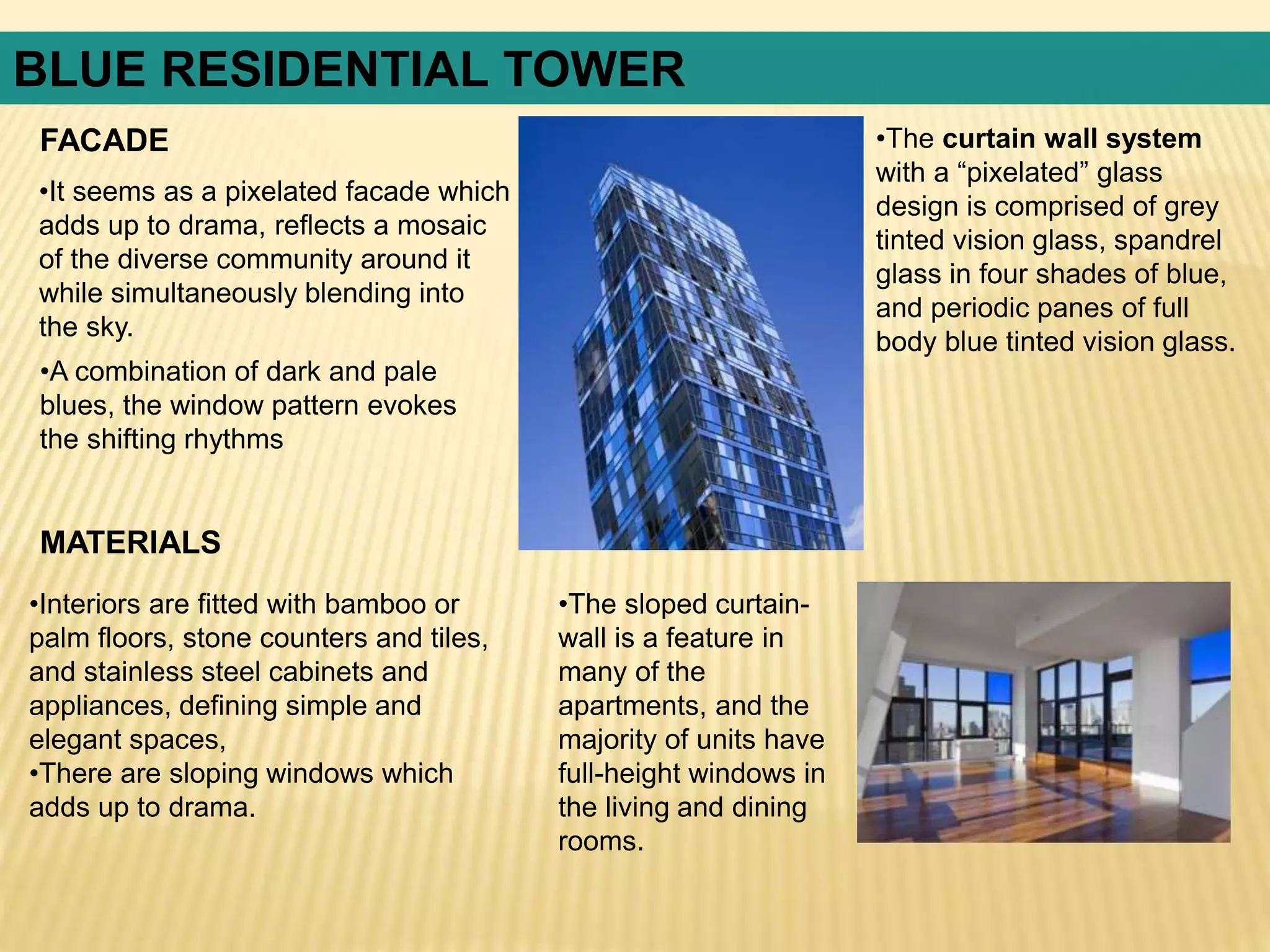
•It seems as a pixelated facade which
adds up to drama, reflects a mosaic
of the diverse community around it
while simultaneously blending into
the sky.
•A combination of dark and pale
blues, the window pattern evokes
the shifting rhythms
MATERIALS
•Interiors are fitted with bamboo or
palm floors, stone counters and tiles,
and stainless steel cabinets and
appliances, defining simple and
elegant spaces,
•There are sloping windows which
adds up to drama.
•The curtain wall system
with a “pixelated” glass
design is comprised of grey
tinted vision glass, spandrel
glass in four shades of blue,
and periodic panes of full
body blue tinted vision glass.
•The sloped curtain-
wall is a feature in
many of the
apartments, and the
majority of units have
full-height windows in
the living and dining
rooms.
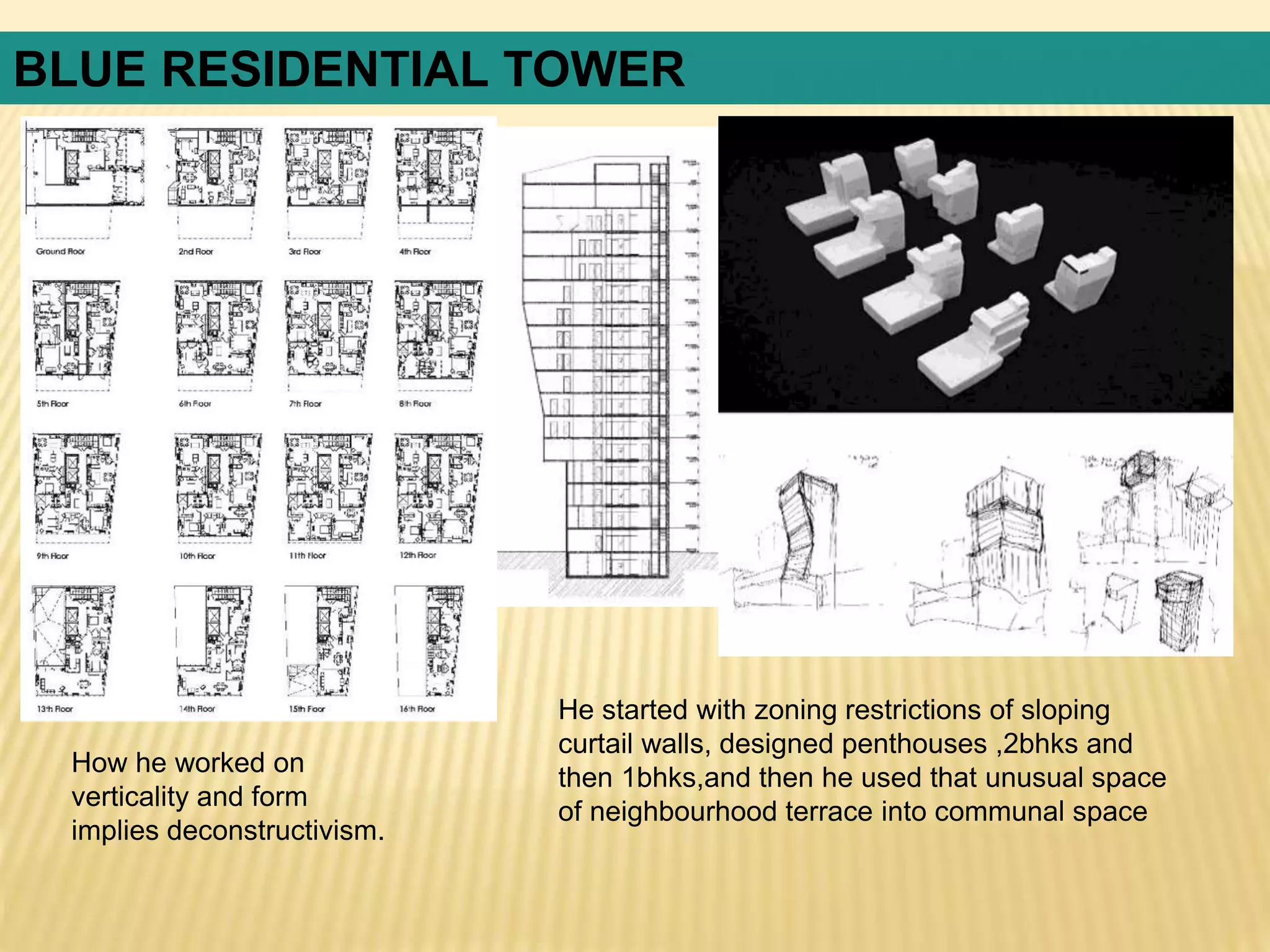
BLUE RESIDENTIAL TOWER
He started with zoning restrictions of sloping
curtail walls, designed penthouses ,2bhks and
then 1bhks,and then he used that unusual space
of neighbourhood terrace into communal space
How he worked on
verticality and form
implies deconstructivism.
BLUE RESIDENTIAL TOWER
Throughout his career as an architect, theorist, and academic, Bernard Tschumi's
work has reevaluated architecture's role in the practice of personal and political
freedom. Since the 1970s, Tschumi has argued that there is no fixed
relationship between architectural form and the events that take place
within it.
In Tschumi's theory, architecture's role is not to express an extant social structure,
but to function as a tool for questioning that structure and revising it.
Tschumi's critical understanding of architecture remains at the core of his practice
today. By arguing that there is no space without event, he designs conditions for
a reinvention of living, rather than repeating established aesthetic or symbolic
conditions of design.
Conclusion
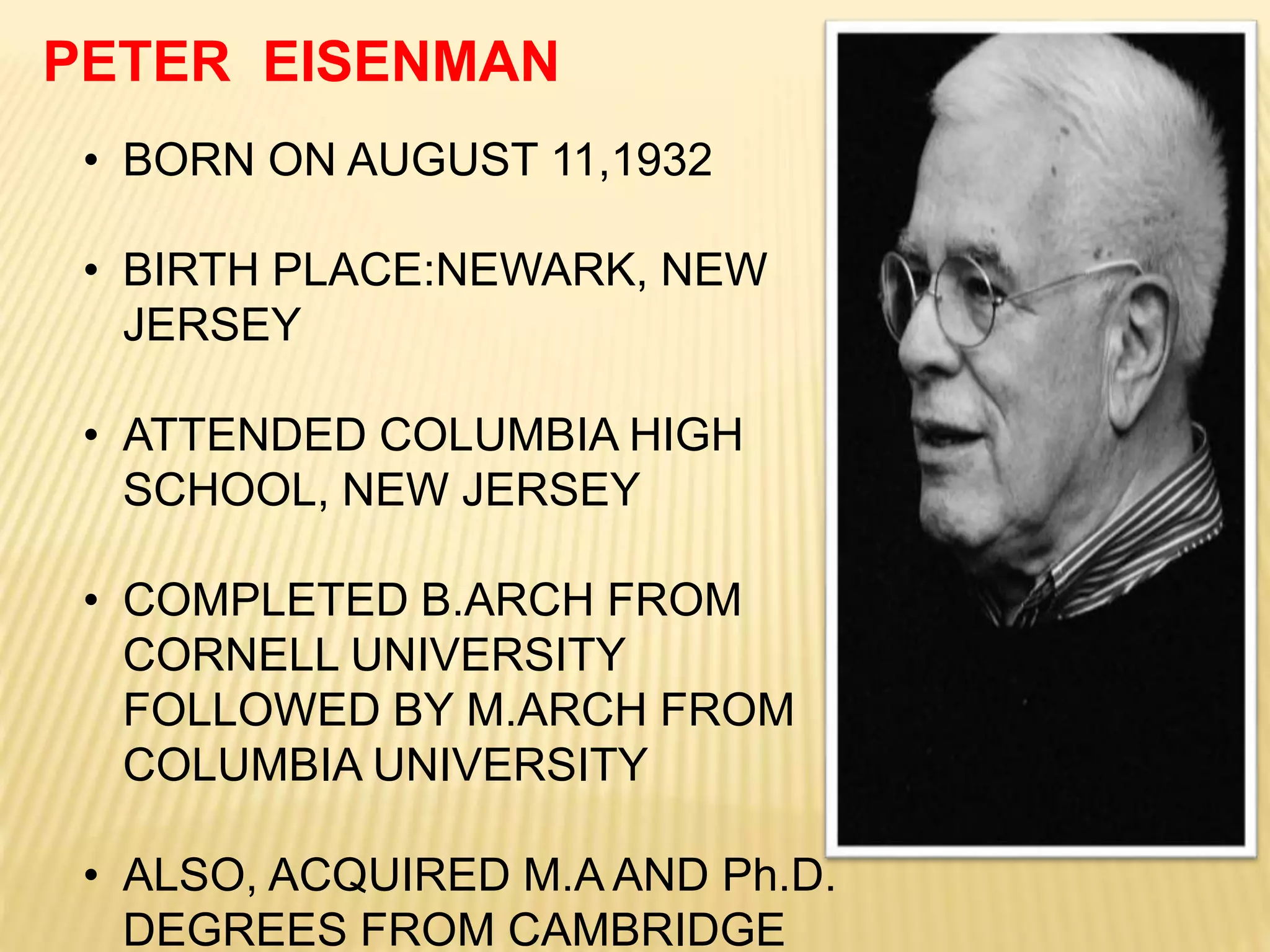
• BORN ON AUGUST 11,1932
• BIRTH PLACE:NEWARK, NEW
JERSEY
• ATTENDED COLUMBIA HIGH
SCHOOL, NEW JERSEY
• COMPLETED B.ARCH FROM
CORNELL UNIVERSITY
FOLLOWED BY M.ARCH FROM
COLUMBIA UNIVERSITY
• ALSO, ACQUIRED M.A AND Ph.D.
DEGREES FROM CAMBRIDGE
PETER EISENMAN
CAREER
• HE FIRST ROSE TO PROMINENCE AS A MEMBER
OF THE NEW YORK FIVE (A GROUP OF FIVE
ARCHITECTS) : EISENMAN, CHARLES
GWATHMEY, JOHN HEJDUK, RICHARD MEIER,
MICHAEL GRAVES
• THESE ARCHITECTS’ WORK AT THAT TIME WAS
CONSIDERED A REWORKING OF THE IDEAS OF
LE CORBUSIER
• LATER ON EISENMAN BECAME MORE
AFFILIATED TO DECONSTRUCTIVISM
• HE REJECTED THE FUNCTIONAL CONCEPT OF
MODERNISM BY DESIGNING STAIRWAYS THAT
LED NOWHERE OR COLUMNS THAT DID NOT
FUNCTION AS SUPPORT
• HIS WORKS WERE CHARACTERIZED BY
DISCONCERTING FORMS, ANGLES AND
MATERIALS
• ACCORDING TO EISENMAN, WHEN YOU CAN
SENSE THE INCOMPLETENESS OF A FINISHED
STRUCTURE, IT IS A PARADOXICAL
EXPERIENCE. IF THE PARTS THAT MAKE UP A
WHOLE ARE IN CONFLICT, THE SENSATION OF
THE INCOMPLETE CONTESTS THE FACT THAT
PHILOSOPHY
WORKS
• MEMORIAL TO THE MURDERED JEWS OF
EUROPE, BERLIN
• GREATER COLUMBUS CONVENTION
CENTRE, COLUMBUS, OHIO
• WEXNER CENTRE OF THE ARTS,
COLUMBUS, OHIO
• HOUSE VI (FRANK RESIDENCE),
CONNECTICUT
• CITY OF CULTURE OF GALICIA, SPAIN
MEMORIAL FOR MURDERED JEWS, BERLIN.
• IT IS ALSO KNOWN AS HOLOCAUST
MEMORIAL
• IT IS A MEMORIAL IN BERLIN TO THE JEWISH
VICTIMS OF THE HOLOCAUST, DESIGNED BY
EISENMAN AND ENGINEER BURO HAPPOLD
• IT CONSISTS OF 4.2
ACRE SITE COVERED
WITH 2,711 CONCRETE
SLABS/STELAE
ARRANGED IN A GRID
PATTERN ON A SLOPING
FIELD
• IT TOOK 1 YEAR FOR ITS
COMPLETION
• IT WAS DESIGNED TO
PRODUCE AN UNEASY
CONCEPT : HOLOCAUST MEMORIAL
 Generally, while experiencing a building a person walks through the
building perceiving columns on the left and moving around and
again there are columns on the right, so there can be a sort of
conclusion about the building being symmetric, axial etc. So
understanding of a buildings comes from being presence in the
experience.
 But in the holocaust memorial, experiencing the building does not
give you understanding of the monument. In this project, when we
move, we do not learn anything, there is no specific path to follow,
any point within the memorial is no different than any other point.
 The underlying idea behind the memorial was to reduce the
meaning of experience because this relates to what happened in
camps. The memorial intends to show the absence of meaning in
the executions carried out in camps.
 The memorial is an analogy to experience of the camps but also an
analogy to the idea of breaking down the relationship between
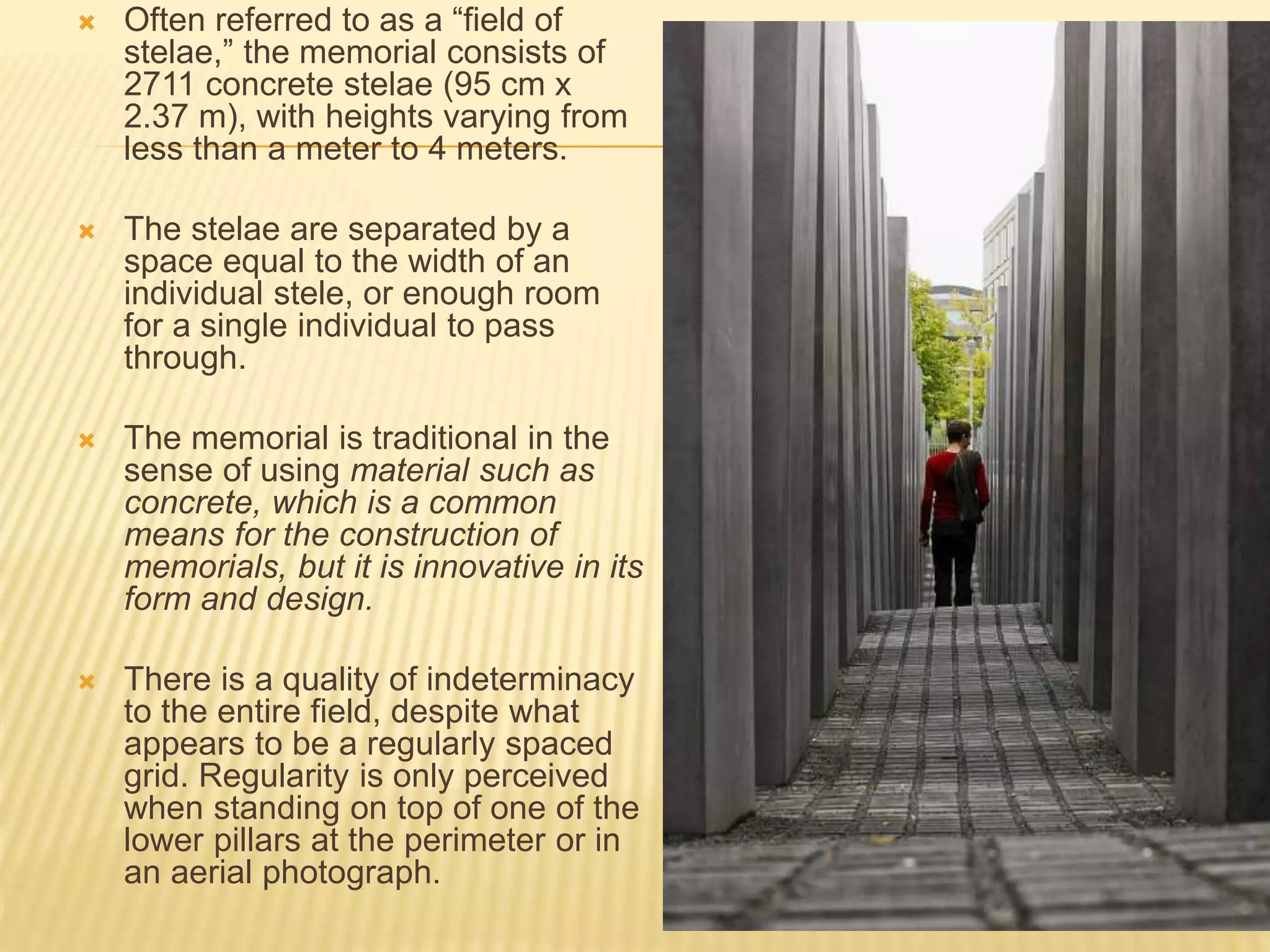
 Often referred to as a “field of
stelae,” the memorial consists of
2711 concrete stelae (95 cm x
2.37 m), with heights varying from
less than a meter to 4 meters.
 The stelae are separated by a
space equal to the width of an
individual stele, or enough room
for a single individual to pass
through.
 The memorial is traditional in the
sense of using material such as
concrete, which is a common
means for the construction of
memorials, but it is innovative in its
form and design.
 There is a quality of indeterminacy
to the entire field, despite what
appears to be a regularly spaced
grid. Regularity is only perceived
when standing on top of one of the
lower pillars at the perimeter or in
an aerial photograph.
 The space of the memorial is not overwhelming in scale, the
instability of the ground and unpredictability of the heights of the
stelae interact to frustrate understanding of the space.
 One is further confused or disoriented by the narrow alleys which
are not truly perceived as straight lines, due to the varying heights of
the concrete slabs and the uneven ground plane.
 Perhaps even more disorienting is the fact that there are no written
cues or symbols of any sort. Immediately discounting the notion that
one should “read” the pillars as tombstones is the absence of any
language and any apparent “right” or “wrong” direction or ending
point.
WEXNER CENTRE FOR THE
• IT IS THE OHIO STATE UNIVERSITY’S
MULTIDISCIPLINARY, INTERNATIONAL LAB FOR
THE EXPLORATION AND ADVANCEMENT OF
CONTEMPORARY ART
• AREA: 108 SQ. FT
• THREE-STORY BUILDING
• PETER EISENMAN WON THE DESIGN
COMPETITION OVER FOUR OTHER
EXPERIENCED FINALISTS IN 1983
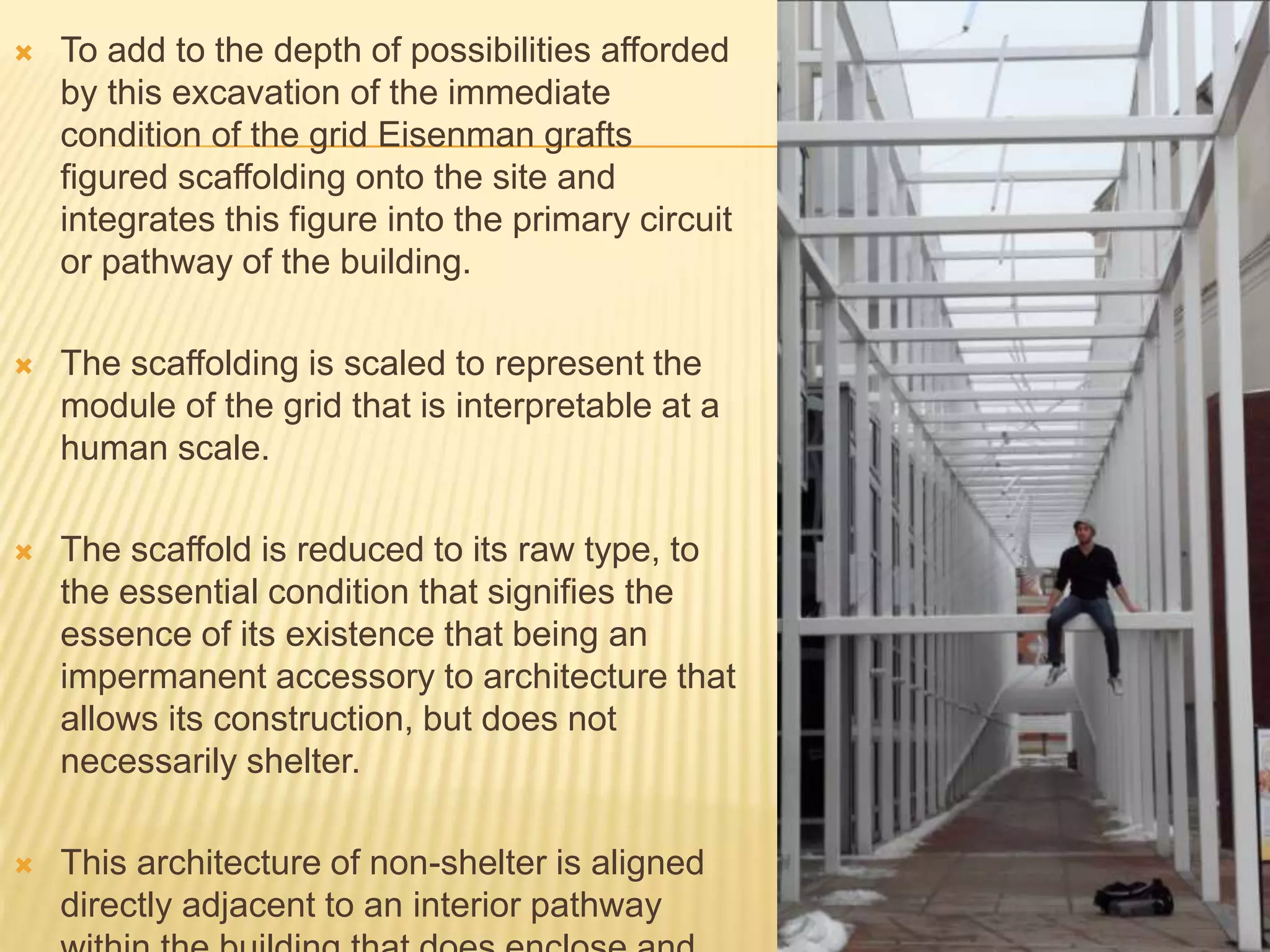
• INCLUDES A LARGE WHITE METAL GRID MEANT
TO SUGGEST SCAFFOLDING TO GIVE THE
BUILDING A SENSE OF INCOMPLETENESS
• IT HOUSES A FILM AND VIDEO THEATER,
PERFOMANCE SPACE, A FILM AND VIDEO POST
PRODUCTION STUDIO, A BOOKSTORE, CAFÉ
DESIGN PROCESS
 The literal use of the
rotated grid is used by
Eisenman as an
extensive method of
giving the architecture its
own voice.
 The identification of the
dialectic grids stems
from conditions that exist
at the boundary of the
site, Eisenman then
grafts one grid on top of
the other and seeks
potential connections or
‘event sites’ at the urban,
local, and interior scales.
 Scalar operations are performed as a means of mediating the scale
of the urban grid towards a pedestrian or human scale, lastly, the
results of these operations serves as a map that is used to locate
program, pathways, structure, interior forms, excavations, and views
along the newly afforded possibilities of ‘event sites’ in both the
horizontal and vertical planes.
 The results of these operations are visible in almost every aspect of
the construction, from the module in the curtain wall, the tiling of the
pavers, planters and trees on site.
 To add to the depth of possibilities afforded
by this excavation of the immediate
condition of the grid Eisenman grafts
figured scaffolding onto the site and
integrates this figure into the primary circuit
or pathway of the building.
 The scaffolding is scaled to represent the
module of the grid that is interpretable at a
human scale.
 The scaffold is reduced to its raw type, to
the essential condition that signifies the
essence of its existence that being an
impermanent accessory to architecture that
allows its construction, but does not
necessarily shelter.
 This architecture of non-shelter is aligned
directly adjacent to an interior pathway
 Within the armory forms the
negative space carved out of the
solid brick masses that make up
these figures is cast with a dark
tinted curtain wall, within which is
an aluminum mullion pattern
evocative of the use of grid.
 The contrast created by the
anodized aluminum of the
mullions intensifies the
impenetrable depth of the glass.
 The lack of historical fidelity in the
reconstruction of the armory, the
fragmentation of the form, and the
insertion of dark glass into the
voids left between these
fragments seems to speak of the
disjointed manner in which we
reflect the past, and in turn, it
serves to remind us of a past we
have lost and can never return to.
Deconstructism

Deconstructism

  • 1.
    Bernard Tschumi (1944)is an architect, writer, and educator, commonly associated with deconstructivism. He works and lives in New York City and Paris. He studied in Paris and at ETH in Zurich, where he received his degree in architecture in 1969. During the 1970s, through drawings and written texts, Bernard Tschumi insisted that there is no architecture without events, without actions or activity. BINARD TSCHUMI
  • 2.
    •Bernard commonly associatedwith deconstructivism. •In 1970 Tschumi has argued that there is no fixed relationship between architectural form and the events that take place within it. •According to him Architecture’s role is not to express an extant social structure , but to function as a tool for questioning that structure and revise it. •Architecture by nature is fundamentally useless, setting it apart from building. Theory
  • 4.
    •International competition design-cultural park with activities that include workshops, gymnasium and bath facilities, playgrounds, exhibitions, concerts, science experiments, games etc. •It is built on a 125 acre site earlier acting as a slaughter house. FORM •He proposed an architecture of disjunction •It is designed as a series of 3 specific systems- lines, points and surfaces PARC DE LA VILLETTE,PARIS •The park is designed using a rectangular grid of 120 metres. •On top of this grid a series of points, lines and surfaces were superimposed to create the form that exists today
  • 5.
    Parc de LaVillette, Paris, 1982 - 97. 1. Points 2. Lines 3. Surface s The basis of the design is the superimposition of three independent systems, namely: Superimposition: lines, points, surfaces.
  • 6.
    •The lines ofthe park are composed of two major perpendicular axes running parallel to the orthogonal grid. •These form the major walkways of the park. •A curved walkway threads its way through the linear one CIRCULATION LINES, POINTS,SURFACE LINES
  • 7.
    LINES, POINTS,SURFACE •The pointor 26 follies red in colour are based upon deconstructed cubes placed 120 meters apart in grid pattern. •Tschumi has designed the follies using the rules of transformation without any functional considerations. •They act as reference points to visitors. •They lack any meaning and display of idea of deconstructivism. POINTS
  • 8.
    •35 acres arededicated to green space (prairies ) which are categorized as surfaces. •These spaces reflect his concept of bringing down the vastness of park to human scale. •Ten thematic gardens decorated with follies are found. SURFACES LINES, POINTS,SURFACE •Some surfaces are in earth and gravel which are more free and the others are in metal and steel
  • 9.
    FACADE •It seems asa pixelated facade which adds up to drama, reflects a mosaic of the diverse community around it while simultaneously blending into the sky. •A combination of dark and pale blues, the window pattern evokes the shifting rhythms MATERIALS •Interiors are fitted with bamboo or palm floors, stone counters and tiles, and stainless steel cabinets and appliances, defining simple and elegant spaces, •There are sloping windows which adds up to drama. •The curtain wall system with a “pixelated” glass design is comprised of grey tinted vision glass, spandrel glass in four shades of blue, and periodic panes of full body blue tinted vision glass. •The sloped curtain- wall is a feature in many of the apartments, and the majority of units have full-height windows in the living and dining rooms. BLUE RESIDENTIAL TOWER
  • 10.
    He started withzoning restrictions of sloping curtail walls, designed penthouses ,2bhks and then 1bhks,and then he used that unusual space of neighbourhood terrace into communal space How he worked on verticality and form implies deconstructivism. BLUE RESIDENTIAL TOWER
  • 11.
    Throughout his careeras an architect, theorist, and academic, Bernard Tschumi's work has reevaluated architecture's role in the practice of personal and political freedom. Since the 1970s, Tschumi has argued that there is no fixed relationship between architectural form and the events that take place within it. In Tschumi's theory, architecture's role is not to express an extant social structure, but to function as a tool for questioning that structure and revising it. Tschumi's critical understanding of architecture remains at the core of his practice today. By arguing that there is no space without event, he designs conditions for a reinvention of living, rather than repeating established aesthetic or symbolic conditions of design. Conclusion
  • 12.
    • BORN ONAUGUST 11,1932 • BIRTH PLACE:NEWARK, NEW JERSEY • ATTENDED COLUMBIA HIGH SCHOOL, NEW JERSEY • COMPLETED B.ARCH FROM CORNELL UNIVERSITY FOLLOWED BY M.ARCH FROM COLUMBIA UNIVERSITY • ALSO, ACQUIRED M.A AND Ph.D. DEGREES FROM CAMBRIDGE PETER EISENMAN
  • 13.
    CAREER • HE FIRSTROSE TO PROMINENCE AS A MEMBER OF THE NEW YORK FIVE (A GROUP OF FIVE ARCHITECTS) : EISENMAN, CHARLES GWATHMEY, JOHN HEJDUK, RICHARD MEIER, MICHAEL GRAVES • THESE ARCHITECTS’ WORK AT THAT TIME WAS CONSIDERED A REWORKING OF THE IDEAS OF LE CORBUSIER • LATER ON EISENMAN BECAME MORE AFFILIATED TO DECONSTRUCTIVISM
  • 14.
    • HE REJECTEDTHE FUNCTIONAL CONCEPT OF MODERNISM BY DESIGNING STAIRWAYS THAT LED NOWHERE OR COLUMNS THAT DID NOT FUNCTION AS SUPPORT • HIS WORKS WERE CHARACTERIZED BY DISCONCERTING FORMS, ANGLES AND MATERIALS • ACCORDING TO EISENMAN, WHEN YOU CAN SENSE THE INCOMPLETENESS OF A FINISHED STRUCTURE, IT IS A PARADOXICAL EXPERIENCE. IF THE PARTS THAT MAKE UP A WHOLE ARE IN CONFLICT, THE SENSATION OF THE INCOMPLETE CONTESTS THE FACT THAT PHILOSOPHY
  • 15.
    WORKS • MEMORIAL TOTHE MURDERED JEWS OF EUROPE, BERLIN • GREATER COLUMBUS CONVENTION CENTRE, COLUMBUS, OHIO • WEXNER CENTRE OF THE ARTS, COLUMBUS, OHIO • HOUSE VI (FRANK RESIDENCE), CONNECTICUT • CITY OF CULTURE OF GALICIA, SPAIN
  • 16.
    MEMORIAL FOR MURDEREDJEWS, BERLIN.
  • 17.
    • IT ISALSO KNOWN AS HOLOCAUST MEMORIAL • IT IS A MEMORIAL IN BERLIN TO THE JEWISH VICTIMS OF THE HOLOCAUST, DESIGNED BY EISENMAN AND ENGINEER BURO HAPPOLD • IT CONSISTS OF 4.2 ACRE SITE COVERED WITH 2,711 CONCRETE SLABS/STELAE ARRANGED IN A GRID PATTERN ON A SLOPING FIELD • IT TOOK 1 YEAR FOR ITS COMPLETION • IT WAS DESIGNED TO PRODUCE AN UNEASY
  • 18.
    CONCEPT : HOLOCAUSTMEMORIAL  Generally, while experiencing a building a person walks through the building perceiving columns on the left and moving around and again there are columns on the right, so there can be a sort of conclusion about the building being symmetric, axial etc. So understanding of a buildings comes from being presence in the experience.  But in the holocaust memorial, experiencing the building does not give you understanding of the monument. In this project, when we move, we do not learn anything, there is no specific path to follow, any point within the memorial is no different than any other point.  The underlying idea behind the memorial was to reduce the meaning of experience because this relates to what happened in camps. The memorial intends to show the absence of meaning in the executions carried out in camps.  The memorial is an analogy to experience of the camps but also an analogy to the idea of breaking down the relationship between
  • 19.
     Often referredto as a “field of stelae,” the memorial consists of 2711 concrete stelae (95 cm x 2.37 m), with heights varying from less than a meter to 4 meters.  The stelae are separated by a space equal to the width of an individual stele, or enough room for a single individual to pass through.  The memorial is traditional in the sense of using material such as concrete, which is a common means for the construction of memorials, but it is innovative in its form and design.  There is a quality of indeterminacy to the entire field, despite what appears to be a regularly spaced grid. Regularity is only perceived when standing on top of one of the lower pillars at the perimeter or in an aerial photograph.
  • 20.
     The spaceof the memorial is not overwhelming in scale, the instability of the ground and unpredictability of the heights of the stelae interact to frustrate understanding of the space.  One is further confused or disoriented by the narrow alleys which are not truly perceived as straight lines, due to the varying heights of the concrete slabs and the uneven ground plane.  Perhaps even more disorienting is the fact that there are no written cues or symbols of any sort. Immediately discounting the notion that one should “read” the pillars as tombstones is the absence of any language and any apparent “right” or “wrong” direction or ending point.
  • 21.
  • 22.
    • IT ISTHE OHIO STATE UNIVERSITY’S MULTIDISCIPLINARY, INTERNATIONAL LAB FOR THE EXPLORATION AND ADVANCEMENT OF CONTEMPORARY ART • AREA: 108 SQ. FT • THREE-STORY BUILDING • PETER EISENMAN WON THE DESIGN COMPETITION OVER FOUR OTHER EXPERIENCED FINALISTS IN 1983 • INCLUDES A LARGE WHITE METAL GRID MEANT TO SUGGEST SCAFFOLDING TO GIVE THE BUILDING A SENSE OF INCOMPLETENESS • IT HOUSES A FILM AND VIDEO THEATER, PERFOMANCE SPACE, A FILM AND VIDEO POST PRODUCTION STUDIO, A BOOKSTORE, CAFÉ
  • 23.
    DESIGN PROCESS  Theliteral use of the rotated grid is used by Eisenman as an extensive method of giving the architecture its own voice.  The identification of the dialectic grids stems from conditions that exist at the boundary of the site, Eisenman then grafts one grid on top of the other and seeks potential connections or ‘event sites’ at the urban, local, and interior scales.
  • 24.
     Scalar operationsare performed as a means of mediating the scale of the urban grid towards a pedestrian or human scale, lastly, the results of these operations serves as a map that is used to locate program, pathways, structure, interior forms, excavations, and views along the newly afforded possibilities of ‘event sites’ in both the horizontal and vertical planes.  The results of these operations are visible in almost every aspect of the construction, from the module in the curtain wall, the tiling of the pavers, planters and trees on site.
  • 25.
     To addto the depth of possibilities afforded by this excavation of the immediate condition of the grid Eisenman grafts figured scaffolding onto the site and integrates this figure into the primary circuit or pathway of the building.  The scaffolding is scaled to represent the module of the grid that is interpretable at a human scale.  The scaffold is reduced to its raw type, to the essential condition that signifies the essence of its existence that being an impermanent accessory to architecture that allows its construction, but does not necessarily shelter.  This architecture of non-shelter is aligned directly adjacent to an interior pathway
  • 27.
     Within thearmory forms the negative space carved out of the solid brick masses that make up these figures is cast with a dark tinted curtain wall, within which is an aluminum mullion pattern evocative of the use of grid.  The contrast created by the anodized aluminum of the mullions intensifies the impenetrable depth of the glass.  The lack of historical fidelity in the reconstruction of the armory, the fragmentation of the form, and the insertion of dark glass into the voids left between these fragments seems to speak of the disjointed manner in which we reflect the past, and in turn, it serves to remind us of a past we have lost and can never return to.